1 September 2014 Tetautau, Penrhyn, Cook Islands
It was a squally night, which doesn't bode well for our seven day trip to Samoa. During one rain shower, I went to get a drink of water and found a huge Cockroach in the middle of the saloon table. I had four attempts to try to clobber it, but it was too fast and eventually sped across the saloon floor and disappeared down a tiny gap between the floor boards into the bilges. AArrrghhh!

Later on in the morning, we ran our water-maker for 90 minutes to top up our tanks and when I went into the front heads to turn it off, I found the cockroach on the work surface. It took me three attempts to hit the damn thing - I managed to stun it with my hand and then pounded it to death with the end of a shampoo bottle. Hopefully it's the only one that we have aboard and hopefully, it hasn't laid any eggs in the bilges…

I went ashore and found Rio setting the sights on his and Tommy's rifles. A group of six guys were going pig hunting - I was invited but declined because I had too many jobs to complete before we leave tomorrow.
When the hunters had left, I wired in a solar panel regulator that I'd given to Rio - all the islanders just connect their solar panels directly into their batteries, which can overcharge and destroy batteries, so hopefully this regulator will help protect Rio's batteries.
I called in on Mr T to give him a video course on fingerstyle guitar playing. He surprised me by giving me a couple of necklaces - one for Glenys and one for me, which he'd made that morning. Glenys received a dolphin and mine's a traditional fish hook shape, both carved from the shell of a black pearl oyster and very nice.

Back on the boat, I had to clean the growth from the propeller and gingerly stepped into the water, hoping that the six Blacktip Reef Sharks wouldn't see me as a tasty snack. As I hoped, they kept their distance - it's funny how my attitude to sharks has changed since I first saw them in the Galapagos in March. There's no way that I would have gone swimming with any sharks only five months ago. It took me an hour to clean the propeller and the sharks all stayed at least ten feet away.

In the evening, Rio and Kura invited us over for a meal because it was our last night. The hunters had shot a huge sow and we watched them shave, gut and butcher it - it wasn't done as elegantly as Aru Kia did the four pigs last week, this was more of a hack and dismember. Rose was cooking potatoes on their outside fire and we sat around it, chilling out, watching the flames. The outside fire is made from half an oil drum and is fuelled by coconut husks - very simple, practical and efficient.
Kura did us proud and made a big Kai Kai (feast) consisting of Coconut Crab, Lobster, Curried Oysters, Barbecued Fish, rice, potatoes and sweet coconut balls. Tasty! After dinner, we sat around chatting and playing our guitar and ukuele. Glenys and I attempted to play and sing the lovely Cook Island National Anthem, but couldn't remember many of the Maori words. Fortunately, Rio, Kura and the others helped out. Rio did a ukulele rendition of "Sitting on Top of the World", turning the old classic in to a great polynesian sound. It was a great evening.

2 September 2014 Penrhyn to Apia, Samoa (Day 1)
We were up early, preparing to leave. After breakfast, we went ashore to say goodbye to some of the villagers. Unfortunately, we couldn't find Mr T, but we called in on Mama P before we went to Rio's house. Kura gave us each a carved necklace made from shell and Rio gave us a couple of "marbi" pendants, which are black pearls fused to the shell.

Saying goodbye to Rio's family was very emotional. They have been so kind to us over the past month and have welcomed us into their home as part of their family - Glenys and I both left with our eyes filled with tears.
Back on the boat, we lifted the dinghy on deck and did our final preparations. Sam came out in one of the Rio's boats because we were giving him a lift to Omoka (it's only seven miles but petrol is very, very expensive here). We upped anchor, pulled out the sails and, to the sound of our fog horn, waved goodbye to our friends in Tetautua.
After dropping Sam off, we headed for the Omoka pass and out to sea. There was a pleasant 15 knot, south-east wind, so we were on a close reach as we headed south-west. Our plan is to head 200 miles further south before turning west towards Samoa because the South Pacific Convergence Zone (SPCZ) is forecast to be north of that route and we want to avoid squalls if at all possible.
We had pleasant reach in 6-8 foot seas for the afternoon, which continued in to the evening and lasted all night. A couple of light showers passed over us, but no really strong squalls. There was a half moon until one o'clock, so the overnight sail was perfect - I hope the weather stays like this.
3 September 2014 Penrhyn to Apia, Samoa (Day 2)
The morning continued with 15 knot winds and fluffy clouds in a blue sky. I checked the weather forecast and the GRIB showed that the wind should increase to 20 knots over the next few days and the SPCZ is hopefully going to stay above us. We're going to stick to our strategy of heading south-west which will give us more of a downwind run to Samoa when the stronger winds arrive.

We've easily slipped into our three hour watches, starting at seven o'clock in the evening when Glenys goes to bed. There's not much to do apart from reading and gazing at the horizon. The motion is okay, but very soporific, so it's hard to stay awake even in the middle of the day.
Our main excitement this morning was spotting a buoy about 1/2 mile away. We immediately sailed over to investigate and we think that it was a weather station drifting to monitor the wind and waves in mid-Pacific. As we sailed past it, we hooked a nice little Horse-eye Jack which I soon landed and filleted for dinner.

Unfortunately, the gimbal mechanism on the cooker failed sometime during the afternoon. It looks like the pin that holds up one side has broken off and the whole cooker was hanging just by the other side. I don't fancy disconnecting the gas and removing the cooker while we're rocking and rolling, so I've propped it up with a few thick books and locked it in a fixed position.
It means that Glenys can't use the oven and has to stand holding the pans in place on the top burners while cooking, but we'll survive until we get to Samoa where hopefully, I'll be able to fix something up.
The wind veered 20 degrees towards the south during the day, so we were hard on the wind for a few hours, but as night fell, the wind backed to the south-east again, putting us back on a close reach. At our change of watch at one o'clock in the morning, we entered a band of squalls marching remorselessly west, which made life a bit more unpleasant.
Thankfully, there wasn't any lightning in the squalls, but each one made the wind vary in direction by 60 degrees; dropping the wind speed down to below 10 knots then increasing it to up to 25 knots, which is just plain irritating. Rather than keep changing the sails, we reefed the sails to cope with 25 knots of wind and then suffered the rolling and the slating sails when the wind dropped.
4 September 2014 Penrhyn to Apia, Samoa (Day 3)
The weather stayed a bit grotty during the morning, with 75% cloud cover and showers constantly around us. I downloaded our weather emails and the SPCZ is right over us at the moment. Hopefully it will bugger off tonight and give us a bit of peace for a couple of days.
So far, I've not been doing very well with fishing. I caught a small, one-meal Horse-eye Jack yesterday, but I've lost two big Dorado and, this morning, I hooked a big swordfish of some kind. My reel screamed as the fish took the line. I saw it make a couple of huge leaps from the water before it snapped the 80lb wire leader and disappeared with my lure.


Just before midday, a huge weather system hit us, giving heavy rain for half an hour, accompanied by rapid changes in the wind direction and strength, gusting to 30 knots at one point - not very nice at all. The miserable weather continued until late afternoon, when the sky slowly cleared and the wind settled down.
We altered course mid-afternoon - I think that we've gone south enough and we're now on a course of 250M heading directly for Samoa. The change in course has put us dead downwind, so I rigged up our spinnaker pole to port and poled out the genoa.
As night fell, we had a steady 15 knot wind from the ENE and a lovely clear sky. We had a fabulous sail overnight in settled conditions, rolling downwind. The wind slowly veered around to the south east, so Glenys gybed the genoa in the early hours of the morning. By daylight, we were romping along on a broad reach with 80% cloud cover and showers surrounding us again.
5 September 2014 Penrhyn to Apia, Samoa (Day 4)
The sky gradually cleared during the morning and we had 50% cloud cover by lunch time. There were still shower clouds around, but they'd all managed to slide past us. Glenys had her morning nap and then cooked up "Panazanella" with the last of the bread, which was starting to go stale - very tasty...
The wind continued from the south-east at 15-20 knots, so we had a soporific broad reach all afternoon. At some point during the afternoon, we passed the half-way point.
The highlight of the day was playing "I Spy". I started with, "I spy with my little eye something beginning with S."
"Sea!"
"Nope."
"Sky!"
"Yes"
Glenys's turn, "I spy with my little eye something beginning with S"
"Sea!"
"Yes."
Having exhausted all that we could see, we turned back to our books.

The night was mostly pleasant with 10-15 knot winds and a bright moon. We were going almost directly downwind, so we were rolling once every five seconds with the occasional monster roll just when we weren't hanging on properly. Large cloud systems passed by or overhead, causing the wind to back or veer by 20 degrees, but we had little rain.
6 September 2014 Penrhyn to Apia, Samoa (Day 5)
By dawn, the skies had cleared and we had a lovely morning running down wind in 15 knot winds and six foot seas. Late in the morning, I hooked a monster Dorado. I fought it hard for 15 minutes, but it kept taking line from my reel and making spectacular leaps from the water hundreds of feet away from us.

I put the rod back into the rod holder because playing the fish was really hard work and it was tiring me out. The fish kept on taking line slowly, so I slowly increased the friction on the clutch thinking that the hundreds of feet of fishing line would stretch and take the shock loads. Unfortunately, the pressure was so great that one of the hoops on my rod snapped off and cut through the fishing line. The fish took my lure and hundreds of feet of fishing line - I was gutted.
Glenys made a beef burrito for lunch, which picked up my morale. I then did the chore of replacing the fishing line on my reel and making up yet another lure. So far on this trip, it's one small fish caught and four escaped with two lost lures.
The afternoon continued to be very pleasant, rolling along under blue skies with fluffy clouds and the night was the same with a couple of minor showers.
At sunset, we had three Red-footed Boobies circling around the boat trying to land for the night. They were struggling to find an up-wind approach because we were flying our sails wing on wing. Eventually, one figured out a cross-wind approach to our solar panels (a convenient landing pad) and managed to stop before it slid off the other side.


I grabbed our fish gaff and poked it off because the damn things make such a mess, leaving guano everywhere. It came around again to try to land and I actually had to poke it with the gaff three times in flight while it was hovering to land. The booby seemed to get the idea and flew off.
Ten minutes later, it heard a clunk from the stern of the boat and found to my dismay that a booby had flown into the whirling, four foot diameter blades on our wind generator. It looked very stunned and was hanging onto the side of the stern arch with its broken wings. The was nothing that I could do except push it into the sea with our gaff.
Fifteen minutes later, we had another booby roosting on our solar panels. We had a full moon and it was very bright, so I reckoned that the booby would keep coming back all night if I tried to dislodge it and there was a very good chance that it would hit the wind generator as well. I didn't want another dead booby on my hands, so I let it stay for the night.
We've passed through a time zone and the sunset is noticeably later, so we put the clocks back an hour at our change of watches at one o'clock. Sleep is so precious to us that we shared the extra time and each had an extra half an hour in bed. Glenys woke me up at 01:30 instead of 01:00, I then put the clocks back an hour, so that it was 00:30 and woke her up at 04:00. A little confusing, but I think that we got it right.
7 September 2014 Penrhyn to Apia, Samoa ( Day 6)
A trough passed to the south of us which sucked the wind out of the area and gave us a stunning sunrise. We had blue skies and calm seas in the morning, so while Glenys went to bed, I sat at my chart table working on my laptop. When she woke up two hours later, the wind had dropped to less than 5 knots and we were only moving at 2 knots - I hadn't noticed because I was so engrossed in what I was doing down below.

While it was so calm, we ran the generator & the water maker and I clambered up the arch to wash the Booby poo from our solar panels - what a mess. We then motored for a couple of hours through the afternoon, before the wind picked up enough to sail again. At sunset, we had a pleasant 8-12 knot breeze from the south, putting us on a close reach, which was lovely in the calm, three foot seas.
By midnight, we only had 130 miles to go, so we were content to plod along at 4-5 knots, aiming to have one more night at sea.
Sometime tomorrow, somewhere between American Samoa and Samoa, we will cross the International Date Line. Suddenly we will lose a day of our lives as the date changes from Tuesday to Wednesday. This is a difficult concept to grasp. If we cross the date line at 10:30 on a Tuesday, how does it suddenly become 10:30 on a Wednesday? Is there some physical time barrier that we pass through and we sail into the future?
I was always fascinated by the way that Superman goes into the future by flying around the world at incredible speeds. Let's say that Superman leaves American Samoa at 10:30 on Tuesday 9th September and flies around the world in a westward direction (and it takes him 1 minute), then he'll fly over Samoa one second after 10:30 on Wednesday 10th September and will arrive back in American Samoa one minute later at 10:31. If he does this 30 times, then he'll land in American Samoa at 11:00 on the 10th October - one month in the future. Therefore, I conclude that time travel is possible. Now where are those red underpants?
The rest of the night was idyllic with a full moon and a cloudless sky, although the wind dropped off at sunrise and Glenys had to motor for a couple of hours.
8 September 2014 Penrhyn to Apia, Samoa (Day 7)
By dawn, we'd lost the wind again, so we motored for a few hours, before managing to sail again - albeit at only three knots. With only 95 miles to go, we were in no great rush, having accepted that we would have another night at sea.
We had lovely sunny skies all day, but it was pretty boring - no wind, no ships, no fish, no boobies. By sunset, the wind had picked up a little, coming from the south as the trough progressed eastwards. There was a noticeable drop in the temperature because the wind was coming up from the colder south latitudes. It's funny how our brains are still tuned to a northern hemisphere way of thinking, where a south wind is always warmer and it's the wicked north wind that is cold.
Glenys rustled up egg, breadfruit chips, bacon and baked beans for dinner. She's really running out of food now. No vegetables (apart from one onion), no milk, no fresh fruit, no tinned fruit - not to mention no alcohol.
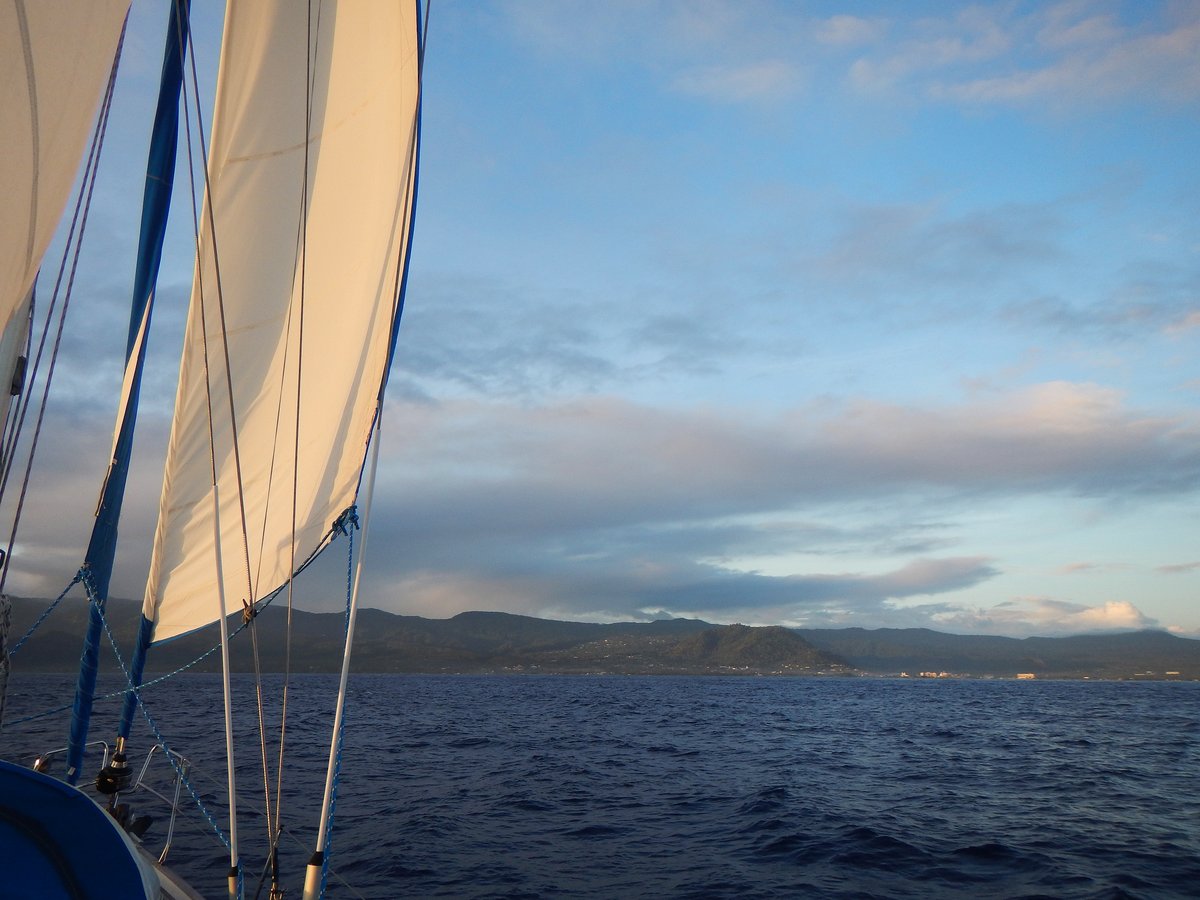
We had a pleasant, if slow, sail through the night, spotting the lights on the island around midnight. We continued sailing towards the main town of Apia and hove-to at three o'clock in the morning about three miles off the north shore of Samoa to wait for daylight.
We've crossed the International Date Line and lost a day of our lives, so instead of being Monday, it’s now Tuesday and this is only a six day week. The time zone has gone from UTC -11 to UTC +13, which means that instead of the UK being 11 hours ahead of us, it’s now 13 hours behind us. Well actually, the UK is 12 hours behind us because the UK has Daylight Savings Time and Samoa doesn't (I think). Confused? So are we.
10 September 2014 Penrhyn to Apia, Samoa (Day 8)
Glenys woke me up at seven o'clock and we tidied up the boat including stowing the spinnaker pole. I called up the Port Control and they gave us clearance to enter the harbour. We dropped anchor in Apia Harbour in 6 metres of water at eight o'clock. We anchored close to our friends Glen and Erie on “Sundance” and they gave us a little bit of local knowledge, mostly about the tedious clearing in process, which has taken some boats 2 or 3 days.
We weren't allowed to leave the boat until cleared in, so I called Port Control and told them that we were ready to start the clearance process. The first problem was that the Health Department didn't open until nine o'clock. I called again at quarter past nine and was told to go into the marina in our dinghy to pick up the officials - against the quarantine rules.
The marina is run by the Port Authority and there’s no office on site, just a security guard at the gate. He was a nice enough guy, but only spoke a little English, so it was a difficult to communicate. Eventually, I gathered that the Health officials had been called and I was to wait until they arrived. When? Shrug of shoulders.
To pass the time, I had wander along the single dock in the marina. There were only six cruising boats, but I knew four of them, so I chatted a while to find out more information about the place. After an hour, the Health officials turned up and I took them out to Alba in our dinghy. Samoans are not known for their svelte figures, so I found it amusing that the two large figures were balanced precariously on the side of our small dinghy looking very, very worried.
The formalities took 5 minutes - filling in two forms. They didn't go down below or inspect anything, so I don’t know why they bothered to come out. Anyway, they were very friendly and once again terrified when they had to get back in our dinghy.
Once ashore, the next step was to call the Port Control again on the radio and ask for the customs to come out. By this time, I realised that this was all very chaotic and I would be waiting about all day for officials, so I decided to go to the port office and clarify the procedure.
On the way, I noticed the customs office, so I went to ask them about the process. The customs officer initially told me off (in a nice way) for leaving the boat, but then gave me some forms and cleared me in - result! The customs officer then told me that the Quarantine office was right next door, so I wandered in there and asked about clearance.
Again, I was mildly reprimanded about being off the boat, but I just explained that I was confused and the Customs had told me to go there. I could see a group of officers hanging about chatting in the back of the office and, after a bit of light banter, one of them had obviously lost a bet because he came over and accompanied me back to the marina.
As we were walking along the road, the officer told me that I had broken the regulations and that I would have to be penalised. I shrugged and said okay. He then said that, as it was lunchtime, my penalty was to provide him with lunch. Amused, I told him that was no problem. However, we didn't have any fresh food left on-board, but my wife should be able to scrape something together out of a tin. He then switched tack and said that maybe I could buy him lunch ashore. I truthfully told him that I didn't have a single Tala on me and couldn't get any until I was cleared in, at which point he gave up.
At the marina, he asked me to point out my dinghy. Having seen the small size of it and after considering his large 18 stone frame, he announced that, as a favour to me, he would do the clearance in the marina security shed. Five minutes later, I was all sorted out. Now all I had to do was to get immigration. I walked back to the Port Office, but Clare, the lady who handles yachts was at lunch.
I went back to Alba and grabbed a bite to eat, while trying to call the Port Control on the VHF, who was obviously at lunch as well. Eventually, Port Control came back and told me to go ashore immediately, to pick up the Immigration, but when I got there nobody knew anything. After waiting another 30 minutes, I decided to go back to the Port office, where I met Clare. She was extremely, helpful, rang the Immigration and then told me I would be better off going into town to the Immigration Office and I should ask for a lady called Naomi.
After going back to the boat to collect Glenys, we walked the mile into town and found the Immigration office. The reception area was crowded with locals sat patiently waiting and a huge crowd jostling for position at the enquiry counter behind which stood a harassed gentleman. I took one look at the scene and realised that we could be in there for hours. I then remembered that someone in the marina had told me that there was a back door into the Immigration office.
We wandered around the building, climber some steps and found a door with a big sign saying “Staff Only. No Unauthorised Persons.” I tried the door and it opened with a loud screech. We stepped inside and an immigration officer came over to see what we were doing. I explained that Clare from the Port Office had told us to come here to see Naomi.
At my name dropping, he gave us a couple of seats at a desk and went off to find Naomi.
Naomi arrived a minute later and looked surprised because she obviously didn't recognise us, but she soon recovered and showed us into a nice air-conditioned room, where we filled in a few forms and were finally cleared in. It took six hours, which isn't too bad considering that I lost two hours because of lunchtime.
After getting some Talas from a cash machine, we walked around town a little, but we were starting to feel very tired, so we gave up and went to buy some groceries. We only bought enough to last a couple of days and grabbed a taxi back to the marina, which only cost US$2.50 - taxis are cheap here.
Back on the boat, we cracked open a beer, had a steak and collapsed into bed.
11 September 2014 Apia, Samoa
After a lie-in, we did a few chores, dropped a big bag of international garbage for Quarantine to dispose of, took a form into Clare at Port Office and dropped off two huge bags of laundry. Having walked into town, we split up and I wandered aimlessly around the streets checking out the many small shops.
Apia is not much different to most small towns, but the thing immediately grabbed my attention was that many of the men were wearing Lava Lavas (sarongs) which is something that we haven’t seen yet. The standard business wear appears to be lava lava's made from plain grey or black material, while brightly patterned material is worn more casually - even the policemen wear dark blue lava lavas.
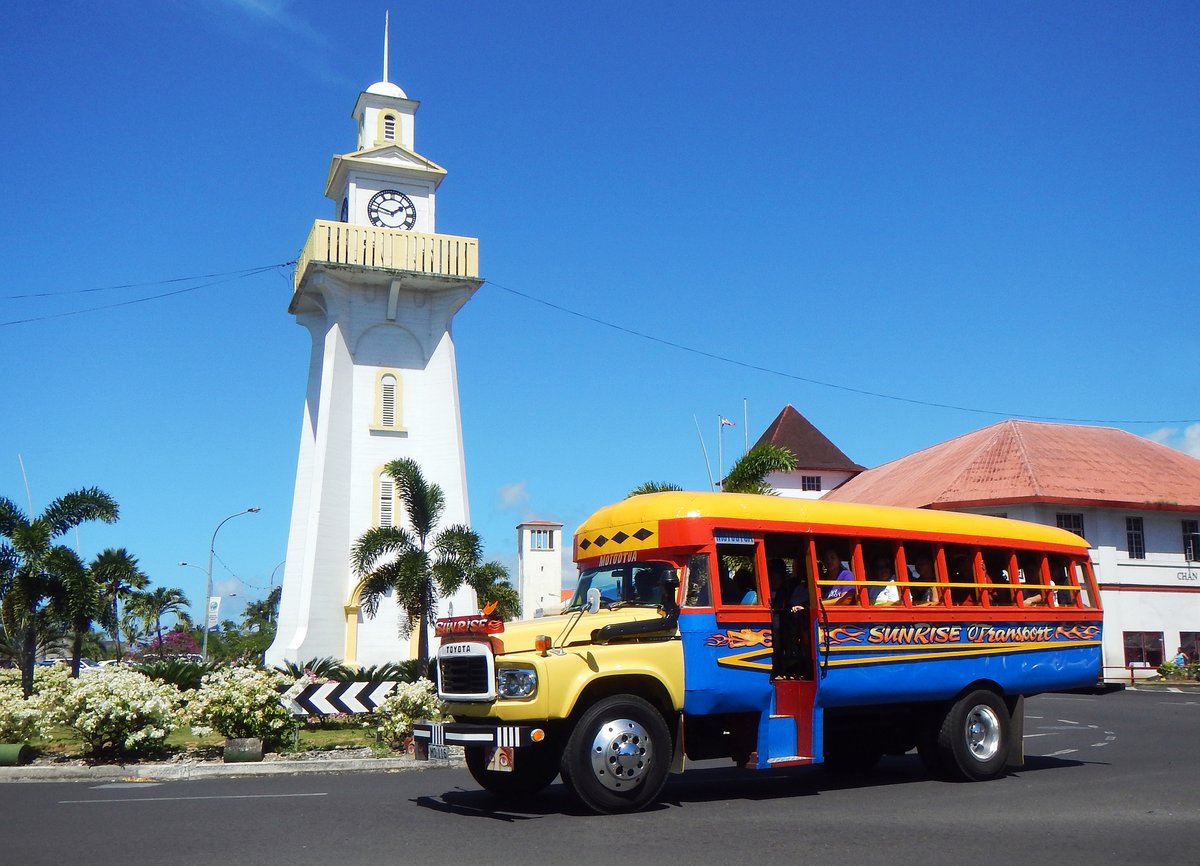
I met up with Glenys at lunch time at Fish Market and we had fish and chips there. They use Tuna instead of a white fish, which is a bit weird battered, but okay. The fish market and the artisan market are next to the main bus terminal, which was busy with people crowding onto the garishly painted buses.
Glenys went her own way, while I checked out some of the hardware stores and finally managed to buy some more cans of refrigerant, so I'm a happy bunny. I picked up the laundry on the way back and then chilled out for the rest of the afternoon finishing off a novel.
12 September 2014 Apia, Samoa
Glenys went into town to keep out of my way while I did some jobs. I first topped up the fridges again - the food fridge seems to only have a tiny leak, but the drinks fridge seems to be getting worse. I might be able to find the leak now…
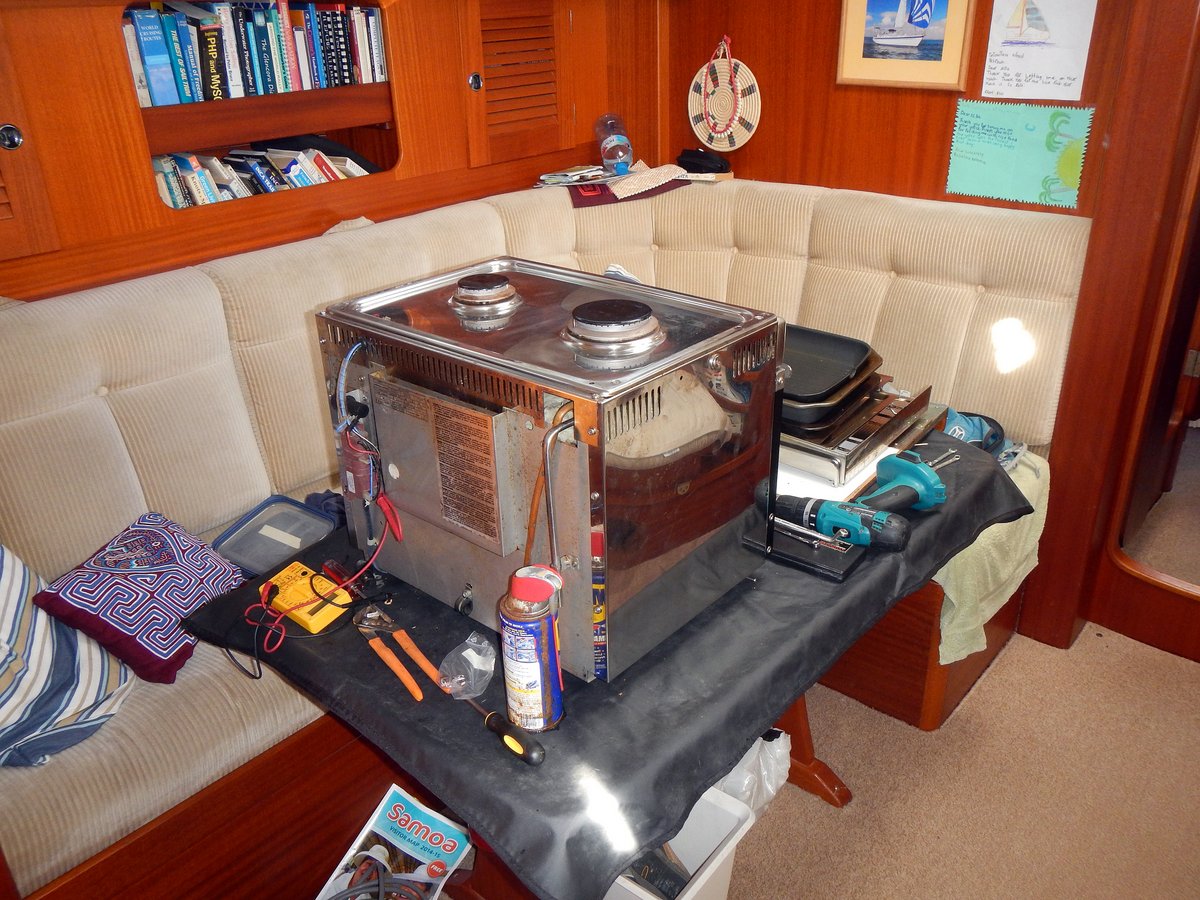
I then tackled the cooker gimbal. The cooker is supported by two stainless steel pins, so that it can swing while we are at sea. These are only 5mm diameter and one of them has sheared off. It’s another example of the poor design and manufacture of our expensive Eno cooker, which cost us $1200US three years ago.
I lifted the cooker out of its slot in the galley and took the side panel off. The gimbal pin is pressed into the sheet metal side panel and has a 16mm diameter retaining disk, so it wasn't a simple case of replacing just a pin. There’s only 8mm clearance at either side of the cooker, so I had to come up with some way of replicating the broken part.
Eventually, after a lot of head scratching, I designed a small stainless steel part which would allow me to drill out the old part and bolt the new part into the side panel. I made a technical drawing of the part and went ashore to see if I could find a machine shop. I first asked the taxi drivers if they knew the location of a machine shop and, after lots of offers to drive me around town (at a high cost of course), one of them pointed me to Samoa Ship Services only two hundred yards along the road.
The supervisor of the machine shop was very helpful, but they were set up with machines to make very large parts for commercial ships - their lathe was 20 foot long. He’s told me to go to the Polytechnic and ask for Fonoia, who apparently is the only person in town with a small lathe and the skill to make my part - that will be my mission on Monday.
Back on board, I ground off the old gymbal pin and carefully drilled a 5mm hole in the side panel. I then drilled through the old retaining disk and inserted a 5mm bolt, grinding the head flush with the retaining disk. After bolting it to the side panel and reassembling the cooker, I should now be able to drop the cooker back in place, but that’s a job for tomorrow.
In the evening, we went out for an Indian curry at a restaurant just up the road from the vegetable market opposite the Gardener Joe supermarket. It was tasty, spicy and hot - our first curry for over a year and we might be going back.
13 September 2014 Apia, Samoa
I put the cooker back together and sorted out the electric ignition which hasn’t worked for two year. I dropped the cooker into place on the gimbal and my little bodge job looks good, so I won't bother to get the part made here and have added it to my list of jobsfor New Zealand, which is getting very large now.
In the afternoon, I went ashore and paid an outrageous $12 US to have 2 hours of internet access. Glenys wandered into town - she is maxing out on shopping after six weeks abstinence. She took her Pipi pearls into a jeweller to get them mounted on earring studs and had a gold clasp mounted on a nice Pupu that I’d polished back in Penrhyn. She came back with a whole more groceries, re-stocking her cupboards.
In the evening, we went to happy hour and met Fabio and Lisa from “Amandla”; Thomas and Annette from "Anke Sophie" and Sandy from “Westward”. There are only about eight cruising boats in the whole country and we’re gradually getting to know them all.
14 September 2014 Apia, Samoa
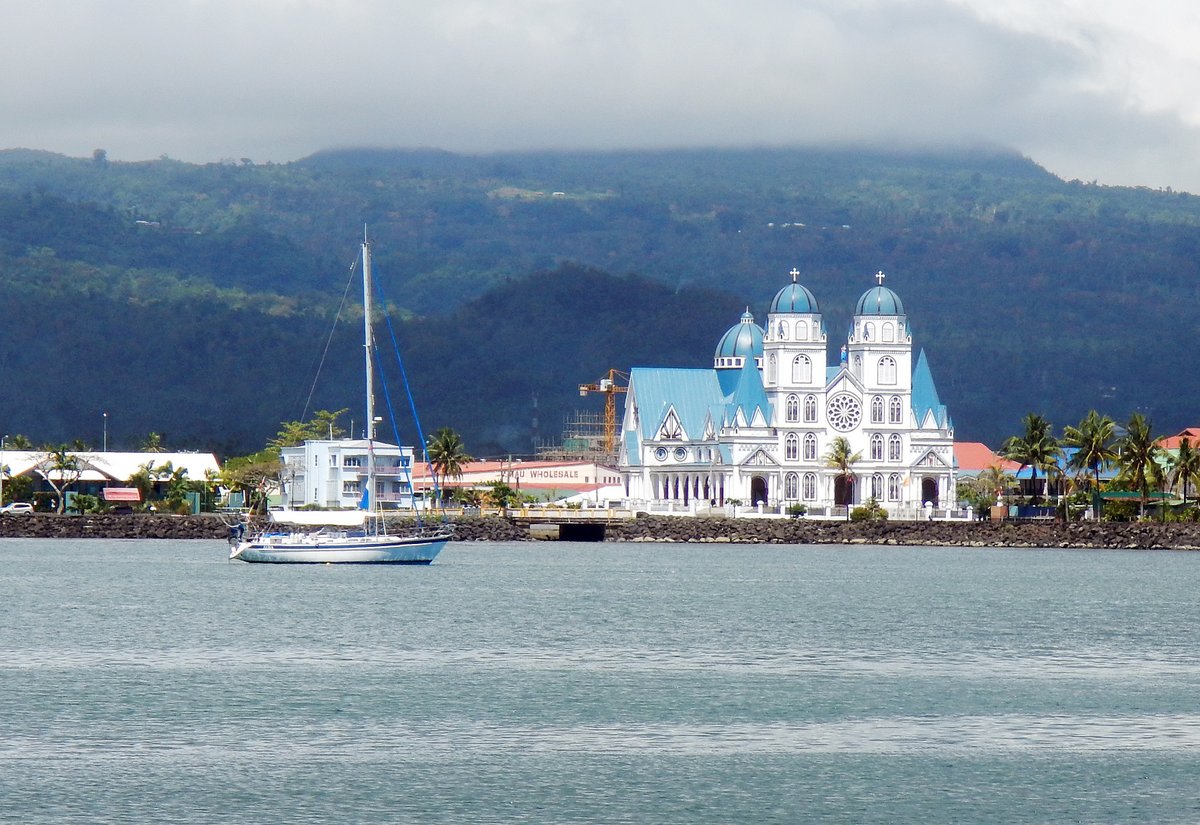
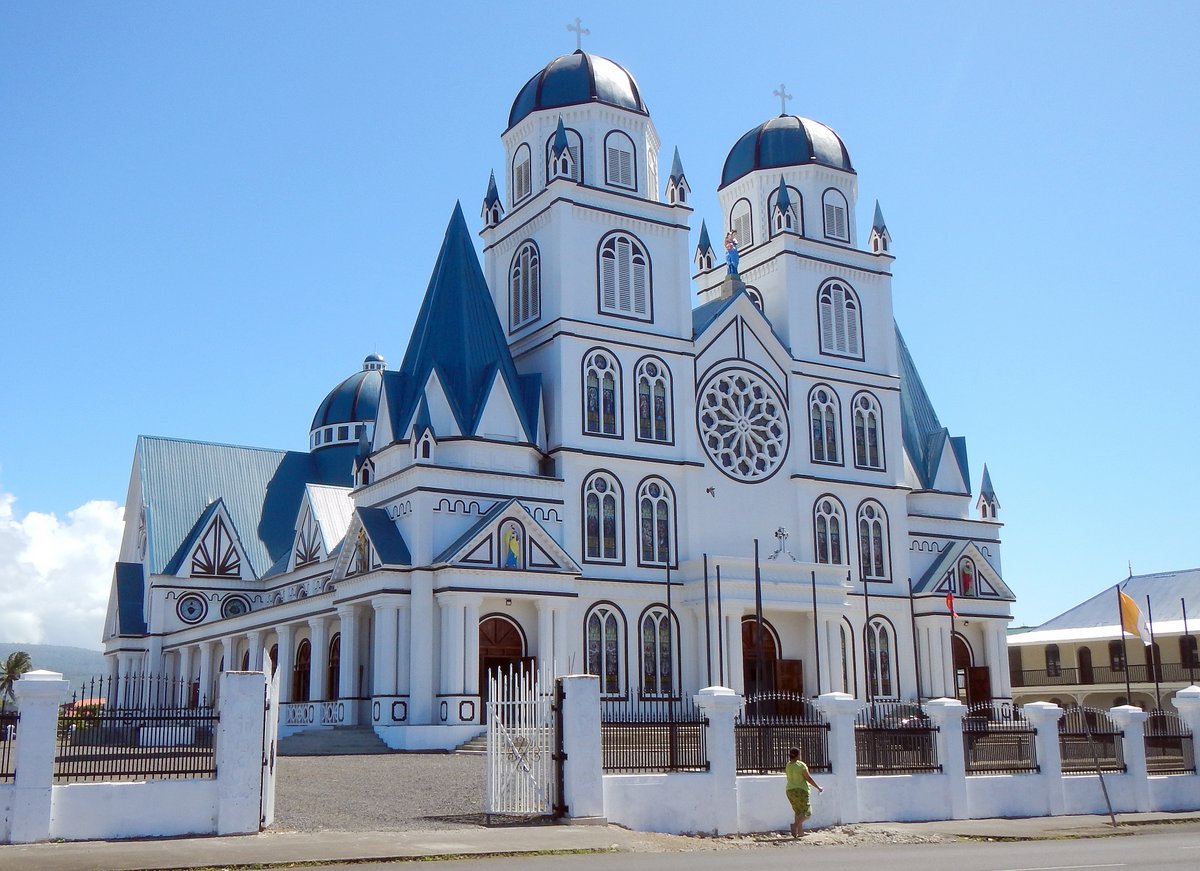
Being a Sunday, we went to church to check out the Samoan singing. We chose the very impressive Catholic church, which dominates the sea front overlooking the harbour. The tourist office told us that the service started at nine o'clock, but the church was packed and in the middle of a service when we got there at twenty minutes to nine.
It was very disappointing. The service was a typical Catholic high mass, with lots of ritual chanting interspersed with grandiose organ playing (Da da da DAAA!) The singing was ritualistic with a very European sound - no Polynesian close harmonies here. Thankfully, the service ended at nine o'clock, so we only had to endure twenty minutes.
Back on the boat, we spent the morning reading. We've been in Samoa for four days so far and haven’t seen very much of the country, so we did some planning. Glenys read up on the touristy things to see around Samoa, while I read up on the few anchorages in Samoa.
There are two islands that make up the independent country of Samoa - Upolu, the island that we’re currently on and the slightly larger Savai’i to the west. Both of the islands are about 40 miles long, but there are only 3 or 4 places to anchor. There’s a nice looking anchorage on the far western end of Savai’i, but it would put us 60 miles further west of here and would make our passage to the north islands of Tonga much harder. It’s 180 miles to Niuatoputapu, and 20 degrees will make all the difference, so we don't think that we'll bother to go to any other anchorages.
In the evening, we had Paul and Helen from “Tai Mo Shan” over for a beer or two. They’re from New Zealand, so we picked their brains about the best places to visit when we get there.
15 September 2014 Apia, Samoa
We were up early and went out to sea to run our water maker because the water in the harbour is very murky and would clog up our water maker filters. It wasn't the best day to go out because we had a miserable three hours hanging around in rain squalls with winds gusting up to 25 knots at times. However, we did manage to fill our tanks to the brim, which will keep us going for another week or so.
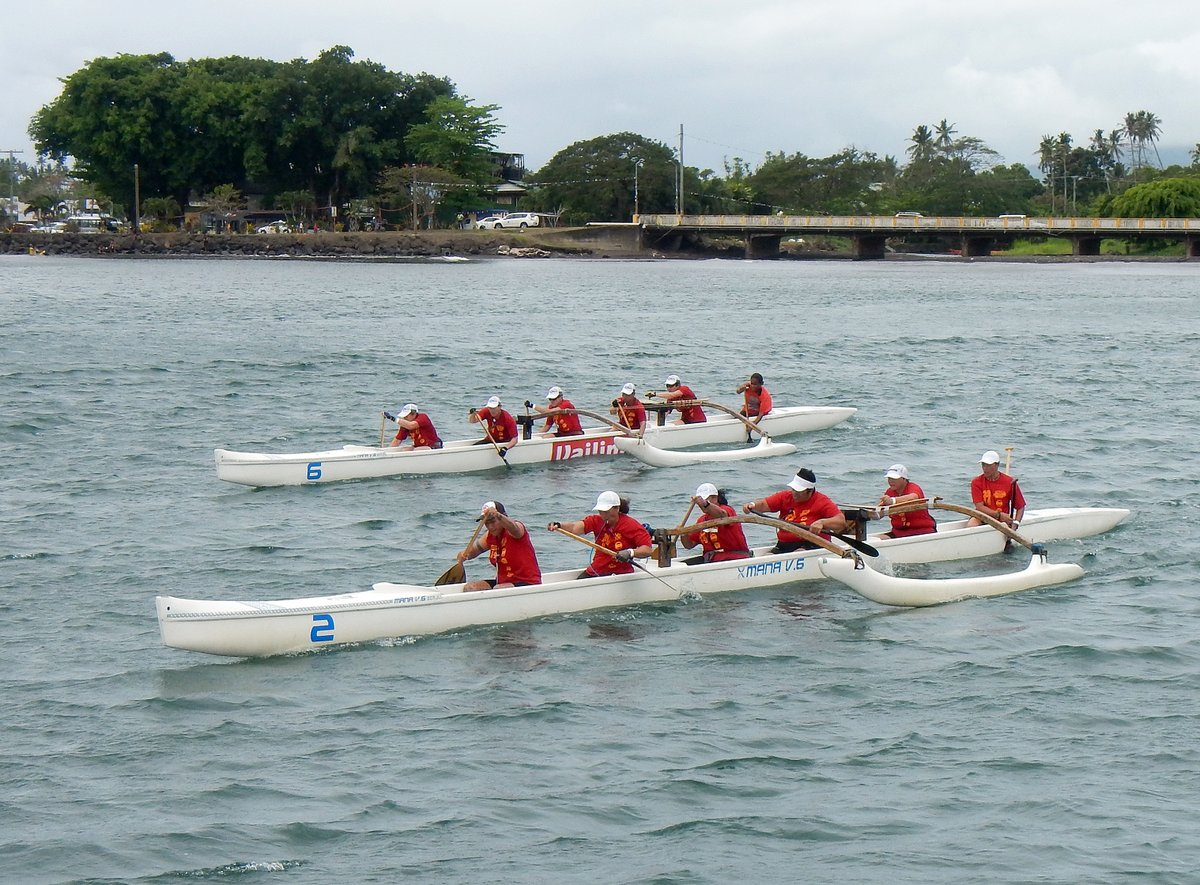
Having anchored back in the same place, we watched an outrigger canoe race. There's a big competition going on this week and the first race was a ladies marathon. The outrigger canoes were 40 foot long with six paddlers participating in a 13 kilometres race. We had a prime view of them because they had to paddle around us just after the start.
Later in the afternoon, a Port Authority boat appeared and told everyone in the anchorage that they had to go into the marina because we were in the way of the outrigger races. Most of the other boats moved almost immediately, but we stayed out another night because the anchorage is nice and cool with a good breeze.
16 September 2014 Apia, Samoa
We had another early start to the day; I jumped in dinghy and went to have a look at the marina. The Apia marina is run by the Port Authority and unlike a commercial marina, there are no staff to take lines or allocate berths, so I took my portable depth meter with me and checked out the remaining berths myself. There was no problem, I measured 5 metres on the approaches and nearly 2.8 metres at low tide in the berth.
It was very painless getting into the berth with a couple of the cruisers giving us a hand to take lines. Once we were settled, we walked along the sea front and booked a hire car for tomorrow. We were planning to go to the cultural centre for their bi-weekly exhibition of Samoan crafts, but it started to rain heavily, so we gave up and retreated back to boat.
I walked to a bar and did some more internet in the afternoon, transferring money around to pay for our expensive flights back to UK. I also checked the weather forecast and it looks like there's a brief lull in the strong south east trade winds over the weekend, so we're planning to leave for Tonga on Saturday 20th. In the evening, we went to a bar for happy hour with some of the other cruisers and then had fish & chips in a seafood restaurant just across the road - a very basic place, but the food was great.
It was absolutely boiling in the marina all day and we hated it. Most people think that it would be nice to be in a posh marina, but we prefer to be out at anchor. Here's Why I’d Rather Stick Pins In My Eyes Than Stay In A Marina:
Marinas are often surrounded by buildings and are "protected" from the weather, so they tend to be airless places. In the tropics, this makes them extremely hot and the lack of wind means that we get no power from our wind generator.
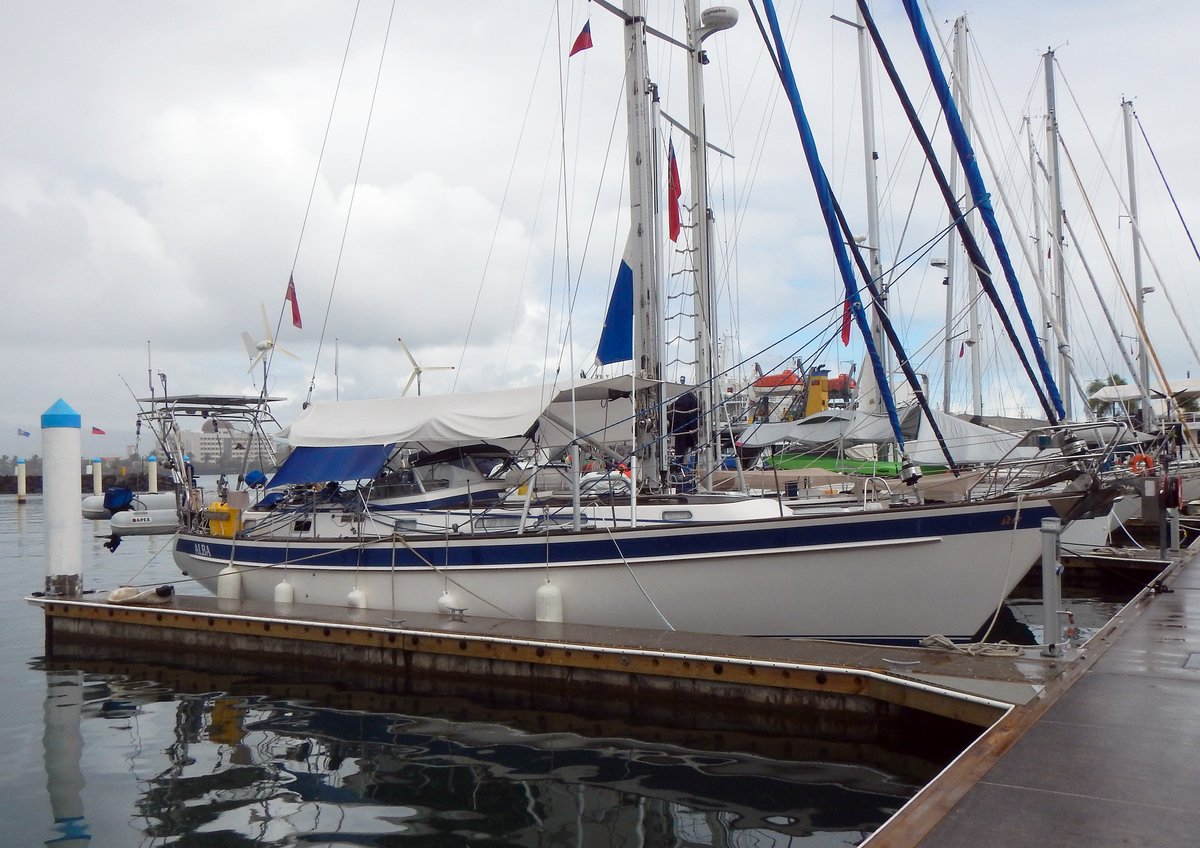
There are ALWAYS multiple bars in marinas, typically frequented by DINKS (Dual Income No Kids) who get very drunk and loud. Even worse is the night clubs that think that it's trendy to be around the rich boat owners (who’d actually like to go to sleep at nine o’clock.)
There’s always some swell and water movement in a marina, so the ropes squeak and the pontoons groan all night. There's nothing more irritating than trying to go to sleep with the constant jerk caused by our 12 ton boat snatching against its mooring lines.
Marinas are too close to land with cars constantly driving about and the noise from rowdy, pissed people pouring in and out of the bars is very intrusive. The constant presence of mosquitos means that we have to have mosquito nets covering our hatches, which further reduces the flow of air through the boat and makes it even hotter.
Having access to electricity is seen as a positive thing, but it’s expensive and probably the wrong voltage or frequency. I’ve spent thousands of pounds on solar panels and wind generator to be self-sufficient, so why pay for electricity?
About the only good thing is having access to a fresh water supply. It’s great to be able to wash clothes without worrying about how much is left in our water tanks. Unfortunately, most of the time it is metered (and expensive) and the rest of the time it's of dubious quality, so there’s no way that it’s going into our tanks.
For crying out loud, why the hell do all marinas have lights blazing away all night? It’s like the Twilight Zone - there’s a constant glow coming through the curtains. I wake in the middle of the night, sweating because of the lack of air and with a dry throat because of the heat and then can't get back to sleep because of the lights.
So we’re on a finger pontoon approximately 15 feet from the next boat. This is not conducive to having a nice, quiet meal in the cockpit (which is where you need to be because it’s so bloody hot below.) If you’re really unlucky, your neighbour is overly familiar and “chats” across the finger pontoon to you while you’re eating.
Oh, I nearly forgot, there are the showers. I don’t care how pretty the bloody showers are, why on earth would I walk 200 metres to the shower block with my towel and wash bag, then walk 200 metres back getting hot and sweaty, when I can have a lovely shower on board?
And, to top it all, you have to pay to be in this hell …
17 September 2014 Apia, Samoa
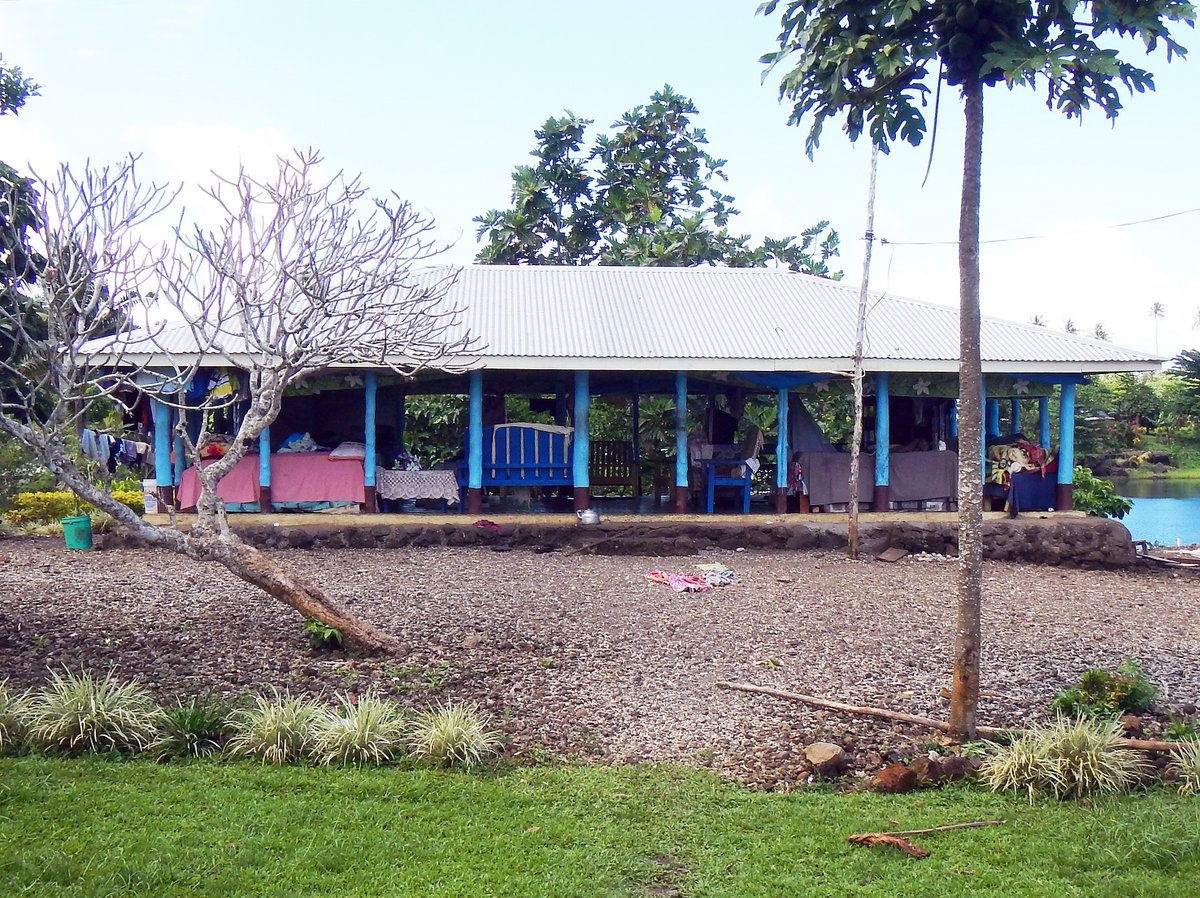
It was yet another early start. We picked up a hire car and went for a tour of the island. Apia is a small, built-up city, but it doesn't take long before you're out in the country, where the traditional open sided houses called fales start to appear.
Our first stop was at the Baha'i house of worship. This is the first time that I'd heard about this religion, which was formed by Baha'u'llah, an Iranian in 1844. He proclaimed himself to be the Messenger of God and his principal teachings stated that all religions are part of one religion. For his revelations, he was imprisoned for most of his life and died in a penal colony in Israel of all places.
There are only eight Baha'i houses of worship scattered around the world. There are no clergy and no ritualistic services, just individual prayer and meditation. It's an impressive building, with nine entrances reflecting that the faith is open to all people and religions. The grounds are serene and it was pleasant to walk around, but I realised that this religion wasn't for me when I discovered that the Baha'i faith calls for total abstinence from alcohol.
We stopped off at O Le Pupu Pue national park and drove three kilometres along a dirt track to go for a trek along the south coast. Despite living on a boat and seeing the sea every day, it was an interesting hour's walk along steep cliffs being pounded by the Pacific Ocean. The path goes through a Pandanus wood and ends up on a lava field that plunges into the ocean.
We also did a short hike to the Ma Tree. It was a hot, but pleasant walk through rainforest and a great contrast to the coastal path only 3 kilometres away. The Ma Tree is a large tree with strange roots that fan out from the tree like big blades. Some of them are over ten feet tall. While in the national park, we had a look at a waterfall, which was okay - I've seen too many waterfalls over the past few years.
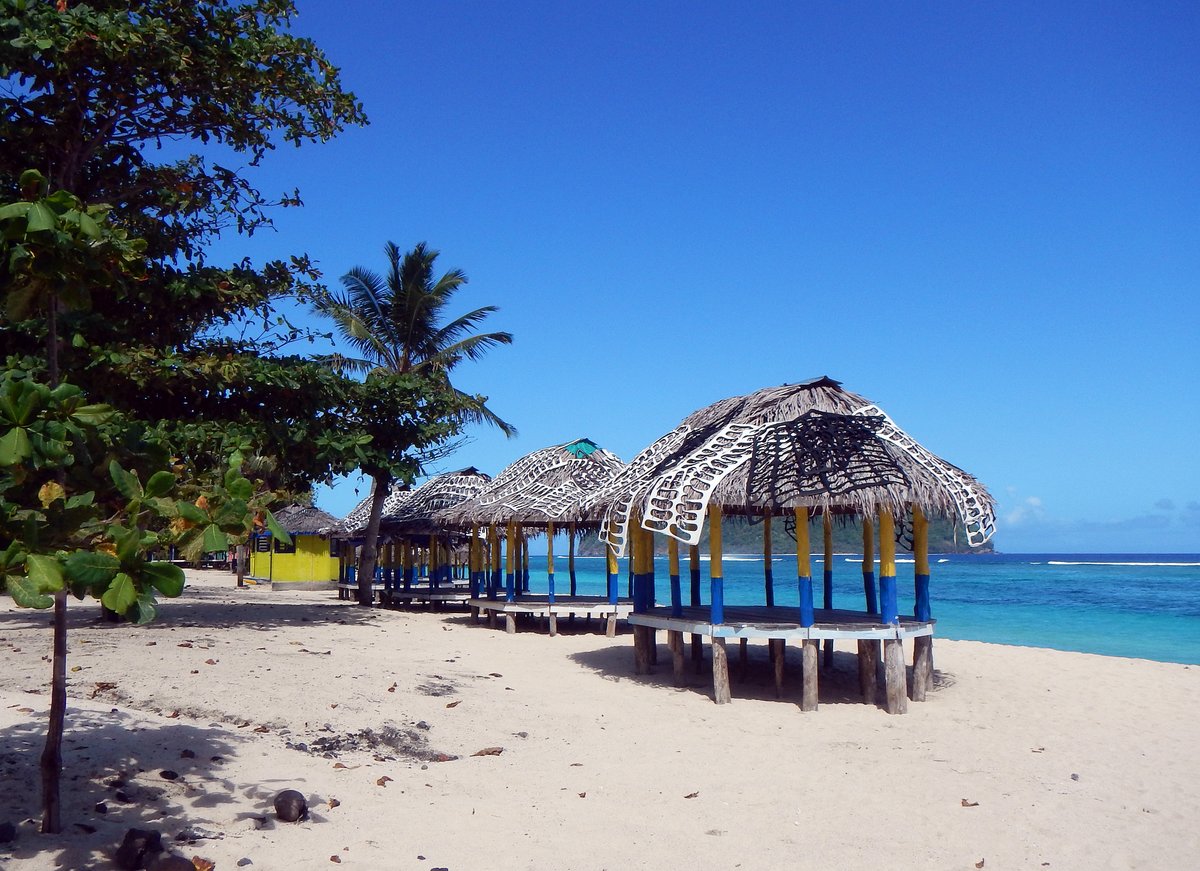
Having worked up an appetite, we drove along the south coast looking for a beach to stop for lunch. It wasn't easy because most of the beaches seem to be enclosed by small private resorts. We eventually found one, parked up and sat down on the white sand to eat our sandwiches, while staring at the rollers crashing on the reef.
Within a couple of minutes, a young guy came up, sat down beside me and started to chat. After a while, he demanded $15US each for us to use his village's beach. We protested and he quickly backed down to $5US each because we weren't going swimming. We finished our sandwiches and, feeling hassled, walked to the car. The guy followed us, still demanding his money. I eventually gave him $2.50 US to get rid of him. Our first and only contact with villagers was unpleasant - we're just tourist dollars on legs.
We stopped off at the To Sua Ocean Trench, which are two huge flooded sink holes joined by a cave. It's a tourist trap with a $10 US entrance fee, but it was fun to climb down the 15 metre steep ladder and swim in the cool water.
It took us the rest of the afternoon to drive around the west end of the island passing through lots of villages and seeing some of the destruction caused by the 2009 Tsunami which wiped out entire villages and killed hundreds of people.
Staying in a Beach Fale is a big thing in Samoa and one of the beaches that we visited is listed as one of the top ten beach destinations in the world - I don’t think so… The Beach Fales are wooden platforms on the sand with thatched roofs and you get provided with a mattress. They're open to wind, rain and mosquitos - I don't see the attraction.
Back in Apia, we filled our three jerry cans with diesel and collapsed back onto our hot, sweaty boat.
18 September 2014 Apia, Samoa
In the morning, we went to the cultural centre, which is across the road from the huge catholic church. Twice a week, they put on an interesting display of Samoan crafts.
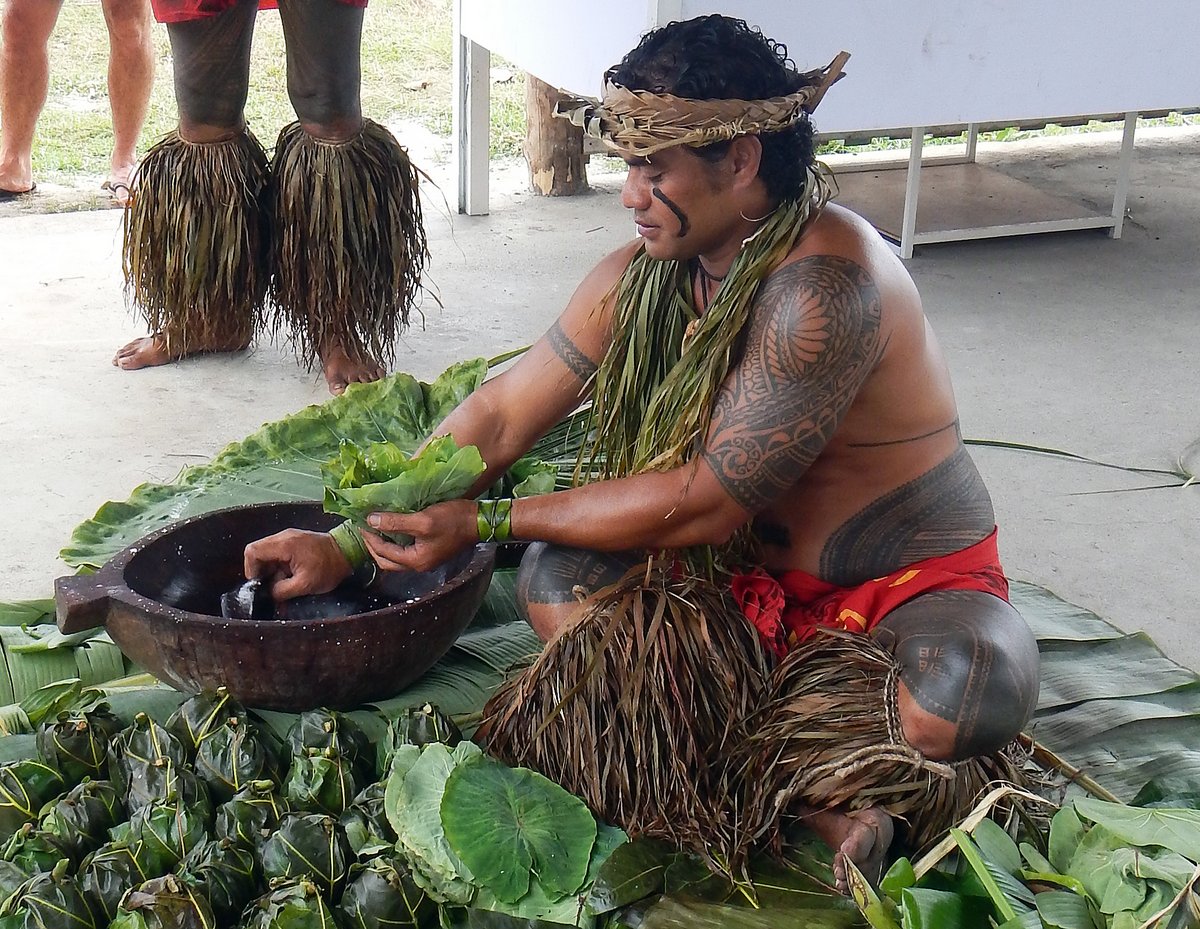
The presentation about cooking in a traditional Umu was interesting. The Samoans heat volcanic rocks in a fire until red hot and then spread them out on the ground. Food wrapped in coconut, taro and banana leaves is placed on the hot rocks and the whole thing is covered with green banana leaves. It typically takes half an hour for the food to be baked - they gave us samples of the food, which was tasty. I particularly liked the Palusami, which is Taro leaves cooked in coconut cream.
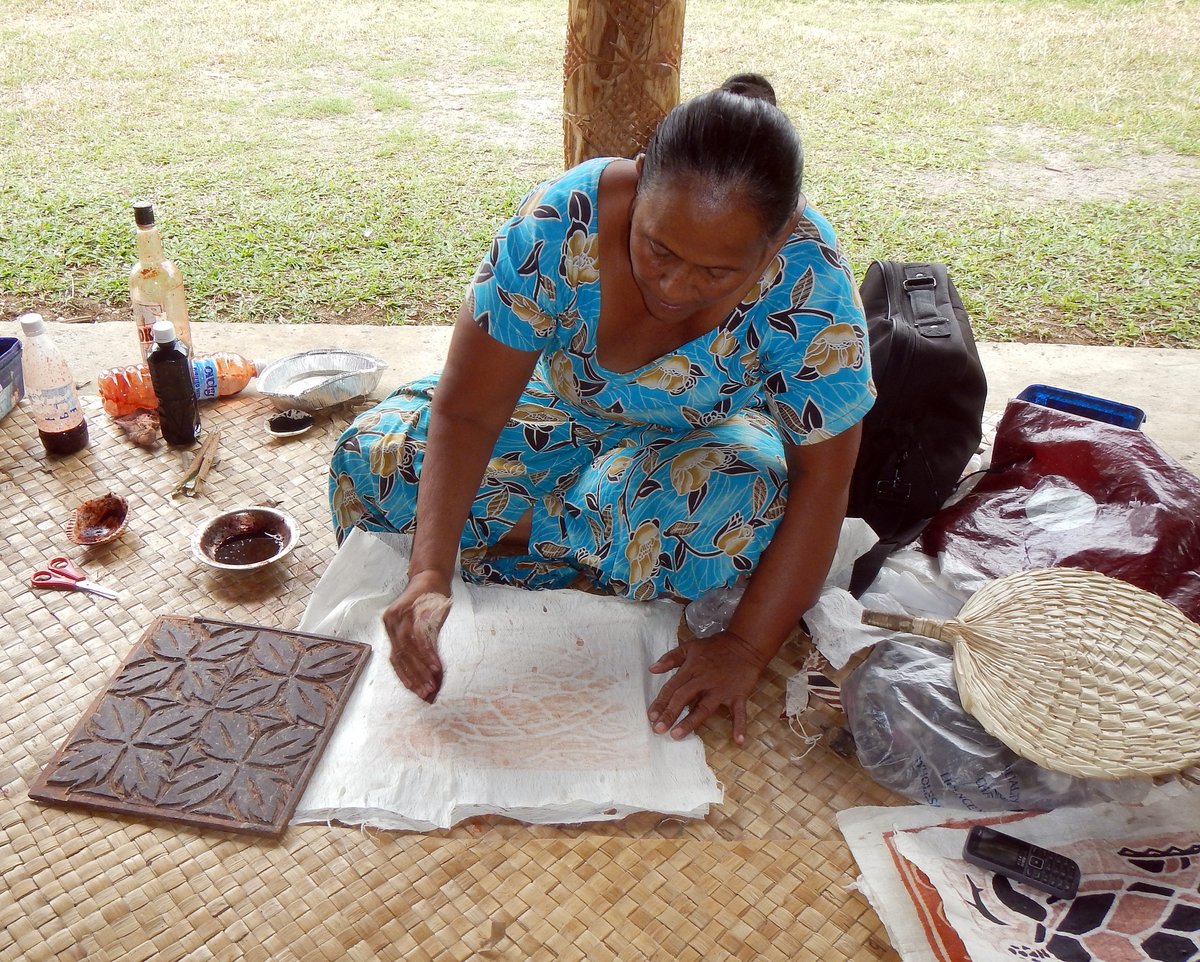
We watched a lady making Tapa cloth from the bark of a mulberry tree. She stripped the bark from a five foot long branch using a knife, then separated the inner part of the bark from the outer (which is discarded). The bark is then scraped with the serrated edge of shells using water to lubricate the bark. This process thins and spreads the bark out, going from three inches wide to six inches wide.
When the bark is thinned out, it's folded over into several thicknesses and is then pounded with heavy club to further spread it until it's over a foot wide and paper thin. It's then stretched out to dry slowly in a shaded, but breezy place. The lady then used semolina as a natural glue to stick several thicknesses together and natural dyes to print a pattern on it to produce the traditional tapa panels that can be seen all over Polynesia.
Another interesting display was traditional tattooing. The "full body" Samoan "Tatua" is a mental and physical challenge that is regarded as a Rite of Passage for young Samoan men. The tattoos are put on using tools with fearsome looking metal needles, hammered into the skin using a light stick-like mallet.
The designs are very dense taking eight, four hour sessions to do the full design and it looks to be an incredibly painful process. We were told that sometimes the person being tattooed is not strong enough (mentally or physically) and may have to have a couple of days rest between sessions. Once started, the Tatua has to be finished because an unfinished tattoo will bring great shame and loss of status to the young man and his family.
It was incredibly hot in the afternoon in the marina. By three o’clock, it looked like they had finished the canoe races, so I wandered down to see the organisers. Yes, they’d finished. I nearly skipped with joy on the way back. Fifteen minutes later, we’d obtained clearance from the Port Control and motored out to the anchorage. There was a nice strong breeze, so the boat soon cooled down.
Our plan is to leave at midnight tomorrow, so we tidied up a bit. Glenys rustled up dinner and we sat down below watching a movie - lovely!
19 September 2014 Apia to Nuiatoputapu, Tonga (Day 1)
We had a great night with a pleasant breeze coming through the hatches and the gentle rolling of the boat rocking us to sleep.
After an early breakfast, we walked along the sea front to the police station ready to watch the daily police brass band parade, which we'd heard at 0845 every weekday since we arrived. By 0900, it was obvious that for some unknown reason, they didn't have it today - bummer!
We continued into town and went to the Immigration office to clear out, which was very quick and easy. On the way back to the Port Office, we stopped off at McDonalds for our second breakfast - the lure of an Egg McMuffin was just too great. At the Port Office, we paid our harbour dues of $100US and managed to persuade Clare that we shouldn't pay for our two hated nights in the marina. Customs gave us our final clearance papers for a small fee of $15US and we were all done by half past ten.
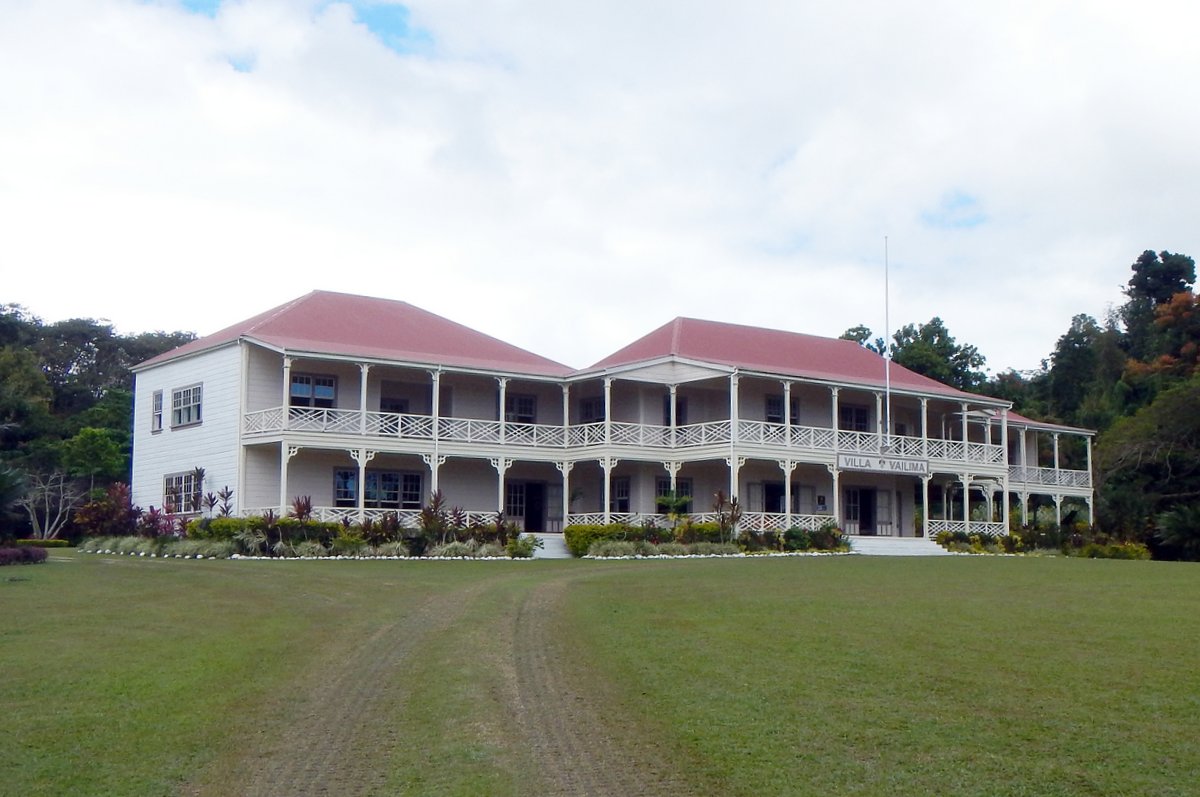
Having time to spare, we took a cab up to the Robert Louis Stevenson museum. It's a very grand colonial house that the author bought in the late 1800s after he made his fortune with Treasure Island, Kidnapped and Dr Jeckel and Mr Hyde. He had tuberculosis and retired to Samoa for the warmer climate.
A lovely lady gave us a guided tour of the house and was very good at explaining the Robert Louis Stevenson’s life in Samoa and how he got involved in helping the Samoan people through times of civil war. He was known as Tusitala which means storyteller in Samoan and was greatly respected and given a huge funeral when he died at an early age. We walked up a path from his house to his grave at the top of a hill - the path was built by Samoan chiefs as a sign of respect for Tusitala.
We bummed a lift back to town and went to the supermarket to do our final shopping before sailing to Nuiatoputapu, where we believe that there are no shops at all. Having spent the last of our talas, we retired to the boat and got ready for our 180 mile two-night sail. Dinner was early and we were in bed by seven o'clock.
The alarm went off at half past ten and we were on our way at eleven o'clock. It was pitch black with no moon and, to make things a little more interesting, a ferry was coming in as we were exiting along the leading line through the reefs. Using our AIS system, I was able to find out the name of the ship and called them up to declare our intentions and we agreed to pass starboard to starboard.
There was no wind in the lee of the island, so we motored for seven hours all the way around the north side of Upolu and through the straits between the two main islands. As we cleared the small island of Apolima, the south-east wind started to kick in and I could start sailing although it was very flukey.
20 September 2014 Apia to Nuiatoputapu, Tonga (Day 2)
By sunrise, we were sailing in clean winds and clear of all obstacles, so we settled down to a lovely day on a close reach with 6 foot seas, 15 knot winds and blue skies. We spent most of the day reading and catching up on sleep, with Glenys napping in the morning and me in the afternoon.
At four o'clock in the afternoon, we only had 80 miles to go and at 6.5 knots were going too fast, so we put two reefs in the main, rolled away the staysail and put four wraps in the genoa, which slowed us down to 5 knots.
Towards the end of my 7-10 watch, the wind picked up to 20-25 knots and veered by 20 degrees, so I rolled away some more genoa and, sure enough five minutes later, we had torrential rain, which lasted for 30 minutes as a big squall system passed over us. The rest of the night passed without incident with a nice 15-20 knot wind, 20 degrees forward of the beam.
21 September 2014 Apia to Nuiatoputapu, Tonga (Day 3)
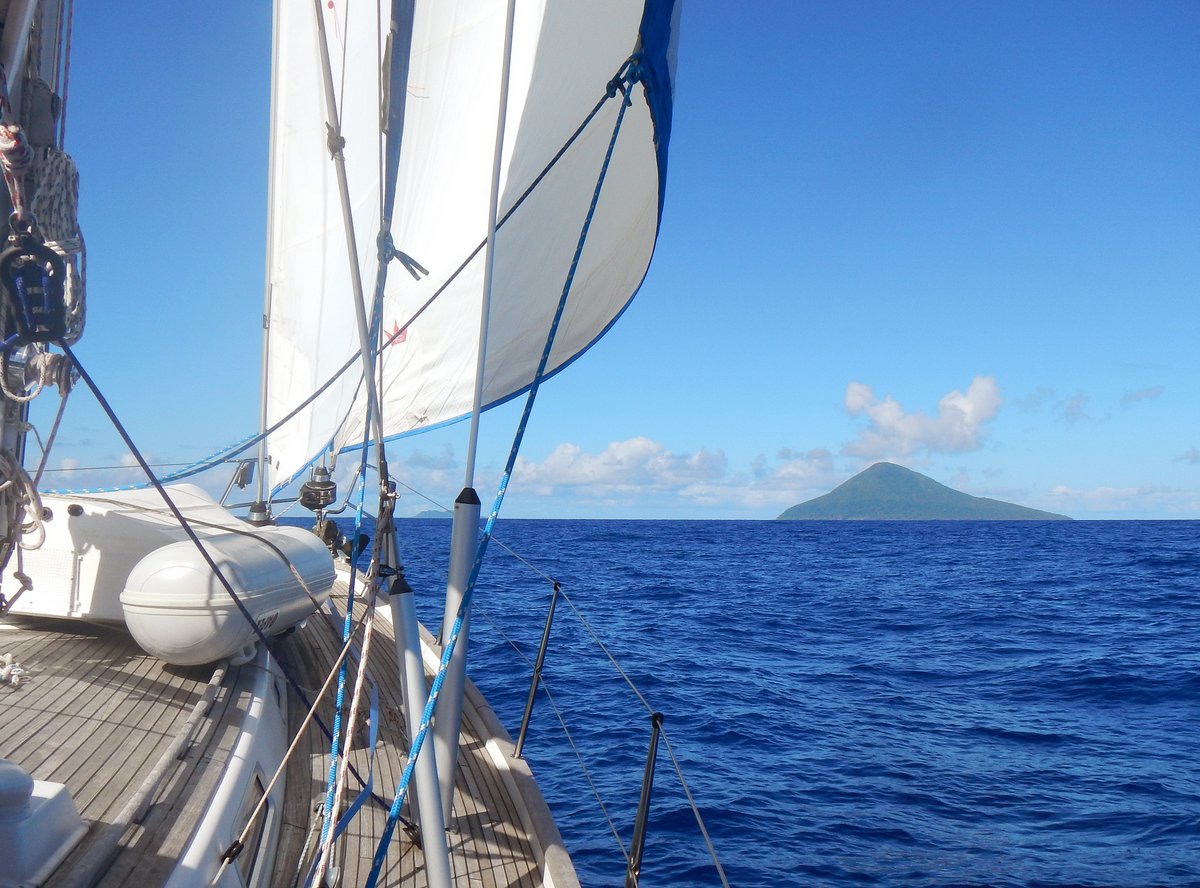
Around dawn, the wind dropped a little to 10-15 knots, so Glenys unfurled the genoa and main. At eight o’clock, we only had 18 miles to go and we could clearly see Nuiatoputapu and the impressive neighbouring island of Tafah which is a 600 metre high volcanic island that rises dramatically out of the ocean.
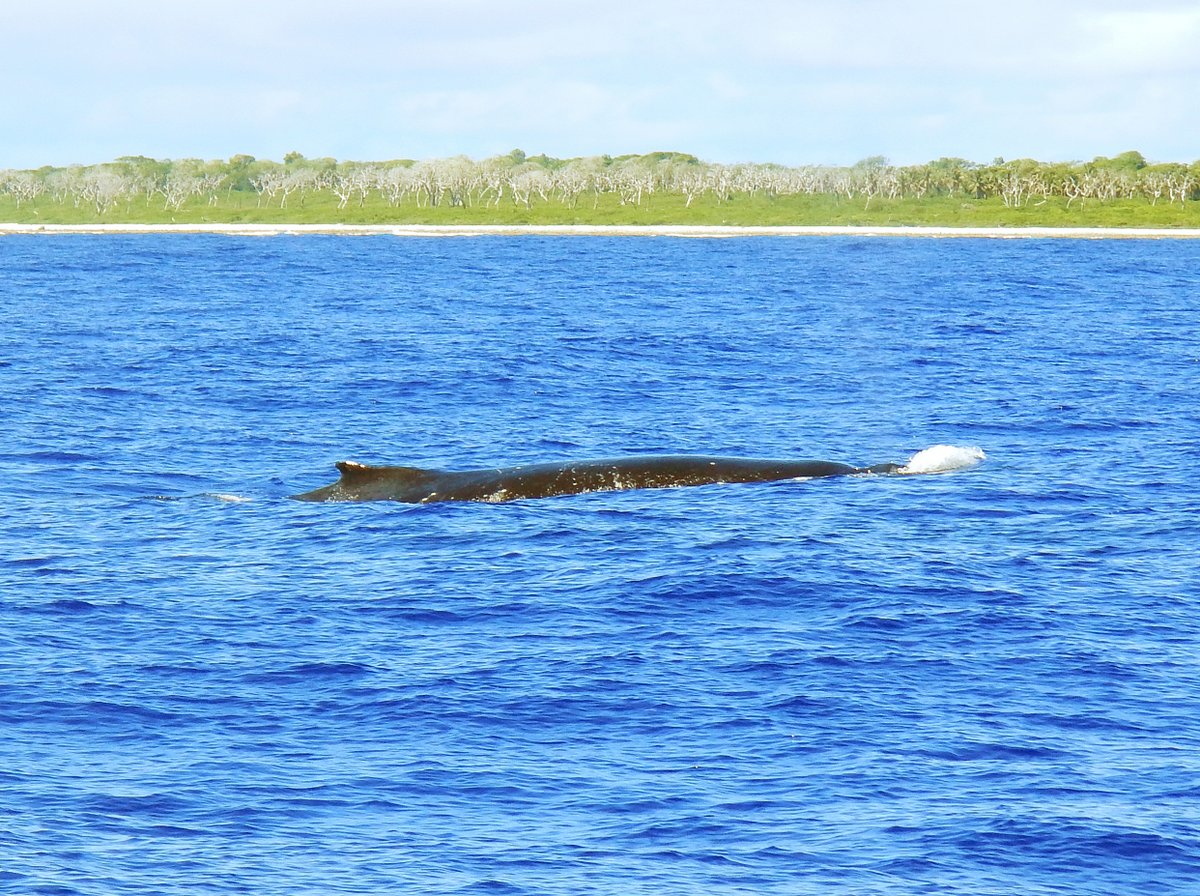
An hour later, the wind had dropped to 5-10 knots, so we turned on the engine and motor-sailed the rest of the way. When we were a few miles from the entrance, Glenys spotted a pod of HumpbackWhales surfacing just 25 metres on our port side. We immediately cut the engine and drifted along watching these huge creatures diving back down right next to our boat.
The pass into the Nuiatoputapu lagoon is narrow and shallow in spots, but thankfully we had good light to see the reefs. There were a set of leading beacons which were very accurate, although there seemed to be a shallow bar extending from the second starboard marker that we skirted around. Once through the pass we found good, deep water and some old decrepit markers on the edges of the reefs.
We anchored 50 metres off the village of Falehau in 10 metres on good holding sand. There were no other boats in the anchorage, which was a pleasant surprise. Within ten minutes, we were called on the radio by a lady called Sia, who told us that because it was a Sunday, we would have to stay on the boat and wait to be cleared in tomorrow. That was no problem - we spent the rest of the afternoon sleeping and reading.
22 September 2014 Nuiatoputapu, Tonga
Two ladies, one from Quarantine and the other from Customs & Immigration arrived mid-morning, so I collect them from the dock and brought them aboard. Just as I finished the paperwork, Lyall Ika, the Health officer arrived, so I brought him aboard as well. Once the formalities were completed, they stayed for fifteen minutes chatting - very friendly.
After lunch, we went for short walk around the local area. The island is 4 miles long by 2 miles wide with a ridge running north-east to south-west. Only 800 people live on the island in three villages - Falehau, Vaipoa and the capital Hihifo.
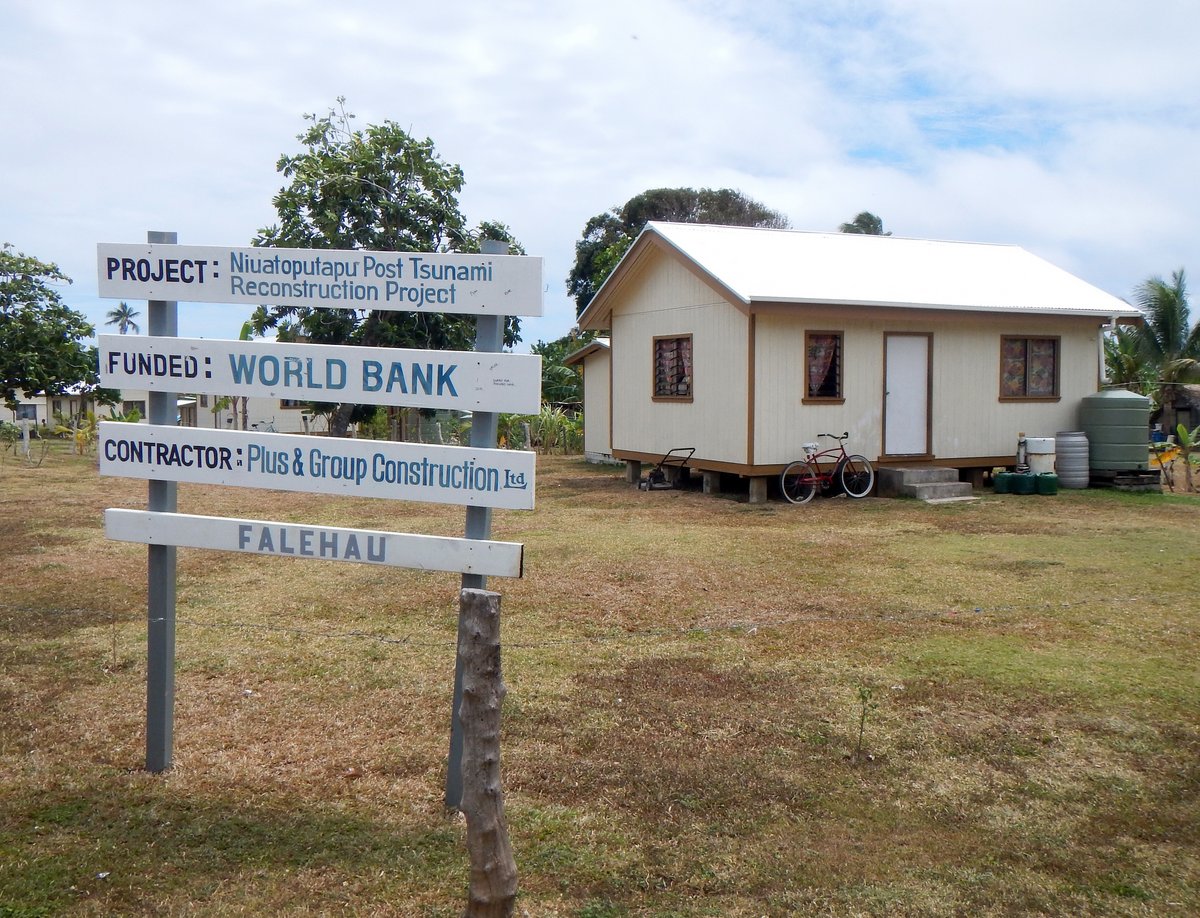
A Tsunami hit the island in 2009 which wiped out all the coastal villages including this one and everything has been rebuilt. Most of the houses are of a standard size and shape constructed from wooden panels - obviously a kit house provided by the government and aid from other countries. The villagers have all fenced off their small patches of land with barbed wire and chicken mesh, presumably to keep out the many pigs that are wandering around the place.
We found the Health Centre, which is a temporary hospital with only three tiny rooms for patients. We paid our $50US fee and then stayed chatting to Lyall who is training to be a doctor and, combined with the single practitioner nurse, comprises the whole medical team on the island. He says that most problems are related to diabetes and hypertension stemming from a poor diet. Interestingly pneumonia is also a problem here, which seems strange because the climate is so hot.
We went for a stroll through the upper Falehau village passing many Tsunami evacuation warning signs. The villagers speak little English, but kids learn it at school, so we had them practising their English on us. Most of the conversations went something like:
“What’s your name?”
“Glenys. What’s your name?”
“Joe”
“That’s a nice name.”
“Lolly, please…”
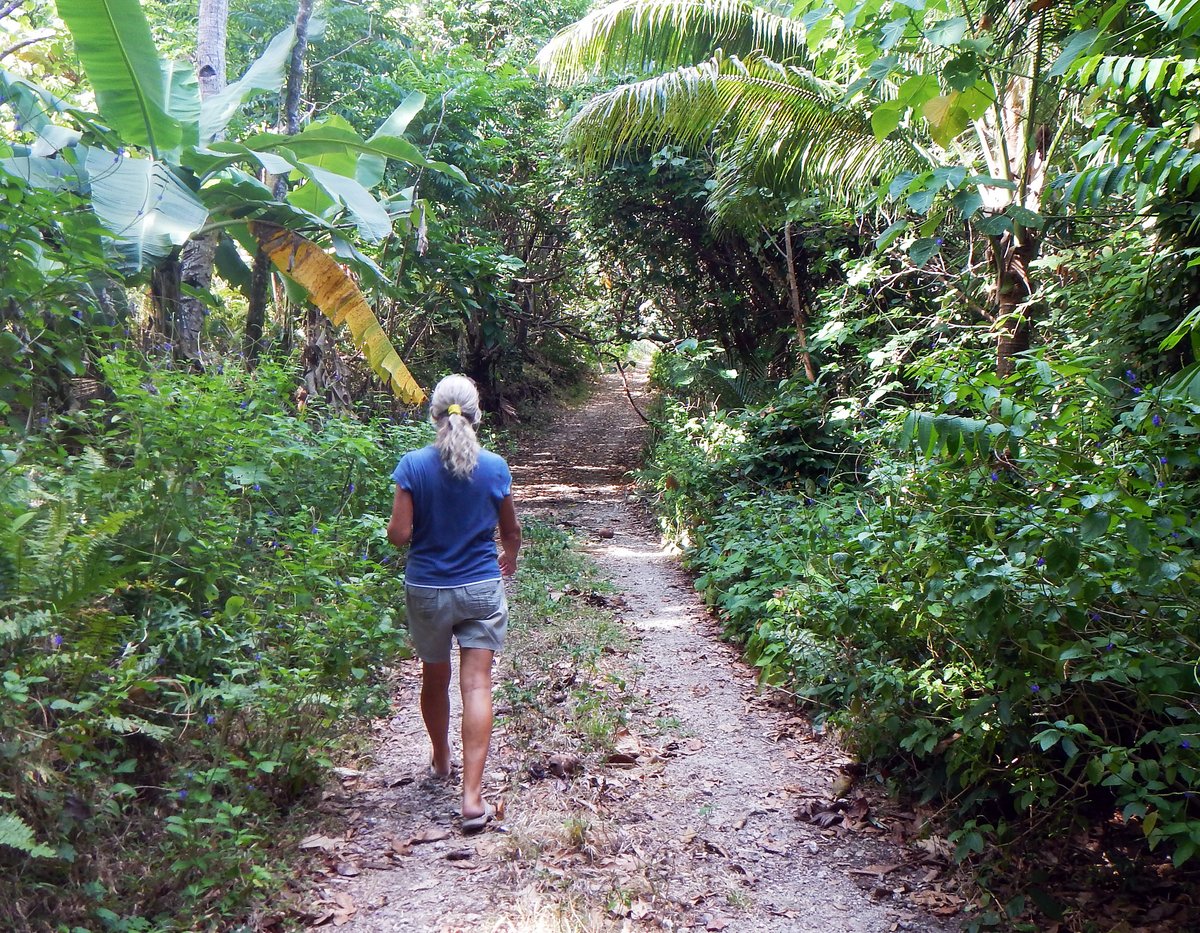
We walked through the village and along a dirt track on the south east side of the island, which goes past many small holding where the islanders are growing bananas, taro, breadfruit, papaya, mangoes and of course coconuts. It was a pleasant walk mostly in shade and followed the bottom of the ridge which splits the island in two.
Thomas and Annette on “Anke-Sophie” arrived in the anchorage later in the afternoon, so there are now two boats in the anchorage.
23 September 2014 Nuiatoputapu, Tonga
We walked started to walk along the hot road to Hihifo to pay the remaining clearance fees, but we didn't get very far before we were offered a lift in the back of a pickup truck for which we were grateful. The customs office and bank are in small porta-cabin type huts next to the high school and we’d soon paid our fees of $10US for Quarantine and $4 US for Customs (with no overtime, which was great.)
Hihifo is a sleepy, spread out village with one small grocery store, which doesn't have a lot of stock - we tried to buy a can of drink there, but they’d run out. However, we managed to find the bakery which is down a small path at the side of a community hall, over a rickety stile and into the garden of a small house. We were uncertain whether we were in the right place, so we shouted “Malo Lay Lay” (hello) and very friendly lady appeared and sold us two lovely warm loaves of bread.
We decided to circumnavigate the island and try to find the pleasant dirt track that we’d walked on yesterday, but we missed a turning somewhere and ended up having a long, hot walk along a road which had little shade and was quite a distance from the ridge.
After lunch, I went to run the water maker and the damn generator stopped running after 5 minutes. To my dismay, I found that the glass bowl on the bottom of the primary fuel filter had shattered. I obviously had no replacement and no chance of buying a replacement on this isolated island. After a lot of head scratching, I removed the broken filter assembly, rammed two 3/8 inch flexible fuel pipe onto the 1/4 inch copper fuel lines and fitted an in-line fuel filter, which is normally the secondary filter for the generator.
Fortunately, the copper fuel lines have flared ends so they seemed to be wide enough to fit inside the 3/8 inch pipe without leaking. The filter that I've used is much finer than the original one, but the whole thing seems to work, and I ran the generator & water-maker for an hour without any problems, so I'm a happy bunny.
We went to “Anke-Sophie” for dinner - they caught a tuna as they approached the island and wanted to share it with us.
24 September 2014 Nuiatoputapu, Tonga
We did some small jobs in the morning - the stitching on the leather cover on our steering wheel was perished and coming apart, so Glenys repaired a few sections. I sorted out the fresh water foot pump that has developed a crack and is slowly leaking our fresh water into the bilge. I had to bodge it with some epoxy and will replace the whole pump in New Zealand - another job for the Land of Plenty .
Later in the morning, we went out to the small island to the north-east of the anchorage and came across Nico (who is Sia’s husband) chopping wood to use for a fire to burn coral rocks down to lime. He tells us that they use it to soften the Pandanus mats that they make. During our chat, he said that he’d lost a lot of lures and wire recently, so I offered to give him some of my spare stuff.
We carried on around the island looking for shells and ended up out on the reef because the tide was out, where we met a couple of ladies gathering sea grapes (Limu), which is a kind of sea weed. They gave us a few to taste and, when we liked it, gave us a couple of handfuls to take back to the boat.
Back at the island, we came across Sia who had been sleeping under a tree with her daughter (also called Sia). We had a chat for a while and she told us how to best prepare the Sea Grapes - just remove the stems and mix with rich coconut cream. Sia said that she was keen to have a pot luck dinner with us and “Anke-Sophie”, so we asked her to call by later in the afternoon and we’d talk about it. We went for a snorkel but the water was murky and cold without wetsuits.
Back on Alba, we had lunch and then did a few more small jobs. Thomas came over and we compared notes on the weather forecasts - we’re both looking for east winds to go 170 miles down to Vava’u. It looks like there’s a bit of unsettled weather with strong south-east winds in a couple of days’ time, then some 15 knot east winds for two or three days before another low pressure ridge crosses the area. We either stay here for another week more or leave in three days’ time…
Sia and Niko turned up at about half past six, bringing along little Sia, who at 2.4 years old, is a little dynamo and was running around our small cockpit like a Tasmanian Devil. We chatted for a while and discovered that Niko spends at least six months away in Australia working on farms picking fruit. The islanders each have small plantations, which provide them with fruit and vegetables for personal use. The only export is Pandanus which doesn't make any one rich, so the islanders (like the Cook Islanders) go to New Zealand or Australia to earn money doing seasonal work.
We arranged to go for a hike with “Anke-Sophie” tomorrow on the ridge that runs along the island. Sia’s going to organise a teenager to guide us for $2.50US each person, which isn’t going to break the bank. We’re also invited to Sia’s house for a pot luck dinner tomorrow night - we've such a busy social calendar.
We ate the seaweed as a side dish to our dinner - it was okay, but nothing to rave about.
25 September 2014 Nuiatoputapu, Tonga
It rained overnight and the morning was very overcast and grey, but it was a good day to go hiking. We met up with “Anke-Sophie” and walked to Sia’s house, where we found Ika, our sixteen year old guide for the day. Another four of the village boys tagged along as well.
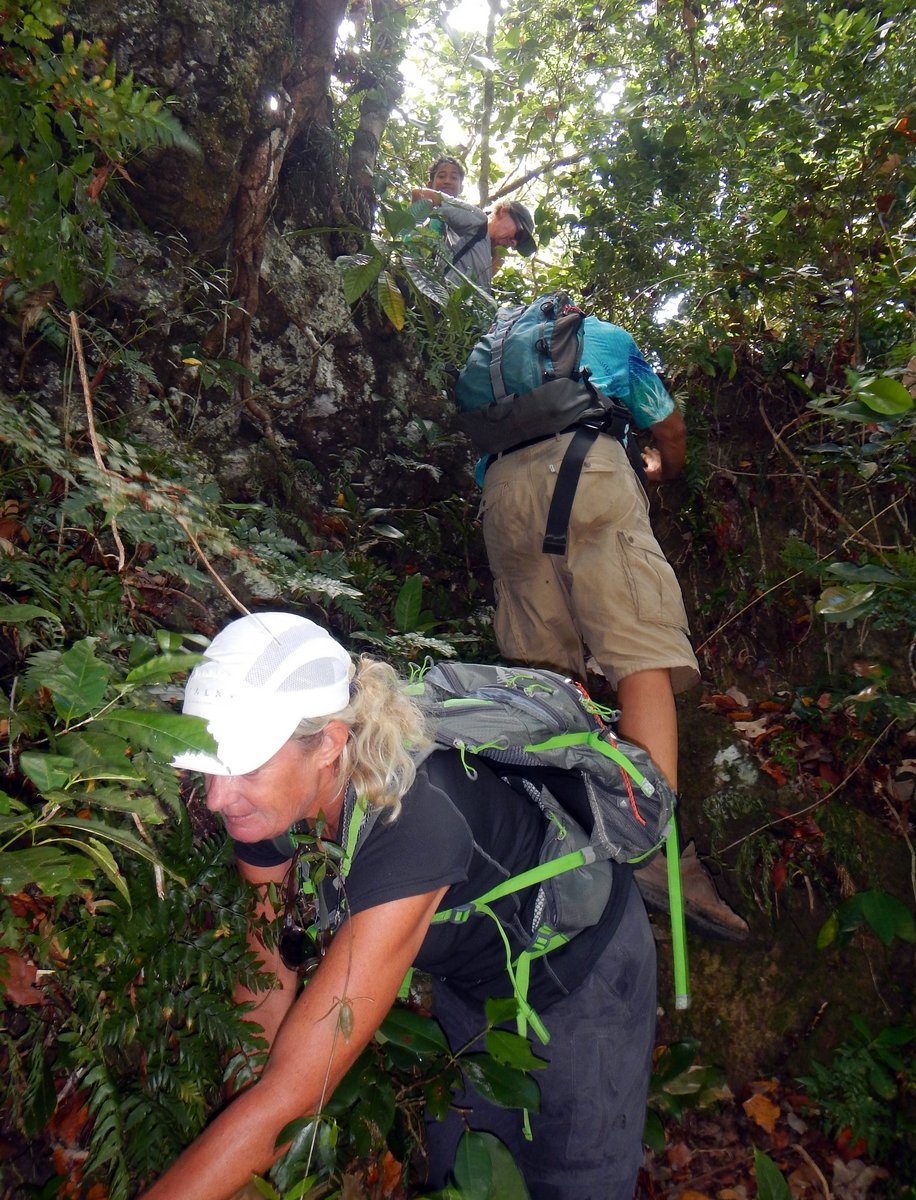
The start of the trail is past the medical centre and through the upper village. You pass a sign saying “Tsunami Safe Location”, then along a dirt track for 100 metres to an opening under a large mango tree on the right. The faint path goes along the edge of a barbed wire fence and then steeply straight up the side of the hill. It’s quite slippery and you have to use roots and trees to pull yourself up.
The top of the ridge is covered with trees for most of the way with the occasional clearing giving grate views of the island and surrounding reef. The terrain is varied with a few sections of steep scrambling using rock, roots and trees to get down or up. Our young guides were amusing in how concerned they were about our safety.
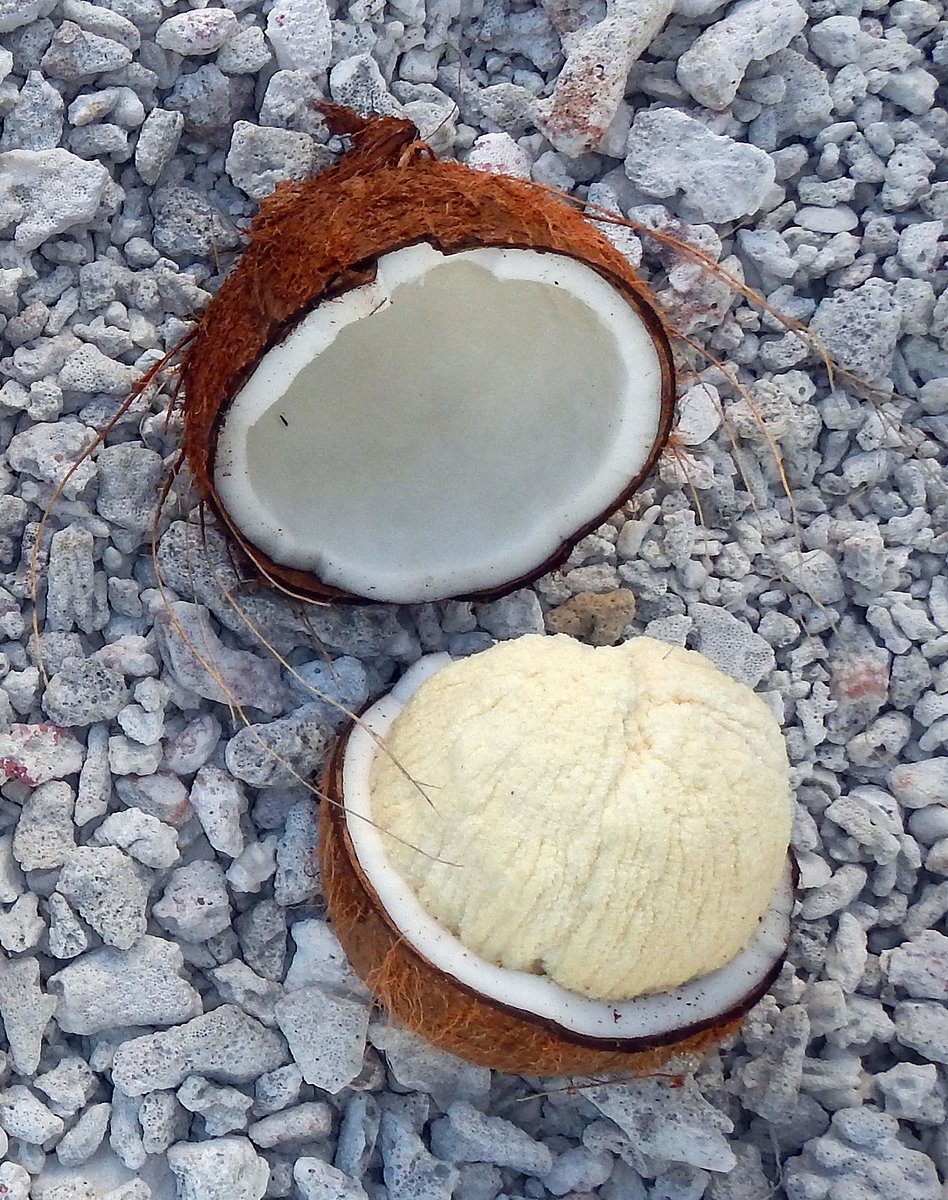
Ika picked up sprouting coconuts along the way and gave us all a snack of Uto. A little later he sent one of the young lads up a coconut tree to get some drinking coconuts. It’s amazing how fast these people can shin up a tall coconut tree.
We dropped down the south-east side of the ridge and through the upper village of Hihifo, down to the bakery, where we let our guides go. We called in at bakery, ordered two loaves for tomorrow and then got a lift back in possibly the roughest pickup truck that we have yet seen in our travels. The driver could only go at 20 miles per hour and there were countless holes in the floor, but the guy was very nice. He dropped us off at Falehau and then turned around and went back to wherever he was going before he picked us up.
It rained for most of the afternoon, but stopped long enough for Thomas and Annette to come over for a couple of drinks before we all went to Sia’s house for a pot luck. We found Sia in her kitchen, which is just a rough wooden table under a breadfruit tree at the side of her house. She invited us into her house where another rough wooden table was set out with food that she’d already prepared - a salt beef stew and taro cooked in coconut milk. “Anke-Sophie” had brought a pasta dish and Glenys had prepared a version of Cassoulet with pork, so there was plenty to eat.
We were invited to sit on rough wooden benches while Sia chatted and made a sweet dish from boiled papaya and selmolina which is powdered Manioc root. Her house is one of the standard wooden buildings that we’ve seen all over the island and consists of a 18 foot by 12 foot lounge with two small bed rooms leading off - very basic.
Sia told us that they lost everything in the Tsunami including their house and all of their possessions, so they’ve started from scratch with the assistance of charity organisations and foreign governments. There was no warning of the Tsunami other than the sea being sucked back before the wave hit. Fortunately, the tidal wave first hit the volcanic island of Tafah, which is only 4 miles away, and this took the full force of the wave and split it into two. The middle village of Vaipoa was relatively unaffected while Falehau and Hihifo were wiped out - scary stuff.
We had a very pleasant evening with Sia and Niko who despite being very poor were gracious hosts.
26 September 2014 Nuiatoputapu, Tonga
It was a miserable day with overcast skies, 20 knot winds and the occasional squall. The weather forecast looks to be good to sail the 175 miles to Vava’u on Sunday 28th, so we walked along the road to Hihifo to see the Customs to get clearance to sail to Vava’u island group. The customs lady was really nice and we soon had the clearance form in hand.
We strolled down to the bakers and picked up two loaves for us and two for “Anke-Sophie”, then hiked back via the back road. This time we took a road on the left about ½ kilometre past the road for the baker, which took us up to a dirt track along the bottom of the ridge. It was a lovely walk, mostly in the shade, passing through small plantations rich with taro, banana and papaya. The trail came out at the upper village of Falehau just where we started the hike up the ridge yesterday.
We called in and said hello to Sia, who showed us two big bundles of dried Pandanus that she asked us to take to Vava’u for her. We said that we’d pick them up tomorrow.
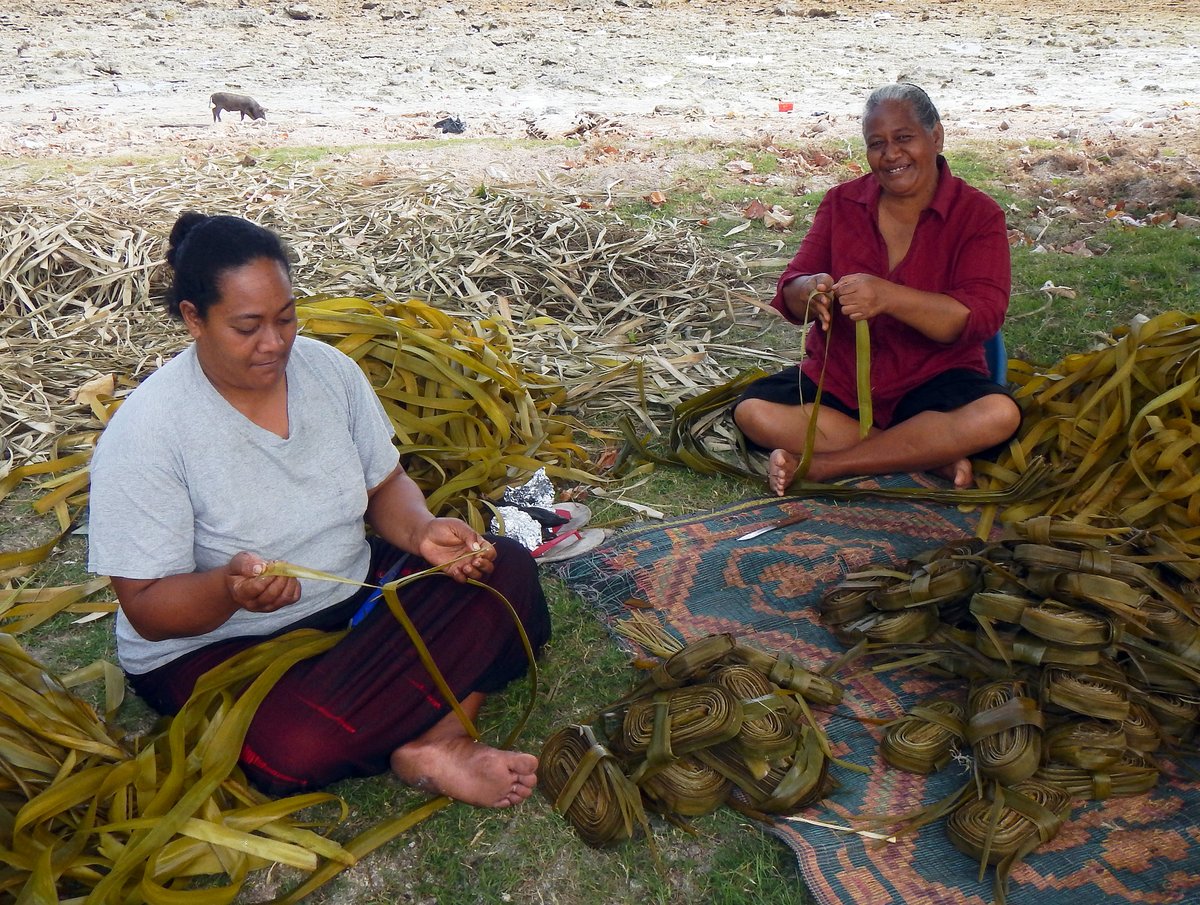
Pandanus is the major export from the island and we’ve seen people processing it in all three villages. It’s quite a laborious business. The plant is grown in the plantations and has a fleshy long leaf with spikes along the two edges and along the spine. After gathering a bundle of six foot long leaves, the first step is to strip off the spiky edges and the spine to produce two pieces of Pandanus leaf about six foot ling by one inch wide. This is rolled up into bundles and boiled in fresh water for over 12 hours.
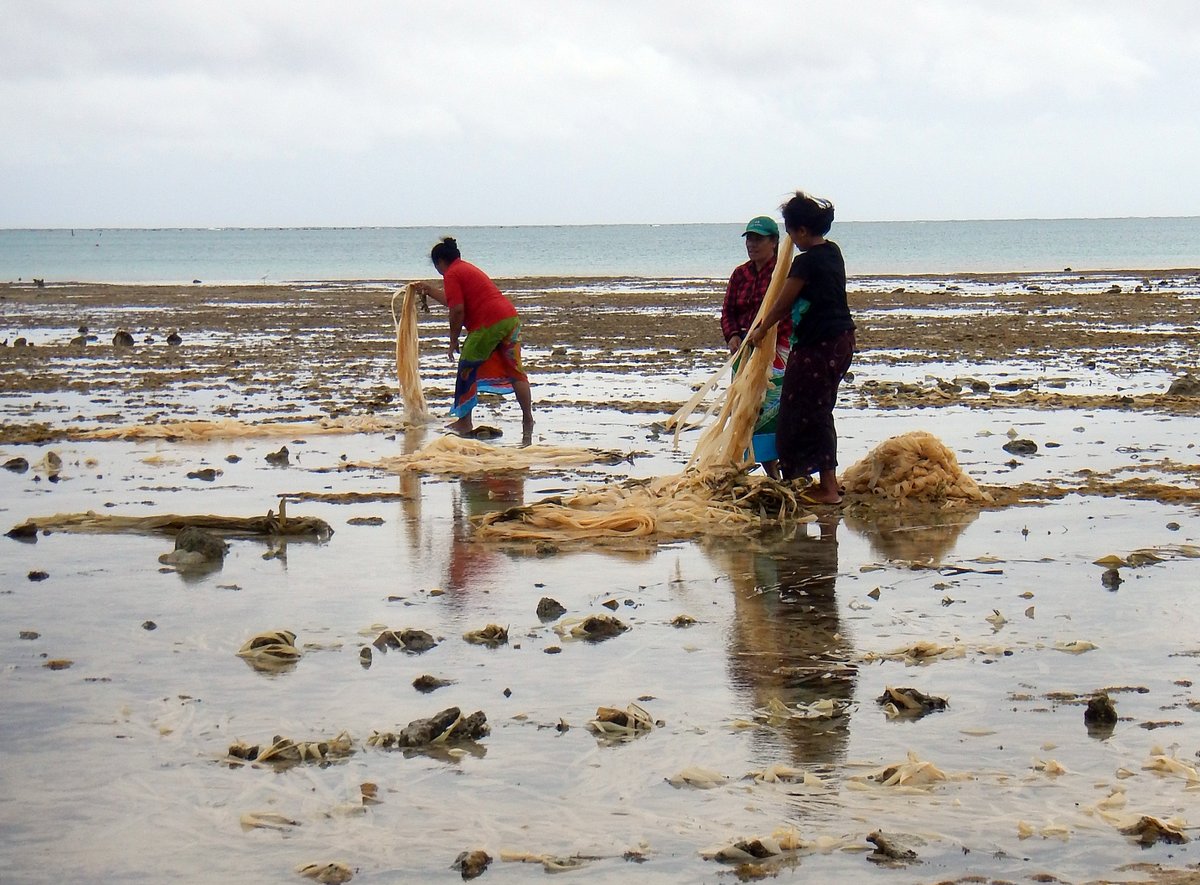
The boiled Pandanus is then unrolled and the leaf is separated, stripping off the shiny top surface. The underside is discarded and the top surface is tied in a bundle with about fifty other pieces and, at low tide, is weighted down with rocks in shallow rock pools on the reef. These bundles are left to soak in the sea for a week - every day at low tide we’ve seen huddles of ladies out checking their Pandanus and rearranging it.
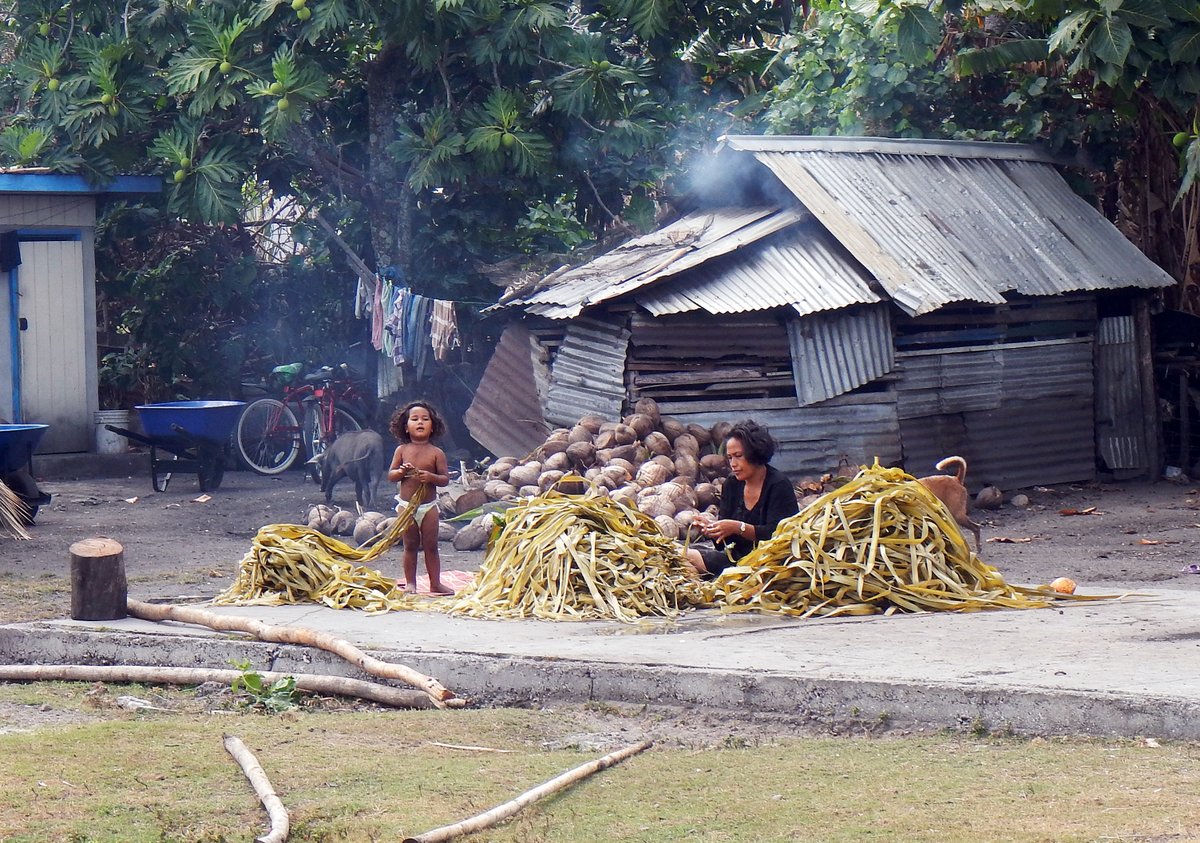
After the long soak in sea water, the Pandanus is washed in fresh water and hung out to dry - practically every house has some bundles of Pandanus hung out to dry. The washing and drying process is repeated a further two times during which the ladies coil and un-wrap the Pandanus in some way to remove curl from the it, ending up with soft, white, straight Pandanus.
As well as exporting the bundles of dried Pandanus, the locals do their own weaving. They use small wooden “combs” with sharp metal spikes spaced at about ¼ inch intervals to split the one inch wide dried Pandanus into consistent ¼ inch wide strips and then weave mats and decorative belts. Small mats are made as a kind of lava lava for special occasions and visiting officials, while big mats are made to give as special gifts.
The mats are too delicate to be used for floor coverings, but instead are normally hung on the wall. We’ve stopped and chatted to groups of three or four of ladies weaving one big mat, which might take them weeks to complete. A team of three ladies can weave an eight foot by three foot section per day for which they will receive $150 Pa’anga, which is not a lot of money.
We chilled out during the afternoon, while squalls passed overhead. I had to recharge our damn food fridge again. The leak is now so bad that I’ve had to leave my recharging gauges permanently connected to the compressor, so that I can recharge it every day. My number one priority when we get to Vava’u will be to find the leak and get someone to fix it.
27 September 2014 Nuiatoputapu, Tonga
The weather appeared to be a little more settled in the morning, but there were still lots of showers around. There’s a big high passing to the south of us, which is forecast to bring better east winds tomorrow.
We chilled out for the morning then, after lunch, went ashore to see Sia. Glenys took her some onions and swapped them for some taro leaves and a couple of breadfruit. We also picked up the two huge bundles of dried Pandanus to deliver to a relative in Vava’u. Back on the boat, being midly paranoid about insects, we put the Pandanus into bin bags and sealed it all up. We've stored it in our front cabin which is the only place that we can fit it.
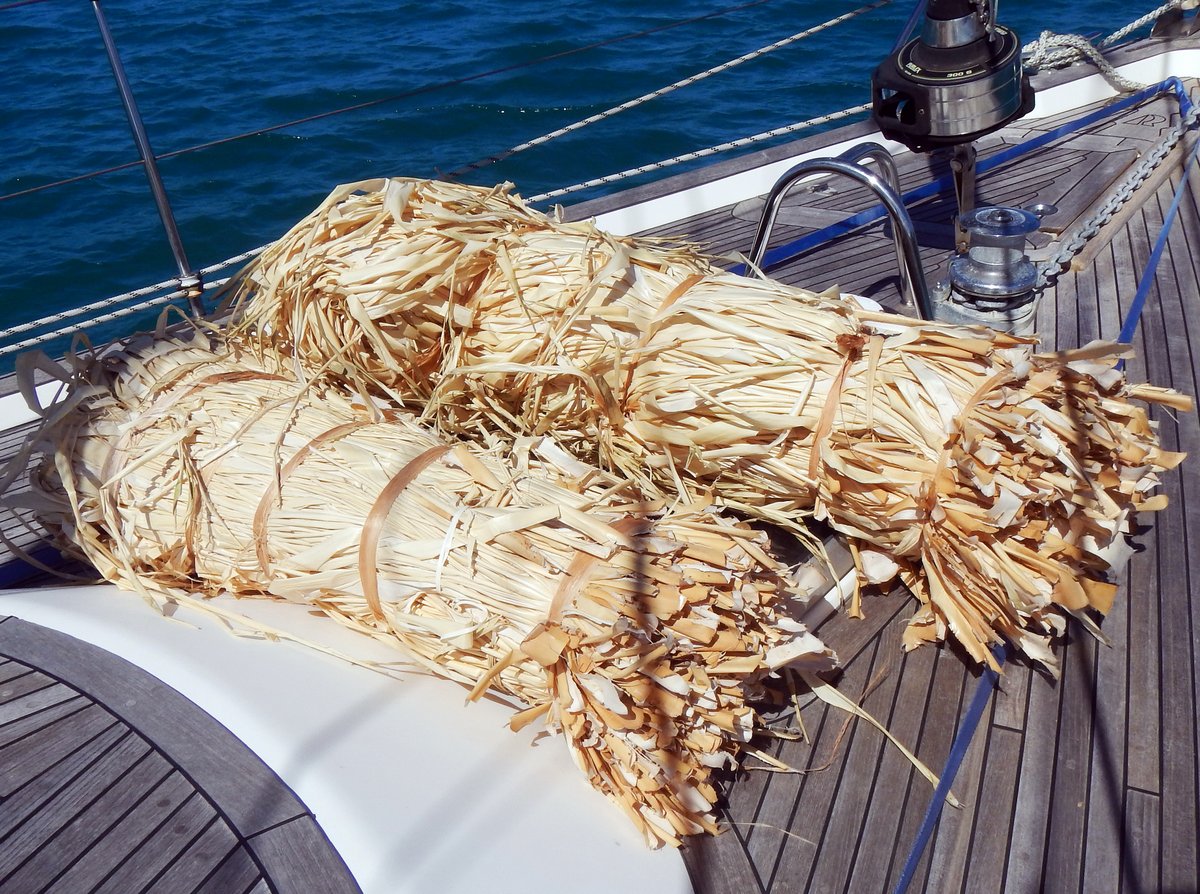
With all our chores done, we put the dinghy on deck and got ready to leave before having an early night.
28 September 2014 Nuiatoputapu to Neiafu, Vava'u, Tonga (Day 1)
It wasn't a very nice day when the alarm went off at 0545 - grey skies and drizzling. I downloaded a GRIB file and, although the wind was 3-5 knots more than yesterday's forecast, it was still from the east.
We pulled up the anchor at first light and cautiously motored out of the pass without any problems, turning west to go around the leeward side of the atoll. Once clear of the reefs, we found that the wind was a little south of east, so we were on a close reach. The next four hours was frustrating as the wind gradually increased making us have to keep reefing and changing the sails. Finally after lunch it settled down to 25 knots, but the confused seas made it unpleasant.
The total distance for this passage was 180 miles, which at our normal average speed of 5 knots is 36 hours. Having left the pass at 0700, we needed to keep up our speed. Normally, if it's windy and confused seas, we slow down even more to make the motion more pleasant, but today we needed to press on, so we bounded along at 7 knots, which made it even nastier.
All we could do was hang on and read. Occasionally, a big wave would hit the side of the boat with a huge bang and Glenys had a total sense of humour failure when she got drenched by a particularly enormous one - her Anglo-Saxon expletives were impressive.
Thankfully, the wind started to drop as the sun set and, with only 15-20 knots, the first part of the night turned out to be quite pleasant, especially when the wind backed as well. At our four o'clock watch change, I had a squall line come through. Typical of the weather in this area, the wind dropped down to 10 knots, then in the space of a couple of minutes, it was up to 25 knots for ten minutes before dropping back down to 20 knots - very disconcerting.
29 September 2014 Nuiatoputapu to Neiafu, Vava'u, Tonga (Day 2)
Around dawn, Glenys had another nasty squall system come through, giving her heavy rain and 28 knot winds. By the time that I got up at seven o'clock, she was wet through and thoroughly fed-up. So after a quick breakfast, she went to bed to warm up.
By eight o'clock, we were still 26 miles from the entrance into the Vava'u group of islands. The sky had brightened up a bit, but the wind died down to 5-8 knots forcing us to start the engine. Unfortunately, the seas were still over six feet and very confused, so it was like being in a washing machine.
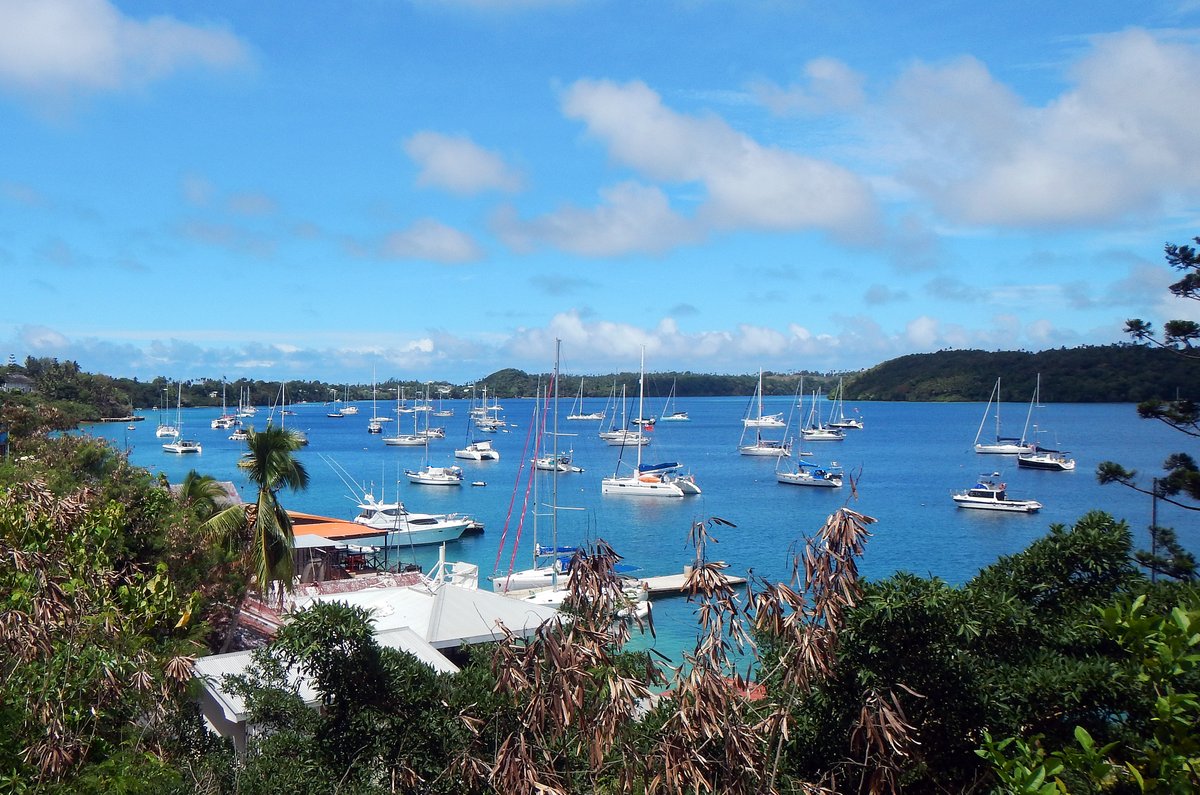
We motored for three hours and then the wind picked up to 10-15 knots, so we were able to sail right into the entrance into the Vava’u group of islands past some impressive cliffs and steep sided islands and rocks. It took a further 1½ hours to motor through to the well-protected harbour of Neiafu, where we picked up a mooring buoy amongst 20 or 30 other cruising boats. Neiafu is one of those places in the world where cruising boats congregate and most people doing the route to New Zealand stop here.
Being late afternoon, we quickly dropped the dinghy in the water to go ashore to get some Tongan money and some essentials like beer, but we didn’t get very far. We were met on the dock by Charlotte and Michael from “Salamander”, who showed us to the Aquarium bar where Grant and Carli from “Viandante” were already having happy hour beers at four o'clock. The day degenerated from there with pizza and chips being used to absorb the alcohol.
30 September 2014 Neiafu, Vava'u, Tonga
First thing in the morning, we moved to a mooring right outside the Aquarium bar to try to pick up their free wi-fi from the boat. I managed to get a connection, but it was so slow that it was useless. As we were having breakfast, Glenys pointed out a boat on a mooring next to us called “Flow”. When we were cruising in the Caribbean in the 1990’s, we had some good friends on a boat called “Flow” - could it be the same boat?
We went over to say hello and to our amazement, it was Horst and Karen who we’d last seen in Mexico in 1996! When we’d left the Caribbean bound for the UK, they carried on cruising for a few years and in 2004, they crossed the Pacific to New Zealand , where they have been living ever since. They are on a short, three month cruise up from New Zealand.
After catching up for a while, we walked into town to do some chores, calling in at the Customs to give them our internal clearance paperwork. After that, we went to the vegetable and craft market, bought a few vegetables, then to the supermarket for some beer and bread. We called in at the catholic church and found Catea, who came to the Aquarium bar to pick up the bundles of Pandanus that we brought for her from Nuiatoputapu.
The town of Neiafu is a bustling little place - very touristy with signs for whale watching tours everywhere, small cafes and restaurants on most corners, but there are still local Tongans walking about dressed in their Pandanus mats and the odd pig wandering across the road holding up the light traffic. Most of the grocery stores are very small, but we found a reasonable supermarket opposite the fire station, which stocks the basics including a case of Fosters lager for only $35US.
After lunch, we hung about on the boat trying to chill out, but it was very hot and humid - there’s a trough passing to the south of us and it’s sucked all the wind out of the area. Horst and Karen from “Flow” came over in the evening. Karen brought a big pan of stew, so we had that for dinner with some fried plantains and plenty of bread. We had a great time, reminiscing and catching up on the past 18 years.