1 April 2014 Galapagos to Marquesas (Day 6)
Dawn brought us grey, overcast skies with intermittent drizzle. Glenys made us a fruit cocktail with yoghurt for breakfast again because our bananas have decided to all ripen at once. After a nice cup of tea, I hunkered down over the laptop and sent off my daily emails. I posted our daily blog; sent an email to Karsten with our position and weather conditions; and sent a couple of emails to request a GRIB file & an ITCZ report.
Ten minutes later, I reconnected to our satellite email server and downloaded the response emails containing the GRIB file & ITCZ report. The ITCZ report showed no ITCZ activity within 48 hours. The GRIB file showed that the intermittent rain might continue for 48 hours, but then we should be back to blue skies for a few days. The wind should stay at between 15-25 knots from the south-east, which is just what we want. There's a nasty looking band of heavy rain forming in three days, but it's forecast to be 150 miles to the north of us - I'll be keeping an eye on it.

The overcast skies stayed with us all morning with the wind occasionally rising to 25 knots and the seas steadily building up. After lunch, we had another period of 25+ knot winds, so I decided to put another reef in the main sail. While reefing I noticed that the outhaul car had jammed half way along the boom. It's been a bit sticky for a few months and it's on my to-do-list to service it the next time that I have access to a decent chandlers.
I rolled away all of the main sail and, with a few judicious blows from a mallet, I freed the outhaul car. The car runs inside a 10mm wide slot on the boom, so it's difficult to see what is going on, but it looks like one of the nylon wheels on the car has disintegrated and the other wheels look badly worn. I'd have to take the end cap off the boom to inspect the car properly, but there's no way that I'm doing that in the middle of the Pacific Ocean when we're rolling like mad in 9-12 foot seas. I slapped loads of Teflon grease onto the parts that I could get to and the car seems to be running more freely. I hope that it lasts until we get to Tahiti in two months' time.
The sky brightened up in the afternoon, but the strong 20 knot winds and 9-12 foot seas continued. The wind and waves were coming from the south-south-east, so we were on a beam reach and occasionally surfing at 7-8 knots - like being on a giant sleigh ride. We've resorted to putting up the bimini rain flap on the port side to protect the cockpit from the occasional monster wave that slaps against the side of the hull and showers the boat with seawater.
Glenys made us Dorado in a Creamy Mushroom Sauce for dinner, with a big pile of mashed potatoes - just what the doctor ordered. After dark, the wind picked up to 25 knots again, so I rolled away the genoa and pulled out the stay sail, which immediately gave us a much better motion because the stay sail is lower and closer to the mast than the genoa.

The night was a mixed bag, with the wind dropping to 15 knots for a while and slowing us down to 4-5 knots. Then, just when we thought that we needed more sail, it would pick up to 25 knots and we'd be romping along at over 6 knots again.
2 April 2014 Galapagos to Marquesas (Day 7)
The weather was beautiful in the morning, blue skies with occasional clouds and the forecast was for little change with the wind remaining at 20 knots from SSE to SE. A band of heavy rain is still forecast to form in a couple of days, but it's going to be 120 miles north of us, so we should be okay.
Karsten sent out a warning email last night. There was a large earthquake in northern Chile yesterday at 1800 hrs, which measured 8.2 on the Richter Scale. A Tsunami warning has been issued for the coasts of Peru and Chile, which is 2,000 miles east-south-east of us.
Tsunamis are an interesting phenomena. In the deep ocean, they are a series of waves possibly a hundred miles apart, but only have a height of a few feet. These waves travel at up to six hundred miles per hour, but a boat in the deep ocean will not be aware when one passes by. If a Tsunami from this earthquake has hit us then it would have been at around ten o'clock last night. We felt nothing unusual - the surface 10 foot swell affects us much more.
However, Tsunamis are very dangerous to coastal areas. When the waves reach shallow water, they slow down and the wave height grows to as much as a hundred feet causing devastation. If a Tsunami warning is issued while we're in a Pacific anchorage, then our best strategy is to get out to sea into deep water, as long as we've got time...
The weather stayed at 20 knots all day, occasionally gusting up to 25 knots, so we didn't have to touch the sails at all. We've been sailing with the wind at 100 degrees on our port side, which is an awkward point of sail for our Hydrovane especially when the boat is yawing around because of big waves and we have gusty conditions.

If the boat yaws upwind then the apparent wind increases quite dramatically and over-powers the Hydrovane, so the boat heads upwind and the Hydrovane gets overpowered even more - a vicious circle. The opposite happens if the boat yaws downwind. It's not a major problem, but someone needs to be in the cockpit to keep an eye on it, so we've been very lazy and have been using our electric autopilot for the past few days, with the Hydrovane working alongside, hopefully taking some of the load off the autopilot.
Glenys did us proud today - producing fruit salad with yoghurt for breakfast; Couscous with chicken and apricot for lunch; Fish Tortillas for dinner and she even made a batch of Banana Bread for our night-time snacks. We're not starving yet.
At dusk, we had 50% cloud cover and were still sailing happily at 6 knots. The clouds always look more forbidding as darkness falls and I always have an hour of worrying whether I have the correct amount of reef in the main sail. It's a delicate balance between wanting to be comfortable at night, but not going too slow.
It's not that I was bored during the night, but I've been thinking about rolling. Let's say that we roll once every 5 seconds with 2 violent rolls every 3 minutes. We still have 2,300 miles to go and we averaged 150 miles in the last 24 hours. If we keep up this speed, we'll arrive in the Marquesas in 15 days. That's a total of 265,000 rolls with 14,500 violent rolls, which are capable of damaging something or someone, I guess that's why they say "Always keep one hand for the boat."
The night passed without incident. We've finally got a sliver of a new moon, which is visible for the first couple of hours. It's been very dark at night up to now, but from now on, the nights will be brighter and we’ll be sailing with a full moon as we approach the Marquesas, which will be wonderful.
3 April 2014 Galapagos to Marquesas (Day 8)
We've been at sea for a week now and the time seems to have flown by - let's hope that the next two weeks fly past just as quickly.
First thing in the morning, it was very dull and overcast, but the clouds soon broke up and we had a great sail rolling along in blue seas topped by white caps.

Everyone on our SSB Net is now around 7 degrees south and heading directly for the Marquesas - apart from "Hera" who are still up at 4 degrees and dealing with heavy rain. Looking at the GRIB file, which I downloaded this morning, we'll have the same 15-20 knot winds for the next three days, hopefully with this nice sunny weather, but “Hera” still have to travel 120 miles south to get clear of the band of heavy rain.
While we were in the squall system a few days ago, we switched on our radar to try to look ahead for individual squalls, but the damn radar screen didn't show anything. We've had problems with it in the past, so we've decided that it's time to retire it and buy a new one. So, while Glenys was having her 2 hour nap in the morning, I was reading the West Marine and Defender catalogues...
We've managed to avoid buying a large screen chart plotter up to now, but it looks like we'll have to buy one now to act as a radar screen. The bad news is that it will probably cost us $3,000, but at least it will be a much better radar system and we get a nice new chart plotter that will integrate with our other systems like AIS. I have to do more research, but the Raymarine system that I'm looking at will even link wirelessly to our iPad, so we'll be able to use our iPad to act as a slave screen in the cockpit - very cool.
After my afternoon nap, we hove-to for an hour to run the generator and water maker. The generator shouldn't really be run if it's tilted more than 20 degrees, so the idea was that heaving-to would be calmer. However, we were being bounced around nearly as much because the boat lay at 70-80 degrees to the wind and the big waves. I tried various positions of the wheel, the main and the stay sail - I even rolled the stay sail away completely, but the damn boat refused to point any higher than 70 degrees to the wind. It's a mystery.
The wind dropped to 15 knots just before dark, so I rolled away the stay sail and unfurled the genoa. It was a lovely night, but the big waves kept us rolling. After midnight, the wind increased to 18-22 knots, so we were screaming along at 7 knots and surfing at 8 knots at times - it was boisterous to say the least.
4 April 2014 Galapagos to Marquesas (Day 9)
The weather this morning was much the same as yesterday, sunny with 15-20 knot winds from the southeast. We've sailed 1,000 miles since we left the Galapagos, so we're over a third of the way through our passage.

After breakfast, we turned the clocks back one hour because we've sailed through 105 degrees west and moved into another time zone. Glenys was a very happy bunny when she went for her morning nap, knowing that she'd have an extra hour in bed.
Last night was very rolly, so we had a play with our sail plan to see if we could dampen the rolls. We're mostly sailing on a broad reach and I' m fairly convinced that having the genoa out causes us to roll more than when we use the stay sail because its centre of effort is much higher. However, when the wind is around 15 knots, the stay sail is not powerful enough by itself and we slow down.
We tried using a barber-haul to pull the stay sail tight amidships with the genoa still out, but that didn't seem to affect the amount of rolling very much and the stay sail blanketed the genoa causing us to slow down. We eventually put out a reefed stay sail sheeted in tight, which seemed to be the best compromise. The genoa was partially blanketed, but the stay sail provided some drive and also had a dampening effect.
In the middle of the morning, I went to the foredeck to check a few things and to my dismay, saw that there was another small tear in the leech of the main sail. There was no choice - it had to be repaired immediately before it got worse. So, we donned our harnesses, rolled away the foresails and motored into wind, so that we could drop the mainsail.
The change in apparent wind when going from downwind to upwind never ceases to amaze me. We went from sliding down 10 foot waves with a pleasant 15 knot wind behind us, to crashing into enormous 10 foot waves with a howling 25 knot wind, putting walls of spray and water across the foredeck. It took us 15 minutes battling in this maelstrom to get the sail off the mast and into the cockpit.

After a short break for lunch, we inspected the damage, finding two large, four inch tears and two smaller ones. It looks like the problems are caused by the seam on the leech. The material is UV damaged, very weak and is worn through in many places. I think that leech seam is tearing when under strain and the forces on the sail are then directed onto the seams between the main panels. The material on the main panels looks to be strong, but the failure of leech seam is putting undue strain on the panels and they in turn rip.
Unfortunately, we didn't have enough sailcloth to replace the 60ft leech seam, so we patched the four rips and sewed twelve, one foot long strengthening patches onto the leech seam where the main panel seams meet the leech. When we did the previous repair, we had to remove the leech line and, in doing so, had weakened the leech further, so we sewed a 1/2 wide tape along the whole length of the leech. Hopefully that will be strong enough until we can find a decent sail-maker.
It took us six hours to do the repair - even with our brilliant Sailrite sewing machine. We then had another epic struggle to get the sail on deck and onto the mast. We finished the job at five o'clock, by which time there was just enough time to tidy up and have dinner before it went dark.
While we were repairing the main sail, the auto pilot carried on sailing us west. We only had the stay sail out, but we still averaged 5 knots over the ground. When we got the main sail back up, we discovered that the wind had backed and we were now sailing almost downwind, so we poled out the genoa and used a heavily reefed main.
It was a lovely clear night with a bright moon and a starry sky, but the motion was horrible, rolling violently from port to starboard. Up to now we've been on a broad reach and the boat has been mostly heeled over to starboard, so when we're in bed in the back cabin, it's been possible to jam ourselves against the starboard bulk head and get some sleep. The downwind rolling was more centralised going from starboard to port and back again, so without any lee cloth on the bed, we were sliding around and getting no sleep.
Our only option was to sleep on the single berth in the main cabin, which has a lee cloth. This is not ideal because the saloon is very noisy with objects banging and clunking in the many lockers. One also gets disturbed whenever the person on watch moves around in the cockpit or goes down into the saloon. However, at least we got a bit of kip and didn't spend our off watch hanging grimly on to the bed in each roll of the boat.

5 April 2014 Galapagos to Marquesas (Day 10)
It was another beautiful morning with 15-20 knot south-east winds - very nice sailing conditions. Unfortunately, our joy of life was dampened when we found that another length of the sacrificial strip on the foot of the genoa was flapping about. The hand-stitched repair that Glenys did a week ago is fine; it's the zigzag stitching on another section that has perished. We've obviously not paid enough attention to the condition of the sails, although we did have the sacrificial strip re-sewn last September.
We ran straight downwind, dropped the sail to the deck and tied it down. I then trimmed the ragged edges of the Sunbrella sacrificial strip and the sail cloth, while Glenys hand stitched the seam back together. Our Speedy Stitcher has been worth its weight in gold. It was very pleasant working on the foredeck, bowling along at six knots with blue skies. By lunchtime, the job was done and the genoa back in place.

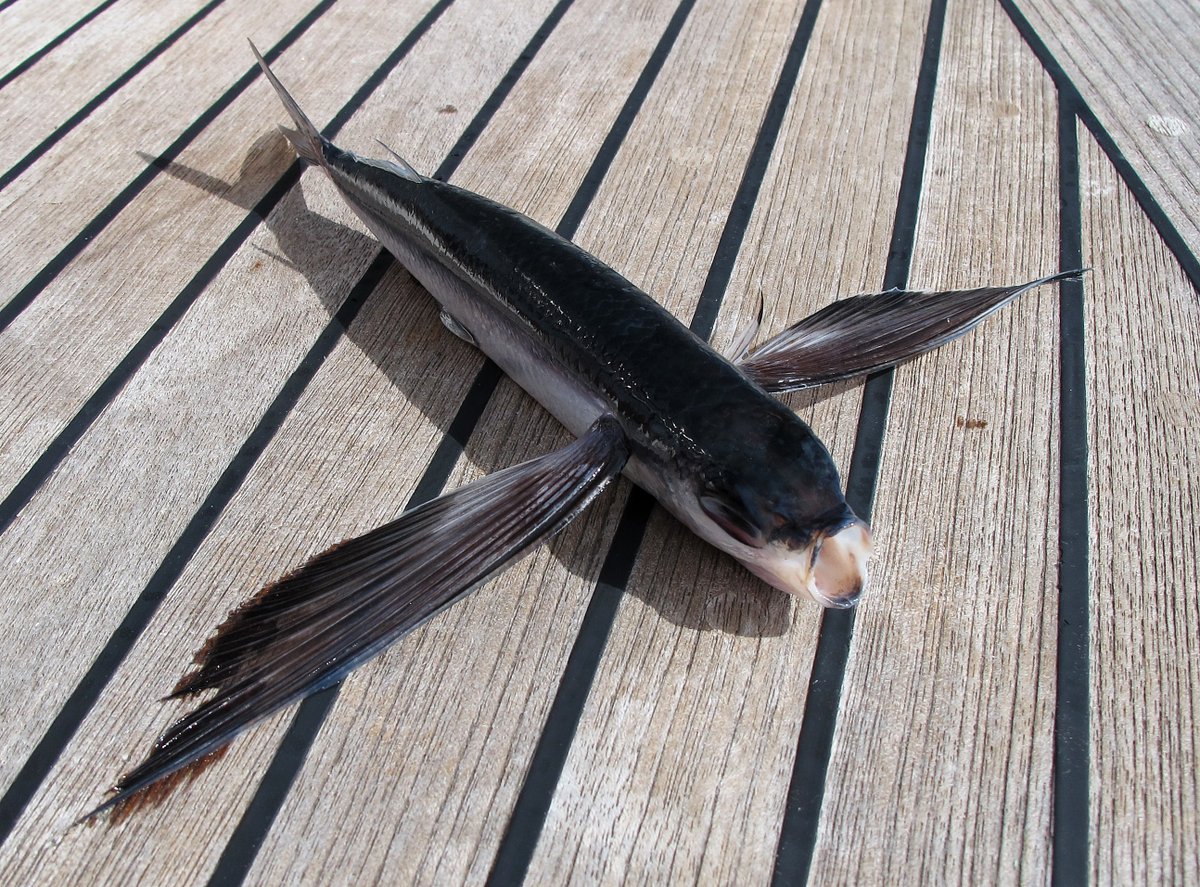
There must be billions of Flying Fish in the Pacific Ocean - every time that I looked out at the sea this morning, there were one or more skimming across the surface of the water. We see whole squadrons taking off, flashing silver in the sunlight as they take to the air to escape the perceived threat of our boat. Some take off too close to the boat, fly almost vertically in their panic to get away and, if they're unlucky, they hit us and flop around on the deck, suffocating. Every day we throw at least five back into the sea.
I love the way the Flying Fish keep in the air. They take off and glide inches above the water, then, as they start to lose speed and altitude, they dip their tails into the sea, give a quick wiggle, pick up air speed and continue gliding on their way. I've been trying to get some photographs, but they pop out of the water anywhere and are so fast that my poor little camera can't focus quickly enough.
The afternoon was a very chilled out affair, reading and catching up on some sleep. We've had a fishing line out for three days with no luck, but we finally hooked a nice 4 foot long Dorado just as we were finishing dinner. It fought well, but we managed to land it without any problems. It was going dark by the time that I'd killed it, so I just gutted it, washed it and chopped it into two halves. It's now taking up space in both fridges - should feed us for four days or so.


We had a good 15-22 knot wind overnight, which allowed us to sail on a fast broad reach. The motion was much better than yesterday when we were forced to go downwind.
6 April 2014 Galapagos to Marquesas (Day 11)
Ho hum! It’s another lovely day on the Pacific Ocean. We're still rolling ALL the time, but let's look on the bright side - we've only got 207,000 rolls to go (that's 1,695 miles).
The motion is not forgiving. Everything has to be thought through and done slowly because we have to have one hand holding onto the boat at all times. I'm convinced that the sea waits until it knows that I'm slightly off balance (or not holding on), then sends in the monster wave, rolling us over 30 degrees and throwing me against something hard. I'm covered in small bruises.
Having said that, it's amazing how easily we've become adapted to our life at sea. The three hour on, three hour off watches have become ingrained - I can't imagine what it's like to sleep for eight hours. When we're not doing repairs or sleeping, then we keep ourselves busy, pottering about or reading. I'm enjoying the life, but don't seem to have enough hours in the day to do everything. For the first week, we were pushing the boat, trying to go as fast as we could to get there, but we're more chilled out now and wouldn't be bothered if it took us another month to get to the Marquesas.
After our horrible night trying to sleep in the back cabin without a lee cloth, I decided that we needed to sort it out. Our back cabin has a lovely comfy bed, which is great when we're at anchor, but is poor at sea. There are cupboards on the wall above the bed, which are only one foot above the mattress. While this is a great use of space when in port, it means that we can't lean against the wall while at sea.
To get around this, we've been packing pillows and sleeping bags into the space below the cupboards on the starboard side, which gives us something to lean against while the boat is heeled over to starboard - this has been working well. Our problem the night before last, was that the boat was rolling violently to both starboard AND port. On the port roll we were remorselessly sliding across the bed - not very conducive to a good night's sleep.

Normally, on a single berth, there would be a lee-cloth - a simple piece of material fixed vertically in place, against which one can lean. Unfortunately, we have fancy, shaped mattresses and there's no place where we can fix the bottom edge of a lee-cloth.
After a lot of staring at the bed, I eventually came up with a solution and forced Glenys to slave over a hot sewing machine again. We now have a piece of material four feet long that lies on top of the mattress and is held in place by six pieces of thin rope. Sewn onto this base are two lee-cloths. One is fixed to the starboard-side cupboards above the bed, blocking off the gap underneath; while the other one is fixed to the cabin walls and provides something to brace against when on port tack. It seems to work okay, but I’ll reserve judgement until we've had a couple of down-wind nights.
While we were making our lee cloths, the autopilot was happily taking us west on a broad reach. We had a heavy rain shower in the late afternoon, but the night was mostly clear with nearly a half moon. The wind is starting to go more easterly, so in order to keep the head sail filled, we are being forced to head slightly more south than we would like. If the wind comes more behind us, then I'll have to re-rig the spinnaker pole on the port side and we'll be running downwind with the sails wing-on-wing - I'm trying to put it off because it's a lot of work...
7 April 2014 Galapagos to Marquesas (Day 12)
It was a very grey morning. The rest of the day was mixed with periods of blue skies and one heavy rain shower. The wind was still trying to sneak behind us, but we managed to stay on a broad reach. At two o'clock in the afternoon, we reach our half way point - yahoo! Only 1,520 miles to go.
Over the past few days, the roller reefing on the staysail has been getting stiffer and sticking on each revolution of the reefing drum. I dug out the manual, inspected the reefing drum and decided that the luff extrusion had dropped down. There was no way that I could move it with the sail in place, so we ran downwind and dropped the sail onto the deck. I was then able to lift the extrusion using the halyard, line up the holes in the extrusion with the holes in reefing drum and screw in the locking bolts. Sorted!

While I was up at the bow, I had a look at the genoa roller reefing and found that the extrusion was too high - when we raised the genoa yesterday we must have dragged the extrusion up. I unscrewed the retaining screws and managed to move the extrusion and align the fixing holes without having to drop the genoa - I serviced both roller reefing units just before we left Ecuador, but I obviously didn't tighten the locking bolts properly.
I've been reading up on the Marquesas and trying to wrap my head around the strange names for the islands and the even stranger Polynesian pronunciation. There are islands like Fatu Hiva (Fa-too-Eee-va), Hiva Oa (Eee-va-oh-a) and Oa Pou (Oh-a-poe-oo). Most of the names of the anchorages and towns are worse. On the small island of Tahuata (Ta-oo-aa-ta) there are anchorages called Ivaiva Nui (Eee-va-Eee-va-nu-ee) and Hanamoenoa (A-na-mo-eh-no-a). Phew!
There’s been some debate on the SSB net about whether to stop at the island of Fatu Hiva. From a sailing point of view, it's logical to stop there first and then sail downwind to the other islands. Unfortunately, there's only a small village on the island, so there's nowhere to clear in and the authorities frown upon boats stopping anywhere before clearing in at Atuona on Hiva Oa. In the past, a Coast Guard boat has gone around the anchorage and levied a fine of $200 on boats that haven't reported in at Hiva Oa.
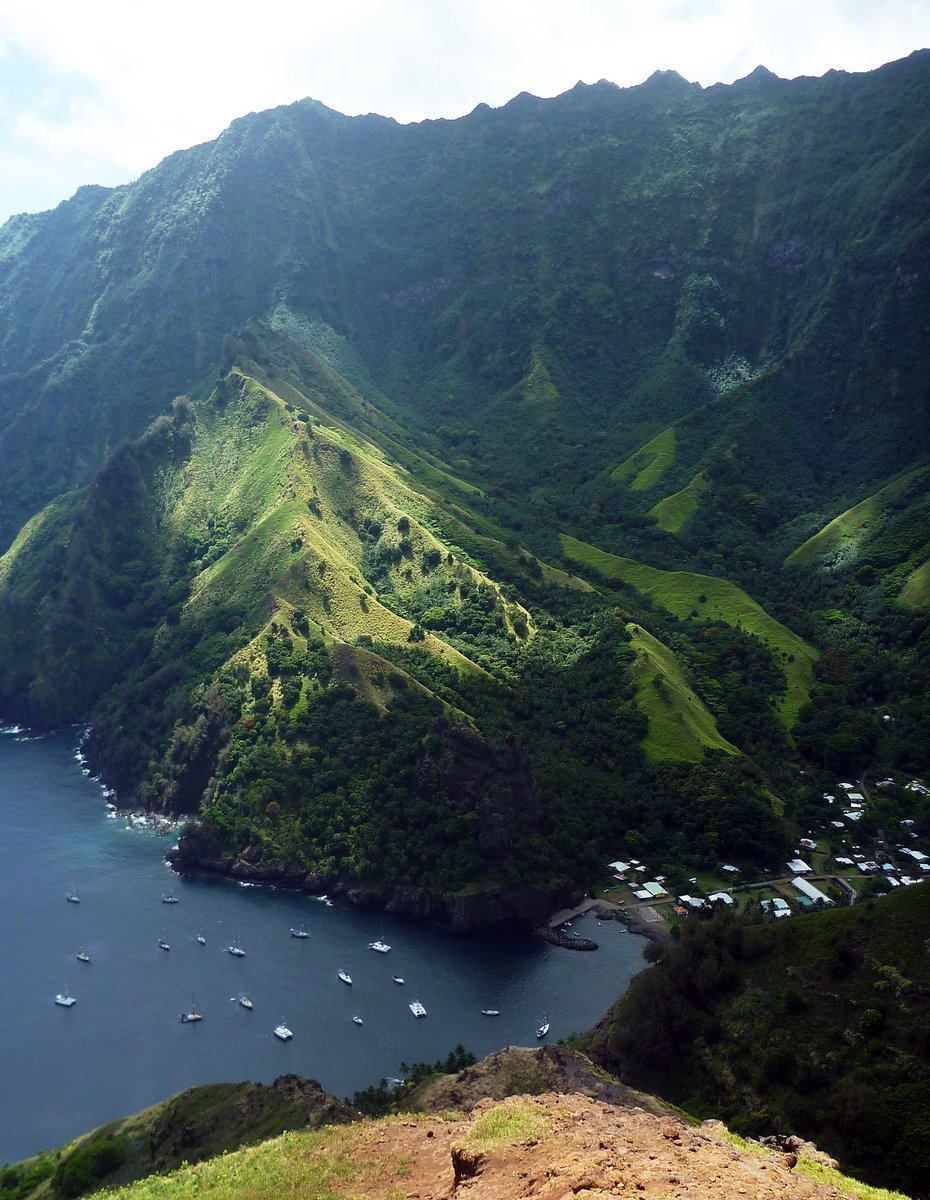
This is a pity because the "Bay of Virgins" at Fatu Hiva is supposed to be one of the most beautiful anchorages in the world, with steep-sided hills cascading down to the sea. Glenys and I can't make up our minds what to do - we don't want to get on the wrong side of the authorities, but we also don't fancy a 45 mile bash to windward to get back to Fatu Hiva from Hiva Oa. Mike from "Shakti” has been talking on the radio to a number of boats who are a week ahead of us and some of them are planning to stop at Fatu Hiva, so we'll wait to see what happens to them.
Glenys made a delicious Fish Lasagne for dinner and then we sorted ourselves out for our night watches. I had my normal wander around the deck and for a change didn't find anything amiss apart from having to reroute the genoa halyard, which was rubbing on the starboard guard rail.
We had a very rolly night because we had to sail almost directly downwind. Thank goodness for the new lee-cloth in the back cabin, it's working really well and we're getting our sleep. Unfortunately, on this point of sail, the wind has forced us 15 miles south of the rhumb line, so we really need to be sailing wing-on-wing now.
8 April 2014 Galapagos to Marquesas (Day 13)
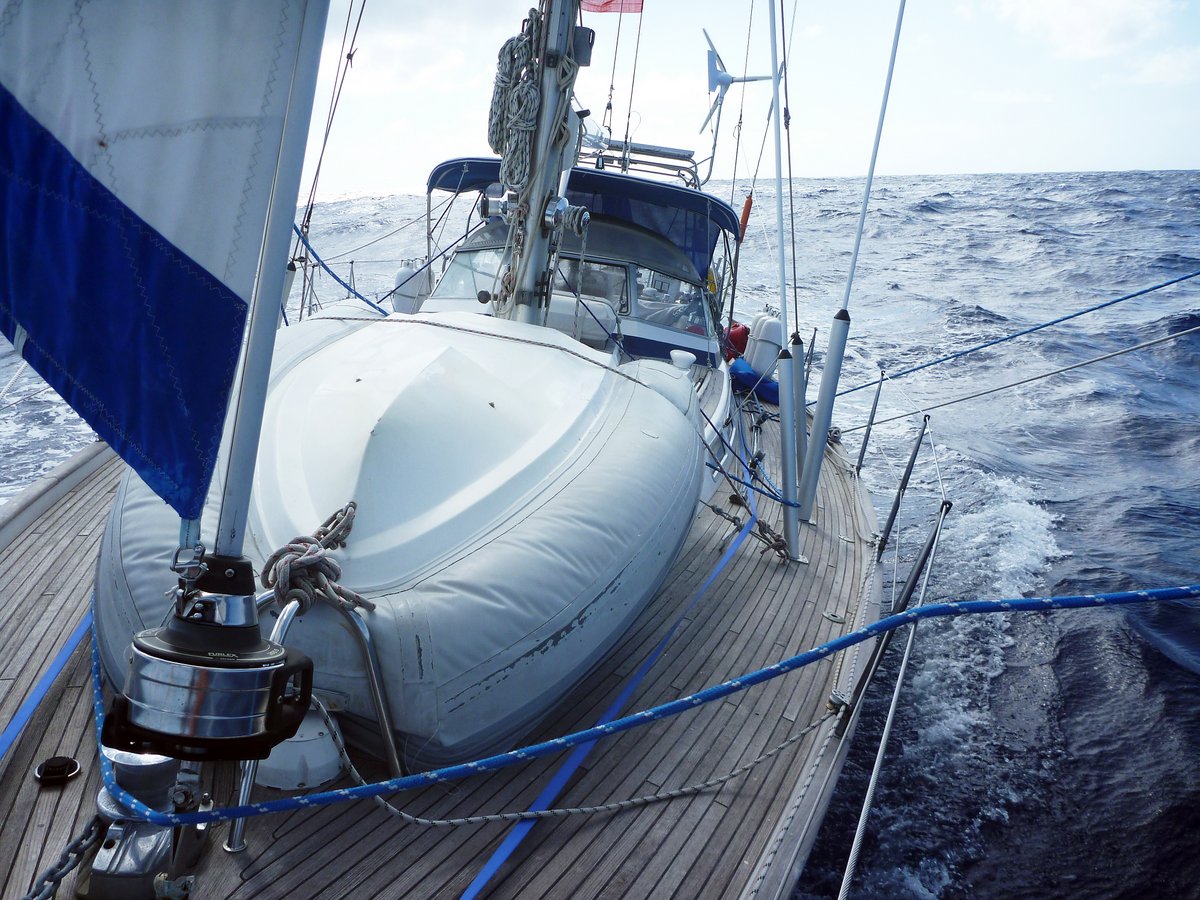
After breakfast, we moved the spinnaker pole from starboard to port. It's a bit of a mission having to sort out the up-haul, the down-hauls, the sheets and swing the 15 foot pole over to port, while hanging on for grim death on the bucking, rolling foredeck. It took us half an hour to do it and get a semblance of order again.
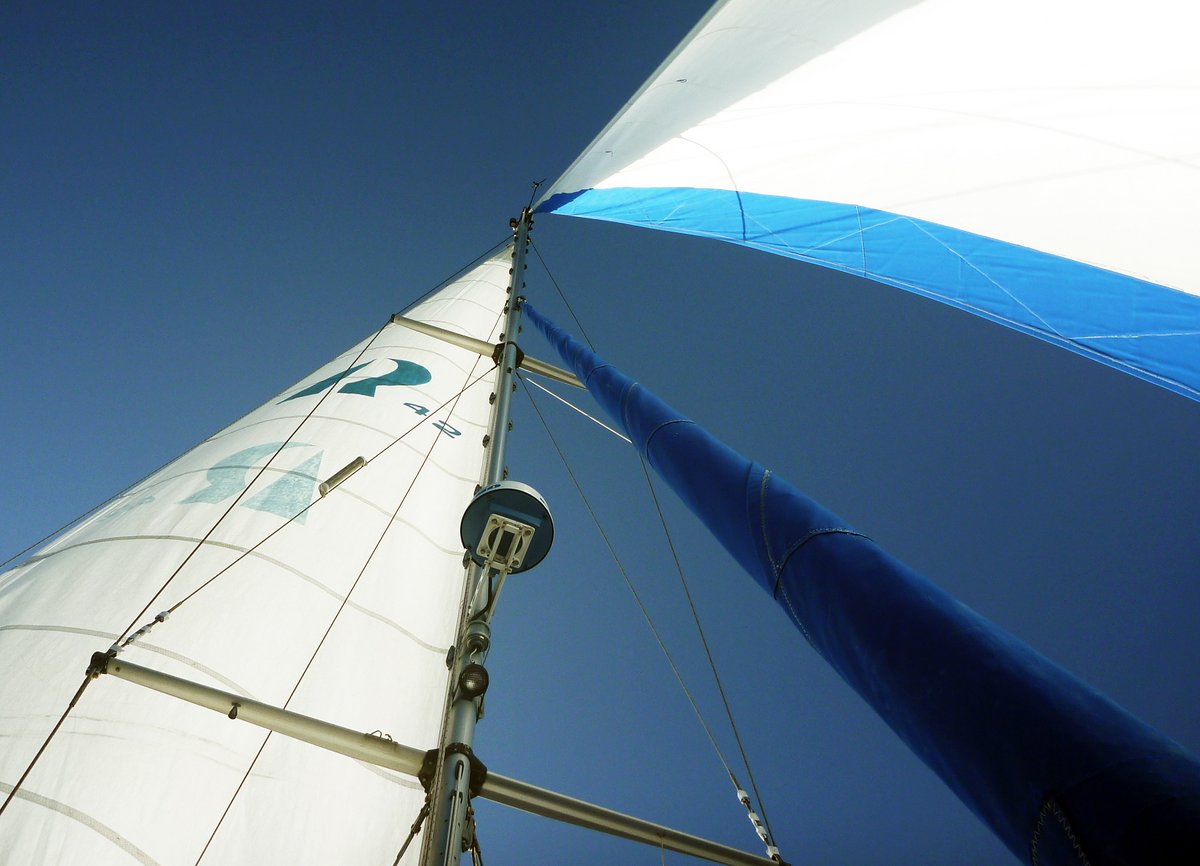
We set up a heavily reefed main to starboard and the genoa poled out to port. The wind was coming from 30 degrees off our aft port quarter, so the genoa was poled out on the windward side of the boat. Normally there would be a high risk of the genoa backing, but I positioned the spinnaker pole angled forwards to put the wind square onto the sail. This setup works great provided the wind is from dead behind or up to 45 degrees on the port side.
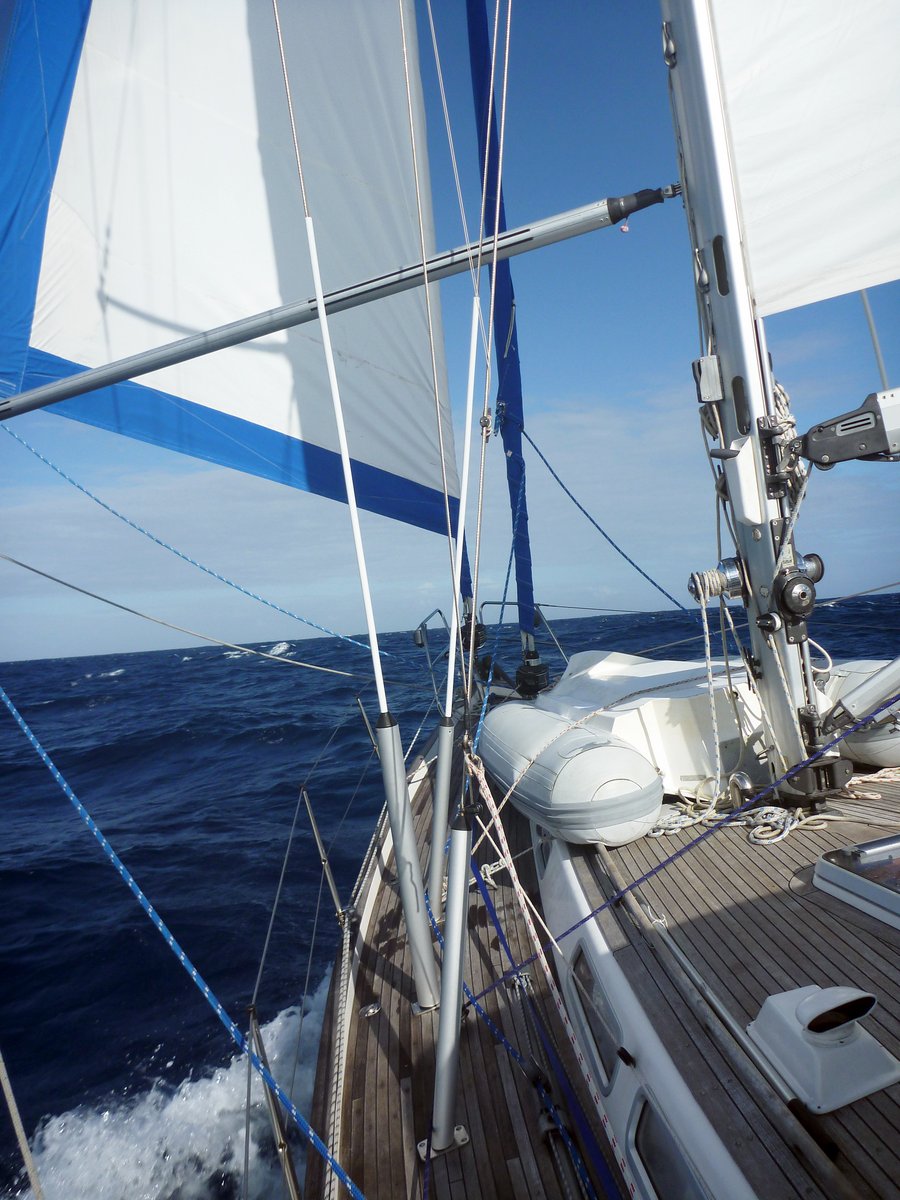
After a few hours, the wind picked up and veered another 10 degrees, forcing us further north than we would like and making me wish that we'd kept on a broad reach. Then, just before lunch, we had a huge roll, the genoa backed and we rounded up into wind, so I had jump up and start the engine to steer us back on course. By this time, the wind was 25 knots gusting 30, so we rolled away the main completely, gybed the genoa to the starboard side and ran downwind with just the genoa.
The afternoon was a bit more stable with the wind reducing to 20 knots and backing 10 degrees, so we gybed the genoa back to starboard on the pole and set the staysail up to starboard to run wing-on-wing – it’s hard work this sailing malarkey.
While I had my afternoon nap, Glenys had a cooking session and baked some Pan de Yuca & blueberry muffins. For dinner, she made Encebollada, which is a delicious Ecuadorian fish soup – it should contain Tuna, but she made do with Dorado.
The skies looked grey and menacing as darkness fell. Halfway through my 7-10 watch, the wind dropped to 10 knots and backed 30 degrees as we entered a shower system. I turned 20 degrees to port initially and then rolled away the stay sail, before turning back on course. The rain hit us five minutes later, followed shortly by the wind increasing to 15-20 knots. Then over the next fifteen minutes, the wind backed to its original direction, so I unfurled the stay sail again and off we went. We've had to do more sail changes today than we've done over the previous 12 days.
The rest of the night went without incident, but we're being forced to sail 10 degrees further north than our ideal course of 265 degrees because with the wind at 45 degrees behind us we're very close to backing the genoa. I'm finding it frustrating that I can't quite get the sail plan right - if we raise the main and go onto a broad reach again will the genoa be crashing and banging in the lee of the main?
We’ve been living on Alba for exactly three years today, so I worked out a few statistics. In the past twelve months, we’ve sailed 5,005 miles bringing our total to 14,457 miles since we moved aboard, but we’re still only 3,120 miles to the west of Grenada, meaning that we’ve only done 15% of our around the world voyage.
9 April 2014 Galapagos to Marquesas (Day 14)
We had a lovely day with bright sunshine. Our course should have been 266 degrees, but with our twin headsail setup, we could only just manage to sail on a heading of 272 degrees. We decided that was close enough - mostly because we couldn't be bothered to adjust the sails. The motion of the boat was pleasant and soporific, so we had some good naps.
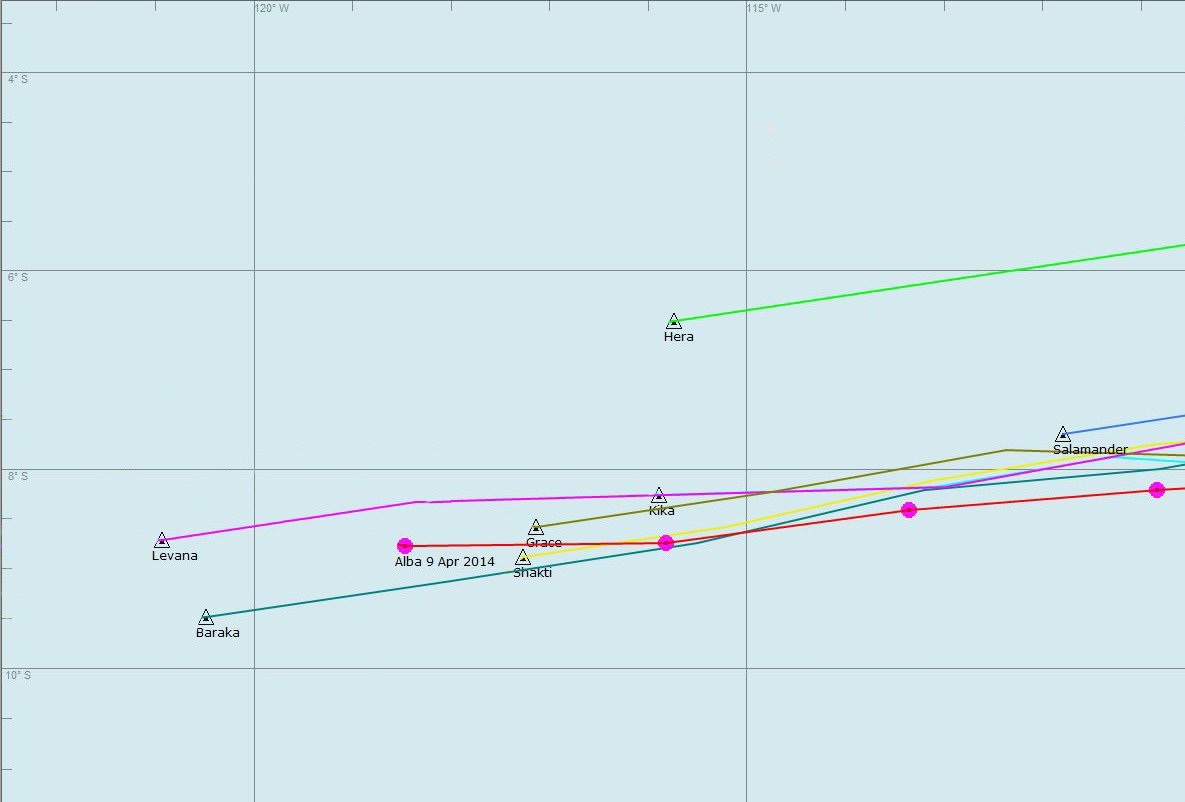
At ten o'clock, I tuned into our small SSB net and chatted to some of the other boats, making a note of their positions. I've continued to plot everyone's position every day and we've all settled down following the rhumb line - our tracks look like a set of meteorites streaking across the ocean.
My latest little project is to read up on cruising the east coast of Australia. A few months ago, we decided that we'd not bother going to Australia mostly because it's expensive and neither of us had a burning desire to go there. Our plan was to sail from New Zealand to Fiji next May and then sail past northern Australia to Indonesia in July. However, if we went to Australia for the cyclone season, then we'd be able to spend 6 months in the area around Fiji instead of just 2 months, so it sounds sensible.
Sailing up the east coast from Brisbane inside the Great Barrier Reef sounds like a nice cruise with a variety of mainland anchorages and off-shore coral atolls. I think that a good plan would be to sail from New Caledonia to Brisbane in November 2015, then spend the four month long cyclone season around Brisbane, before starting to cruise north in April, aiming to arrive in Darwin in July. From Darwin, we could join the Sail Indonesia rally and head up towards Singapore.
The only real downside to this plan is having to spend four months in Brisbane in their hot, humid summer. However, we'd probably go back to the UK for a month; go on a road trip for a month and haul out, so I don't think that we'd be hanging around too long. I'll do some more investigation, but it looks like a good option to me – if we do it, our next four years would look something like:
| Apr 14 - Oct 14 | South Pacific Islands |
| May 15 - Oct 15 | Fiji, Vanuatu & New Caledonia |
| Nov 15 - Jul 16 | Australia |
| Nov 14 – Mar 15 | New Zealand |
| Aug 16 – Oct 16 | Indonesia |
| Nov 16 onwards | Malaysia & Thailand |
The night wasn't as pleasant as the day. Clouds built up during the afternoon and the seas became more confused. The good news was that the wind backed a little allowing us to sail on the correct course to the Marquesas.
On my 1-4 watch, the wind dropped to 15 knots and then started to gust up to 25 knots as we passed between two dark banks of clouds, so I rolled away the genoa and ran with just the stay sail. Ten minutes later, the wind settled down, so I unrolled the genoa again. It's a right faff to keep reefing like that, especially when nothing happens, but I can almost guarantee that the first time that I don't reef early, we'll be clobbered by 30 knot winds...
10 April 2014 Galapagos to Marquesas (Day 15)
Dawn brought us grey overcast skies and a couple of rain showers, but it soon brightened up and, by midmorning, we were rolling along at 6.5 knots enjoying the sunshine.
We've been at sea for two weeks now and I'm surprised that Glenys hasn't killed me yet, despite not having anyone else to talk to. We've just passed 120 degrees west and have entered another time zone, so we put the clocks back again - meaning that I had to wait an extra hour for lunch.
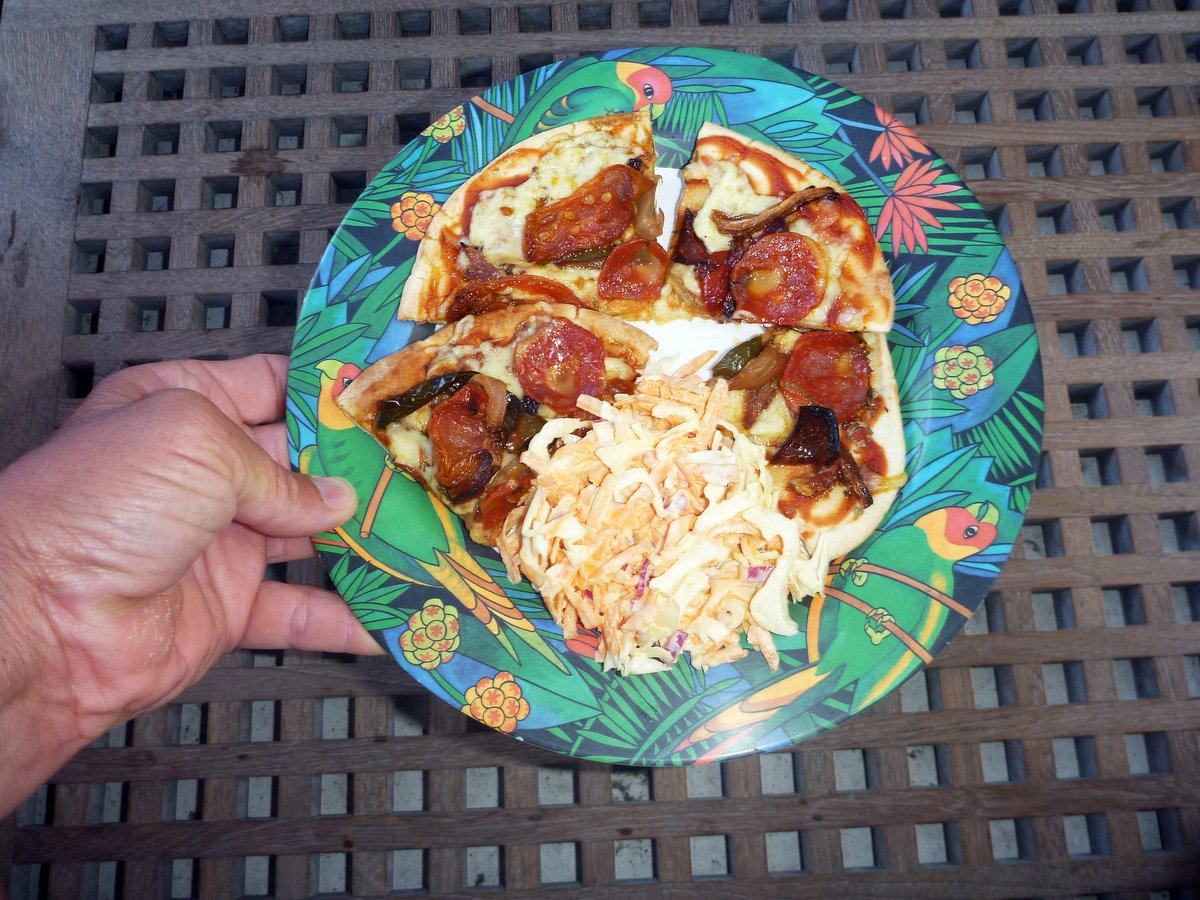
The last of the Dorado has been used up, but we didn't put the fishing line out because both of us are getting a little bit weary of fish for every meal. Glenys made pizza out of some Arabic flat bread that she bought in Santa Cruz - she's calling it Passage Pizza because it was so easy to make. For dinner, we had the old Central American staple of pork with rice and beans.
The afternoon was just another day at sea - I had a nap and Glenys pottered about, glancing up at the wind direction every so often. The clouds built up during the afternoon again and we had a couple of showers, but it was dry as the sun set.
Overnight, the seas were big and chaotic, with 20 knot winds, but at least we were going along nicely at 6-7 knots. While sitting in the cockpit on watch, it seemed quite tranquil (apart from the incessant rolling), but down in the back cabin the roar of the waves catching us up and the occasional surfing was loud. Glenys was quite concerned when she came into the cockpit for her 1-4 watch, thinking that we were running ahead of strong winds, but I was just sat there calmly gazing out at the stars.
11 April 2014 Galapagos to Marquesas (Day 16)
The weather is very consistent at the moment and we've both fallen into fixed routines, so the following is a typical day in the life of Glenys:
It's 4 am and Neville has just woken me to do my 2nd watch of the night. It's hard to get myself out of bed, as I was deep asleep after a restless time the previous off-watch. Going up into the cockpit, it's a lovely night, the stars are out and the wind is steady at 15 knots. It's gradually been calming down after a week of constant 20-25 knots from ESE, and the sea swell is less, although we continue to roll. We still have both headsails out, wing on wing, giving us a fairly comfortable ride.
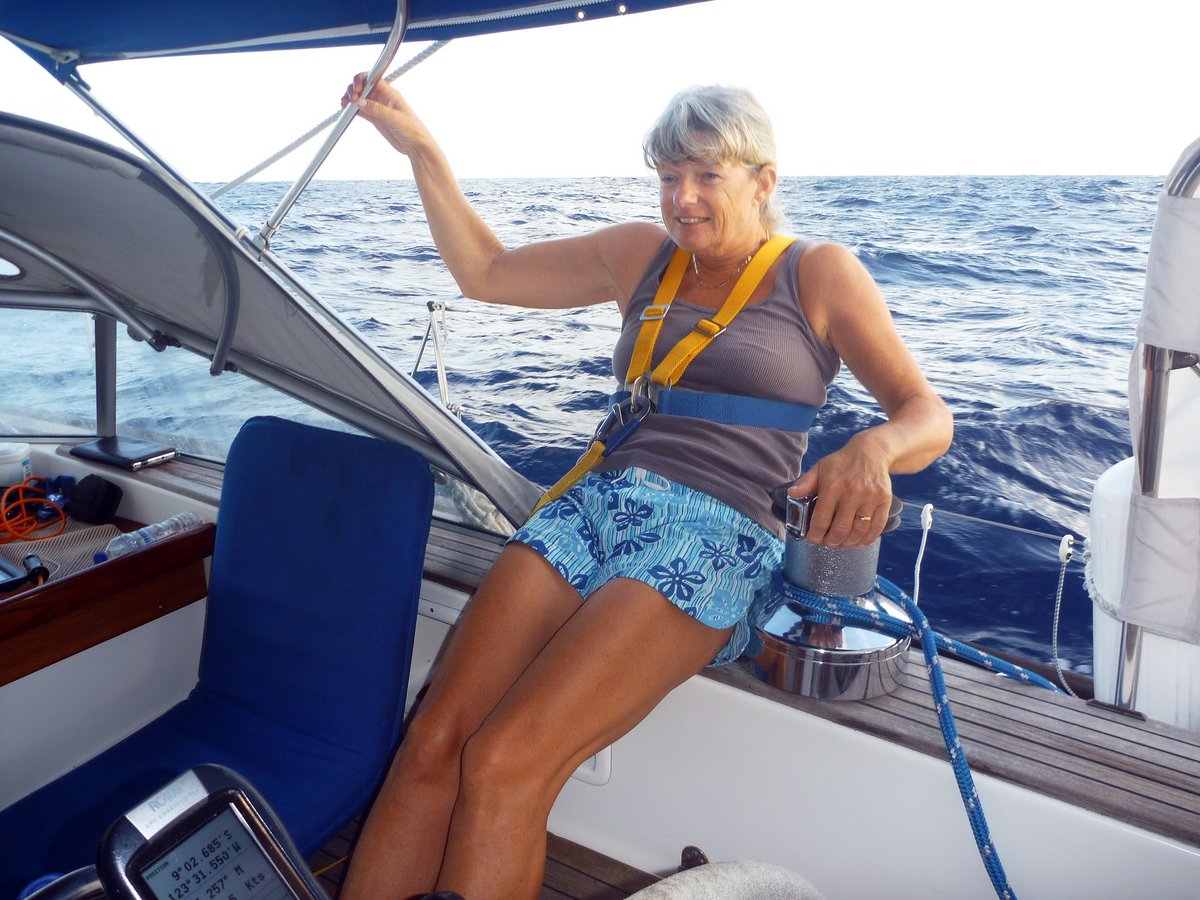
I've been using an app on the i-Pad to recognise some of the stars and constellations - I'm pretty good at knowing where Vega is now, as well as Alpha Centauri and Sirius.
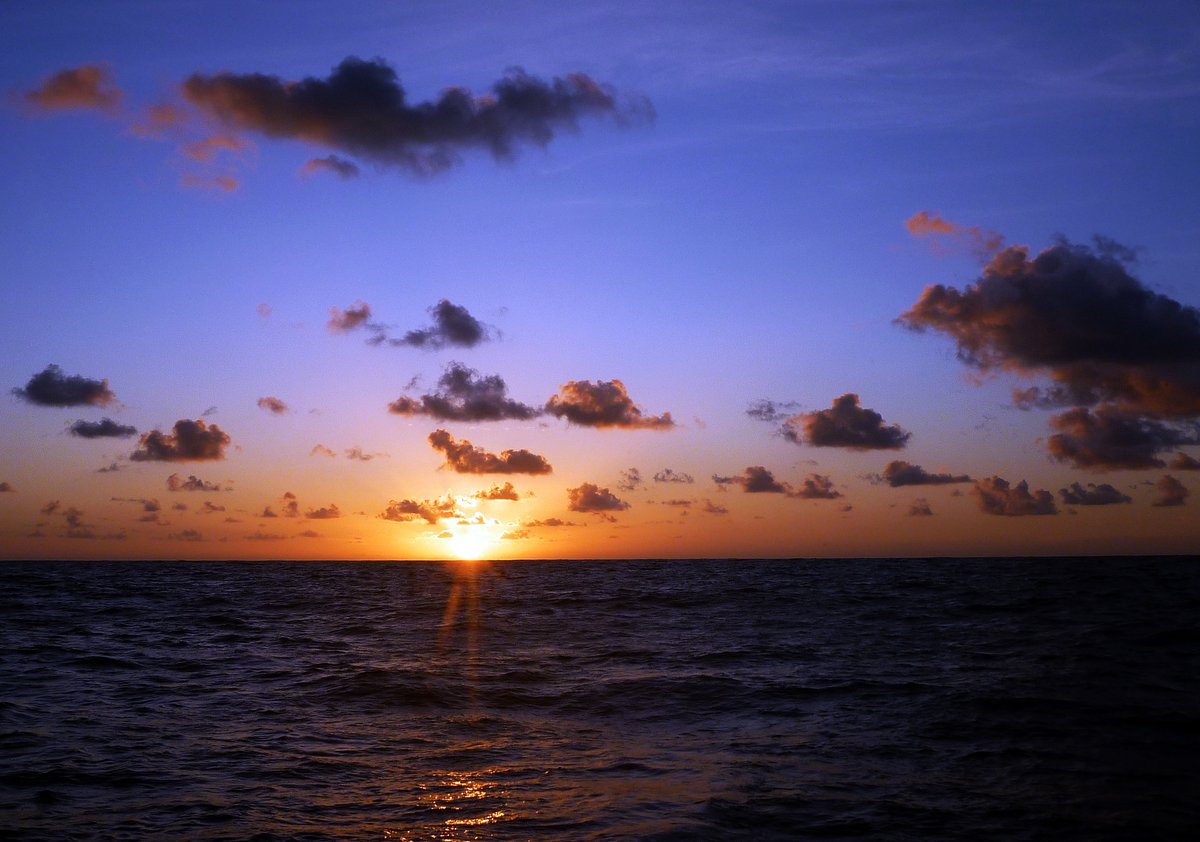
We turned the clocks back one hour yesterday, so I only have to wait an hour before the sky begins to lighten. I've been trying to capture a perfect sunrise on camera - today I go to the back of the boat to take some shots, rather than just leaning out of the cockpit. Hopefully, one of them will pass Neville's quality control.
At 6 am, I write our position in the log and put the kettle on for a cup of tea. I'm a bit random as to when I write an entry, but at least we'll have a last known position if the 3 different GPS devices on-board all decide to fail.
Just after 7am, Neville pops his head up the companionway and catches me doing some sit-ups. I've started doing exercises on the night shifts to help keep my body from atrophying and also to help keep me awake. I've found a great position for sit-ups, sitting sideways on the cockpit coaming next to the genoa winch, and leaning back as far as I can go. For each roll of the boat, I pull myself back up - the deeper the roll, the harder my stomach muscles have to work.
I make breakfast - orange juice & cereal, and then get out the ingredients for making bread. 1/2 hour later, the dough has been kneaded and divided into 2 loaf tins, ready for proving. I place each tin inside a black plastic bag, put them in a sheltered spot in the cockpit, and retire to bed for a couple of hours. When I get up, the bread hasn't risen as much as I would like, but I put the oven on anyway, and bake the bread. By 12.30, I've made some tasty open-topped sandwiches for lunch - it must be alright because Neville asked for more.
I wash up straight after lunch. There's no hot water, so I have to boil a kettle before I can begin. Because we're rolling so much, I have to wash up in one sink, and put the dishes to drain in the other. If I put them on the work surface, everything would end up on the floor. After drying and storing everything away, my galley is now clear and ready for the evening meal's preparation. There hasn't been any hint of a bite from fish on the lines yet, so I've taken some chicken out of the freezer just in case.
I check on my remaining fresh fruit and vegetables to make sure none have gone bad. Half a cucumber needs throwing overboard, and a couple of limes are nearly past their sell by date, but otherwise they all look OK.
Around 1.30 pm Neville goes for his afternoon nap, leaving me to sit quietly in the cockpit, reading a book, making a mental note of little jobs that need doing, catching up on my overall tan. I like this part of the day.
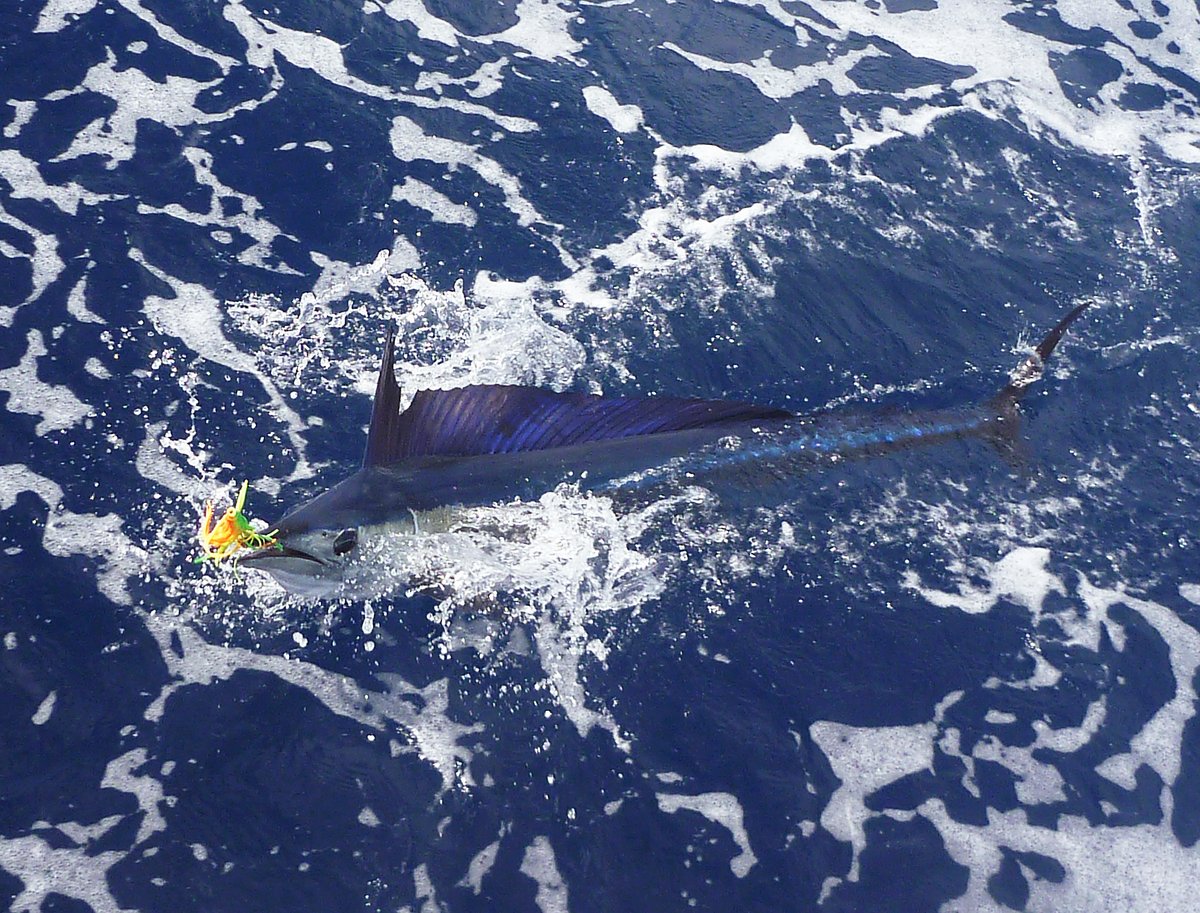
3pm - the fishing line on the rod whizzes out, and out, and out. This must be a big one! Neville hears it in the back cabin and rushes upstairs pulling on clothing as he comes. He spends the next 1/2 hour reeling the fish in - is it a wahoo? No, it's a 5 foot Shortbill Spearfish, and we definitely do not want it on-board. So after playing it for a while, with me taking as many photos as possible of the beautiful fish, Nev gets ready to cut the line. The Spearfish saves him the effort by jumping off the hook in a successful bid for freedom. What a buzz!
Having had no luck with fishing today, (and to be honest, I don't really mind), I start preparing a chicken pasta dish ready for us to eat at 6pm, just as the sun is setting. Again, I wash up straight after dinner, otherwise the clanking of dishes in the sink all night would drive us mad.
I then have a quick, refreshing shower - plenty of hot water now, having run the water-maker for an hour earlier on - say goodnight to Nev and into bed by 7pm.
At 10pm, I'm woken again for the 1st of my night watches. We're rolling a fair bit, so I guess the wind must have died down some more. I jam myself into a secure position to put my contact lenses in. When I go up into the cockpit, it's another lovely night, the stars are out, and the wind is steady.
I read a book, make the odd minor course correction to cater for wind shifts as cloud systems go by, make a jam butty then do some sit-ups to counteract the effect of said butty. When Neville comes up at 1am to take over, I am more than ready to go to bed and get my 3 hours sleep before the start of another day.
12 April 2014 Galapagos to Marquesas (Day 17)
It was a really lovely day; the wind dropped to 15 knots and backed 10 degrees, so that we were going more downwind. The lower wind had made the seas calmer and we rolled less. The GRIB files that I downloaded this morning indicate that these conditions should continue for the next week, with the wind possibly dropping a little bit further.
At midday, we'd done 2,280 miles with 760 miles to go, so if we keep up this rate, we'll be arriving on Thursday, 17th - only 5 sleeps to go.
I'm not 100% certain, but I think that the 18th is Good Friday followed by Easter weekend. If that's the case, we'll probably not be able to clear in at Atuona on Hiva Oa until Tuesday, 22nd April, which would be at least five days of hanging around in an anchorage renowned for being very rolly and crowded - we were only planning on staying there a couple of nights.
So Glenys and I have come up with three options (in order of preference)
1.Call in at The Bay of Virgins on Fatu Hiva - which is supposed to be one of the most beautiful anchorages in the world. However, we risk getting kicked out or even fined $200. (We could try arguing that there's no point in going to Hiva Oa because we can't clear in.)
2.Go to Hanamoenoa on the small island of Tahuata, which is an isolated anchorage about 10 miles past Atuona and is reported to be lovely and calm. We'd then have to come 10 miles back up-wind to clear in at Atuona.
3.Go to Atuona on Hiva Oa and probably be forced to wait five days in a rolly anchorage to clear in.
We obviously need to confirm that next weekend is Easter, so I sent our son Craig an email asking him. I also raised the issue on the SSB net this morning and Dave on "Baraka" is going to email his clearance agent in Hiva Oa to ask if the authorities will be closed for a long weekend. We've got a couple of days to make our minds up where to make our landfall - even in the middle of the Pacific Ocean, we have to worry about bureaucracy.
The afternoon was a chilled out affair, I had a couple of hours kip as usual and then sat at the chart table, editing photographs and creating the pages for our web site, so that I can easily publish them the next time that we have an internet connection.
We had a huge moon for most of the night and the skies were clear, so it was beautiful sliding along at 5 knots in the six foot seas, with the bright moonlight glinting on the waves. The boat was still rolling every five seconds, but there weren't so many rogue waves, so to us it seemed relatively calm.
13 April 2014 Galapagos to Marquesas (Day 18)
I seem to have a very busy routine in the mornings. I was up just after seven o'clock to find that our boat speed was well below five knots, so the first job was to roll away the stay sail and pull out the main. Glenys served up breakfast, then I went down to my laptop on the chart table, finished off yesterday's blog and sent an email to post it to our Passage Blog. I also sent an email to Karsten, our weather router, and a request for a GRIB file.
After waiting for a couple of minutes, I reconnected to the email server and downloaded the GRIB file. The weather looks to be consistent for the next 5 days, with winds from the ESE at 10-15 knots.
I went for a stroll around the deck, checking for any signs of chafe or damage. Today was good - all I had to do was to tighten the ropes lashing the dinghy onto the foredeck because it's deflated a little. On the way around the deck, I threw six Flying Fish over board.
At ten o'clock, I tuned into our small SSB net and chatted to some of the other boats, then plotting their positions.
Having done all of my chores, I spent the rest of the morning at the chart table, continuing to work on photographs and web pages. Occasionally, I climbed into the cockpit to have a quick look around, checked the wind direction, checked our course over the ground and went back down below. Thank God for autopilots.
I received some more information about the Easter weekend and Fatu Hiva. Dave from "Baraka" received a reply from his agent in Hiva Oa, who says that the gendarmerie is open on Friday, Saturday and Monday over the Easter weekend, so we should be able to clear in there, but I don't believe it. I also received an email from our friends on "Vanupied", who have just visited Fatu Hiva and had no problems. So, we've decided to make our landfall at Fatu Hiva, stay for 3 or 4 days and then go to Hiva Oa to clear in.
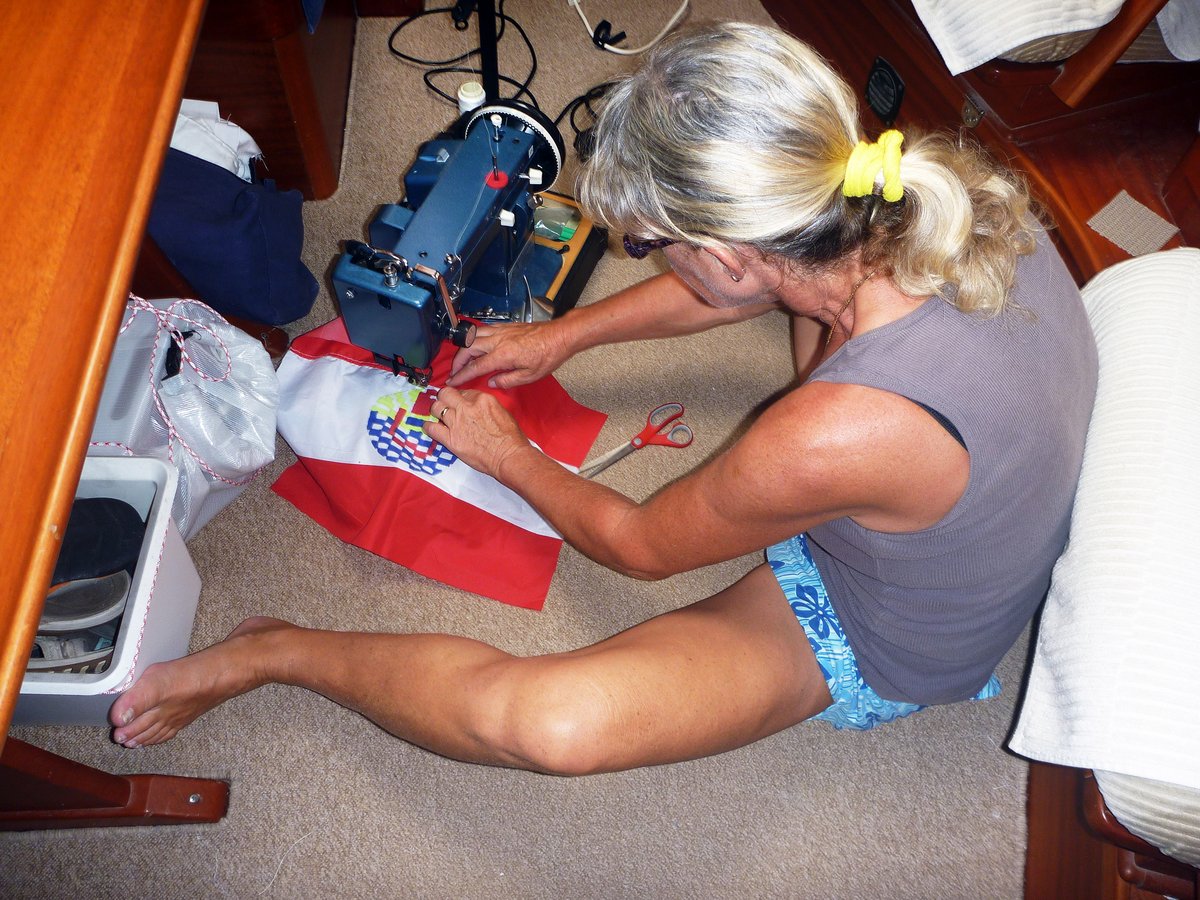
The afternoon was very peaceful, sailing at 5-6 knots in relatively calm seas. Glenys even felt motivated enough to get the sewing machine out and made a Marquesan courtesy flag.
The weather has been very consistent today, so we didn't bother to reef for the night, but carried on with the full main and genoa goose-winged out. Once again we had a full moon, which makes the night watches so much more pleasant. It was another lovely night - long may they continue.
14 April 2014 Galapagos to Marquesas (Day 19)
Last night, I noticed that our batteries were getting low on charge, so I turned off the beer fridge and my laptop (which has been permanently running for 18 days). We're obviously using more power than we're generating at the moment, mostly because the wind has dropped off and we're not getting a lot of charge from the wind generator.
So, to give the batteries a boost, I ran the engine for an hour this morning - it hasn't been run for two weeks, so it was good to run it. Later on in the afternoon, we also ran the generator for an hour and made some water, so hopefully, we've put enough back in the batteries for the solar panels to keep them topped up.
Since I caught the Shortbill Spearfish a few days ago, we've not had much luck with fishing, so I made some new lures from different coloured rubber squid. I've been using red/white and green/yellow for the past couple of days with not a single bite, so I swapped to dark blue and fluorescent green this morning. Just after lunch, got a strike on the blue lure on my rod, the line screamed out, but in my panic, I put too much drag on too quickly and lost the fish - what ever it was, it felt bigger than the Spearfish.
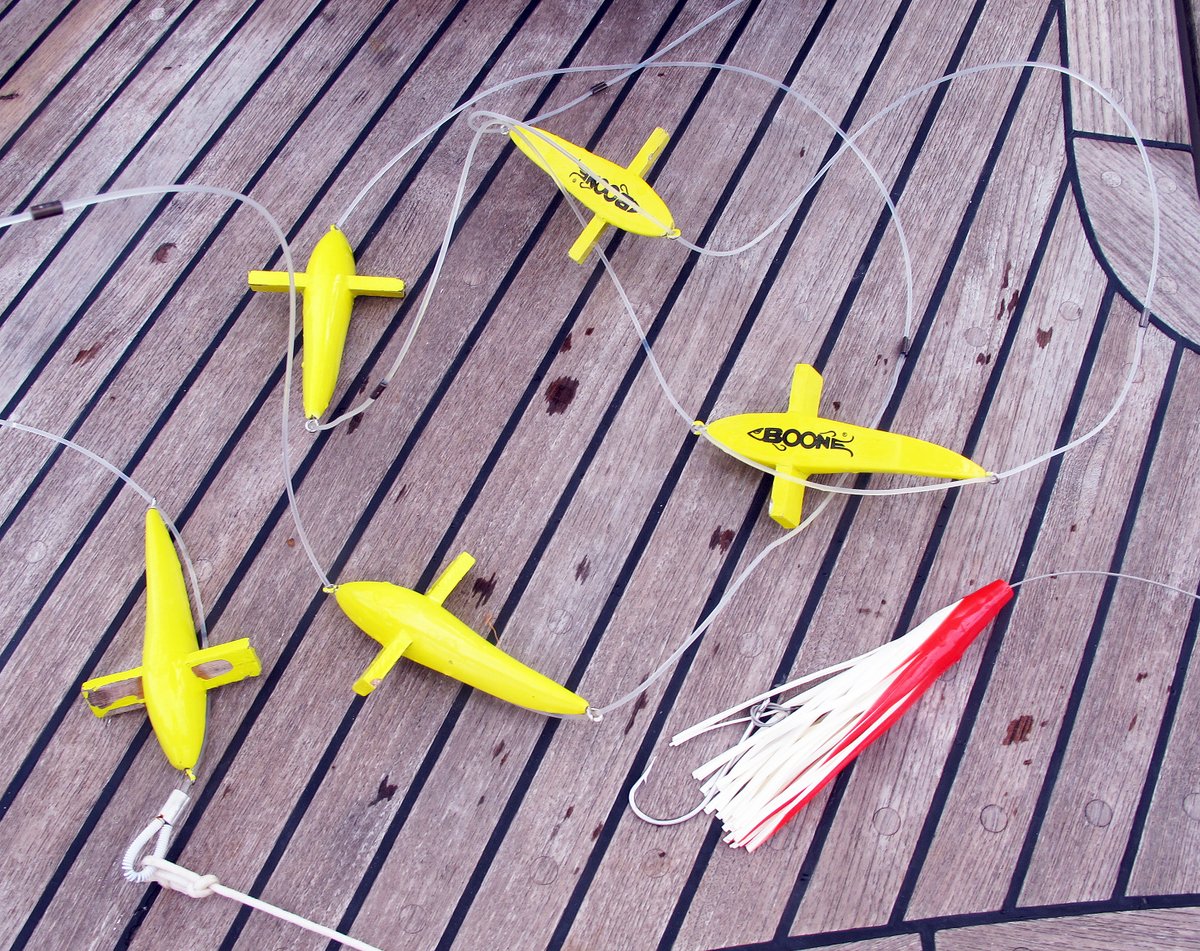
Then, while I was having my afternoon nap, Glenys heard the rattle of the hand line, but before she could get up to look, the fish snapped the 3 mm nylon braided cord! The line parted at a knot that I'd put in the line (knots reduce the strength of rope), but even so, it took a lot of force to break it. Goodness knows what it was, but it was very big. The worst thing about the line snapping was that, as well as losing a lure, some behemoth of the deep is now dragging around my beloved Birds.
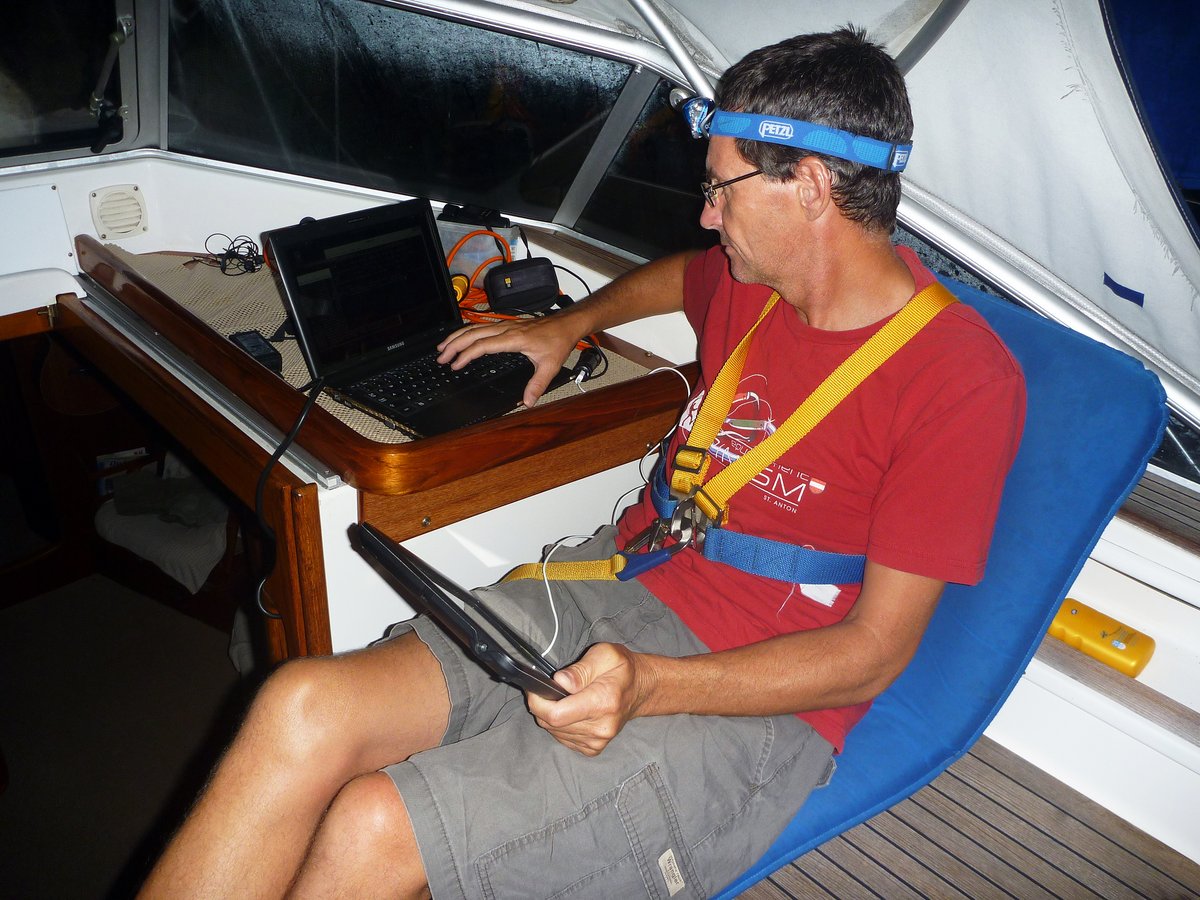
There's something weird happening to our autopilot. Over the past week, it has suddenly changed course three times causing sails to back. It happened again this afternoon, so I switched the autopilot off and then back on to reset everything. I then noticed that the giro compass reading was 20-30 degrees different to the magnetic compass.
A couple of hours later, the autopilot decided to turn 20 degrees to starboard and we found that the giro has corrected itself. I guess that it needs to be recalibrated, but we'll need to do that in calmer water because we need to motor round in large slow 360 degree circles.
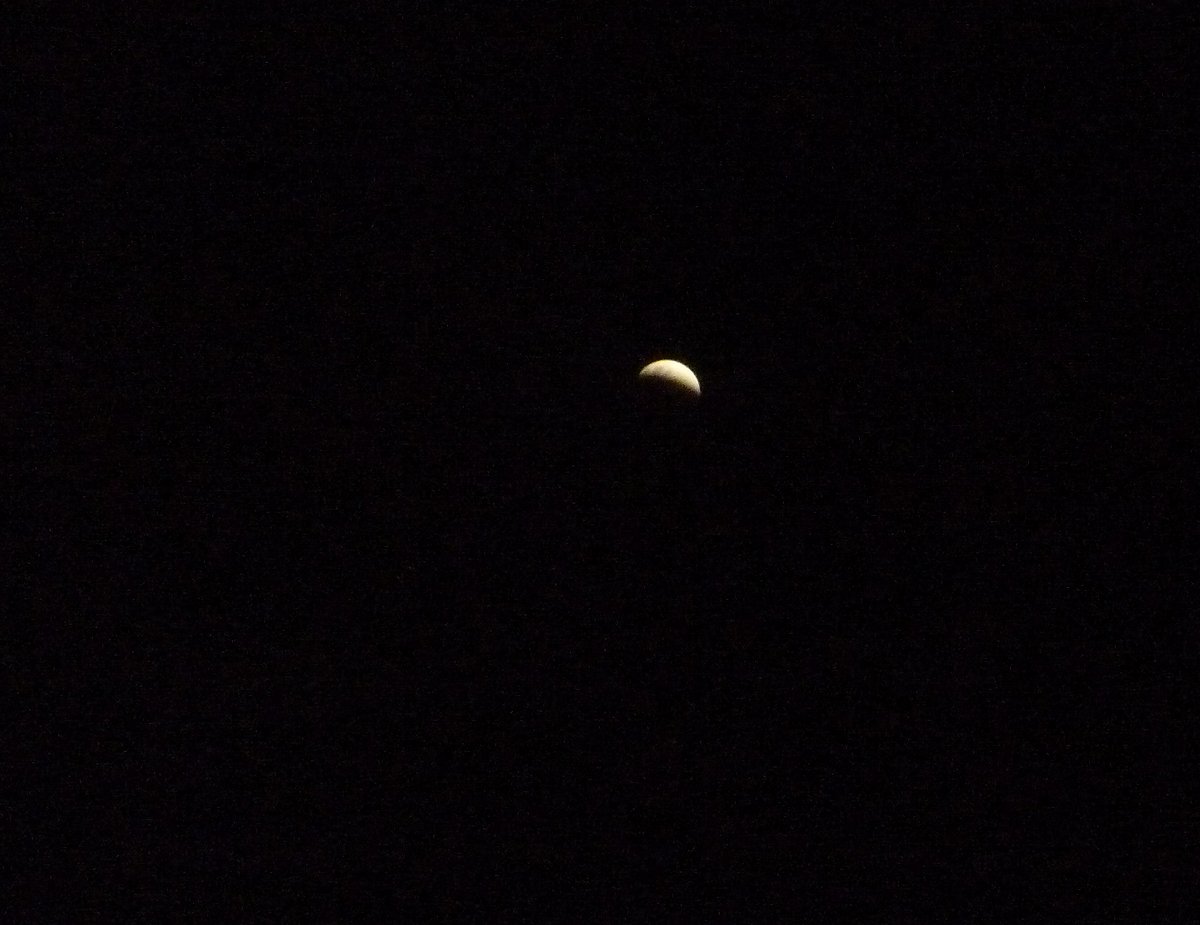
It was a lovely night, sailing smoothly along at 5-6 knots in calm seas with a huge bright moon. To make things even better, we were privileged to witness a full eclipse of the moon. The shadow of the earth started to nibble away the bottom edge of the moon at around ten o'clock. A couple of hours later, the moon was totally eclipsed and had turned a spooky red - I believe that they call this a blood moon. The moon then slowly emerged from the earth's shadow and the rest of the night was brightly lit by the full moon once again. Amazing.
The weather has been so good for the last few days that I've spent my night watches jammed into a corner of the cockpit working on another little project, which is learning how to hack into a wireless network. I've set up a kind of test lab with two laptops connected to our wireless router. With this setup, I'm able to recreate the various security protocols that are set up on wireless routers and I'm trying to learn how to break their security.
Sounds like a weird thing to be doing in the middle of the Pacific Ocean, but hopefully, it will enable me to "borrow" a little internet time on wireless routers that I find in the anchorages ahead. I don't think that there are many Pay-As-You-Go internet hotspots in the South Pacific Islands.
I'm finding it fascinating, but for some reason Glenys' eyes glaze over when I start enthusing about the differences in the encryption algorithms between WEP and WPA.
As dawn approached, the wind veered 10-15 degrees, so I had to do a bit of work and gybe the genoa to the starboard side - we're now on a pleasant broad reach.
15 April 2014 Galapagos to Marquesas (Day 20)
I dragged myself out of bed at half past seven and staggered into the saloon to find Glenys kneading bread dough in the galley - nice to know that we're going to have fresh bread today.
So far, we've done 2,700 miles with only 330 miles to go. In the last 24 hours, we’ve done 150 miles, so if we manage to keep up this pace, then we'll arrive in the afternoon of the 17th, which would be nice. Otherwise, we might have to heave-to off Fatu Hiva for a night, which would be a tad frustrating.
There were 10 boats on the SSB net this morning, all doing fine and enjoying this very settled weather. We had a quick straw poll of where each boat was making landfall - four (including us) are going to Fatu Hiva, four to Hiva Oa and two are going further on to Nuka Hiva.
I was sat in the cockpit in the morning when I suddenly heard a large exhaling sound next to the boat. I whipped my head around and caught sight of a large black shape just off our starboard quarter. It surfaced again about two boat lengths away and then disappeared. It had a reasonably large fin, was bigger and darker than a dolphin, so we think that it was some kind of Pilot Whale.
Though fleeting, this is the first sign of life that we've seen for 20 days apart from a few sea birds, the four fish that we've caught and a few million Flying Fish of course. This stretch of ocean is the most barren that we've sailed. We were expecting to see pods of dolphin occasionally, but none have appeared so far - perhaps they're just shy.
In the last week, I seem to have been attracting huge fish to my fishing lures. I've been using wire traces and thought that perhaps the smaller fish are spotting the thicker trace, so I made up a blue squid lure with a 60lb translucent monofilament trace and put it out on my rod. It didn't work, I still didn't get a sniff of a bite all day.
The wind fluctuated between 12 and 18 knots throughout the day, and also varied in direction slightly, so we had to gybe the genoa a few times. Having the main held out to starboard with a preventer and the spinnaker pole fixed out to port is working very well for us. If the wind comes from 90-135 degrees on our port side, then we pull the genoa to starboard on a broad reach.
However, if the wind backs to 135-180 degrees on our port side, then the genoa (set to starboard) loses wind in the lee of the mainsail. So we simply pull the genoa out to port on the spinnaker pole and, in a wing-on-wing configuration, the genoa has clean air again. It's magic. We even had the stay sail out to starboard as well for most of the day, which gave us a little more speed.
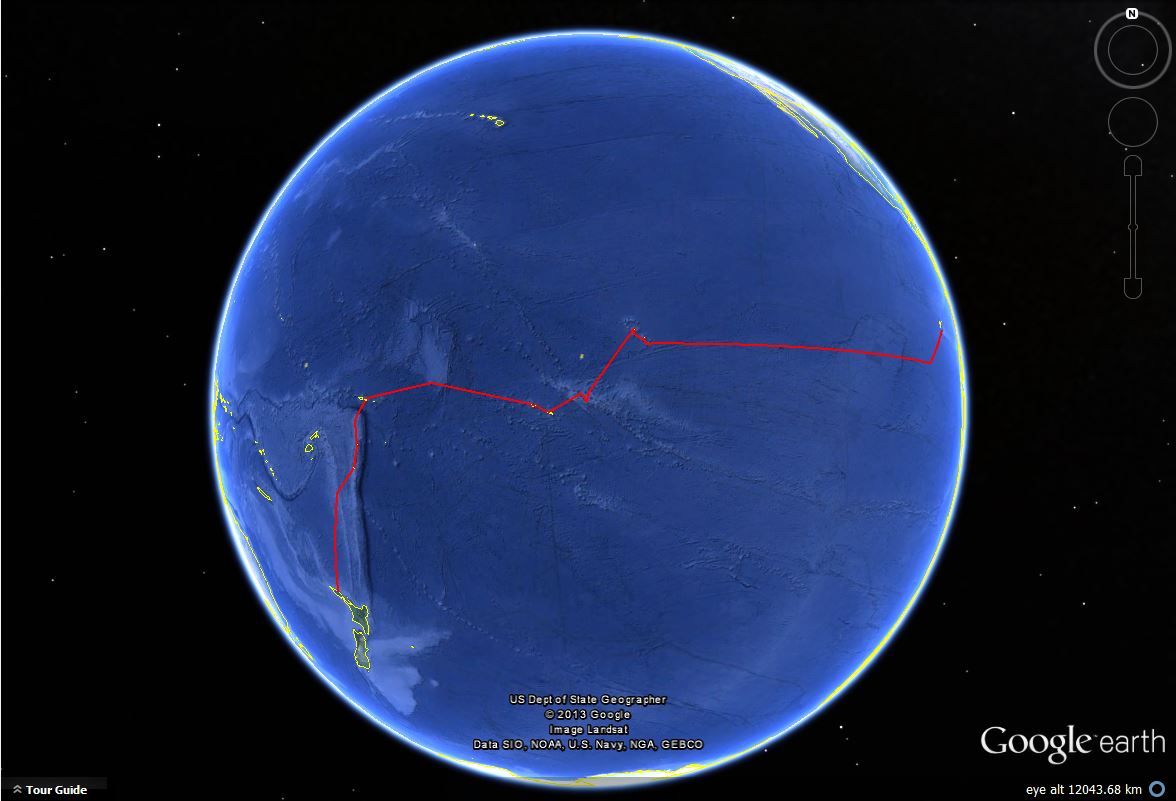
In an idle moment on my first night watch, I created a path on Google Earth, which shows our planned route across the Pacific from Galapagos to New Zealand. When I'd finished, I zoomed out to show the whole planet and it's amazing how big the Pacific Ocean is - it almost covers one half of the Earth. It's very humbling to think that we're crossing that huge expanse of water.
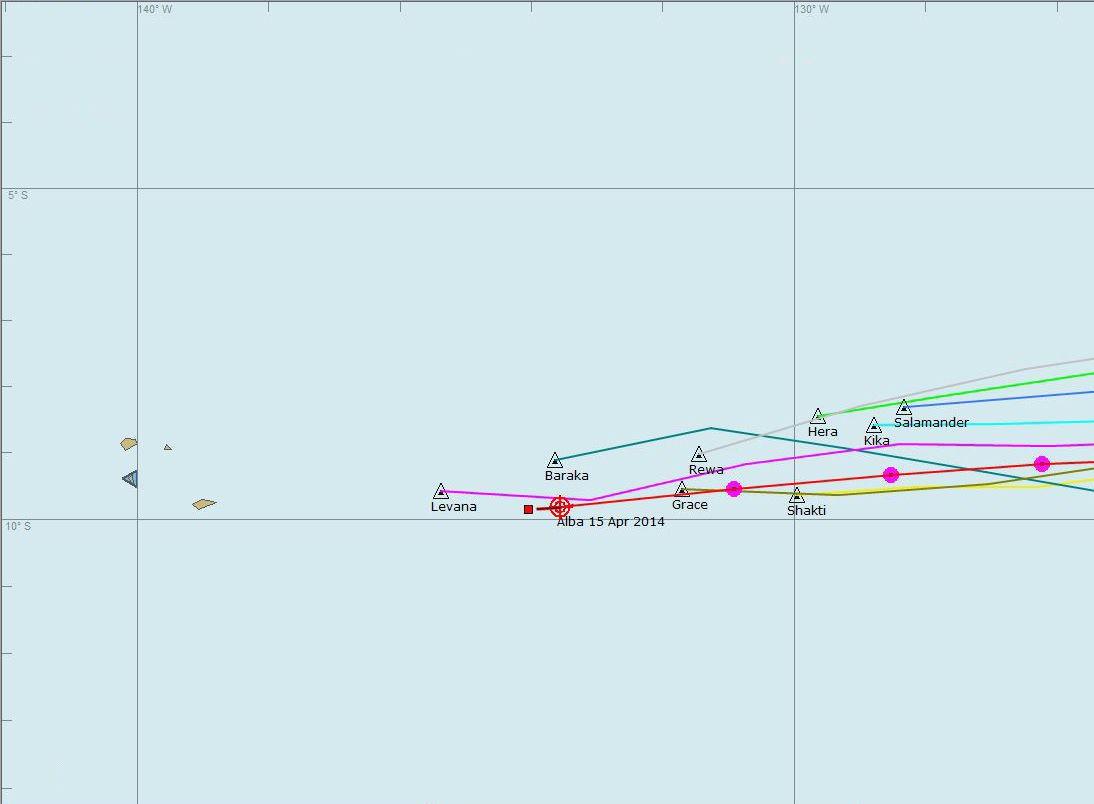
We crossed longitude 135 degrees west, so I turned the clocks back during the night. The Marquesas is on a very strange time zone of - 9.5 hours, so the clocks went back 1-1/2 hours. I came up with a cunning plan to adjust our night watches so that we each got an extra 45 minutes in bed. Glenys struggled to understand my convoluted logic and she's suspicious that I've wangled 1-1/2 hours extra in bed just for myself - as if...
It was a lovely night again with a bright moon - one couldn't ask for nicer sailing conditions. We kept all our sails out - full main, genoa poled out wing-on-wing and even the stay sail was deployed. We're now on a mission to keep up our boat speed to make sure that we make landfall on the 17th.
16 April 2014 Galapagos to Marquesas (Day 21)
I woke at half past six and couldn't get back to sleep - a combination of time zone changes and my excitement that we were nearly at the end of our passage. At 0800, we had 165 miles to go, so there was a good chance the we would drop our anchor in Fatu Hiva the next day.
There were 10 boats on the SSB net, all doing fine. "Baraka" was about the same distance from Fatu Hiva as we were and so they should be arriving at the anchorage around the same time. We had light 10-15 knot winds all day with the direction slowly backing to be from the east by late afternoon, so we had a very relaxing day, ending up running dead down wind.
Before dinner, Glenys went into the front heads to have a shower, and I was down below receiving a weather email, when suddenly the boat turned to hard to starboard. By the time that I'd got up to the steering wheel, we had hove-to with the main backed - thank goodness that I had a preventer on the main boom.
I turned the boat back onto the correct heading and saw that, once again, the heading on the autopilot was different to our magnetic compass, this time it was out by 50 degrees. This was the fourth time that the autopilot had freaked out and it seemed to happen when Glenys was in the front heads - what on earth was she doing?
When she came up to the cockpit, she ran through everything that she had just done - she went to the toilet, had a shower holding the shower head in her hand and then ran the shower pump. It was more or less exactly the same thing that I do. The flux gate compass for the autopilot is in a cupboard on the other side of the shower room bulkhead wall - perhaps she builds up a lot of static electricity and had discharged it when she switches on the light or something?
We ran through everything that she did in the front heads again in great detail - where she stands, what she holds, how she braces herself while on the toilet and what she leans against when she's showering, etc. The only thing that she did different to me was she leans against the bulkhead wall when she's showering.
I went into the shower room and banged on the bulkhead wall and to my amazement, the autopilot turned to port and the flux gate compass corrected itself. Mystery solved - we must have a loose connection or an intermittent fault on the flux gate compass. At least we know that all we need to do is bang on the wall if it goes wrong again...
At sunset, we had 100 miles to go, but the wind had dropped right off and we were only managing 3-4 knots through the water. Fortunately, we had a favourable 1 knot current pushing our speed over the ground up to 4-5 knots, so there was a fighting chance that we'd have less than 50 miles to go at dawn and we could motor the rest of the way.
It was a lovely moonlit night and calm enough that I could listen to my French language course. We've been in spanish speaking countries for well over a year and I never got to grips with the language. I could speak enough Spanish to be able to get by as long as I could wave my arms around and point, but I couldn't have a conversation other than "I want", "Where is", etc. It was very frustrating not to be able to have a "chat" with the locals.
We'll only be in French Polynesia for three or four months, but I'm determined to speak French better than I can Spanish. I learned French at school for four years and have spent many weeks on holiday in France, so I should be able to pick it up a bit easier - I just need to put the effort in...
At 0400, we were still plodding along at 3-4 knots through the water and had 50 miles to go, so we weren't doing too bad, but it seemed frustratingly slow especially with the sails slatting as we rolled in the light winds.
17 April 2014 Galapagos to Marquesas (Day 22)
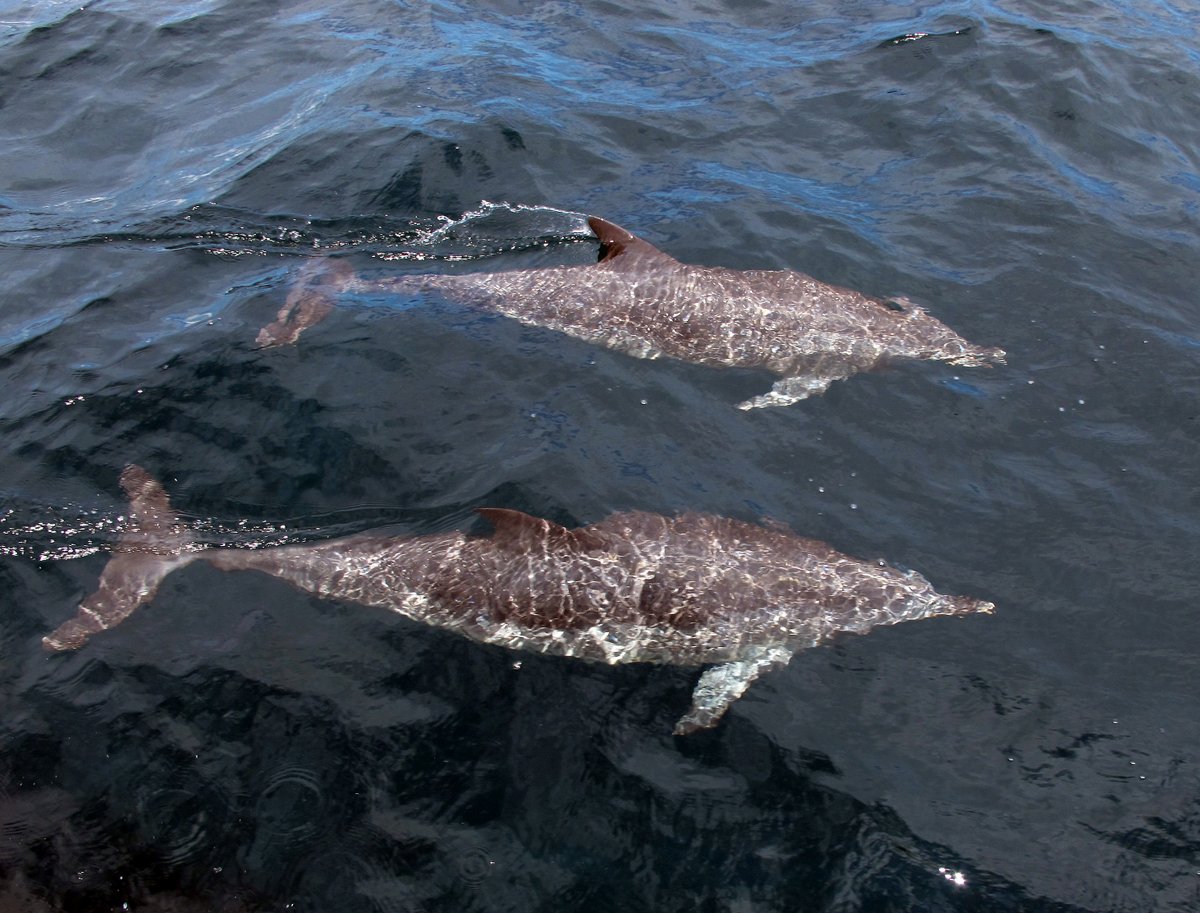
When I got up this morning, I found Glenys kneeling at the bow of the boat taking photographs of dolphins - our first in 3,000 miles of sailing across the Pacific Ocean. Their skin was very mottled with large random patches of pale colour, almost like they had been sunburnt and peeled.
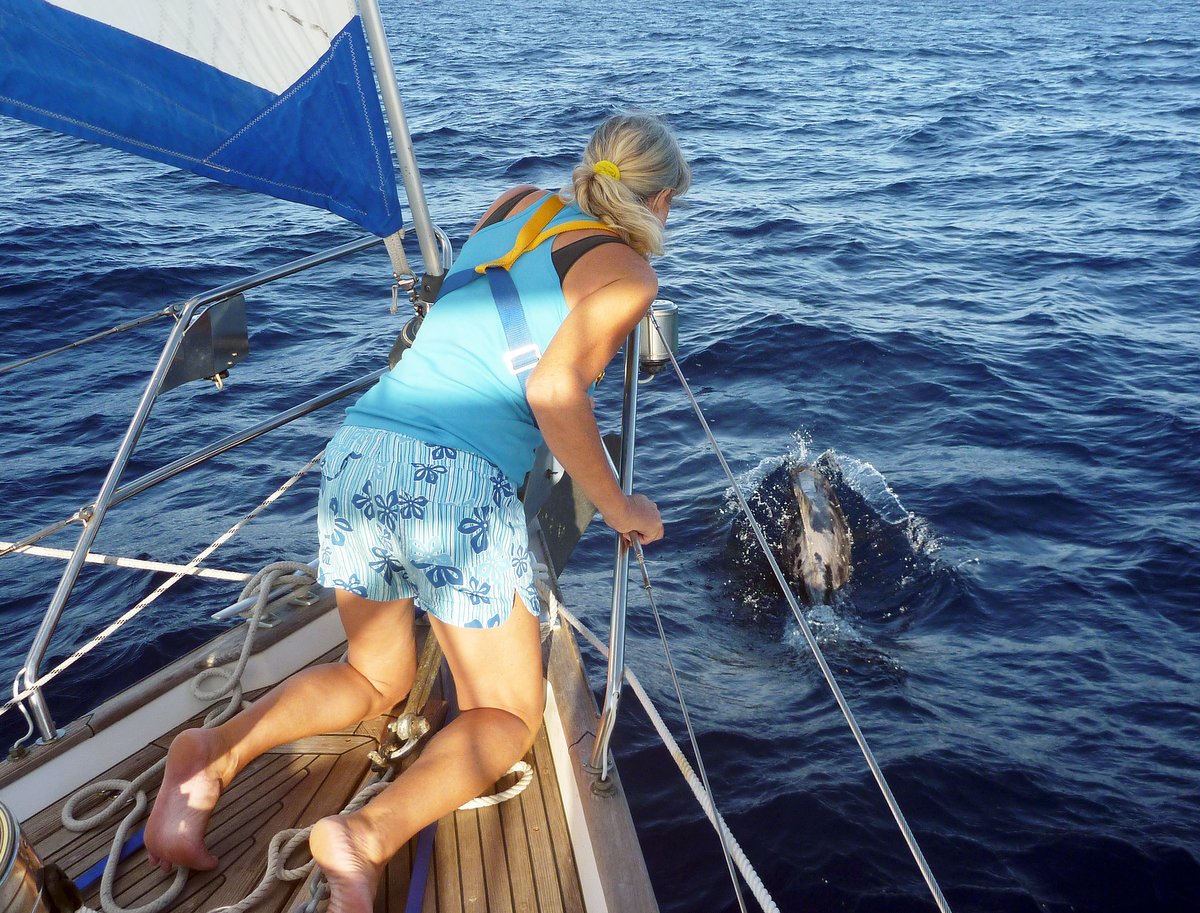
I'm tempted to name them Marquesan Scruffy Dolphins, but I'm pretty sure that they were Pantropical Spotted Dolphins. According to our Whales and Dolphins book, young dolphins of this species have no spots and the spots grow larger as the dolphins mature, to the extent that they appear to be large patches .
When I looked up from watching the antics of the dolphins, I could see the faint outline of the mountainous island of Fatu Hiva ahead of us. We were still plodding along at 5 knots over the ground, but with only 35 miles to go, we'd definitely be there by the afternoon.
At 0830, I called into our SSB net and there are now 16 boats on the roll call. A group of six other boats left the Galapagos a few days after us and have found our frequency, so they're going to keep it going after we all make our landfalls. It's been a very useful net and good to hear from the other boats out here - I'm glad that I made the small effort to organise it before we left Isabella.
It's funny how the net morphed from being a loose collection of boats calling each other up, to quite a formal net with a structure. At first, I was acting as the main initiator of conversations, but my radio isn't very powerful, so I soon handed it over Sasha on "Levana", who could talk to the more distant boats. Then Dave from "Baraka", who has a very good radio, started to initiate the conversations and, by default, became the "Net Controller". The new boats are now discussing who's going to be the formal Net Controller when Dave makes his landfall today.
After the net, I couldn't resist getting the spinnaker out. It was such a beautiful day with a light 10 knot breeze. Glenys was all for sitting in the cockpit reading her book, but my enthusiasm won her over. Funnily enough we didn't have much more boat speed because I had to roll away the genoa and the stay sail and then heavily reef the main sail because it kept taking the wind from the spinnaker. It looked pretty though.
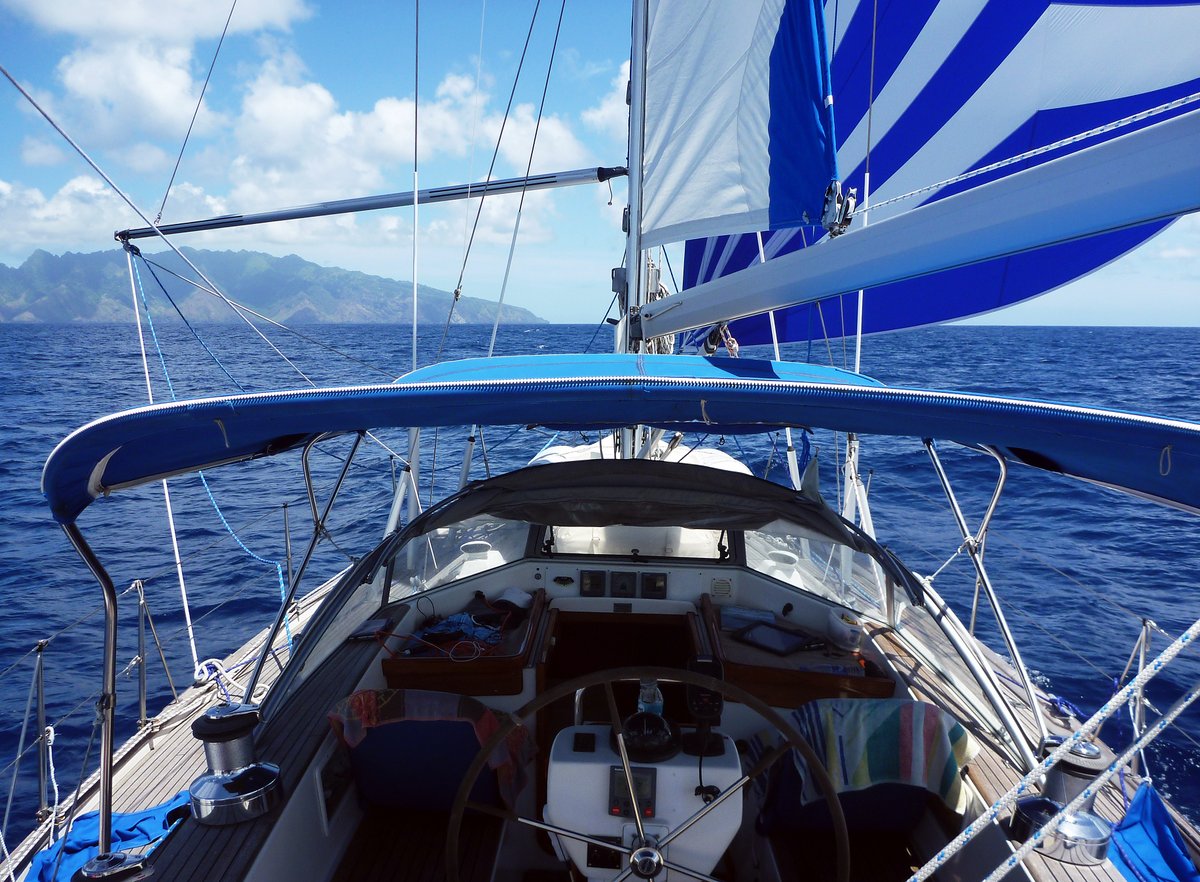
By two o'clock, we were approaching the north of Fatu Hiva and the wind picked up around the end of the island. I was expecting an acceleration zone, so we were ready to quickly trip the spinnaker and sleeve it. We then had a great sail for half an hour with main and genoa as we rounded the island. The wind dropped when we hit the leeward side, so we turned the engine on and scurried around taking the pole down and making the boat look presentable - we might have been at sea for 21 days, but there are certain standards to be maintained.
There were thirteen other boats already anchored in the Bay Of Virgins and the seabed drops off very, very steeply from ten metres. One minute you're in 50 metres of water then suddenly you're in ten metres. We wandered around for fifteen minutes and tried to anchor in five metres at the head of the bay, but the bottom was just rock and we dragged. We eventually found a spot in 10 metres between the north side of the bay and the other yachts, but it took two attempts before we were happy. We're close to the rocky shore, but I think that we'll be okay.
The anchorage is very spectacular and I can see why people rave about it. The bay is surrounded by very steep, high slopes covered in coconut palms and other vegetation. Huge pinnacles of conglomerate rock thrust up from the green slopes. At the head of the bay is a valley with the village and beyond that there's a pass through steep cliffs that leads to some very impressive slopes climbing up to a knife-edge ridge 900 metres above us.
The sailors who frequented this bay in the 1600s, originally named it "Baie de Verges" (Bay of Penises), but the missionaries who followed were outraged and slipped an "i" into the name making it the "Baie de Vierges" (Bay of Virgins).
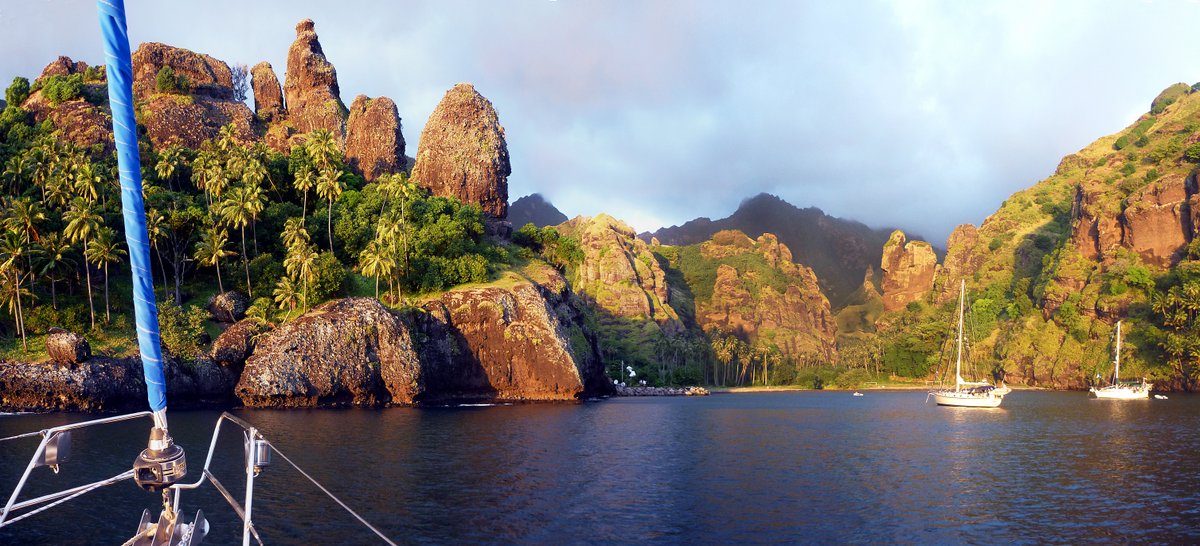
Once we were anchored, we cracked open a cold beer - it was the best beer I've ever had... This last three weeks has been the longest time that I've been without drinking alcohol since I was a teenager. Funnily enough, I haven't missed my evening beer when we were at sea, but it was the first thing in my mind when the anchor dug in...
Just as night fell, a small boat with three local guys came over and traded us a big bunch of bananas and four pamplemousse for a small bottle of rum. They probably got the better end of the deal, but we weren't bothered because we got some fresh fruit and we were keen to try the famous Marquesan pamplemousse, which are huge grapefruit that are supposed to be quite sweet – but we left that pleasure for tomorrow and, not surprisingly, had an early night.
18 April 2014 Bay of Virgins, Fatu Hiva, Marquesas
We were up fairly early because we couldn't sleep with a new place to explore. The pamplemousse that we had for breakfast was very tasty and juicy, but still needed some sugar – someone told us later that they’re sweet when ripe later in the season. We enjoyed it and no doubt will be eating lots more.
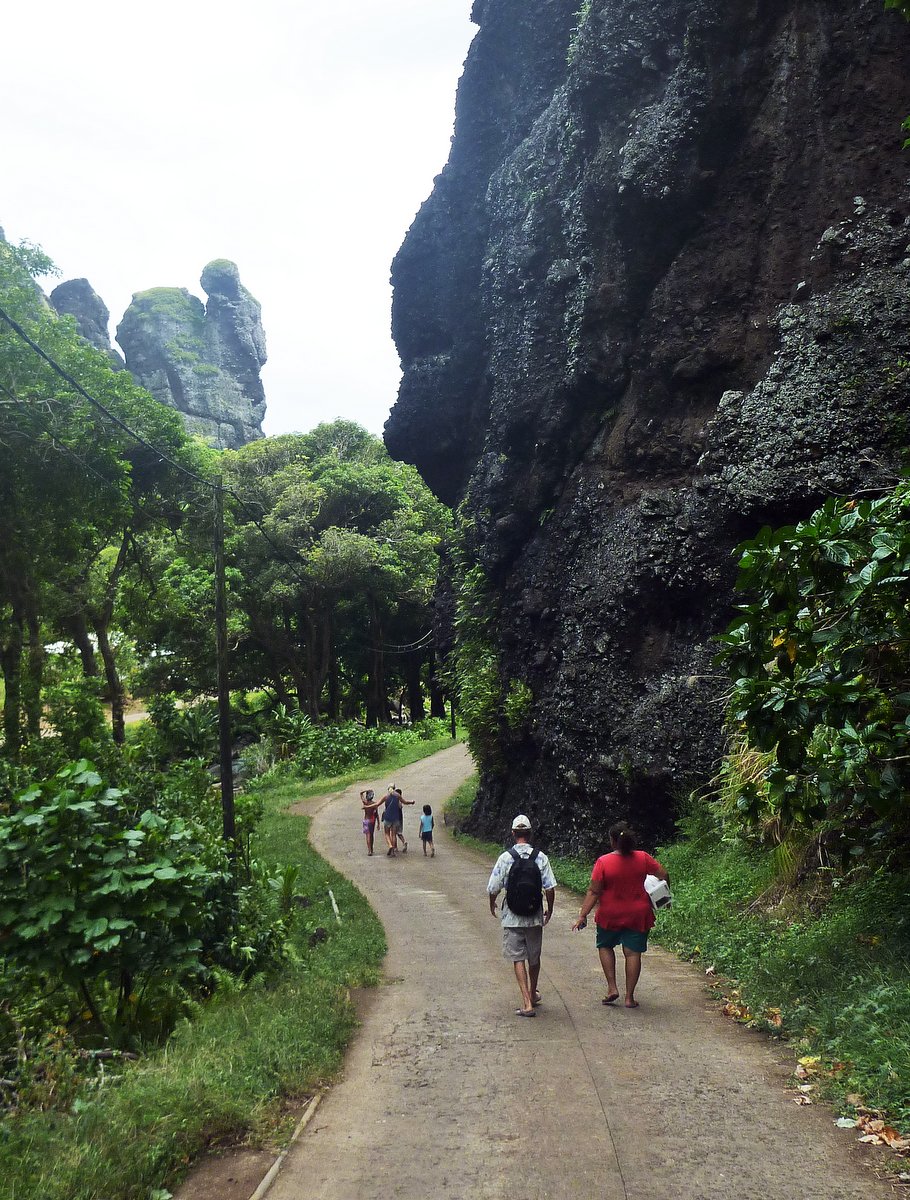
We pottered around on the boat for a few hours, tidying up and I did a bit of admin, printing out some documentation ready to clear in. We dropped the dinghy into the water, put on the small outboard and went ashore, leaving the dinghy tied up to a concrete dock behind a breakwater. Within minutes, we had ladies coming up asking if we wanted to have a traditional Marquesan dinner. We politely declined for now.
The village is very tidy with small single story concrete houses. Each of the houses has their own gardens which are nicely maintained and there are fruit trees and flowering bushes everywhere you look. But it’s the surrounding landscape that constantly catches the eye. Huge cliffs surround the village and beyond them are very steep, verdant slopes going up to the ridges high above.
We walked along the concrete road from the dock and came across a small grocery shop, where we met Dave and Jan from “Baraka”. There was also another cruiser who had some Polynesian Francs and he kindly changed $20 for us, so that we could buy some bread. Well actually, the shop had run out of bread, but they were going to make another batch for the cruisers that were milling about – we had to go back in an hour.
We went for a stroll with Dave and Jan further along the road and were accompanied by a young lady and three kids, who were obviously intent on selling us some fruit. The village is bigger that I first thought and is spread out along the valley. We walked as far as a steep bend in the road and decided that was enough exercise for our passage-atrophied legs.
Several times, we were invited into houses to look at wood carvings. This island is known for wood carvings, which are lovely, but they're a little too large for our small boat and are quite expensive – the cheapest starting at $30 US. They will sell cheaper (with the incentive of a bottle of rum), but I think that we’ll wait until we find a nice small carving of a Tiki.
When we got back to the dock, Glenys bought a bag of oranges from the lady and swapped a pack of playing cards for another pamplemoose with one of the boys.
After lunch (and a short nap), we jumped into the water and started to clean our hull which was disgusting, covered in green algae and Gooseneck Barnacles. The algae was at least half way up the hull and some of it was very tenacious – after three hours of scraping and scrubbing, we’ve done three quarters of the hull.

We had Dave and Jan from “Baraka” over for sun-downers.
19 April 2014 Bay of Virgins, Fatu Hiva, Marquesas
We had a quiet chill-out day. I caught up with sorting through editing all my photographs and updated my web pages, while Glenys read a book and stared at the scenery.
In the afternoon, I jumped into the water and went for a snorkel along the rocky shore only 25 metres from where we’re anchored. It’s a nice rock reef that drops of very steeply to 8 metres with some coral and a fair number of fish. The water visibility was 8-10 metres, so it was very pleasant - I saw quite a few Moorish Idols.
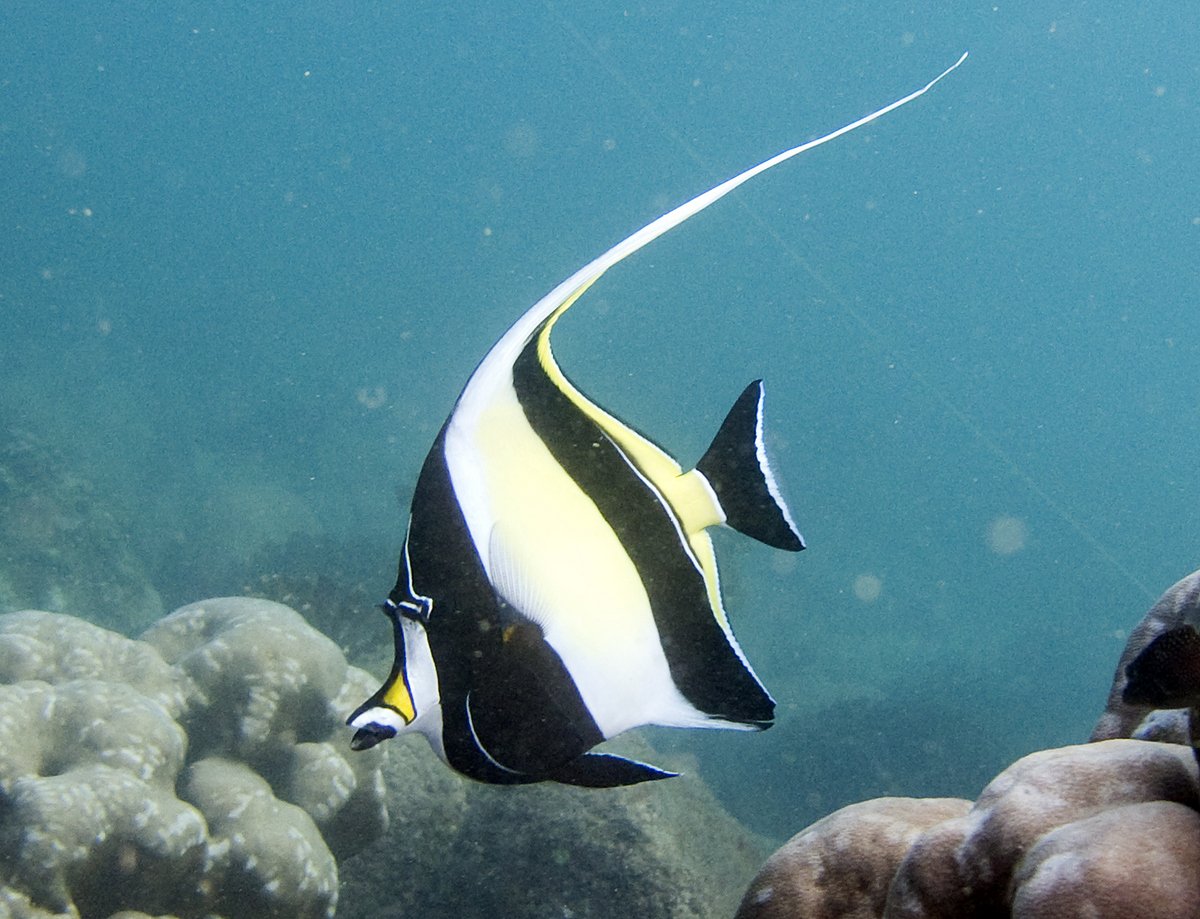
By the time that I swam back to the boat, Glenys was in the water scrubbing the growth off the hull so I joined her and spent a couple of hours until the job was done. Alba looks nice and clean for now.
There are lots of big, one-inch long Wood Wasps in the anchorage; they fly slowly around the boat with their long legs dangling behind them, checking out everything. We’re not sure what they’re after, but they’re not aggressive and move if gently shooed away. However, this afternoon, Glenys went to get some bananas that were hanging on the arch and unfortunately, grabbed a banana that had one of these wasps on it. The sting that she got was very painful. She went into a state of shock and cried out, “I'm not going to die, am I?” We’re now very careful to look around before we grab hold of anything.

“Shakti” and ”Salamander” arrived today and all the boats that were on our little SSB Net were invited over to “Dragonfly” by Jill and Al – as you can imagine there were lots of “No shit, there I was” stories about our respective Pacific crossings.
20 April 2014 Bay of Virgins, Fatu Hiva, Marquesas
We went for a hike up to the waterfall up at the head of the valley. Being Easter Sunday, a lot of the villagers were inside the church as we walked past, so we didn't have an escort of cheeky kids walking along with us. We strolled through the village, around a steep s-bend in the road and took the next dirt track on the left, where someone has built a small cairn.
This dirt road took us through lush farmland past banana trees, coconut palms, copra drying sheds and hedges of flowering shrubs - very, very pretty. After fifteen minutes, the road petered out when it converged with the river and the path to the waterfall went up sharply to the left. From there it was a pleasant walk through woodland along a path strewn with lovely big flowers.
We reached the waterfall after another fifteen minutes of steep walking and, although there wasn't much water, the waterfall is an impressive sight being over 100 foot high. After taking a few photographs, we retraced our steps back to the main road, where we decided to turn left and go for a walk further along the road.
The concrete road grinds up remorselessly at about 20 degrees, so it was a bit of a shock to our little legs. At each of the switchback bends, we were rewarded with fabulous views of the valley and the ridges towering above. We also had great views looking down at the village of Hanavere and the occasional, fleeting glimpses of the anchorage beyond. After an half an hour, I was on a mission to get to somewhere that would give us a good view down on the anchorage.
After another hour of trudging, we arrived at a radio relay station perched very high on the hill overlooking the anchorage and, by scrambling down to a slightly lower hilltop, I was finally able to get a good view down onto our boat and take some photographs.
Feeling pretty tired, we turned around and walked back down the road, stopping occasionally to watch pairs of lovely, white Tropicbirds having a whale of a time riding the air currents high above the valley. We also spotted a pretty bird that looked like a small dove, but with green wings, which blended in very well against the green leaves of the trees - I believe that it was a Fruit Dove.
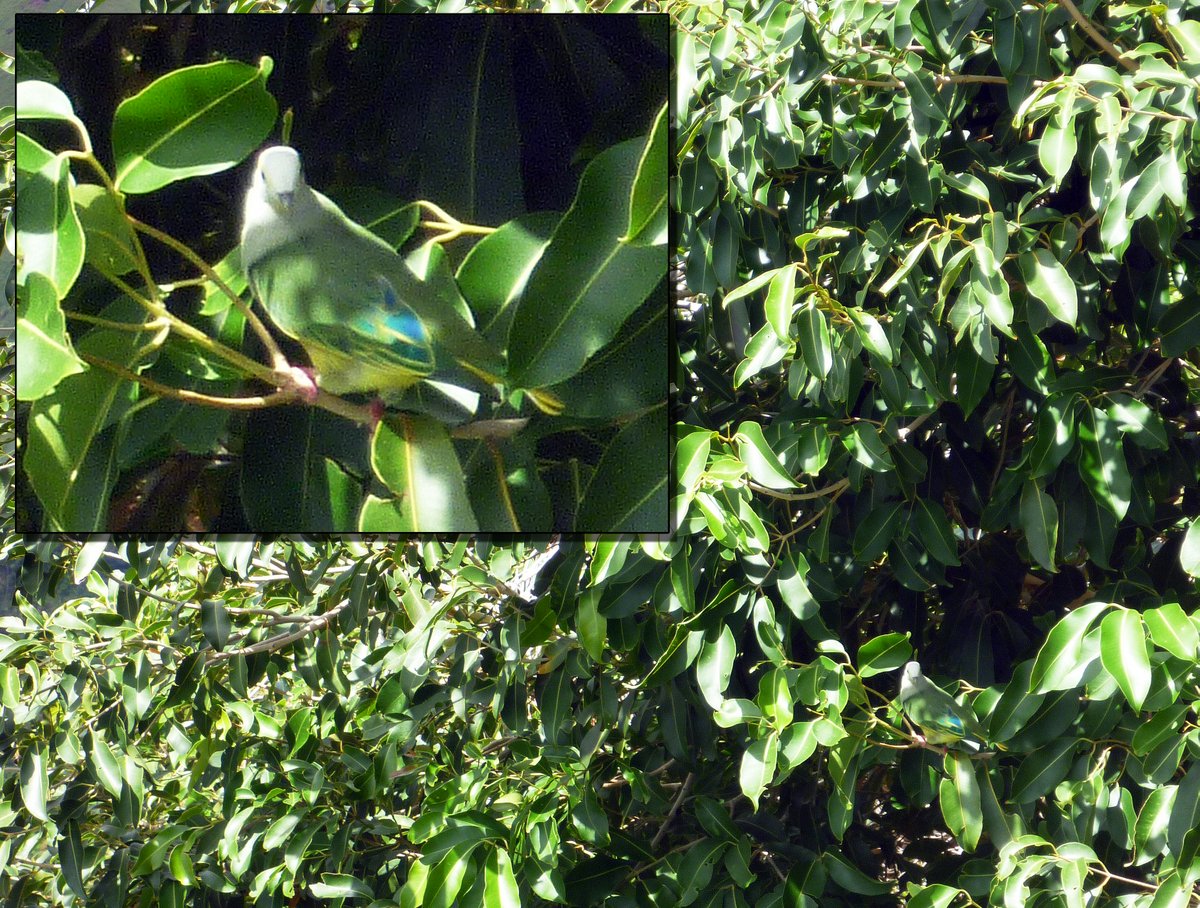
It took us an hour to walk back to the village quay, arriving back at the boat at two o'clock. We were knackered, so the rest of the afternoon was spent dozing and chilling out. We had another early night.
21 April 2014 Fatu Hiva to Atuona, Hiva Oa
We jumped out of bed at seven o'clock, and half an hour later were motoring out of the bay heading for a small island called Mohotani, which is conveniently on the way to Hiva Oa where we had to go to clear in. The anchorage at Atuona is notoriously rolly and crowded, so the plan was to stay at Mototani overnight and leave very early the next day to get to Hiva Oa in the morning, clear in, buy some provisions and run away.
We had a great reach across to Mototani, which is a very impressive 500 metre high island. The wind deserted us as we went along the leeward side of the five mile long island, so we motor sailed towards the anchorage at the northern end. By two o'clock, we were halfway along the island and had another look at the chart.
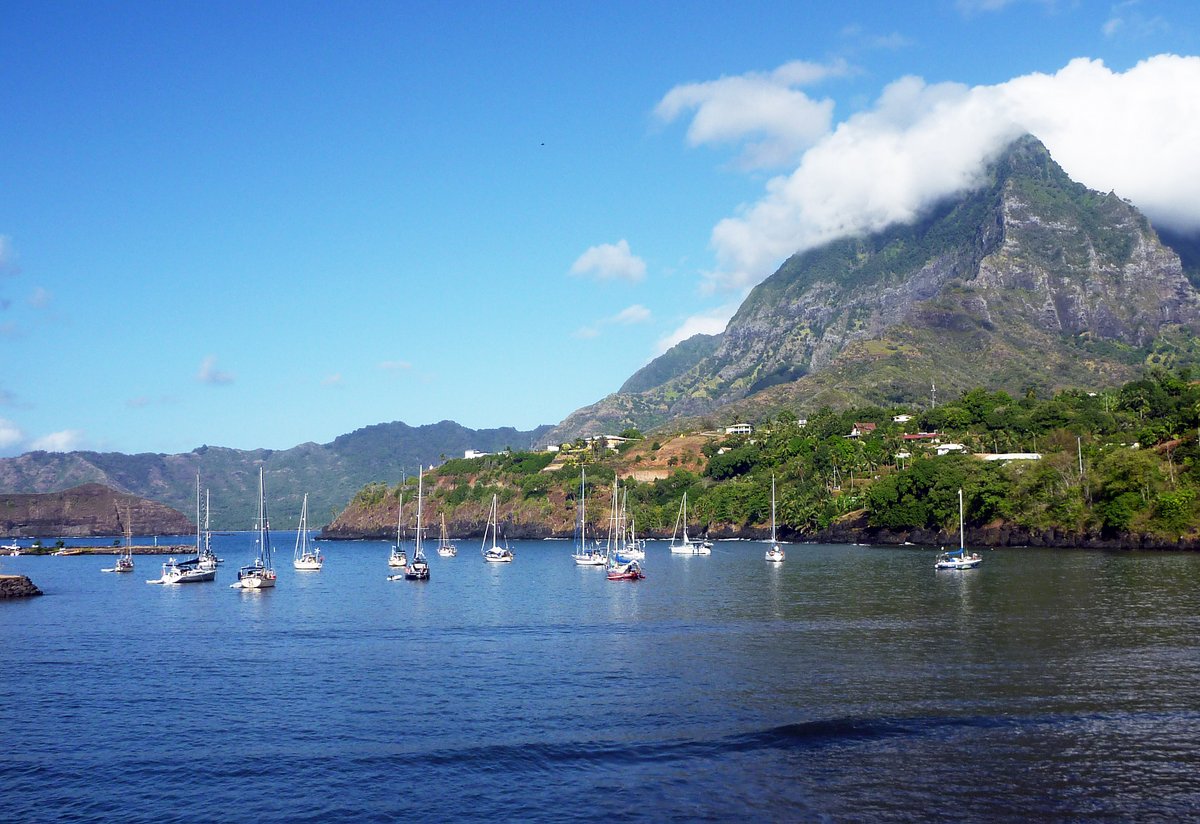
The wind was coming from the east and we thought that the only anchorage on Mototani may be untenable. Atuona on Hiva Oa was still a three hour sail away so, as we were running out of time, we opted to head straight for Atuona on Hiva Oa. On the way, we had a huge pod of Spinner Dolphins jostling for position to ride our bow wave.

I was very nervous about going into Atuona harbour because I was expecting it to be very crowded with a back log of boats waiting to clear in after the Easter holidays, but it wasn't too bad. The anchorage is behind a large breakwater and the boats weren't rolling too much. The port authority make all yachts anchor in water shallower than 5 metres leaving the deeper water for ferries and cargo ships to manoeuvre into the commercial dock - most of the anchorage is between 2 and 4 metres deep.
We wandered around for ten minutes checking the depth and decided to anchor just behind "Hera". It was a little tight, but the water was a little bit deeper on the east side of the bay. We dropped our bow anchor and I was just putting out a stern anchor when an obnoxious American from "The Beguine" came over in his dinghy and TOLD me that my anchoring wouldn't work and that I'd be too close to him.
I briefly thought about arguing, but couldn't be bothered, so we pulled up the anchor and moved towards the middle of the bay. I found out later that the same guy had been shouting at Maarten from "Hera" about his anchor buoy. Normally cruisers go out of their way to be polite and helpful, but this American guy is obviously an A-hole.
22 April 2014 Atuona, Hiva Oa
There's a one metre tidal range here and having bow and stern anchors out means that we don't swing with the tide. Last night, it was very noticeable when the tide was going out because we had water slapping under our sugar scoop.
We got up at seven o'clock to find "Bellatrix", a small 28 foot yacht, only ten feet from our stern. Tim, a single hander from Estonia, was up on his foredeck adjusting his bow anchor. He didn't have a stern anchor out and was swinging in the tide, so I let out some scope on our stern anchor and shortened our bow anchor.
When we were settled, I went over to say hello and apologise for being too close, but he said that it was his fault, that he only had one anchor and was going to move further into the bay. What a nice bloke - he restored my faith in human society after my ugly contact with the loud-mouthed American yesterday.
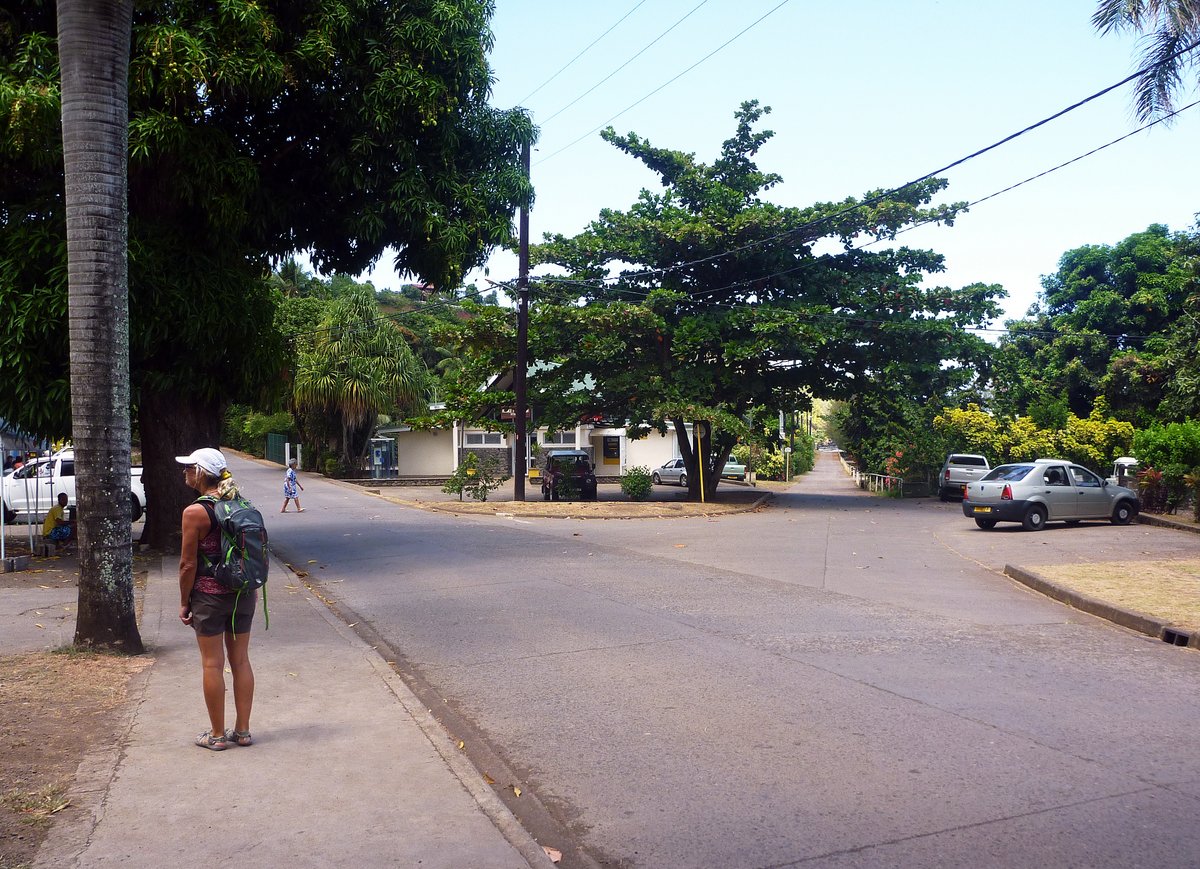
After breakfast, we walked into town, which took 30 minutes, but it was a pleasant walk in the cool of the morning. Atuona is a nice little town and everyone is very friendly. The locals are all heavy set with large round faces and look very severe at first, but soon break into smiles and seem to be a happy bunch. I'm not surprised because this is a beautiful island with fruit literally falling off the trees.
Our first stop was at the Gendarmerie to clear in. I was a little nervous thinking that we might be in trouble for stopping at Fatu Hiva, but the young police officer was very helpful and we only had to fill in one form with no questions asked about when we arrived, etc. It was all done and dusted within fifteen minutes, probably the quickest (and cheapest) clearance that we've done for years.
The officer didn't stamp our passports and told us that as EU citizens, we were allowed to stay indefinitely in French Polynesia. This is great news, especially when compared to the hassle that people from non-EU countries have to go through. They have to use an agent, have to have a visa before they arrive and often have to post a bond with a bank of about $1000 per person. At long last, I've found a good reason to be a member of the European Community.
We called in at the Post Office to post our customs form off to Papeete and buy a SIM card for our phone. While we were in the Post Office, we met John from “Kika" who was chatting to Marie Jo, a local lady who acts as a taxi service, does laundry, organises tourist trips, etc. We arranged to go for a day trip around the island with John and his crew the day after tomorrow.
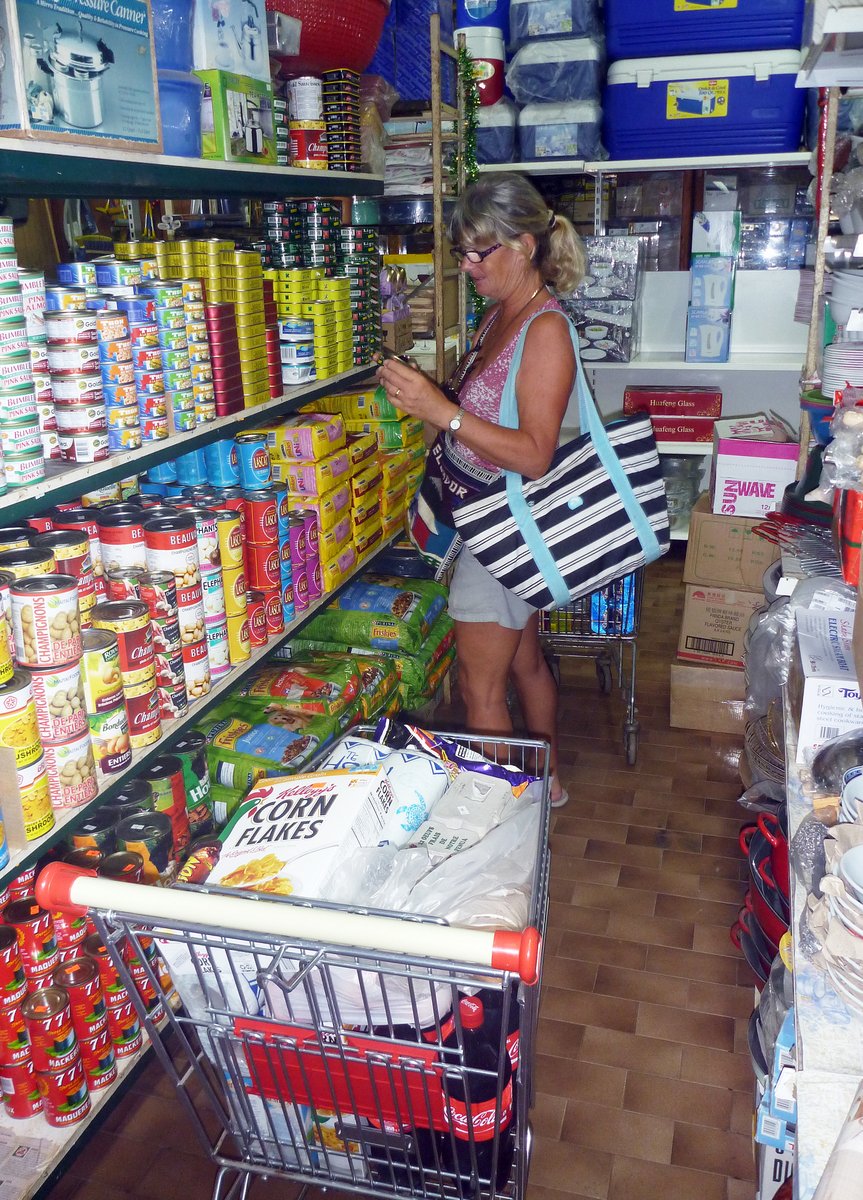
With our administration all done, we wandered down the main street calling in at a few small grocery stores, until we came across a large(ish) supermarket on the road leading out of town. It was very well stocked, so we went into a shopping frenzy, stocking up with drinks, vegetables and other essentials - we even found some lamb cutlets. They were very expensive at six for $14, but I couldn't resist them - we've not seen lamb since we were in the USA in 2012.
We asked the supermarket to call Marie Jo, who picked us up and dropped us at the dock for $6. She then took away two bags of laundry, which should be back tomorrow. We were back on the boat just after midday eating lovely fresh baguette for lunch.
After our resoundingly productive morning, the afternoon was a relaxed affair. In the evening we invited over the four other boats that were on the “Goodbye Isabella” net over for drinks – Maarten and Bea from “Hera”, Dave and Jan from “Baraka”, John and his crew from “Tika” and Robert and Lucie from “Grace”. We also invited Tim from “Bellatrix”. It was a little cramped with thirteen people in our cockpit, but everyone seemed to have a good time.
23 April 2014 Atuona, Hiva Oa
We had to get up early again, not because we were doing anything in particular, but because the town shuts down between eleven o'clock and two o'clock. We walked into town and visited the Gauguin museum.
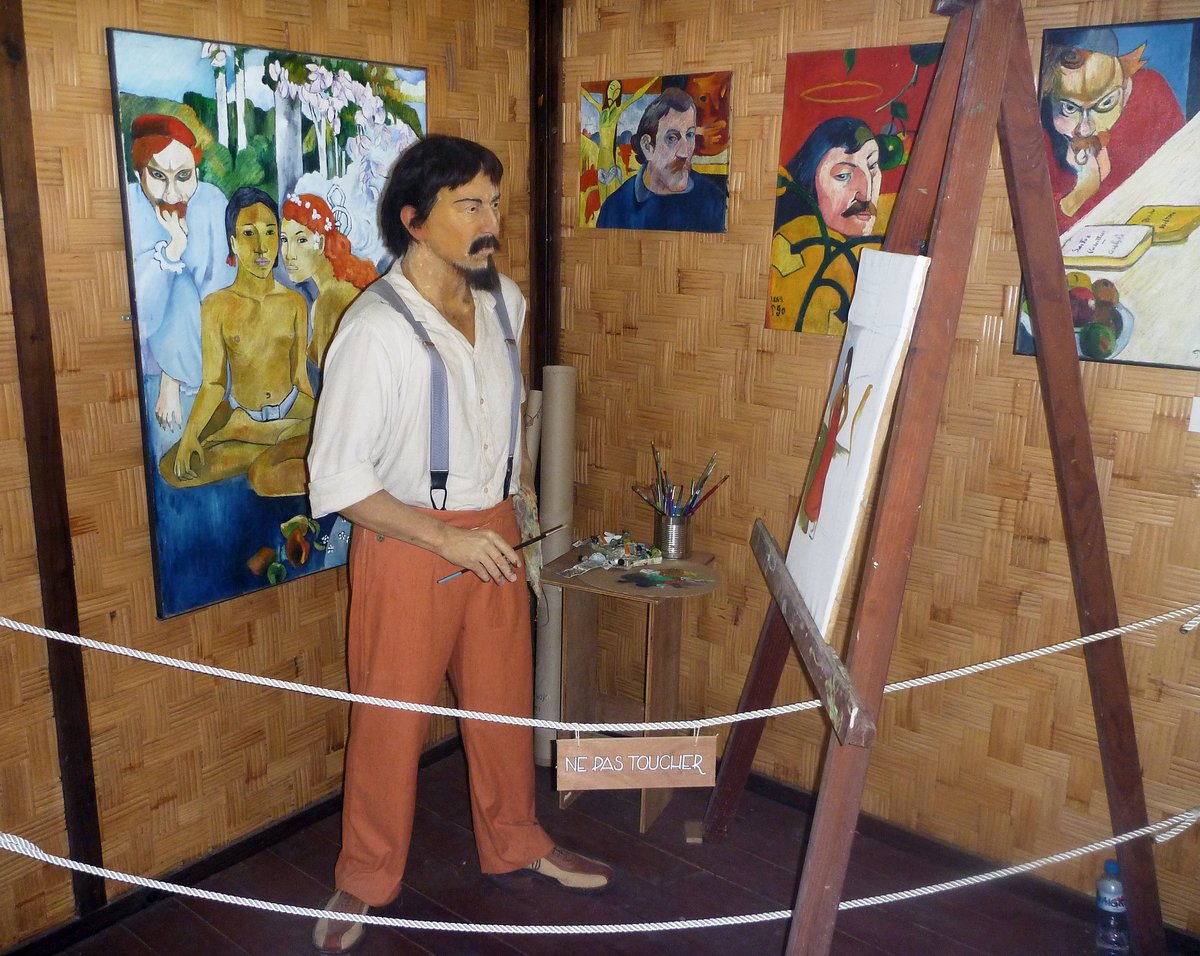
Paul Gauguin was a French artist who moved to Tahiti in the late 1800s and ended up in Hiva Oa. I'm not too enamoured by his painting, but visiting the museum was one of the few things to do in town. There’s an interesting replica of the house in which he used to live, with a good wax figure of Gauguin painting a picture. A Belgium musician called Jacques Brel also lived here, but having never heard of him, we didn't cough up the $3 fee to visit his museum.
We wandered around town for a while, visiting an Artisan exhibition – wood carvings, jewellery made from seeds and printed cloth abound, but nothing caught Glenys’s eye. After stopping off at a supermarket to buy some baguettes and paté, we walked up to the cemetery perched on a hill above town. We hunted out the graves of Brel and Gauguin and then sat down on a pleasant grass bank overlooking the town & the bay to have our picnic lunch. You can’t beat fresh baguette and paté on a nice sunny day.
There wasn't much else to do in town, so we walked back to the boat expecting to have a chill out afternoon. Unfortunately, a Swedish-flagged Hallberg Rassy 40 called “Blue Horizon” had dragged their stern anchor and collided with “Grace” while both sets of crew were on-shore. Some of the cruisers had reset “Blue Horizon’s” stern anchor, but they were still too close to “Grace”.
When Stigg & Siv from “Blue Horizon” came back, they started to re-anchor and somehow broke the rode for their stern anchor. The water in the anchorage is very brown and murky, with visibility of about 1 foot, so Stigg was forlornly rowing around the anchorage, dragging a dinghy anchor, trying to find his stern anchor. I went to give him a hand, but after fifteen minutes it was apparent that trawling around hoping to snag the anchor rode was not going to work.
I asked Stigg to tell me where they thought the anchor was and dropped a buoy to mark the spot. I then put on my snorkelling gear and started diving down 3-4 metres and swimming in a grid search pattern using the buoy as a reference. After 45 minutes, I finally found the anchor rode – the anchor was 25 metres away from where they thought it was. They were very happy to have their anchor back and I enjoyed the technical challenge (and the bottle of wine that they gave me later).
24 April 2014 Atuona, Hiva Oa
We went on a tour of the island with Dave & Jan from “Baraka” and John, Peter & Colin from “Kika”. Marie Jo drove us around in her four wheel drive pick-up truck on the only road that crosses the island. It wasn't really a guided tour because she didn't tell us anything about the places that we visited, but just dropped us off and let us wander off to look at tikis and petroglyphs on our own.
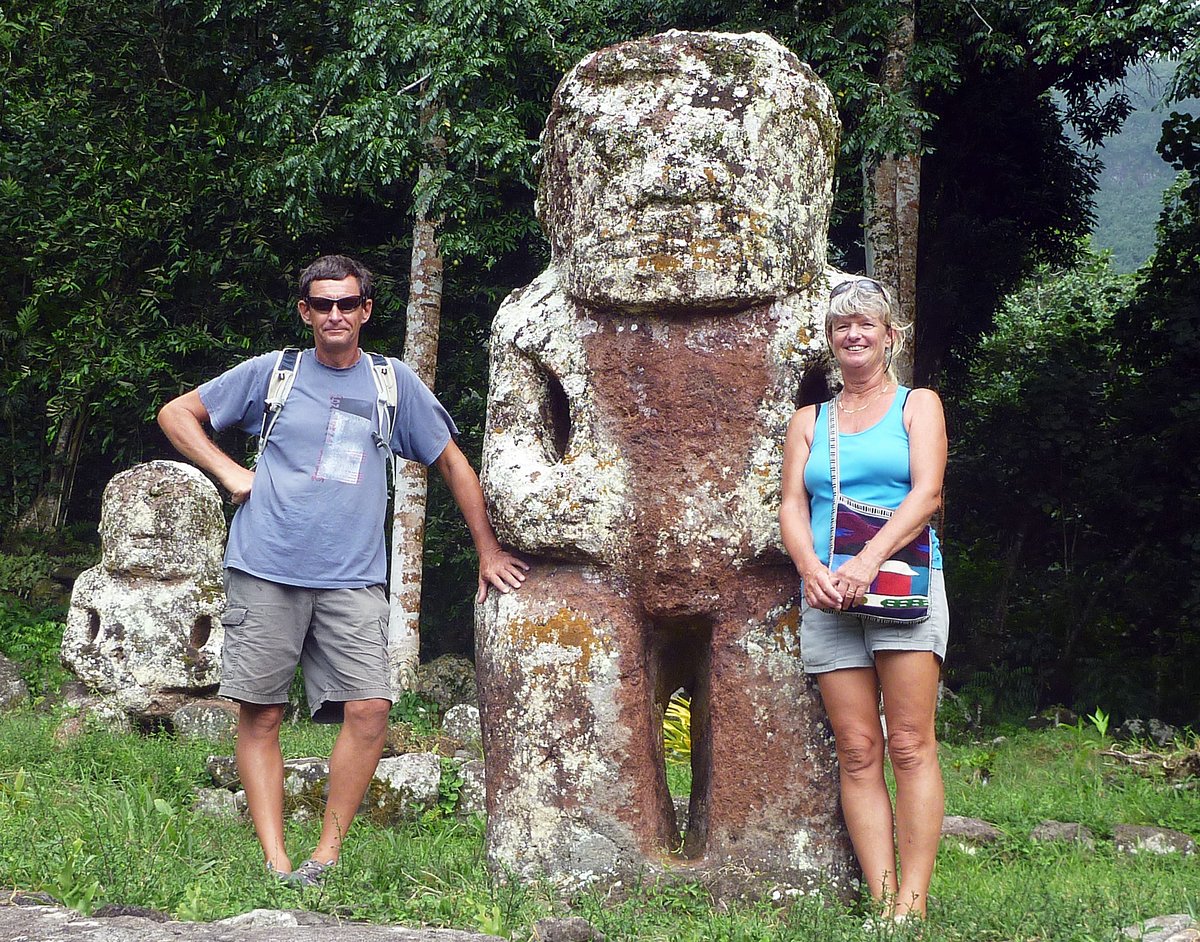
Tikis are carved stone statues, similar to, but not as grand, as the famous statues on Easter Island. It's believed that the tikis on Easter Island were actually carved by Marquesans who had journeyed there hundreds of years ago. Petroglyphs are drawings chiselled into rock by the same ancient Marquesans.
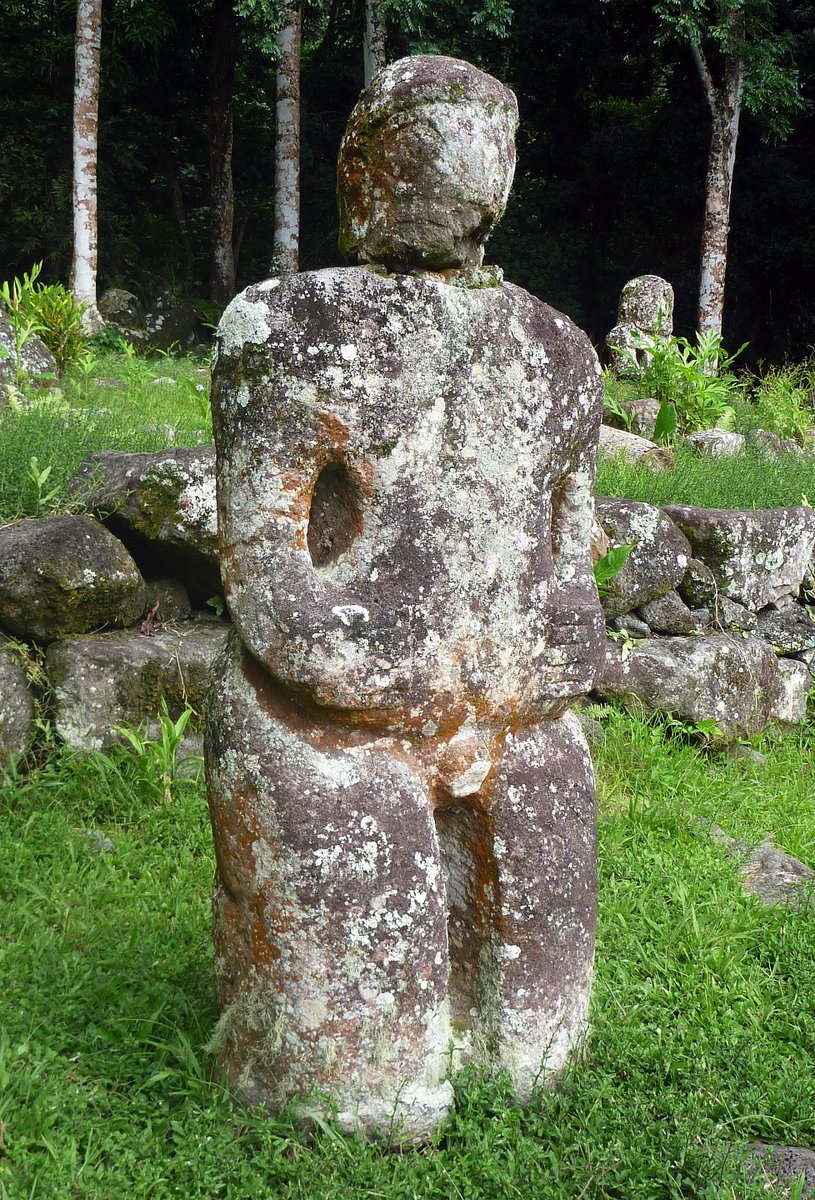
We visited the site of the Laughing Tiki and the large archaeological site of Iipona at Puamau, where we saw the largest tiki west of Easter Island and other ancient structures such as platforms built from stones that were used for prayer and human sacrifice. The ancient artifacts were relatively interesting, but we mostly enjoyed talking to Marie Jo and asking questions about Hiva Oa and the plants as we travelled across the island. She helped us to collect Pamplemousse from a couple of places and we picked small hot chilli peppers that seem to grow everywhere.
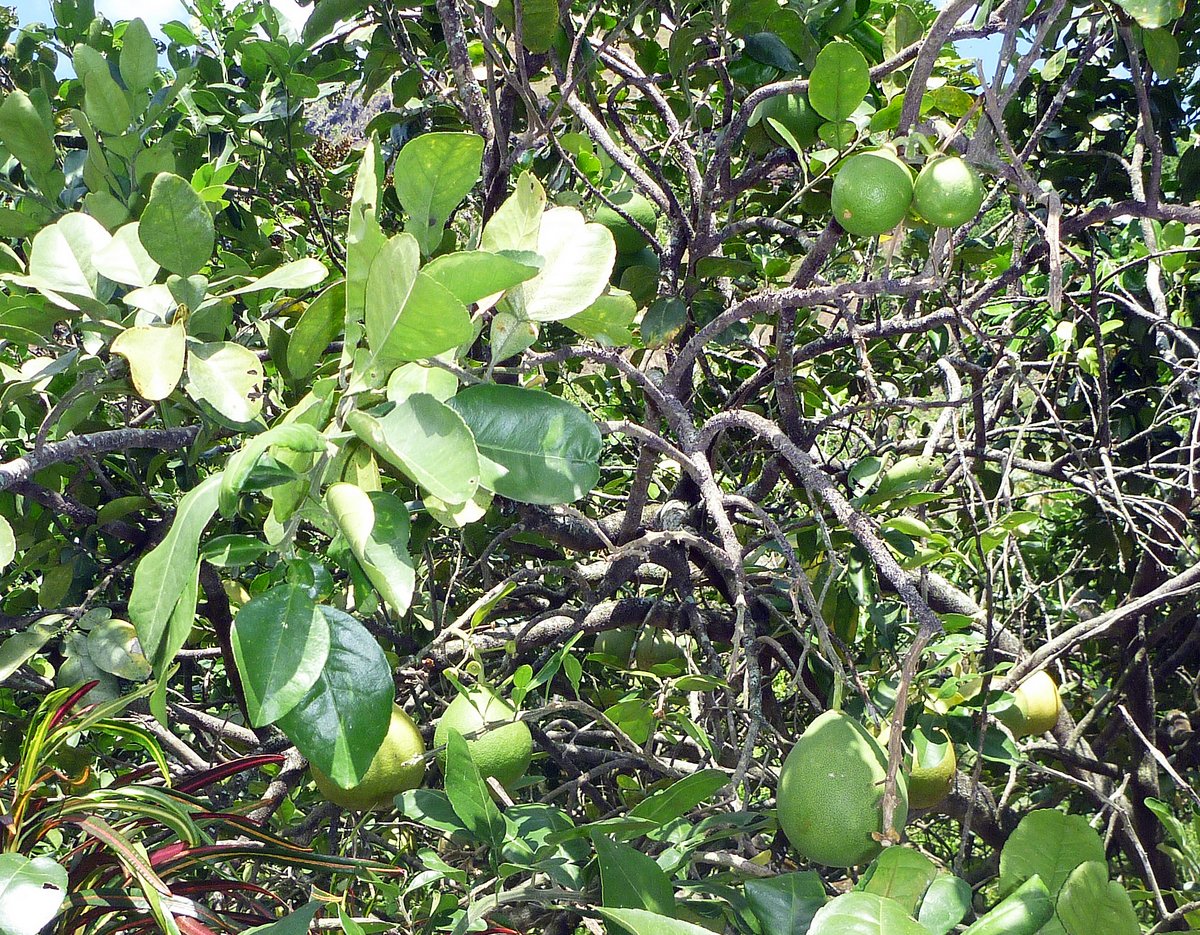
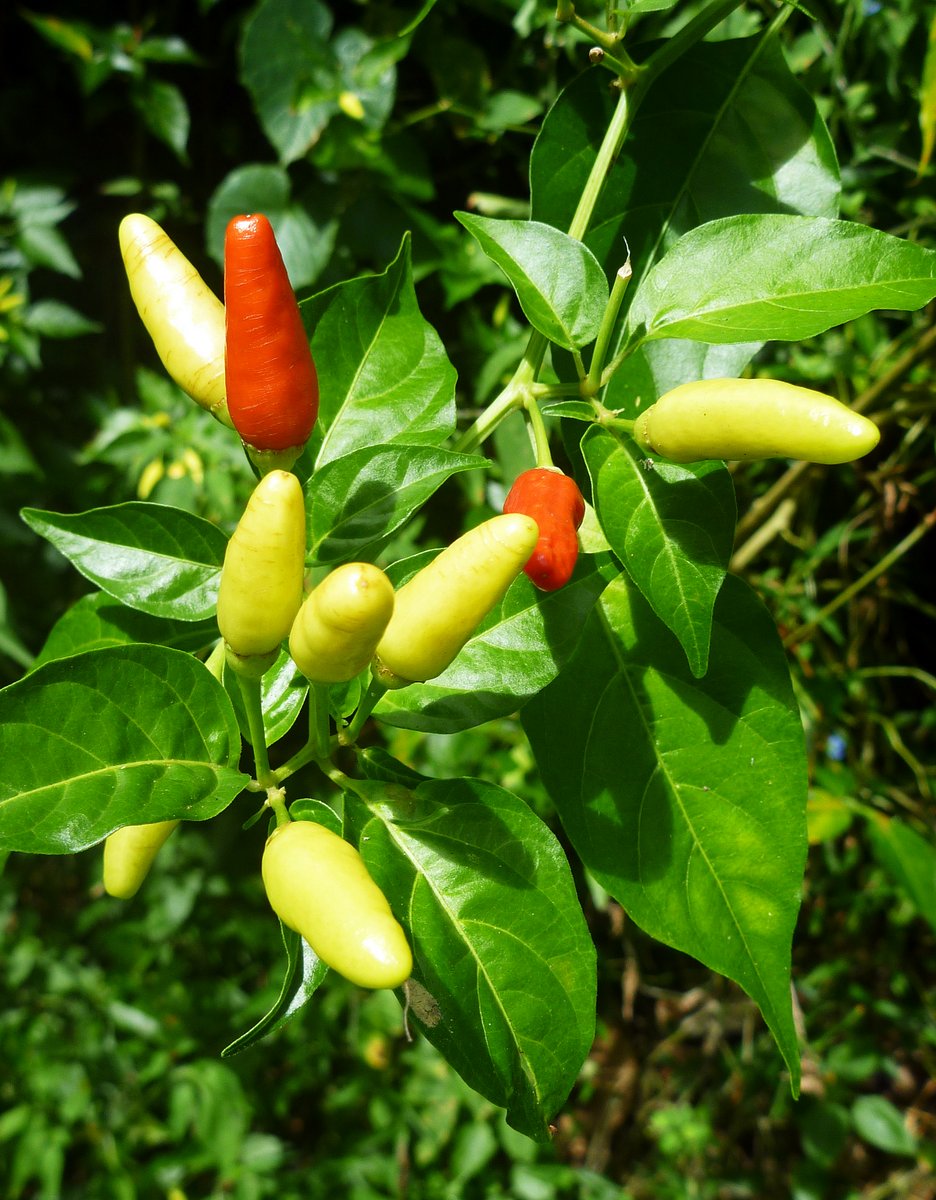
After visiting the Iipona site, we stopped off at a small restaurant in Puamau called Chez Therese and had a fabulous lunch. We had Poisson Cru (raw fish in coconut milk); Poipoi (a kind of dumpling made from fermented breadfruit mixed with manioc flour); Fried breadfruit; Par boiled breadfruit; Fried chicken; Rice; and a fabulous salad with grated mango on top. It was all delicious - the Poisson Cru was absolutely gorgeous and even the breadfruit was good. Glenys chatted to the lady who prepared the meal about recipes and she insisted on giving Glenys some watercress, mangos and a huge one foot long bean pod that she called Haricot Verte.
There’s only one road that crosses the island from Atuona to Puamau and it’s a very, very rough dirt road for much of the way, winding its way along and down knife edge ridges. We suffered a flat tyre on the way to Puamau, so Marie Jo was very worried all the way back - if we had another puncture in the middle of nowhere, it would have been a big problem - we only saw about six other vehicles on the trip and in most places there was no phone signal to call for assistance. Fortunately, we made it safely back to the boat.
25 April 2014 Hiva Oa to Hanamoenoa, Tahuata
We were up early again and hitched a lift into town to try to get an Internet connection at the Post Office. There’s an internet wifi signal at the anchorage, but it’s incredibly slow and intermittent and to make matters worse, there’s ten cruisers trying to get access all the time. I lost five dollars yesterday when the system took money from my credit card and then failed to give me a login, so I've given up on it.
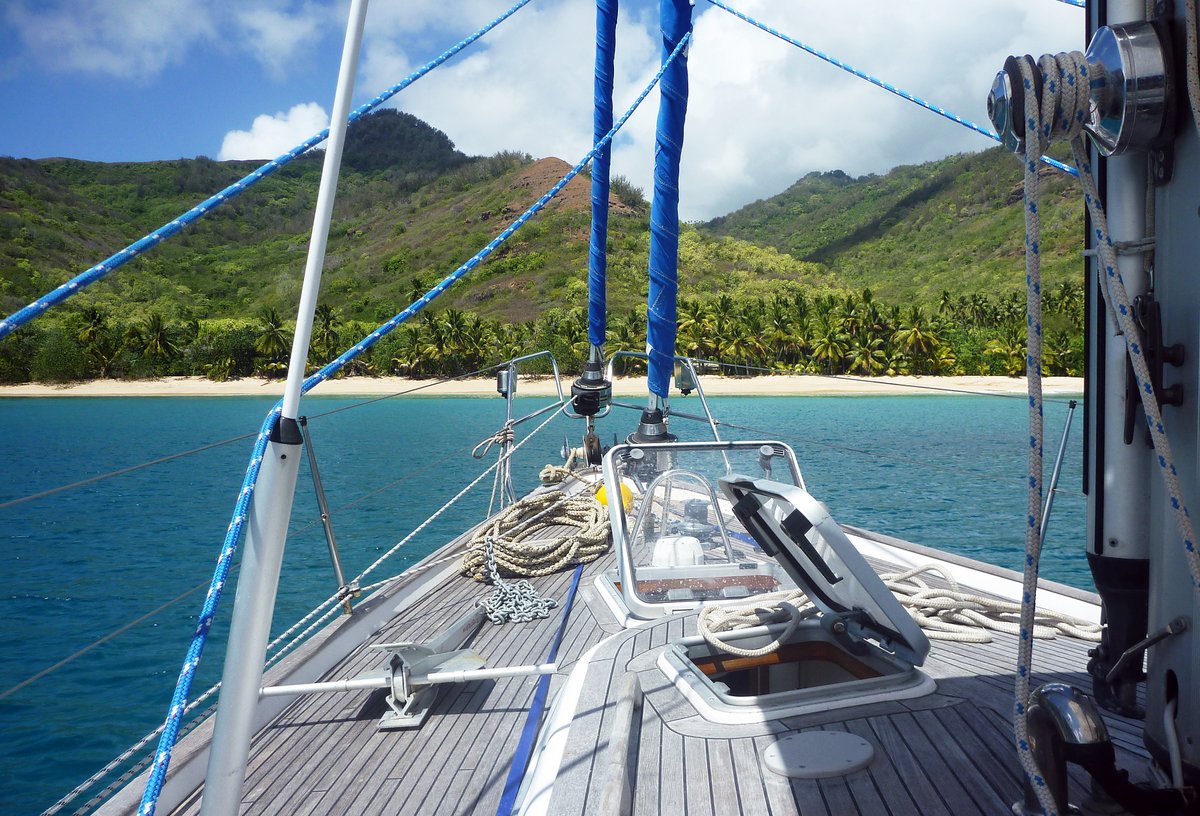
Unfortunately, the internet signal at the Post Office was so bad that it wouldn't even give me the login page, so we gave up and went to the supermarket to buy a few things. There’s a real French influence in the grocery stores here, with French pastries and of course, lovely warm baguettes standing upright in plastic crates. However, one has to be quick because the locals swoop in on the crates when they arrive and grab armfuls of the wonderful smelling bread.
We hitched a lift from Marie Jo back to the boat, pulled up anchor and had fabulous sail across to Tahuata. It was only ten miles, so Glenys was more tolerant than usual and I was allowed to crank up the sails while we beat out of the bay in 15-20 knot winds. After three years on the boat, I think that I'm finally starting to like sailing just for the pure joy of it. We went upwind like a witch for 30 minutes and then eased the sails to a broad reach when we rounded the headland.
Two hours later, we were anchored in Hanamoenoa, which is a beautiful bay with a white sand beach, fringed with coconut palms swaying in the wind. There were only three other boats in the anchorage, so it was lovely for an hour until three huge Australian catamarans arrived and plonked themselves between us and the beach, ruining our view - oh well...
I went snorkelling on the northern headland of the bay and managed to spear 4 red pan fish. I also saw a Manta Ray, a couple of Spotted Eagle Rays and a four foot Black Tipped Shark came over to check me out – I was glad that I’d finished spearfishing and had my catch back in the dinghy. After my shark encounter, I decided to call it a day and retreated back to the boat.


We had the fish for dinner – one was okay, but the others had very chewy flesh and weren't very pleasant. It’s a bit difficult to know what to catch here because Ciguatera is problem in bigger fish like grouper and snapper – I need to talk to some locals about what is safe.
26 April 2014 Hanamoenoa, Tahuata
With nothing planned for the day, we had a lie in – first time for ages. I really like this anchorage, there always seems to be some wind and there’s just a gentle rocking motion from the slight swell that gets in here.
We had a day of catching up on jobs. One of the tubes on the dinghy went completely flat this morning and I discovered that it had a two inch tear where the Hyperlon fabric has gotten so thin that it just wore out…
I lifted it on deck and used most of our Hyperlon patching material to repair the tear and to add some reinforcing patches to other areas that are badly worn. The rubberised outer coating on the fabric has now perished and we’re through to the fabric in a lot of areas now – it’s in a very sorry state and I hope that it keeps going and doesn't fail completely while we’re in the middle of nowhere.
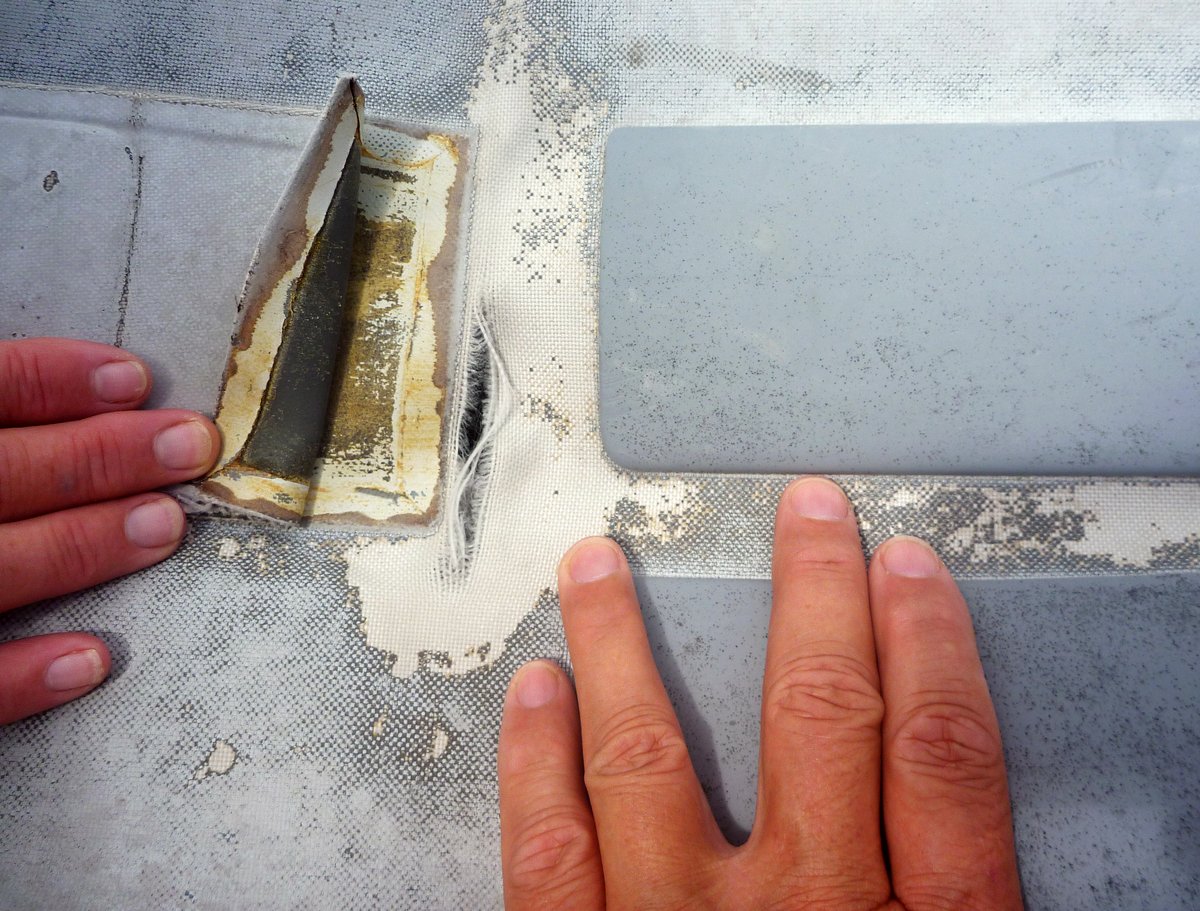
Later in the afternoon, we went snorkelling on the southern headland and had to swim all the way there and back because dinghy was still on deck. The site was okay, but not as good as the northern headland. We must have swam over half a mile and, by the time that we got back to the boat, Glenys felt exhausted and not very well. She made dinner and then couldn't face eating it – she even left half a can of beer which means that she must feel really poorly.
27 April 2014 Hanamoenoa, Tahuata
Glenys had a rough night and kept waking up. She felt very ill this morning and has a dodgy tummy, so we think that she’s picked up some kind of virus. She had a quiet day resting.
The dinghy inflated okay this morning, but I think that we need to buy a dinghy sooner rather than later. We may be able to buy one in Papeete when we get there in four weeks’ time, or alternatively we could call into US Samoa in August and order one directly from the USA, which might be much cheaper.
We now have quite a few expensive things on our shopping list - a dinghy; radar; chart plotter; AIS transceiver; a spare drive for the autopilot and some other specialist spares. I'm trying to figure out whether it would be cheaper to call in at US Samoa rather than waiting until we get to New Zealand, so I spent the morning looking at marine catalogues making up a list of things that we need. I’ll try to get quotes and work out what to do – either way we’re going to be spending over $10,000 by the look of things.
While Glenys was having an afternoon nap, I went snorkelling with John and Colin from “Kika” on the tip of the northern headland. It’s a really good snorkelling spot and we saw two Mantas and a more Spotted Eagle Rays. We watched three Spotted Eagle Rays spiralling around each other in a kind of vertical column – they looked like they were playing.
John and Colin didn't have any fins, so when we got back to the anchorage, I lent them our fins and showed them how to dive down underwater. It was a revelation to them that they could get down to 5 metres, so I think that they’ll be buying some fins when they get to civilisation.
Glenys was feeling slightly better in the evening and had something to eat, but went to bed early.

28 April 2014 Hanamoenoa, Tahuata
Glenys was still feeling ill and exhausted, so she had a quiet day resting and I spent most of the day trying to repair my Canon G11 camera.
Just before we left the Galapagos, the telescopic lens jammed in the fully extended position and won’t retract. I tried blowing compressed air from a dive tank around the lens to see if there was any grit stopping the lens mechanism, but that didn’t make any difference. The camera is five years old and it’s not worth spending $300 getting it repaired, so I decided to try to take the camera to pieces to see if I could fix it.
Three hours later, I’d managed to disassemble it – lots of very small screws and scary little connectors holding the various parts together. The lens mechanism is right at the heart of the camera, so I had to strip everything around it and document every step with photographs. Just as I was pulling off the cover to the lens assembly, I found a broken cable – these are incredibly small thin pieces of mylar plastic with printed wiring. I don’t know whether I broke it while I was fiddling around or whether it was already broken and the cause of the fault. Either way it’s buggered.
I am in despair. I use this camera for all of my underwater photographs and take it out every time that we go snorkelling or diving. If I was back in the UK, I would use this as an opportunity to upgrade my camera rig and would have already ordered a new camera and underwater housing. Unfortunately, I probably won’t be able to buy one for months. I might have a chance in Papeete when we get there in June, but it’s unlikely, so maybe this is another thing that we get sent to US Samoa in August.
So, for at least the next four months, I’m unable to take underwater photographs, while we sail thorough the Tuamotus and other South Pacific islands with pristine reefs and crystal clear water – Oh Miser!
Late in the afternoon, I went for a snorkel by myself on the northern headland and saw a couple of Manta Rays, one of which swam five feet underneath me – if only I’d had a camera…
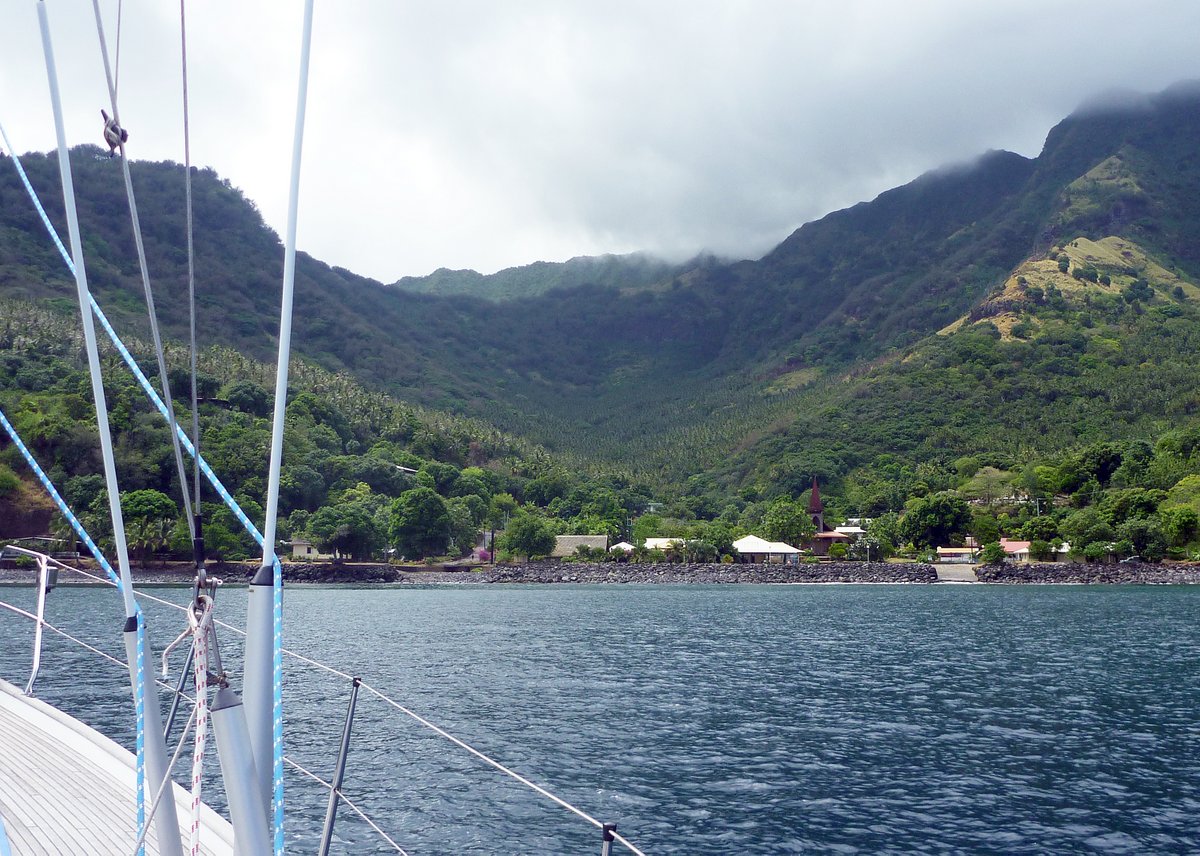
29 April 2014 Hanamoenoa to Vaitahu, Tahuata
There’s not much improvement in Glenys – this tummy bug is exhausting her. We decided that a change in scenery was needed, so we sailed a few miles down the coast to the small village of Vaitahu and anchored amongst four other yachts. It’s a pleasant anchorage surrounded by steep hills reaching up to a ridge line 900 metres above us. The weather wasn’t very good with rain showers passing through, so we spent the morning on-board.
We’ve not had an internet connection since we left the Galapagos a month ago and I’ve been trying for two days to send an email to our son Craig via satellite phone. It’s a small email, but I have to attach a small image of my signature and these emails are not getting through to him. We’ve been talking to him by text messages on our mobile phone, but we’re now running out of credit, so shortly we’ll be incommunicado. It’s very frustrating.
We went ashore in the afternoon and had a walk around the tiny village. It’s all very neat and tidy, but everywhere was closed up, including the two small grocery stores and the post office, so we’re not able to buy a top up card for our mobile phone. There’s a very impressive looking church, which seems out of place in this small village - we’re told that the villagers built it themselves.
The other cruisers in the anchorage have told us that the village stores have run out of practically everything, but there’s a cargo ship due to arrive tomorrow. I believe that the supply ship comes in every three weeks, so it will be a big event on the island. It will be interesting to see how they will unload everything because waves are constantly crashing against the village’s tiny dock.
30 April 2014 Vaitahu to Hanamoenoa, Tahuata
I woke up at the crack of dawn and just had to try to send the email to Craig again. I read some of the technical blurb on the satellite phone email system and decided to bypass their “clever” compression system. It worked! Craig sent us a text message that used up the last of our credit on our phone, but at least he got his email.
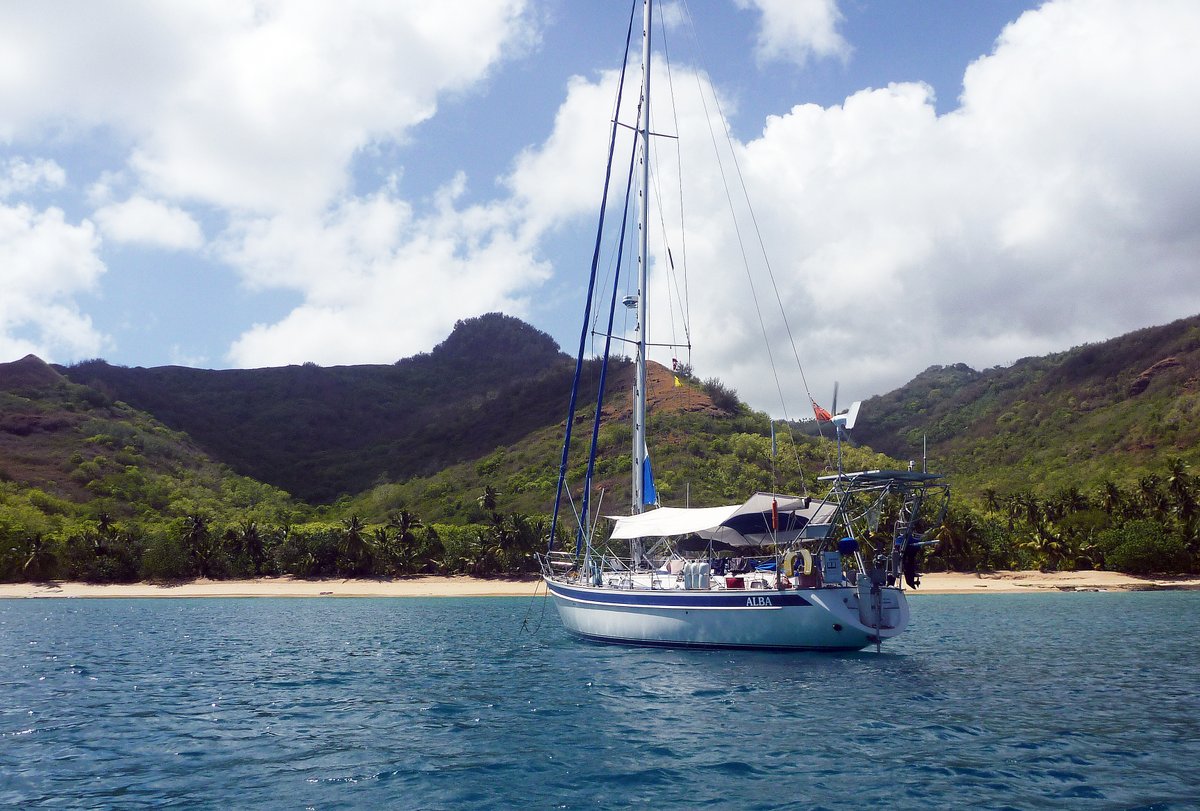
The cargo ship arrived in the middle of the morning and we could see a large number of pickup trucks lining up on the shoreline. A huge crane on the ship swung into action and lifted a flat-bed barge down into the water, then started to unload its cargo. The barge ferried the cargo to the small concrete dock and then held station against the strong surge while a JCB unloaded the crates of cargo onto the quay where the locals were soon grabbing their goods. The only thing being exported from the island were sacks of dried copra and empty diesel drums.
After an hour of watching the operation, I dropped Glenys ashore on a mission to find a phone card and get some bread. The store was open, but there was no bread available and the shopkeeper told Glenys that he wouldn't be receiving any more supplies until another cargo ship comes in on the 4th of May. However, she did manage to buy a mobile phone top up card from a guy who sells them as a bit of side line – he charged her $12 for a $10 card, but was apparently very nice about it.
After lunch, we decided that there was little point in staying at Vaitahu – it’s an impressive place with the hills towering above, but a little gloomy with a black rocky shoreline. We upped anchor and went back to Hanamoenoa and what a difference a couple of miles makes. The water here is blue and the verdant green of the coconut palms contrasts beautifully with the white sand beach – it lifts the soul.
We went snorkelling on the northern headland again and saw three Spotted Eagle Rays swimming in formation around one particular rock, which I think was a cleaning station where small wrasses come out and pick off parasites. They were very unconcerned about us, even when we dived down to within a few metres of them. We're planning to do a dive at this site tomorrow.
“Salamander” turned up in the late afternoon, so we invited Michael and Charlotte over for sundowners.