1 March 2014 San Cristobal, Galapagos
The good news is that there don’t appear to be any mosquitoes in San Cristobal. The bad news is that there are lots of house flies, which invade our boat in the daylight hours. They’re annoying little buggers that keep landing on us, so I'm constantly wandering around with a fly swat – at least they seem to go away after sunset.
We packed our snorkelling gear and lunch into a couple of bags, walked through the Interpretation Centre and along some paths up to a nice view point on Las Tijeretas Hill. We then took a path leading off to Playa Baquerizo. It’s only supposed to be two kilometres, but it must have taken us an hour and a half to walk there. The path goes steeply down the hill and then through the scrubby vegetation along the coast. Some of the time we were scrambling over lava rock and other times on a sandy path. It was very, very hot, with little shade to be had from the small trees.

Despite drinking lots of water, we were both feeling dehydrated and tired by the time we arrived at Playa Baquerizo. It’s a nice beach, but there’s hardly any shade under the low bushes. We went for a snorkel, but the waves rolling into the rocky beach had churned up the water and the visibility was poor. We tried to spend time looking around the waterline, but the Horse Flies are prolific and their bites hurt, so we gave up and walked back to Las Tijeretas Hill and then down to the rocky bay below.

Las Tijeretas Bay is great. There’s some steps leading down across the rocks into the sea and the water visibility was about ten metres. We saw some Mexican Hogfish and had Sea Lions playing around us. They come over to have a look and will swim around you if you do interesting things like diving down and swimming upside down, which is what they seem to do a lot. I took lots of underwater photos, but they didn't come out very well because of the poor visibility and the speed that the Sea Lions move.

By this time it was mid afternoon, so we retired back to the boat and chilled out for the rest of the afternoon. It’s damn hot out there.
2 March 2014 San Cristobal, Galapagos
We had a quiet day pottering about. I went into town and went to the internet café to do some admin, while Glenys dropped off some laundry. I booked us on a two dive trip to Kicker Rock in a couple of days’ time, which is supposed to be very good with a great chance of seeing hammerhead sharks. It had better be a good trip because it’s costing us $135 each for the two dives.
Back on the boat, I had another look at our generator. The starter motor is gradually becoming loose because some threaded inserts in the engine mounting flange are coming loose. Panda Fischer tells me that the only solution is to replace the engine flange with a new improved version. Unfortunately, it’s a big job and I can't do that until we get to New Zealand in 8 months’ time.

So, before running the generator today to make water, I measured the gap between the starter motor and the flange and will monitor it over the coming months. I also used a piece of 3 mm nylon line around the starter motor solenoid and the exhaust elbow to pull the starter motor up tight against the engine mounting flange - hopefully it will stop the starter motor vibrating, which must be making the problem worse.
I've now got bits of string holding the generator together and also holding the stern gland in position. The boat’s turning into a Heath Robinson machine.
In the afternoon, Glenys decided to make strawberry jam of all things - she bought some strawberries cheap at the market and just wanted to play. I was more impressed that she made some Sweet Pepper Jelly, which goes well on cheese and crackers.
We invited Erin and Glen from “Sundance” over for evening drinks, they're off to Santa Cruz tomorrow and will be staying a week ahead of us, but we should catch up with them in the Marquesas.
3 March 2014 San Cristobal, Galapagos
We walked to La Loberia beach, which is three kilometres from town and a bloody long way in the beating sun. It’s a lovely, well protected bay, with a nice sandy beach and a very popular spot with both tourists and the locals - especially as today was a holiday.
We went snorkelling and, even though the tide was out, there was lots to see. Large Leatherback and Green Turtles come into the bay to feed and they are surprisingly close to the shore, swimming around between the people in the water. They are obviously used to the close presence of swimmers and just continue browsing the algae from the rocks. We also saw a couple of Spotted Eagle Rays, but the Sea Lions and Marine Iguanas stayed out of the way on the rocks.


After snorkelling for an hour, we were getting cold, so we went for a walk along the shoreline. There’s a very rocky path at the east end of the beach which leads to some 50 foot sea cliffs where there are lots of nesting Swallow-tailed Gulls, which only breed in the Galapagos Islands, and we saw our first Blue Footed Booby.


We were very hot again by the time we got back to the beach, so we went snorkelling again. The National Park rules state that one isn't allowed to get any closer than two metres from any wildlife, but Glenys couldn't resist swimming along resting her hand on a Green Turtle. No-one seems to have told the wildlife to keep two metres away from humans, because we saw a sea lion walk up the beach with its cub and crawl under a sun umbrella. The people who owned the umbrella were a bit worried at first, but soon moved their towels to make space for the suckling mother.
As we walked back through town, we came across a Mardi Gras parade getting ready to go around town. It was only one float and one dance group, so we didn’t bother to stay to watch it. Glenys made Viche de Cameron for dinner which has to be our favourite Ecuadorian dish.
4 March 2014 San Cristobal, Galapagos
We went on a dive trip to Kicker Rock which is an impressive rocky island that juts more than a hundred metres vertically out of the sea. There’s a 20 metre wide passage through the middle of the island and the two metre swell was being enhanced to a height of four metres as it was compressed through the narrow gap.
For our first dive, we were dropped off next to a vertical wall, just outside the passage. We descended to 20 metres and then swam along the wall and into the passage. The visibility was poor at about ten metres, but almost immediately we started to see sharks – Galapagos and Black Tip Sharks.


We were nervous at first, but it’s amazing how quickly one gets used to the presence of these supreme predators. These only seemed to be small sharks probably 2-3 metres long, so that helped my confidence. It was very eerie swimming along underneath an overhanging wall, in the shadows with up to ten sharks at a time ghosting past.
There wasn't much current, but there was quite a bit of surge from the swell entering the gap. As we were effectively in a tunnel, the light was very dim, so combined with the high level of sediment in the water, taking photographs was challenging to say the least. However, with careful use of Photoshop, I was able to retrieve a few.
For our second dive we had a choice of drifting along a wall on the outside of the rock or doing the channel again. The wall that we saw on the first dive was boring (there’s no nice colourful coral or sponges here), so we decided to do the same dive again. We were hoping to see hammerhead sharks, but today was not our lucky day. The surge through the gap was even more impressive than in the morning and we were all swaying back and forth about five metres. We spotted a Scorpionfish with its brilliant camouflage.

On the way back, the boat stopped off at a beach and I got some nice video of a Sea Lion playing around me.
We were tired in the evening, so we went out for a meal . The restaurant gave us an “A La Carte” menu which had meals at the tourist prices of $12-15 per head. Fortunately, Glenys spotted that they also served a “Cena de Casa” for only $5. It was just like the Almurezo’s (typical lunch) that we've been eating on mainland Ecuador – soup followed by a plate of fish, rice and salad. Very nice.
5 March 2014 San Cristobal, Galapagos
We had a chill out day. In the morning Glenys went shopping and I went to the Internet café. I sorted out my email and then concentrated on Google Earth. The only pilot books available of the Pacific are wildly out of date and the electronic charts can be out by up to half a mile being based on surveys done in the 1900s, so I had a cunning plan. I entered push-pins for the various anchorages that we’ll be visiting in the Marquesas and Tuamotus and made sure that the images were downloaded into the Google Earth cache, so that I’d be able to view them properly when off-line.
Back on the boat, I took screenshots of Google Earth displaying the various islands and anchorages, both with a 3D view and a straight-down view with a grid displaying the Latitude and Longitude. The 3D image gives us a bird’s eye view of the approach to the anchorage and the straight-down view is a simple kind of chart. I then used Photoshop to add the name of each anchorage to the images, put them all into a PDF file and, lo and behold, I have a mini chart packs of the Marquesas and Tutmotus anchorages that we want to visit. They look good on our iPad and are available on our Downloads page.
Bolivar popped over just after five o'clock in the evening - he'd just returned from his four day holiday in Isabella and dropped off our zarpe, so that we can go to Santa Cruz tomorrow. He’s been over to Isabella and kindly brought us some mail that was sent from the UK to Shelter Bay Marina in Panama last August. It sat in Shelter Bay for a few months, then our friends on “Vanupieds” picked it up and delivered it to J.C. Soto, an agent in Isabella. He gave it to Bolivar, who hand delivered it to us. It's only taken seven months to get to us – perhaps that’s why they call it snail mail.

6 March 2014 San Cristobal to Santa Cruz, Galapagos
The alarm went off at six o'clock and fifteen minutes later, we were on our way to Santa Cruz, which is only forty miles away from San Cristobal. There was no wind for the first couple of hours, so we motored along at 4½ knots, trying to preserve fuel. The wind finally picked up to just over five knots, so we were able to fly the spinnaker and had a lovely sail for two hours in the flat calm seas.
As we approached Isla Santa Fe the wind disappeared, so we motored along the windward side of the island. It’s a barren hunk of rock, about five miles long with sea cliffs teeming with sea birds and cactuses sticking up on the desolate land above. Unfortunately, the swell was crashing against the sea cliffs send in waves back causing the water to be very turbulent, so we had to stay ½ mile offshore.
The wind never came back, so we motored the rest of the way into Puerto Ayora. The port is a very busy place with cargo ships unloading, twenty big tourist boats at anchor, lots of small local boats on moorings and dotted between them there were ten sailing boats. We found a space on the west side of the bay behind a couple of other yachts, but in front of the big tourist ships.
Our agent, Irene Pumayugra, came out on a water taxi with the port captain and another guy in uniform – customs I think. They filled in the same form that had been completed in San Cristobal and we had to pay a $15 clearing-in fee. Irene is going to come out on Saturday and give us the documentation to allow us to get diesel here. We have to get a taxi to the petrol station and jerry jug it, which is a pain in the neck - I’d like to know how these big tourist ships get fuel.
Michael and Charlotte from “Salamander” came over to say hello and stopped for a few beers. We’d last seen them in Bahia de Caraques and had a bit of catching up to do.
7 March 2014 Santa Cruz, Galapagos
We woke to another blue sky day. Most of the big tourist ships had left the anchorage and the port looked less manic in the bright sunshine. While we were eating breakfast in the cockpit, we had Blue Footed Boobies diving into the water catching small fish that had gathered under our boat. Meanwhile, below the poor fish, there were half a dozen Wahoo herding them into a tight shoal and then dashing up to snap up a mouthful.
From dawn, we’d had lots of boat traffic going past us with big wakes. It appeared that we were anchored in the main route between the town dock and the ships in the outer anchorage, so we moved closer towards the shore. Puerto Ayora has a reputation of being very rolly when any swell comes into the bay. There isn't much swell at the moment, but I put out a stern anchor to keep our bow pointed into the swell, just in case.
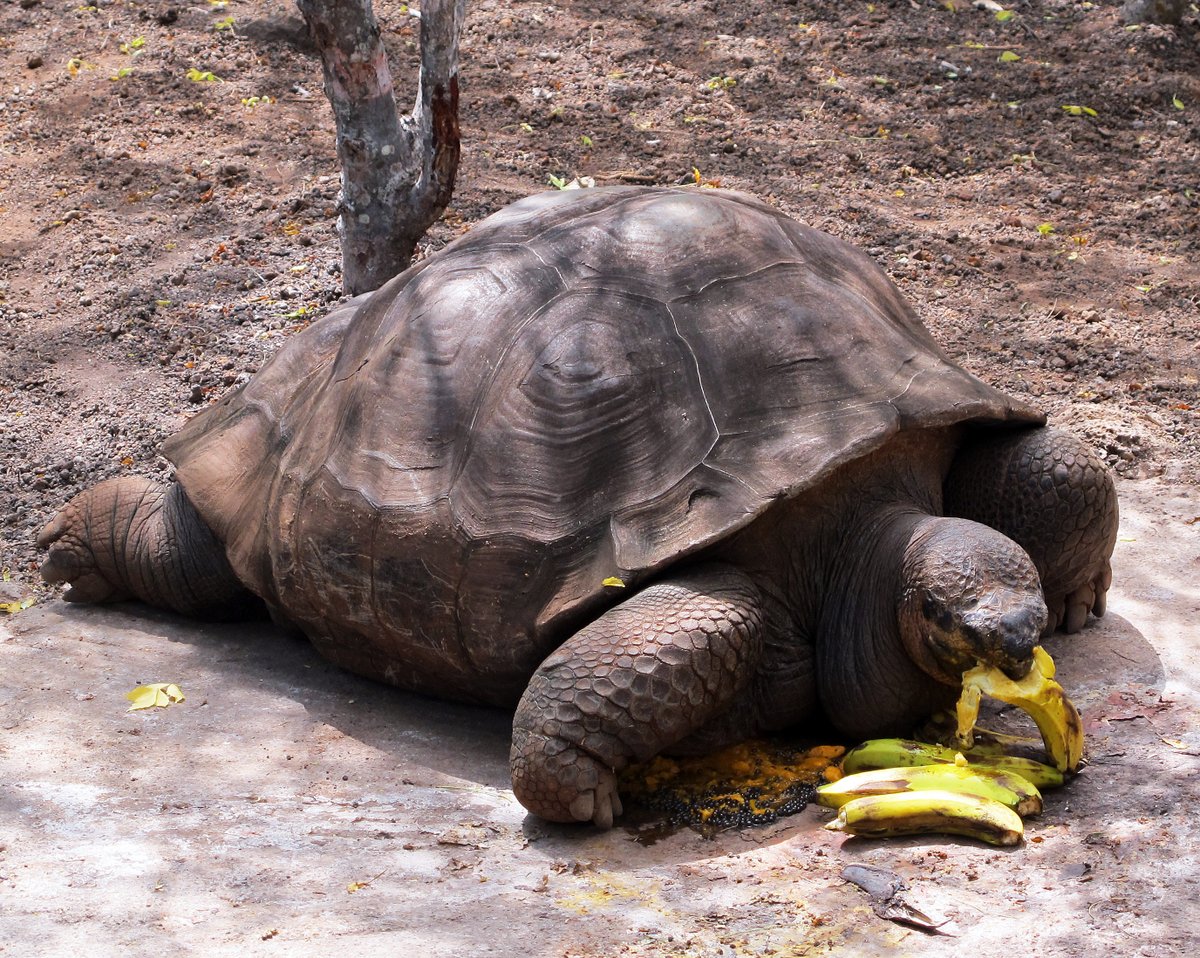
Once we were settled, we caught a water taxi into town and had our usual wander about checking out the supermarket and vegetable market, both of which look pretty good. We then walked out to the Darwin Centre, which is a research centre where they breed Galapagos Tortoises. It was interesting to see the small baby tortoises, which when they are only three years old, are the size of the fully-grown pet tortoises that we have in the UK. It’s incredible that they keep growing to such a massive size.
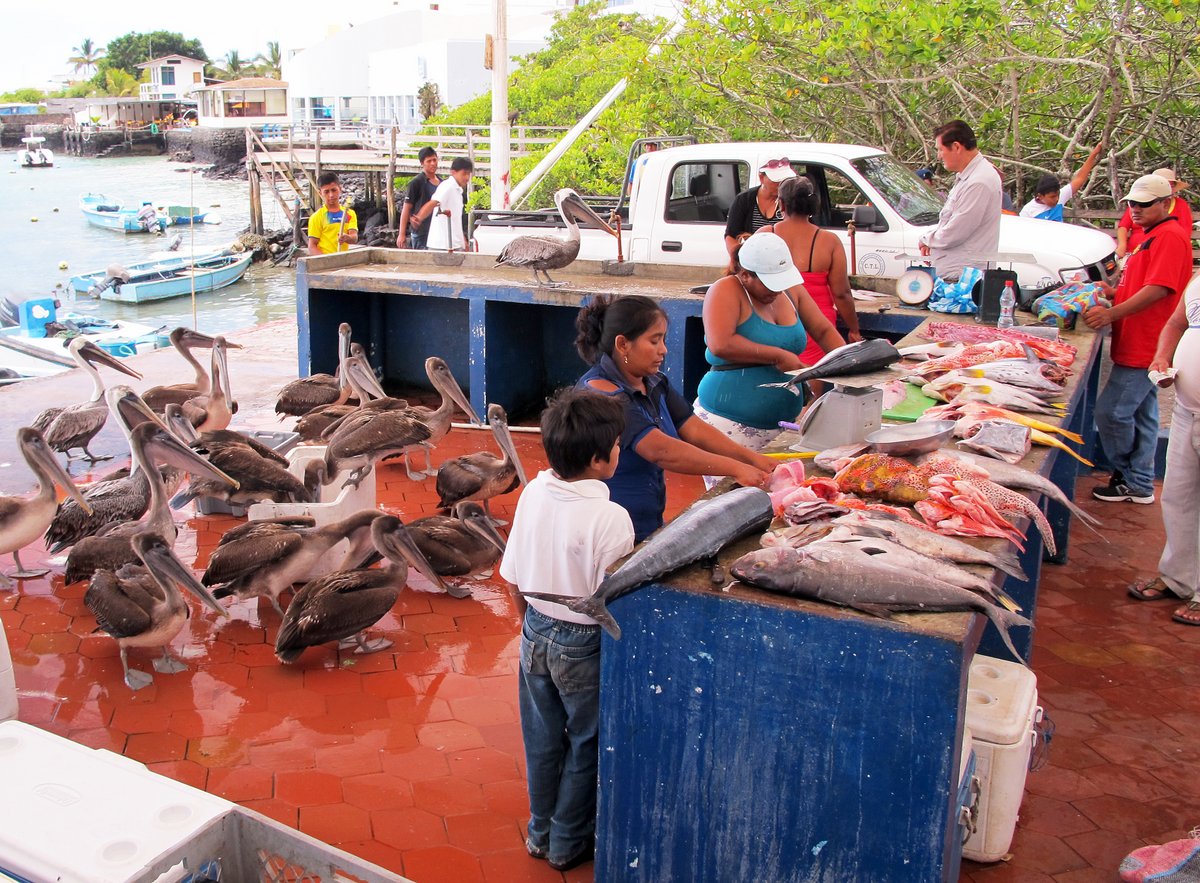
On the way back from the Darwin centre, we stopped off at the Fish Market, which has turned into a small tourist attraction because Sea Lions and Brown Pelicans hang about waiting patiently for scraps from the people cleaning the fish.


While walking around earlier, I’d noticed that there were a lot of small local restaurants on Charles Binford Street just off the main high street. So, rather than paying the $15 tourist prices in the posh restaurants on the Malecon, we went back there. We had a delicious shrimp soup followed by a pan-fried fish with rice and salad for $3 including a glass of Guava juice.
In the evening, we went over to “Sundance” for a beer or two. They also have a stern anchor out to hold themselves in to the swell. Unfortunately, a Polish boat anchored close to them three days ago without a stern anchor and is swirling around in the tides, whereas “Sundance” stays roughly in one position. While we were aboard “Sundance”, the Polish boat was only six feet away.
Glen and Erin have tried to talk to the owner, but he has been very rude and has ignored them. If the Polish boat hits “Sundance”, then he is liable for any damage because he anchored last, but looking at the boat, they are probably not insured and couldn't afford to pay for any damage. So what do you do? Despite being the aggrieved party, I would have moved two days ago – I couldn't stand the hassle…
8 March 2014 Santa Cruz, Galapagos
It was Glenys’s 57th birthday today and I had to remind her – it’s those aluminium pans, you know! We've both agreed to stop buying each other presents and this is the third year running that I've not bought her anything, but I've promised to buy her some black pearls when we get to the Tuamotus.
We went for a walk to Las Grietas. We took a water taxi from our boat to the dock at Angermaeyer Waterfront Hotel and then walked along a good footpath for 20 minutes. The path goes across the Playa Punta Estrada and then around a lagoon. The landscape is barren, but there are countless Darwin Finches darting about. Charles Darwin studied the small differences between these rather boring finches, which led to his famous Theory of Evolution.

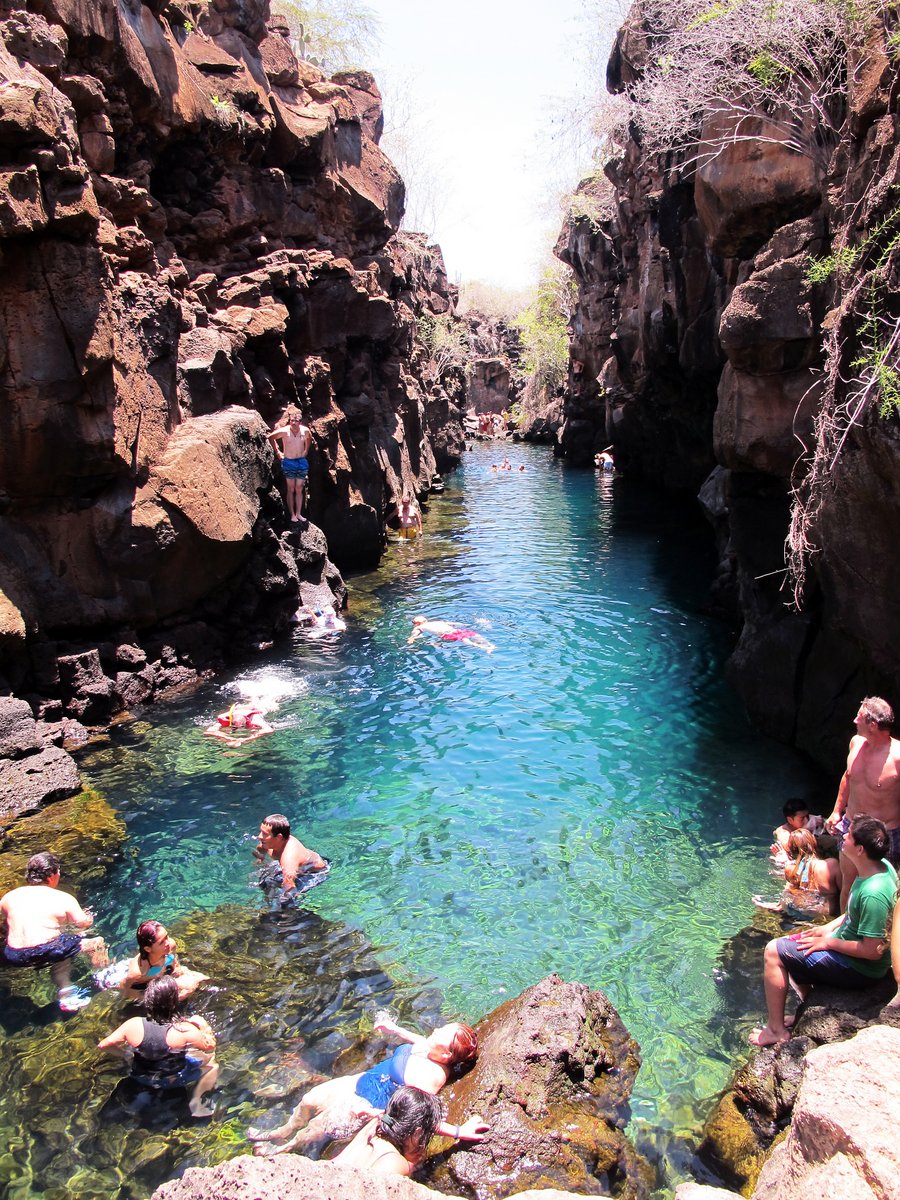
Las Grietas is a long, steep sided canyon filled with sea water. The main attraction, apart from simply swimming in the cool, crystal-clear water, is to climb up the steep sided cliffs and jump off.
It was Saturday, so the place was packed with locals all having a whale of a time. We only stayed long enough to have a swim and jump off the cliffs a couple of times and then walked back to Playa Punta Estrada. We tried to go snorkelling, but unfortunately, the tide was out and we couldn't get past the shallows at the head of the bay, so we gave up and retired back to the boat where we chilled out for the rest of the afternoon.
Last night, we watched a BBC documentary on the Galapagos Islands and one of the things that David Attenborough talked about was the way that Mangrove Seeds drift across wide expanses of sea and plant themselves when they drift ashore. The seeds are about six inches long and float horizontally when in salt water, but then float vertically when they are in brackish water. In this vertical configuration, when they touch land, they plant roots and are very effective colonisers of shore lines. We've been poking around mangroves for the past three years, but I've never noticed these seeds. Today, I saw hundreds of them, even finding one floating vertically in the shallow water off Playa Punta Estrada.

We went for a stroll around town in the evening. There were loads of locals wandering about with their kids near the square just off the town dock - most of the older boys were zooming about showing off their prowess with skateboards. Meanwhile vendors were setting up beer and food stalls and a band was setting up huge speakers on the stage overlooking the square. We grabbed a beer and did a bit of people watching.

Down at the fish market, plastic tables had been set out and people were buying fresh fish and having it cooked on the spot served with a plate of rice and plantains. We wandered over to the street with the local restaurants and found that it had been blocked off and the street was covered with tables and chairs. Large groups of tourists were arriving to eat barbecued fish for $12-15 per head – a long way from the $3 charged during the day when the locals eat there.
Glenys fancied some stodge, so we ended up in a very American looking bar, having fish burger and chips. Glenys treated herself to a Blue Booby Marguerite for her birthday, which was errr… very blue. Back at the square, the band showed no sign of starting for hours, so we gave up and were in bed by half past nine – we’re getting old…
9 March 2014 Santa Cruz, Galapagos
It was another beautiful day, so we walked to Playa Tortuga. It’s a long three kilometre walk along a paved path to the beautiful white sand bay. “Tortuga” means “Turtle” and the beach is a favourite place for Green Turtles to lay their eggs. We walked along the edge of the sand dunes and saw several turtle tracks coming out of the sea, leading to obvious nests. We were very lucky to find a small hatchling, which was struggling in the hot sun. Being the only one visible, we assume that it was the runt of the clutch and its brothers and sisters had already made it to the sea.
Although you’re not supposed to touch the wildlife, Glenys felt sorry for it and carried it to the sea, where the tiny two inch long turtle seemed to recover a little, but still seemed confused about which direction to go. At least we gave it a fighting chance. Unfortunately, I forgot to put a memory card in my camera and so I have no photos of the cute little thing – what an idiot…
There are lots of Marine Iguanas along the beach both swimming in the sea and strolling along the sand. We also spotted a few juvenile black tip sharks swimming at the edge of the sea in water that was only a few inches deep – strange behaviour.

At the west end of the beach, there’s a big lagoon with another lovely beach. Like the main beach, there were hundreds of people enjoying the good weekend weather. Glenys and I went snorkelling, but the water close to shore is very murky, so we swam several hundred metres out into the middle of the bay where the visibility improved to 4 metres allowing us to see an octopus and a huge 1 foot wide clam. We swam back along the mangroves which line the shore and had a great time observing Marine Iguanas swimming a few feet away from us – if only I had my camera…
We were back on the boat by mid-afternoon and went to “Salamander” for a barbeque in the evening.
10 March 2014 Santa Cruz, Galapagos
We got up early and went on a tourist trip to North Seymour Island. It cost us $135 each, but we bit the bullet because other cruisers have said that it’s well worth it. The itinerary consisted of a bus ride to the north end of Santa Cruz, a boat ride to a beach for snorkelling, lunch and then a 2 hour wander around North Seymour Island, which is a breeding site for Blue Footed Boobies and Frigatebirds.

The bus journey takes 30 minutes and it was interesting to see the way that the terrain and vegetation changed as we moved away from the coast up into the highlands. Near to the coast, the landscape is very dry and the vegetation is cactus and scrubby trees. The road then goes through lush farmland covered with trees, grassland, cattle grazing, vegetable crops and even fields of bananas. As we climbed higher, the vegetation became a kind of scrubby forest with strange trees covered with hanging moss and lichen.
The trees are called Scalacia and were one of the first plants to colonise the newly formed volcanic island hundreds of thousands of years ago. It is a unique species derived from a type of Dandelion and covers the higher slopes of all of the Galapagos Islands. The trees that we saw were growing to a height of 10 metres and looked very primeval.

The bus dropped us off at a small dock in the channel between Santa Cruz and the smaller island of Baltra. Bizarrely, the main airport for the Galapagos is on Baltra and all passengers have to be transported to a dock, loaded onto small ferry boats for the 400 metre trip across the channel and then onto buses to their destination. I believe that the airport was built by the American Air Force when they had a base here.
Our boat was a nice 55 foot sport fishing boat and we had a pleasant motor in calm water to the Las Bachas Beach, where we had an hour to snorkel or stroll along the beach. Glenys and I went snorkelling, which was okay, but again the visibility was very poor at only 2-5 metres. We didn’t spot anything new, but had a nice time swimming with a couple of Leatherback Turtles in the shallows.
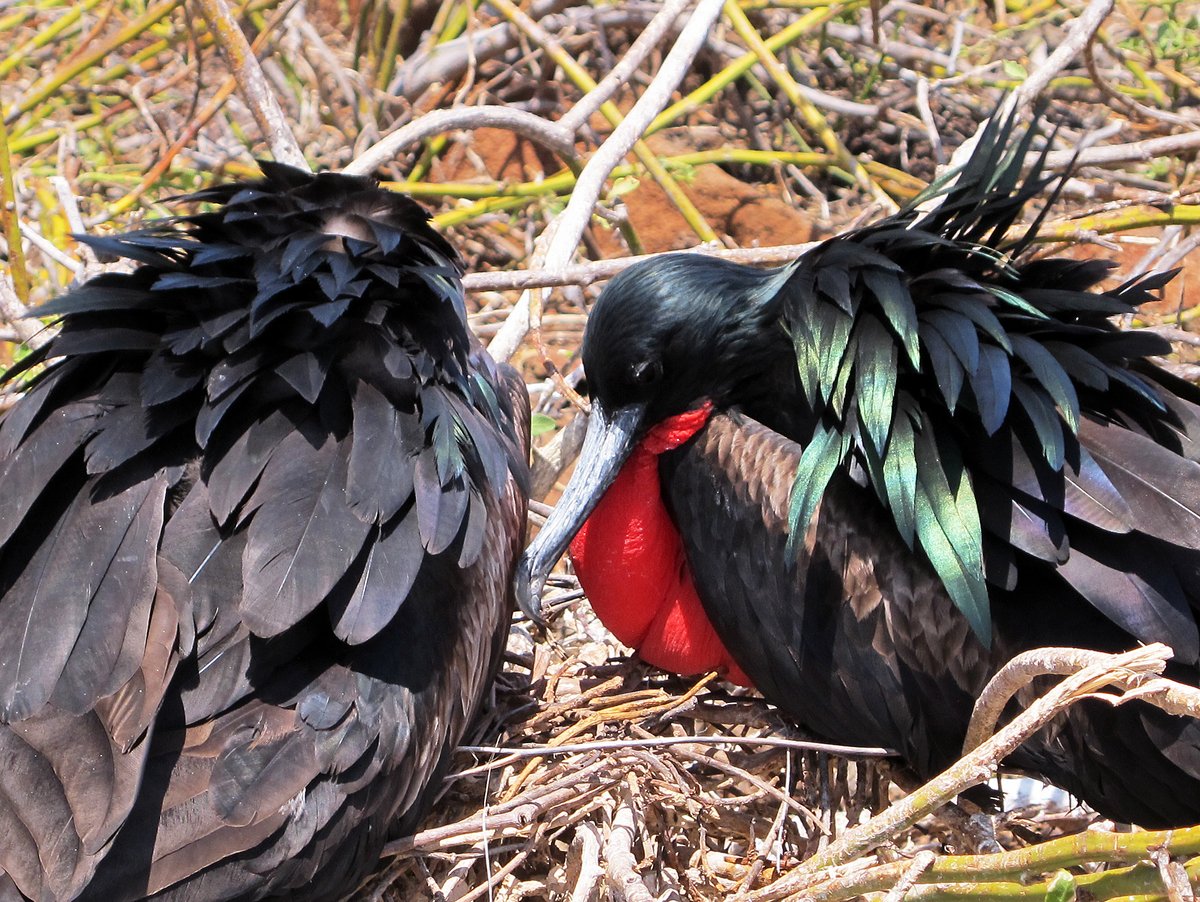
The walk around North Seymour Island was very interesting. At this time of year, Magnificent Frigatebirds are breeding and there were hundreds of males sat on their scruffy nests with their bright red pouches inflated trying to attract a female. As we walked around, we saw the various stages of the life of the Frigatebird, from small fluffy chicks hidden beneath a protective parent to older chicks preening themselves on the nest while their parents were out fishing. We were told that young male Frigatebirds have a white head and chest, while females have a black head and white chest – it’s only the mature males that have red pouches.
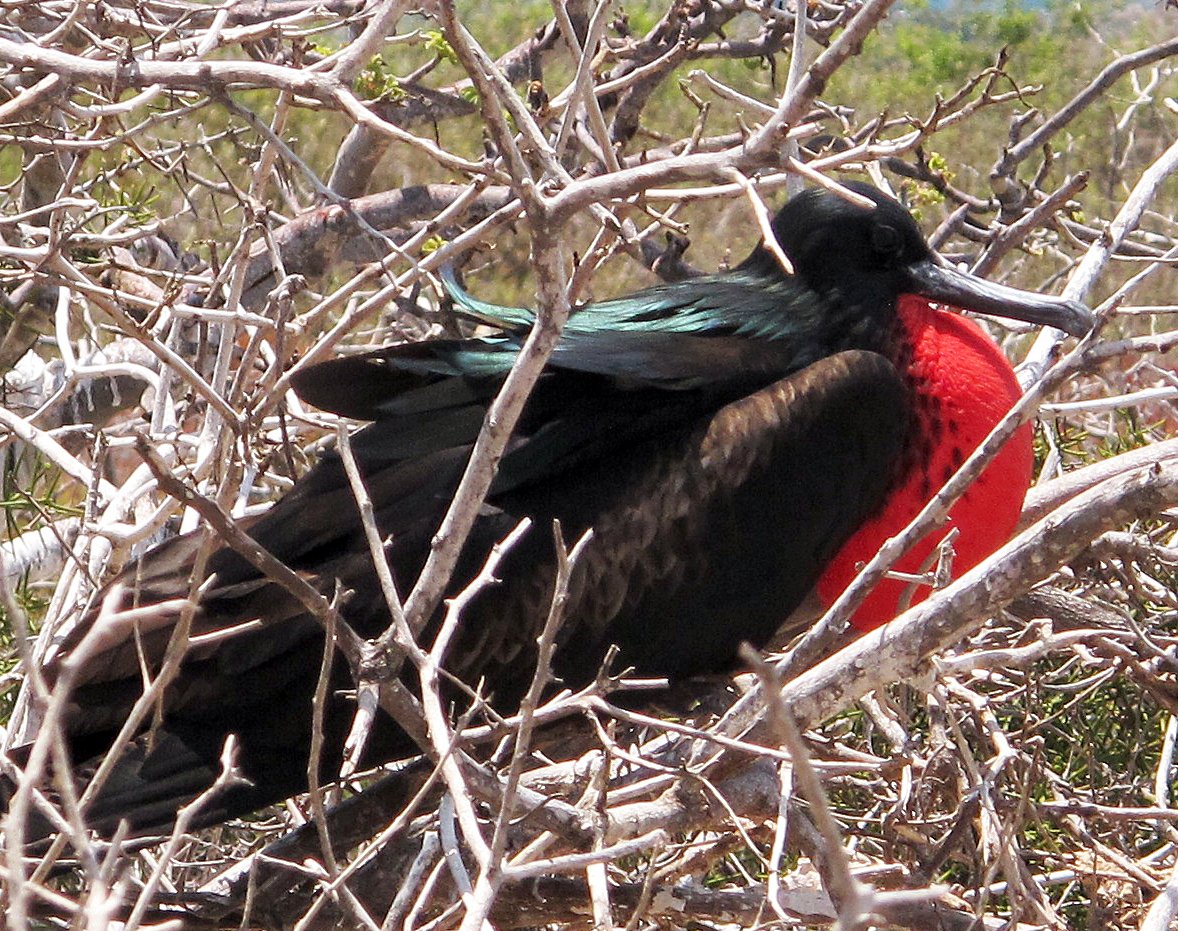
Unfortunately, there were not many Blue Footed Boobies around. This was a pity because I was looking forward to seeing their courtship dance, which is supposed to be comical, with much foot stamping and contorted body positions. Ah well, maybe I’ll see it somewhere else.
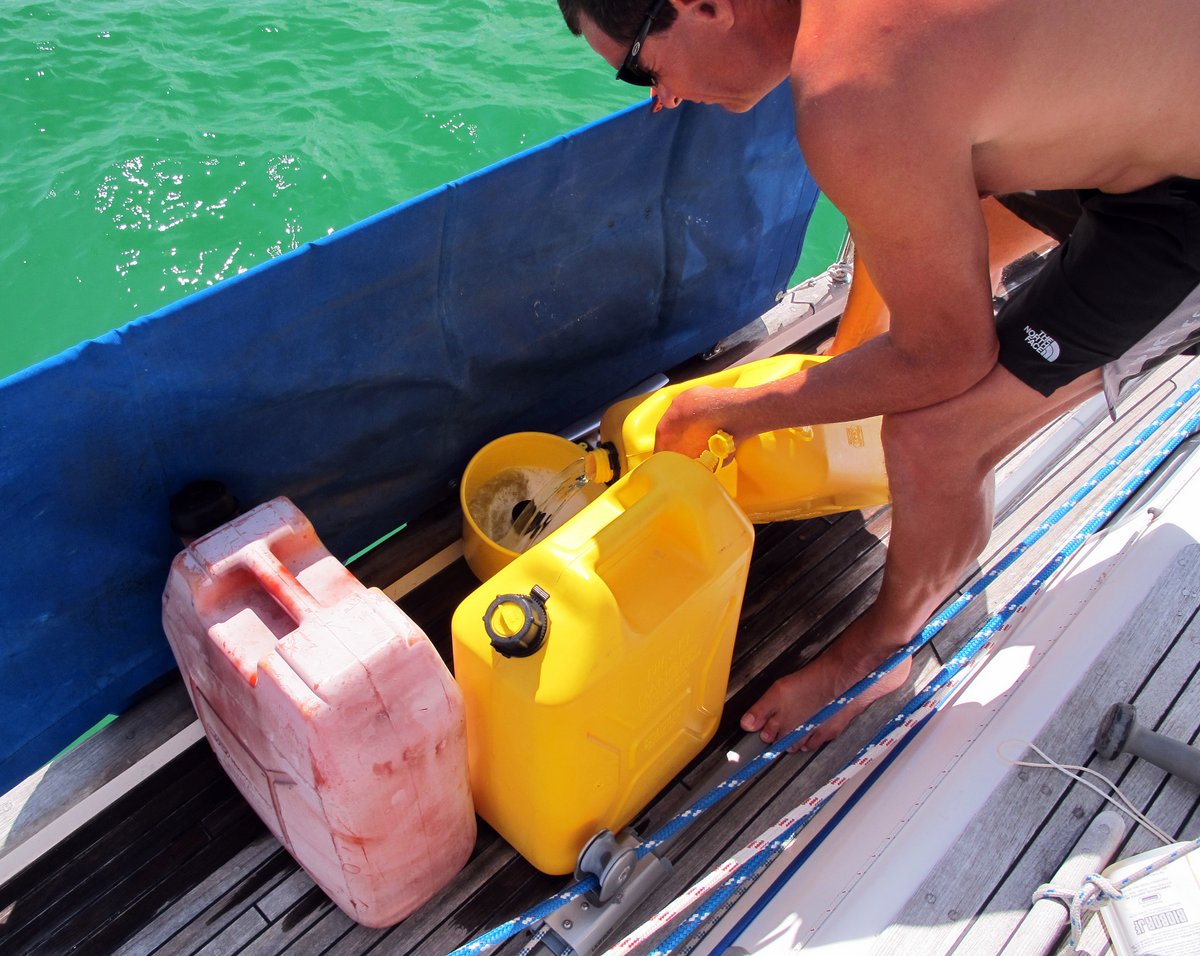
The bus started to overheat on the way back to town, so the driver turned around and we had to wait while they filled up the radiator. In typical Ecuadorian fashion, they only had a one gallon drinking water container and had to keep shuttling back and forth in their inflatable to get the fresh water from the sports fishing boat – it took them 40 minutes.
11 March 2014 Santa Cruz, Galapagos
Having been tourists for the past week, it was time to catch up on some chores. Glenys dragged me off to the “big” vegetable market, which only occurs on Saturday and Tuesday mornings. It opens at 0600 and one is supposed to go there very early to get the best produce. We arrived at 0900 and there weren’t that many stalls - Glenys thinks that the normal market on Avenue Baltra has a better selection. After buying lots of vegetables, we walked along to the normal market, where there are several good butchers.
After lunch on board, we tackled the tedious task of getting diesel. Our agent, Irene, had dropped off a document permitting us to buy up to 60 gallons of diesel. We took our three jerry cans ashore and caught a taxi to the fuel station on the outskirts of town, which cost $3 for the return trip. At the fuel station, we had to go into an office, where our paperwork was checked. There was a little bit of confusion when I tried to explain that I wanted to do two or three trips getting about 15 gallons each time, but the guy understood eventually.
I was issued with another slip of paper, which stated the number of authorised gallons. I’d told him fifteen gallons and tried to emphasise “approximately” because I really wanted to fill all three containers to the brim and didn’t know how much that was going to be. I gave the form to the pump attendant, who set the pump to cut off at 15 gallons. There was total confusion when I said that I wanted more, but the taxi driver came to our rescue and persuaded the pump attendant to reset the meter.
We went back to the boat, poured our 18.7 gallons of diesel into the tank, then went back for more. This time I got a slip of paper for 20 gallons thinking that I should over-estimate. When I only took 18.5 gallons, the pump attendant was even more confused (and annoyed) that I hadn’t taken all 20 gallons. After a bit of chaos, he charged me for 19 gallons, but gave me a receipt of 20 gallons – how weird is that?

Back at the boat, we only managed to pour in 1½ jerry cans before our diesel tanks were full, so on our third trip, I asked for 7 gallons to top up our two jerry cans and pleased the pump attendant by taking the exact amount. The most annoying thing about the whole process is that we have to pay $5.03 per gallon when the Ecuadorians only pay $1.04 per gallon. It’s a load of administrative nonsense and then we’re charged FIVE times the pump price.
12 March 2014 Santa Cruz, Galapagos
We climbed out of bed early and walked to Playa Tortuga (this time with a memory card in my camera.) We walked along the edge of the sand dunes again, looking at the turtles nests, but didn’t see any hatchlings this time. However, it was a nice walk and we saw lots of tracks where the large female turtles had dragged themselves up the beach.
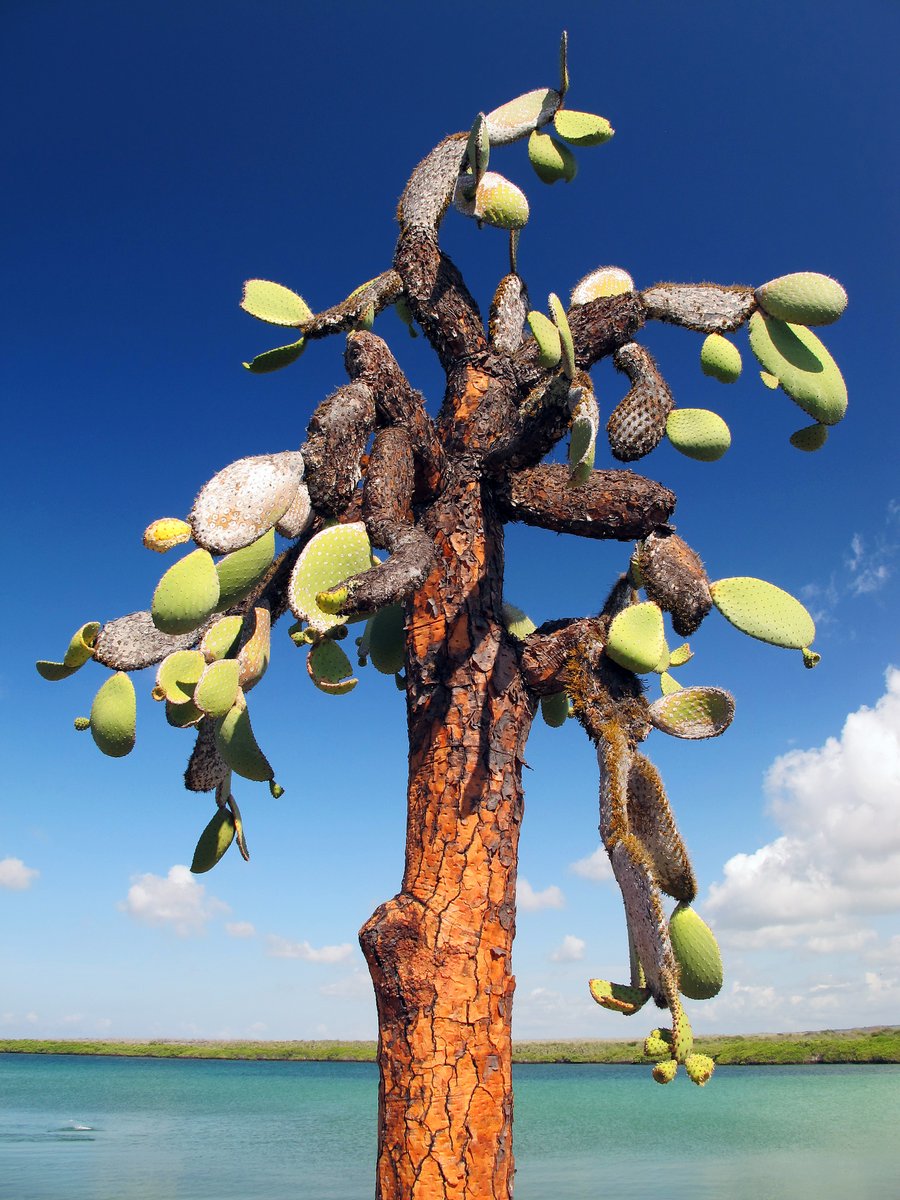
On the peninsula, at the end of the beach, is a wonderful patch of Galapagos Giant Cactus. These are the only cactus in the world that grows like a tree and have trunks that look like wood where the plants store large amounts of water. The cactii look very strange, seeming to grow out of the bare volcanic rock.
We had a nice snorkel along the rocks at the edge of the lagoon, spotting some small Black Tip Sharks and swimming with a couple of Marine Iguanas. We then walked back to the main beach where there was a small pool that had been created as the tide went out. The water was very clear and six small Black Tip Sharks had been trapped there. It was really fascinating to swim with them and watch as they moved around the legs of people standing in the pool.
After a long hot trudge back to town, we treated ourselves to an Almuerzo before heading back to the boat to chill out. Later in the afternoon, I wandered into town to try to buy some boat parts.
There are two chandlers – ElectroNautica on Charles Binford street and Bodega Blanca on Seymour street, both just off the Malecon. They both have a fair range of parts – Electronautica specialises in electronics and I guess can repair electronic equipment, while Bodega Blanca is more of a general hardware store with some marine parts. I didn’t do very well and only bought a snap clip and an impellor for our Mercury outboard. Everything else on my list was either not available or they’d run out. I dream of going to a West Marine store.
Our zarpe was dropped off in the afternoon, so we’re all ready to leave for Isabella in the morning. It's about time to go because the anchorage has been very bouncy for the past couple of days - I've very glad that we've got a stern anchor keeping us pointing into the 2-3 foot waves.
13 March 2014 Santa Cruz to Isabella, Galapagos
The alarm clock woke us up at the crack of dawn. I jumped into the dinghy and pulled up the stern anchor, while Glenys sorted out the awning and tidied up. We were motoring our of the anchorage at half past six.
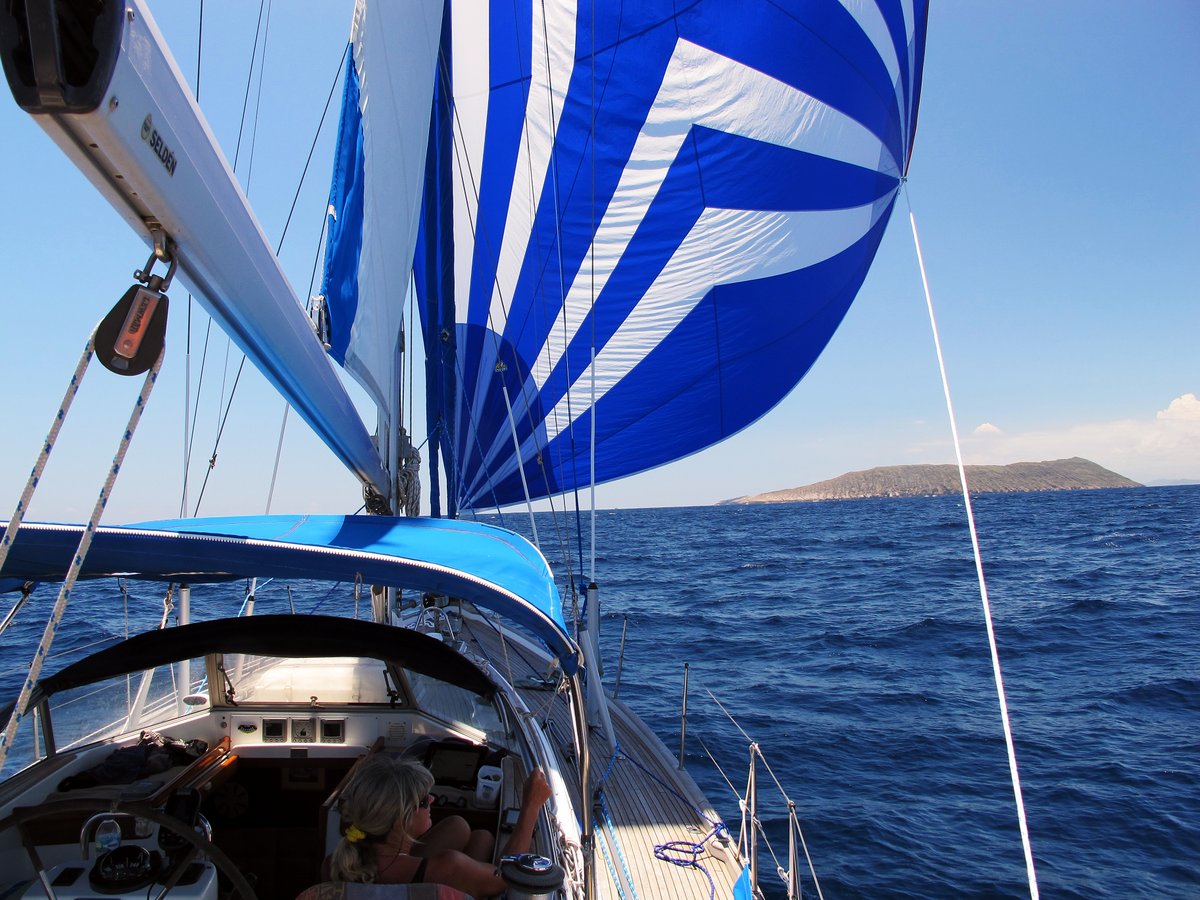
The wind was fickle for the first hour, while we motored away from the effect of the land, but it then picked up enough to fly the asymmetrical spinnaker. Even after nearly three years living on Alba, I’m still learning how to sail. The wind was coming from our port aft quarter and the spinnaker kept collapsing and re-inflating with a bang – very annoying. Eventually, I put two reefs in the main sail and pull it amidships, which worked a treat because the main wasn’t preventing the wind from hitting the spinnaker.
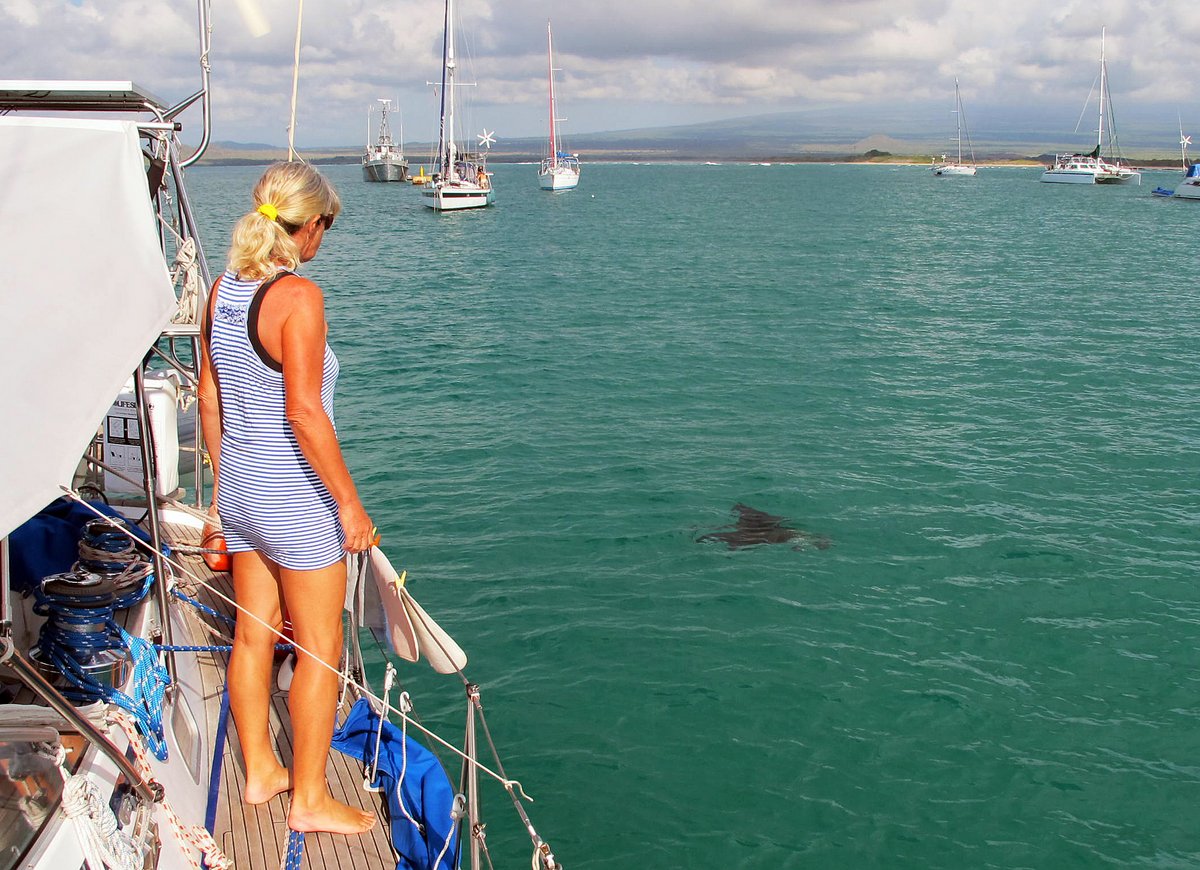
Once we’d got the sails set up correctly, we had a fabulous sail in calm seas and blue skies. We even had a pod of Bottle Nosed Dolphins join us for a while.

We sailed to the south of a small island called Isla Tortuga. It’s a spectacular sight being the remains of the rim of a two mile wide volcanic crater that sticks up from the ocean. Half of it has been eroded by the sea leaving behind a crescent shaped island. We were planning to sail through the middle of the crater, but as the area is uncharted and we were under spinnaker, we kept to the south side of the rocky circle.
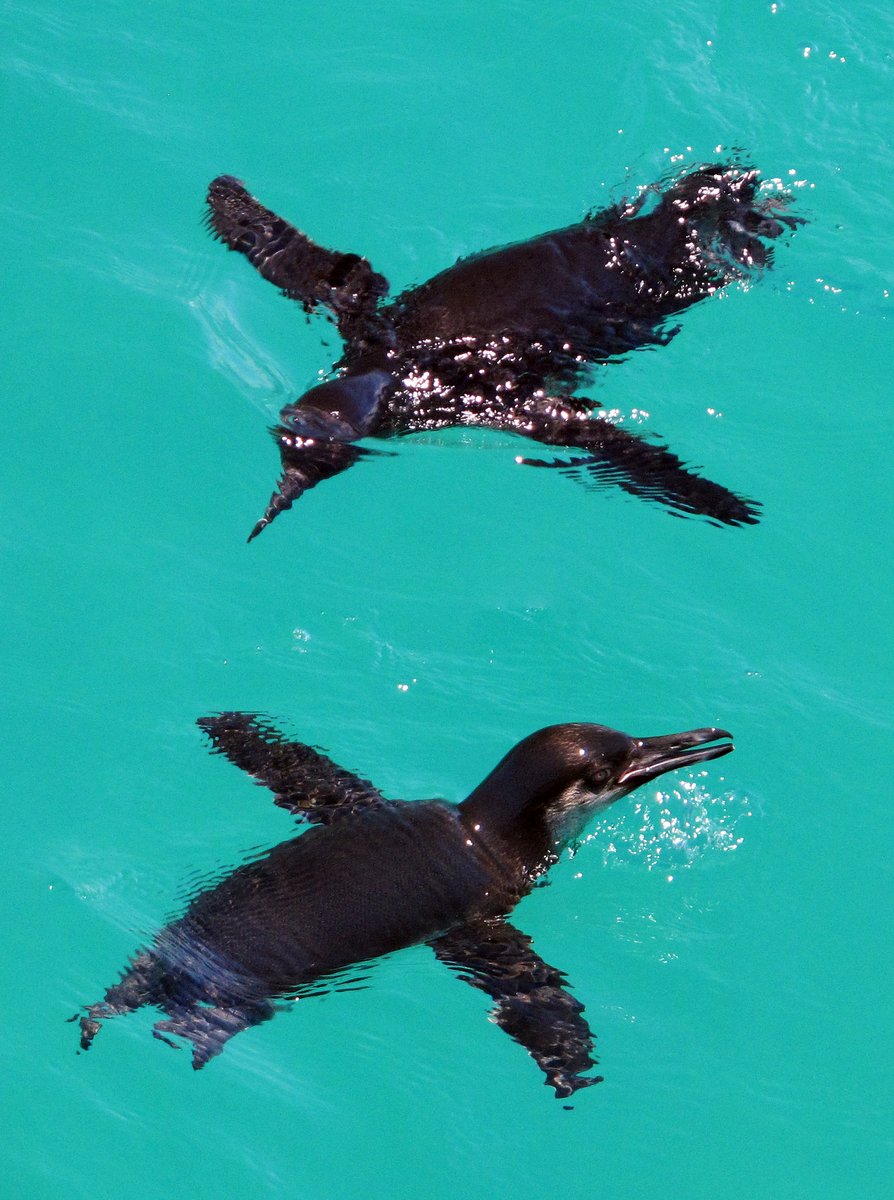
Having gybed the spinnaker as we passed the island, we headed off to Puerto Villamil on Isabella, arriving at four o'clock in the afternoon. There are ten other cruising boats anchored here and it took a while for us to find a place that is out of the swell. The anchorage is lovely with blue water and we were very excited to see our first Galapagos Penguins zooming about us seeming to fly underwater with their short stubby wings.

I went ashore to meet J.C. Soto who is the agent here. He’s taken our documents and told me that he needs a few days’ notice when we want our International Zarpe. Strange to think that when we leave here, we’ll be sailing for 25 days…
14 March 2014 Isabella, Galapagos
Glenys became in Internet Widow in the morning because I had an Internet connection on board for the first time since we left Bahia de Caraques three weeks ago. I spent all morning catching up on older emails and sorting out our finances. This is a big month in expenditure because we have to pay out for our health insurance and our yacht insurance, so I had to move a bit of money around.
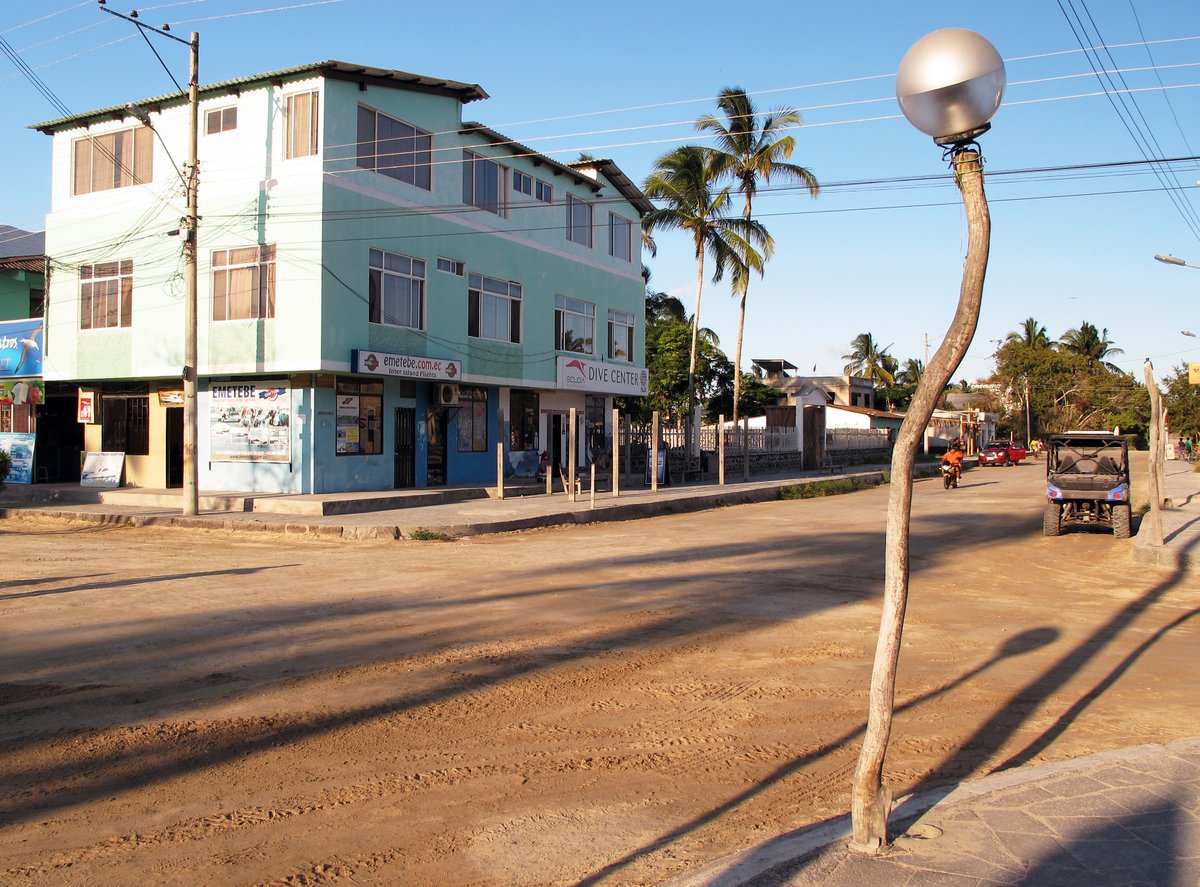
In the afternoon, we dinghied to the dock and walked into town – it’s not very convenient because it’s a fifteen minute slog in the beating sun along a dusty road. There is a small shortcut that goes between some government buildings and leads you onto the edge of the town beach.
The small town of Puerto Villamil is a dusty sleepy place, where the roads are made from hard packed dirt and the pace of live is relaxed. We went into a dive shop and arranged to go out to Isla Tortuga for a two tank dive – it might be Monday, Tuesday or Wednesday – who knows?
We called in a few tour operators and asked about the cost of hiking up to the sulphur mines. There are lots of organised trips to go to the volcano, but the sulphur mines are an hour further and not many people do it, which is exactly why we want to do it – we don’t want to be mixed in with fifteen hikers on a kind of school trip. Unfortunately, all the tour operators were very vague and wouldn't give us a price, wanting us to put together a group and then they would work out the price. I'm guessing that it will be about $200 split between the group, so if we got six people together it would be about $35 which is the price of the normal trip.
The town was still having a siesta and the small grocery stores were mostly closed, so we walked up to the Tortoise Sanctuary along a very pleasant board walk through a mangrove swamp. The main purpose of the Tortoise Sanctuary is to breed the different species of Galapagos Tortoise that live on the island and to release them to the wild. I was amazed to find out that hardly any wild hatchings survive because of the presence of rats and other introduced predator species. If the Tortoise Sanctuaries on the various islands didn’t breed tortoises then they would become extinct.
Galapagos Tortoises are not the most interesting creatures in the world, so we were soon back in town wandering around the small grocery stores. Glenys thinks that she’ll be able to buy everything that she’ll need for the long passage to the Marquesas.
15 March 2014 Isabella, Galapagos
I had a dodgy stomach today, so we stayed on board. Glenys got on with some cleaning jobs, while I spent most of the day researching what we’re going to be doing over the next 12 months. I started looking at anchorages in the pacific islands and have now sussed out what we’re going to do through the Society Islands from Tahiti to Bora Bora. I then moved onto investigating New Zealand.
I've been having some email correspondence with a couple of cruising friends who are currently in New Zealand and they've been giving me the low down on the various boatyards and marinas in the North Island. Even though we’ll be there for nearly six months, it sounds like the boat yards are always busy, so I might have to pre-book a haul out to get some jobs done.
We’re planning to go home to the UK for a month over Christmas and then go for a month-long road trip around South Island. Add in time for a haul-out and some major jobs, I think that we’ll only have eight weeks to actually sail in New Zealand…
16 March 2014 Isabella, Galapagos
We were awoken to a loud bash on the side of the boat. Shoals of small fish are gathering under our hull and the predators want them. The local Brown Pelicans fly to a height of 30 feet and hurtle down, crashing into the water inches from our hull creating a loud bang as the water slaps against the boat. Meanwhile, Galapagos Penguins are zooming about picking off individual fish out of the shoal – it’s hell for fish out there.
We pottered about today, I rigged up the spinnaker pole to check it out for downwind sailing and I also played with setting up the main boom to hold out a second head sail. On our previous boat “Glencora”, we’d had two spinnaker poles, which was ideal for holding out two head sails wing-on-wing when we crossed the Atlantic Ocean. Unfortunately, I only have one spinnaker pole on “Alba”, so I’ve come up with a way of using a snatch block on a loop half way along the main boom which I hope will work.
In the afternoon, we walked into town, dropped off our laundry and bought a few provisions including some frozen shrimp. Most of the small tiendas were open even though it was a Sunday - even the small baker was open, so we had some nice fresh rolls to eat with our Viche de Camaron.
17 March 2014 Isabella, Galapagos
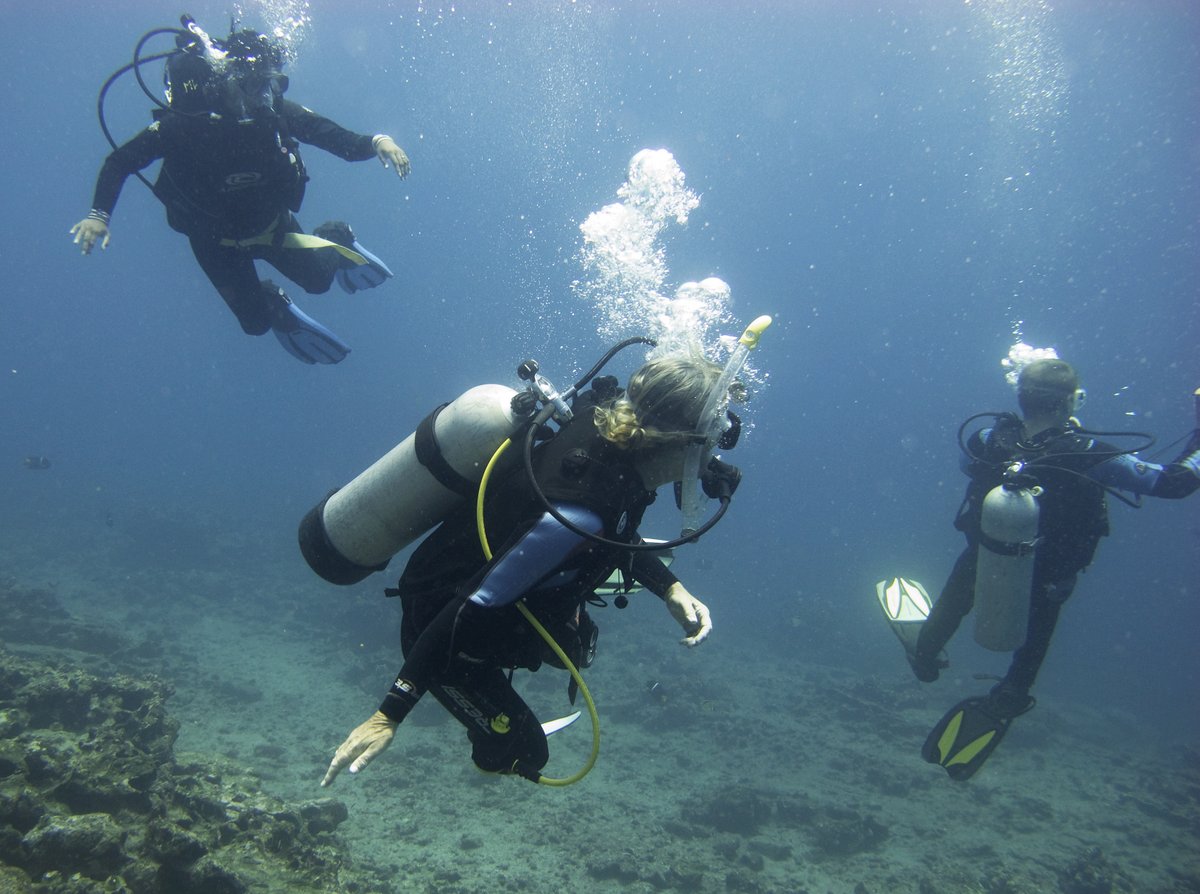
The dive boat from Isabella Dive Centre came to pick us up at half past seven and took us out to Isla Tortuga. There were eight other divers, so they split us up into two groups. Both drift dives were on the windward, eastern side of the crescent shaped island and excellent. They dropped us off close to the rocky shore and, as soon as we had descended to 20 metres, we started to see large pelagic fish – the visibility was over 20 metres and excellent.
Groups of four or more Hammerhead Sharks were swimming past, coming in and out of our sight. They seemed to be more cautious than the large White Tip Sharks, who would make closer passes to our small group. Turtles swam by constantly, often circling us before carrying on with their foraging. A few times, we encountered large shoals of Pelican Barracuda, who would swirl around us – there were so many that it was impossible to see the other divers in the group even though they were a few metres away.


We had four sightings of huge Manta Rays. With over four metre wing spans, these giant creatures fly slowly along underwater, using modified fins to scoop plankton in to their mouths. They are absolutely beautiful to see in the wild.

We could see strong thermoclines, which is a shimmering in the water, caused when cold denser water mixes with warm surface water. One of the reasons that the Galapagos has such plentiful marine wildlife is that a cold, sub-surface current comes across the Pacific Ocean from west to east where it hits the Galapagos Islands and rises to the surface bringing with it rich plankton. Descending down below the thermocline, the temperature dropped very noticeably, but it was worth it to find a yellow Pacific Seahorse, clinging to the rock, harvesting the plankton and small marine animals.

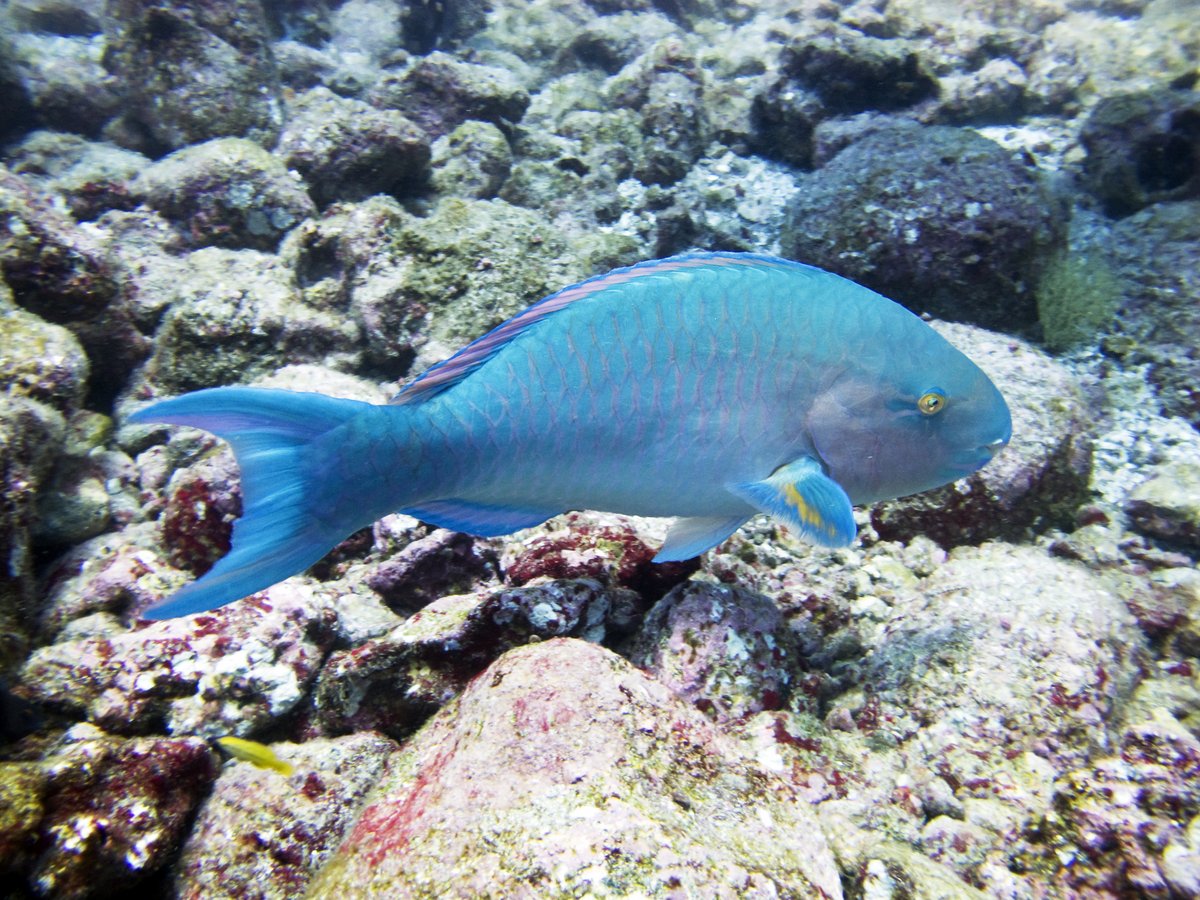
There was so many large pelagic fish that it was hard to know where to look. I hardly glanced down at the rocky sea bed, but managed to get a reasonable photo of an Azure Parrotfish on one brief lull in the visual onslaught. It’s one of the best places that I’ve dived.
We were back on Alba in time for lunch and spent the afternoon chilling out – Glenys reading while I spent hours editing the photographs and video that had been building up for the past week.
18 March 2014 Isabella, Galapagos
We went shopping in morning, wandering around the small tiendas looking what they had in stock. We snaffled the last of the bread rolls from the bakers and found some cans of beer in a supermarket (at twice the price of mainland Ecuador). There’s not a lot of meat around and I heard several locals asking for chicken which everyone seems to have run out of. We found one shop that had some pork chops, but when they pulled it out of the freezer, it was a solid clump of frozen meat so we didn't bother. We finally found a nice piece of frozen Wahoo which looked more appetising.

There’s quite a collection of wildlife centred around the dinghy dock with lots of Sea Lions lounging about. They've taken over the bench seats and most of the time there are 15 or so blocking our way to our dinghy. Most of the time, we can step carefully between them, but today a bull was sat in the middle and we had to shoo it away. They’re quite intimidating when they start defending their territory.
There’s also a fair number of Marine Iguanas, that lie on the path and board walk heating up in the sun. They often look like they've been run over by a car because they just collapse flat and don’t move even when you step close to them. Then occasionally, one will sneeze out a liquid which sprays out a couple of feet – they have a special gland which they use to extract the excess salt from their bodies. Very weird…
We chilled out on the boat for the afternoon. My stomach’s a bit iffy again. A couple of days ago, before we went diving, I took some Immodium and I think that it’s been controlling the symptoms (i.e. running to the toilet) and not helped in sorting out the problem (i.e. nasty bacteria in my stomach), but I’m not sure what to do. I’ve taken some tablets (“Lacteol Fort”) that a pharmacy recommended in Quito when Glenys had a dodgy tummy, I’ll see what they do.
19 March 2014 Isabella, Galapagos
It was another beautiful day, so we hired a couple of bikes and cycled to the Wall of Tears. The National Park have built a dirt road which runs for 6 kilometres along the south coast of the island and have built a number of short footpaths out to view points and places of interest. We decided to ride directly out to the Wall of Tears and then take our time coming back.
God it was hot! The road meanders its way through scrub-land populated by shrubs and Galapagos Giant Cacti. There’s very little shade and the sun is merciless. We’d each drunk a litre of water by the time that we’d ridden the 6 kilometres.
The Wall of Tears is a 7 metre high, 100 metre long wall built from blocks of lava rock. It’s in the middle of nowhere and was constructed by prisoners in a penal colony sixty years ago as a form of punishment. It must have been hell, working away in the blistering heat, building something so pointless. There’s a set of steps leading up a small hill next to the wall which we climbed to get a panoramic view of the south end of Isabella – miles and miles of desolate scrubland.
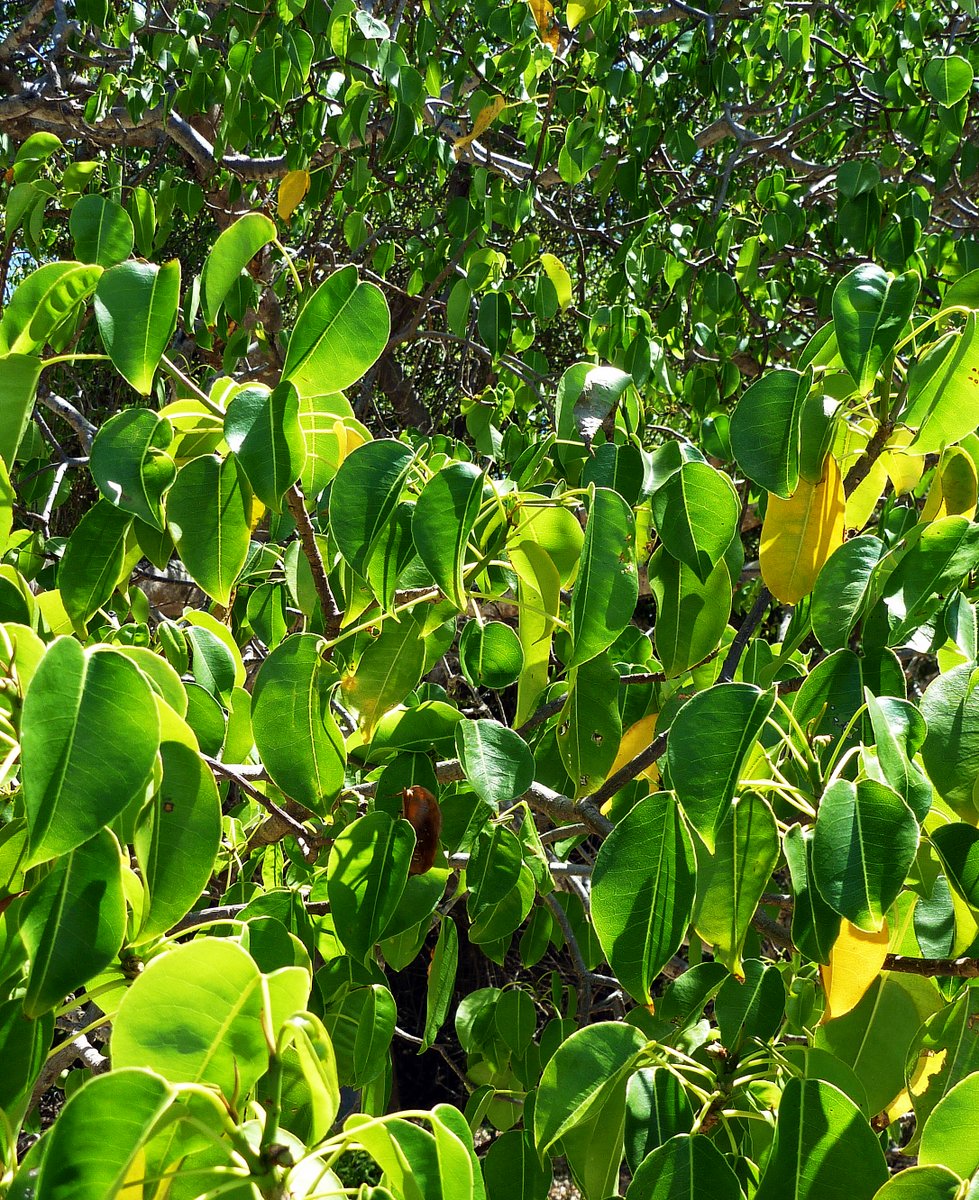
On the way back we spotted a few wild Galapagos Tortoises munching away on the small, green, poisonous apples from the Manchineel Tree. We've seen this tree all through the Caribbean and its sap is so toxic that just standing underneath it in the rain will bring some people out in blisters. I believe that the Galapagos Tortoise is the only animal capable of digesting the noxious apples
We stopped off at a path called “El Estero” that led to a lovely little spot in the mangroves, where there’s a small beach with very clear water. It would have been lovely to go snorkelling around the mangroves, but unfortunately, we were at low tide and the water was only inches deep. (I was a bit gutted because I’d lugged our snorkelling gear all the way up to the Wall of Tears and back…)
Another interesting place was “Tunel del Estero” - a small lava tunnel, which we were able to go inside. These tunnels are caused when the hot magma flowing down from the erupting volcano, cools down on the outside. The molten lava inside continues flowing down to the sea and leaves behind a tunnel – fascinating.
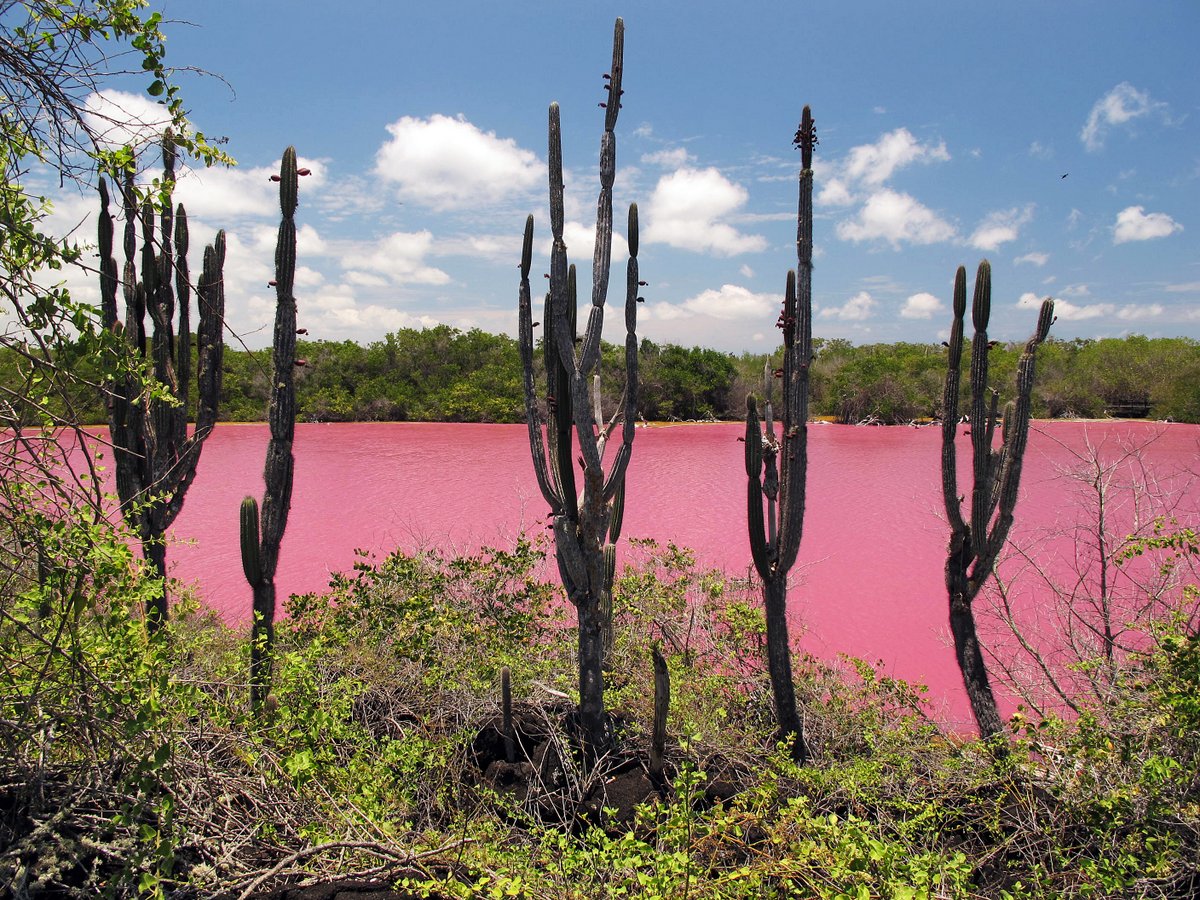
There are a set of saline lagoons along the shore and several paths lead out to these. The most interesting lagoon was a surreal pink colour reminding us of the salt ponds in Bonaire, where the different salinity levels of the water caused different types of algae to bloom creating a kaleidoscope of colour.
After dropping the bikes off, we walked back to the dinghy dock and walked up a short board walk to Concha Perla which is a popular snorkelling spot. It was lovely to plunge into the cold sea after five hours in the beating sun. The snorkelling wasn’t too bad, despite the twenty or so people splashing around – I spotted a big Green Turtle and a Spotfin Burrfish.

20 March 2014 Isabella, Galapagos
I didn’t have a good night, my diarrhoea came back with a vengeance, forcing me to take more Immodium. While I lurked onboard, afraid to leave my beloved toilet, Glenys went into town to do some shopping and managed to find some more “Lacteol Fort” tablets. There’s a small corner shop where they have an impressive range of drugs piled up on an open shelf, which you can buy one tablet at a time. Glenys says that there are even some antibiotics lying around, for which you’d have to have a prescription in the UK.
In the morning, I pottered about doing a few jobs including cleaning the filters for the water-maker, which have become very silted up even though the water here appears to be very clear. I reckon that it’s mostly plankton that’s being filtered out, so I’ve soaked the filters in some Sodium Metabisulphite solution to try to kill the organisms off.
In afternoon, I spent some time on guitar music, trying to work out how to play Sunny Afternoon by the Kinks. It’s a fabulous tune, but there’s some very weird chords and different rhythms going on that are beyond me at the moment. I seem to have lost my motivation for playing the guitar at the moment perhaps I need a guitar buddy.
“Salamander” arrived in the later afternoon from Santa Cruz. Charlotte is a doctor, so I scooted over to ask her opinion about my dodgy stomach. She tells me that if it’s been going on for 5 days then I should be thinking about taking an antibiotic. The “Lacteol Fort” that I’d been pinning my hopes on are just tablets to add a "good" type of bacteria to my stomach, which apparently won’t do much good. I shouldn’t really take Immodium because all it does it to bung one up, so now I’ll have to wait until I’m un-bunged to see if my stomach has sorted itself out.
Mike and Rosie from “Shakti” came for beers. They’re from Australia and have spent several years in Malaysia and Thailand. They absolutely rave about the area, so we picked their brains for most of the evening. It sounds like it would cost $350/month to keep the boat in a marina in Malaysia and flights to Australia are very cheap, so we’ll almost definitely sail past Australia without stopping and then fly back there for a long road trip.
21 March 2014 Isabella, Galapagos
SLAP! SLAP! I slowly dragged myself out of a deep sleep.
SLAP! “Got the little bugger”, said Glenys.
For the last few days, the wind has deserted the anchorage and it’s very airless until the sea breeze picks up later in the day. This has brought with it a small plague of house flies, which arrive at dawn and go away at dusk. They’re very irritating, landing on exposed skin then darting away at the slightest movement to return moments later. We kill them off methodically during the day, but they’re at their most annoying early in the morning when we’re trying to sleep.
It’s about time that we started our passage across the Pacific to the Marquesas and we’d like to go next week, so I downloaded a GRIB file to check the winds. Unfortunately, the wind is remaining light and variable around the Galapagos for the next seven days and there’s no sign of it changing. It looks like we’ll have to just accept that we’ll have to motor for a couple of days to get down below 5°South to pick up the south easterly trade winds. We’ll review it again in a few days’ time.
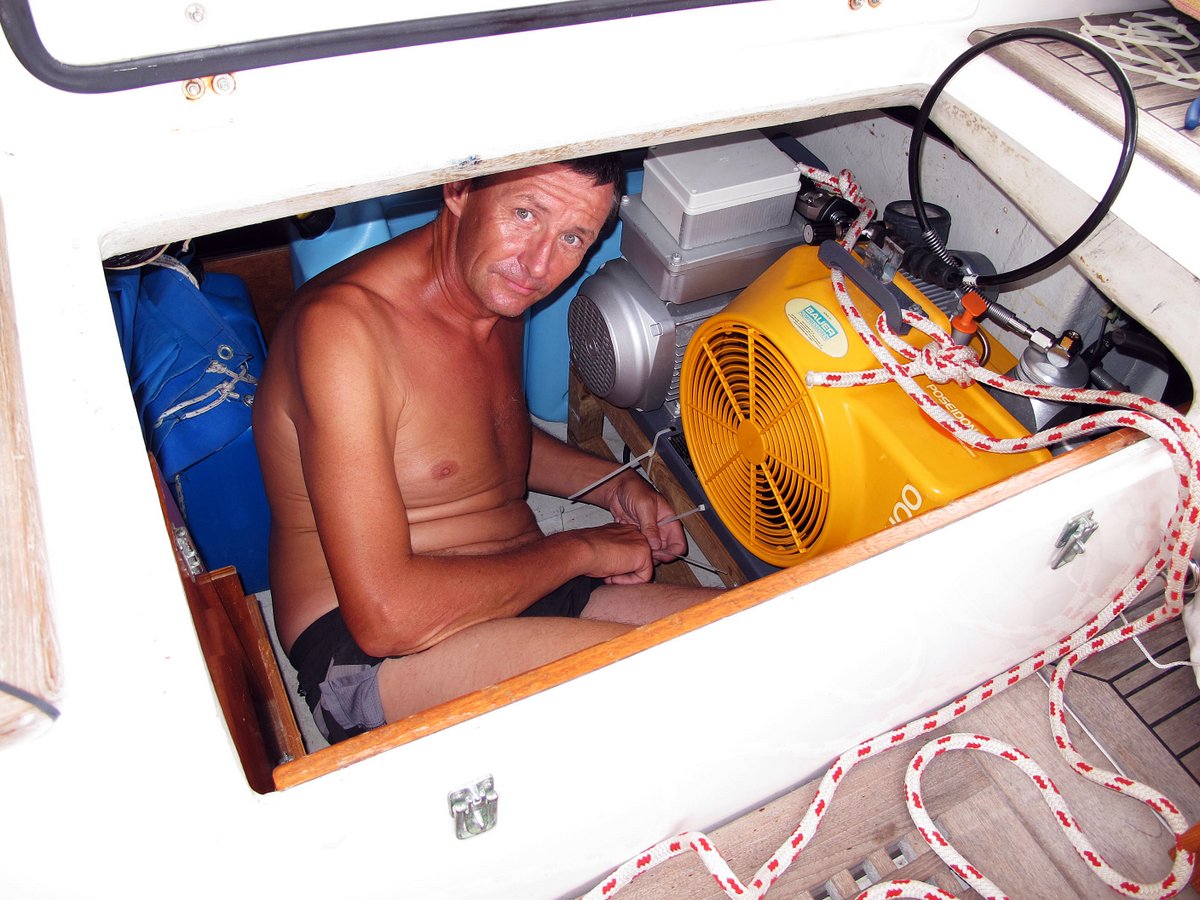
I got on with a few jobs, the main one being to service our dive compressor that hasn’t been run for nearly a year. With some trepidation, I started up our generator and started the compressor and to my amazement, it ran fine and came up to pressure quickly. I ran it for ten minutes to clear the system and then filled the air tank that I’d used to scrub the hull when we left mainland Ecuador.
After lunch, when the compressor had cooled down a little, we pulled it out of its home in the cockpit locker and I gave it a good inspection and service. It was fairly straight forward, just changing the oil and the primary air filter. Everything looks good, so I put it back in the cockpit locker. As usual, it was a struggle to get it back in position, taking a lot of grunting and cursing and then having to crawl into the cockpit locker to strap it in place with cable ties – not a nice job in this heat.
Glenys spent a few hours in the water, cleaning the waterline and the hull because we’ve got quite a bit of growth over the past three weeks since the hull was scrubbed in San Cristobal. There was a thin coating of slime on the antifoul and long fronds of green algae hanging down off the hull just on the waterline. The propeller is covered with barnacles and the keel still needs doing, so that will be one of my jobs tomorrow.
In the late afternoon, we wandered into town and looking to buy some antibiotics that we can use to treat persistent diarrhoea. Charlotte from “Salamander” recommended Ciprofloxacin and Metronidazole, but I didn’t hold up much hope of finding them in this sleepy little place. After wandering around for a while, we eventually found a small pharmacy and to my amazement, they had the drugs and were willing to sell them to us without a prescription. We bought two courses of both drugs for only $18 – sorted!
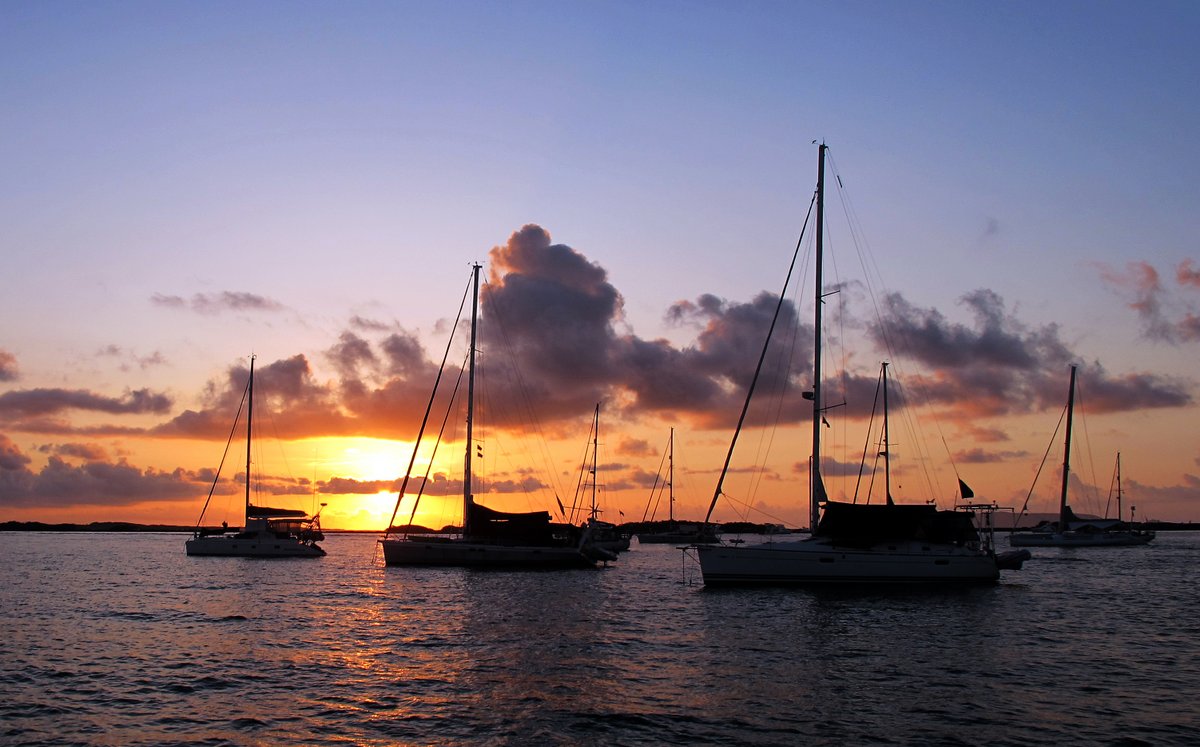
We met Michael and Charlotte from “Salamander” on the beach and went for a couple of beers in a bar before going back to their boat to have a barbeque with some tuna that they bought on the dinghy dock this morning.
22 March 2014 Isabella, Galapagos
The vegetable market on a Saturday is supposed to be good as long as you get there at six o’clock in the morning, but we couldn’t be bothered to get out of bed. “Salamander” went but they said that it wasn’t that great, so we’re glad that we didn’t get up early. Instead, we sauntered into town at half past nine, just in time to catch the baker before he closed up at ten o’clock.
Glenys then dragged me around town, calling in at various tiendas and small supermarkets, buying the normal things like beer, wine, milk and something for dinner.
We’ve not had an internet connection on board for the past three or four days. I can link to one WiFi router, but it doesn’t have any internet connection. I’m pretty sure that they need to reboot their router, but I can’t really ask them to sort it out because I’m using it without permission. I managed to access the administrator login page for their router and spent a couple of hours trying to hack my way in, so that I could reboot the router, but I’ve not got the correct hacking tools to do it - very frustrating.
Later in the afternoon, I inspected our steering gear which was feeling a little stiff on the sail to here from Santa Cruz. To my relief, there doesn’t appear to be anything wrong, but I think that I over-tightened it when I did it a few weeks ago. I slackened it off a little and it seems much better. The last thing that we want is problems with our steering on our passage to the Marquesas.
23 March 2014 Isabella, Galapagos
As it was Sunday, we had a chill out day.
I managed to get an internet connection, so I spent all day reading up on how to hack into routers and wireless connections. I’ve previously downloaded a hacking toolset called Kali-Linux, so today I downloaded documentation on how to use the tools. I struggled to get anything working today, but I’m going to spend time on our 25 day passage to the Marquesas, learning how to use the tools. I’m going up a step from a Silver Surfer to become a Silver Hacker.
Glenys wandered into town in the afternoon and booked us onto a hike to a nearby volcano tomorrow.
24 March 2014 Isabella, Galapagos
We were up early to go on a hiking trip. A rickety open-sided truck with hard wooden seats drove our group of fourteen people up to the slopes of the Sierra Negra volcano. As on our trip on Santa Cruz, the landscape changed from volcanic plains with cacti, to lush farmland as we went higher and further inland.
It was a pleasant walk through green vegetation up to the rim of the Sierra Negra Volcano, which is the second largest active volcanic crater in the world with a diameter of ten kilometres. It’s a very impressive sight. The volcano last erupted in 2005 and the floor of the crater hundreds of feet below is covered by unearthly, black lava and ash, which is nicely contrasted by the green slopes of the crater rim.

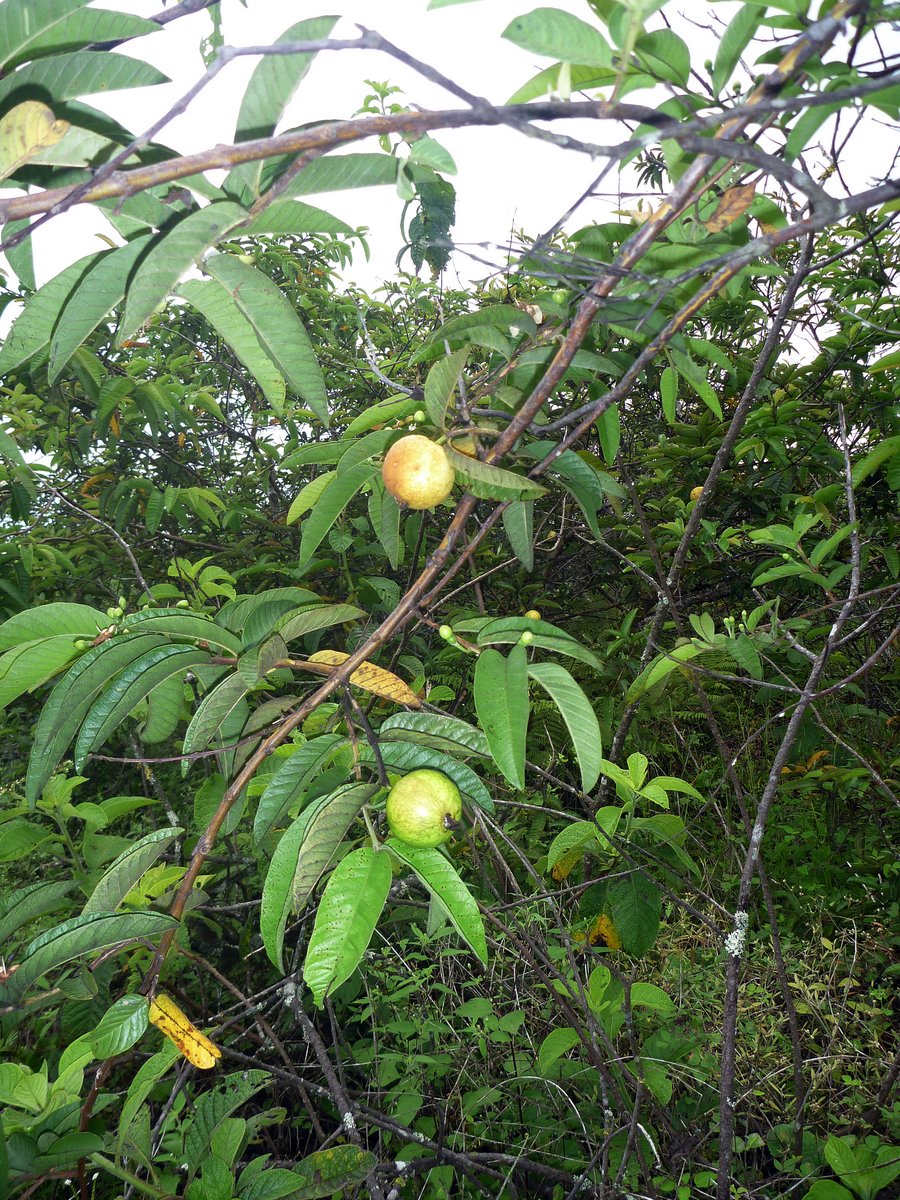
The path took us along the volcano rim, walking between low Guava Trees, which our guide told us is a very invasive species that is slowly forcing out the native plants. We were allowed to pick the ripe, yellow fruits, which were the size of a small plum and tasted pleasant. The fruit has hundreds of seeds and I can see why it's so prolific.
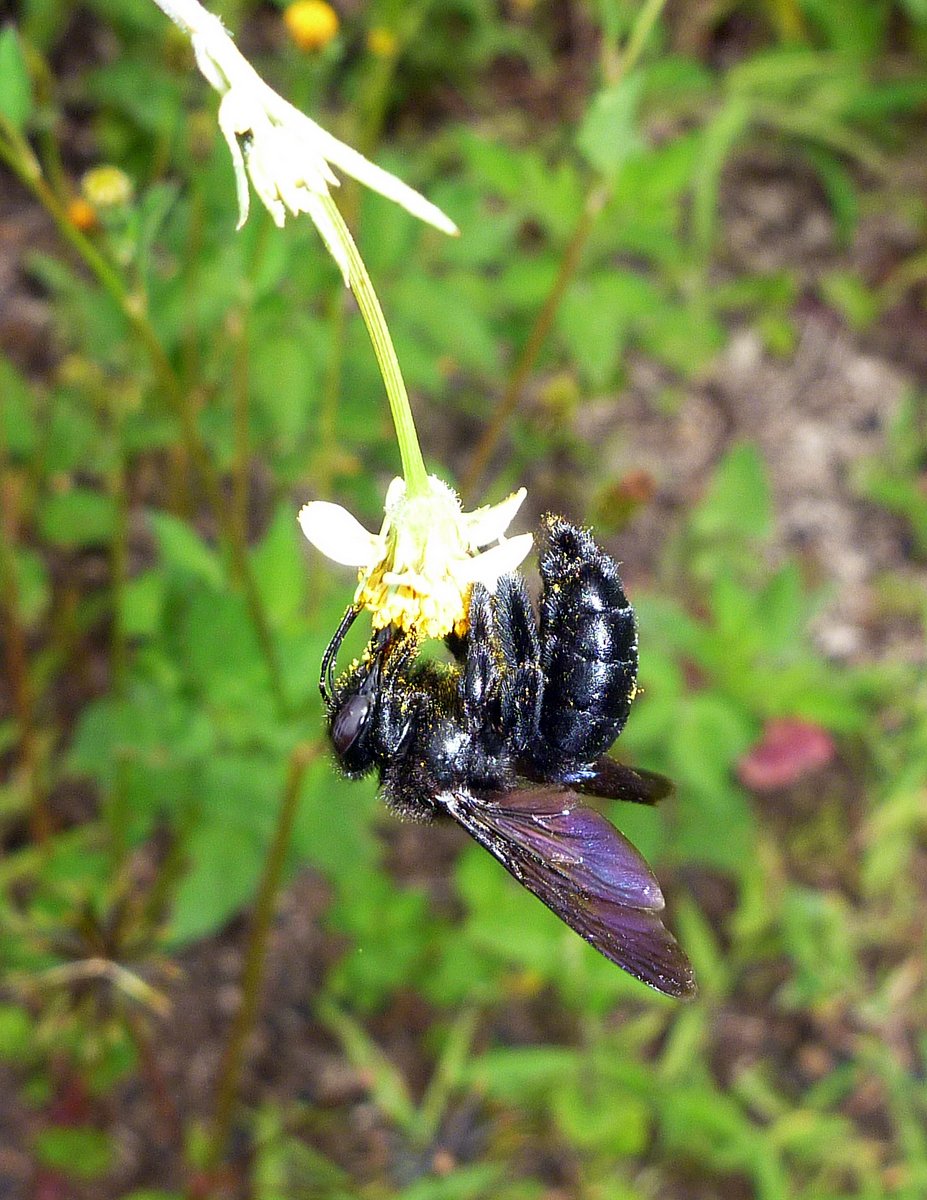
I finally managed to get a reasonable photograph of a Galapagos Carpenter Bee. We've often seen these jet-black bees buzzing around and know that they are the only native bee on the Galapagos Islands. What makes them very interesting is that they prefer yellow flowers, so therefore, all the native flowers on the Galapagos Islands are yellow – if the Carpenter Bee doesn't like the colour of the flower then it simply doesn't get pollinated.
Our guide led us on to the slopes of Vulcan Chico, which is a smaller volcano that erupted about thirty years ago. Very little vegetation has managed to grow on the desolate lava fields – just a few cacti and the odd Scalacia Bush, which is a type of Dandelion that seems to grow out of the bare rock. We walked along the very rough path looking at strange lava formations, including hollow lava tubes formed when the outside of a lava flow cools and the hot magma continues to flow away.

The guide explained that the lava contains a lot of iron, which is why the new lava is black and the older lava turns brown as the iron oxidises and goes rusty. The path led us to areas where there were sulphur deposits giving a sharp contract of colour in the bleak landscape. We had a couple of interesting hours wandering around before we had to head back to the verdant slopes of Sierra Negra and the eight kilometre hike back to the bus. It was a great day out and good value at $30 per person.
Back on the boat, I downloaded another GRIB file and, while the weather still looks unsettled above six degrees south, it doesn't seem to be changing much, so we've decided to leave in a couple of days’ time. We told J.C. Soto, our agent that we want to leave on the 27th March – gulp!

David from “Rewa” invited a few boats over for a cocktail hour -he’s got a big 55 foot ketch and plenty of space. It was good to meet some of the other cruisers whom we've not met before. Quite a few boats will be leaving over the next few days, so we’ll have some company – we’re going to set up a schedule to chat on the SSB radio each day to see where everyone is and what weather they have.
25 March 2014 Isabella, Galapagos
I was up early sorting out some administration and producing a list of jobs to do before we leave for the Marquesas.
We needed to renew the insurance for our boat. I’d already received the final quotation and “just” needed to pay the premium. Internet banking is great for most of the time, but the banks keep changing their security processes. Our bank has suddenly decided that if I want to send money to someone that isn't already set up on my account, then they will contact me by phone to validate my identity. The Catch 22 is that the web site won’t let me enter a foreign mobile phone number, so they can’t contact me. After an hour of frustration, I've had to send money to my son, Craig, and asked him to send the money onto the insurance company.
I worked out a frequency and time for our little SSB radio net and then spent a couple of hours going around the nine boats that are leaving in the next week. Most of my time was taken up chatting about the best strategy for the route from the Galapagos to the Marquesas. We’re all in the same mind set of heading south/south west until we pick up the trade winds, but I'm more worried about the horrible looking band of weather shown on the GRIB files around 6 degrees south – there seemed to be a lot of rain and possible squalls, which I’d like to avoid. I’ll just have to play it by ear.
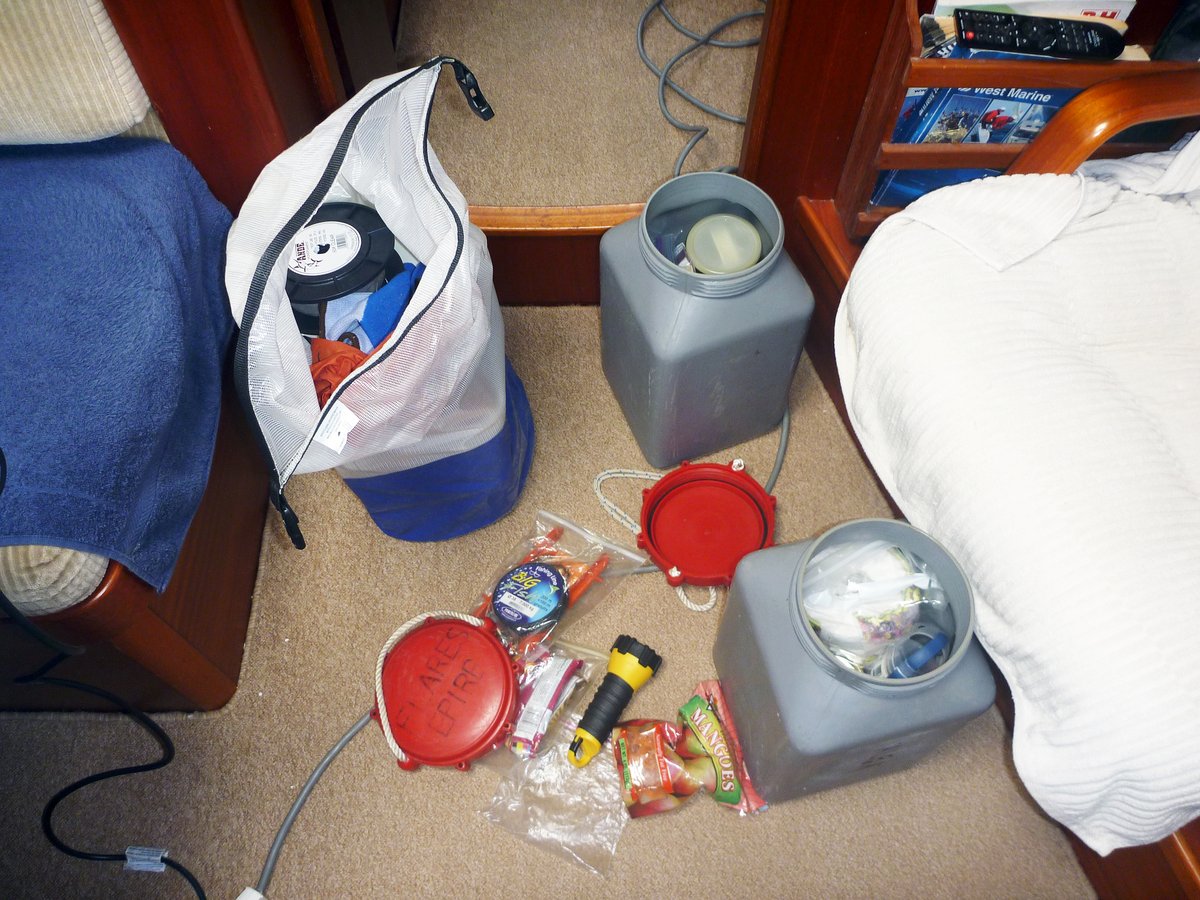
Meanwhile Glenys sorted through our "Grab Bags". These are three waterproof containers, which we'll be trying to take with us in the life raft if we have to abandon ship. Having read a few horror stories of people being ship wrecked and spending weeks surviving in a small life raft, we have been very thorough in what we want to take with us. There are flares, knives, fishing tackle, a plastic cutting board, torch, handheld GPS, first aid, food, etc. There's even a pair of tights to sieve plankton for when we get very, very desperate.
Later in the afternoon, Glenys dragged me into town to go shopping and we ended up lugging back three heavy bags of groceries as well as a big bag of laundry. The road into town is a kilometre of loosely packed volcanic dirt. Taxis and pick-up trucks are constantly driving between the dock and town, leaving clouds of dust in their wake. It’s really playing havoc with Glenys’s eyes because she wears contact lenses - we’ll be glad not to have to trudge this route for much longer.
We had “Salamander” over for a few beers in the evening.
26 March 2014 Isabella, Galapagos
We're planning to leave for the Marquesas tomorrow, but there were still fifteen jobs on our To Do List - the biggest one being to finish off cleaning the hull. Five days ago, Glenys spent a couple of hours cleaning the waterline and already we had green slime growing where she had cleaned – she had to spend an hour doing it again. I spent a couple of hours snorkelling down to the deeper parts. The propeller had a light crusting of barnacles and algae which needed scraping off; the rudder had a few large clams & barnacles growing in the more hidden recesses; and some of the through-hull fittings needed the judicious use of a long screwdriver to winkle out big barnacles & clams - these are very fertile waters.
The rest of the day was spent pottering about doing small jobs and, by the end of the afternoon, all we had left was to walk into town to do our final provisioning, followed by another hot dusty walk back to the dinghy dock.
Two days ago, we told our agent, J.C. Soto that we wanted to leave on the 27th, but as expected, our zarpe was not ready and we've got to pick it up tomorrow at nine o'clock. J.C. is a really helpful guy and tries to sort everything out for us cruisers, but the system defeats even him. I dropped off our gasoline container with J.C. yesterday and hopefully it will be filled by tomorrow, but who knows.
We had a quiet night in. I've tentatively worked out a route for our passage. We’re going to hedge our bets and aim for 6°S 94°W, which is a course of 210°, but this will obviously be subject to the wind direction – we’ll make sure that we use any wind to the greatest advantage.
27 March 2014 Galapagos to Marquesas (Day 1)
Both of us were up early, unable to sleep because we were excited about leaving today. While we were waiting for our zarpe, I pottered about tidying up and doing a few small jobs, while Glenys cooked up some meals for the first few days at sea.
Our agent, J.C., finally called us just before ten o'clock and I zipped ashore to meet him at the Port Captain's office where I picked up our International zarpe. J.C. then hailed a taxi, took me to his house to pick up our jerry can full of petrol and told the taxi to drop me off at the dinghy dock - it cost me $25 for 5 gallons.
Back at the boat, we hauled the dinghy on deck, had a final tidy up, sent a couple of emails to family and left the anchorage at 1230. After clearing the harbour, we set a course of 210°M and thankfully had enough wind to sail. The wind was coming from the south-east at 8-14 knots, so we were on a very pleasant reach.
After a couple of hours, we hooked two fish. Glenys luffed up and eased the genoa sheets to slow down and I managed to land a nice 15lb Bigeye Tuna on the birds line, but the fish on my rod got away. It must had been a bigger Bigeye Tuna because it hit at the same time and the line screamed out. I was in serious danger of getting to the end of the line on the reel, so I put on some heavy brake, the fish bent the hook straight and got away.

I had to gaff the fish that I landed and it bled profusely while flailing about, so both I and the aft deck were covered in blood. I made four cuts on the fish - in both gills and behind the lateral fin, then put a rope around its tail and dropped it back into the water to bleed it out while I cleaned up the bloody mess.
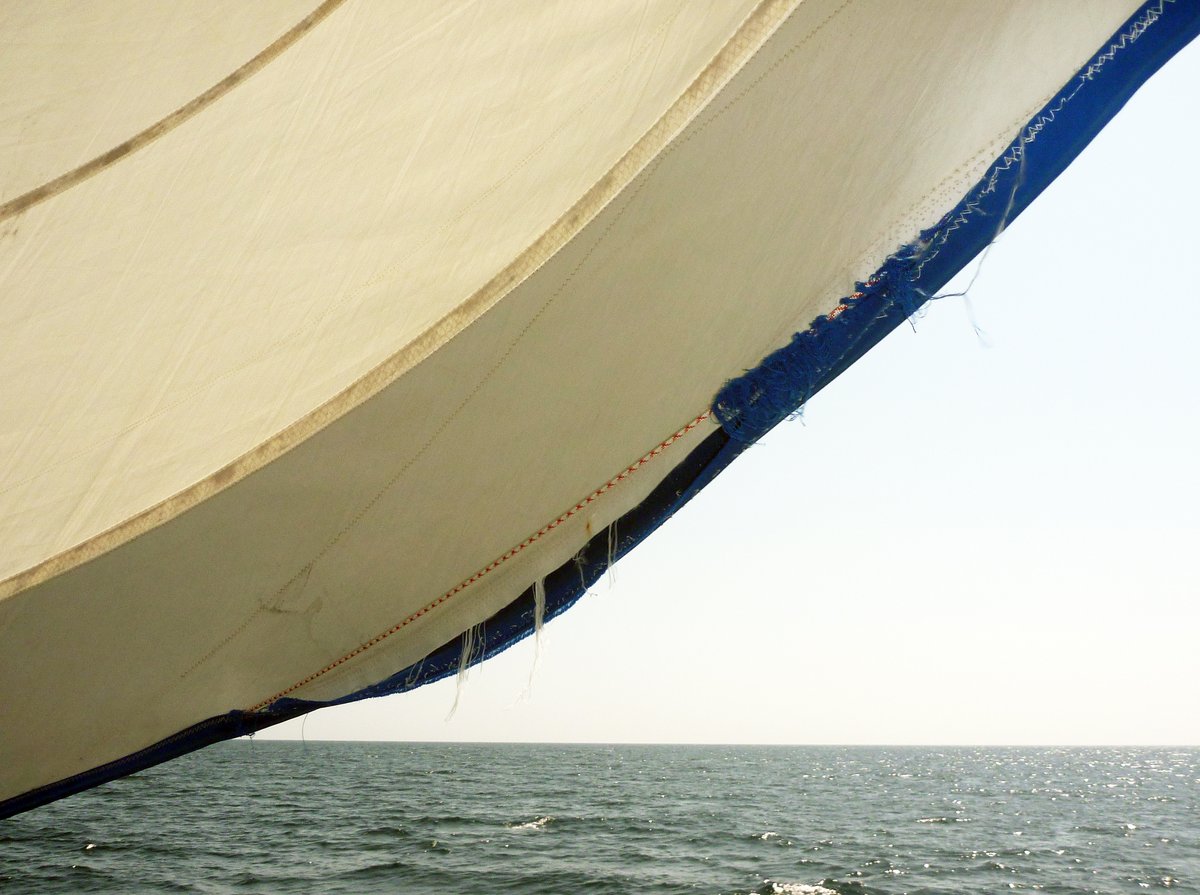
It must have taken fifteen minutes to land the fish and clean up, meanwhile the genoa and stay sail were flogging, which was a big mistake. When we headed back on course, we found that a six foot length of the stitching on the sacrificial strip on the genoa had come undone and there was also some damage to the stay sail - not a good start to our 3,000 mile passage.
It took Glenys two hours to hand stitch both sails, but the repairs look nice and strong - with luck they will last the journey. Fortunately, the seas were very calm, so doing the repair wasn't too traumatic.
The wind stayed with us all afternoon, veering slightly towards the south and, as it went dark, we were still on a close reach with 8-10 knot winds and calm seas, which was lovely. Unfortunately, the wind disappeared a couple of hours later and we had to turn on the engine.
We've adopted the tactic of running the engine at 1500 rpm, which only gives us a boat speed of 4.5 knots, but should only use 1.6 litres of fuel per hour, meaning that we can motor for 11 days and cover 1200 miles. If we ran the engine at 2,000 rpm, we would have a boat speed of 6 knots, but would use twice as much fuel meaning that we could only motor for 5.5 days and only cover 800 miles. "Slower but further" is the name of the game - we've got all the time in the world.
The wind picked up at three o'clock in the morning and we were able to sail, albeit at only three knots, but at least we were moving and the main sail wasn't banging about. It only lasted four hours before it died again.
28 March 2014 Galapagos to Marquesas (Day 2)
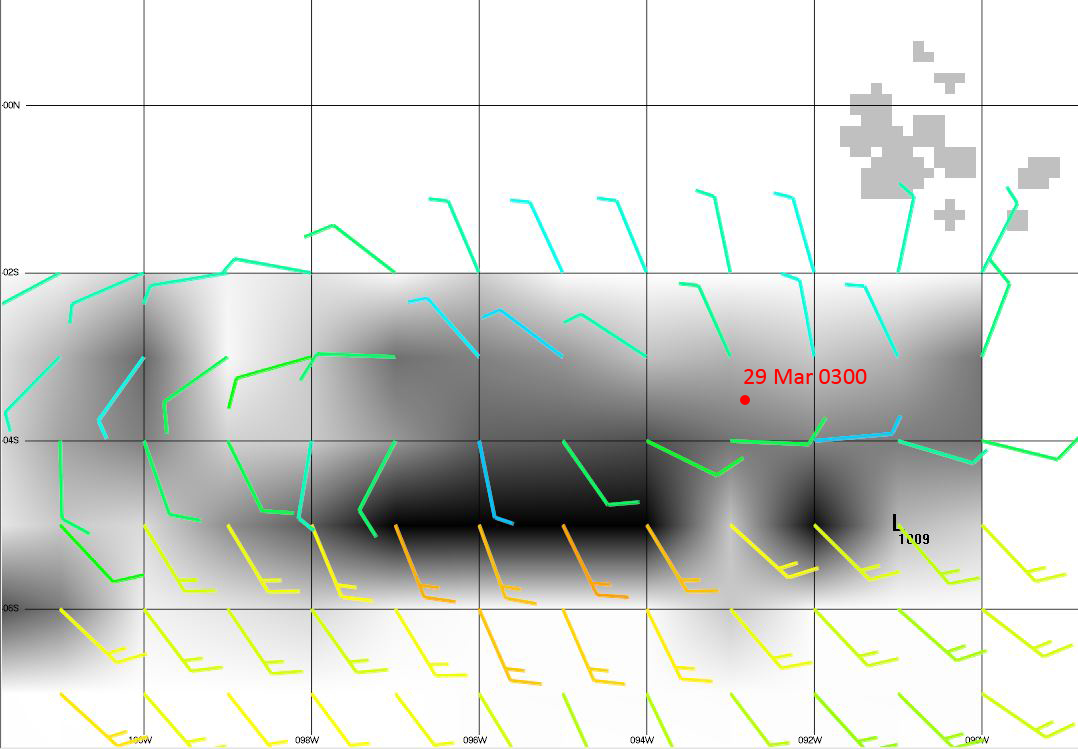
After breakfast, I downloaded a GRIB file via our satellite phone, which shows that the unsettled weather of the ITCZ is still between 4°S and 7°S (we’re at 2° 18’S). The GRIB file shows heavy rainfall and 20 knot winds in various areas of the ITCZ over the next seven days and we've got to pass through it to get to the south-east trade winds. My biggest worry is encountering squalls and lightning.

The wind picked up at nine o'clock, so we were able to fly the spinnaker, but it only lasted for two hours before we had to turn the engine back on. We motored all day with the wind staying below five knots and constantly changing direction.
I switched on the SSB radio at midday and chatted to the other boats on our little radio net. There's six of us out here; "Baraka" are a day in front of us and the other four ("Shakti", "Kika", "Hera" and "Levana") are all within 30 miles of us. We're all heading down towards 5 or 6 degrees south looking for steady winds. "Baraka" is 120 miles ahead and still has variable weather.
Our afternoon was a quiet affair, reading and napping. Glenys cooked some of the Bigeye Tuna for dinner, which was delicious. It has a nice, light coloured meat, much nicer than the dark red meat of the Bonitos that we've been catching recently. I wonder how much difference it made to bleed the fish for ten minutes?
As darkness fell, it started drizzling and the rain continued on and off for most of the night. The wind finally returned at 0100, but bizarrely, it was coming from the west. However, it was only 10-14 knots and the sea was calm, so the motion was quite comfortable even though we were sailing hard on the wind.
By 0300, the wind had dropped to 5-10 knots and veered to the north-west, so we were on a reach, but worryingly, I saw flashes of lightning in the clouds. Ten minutes later, the wind had backed around to the south and increased to 20 knots, so I had a hectic time tacking both sails, then rolling away the stay-sail and reefing the genoa.
We continued on a close reach with heavy rain making life unpleasant. Soon the wind had increased to 25 knots, so I had to put another reef in the main and roll away more of the genoa. By this time, Glenys had got out of bed and was providing moral support – there was no moon and it was as black as the ace of spades out there.
An hour later, the wind started to drop and then suddenly backed to the north-east. After ten minutes, we were getting 30 knots winds from behind us with torrential rain. The autopilot was struggling with the confused seas and strong gusts, so I hand-steered for an hour. We only had a scrap of genoa out, and I had the heavily reefed main pulled centrally to stop us rolling. At one point, we recorded 42 knots with the wind behind us.
We had no idea where the centre of the weather system was, so all we could do was to head south west. The wind finally started to abate at dawn.
I went forward to investigate a flapping noise and found to my horror that we had a large eight foot rip in the mainsail. The wind was still blowing 20-25 knots and the seas were horrible, but we had to get the mainsail down before it ripped even more. We turned into wind, motored slowly into the big waves, and then had a ten minute struggle on the bucking foredeck to get the large mainsail down and man-handled into the cockpit.
29 March 2014 Galapagos to Marquesas (Day 3)
The tear in the mainsail was from the leech along a seam for eight feet. Fortunately the stitches had failed along the seam itself, which "just" needed to be re-stitched, but the sail cloth had ripped a foot from the leech and would need reinforcing with a patch.
After agreeing a plan of action, I went to bed for a short kip because I'd been up for eight hours, leaving Glenys sewing the seam by hand with our brilliant Speedy Stitcher. She spent three hours sitting in the cockpit, surrounded by the bulky mainsail, hand sewing the seams. The job was made more difficult by the constant rolling of the boat in the confused seas and, to make matters worse, it absolutely threw it down, so she got soaked through to the skin.

When the leech of the sail ripped, it pulled out the leech tensioning line, which runs inside the leech seam. We spent half an hour trying to thread this 65 foot length of 4mm line back through, but only managed to get 20% of the way before we gave up - the leech would just have to stay un-tensioned.
I talked to the other boats on the net and most of them had experienced the bad weather, but we'd had the highest winds. Interestingly, "Kika" were 60 miles to the east of us and had had a pleasant night - these squall systems are very localised.
After lunch, we dragged out our Sailrite sewing machine and Glenys set it up on the saloon floor. She didn't want the heavy machine on the saloon table in case it slid off in the constant rolling. We cut out a couple of sailcloth patches to repair the damaged leech and pulled the damaged part of the sail down below. It then took a couple of hours to put on the patches and zigzag stitch along the damaged seam to reinforce the hand stitching.
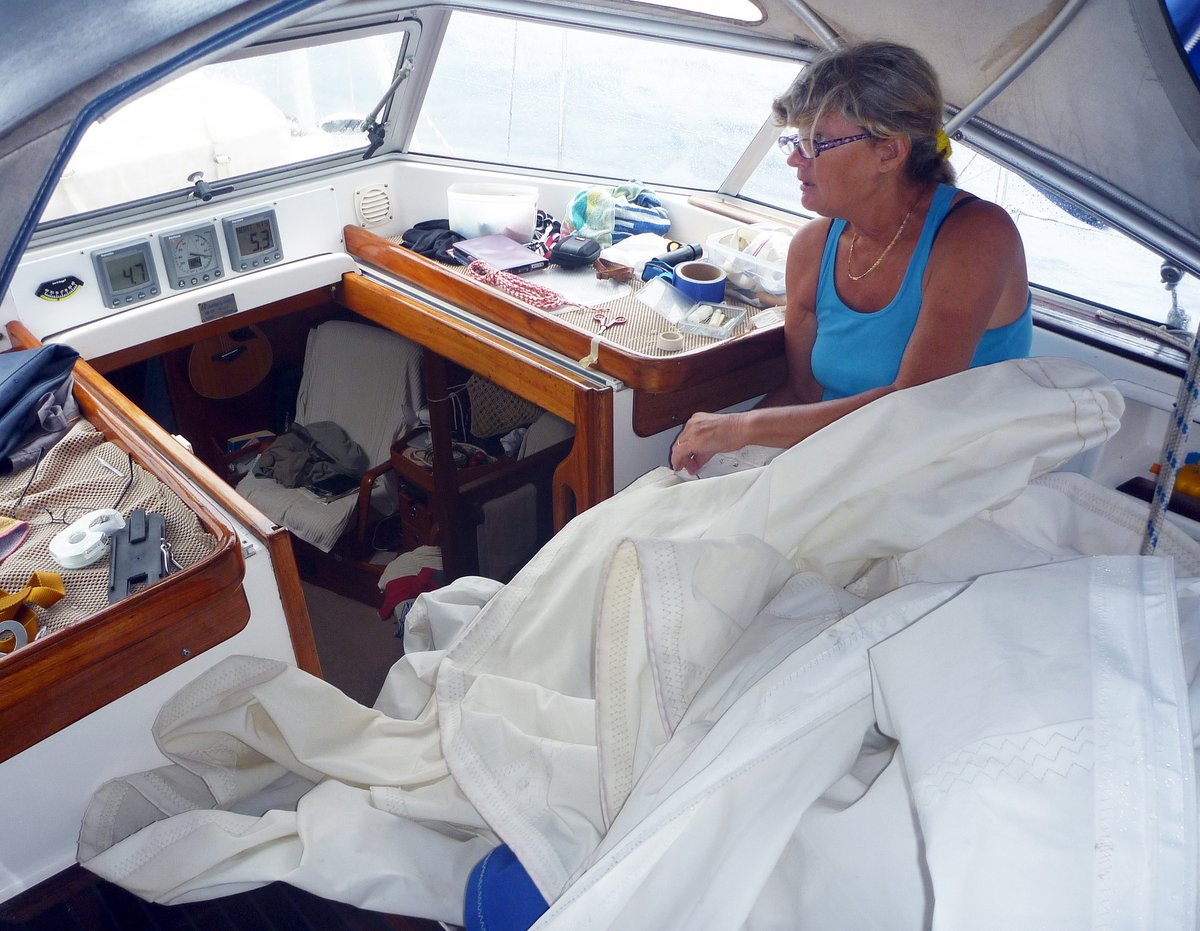
We finished the repair by four o'clock. Glenys did most of the eight hour job, with me assisting when necessary. Thankfully, we came out of the heavy rain just before the sail was ready to put back on the mast. It took fifteen minutes to man-handle the large sail up on the pitching deck and hoist it. The repair looks good although the leech is fluttering because we have no way of tensioning it.
By this time, the wind had backed to west-south-west at 15 knots, so we were able to sail south. A couple of hours later, as darkness fell, the rain finally stopped and the heavy cloud cover was starting to lighten up. Unfortunately, the wind also started to drop, so by eight o'clock at night, we were motoring south-west again in the rapidly calming seas.
By ten o'clock, the wind had backed even more to the south and increased to 8-12 knots, so we could sail south-west once again. The rest of the night was wonderful, gliding along at 3-5 knots in calm seas - even the stars came out.
30 March 2014 Galapagos to Marquesas (Day 4)
Dawn brought us blue skies and the lovely 10-14 knot south wind continued. After a marvellous breakfast of fruit cocktail and yoghurt, Glenys went to bed for a couple of hours and I downloaded some weather information via satellite email. Having been clobbered by the squall, I've now developed a very keen interest in the weather.
I received an email from Karsten Staffeldt, who’s an amateur weather router living in Panama. I've sent him our current position and he's sent me back a text forecast with details of the surface forecast, a description of a satellite image, the position of the Inter Tropical Convergence Zone (ITCZ), etc. It's great information and a very useful addition to GRIB files, which are raw data from a computer weather model. Unfortunately, this is the first email that I've received from Karsten while we've been underway, so I didn't have his take on the squall until after the event.
Karsten tells me that the crappy weather that we had is called a "Trough System" or a "Secondary ITCZ". These systems are uncommon, but when they occur, they happen in March and April and can move rapidly in any direction. Karsten says that the current system will dissipate in the next two days and we should have south to south-east winds at 10-15 knots as we travel south west.
I downloaded a GRIB file, which confirmed that the Secondary ITCZ is dissipating and the south winds will become stronger SE trade winds as we get further south. However, the GRIB file also shows an area of strong rainfall forming in three days’ time, which could possibly be another Secondary ITCZ. It stretches west for hundreds of miles and comes down to 6°30’ South, so I plan to head down to 7° South before heading west.
I wanted to see if I should have predicted the squall, so I reviewed the GRIB files that I've downloaded over the last few days. I found that the 24 and 48 hour forecasts predicted the Secondary ITCZ in the general area, but 180 miles further south. Only the GRIB that I received the morning after the squall, showed heavy rainfall in the correct place, so I'm a bit happier that I couldn't have forecast it.
The fabulous conditions continued into the afternoon and, at dusk, the wind had increased to 12-15 knots and backed to 160°, allowing us to ease the sheets a little to maintain our course of south-west. We had a lovely sail overnight. The wind backed even more to near south-east, so we were on a beam reach for half of the night - it looks like we've finally reached the trade winds.
31 March 2014 Galapagos to Marquesas (Day 5)
During the morning, we passed 7°S, so hopefully we'll now be clear of the Secondary ITCZ. We had a go at turning 20 degrees more west, but the wind came abaft the beam causing the apparent wind to drop and we slowed down to four knots. This in turn caused us to roll more and the sails to slat, so we went back on a south westerly course. The wind is forecast to increase over the coming 24 hours, so we decided to wait until we had stronger winds.
I chatted to other the other boats and took their positions as usual - we now have seven boats checking in and everyone is doing fine. After I signed off, I entered everyone's positions for the last four days into our chart plotter program and it's interesting to see the differences in our tracks. Alba’s track follows a bearing of 210 degrees down to 7°S; “Kika” kept to the east of us; “Hera” have started out on the classic route of going down to 3 degrees and then following the rhumb line and the rest are now "cutting the corner" and taken a course more to the west. All of us (apart from “Hera”) are through the Secondary ITCZ. I hope that “Hera” time their crossing well.
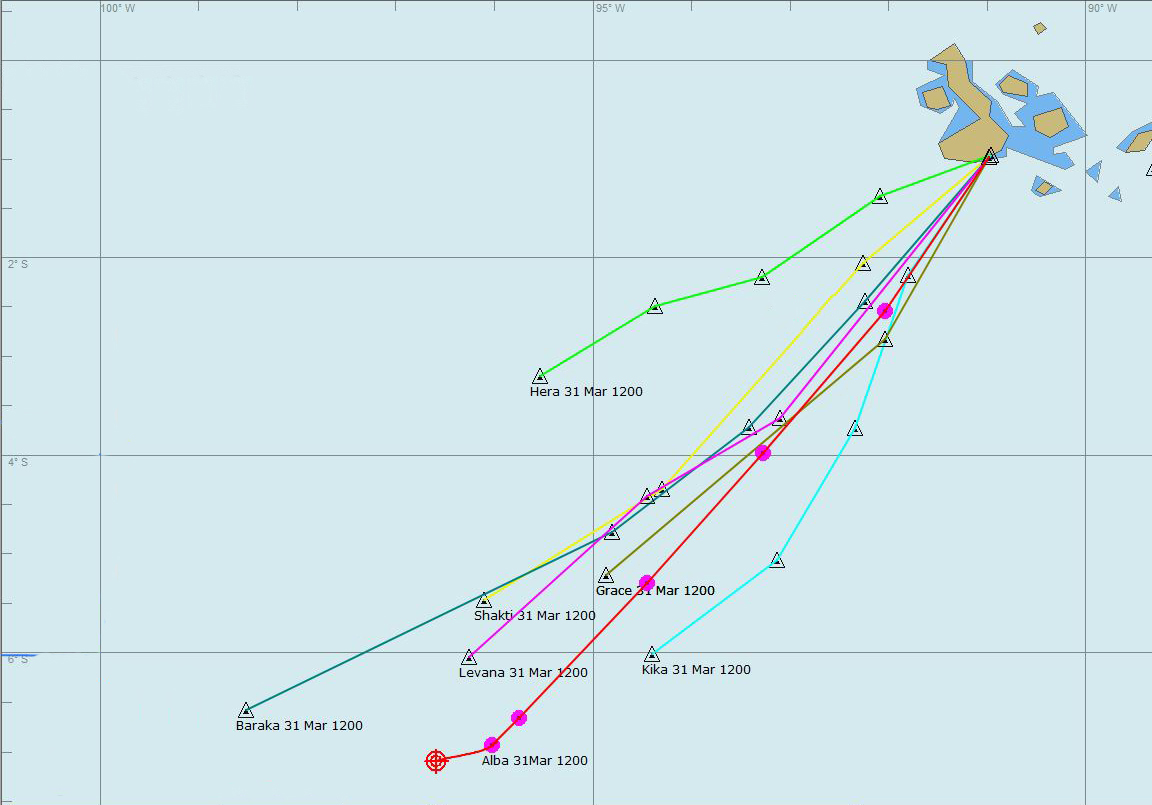
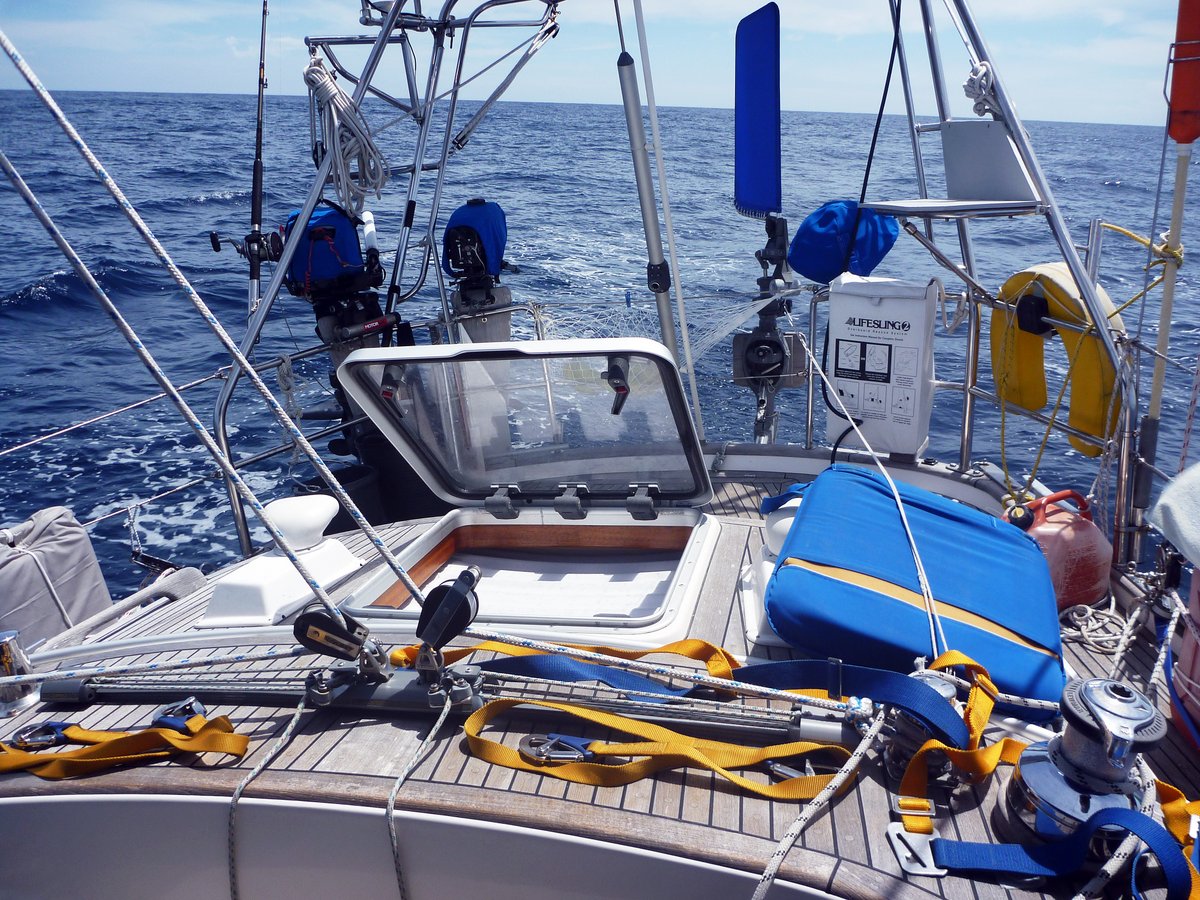
In the afternoon, the wind picked up a little, so we bore away 30 degrees and started our run towards the Marquesas. The wind was 50 degrees off our port quarter, and the sails were slating, so we rigged up our spinnaker pole to starboard and poled out the genoa. I put a preventer on the main and off we went on the rhumb line to Hiva Oa.
We have the spinnaker pole rigged up with an up-haul and two down-haul lines, so that it's held rigidly in position. The genoa sheet is led through a snatch block on the end of the pole, which reduces friction and more importantly reduces chafing on the sheet. It's a great set-up allowing us to leave the pole in position and to roll the genoa in and out as needed.
We finished off the last of the Bigeye Tuna last night, so I put out two fishing lines and in the late afternoon caught two small Dorado. One looked to be 3 or 4 lbs, but the other one was a 1 lb tiddler - we kept them both of course. Cleaning Dorado is so much easier than Tuna, which is bloodier and much harder to fillet having tougher skin.

Just as I finished filleting the fish, the wind picked up to 20-25 knots, so we put two reefs in the main and four wraps in the genoa. As the sun went down, we had 50% cloud cover, 20 knot winds from the south-east and we were rolling along at 5-6 knots. We also had half a knot of current pushing us along, which was handy.
We had a pleasant night with consistent winds and 6-8 foot waves. Most of the time we're rolling gently every two seconds, but every few minutes, a large wave will catch us and roll us violently over 30 degrees. Everything bangs in the lockers and anything not held down flies through the air, but after six rolls we settle down. Then, a few minutes later, we're holding on for dear life again.
The rolling isn't too bad when you're on watch because you can feel the boat being lifted up by a big wave and grab hold of something, but it's hard to sleep. Despite wedging ourselves against the bulkhead, the violent roll always rolls us to some extent. Ah well, only 2,450 miles to go.