16 October 2016 Admiral Marina to Bangkok, Thailand
At quarter to eleven, we wandered to the main reception to await the arrival of the taxi. Of course, the taxi didn’t turn up at eleven o’clock. Glenys rang the taxi company who said that the booking had not been confirmed despite the fact that she had a confirmation email. There was nothing we could do except ask the hotel to book a taxi for us; wait 20 minutes and pay £8 more for the privilege.
The taxi arrived on time and dropped us off at Kuala Lumpur airport an hour later. We still had three hours to go before our departure, which was adequate to have our traditional pre-flight meal of Big Mac and Fries. The flight to Bangkok was on time and the two hour flight was pleasant enough. A taxi was waiting for us at the airport, so we were ensconced in our room at the Navalai River Resort by five o’clock – perfect timing to crack open a cold beer from the mini bar.

King Bhumibol of Thailand died three days ago, ending a 70 year reign. He was much loved by the people of Thailand and the nation has gone into mourning. Everyone is wearing black or sombre clothes; people are flocking to the Grand Palace to grieve; and entertainment is being restricted. On the drive from the airport, we saw numerous pictures and tributes to the king and the streets are lined with black and white bands of cloth.
In the evening, we went out to have a look at the local area which is rather touristy, with backpacker hostels, restaurants and bars. There were hundreds of tourists wandering around including uncouth Russians baring lots of flesh covered in tattoos and the usual collection of backpackers in their standard uniform of baggy trousers with elephants, dreadlocks, and a plethora of body piercings. They all look like they’ve stepped out of the film “The Beach”, which was popular in 2000 – that was 15 years ago – time to move on, dudes…
Unfortunately for all these hedonistic people, the death of the king has put a damper on the party scene. None of the restaurants are serving alcohol; there’s no music playing in the bars; and the tourists are looking glum. We’d managed to buy a beer in the hotel before we stepped out, so we retreated from the depressed atmosphere in the streets and had a very pleasant meal in the hotel. It was a clinical atmosphere and a little expensive, but at least we were able to buy a couple of cold beers.
17 October 2016 Bangkok, Thailand
We were up early because Glenys had arranged for a guide to meet us at 08:00. During our holiday in Myanmar earlier this year, we realised the benefit of having a local guide when visiting a large city for a short time. Utai was our personal guide, but only cost us £30 for the whole day, which was a bargain, allowing us to get an insight into Bangkok that we’d never have if we’d wandered around by ourselves.

We left the hotel in a taxi and headed off to the Wat Traimit temple, which houses a huge, solid gold Buddha. The 3 metre high statue weighs 5.5 tonnes and is believed to have been made in the 13th or 14th Century. In the 1700s, the statue was covered in plaster, to hide it from the Burmese just before they destroyed the ancient Thai kingdom of Ayutthaya. For two hundred years, the Golden Buddha remained unnoticed.
In 1957, the Buddha was being moved to a new temple in Bangkok and an accident occurred, chipping off a portion of the plaster revealing the gold beneath. Worth about $250 million, the statue now has its own building in the Wat Traimit temple - it’s very impressive.
Chinatown is close to the Wat Taimit temple, so Utai walked with us through Chinatown, pointing out restaurants specialising in stomach parts, sharks fin and the more mundane birds nest. I was amazed to see that a single Shark's Fin cost £40-50. We then visited the Chinese market which had an amazing array of unusual foodstuffs including dried cuttlefish, sea cucumber and a plethora of mushrooms.

Jumping on a local bus with wooden floors and rattling open windows, we headed to the Flower Market which is huge, supplying all kinds of flowers and flower arrangements. After a short trip on a Tuk-tuk , we arrived at the Wat Po temple, which is one of Bangkok's oldest and grandest temples. The center piece is a 46 metre long Reclining Buddha housed in its own building which was constructed around the huge statue.


Around the central building are two sets of galleries housing hundreds of 2 metre high Buddhas all plated with gold. Utai told us that you can have a Buddha reconstructed for £5,000, which presumably gives you lots of karma. There were various Buddhas in the process of restoration and we were able to see how they apply multiple layers of black lacquer which is polished to a high sheen before the gold leaf is applied - a long and painstaking business.


We caught a ferry across the river and Utai took us to his favourite restaurant selling noodle soup. It was a very rough, but busy place and the soup was delicious – it cost us £2 for three meals and three drinks. Over lunch we discussed what to do in the afternoon, and despite the high cost of £20, we decided to hire a long-tail boat to take us though the canals of Bangkok to the Artists’ House, where we hoped to see a traditional puppet show.
The Chao Phraya river flowing through Bangkok has a very strong current and combined with the number of boats zooming about, the waters are very turbulent, so it was interesting to go for a short ride. There are a set of lock gates between the main river and the canals of the city designed to stop flooding. Unfortunately, we hit tourist rush hour and had to wait for 30 minutes outside the lock, which can only take six long-tails at a time.
The trip along the canal was okay – lots of wooden houses on stilts at the edge of the canal with large monitor lizards sunning themselves and herons standing like statues waiting to strike at passing fish. At the Artist House, we found that they weren’t putting on the puppet show because entertainments have been put on hold while mourning the death of the king, which was a shame because the puppets look very elaborate.

After walking around the wooden buildings, we caught a songthaew , which translates to “two rows” and is a pick-up truck equipped with two long benches, generally painted in bright colours. This took us a mile or so to a busy main road where we were able to flag down a taxi. The cab took us to the Golden Mount temple (Wat Saket) where we walked up hundreds of steps and viewed a small Buddha that contains relic of Buddha.

In the evening, we walked down to Khao San Road, which is supposed to be THE party street in Bangkok. It was a little more lively than last night because the bars are selling alcohol again, but it was all very subdued.
18 October 2016 Bangkok to Kanchanaburi, Thailand
After another huge breakfast, we caught a bus to Kanchanaburi – a two hour trip on an air conditioned coach which was very pleasant. The driver had a television constantly playing government approved, five minutes programmes, which showed photographs of the deceased king overlaid with emotional music, mostly school children singing. It was very interesting for the first hour, then I zoned out.
Kancanaburi is a very touristy town in the west side of Thailand and, on arrival at the bus station, we were bombarded with offers of tours and taxi rides to our hotel. Glenys soon negotiated a “songthaew" to take us up to Hell Fire Pass tomorrow and they dropped us off at the U Inchantree hotel, which is a lovely little “boutique” hotel on the side of the River Kwai.

After dumping our bags, we walked 5 minutes into the small village and had lunch at a very touristy restaurant over-looking the infamous Bridge Over The River Quai. A few days previously, we’d watched the 1950s film depicting the construction of the bridge, but that was total fiction.
The bridge is part of the notorious Thailand to Burma railway which was built in the Second World War using Allied Prisoners of War. However, the bridge was actually constructed from steel sections brought from Java and not made from wood as depicted in the film.
After lunch, we walked to the JEATH museum, which is a bizarre collection of artefacts, seemingly randomly put in place. Most of the exhibits are related to the Second World War and the forced labour camps that were run by the Japanese. There’s a wide range of objects from mess tins to a helicopter and an impressive array of old weapons. The museum is chaotic, but that’s it’s attraction, it’s fun to wander around and look at stuff rather than reading endless artistic signs spouting history.
We wandered into a side building, thinking that it contained a collection of photographs and were amazed to find that there were five floors jam-packed with objects from centuries of Thai Burmese wars. The walls are covered with beautifully detailed mural paintings . There’s a second building containing just as much stuff. It was well worth the £0.20 entrance fee.

Maxed out with viewing historical artefacts, we walked across the Bridge On The River Quay - whistling the tune from the film - “Hitler, has only got one ball, …” The railway is still in use, but the trains go very slowly and there are many places to duck out of the way when a train crosses. At the other side there’s a Chinese Buddhist Temple, which is a colourful and peaceful place to visit.

In the evening, we went out to one of the many restaurants around the bridge area, where I ordered a catfish yellow curry. It sounded interesting, but was inedible because the catfish was hacked into chunks with millions of bones and the curry was so hot that my throat went into anaphylactic shock. I’m going to stick to milder chicken green curry from now on.
19 October 2016 Kanchanaburi, Thailand
Our hired songthaew picked us up at 09:30 – it was a little extravagant at 1400 Bhat (£28), but we had it for the whole day and the driver would take us wherever we wanted. Bouncing about in the back of the truck, it was a long 1¼ hour drive to the Hell Fire Pass museum. The museum is excellent, giving details of the construction of the Thailand to Burma Railway. I gleaned these facts about the construction:
The Thailand to Burma Railway, also known as the Death Railway was a 415-kilometre railway built by the Empire of Japan in 1943 to support its forces in the Burma campaign of World War II. This railway completed the rail link between Bangkok, Thailand and Rangoon, Burma. The line was closed in 1947, but a section was reopened ten years later in 1957.
Forced labour was used in the construction of the railway and over 680 bridges. 200,000 Southeast Asian civilian labourers (“Romusha”) and 60,000 Allied prisoners of war (POWs) worked on the railway. During the 14 month long construction, 12,621 Allied POWs died of malnutrition, illness and torture. The Romusha fared even worse – without the military discipline of the POWs, their camps soon deteriorated, illness spread and 100,000 of the workers died.
After the end of World War II, 111 Japanese military officials were tried for war crimes because of their brutalization of POWs during the construction of the railway, with 32 of these sentenced to death. No compensation or reparations have been provided to Southeast Asian victims.
The museum has a number of copies of sketches and paintings by Murray Griffin, an Australian War Artist who was captured and forced to work on the railway. His paintings depict the daily life of the POWs in graphic and disturbing detail. Over 13,000 of the POWs who worked on the railway were Australian and the Australian government has a superb website about the railway - http://hellfire-pass.commemoration.gov.au.

We went for a walk along a 3 kilometre section of the railway route including passing through an infamous cutting called Hell Fire Pass, so called because the sight of emancipated prisoners working at night by lantern-light was said to look like a scene from hell. The five metre wide cutting goes for several hundred metres through a rock outcrop that is tens of metres high. The workers cut out this massive section of rock using hand drills to bore holes for dynamite and then carried out all the rubble by hand – all in terrible conditions. It’s a very moving place to visit.
After a quick Pad Thai for lunch, we wandered around the Sai Yok Noi waterfall and then caught the train along a section of the death railway back to Kanchanaburi. The train was rickety with slide-down windows and bench seats. It was an interesting, if uncomfortable 3 hour journey, with some nice views over the River Kwai. The railway crosses the 300 foot long Wang Po viaduct, which clings to a rock face high above the river and was constructed from wood in the Second World War.
20 October 2016 Kanchanaburi, Thailand
We were picked up after breakfast and taken to Elephants World for a two day stay. This is a sanctuary for old, disabled, and abused elephants. The refuge started with 3 elephants eight years ago and now has 25. The non-profit organisation has a tourist program that doesn’t impact on the elephants having no rides or shows, just an opportunity to observe and interact with the animals. It’s a nice place.

Each elephant has a Mahout , who traditionally comes from a village on the Burmese-Thai border. The Mahout looks after one elephant, driving it as required and looking after its health & well-being. Historically, Mahouts bonded with elephants for tens of years, but now-a-days they tend to be young men who move on for better job prospects.

For our first day, we were put in a group with 40 other visitors. After a safety briefing, “Elephants are huge and unpredictable”, we were given big baskets of watermelons and bananas and allowed to feed about 15 elephants, who were all lined up and eagerly waiting. It’s amazing how dextrous and strong their trunks are.
We then watched a group of elephants bathing in the river and being cleaned by their Mahouts, which looked like fun. After half an hour, the staff marched us off in smaller groups to help prepare food for the elephants. Our group was tasked with making a huge pot of sticky rice for three very old elephants, who have lost their teeth and are unable to eat normal food.
After lunch, we watched a couple of short documentary films, watched the elephants bathing in a watering hole and helped with some more food preparation. The highlight of the day was going down to the river and helping to wash a handful of elephants. It was great fun getting wet, splashing about and scrubbing the elephants with a long brush – they seemed to enjoy it too. One elephant was reluctant to join the mass of tourists and sprayed Glenys with water when she tried to approach it.


The day was well organised. All 40 people had time to watch elephant behaviour and get close enough to interact with the huge gentle animals.
The Mahouts are interesting to watch. They carry a Bull Hook , which they use to guide the elephant. It’s a vicious-looking metal curved hook on the end of a short stick, but is actually quite blunt. I found an interesting online “Elephant Care Manual” produced by the United Nations in 2005, which has a very colonial manner: (http://www.fao.org/docrep/008/ae943e/ae943e00.htm)

The bull hook is the mahout’s most important tool. It should be with him at all times when he is with the elephant, and he should know how to use it in such a way as to not injure the elephant. Beginning mahouts should be repeatedly told that the real purpose of the hook is not to cause pain but rather to apply strong, clear pressure to very particular control points that the elephant has been trained to react to (stop, turn left, turn right, kneel, stand still, etc.). The hook also extends the mahout’s reach - like doubling the length of his arm.
When the day-tourists departed, Glenys and I walked with one of the mahouts to take an elephant up into the hillside near the sanctuary, where the elephant was to spend the night.

Before we left the sanctuary, the mahout attached a very strong chain to the elephant’s foot with a shackle, signalling the elephant to carefully lift her foot to make this easier. The mahout draped the 25 metre chain over the elephant's neck and off we wombled up a steep narrow path. The elephant seemed quite pleased with her night resting spot, chained to a strong tree, but surrounded by tasty young bamboo for that essential night time snack.
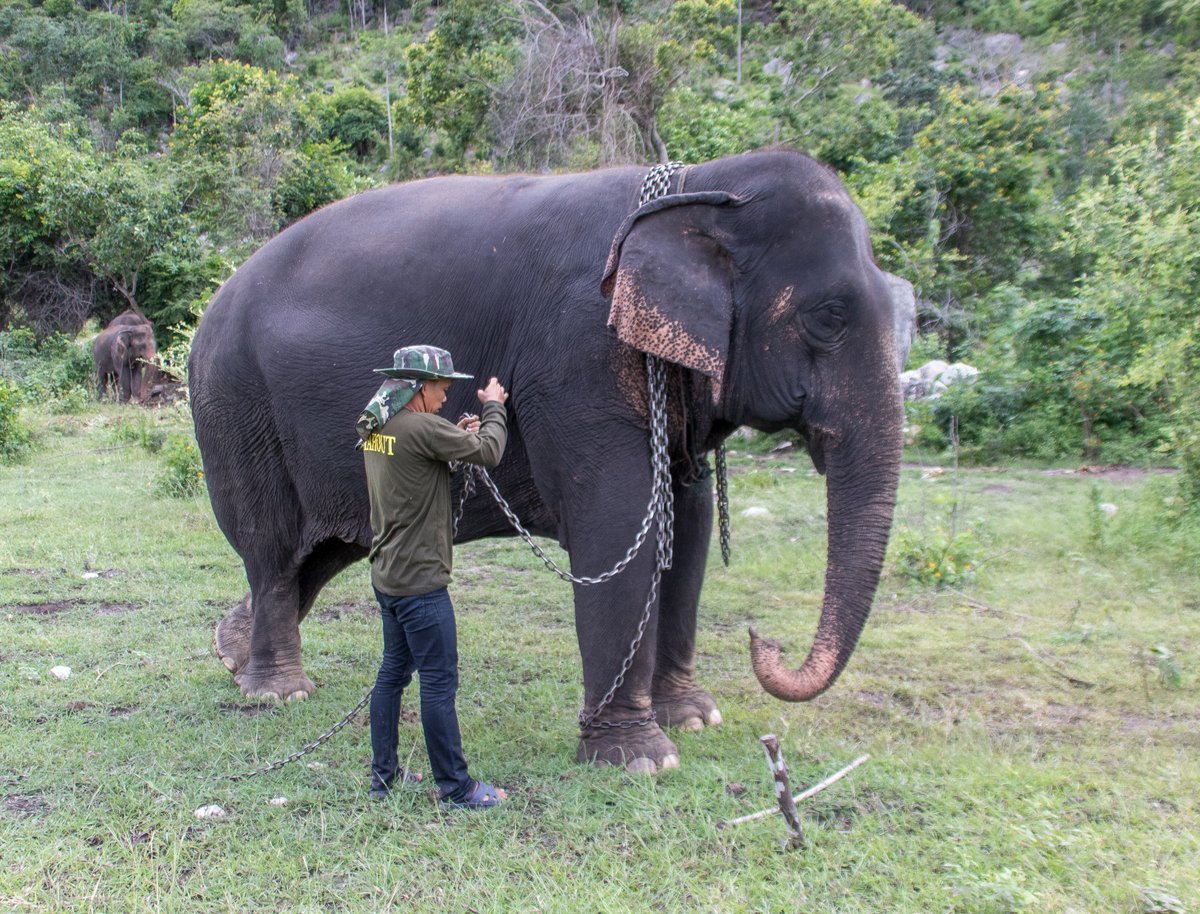
Back at the centre, we had dinner at 18:00, a couple of cold beers, watched a documentary on elephants and were in bed by 20:30.
21 October 2016 Kanchanaburi, Thailand
After breakfast, we walked out with some of the mahouts to fetch two elephants from their night resting place. A group of ten elephants were brought near to the sanctuary buildings, where piles of pineapple plant leaves had been set out. The elephants soon split themselves into smaller groups to eat breakfast with their friends. Glenys and I were able to walk among the elephants for half an hour, chatting to the mahouts and the volunteer assigned to us.
Two of the mahouts led two elephants and us through some bush to the river. We then had a magical hour feeding the elephants and washing them in the river. It was a lovely spot, isolated from the rest of the activity in the sanctuary and we could imagine that we were alone in the jungle with our own elephants – amazing.
We walked back to our cabin, had a shower and then two ladies turned up to give us a one hour Thai massage, which was excruciating at times, but we felt very relaxed after the torture was over.

After lunch, we jumped into a songthaew and, donning buoyancy aids, we jumped into the River Quai. There’s a dam up stream and every afternoon they release a load of water, which raises the level of the river and creates a strong current. We had a very peaceful hour floating several miles down the river.
Back at the sanctuary, we spent the remainder of the afternoon joining the other tourist observing the elephants being washed in the river and then fed. It was a fabulous two days and very thoughtfully organised.
Late in the afternoon, a mini bus dropped up off at the Good Times Resort in Kanchanaburi, where we collapsed and had dinner at the hotel, sitting by the river.
22 October 2016 Kanchanaburi to Bangkok, Thailand
After another big, egg & bacon breakfast, we loaded our rapidly expanding stomachs onto a tuk-tuk, which dropped us off at the Kanchanaburi bus station. We bought tickets for one of the First Class air-conditioned coaches and then had to walk 400 metres to where the bus was parked outside the bus station – confused? So were we.
The bus trip was okay with reasonably functioning air conditioning, ripped false leather seats and a grumpy driver. We were a little more confused when the bus went past the southern Bangkok Bus Station and headed towards the city centre, but that was okay because our taxi fare to the hotel would be less. After sitting in a traffic jam for 20 minutes, 95% of the people on the bus got off on the side of the road, but we were told (in Thai) to stay on the bus.

The bus then did a u-turn and took us back to the bus station five miles further out of town. Confused? No problem, this is Southeast Asia. At the bus station, we grabbed a taxi, which all went swimmingly well until a couple of miles from the hotel, the driver wanted to know (in Thai) where the hotel was – not a good sign. Fortunately, we had bought a SIM card for our tablet and we were able to guide him using Google Maps.
After dropping our bags in the hotel room, we stepped out for a look around the area. We shared a deep fried omelette-thing for lunch, which we bought from a street stall – it was okay, but contained a week’s allowance of saturated fat. By this time it was too late to go very far, so we walked to the Bangkok Shell Museum, which was very good with a fabulous collection of shells. All of the exhibits are beautifully laid out with good descriptions of all the various families of sea shells.
In the evening, we went to a nearby restaurant called Queen of Curries, which specialises in Thai curries. It’s a small restaurant catering for tourists asking how hot you want the curry. It was very good.
23 October 2016 Bangkok, Thailand
Glenys wanted to go to Ko Kret, which is an island in an oxbow bend in the Chao Phraya River. It has one of Thailand’s oldest settlements of Mon people, who were a dominant tribe in central Thailand and Myanmar between the 6th and 10th centuries AD. It’s supposed to be a peaceful place to spend a day, but the river boat people told us that the river is flooded to such an extent that we can’t go there.
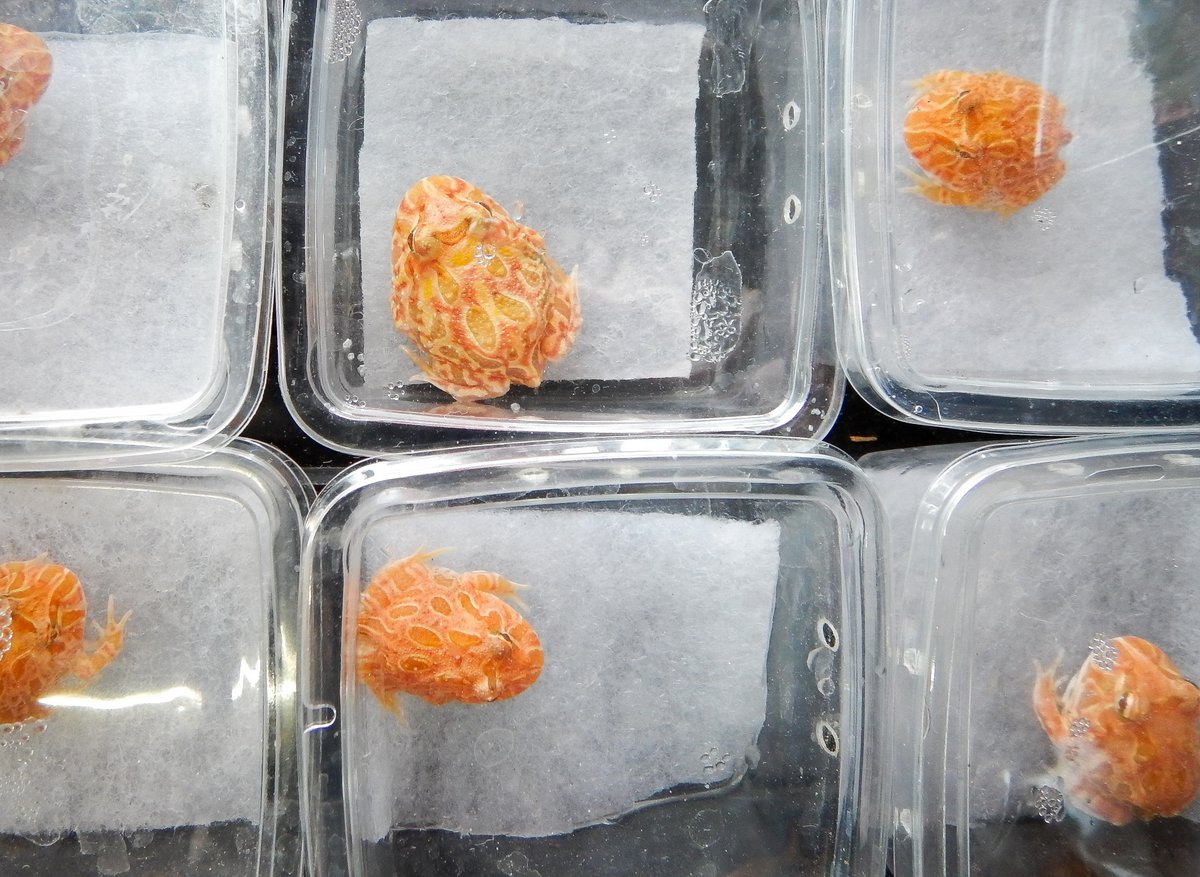
Instead, we took the sky-train to the Chatuchak Weekend Market, which is one of the largest markets in the world. It’s so big that they have a map of the market, which is organised in sections selling various types of goods. We headed for the animal section first where you can buy a huge range of animals from Mongoose to Chameleons and Stingrays to Cobras. The tropical fish section is incredible with some fabulous sea water tanks containing soft corals and a plethora of fish.
The rest of the market consists of thousands of small stalls selling clothes, carvings, musical instruments, shoes, etc, etc. After an hour, I’d lost the will to live, so we walked to the food market, which is across a major road, where we had a great roast duck and rice meal in their food court.
One of the major TV stations in Bangkok hosts a Thai Boxing program every Sunday afternoon and it’s free to go to the stadium where they film the program. It’s about a mile from the Chatuchak Market, so we grabbed a taxi, but when we arrived, we found that they weren’t running the event out of respect for the King’s death – I was gutted!
Glenys left me sulking in the park next to the Chatuchak Market, where I sat under a tree reading my book, while she rushed back for a hour’s shopping without me slowing her down. Back at the hotel, we chilled out for a while before going out for a meal in a nearby restaurant.
24 October 2016 Bangkok to Siem Reap, Cambodia
We caught a cab to Bangkok Airport and then a flight to Siem Reap in Cambodia. It all went swimmingly well and a tuk-tuk driver was waiting at the airport to take us to the hotel. It’s nice when a plan works out.

We had a bit of a panic when an ATM wouldn’t give us any money and we were very confused when the next one issued US dollars. Our tuk-tuk driver explained that tourists pay for things in US dollars and locals pay for things in Cambodian Riels. It’s all very reminiscent of Cuba that has a hard currency for tourists and a soft currency for the locals – no doubt we’ll find out that tourists pay a lot more for things in Cambodia.
Once we’d dumped our bags in the hotel and arranged for a guide to take us around some of the temples tomorrow, we headed into town. The place looks very much like Indonesia and Myanmar, with hundreds of motor bikes dashing about on broken roads and lots of small shops selling a wide range of products. The locals look very similar to Thai and Myanmar people.
We strolled around some of the narrow streets and ended up on Pub Street, which is a complete contrast to the rest of the town. Instead of dusty shops, the street is lined with flashy restaurants and bars offering Pizza, Burgers, Steak, Mexican as well as traditional Khmer food. Notices for happy hour abound, pretty girls try to entice you into their massage parlour and neon lights flash.
Unable to resist an offer of beer for $0.25US a glass, we did a mini pub crawl; then had an appetiser in one bar and a meal in another. The Khmer food tastes very similar to other East-Asian countries, but has a background flavour of aniseed. As we suspected, everything is priced in dollars and food is twice the price that we’d pay in Malaysia or Thailand (although at $6 US for a meal, I guess we shouldn’t complain too much.)
25 October 2016 Bangkok to Siem Reap, Cambodia
We had an expensive day touring around the temples. The Tuk-tuk driver cost $20US, our personal guide cost $40US and the tourist passes to gain access to the temples for three days cost a staggering $40US each – that’s $140US just for looking at some old temples. I’m in serious danger of becoming Victor Meldrew, but we had a very pleasant day.
Our first stop was at the Angkor Wat, which is Cambodia’s prime attraction for visitors. It’s a huge complex with a very wide surrounding moat. Built in the early 12th Century, it was originally constructed as a Hindu temple for the god Vishnu, gradually transforming into a Buddhist temple 50 years later. It has some interesting carvings and the site is huge, but we weren’t particularly impressed, especially because there are thousands of people visiting it every day.

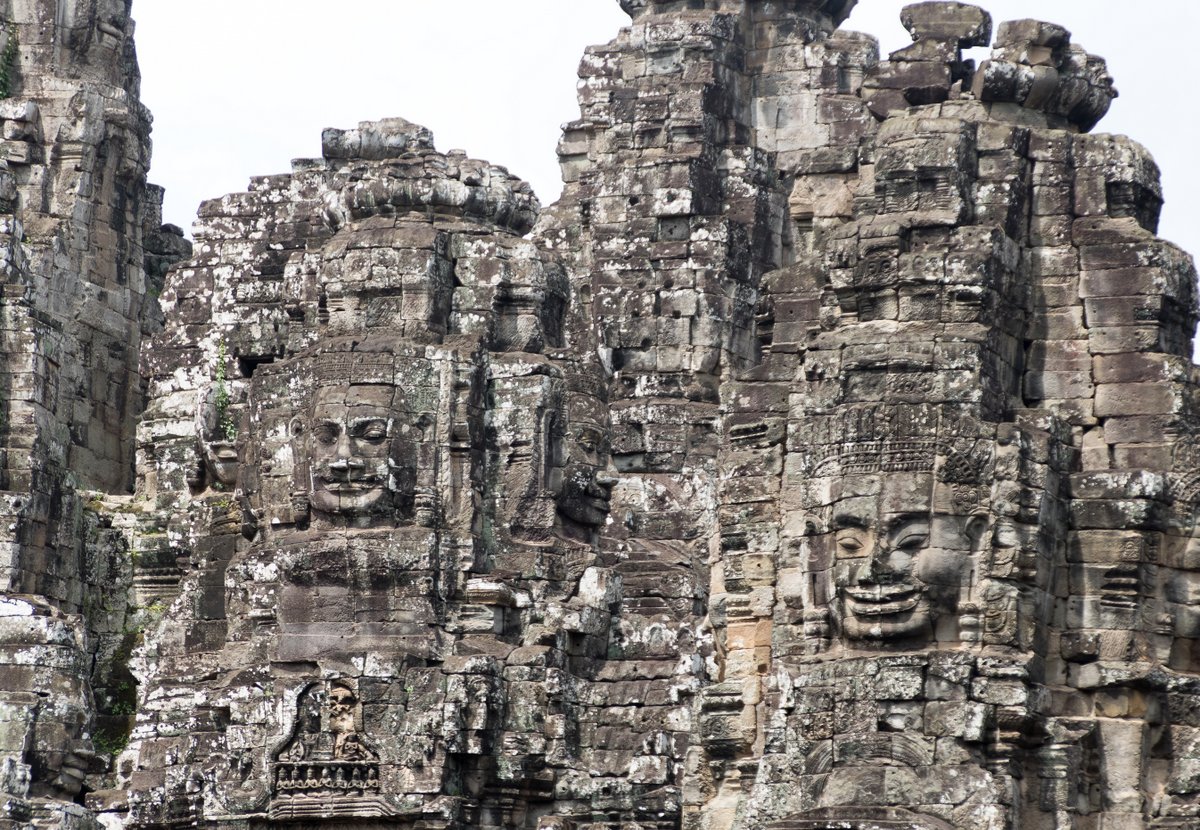
We called at the Bayon temple, which was very interesting. It was built at the end of the 12th century by King Jayavarman VII, who was a Buddhist. The temple’s has 46 towers, each with four serene and Smiling Stone Faces looking out at the four points of the compass. It is said that the faces are a likeness of the King and each tower represents one of the regions of his empire. The king’s faces are watching each of the regions and protecting his subjects.

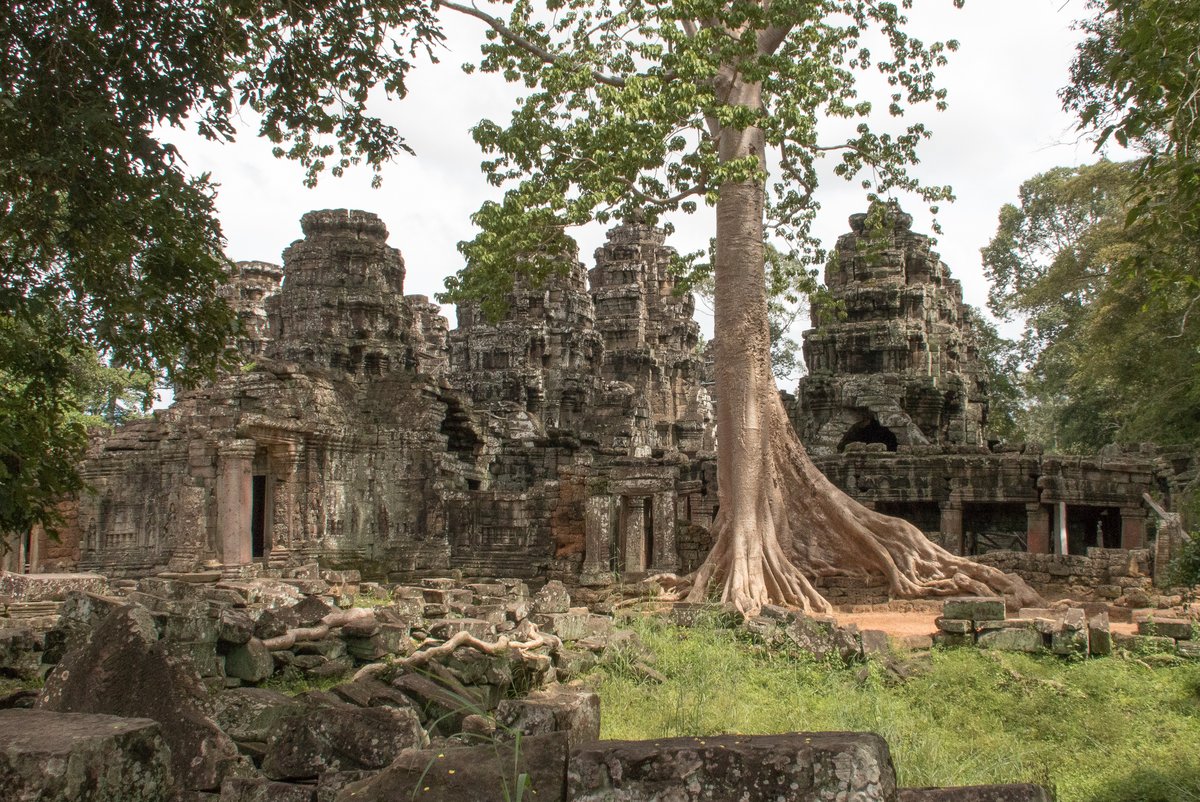
Our last stop was at Ta Prohm, which is the temple used as a location in the film Tomb Raider. It was again built by King Jayavarman VII at the end of the 12th century. Most of the temples in this region were abandoned when the people relocated and jungle soon covered the buildings. The temples were lost in time for 300 years, before being discovered by a Frenchman in the late 1800s. Unlike most temples in the area, Ta Prohm is in much the same condition in which it was found and the atmospheric combination of trees growing out of the ruins and the jungle surroundings make it very photogenic.

One of the most interesting aspects of the temples is the mixture of Hindu and Buddhist influences. Before King Jayavarman VII, the country was Hindu and even though the king was Buddhist, his temples were a combination of Hindu and Buddhist. The next king was stoutly Hindu and removed many of the Buddhist images. More Buddhist images were destroyed by the Khmer Rouge in the 1970s - they thought all religion was a crime.
26 October 2016 Siem Reap, Cambodia
We had another temple day, this time without a guide. We visited ten temples and saw a wide range of styles:
- Phnom Bakeng – a 10 minute walk up a hill. Lots of renovation work going on. Okay view of Ankor Wat.
- Baphuon – big temple and can walk to the top.
- Phimeanakas – next to Baphuon – didn’t stop or bother to climb up.
- Terrace of the Elephants – in front of Phimeankas - carved elephants on a wall.
- Thommanom – small temple with good stone carvings
- Chau Say Thevoda – Across the road from Thommanon, similar type of temple, but not as good.
- Banteay Kdei – being restored, but lots of trees growing up through the buildings.
- Pre Rup – large temple, can walk up to the top.
- East Mebon – interesting boardwalk across a lake to an island which used to be used as a hospital with healing pools and stupas.
- Ta Som – Very nice temple. Similar in style to Ta Prohm (Tomb Raider), but much less crowded and some interesting trees growing through building.
- Preah Khan – Huge temple. We walked from east gate to west gate.


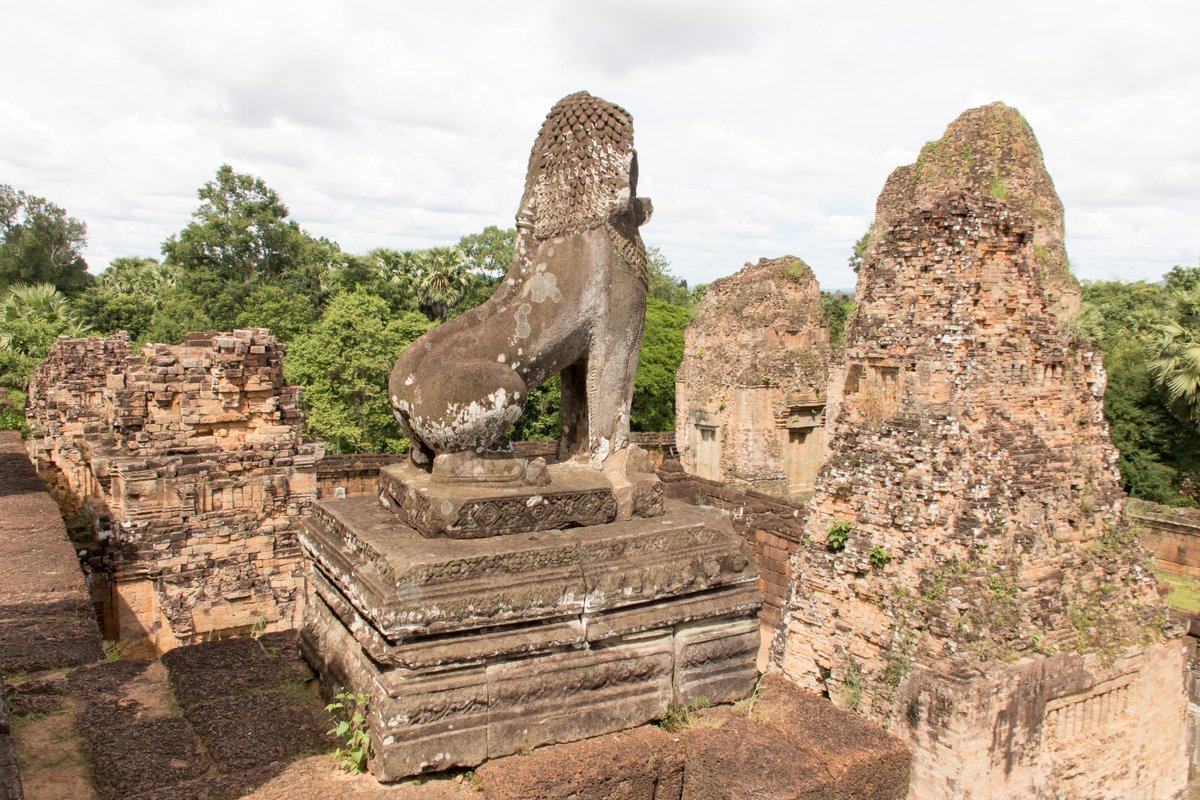


Being all templed out, we staggered back to the hotel for a few hours rest, before going out for a meal at a huge restaurant that stages an Aspara Dancing show. It was a huge venue with 500 people fighting for food at the fixed price buffet. The dancing was okay - very similar to Balinese dancing.

27 October 2016 Siem Reap, Cambodia
We’d had enough of temples, so we went on a three hour horse ride through the paddy fields, which was great fun, wading through drainage ditches and carefully balancing on top of the narrow, slippery mud walls between the fields.
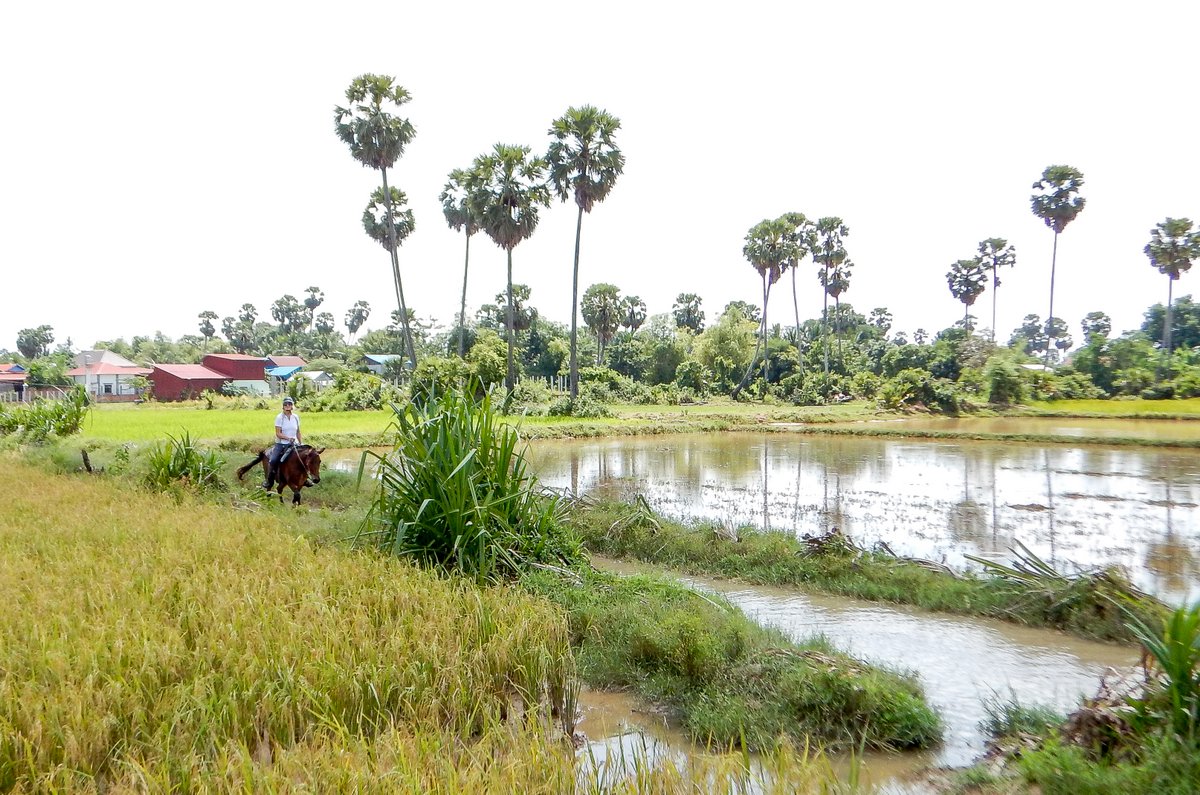
The horses were well trained, but mine was very feisty and it was a struggle to keep him under control. I nearly came off on a fast canter, when he spooked at something and suddenly jumped to the left and stopped. We were very hot and tired at the end of the interesting ride.
Back at the hotel, we went to a small restaurant and had stir-fried frog - a local speciality. It was very tasty, but was a fiddle getting the small amount of meat off the tiny bones. We spent the afternoon hiding in the air-conditioned room and resting after our morning exertions.
In the evening, we walked to pub street and had a Mexican meal - we couldn’t face any more Asian food.
28 October 2016 Siem Reap to Battambang, Cambodia
We were up early and picked up from our hotel by a bus company to take us to Battambang. It was a very pleasant three hour trip on an air-conditioned mini-bus arriving at 11:00. It was total mayhem when the bus pulled to a stop with dozens of Tuk-tuk drivers crowding around, shouting and holding up various signs. We hadn’t arranged for anyone to pick us up, so Glenys pointed at a young driver holding a sign offering free drop-off at the Delux Villa hotel where we were staying and he latched onto us like glue while we picked up our luggage.
We later discovered that the Tuk-tuk drivers aren’t paid by the hotels, but offer free drop off in the anticipation of taking the tourists on tours. Our man, Pen, hung around outside the hotel reception while we checked in and discussed the various things that we could do in Battambang. Of course, when we came out, we arranged for Pen to take us out in the afternoon.
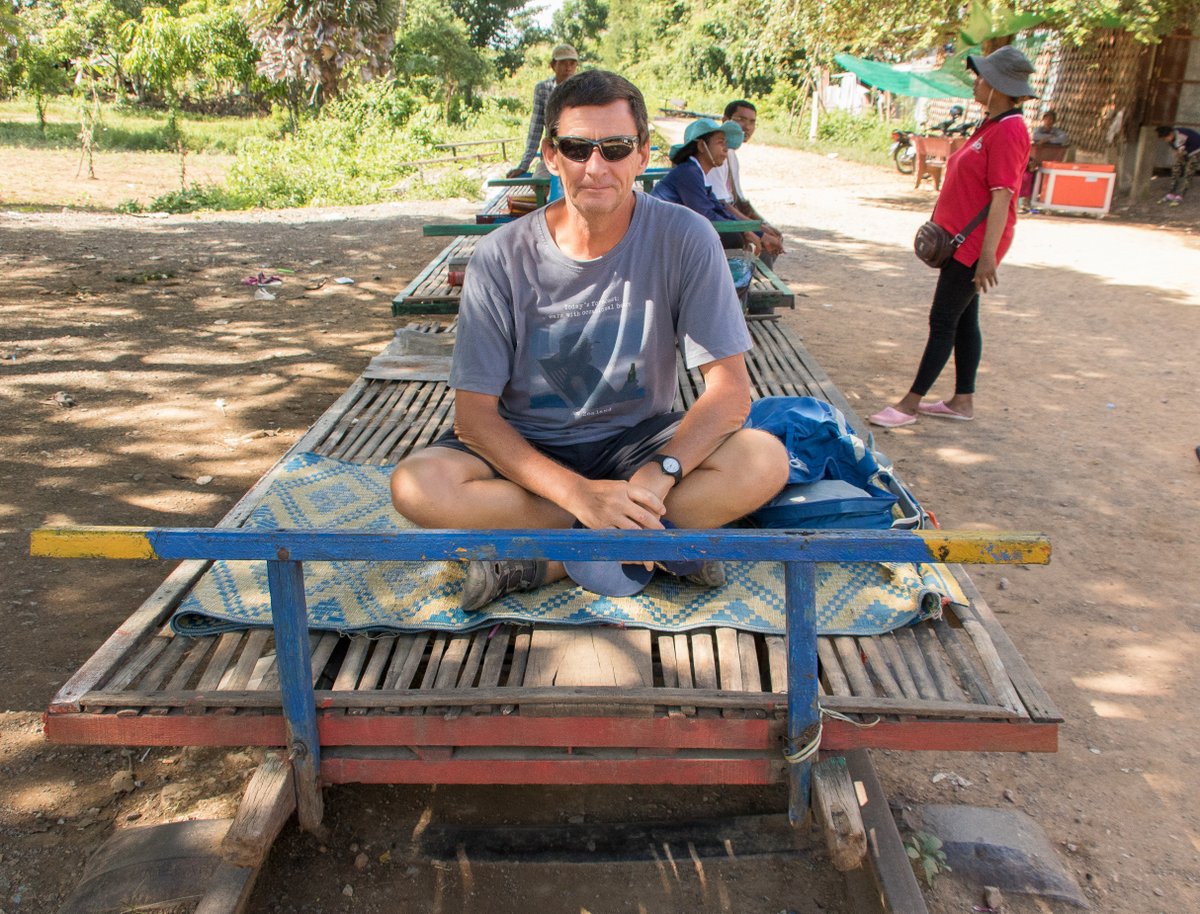
After dumping our bags in our very nice air-conditioned room, we stepped out for lunch, but struggled to find a restaurant. The markets are usually a good bet, but the various stalls in the market looked dodgy and there was nothing nearby. We ended up in a very westernised bistro by the river, which was okay. Of course, on the way back to the hotel, we found Street 121, where all the restaurants had been hiding.
Glenys has come down with a bad cold and was feeling so grim that she could hardly eat her lunch, so she stayed in the hotel room, while I went out on the tour that we’d booked.
Our Tuk-tuk driver, Pen, took me to the Bamboo Train, which is a bizarre rail journey. The French colonial government built a railway system in Cambodia, but it’s largely abandoned after the Khmer Rouge regime shut it down in the 1970s. The resourceful Cambodians started to make use of this unused resource and built small self-powered little trains which are 3m * 2m wooden platforms covered with bamboo slats, sitting on top of two sets of barbell-like wheels.
The trains are very simple, but an elegant design. Each axle of the bamboo train has two large roller bearings and hemispherical cut-outs in the cross member of the platform - the platform simply rests on the axles by gravity. The power is provided by a small 5hp petrol engine (like on a lawnmower), which drives the rear axle using v-belt. This engine is mounted on a loose piece of wood, which is moved backwards using a wooden lever. As the wooden lever is pulled, the engine moves backwards, tightening the v-belt and powering the rear axle – pull harder, go faster.

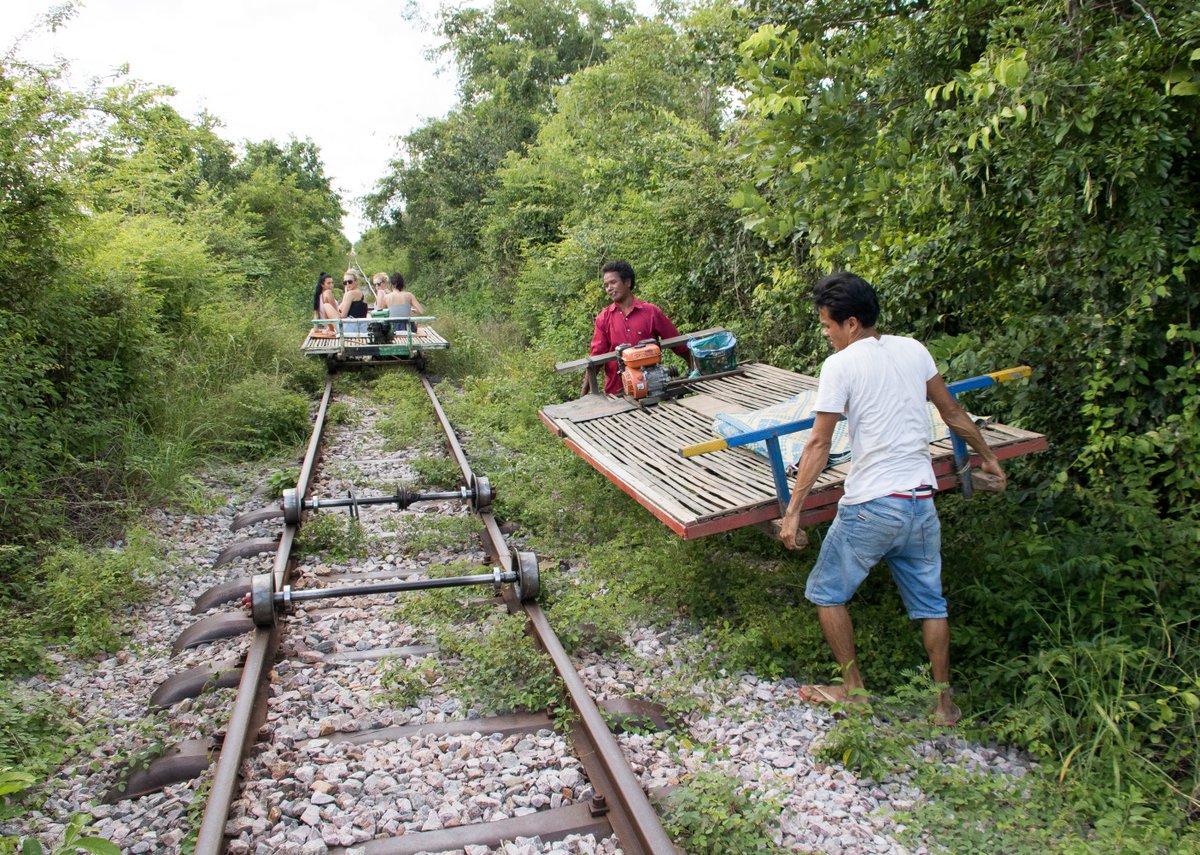
The bamboo trains are now only a tourist attraction, the main one being in Battambang along seven 7 kilometres of warped, misaligned rails. There are about twenty of these bamboo trains operating on the single track, going backwards and forwards all day. The trains take tourists to the end of the track and back. Of course at the end of the track, there are a number of stalls selling souvenirs.
It’s great fun whizzing along a foot from the ground on a kind of magic carpet. The top speed is only 20-25 miles an hour, but feels more because you are thrown about by the poorly maintained track and no suspension.
One of the interesting problems is what to do when one train meets another coming in the other direction on the single track. The construction of the trains makes the solution simple. One of the trains is quickly pulled apart and put on the side of the track which the other train goes past. It’s kind of like a game of chicken, but the rule is that the train with the least number of passengers has to get off. Being on a train by myself put me in a poor negotiating position, so I had to get off four times, but that just increased the fun of it all. The trip takes about 20 minutes each way and was great fun.
I was then driven to Phnom Sampeau, a hill eleven kilometres southwest of Battambang. Pen walked with me up the hill, telling me that he lives close the hill and, before he was a Tuk-tuk driver, he used to guide tourists up the hill.
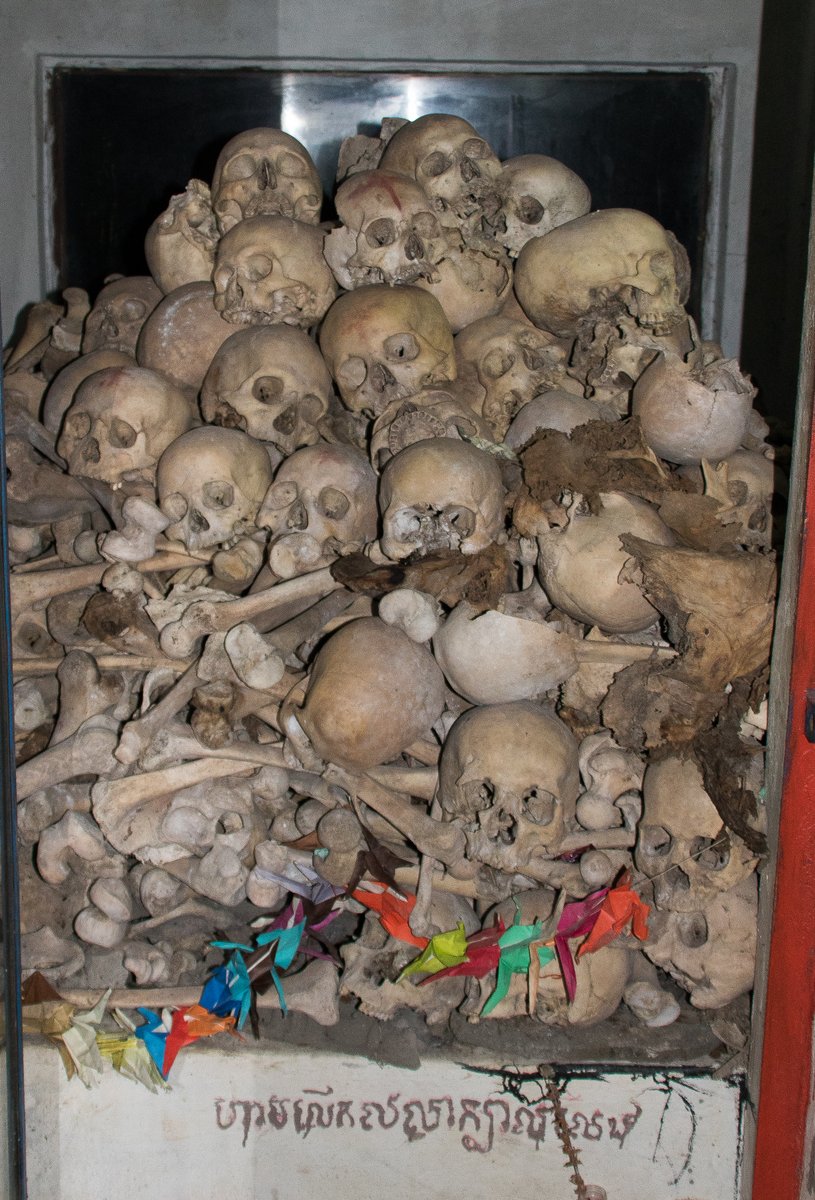
Our first stop was at the Killing Caves. This is our first contact with the genocide carried out by the Khmer Rouge led by Pol Pot in the late 1970s in which over two million people died. Pen took me to a Buddhist temple, which was commandeered by the Khmer Rouge and turned into a prison housing 500 people. The Khmer Rouge interrogated the prisoners, extracted a confession and then bludgeoned the victims to death and dropping their bodies into a set of caves.
There’s a shrine at the bottom of one of the caves with a glass fronted cabinet displaying the skulls and bones of some of the 10,000 people murdered here - very grisly.
Pen and I walked up to the top of the hill, where there are some pagodas. These are not particularly interesting, but there’s a good view of the surrounding area, which is incredibly flat for miles and miles, covered with paddy fields.

We walked back down the hill via a series of dodgy, crumbling concrete steps, had a beer and waited for 17:30 when bats start to fly. There’s a huge cave system at Phnom Sampeau, which is home to millions of Asian Wrinkle-lipped Bats. Just before sunset, the bats leave the cave to spend the night eating flying insects over the rice fields. It’s a spectacular sight with the bats streaming out in a 20 metre wide band, which snakes about the sky.

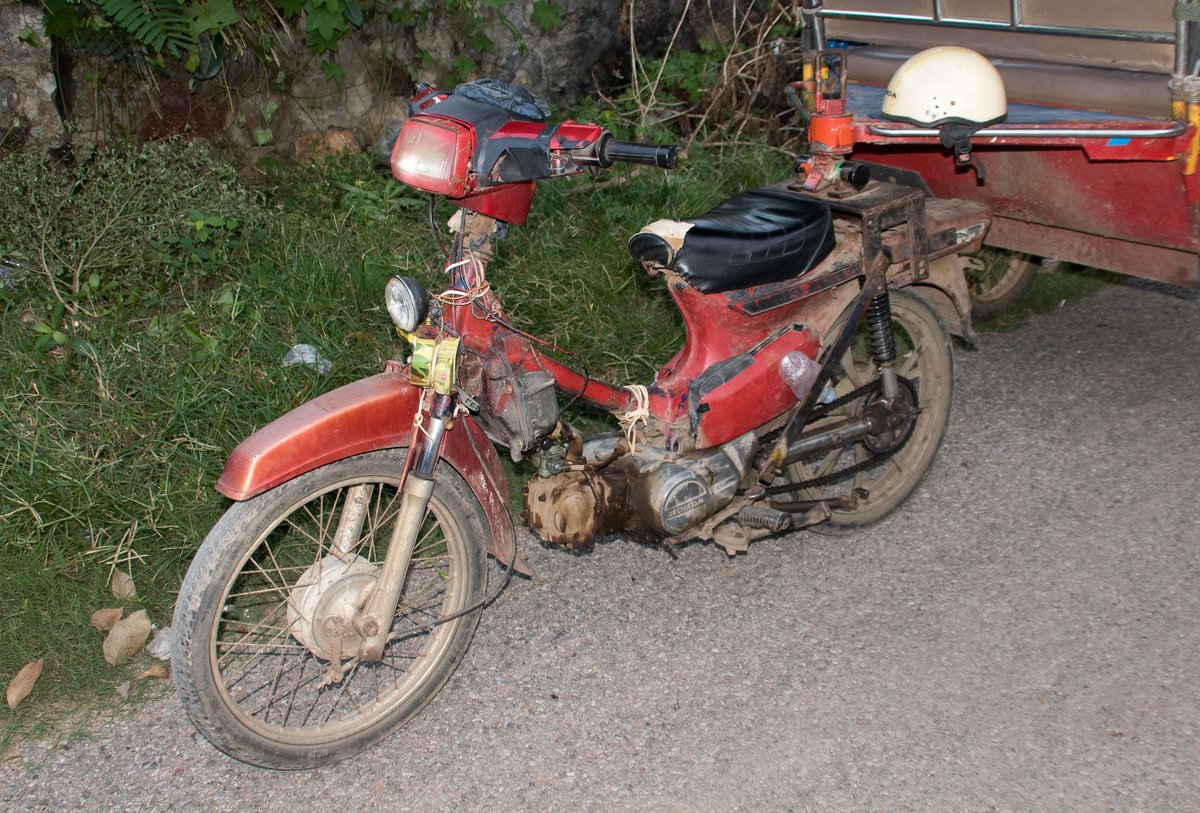
Pen told me that he used to guide tourists up to the top of mount Phnom Sampeau, but two years ago he managed to buy his Tuk-tuk. Unfortunately, his motorbike is very old and dilapidated, so he loses business because tourists want to travel in faster, flashy Tuk-tuks. He’s saving to buy a new one which will cost him $300US. I said that it didn’t bother me about how his motorbike looked - of course, we then we broke down twice on the way back, because his chain came off.
29 October 2016 Battambang, Cambodia
Glenys booked us on a cookery course at the Coconut Lili restaurant. There was only one other person on the course, so it was good fun. Lili (a bloke) first took us to the local market to show us around and buy some ingredients. We’ve obviously spent a lot of time in Asian markets, but the Cambodian markets have many strange things, such as frogs (skinned of course), so it was interesting.


Typically, Cambodian men go out to work and the women stay at home to look after the house and the children, so the market goers were mostly women, bustling about and haggling to get the price down. Lili told us that there are three levels of pricing - the lowest is Women who haggle every day; the next highest is Men who rarely go to the market and don’t know the going price; and the highest price is Tourists. Being a male tourist, the odds of me being overcharged are obviously very high.
Back at the restaurant, we prepared four dishes - Spring Rolls, Tom Yam Soup, Fish Amok, Coconut desert. It was all very interesting and at lunch time, we ate our own food, which was fabulous - the Fish Amok is a traditional Cambodian dish, easy to make and very tasty. The course cost $10 each, which is a bargain considering that you get a four course lunch out of it. Lili was a very good teacher and spoke excellent English.

In afternoon, we chilled out in the hotel room and in the evening, went to a circus. This is run by the Phare Ponleu Selpak Performing Arts School, which is a not-for-profit organisation that provides courses for local children giving them a path to employment as a performer. The evening was a mixture of dance routines with a clown-like story with some impressive gymnastic circus tricks.
30 October 2016 Battambang to Phnom Phen, Cambodia
We took a Tuk-tuk to the Post Office where we boarded the Post Bus. The post office runs a service between various towns primarily to deliver mail, but has extended their service to use mini buses and offer seats to passengers. It’s a little bit cheaper than the commercial services ($7US for the six hour journey).
Unfortunately, they allocated us seats 1 & 2 which are the front two seats by the driver. One was a normal seat, but the other was a horrible narrow, high seat in the middle. We set off with Glenys perched on this middle seat. After twenty minutes, we realised that there was a proper, comfortable empty seat in the back, so after a lot of hassle, we managed to persuade the driver to pullover, so we could change seats.

Despite grabbing proper seats, it was an uncomfortable six hour journey along some roads in very poor condition and we arrived in Phnom Pehn after five o’clock. We took a Tuk-tuk to the Grand Palais hotel, arriving just before the heavens opened and it threw it down. It rained hard for the rest of the evening, so we couldn’t be bothered to go out for a meal and instead shared a fabulous burger and pizza in the hotel bar.
31 October 2016 Phnom Phen, Cambodia
Today we focused on the genocide carried out by the Khmer Rouge in the 1970s. We first visited the Tuol Sleng Genocide Museum, which is also called Security Prison S21, where 20,000 people were imprisoned, tortured and, after they had confessed, were taken to an execution centre and murdered.
The Khmer Rouge started as a communist group fighting a bitter guerrilla war with the Cambodian government forces. Having gained power in 1975 under the leadership of the notorious Pol Pot, they began a radical social program to change Cambodia to a ultra-communist Agrarian (farming) society. A ruling council called the Angkar dictated the life (or death) of the Cambodian people. Over 2 million people died during their four year reign - half died of malnutrition and disease, while the other one million people were physically killed by the regime.
The Khmer Rouge emptied the cities and forced people into labour camps in the countryside. The people were forced to work long hours, with meagre subsistence rations. Anyone deemed to be against the regime was sent off to one of the 20,000 prison camps, tortured and killed. Intellectuals, previous government workers and various ethnic races (Vietnamese, Thai, Chinese) were targeted and imprisoned.

Even the wearing of spectacles or being able to speak French was a sure sign that you were an intellectual and you would be carted off. Hypocritically, most of the Khmer Rouge leaders were university educated. Pol Pot in particular was educated in a Paris university, spoke French fluently and had a love of French Literature. Son Sen, who oversaw the Party's security organisation and was ultimately responsible for Prison S21, wore glasses.
The thing that most amazed me was that until 1993 the UN and most of the western world recognised Pol Pot’s Kymer Rouge government in exile as the official Cambodian government and they held a seat on the UN - it was an incredible 12 years before the world recognised the atrocities of the Khmer Rouge genocide.
We spent two hours walking around the Prison S21, listening to an audio guide, which gave a very good history of the place with some heart-breaking accounts of people who survived the terrible times. There are thousands of photographs of victims displayed in the rooms used to hold prisoners.
The officer in charge of the prison, Comrade Duch, was fanatical about keeping records of each prisoner and would only approve the killing of the victim after a signed confession was extracted by torture. There were even rules that victims had to obey while under torture including “While getting lashes or electrification, you must not cry at all.” It was all very depressing.

We continued on to the Choeung Ek Genocidal Center, one of the better known Killing Fields. This place has 129 mass graves, 86 of which were excavated and 8,985 corpses were exhumed. The largest mass grave was a grave containing 450 corpses. The government has built a large stupa containing the skulls and other bones of the 8,985 victims, which are displayed behind glass panels - it’s a very sobering place.

Once again we used an audio guide, which was excellent, guiding us around the site passing mass graves and even a patch of ground which has been partially excavated revealing human remains. One of the worst spots is the Killing Tree where, in order to save bullets, the soldiers killed children by bashing them against the tree and then throwing their bodies into a pit at the side of the tree. It’s very hard to understand the evil brutality of the soldiers who did the killing.

Back in Phnom Phen city, we went for a stroll in the afternoon, down to the river where it’s very touristy with lots of budget hotels, bar and restaurants. As we strolled along the riverside, we were approached by a bald man in saffron robes, who put bead bracelets on our wrists and blessed us. He asked for a $2 donation, which seemed a bit odd, but by this time I was off balance and didn’t want to upset a Buddhist Monk. I gave him $2US, then as he walked away, I realised that he wasn't a monk and I’d been conned – I sulked for a couple of hours - it's not the money, it's the principle of the thing.

1 November 2016 Phnom Phen, Cambodia
After having a quick look around the central market, which is full of tourist souvenirs, we walked to the river front. It’s a challenge walking down the street here – the pavements are packed with motor bikes; food stalls; people sitting about; and any objects that the shops feel like dumping there. Consequently, you either weave your way through the bedlam on the pavements or risk death on the road from motorbikes, tuk-tuks and cars.
The traffic is chaotic – probably even more so than in the other east-Asian countries that we’ve visited. They drive on the right and the motor bikes and Tuk-tuks are constantly weaving about. At a crossroads, it appears to be a simply a game of chicken – no giving way here.

One strategy that motorbikes adopt is that when turning left, instead of crossing traffic approaching from the left, they turn left immediately, hugging the pavement against the flow of traffic and then when a slight gap appears they dive across the road. This is very disconcerting at first and a hazard when crossing junctions because motorbikes can attack from any direction.
At the river, we found that there is a small community of people living on long-tail boats. Doing some research, I found that there are about 100 families living in the Phnom Phen area on these 10 metre long narrow boats. They eke out a subsistence-living by fishing in the muddy, fast flowing river and selling a small number of fish in the local markets. There’s pressure from the government to remove them from around Phnom Phen and their consequential lack of access to the market will make their way of life unsustainable.
We were hoping to visit the Grand Palace, which is the official residence of the King of Cambodia, but it was closed for some official occasion. Instead we visited the National Museum, which was okay, but very small. We couldn’t face another Cambodian lunch of curry and rice, so we bought a baguette and a tin of tuna and retired back to hotel room.

In the afternoon, we went to a bar called “The Empire” that has a small cinema upstairs where we watched “Killing Fields” which was very moving after what we saw yesterday. The film was made in 1984, just five years after the Kymer Rouge were kicked out of Cambodia. Again, I cannot believe that western governments continued to allow the Kymer Rouge to hold a place on the UN council until 1993 - did they not go to the cinema or read newspapers?
The bar is run by an English guy who has a range of western meals, so I took the opportunity to have my last Pork spare ribs before we return to Muslim Malaysia tomorrow.
2 November 2016 Phnom Phen to Admiral Marina, Malaysia
We caught a Tuk-tuk to the airport, battling through the chaotic traffic. I found being in Phnom Pehn very frenetic and I’d become weary of being hassled every time we stepped onto the streets, so it was a great relief to walk into the calm, air-conditioned, blandness of the airport.
The two hour flight was on time and pleasant. We grabbed a cab and were back at the marina by 15:00. Thankfully, the boat hasn’t sunk; or been overrun by ants; or been hit by lightning; or spontaneously burst into flames. We plugged in the air-conditioning, had a few beers, a sandwich and had an early night.