1 June 2013 San Andres, Colombia
We went shopping in the morning and spent the last of our Colombian pesos. The supermarket where Glenys did her provisioning had run out of canned beer, so I went out on a quest to spend our last 40,000 pesos on 12 cans of beer. It’s a strange, but very nice feeling to spend all of your remaining cash.
We spent the afternoon tidying up ready to leave tomorrow.
2 June 2013 San Andres to Cayo Albuquerque, Colombia
We jumped out of bed at seven o'clock and were away before eight. There was a pleasant ten knot wind as we followed the shipping channel out of the bay. Once out in the open sea, the wind dropped, so I put up our asymmetrical spinnaker. There were dark shower clouds to windward of us, so we kept a sharp eye on them and sure enough, thirty minutes later, the wind started to pick up. By time we got the damn spinnaker down, it was blowing 20 knots, but fortunately the heavy rain passed by us.

As the squall went behind us, the wind settled down to 15 knots and we had a great sail for a few hours. We motored in through the reef around Cayo Albuquerque keeping a sharp eye out for the various shallow reef patches. It’s a couple of miles from the entrance to the two small islands in this isolated atoll. I’m glad that we had good light because there are quite a few shallow patches that we had to navigate around.
We anchored in 8 metres of water in sand among coral heads to the west of the bigger of the two cays. There’s only one other boat anchored here which is nice. The water colours are stunning and the cays look idyllic being covered with coconut palms and having white sand beaches. One of the cays has a fishing camp and the other houses a small naval military base. We were hailed on the VHF and asked to go shore to present our documents.
We were met at the beach by a soldier in shorts and bare feet, but toting a mean looking shotgun and wearing a flak jacket. He led us through the coconut grove to the centre of the island where there are five or six wooden buildings. The place is nicely kept with brightly coloured conch shells surrounding the base of every one of the numerous coconut palm trees. The soldiers based here obviously don’t have a lot to do.
The commandant was a young officer who we found watching a baseball game on TV with the other off-duty soldiers. Our paperwork was soon inspected and he simply recorded the details of our boat and where we’re going. On the short walk back to our dinghy, I found out that there are about twenty naval personnel based here and they come out for thirty days at a time – not a bad job…
We went snorkelling, swimming from the boat to the nearest patch of reef about 100m away. When we jumped in the water, there was a small, nine inch long Remora under the boat, which followed us for 30 minutes, trying to attach itself to our legs. Glenys was not a happy bunny and kept scaring it away when it came to her. It would then frantically swim to me and stay with me until I shooed it away. I let it attach to my leg with the large sucker on its head - it was a very gentle attachment, but a little weird. Glenys was very relieved when it gave up on us. The reef was okay, lots of small fish - I guess the fishermen have killed the large ones…
We invited Mark & Debbie from “All Ways” over for a sunset beer. They live in the Bocas del Toro in Panama, so they had some useful information about our next destination.
3 June 2013 Cayo Albuquerque, Colombia
It was a miserable rainy morning, with several large squalls coming through, giving us heavy rain, high winds and lightning, so we hunkered down and pottered about in the morning.
The afternoon was better. It brightened up and we went snorkelling on one of the isolated reefs, which are like miniature atolls. They’re about 50 metres in diameter with the top being very shallow and the edges dropping down to the surrounding white sand at a depth of around ten metres. The sides of the reef are covered with coral and teeming with small fish - we spotted a nice Southern Stingray burrowing its way through the sand looking for food and a Masked Hamlet which I've never seen before. I can tick that off the list, but I'm now on a mission to get a good photo of one.


The weather turned unsettled again in the evening, so we hid down below and watched a movie. Unfortunately, there are lots of flying ants that are being attracted by our lights, so we ended up having to close all the hatches to keep them out of the boat making it unpleasantly hot inside.
4 June 2013 Cayo Albuquerque, Colombia
It was a much nicer day, so we went snorkelling in the morning and again in the afternoon. The rest of the day was spent hiding from the heat of the sun and tidying up ready to leave for Panama tomorrow. It's 180 miles, so we'll leave in the morning and sail overnight. I checked out the weather forecast and the wind is going to be light and variable for the next week, so we'll probably have to motor the whole way.

It's my birthday tomorrow, but we've postponed it and I'll have an official birthday after we're settled in the anchorage in Bocas town. In the evening, we went over to “All Ways” for sun-downers - Mark made a Conch Salad, which was very, very tasty served with tortilla chips.
5 June 2013 Cayo Albuquerque to Bocas del Toro Town, Panama (Day 1)
It was bright and sunny, so we upped anchor at half past seven and weaved our way out through the coral patches. There was a pleasant 12 knot east wind, so we were able to sail south on a reach in fairly calm seas.
The wind gradually died on us and veered around to the south, so by four o'clock, we were motoring. By dark, the seas had dropped and we slipped along in glassy seas all night.
6 June 2013 Cayo Albuquerque to Bocas del Toro Town, Panama (Day 2)
We had a very uneventful night, seeing two fishing boats and lots of stars. The only slightly worrying thing was the frequent flashes of lightning to the west of our track, but all the activity seemed to be near to the Costa Rican coast well over fifty miles away.
When dawn came, I could see some impressive thunder clouds to the west and south of us, but fortunately we sailed right between them all. A pod of Bottlenosed Dolphin escorted us through the shipping channel into the bay.

Bocas del Toro is a 15 mile wide collection of small islands that forms a very protected stretch of water with lots of anchorages. We motored around to Bocas Town and anchored amongst a dozen other boats – by the look of them most are permanent live-aboards that probably haven’t moved for years. I hailed the port captain on the VHF radio and thirty minutes later, we were boarded by four officials – Port Captain, Immigration, Customs and Agriculture. They were all very pleasant and efficient and the whole process took less than 15 minutes. It cost us $100US including $15 for the water taxi that brought them out. Tomorrow I have to go and get a cruising permit that will last for one year, but cost us $195US. Not a cheap place to visit.
We spent the rest of the afternoon chilling out – we’ve decided to have my official birthday on the 8th June.
7 June 2013 Bocas del Toro Town to Red Frog Marina, Panama
We dinghied into town and found a rough dinghy dock squeezed between the numerous waterfront restaurants. The port captain soon issued our cruising permit and relieved me of $195US. It should have cost us $193, but he stung me for $2 with the old “I don’t have any change” trick – I told him to buy himself a beer and saved a little bit of face.

Bocas Town is a typical Western Caribbean tourist town – lots of small restaurants, Chinese supermarkets and souvenir shops. We spent a couple of hours wandering about and checking out the supermarkets and hardware stores. There’s not a lot here, but they sell some reasonable wine in 1 litre cartons for only $4, so we’ll be stocking up on that before we leave. The island is popular with surfers and back-packers, so there’s plenty of young, scruffy people wandering around in strange looking clothes and sporting dreadlocks.
We met Tony from “Cetacea” on the main street, who told us that the Red Frog Marina is having a party tomorrow afternoon and the food and beer is FREE…. On top of that they are offering FREE docking for transient boats for the weekend. As soon as we were back on the boat, I called Red Frog Marina and sure enough we could go there for free. I cheekily asked if we could have two free nights and they said “Sure”. That’s my birthday party and present sorted out then.
I nipped back into town to buy a few more essentials (beer, wine and bread) then we motored around to the marina five miles away. Red Frog Marina is a lovely new marina hidden amongst mangroves and overlooked by jungle. We were soon settled, so Glenys rushed off to use their laundry room – we’ve not had any laundry done since we were in Montego Bay in Jamaica six weeks ago, so the dirty washing has been piling up.
Meanwhile, I dragged out our small air conditioning unit and made a small stand, so that it fits into our companion way. By half past five, everything was plugged in and we had lovely cold air blowing around our saloon. We had a quiet night in, watching a movie and luxuriating in being cold for a change.
8 June 2013 Red Frog Marina, Panama
It was my “official” 57th birthday today. While I've been getting older, I've noticed that my eyebrows are getting bushier and have horrible long, grey, wiry hairs. In an attempt to stop me looking like Dennis Healey, I've been plucking the offending hairs out with tweezers. God knows how women cope with doing this all the time because it bloody hurts. Glenys has obviously become weary of me moaning about the pain because she’s bought me a Nose and Eyebrow trimmer for my birthday – old age is a terrible thing.
It absolutely threw it down in the morning, but this didn't stop Glenys the washing woman, dashing off to use the laundry room – she’s done six loads of washing since we arrived here. I chilled out using the very fast internet connection and ordered some more things to be delivered to the UK.
Thankfully, the rain stopped in the afternoon and the BBQ party was a great success with 30 or so people attending. The BBQ was good, the band was good and the free beer and rum punch was even better.
Later in the afternoon, we started to walk over to Red Frog Beach on the other side of the island, but a guy pulled up in a golf cart and offered us a lift. He turned out to be the manager of the villa project that is being built on the island and took us for a guided tour of the place. There’s quite a little community of small villas that have been built on the side of the hill overlooking the sea. Most of them have been bought by people who rent them out to holidaymakers – it’s very tastefully done but I wouldn't like to live there because it’s such a false environment.
9 June 2013 Red Frog Marina, Panama
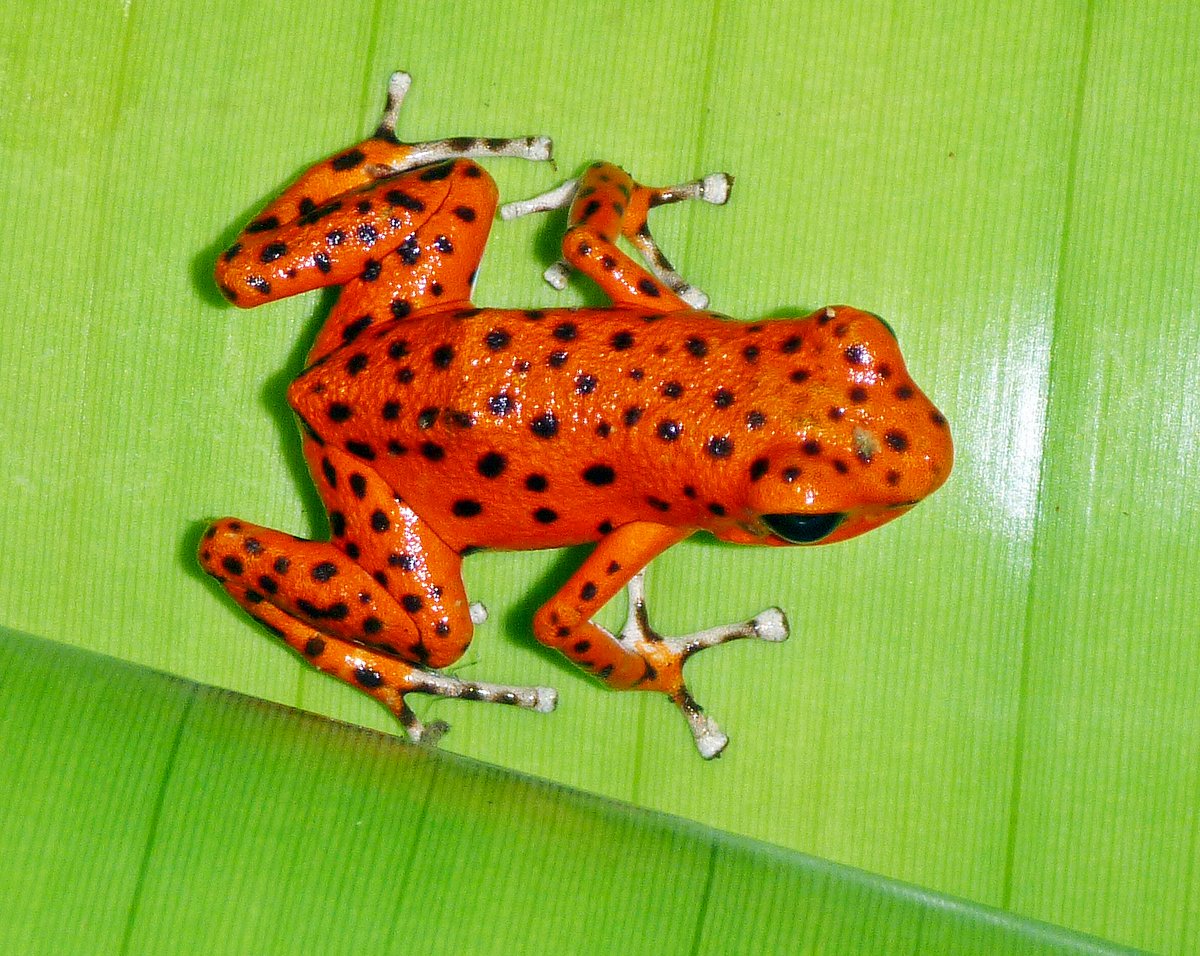
It was a much nicer day, so we went for a walk along a trail that leads through the jungle to one of the remote beaches on the island. We've heard that there are three toed sloths on the island, so we were keen to see one of them. Also, this island (Bastimentos) is famous for a red variety of Strawberry Poison Dart Frogs – hence Red Frog Marina.

We didn't know whether to look up into the trees for sloths or down at the ground for frogs, so our progress was very slow, but it was great to be back in tropical rain forest again with the sounds of many bird calls around us. After an hour of desperate searching, we finally spotted a couple of the frogs and they are tiny - they’re only ¾ inch long. I was so excited to find them and took lots of photos, one of which I'm rather proud of.
The bright colour of the frog is a warning to potential predators that they carry very nasty toxins, which the indigenous Indians use on blow dart tips. We've been told that these toxins are so nasty and so novel, that they have attracted the attention of biochemists, who are interested in figuring out how they work, and whether they might have practical uses for human medicine. Their efforts have been used to create a pain-killing drug that is said to be two hundred times more powerful than morphine.
We’ve also been told that the colour of the frogs on Bastimentos is unique and that frogs on other islands in the Bocas have different colours – on Pope Island they are green; on Cerro Brujo, dark blue; on Nancy Key, orange; and on Bocas Island, green and yellow with black polka-dots. The collector in me wants to go and photograph all the different colours…
Having terrorised the little frogs for ten minutes, we wandered on looking for sloths and found one high up in a tree. We could clearly make it out with our binoculars, but it was too far away to get a photograph unfortunately. Our walk finished on north Beach and we wandered back spotting one more frog crossing a path. Good little trail.
We filled up with water at the marina, bought some petrol for the outboard and went all of 400 metres to an anchorage just outside the marina. We had a quiet afternoon, browsing the internet and playing musical instruments.
10 June 2013 Red Frog Marina, Bocas, Panama
The weather forecast was for thunderstorms and showers, so we decided to stay in here for another day. A large squall came through just before lunch with gusts of 30 knots and torrential rain, so we’re glad that we stayed put.
We spent most of the day taking advantage of the good internet connection and reading up on the Galapagos and Easter Island - we’ve heard that it’s very expensive to stay in the Galapagos Islands and we’re trying to decide whether to bother to go there.
The regulations in Galapagos seem to constantly change and there’s a great deal of confusion about what the fees are – the cost seems to vary depending on which island you clear in at. We’ve heard estimates between $600US and $1,200US to stay for a month. In addition, to see most things you have to go on guided tours, which on average seem to cost $100+ per person, so it would be very easy to spent $2,000US over a few weeks. After reading lots of online information and blogs, we’re still not sure how much it will cost. I sent an email off to a clearance agent in Isabella in the Galapagos, hopefully he'll reply in a few days.

Another major decision that we have to make is whether to go directly to the Marquesas with the hundreds of people who cross the Pacific each year, or whether to go to the Gambier Islands stopping off at Easter Island and Pitcairn Island. Not many people go that route because it can be difficult to anchor at both Easter Island and Pitcairn Island, but the opportunity to see these to remote places is almost too much to resist. The trouble is that the Marquesas sound beautiful as well…
Perhaps we’ll sail Galapagos – Easter Island – Pitcairn – Gambier Islands – Marquesas. That would be 4,200 miles instead of 3,000 miles directly from Galapagos to the Marquesas, but the voyage would be split up into 4 smaller passages, the longest being the 2,000 mile trip to Easter Island. Sounds like a plan to me.
11 June 2013 Red Frog Marina to Dolphin Bay North, Bocas, Panama
It was a nice sunny day today, so we upped anchor and headed for the Bocas Town anchorage. There's a very shallow patch of reef in the outer part of the anchorage that we needed to avoid. The inside of the reef is fairly shallow, but we managed to motor through it when we arrived here from St Andres last week - the shallowest depth that we saw then was 2.5 metres.
It's quite a long way around the reef, so I decided to go through the shallow area again, where there are a few boats on moorings. All went well until the depth dropped quickly down to 2.5 metres and then slowly decreased until we started bumping the bottom at 2.0 metres. We were still moving, so thinking that this was an isolated shallow patch, I increased the engine power and ploughed ahead. 25 metres later, we were hard aground with the depth gauge reading 1.8 metres. Glenys looked aghast at me and asked, "What were you thinking?"
We were at low tide, but unfortunately, the tides here are not at regular 12 hour intervals and the next useful high tide was in the middle of the night - very embarrassing. My first cunning plan was to use the dinghy to heel Alba over using a spinnaker halyard and to try to plough on to get through to the anchorage 50 metres ahead. We managed to push ourselves another 10 metres onto the sand bank before we couldn't get any further.
By now, we'd attracted a lot of attention, and a few people came over to offer help and advice. Comments like "It's very shallow here"; “We’re at low tide now, wait for it to come up” and "Lots of people go aground here" were not what I wanted to hear. We gave up and had a regroup, sitting in the cockpit, while Glenys shook her head and repeated, "What were you thinking?"

I put on my snorkelling gear and went to survey the sea bed. We'd made an impressive, one foot wide furrow in the sea grass that stretched 50 metres behind us. It didn't look very promising ahead of us either - it was hard to gauge the depth, but it looked to be getting shallower before we would be in the anchorage 50 metres away.
I decided on Plan B - rather than waiting for over 12 hours for high tide, we'd go back the way that we came. I tied a long rope from our dinghy to the bow of Alba and combined with Glenys using the bow thruster and the main engine, we remorselessly pulled our home around 180 degrees.
I then reattached the spinnaker halyard to our dinghy and pulled Alba over as much as I could while Glenys powered forwards. I could only induce a heel of 10-15 degrees because the outboard propeller was cavitating and the dinghy was veering around all over the place. In addition, we had to stop every few minutes while I repositioned myself, so our progress was very slow, but at least we were moving.
Twenty minutes later, Glenys gave me the thumbs up as she got back into deeper water. The trauma wasn't quite over because, in her enthusiasm to get to even deeper water, Glenys powered away. I'm in the dinghy with a rope running from the top of Alba's mast to the aft end of the dinghy, so I'm being pulled backwards through the water and water is rapidly flooding over the transom. I was in great danger of being pulled under water, which wouldn't be good for the outboard engine. After much screaming and shouting, I managed to attract her attention and didn't sink.
After a few deep breaths, we quietly motored the long way around the reef and anchored safely in 4 metres of water. Totally traumatised, we had a quick sandwich to restore our blood sugar levels and went into town to buy some provisions.
Fully laden with enough food to last a week, we sneaked out of the anchorage and headed for Dolphin Bay. We'd heard on the morning cruiser's net that the Valley of the Frogs Restaurant does a horse riding trip, so we were keen to try it out. Dolphin Bay is a three mile wide, enclosed lagoon with two small channels giving access. We entered via the eastern channel and had been told to look for a green house. Well, we couldn't see it, so I made a general call on the VHF radio and immediately had a guy called Brent giving me directions to find the place. We eventually found it tucked away behind a small headland.

At five o’clock, a panga pulled alongside and Brent introduced himself and said that a few people were going over to the restaurant, so we joined them. There was a large group of ten people gathered; all ex-pats who have bought property in the area. They all communicate by VHF radio and have set up the Bocas Emergency Network (BEN) and they run the cruisers net in the morning. Most of them are cruisers who have put roots down here. They were a friendly group and the meal was good and very filling - $14 for two huge meals. The restaurant owners are 7th Day Adventists and therefore don't serve alcohol, so I had to zip back to Alba to get a few beers.
I sat next to Robert (BEN 68) who only moved into the area two weeks ago. He and his wife, Julie have just bought a property with Cocoa trees and a small chocolate making operation. It sounds interesting, so I said that we’d go over the day after tomorrow and have a tour of his place. Meanwhile, Glenys arranged for us to go riding tomorrow morning.
12 June 2013 Dolphin Bay North, Bocas, Panama
It was bloody horrible weather and raining heavily, so Glenys went over and cancelled the horse riding.
We managed to get an intermittent Internet connection, so I ordered a few more spares to be delivered to the UK. Glenys continued reading about the various places and routes in the Pacific and we've more or less decided that we'll go to Easter Island. This means that we can be in the Galapagos Islands a month earlier than the crowds, go to Easter Island, Pitcairn and the Gambier Islands and still be in the Marquesas by May. So our plan now is:
Jul 2013 Fly back to UK
Aug 2013 East Panama & San Blas
Sep 2013 Transit the Panama Canal
Oct to Dec 2013 Ecuador
Jan 2014 Galapagos
Feb 2014 Easter Island
Mar 2014 Pitcairn & Gambia
April 2014 Sail to Marquesas
May to Oct 2014 Pacific Islands
Nov 2014 Sail to New Zealand
Sounds easy enough, but we’ll probably be sailing 9,000 miles from Panama to New Zealand which that’s quite a way in only 14 months – we’ll be at sea for 20% of next year.
The torrential rain reduced to light drizzle in afternoon, so the local Indians came out in their dugout canoes and started to fish. This is certainly a tranquil, beautiful place and little reminiscent of the Lake District with green pastures, mountains in the distance – and the rain. However, we have Bottlenosed Dolphins splashing around the boat and small rays gliding past just showing their wing tips like some strange type of shark. The jungle is never far away and around five o'clock, the parrots start to fly overhead on their way to night time roosts. They always fly in pairs, taking a very straight route and are constantly squawking, which is now our signal to open a cold beer.
As the sun went down, we had an invasion of flying creatures with four wings, so Glenys put up the mosquito netting to keep the little devils out. We found out later that these are flying termites, which shed their wings just like we get flying ants in the UK, but these are twice as big - yuk!
13 June 2013 Dolphin Bay South, Bocas, Panama
We pulled up our anchor and started to motor across the bay to the Cocoa farm owned by Robert and Julie. On the way, they met us in their panga and said that they were going into town today, so we said that we'd meet up with them either this afternoon or tomorrow morning. We continued across the lagoon, anchored off their property at the south side of Dolphin Bay and got on with some jobs.

Robert & Julie turned up at half past three, so we went ashore to have a look around. Their property is on the mainland and covers 80 acres, which has been carved out of the native jungle. They have a good sized house, but there are no services – no electricity, no water, no telephone, there isn't even a road within ten miles. So they have solar panels for electricity, catch rain water, use the VHF radio for communication and their transport is a panga with a 115hp outboard. It’s like living on a boat.
We had a guided tour of the property, which was set-up by another ex-pat, 16 years ago. The land is very well maintained with good paths and some landscaped areas near to the house. The whole property is essentially still rainforest with tall trees providing a canopy for the cocoa trees which are growing in the shade. Two Indians from the nearby village come in and tend the land for $40US per week – and that’s a good wage around here.
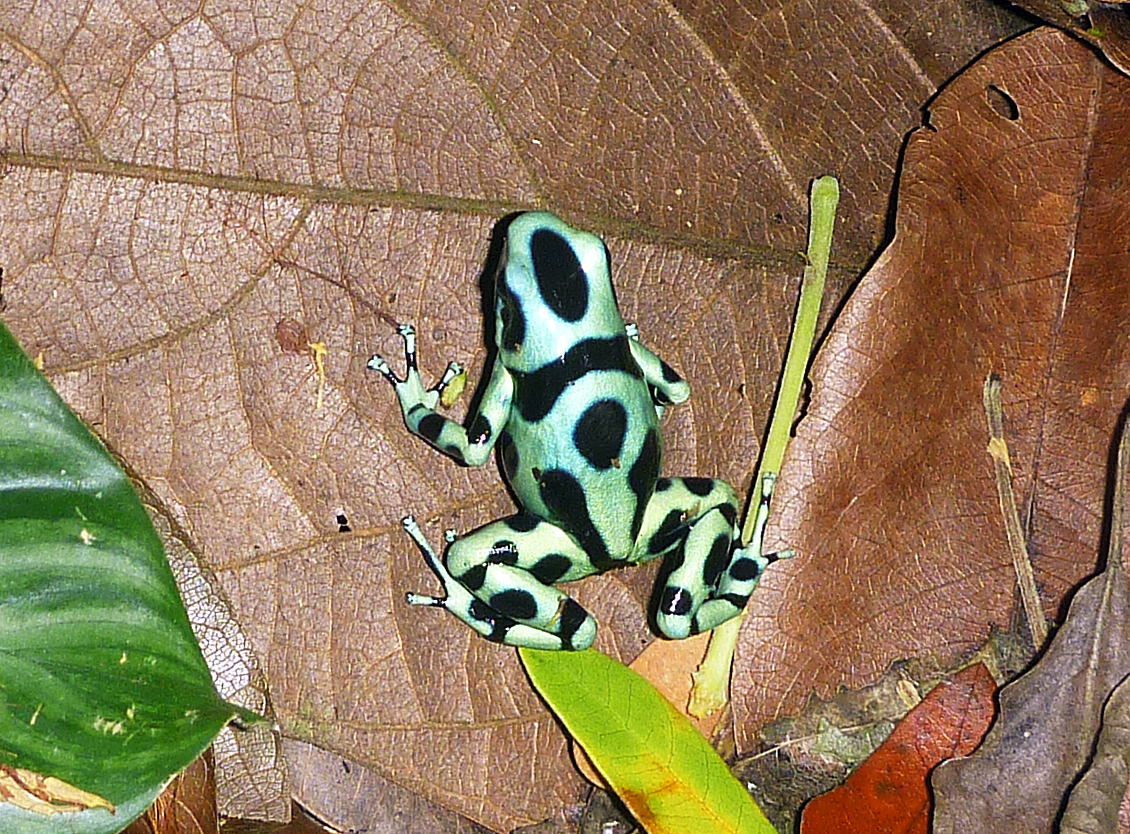
We saw another species of Poison Dart Frog - this one is light green with big black blotches; it’s also much larger being two inches long. Robert is a font of knowledge and showed us various plants and trees as we walked around – I was most impressed with the Walking Palm that he showed us – it puts down air roots and can slowly move at a rate of one foot per year across the ground to get better sunlight.
The cocoa trees have tiny white flowers that only open for a single day. The flowers have both male and female sex organs and are only pollinated by a particular type of gnat, which lives on rotting cocoa husks that are left on the tree. If a flower is pollinated then a cocoa pod will grow. Strangely, the flowers can pop up anywhere on the tree, so pods grow in very peculiar places on the tree such as the middle of the main trunk rather than on the ends of branches.
The cocoa pods are harvested twice a year when they turn yellow – September being the next crop. If there aren't enough ripe pods to process efficiently, then Robert will get the local Indians to go out into the jungle and harvest wild Cocoa pods for which he pays $0.04 each. The Indians like this work because they can earn hundreds of dollars in a short period of time.
The beans are removed from the yellow pods and put into three foot long wooden boxes and left to ferment for four or five days. The fermented beans are laid out on a drying platform and dry in the sun, which takes about a week. The dried beans are then taken into the chocolate making shed for processing into chocolate (and when I say shed, I mean a 12 foot long shed…)

The previous owner has assembled a collection of very Heath Robinson, home-made processing machines. The beans are first placed in a roasting machine which is made from an old propane gas cylinder with a small 12 volt motor rotating it over a propane burner. Next, the beans are put through a grinder which has a home-made ducting system using a woodworking sawdust extractor to separate the lighter husks from the heavier cocoa bean granules (called “Nibs”). The Nibs are put through the machine three times to ensure that all of the husk material has been extracted.
The Nibs are pure chocolate and look like coffee granules. Some people like to eat them raw because they are very high in antioxidants, but they were too dry and bitter for my taste. These Nibs are then put through another, finer grinding machine a few times, which releases the oil out of the granules and turns it into a runny chocolate slurry. The chocolate is poured into ½ lb moulds and put into a freezer overnight. The next day, it’s wrapped and sold to local shops and restaurants.
Robert currently only does two manufacturing sessions a week and produces about 20 lbs of chocolate per week, which sells at $15US per pound. As Robert says, it’s a hobby at the moment, but they are planning to develop some more products like making soap containing chocolate husks as an ex-foliate. We sat on their veranda drinking cold beers as the sun went down looking out at Alba swinging gently in the light breeze – what a nice place.
14 June 2013 Dolphin Bay South, Bocas , Panama
We motored back to Valley of the Frogs restaurant and went horse riding. Our guide, a young Indian girl, took us towards the rain forest. It’s obvious that the whole island used to be covered in jungle, but this farm land has been cleared for cattle and is now lush grass land. It’s quite hilly despite being on a small island and we traversed some steep slopes on narrow footpaths.
The terrain became more wooded and then turned into lush rain forest as we rode into the Valley of the Frogs. We walked for a while along the jungle path, looking for frogs and other wildlife. The Poison Dart Frog are similar to the ones on Bastimentos, but these ones have blue feet. We were hoping to see some wild monkeys, but the guide couldn't spot any. It was a fantastic 1½ hour ride – all walking, but very interesting terrain.
Back on the boat, we chilled out for an hour, had lunch then decided to go to the next bay through a small channel. The channel was okay, but the weather wasn't. Half way through the channel, the wind picked up as a squall line approached. The skies darkened, so we couldn't see any changes in water colour and our electronic charts show nothing of this area.
We slowly edged our way into an anchorage past some very shallow areas and dropped the anchor in 6 metres. As we backed down on our anchor, the depth dropped to three metres. The squall was rapidly approaching, so we gave up and ran away. The squall hit us as we were motoring back through the channel – bad timing. We went back to the anchorage off Green Acres where we knew that the holding was good.
15 June 2013 Dolphin Bay South to Palos Lagoon, Bocas, Panama
The weather forecaster on this morning’s cruiser’s net said that there was a large area of rain heading our way. After our minor trauma with the squall yesterday, we were keen to get around to the next anchorage before the rain arrived, so we were on our way just after eight o'clock.
We motored through the channel into Palos Lagoon and anchored off a small bay near the Rana Azul restaurant. There’s a shallow bar across the cove with a narrow entrance through it, but again, we had insufficient light to see the water colours properly, so we had to anchor about ½ mile from the shore. The shoreline is part of the Panamanian mainland, covered in lush jungle and we could hear the eerie calls of Howler Monkeys in the distance. We've been told that Howler Monkeys never go down to the ground, so as jungle is cleared, the monkeys can become isolated in an area. They are not found on the islands in the Bocas, so this is the first time that we've heard them in Panama.

While we were walking around the Cocoa farm yesterday, I spotted a calabash tree and asked Robert if I could have one of the dried calabash gourds. We've never found a suitable lampshade for our cockpit light, so I've decided that I'm going to make one from this calabash - sometimes I think that I've got too much time on my hands.
We had a reasonable internet connection, so I started off by looking for information how to dry and process a calabash shell. To my surprise, I found a whole craft industry devoted to the processing, carving and painting of gourds. Two hours later, I knew how to sort it out and had picked up some ideas on how to decorate my lampshade.
Fortunately, my calabash was well dried and hard – it can take several months to dry a fresh green gourd taken straight from the tree. I cut off the bottom, which revealed a black, stinking mess of seeds and gunk. This was quickly dumped overboard before putting the gourd in a bucket of fresh water for twenty minutes to soften up the remaining vegetable matter inside.
Using a spoon, I scraped out the inside of the calabash and then used a pan scrubber to scour the outside surface. I cut off the stem and drilled an 8mm hole in the top to fit an electrical cable and I now have a gourd ready to be decorated. It still stinks, so it's been banished to hang on the arch to dry some more.
I spent most of the rest of the afternoon, trying to design a pattern to decorate my lampshade. I couldn't figure out how to draw a pattern because it’s a spherical surface. I spent ages cutting out a piece of paper like a geonomic projection and wrapped it around the calabash. Unfortunately, this gave me a very strange shape to work and I gave up on that idea. I've decided to keep it simple and will have three compass roses and a few star constellations. The idea is to make draw the shapes on the surface in pencil and drill a series of small holes along the lines, which will hopefully let light shine out onto the underside of the bimini.
16 June 2013 Palos Lagoon, Bocas, Panama
In the morning, I continued designing my lampshade by drawing a simple compass rose and working out which star constellations to use. I then started the laborious process of drawing the design on the curved surface - not an easy process. By lunchtime, I’d only managed to layout the guide lines and drawn one compass rose.
Being Sunday, the local ex-pats all gather at the Rana Azul restaurant for lunch, so we joined them. It was a good turn-out with thirty or forty people there. We’d met a few of them earlier in the week and others came up and introduced themselves, involving us in the occasion – we had a good time. The restaurant serves fantastic pizzas, so I made a determined effort to eat a whole medium pizza and was extremely bloated by the time we left.
We were back on the boat at four o’clock and I spent the remaining daylight drawing the other two compass roses onto the lampshade and drilling 200 small holes outlining one of the compass roses – only 500 holes to go.
17 June 2013 Palos Lagoon to Bocas Del Toro Town, Panama
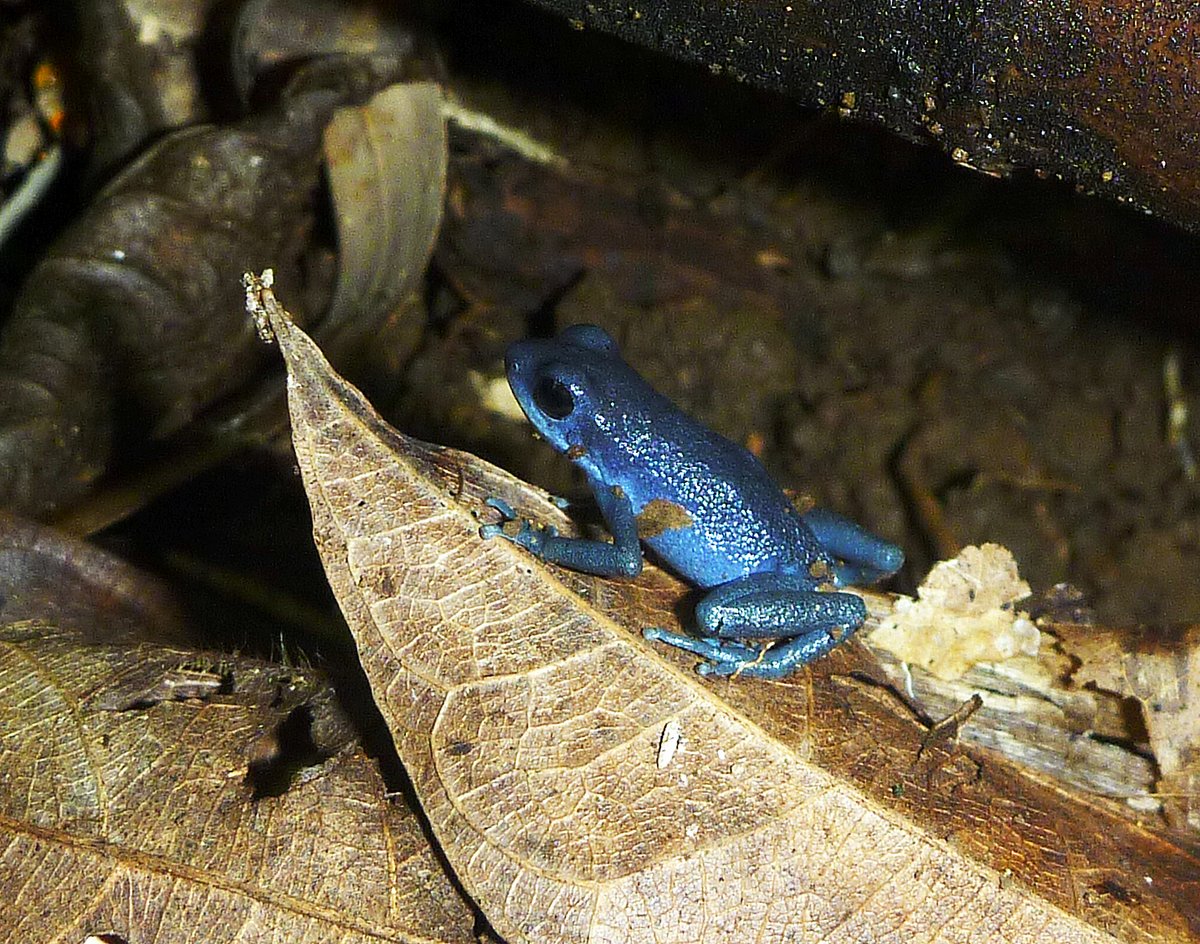
It was a lovely day, so we jumped in the dinghy and went across to Jim Jackson’s property. One of the Ex-pats had told us that we could go for a walk on this land. Jim died three years ago and has donated his property to the Smithsonian Institute, but before he died, he laid out an impressive set of paths around his property, all cut out of the native jungle. It’s very well maintained and has many crop trees (cocoa, banana, etc) growing in the shade of the natural rainforest canopy. We spent a pleasant hour or two wandering around and spotted yet another variant of the Poison Dart Frog – this one was blue.
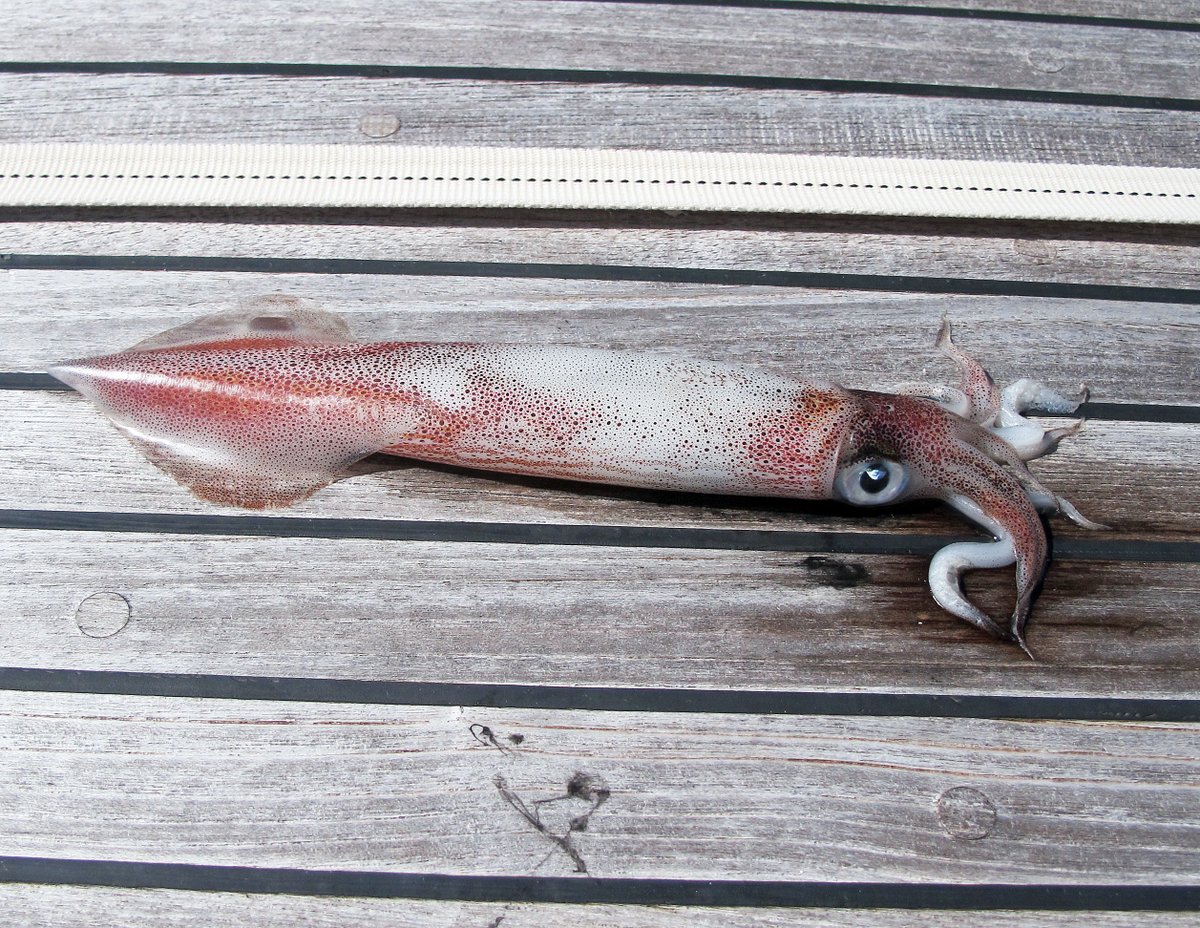
Back on the boat, I started to get ready to leave and found an eight inch long squid on our front deck. We’ve found small fish on our deck in the past but never a squid. Something must have really scared it for it to leap six feet out of the water onto our deck…
We motored back to the Bocas Town anchorage and wandered into town to re-provision after a week out in the boonies. While Glenys was dropping off some laundry at the Bocas Marina, I spotted a small notice board outside the marina bar giving detailed instructions on how to wash a cat:
1. Put both lids of the toilet up and add 1/8 cup of pet shampoo to the water in the bowl.
2. In a smooth movement, put the cat into the bowl and close the lid (you may have to sit on the lid.)
3. At this point, the cat will self-agitate and make ample suds. Never mind the noises that come from the toilet, the cat is actually enjoying this.
4. Flush the toilet three to four times. This provides a power wash and rinse.
5. Stand well back and quickly open the lid.
6. The cat will rocket out of the bowl and streak through the boat/house.
7. Both toilet and cat will be sparkling clean.
It’s amazing what handy tips we pick up while cruising.
Later in the afternoon, I drilled another 300 holes in my lampshade before the battery on my drill ran out. Only another 200 damn holes to go - sometimes, don’t you wish that you’d never started something.
18 June 2013 Bocas Del Toro Town, Panama
We woke to the rumble of thunder, and then 20 minutes later we had heavy rain. This put a hold on our plans to hire a couple of push bikes for the day. This weather is totally unpredictable – the weather forecast always says “chance of thunder storms”. Yesterday we had blue skies and fluffy white clouds and this morning it looked like the depths of Mordor. We’re planning to leave tomorrow to sail overnight to Portobello, but we’ll just have to wait and see what the weather is like in the morning.
Amazingly, the weather cleared by eleven o’clock, so we headed out and hired a couple of bikes – only $5 per day. We went along the east coast of the island to check out the surfing beaches. We eventually found a place where a dozen surfers were strutting their stuff in six foot waves – they all looked pretty good to me.
We retraced our route because the road just seemed to peter out and stopped off at a small road side restaurant where lots of locals were eating. Glenys had a bowl of soup for $2, which had lots of unidentifiable animal parts, but was incredibly tasty – soup is always a good choice in these places.
After lunch, we rode 7 kilometres to a bat cave. It was a right mission with plenty of hills, especially on the bikes that we had, which were more suitable for going shopping than tackling steep hills – no gears. Apparently, the Virgin Mary has appeared twice to people in the entrance to this cave, so the locals have built a small shrine there and there are two statues of the Virgin Mary at the entrance, presumably in the location of the apparitions.
There was no one around, so we changed into our swimming things and waded into the cold water of the cave. Unfortunately, our small head torches were too dim to go very far into the cave, but we saw the bats and had a nice cooling plunge in the stream. As we walked back to our bikes, a lady appeared (not the Virgin Mary) and asked us for $2 as an entrance fee – a bargain because they keep the place very tidy.
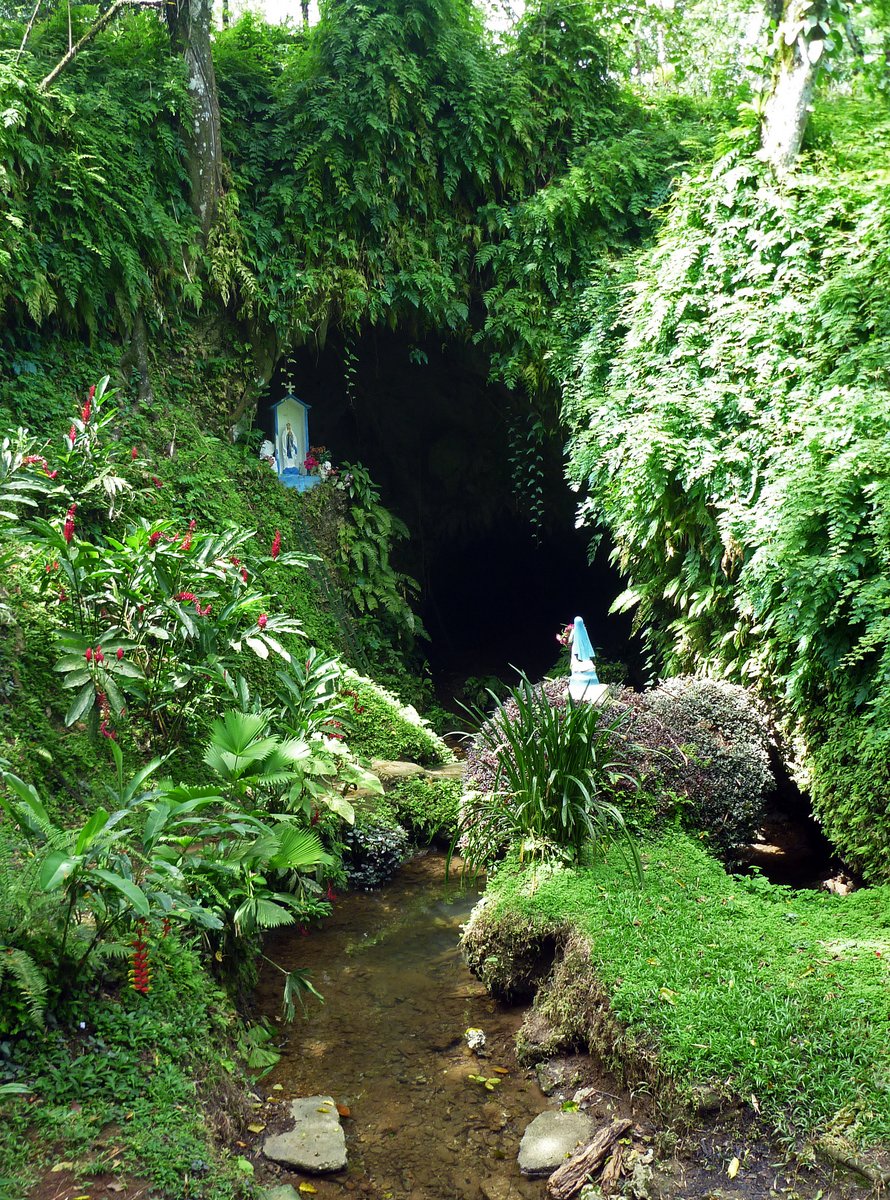
The trip back down the hill was great and we returned the bikes at around three o’clock – four hours of riding is quite enough for my little legs. We did some final provisioning ready to leave tomorrow.
19 June 2013 Bocas Del Toro Town to Portobello, Panama (Day 1)
It was a grey overcast morning and the GRIB file showed a patch of heavy rain to the east of us – exactly in the direction that we want to go. I chatted to “Captain Ron” who does the weather forecast on the cruiser’s net and he said that the rain system is tracking south west and the afternoon should be dry. The weather looks to be getting more unsettled at the weekend, so we decided to go for it today – we’re going to get wet anyway.
I nipped ashore and picked up our zarpe giving us permission to sail from here to Portobello. It’s a right palaver – I had to fill in a form, then the officials had to fill in two forms and two very detailed receipts. It cost me $13.70.
I just made it back to the boat before it started to rain. Putting on my swimming shorts, I stowed the dinghy on deck and got Alba ready to sail. By the time that I’d finished, it was raining heavily – at least I got a nice cooling shower.
The weather system fizzled out by half past one, so even though it was still drizzling and overcast, we upped anchor and set out through the Canal des Bocas del Toro. This channel goes past the surfing beaches that we looked at yesterday and there were big, six to eight feet waves rolling in, but caused us no problems because they weren't breaking. We had to go six miles out to sea before the water depth increased to 100 metres and the waves settled down to a longer, spaced-out ocean swell.
There was hardly any wind and what we had was coming from all directions, so all we could do was to motor all day heading directly east. By evening, there were thankfully no signs of thunder storms in our path, but we could see some systems more out to sea.
20 June 2013 Bocas Del Toro Town to Portobello, Panama (Day 2)
There wasn’t any change to the wind overnight, but we were increasingly worried about lightning as time went on. We could see huge flashes of lightning to the north of our route, but couldn’t see any rain activity on our radar – all we could do was worry.
At around seven o’clock, the wind picked up to 10 knots from the south east so I was able to start sailing, but it was short lived and an hour later we were motoring again. I went for a nap, but at ten o’clock I was woken up by Glenys because we were heading straight into a dark weather system. I flicked on our radar, but there was no major rain activity (so there was nothing to try to dodge) so we just kept motoring east. Five minutes later, we had 30-35 knot winds from the east, but there was very little rain. We had 30 minutes of strong winds, but it finally abated and the skies cleared as we approached the harbour of Portobello.

There were many more boats in the harbour than I expected – I guess around 50 sailing boats and a few bigger ships. We motored around and spotted “Vanupieds” and “Nuwam”, who we met on the east coast of the USA last year. There are a lot of derelict boats and scruffy live-aboard type boats over by the town, so we anchored in 10 metres of water at the northern side of the harbour, where most of the other yachts appear to be cruisers.
After lunch, we went into town and what a scruffy, run down place it is. Portobello used to be the greatest Spanish fort in Central America and there are the remains of three fortresses. Gold was brought to Panama City from Peru and the Orient and carried overland to Portobello, where it was loaded onto Spanish Galleons and shipped back to Spain. This obviously attracted the attention of English Privateers and the city was constantly attacked by pirates and the Royal Navy, being finally demolished in 1739 by Admiral Edward Vernon.
Today the locals’ homes stand in between the ruins of the colonial fortifications and some of the neighbourhoods look decidedly dodgy. The Port Captain wasn't in his office, so we wandered around and met a few of the local ex-pats - English Dave, Irish Dave and Consignment Dave are the ones that stick in my head. They all arrived by sailing boat and just got stuck here.
We were feeling too weary to wander around for very long, so we retired back to the boat to have a nap and chill out. We had a quiet evening and were in bed by half past eight – this sailing lark is exhausting.
21 June 2013 Portobello, Panama
We wandered into town again and managed to find the port captain. He was just finishing off the clearance papers for a yacht that had arrived from Columbia bringing eight back-packers into Panama. This is a very popular way for these young people to get across the border - I believe that most of them stop off in the San Blas islands for one night. It sounds like it’s a very lucrative operation for the yacht owners, but it must be very crowded on these sailing boats – Alba is certified to carry 12 people, but I can’t imagine having that many people on board, they must sleep on the decks.

Once we’d received our clearance papers from the very friendly port captain, we went for a look at one of the forts. It’s run down, but there are lots of cannons lying about and there were ten or so people working on rebuilding the fort, which is interestingly made from blocks cut from coral. I’ve heard that the town is a World Heritage Site, so they must be getting funding from that. There’s a look-out fort perched 300 feet up the hill overlooking the bay, so we trudged up the eroding dirt steps and were rewarded by a very nice view of the bay.
We had a wander around town again and went into the local church (Inglesia de San Felipe), where there’s a six foot statue of a Black Christ. This is an important shrine in Central America and people come from as far away as Costa Rica to attend the Festival de Cristo Negro which occurs on the 21st October every year. It’s supposed to be quite a spectacle. After the sun sets, the statue is paraded down the streets of Portobello, while pilgrims dressed in purple robes and thorned crowns dance and drink until the small hours of the morning – a pity that we’ll miss that one.
There are a lot of vultures around the town, which are not as wary as the ones that we’ve seen elsewhere. You can see them perched on walls and roofs all over town, so this is not a place where I’d like to go to sleep outside. The locals dump garbage in a clearing next to the port captain’s office and a bulldozer clears it away every so often. The vultures are all over the garbage, picking away at the bags like seagulls do in the UK, but this is much, much scarier.
“Vanupieds” and “Nuwam” came over for a beer or two and we caught up on everyone’s adventures for the past six months.
22 June 2013 Portobello, Panama
It was an absolutely horrible day. There’s a Tropical Wave passing through the area and it brought heavy rain and thunderstorms for most of the day, turning the water in the harbour into a horrible brown colour. We hunkered down and got on with doing our own thing. Glenys spent most of the day looking at reading up about the San Blas islands where we’re going to go when we get back from the UK.

I spent most of the day working out a project plan for when we get hauled out when we get back from the UK. We've got to replace the bearings on the rudder, stop the water that is leaking through the floor of the aft locker, put on a couple of coats of anti-fouling paint, replace the timing belt on the engine and sort out the oil leak on the generator. I've broken it down into small tasks and worked out that if everything goes to plan, we should only be out on the hard for seven days – I've always been an optimist.
It carried on raining all evening, so we cracked open some beers and watched a movie.
23 June 2013 Portobello, Panama
It was another unsettled morning with showers and sunny intervals. I downloaded a GRIB file and it looks like it will be unsettled for the next week, with a series of Tropical Waves marching remorselessly west. We’re planning to go 20 miles west to Shelter Bay marina on the 30th June, so we have a week to sail around this area – we’ll have a look at the sky tomorrow morning and maybe head 10 miles around the corner to another bay. We need to make some water and I’m not making it in this harbour – it’s very murky.
We pottered around in the morning, starting to gather things together ready to take back to the UK. I sorted through our paper charts. I was going to take a load back to the UK, but eventually decided that it’s not worth the effort because in the past two years we've hardly looked at them. I’m going to keep some very large scale paper charts of the Caribbean and Atlantic Ocean as an emergency backup in the unlikely event that all of our electronic charts fail. I can’t think what to do with the remaining 50 or so charts – I’ll try to give them away, but I guess that they’ll probably end up in a skip.
It’s Sunday, so we went out to town and had lunch at Captain Jack’s bar, where we were able to get internet connection and catch up on our email. Glenys booked a five star hotel in Panama City for the night before our flight to the UK using some of the air miles that we’ve accumulated over the past twelve months. It’s getting imminent now and we’re both looking forward to seeing our family – only 10 sleeps to go now.
We bumped into Peter Lee on “Raven Eye” who we met in Trinidad over a year ago, along with his daughter Kati. Unfortunately, he wasn't very communicative and is deeply distressed because Kati is presumed lost at sea. She left St Martin at the beginning of April on the Lady Domina with four Scandinavian men bound for the Azores. The passage should have taken 2-3 weeks, but after ten weeks nothing has been seen of the 75 foot yacht. What do you say to a man who has had such a tragic loss? I guess that the worst part is that he doesn't know what happened – gives me goose bumps every time I think about it.
24 June 2013 Portobello, Panama
We woke up to the sound of heavy rain again. So we lurked around in the morning, waiting to see if we could go around to Green Turtle marina which is twenty miles away. By eleven o'clock, it was still raining, so we decided to stay here for another day.
This miserable weather is really taking it out of our batteries. I've been relying on our 380W solar panels and our wind generator to keep the batteries charged, but with not much sun and very little wind, we've been running the batteries down, so I had to run the engine for an hour just to charge the batteries because I don’t want to run our generator because of its oil leak.
Glenys did a stock take of our medical supplies and read up on what we should have. We want to make sure that we have enough drugs to be self-sufficient until we get to New Zealand next November. Our main concern is having strong painkillers and antibiotics because we’ll be spending a long time at sea or in remote places where it will be difficult to get medical assistance.

I updated my website and edited a load of photographs that have been building up and then had another go at my calabash lampshade. After drilling the remaining 200 holes, I tidied up the bottom edge and sanded it all over with fine sandpaper. I then dug out our acrylic paints and painted a test piece to work out the colours and to make sure I could actually paint the design. The test came out okay, so I took a deep breath and started painting. I didn't manage to finish it off, but I've not got too much left to do.
25 June 2013 Portobello to Shelter Bay Marina, Panama
It looked a bit brighter first thing in the morning, but by eight o'clock, we’d had our first shower. I downloaded another GRIB file and the weather is remaining unsettled for the next week, with more Tropical Waves on the way. Glenys and I had a discussion about what to do. There seems to be little point in going 20 miles east to Green Turtle marina, because we’d be going further away from Shelter Bay Marina where we’re planning to leave the boat – our worst case scenario is being trapped somewhere and not being able to get to Shelter Bay. We’re both getting weary of Portobello, so we decided to get our zarpe to leave directly for Shelter Bay.
I went ashore at nine o'clock and the immigration officer told me that “El Capitan de Puerto no esta aquí”. She told me to go back at half past ten. Frustrated, I went back to the boat and kicked my heels for an hour. The guy didn't turn up at half past ten, but I was told that he’d be there soon, so I went for a wander around town for half an hour. No sign of him at eleven o'clock, so I managed to persuade the Immigration Officer to ring him and was told that he’d be there at noon. All I could do was go back to the boat and wait again, which was doubly frustrating because the sun was now shining and it was perfect weather to leave.
Thankfully, the Port Captain turned up at noon, so I filled in the interminable form, paid my $20 fee and left before I lost my temper. We were under way ten minutes after I stepped back on the boat, but it took two hours before I’d calmed down and stopped ranting about officials in third world countries.
We motored for four hours to the breakwater outside the Colon Harbour, which is the entrance to the Panama Canal and one of the busiest ports in the world. Fortunately, there wasn't too much traffic and we only had to heave to and wait for one large ship to go through the narrow entrance through the breakwater. As soon as he passed us, we nipped in behind, scurried through the breakwater and headed towards Shelter Bay Marina. The marina manager John, was waiting at the dock and we were soon tied up in what would be our home for the next month or so.
I had a quick chat to John, who in passing, said that he used to own a boat called “Alba 2”, which he’d bought 20 years ago from a English guy called Sergio – the same guy that we bought our boat from - it’s a small world.
By the time that we’d plugged in the air conditioning unit, it was five o'clock, so we cracked open a cold beer and relaxed in the cockpit before going for a long shower and checking out Happy Hour at the marina bar. We gate-crashed a table with a group of eight Americans and had a pleasant evening with them. By the end of the evening, we’d agreed to share a minibus with them on the 27th to go on a shopping trip to Panama City.
26 June 2013 Shelter Bay Marina, Panama
We now have a brilliant internet connection, so we spent most of the day down below in our lovely, cold air-conditioned saloon, surfing the internet and preparing a long list of things to buy on our shopping trip tomorrow. This will be the first time that we've had access to decent shops since we left the USA in December, so we have a long, long list.
I met the Boat Yard Manager, Dave and discussed the various projects that I have to do when we haul out. It sounds like there are enough skilled people around to give me a hand as required. Getting hold of the anti-fouling paint that wanted proved to be a challenge. The local suppliers of Petit and Micron are said to be unreliable, so Plan A was to get a company called Marine Warehouse to ship some out to me. This company is in the USA and sends a shipment of parts out to their Panamanian agent, Arturo every two weeks. Unfortunately, I've missed this week’s shipment, and the next shipment might not arrive in time for when we haul out. However, Arturo told me that he knows someone who has a 3 gallon tin of Micron CSC in blue which he wants to sell for $465 US – this is 60% of the USA price, so I snapped his hand off. It will be delivered on the 28th – I can tick that off the list.

We met Bill & Lara who are cruising on “Sunrise” with their four year old daughter Isobel. They’re going through the Panama Canal on Sunday 30th June and asked us if we would be line handlers for them. I immediately agreed because it'll be interesting to see exactly what goes on before we make our transit in a couple of months. We’ll be going through the first lock on Sunday afternoon, picking up a mooring ball in Gatun Lake overnight and then transiting the other two locks on Monday. We should be in Panama City mid-afternoon and will catch the express bus back to Colon. It should be an interesting two days.
We fly out to the UK on the 4th July and our days are rapidly being filled up, so we've already started to pack our bags.
27 June 2013 Shelter Bay Marina, Panama
We jumped onto a mini bus with eight other people and drove for two hours into Panama City – it was a busy, “Shop Until You Drop” day. We went to a big general store first, then a chandlers, then another general store, ate a sandwich from Subway in the van, then two auto stores, then a material shop in the high street, then a hardware store and we were back at the marina by six o'clock – knackered…
Panama City is a huge sprawling place, with a mixture of run down areas and American-influenced, modern shopping malls with very well equipped stores and the inevitable American fast foods outlets. Everything is very spread out, so we were glad to be driven around to the various stores. We also got our first glimpses of Kuna Indians, who were walking around the streets in their brightly coloured traditional clothing made up from hand-sewn tapestry panels called molas.
We spent a lot of money, but managed to tick many items off the list. We ended up with a varied collection of things – engine filters, sunglasses, printer paper, sandpaper, snorkels, bilge pump switch, huge box of breakfast cereal, etc, etc. We even bought three new fire extinguishers (which weren't on the list, but cheap) and a huge piece of foam, which was 6 foot by 5 foot by 2” thick - it was a challenge to fit into the already packed mini bus.
The road to Panama City crosses the Gatun Lock on the Panama Canal – we were held up both going and coming back by lock gates being opened for ships. We watched one of the huge Panamax ships inching its way into the lock. These are specially designed freight ships that just fit through the locks. They’re 950 feet long (50 foot shorter than the locks) and 106 feet wide (only 4 feet narrower than the locks) – it’s amazing how they manoeuvre these massive vessels with so little clearance at the sides.
While we were out, our friends Bonnie and Maury on “Smidge” arrived, so we went to the marina bar to have dinner with them and catch up on their adventures since we last saw them nine months ago. They had a great time in the San Blas islands especially in the more remote eastern islands, so we’ll be picking their brains over the next few days.
28 June 2013 Shelter Bay Marina, Panama
We spent the day sorting through yesterday's purchases and doing a few small jobs like fitting the new fire extinguishers in place and sorting out our laundry. Arturo delivered a huge 3 gallon tin of anti-foul paint, which I've shoved in the front heads. I finally managed to get hold of the Port Captain and cleared in – it’s only taken me four days.
In the evening, we went to the bar as usual and managed to resist eating there - we've still got food that we need to eat before we go back to the UK.

29 June 2013 Shelter Bay Marina, Panama
We caught the courtesy bus to the local shopping mall (Quatro Altos), which is provided by the marina every day. The supermarket at the mall is good and there's small branch of the chandlers that we visited in Panama City. The other stores are adequate, but the hardware store is not very good. I've been told that there's a bigger one only a short taxi ride away, so I'll try that next time.
Our afternoon was spent doing some more small jobs, preparing the boat to be left for three weeks. "Smidge" came for dinner and we gave them the "Spanish Inquisition" about the San Blas islands.
30 June 2013 Shelter Bay Marina, Panama
I woke up all excited about going through the Panama Canal. The morning dragged by slowly doing some admin and a bit more preparation to go to the UK.
After lunch, we climbed on-board "Sunrise" and met Rocky who was the third crew member helping Bill and Lara. Isobel who's only four years old, was very excited to have so many people on-board. We left the marina at half past one and motored across the harbour to the small craft anchorage called "The Flats".
Bill ran through the canal transit procedures with us. In order to go through the canal, each yacht must have four 150 foot long, one inch thick shore-lines; adequate fenders (normally car tyres covered in black plastic bags) and four crew to act as line-handlers. In addition to the captain (Bill), every vessel has to have an Advisor, who keeps in contact with the Canal Authorities and tells the captain when to enter the locks and generally guide the yacht through the process.
At around three o'clock, a Canal Authority transport boat approached us and our Advisor, Roy leapt on board. After a quick check that we had all the necessary people and equipment, he got us to weigh anchor and we headed towards the Gatun Lock closely followed by a French catamaran who was to transit the locks with us. Just outside the lock gates, Roy had us raft alongside the catamaran and together we motored into the lock following a large freighter, who took up the front 2/3rds of the available space.
As we entered the locks, two line-handlers on the shore threw thin 1/4" diameter "messenger" lines, weighted with monkey fists to us. Rocky and I grabbed the messenger lines and tied them to large 3 foot diameter loops that we'd already tied into the shore-lines. Two line-handlers on the catamaran were handling ropes on the starboard side of our small raft. On a signal from the two Advisors, the shore line-handlers started to haul on the messenger ropes, pulling our heavy shore-lines up to the lock side, where they dropped the big loop onto a bollard.
Safely positioned in the middle of the lock by the shore-lines, the lock gates closed and water flooded in to raise us rather quickly up to the level of the second of the three chambers in this lock. There's a huge amount of turbulence in the water when the lock is filling up, so we were grateful for the thick shore-lines.

Once the upper lock gate was opened, the freighter powered forward, causing lots of prop wash. The Advisors wisely waited a couple of minutes for the turbulence to die down before instructing the shore line-handlers to take the shore-lines off the bollards, allowing us to pull the heavy ropes back on board. The shore line-handlers then walked alongside holding the messenger lines as we powered our raft forwards into the next chamber.
There are three chambers on the Gatun Lock and it took over an hour to get up to Gatun Lake. It was interesting to watch the freighter being guided in the lock. The shore-lines for big ships are very large steel hawsers connected to train engines (called Mules) that run on railway lines alongside the length of the lock. The railway lines go up 45 degree inclines at the lock gates and run on rack and pinion tracks.
The ships have Canal Authority line-handlers who handle the steel hawsers on board the ship. Roy told me that this is a very dangerous job because the steel hawsers sometimes snap under the tremendous loads causing the hawser to whip around causing major injury and occasionally killing people.
Once safely through the Gatun Lock and into Gatun Lake, we separated from the catamaran and under Roy’s guidance motored to a large buoy where we tied up for the night. Gatun Lake is a large freshwater reservoir formed by damming the Chagres River and all the water for filling the locks on both sides of the canal comes from this huge 20 mile long lake.
Before dinner, most of us had a quick dip in the fresh water despite the fact that there are big crocodiles living in the Lake.