1 November 2015 Singapore
We had a wonderful night’s sleep with the sheets pulled over us as the freezing air wafted through our bedroom.
After all the motoring that we’ve done in the past couple of weeks, it was time to change the engine oil. It’s normally a horrible, hot, sweaty job, so I took advantage of the air-conditioning and did a full engine service - it all went well. Meanwhile, Glenys ventured outside and started to wash down the deck, which was very dirty and salt-encrusted after three months without rain and the ash from Borneo.
We had ham sandwiches for lunch - yes, we can buy ham, bread and lettuce here, which have been impossible to buy in Indonesia. In the afternoon, Glenys carried on with some more hosing-down and I did some admin work, checking our bank accounts to find that we’ve been well below our monthly spend limit while in Indonesia. Unfortunately, I suspect that we’ll be breaking the bank here in Singapore.

In the evening, we caught the MRT over to Chinatown and wandered around, having a few beers and eating at some of the street stalls. We had one small plate of chicken and rice in the Chinatown complex at the end of Tengganu Street, which is supposed to have over 500 food stalls and is a riot of smells and noise. We then had a larger meal in Smith Street, which is a bit more upmarket, but very pleasant, sitting at tables outside in the street.
We called in at the Buddha Tooth Relic Temple, which free and fabulous. The fourth floor has a magnificent shrine (called a stupa) made of solid gold, which houses the holy relic - the left canine tooth of the Buddha, recovered from his funeral pyre in Kushinagar, Northern India. There’s a rooftop garden with the temple of 10,000 Buddhas and the world’s largest prayer wheel. The third floor houses a very good museum explaining the history of the Buddhist religion and a there’s a magnificent main temple on the ground floor. Unfortunately, we didn’t have time to fully explore everything before they closed, so we’ll be going back again next time we visit the area.

We walked over to the Marina Bay area, which is to the south of the city and all built on reclaimed land. I’ve seen a lot of cities, but the views of the skyscrapers of Singapore lit up at night and reflected in the water is stunning. One of the most interesting buildings is Marina Bay Sands which consists of three towers, connected at the top by a 1 hectare roof terrace with the world's longest “infinity” swimming pool at 146-metres long. Unfortunately, you can only go in the pool if you’re staying in one of the hotel rooms, which cost at least £200 per night.
Our final stop was at the Gardens by the Bay, where we watched a light show at the Supertree Grove. These huge artificial trees (50 metres high) look like something out of the film Avatar and, at night, are lit by thousands of coloured lights. We watched the light show, which was very impressive with the lights synchronised to music, but the music was uninspiring, being heavily biased to Disney songs.

2 November 2015 Singapore
It was a shop-until-you-drop day. We caught the MRT underground to Bugis and walked to Sim Lin Square and Sim Lin Tower, which are two huge, seven-storey malls, packed with shops selling camera, computer and electronic kit. Our first stop was at a small repair shop where we had our iPad battery and touch screen replaced for only £50.
I teased myself by looking at SLR cameras. I’ve more or less decided on a Canon SLR camera, but I’m not too sure about what lens to get. I’ll have to do some more research and read some more reviews - half the fun in buying new gear is the agonising over what to get. On the positive side, Glenys seems to be resigned to me buying another camera.

After lunch, we went back to the Mustafa centre and bought two MP3 players, a DVD drive and a few other things. I made sure that we were in and out quickly this time and I kept Glenys in sight at all times.
We walked for fifteen minutes to a dive shop called Scuba Warehouse, which had a very good stock of most things. We went into a buying frenzy and bought two full length sting suits, a snorkel, a muck stick, gloves, a new dive knife and an inflatable Surface Marker Buoy (SMB). I was even able to buy replacement covers for our regulators.
Loaded with all our new stuff, we went back to Vivocity where bought a new vacuum cleaner, did a major grocery shop and caught a taxi back to the marina - cabs are very cheap only costing about $5-10 Singapore dollars for the trip from Vivocity. One of the nice things about staying in a posh marina is that they have little golf buggies running about. We asked the cab to drop us off at the reception and they called a man on a buggy, who dropped us and all our shopping off at the boat.
3 November 2015 Singapore
Glenys woke up with some kind of flu virus, so she had a quiet day on board. I left her suffering and went out to do some serious camera shopping. After some more agonising, I eventually a nice new Canon 750D with a Sigma 18-300mm zoom lens. I also went and picked up a new macro lens for my underwater camera, so I should now be able to take good pictures of small creatures without having to crop and edit the photos so much.
We both spent the afternoon chilling out and then watched a movie in the evening taking advantage of the air conditioning.
4 November 2015 Singapore
Glenys was feeling much better today, so we visited the Haw Par Villa Park, which is an amazing (if slightly bizarre) piece of Singapore history. It’s an early example of a theme park, being built in 1937 by the Burmese-Chinese brothers Aw Boon Haw and Aw Boon Par (the developers of the famous Tiger Balm ointment). The park consists of hundreds of painted statues set out in dioramas depicting traditional Chinese stories and fables.

Haw Par Villa Park has gone through its ups and downs and is currently owned by the Singapore Tourist Board, who tried to modernise it in the 1980s, but lost a lot of money. It’s now completely free to enter and, consequently, is run -down, but that seems to add to its charm. The café and some of the areas are closed, but we came across a couple of old guys who were repainting some of the statues.

I must admit that I wasn’t too keen on this trip, but I’m so glad that Glenys dragged me along because it’s very interesting (and was great place to practise with my new camera). Each of the dioramas has an information board describing a fable and the moral of the story. There’s the story called “Journey to the West”, which is a classic Chinese tale about a Buddhist monk called Tripitaka and his companions; the Monkey King, Pigsee and Sandy - I can remember a TV series about the book called Monkey, which aired when I was a kid.

The highlight of the park is the “Ten Stages in the Court of Hell”, which is a tunnel taking visitors past a series of judgmental dioramas depicting little clay humans being tortured by demons in a many different ways for many different sins. You disrespect your elders and you get your heart cut out; waste food and you get cut in half; and get caught for business fraud and you are ground up by a large stone. It’s quite grotesque and I read that most of the children of Singapore have had nightmares after visiting the place.

It was once rumoured that Haw Par Villa comes alive at night, and that the statues are actually dead humans covered in wax. Even now, as security guards perform their duties around the park, they continue to leave offerings, such as food and cigarettes, in front of certain statues to seek protection.

We made it back to Vivocity mall in time for lunch at the excellent Food Republic, which is thirty or so stalls selling a variety of foods for different countries. Stuffed full of Chinese food, we waddled to the cinema, where we were surprised (and a little chagrined) to find that we qualified for old age pensioner rates - half price for being over 55.
5 November 2015 Singapore
This was our last day in Singapore, so our first job was to go to the Port Authority “One-stop” office to clear out. It was very fast and efficient, but we still have to go to the quarantine anchorage tomorrow to clear out of immigration.

With our admin done, we went to Little India to do some sight-seeing. It was lunch time by the time we got there, so we went to the Tekka Centre and had a fabulous Mutton Curry with Black Bean Dal, Cauliflower Bhaji, Rice and a Nan (all for £5). The place has hundreds of food stalls selling a wide range of Indian foods. It’s crowded, hot and noisy. Everyone eats from plastic trays on plastic tables, but it’s very Indian - most of the locals are eating their curry with their fingers and chapattis.
Bloated with far too much curry, we wandered around the various market halls. Little India is gearing up for Deepvali in five days’ time, so the streets are lined with stalls selling garlands of flowers and decorations. Girls are queuing up to have henna tattoos on their hands and mothers dressed in saris are bustling about buying food for the celebrations. It’s a pity that we won’t be here.
We were planning to visit a couple of Hindu temples, with their fabulous statues and carvings,but they were all closed between 12 and 4, so we retired back to the boat and tidied up ready to leave in the morning. In the evening, Tom and Susie from “Adina” came for drinks in our air-conditioned saloon - luxury.


6 November 2015 Singapore to Pulau Pisang, Malaysia
Despite being on the fuel dock at eight o'clock, it took ages to refuel and pay our marina bill. The office didn't open until nine o'clock and, of course, everything was sequential - wait for the fuel dock attendant, wait for the water and electricity meters to be read, wait for the complicated bill to be recalculated twice and printed out, etc. However, we were soon at the Immigration quarantine anchorage; cleared out and, by half past ten, we were on our way.
Escaping Singapore was a little challenging. We motor-sailed just outside the northern edge of the shipping lanes, hoping to keep out of trouble. Our route took us through a big ship anchorage, where, unfortunately, a large tanker decided to pull up its anchor right in front of us. I tried to call them on Channel 16, but there was no response, so I had no idea where they were going.

I assumed that he was heading off into the shipping channels, so I crossed over to his starboard side. It took him ten minutes to build up his speed to ten knots and then he decided that he was going to cut in front of us towards one of the Singapore ports. I tried again to talk to him, but no joy and then the cheeky bugger gave one huge blast on his horn (turning to starboard) and went for it. He was the over-taking vessel, outside the shipping lanes, wouldn't answer me and forced me to take avoiding action before he pulverised us - I was annoyed.
I used to have a t-shirt, showing a large eagle swooping down on a small mouse and the mouse is stood still giving the eagle the “finger”. The t-shirt had the words, the “The Final Act of Defiance”. I’m afraid that as bridge of the huge ship passed by us, I walked to a prominent position on our aft deck and did the same as the mouse. I hope the captain saw me.

We managed to get into the Straits of Malacca without any further incident, where we found a ten knot wind directly against us. Fortunately, we had a very helpful 1-2 knot current with us, which pushed us along at seven knots, enabling us to get to Pulau Pisang (01°27.81N 103°15.79E), where we anchored in 4 metres of water in the lee of the island. There’s not a lot here, but that’s no problem because we don’t intend to go ashore until we get to Port Dickson, where we’ll clear in.
It’s 450 miles from Singapore to Langkawi - sailing up the western coast of the Malaysian peninsula. We've read various pilot books and other cruisers’ blogs and, sad to say, it’s appears to be a poor cruising area. There are some interesting historical ports (Mallaca and Georgetown), but the water is murky, so there’s no diving or snorkelling and many of the anchorages are road-steads with little protection. On this trip north, we've decided to just keep going, staying one night at each anchorage - perhaps when we come back south, we’ll spend more time exploring the coast.

7 November 2015 Pulau Pisang to Pulau Besar, Malaysia
Glenys woke me up in the middle of the night, suffering from Conjunctivitis. It was so bad that she couldn't see out of one eye and needed me to find the correct medication from our first aid kit. It was a hot and humid night, so we both lay awake for a while, watching the flashes of lightning and hearing the thunder as a big thunderstorm passed close to us. Fortunately, we didn't have any strong winds, but the wind direction varied giving us wind against tide for some of the night making it uncomfortable.
We set off at the crack of dawn, knowing that, with a 70 mile passage ahead of us, we had to average 5.8 knots to arrive before sunset. Unfortunately, the 10 knot wind was against us all day, so we had to motor-sail and had to run the engine at higher revs than normal. On the positive side, the tidal current was with us for most of the day, but the wind-against-tide made for some choppy seas, so we were pitching quite a lot - not the most restful motion.
By four o'clock, ominous black clouds had formed over the coast five miles to our starboard side and sure enough, we soon had a spectacular set of lightning bolts illuminating the shore. With 15 miles to go, we could only watch and pray that the storm stayed over the mainland.
We arrived at Pulau Besar (02°06.49N 102°20.56E) half an hour before sunset and anchored in 5 metres of water. It’s only a small island, so we weren't expecting to get much protection or sleep. The thunderstorm started to head out to sea just after dark, but thankfully, it had lost most of its power and we only had a little light rain and the lightning stayed as sheet lightning in the clouds.

8 November 2015 Pulau Besar to Admiral Marina, Malaysia
It wasn't too bad a night and we had a leisurely start with only 40 miles to go to Admiralty Marina. The morning was very calm with hardly any wind and calm seas, so we motored at a more relaxed pace. There was a rain shower around midday and the wind switched direction to be from the north-west - straight on the nose again, so the last couple of hours were a little bumpy.
Our charts contain very little sounding information for the approaches to Admiral Marina, so we were a little nervous especially because it was low tide. In the event, it was very straight forward with the sea bed shallowing very gradually to 4 metres and once inside the marina, there’s at least four metres of water.
Admiral Marina is a very pleasant, well maintained marina and appears to have a large number of empty berths, but we’re only allowed to stay for two nights because the spaces are reserved for the Sail Malaysia Rally, which leaves Putri Harbour (near Singapore) on the 10th. We've heard that there are 65 yachts on the rally, so everywhere will be packed out as they head north up the coast. Fortunately, we’ll be days ahead of them.
The marinas in Malaysia are much cheaper than those in Singapore - we paid £24 per night in One:15 Marina in Singapore and this place is only £12 per night. This looks like it might be a good place to leave Alba while we travel back to the UK in May/June next year.
In the evening, we went to the bar for happy hour and had a few drinks with Rich and Jan from “Slipaway”.
9 November 2015 Admiral Marina, Malaysia
We caught a taxi into Port Dickson to clear into Malaysia. The marina organised the taxi for us and charged us twice the going rate, but it still only cost us 30 Ringgit (£5). The driver dropped us off at the ferry terminal where we had to wait for ¾ hour while the immigration team sorted out a huge queue of people boarding a ship. It was just plain bad timing on our part. The actual Immigration process only took 10 minutes including having our fingerprints taken - we were given 90 day visas.
It was a short walk to the Port Captain and Custom offices, which are next door to each other. The process was very simple and there were no charges. We’d spotted a Maxis shop on the same street as Customs, so we bought SIM cards for our mobile phone and 3GB of data for our iPad. A short stop at an ATM got us some cash, so we’re now fully cleared in, flush with cash and have internet access.

Having cleared into Malaysia and obtained the immigration stamp, we had no empty pages left in our passports, so we needed to get new passports. The only way to renew a UK passport is to send the old ones back to the central passport office in Liverpool in the UK. It can take up to four weeks for the passport office to process the application, so we might not get our passports for six weeks, which may cause us problems with the Malaysian Authorities as we travel up the coast.
We’d already completed on-line application forms and printed them out. We’d also printed two new passport photographs, so we now needed to send the forms and our passports off to the UK.
We tried to find a TNT or DHL office, but there aren’t any agents in Port Dickson. We eventually found a small Malaysia courier called City-link Express. When we told them that we wanted to send our passports back to the UK, they refused, saying that they couldn’t ship original documents - how crazy is that? I argued that I had to send them back and eventually they relented and allowed us to use their service, but at our risk.
I carefully wrote out the address on one of their document envelopes and put our passports inside, feeling more and more nervous about trusting these very important documents to this rather chaotic organisation. Unfortunately, we had no other choice other than delaying it until we sailed to a bigger town, but that might not be any better. With a deep breath, I handed the package over and trusted them.
Having sent our passports off, we walked back into town and stopped off at a café/restaurant and had our first Malaysian meal - a huge plate of curry, vegetables and rice - all for 9 ringgit (£1.50 each). A bottle of water was £0.16 and a can of coke was £0.32 - it’s good to be able to eat out cheaply again, after the expense of Singapore.
We caught a taxi from the bus station which cost us 15 ringgit (£2.50) and spent the afternoon lurking down below in our air-conditioned saloon, using the internet and working out a detailed route from here up to Langkawi.

10 November 2015 Admiral Marina to Pulau Angsa, Klang
With nearly 70 miles to go to the next anchorage, we were up at the crack of dawn and motoring north in flat calm seas with hardly any wind. Since we left Singapore, the weather has been consistent - nice in the morning, then getting very sultry in the afternoon as huge cumulus clouds build over the coast, with a high chance of thunderstorms overnight.
We made good time and by one o’clock we were approaching Klang, which is a huge container port close to Kuala Lumpur. We had a great view of the port activities as we motored down the narrow waterway between the main land and an island, passing very close to the container ships being unloaded by massive cranes.
We’ve had plenty of time to look at passing ships over the last two weeks and the “Bulbous Bow” is an obvious feature on a lot of ocean going freighters and tankers. I found this explanation (geek alert):
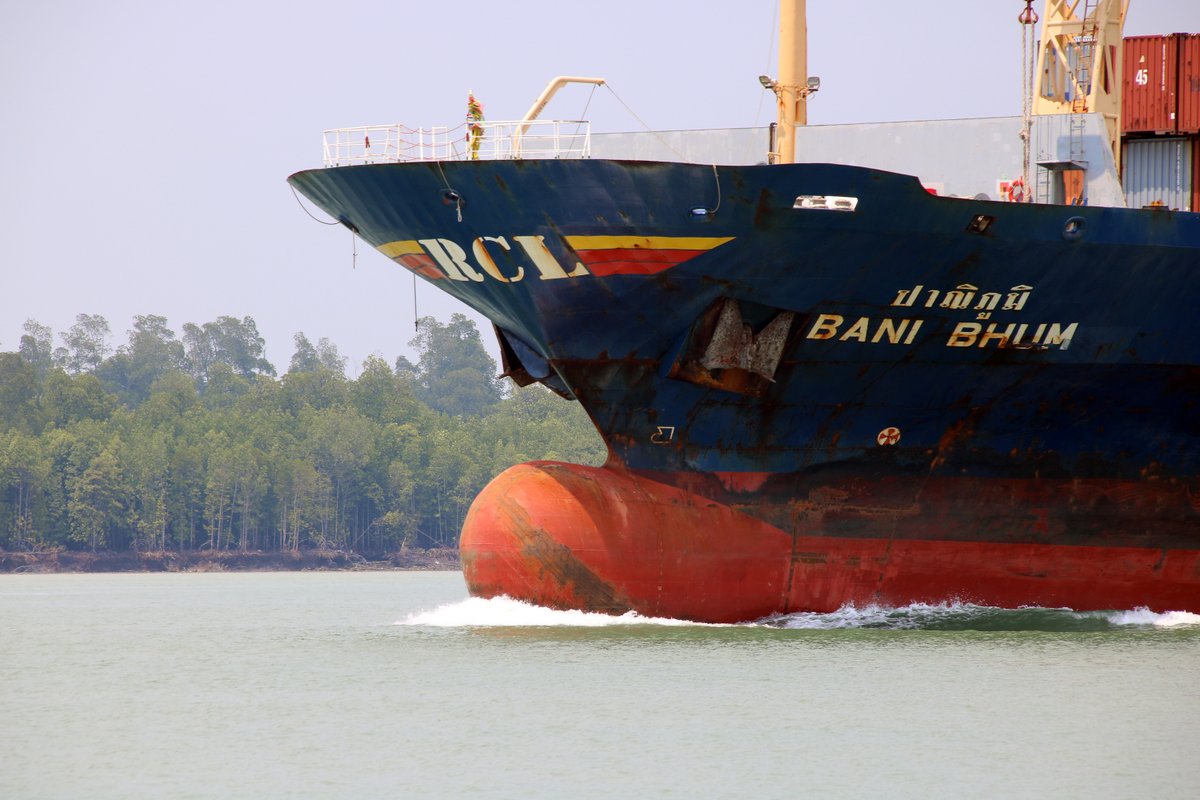
A bulbous bow is a protruding bulb at the bow (or front) of a ship just below the waterline. The bulb modifies the way the water flows around the hull, reducing drag and thus increasing speed, range, fuel efficiency, and stability. Large ships with bulbous bows generally have a twelve to fifteen percent better fuel efficiency than similar vessels without them. A bulbous bow also increases the buoyancy of the forward part and hence reduces the pitching of the ship to a small degree.
In a conventionally shaped bow, a bow wave forms immediately before the bow. When a bulb is placed below the water ahead of this wave, water is forced to flow up over the bulb. If the trough formed by water flowing off the bulb coincides with the bow wave, the two partially cancel out and reduce the vessel's wake. While inducing another wave stream saps energy from the ship, cancelling out the second wave stream at the bow changes the pressure distribution along the hull, thereby reducing wave resistance. (Interesting, Eh!)
The current had been favourable all day, but changed in the middle of Port Klang and we had a couple of knots against us for the last 15 miles to Pulau Angsa. Like all the anchorages that we've stopped at so far in Malaysia, Pulau Angsa is an open road-stead, consisting of two small islands five miles off the coast, with a non-drying shallow sandbar, one mile further out to sea.
The wind was coming from the north, so we worked our way to the south of the island and anchored at (03°10.85N 101°13.03E). Fortunately the forecast is for variable winds, but there’s a thunderstorm system rumbling away along the coast, so who knows what we’ll get tonight.

11 November 2015 Pulau Angsa to Pulau Pangkor, Malaysia
I suppose that it was good that we weren't struck by lightning or murdered in our beds, but other than that, it was a pretty horrible night. It didn't start well, because a few minutes after I went to sleep, I had a vivid dream that we were sinking and leapt out of bed telling Glenys that there was water on the floor and I was going to check the bilges - they were dry, of course, and she now thinks that I’m getting senile.
Later on, we were woken by thunder, lightning, heavy rain, wind from all directions making us pitch, then roll, then pitch with water slapping under the transom, then roll... It all calmed down at about three o'clock in the morning and we finally had a bit of sleep until the alarm clock went off at six o’clock.
With another long 75-mile day ahead of us, we set off as the sun rose and motor-sailed with the engine roaring away. Fortunately, we had the tide with us for the first five hours, after which, we headed for shallower water while we fought the adverse 1-2 knot tide.
By mid-afternoon, we were down to 5.5 knots over the ground and, with 25 miles to go, it wasn't looking good for getting to our destination by sunset. Fortunately, a sea breeze picked up and we were able to pull out the genoa increasing our boat speed to seven knots and our speed through the water to six knots. Doing this kind of coastal hopping is horrible - we've got to get there, so we have to keep running the engine even though normally we’d be sailing.
We made good time and, just after six o’clock, we pulled into the bay on the south-west corner of Pulau Pangkor and anchored at 04°12.57N 100°33.00E in 5 metres of water. It’s a lovely anchorage and is protected from nearly all directions with a sandy beach and hills covered with trees. What a difference from the other anchorages south of here. I’ve changed my mind about Malaysia and I now like it.
There was a good internet connection, so I checked with the City link courier and our passports are still in Kuala Lumpur, so I’m starting to feel nervous now…
12 November 2015 Pulau Pangkor, Malaysia
We caught up on a few chores in the morning then went ashore to have a look around. It’s a small holiday town, full of resort hotels and apartment buildings. There are a few restaurants around, but they were mostly closed at lunch time, so we ate at a small roadside warung - Mee Goring and Laksa, nice and cheap.

We could have hired a motor bike very cheaply, but couldn't be bothered - it’s a small island and I’m not sure what there is to see. We went for a walk along the beach, which is nice enough apart from lots of sea weed being swept ashore. The water is very murky and looks slightly brown, so it’s not the best holiday destination in the world.
One thing that is very apparent in this area is the lack of coconut palms. These islands seem to be covered with deciduous trees and only the odd coconut palm tree. It makes it look more like some higher latitude place like Maine rather than close to the equator - very strange.
13 November 2015 Pulau Pangkor, Malaysia
After yesterday’s relatively nice weather, we were woken at four o'clock in the morning by a big thunderstorm with bright lightning and torrential rain. The rain continued through the morning, so we abandoned the idea of leaving today and had a pleasant day doing our own thing. I was pleased to find out that our passports have been delivered to the Passport Office in the UK, which is a great relief.
Glenys found some bacon in the fridge, so we had bacon and grilled tomato sandwiches with brown sauce for lunch - luxury. The rain stopped in the afternoon, but we could still hear the rumble of thunder in the distance, so we lurked down below. It became a little rolly in the afternoon as the wind dropped and we had swell coming in from the east.
14 November 2015 Pulau Pangkor to Pulau Talang, Malaysia
It was only 14 miles to the next anchorage, so we had a leisurely start and arrived at Pulau Talang just before lunch. There was no wind and the sea was glassy calm. We anchored at 04°25.05N 100°34.54E - it’s another road-stead next to a small island, a couple of miles off shore.

It was absolutely boiling, with no wind and the sun beating down on us. We put up our big awning, which helped a little, but we had a very unpleasant afternoon unable to concentrate on anything much in the heat.
In the afternoon, the wind picked up from the SW, which put us on a lee shore and gave us an uncomfortable motion, so we scooted around the island to re-anchor at 04°25.30N 100°34.71E. The motion was much better, but it was still very hot and we were grateful when the sun went down, although it remained very humid at 80%.
15 November 2015 Pulau Talang to Pulau Jerejak, Penang
Despite the humidity, we slept okay with the fans whirring away in our aft cabin. We upped anchor at the crack of dawn, set for another 60 mile day of motoring. By midday, we had 15 knots of wind caused by passing squalls, but it was on the nose, so we had to keep on motoring.
Penang is a large island about ten miles long, connected to the coast of Malaysia by two five mile long suspension bridges. Fortunately, the clearance under the bridges is a minimum of 25 metres, more than enough to get our 20 metre mast through. We’ve encountered lots of fishermen laying nets as we've travelled up the coast, but none as cheeky as the guys setting their net across the shipping channel directly under the bridge. Fortunately, they saw us coming and left enough space fro us to get through.
We anchored off the small island of Jerejak at 05°19.06N 100°18.50E between a small fish farm and the jetty for the Jerejak Resort. The anchorage is very well protected and the holding is good in soft mud. In the late afternoon, we had a thunderstorm go over with 30 knot winds and we hardly rocked at all - at last a good anchorage.
16 November 2015 Pulau Jerejak, Penang
After a good night’s sleep, we chilled out in the morning and then went ashore to look at the Jerejak resort. It’s all a bit run down, but they have a nice swimming pool and a restaurant. They told us that we can use their little ferry to the main island of Penang (which runs every couple of hours) and then get a taxi into Georgetown. We had lunch in their restaurant which was okay at 14 ringgit for Nasi Goreng.
Jerejak Island used to be a leper colony and then became a prison island, so it has an interesting history. The lady on reception gave us a little brochure describing some walks on the island, so we decided to take the 3 km trail to the old prison. Unfortunately, after a couple of hundred metres, the path was completely overgrown. We disturbed a group of Long-tailed Macaques who screeched at us in annoyance as they moved away and a huge cloud of hungry mosquitos formed around us, so we beat a hasty retreat back to the resort grounds.


We then had a go at the Balqis trail which follows an old concrete/gravel road up past the north side of reception. It was overgrown in places, but passable. We came to a junction where the Razak Trail went off faintly to the right and the Balqis trail continued down to the left.
We followed the Balqis trail, which finished at beach on the east side of the island, where there are some very dilapidated ruins of the English prison buildings. It was all heavily overgrown and buggy, so we turned around and went back.
At the junction, we followed the Razak trail, which is marked by red paint on the trees and the occasional sign, which is lucky because it’s very overgrown. We came across the ruins of a zip line and then a couple of big trees had fallen, blocking the path. As I was skirting around the second tree, Glenys stay on the path waiting for me and was attacked by biting ants. While jumping around swatting ants, she ran into some razor grass, which put a nasty 18 inch cut on her leg.
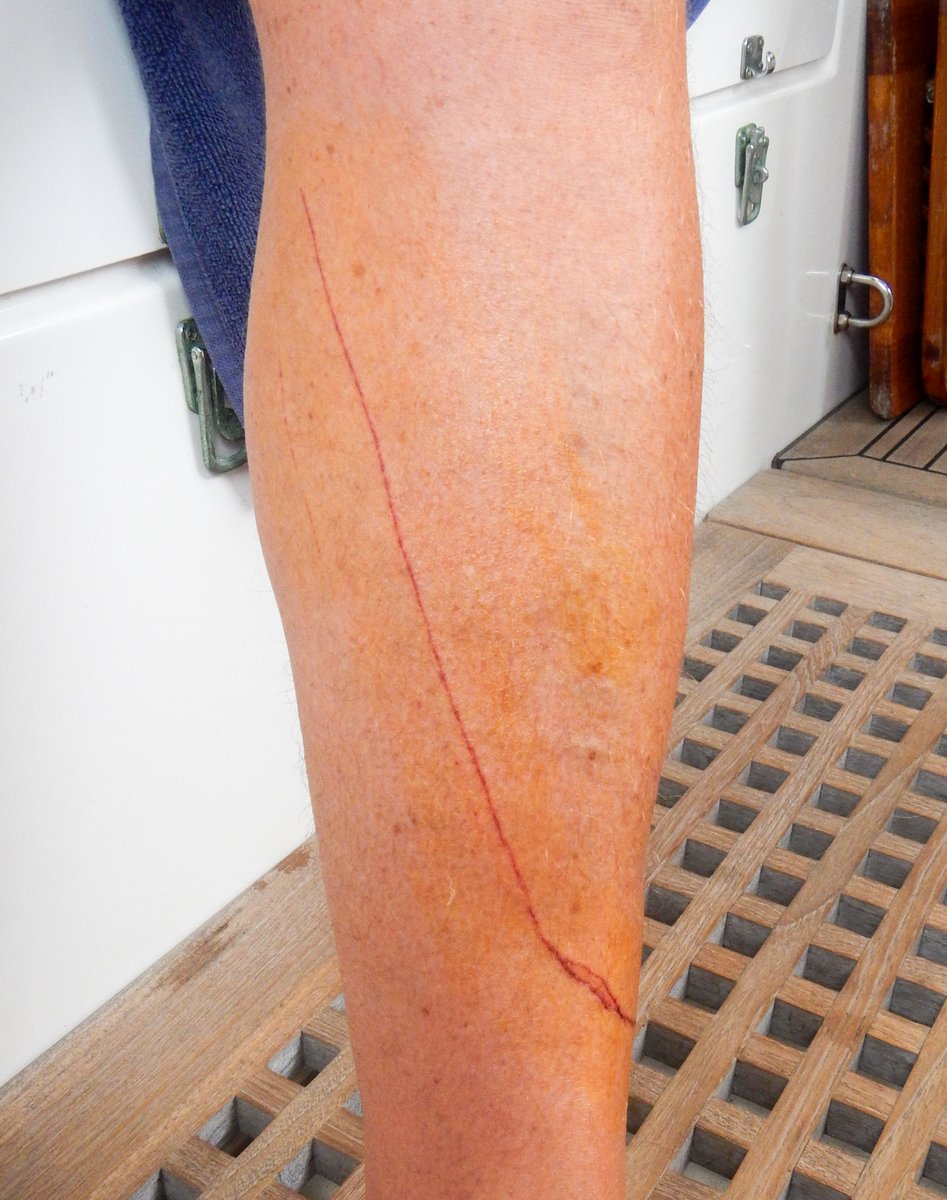
By this time, she’d had enough; we were inadequately prepared for this kind of terrain, so we turned around and went back to the boat to treat our wounds and bites. If you were dressed in long trousers and sleeves with every exposed part of your body covered in 50% DEET and armed with a sharp machete, then this would be an interesting little hike. But in shorts and flip-flops, it’s a mission.
17 November 2015 Pulau Jerejak, Penang
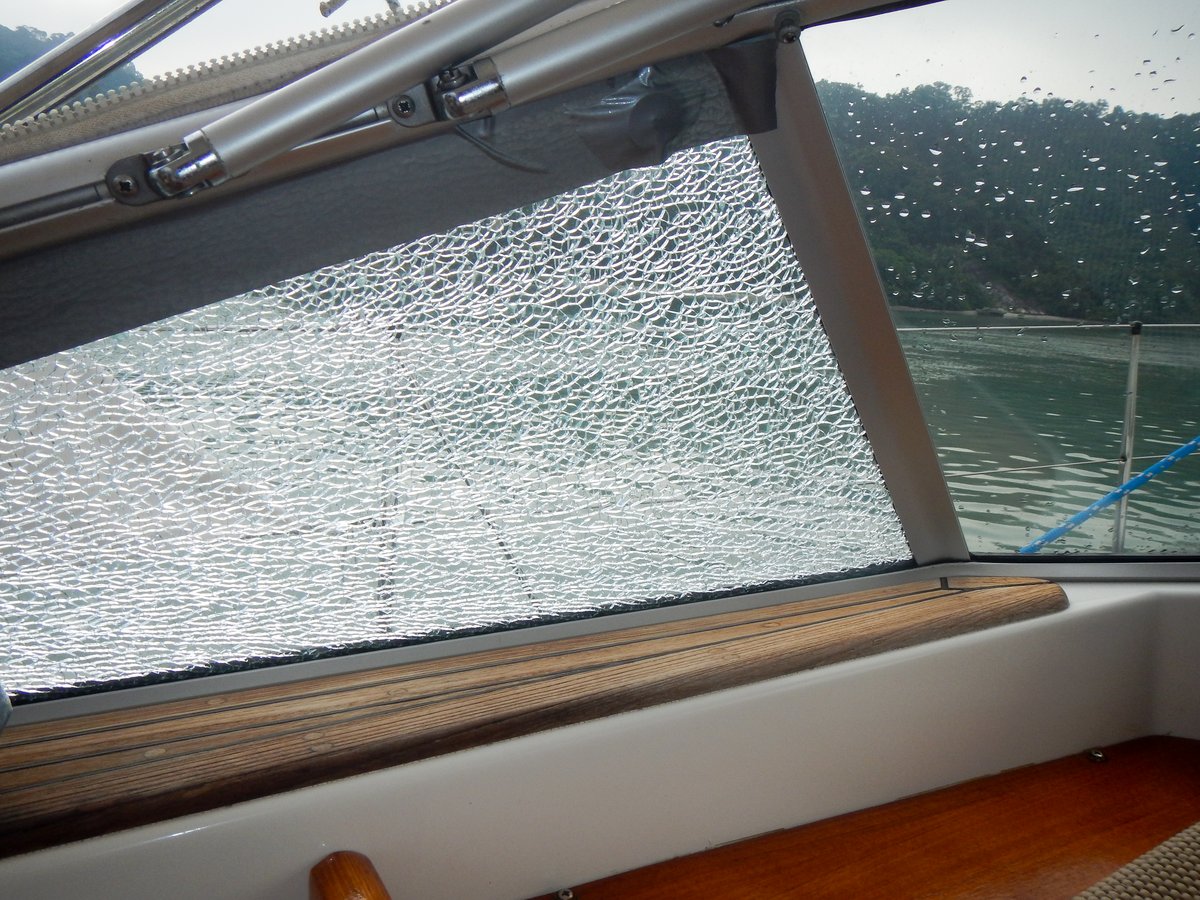
A couple of weeks ago, we noticed that an aluminium disk, which holds a handle on the side window of our windscreen, had broken in two. I had a go at removing and replacing it, but the screw wouldn’t move and I was reticent of applying too much force in case I broke the glass window - not a good thing to happen in the middle of nowhere.

This morning, we woke to find that the window had self-destructed and the glass had cracked into small pieces. Fortunately, all the pieces were still held in place and hadn’t exploded everywhere, so I used Duct Tape to stick it all together and hope that it will survive until we get to Langkawi or Phuket, where I can get a replacement. It’s going to be a nightmare to replace it - the windscreen frame is made from aluminium and you can bet that all of the stainless steel fasteners have seized up.

We caught the 10:30 ferry across to the mainland and then took a taxi into Georgetown - 40 ringgit for the return trip on the water taxi and 30 ringgit into town (£12). I had the impression that Georgetown would be a sleepy little ex-colonial town, with a small community of Chinese people. It’s actually a huge city of 1.5 million people, high rise apartment blocks and jam-packed with cars.
We wandered around Chinatown and Little India, joining the milling herds of tourists. There’s a huge Chinese population here and the Clan Jetties were our first stop. This is a series of six wooden jetties lined with small wooden houses, which were built on stilts by Chinese immigrants in the late 1800s. Each of the jetties is owned by a single clan who lived together in close proximity. We walked down the Chew jetty, which is now a major tourist attraction with all the small houses having shops selling souvenirs.
We wandered around the streets of china town looking for street art - there’s some famous art including a bicycle fixed to a wall with a couple of kids painted as riding it. Unfortunately, a lot of the art is now in a state of decay. We made an interesting stop at Khoo Kongsi, which has a very ornate Clan House Temple set amongst an area of traditional clan houses.

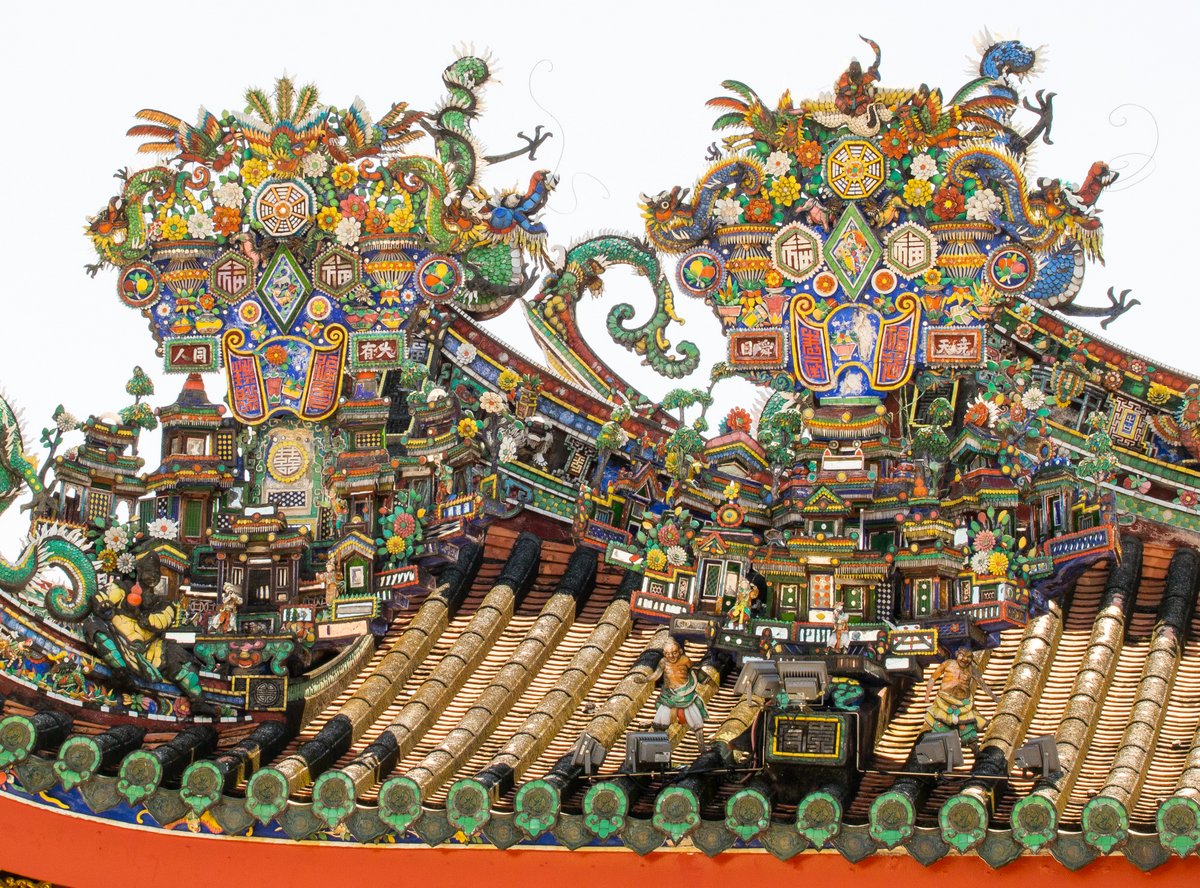

The Khoo clan were merchants from China and when they arrived in the late 1880s, they built a walled community like a village which had its own school and council. The beautiful clan temple was built in 1906 when the Khoo clan was at the height of wealth and eminence in Penang society - it was renovated in 2001.
We had lunch in Little India and then caught a bus to see two Buddhist temples. One had a very large reclining Buddha, but neither was as impressive as the Buddhist temple in Chinatown in Singapore. We've not had much contact with Buddhism, so I was fascinated to see gold leaf stuck onto what appeared to be statues of monks. There were even signs telling people not to stick gold leaf onto certain wooden statues. I found this snippet on the internet:

Gold in the form of a thin leaf is an item valued for its purity as a religious offering and for its power to placate spirits and request favours. Postage-stamp-size booklets of gold leaves are always on sale along with incense, flowers and candles at temples and shrines for use as daily offerings.
One way for Buddhists to show their respect for a person or concept is to make merit by affixing small squares of gold leaf onto images of Buddha, revered monks or other sacred objects.
Even the act of making gold leaf earns merit for individuals. Sheets of gold are pounded to .000005 of an inch. The leaves of gold are made by two poundings with wooden mallets. It takes about five hours of hammering to complete one pouch of gold leaf. Then the job passes to the delicate hands of young girls to slice up squares of 2.5 centimetres and put them on waxed paper and stacked in booklets ready to sell.
We just made it back to the Jerejak Jetty in time to catch the 16:00 ferry and we were back on the boat in time to rip open a cold beer.
18 November 2015 Pulau Jerejak to Pulau Payar
We were on our way just after dawn. We only had 35-40 miles to go, but the tides were favourable for an early start. It was interesting to go past the city of Georgetown. We made a slight detour to have a look at the Junk Anchorage, just off the end of the Chew Jetty. It looks okay, but the only place to go ashore is on the end of the Chew Jetty and it’s very rough. Although it’s more expensive to get into town, I think Jerejak is a much better option.
It was another tedious day of motoring and avoiding fishing boats laying nets along the side of the shipping lanes north of Georgetown.

We arrived at Pulau Payar Marine Park in the middle of the afternoon (06°03.91N 100°02.75E) and picked up a mooring. There are three big orange moorings available for yachts, but the one closest to the park buildings seems to be occupied by a park boat all the time. It was lovely and calm when we arrived, so we picked up the one furthest away from the docks to avoid being bounced about by boat traffic - three large passenger boats left in the late afternoon, presumably full of tourists.
I went ashore and paid the park fee of 5 ringgit per person for a day. Nobody spoke much English, but they were very friendly and there was a notice board showing ten dive sites and four snorkelling sites. I was told that there are moorings at each site. Glenys stayed on-board running the watermaker - it’s the first time since Singapore that the water has been clear enough to run it.
I went for a snorkel just off the main pier. The water had a slightly green tinge, but I had visibility of ten metres. There’s lots of coral and fish, so it was good. I played with my new macro lens - didn’t get any good photographs though, I was just experimenting. I did see a couple of Giant Groupers, who were very unconcerned by me - it shows that we’re in a national park.

As night fell, a wind picked up from the north causing short, sharp, 1-2 foot waves, which made us pitch badly. It was unpleasant down below.
19 November 2015 Pulau Payar to Kuah, Langkawi
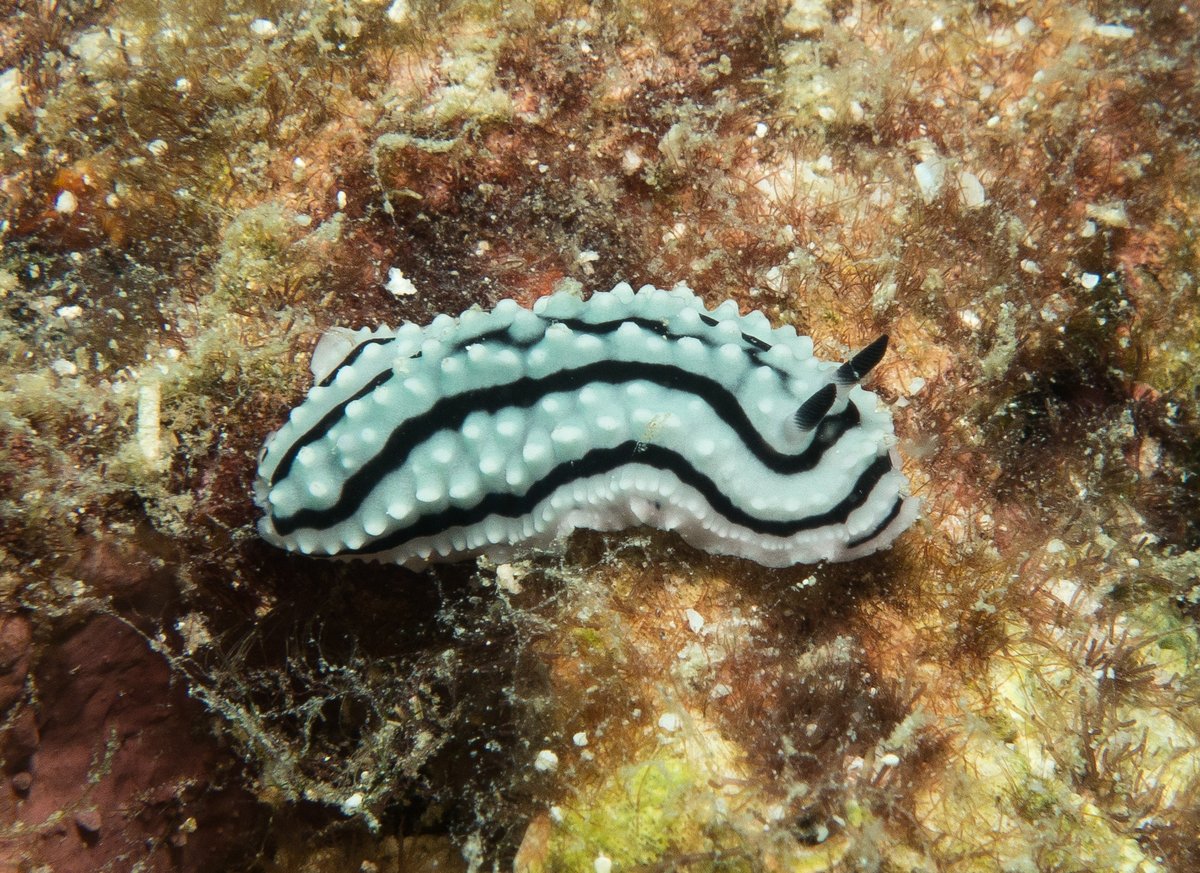
Despite the (at times violent) pitching that went on all night, we had a good night’s sleep. We ran the water maker again, to top up our tanks, then went snorkelling at a spot called the Japanese Gardens. It wasn’t world-class, but was very good after a month with no snorkelling. I played with my macro lens and took a nice close-up of the rhinophores of a small one inch long Liz's Phyllidiella.

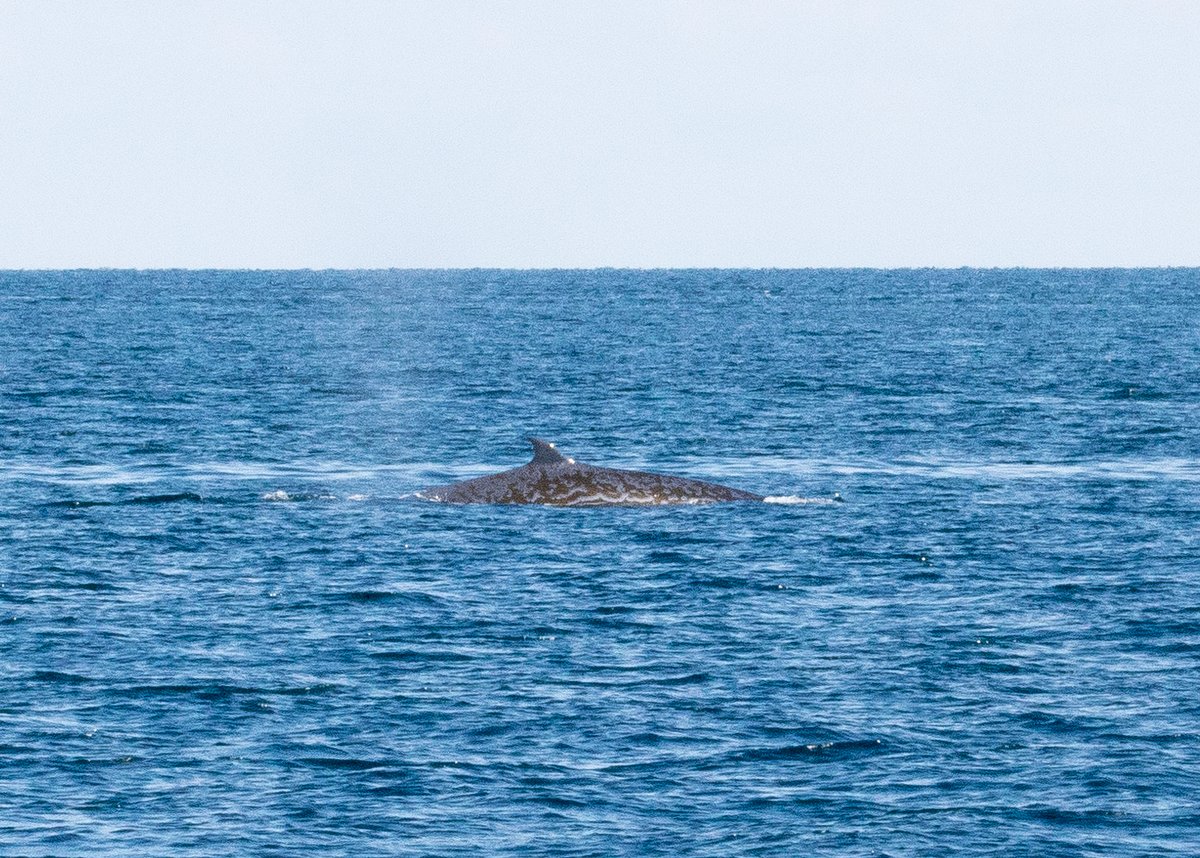
After an hour or so snorkelling, it only took ten minutes to tidy up enough to get on the move towards Langkawi. Just as we were leaving the island, I spotted a whale - not sure what it was, but I got a reasonable long distance photo with my new zoom lens.
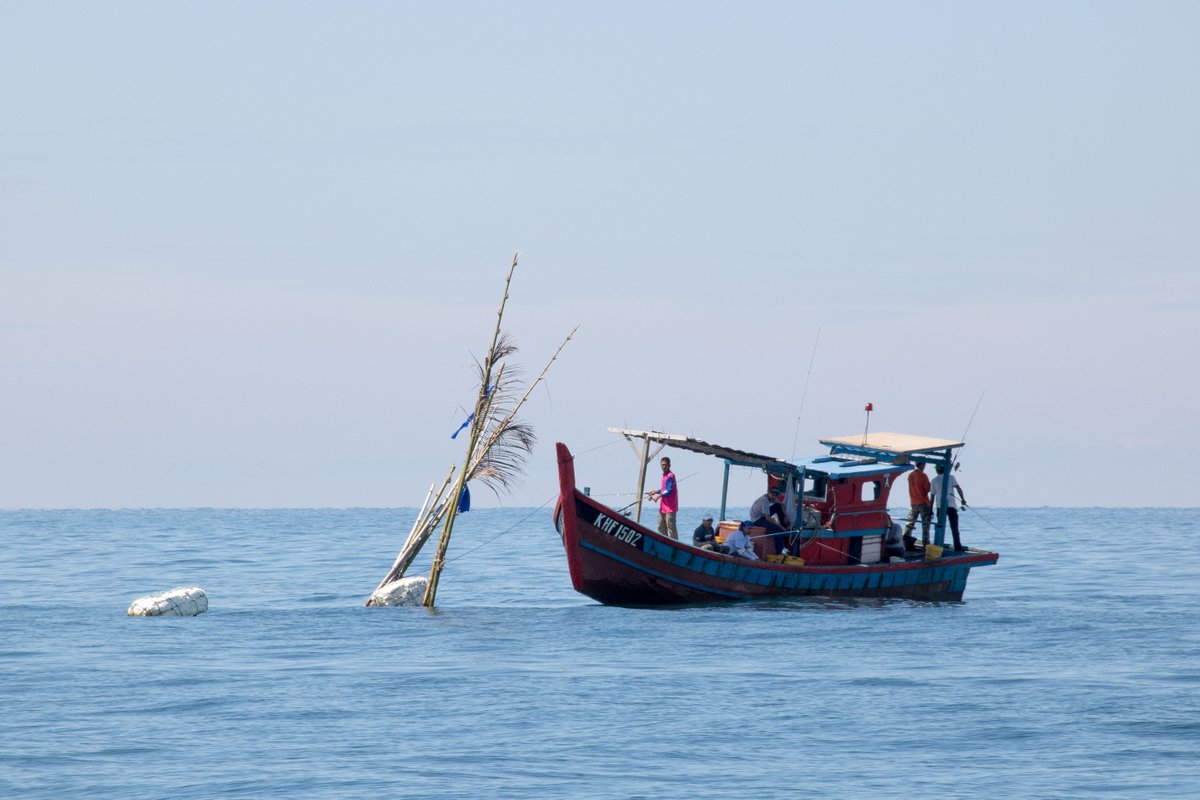
Of course, there was no useful wind. We encountered lots of strange floats with long bamboo fronds sticking up out of the water. They were a mystery until we saw a fishing boat moored to one of them with six guys fishing with real rods - they were another type of Fish Attraction Device.
By early afternoon, we entered the Langkawi group of islands at the south west corner and then motored past various anchorages checking them out for when Craig and Kristen get here next week. The scenery is stunning with scores of small, tall islands jutting out of the water forming narrow channels, all backed by towering cliffs on the bigger island.
A couple of hours later, we anchored off the main town of Kuah (06°18.91N 099°50.62E)in five metres of water amongst a fleet of twenty or so yachts. We've finally made it to Langkawi – the Malaysian coast has been very boring with 500 miles of motoring
In the evening, there was a horrific thunderstorm with torrential rain, which has uncovered the fact that most of our side windows leak. As I write this, there’s a drip falling on the fan in front of me and spraying me with droplets of water every 10 seconds – it’s not all fun living on a boat. The good news is that our passports have been dispatched from the UK, which is much, much faster than we expected.
20 November 2015 Kuah, Langkawi
After a slow start, we zipped ashore and put our dinghy on the small ferry jetty. We then walked through the park towards the main ferry terminal. The park is very pleasant and at the end there is a huge statue of a sea eagle which is one of the main tourist attractions in Kauh.
The ferry terminal looks like an airport with duty free shops selling cameras and expensive European chocolate. We eventually found the Port Captain office on the first floor tucked away behind the doors where passengers disembark. After filling in one form we were officially cleared into Langkawi. The Malaysian Authorities want yachts to clear in and out of every port, but most cruisers get their initial clearance all the way to Langkawi.

After dropping off our papers with Customs, we walked into town, but most of it was closed because it’s Friday (a Muslim day of rest) and also some kind of holiday. We found a Chinese street restaurant and had a very good lunch. The town is a strange place being full of duty free shops selling Gucci hand bags, chocolate and posh pans. There’s quite a bit of cheap duty free booze about, but who buys it in this predominantly Muslim country?
With nothing much to do or see in town and no supermarkets open, we had to walk almost back to the ferry terminal to the Billion super-market in a shopping mall. We bought enough provisions to last us for a week and then caught a taxi back to the boat. Wine is reasonable at £4 per bottle, beer is cheap at £8 per case and liquor is very cheap at £3.50 per litre
In the evening, Dave and Brendan from “Laragh” came over for a few beers.
21 November 2015 Kuah to Telaga Harbour, Langkawi
There wasn't much to keep us in Kuah and we were keen to see an old friend at Telaga, so we pulled up the anchor. There was lots of mud on the chain, so I had to drop anchor again, while I got out our sea water hose pipe and got it working after not being used for over a year.
Again, there wasn't much wind, so we motor-sailed the 16 miles to Telaga - will we ever sail again? There are two man-made islands protecting the anchorage and the approaches to Telaga Marina. There appear to be three passages into the anchorage, but the charts show little detail, so we erred on the side of caution and used the channel to the east of both islands, following the approach to the marina.
We then turned to port and carefully picked our way through the anchorage - it’s very shallow with depths of 2.5 to 3 metres at low water. It’s a popular spot, but we soon found a place at 06°21.74N 099°40.69E in 3 meters of water.

The holding is renowned for being poor and we couldn't set the anchor properly - it just dragged slowly through the mud, so we let it settle for a couple of hours and then backed up, which seemed to be okay.
Phil Wise and his wife Sandy from “Southern Wing” came over to see us. We haven’t seen Phil since 1994, when we spent a lot of time together in the Caribbean. Twenty one years ago, he was cruising on a catamaran called “Wise Cat” with his ex-wife Robyn and their three kids Coby, Nat and Callum, who were good friends with our two sons. Since returning to Australia, he has been divorced, married Sandy and together they have spent eight years building their 60 foot Catamaran, which Phil completely designed from scratch. It looks more like a racing machine than a cruising boat.

In the evening, we went out for a pizza at one of the many restaurants in Telaga Marina with “Southern Wings” and some of their friends.
22 November 2015 Telaga Harbour, Langkawi
We spent the day doing some jobs. I booked a car for tomorrow, so that we can do some provisioning.
We’re planning to repair or replace our teak deck next year, so I spent some time research in boat yards in Thailand and starting to get some quotes. It’s a major project having the teak replaced and I want to make sure that they do a good job.
It used to be cheap to get boat work done in Phuket, but the prices have steadily increased over the past five years and costs in the bigger boatyards are now approaching New Zealand and Australian prices. I chatted to Irvin and Jenny on “Back Chat” who have just returned from being hauled out at Phithak Shipyard in Satun, which may be a cheaper alternative. I’ve made initial enquiries with Satun as well.
In the afternoon, I serviced the front heads toilet pump - not my favourite job, but Craig and Kristen arrive in 5 days’ time and it needs to be working properly.
23 November 2015 Telaga Harbour, Langkawi
We hired a car at the Telaga Marina. The marina staff have a number of cars that they hire out for 10 ringgit (£1.60 per hour), which is a great deal. There’s no messing about with insurance, driving licenses or forms - you say you want a car, they give you the keys and, when you get back, you pay for the number of hours that you’ve had the car. Why can’t life always be that simple?
The small town of Matsirat is only 10 kilometres away and has a good Chinese supermarket called Song Haut, which most of the cruisers use. They have a duty free wine and spirit section, so we were able to buy wine for £3-5 per bottle and spirits for £4-6 per litre - we’ll definitely be going back to stock up before we leave for Thailand. We ended up with four trolleys of provisions, getting ready for our visitors at the end of the week.

While Glenys was in the supermarket, I went to top up the data on our iPad. Every time that I go to do this, the music from “Mission Impossible” pops into my head as I enter the mobile phone shop. They always look totally bemused that the iPad doesn’t have a telephone and there’s always a lot of group discussion about how to do the top-up. I was lucky today and it only took 15 minutes to get my £8 of additional data.
After curry for lunch at an Indian restaurant across the road, we stopped off at a small shop called Sailor’s, which sells a range of frozen food. The business was set up by a couple of South African cruisers a few years ago and they now sell a variety of meat, pizzas, pies and sausages. Being in a predominantly Muslim country, all their products are halal, so there’s no pork - just beef and chicken. It looks like good stuff, so Glenys’ freezer is now crammed full.
We took all our provisions back to the boat and Glenys set to the task of stowing everything away. After an hour, she asked “Didn’t you buy any bottles of wine?” Errrrr - we’d left a trolley loaded with £100 of wine and spirits in the supermarket! I jumped in the dinghy and raced back to the marina, where I hired a car for an hour and sped off to Matsirat.
I walked into the supermarket and found the trolley where I’d left it. The staff at the supermarket had been looking after it for me and were all smiles as I checked that everything was still there. What nice people.
In the evening, we went over to “Southern Wing” and had a pot-luck dinner along with “Back Chat”. Irvin plays guitar, so we had a bit of a session.
24 November 2015 Telaga Harbour, Langkawi
We had another day of pottering about. After 500 miles of motoring in muddy waters along shipping lanes, we’d picked up a horrible brown stain on the bow, which Glenys managed to get off with some “On & Off”.

Our wind instrument have stopped working, so I went up the mast and tried to sort it out, by cleaning the contacts on the connector, but that still didn’t work. I then spent an hour or so reading forum entries on the internet and found a service manual. The voltages coming down from the transducer at the top of the mast are showing only 0.7V on the direction signals, so either the circuit board is not working or I have a dodgy connection.
I went back up the mast and removed the transducer, which I stripped down, cleaned with Contact Cleaner and put out in the sun to make sure that it was completely dry. After reassembling it, I went back up the mast, reinstalled it, but it still shows the same incorrect voltages. My next step is to make up a short test lead to connect to the instrument panel to eliminate a fault in the wiring. I suspect the circuit board, which is very annoying because I replaced the whole transducer two years ago.
25 November 2015 Telaga Harbour to Rebak Marina, Langkawi
Phil and Sandy popped over for a couple of hours in the morning and gave us some good information about Malaysia and Thailand. They’re planning to go up the east coast of Malaysia next year, like we are, so it was good to pick Phil’s brains on the area. The best time to go is during the south west monsoon from May to October. This will work well with our plan to fly back to the UK in May/June and cruise the east coast from July to September.
After lunch, we motored the five miles to Rebak Marina, which is attached to a holiday resort with a nice swimming pool. The marina is okay, but the toilets are below par and the whole place including the resort looks a little tired. We installed the air conditioning and settled ourselves down below.
Thankfully our passports have arrived, so we are once again legal and can now leave for Thailand in a couple of weeks’ time. The process of renewing the passports was a little convoluted, but in the end it all worked very efficiently - only 16 days from dispatch to receipt, which I think is a minor miracle.

In the evening, there was a free barbeque, set up by Sailor’s, where they showed off their various sausages, bread and meats. There was a good turn-out with over a hundred people there, but we only knew Dave from “Laragh”. All the others seemed to be live-aboard, ex-pat Australian and New Zealanders, who have managed to sail up here then never left. We met Kenneth from “Strumvogel”- a Scottish guy who owns a Hallberg Rassy 38.
26 November 2015 Rebak Marina, Langkawi
Glenys ran around doing three big loads of laundry and cleaning the boat ready for the arrival of our Craig and Kristen tomorrow. I did some more planning for our teak deck.
Kenneth from “Strumvogel” had his teak deck replaced last year, so I went to have a look at it. The planking is stuck on without having to be screwed down and looks to be a good job. It was done by “Phuket Inter Woodwork Co Ltd” in Boat Lagoon for £7,000. Scaling up from a 38 foot to a 42 foot boat (say +20%), would give a price of £ 8,750.
I took some basic measurements and spent a couple of hours drawing out a scale diagram of our decking and then superimposed a ½ metre grid over the top. By counting the squares for the parts of the deck with teak, I was able to work out that our total deck is 28.2 square metres. The cockpit is 4.4 sq. metres and is in pretty good condition, so the deck that we need to replace is 23.8 sq.m.
I’ve received one estimate from (an expensive yard) who gave a rough estimate of £490 per square metre, which equates to £11,600 to have everything replaced.
I need to add in £1,500 to haul out and be on the hard for two months, £500 to remove and replace the mast and £500 to rent a small apartment for two months. This all adds up to between £11,000 to £14,000. A lot of money, but it would be twice as much to do it in Europe. I now need to inspect the deck properly and work out if I can get away with having some parts repaired rather than replaced.
27 November 2015 Rebak Marina, Langkawi
We spent the day waiting for Craig and Kristen to arrive, just pottering about. Glenys worked on arranging our three week trip to Myanmar. She’s been talking to a couple of tour operators in Myanmar and together they’ve agreed a customised tour with hotels, cars with drivers, hiking guides and even a balloon ride over the temples of Bagan. Glenys has told one of the agents to go ahead and book all the hotels; we’ve booked the flights and we’ve reserved a berth in Yacht Haven Marina in Phuket from the 8th January - very exciting.

Finally, we went to pick up our visitors. Staying at Rebak Marina is a bit of a nuisance because it’s on a separate island and the resort’s little ferry only goes every couple of hours, so we were at the airport way too early. The last “official” ferry goes at 19:45, so with their plane arriving at 19:10 and a ten minute taxi ride to the ferry dock, it was going to be very tight.
Their plane arrived a few minutes late, but Craig and Kristen only had hand luggage, so they were through quickly. Unfortunately, another plane had landed 15 minutes earlier and there was a huge queue at the taxi rank, so we gave up on getting the 19:45 ferry. We actually arrived at the ferry dock at 20:00, thinking that we’d have to wait for an hour for the next “staff” ferry, but for some reason they put us on a ferry at 20:15 - I don’t know how that happened, but we were able to get in the bar by 20:30.
The bar at the marina is great. The food is a little bit expensive in Malaysian standards (£4 per meal), but everything we had tasted great. The bar also lets cruisers bring their own drinks, which is great.
28 November 2015 Rebak Marina, Langkawi
We had a very slow start to the day, chatting with Craig and Kristen and catching up on the past eleven months. After lunch, we went for a walk and spotted a pair of Great Hornbills which like to eat the fruit on palm trees in the hotel grounds. I tried to find a trail that another cruiser had told me about, which goes off into the forest, but after going down many dead ends, we gave up and retired to the swimming pool.

The pool is very nice, with complimentary towels and reclining chairs under sun umbrellas. There’s even a bar in the pool where we had a few cocktails - luxury. In the evening, we went to the bar again and the day was gone. Tomorrow we go sailing for three days to do a circumnavigation of Langkawi.

29 November 2015 Rebak Marina to The Gorge, Langkawi
While Glenys was getting us ready to go sailing, I checked the engine and found to my horror that the engine bilge was filled with bright green coolant out of the engine. There was a small drip every twenty seconds, coming from somewhere at the front starboard side of the engine.
For the next 30 minutes, I tried to find the source of the leak, but it’s in the most inaccessible part of the engine. I tried to take photographs; I tried hanging upside-down, squeezing my head into the small spaces, but couldn’t pinpoint the leak. It seems to be coming from somewhere behind the alternator, then dripping down onto the oil filter.
As the leak didn’t seem to be too bad, I topped up the coolant with water and ran the engine for 30 minutes. The leak didn’t seem to get any worse and remained at a steady drip with only a small cupful of water in the bilge at the end of my test, so we decided to go out sailing anyway, but restrict our voyage to the local area rather than trying to sail around Langkawi.
When we cleared the marina, we were lucky and actually had some wind, so we were able to sail down to Pulau Intan Besar (06°14.36N 099°43.18E), where we anchored for lunch. The cruising guides say that this has clearer water than other places in Langkawi, so we dug out our snorkelling gear and went to have a look. It was dreadful, even near the rocks lining the shore. The visibility was one foot and very grim. We gave up after ten minutes, but at least it cooled us down.
After checking the engine again and finding only a cupful of coolant in the bilge, we set sail heading around the south of Pulau Singa Besar and then cut across to The Gorge which is a stunning anchorage in a narrow channel between islands overlooked by towering cliffs. We anchored in the middle of the channel at 06°11.47N 099°47.21E in 9 metres of water and really good holding.
It was hot and humid for the rest of the afternoon and then we had a large thunderstorm, with rain and lightning, but we were protected from any wind.
30 November 2015 The Gorge to Telaga Harbour, Langkawi
We pulled up the anchor at around nine o'clock and motored ½ mile to Teluk Dayang Bunting (06°12.05N 099°46.73E). This anchorage is right next to the Lake of the Pregnant Lady, which is one of the major attractions of Langkawi. Each day, scores of fast boats bring hundreds of tourists out to see this land-locked fresh water lake.
We were a little late and, by the time we arrived at the dock in our dinghy, there were dozens of water taxis at anchor and a handful jostling for position to drop off their loads of tourists. I dropped Glenys, Craig and Kristen off at the dilapidated concrete dock, but couldn’t work out where to leave my dinghy.

The main dock is 20 foot above the water and, at low tide, the bay is very shallow, so I couldn't tie to the dock and couldn't land the dinghy on the beach. Normally, everyone in Malaysia is laid back and helpful, but not the water taxi guys here. No smiles, they just waved me away, telling me to go somewhere else. Even saying “Tidah Masala” (No Problem) didn’t break through the money grabbing focus of the boat drivers, who simply wanted to jet off and get another load of tourists.
I gave up and told the others that I’d pick them up in an hour. On the way back to Alba, I stopped off at another boat and they told me that it used to be possible to get to the lake from a small beach, but that the steps had been removed. I scooted over and found a nice beach with a gully leading up to a wooden walkway - it was a bit of a scramble, but no problem. I left the dinghy on the beach and walked along the board-walk, soon finding the others.
The Lake of the Pregnant Lady is about ½ mile in diameter and is surrounded by impressive cliffs. It would be a serene nature experience, if it wasn’t for the hundreds of mostly Malaysian tourists jumping into the water, paddling in kayaks, boating on pedalos and even scuba diving. It’s all a bit quaint, like a seaside resort in England fifty years ago. To my chagrin, the others wanted to go on a pedalo - imagine the humiliation of a captain of an ocean-going yacht becoming a passenger on a pedalo. (It was actually quite good fun…)

Back at the boat, we motored to an anchorage at the north end of Pulau Singa Besar (06°13.58N 099°44.78E) for lunch, then continued up to Telaga. We had some wind and managed to sail most of the way arriving late afternoon. Craig and I went into the marina and arranged for two scooters for tomorrow.
The engine is mystifying me. This morning there was only a cupful of water in the bilge, which I cleaned out before we left the Gorge. By the time we arrived at Telaga after 3.5 hours of motoring, we only had a small cupful of water in the engine bilge. So, the engine dumped 5 litres of water after ½ hour motoring to Rebak and standing for 4 days, but only dumped ¼ litre after 3.5 hours motoring - hmmmm....