1 August 2015 Tual to Banda (Day 1)
The alarm went off at half past five and we were moving half an hour later. We had a very slow start with hardly any wind, so we motored for a couple of hours. Once we cleared the island, the wind picked up to a very nice 20-25 knots from the south-east putting us on a port broad reach. The waves were only 1-2 metres, so we had a very pleasant day.
We've finally caught up with the "rival" Sail2Indonesia rally, who’ve been anchored on the other side of the island in a town called Debut. There are over 50 boats on the rally and we've been hearing them on the VHF radio, while we were in Tual. Their next stop is Banda, so we'll be bumping into them when we arrive. We know a few of the boats in the rally, so it will be good to see old friends.
By nine o'clock, the chatter on the radio had increased to a constant noise as 10-20 boats left Debut and were telling each other to watch out for fishing buoys and various reefs. It was amusing to watch them scatter on the AIS. Eventually, it settled down and we have a small flotilla of at least five boats heading for Banda. One of the boats is "Keyif", a Turkish boat with Selim and Nadine, who we met in the Galapagos and last saw in New Zealand.
We had to sail 40 miles to clear the Kai Islands, where we saw a few fishing boats and were forced to skirt around a few buoys with black flags and Fish Attraction devices, despite the water being over 200 metres deep. Then we had a scare. We were both doing our own thing - I'd been down below sorting out an email and Glenys was sitting in the cockpit absorbed with researching future anchorages, when I thought I heard shouting.
We had our starboard rain panel zipped onto the bimini to keep the sun out of the cockpit. I peered around and was shocked to see a fishing boat just 25 metres away, with the fishermen waving hello. They were anchored in over 200 metres of water at least 10 miles from land. We enthusiastically waved back, relieved that we hadn't hit them.

The rest of the day was uneventful and great sailing. After dark we had a full moon, with clear skies and constant SE 20-25 knot winds, so it was an idyllic night.
2 August 2015 Tual to Banda (Day 2)
“Keyif” slowly overtook us overnight, but the wind backed 15 degrees before dawn and I’d already rigged up our pole to port, so we were easily able to sail wing-on-wing while they continued on with their genoa being de-powered by their main sail. The race was on.
Slowly and remorselessly, we gained on them and we were side by side as we went through the channel past Pisang Island into the Bandas Island group, so we entertained ourselves by taking pictures of each other’s boats under sail.
One of the islands is an impressive cone-shaped volcano called Gunung Api, which rises steeply to a height of 666m and last erupted in 1988. Just across a ½ mile stretch of water lies the island of Pulua Neira and the main town Banda Neira. There were already ten or so boats from the Sail2Indonesia rally in the harbour and they helped us to dock stern-to a sea wall outside the Hotel Maulana (04°31.41S 129°53.85E).
Once secured, we relaxed for the afternoon, catching up on some sleep. In the evening, we met “Red Herring” for a beer or two along with a load of other cruisers including Mike and Rosie from “Shakti” who we last met in the Marquesas. We had a buffet dinner at the hotel - our first Indonesian meal and very nice, but tourist prices at 10,000 rupiah each ($10US). “Red Herring” talked us into climbing the volcano with them tomorrow.
3 August 2015 Banda Neira, Indonesia
We picked up Graham and Karen from “Red Herring” at eight o’clock and dinghied across the harbour to the island called Gunung Api (“Mountain of Fire”). There’s a prominent blue house on the shore and the trail starts a white building that is a kind of shelter (around 04°31.52S 129°53.54E). We pulled our dinghy up onto the small rocky beach and chained it to this building.
We walked up past the building and followed an obvious footpath heading straight up the hill. After going through a lovely bamboo grove, the path became steeper and at times we were scrambling. The ground is very loose in places, so we were glad that we were wearing our strong hiking shoes. The trail goes straight up the mountain (no nice switch-backs here), so it was a gruelling 90 minutes to get to the top.

The view of the Banda Island group is fantastic. At the summit is a very dodgy-looking, overhanging cornice on the edge of the steep-sided crater. The ground is compacted pumice and ash, with large cracks and holes in the soil, so we kept well away from the edge. Instead, we followed the crater rim anti-clockwise for a hundred metres to a point below the summit, where we had a fabulous view down into the crater and could clearly see the lava flow from the 1988 eruption, all the way down to the sea.
The walk back down was a mission, hanging onto tree branches while sliding down on the loose path. Part way down, we stopped and watched a huge ferry manoeuvring onto the town dock. Its stern was only 50 metres from our raft of yachts and the prop wash was bouncing our boats around. One boat called “Tulu” who was closest to the ferry and was pushed onto the harbour wall, putting a dink in their transom and banging their rudder off the rocky seabed. They escaped with minor damage.
Back on the boat, we had lunch and a quick nap, then walked into town. We’ve run out of cash and had to borrow R700,000 rupiah from Karen on “Red Herring”, so our first stop was the bank. Unfortunately, we couldn’t get any money out of the ATM using either our Mastercard or Visa cards. The damn bank closed at three o’clock, ten minutes before we got there.
We wandered off down into the narrow streets near to the shore where there are lots of small shops selling all sorts of things. There’s no supermarket here, so you have to hunt out the things you want. The locals here are used to yachties, so some of them speak a little English and everyone knows how to say “Hello”.

We’re trying to speak Indonesian (“Bahasa Indonesia”) and the locals love our feeble attempts. There’s no relationship to any of the European languages that we have used, so it’s a matter of just remembering the words - “Terima Kasih” is “Thank you” and “Tidak” is “No”. Fortunately, there are no tenses, plurals or genders, so once we’ve mastered the pronunciation and start remembering the words, it should become easier. They speak the same language in Malaysia, so there’s a great incentive to learn.
The biggest challenge at the moment is the money. Not only do we have to cope with the strange numbers (Satu, Dua, Tiga, Empat…), but we also have to cope with the fact that the locals miss out the thousands. So the tomatoes that we bought cost “Dua Puluh” which is 20, but the note we hand over says 20,000, which is $2US…
I spotted some Quails Eggs, so just had to buy some - when hard boiled, they’re lovely to eat as a snack. There are a lot around in the small stores, apparently they collect them from the rice fields where the birds lay them.
Back at the boat, I tried to check how much Internet data we had left on our iPad. The iPad is “clever” because it has a special mechanism that automatically works out how much data is left on a SIM Card. Unfortunately, the Indonesia telecom company (Telkomsel) who we’re using haven’t implemented this “clever” protocol. To find out how much data we have left, we have to ring special number (*888#), but the iPad doesn’t have a phone, so I can’t ring it. The iPad SIM card doesn’t fit in our phone, so we have a catch 22.
I eventually found an app provided by Telkomsel, which runs on the iPad and lets you find out how much data is left and even allows us to top-up on-line. Brilliant! I downloaded it and went to log in, but the app wants a token code and ….. to get the token code, you have to ring a special number (*232#) and we already know the iPad doesn’t have a phone - Aaarrrrgghhhh!
We went for beers and a meal of fried rice and noodles with “Red Herring” at the dive centre. While I was there I arranged a scuba dive in a few days’ time on the 6th.

The dive centre is struggling because petrol is in very short in the Bandas because the boat that normally goes to Ambon to get fuel has a damaged engine. The dive centre has a small dive compressor (like mine), but can’t fill tanks because they have no petrol.
I’ve arranged for a boat to take six of us diving, but we’ve got to bring our own tanks & gear and they just provide the boat and a dive master. We’ll come back to the anchorage at lunch time, fill our tanks and then go out for a second dive in the afternoon. It will only cost $15US per dive, so that’s cool.
4 August 2015 Banda Neira, Indonesia
I called our bank and credit card companies on Skype to check if there was a problem with our cards, but they both said that there they weren’t blocking the cards and they are fine for use in Indonesia. We walked into town to the bank and tried the ATM machine again, but no joy. We went inside the bank and they told us that we can only get money over the counter if we have an account there.
The bank won’t even exchange US dollars, so we were sent over the road to a Chinese shop. A really nice guy there exchanged $200US at a good exchanged rate giving us R2.6 million rupiah. It’s obvious that he does this a lot because he even had a machine to count bank notes.
We had a wander around the narrow streets, stopping to chat with some of the locals. We met one guy who runs a business exporting nutmeg and other spices to Holland.

After lunch, we went on a spice plantation tour organised by a nice lady called Ayu at the hotel which we’re moored off. There were only two of us, so instead of us having a private charter boat, our guide Cinta, took us to the dock and we clambered on board one of the many wooden boats that chug between the islands. It cost us $0.50US for the two mile trip to the village of Lothoir on Banda Besar, where we learned some of the turbulent history of the region.
The Banda Islands are part of the Maluku region of Indonesia, known as the Spice Islands.
Nutmeg was once unique to the Banda Islands. When dried and processed these nuts yield nutmeg spice, which was historically used as a hypnotic medicine – it shares a common chemical ingredient with the rave drug ecstasy. Today, both nutmeg and mace are used mostly in fruitcakes, seafood sauces and liqueurs.
Cloves were the ancient world’s cure for toothache, halitosis and sexual disinterest. Today they’re popular in mulled wine and cooking, and used in the manufacture of chewing gum, perfumes and toothpaste.
By the 1st century AD, Maluku spices were reaching Europe via tortuous and risky caravan routes through India and the Persian Gulf. This made them vastly expensive. Eventually Europeans figured out that they could save money by seeking the source of the spices for themselves.
The Portuguese showed up in 1510, but were superseded by the Dutch who arrived in Banda in 1599. They built forts in Banda and defended their trade from their European rivals. In 1621, the Dutch Governor General, acting for the Dutch East India Company, shockingly killed all of the native islanders, apart from several hundred who escaped to the Kai Islands. He then leased the land to Dutch plantation owners, who imported slaves to farm the spices.

This system survived for almost 200 years. In the late 1790s, the Dutch East India Company became bankrupt and the English took over control of the region. They only stayed for a short time, but smuggled out precious spice-tree seedlings to plant in their colonies in Malaysia, Sri Lanka and the Caribbean. Within decades Maluku was becoming economically irrelevant as its spices could now be produced cheaply elsewhere.
As we walked through Lothoir, at practically every house, there were tarpaulins stretched out on the ground with nutmeg, mace, cloves, almonds and cinnamon drying in the hot sun. The smell of spices is lovely. Cinta took us up some steep steps into the plantation, which was “acquired” by the government from its previous Dutch owners and parcelled off into small plots to be managed by the villagers. The villagers pay a tax on their sales to the government.
The plantation has huge kenari trees, which produce a type of Almond nut and shade the smaller nutmeg, clove and cinnamon trees. Cinta asked one of the villagers show us how they harvest nutmeg. The nutmeg fruit grown throughout the year and the farmers walk around their groves with a hook on a long pole. When they spot a ripe nutmeg they use the pole to hook and pull the fruit from the tree - a very laborious business. Fruits that have ripened to the point where they spilt open on the tree are premium quality.
The nutmeg shell is cut open to reveal the nutmeg wrapped in mace. The mace is pulled off the nutmeg and the two parts are dried separately. The farmers get $15US for a kilogram of dried nutmeg and more for mace.
The farmer cut a small piece of cinnamon bark from a tree and it tastes amazing - very strong and sweet. Apparently, they roll the cinnamon bark into a tube and tie it while it is drying to give it the shape that we’re used to seeing in our supermarkets.
We also saw cloves growing, which are the small unopened flower buds of the Cengkeh Tree. They are harvested when the red flower is just appearing and are cut down using sharpened hook on a pole.
On the way back through the village, we stopped off at a house and had some chilled cinnamon tea with a very tasty plantain cooked in cinnamon syrup. Glenys bought a big bag of mace for $3US - she’s no idea what to use it for yet, but it looked and smelled nice.

The public water buses stop running from Lothoir in the afternoon, so we walked to another village and picked up a water bus at their very long pier. There were only a few people on the boat, so we had a great time chatting to the locals, getting them to teach us “Bahasa Indonesia” (Indonesian).
Back at the boat, before we settled down for the night, I went for a snorkel along the sea wall. I’ve been told that there are Mandarinfish living in the coral rubble at about 5 metres depth in front of the dive centre. These two inch long, beautiful, red and green fish only come out at dusk, but despite spending 30 minutes looking, I couldn’t find any. The sea bed is littered with rubbish and the water is filthy, so I won’t be trying again.

5 August 2015 Banda Neira, Indonesia
After a late breakfast, we walked into town. Our first stop was the bank, but the ATM machine wasn’t working at all, so we wandered over to see our Chinese friend and he gave us a better exchange rate for $300US - R13,500 to $1. Not bad, but we only have $1,000US cash left, so I hope that we get some money from a bank soon.
The battery in my watch had stopped working, so I took it to a watch repair guy, who has a little wooden trolley on the side of the road. He didn’t speak any English, but I indicated that the battery needed replacing. The guy flipped the back off and fitted a new battery, but the small digital display was flashing strangely. I couldn’t get it to reset, so the guy gestured to give it back to him.
He removed the battery and scraped the battery contacts with a screwdriver, but that didn’t work either. Pointing his finger in the air to indicate that he’d had a brilliant idea, he took the cigarette out of his mouth, blew the end to make it glow red and to my horror pressed his cigarette into the inside of my £350 Tissot Titanium watch, obviously trying to melt the solder on the battery contact. This didn’t work, but we found that pressing the button in while inserting the battery worked - phew!

Flushed with success, we went to sort out our phone and iPad. We were lucky because there was a young man at the phone shop, who spoke good English. When I say phone shop, it was actually a six foot by six foot booth opening out onto the street. Anyway, he tried to get our phone working, but eventually worked out that the SIM card wasn’t registered properly - we should take it back to where we bought it - Tual, 120 miles back upwind - yeah right!
A new SIM card costs R20,000 ($2US), so I said that we’d buy a new one, but they didn’t have any left. We moved onto the iPad and explained that we wanted to add 3GB to our data SIM card. He asked another guy who said that they couldn’t do that - mass confusion. It turned out that these small operators are only allowed a certain amount of call time/data and they had used all of theirs up for the time being.
They directed to another shop past the fort. Unfortunately, they didn’t speak any English, but after ten minutes, they’d also worked out that the phone SIM was useless, so I bought another one plus $10 worth of call time. Once we’d sorted that out we tackled the iPad. After removing the SIM card and inserting it onto various phones, they managed to add 3GB of data to the card and even managed to get the token code, so we now have the telecom app working.
We went for a look around the nicely restored Dutch fort perched above the town. The guide book says: It’s a five-pointed star fort in classic Vauban style, built at great expense in 1611. The massive cannon-deflecting bastions, over-engineered for the relatively easy task of keeping out lightly armed island intruders, were clearly designed to withstand English naval bombardment. So in 1796, it caused quite a scandal in Holland when the English managed to seize it without firing a shot.
We went for a meal at a very nice hotel/restaurant called “Cila Bintang Estate”, which is across the road from the fort entrance. There were already some cruisers in there, so we joined them. We had a nice lunch of Fried Rice and Fried Noodles for 4,000 rupiah each. Not bad for such a flash place.
Back on the boat, we chilled out for the afternoon and then prepared our dive gear ready for tomorrow. Unfortunately, one of our tanks was totally empty because the over-pressurisation “burst” disk in the valve had ruptured. I don’t have any spare burst disks, so I went to the dive centre to see if they had any. No chance. Fortunately, there were loads of cruisers at a happy hour and Stan from “Buffalo Nickel” has offered to lend me a tank tomorrow.
6 August 2015 Banda Neira, Indonesia
It was a rough night. There was some kind of party going on in town and they were playing loud music all night. It doesn’t matter where we are in the world, parties always seem to continue until dawn - “Yeah man, it was a great party, we danced all night”.

The dive boat came to pick us up at nine o’clock and then collected Brian & Sandy from “Persephone” and Stan & Val from “Buffalo Nickel”. They took us over to Pulua Pisang (Banana Island) and we entered the water at the north end of a low cliff (around 04°29.64S 129°56.05E).
We descended to 25 metres and followed a nice wall, heading south. Unfortunately, the visibility was poor, with lots of plankton in the water, but we spotted a Nudibranch called a Crested Nembrotha. These are a kind of sea slug, only a couple of inches long, which have their gills exposed on their backs.

After the dive, the boat dropped us off at our yachts, were we had time to fill our tanks and have lunch, before being taken to the edge of the lava flow on Gunung Api (04°30.35S 129°52.82E). The volcano last erupted in 1988, so the coral at this dive spot is very young, but it is impressively varied and colourful. Despite being a shallow dive at less than 15 metres, the visibility was worse than the first dive, but I got a nice snapshot of a Spine-cheek Anenomefish.

Back at the boat, we tidied up a bit, getting ready to start a three night, 400 mile passage to Wakatobi tomorrow.
7 August 2015 Banda Neira to Wakatobi, Indonesia (Day 1)
We left port on a Friday again. After our bad luck leaving Port Moresby a couple of weeks ago, I was a little nervous, especially as we had to extricate ourselves from the row of yachts lined up against the dock wall. Each boat had dropped their anchor; backed up; and tied two lines to trees ashore. Dotted around were a series of buoys and ropes placed by the locals who normally moor their boats here.
It should have been a simple operation - someone unties our two stern lines from the trees; we motor forwards slowly as we pull up the anchor; and when clear, off we go. However, (especially on a Friday), there was much scope for disaster - snag a shore line around something in the water as we pull it on board; wrap a local mooring line around the propeller; get the anchor stuck on an underwater obstruction; pull up someone else’s anchor while pulling ours up; and (of course) any combination of the above.

We made sure that our neighbours were on deck, in case we pulled up their anchor and ….. it all went rather well. Ten minutes later, we were in the middle of the bay, drifting slowly while we got the dinghy on deck, stowed fenders and coiled the shore lines. By nine o’clock, we were clear of the harbour and on our way. Perhaps, it’s only unlucky to leave a country on a Friday.
Once clear of the islands, we had a lovely sail all day with south-east, 15 knot winds pushing us along at 6 knots on a broad reach. The seas were only 1-1½ metres, so the motion was very pleasant. While I was in bed having an afternoon nap, Glenys hooked a big swordfish, which tore line out of the reel, while leaping into the air. She slowly tightened the clutch on the reel, but it snapped the 60 lb line. Oh well.
The pleasant conditions continued into the night and it was very relaxing. There was no moon until well after midnight, but there was a strange glow to the sea, which appeared to be milky. It seemed to be some kind of dull phosphorescence, dimly radiating and looked very ethereal. The effect disappeared when the moon appeared.
8 August 2015 Banda Neira to Wakatobi (Day 2)
There was no change in the weather and we continued to have idyllic sailing conditions all day. Since we came through the Torres Strait, it's probably been the best, most consistent sailing weather that we've had in four years of cruising. Normally, we put an extra reef in the main at sunset, but we've not felt the need in this region.
After losing a lure to the swordfish yesterday, I spent an hour or so making up some new lures and putting new leaders and hooks on old ones. I had two lines out all day with different coloured lures, but no strikes.
We didn't make any water while in Banda, so our water tanks were down to 25%. I tried to start the generator, but it wouldn't turn over. Hanging upside down, lying across the engine and generator, on a rolling boat is not my idea of fun, but after 30 minutes of investigation, I found that a fuse in the starter circuit had blown. I tried to find out why, but I couldn't see any bare wires or loose connections - perhaps the fuse was just tired... With the generator running, we ran the water-maker for an hour and were able to have a shower this evening without worrying about running out of water.

Most Indonesians are Muslim and our knowledge of Islam is a lamentably thin, so we're trying to understand what it's all about. I've found a novel called "Mother of the Believers" by Kamran Pasha, which tells the story of the early days of Mohammed from the view point of one of his wives. It's well written and fascinating. The most interesting thing to me is the huge historical similarities between Judaism, Christianity and Islam, yet the few fundamental differences have caused such trouble.
The good weather continued until just after midnight, when a line of squalls overtook Glenys. There wasn't much wind in them, but she had to cope with 40 degree wind shifts and patches of no wind, plus heavy rain showers. We were still in the middle of it at our 1 am watch change. I got annoyed with the wind shifts and having to run downwind off-course, so I rolled away the main and sailed with just the genoa, which allowed me to come back on course.
With only one sail out, we slowed down, but it doesn't matter because we can only get into the anchorage in Wanci, Wakatobi at high tide and the next tide we can make in daylight is at eight o'clock in the morning on Monday 10th. At 0200, we had 125 miles to go, so we only need to average 4.1 knots.
9 August 2015 Banda Neira to Wakatobi (Day 3)
Just after breakfast, I put out our fishing lines and within an hour had hooked and landed a nice 2½ foot Dorado. By half past nine, it was all filleted and resting in the fridge. Fish Tortillas for lunch and pan-fried fish & chips for dinner...
It was another lovely morning with 15-20 knot winds from the east, so we ran downwind with just the genoa poled out to port. We were trying to slow down, but had a one knot favourable current pushing us remorselessly west. The wind dropped to less than 10 knots in the afternoon, so we drifted along at 3 knots in calm seas.

At sunset, we were 40 miles away from Wanci (giggling schoolboys, note that it's pronounced “Wanchi"). We picked up a strong broadcast on VHF ch16 from Wakatobi Information Centre (W.I.C.) radio, who were welcoming yachts to the island. I called them up and told them that we'd be at the entrance at 0700 tomorrow. They said that they will guide us in. There are four boats at anchor already and some had gone through the very narrow, dredged channel at midnight - not us thank you.
A bit later, I chatted to Karen from "Red Herring" on the SSB radio and found that they are already in the anchorage. Our cruising guide says that the dredged channel into the anchorage is 2.1 metres at HIGH tide. "Red Herring" went through with a 0.8 metre low tide and had at least 3.4 metres of water, so the cruising guide is completely wrong and we should be able to get in and out at any state of the tide, which is a relief.
By eight o'clock, we started to see the lights of shipping, mostly fishing boats, but we had two large commercial vessels pass within ½ mile of us. At ten o'clock, we heavily reefed the genoa and bobbed along at 2 knots with a scrap of sail and were rounding the north of the island at midnight. We've been warned that there are many unlit Fish Attraction Devices (FADs) around the area, so we made sure that we kept outside the 1,000 metre depth contour, which is about four miles off-shore and hove-to for the night.
10 August 2015 Banda Neira to Wakatobi (Day 4)
At dawn, we started to motor towards the channel through the reef. Gino from W.I.C. came out to meet us in a RIB powered by a 15hp outboard. He’s a nice guy, but his English is not too good and he’s a little chaotic. He babbled to us on the radio and said to follow him between the marker poles, which I think that he said had red flags and some other colour. He then zoomed off at high speed leaving us behind.
It was eight o'clock in the morning and the sun was very low in the sky, straight into our eyes, so it was impossible to see the colour of the water and the marker posts were difficult to see in the glare. There was a large dredging barge on the inside of the lagoon, presumably at the end of the channel. I tentatively motored towards the centre of two lines of flags. The water looked very shallow, but I had faith in the markers and carried on. Suddenly we hit the bottom, bounced over something hard and stopped.

Don’t Panic Mr Mannering! I tried to motor backwards - no chance! I tried to turn the bow with our bow thruster - no chance! I even tried to move forwards - no chance! We were hard aground. It was now one hour after high tide, so the tide was going out and, if we delayed, the situation would only get worse.
I ran down below and grabbed two long ropes from under our fore-berth, throwing anything in the way to one side. By the time I was back on deck, Gino had realised that we were on the reef and came alongside. I could see deeper water only 5 metres to port.
I quickly tied the two ropes together and gave Gino one end, tying the other end to our spinnaker halyard, which runs to the top of the mast. I then told him to use his dinghy to pull the rope to our port side, hence pulling our mast top to port and heeling us.
As we heeled over, I hit the bow thruster, which slowly turned our bow to port. At the same time, I gunned our engine in forward gear and with a couple of sickening lurches and bangs, we floated free. Total time from going aground to getting off was only ten minutes, but seemed like an hour.
From the safety of deep water, I could see my mistake. The red flags were hidden by the glare of the sun and the bulky shape of the dredging barge. On the other side of the channel, there were actually two rows of green flags and I had mistakenly gone for the middle of them - right onto the reef. As always, it was an accumulation of errors - tiredness, going directly into the sun and trusting rather than thinking - if Gino hadn't been "helping" me, I doubt that I would have done the same thing.

On the second attempt, we safely negotiated the channel and arrived in the relative safety of the lagoon. Now we had to anchor. There were four other boats anchored at the end of the entrance channel, but Gino insisted that we motor further south into the lagoon towards some mooring buoys. I think that he was telling me that he wanted all yachts to pick up moorings or anchor near them.
We attempted to pick up a couple of moorings, but neither of them had pennants to tie onto and looked dodgy, so we decided to anchor. We tried in a couple of places in 5-8 metres of water, but both times we dragged our anchor - it felt like loose broken coral. By this time, we were feeling very tired and grumpy.
We picked up a third mooring, which had a reasonably new pennant, but as the wind caught us and put tension on the rope, the whole mooring pulled away and we drifted off downwind with the buoy in tow. Finally, we anchored in 12m to the west of the moorings (05°19.80S 123°32.07E) and the anchor held, so we collapsed in a heap. We're in Wakatobi- we've survived.

We chilled out for the afternoon and were going to have an early night, but a welcome event had been organised at the W.I.C. office at seven o'clock in the evening, so we went ashore at sunset. Gino allocated us some “guides”, who are teenagers and university students that are learning English and they were keen to walk with us to the night market. It was fun to chat to them as they asked us questions in English - they are as interested in us as we are with them.
After wandering around the market for half an hour, we went back to the W.I.C. office and hung around for an hour chatting to other cruisers and the guides. They all want to have their photo with us for some reason.
Eventually, a lady stood up and started the proceedings, which were a series of little speeches by various teenagers, some traditional story-telling, a lovely little dance by a boy and a girl and a short song. It was like attending a school concert. They even asked me to stand up and give a little speech - I don’t know why I was selected, but I suspect that one of the other cruisers set me up.
We believe that the town is arranging a set of events that lead up to Independence Day on the 17th, but no one knows when it will start. It appears that the organisers are waiting for more boats to arrive. Maybe we’ll find out tomorrow. We’re in no rush. We've done 2,800 miles in the last 36 days, so we feel like a bit of a rest.
11 August 2015 Wanci, Wakatobi
In the morning, we went ashore at W.I.C. intending to go for a stroll around town. We were met by a group of the young guides and there was obviously no way that we were going anywhere by ourselves. A young lady called Novi and a lad called Rama accompanied us and were very protective, with Novi holding Glenys’ hand as she crossed the roads - very sweet.
We visited three banks, but none of the ATMs would give us any money. I talked to the manager of the biggest bank, but he confirmed that there is no way to get money over the counter - we have to use the ATM. It’s so frustrating.

The young guides proved their worth when they helped us to find a couple of dive centres and translated for us. I was trying to find a replacement “burst disk” for our scuba tank and had some success at the Mawadah Dive Centre. At first, the owner of the dive shop said that the only place to get the burst disks was from Jakarta and it takes at least a week, but then he searched around and found three old ones that look okay. I was astounded and very grateful when he just gave them to me for free.
While at the dive shop, we found out that they will do scuba dives for only $20US including a tank, provided that we have our own equipment, so I'm going to get a group together.
We visited the central market, which has lots of very narrow lanes between hundreds of stalls selling an eclectic variety of goods. Novi introduced us to her aunt who runs one of the stalls and we had to take the obligatory photograph.
After lunch on the boat, we went to do a snorkel on the outside of the reef near to where we are anchored. It was very nice, but not quite the vertical wall that I was expecting. The water is still a bit murky - will we ever get the crystal clear water that the tourist brochures promise?
We went for a meal at the Wisata fish restaurant with “Red Herring” and “Catimini”. This restaurant is built on stilts on the shore close to the anchorage and was very good value at 75,000 rupiah each with a soft drink. The only downside was that they didn't have any Bintang beer.
12 August 2015 Wanci, Wakatobi
There are now five boats in the anchorage and we all went on a coach trip to Tindoi village. Our small coach must be the highest vehicle on island because we had loads of trouble when going through villages. Our first obstacle was a tree with low hanging branches, which the driver tried to sneak under, but had no chance. The problem caused a crowd to gather and there was much discussion until someone had the sense to get a machete and dispatch a young boy up the tree to chop off a few branches.
We carried on, but had to stop many times because the mains electricity wires feeding the houses are strung precariously low across the street. Most of the time, the driver slowed down and simply eased forward with the wire dragging over the coach roof; at other times, they used long bamboo poles to lift the wire. Unfortunately, a few times, neither strategy was successful and three or four wires were ripped down as we tried to pass under them - no TV for those villagers tonight.

We safely arrived at Tindoi without being electrocuted and were met by the whole village (about 200 people) - some dressed in their traditional costumes. To the sound of a percussion band, we were led past people lining the street to a small field where some chairs had been set out.
There were a series of speeches welcoming us to their village and then they asked us all go into a tent to pray together. The village elders were already in there, so we sat on the floor and had a short Muslim prayer. The elders then revealed a huge pile of food and we were invited to tuck in. It was all very nice - rice cooked boiled in banana leaves, barbecued Tuna, donut-like cakes (Cucur), to name a few.
We were shown back to our seats where a lovely group of young ladies dressed in yellow traditional costumes started to perform a slow graceful dance (called Pajoge). A big plate was placed in front of the dancers onto which local men started to drop money as a kind of payment to be allowed to dance with the beautiful ladies. Within minutes it had turned into a mob of locals and cruisers dancing around the girls.
The next event was a slow fighting “dance” almost like Tai-chi (called Mansaa), where the two opponents make smooth movements to build up power and then quickly attack their adversaries in a non-contact fight. It was fascinating to watch and cruisers were invited to take part, which the villagers thought hilarious.
The men of the village then started to play a game called Hekansalu, where six, 30mm diameter, disk -shaped “Kansalu” seeds are set up in a line and the players then use their feet to slide other seeds across the ground to attempt to knock the line down. Following that, the women showed us a game called Hedaroji, which is similar to marbles, but using spherical seeds. For both games, we were invited to play, which was fun.
Back at boat, I ran around for an hour organising a dive for tomorrow. It became very complicated because we ended up with five divers and seven snorkellers from four boats, so I was running backwards and forwards getting everyone to agree a price and starting time.

“Catimini” have had a problem with their navigation computer and I (foolishly) said that I’d go and have a look at it. I found that there was a problem with their display, which was either a hardware fault on the graphics card or a driver. In a moment of madness, I deleted their driver and now I'm faced with a totally black screen. It’s their main navigation device, so it’s not good. I’ll have to have another go tomorrow.
13 August 2015 Wanci, Wakatobi
The dive boat picked us up at the W.I.C. dock and took us out to Sombu Jetty. We descended to 20 metres on a 60 degree wall and followed it north, returning at 12 metres. The visibility wasn't good enough to take long-range shots of divers, so I concentrated on small creatures, getting a couple of nice shots, including another nudibranch called a Swollen Phylidia. The dive master Arif, was very good at pointing out things and showed us a tiny, tiny shrimp on a sea fan which was so small that I couldn't see it at all until I took a photo and enlarged it.

In the afternoon, we were planning to have a rest, but discovered that we had no beer left, so we went out on a small shopping expedition accompanied by a couple of guides, of course. Novi seems to have become Glenys’ friend, which is great because she’s very nice.
In the late afternoon, I had another go at “Katimini’s” computer. I downloaded the latest driver for their graphics card, but that didn't seem to work either. I'm severely handicapped by the fact that their computer is completely in French, so working on it is a challenge. By the end of two hours, I was no further forward and was again faced with the black screen of death. The only good thing about the situation is that Roger has a good supply of cold beer.
David and Katrina on “Laragh” arrived during the afternoon. We haven't seen them since New Zealand, so we invited them over for dinner to catch up. At seven o'clock, we went out to watch a dance competition in town. We had VIP seats in front of the stage, complete with bottles of water and cakes set out on coffee tables in front of us. The dancing was good, but we sloped off at ten o'clock.
14 August 2015 Wanci, Wakatobi
No peace for the wicked, we had to report in at nine o'clock to be taken to the Bajo village.

The Bajo people are a marine, nomadic tribe that originate from the Solomon Islands, but some groups have migrated to the eastern part of Indonesia. Historically, they used to live permanently in boats at sea, sailing the ocean between the Philippines, Malaysia, and Indonesia catching and selling seafood.
However, nowadays, more and more Bajo people are abandoning their traditional nomadic lifestyle to settle in permanent homes in stilt villages built over the water. In the village on Wangi Wangi island, they are going a step further and are dumping tons of coral rubble and stone underneath their stilt houses, slowly building a solid village including streets from the sea.
We were invited to a traditional ceremony called Duata, which asks the spirits for good fortune and to help cure diseases. A double-hulled boat approached us with a percussion band and girls performing a traditional dance. The shaman then danced while another healer was placing offerings of rice and fruit in the sea.

It was interesting to see some of the villagers sitting in dugout canoes, processing sea food such as seaweed, sea urchins and fish. Some of the older ladies had their faces covered with a traditional sun-protecting powder called Burak, made from water-weed, rice and spices.

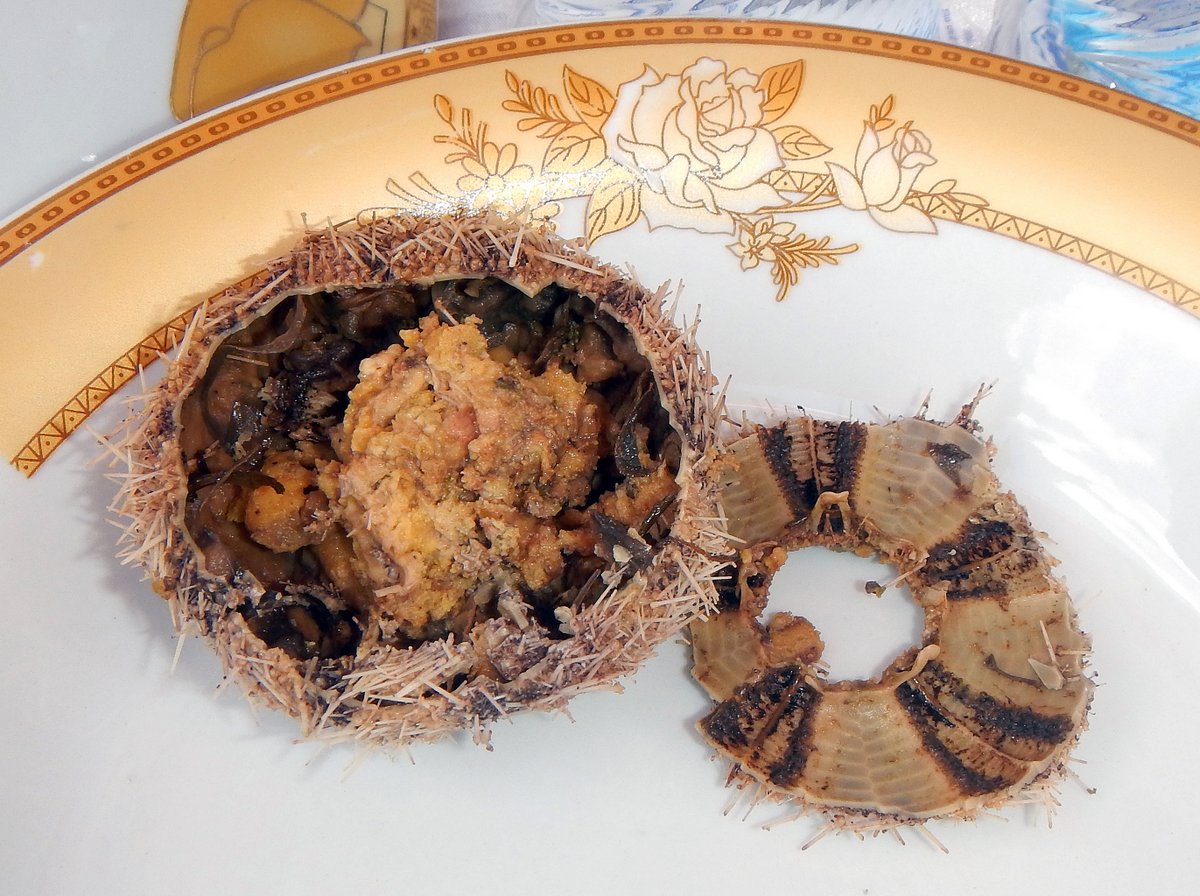
The village had prepared a feast of Bajo food including crabs, fish, a type of Poisson Cru, Sea Urchins, curried clams and sea cucumber (too chewy to eat). It was another mid-morning meal, but that didn't stop us tucking into the delicious dishes. After the meal, we had a quick walk around the village looking at the way that the Bajo are making their stilt village permanent. They’re even building a huge Mosque on reclaimed land.

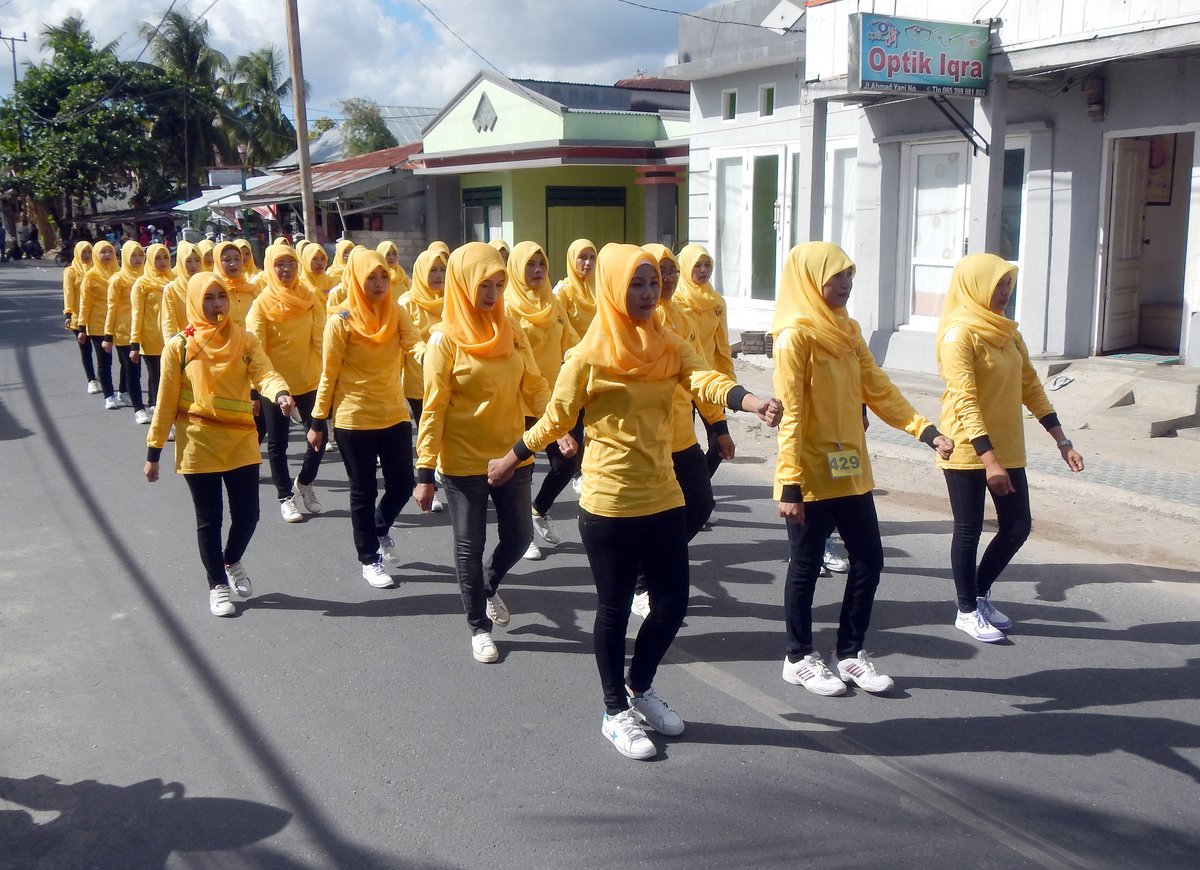
After a couple of hours rest on boat, we were ordered to go back to W.I.C. and join in a parade. It’s Independence Day on the 17th and there’s a series of marches taking place though the town. Yesterday was the children's parade and today was the adults - they gave us cruisers a slot in this parade. It’s some kind of competition, so all the various government departments have a team entered. It was funny to see the well-practised teams marching in time in three straight lines and then the shambling mob that was the cruisers.
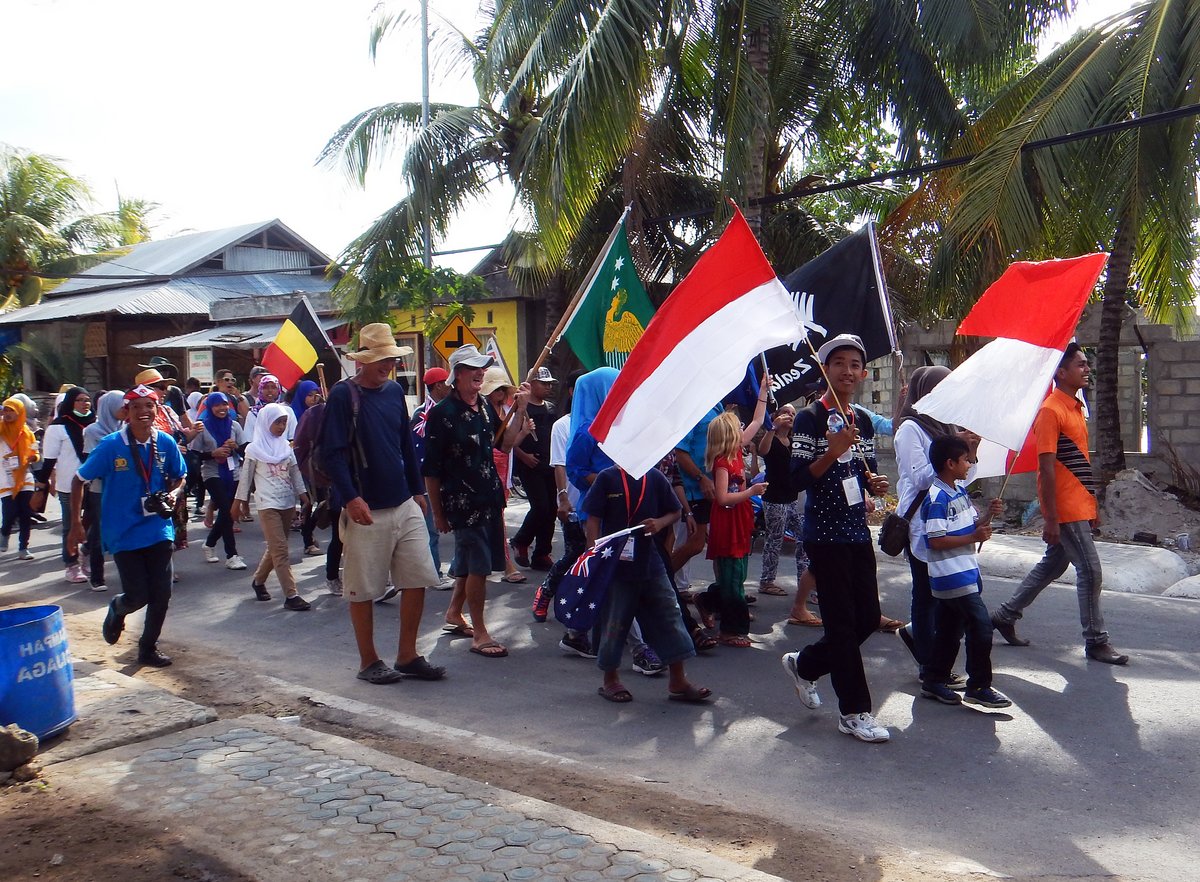
As we walked around, I had five teenage girls accompanying me as guides (how lucky am I!). They were paranoid about letting me walk away from the parade, but I still managed to persuade them to let me to visit one of the many water caves in the town, which are used for washing clothes and bathing.
My guides also helped to translate when I wanted to take a picture of a lady on the side of the road selling petrol. There are no petrol stations in the town, instead there are hundreds of small stalls along the streets selling fuel in one litre plastic and glass bottles - they look like Molotov Cocktails.
Back at the boat, I arranged to do another dive in the morning and later, we went with “Red Herring” for a few beers on “Laragh”.
Just as the sun was going down, we watched “u’Batu’ba” come in through the channel and suddenly stop. Gino had jumped on board, grabbed the wheel and grounded one of the hulls of the wide catamaran. Graham and I zipped over to see if we could help, but the tide was rising and Alex didn't want to risk damaging his hull by being dragged off. He eventually floated off at nine o'clock in the evening.
15 August 2015 Wanci, Wakatobi
I woke up in the middle of the night with a bad case of Bali Belly. I took a couple of Imodium tablets and then another in the morning, hoping that it acted quickly. There’s nothing worse than having a bout of dysentery when 30 metres underwater and trapped inside a wetsuit.

The dive boat took us to Shark Point, where we descended to 25 metres and headed north. We saw over a dozen Blacktip Reef Sharks, but they were very shy and almost impossible to photograph. It was still a nice dive and, thankfully, the Imodium worked.

Back at the boat, we had lunch and then crashed out for three hours, catching up on lost sleep. I then zipped over to “Catimini” to look at their navigation computer again, but couldn't make any progress. I've had to admit defeat and think that the video card is damaged. Roger is going to try to get another, but it will be difficult to replace before we get to the next big town of Bau Bau.
In the evening, we were piled into cars and taken off to a big hotel for a welcome party hosted by the Regent of Wakatobi. We had a buffet dinner, speeches, traditional dance displays and then they had everyone up on the dance floor doing a kind of line dance. At the end, there was a presentation by the Regent giving us a scarf, a certificate and a plaque, which was very nice of them.
They asked the cruisers if anyone wanted to sing a song, so Dave from “Laragh” and Peter from “Per Ardua” (both Irish, of course) stepped up gave a well-received performance of “Molly Malone”. It was past midnight before we climbed into bed.
16 August 2015 Wanci, Wakatobi
The organisers had organised a cultural visit to Liya Village. Five of the boats in the anchorage decided to do something else, so only four boats with eight cruisers attended the event, which was a bit of a disappointment for the organisers and the villagers who had laid on a welcome and food expecting over twenty five people.
However, it was an interesting visit. Liya village is actually four villages (housing 5,000 people) which are located around an old colonial fort made from coral rubble. The fort was built in the 13th century and there are old rusty cannons lying about the place.
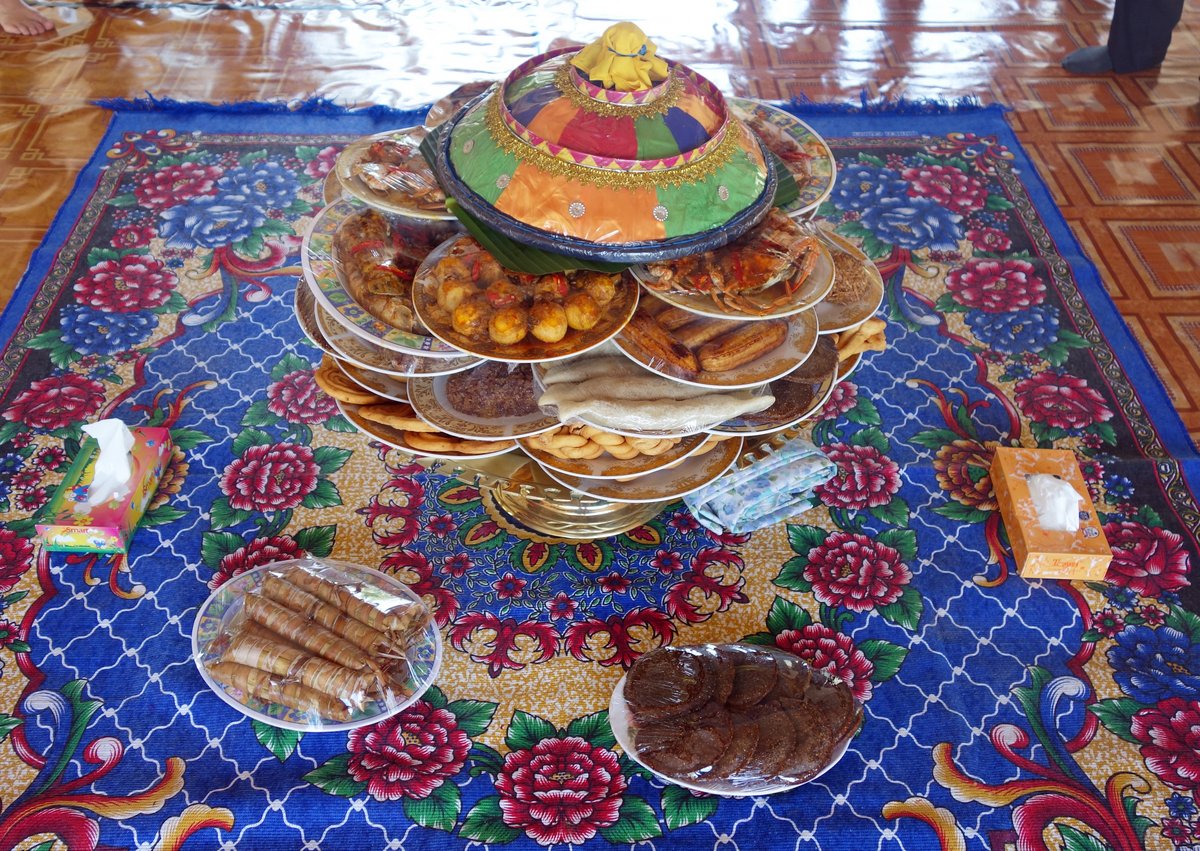
We were welcomed by village elders in traditional costume, who performed a graceful traditional dance. Our group was led to a meeting hut called a Baruga, where a fabulous pyramid of food had been prepared - this is called Livo and is the traditional food for ceremonies, such as births, circumcisions and weddings. After a rather lengthy prayer given by a village elder, we were invited to tuck in. With lobster, crab, barbecued fish, curried eggs and rice on offer, we obliged happily, even though it was only just past ten o’clock.
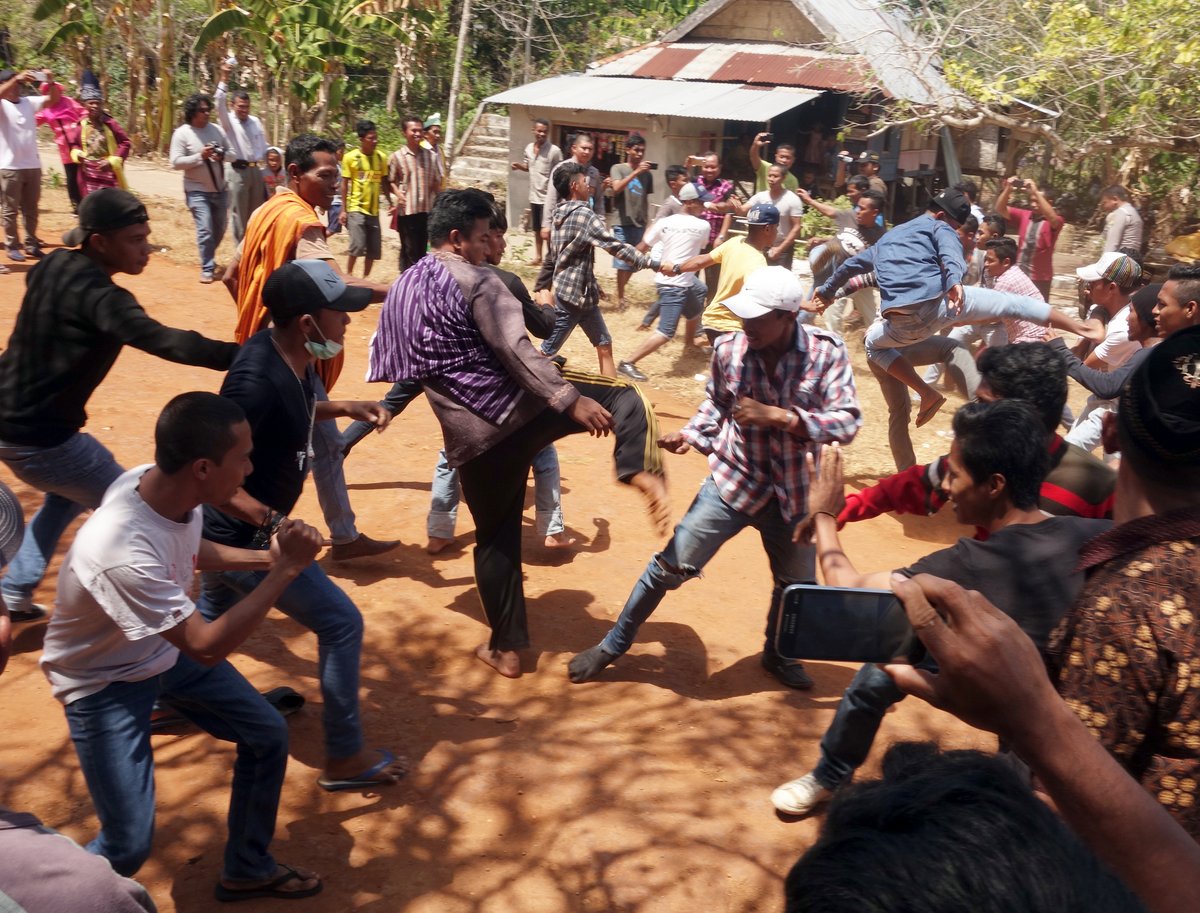
After our second breakfast, we gathered with a crowd on a field and watched a traditional kick boxing event called Posepaa. The opponents fight in pairs and have to hold hands throughout the bout. The teams are young men from two rival villages. It started off very controlled with some single-pair matches, but emotions soon too hold and it quickly turned into a full scale battle with tens of pairs of young men fighting. We kept well out of the way.
On the way back to town, we asked the driver to stop off at a seaweed farm. The seaweed is grown on thin lines held up by thousands of polystyrene floats and plastic bottles. Using a long canoe, the seaweed is harvested and then taken to stilt platforms, where it’s spread out to dry in the sun. Some of the harvested sea weed is reattached to the lines and replaced in the sea.

Back at the boat, we did a few jobs - Glenys scrubbed the green slime from our waterline, while I caught up on my blog and editing hundreds of photographs.
Our time here is coming to an end because we have to be in Pasar Wajo on the 19th for a welcome ceremony there. We told Gino that ten or so boats including us were leaving on the 18th and this caused a little bit of chaos because they were expecting us to stay another week. We tried to explain that we were expected in Buton and that another rally was arriving in the next two days, but he seemed very upset. He rang his boss and (in desperation) told us that the people in Pasar Wajo were not ready to receive us.
We’re going anyway, so I assembled a list of the boats on our rally and the dates that they are planning to leave Wakatobi, so that he knows in advance. The port captain is supposed to issue us with clearance to the next port, but if we don’t get tomorrow then we’ll just leave anyway.
17 August 2015 Wanci, Wakatobi
It was another early start and we were ashore by quarter to eight to go to the official Indonesian Independence Day celebrations. We hung around for ages because only eight cruisers bothered to get out of bed and the guides were waiting for more - trying to organise cruisers is like trying to herd cats.
Initially, the event was a little dull with a brass band, some marching and a lengthy flag-raising ceremony, but things improved when a group of school children sang a couple of songs all dressed up in traditional costumes. It was strange to see the little seven year old girls in heavy make-up, but they were very photogenic.

The carefully planned agenda fell apart when a famous Indonesian actress called Anissa Rahma appeared and stood amongst the choir. The crowd went wild, including all our teenage guides - all clambering to get a photograph of her. The organisers then tried to have an official photo shoot with the Regent and various officials standing on some steps, but the crowds of adoring kids and adults were clamouring to get a better view of Annissa Rahma, so the event sort of fizzled out, especially when the actress was whisked off in a car.
With our guides in tow, we wandered around the market for a while and then took three of the guides (Lilis, Ica and Indah) back to Alba for a look around. Then we had a quiet afternoon pottering about tidying up ready to leave tomorrow.
In the evening, we’d arranged for a small get together at W.I.C. to play a some music and say thank you to the guides. Katrina and Dave from “Laragh” wrote a short song about Wakatobi, to the tune of Yellow Bird. Dave handed out photocopies of the words and taught everyone the tune. It was great fun and the young guides and the staff of W.I.C. loved it.
The head of the Tourism board happened to be there and decided that it would be a good idea for us to go to the Regent’s Independence Day party and sing our song. So we were told to be back at the W.I.C. office at quarter to eight. We nipped back to the boat for a quick meal, dressed up a little and scooted back. And then waited and waited for other cruisers.
I know that the cruising life is supposed to be relaxed and care free, but some people are so rude. We’d been invited to a formal event hosted by the Regent of the Wakatobi region and they couldn't be bothered to arrive on time AND kept everyone else waiting for half an hour. Eventually, at twenty past eight, I cracked up and told Gino to ignore the stragglers and get going. [Neville climbs down from his soap box.]

I’d expected the event at the Regent’s residence to be a kind of cocktail party/reception, but it turned out to be a formal presentation with several hundred people sitting in rows of chairs in front of a stage. There were a few traditional dances, a long speech by the Regent and then we sang our little song, which seemed to be well received. There were other long speeches and awards for the parade teams, but thankfully, we were let out early at ten o'clock because they knew that we were leaving at dawn.
18 August 2015 Wanci to Pasar Wajo, Buton
We left around half past six and didn't have any trouble with the narrow channel this time. The tide was 1.3 metres above chart datum and the minimum depth that we saw was 3.2 metres at the outside edge of the channel, so there appears to be about 2.0 metres at chart datum.
There was hardly any wind as we crossed the bay, but as we rounded the headland, the wind picked up to 10-15 knots. Five other boats left around the same time and I saw “Red Herring” put up their spinnaker, so the race was on - up went our spinnaker, closely followed by everyone else's. Unfortunately, we were severely thrashed as "Red Herring" zoomed off over the horizon, closely followed by “Laragh” who cruised past us a while later.
We arrived in Pasar Wajo mid-afternoon, and anchored in the south west of the bay at 05°31.34S 122°50.89E in 17 metres of water. The holding is good, but the prevailing east winds have put the fringing reef fairly close behind us. There are lots of turtles surfacing around us, but the water is cloudy and there are haloclines here, which are layers of fresh water and sea water. I guess that there are underwater springs nearby.
There’s a Buton Information Centre (B.I.C.) ashore, who started to call us as soon as they spotted the first sail. They don’t have a boat, but directed us to the best anchorage. All of the five boats who arrived this afternoon gathered on “La Passarola” for a few beers - no one wanted to go ashore and be organised just yet.

19 August 2015 Pasar Wajo, Buton
We had a late start and went ashore at around ten o’clock. The B.I.C has set up a tent by the main dock and we were met on the beach by a gaggle of guides. Again they are all volunteers who speak good English. The head of B.I.C., Rusdi, told us that they have organised for us to attend a “baby” ceremony on the 24th - not quite sure what it’s all about, but it seems to involve 500 babies… The Takawa (a colossal dance with over 20,000 dancers) is not taking place this year, which is a bit of a disappointment.
However, there is a big Expo taking place here over the next week, with various exhibition stands set up where government departments and private companies are promoting themselves. We've been invited to the opening ceremony this afternoon and there’s a party tonight. After that they will organise events and trips depending on what we want to do.
Some guides were allocated to us and, together with “Red Herring”, we jumped on a Pete-pete (mini bus) and zoomed off to the local market, where we spent a happy hour wandering around looking at the fish, vegetables and other goods on sale. It’s a riot of colours and images, so it’s difficult to stop myself taking photographs. We stopped off at a small eating place and had Nasi Goring (Fried Rice) and Gardo Gardo (Vegetable in Peanut Sauce). At $1.50US for a meal, it’s not worth cooking here.
In the afternoon, we picked up “Red Herring”, to go to the Expo opening ceremony. On the way, Graham noticed a two foot long Banded Sea Snake in the bottom of our dinghy. These are one of the most poisonous snakes in the world. They are normally shy and keep away from humans, but unfortunately, this one was trapped in an enclosed space with us and couldn’t get out.
The snake became more and more agitated as the four of us lifted our feet out of its way, while trying to stop it hiding behind the fuel tank or disappearing under the hollow floor. It started moving faster and faster as I frantically pulled the paddle from the end of one of our oars. After a couple minutes of panic, I finally managed to get the paddle under the snake and flip it overboard - phew!

We arrived at the opening ceremony a little late, so the Regent of Buton had already started his speech to the local dignitaries. Embarrassingly, they made some people give up their seats near the front of the 200 person crowd and shuffled us in, while the Regent paused his speech to welcome us. Everyone was very friendly and they didn’t seem to be annoyed by our scruffy attire or the interruptions.
Two guides, Erick and Lisnansari (Lis) seem to have adopted us and accompanied us around the Expo stands, where we had fun as the locals practised their English and had their photos taken with us. The Regent was also walking around the stands and he found us at a stall giving away samples of Araq (strong alcohol similar to Anise). Glenys had already partaken and was dancing with a small group of locals. The Regent poured me a glass of Araq and watched delighted as I downed it in one - if nothing else, we cruisers know how to drink.
We nipped back to the boat at sunset and come out again at eight o'clock to attend the party. The B.I.C. had organised a take-away dinner of fried chicken and rice for us and we were then allowed to wander around with our guides. There’s a little fun fair been set up for kids and lots of stalls selling bling and luminescent toys - just like anywhere else in the world.
Erick and Lis took us for a walk to the Blue River, which is a fresh water lagoon that that has been made into a huge swimming area with concrete walls and a promenade with plenty of little food stalls. It’s obviously a place where young people come to eat and have a good time in the evening - we’ll be back.
Back at the Expo, we were given seats on the stage where a big band was playing. The Regent was sat behind us and he had two cases of Bintang beer brought out for us - warm, but nice of him. The organisers had us all go onto the stage and dance in a big cirlce with dancers in traditional costumes. We were escorted back to our dinghy just after ten o'clock.
20 August 2015 Pasar Wajo, Buton
As a treat, we had boiled duck eggs for breakfast, which I'd bought at the market yesterday. I spotted the slightly blue shells and not knowing the word for duck egg, I simply pointed at them, made “Quack Quack” noises and waddled like a duck. The market stall holders thought this was hilarious, but understood what I meant. The eggs were delicious and only $0.30US each, so we’ll be getting more of these.

We met Erick and Lis ashore and they took us off in a car on a little tour of the local area. In convoy with “Red Herring”, we first went to Kali Buki, which is a sinkhole with a fresh water spring at the bottom. The enterprising owner of the land has built steps down to several concrete fish ponds where he breeds carp - he sells fish food to visitors. It is a very cool and tranquil place.
Lis then kindly took us to her parents’ house, where they had laid out some plates of Finger Food and had specially made some Cucur for us, which is a small flat sweet bread - like a mixture of a doughnut and a pancake. Lis’ father is a teacher of Islam, but unfortunately doesn’t speak much English, so I couldn’t ask him the hundred and one questions that I have about the Islamic faith. It was a nice little visit and we gave Lis' parents some small gifts of a penknife and a scarf.
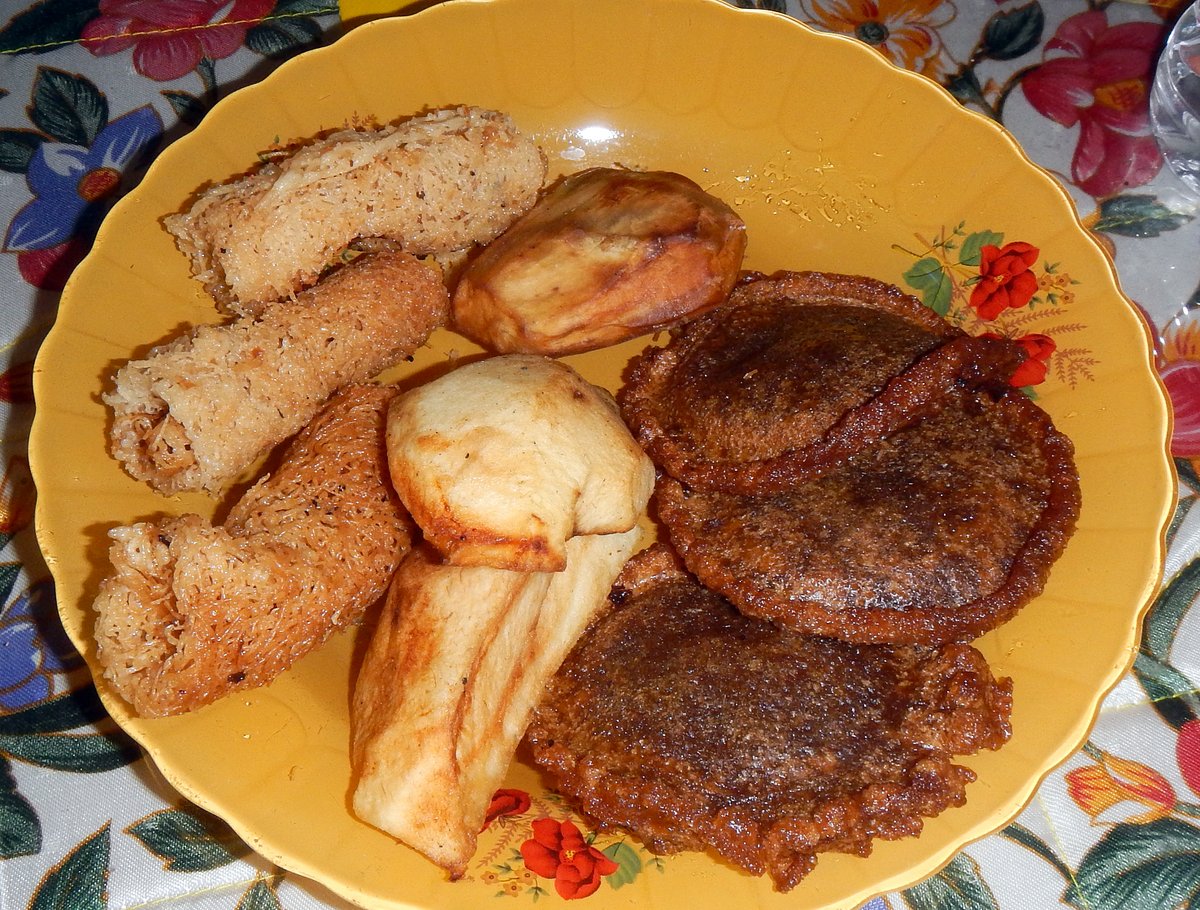
We then visited Takimpo Fort. It’s perched on a hill above Pasar Wajo and used to be the home of the Takimpo tribe, who built the walls as a defence against the Europeans who arrived in the 1600s. The village was abandoned a hundred years ago and the only things left is a small mosque and a Baruga (a raised platform used for a meeting place), which the ancestors of the Takimpo people maintain for their historical value.
After a take-away lunch that W.I.C. had provided, we prepared our equipment to go on a scuba dive and snorkelling trip. Unfortunately, we’d been given the wrong information and there was no diving. Instead they’d arranged to take everyone to a nearby beach by car to go snorkelling. Glenys and I didn't fancy snorkelling with 20 people and 7 kids, so we went back to the boat.
I ran our dive compressor and, thankfully, the second-hand burst disk that I was given in Wakatobi, worked okay and I was able to fill both tanks.
At half past four, I zipped over to a fishing pier (05°30.95S 122°51.97E) on the eastern shore of the bay to do some snorkelling by myself. This is the location of a “muck dive” called Magic Pier (the “muck” meaning a shallow dive on a rubbish-strewn seabed, close to shore, often with poor visibility). My main aim was to photograph the elusive Mandarinfish, which only come out of their hidey holes at dusk, but I couldn't find any.

I didn't mind because this was possibly the best place that I ever been to for underwater photography. There are hundreds of small fish and creatures wandering around the rubble, broken fishing traps and general rubbish. I got some good photographs of new creatures including a Shortfin Lionfish and the fabulous Peacock Mantis.


In the evening, we were invited to a dinner hosted by the vice-regent. We were given traditional sarongs to wear, which are tubes of material that you pull over your head, fold a tuck to fit tight around your waist and then roll the top to hold in place. It’s the most practical sarong that I've seen - held firmly in place but the rolled top, yet the tuck gives plenty of freedom. The men wear long trousers underneath the sarong and the ladies wear trousers or long skirts.
Garbed in our sarongs, we were led to a small marquee where half a dozen tables had been set out and a big buffet laid on. Surrounding the tables were chairs for 150 local dignitaries and the sides of the marquee were open, allowing several hundred more locals to look in. We were invited to take food from the buffet and eat while everyone watched us - it was a little like being in a goldfish bowl.
The welcome dinner was hosted by the Vice-Regent, who gave a little speech. I volunteered to give a little thank-you speech and then we watched some local dancers. After that it was party time with western rock music being played. We were expected to dance watched intently by the crowd - thank goodness they provided some Bintang beer to relieve our nerves. It was another pleasant evening.
21 August 2015 Pasar Wajo, Buton
We went in at nine o'clock, hung about for an hour (not quite sure why) and then had an hour’s drive along some extremely bumpy dirt roads to the village of Wabula. This is predominantly a fishing village, were they set out massive fish traps on the shallow reefs.
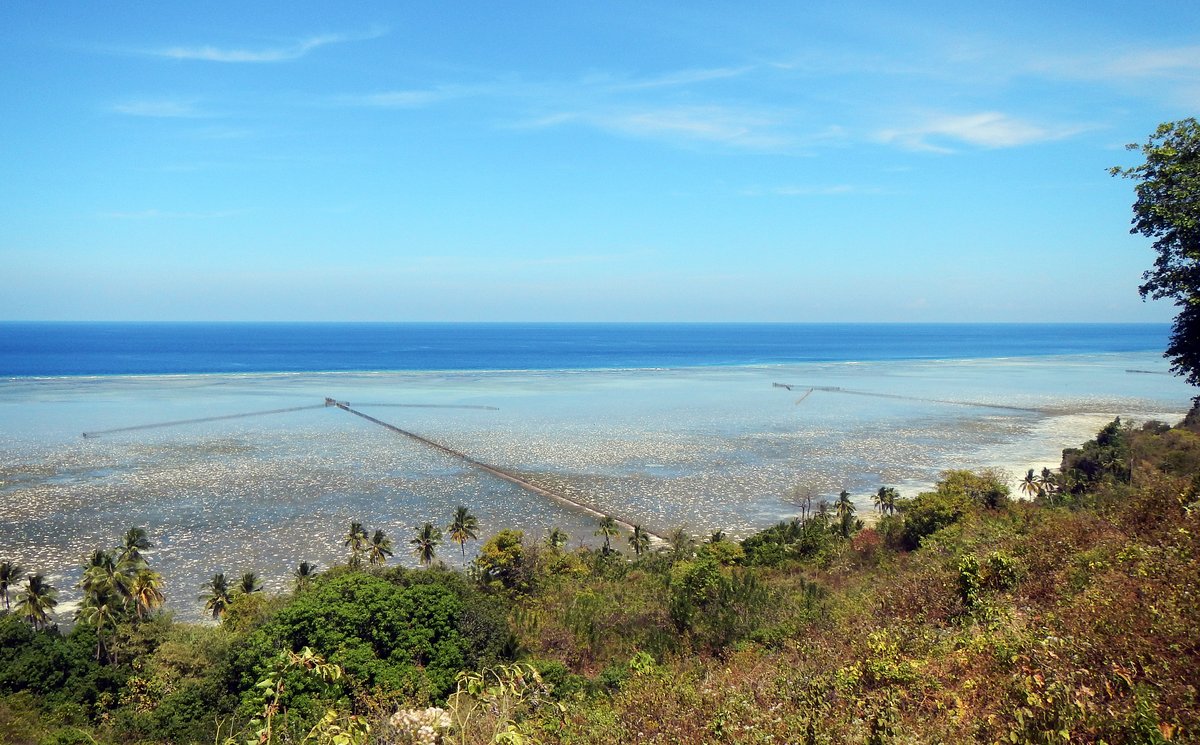
When the tide goes out, about ½ mile of reef and sand is exposed, so the fishermen have driven wooden stakes into the beach forming huge arrows that point out to sea. Fish come in with the tide to feed and, when the sea goes out, the fish get trapped by the point of the arrow. The stupid fish keep trying to swim into deeper water, instead of swimming around the simple trap.

While the men are out fishing, the ladies of the village weave cloth on amazing, wooden hand-looms built beneath their stilt houses. The process looks to be incredibly laborious and we’re told that it takes 5-7 days to weave one - we could buy one for only $20US.
Glenys liked the look of a sarong that was being woven by one of the ladies called Walema. She was half way through making it, so the sarong will be delivered to W.I.C. in a few days. If it doesn’t arrive by the time that we leave Pasar Wajo, then W.I.C. will send it to the organisers at our next stop in Bau Bau - a 60 miles sail, but only an hour’s drive by car.
After wandering around the village looking at the looms, we were driven along the bumpy road back to Pasar Wajo, where the organisers had once again bought us a take-away lunch consisting of fried chicken, rice and a hot sauce - very tasty. We escaped back to the boat and chilled out for the afternoon, catching up on some sleep.
At half past four, I picked up Les from “La Passarola” and we went for a dive at “Magic Pier”. We anchored the dinghy to the north east of the pier and descended to 15 metres heading south west then came back up to 5 metres directly under the “T” end of the pier. There we found huge concrete blocks, dumped as part of the pier construction and lot of other rubbish, like car tyres.
Amongst the concrete blocks, I finally found the elusive Mandarinfish. There were scores of the two inch long, colourful fish hovering above the rubble going through their mating display. In my excitement, I neglected to set up my camera properly and most of the dozens of photographs that I took were rubbish, but I managed to edit a couple of decent ones. I also got a nice photos of the brightly coloured Ribbon Eel and a well camouflaged Tassled Scorpionfish.


22 August 2015 Pasar Wajo, Buton
The rally organisers had arranged for everyone to go to a waterfall and an asphalt mine, neither of which appealed to us, so we went off on our own - when I say went off on our own, we were accompanied by Erick, Lis and Iwan - our own personal driver.
Our first stop was at the market where Glenys bought a new outfit - a dress and sandals at an amazing cost of 110,000 rupiah ($11US). We also bought some more duck eggs and a few vegetables.
A lady was selling some parcels of rice cooked in a woven coconut leaf parcel, so we bought a couple of those and also some Tempeh, which is a traditional Indonesian soya product. It’s made by a fermentation process that binds the soybeans into a cake form, similar to a very firm vegetarian burger patty. Typically, it is cut into cubes and fried to include in meals as protein.
After buying some petrol, some outboard oil and two cases of Bintang beer, we drove off to the Bajo village to have a look around. This village used to be isolated from land an only accessed by boat, but the Bajo villagers have built a long causeway out from the shore. It was interesting to wander around and look at the traditional house built on stilts, connected by some very dodgy single plank walk ways.
A dive had been organised in the afternoon, but it was typically chaotic. We were told to go to a dock and the dive master would meet us there. We all turned up in our dinghies, but no sign of anyone. After fifteen minutes of confusion, a boat turned up, then the dive masters turned up another fifteen minutes later.

It turned out that they only had three sets of scuba gear despite having a head-count in the morning, so I had to scoot back to Alba to get our dive gear. They then loaded us onto their boat and kept us waiting for 20 minutes. Eventually, we set off to “Magic Pier” - it would have be so much easier to go by ourselves.
Despite all the hassle, the dive was very good. They took us straight to the end of the pier to where the Mandarinfish appear. I’d already seen these fish, but the dive masters were great at pointing out other little creatures, especially when they saw that I had a decent camera.
I was so excited to see two Ornate Ghost Pipefish. These are less than two inches long and almost transparent, so they are very difficult to see. Even when pointed out to me, my tired old eyes had trouble focussing on them. They are one of the weirdest fish in the sea with their unearthly camouflage. The guides also pointed out a lovely yellow nudibranch called a Great Bergia.

23 August 2015 Pasar Wajo, Buton
We had another morning doing our own thing. We invited Erick and Lis visit Alba for half an hour and then went for a scuba dive at Asphalt Pier (05°31.02S 122°50.71E). This is another muck dive underneath the end of a dock by an old Asphalt Works. There’s lots of junk on the sea bed, but we saw some creatures amongst the mess, including a couple of big Painted Lobster, a Broadclub Cuttlefish that flared bright yellow when disturbed and some lovely yellow Anenomes on the columns of the pier.


In the afternoon, I chilled out running the water-maker and not talking to anyone (for a change). Meanwhile Glenys went off to learn how to cook Indonesian food at Rusdi’s house. They learned how to make Mei Goring (Fried Noodles) and a complete meal consisting of Parende (Fish Soup), Kasoami (Steamed Cassava) and Sayur Bening (Steamed Vegetables). I can’t wait to try it all.
24 August 2015 Pasar Wajo, Buton
It was a full day today. There were three separate traditional events going on, which seemed to overlap and caused us much confusion, but I think that I've figured out what went on.
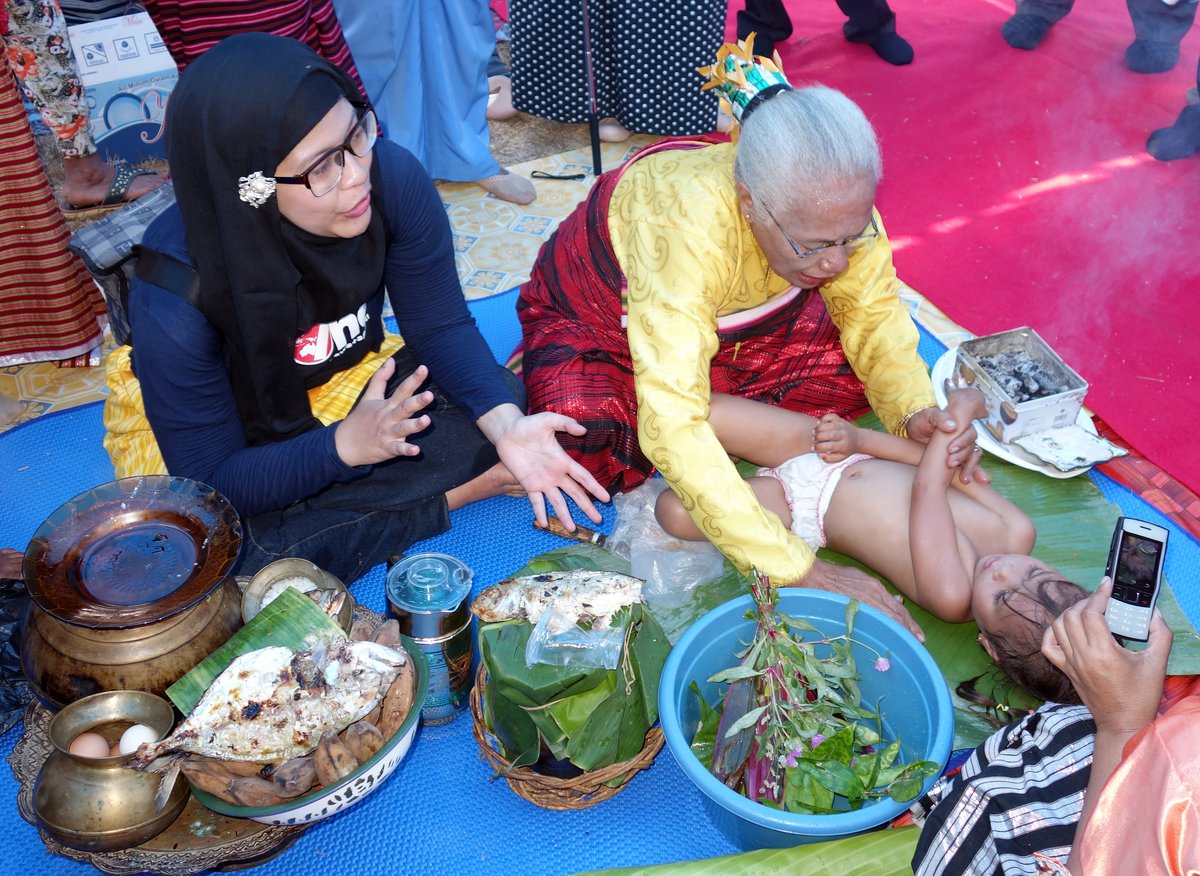
The first event was called “Dole-dole”, which the guides described as a natural immunisation ceremony. Over 500 kids between two and five years old went through this ceremony, and to say it was mayhem is an understatement. There were three marquees bustling with proud parents and their families - heat, bustle and screaming kids. Everyone was dressed in their finery including all the cruisers who were wearing sarongs.

The Dole-dole ceremony is carried out by an elder lady in three stages. The first stage is to smear medicinal oils onto a banana leaf on the ground, place the child onto the banana leaf and massage the oil into the unsuspecting infant. A brush made from various green leaves is then dipped in water and splashed on the child. The now confused (and screaming) child is then held over platters of food and smoking braziers and rotated three times. The dazed child is stood up and a handful of rice is shoved into his/her mouth (which the child obviously doesn't want). The child is now naturally immunised against disease.
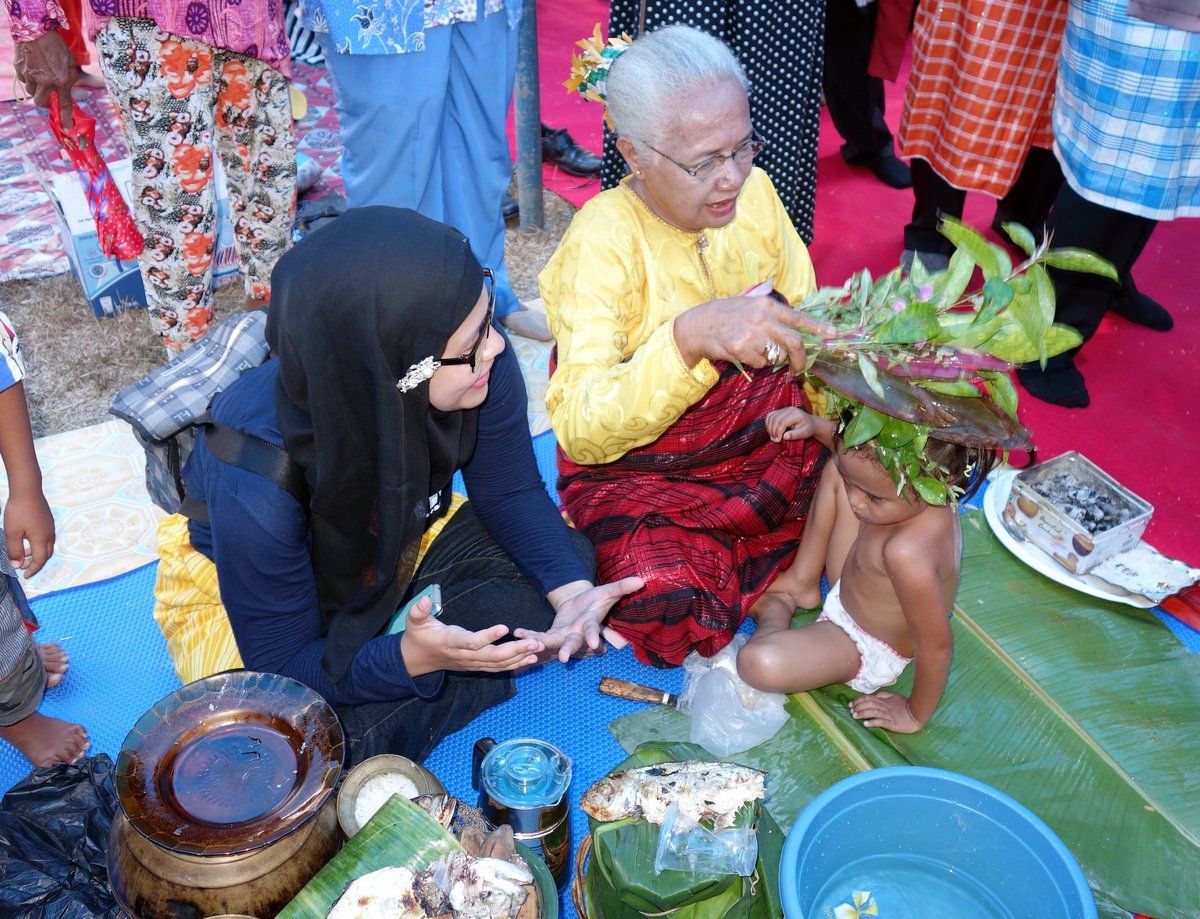
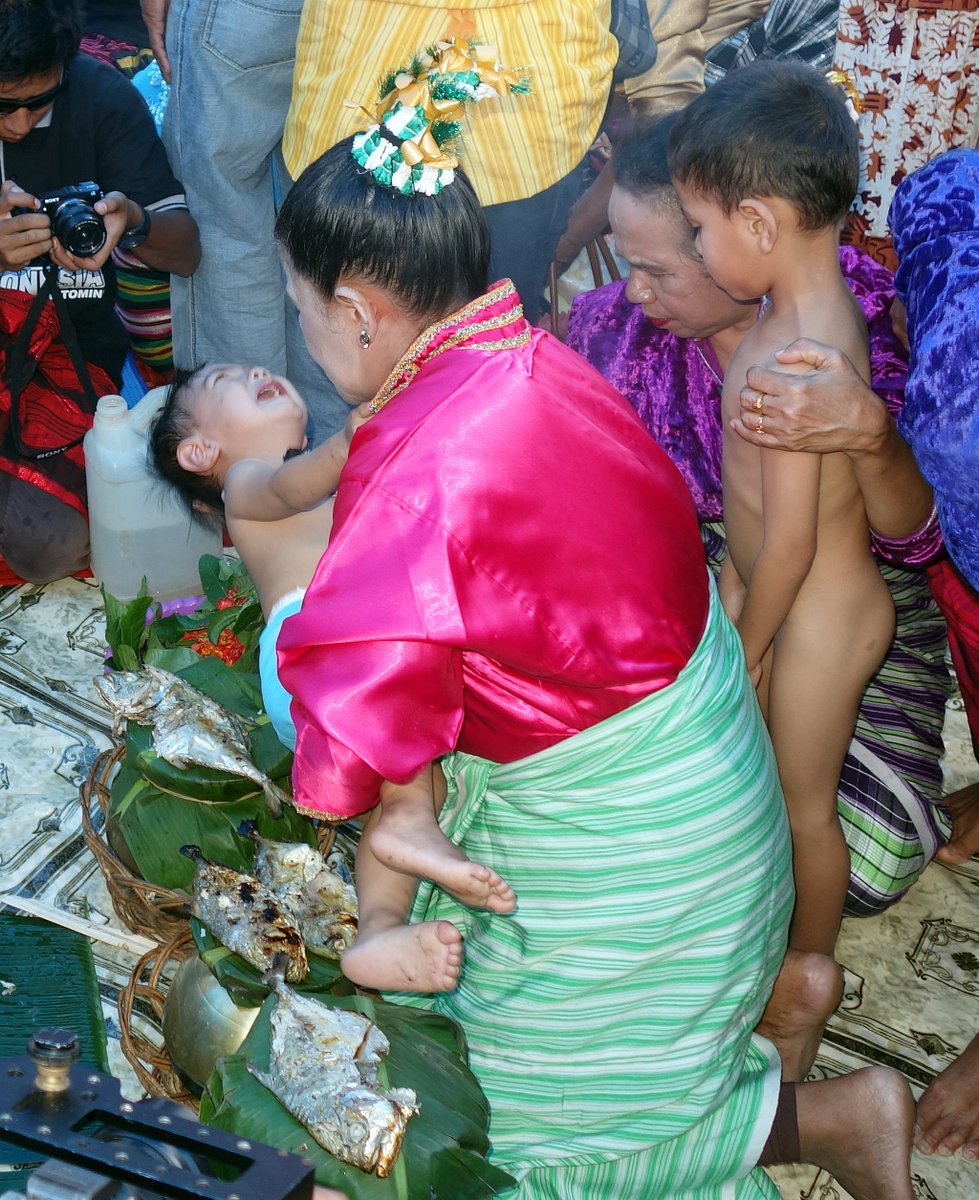
It was hot and chaotic in the tents and we were continually being asked to pose for photographs with families, which is a wee bit wearing, so after an hour, we escaped to the Blue River for a cold drink and a rest before heading to the local market. Glenys went off buying vegetables and I handed out some photographs that I’d printed of people in the market. They were very well received and I was asked to take loads more photos of the stall holders.
Glenys bought a pair of sandals a few days ago and already the straps had pulled out. The market stall where she bought them was closed, so she invested 10,000 rupiah in having a street-side cobbler repair them. He did a cracking job, working for 20 minutes sewing all around the soles as well as stitching the straps - all for a dollar.
We decided to brave the marquees again and found that the screaming children had mostly disappeared and the marquees were being filled up by rows and rows of beautifully costumed young ladies all seated on the floor with covered platters of food laid out in front. The ladies were waiting patiently for the Kande-Kandea feast to start later in the afternoon. Again we were inundated with requests for photographs with pretty teenage girls, so who can refuse?

To escape the oppressive heat of the marquee, my guide Lis asked if I would like to go to her Aunt’s house for a rest. We walked a few hundred metres from the celebrations and up to a beautiful wooden house perched on the hill over-looking the festival grounds. I was greeted by Lis’ aunt and cousin and we sat in their airy lounge catching a cool breeze, while I showed them photographs of our travels on our iPad. The floors, walls, ceiling of the house, and even the furniture, were all made from an unvarnished hard wood - it was simple and lovely.
After chilling out for a while, Lis and I walked back down to the road to watch the Posuo parade. This marks the end of a process that all young post-pubescent girls in Buton undergo before being married. Pusuo is also called “seclusion” and is a Muslim ritual where the girls are isolated in a room for eight days and nights. The objective is to “prepare girls with the ethical, moral and spiritual values for their role as a daughter, mother, wife and society member.”
From what I have read, the girls are given instruction by a religious guide called a Bhisa. They are instructed in relevant sections of the Quran and there are various rituals including washing in scented water and being covered in Turmeric powder. Some girls report that it is a spiritually uplifting process and others decry the seclusion procedure as miserable, having been forced to attend by the peer-pressure of their families.
Having endured the Posuo procedure, the girls are now women. In a strange contradiction after such an intense religious process, the young women now leave behind the protection of their Hijabs (Muslim head scarves), dress up in fabulous glittering costumes with heavy make-up and walk a kilometre or so in a long parade. It’s beautiful to watch - the young women are happy, smiling and waving at everyone. I suppose that it’s not too surprising that they are ecstatic after having completing eight days and nights of religious instruction while locked away from their iPhones.

We followed the procession into the marquees, where the young ladies sat on rows of straight backed chairs, while we were escorted through the bustling crowd and given a place in front of one of the beautiful hostesses for the Kande-kandea feast.

We were each allocated a hostess and a huge platter of food, but not allowed to eat until we had suffered some rather lengthy speeches given by the Regent and other politicians. It was incredibly hot with the sun beating down onto the tent roof, no breeze and hundreds of bodies closely packed into the marquee, but after an hour we were finally allowed to eat.
I only managed to eat a very small portion of the fabulous dishes that were laid out in front of me. My hostess didn't eat, but instead, concentrated on making sure that I had whatever I wanted. After fifteen minutes of gluttony, the feast was over and everyone escaped out of the tent into the cooling breeze, stretching legs that were stiff after an hour sitting crossed-legged.
Glenys and I zipped back to the boat for a couple of hours rest, and then I left Glenys nursing a cold and mild case of dehydration to go to the Farewell party. The guides took us to a restaurant where there was a Karaoke machine. Once we were seated the guides brought in two cases of Bintang beer and Mr Rusti poured everyone a healthy helping of Ataq, which got the party off to a good start. The guides sang “Sailing” and there were a lot of tears and hugs. Karen led a conga through the restaurant, “Laragh” played an Irish jig while the two young girls from “Per Ardua” (Erin and Isla) danced and everyone had a great time for a couple of hours.
No time to rest, we were then taken to a concert hosted by Regent, where we were given seats on the stage to watch a famous Indonesian pop star sing few songs. In another strange ambiguity, there were a group of “He-shes” seated on the stage seats close to us. Dressed in tight fitting skirts, they were fun, strutting around wanting photographs with the Orang-bule (white men), but Islam severely frowns on homosexuality, so how do the Muslims reconcile these people?
It was another late night.

25 August 2015 Pasar Wajo to Bau Bau, Buton
We were up before sunrise and left as soon as we could see the fishing buoys and FADs that litter the bay. It was a pleasant sail with the wind behind us. I was very lazy and couldn't be bothered to get out the spinnaker or even pole out the genoa, so we bobbed along with the genoa losing the wind behind the mainsail.
As we were approaching the harbour, I hooked and landed a big 15 Kg Wahoo. I caught it on the hand-line, so it was easy to bring it in, but once on the aft deck, it flailed around and refused to die despite a liberal dose of rum in its gills - only continual blows to the head with my “judge” put an end to it. The aft deck was covered in blood.

It was a bit chaotic when we arrived in Bau Bau. There were three boats ahead of us and the coordinates given by Sail Indonesia were incorrect, so they were all milling about. We spotted a new-looking, floating dock next to a hotel, so we anchored off that in 20 metres depth at 05°27.36S 122°37.21E. Fortunately, it turned out to be the correct place.
I filleted the Wahoo and went around the fleet handing out meal-sized fillets to each boat, so I was Mr Popular that night. We had pan-fried fish and chips for dinner and a quiet night in.
26 August 2015 Bau Bau, Buton
There were no events planned for the day, so together with “Red Herring”, we went off in a car with a driver called Komang to renew our visas.
The Indonesian immigration will initially only issue a 60 day visa, and we have to renew it every month for a further 30 days. The rally organisers have scheduled the fleet to renew visas in Lombok in the middle of September, which is 400 miles away, meaning that we would have to rush to get there - we would rather take our time and stay longer in Takebonerate and Komodo. By obtaining our visa extension early, we will be able to miss out the stop at Lombok giving us extra time.

The Bau Bau rally team were great and helped us to prepare all of our documentation, including writing a local sponsorship letter for us. The Immigration department don’t often do visa extensions and ran out of forms - they only had two, so we had a lengthy wait for a couple of hours at the tourist office, while they found some more.
We filled in all the relevant paperwork and delivered it to the immigration department. All seemed to be in order, so we have to go back tomorrow to have our fingerprints taken - this has to be online and the internet connection between here and Jakarta is not good enough in the afternoon! By the time that we’d finished running around, it was well past one o'clock so we went for a Nasi Goreng lunch.
We chilled out for the rest of the afternoon and in the evening went to another welcome dinner at the tourist office this one attended by the mayor. There were several displays of traditional dancing and a very interesting percussion band that chanted an Arabic poem. It’s interesting that they can read and understand Arabic - I guess that they learn it while they are reading the quran.
After the performances, the compare wanted the cruisers to go up on stage and sing a song. This keeps happening to us and we’re not organised enough to handle it. Fortunately, Peter and Meillia from “Per Ardua” stepped up and sang a little Irish jig to which their two little girls danced - the crowd loved it.
27 August 2015 Bau Bau, Buton
We all went on an organised coach trip to the Bau Bau fort, which is apparently the largest fort in the world. Unfortunately, it’s so huge that there’s no real focus to it - it seems to be a five kilometre long wall with normal houses built inside.

They took us to the old Sultan’s residence. The last sultan was removed from office after their independence in 1945, so the residence is now a museum. It’s a fabulous, airy, wooden house with lovely furniture and lots of photographs of old sultans on the walls. All of the Sultans have been direct descendants of Genghis Khan, but rather than inheriting the position, the living descendants used to be nominated for an election and the sultan was voted in by the people. It’s an interesting mix of democracy and hereditary succession.
Halfway through the morning, the immigration department said that they had a network connection with Jakarta, so Komang whisked us off to the immigration office where we quickly had our fingerprints and photograph taken. It cost us 355,000 rupiah ($35US) each for the extension, but they kept our passports - they had to wait for a reference number from Jakarta, before they could stamp our passports. Komang picked them up later in the afternoon. It was all pretty painless - thank goodness we had the use of a car and driver.
Komang took us back to the fort, where we saw a traditional blacksmith making crow bars from the iron bars used to reinforce concrete; and knife blades from steel car wheels. He had a very basic foundry set up with charcoal piled in a shallow hole in the earth and a leaf blower fanning the fire. It might have been simple, but it was effective. The blacksmith and his son showed us how they manually hammer out a knife blade and temper the cutting edge in oil. I loved that they used an old bomb casing as their anvil.
We joined the others for lunch at the tourist board office. Then Komang took us in the car to try to get some propane gas. One of our gas bottles has run out, but it appears that there is nowhere in Bau Bau that can refill bottles - the locals only have the facility to exchange bottles. The local bottles have a different valve to our POL fittings, so my next mission was to try to find a valve that would fit the Indonesian bottles - I would then be able to decant propane into my bottle.

No chance - we went around various hardware shops. There doesn't appear to be anyone who actually installs fixed gas pipework - the local people all use simple regulators and rubber hoses to connect to their stoves - like we would use on a barbecue. Another minor problem is that I can’t hire a propane tank for a few hours; I have to buy one at a cost of $75 US, so it would be expensive. After a couple of hours, I admitted defeat - if we run out of gas then I will have to buy an Indonesian bottle, a regulator and rig it up as a temporary solution.
In the evening, we invited “Laragh” and “Red Herring” over for a jam session and had a great time preparing a list of songs that we can perform if requested at one of these parties.
28 August 2015 Bau Bau, Buton
I’d arranged a dive trip for five of us cruisers. We loaded all our gear in a very slender boat with two bamboo pole outriggers and zipped across the harbour to the opposite shore near 05°24.17S 122°36.18E. There’s a 20 metre high cliff and underneath the surface is a fabulous coral wall.
Our first dive was into a cave system. Glenys refused to go in and went off with one of the guides along the wall. The rest of us went into the cave which had two large chambers with a sink hole at the surface between them. It was an atmospheric dive, but not many creatures apart from a few cardinal fish and some lobster.
The second dive was a drift dive along the coral wall. The visibility was very poor, so we all concentrated on small creatures. I got very excited when I spotted a small Yellow Sea Cucumber and took some photographs, but then Adrian from “Anthem” pointed out hundreds more - the reef was plastered with them. The coral was beautifully coloured and we saw quite a few nudibranches and flat worms including a Linda's Flatworm. It was great diving for only $25US per dive.


We didn't get back to the boat until half past two, so the Wahoo sandwiches that Glenys prepared went down well. I tried to chill out, but “Catamini” still have a problem with their computer, so I went across and had another go. I tried installing various display drivers, but failed - I think that there’s a hardware fault on the video card.

Everyone was invited to “La Passarola” for coconut rum - Les has found a five litre jug of home-made rum stowed away on his boat, so Colleen and he wanted to share it. Afterwards, we went to the hotel restaurant for dinner. It was the birthday of Roy from “Peggy West”, so we had birthday cake and then a jam session with “Laragh”, “Red Herring”, Adrian from “Anthem” and Peter from “Per Ardua”. We’re getting quite a band now.
29 August 2015 Bau Bau, Buton
Last night, Adrian from “Anthem” told me that he had a valve that fits Indonesian propane bottles, so I nipped over at eight o'clock to borrow it. I then went ashore and asked Komang if he could get hold of a full propane bottle. He arranged for the hotel to get one for me - I agreed to pay them $20US for the gas and $5 for letting me use the bottle.
After breakfast, Komang ran us around. We dropped Glenys off at the supermarket to do some provisioning and then I went to get some cash and four cases of Bintang beer. We picked Glenys up and were back at our dinghy within an hour - I like having a private driver. The hotel had sorted out a propane bottle, so we took that back to Alba as well.
The other cruisers went to the vegetable market in the morning and everyone was invited to a local village for lunch, but we decided to give it a miss and get on with some chores, so that we’d be ready to leave tomorrow.
I set up the propane bottle with a hose to decant from the Indonesian bottle to our aluminium bottle and within an hour had filled it. I weighed our other bottle and found that it was at least ¾ full, so we should have enough cooking gas now to last us until we get to Singapore. There was still some propane left in the Indonesian bottle, so while I had it all set up, I filled a small bottle for “Peggy West”.

We ran the water-maker; I serviced a winch that was getting stiff; and we tidied up getting ready to leave tomorrow - a good productive day. Around five o'clock, “Red Herring” called by and told us that their afternoon had been horrible. All the cruisers had been taken to a village where there was some kind of memorial ceremony going on, but it didn't happen for ages and they spent two hours sitting waiting and then had to suffer an hour of speeches.
Both Karen and Graham were despondent, so we invited them on-board for a therapeutic beer and then Adrian and Jenny from “Anthem” called by, so we invited them for a beer too.
Another farewell party had been arranged in the evening, but we couldn't be bothered to go. We've had three weeks of cultural events, lunches, tours, speeches and parties, and enough is enough. We had a lovely quiet night by ourselves.
30 August 2015 Bau Bau to Telaga Island, Buton
We pulled up the anchor at around nine o'clock, when the wind started to pick up. We managed to sail for an hour, but the wind died after we cleared the harbour, so we motored for a couple of hours. Then just after lunch, we started to get a breeze and, by one o'clock, we were romping along with a 20 knot sea breeze putting us on a fast reach.
A few hours later, we dropped anchor on the north side of Telaga Island along with “Catamini”, “Red Herring”, “Sea Monkey” and “Conrad”. It’s a pleasant anchorage in 15 metres just off a small white-sand beach (05°24.17S 122°36.18E). We’ll definitely be staying here tomorrow, well away from the constant calls to prayer and the attention of well-meaning guides.
On the approach to the island, we landed a small 2 foot long Barracuda. I'm always paranoid about Ciguatera, so when I saw a local guy chugging past in his outrigger boat, I grabbed a fish identification chart and zipped over to him. He was surprised to see me and didn't speak any English, but a few smiles and pointing to the picture of the fish while asking “Bagus?” (Good?), got me lots of head nodding and repeating of “Bagus, Bagus” from him. So we had Barracuda for dinner.
31 August 2015 Telaga Island, Bombana
We had a lie-in for the first time for a while, but that was disturbed by a strange pinging noise. I climbed out of bed to investigate, thinking that it was a rope slapping against the mast or the rigging. I tightened various ropes and went back to bed and it happened again. I got up and had another look - I even checked the wire on the shrouds, thinking that maybe a few strands of wire might be breaking.
Later on in the day, I was snorkelling and heard the same noise while 8 metres underwater, but much louder - it scared me to death. When it happened again, I figured out that the sound was caused by the locals using dynamite to fish. This horrible method of fishing involves dropping a stick of explosive into the water, which stuns and kills all fish in the nearby area. The fishermen gather the fish from the surface of the water. It's very destructive, indiscriminately killing small fish and decimating the coral.
We spent the day relaxing. I spent most of the day playing the guitar and working out a few songs, Glenys read a book. We went snorkelling, which was okay, but not surprisingly, there don't seem to be many fish.
For dinner, we had Barracuda & chips with a bottle of red wine, while watching a movie - a perfect end to a peaceful day.