1 March to 9 March 2017
At the beginning of March we were on a road trip around Sri Lanka, which is covered in a separate article .
10 March 2017 Udawalawe to Mirissa, Sri Lanka
Saranga met us at the bus station in Matara, took us to bakery to get some “shorts” (samosas, etc) and then called in at a laundry to drop off our dirty clothes. This small laundry is tucked away in a back street, but is supposed to be the best in Mirissa and is used by many of the Guest Houses. They air dry everything and tend to use an iron to help semi-dry the clothes before pegging out. The iron that they use is a wonder to behold. It’s a huge cast iron device into which they place burning charcoal made from coconut shells - must be a hundred years old.

We’re planning to leave Sri Lanka in a few days, so we arranged for Suranga to take us shopping tomorrow. He was uncertain if the liquor store would be open on a weekend, so I jumped into his tuk-tuk and we went to Weligama, where I bought five cases of beer and a couple of bottles of the local rum.
It’s so much hotter on the coast than inland and there was no breeze in the afternoon, so we suffered on our hot, stuffy boat with all the fans going. We had an early dinner of egg and beans on toast and had an early night.

11 March 2017 Mirissa, Sri Lanka
The weather forecast shows light and variable winds for the next two weeks, which means that we’ll be motoring for all of the 400 miles to the Maldives. Our visas expire on the 20th March, so we’ve decided that we might as well leave on Wednesday 15th. We want to visit Galle town for a day, so we’ll catch a bus from here on Monday, sail to Galle and clear out on Tuesday and then leave early the next day.
After breakfast, I topped up our diesel tank from our three jerry cans and then we spent most of the day stocking up with food, drinks and fuel. Saranga ran us around for 2½ hours in the morning and then late in the afternoon took me to get more fuel and pick up our laundry. By the end of the day, we were fully stocked up and ready to sail to the Maldives.
Tomorrow is a full moon and a national holiday called “Medin Poya”, so there was a lot of partying going on in the evening. There were lots of young men (15-30) wandering around, wearing sarongs with bare chests and paintings on their backs. By five o’clock, most of them had consumed copious amounts of Arrack and showed no sign of stopping until midnight. Small parties were happening with drums, trumpets and trombones playing while everyone manically danced. It was very crazy, so we stayed out of the way and had a quiet night in watching a movie.
12 March 2017 Mirissa, Sri Lanka
Saranga told us that there was a parade in town starting at about nine o’clock. We found the Buddhist temple and there were a lot of people milling about. There was a drum and flute band playing in the temple; children dressed in brightly coloured costumes and half naked young men who looked like they’d been up all night partying.

It took the “organisers” an hour to round everyone up into a line - total chaos. Eventually the parade started at about ten o’clock. The main road was lined with locals six-deep, with hawkers selling helium balloons, ice cream and rattle drums made from old tin cans. The parade turned right onto the main road, but for some reason the twenty policemen didn’t think to stop the traffic, so it was mayhem. Buses, trucks, tuk-tuks and motorbikes, were trying to move in both directions while the parade took up at least half of the road.
Eventually, the police got their act together and started a one-way traffic system, which at least allowed the parade to move forwards. It was a carnival atmosphere with small groups of children, teenagers and adults, dressed in brightly coloured outfits and accompanied by drum bands - great fun.
After an hour, we’d had enough and went back to the boat to do some jobs. We removed the bimini and Glenys repaired a zip that was coming loose. Meanwhile, I donned snorkelling gear and spent an hour cleaning the propeller in the grim, dirty water. I’m glad that I did the job because the propeller had a layer of barnacles and then soft growth one inch thick. We should be able to motor a little faster now.
Our afternoon was a quiet affair - it’s too damn hot to do anything, except have a siesta.
13 March 2017 Mirissa, Sri Lanka
Despite the no-wind weather forecast, our plan is still to leave Sri Lanka in two days’ time, so I was up early doing some administration. I contacted our Sri Lanka agent (Isle Shipping) and arranged to be cleared out tomorrow, with the intention of leaving for the Maldives the following day.
It’s a 440 mile passage, so we would like to leave at dawn on the 15th to give us a chance of arriving during daylight on the 18th. If we stay in Galle port overnight, we won’t get permission to leave the port until after 09:00 because the Navy don’t start work until then. Therefore, I’ve asked the agent if we can anchor outside the port overnight, so we can leave early.

I then sent an email to an agent (Real Sea Hawks) in the Maldives, appointing them and supplying the relevant, completed forms. A guy called Assad came back quickly, confirming that there are no extra charges for arriving on a weekend and that we can buy fuel in the small town of Uligama. Fruit is very difficult to obtain in the Maldives, so the agent asked if we could bring some pomegranites and pineapples...
We caught a local bus into Galle and had a Tourist day out. The old town is an interesting place. As usual in South-east Asia, the Portuguese arrived first in the early 1500s and then the Dutch arrived a hundred years later and took control. The fortified old town, with it’s lovely, narrow streets was built by the Dutch and still retains much Dutch architecture - surprisingly, the British didn’t follow their usual tactic of burning the town when they took over in 1800.
From the bus station, it was a short walk around the cricket stadium, entering via a tunnel through the thick walls. Inside, we wandered over to a notice board with a street map, where (unsurprisingly) an old guy immediately struck up a conversation with us. Instead of the usual, “Where are you from?”; this guy amazed us by asking “Are you from a yacht?”
In a way, I was dismayed that we’d been compartmentalised so quickly. Was it the deep suntan? Or the ten year old t-shirt? Or Glenys’ sun-bleached blonde hair? Or our bowlegged, swaying walk from years on a roiling deck? Who knows - at least the guy got my attention for a couple of minutes – until he tried to get us into a tuk-tuk, so that he could show us his batik and wood carvings...

We had an enjoyable, if hot, stroll around the walls – there are some interesting old colonial buildings around the edge of the compact town and fabulous views of the surrounding sea. We then ventured into the town and walked through some of the pretty, narrow streets, finishing off in Pedlar Street, where I bought Glenys a belated 60th Birthday present of a Moonstone pendant and earrings. Moonstone is one of the semi-precious gems that Sri Lanka produces and it has a nice blue glow inside when the light catches it.
After a mediocre lunch in one of the many sanitised tourist cafes, we walked out of the tranquil fort into the mayhem of the commercial district of Galle. We looked around a few of the local shops, where Glenys bought some Buffalo Curd, which is a local delicacy served with Honey for breakfast. We also bought six pineapples - four for the agent in the Maldives. Pomegranites were an outrageous price, so we didn’t buy any.
Back on the boat, we tidied up in the afternoon and had a quiet night in.
14 March 2017 Mirissa to Jungle Beach, Sri Lanka
We had an early start; checked the engine; prepared for sea and left Mirissa at 08:00. We were a little concerned about the tight berth that we’d squeezed into, especially because one of the 50 foot charter catamarans had parked at the end of the pontoon, partially blocking our exit. However, the crew gave us a hand and with one of them on the bow of the catamaran pulling our stern out, it was a doddle to extract ourselves.
There was no wind, so we motored to Galle, stopping half way for an hour to make some water. I contacted Galle Port Control who made us anchor outside the breakwater to await Naval clearance. Although we anchored in roughly the same spot as before, our anchor rumbled over rock or coral. I emailed the agent, to say that we’d arrived and he rang me back saying that the Navy had given permission for us to enter the port, which saved us some time.

The “marina” had quite a few med-moor berths available, but one of the concrete walls was vacant, so we moored alongside. We’d only just finished off tying our ropes when the Agent representative arrived with two Navy guys. They stepped on board and immediately went down below with their big boots on. They wanted a copy of our clearance from Galle to Mirissa, which meant that I had to photograph it, transfer it to my laptop and then print it out, which took ten minutes, so I shooed them into the cockpit out of the way.
The agent then had me sign some forms and went away with our passports to get the necessary clearance from Immigration and Customs. An hour later, we had everything completed, including permission to leave the port and a special clearance to anchor at Jungle Beach overnight.
I’m glad that we didn’t spend more than a couple of hours against the wall in the “Marina” because there was quite a surge as the prevailing south swell worked it’s way into the port. Apparently, it was worse last week, but Alba was still straining and snatching at the ropes as we were pushed about.
I’d deliberately gone alongside where there were two car tyres to give us some protection in addition to our fenders, but we had a few resounding thumps from the hull as we bounced about. Upon investigation I found that, in the middle of one of the tyres, there was a thick iron loop sticking six inches out from the wall. As we surged against the wall, the tyres were compressing and the iron loop was slamming into our topsides. I was annoyed to find four or five small gouges in our beautiful, shiny, recently painted top stripe.

By 14:30, we escaped Galle harbour and motored a couple of miles to anchor off Jungle Beach at 06°01.18N 080°14.25E in 9 metres of water on sand. It’s a lovely spot next to two small beaches with an impressive white pagoda on the high hill above the bay. The headland sticks out enough that bay is well protected from the southern swell.
After cleaning the dirt and slime from three weeks in Mirissa from our fenders and ropes, we had a quiet afternoon and evening. We’re both feeling more apprehensive than normal about this trip. It seems very wrong to be leaving port on a long passage when there’s no wind forecast for the foreseeable future. If the engine fails, then we’ll be faced with a very, very slow passage - it could take us two weeks to sail 400 miles…
15 March 2017 Sri Lanka to Uligama, Maldives (Day 1)
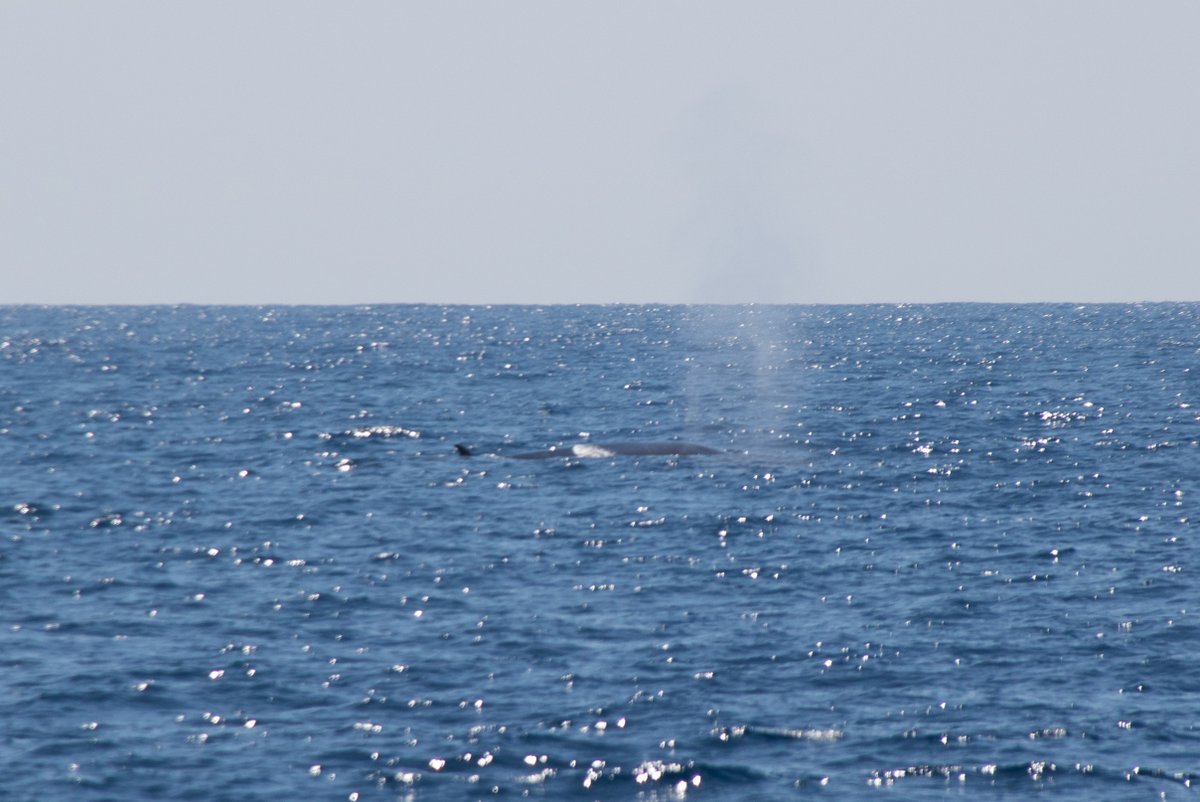
Once again, we were up at the crack of dawn. While we were having breakfast and getting ready to sail, we ran the watermaker to top up our tanks. By 07:00 we were on our way, motoring west in very calm seas. The island of Sri Lanka is surrounded by water over 2,000 metres deep and the steeply sloping sea bed attracts lots of pelagic fish and whales. We were lucky enough to see a whale blowing on the surface, but it was too far away to identify – it was probably a Blue Whale, which are common in this area.
It was a frustrating day, with very little wind. Every couple of hours, we’d get a teaser when the wind picked up a few knots, but after ten minutes we’d be rolling sails away and back to motoring.
There was a lot of garbage in the water and, sure enough, around lunch time, we heard a loud rattling noise from the stern as our rope stripper dealt with something wrapped around the propeller. We stopped the boat and I dived down with a kitchen knife to chop off the remains of a large rice sack. The stripper had done its job of cutting the sack allowing the propeller to continue to rotate (and not stalling the engine), but there was still a large amount of sack covering the propeller.
While on the subject of the propeller, after scraping it clean the other day, it’s singing again. We’ve found that at 1500 rpm, it’s quiet, but above that we get the damn resonating sound. In these calm seas, we go along at 5 knots at 1500 rpm, so it’s not too much of a problem, but when we get to a secure anchorage in the Maldives, I’m very tempted to remove the propeller and file on some anti-singing edges.
While I was bored this afternoon, I took my guitar tuner into the aft cabin and I can report that the resonating frequency of our Singing Ringing Propeller is 659.26 Hz which is the high E-string on a guitar.
By the late afternoon, huge clouds were gathering around us and, as the sun went down, we could see many rain squalls. Half an hour later, the dark sky was illuminated by lightning flashes. My 7-10 watch was miserable. The wind was constantly veering and backing by as much as 180 degrees in 10 minutes. The wind picked up to 20 knots at one point, but we didn’t get any more. We had rain varying from light drizzle to a torrential down pour.
Eventually, after a few sail changes, I settled with two reefs in the main and no head sails, motor sailing and easing the main out if the wind was too strong. The lightning continued for four hours and at times was terrifying with huge bolts of lightning leaping from the low clouds and striking the sea. I changed course a couple of times when there was consistent forked lightning ahead of us. Fortunately, the closest strike was ½ mile away (2 seconds from seeing the lightning to the thunder), but it was a tense time.
During Glenys’s 10-1 watch, the squalls moved off north and it was lovely when I got up at 01:00 – I even managed to sail for an hour. Unfortunately, the skies remained overcast, so we didn’t get the benefit of the full moon, although it was just bright enough to see the horizon.
16 March 2017 Sri Lanka to Uligama, Maldives (Day 2)
Today we had very changeable conditions. Dawn brought us grey overcast skies, with low cloud and signs of darker rain squalls around us. By 07:30, we had a 10 knot wind from the south-east, so we pulled out the sails and turned off the engine. Half an hour later, the wind increased rapidly to 20-25 knots from the SSW, putting us hard on the wind and forcing us to reduce sail to 2 reefs in the main and just the staysail.

We had a romp of a sail for the next three hours, but the wind slowly dropped and veered, forcing us to let out more sail and bear away north of our rhumb line. On the plus side, the squalls seemed to be heading north, leaving brighter skies behind. Eventually, we were being forced too far north, so I tacked south-west, started the engine and motor-sailed directly into the 2 metre waves, which was unpleasant, but at least we were heading towards brighter weather.
By midday, we were back on our rhumb-line course, motoring into a 10 knot west wind, with a horrible sloppy, confused sea, which was left over from the morning’s strong winds. As the afternoon wore on, the seas calmed down and the wind dropped to 5 knots from the north-west, finally giving us a pleasant motor-sailing angle.
At dusk, we had clear skies above us and scattered clouds on the horizon, giving us a nice sunset. On my 7-10 watch, the stars came out and I was able to see the Plough pointing north, the Southern Cross pointing south and Orion slowly leading us west. To the north, I could see the loom of lights radiating from India even though the coast was 100 miles away – extreme light pollution.
The nearly full moon came out just before our 22:00 watch change and the rest of the night was fabulous – nil wind, glassy seas, bright stars. What a change from the misery of last night.
17 March 2017 Sri Lanka to Uligama, Maldives (Day 3)
When I dragged myself out of bed at 07:00 this morning, we had no wind at all and we were gliding through a glassy calm sea, which continued all day. I spent the morning reading up on the history and geography of the Maldives - there are thousands of small islands and reefs scattered through the twenty or so major atolls.

We’re only planning to stay in the Maldives for 60 days, so we need to prioritise where we stop. There’s also about 500 miles of sailing between Uligama in the north to Gan in the south, so that’s going to take up some of our time – probably 20 out of our 60 days will be spent sailing between anchorages. If we stop in each anchorage for 2 days then we can only visit 20 anchorages...
By noon, the sun was beating down and there was no sign of any wind, so we went into full “tramp” mode - rolled away the main sail; and then put up the boom awning and uber-scoop. After that, it was much cooler in the cockpit and aft cabin.
Glenys has been having a nightmare with the fresh food that she bought in Sri Lanka. After only one day, she noticed a nasty “rotting cabbage” smell and found that the cabbage bought from the fresh market was starting to go. Dodgy leaves were removed and the cabbage is in the fridge. Bread has gone mouldy in three days, bananas have ripened quickly and grown mould, an avocado went off and she had to throw away three mouldy tangerines. Goodness knows why stuff has gone off so quickly.
During the afternoon, Glenys noticed a brown object in the water - we first thought it was a piece of flotsam. We spotted another object a minutes later, so went over to investigate and found that they were juvenile turtles. They had lots of green seaweed on their backs, so they look like they spend a lot of time floating on the surface. It was almost like they were sleeping because when we came close they slowly roused themselves and swam away – they also seemed to have difficulty submerging – very odd.
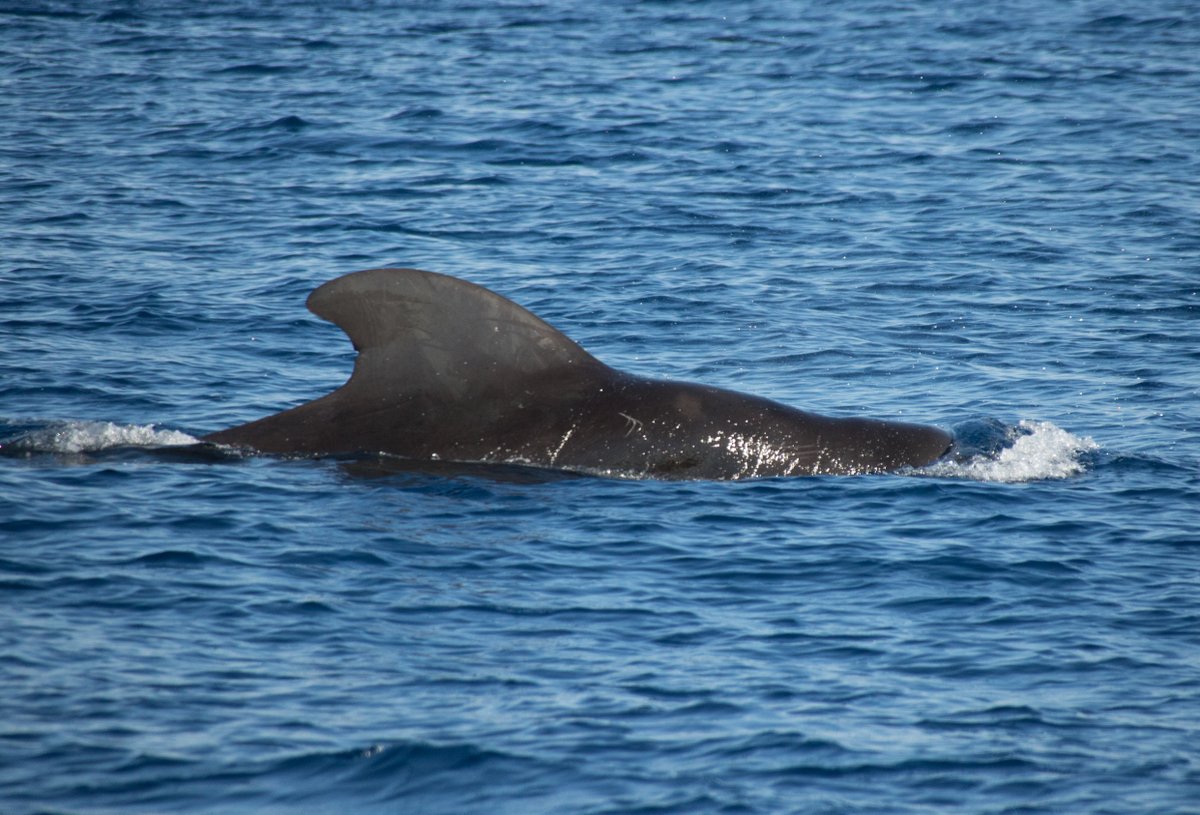
We had a nice encounter with a pod of a dozen Short Fin Pilot Whales. They were slowly making their way south-west, but allowed us to get within 50 metres. I have lots of photographs of grey fins barely sticking out of the water – they aren’t the most energetic creatures that we’ve seen.
The lack of wind continued into the evening, so we slowly motored towards our destination – at sunset, we had 85 miles to go. The night was more of the same – motoring and motoring. At least we had a beautiful starry sky, even better than last night.

18 March 2017 Sri Lanka to Uligama, Maldives (Day 4)
At sunrise, Glenys got our first glimpse of land, but it took us another four hours to get to Uligama. It was low tide and overcast when we arrived, and the preferred anchorage is a small 70 metre wide patch of sand in the middle of the fringing reef. We had several attempts to cross the reef, but kept backing off when the depth dropped below 3 metres with bommies sticking up around us. Eventually, we found a way through and anchored in 3.5 metres depth in gorgeous white sand at 07°05.067N 072°55.164E.
We anchored in the middle of the sand patch and I only put out 15 metres of chain to reduce our swinging circle. The anchor slammed into the sand, but we were still nervous about being in the middle of the coral with no clear escape route, so I dropped a second anchor about 15 metres away from the primary anchor, which will help me sleep tonight - I’m such a wimp…
As soon as we’d anchored, our agent, Hammad of Real Sea Hawks, called us on the VHF radio and said that the officials would be coming out in 30 minutes to clear us in. Bang on time, four officers from the Coast Guard, Immigration, Customs and Health came out in a small boat and piled into our cockpit. The agent was very efficient and had the various forms ready for me to stamp and sign. Most of the forms were standard apart from the Coast Guard declaration which lists illegal items. As well as the usual firearms and drugs, other illegal items included alcohol, pig, dog and pork - we are definitely in a strict Muslim country. The formalities were all finished within 30 minutes. The agent might cost a lot of money, but provide a good service - Hammad even brought out two SIM cards, so we were online by midday.

After putting the dinghy into the water and having lunch, we went for a snorkel. The coral inside most of the Maldivian atolls was badly damaged by a major bleaching event a year ago, but this area seems to be only slightly affected. The reef next to the anchorage had healthy hard corals, but not much soft coral. There are also plenty of fish - Cow Tail Stingrays under our boat and I had a curious Nurse Shark circle me.


Later in the afternoon, we ventured into town. Hammad met us at the dock and took us to a tiny cafe, where we had a cup of tea and some “short eats”, which are small samosas and other spicy snacks. While we were there we topped up our SIM cards, so that we now have 4GB each. We stopped off at a small shop, where Glenys bought some of their nice-looking potatoes and some other fruit and vegetables, some of which are grown hydroponically at a nearby island.
We all went for a stroll around the small village, which is laid out on a very rectangular grid. The streets are hard packed sand and the Older Houses are built of Coral Rubble cemented together. Hammad told us that the use of coral is not allowed anymore and they build with cement blocks now. There are 500 people living in the village, but a third of them live away, working on resorts and at the capital, Male.


19 March 2017 Uligama, Maldives
We had a day pottering about on the boat, waiting for our Cruising Permit. Glenys jumped in the water and scrubbed our water line, which was looking a little “green”. I checked the engine after our 70 hour marathon and all looks good, which is a relief. I did some admin catching up on emails.

There’s a bit of a fuss because the Maldivian government has recently imposed a monthly fee for anchoring in Hulhumale (near Male), which is $50US/metre. This means that we would be charged $660USD, even if we only stop there for a few days. As one cruiser has wryly said “There’s no anchorage in the world worth $600 per month”. It looks like we’ll be sailing past the capital of the Maldives.
While on the subject of fees, we were planning to stop at the Seychelles for a couple of weeks in July, but we’ve just found out that the Customs in the Seychelles are now charging a $225 "Launch fee" for customs to come out to a yacht entering the main town of Mahe. The clearance fees have gone up from $90US to $315US - a 300% increase. I’ve sent off a whinging email to various government officials in the Seychelles to try to get them to overturn this huge fee, but I suspect that we’ll be avoiding the Seychelles as well.
The Indian Ocean is rapidly turning into an expensive trip. The Andamans cost us $300US with visas and port fees; Sri Lanka cost $450US for agent’s fees, visas and port fees; the Maldives is costing $1,200US in agent’s fees, visas and port fees. That works out to just over $100US per week for clearance fees alone.
Yesterday’s approach to the anchorage over the reef was a little fraught, so I went out in the dinghy with our portable depth sounder and found that there’s a better route into the anchorage even in poor light conditions. I suggest that you line up with the dredged channel into the town’s small harbour and at the first marker pole turn 90 degrees to port, following a sandy channel into the anchorage. It’s easy to see the sandy channel and there’s at least 4 metres of depth all the way into the anchorage (which is 3.5 metres deep). Waypoints would be: 07°04.942N 072°55.161E; 07°04.964N 072°55.203E; 07°05.006N 072°55.194E. Anchor at 07°05.067N 072°55.164E.

The Cruising Permit never turned up. We were told that, being a Sunday, there was a backlog of work at the government office and they didn’t file our application on their computer system correctly, so our agent wasn’t able to pay the fee - we should get it all resolved tomorrow.
Since we were hanging about for the afternoon, I asked Hammad to arrange diesel for us. A couple of hours later a wooden boat turned up with a load of 20 litre containers filled with diesel. The crew very efficiently siphoned the fuel in to our tank through our diesel filter funnel. I’m glad that I used the filter because there was quite a bit of water and dirt in the fuel. The fuel cost $0.89US/litre.
A couple of times during the day, we went snorkelling on the nearby reef and saw a Green Turtle, lots of colourful Powder Blue Surgeonfish and two Blacktip Reef Sharks.


During the day, I had various discussions with Hammad and Assad about the Cruising Permit and have discovered that the document lists the places that we’re allowed to “visit”. After much dialogue, it appears that we are not allowed to go ashore at any “inhabited” islands apart from four places - Uligama, Kulhudhuffushi, Hulhumale/Male and Gan.
Not only is this going to prevent us from having a look around small villages and meeting the locals, but we won’t be able to buy provisions anywhere apart from the four named towns. To make matters worse, we won’t be able to visit Male because of the new high anchoring fees, so we’re faced with a 450 mile stretch of the country between Kulhudhuffushi and Gan, where we won’t be able to go ashore or buy food.

I’ve been told that this has always been the case, but in the past, cruisers have visited towns without any problems. However, Assad tells me that last year a French Yacht sold alcohol to some locals, which the Muslims regard being as bad as illegal drugs, so the Customs have clamped down and don’t trust sailors any more. Apparently, they are actively checking for infringements of the cruising permit and a fine of $2,000US could be enforced.
There’s a Sail Maldives Rally in progress, which started three weeks ago. They have an itinerary that is visiting many inhabited islands where we are not allowed to go. I’ve been told that they have special dispensation from the government to be able to do this. Unfortunately, they are 200 miles south of us and we’ve missed that opportunity.
I’m so annoyed by this that I’ve send a couple of formal emails to Assad, focussing on the provisioning problem and requesting that another dozen towns be included on our Cruising Permit. My logic is that there should be at least one town in each major Atoll, which we are allowed to visit to buy food and supplies. Assad says that he’s going to send the emails onto the relevant authorities - don’t hold your breath.
In the evening, a small fishing boat came into the anchorage and cruised past us with lights blasting away. They had two poles rigged out to either side of the boat, with three guys wearing snorkelling gear hanging onto each pole. Every so often, the divers would let go and swim over the reef with dive torches. I later discovered that they are looking for lobster to sell to the tourist resorts.
20 March 2017 Uligama to Dhiffushi, North Male Atoll (Day 1)
I woke up exasperated about the fact that we won’t be able to go ashore at any of the “inhabited” islands and decided that our best bet was to try to join the Sail Maldives Rally. I emailed our agent, Assad, who contacted the organiser of the rally, who said that we are welcome to join. I chatted to the organiser (Haneef) on the phone and he’s sent me a list of their planned anchorages for the next 10 days.
I’d done all this while Glenys was still in bed. Fortunately, after she’d woken up, she agreed that it was a good idea to join the rally, so we confirmed with the rally organisers. The rally will be arriving in Himmafushi on the 22nd March. This is 10 miles north of Male and 190 miles from here, so we decided that the best plan would be to sail overnight and join the rally as soon as possible. We’ll be sailing past a big chunk of the northern half of the Maldives, but there’s still 200 miles of atolls to explore in the southern half, which should keep us occupied for eight weeks.
At 10:30, Hammad texted me to say that our cruising permit was now sorted out, so we went ashore. He’d found us a big papaya and two breadfruit, which Glenys had asked for, and handed over the Cruising Permit. The document is valid for thirty days and is a single piece of paper that states that we can only visit two places - Kulhudhuffushi and Male. It also says very clearly that “This permit allows visiting only permitted islands and places”.
We paid $780US as a down-payment on our fees and ran away. By 12:00, we were on our way out of the anchorage and motoring in nil winds, heading for Dhiffushi, N Male Atoll, where we will join the rally.
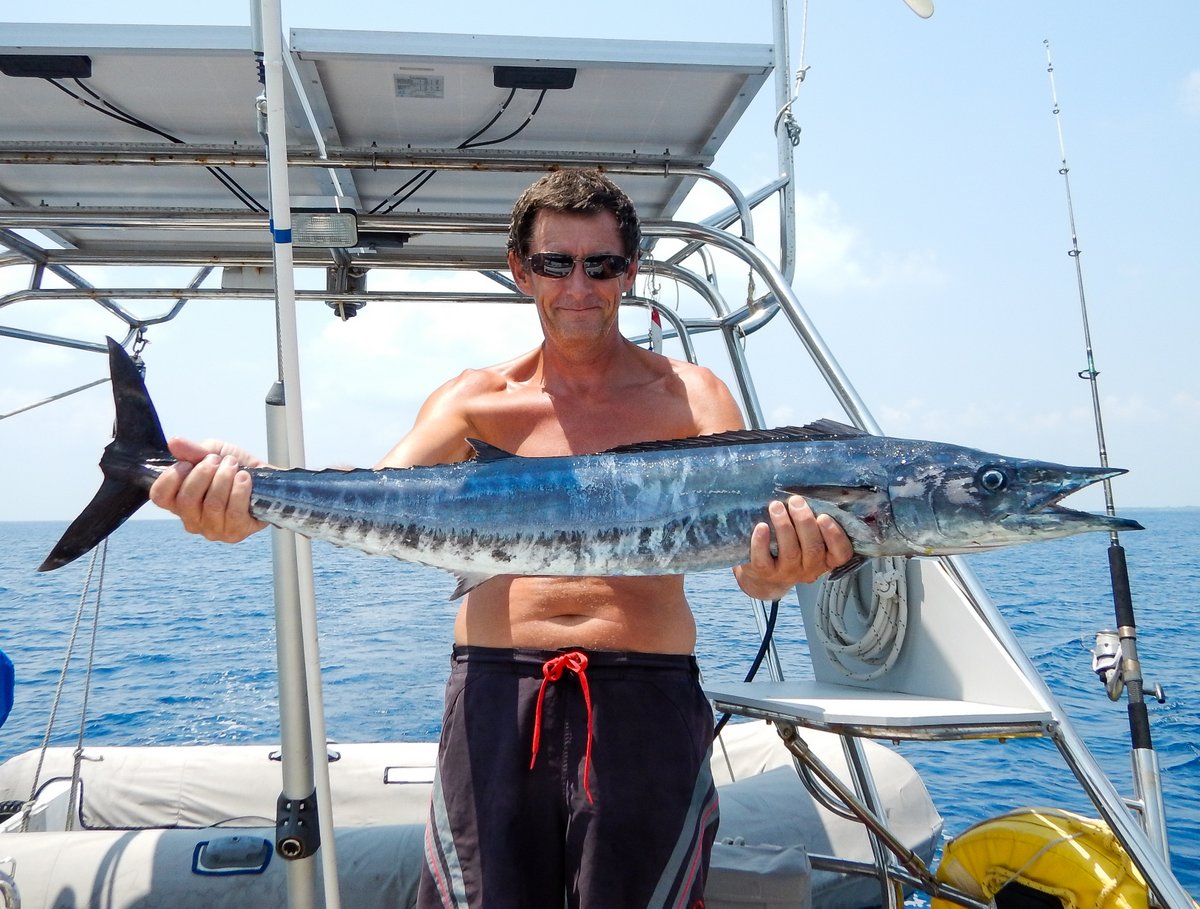
We had a very hot afternoon motoring through the top of North Thilandhunmathee Atoll and then out to sea following the eastern edge of the various atolls heading south. The big excitement of the day was catching a 6kg Wahoo. It’s the first fish that we’ve caught for months, so I was pleased with myself. Later in the afternoon, we saw another group of Pilot Whales, but the moment soon passed and we were back to motoring monotony again. The night was more of the same remorseless motoring.
During the night, I checked our paperwork (I was very bored) and found that after all the waiting, we’ve been given the Cruising Permit for another boat! I’m kicking myself for not checking it properly before we left, but we were just so grateful to get the document and be on our way. Goodness knows how they will sort this one out, now that we’re 200 miles away.
21 March 2017 Uligama to Dhiffushi, North Male Atoll (Day 2)
Dawn brought no wind, so we lounged about all day, motoring hard to get to Dhiffushi before dark. I spent a few hours down below catching up on editing photographs and doing my blog. Glenys read a book.
Every time that I stuck my head into the cockpit, I would see a Flying Fish scooting across the calm seas. They are fascinating to watch - popping out of the water and gliding on their wings; then as they lose speed they dip their tails into the water, give a few waggles and accelerate to maintain their glide. I’ve been trying for years to get a decent photograph, but each time I go to the front deck they never appear - I stand there for five minutes and then give up - I don’t have the patience to be a wildlife photographer.
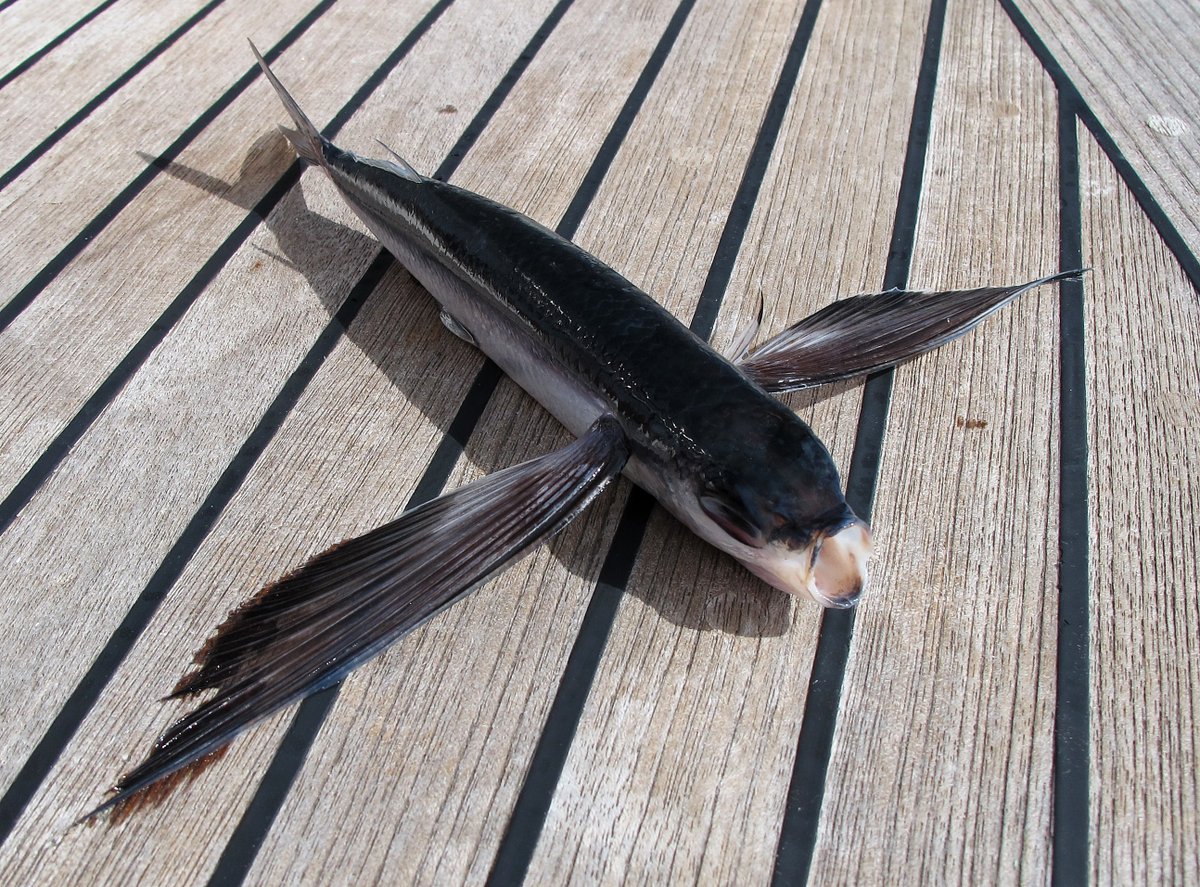
We arrived in the anchorage at Dhiffushi at 15:30 and dropped our anchor at 04°26.99N 073°42.17E in 10 metres of water. There are about ten other boats on the rally and one guy zipped over in his dinghy to tell us that everyone was going ashore at 16:30 for a welcoming ceremony. OK; sort the dinghy out; get the awning up; have a shower and hurry ashore.
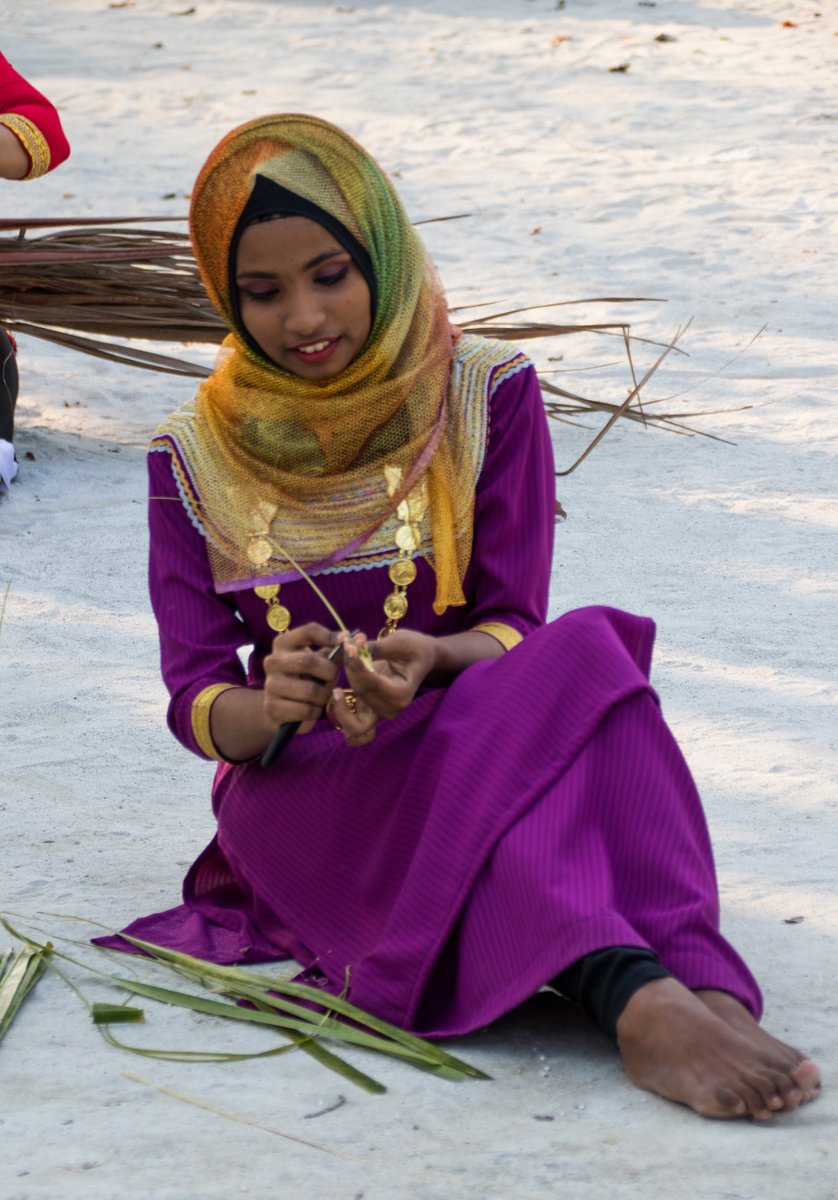
Dhiffushi has about 1,000 people and has a few guest houses run by the local people, so there were a few white tourists on the small beach. The welcoming ceremony was quaint, with a short traditional dance by a group of ladies and then another group of ladies sat on the ground in front of us and demonstrated some of the traditional skills of the islanders, such as making coir rope (from coconut fibres), threshing rice and weaving coconut fronds.
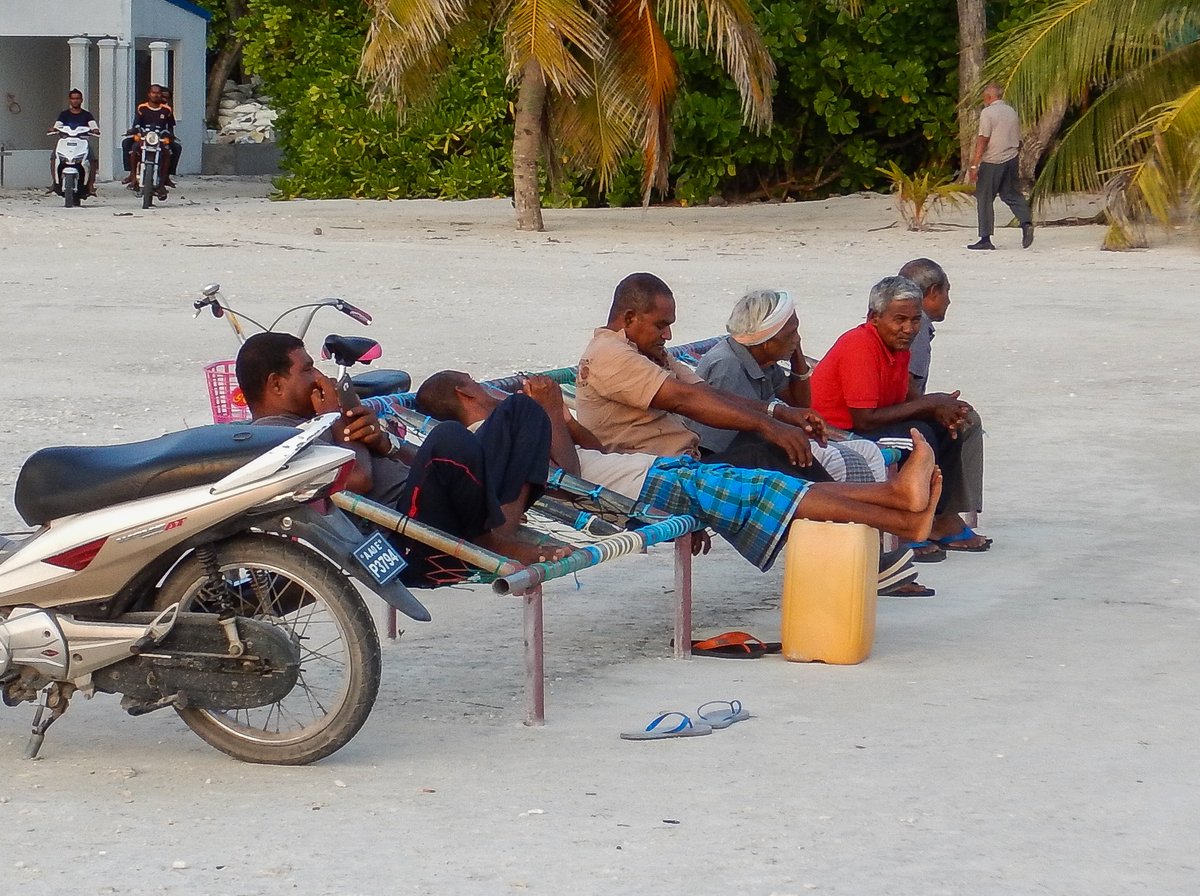
We were then escorted around the village, which was similar to Uligama on a very rectangular grid pattern, but it was a little more “lived in”. It was interesting to see the numbers of Jolis around the town - these are a cross between a deck chair and a hammock and are the traditional Maldivian chair. Originally, Jolis were made entirely from the coconut tree, with a wooden frame supporting a rope seat made from coir rope. Nowadays they are made from synthetic rope and steel tubing.
Everyone retired to the Rally’s Mother Ship, which is a 70 foot catamaran power boat, with two decks. The top deck is a huge open space, the size of a tennis court, while the lower deck is more like a night club complete with a mirrored ball on the ceiling. We all congregated on the top deck, where the organisers had laid on free, ice-cold beer - bring it on!
22 March 2017 Dhiffushi to Himmafushi, North Male Atoll
After our long overnight passage and our indulgence in free beer, we had a lie-in until nine o’clock. Half an hour later, John from “Atea” called by to say that they were going to do a wreck dive and did we want to come? Yes, please. We leapt into a frenzy of filling dive tanks and getting the gear ready, only just making it before John, Eric and Chantelle arrived in “Hokulea’s” dinghy.
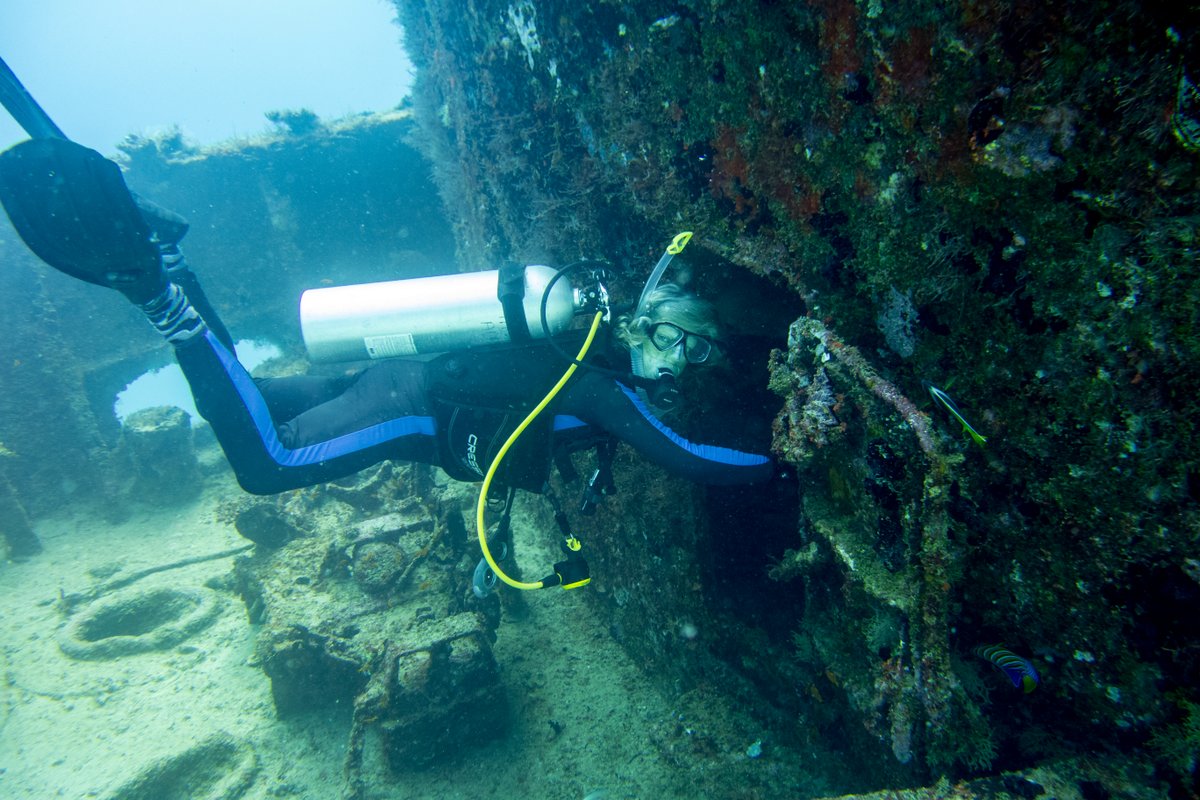
It was 1½ miles to the dive mooring at 04°27.483N 073°40.831E. The wreck is at 20 metres directly west of the mooring and was only put in place five years ago, so there’s not a huge amount to see, but it was a pleasant dive in clear water. The highlight was finding a Peacock Mantis, lurking at the edge of his little cave.

Back on the boat, we washed the dive gear, lifted the anchor and had a lovely sail in a 10 knot west wind, giving us a nice beam reach. There was a very obvious 4 metre deep channel through the reef, which took us into the protected lagoon at Himmafushi. We anchored at 04°18.32N 073°33.58E in 8 metres of water amongst a few coral bommies.
After a short rest, we donned snorkelling gear and swam across the fringing reef to the drop off. Unfortunately, it was disappointing with mostly bleached coral. There’s an incredible thermocline, with bath-temperature water on the surface and cooler water once you get down to five metres, but even the deeper reef was bleached out.
We've been told that the Rally has arranged for the Rally participants to anchor in Hulhumale without having to pay the $50US per metre anchoring fee, so the plan is to go there tomorrow. (We later found out that the Hulhumale Authority is not going to charge any visiting cruisers, but this may change.)
23 March 2017 Himmafushi to Hulhumale, North Male Atoll
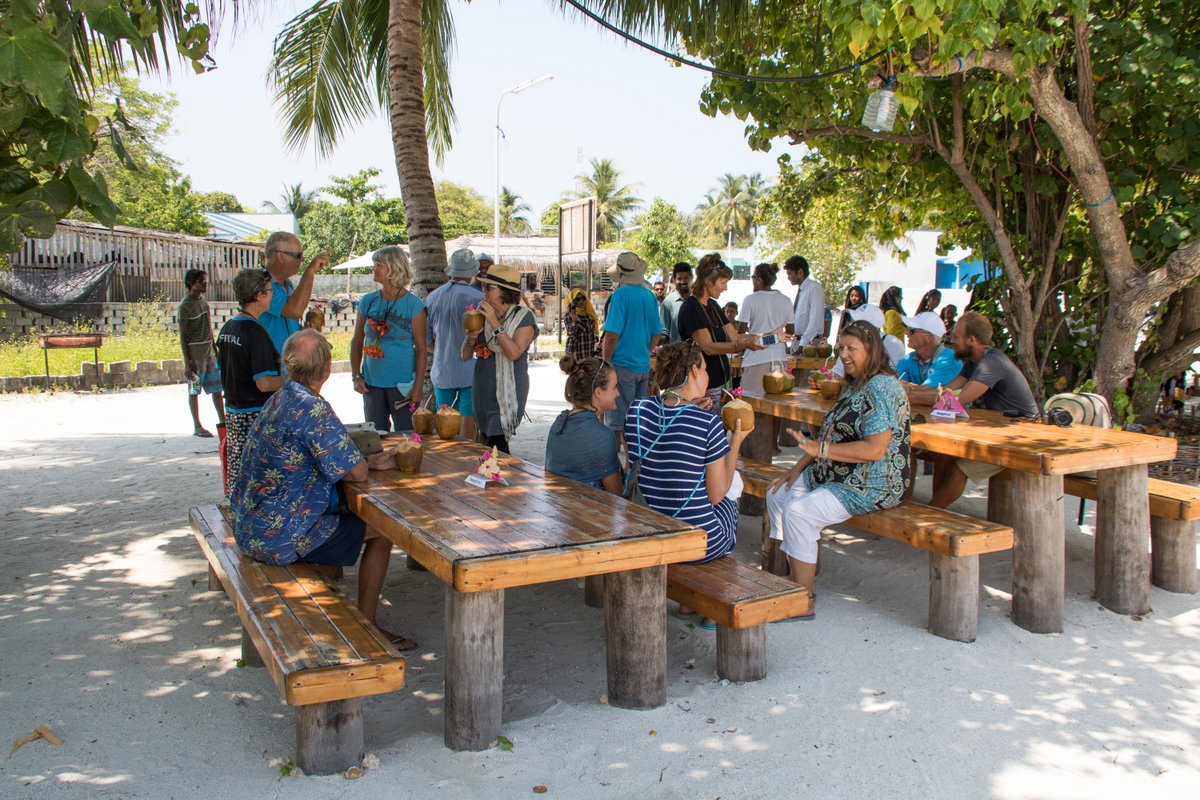
There was a “welcoming ceremony” in morning, which consisted of a lot of hanging about; a small flower garland handed out by some school kids; a drinking coconut; a short dance by the kids and a walking tour of the island. On the plus side, they provided a good buffet lunch with some interesting local food.
While we were hanging about, I had a discussion about the cruising permit with John on "Atea", who spent three months in the Maldives last year. He confirmed that the official line has always been that we can't visit any islands apart from the four listed on our Cruising Permit. Last year, "Atea" went ashore whenever and wherever they wanted - as did everyone else that we’ve talked to.
I think that Assad is taking the "official" line and that the Customs might want to be a little stricter this year, but we would be very unlucky to have any problems visiting inhabited islands.
All of the three small islands that we’ve visited so far have Guest Houses for tourists and some souvenir shops and dive operators, so it's unlikely that the locals would be bothered about us going to their island. We'll have to think about what we'll do when we leave the rally in a few weeks' time, but for now, I'm going to ignore all the politics and start enjoying myself...
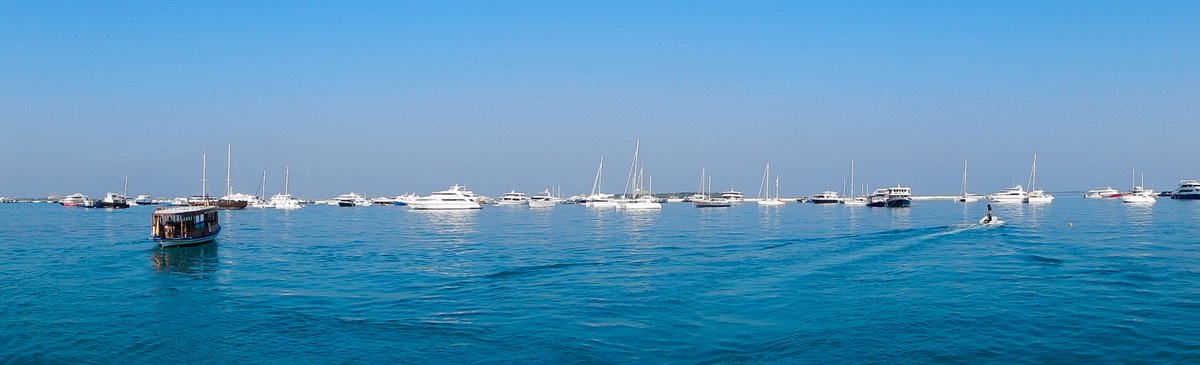
After lunch, we all rushed off to our boats to motor six miles to Hulhumale - it was like the “Wacky Races”, with boats roaring out of the anchorage. The entrance through the breakwater into the Hulhumale anchorage at 04°13.17N 073°31.93E is wide and at least 4 metres deep and once inside the depth drops to 10 metres. The anchorage is very, very crowded with scores of live-aboard tourist boats swinging on moorings or with three anchors out.
It took us two attempts, but we managed to squeeze into a space at 04°13.45N 073°32.21E. We were anchored in 10.5 metres, but only put out 30 metres of chain to reduce our swinging circle - it seems to be very good holding on sand. The anchorage is busy and noisy with international jets and sea planes flying overhead; dinghies whizzing about; fishing boats milling; and in the channel to the east of the anchorage, huge barges ply back and forth bringing hard-core to the land reclamation project to the north.
24 March 2017 Hulhumale, North Male Atoll
After breakfast, we went snorkelling with “Jackster” and “Ngawala”. There’s supposed to be a world-class dive spot called Banana Reef, which we believed to be one of the two reefs about ½ mile to the north west of the northern channel into the anchorage. (At 04°13.46N 073°32.21E and 04°14.04N 073°32.00E). Both of these reefs are completely dead and just a pile of rubble.
However, there were a lot of fish, so we drift-dived the northern one, with Dave from “Jackster” volunteering to stay in his dinghy as support. There were lots of Giant Moray Eels, but nothing much else of note. The other reef had less current and was marginally better, but only worth twenty minutes of our time.

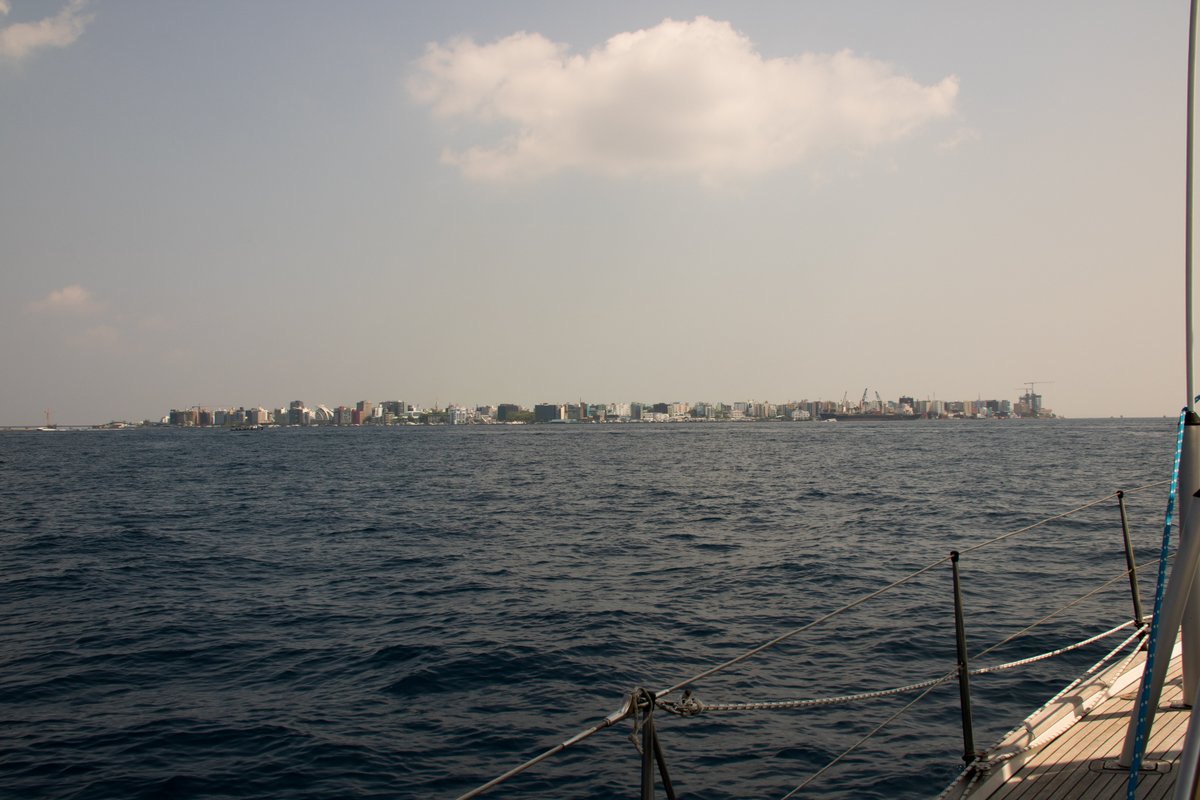
In the late afternoon, we went ashore and wandered around Hulhumale. It’s a massive reclaimed island designed to meet the expanding housing and commercial property demands of Malé, the capital city, which is drastically overpopulated. The reclamation was started in 1997 and is planned to be completed in 2020.
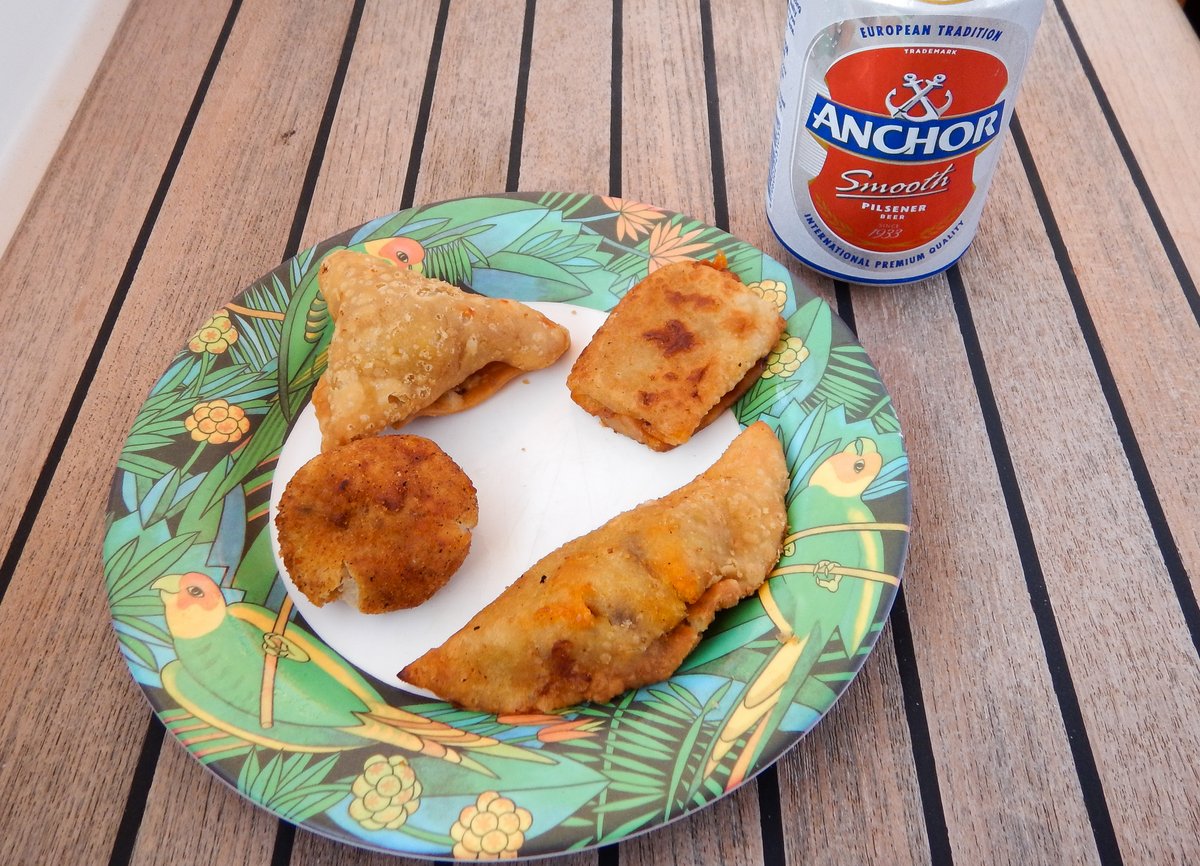
The town is obviously a “new town” with multi-storey apartment buildings laid out in a very rectangular pattern - like 1960s UK council houses. It’s not a pretty place, but they have a pleasant formal park and the supermarkets are well stocked. Glenys bought a few more provisions and we took home some “Short Eats” bought from a café.
Unfortunately, we’ve arrived at Hulhumale at the start of a weekend, when the live-aboard tourist boats have their change-over. Just before dark, dozens of the huge 100 foot long boats turned up and it was mayhem. They all seem to drop their main anchor and then put out two more anchors 75 metres away on long ropes.
One of the live-aboard dive boats anchored about 15 metres in front of us , which was way too close, but there was no way that they were going to move - they were so near that their aft deck lights were illuminating our whole boat. We didn’t want to have our dinner in the cockpit staring at them, so we had bacon and grilled tomato butties down below while watching a movie.
25 March 2017 Hulhumale to Emboodhoo, South Male Atoll
We didn’t sleep particularly well, but thankfully the big live-aboard boat didn’t bang into us. I got up in the middle of the night and they still had lights blasting away, but at least they had someone on anchor watch.
After an early breakfast, we went into Male on the local ferry. We were hoping that the place would be interesting because it’s one of the most densely populated cities in the world (with a population of 133,000 in an area of 2.2 sq. miles). However, we weren’t impressed - it’s just a big town full of shops. There were no interesting places to visit, apart from a large mosque (not allowed in), the Sultan’s Park (closed) and a museum (yawn). It didn’t help that they had a power cut and lots of shops were closed because they couldn’t operate their tills.
We were back at Hulhumale by 12:00, where we called in at a supermarket to buy some more provisions, before heading back to the boat. After a quick sandwich, we pulled up the anchor and ran away from the chaos. It was interesting to motor past Male - much better than visiting it.
We headed down to South Male Atoll and entered through a narrow pass at 04°07.48N 073°27.53E, which was very deep and easy to navigate in good light - it goes right past a big resort. Working our way across the atoll, we motored to Emboodhoo, going through the fringing reef at 04°05.46N 073°30.79E. We anchored at 04°05.65N 073°31.23E in 12 metres of water on lovely sand.
26 March 2017 Emboodhoo, South Male Atoll
Mid-morning, we jumped in the dinghy and went snorkelling in the pass to the south of the anchorage. There was a strong current, so we drifted with the dinghy down both sides of the pass. It was all very disappointing with bleached coral along the whole channel. There were plenty of fish, but the lack of colourful coral makes it look so depressing.
For lunch, we had Fish Curry Butties - we still have two more days’ worth of the Wahoo to finish off. In the afternoon, we went snorkelling on some coral pinnacles inside the lagoon, but again, the coral is completely bleached and broken off in huge chunks. It’s such a pity; we could see that the pinnacles used to be fabulous coral reefs, but no more. We’ve not done any decent snorkelling in the Indian Ocean - I hope that it will get better.
We had a quiet evening, watching a movie - Pan-fried Wahoo, Breadfruit chips and peas.
27 March 2017 Emboodhoo to Mathiveri, North Ari Atoll
The organisation of the Sail Maldives Rally is a bit chaotic. Two days ago, we were told that the next stop was at Guraidhoo, which is 10 miles south of Emboodhoo. Last night they told us that we have to go to Mathiveri, 45 miles west of Emboodhoo, so we had to get up at 06:00. The 15 knot wind was from the WNW, so we were motoring almost directly upwind.
After a couple of hours, we heard on the radio that some of the boats were going to Rasdhoo Atoll, so we headed there, which was even more up-wind. It was a grey, overcast day and it seemed pointless to just stay one night in Rasdhoo, so a few miles out, we changed our minds; bore away and headed for Mathiveri. At least we were able to sail for a few hours.
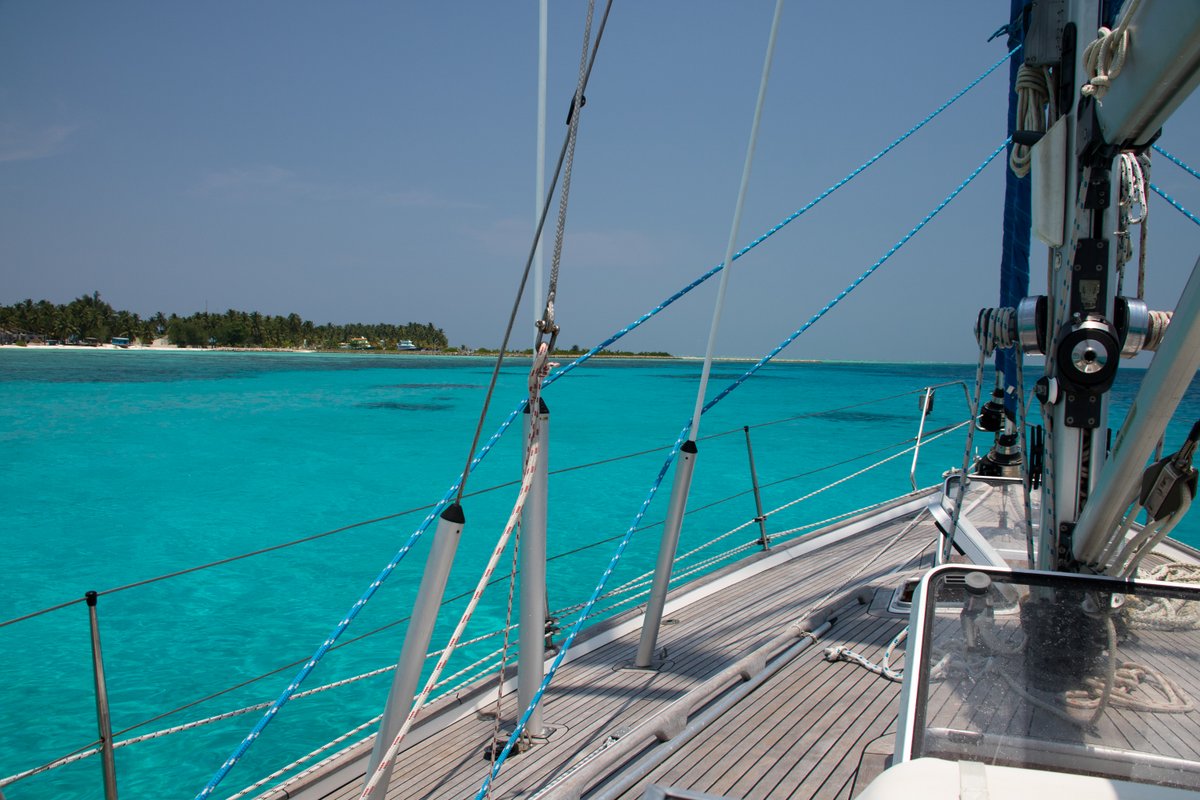
On the way, we checked out a couple of coral reefs where we thought that we might anchor overnight, but the reefs were well below water and with the strong 15 knots wind, the anchorage would be bouncy. Frustrated, we continued to Matherveri and anchored at 04°11.44N 072°45.11E in 5 metres on sand in between coral heads. I was worried about swinging into the fringing reef if a squall came through, so we put out a second anchor. It's a beautiful anchorage with stunning water colours.
Fortunately, the skies cleared a little and we were able to go snorkelling around the boat, which (surprisingly) still has some live coral. There’s plenty of sea-life, so I’ll be happy to stay here for a few days. By nightfall, no one else had turned up - it looks like some boats are still in Male and the rest have stopped at Rasdhoo Atoll - as I said, the rally is a tad chaotic!
28 March 2017 Mathiveri, North Ari Atoll
After breakfast, we popped into the village and spoke to Aslam, one of the Council members. He confirmed that there was a welcoming ceremony at 16:30 and told us the best places to go snorkelling and diving.
We headed north from the village to a wrecked sail boat. It was sunk about a year ago, so didn’t have any reef growth on it, but it was interesting to snorkel around. It still has a windlass, winches and hatches - in most places around the world it would have been stripped by now.
Our next stop was at an isolated reef at 04°11.74N 072°45.89E, which was interesting. The coral is all dead, but there’s still a large number of fish around. We were pleased to have an encounter with a Devil Ray, which was cruising along the north side of the reef. We also saw a couple of Blacktip Reef Shark. The south side was shallower and didn’t have as many fish.

Back at the boat, I started to fill our dive tanks, but the damn generator started to run slow then fast and eventually stalled the dive compressor. I spent a miserable hour in the hot engine compartment getting it going again. There was a nasty rattle and vibration, which turned out to be the heat exchanger bouncing about because the two hose clamps holding it had broken.
The irregular running was another issue, which I isolated to the fuel relay being loose in the relay holder. It looks like the female connectors have become loose, so I attempted to force them closed, but the fuse holder is in an awkward place and it was a struggle using a torch and a mirror to see what I was doing. After a few attempts, I managed to get it going again, filled the dive tanks and ran the water maker for 30 minutes to make sure that all was well.
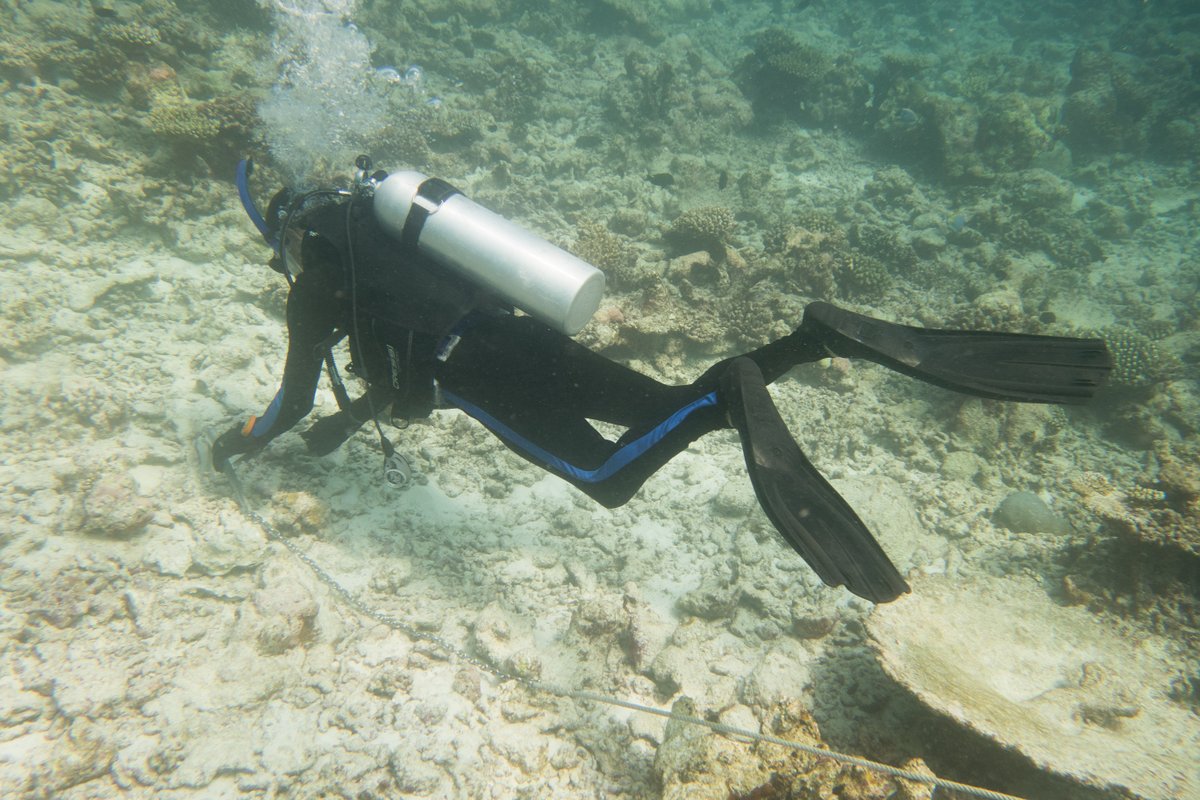
Finally, we went for a scuba dive at 04°10.92N 072°44.68E. It was a shallow dive on a flat reef in depths between 6 and 14 metres. Again the coral was bleached and in very poor condition, so it wasn’t the best dive that we’ve done.
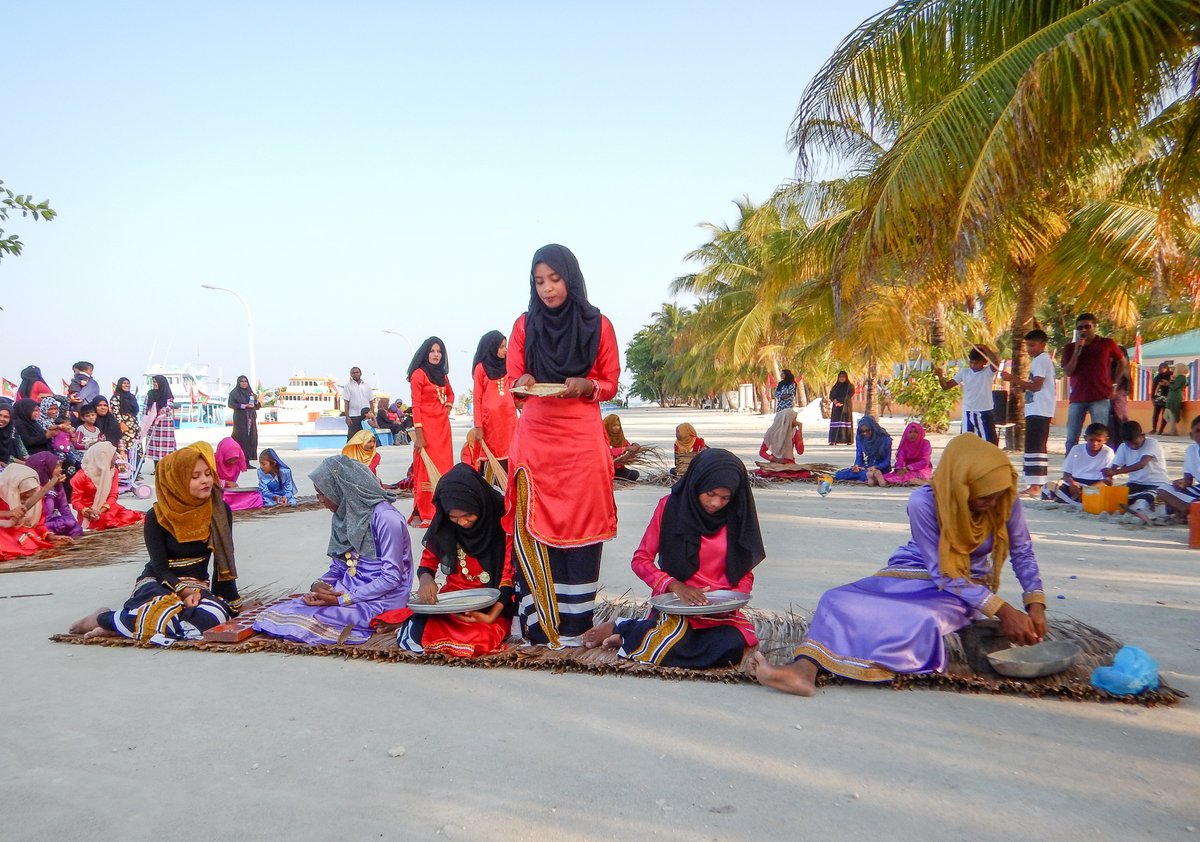
There was a welcoming ceremony in the late afternoon. It was embarrassing because only four yachts have arrived, so the eleven cruisers were heavily outnumbered by the 100 villagers who turned up. Nevertheless, everyone was friendly and a group of teenagers demonstrated various local crafts. We were then taken for a tour around the island.
Each island has a Council, who manage the island’s resources. They are keen to promote tourism and especially their locally owned guest houses. The villages that we have seen are very similar with streets of hard packed sand laid out in a regimented rectangular grid. Nevertheless, it’s interesting to walk around and chat to the locals about their way of life.
29 March 2017 Mathiveri to Maavaru Faru, South Ari Atoll
We left Mathiveri early and motored 20 miles down to Maavaru Faru, which is an isolated circular reef. We entered at the northern end of the reef and anchored at 03°52.432N 072°42.92E in 10 metres. As soon as the anchor was set, we jumped in the dinghy and went snorkelling. We tried in the channel around 03°52.51N 072°43.36E, but once again the coral was all bleached out.
Feeling desperate, we went out to the North East corner of the reef, but the seabed was sparse, scoured by the waves. We then noticed some tourist boats hanging about on the nearby drop off, so we swam out as they dropped snorkelers into the water. The boat crew told us that this was a Manta feeding station (03°52.72N 072°42.41E). We stayed there for fifteen minutes, but didn’t see any mantas. By this time we were feeling a bit exposed and retreated because we were ¼ mile from our dinghy and essentially out to sea - if a strong current set in then we’d be in trouble.
In the evening, Mick & Janice from “Zoa” and Tony from “Endymion” came for sundowners.
30 March 2017 Maavaru Faru to Dhigurah, South Ari Atoll
An early start saw us motoring south. Around midday, we stopped off at another isolated reef called Gorraalhuhau. The entrance pass was at 03°36.44N 072°48.53E and it was over 8 metres deep. We anchored on a sand slope at 03°36.57N 072°48.54E in 8 metres depth, then backed up into a small sandy patch, which was much shallower and surrounded by coral. It was very tight and it’s definitely a settled weather lunchtime stop.
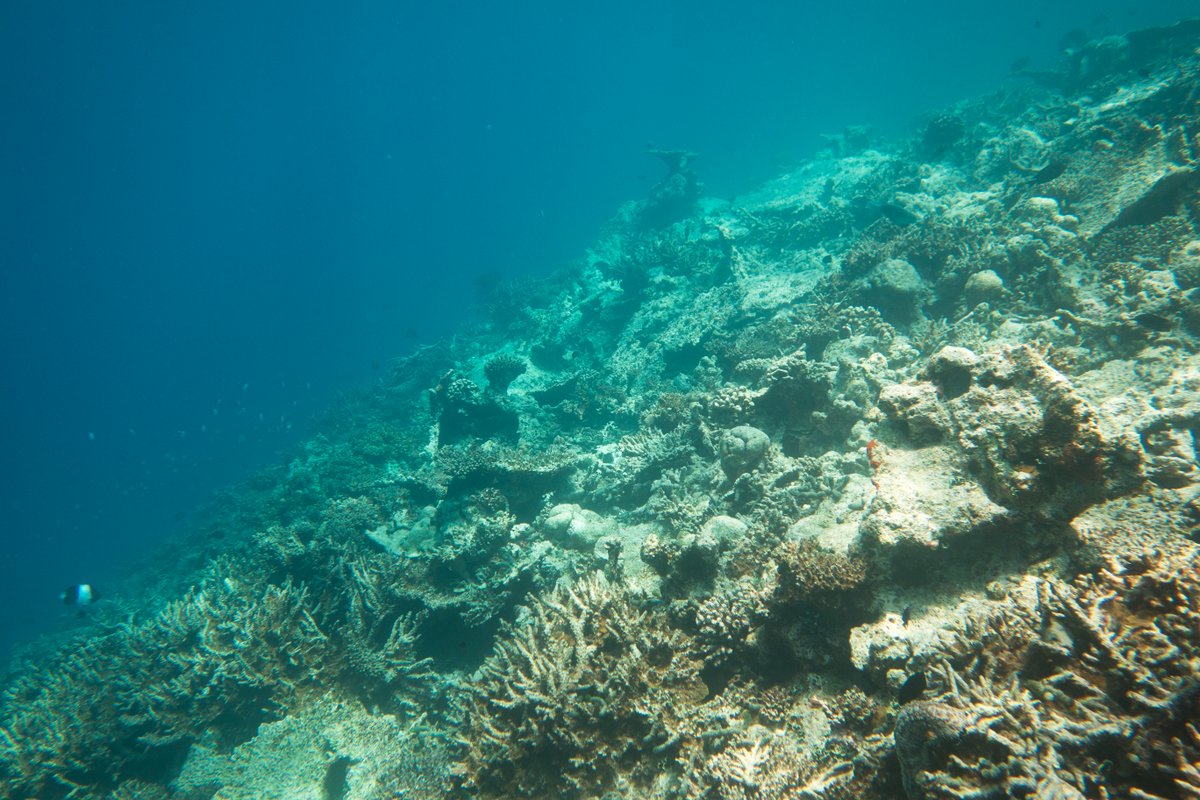
We snorkelled around the boat; and then we tried the eastern drop off; and then we went across to a sand spit where we’d seen a tourist boat dropping off snorkelers - everywhere, the coral is bleached out and dead. The colours are beautiful above the water, but below it’s like a moonscape - I felt like crying.
After lunch, we continued on to Dhigurah, crossing over the fringing reef at 03°32.38N 072°54.96E and anchored at 03°32.04N 072°55.50E. I went ashore and chatted to a dive operator, who offer dives for $65US per person and snorkelling with Whale Sharks for $65US. I declined because it’s just too much money, but he was still willing to have a chat about the diving in the area. He told me that in May 2016 there was a major bleaching event, which has killed off most of the coral in the shallow reefs in the Maldives. There’s still live coral in the deeper water (>20 metres) and in the channels where there’s a strong current, but you have to know where to go.
Back on the boat, I did some research on the problem:
Corals are marine invertebrates, which typically live in compact colonies of many identical individual polyps. Each polyp is only a few millimetres in diameter and has a set of tentacles surrounding a central mouth opening. An exoskeleton is excreted near the base. Over many generations, the colony thus creates a large skeleton creating coral reefs.
Most corals live in a symbiotic relationship with algae called zooxanthellae, which live within their tissues. Zooxanthellae are able to transform light energy into chemical energy and sugars (photosynthesis). Those sugars are directly transmitted to the coral host, and represents 80% of the coral's nutrition. Interactions between the two generate the brilliant colour of coral.
If the sea water temperature is raised above 31 degrees C, then the zooxanthellae over-produce nutrients and the polyps start to reject the zooxanthellae. If the high temperatures persist for a week or more the polyps will reject all of their plant partners and the coral loses its colour, turning white - called Bleaching.
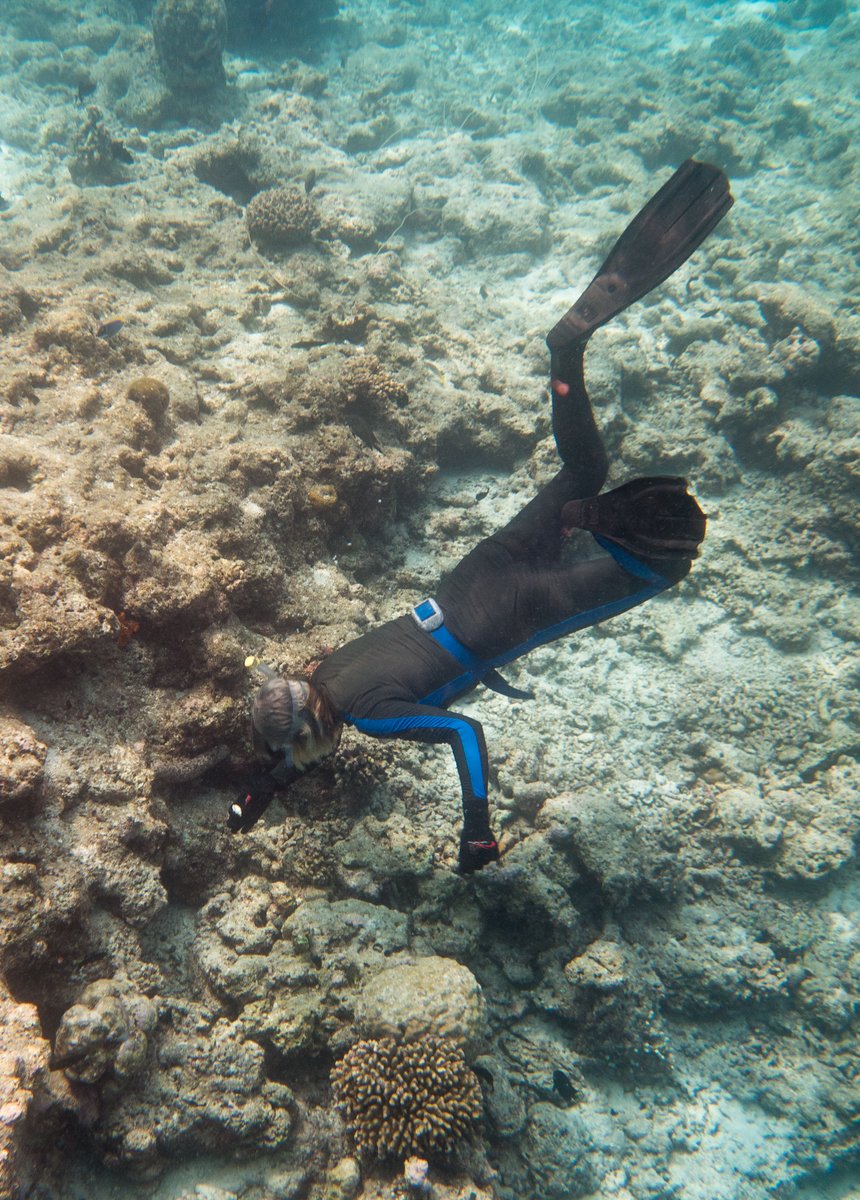
Should the sea temperature fall quickly, the zooxanthellae will return to the polyps and the reef will slowly recover over the period of a year. If the high temperatures persist then the polyps will die. Algae grows on dead coral making it difficult for new colonies to form. However, if there are enough fish on the reef they can clean the algae away and allow corals to return, but this take many years even decades.
The Maldives has had a Bleaching Events in 1998, 2010 and 2016. The 2016 event is widely recognised as a Global Event caused by a severe El Nino episode. Many of the world's coral reefs were affected with even the huge Australian Great Barrier Reef suffering 90% bleaching.
In the Maldives, the estimates for the damage in 2016 vary between 60% and 90% of reefs being affected. My personal observations are that at least 90% of the shallow reef is dead, but I don't know about the deeper reef. It’s like the tale of the Emperor’s New Clothes - the Maldivians know that the coral is dead on the shallow reef, but nobody talks about it. Too much of their economy depends on tourists and diving.
I'm gutted. For decades, I’ve been dreaming of snorkelling and diving on the pristine reefs in the Maldives. We were planning to spend two months exploring the reefs, but now we only want to get into the water to cool down - snorkelling on the reef is simply depressing. To make matters worse, we’ve heard that the coral in Chagos has also suffered, so our planned four weeks in that isolated atoll might also be disappointing.
To add to problem, here’s hardly anything to do ashore on the islands. There are no historical buildings or other points of interest and the villagers are very reserved. The beaches are beautiful, but we only go onto beaches to land our dinghy or look for shells. There’s nowhere to hike or do any of the things that interest us.
With the dismal state of the reefs, Glenys and I have had some serious discussions about what to do and have decided that we’ll shorten our stay in the Maldives and are now planning to spend only two weeks in Chagos. This will give us an extra month, so we’re going to head south and spend the extra time in Rodrigues, Mauritius and Reunion. It’s a 1,000 mile passage to these islands, but other cruisers say it’s great there. We don’t know much about the islands, so we’ve started to read up about them…
31 March 2017 Dhigurah, South Ari Atoll
First thing in the morning, we went out on “Hokulea” to look for Whale Sharks, which are a big tourist attraction in this area. We cruised along the western side of the island along with a few tourist boats, but we didn’t see a single sign of a Whale Shark - I don't think that the tourists saw anything for their $65US boat ride.
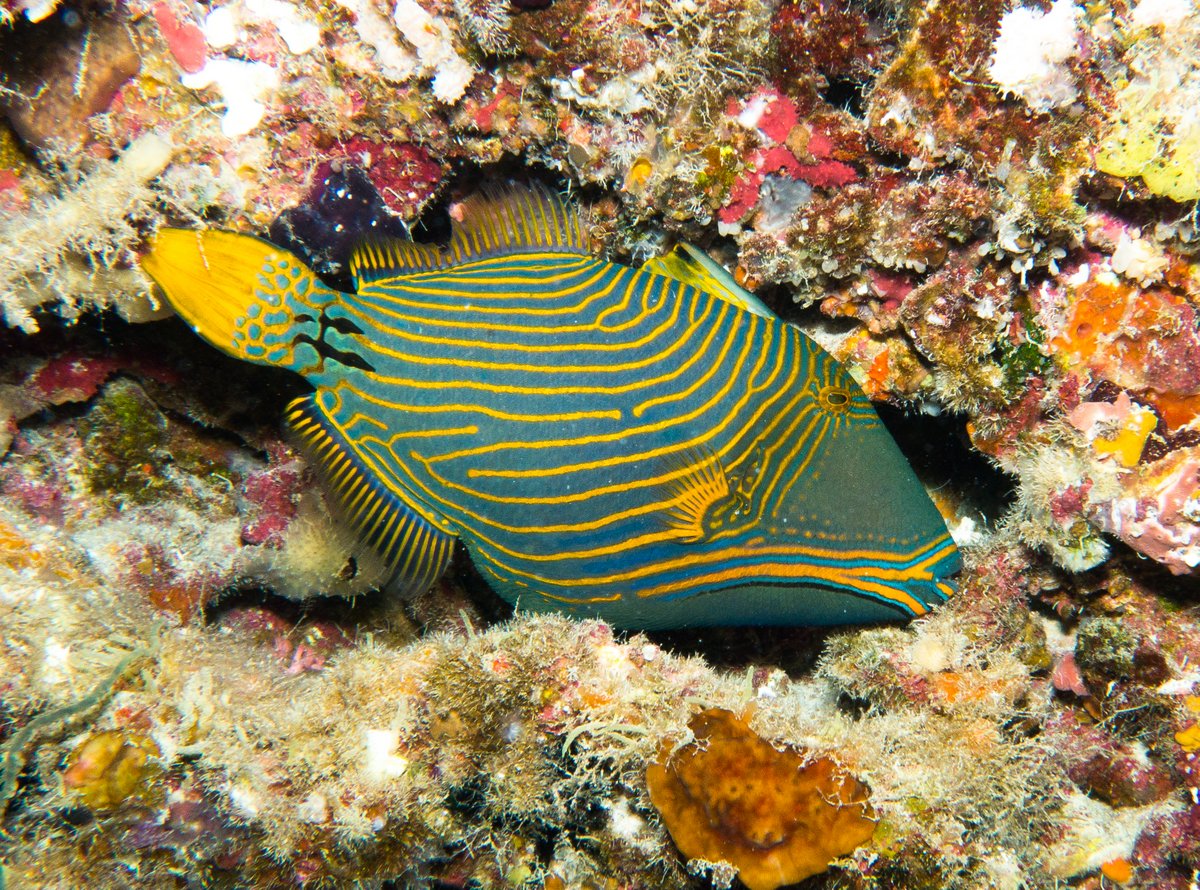
After a quick lunch, we went for scuba dive with “Hokulea”. We thought that there would be a strong current along the wall that we were diving, so we left our dinghy at anchor and entered the water from “Hokulea’s” dinghy about 400 metres back along the drop-off. (We started the dive at about 03°32.50N 072°55.17E and headed east.) It was a very pleasant dive along a steep, 70 degree wall. At 20 metres, there was some live coral, sea fans, colourful encrusting sponges and lots of fish, so I’m feeling a little bit better about the Maldives.
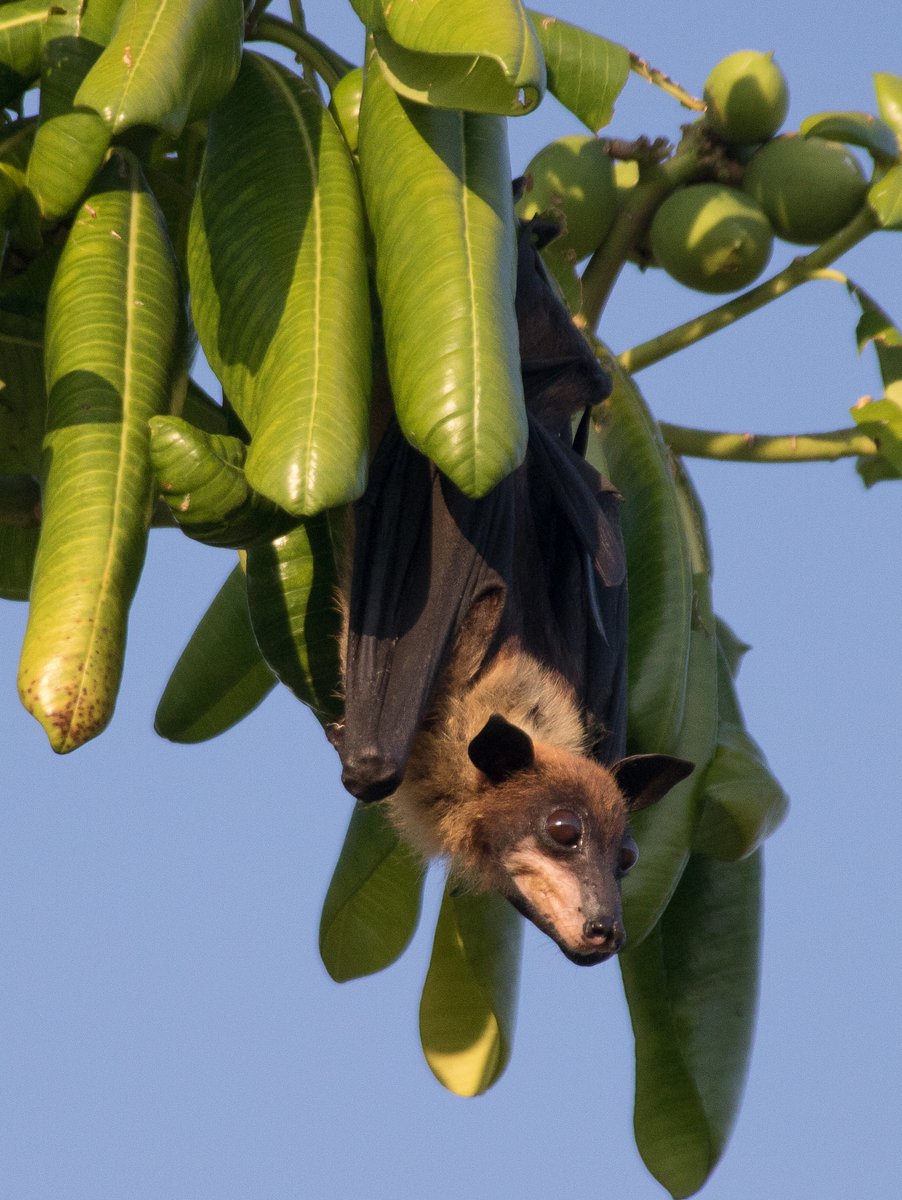
Later in the afternoon, there was a welcome event on the beach. This was in the same format as the other stops. A drinking coconut; a demonstration of traditional crafts by some ladies and then a walk around the village - looking at another colourful, tidy school and a health centre. No surprise, we ended up at the souvenir shops. I entertained myself by taking pictures of Fruit Bats, which are common here.
There are more photos in our Photo Album section.