1 January 2018 Mossel Bay, South Africa
It was blowing a hooley with 30 knot south-west winds, but we were fine in the marina on the floating pontoons. There are two German boats out at anchor, who seemed to be okay with good protection from the land and the harbour walls.
However, there are four boats, double-rafted against the concrete wall of the central fishing jetty. The inner two boats, “Peregrine” and “Toomai” had a sleepless night being pressed against the huge tyres and having to constantly adjust their mooring lines in the two metre tides. I guess that tonight will be no better.

After a quiet morning, Pete Bath, an old skydiving friend, came to visit us with his girlfriend Hayley. Glenys laid on lunch aboard Alba and we had a lot of catching up to do because we’ve not seen Pete for over 15 years. After lunch, we jumped into his flash BMW and Pete took us to his home in Knysna.
On the way, we stopped off at Knysna Heads, which is a narrow passage into the well protected Knysna lagoon. We initially wanted to sail into the lagoon, but it is notorious for big waves over the entrance bar and there’s a good chance that we could have been trapped there waiting for tides and weather to coincide to get out. I was expecting to see large breaking waves because of the strong on-shore winds, but the pass was fairly calm, probably because it was just approaching high tide.
Pete lives on a gated estate in the hills above Knysna, where he built his own house overlooking a gorgeous river valley. It’s a beautiful spot and the estate even has its own 18 hole golf course. We had the inevitable Braai, drank lots of red wine and reminisced late into the night.
2 January 2018 Mossel Bay, South Africa
Being in a house, we indulged in a long hot shower, finished off our laundry, had toast and marmalade for breakfast and then Pete drove us back to Mossel Bay. It would have been great to stay a few days, but we needed to vacate the berth in the marina at noon, so we had no time left.

Back at the marina, I checked the weather forecast and there’s still a good weather window to get to Cape Town leaving tomorrow morning. It looks like the wind will be mostly behind us and we should round the feared Cape of Good Hope with only 15 knots of wind – touch wood...
I walked to the Yacht Club to pay our berth fees. The first night was free and, with two nights at 190 Rands, the total added up to £20 for three nights – a bargain. I wandered over to the Port Control office to hand in my Flight Plan. The guy told me to just radio in when we were leaving the port and wasn’t too interested in my Flight Plan document, but because I’d gone to the effort of filling it in, he graciously accepted it saying that he would “file it” (possibly a euphemism for putting it in the waste paper bin.)
We left the marina late in the morning and went out to anchor at 34°10.54S 022°08.51E in 6 metres depth on good holding sand. This is the first time that we’ve been at anchor since we left Mozambique 2½ months ago and it’s wonderful (apart from the damn jet skis using us as a turning point.)
Now that we’re anchored in clean water, I ran the water-maker to test the generator and the new low pressure pump that I fitted a month ago. To my great relief, everything performed flawlessly, so that’s one item off my checklist. I then had a reality attack, realising that in 2 weeks’ time, we will have to leave South Africa and start our 6,000 mile voyage across the Southern Atlantic Ocean to the West Indies – gulp!
3 January 2018 Mossel Bay to Cape Town (Day 1)
The weather forecast was still good, with the south-west winds arriving at Cape Town at midday on Saturday 6th, so with only 240 miles to go we had plenty of time. We were ready to go at 08:00, but there was no wind at all and it wasn’t due to pick up until 12:00, so we hung around. Leaving at midday was actually much better timing, putting us at both Cape Agulhas and Cape Point during daylight and we’ll still get into Cape Town on Friday afternoon, 24 hours before the weather changes.

I was a little confused about Cape of Good Hope, Cape Agulhas and Cape Point, so I did a little research:
A common misconception is that the Cape of Good Hope is the southern tip of Africa. This was based on the early sailors thinking that the Cape was the dividing point between the Atlantic and Indian Oceans. The southernmost point of Africa is actually at Cape Agulhas about 150 kilometres to the east-southeast. The currents of the two oceans meet at the point where the warm-water Agulhas current meets the cold water Benguela current and turns back on itself. That oceanic meeting point fluctuates between Cape Agulhas and Cape Point (which is about 1.2 kilometres east of the Cape of Good Hope).
When following the western side of the African coastline from the equator, however, the Cape of Good Hope marks the point where a ship begins to travel more eastward than southward. Thus, the first modern rounding of the cape in 1488 by Portuguese explorer Bartolomeu Dias was a milestone in the attempts by the Portuguese to establish direct trade relations with the Far East. Dias called the cape Cabo das Tormentas ("Cape of Storms"), which was the original name of the "Cape of Good Hope".
With some trepidation, we set off for the Cape of Storms at 09:30 – we ‘ve never been good at waiting to leave. There was hardly any wind at first, so we motored for a couple of hours, but by 13:00 we had 15 knots on our port beam and were trucking along nicely. In fact, too nicely – we were doing 6 knots with some current with us, so we’d get to Cape Agulhas before daybreak. By 14:00, we were down to just a reefed genoa, rolling downwind, trying to slow down.

It was a beautiful blue-sky day, but the wind was cold, so we had the aft and side flaps down on our bimini to give us some shelter, yet still had to wear a fleece. “Peregrine” and “Ui” left at the same time and were in AIS range all day.
The east wind continued into the night and at one point increased to 25 knots with suitably bigger waves, but it wasn’t any problem apart from making us roll more. On my 7-10 watch, I was engrossed in a book, when one of the big rolls caught me by surprise and I slid sideways off my seat before I had chance to grab hold of something. I slammed down onto the cockpit floor, bruising my left elbow badly – damn annoying, but at least my Kindle is okay. I moved my seat onto the cockpit floor and spent the rest of the watch down there.
My 1-4 watch was idyllic - the wind had dropped to East 15-20 knots, the wave height and motion was much calmer and we had a full moon with clear skies.
4 January 2018 Mossel Bay to Cape Town (Day 2)
Low grey clouds rolled in just after dawn and the wind dropped slightly to 14-18 knots. We rounded Cape Agulhas at 08:30, which was good timing, but the land is flat, so it's not the most impressive headland that we've rounded. We head north from here, which is good news because it's so cold that we have to wear jackets.

Our next mission was to slow down enough to arrive at Cape of Good Hope after dawn tomorrow, so that we can see the mountainous scenery all the way up to Cape Town. It’s only 85 miles from Cape Agulhas to Cape of Good Hope, so we only had to average 4 knots to get there at 05:00.
The wind dropped off to 10-12 knots during the morning, so we bumbled along at 2-3 knots until noon, still with a ½ knot current with us. Then we pulled out the genoa to get back to 4 knots. By nightfall, the wind was 15 knots and we were going too fast, so we reefed the genoa again to slow down. It’s very irritating, but the seas were only ½ metre and it was a pleasant motion.
At our 01:00 watch change, I noticed that the depth sounder was showing various depths between 5 and 20 metres; then jumping to about 120 metres and then infinity – the chart showed that we were in depths of about 120 metres. In the past, we’ve had momentary, strange readings when a fish or dolphin slipstreams under the boat, but this was either a very persistent whale or a fault with the depth sounder.
I hove-to and turned the instruments on and off a few times, but the strange readings persisted. I went to the front of the boat with a powerful torch to make sure that we hadn’t picked up some flotsam (and to check for whales), but it all looked clear.
There’s a transducer sealed into the front of the hull with a 3-way wire coming back to the depth display. The wire looked okay at the transducer and I checked the connectors at the depth display, spraying them with WD40, but the problem persisted. I put it on the list of jobs to be sorted out in Cape Town - I hoped that the transducer was okay, because we’d have to haul-out to change it, which would cost a fortune. I covered the display up because it was depressing me.

An hour later, when we were in depths of less than 100 metres, I uncovered the depth gauge and it seemed to be behaving itself, showing sensible depths. All I can think of was that the sonar signal was getting confused by the sea bed at 120 metres – perhaps it’s the limit of its range or perhaps the whale had moved on...
5 January 2018 Mossel Bay to Cape Town (Day 3)
We continued our leisurely approach to Cape of Good Hope and it was exciting to be arriving at dawn. Initially, I could only see the beam of the Cape Point lighthouse and then gradually the rocky Cape of Good Hope appeared as the sky lightened. I dragged Glenys out of bed and we watched the sun rise above the horizon, giving the clouds a rosy glow, highlighting the craggy cliff and the light house.
I went to bed for a few hours and then got up just as we passed by Hout Bay. It looked like an pretty place surrounded by high hills, but we didn’t have time to stop there. In the far distance, we had our first glimpse of Table Mountain. The wind increased along this section of the coast and we had a cracking broad reach in 25-30 knot south winds.
As well as the striking scenery, there was lots of wildlife. We saw two large pods of Humpback Whales, many Cape Fur Seals resting on the surface, large fronds of Kelp and a group of Dusky Dolphins, which are only found in these southern latitudes.


The wind dropped as we approached the Cape Town Harbour, so we motored for the last hour. The view of Table Mountain as we entered the port was fabulous. We obtained clearance from Port Control and then motored through the busy port into the Royal Cape Yacht Club. The marina is very crowded, but we tied up without any drama. Glenys made a celebratory lunch of Bacon & Grilled Tomatoes butties with brown sauce – yum.


We went for a wander around the Yacht Club, which was established in 1905. It’s a nice place with a restaurant and a laundry. There’s a small boatyard, with an even smaller chandlers. Unfortunately, the marina is in the middle of the commercial port and is surrounded by large ships and fishing boats, who run generators all day, so it’s very noisy.
While in the clubhouse, we were very surprised to bump into an old friend, Ian Lomax & his wife Lynda together with their friends John & Jenny. Ian had seen one of our Facebook posts and knew that we were due to arrive today. We invited them back to Alba for a drink and had a meal with them in the evening, but we couldn't keep up the pace and were in bed by eight o’clock.
6 January 2018 Cape Town, South Africa
It’s been a difficult trip from Richards Bay, with a lot of strategic thinking required to make best use of the short weather windows, so I’ve written a short article on Surviving the South Coast of Africa, which might be of help to those following in our wake.
We’ve now completed just over ¾ of our voyage around the world and, in a couple of weeks’ time, will start our trip across the South Atlantic Ocean heading for the Caribbean. I worked out that since leaving Thailand last January, we’ve sailed 6,966 miles making our total up to 36,277 miles.

After breakfast, we went to the V&A Waterfront, which is a huge shopping area with restaurants and shops. There’s also a marina, so we went to have a look. The Royal Cape Yacht Club is nice, but it’s a bit out of the way and it can be noisy with large ships nearby constantly running their generators. The V&A marina looks modern and very nice, but seems to be a bit soulless, surrounded by apartments and restaurants.
In afternoon, our friends Rod and Mary from “Sheer Tenacity” picked us up and took us to their house. We first met them in the Caribbean six years ago and they stopped cruising a year ago. We had a great evening, reminiscing while having a traditional Braai and lots of red wine.
7 January 2018 Cape Town, South Africa
It was a miserable rainy day, but Cape Town needs the water. The population of the city has increased dramatically over the past five years and there isn’t enough water in their reservoirs. Strict controls are in place restricting the use of town water, but unless they get a considerable amount of rain, they will run out of water in April this year.
There are notices everywhere, warning of fines for misuse of water. The government has advertising campaigns telling people to only shower for two minutes and not to flush the toilet so often - an average toilet flush uses 10 litres of water. They even have a slogan - “If it’s Yellow, Let it Mellow. If it’s Brown, Flush it Down.” It’s a terrible situation caused by unbelievable lack of planning - the city is by the sea - why don’t they have desalination facilities?


Ian & Lynda picked us up from the Yacht Club and took us to a laptop repair place to get the screen replaced on my laptop. The outfit is called laptoprepairservices.co.za and they operate from a small apartment in a residential district (which was a little off-putting) but they sorted it all out, only charged £90 and delivered it back to the Yacht Club the next morning - great service.
We then met up with John & Jenny and did a tour of the Durbanville Hills vineyards, which is only ½ hour drive away. We visited several vineyards, where we indulged in tasting four or five wines. We’ve never done this before and it was interesting to see the difference in the buildings and how commercial they were - we only had to pay about £2-3 for the tasting at each vineyard.
Durbanville Hills was very clinically modern and set up for tourists, offering five wines matched up to cheeses - a bit pretentious IMHO. Altydgedacht was an older vineyard with a traditional wood-panelled tasting room. There was a bar where you asked for the wine that you wanted to taste - it was a nice friendly atmosphere. Nitida had a pleasant tasting room sat at tables next to oak barrels - we were flagging by this time, so we ordered a platter of snacks.
We had a late lunch at Hillcrest. It was basic food, but the chicken pie and chips was lovely and just what I needed to soak up the wine. We did another wine tasting, but we were losing the will to live by now and I actually started to pour away the wine that I didn’t like.
Our last stop was at a famous, sea-front bar called Blue Peter in Bloubergstrand, but after six hours of drinking, I could only face a Ginger Beer.
8 January 2018 Cape Town, South Africa
The engine mechanics from Southern Power arrived at 10:30 and had the timing belt fitted in a couple of hours. I’d asked them to replace the lubrication pipe to the turbo, but there was a misunderstanding and they’ll be back tomorrow to fit it.
After lunch, our friend Ian ran us around, so that we could buy a few things on our technical shopping list - it’s handy having some local knowledge. He also took us to his doctor, where we made an appointment for a check-up in a couple of days. We were then dropped off at a huge Shopping Mall called Canal Walk in the Century City district, where we ordered a pair of glasses for each of us.

After all that running around, we had a quiet evening in, watching a movie.
9 January 2018 Cape Town, South Africa
The diesel mechanics turned up promptly at 08:00 and fitted the new lubrication pipe. When they’d gone, I removed the sea water pump and stripped it down to replace the seal and a rusty bearing. Unfortunately, I couldn’t get the bearing out of the pump body, so needed to take it to the Volvo workshop for help.
The water came on at 09:00. Due to the water shortage, the water supply in the marina is only turned on for one hour, three times a week. After, topping up our water tanks, we called an Uber taxi and went into town to collect a small hire car - only £15 per day, which is a bargain.
I dropped Glenys off at the V&A shopping mall, so she could do some shopping without me moaning and I carried on to the Southern Power and they are going to get the rusty bearing out of the water pump for me. They also commented that the pump shaft is very worn where the lip seal makes contact, so they are also going to get the shaft chromed and ground back to the original dimension. I’m hoping that I’ll get it back by the end of the week.
I recharged our drinks fridge with R134a refrigerant - we have a small leak on it, but I’ve been unable to find anyone to repair it - another job for Trinidad. The boat yard has an oil disposal tank, so I dumped all of our petrol (25 litres) because we’ve had some of it for over a year and it hasn’t been used for three months - old fuel causes problems with the outboard.

The wind had been 25 knots from the south all day, but in the late afternoon we started to get strong katabatic gusts. I guess that the wind is rising up to the top of Table Mountain, cooling down and then dropping down the face of the mountain. As the sun went down the gusts increased in severity and we recorded 46 knots. Even in the marina, we were heeling over as the gusts hit us.
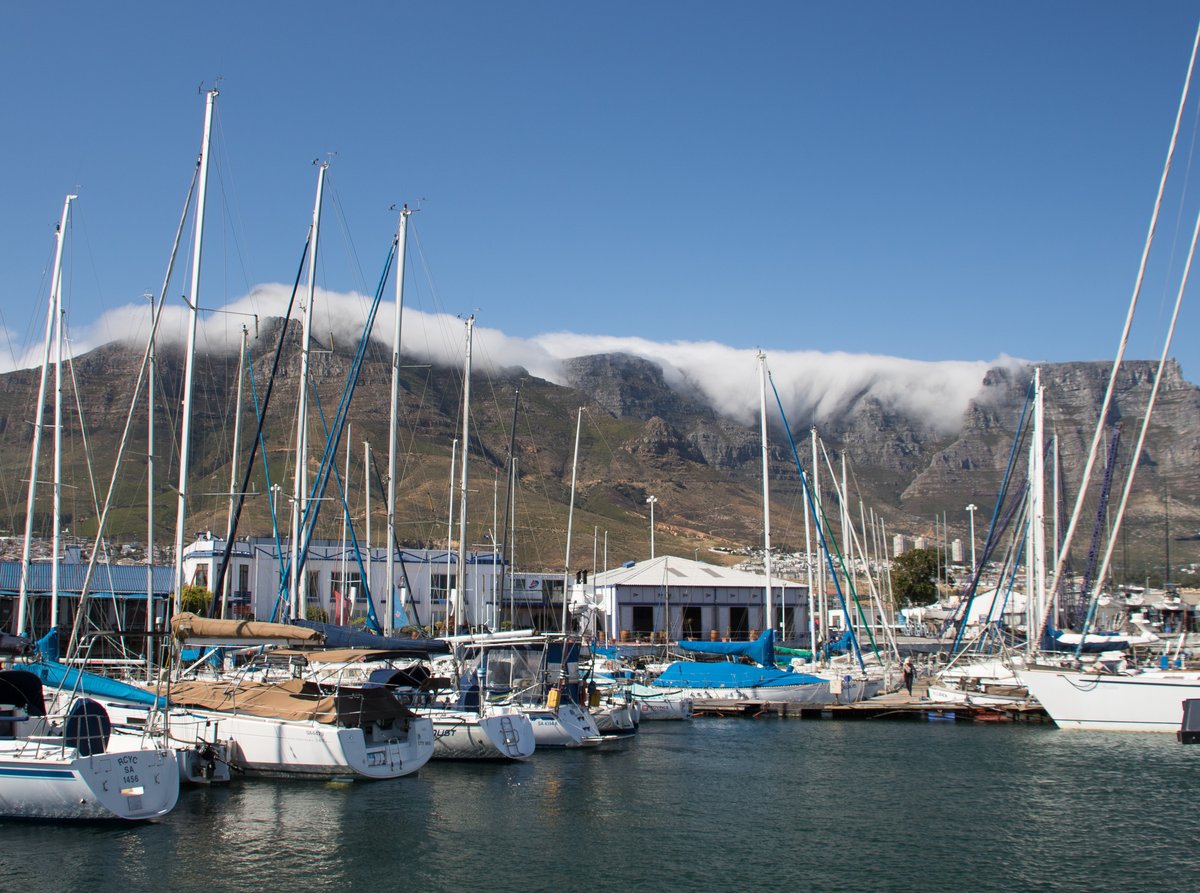
A strange cloud formation formed over the edge of Table Mountain, with the clouds rolling down the steep cliff. I found this snippet:
During the summer months, Table Mountain is best admired in all its magnificence against the blue backdrop of clear Cape skies. Ironically, it’s on such cloudless days that the mountain’s legendary white tablecloth is suddenly cast over the “table”, as if by God himself.
Albeit marvellous, Table Mountain’s “tablecloth” is nothing more than an orographic cloud formation (clouds that develop in response to the forced lifting of air by the earth’s topography). As a south-easterly wind blowing up the mountain slopes meets colder air at higher altitude, condensation takes place and a thick mist soon coats the top-most regions of the mountain.
As the cloud cover pours over the side of the mountain, the process is reversed. Clouds encounter warmer air layers lower down, where the moisture evaporates, making the clouds disappear. Despite its undeniable beauty, the tablecloth can be dangerous to unwary hikers. The cloud often descends rapidly, obscuring visibility and posing a threat to hikers unfamiliar with the mountain.
10 January 2018 Cape Town, South Africa
It wasn’t a very pleasant night with katabatic gusts heeling us over and ropes creaking everywhere. I got up at 03:00 to change one of the ropes, which was creaking right above our bedroom. However, we survived.

It’s been over 18 months since we had a medical check-up, so we went to the doctors. We had an appointment at a Medi-care centre in Century City, which is a kind of mini hospital with doctors; some specialists and a pharmacy.
They did various blood & urine tests and we had a consultation with a general practitioner. It was all very easy and the consultation only cost £25 each (although all the tests cost £150 each.) We’re going back in a few days to get the results of our blood tests, but everything else looks okay, except Glenys had a high blood pressure reading, so they’re going to check her again when we go back.
We had to miss breakfast because of the blood tests, so back at the yacht club, we treated ourselves to an excellent bacon and egg brunch.
In the afternoon, Glenys pulled out her sewing machine and did various Sunbrella repairs. Meanwhile, I went out to buy some new petrol and then put the dinghy into the water for the first time since we left Mozambique in October. We lowered our 15hp outboard onto the dinghy and I cleared the fuel pipes of the old fuel. To my astonishment, the outboard started after only three pulls.
By two o’clock, it was blisteringly hot, so outside work stopped - a complete change to the cold windy weather yesterday. We had a quiet night on-board.
11 January 2018 Cape Town, South Africa
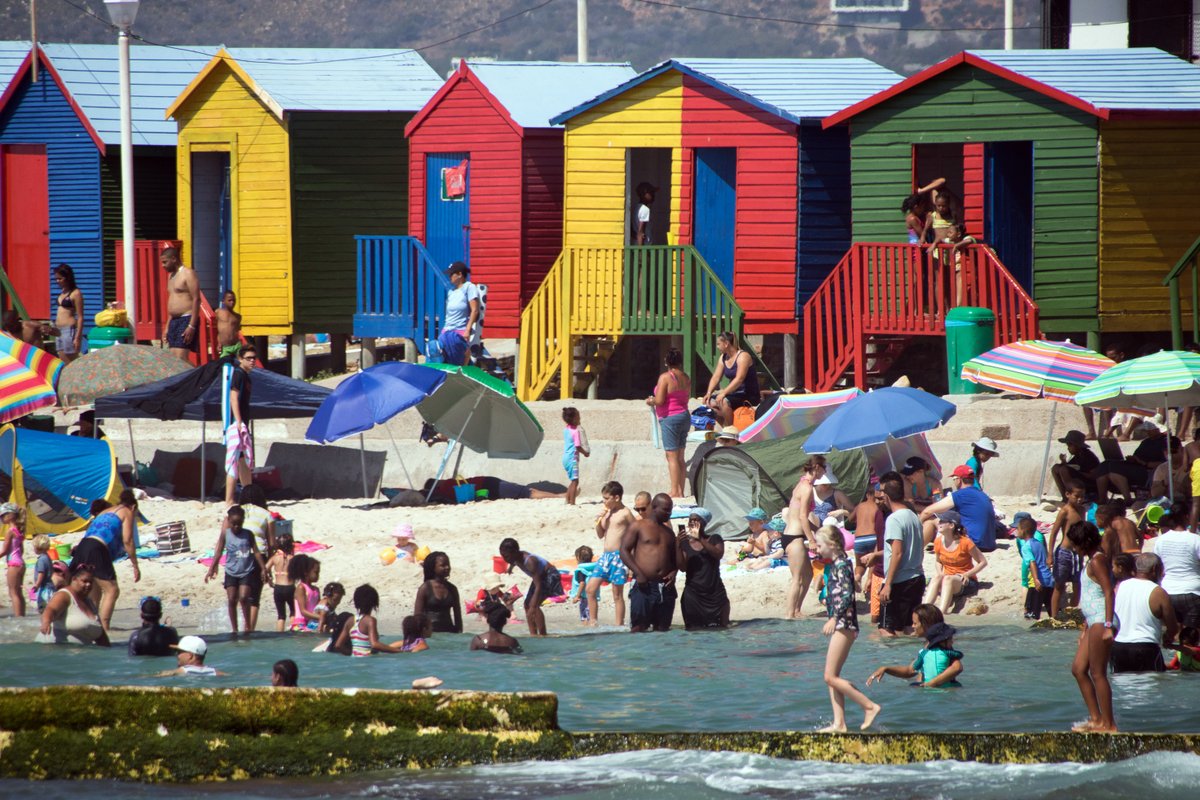
We had a day off chores and drove down to Simons Town, stopping off at a couple of beaches on the way. The east coast of the Cape Peninsula is a series of holiday towns and, being the school holidays, the roads are packed with cars. The beaches are crowded with people enjoying themselves. Interestingly, there are colourful Beach Huts on some of the beaches, very reminiscent of Victorian England.
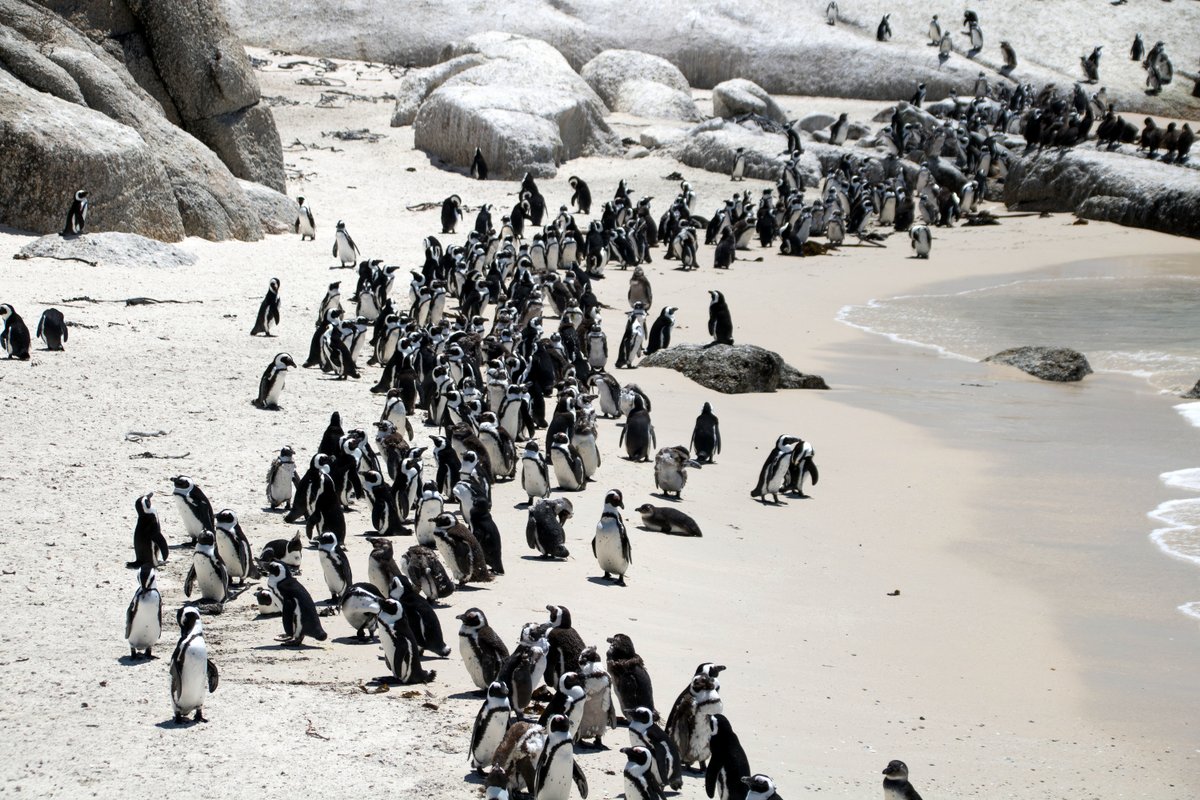
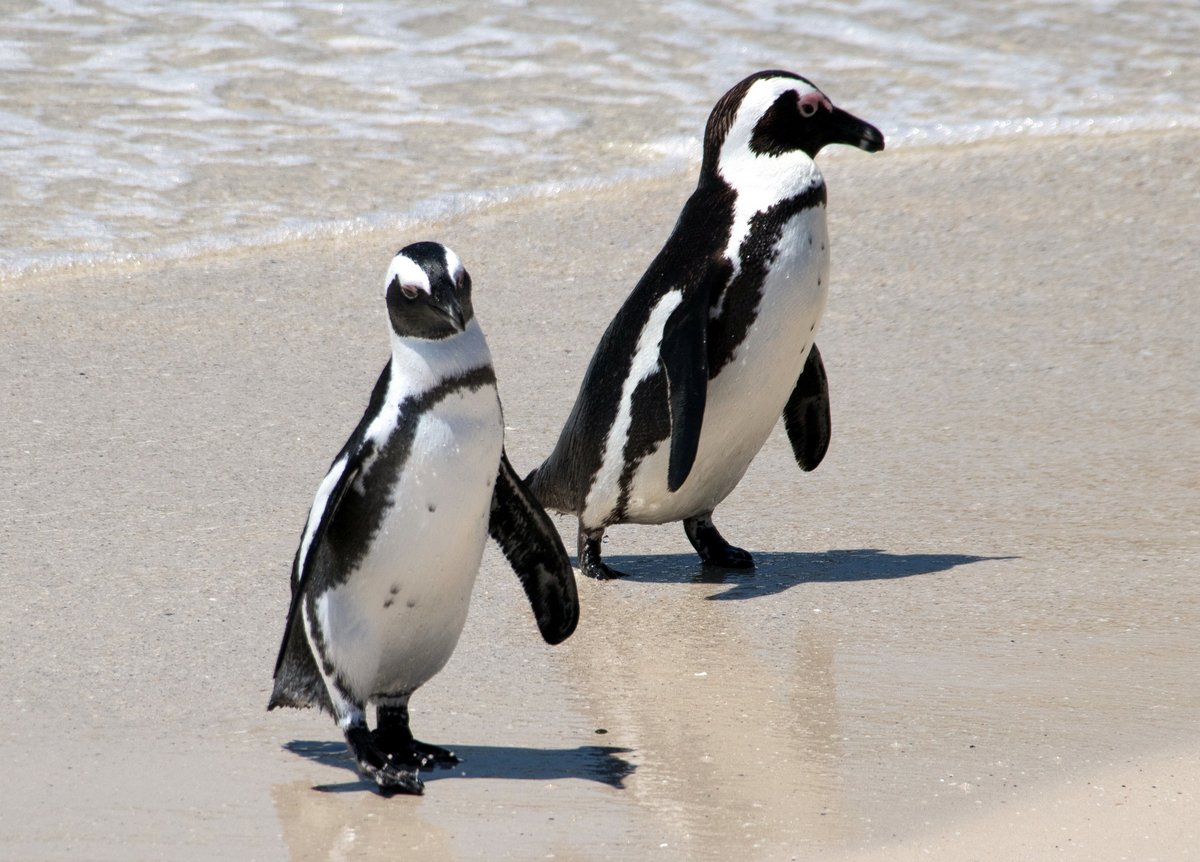
At Simons Town, we visited Boulder Beach, where there is a large breeding colony of African Penguins. The beach is a national park and visitors are corralled onto wooden walkways. There were hundreds of people there, but it was still a nice experience. The penguins totally ignore the tourists and get on with their lives. There were hundreds of penguins stood on the beach with about twenty penguins on their Nests, defending their eggs against the predatory Herring Gulls.


For lunch, we called into a nice little café on the main road and had a Bunny Chow, which is traditional South African dish, consisting of a curry served in a scooped out piece of bread.
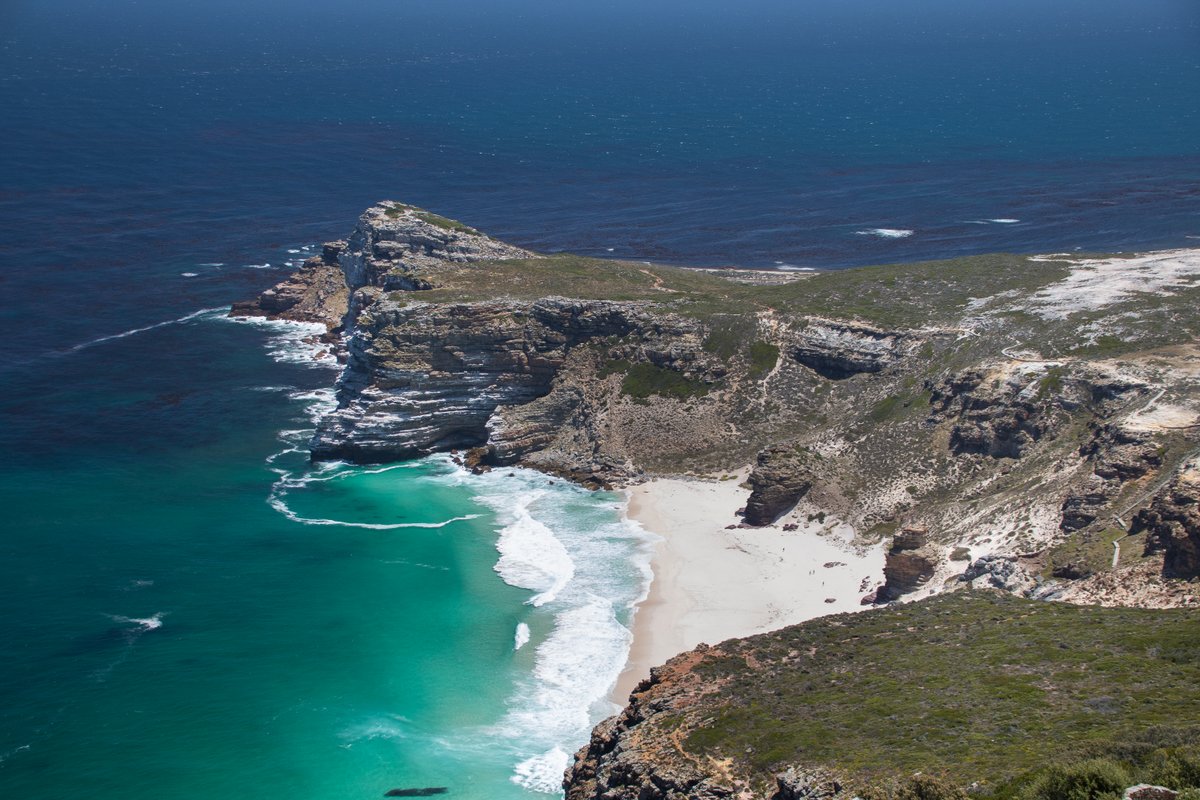
We then drove south to the tip of the Cape Peninsula to visit the Cape of Good Hope and Cape Point. Along with the other hundreds of tourists we walked up to the lighthouse on Cape Point and had a great view of the Cape of Good Hope. There is an interesting hike down to the Cape of Good Hope, but we didn’t have time to do it. We drove back to Cape Town along the west coast along the magnificent Chandlers Way, which winds along the cliff face above Hout Bay.
In the evening we went to a Braai organised by Ian & Lynda at their golf club. It was a fun night - mildly chaotic and troubled by a cold westerly wind.
12 January 2018 Cape Town, South Africa
We went back to the doctors for the results of our blood tests. Everything is good with no sign of cancer, gout or anything else nasty. Glenys has slightly elevated blood pressure and we both have a B12 vitamin deficiency, so they injected us with B12 boosters. I have a slightly “troubled” liver, but nothing that a few weeks off the booze wouldn’t sort out - thankfully we’ll have some long periods of forced abstinence while sailing across the South Atlantic.
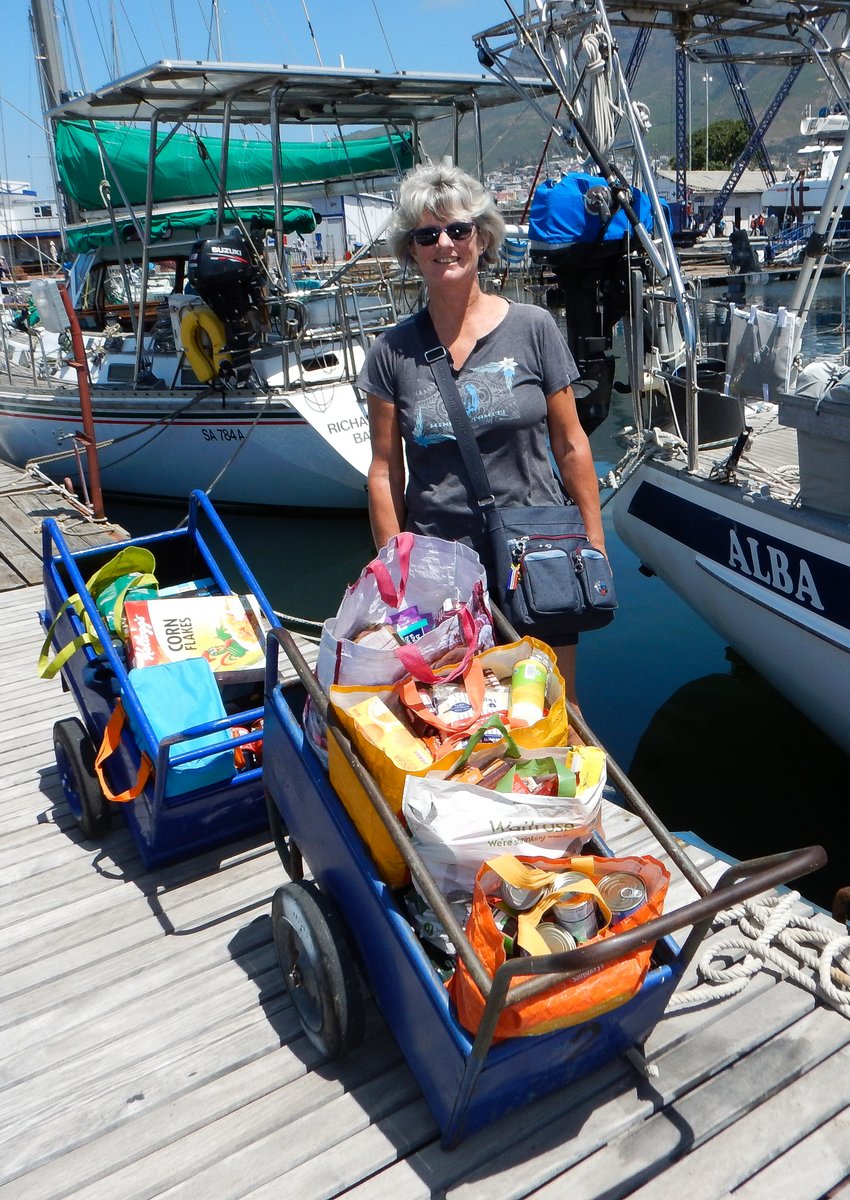
After escaping the doctors, we went to the Canal Walk mall and did some food shopping, loading three trolleys - a good start to the provisioning for the next three months. By the time that we’d lugged it all back to the boat, it was 14:30, so we spent the rest of the afternoon, pottering about stowing things away and doing a few small jobs.
Our engine water pump is still at the chrome shop and won’t be back until Monday 15th, so we’ve decided to head out to the Wine regions of Franschhoek and Stellenbosch on Sunday, staying one night and returning on Monday. This will give us four clear days to finish our provisioning; tick off a few more jobs; climb Table Mountain; and have final visits with our friends, before we leave on Saturday 20th. It’s all go.
13 January 2018 Cape Town, South Africa
We had a day on board doing a few jobs. After doing some laundry, Glenys took down the bimini and did some repairs.
I went up the mast to replace the spinnaker halyard and inspected the standing rigging. I found that the fair lead for the staysail halyard had worn badly - the halyard is steel wire and wears away the bronze fairlead. I last did it 3 years ago and fortunately I carry a couple of spares, but I’ll have to wait until after the weekend to get some Monel pop-rivets.
I also noticed that the Dyneema running back stays are showing signs of wear, probably from the mainsail pushing against them when we’re going down wind. I took them around to Southern Ropes and they’re going to supply new rope and do the splices for me. I should get them back early next week.
14 January 2018 Cape Town, South Africa
We were up early and drove for an hour to Franschhoek, a small town in a wine growing area. After having a look around the quaint town, we boarded a Wine Tour Tram, which took us to a couple of Vineyards – Ricketty Bridge and Grande Provence. They gave us an hour at each vineyard to do a tasting of 4 or 5 wines. Glenys and I decided to share one tasting, so that we didn’t get too tipsy.
After the tram ride, we were picked up by a small bus, which took us to five more vineyards, but we elected to only visit another three - Eikehof, Leopard’s Leap and Dieu Donne. It was a pleasant day, sitting around chatting and drinking wines, but none of the wines were outstanding. We’re not great white wine drinkers and we weren’t impressed by the ones we tried. The red wines were a disappointment as well, apart from a Merlot at Eikehof – we bought two bottles.
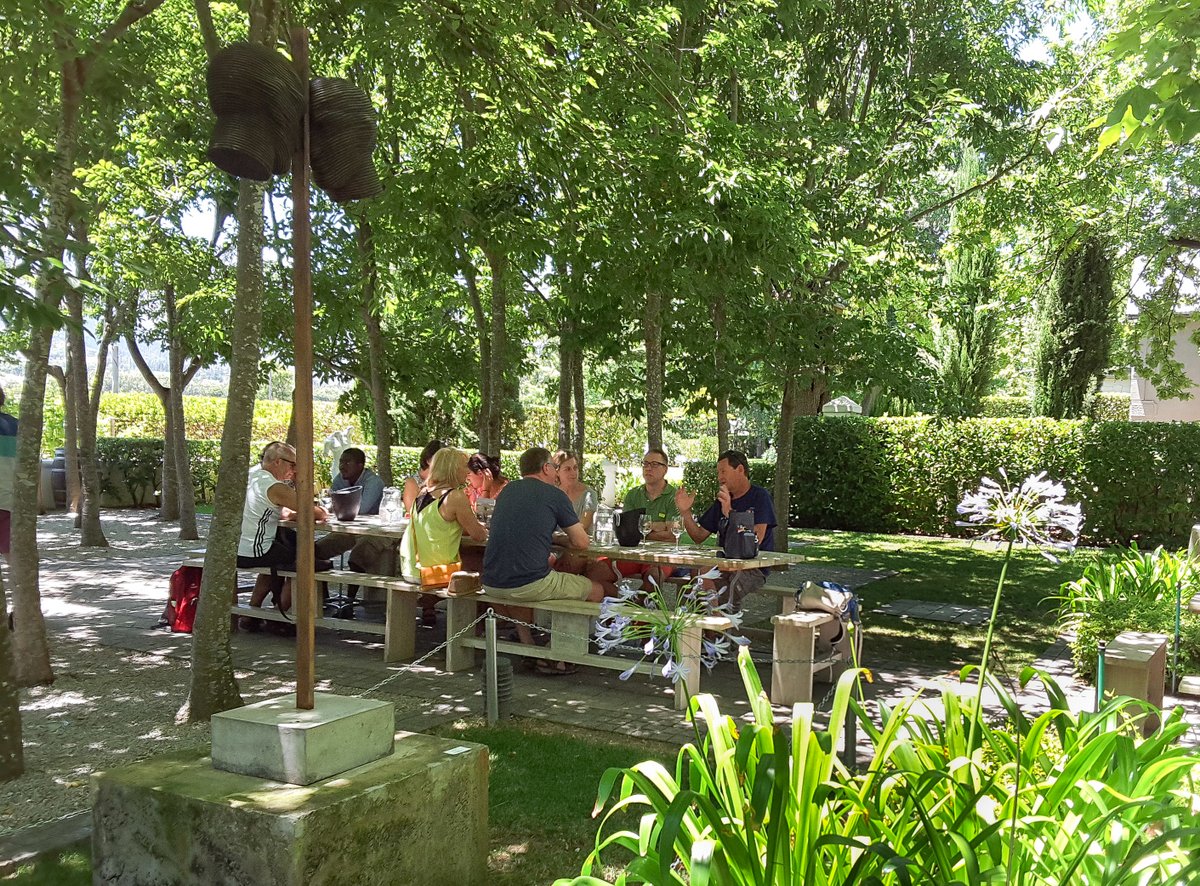
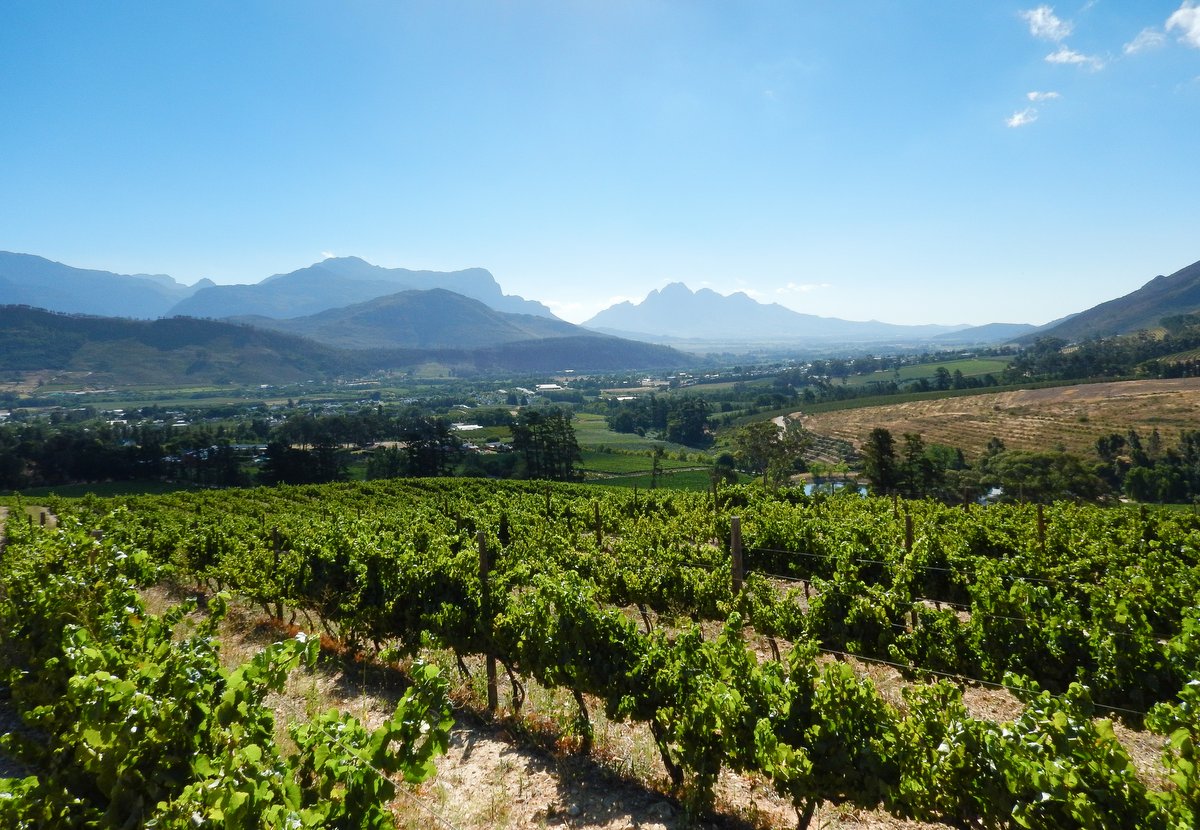
The vineyards were very varied – Leopard’s Leap was a modern, clinical, tourist trap and the wines were very poor. Eikehof was a lovely little family farm, with a super cheese platter and good wines - the owners serve the wines and chat about their farm. The other three were mid-range vineyards with nice old buildings and pleasant staff. Dieu Donne is high above the town with a lovely view of the valley and is a very nice place to sit in the late afternoon sun.
Glenys had booked us into a guest house called La Ballon Rouge, where we were lucky to be given an upgrade to a luxury suite, with a huge bedroom, a large lounge and a roof-top patio complete with Jacuzzi. Unfortunately, the Jacuzzi was out of action because of the water shortage.
Franschhoek is famous for its cuisine, so we had our eye on an up-market Indian restaurant, but when we got there all the tables were occupied or pre-booked. It appears that booking is essential for the better restaurants. We didn’t fancy a meal in any of the pretentious-looking French restaurants, so we opted for a rougher-looking place just past the church, where we had a fabulous pizza, sat on a garden bench under the trees – they served good wine for £6 a bottle, so what more could you ask for.
15 January 2018 Cape Town, South Africa
After a leisurely full English breakfast, we visited the small museum in Franschhoek, which has fascinating information about the emigration of the Huguenots from France and how they settled in South Africa.
Huguenots were French Protestants mainly from northern France, who were inspired by the writings of John Calvin and others. Europe in the 1500s was mostly Catholic and the Huguenots were violently persecuted by a series of Catholic French Kings. Over a century, edicts for tolerance would be issued by the King, but then later revoked by the next monarch.
From 1661, Louis XIV went to great lengths to convert the Huguenots, but he failed. So in 1685, he revoked the Edict of Nantes, which resulted in the Huguenot persecutions being resumed. Once again, the Huguenots fled in large numbers (over 200,000) to other countries in Europe as well as England and America.
About 200 Huguenots emigrated to Cape Town. They were mostly farmers and craftsmen and soon established farms in the Franschhoek ad Stellenbosch areas. Many of the vineyards are still owned by their descendants.
Sated with historical knowledge, we drove to Stellenbosch, which is a large town in the middle of another wine growing area. The town was heaving with cars and it was difficult to park, so we ran away - it’s only another big town. Instead, we drove to Vergelegen, which is a large winery about 20 kilometres away from Stellenbosch.
Vergelegen is a stunning estate. It was originally owned by an early Governor of Cape Town, who allocated himself five times as much land as any other settler (typical politician). The vineyard has changed hands many times over the centuries and is now owned by Anglo American, one of the largest mining companies in the world. They have rebuilt the historical buildings; reconstructed the traditional gardens and opened it up to the public.
For the small entrance fee of £0.50, you are able to walk around the beautifully manicured grounds; bring your own picnic; or go to one of their two restaurants. We elected to go to the Stables restaurant, which is “a bistro dining experience in casual surroundings” - I’ve seen “posh” restaurants that are rougher…

Despite us arriving after 13:30, they didn’t have any tables available - “Booking is essential, Sir”. However, they managed to find us a place on a couch in the waiting area, which was probably nicer than the tables. We weren’t feeling very hungry, so we ordered two sandwiches, which were essentially huge salads, artfully ladled over a piece of ciabatta bread. Accompanied by a couple of glasses of Merlot, the meal was very good.
After lunch, we wandered around the grounds for an hour, visiting the lovely formal gardens and a small museum in the original manor house.
It took us an hour to get back to the Yacht Club, where we found the rebuilt sea-water pump waiting in the cockpit for me - it’s back to reality tomorrow.
16 January 2018 Cape Town, South Africa
We were planning to leave on Saturday 20th to give ourselves a couple of day’s leeway before our visas run out on the 22nd, but there’s some strong winds and 5 metre waves forecast on Saturday morning. It looks like we’ll have to wait until Monday the 22nd before we leave, which is taking it down to the wire.
I fitted the sea-water pump and ran the engine for 15 minutes - all looks good. After picking up the running backstays, I spent an hour up the mast and installed the new fairlead and the running backstays, so we’re now in a fit state to go sailing.

Our mast has a lot of bend in it and I was thinking of adjusting the lower shrouds to move the centre of the mast back. I chatted to Warren from Associated Riggers, who was very helpful and sent along one of his riggers to have a look. The conclusion was that our forestay is too long, causing the head of the mast to be too far aft - adjusting the lower shrouds would not help and would cause more problems.
Warren gave me a new toggle to fit in place of the two existing ones, which will effectively shorten the forestay by 50mm, I’ll try to fit it tomorrow.
Late in the afternoon, we filled up with diesel and moved the boat to another berth because we’re staying longer than originally planned.
17 January 2018 Cape Town, South Africa
It was another early start, going to the doctors for another B12 vitamin injection and Glenys had another blood test for her white blood cell count. It all looks good, so we can forget about doctors for another year. While we were out and about, we went food shopping and stocked up on another 30 litres of wine, mostly quaffable stuff in boxes, but we bought a dozen nice bottles for special occasions.
After lunch, I replaced the toggle on the forestay and the mast looks a lot straighter, but the inner forestay is now too loose - typical. Warren at the riggers told me to remove sail, remove the toggle on the bottom of the inner forestay and pull it down tight, so that I can measure how much to shorten the stay.
I rigged up a rope from the end of the furler drum and led it back to a winch, so that I could get enough tension in the inner forestay. I think that I have the mast set up correctly now, but I want a rigger to look at it and confirm before we decide how we’re going to shorten the inner forestay. Unfortunately, the riggers were shut at 15:30 - I think Wednesday is race day.
In the evening, we went to Rod & Mary’s house for a traditional Braai and drank loads of red wine while reminiscing.
18 January 2018 Cape Town, South Africa
The weather forecast is now showing a small low pressure area coming off the coast to the north of Cape Town on Sunday 21st, which will bring north winds along the coast - right on the nose. The wind doesn’t go south until Tuesday afternoon, so we might have to wait until Tuesday or even Wednesday 24th.

I called in at the Immigration office and they told me that if we stay past our visa expiry date then we will still be able to clear out, but we will be classified as “Undesirables”. If you have overstayed for less than 30 days then you are banned from returning to South Africa for 1 year - this rises to 3 years if you stay beyond 60 days. There is apparently no fine and, if we have a good reason for over staying, then we can submit an appeal to have our “Undesirable” status removed. I think that boat problems or bad weather would qualify as good reasons for the appeal.
First thing in the morning, I went to the riggers and Warren said that he’d try to send someone around to have a look at my rig. In the meantime, I removed the furler drum and exposed the adjustment screw on the bottom of the inner forestay. I think that we need to shorten the stay by 20mm, but there only looks to be 12mm of adjustment left.
The riggers turned out to be busy all day, but I chatted to Warren at the end of the afternoon and he thinks that it may be better to shorten the inner forestay wire. Apparently, it’s an easy job and he promised that he would have someone on my boat in the morning to do whatever work is necessary.
We were both feeling little under the weather after our boozy Braai last night, so we pottered about researching future anchorages and I caught up on my blog.
During the afternoon, the “Tablecloth” clouds appeared over Table Mountain and by five o’clock the wind had picked up and was very gusty. We checked all the ropes, tied down everything on deck and hid down below.
19 January 2018 Cape Town, South Africa
It blew a hooley all night, with 30-40 knot gusts hammering into us, making the boat heel over and then bounce against the fenders. I got up in the middle of the night to check ropes and make sure that the fenders were still in place. I also tied an extra rope onto the inner forestay which was only held down by an old piece of 6mm rope.

The rigger, André turned up at 09:00, it was still very, very windy but he was able to do his job. He checked the overall rig to make sure that I had the correct mast shape and then decided to back off the adjustment screw and shorten the wire. The minimum that you can shorten a wire by is 40-50mm, so we went for the minimum and took up the slack with the adjustment screw.
It’s was a bit scary watching André hacksawing a piece of the wire off, but he soon had the Norseman fitting reassembled and we were back in business. The mast looks a lot straighter, so I’m hoping that this will remove some of the creases when I furl the mainsail.
I’m really pleased with the advice that I received from Associated Rigging and despite being very busy, they helped me out. They didn’t charge a fortune either - the new toggle on the forestay was £45 and the labour was only £15.
I pottered about for the rest of the morning, putting the inner forestay furling drum back together and sorting out the running rigging. I went up the mast to have a look at the top of the furling extrusion now that we’ve shortened the wire by 25mm, but it all looks good - I still have about 30 mm of clearance. We may have to make a shorter strop for the top of the stay sail.
In the afternoon, we drove around doing some last minute shopping - we’re taking the car back on Monday 22nd. We picked up some webbing from North Sails; filled our propane tank at Woodstock Gas; bought some Dyneema rope for a new staysail halyard; bought petrol for the dinghy; and found some non-slip matting in the carpet section of Builders Warehouse.

We wanted to get some British Pounds to use in St Helena, where there are no ATMs and just one bank, but because we weren’t flying out of the country and couldn’t show our airline tickets, they wouldn’t sell us any. The anti-money laundering rules are crazy - we only wanted £300.
The wind blew and blew all afternoon - I recorded 40 knots. In the evening, we went to the bar to see Martin and Maggie from Dreamcatcher, who arrived early this morning.
20 January 2018 Cape Town, South Africa
It blew a hooley again all night, blowing 50 knots. There were a number of our friends who were caught out by the strong winds yesterday - “Jackster” had to be towed into Hout Bay; “Relax” anchored on the east side of False Bay and “Full Circle” had to anchor outside the Cape Town breakwater last night and all day waiting for the 50 knot winds to subside - they’re planning to come in tomorrow morning.
The howling wind was getting us down, so we decided to go for a drive to Hout Bay to see if we could find “Jackster” - we invited “Dreamcatcher” to come along. We stopped half way on the west coast of the Cape Peninsula where there were some impressive white cap waves and spume. It was even worse in Hout Bay and we got soaked walking along the breakwater to find “Jackster”.
Unfortunately, the gate to the quay that they were on was firmly locked and there was no sign of activity on the boat, so we decided to leave them to catch up on some rest. We had a nice lunch in the “The Lookout” restaurant, which was very nice and surprisingly well sheltered from the howling wind.

On the way back, we stopped at the Groot Constantia winery to have a quick look at their grounds. It was a nice place, but not as impressive as Vergelegen.
In the evening, we invited Ian, Lynda, John and Jenny around to Alba for a curry dinner. We were a bit worried that they might feel queasy because the boat was rocking around in the gale force winds, but everyone was okay and we had a good evening.
21 January 2018 Cape Town, South Africa
The wind dropped to nothing during the night and we woke to a peaceful, calm day, so we got on with some jobs. We put the staysail up and checked that the luff length was ok after shortening the inner forestay - all looks good. I checked that the new Dyneema rope for the staysail halyard fitted okay and then pulled the old halyard from the mast, so I can get the shackle spliced on tomorrow.
Glenys took down the bimini again and did some more strengthening stitching. We’ve got the boat in good condition and feel confident that we’ll make it across the South Atlantic. There’s still north winds forecast for the next two days, but it looks good to leave on Wednesday 24th. “Dream Catcher” are also thinking of going on the same day.
Our friends on “Full Circle” finally came into the marina this morning and we went out to the club bar for dinner with them. They had a wild ride for the last 48 hours of their passage, but were fairly comfortable at anchor outside the breakwater.
22 January 2018 Cape Town, South Africa
I was up early taking the staysail halyard to riggers so that they could splice the shackle on for me. We then paid our bill at the marina and toddled off to clear out. It’s about 1½ miles to the Port Control building, so we were glad that we still had a car.
We went into the cylindrical port authority tower and were given a clearance document by the receptionist. She told us that she’s allowed to do the clearance provided that the yacht is in the Royal Cape Yacht Club, otherwise you have to go to the Harbour Master’s office and fill in more forms, which can take a long time.
Immigration and Customs are in another building on the way back to the Yacht Club and we soon had their forms filled in and our clearance was completed by 09:30. There’s a north wind forecast for today and tomorrow morning, so we’re planning to leave on Wednesday 24th. Our visas run out at midnight today, so we told the authorities that we’re leaving today. We’ll be “Undesirables” if we are caught, but we’ll just stay in the marina, so that chance of having to show our passports is negligible.
I dropped Glenys off at the boat and drove off to buy some engine filters & fill up the car with petrol. We dropped the car off in town just before lunch.
We walked around town looking at some of the tourist “attractions” - Chiappini St has many brightly coloured buildings, originally Cape Malay people. We walked through Company's Garden and found a nice restaurant at Greenmarket Square, where there are lots of souvenir stalls and buskers. It’s okay for a big city, but I’d rather be in a small village somewhere.
The most interesting thing was going to the Namibian Tourist office (25th Floor, Atterbury House, Riebeeck Street). A very nice lady chatted to us for 30 minutes about Namibia and things to do there and we walked off with a bagful of tourist brochures. The view of Cape Town from their office window is impressive.
Back at the boat, there was a cold 15 knot wind from the north, so I’m glad that we decided to wait a couple of days. In the evening, we went out for a meal at the bar with “Full Circle” - this time the kitchen stayed open long enough to get a meal.

23 January 2018 Cape Town, South Africa
We woke to the sound of fog horns out at sea. There was no wind and the dense fog didn’t clear in the marina until 10:00. We got on with a couple of jobs - Glenys did a final load of laundry and I replace the primary diesel filter on the engine. We then installed the new staysail halyard and hoisted the stay sail. After filling our water tanks, we were ready to leave tomorrow.
Over the next 4-5 months, we will be sailing about 6,000 miles with 45 days at sea, but for some reason, I feel fairly calm about it - shouldn’t I feel more worried? Have I forgotten something or maybe we’re very well prepared, (touch wood!)
Over the past two weeks the boat has become very dirty with sand and grime brought in by the gale force winds. All of the ropes are dirty, the standing rigging has a layer of greasy dirt and whenever we touch anything on deck we have to wash our hands. Unfortunately, with the water crisis, we can’t wash the decks down with fresh water and the sea water in the marina is dirtier than the boat. We’ll just have to suffer until after we have left.
We had a final dinner in the bar with “Full Circle” and had an early night.
24 January 2018 Cape Town to Lüderitz, Namibia (Day 1)
It was a glorious blue-sky morning and we managed to leave by 08:00. There was a 8-10 knot west wind, putting us on a close reach, but the seas were only about 1 metre, so it was very pleasant sailing. The wind dropped occasionally, so we had to start the engine a couple of times. By 14:00, the wind had backed to the south and increased to 20 knots, so we put the spinnaker pole out to port and ran downwind wing-on-wing.

We soon fell into our routine and the day passed quickly. The sea conditions were much better than we had between Richards Bay and Cape Town, so it was pleasantly normal. Despite the sunny day, the wind was cold and we both wore fleeces during the day. “Dreamcatcher” left Cape Town at the same time as us and were doing a similar speed, so we had a chat on the VHF after dinner.
The dirt accumulated on the ropes and rigging is driving us mad. Every time we have to do something, we have to wash our hands. Unfortunately, the boat is rocking and rolling too much and we can’t be bothered to wash everything down. We’ll have to wait until we get to Lüderitz.
By nightfall, we had 20-25 knot winds and 2 metre seas. We rolled away the main and ran downwind with just the genoa. The temperature dropped further, requiring jackets, long trousers, socks, gloves and a woolly hat – we’re glad that we’re heading north back to the tropics. ½
25 January 2018 Cape Town to Lüderitz, Namibia (Day 2)
We had another glorious blue-sky morning with a south 22-28 knot wind. At 08:00, we’d done 152 miles, which is a good daily run for us – it’s helped that we’ve had ½ - 1 knot of current with us for most of the way. We continued the day with just the genoa, occasionally reefing a little if the wind picked up and gybing a couple of times as the wind changed direction slightly.

Having the spinnaker pole out all the time is so flexible. I think that the boat rolls less with the genoa poled out to windward. To reduce chafe, we run the genoa sheet through a snatch block at the end of the spinnaker pole. We had one minor incident when the snatch block broke with a bang – a bolt connecting the block to the shackle had corroded over the last seven years. It only took ten minutes to gybe the genoa, lower the pole and reinstall a new snatch block – most of that time was finding out where the hell I’d stowed the spare block.
Despite the cloudless sky, it was another cold day. We had various flaps zipped onto the bimini to try to block the wind, but it finds its way under them – we’re not really set up for cold weather sailing. Late in the afternoon, we ran the engine for 30 minutes, so that we could have a hot shower.
The clear skies and steady wind continued after dark, but by our 01:00 shift change, the moon and stars disappeared behind a layer of cloud. It was damn cold. At 04:00, the wind started to drop and we encountered a counter current, so with our reduced boat speed, our speed over the ground decreased to 4.5 knots.
26 January 2018 Cape Town to Lüderitz, Namibia (Day 3)
Dawn revealed 90% cloud cover and the wind continued to drop, so at 07:00 Glenys turned on the engine. After pulling out the mainsail to starboard, we motor-sailed all morning. At 08:00, we’d made a 24 hour run of 160 miles. With 170 miles to go, we’re hoping to get to Luderitz tomorrow morning.

I tried to get a weather forecast via our sat phone, but I struggled. For some reason, the modem driver wasn’t working and I had to delete it and manually reinstall the driver. I then managed to send the request email to saildocs (well, I think it went), but I received nothing back. I then discovered that my annual subscription to the Mailasail compression service had expired. It’s not easy sometimes...
Fortunately, “Dreamcatcher” were only 8 miles behind us and I was able to get a weather forecast from Martin. It looks like we’ll have light winds until mid-afternoon and then the south wind will pick up to 25-30 knots by 04:00 tonight. It will continue to be windy tomorrow, which is not good news because Luderitz suffers from strong katabatic winds, so we might have gusts up to 50 knots when we arrive.
At 13:00, the wind picked up enough to sail and we had a little bit of current with us. It was idyllic sailing all afternoon with blue skies, 15 knots of wind directly behind us and a smooth 1.5 metre swell. The wind slowly backed, forcing us west of our required course, so just before sunset, we bit the bullet and spent 15 minutes gybing the spinnaker pole to starboard and the main to port.
The wind gradually increased during the night and at 03:00, with 25-30 winds, I rolled the main sail away completely, so we were running with just a genoa. We were still doing 6 - 7 knots boat speed plus ½ - 1 knot of current with us. If anything, it was colder than last night - thank goodness we bought some drinking chocolate in Cape Town to keep our spirits up.
27 January 2018 Cape Town to Lüderitz, Namibia (Day 4)
This weather is amazing - we had another blue-sky morning with consistent south 20-25 knot winds. At 08:30, we heard Dreamcatcher talking to Luderitz Port Control and they said that Immigration would only be available until 12:00. We still had 12 miles to go, so we turned on the engine and started to motor-sail, aiming to get into the port in time to clear in. On the way, we chatted to Stefan from “Sabir”, who arrived a few days ago. He gave us some useful advice and told us about a mooring that was available.

As we approached Cape Daiz, the birdlife increased substantially, with gannets, cormorants and seagulls fishing. We’ve seen quite a lot of Shearwaters and the occasional Albatross during the passage, but nothing like the numbers here. A large pod of Dusky Dolphins joined us and exuberantly surfed in the waves alongside us for 15 minutes.
Other cruisers have reported that the winds increase dramatically around Cape Diaz, so we heavily reefed the genoa and continued motor-sailing. It wasn’t too bad around Cape Diaz with the odd gust up to 30 knots, but we had 35 knot gusts as we reached towards Luderitz Port. The approach channel was directly up-wind and we were glad that Stefan was waiting to thread our ropes through the eye of a mooring.
We were tied up by 10:15. There was no time to rest, I had to get the dinghy into the water, so that we could get ashore and clear in. Despite the howling 30 knot winds, it didn’t take long and thankfully the outboard started without any problem, so we were ashore by 11:00. We tied up to a floating dock at the end of a pier. We’re told that the floating dock is used for tourist boats, so we tied up as close to the pier as we could.
The Immigration and Customs office are in two buildings, which we found by walking down the dinghy dock to the main road and turning right. We spotted the sign for the customs office just before you got to some gates into the main port opposite a supermarket called OK Foods. “Dreamcatcher” were already waiting for the Immigration officers, who were apparently “on their way”.

They didn’t turn up until after noon, but we soon had our passports stamped with 90 day visas. Customs were fairly quick, stamping one form and handing back to us. Port Control is inside the main port - to gain access you have to walk around the port wall to the main gate. They only took copies of our passports and ship’s papers. We had to pay $80Nam (£4) to immigration and $100Nam (£5) to customs for overtime.
We walked out of the port main gate and up the high street to where there are two telecom offices either side of the post office. Most shops close on Saturday afternoon, so we just made it to the MTC office before they closed at 13:00. We bought a SIM card for our phone that gives us 3GB for $465Nam (£23).
By this time, we were feeling tired, so after buying a loaf of bread, we went back to the boat and chilled out for the afternoon. The wind picked up more, blowing over 40 knots, which was very wearing - I hope that it’s not like this all the time. We had an early night, thankful that the wind was starting to drop.
28 January 2018 Lüderitz, Namibia
We woke to another blue-sky day and pleasingly light winds. After breakfast, we visited a British guy called Andy, who lives on a trimaran near the dock. He helps to rent out various moorings and generally helps cruisers. All of the moorings belong to either cray fishing boats or diamond mining boats who go out for a week at a time, but want their mooring when they come back to port.
Andy thinks that the mooring that we’re on belongs to a cray-fishing boat and he doesn’t know when they will be back. However, this is the high season for cray-fishing and normally the boats come in to port to unload their catch, refuel and then go out again. It’s a bit unsettling to know that we might be kicked off at any time and it will be difficult to leave the boat to do some land travel.

The alternatives are to anchor close to Andy at 26°38.43S 015°09.45E, or move to another mooring across the port. We’ve had mixed reports about the anchorage, which is soft mud - some cruisers have found it to be good and others couldn’t get the anchor to set.
(Update: “Peregrine” came in after us and his Rocna held well at 26°38.43S 015°09.45E, but he then put out a second anchor to be sure in the strong winds. There’s also an Amel anchored at about 26°38.10S 015°09.33E, who has held well in the 40+knots on a single anchor. )
Andy has an alternative mooring on the west side of the ship channel, but it’s a little more exposed and a long way from the dinghy dock. We later checked with the Port Control officer, Sam, who said that he had no problem with us moving over that side of the port. We’ll sleep on it.
We wandered around town. It’s a Sunday, so there weren’t many shops open and not many people on the streets. There are a few restaurants, a couple of medium sized supermarkets and the architecture is old colonial German. The town obviously used to be very prosperous with some large buildings and a huge disused railway station.
In 1487, Bartolomeu Dias discovered the bay on which Lüderitz is situated and erected a padrão (stone cross) on the southern peninsula. In the 18th century Dutch adventurers and scientists explored the area in search of minerals, but did not have much success.

Further exploration expeditions followed in the early 19th century during which the vast wildlife in the ocean was discovered. Profitable enterprises were set up, including whaling, seal hunting, fishing, and guano-harvesting. Lüderitz thus began its life as a trading post. The town was founded in 1883 when a German, Adolf Lüderitz bought the bay and some of the surrounding land from the indigenous Nama tribe.
In 1909, after the discovery of diamonds nearby, Lüderitz enjoyed a sudden surge of prosperity with a diamond rush. In 1912, the adjacent diamond mining settlement of Kolmanskop was built. The diamonds were initially recovered by gangs of men crawling along plucking diamonds out of the sand; more than 1 million carats were recovered in the area in just 20 months.
From 1920 onwards, diamond mining was concentrated further south in places like Pomona and Elizabeth Bay. This development consequently led to the loss of Lüderitz’ importance. Today, Lüderitz has a strong fishing fleet and supports the seabed diamond mining operations.
We walked up the main street, which soon dissolved in to a dirt road leading off into the desert. A right turn took us up a sandy street to a small rocky hill, which begged to be climbed. From the top, we had a great view of the town and the surrounding desert - it looks like a real frontier town.
For lunch, we called in at the Garden Café, next to the waterfront, which was very nicely Germanic, serving sandwiches made from home-made bread rolls - an interesting little place. We chilled out for the rest of the afternoon and had a quiet night in.
29 January 2018 Lüderitz, Namibia
There was no wind at all this morning and a light sea mist. We decided to move over to the other mooring on the west side of the port. We’re a bit isolated out here, but the mooring looks strong and we can relax about being thrown off. Andy tells me that the mooring is owned by a diamond dredger that is on the hard and won’t be back for at least a month.
Being a Monday, we went into town and talked to the tourist information office; the one tour operator; and the car hire company. Rather than hiring a 4 wheel drive car and heading off by ourselves, we decided to do some tours with “Namib Offroad Excursions”. It’s a small operation run by a guy called Heinz, who’s really friendly and has lived in the area all his life. He’ll customise tours for us and more importantly, he’s the only operator who can get permits into the Restricted Areas owned by the diamond mining companies.

We’ve managed to talk “Dreamcatcher” into coming with us. Tomorrow, we’ll visit Kolmanskop, a deserted mining town and drive around the desert on the Luderitz Peninsula. We’ll then spend half a day exploring another deserted mining town called Elizabeth Bay. Finally, we’re going on a two day, 4*4 drive into the Koichab Sand Dunes - nobody else is allowed into the area and we’ll be camping overnight, so it should be fun. The whole package is going to cost £290 per person - not bad for four days.
In the afternoon, I did some research on the diamond industry and found that diamond mining accounts for 20% of Namibia’s foreign income. There are half a dozen, 60 foot long diamond dredgers that are based in Lüderitz. They go out to sea for a week at a time, using a scuba diver and a long hose to suck gravel from the sea bed and then grading it down to diamond-rich gravel. When they come back into port, there is tight security around the boats until the cargo is taken from the boat to be shipped inland to a diamond processing plant.
30 January 2018 Lüderitz, Namibia
We went on a morning tour to Kolmanskop, which is a deserted mining town that is slowly being reclaimed by the desert sands.
In 1908, the worker Zacharias Lewala found a diamond while working in this area and showed it to his supervisor, the German railway inspector August Stauch. Realizing the area was rich in diamonds, German miners began settlement, and soon after the German government declared a large area as a "Sperrgebiet” (Forbidden Zone), starting to exploit the diamond field.

Driven by the enormous wealth of the first diamond miners, the residents built the village in the architectural style of a German town, with amenities and institutions including a hospital, ballroom, power station, school, skittle-alley, theatre and sport-hall, casino, ice factory and the first x-ray-station in the southern hemisphere, as well as the first tram in Africa. It had a railway link to Lüderitz.
The town started to decline after World War I when the diamond-field slowly started to deplete. By the early-’30s, the area was in decline. Hastening the town’s demise was the discovery in 1928 of the richest diamond-bearing deposits ever known. These were on the beach terraces 270km south of Kolmanskop, near the Orange River. Many of the town’s inhabitants joined the rush to the south, leaving their homes and possessions behind. The new diamond find merely required scouting the beaches as opposed to more difficult mining. The town was ultimately abandoned in 1954.
We arrived at 08:30, which gave us an hour before the start of the official tour. Heinz showed us around some of the buildings not included in the tour such as the hospital and the school. It was good to be able to view these without hordes of other tourists invading the buildings - over 100 people visit Kolmanskop each day.
The official tour is very good and informative, describing the way of life in the 1920’s. The people lived well in the town with ice, fresh water and lemonade being delivered to each house every day by the small gauge train. The bowling alley has been reconstructed as well as some of the shops and the shopkeeper’s house. It’s very interesting to wander around and see the way that the sand is slowly taking over the buildings.

In the afternoon, Heinz took us for a drive out into the desert on the Luderitz Peninsula in his 4-wheel drive mini bus. One soon gets bored with looking at the desolate landscape, but Heinz was very informative about the history of the town, showing us where they mined Penguin guano; an old whaling station; Flamingos; and fortified walls built by Scottish troops during the First World War.
31 January 2018 Lüderitz, Namibia
It blew a hooley all day. I caught up on some administration, while Glenys swabbed down the decks and deck equipment with sea water to remove the thick layer of grime that we’d picked up in Cape Town. We still need to wash the ropes, but we’re currently rationing ourselves with the drinking water because we can’t run the water-maker in this port - the water is too murky.
For the past few days, we’ve had a huge diamond factory ship called the Debmar Pacific in port. I gleaned this information about the ship:
In recent decades, geologists realized that because diamonds could be found in Namibia’s Orange River, there was a good chance they could also be detected at sea, swept there by the current. As it turned out, the underwater gems were among the world’s most valuable stones — with far greater clarity than diamonds mined on land.
DeBeers uses survey ships and drones to investigate vast stretches of the ocean, looking for areas that might be worth exploring. Ships like the Debmar Pacific are then sent out to dredge the most promising areas.
The Debmar Pacific, which often stays at sea for over a year, uses an airlift drill of 6.8m diameter that bites into the ocean floor somewhere between 90m to 120m beneath the surface. Most of the diamonds are close to the surface, so it does not go deeper than six feet beneath the seafloor.

Every year, the ship will mine around 5 sq km of sea bed. Four anchors keep the ship in position while drilling is underway. They work 24 hours a day and only consider stopping production when the swell hits five metres.
The process recovers sediment from the sea bed, which is sucked up into the vessel above. The gravel is de-watered and sized, with waste dispensed over the side of the ship. The graded gravel is then passed through a Dense Medium Separation plan, which produces a diamond rich residue that is flown by helicopter for further processing.
Other, more modern ships have a Remotely Operated Subsea Tractor, which trundles about the sea bed extracting gravel. These more sophisticated ships take the diamond extraction process further and have x-ray detection machines to find the diamonds in the diamond rich residue. The diamonds are automatically sealed into tin cans and flown off the ship.
There are more photos in our Photo Album section.