4 October 2018 Chaguaramus, Trinidad
Our son Brett dropped us off at Gatwick very early on a misty morning. We checked in and walked onto the plane on time, but as soon as they had us seated, they announced that there were some delays because of the fog and that they would keep us informed. I hate being trapped like that. We had a frustrating two hour wait until the fog cleared enough to allow normal airport operations.
There was another one hour delay at St Lucia while some passengers disembarked and others got on and we arrived at Port of Spain in Trinidad, two hours late. There was a very long wait at Immigration while they faffed about with each person. I was expecting all sorts of trouble because we will be leaving on a yacht, but the paperwork that we’d obtained before we left worked well and we’re soon given a 3 month visa.

After picking up the bags, we were stopped at customs, who quickly spotted that we were yachties (how do they know?). The lady asked us if we were carrying any spare parts. There was no point in denying it, so we were taken to one side and had to go into an office to declare the items.
Strangely, they didn’t want to inspect our bags, nor did they want a list of the items - they only wanted to know how many bags contained spare parts. They explained that we will have to immediately go to the Customs office in Chaguaramus to have our bag or bags inspected. We told them that we only had one bag and that was duly noted on the form.
We’d arranged that Mike would pick us up from the airport, and despite the two hour delay, he was waiting for us. He said that it was no problem to stop off at customs - he said it was normal. While he went for his car, I repacked our bags, so that we had a few big impressive spare parts in one bag to show customs.
The route back to Chaguaramus goes through Port of Spain and the traffic was atrocious, so it took about an hour to get to the Customs office. A very nice lady took the form given to me at the airport and looked at the spare parts in my bag. No problem, everything was ok and duty free because it was for the boat. It’s a very strange system and obviously open to abuse.
We dumped our bags in our hotel room and were drinking a nice cold beer by 20:00. We collapsed into bed an hour later.

5 October 2018 Chaguaramus, Trinidad
We were up early and carried our heavy bags to the boat. The inside smelled a little musty, but not bad after three months - there was also no sign of the dreaded mildew. Even the deck and the topsides looked pretty clean. The bottom has been anti-fouled, but strangely, there are two shades of blue paint. Everything looks okay to go back in the water.
We’d been told that we were being launched at 14:00, but there was another boat “Larus” parked right in front of us. We chatted to Tim and Nancy who were surprised that they would have to be moved today - they were due to be launched on Monday next week. I went to the Peakes office who assured me that we would be launched at 14:00. There was a bit of discussion with Tim who was offered the chance to be launched today, but decided to go in on Monday as planned.
I asked the Yard manager about the two tone paint and he said that one of the tins of Jotun Seaforce 90 must have been from a separate batch because the colour was different. He said that he’d done his best to blend in the colours, but there was nothing else that he could have done. The hull looks a bit like a harlequin, but it’s underwater and perhaps the patchy look will deter Killer Whales from attacking the boat.
We pottered about for the rest of the morning doing jobs ready to launch. The anchor chain was still draped over a trestle on the ground, so I spent an hour re-marking it every 10 metres and then attaching the anchor, before lifting it back into the anchor locker. I rechecked the steering cables and checked the engine, re-priming the diesel lines, ready to start it for the first time in 3 months.
For lunch, we strolled across to the Roti Hut in Power Boats, but we were immensely disappointed to find out that they are closed on Fridays. Instead, we went to one of the food stalls set up outside Powerboats and bought a tasty meal of pork, beans, rice and provisions - a bargain for £4.

The afternoon turned into a farce. There was much confusion and by 14:00 there was a discussion with the yard workers to explain that “Larus” want to be launched on Monday and that “Alba” wanted to be launched today. They eventually understood and moved “Larus” to another spot. Unfortunately, another yacht, who was supposed to have been lifted in the morning, arrived 6 hours late and they had to haul him out before they could launch us - another hour’s delay. We finally got into the water at 16:15 - 15 minutes after their finishing time.
All went well after that. The engine started fine and I remembered to "burb" the stern gland this time. The gear lever was a little sticky at first but soon loosened up. We motored out of the dock and across to Coral Cove Marina. We always want to be bow-in to the prevailing wind, so that we get a breeze through the boat. This meant that we’d have to back into our berth, which is always fraught and more so after 3 months way. However, with the help of a guy on the dock we managed without any disaster.
We’d had the presence of mind to buy 6 cold beers before we left Peakes, so we were sinking on at 17:00. It was a long tiring day.
6 October 2018 Chaguaramus, Trinidad
We had a slow day, pottering about, unpacking our bags and tidying the boat ready to start jobs tomorrow. I dropped the dinghy into the water and was amazed that the outboard started on the second pull. We wanted to hose down the decks and clean everything, but there was no water pressure from the taps on the dock. Unfortunately, it’s the weekend, so there’s no one in the office to complain to. Glenys cracked up and washed the cockpit down using water from our water tanks.
We went shopping in the afternoon and bought enough food to feed us for a couple of days. The fridges are thankfully still working, so the drinks fridge is now well stocked with beer.

I don’t know if it’s jet lag or the weather, but both of us are finding it hard to motivate ourselves to do anything. After 3 months in the UK, we’re finding the heat and humidity oppressive. There’s no wind in this part of the bay and the humidity builds up during the morning, leading to rain in the afternoon. At least the rain cools us down a little in the afternoon, but we need two t-shirts every day.
Glenys stepped up to the mark and despite the heat, cooked a lovely Goat Curry for dinner.
7 October 2018 Chaguaramus, Trinidad
There’s still no water today and the free Wi-Fi supplied by the marina is only available in the immediate vicinity of the office, which is a good 100 metres away - not very convenient. We bought a B-Mobile Sim card, which is also useless. We paid £35 for unlimited internet and telephone calls and despite trying at different times during the day and night, we’re barely able to receive emails and load Google. We’re expecting to be here in Chaguaramus for two weeks, so we’re thinking of going to another marina.
In the relative cool of the morning, I fitted a new LCD display to our auto pilot control head. The sun has baked the old display to a point where it is barely readable, so I bought a new LCD display from Dan Gerhardt in the USA. I approached the job with more than a little trepidation because it required pulling the electronic unit apart and, if I messed it up, we wouldn’t have an autopilot, which would be a major disaster.
The job turned out to be fiddly, but fairly simple, thanks to the excellent instructions provided by Dan. Unfortunately, the read-out on the display is hard to read because too much of the background is being lit up. I had a flurry of emails with Dan, who said that the problem is that my particular circuit board is providing too high a voltage to the LCD display.

The solution is to replace a resistor on the circuit board. Dan is sending a replacement resistor and instructions to us here in Trinidad. It’s a surface mounted resistor (very, very tiny) and I’m not sure that I feel confident enough to do the soldering. The autopilot is usable, so I might just leave the modification until we get to the USA - Dan says he’ll do the soldering if I send it back to him.
The teak grating in our front heads cracked when we were in Sri Lanka over a year ago and I did a bodge job, screwing a piece of plywood to it. The water doesn’t drain, so after each shower, we have to lift and turn the grating over to get the water out. In addition, the plywood has started to rot and has mildew - it’s a mess. I’ve not been able to get a new grating made along the way and the carpenters here have quoted over $500US dollars to make a new one.
My solution was to buy a teak grating kit from K J Howells, in the UK for only £160. We’ve lugged the kit out in our hold baggage and I now have to assemble it. It’s a bit like a wooden puzzle, which has to be stuck together with epoxy glue. It took me a couple of hours to complete the first phase, which I did in the saloon, which is the only flat surface big enough.
In the late afternoon, there was a trickle of water coming out of the hose pipe and we managed to top up our water tanks, although it took 1½ hours.
8 October 2018 Chaguaramas, Trinidad
We went for a walk over to Power Boats to do some errands and try to get a berth on Dock C, but there’s no room. The other docks in Power Boats are all exposed to the South, from where occasionally large, dangerous swells roll in. Last month they had a cracker and the dock in front of Power Boats’ shop and restaurant was trashed. We’re better off in Coral Cove.
Yesterday, we went to watch our life raft being opened to have it serviced by Marine Safety Equipment. When the guy carefully unfolded the raft, he found that the glue had started to fail in many places, including the seams holding the two buoyancy rings together and also where the rubber floor joins to the rings. He condemned it as unrepairable. The life raft was manufactured in 2006, so it’s 12 years old - apparently time and heat degrade the glue and poor thing has seen a lot of tropical sun.

It’s a bit worrying that the life raft would have fallen to pieces if we’d have had to use it in anger. You can just imagine having to abandon ship in a storm; inflating the life raft; throwing in our carefully prepared survival grab bags; stepping into the life raft as Alba sinks below the waves, only to find the floor peeling loose and the buoyancy rings separating. We’d end up hanging onto one of the buoyancy rings having lost everything and, after a few hours in the water, hypothermia would set in and we’d slide down into the abyssal depths.
A new Sea-Sava life raft is going to cost us 17,000TT (£1,920), which is a bit of a shock to the system, but even worse is that it will take two weeks to be shipped into the country, so it looks like we’re stuck in Trinidad a bit longer than we’d like. I’m kicking myself for not having the life raft inspected before we left for the UK, which would have given us more time to buy a life raft at a better price, but hey, there are worse places to have to spend a few weeks.
I spent a couple of hours trying the chandlers and ringing a life raft company in Port of Spain, but the best deal seems to be the Sea-Sava life raft that we’ve been quoted - it’s also the fastest delivery.
In the afternoon, I popped over to Cruise Inn and I went to the B-Mobile shop. I was loaded for bear, ready to demand my money back because we’ve not had any internet for three days. The nice lady in the store took my phone and told me that my settings were all wrong. Two minutes of clicking and we were on-line - I’m so embarrassed.

I popped into Ullman Sails and was told that the work on our Genoa and Staysail has been completed. I owe them 5,000TT (£500), but unfortunately, they still don’t have a credit card machine, so we have to go and get cash. This is a pain in the neck because there are no ATMs in Chaguaramas and we’ll have to catch a bus out to one of the malls.
I was incredibly hot in the afternoon, so we packed up early. In the evening, we invited Ian & Manuella from “Mr X” for a few beers.
9 October 2018 Chaguaramas, Trinidad
My first job was to work on the teak grating. The instructions say something like, “Glue and insert the flat infills into the castellation cross pieces” - yeah right… Either the tolerances on the wooden parts were too tight or probably, the teak has swollen in the heat and humidity. It took me an hour to individually sand and fit each infill. It then took another hour to glue it all together. It’s a mission working in this heat because the epoxy is going off in about five minutes, so I’ve gone through four mixings and brushes. However, mustn’t complain - all I have to do now is sand it and cut it to size.
Glenys went into Port of Spain to get cash and a few things. Around midday, we had huge thunderstorm and she got caught out in it - she came back like a drowned rat. Meanwhile, I’d forgotten to pull the drain plug out of the dinghy, so it was filling up rapidly. I donned my swimming shorts and, in the torrential rain, I strained to pull the dinghy upright to drain it. I later found out that I’ve pulled a muscle in my back.
Marine Safety Equipment has told us that they have a Sea-Sava life raft on their shelves, which they have already sold to Tim on “Windward Lady”. They have talked to Tim and he has kindly agreed that we can have his life raft and he’ll wait for a new one to arrive in the next couple of weeks. I wandered over to Power Boats to thank him and I’ve agreed that we’ll buy that one.

In the afternoon, I replaced the plastic engine control panel, which has been slowly falling to bits over the past few years. It was a fiddly job removing the 4 gauges and the various switches and lights. There are hundreds of wires and I was extremely careful to make sure that I didn’t accidentally disconnect any wires and disable the engine…
10 October 2018 Chaguaramas, Trinidad
I could hardly move this morning because my back had seized up, but a few, big Ibuprofen tablets soon eased that. Marine Safety Equipment came to pick me up and I paid for the new life raft, which is now sitting on our deck.
I’ve discovered that our old RFD life raft has a 12 year warranty. It was manufactured in Aug 2006 and we dropped it off at Marine Safety Equipment in June 2018 (11 years and 10 months). Marine Safety Equipment recommended that we wait until we were just about to leave Trinidad to get it serviced because we would then have an extra three months until the next service. In My Humble Opinion, I have a justifiable warranty claim on the basis that I delivered it for a service at one of their recommended service centres within the warranty period. I blasted off an email to Survitec, the manufacturer of the old life raft, invoking a warranty claim.
After lunch, I picked up some paint for the engine that I’ve had mixed and then had a go at sanding the teak grating. Unfortunately, the only sander that I have is a small, ¼ sheet palm sander, which isn’t good enough, so after an hour I gave up. I need a more powerful unit. At 14:00, the heavens opened with another mighty thunderstorm, so we gave up and read a book.
11 October 2018 Chaguaramas, Trinidad
After breakfast, we did a bit of planning for our route up to the east coast of the USA next year. Glenys has discovered that the Bahamas have just introduced a $20US per day anchoring fee in the Exumas. We were planning to spend at least two months cruising in the Bahamas, so this was a bit of a shock - $600US per month…
Should we bypass the Bahamas and perhaps go to Columbia and Cuba instead? After a bit more research, we discovered that the outrageous fee is only payable in the Exuma Land and Sea Park, which only covers 30 miles, so there’s loads more places to go without being charged for anchoring.
I did a bit more work on the teak grating and worked out the final dimensions. Mike from El Lobo is coming over tomorrow with his small table saw and a belt sander, so I should soon be able to tick this job off the list.
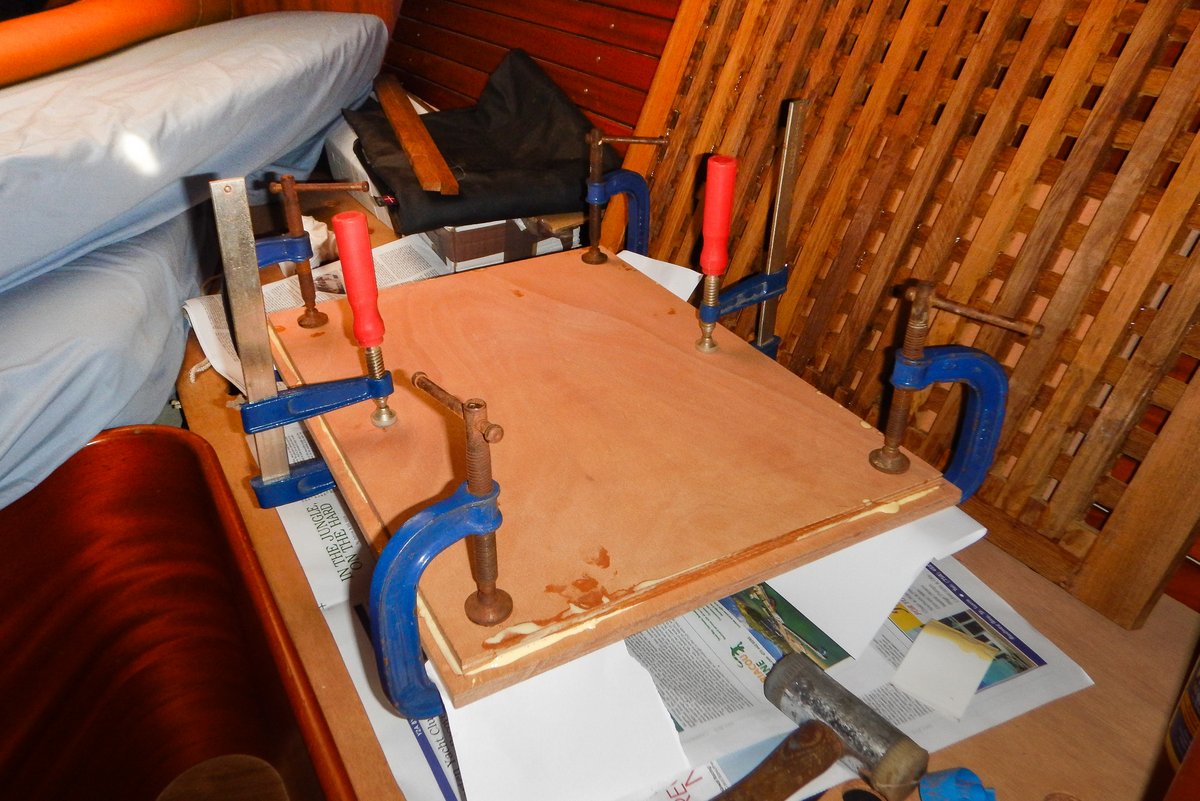
I picked up six pieces of plywood from one of the carpenters, so that I can make three cupboard doors for the front heads. They’ve charged me $120US to supply and cut up ½ sheet of marine plywood, which is outrageous, but they tell me that the marine plywood is imported hence the high cost. I glued and clamped one of the doors - I only have enough clamps to do one a day, so it will take a whole week to do the job including the painting.
Just before lunch, I decided to replace four clevis pins at the top of the lower shrouds. When Jonas, the rigger inspected the rig, he noticed that these clevis pins were 12mm instead of 14mm, so I brought four new ones back from the UK. It was a fairly simple, if lengthy job, climbing up and down the mast. I had a bit of a delay when I had to dash to the Chandlers to get some spacer washers - that took 30 minutes…
I was feeling very dehydrated after three hours in the sun, so I packed up in the late afternoon and chilled out for the rest of the day. Most of the jobs that we have to do are very technical and I have to do them, so Glenys is at a bit of a loose end and just pottering about while I mutter and curse in the beating heat.
12 October 2018 Chaguaramas, Trinidad
Mike from “El Lobo” came over to give me a hand with a few things. He brought his belt sander that made short work of flattening out my teak grating. He also brought a small portable table saw that we used to trim the grating to size. I still need to do a little more sanding, but the grating is almost finished.
We then drove to a hardware store called Kings, in St James, where I ordered three replacement mirrors. They told me that it would take 1½ hours, so we went to Mike’s partner’s bakery (she’s called Katrina) and had a leisurely lunch. I discovered that Mike has lost two boats since we were here in July!
His original boat “El Lobo” was a ferro-cement , junk-rigged schooner, which was hit by a jet ski about seven years ago. It appears that the repair to the hull failed and the boat sank in the Chaguaramas anchorage. His other boat was also a ferro-cement hull and also sank in the Chaguaramas anchorage. He thinks that it was hit by local boat. Both yachts were only insured as 3rd party, so it’s a huge loss to him - it was a conversation stopper.
After we picked up the mirrors, Mike dropped me back at the boat and I started to fit them. Unfortunately, some of the mounting brackets had corroded, but I was able to rescue enough to fit two of the mirrors. I know that they have some suitable brackets at King’s to I’ll have to get back there somehow.
Just before Miller Time, I managed to glue another of the cupboard doors. My back is still extremely stiff and sore - it’s only by taking Ibuprofen that I’m able to do any work at all. I’d like to rest it, but there are too many jobs to be done.
13 October 2018 Chaguaramas, Trinidad
The steering on Alba is driven by stainless steel cables which run through Teflon-lined conduit. The Whitlock manual states that the steering cables should be greased every year and replaced every 3-5 years. The conduit should be replaced every 5-10 years. The manual goes on to say that for boats in constant use, these numbers should be halved.

I’ve been very lax at the maintenance on this very important part of the boat, having never greased the steering cables and I’ve never considered changing them. While I was in the UK, I bought a new set of steering cables and conduit, but since getting back to Trinidad, I’ve been putting the job off because it could go horribly wrong and we could be stuck here for weeks waiting for parts.
Finally, I plucked up the courage to start the job today. With Swear Box handy, I spent the morning removing the steering cable and conduit, which seemed to go well. The afternoon was a little more fraught involving much swearing, grunting and straining (which didn’t help the pulled muscle in my back). By the end of the day, I was totally exhausted, but had replaced the conduit and had the steering cable in place ready to connect.
I was in bed by 20:30.
14 October 2018 Chaguaramas, Trinidad
After breakfast, I pulled the aft cabin apart again and spent the morning connecting and tensioning the steering cables. It was very fiddly, but it’s all done and I can sleep at night without worrying about our steering failing - unless of course, I’ve done something wrong…
While I’ve been doing the steering, Glenys has been giving me a hand occasionally and has been pottering about for the rest of the time, cleaning and polishing. In the afternoon, I did a bit of filling on the damn teak grating and glued the third and final cupboard door.
We’ve sprung a cooking gas leak. I fitted a new 9 kg bottle about a week ago and it’s completely empty. Fortunately, we’ve just had another bottle filled, but I can’t find the leak. It’s a big leak and the worry is that the gas is collecting in the bilges and the slightest spark will cause Alba to explode. It’s not the usual suspects of the flexible hose and regulator - although there is a smell of gas in the gas locker. I’ve checked everything that I can see, but tomorrow we’ll have to empty lots of cupboards in the galley and test every part of the system. We had cold salad tonight.
There are more photos in our Photo Album section.
15 October 2018 Chaguaramas, Trinidad
Jonas, the rigger turned up just after 08:00 as promised. When he inspected the rig back in June, he’d spotted three toggles that were the incorrect size and needed to be changed. They were in critical places at the top of the Back Stay; the top of the Fore Stay; and the bottom of the Inner Fore Stay.
Once he’d replaced the toggles, Jonas checked the tension on the rigging and re-tuned it. There wasn’t much wrong - the intermediate shrouds were too tight and the cap shrouds were a little too loose; he also backed off the lower shrouds. I think that the lowers may be too loose when beating to windward, but I won’t be able to check until we go sailing again. Jonas has told me to tighten all four of the lower shrouds equally, if I need to adjust.

With the rigging all done, I dinghied across to the sail loft and picked up the genoa and stay sail, which have had new sacrificial strips fitted and some other bits of maintenance. By the time that I’d got them on board, it was lunch time.
After a quick sandwich, I tackled the gas leak. The gas regulator was looking very corroded after travelling around the world, so I replaced it and also the flexible hose in the gas locker. I turned the gas on; pressurised the system; and then turned the gas off at the tank. To my great relief, the pressure held for ten minutes. The leak must have been in the regulator, escaping out through the safety vent, which is so large that it’s difficult to test with soap and water. I’m a happy bunny now and we had a hot meal in the evening.
Work stopped for a heady rain squall, after which we put up the main sail. It’s been a long saga to sort out the creases that appear when we furl the main. Over the last few months, North Sails have shipped the sail up to Martinique, done some minor modifications and shipped it back to us. They claim that the sail material is in good condition and the sail still has the correct shape as designed. However, they have removed an inch or so from the luff in an attempt to flatten the sail.
The was no wind when we put the sail up so it was hard to set the halyard tension, but the sail looked okay and furled away with less creases than before. I’m not sure if the small changes in the rigging and the sail have made any difference - we’ll have to wait until we furl it in anger when we go sailing.
16 October 2018 Chaguaramas, Trinidad
I could hardly move this morning because my back had seized up - too much lifting, twisting and straining over the past three days has taken its toll on my pulled muscles. I popped a few Ibuprofen, did some stretching exercises and managed to get mobile again.

Our first job was to put up the genoa and stay-sail after having some maintenance done. The main work done by the sail loft was removing and replacing the UV sacrificial strips, which make the sail look much better. I spent the rest of the day pottering around on deck doing various little jobs to get the boat ready to sail. I replaced the two winch handle holders on the mast, which have looked awful for the last two years.
Later in the afternoon, I finally finished off the teak grating for the front heads, cutting a few grooves in the bottom to let water drain and giving it a final sanding. Glenys spent the afternoon sewing, including making a cover for our new life raft.
Over the past ten days, we’ve managed to tick a lot of jobs off our long list and it’s starting to feel like the boat is getting back together. We’re looking forward to getting back to cruising next week - our aim is to head off on Monday 22nd.
17 October 2018 Chaguaramas, Trinidad
Glenys continued sewing jobs, finishing off the life raft cover and making some new shower curtains for the front heads. She then re-stitched the leather cover on the steering wheel. Meanwhile, I had an engine room day.
We’ve developed a very small leak on the radiator cap spout on the heat exchanger. I spoke to the local Volvo guy and he says that the spout is press fitted into the heat exchanger. Replacement is an easy job to do in the workshop, but first the heat exchanger has to be removed from the engine, which is long complex job. At his suggestion, I’ve put a seam of Marine-Tex around the joint, which will sort out the minor weeping and defer the job until the heat exchanger has to come off for any reason.
We’ve had a saga with a leaking sea water pump for over a year now - I replaced the seals in Madagascar in November; had the shaft reground and the pump rebuilt in South Africa by the Volvo agent, which didn’t work; so I had to replace the seals again in May. While in England, I bought a new sea water pump, which I fitted today - hopefully that’s the end of sea water leaks.
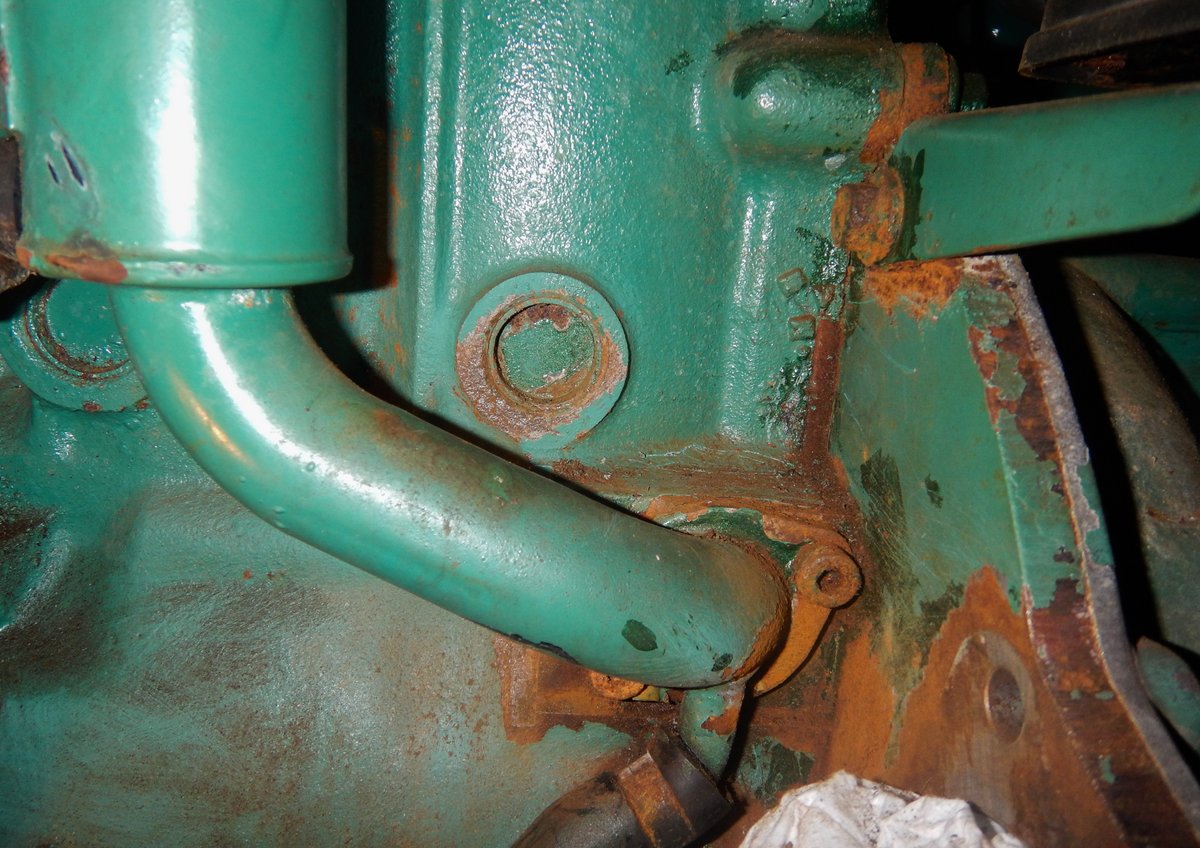
One of the consequences of a leaking sea water pump is that the rear of the engine is constantly soaked with seawater, which on a hot engine is rather corrosive. I’ve been trying to keep on top of rusting spots, but there are parts of the engine that I’ve not been able to access, particularly behind the alternators and the starter motor.
In the afternoon, I removed the starter motor and the alternator on the port side of the engine. This gave me access to surface rust patches, which I attacked with wire brushes. I then painted on some rust treatment and washed it down with water. The whole engine has become greasy and dirty, so while I had the electrics disconnected, I used spray-on degreaser and various brushes to get into all the nooks and crannies, washing down with fresh water.
The starter motor was also looking a bit sad with surface rust patches, so I wire brushed it down; painted on some rust treatment and then applied a coat of 2 part epoxy primer. I’ll finish it off tomorrow.
18 October 2018 Chaguaramas, Trinidad
Yesterday, I spent half a day wire-brushing and treating rust, but this morning, I spotted more surface corrosion. I removed the sea water pump again, so that I could get better access to the areas beneath it. I spent another two hours wire-brushing, applying rust treatment and applying the primer.

The primer has to be left for about 6 hours to cure, so in the afternoon, I tackled the water maker. About a year ago, I bought a new high pressure valve because the old one is slowly failing, but I’ve been putting off fitting it because we are so dependent on the water maker while cruising - if I damaged something, it would be a disaster. (OK, I’m a coward, but sometimes the old adage makes sense - if it ain’t broke, don’t fix it...)
I pulled the water maker panel to pieces and then discovered that the pressure valve is different from the old one. I don’t have any high pressure fittings, so I bundled everything into my rucksack and walked the mile to Echotec. One of the technicians said that all I needed was a different T-piece - hmmm, might be complicated. I asked if he could sort it out for me and fit it all back onto the panel. Sure thing, pick it up tomorrow… What great customer service.
It’s been raining most of the day, so Glenys decided that it would be good to give the teak deck a good cleaning - despite treating it for mildew in June, there lots of dark grey spots appearing. I think that the problem is caused by too much rainfall with humid conditions and no sea water going over the decks.
We’ve run out of Tri-sodium Chlorate (TSP) and they don’t seem to sell it here, so Glenys just lightly scrubbed with some washing up liquid and a cup of bleach in a bucket. I’m sure that we’ll have lots of sea water over the decks in the next few months which will stop any more mildew forming.

In the late afternoon, I painted a coat of green enamel paint on the engine, but the results were a little disappointing because the undercoat is a very vivid white and making the whole thing look patchy. I’ll have to put on another coat of green paint. In any case the engine looks a lot, lot better than it did before I started.
19 October 2018 Chaguaramas, Trinidad
We went on one of Jesse James’ legendary trips to visit Yeretté, which is the home of a Hummingbird enthusiast called Theo. He lives high up in the Maracas Hills and has set up over 50 nectar feeders which attract hundreds of Hummingbirds. There are 18 different species of Hummingbirds in Trinidad and Tobago and 14 of them regularly visit Yeretté.
Theo sat us down on his patio for an introductory talk about his Hummingbirds. Unfortunately, he digressed onto on a lengthy and rather boring talk on the Amerindians - the indigenous people of the Caribbean, who were wiped out by the Europeans when they arrived in the 1500s. All very interesting for a couple of minutes, but after 20 minutes of his slow monologue, I was itching to take photos of the hundreds of hummingbirds whizzing about and excused myself to wander around the garden.
Unfortunately, it rained for most of the time that we were there - this didn’t deter the Hummingbirds, but the poor light meant that taking photographs of the fast, tiny birds was very difficult. I couldn’t take fast shutter speed photos and there was no sun to glint off their iridescent feathers.
After a pleasant lunch, the rain became torrential; stopping us going into the garden, but Theo showed us a presentation of the hundreds of fabulous photographs that he has taken of the various species of Hummingbirds that visit his home. His photographs showed a lot of the fascinating behaviour of the birds including their tiny nest, which are held together by spider’s webs.

The torrential rain continued all afternoon, so Jesse postponed our trip to the Caroni Swamp, where we were planning to see Scarlet Ibis coming home to roost. The drive back to Chaguaramas was slow due to the huge amount of rain on the roads, but we were back on Alba by 16:30, which gave me enough time to apply the second coat of green paint to the engine.
20 October 2018 Chaguaramas, Trinidad
The second coat of green paint had covered up the patchiness on the engine, so I was able to put the engine back together. It took a couple of hours to replace the seawater pump, the alternator and starter motor. Thankfully the engine started and ran OK.
I pottered around for the rest of the day finishing off many little jobs, so by mid-afternoon, the boat was looking shipshape. All I need to do now is put the water maker back together and we’ll be ready to go sailing. There’s another patch of heavy rain due tomorrow and the following day, so our aim is to leave on Tuesday 23rd.
Glenys spent the afternoon cooking a fabulous Indian meal. “Jackster” and “Relax” came for dinner and we had a good time catching up on each other’s adventures since we all left South Africa.
21 October 2018 Chaguaramas, Trinidad
Being a Sunday, we had a quiet day pottering about and catching up on some administration.
The heavy rain on Friday was so extreme that huge sections of central Trinidad are flooded. Jesse James and a few cruisers went out yesterday and today to help rescue people who are trapped in their homes. The ITCZ has moved north of the equator and is bringing this heavy rain to the region. We'll probably wait until Wednesday or even Thursday before we sail to Grenada.
There are more photos in our Photo Album section.
22 October 2018 Chaguaramas, Trinidad
First thing in the morning, I walked the mile along to Echotec, but the flooding south of Port of Spain has prevented people coming into work, so my water-maker panel was still in pieces, which is a major setback. They say that it should be done tomorrow.
Back at the boat, we took down the awning and Glenys gave it a good scrubbing. When it was fairly dry, she dragged out her sewing machine and did some essential repairs, reinforcing stitching that had perished in the tropical sun. We had heavy rain showers in the afternoon and evening. In a brief lull, we managed to get the bimini back in place. It looks nice and clean now, but the water proofing has been scrubbed off and it leaks like a sieve.

The weather looks good on Wednesday & Thursday. Assuming that the water maker panel all fits together, we’re aiming to leave for Grenada on Thursday night.
23 October 2018 Chaguaramas, Trinidad
I contacted Echotec first thing in the morning. The technician who was going to do the job, still can’t get into work, but someone else is going to do it. It was a nice sunny day, so Glenys pulled back the boom awning and let the bimini dry out. She then brushed on a whole load of water proofing.
Echotec dropped off the watermaker panel at lunch time and I soon had it all connected together. Unfortunately, the new pressure valve protrudes backwards more than the original and the panel didn’t fit into the wooden housing. I had to cut another piece of wood to angle the panel forwards and then plug the existing screw holes with cocktail sticks and epoxy. I’ll have to finish it off tomorrow morning when the epoxy has set.
24 October 2018 Trinidad to Grenada (Day 1)
It was a beautiful day, so I quickly finished fitting the water maker panel and we went out for a test sail. The engine performed well; the steering worked; the rigging and sails looked good; and the water-maker ran fine for 20 minutes. Our sea trials were completed by 11:00 and the weather looked fabulous, so we decided to go back to the marina, clear out and leave for Grenada tonight.
At 14:00, we went over to clear out. Immigration was ram packed and the immigration officer moved at the speed of a sloth. It took over an hour to get our passports stamped, so we didn’t get to customs until 15:15, but we were cleared out by 15:30. We had some spare Trinidad dollars, which are hard to exchange, so called in at the Duty Free shop and picked up 8 bottles of wine and a case of beer - £4 to £6 for a bottle of wine - not bad for the Caribbean.
Glenys went to pay the marina (and get rid of our last Trinidad dollars), while I put the dinghy on deck. We were soon all ship-shape and motored out of the marina at 16:30. There was hardly any wind, so we motored out of the Bocas channel, encountering some 2-3 foot over-falls at the entrance because of the outgoing current against the ENE wind.

We motor sailed for a further hour until we’d travelled a few miles offshore, where the wind settled down to a constant direction. I was expecting ESE wind, so that we’d be on a beam reach, but the gods were against us and we were very close hauled. At least we had a current with us. There was a beautiful full moon and we had a pleasant night sail even though hard on wind.
25 October 2018 Trinidad to Grenada (Day 2)
Our land fall was perfect. Glenys watched the sun rise and, by 07:30, we were anchored in Clarke's Court Bay (Benji Bay) at 12°00.30N 061°43.83W in 12 metres depth on good holding mud. We were in time to listen to the Grenada Cruiser’s net on Ch.66 at 07:30. We were surprised to learn that it’s Grenada’s Thanksgiving Day today, so most businesses are closed and even if the customs is open, we’ll get hit for overtime.
Glenys rustled up some bacon butties and a cuppa tea for breakfast and then we chilled out for the rest of the day. I dropped the dinghy into the water and went for a swim. It’s the first time that I’ve been snorkelling since June and the visibility isn’t too bad.
We’re in a good spot with a reef about 50 metres behind us. I’ve put on loads of weight after being in the UK, eating too much food and doing no exercise, so I’m determined to get fit again. I’m planning to swim to the reef and back every day and start doing my morning exercises again.
26 October 2018 Benji Bay, Grenada
After breakfast, we popped around the corner to Phare Bleu marina to clear in. I was a little nervous about not even trying to clear in yesterday, but they didn’t bat an eyelid, when I said that we’d arrived at 17:00 yesterday, which is outside their normal hours. The customs lady took our forms, but said that we had to wait for the immigration guy to turn up. We were only kept waiting for 30 minutes, so we were soon finished.

The customs lady had enormous, 1 inch long false nails, which were definitely a liability when she was shuffling her paperwork, never mind having to type on her computer. We’ve seen long nails on officials all over the Caribbean - it’s a symbol that they don’t have to do any manual labour. Rather sad, really.
After dropping our documents off at the boat, we carried on to the small dock at Woburn and caught a minibus into St Georges. Our first job was to get a SIM card with internet access. We then wandered around some of the quaint small stores looking for a few bits and pieces. I love St Georges, it’s a bustling little place and so colourful in the bright sunshine, the Carenage is particularly picturesque, with houses built on the steep slopes overlooking the natural harbour.
We had lunch at the lovely Nutmeg restaurant - it’s become a bit of a custom because we’ve been going there for the past 25 years. We normally have one of their excellent rotis, but they’d only just started to peel the potatoes, so we shared a Callalloo Soup and Curried Lambi instead. It’s a great place to sit and chill out, overlooking the colourful fishing boats on the Carenage.
We bought a few provisions in the Food Fair. I love walking around the supermarkets in the Caribbean. There's stuff that you'd never see in a UK supermarket. Today's delight was loose bars of Blue Soap. It's a very old-fashioned block of soap used for laundry. Apparently, it contains ultramarine blue and sodium carbonate for a better wash. It’s supposed to be kinder on hands than laundry detergent and has a mild fragrance to complement cleaning. It's also only £0.35 for a block of it. Glenys is not convinced...
We caught a minibus back to Woburn and, at the dock, I unlocked our stainless steel chain, expecting the dinghy to stay put because it was also tied on with a rope painter. To my shock, our dinghy started to drift away from the dock because the painter was no longer attached to the dinghy! I did a hop, skip and a jump across a local boat and just landed in our dinghy.
After starting the engine and motoring back to the dock, I found that our painter was still tied to the dock, but some idiot had untied the rope from the dinghy. The bowline has been tied on there for a couple of years, so I know that it didn’t work loose by itself. I’m guessing that another cruiser has untied the painter to get his own dinghy out of a tangle - he could have at least tied it back on.
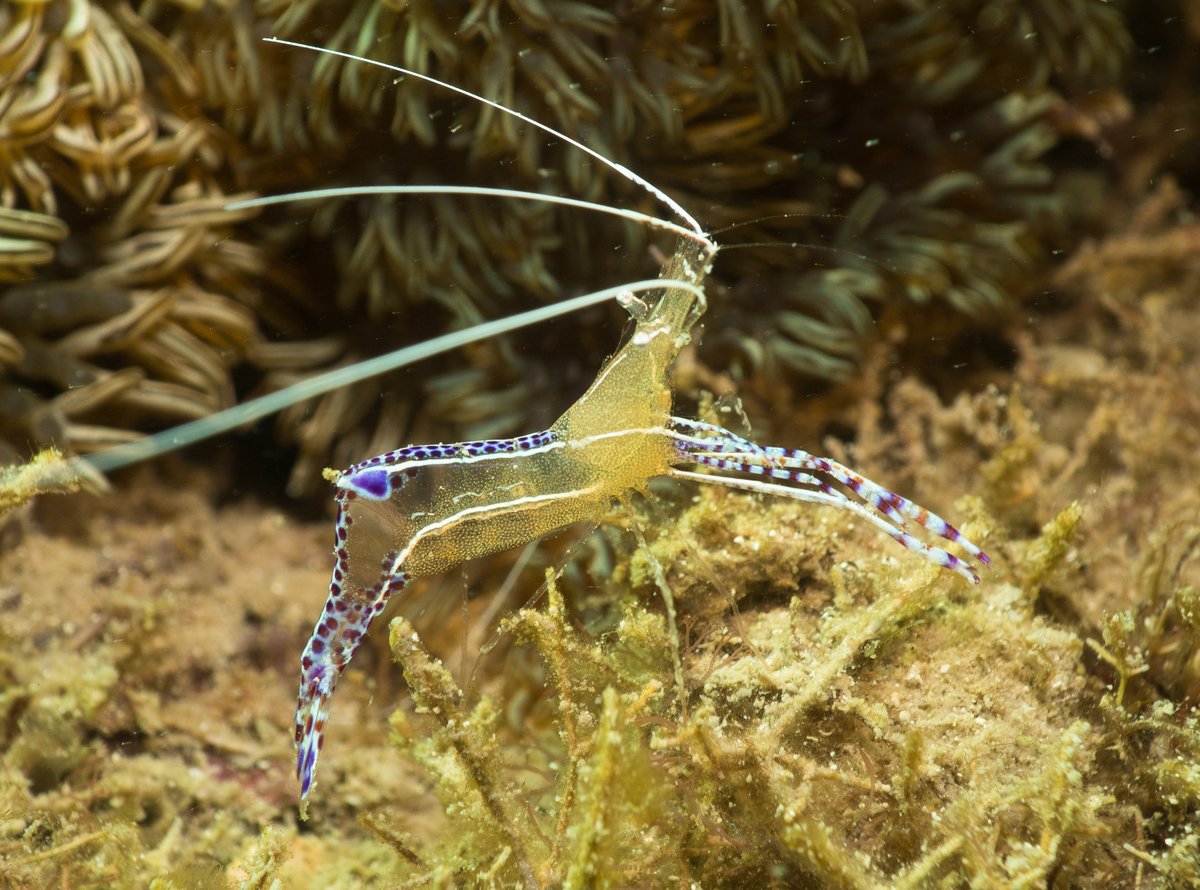
Back at the boat, we grabbed our snorkelling gear and went for a snorkel just off the cliffs on Little Calivigny Point (about 12°00.18N 061°43.72W). It was surprisingly good, with 5 metres of visibility and lots of coral and fish. The reef is covered by a thin layer of sediment, but we saw a few fire worms, lots of feather worms and a few colourful shrimp. Unfortunately, the batteries for my underwater camera haven’t been charged, so no photos, but I’ll have it all ready to go tomorrow.
27 October 2018 Benji Bay, Grenada
In the morning, I dug out my underwater camera and set it all up. After lunch, we went back to the same reef off Little Calivigny Point. We saw a couple of Lionfish and a Peterson Cleaning Shrimp. I also took a nice macro photo of a Magnificent Feather Duster. It’s great to be back snorkelling.


We chilled for the rest of the day.
28 October 2018 Benji Bay, Grenada
We had a fairly quiet Sunday. At lunch time, we went to a bar called Island View (just below Taffy’s bar), where they had specially cooked some spare ribs. It was okay, with a few provisions, but expensive for what we had.
After chilling out in the afternoon, we dinghied over to Hog Island for a few beers at Roger’s bar. The place was bouncing with lots of locals having a good time. There were the usual gaggles of cruisers, who looked like long term mooring residents - no one that we knew or wanted to talk to. It makes me sad to see the large number of moorings in the Hog Island anchorage, all with foreign boats who just doss here.
There are more photos in our Photo Album section.
29 October 2018 Benji Bay to Tyrell Bay, Carriacou
We were planning to go up to the Grand Etang National Park for a hike today and then sail up to Carriacou tomorrow or the next day. However, there’s a Tropical Wave due to arrive tomorrow night, which will bring rain and stronger winds for the rest of the week. After ten minutes of debate, we decided to abandon the hike and sail up to Carriacou today, while the weather is perfect.
It took us 30 minutes to get the boat ready for sea and we left at 08:30. We had a pleasant motor along the south coast to Saline Point and then a cracking sail across St Georges Bay. As usual, when we arrived at Moliniere point, the wind dropped and came from all directions, so we motor sailed up the west coast of the island. It was very calm, so we chilled out reading our books.

Just as we were passing the small town of Gouyave, I noticed that our boat speed had dropped to 2 knots despite the engine running at 1800 rpm - we’d picked up some flotsam. We stopped the engine and drifted while I donned snorkelling gear and went to have a look at what we’d picked up. I was amazed to find a large polystyrene float attached to a long rope leading down into the depths - probably to a large lobster pot.
The rope had missed the propeller, but has snagged around our rudder, so we were towing the whole contraction along. It took a few dives, but I was able to pull the rope away from our rudder and there was no damage done to Alba or the fishing gear. Speaking of fishing, we trailed a line all the way to Carriacou and all we caught was Sargassum Weed, which I had to keep cleaning off every 30 minutes.
To the north-west of Grenada, there’s an active underwater volcano called Kick Em Jenny, which has a 1.5 mile exclusion zone around it. The volcano last erupted in 1973, but there have been a couple of minor earthquakes this year, so we wanted to keep well clear. Unfortunately, Kick Em Jenny is directly on the rhumb line to Carriacou, so we motor-sailed a few more miles upwind along the north west coast of Grenada before we headed offshore.
We had a cracking sail to Ronde Island and then onto Tyrell Bay where we anchored at 12°27.36N 061°29.29W in 5 metres on good holding sand. The bay isn’t as busy as it was in June, but there are still a lot of boats here. Marcus and Margie from “Island Kea II” came over to say hello, so we invited them on board for a few beers.

30 October 2018 Tyrell Bay, Carriacou
It was a bit more blustery in the morning, but still sunny, so we went snorkelling along the headland to the south of the anchorage. We first went to a small wreck in shallow water at about 12° 26.69’N 61° 29.89'W, which was okay. It’s a fairly new wreck, so there’s not much sea life established yet and the area around the wreck is mostly boulders. At least the visibility was good.
On the way back, we picked up a dodgy looking mooring about 50 metres off shore from a large rusting wreck (about 12° 27.077'N 61° 29.668'W). The mooring leads down to a very nice reef with good visibility. Unfortunately, it’s between 6-10 metres deep and a challenge to do photography, so I soon exhausted myself.
The wind picked up in the afternoon, but at least it didn’t rain. We’re glad that we came up in settled weather. We ran the water-maker and chilled out for the rest of the day.
31 October 2018 Tyrell Bay, Carriacou
The tropical wave finally came through in the middle of the night, bringing some heavy rain, but not much wind. After breakfast, we went for a walk to see if we could get to the end of the southern-most peninsula. We dropped our dinghy off at the marina dinghy dock and walked up the very steep access road.
At the top we turned right. Within a few hundred metres, we were out of the houses and into grazing farmland. It’s all fenced off, so we were unable to walk to the edge of the high cliffs overlooking where we were snorkelling yesterday. We came across a place where the fence ended and we were able to turn right to walk across to the west coast line. Unfortunately, the bush was too thick to walk up to the top of the cliffs.

Eventually, we arrived at a beach facing towards Saline Island and walked along through the mangroves, coming across some impressive invasive plants, covering the mangrove trees - lovely colours. The dirt track petered out next to a couple of houses and we weren’t able to get through to the end of the peninsula, but it was nice to get out and stretch our legs.
In the afternoon, we popped over to see “Island Kea”, who are on the hard. They’re deep into work, but had time to dig out some chart books for the Bahamas, which they gave to us. We need to do some serious planning of where we will be able to visit. Our keel is 2 metres deep and a lot of the Bahamas is very shallow water.