
15 September 2014 Apia, Samoa
We were up early and went out to sea to run our water maker because the water in the harbour is very murky and would clog up our water maker filters. It wasn't the best day to go out because we had a miserable three hours hanging around in rain squalls with winds gusting up to 25 knots at times. However, we did manage to fill our tanks to the brim, which will keep us going for another week or so.
Having anchored back in the same place, we watched an outrigger canoe race. There's a big competition going on this week and the first race was a ladies marathon. The outrigger canoes were 40 foot long with six paddlers participating in a 13 kilometres race. We had a prime view of them because they had to paddle around us just after the start.
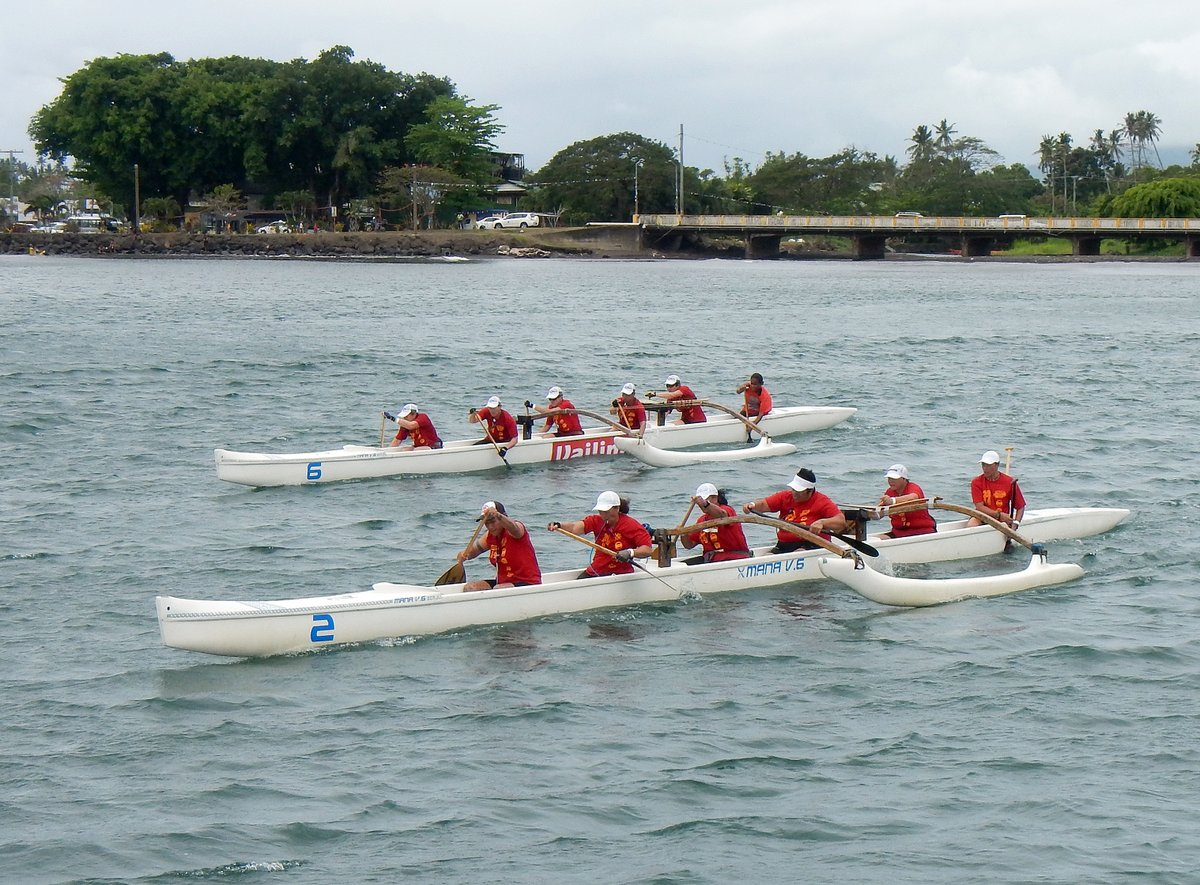
Later in the afternoon, a Port Authority boat appeared and told everyone in the anchorage that they had to go into the marina because we were in the way of the outrigger races. Most of the other boats moved almost immediately, but we stayed out another night because the anchorage is nice and cool with a good breeze.
16 September 2014 Apia, Samoa
We had another early start to the day; I jumped in dinghy and went to have a look at the marina. The Apia marina is run by the Port Authority and unlike a commercial marina, there are no staff to take lines or allocate berths, so I took my portable depth meter with me and checked out the remaining berths myself. There was no problem, I measured 5 metres on the approaches and nearly 2.8 metres at low tide in the berth.
It was very painless getting into the berth with a couple of the cruisers giving us a hand to take lines. Once we were settled, we walked along the sea front and booked a hire car for tomorrow. We were planning to go to the cultural centre for their bi-weekly exhibition of Samoan crafts, but it started to rain heavily, so we gave up and retreated back to boat.
I walked to a bar and did some more internet in the afternoon, transferring money around to pay for our expensive flights back to UK. I also checked the weather forecast and it looks like there's a brief lull in the strong south east trade winds over the weekend, so we're planning to leave for Tonga on Saturday 20th. In the evening, we went to a bar for happy hour with some of the other cruisers and then had fish & chips in a seafood restaurant just across the road - a very basic place, but the food was great.
It was absolutely boiling in the marina all day and we hated it. Most people think that it would be nice to be in a posh marina, but we prefer to be out at anchor. Here's Why I’d Rather Stick Pins In My Eyes Than Stay In A Marina:
Marinas are often surrounded by buildings and are "protected" from the weather, so they tend to be airless places. In the tropics, this makes them extremely hot and the lack of wind means that we get no power from our wind generator.
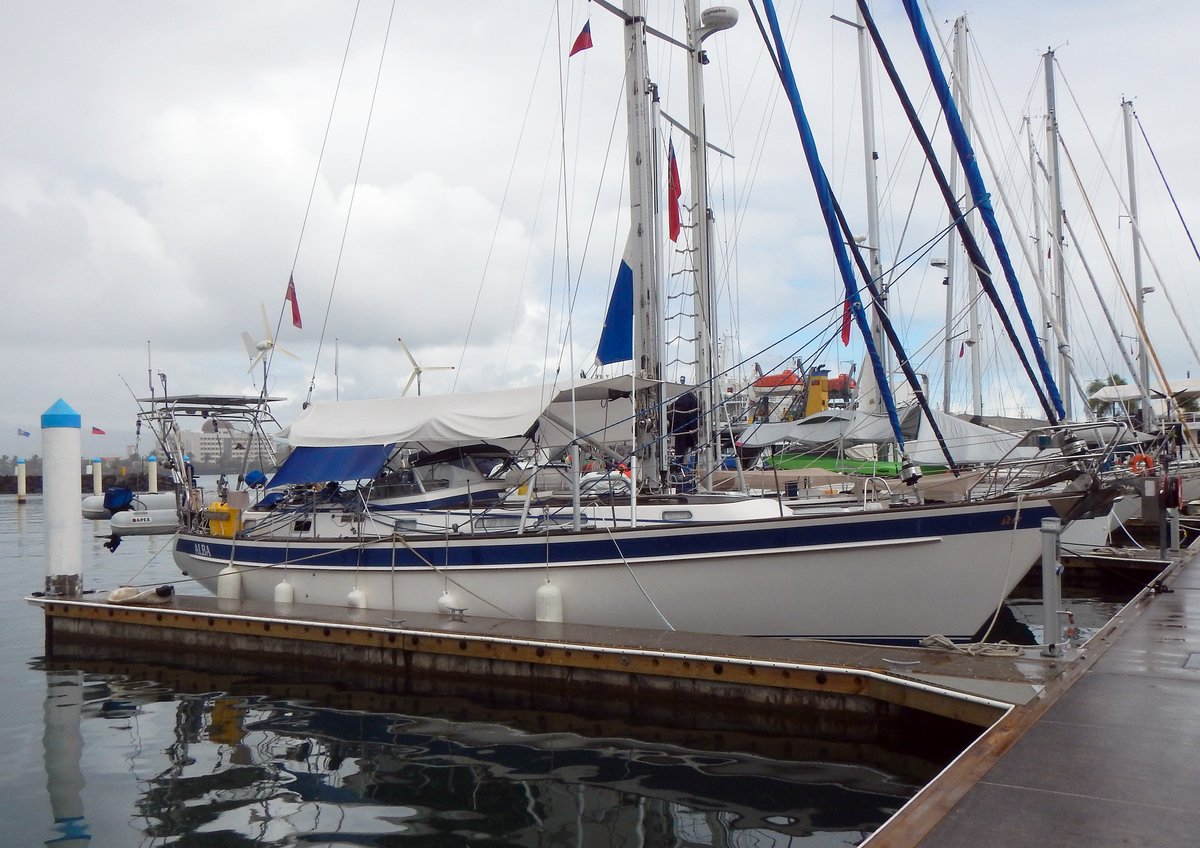
There are ALWAYS multiple bars in marinas, typically frequented by DINKS (Dual Income No Kids) who get very drunk and loud. Even worse is the night clubs that think that it's trendy to be around the rich boat owners (who’d actually like to go to sleep at nine o’clock.)
There’s always some swell and water movement in a marina, so the ropes squeak and the pontoons groan all night. There's nothing more irritating than trying to go to sleep with the constant jerk caused by our 12 ton boat snatching against its mooring lines.
Marinas are too close to land with cars constantly driving about and the noise from rowdy, pissed people pouring in and out of the bars is very intrusive. The constant presence of mosquitos means that we have to have mosquito nets covering our hatches, which further reduces the flow of air through the boat and makes it even hotter.
Having access to electricity is seen as a positive thing, but it’s expensive and probably the wrong voltage or frequency. I’ve spent thousands of pounds on solar panels and wind generator to be self-sufficient, so why pay for electricity?
About the only good thing is having access to a fresh water supply. It’s great to be able to wash clothes without worrying about how much is left in our water tanks. Unfortunately, most of the time it is metered (and expensive) and the rest of the time it's of dubious quality, so there’s no way that it’s going into our tanks.
For crying out loud, why the hell do all marinas have lights blazing away all night? It’s like the Twilight Zone - there’s a constant glow coming through the curtains. I wake in the middle of the night, sweating because of the lack of air and with a dry throat because of the heat and then can't get back to sleep because of the lights.
So we’re on a finger pontoon approximately 15 feet from the next boat. This is not conducive to having a nice, quiet meal in the cockpit (which is where you need to be because it’s so bloody hot below.) If you’re really unlucky, your neighbour is overly familiar and “chats” across the finger pontoon to you while you’re eating.
Oh, I nearly forgot, there are the showers. I don’t care how pretty the bloody showers are, why on earth would I walk 200 metres to the shower block with my towel and wash bag, then walk 200 metres back getting hot and sweaty, when I can have a lovely shower on board?
And, to top it all, you have to pay to be in this hell …
17 September 2014 Apia, Samoa
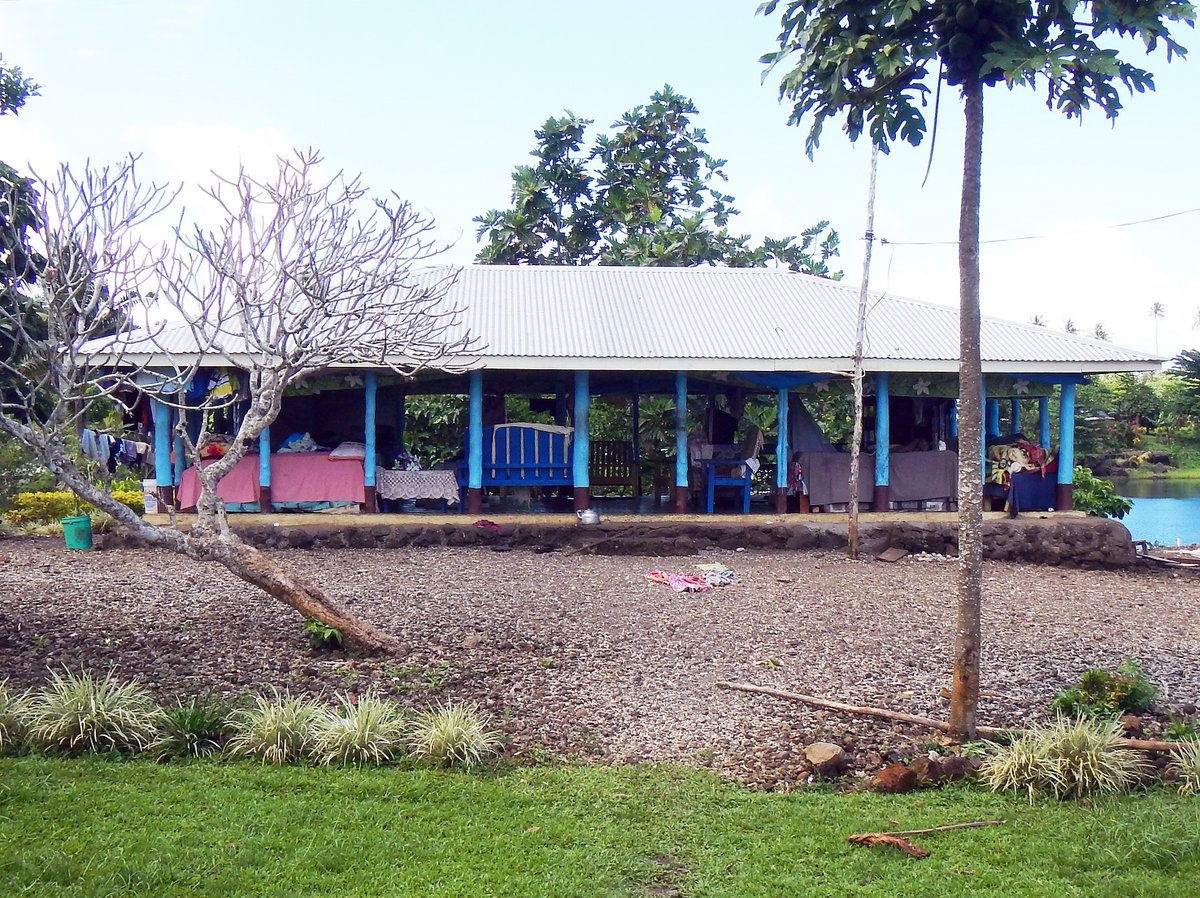
It was yet another early start. We picked up a hire car and went for a tour of the island. Apia is a small, built-up city, but it doesn't take long before you're out in the country, where the traditional open sided houses called fales start to appear.
Our first stop was at the Baha'i house of worship. This is the first time that I'd heard about this religion, which was formed by Baha'u'llah, an Iranian in 1844. He proclaimed himself to be the Messenger of God and his principal teachings stated that all religions are part of one religion. For his revelations, he was imprisoned for most of his life and died in a penal colony in Israel of all places.
There are only eight Baha'i houses of worship scattered around the world. There are no clergy and no ritualistic services, just individual prayer and meditation. It's an impressive building, with nine entrances reflecting that the faith is open to all people and religions. The grounds are serene and it was pleasant to walk around, but I realised that this religion wasn't for me when I discovered that the Baha'i faith calls for total abstinence from alcohol.
We stopped off at O Le Pupu Pue national park and drove three kilometres along a dirt track to go for a trek along the south coast. Despite living on a boat and seeing the sea every day, it was an interesting hour's walk along steep cliffs being pounded by the Pacific Ocean. The path goes through a Pandanus wood and ends up on a lava field that plunges into the ocean.
We also did a short hike to the Ma Tree. It was a hot, but pleasant walk through rainforest and a great contrast to the coastal path only 3 kilometres away. The Ma Tree is a large tree with strange roots that fan out from the tree like big blades. Some of them are over ten feet tall. While in the national park, we had a look at a waterfall, which was okay - I've seen too many waterfalls over the past few years.
Having worked up an appetite, we drove along the south coast looking for a beach to stop for lunch. It wasn't easy because most of the beaches seem to be enclosed by small private resorts. We eventually found one, parked up and sat down on the white sand to eat our sandwiches, while staring at the rollers crashing on the reef.
Within a couple of minutes, a young guy came up, sat down beside me and started to chat. After a while, he demanded $15US each for us to use his village's beach. We protested and he quickly backed down to $5US each because we weren't going swimming. We finished our sandwiches and, feeling hassled, walked to the car. The guy followed us, still demanding his money. I eventually gave him $2.50 US to get rid of him. Our first and only contact with villagers was unpleasant - we're just tourist dollars on legs.
We stopped off at the To Sua Ocean Trench, which are two huge flooded sink holes joined by a cave. It's a tourist trap with a $10 US entrance fee, but it was fun to climb down the 15 metre steep ladder and swim in the cool water.
It took us the rest of the afternoon to drive around the west end of the island passing through lots of villages and seeing some of the destruction caused by the 2009 Tsunami which wiped out entire villages and killed hundreds of people.
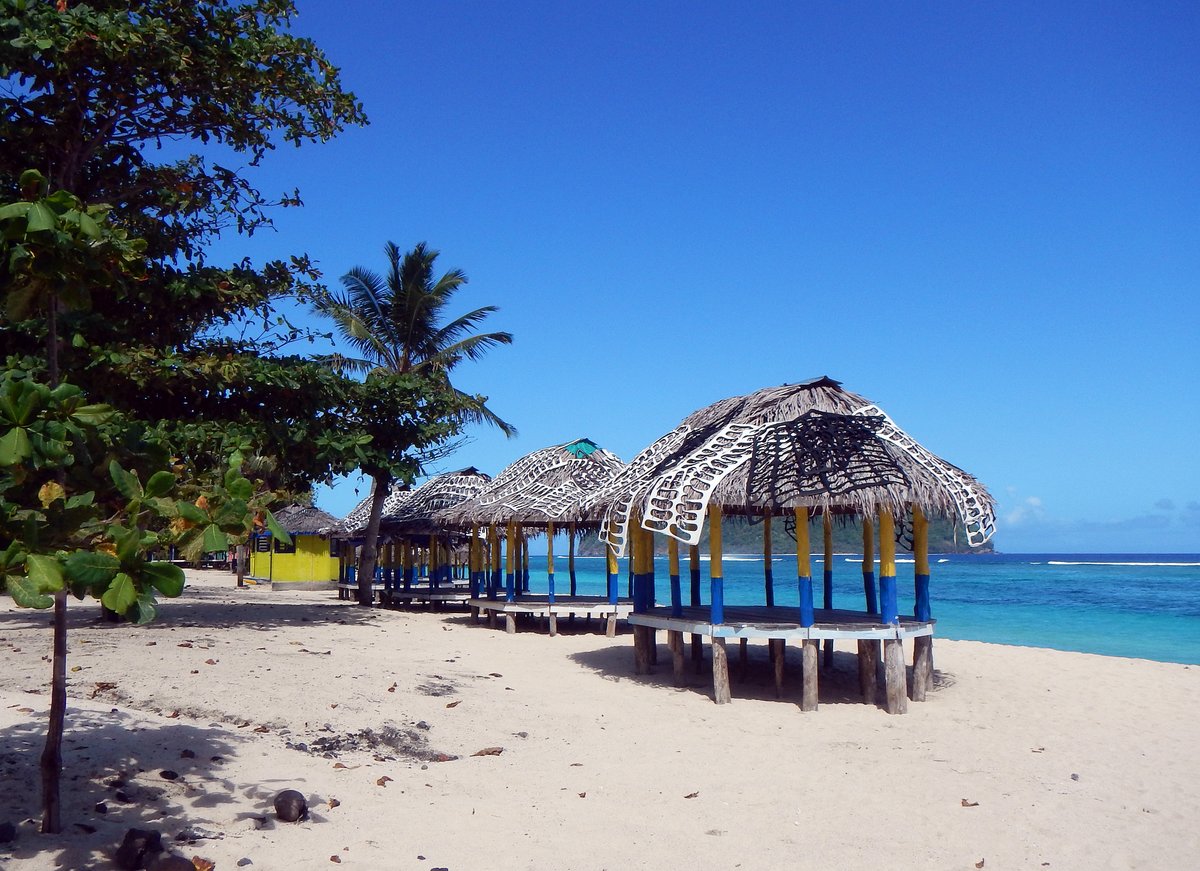
Staying in a Beach Fale is a big thing in Samoa and one of the beaches that we visited is listed as one of the top ten beach destinations in the world - I don’t think so… The Beach Fales are wooden platforms on the sand with thatched roofs and you get provided with a mattress. They're open to wind, rain and mosquitos - I don't see the attraction.
Back in Apia, we filled our three jerry cans with diesel and collapsed back onto our hot, sweaty boat.
18 September 2014 Apia, Samoa
In the morning, we went to the cultural centre, which is across the road from the huge catholic church. Twice a week, they put on an interesting display of Samoan crafts.
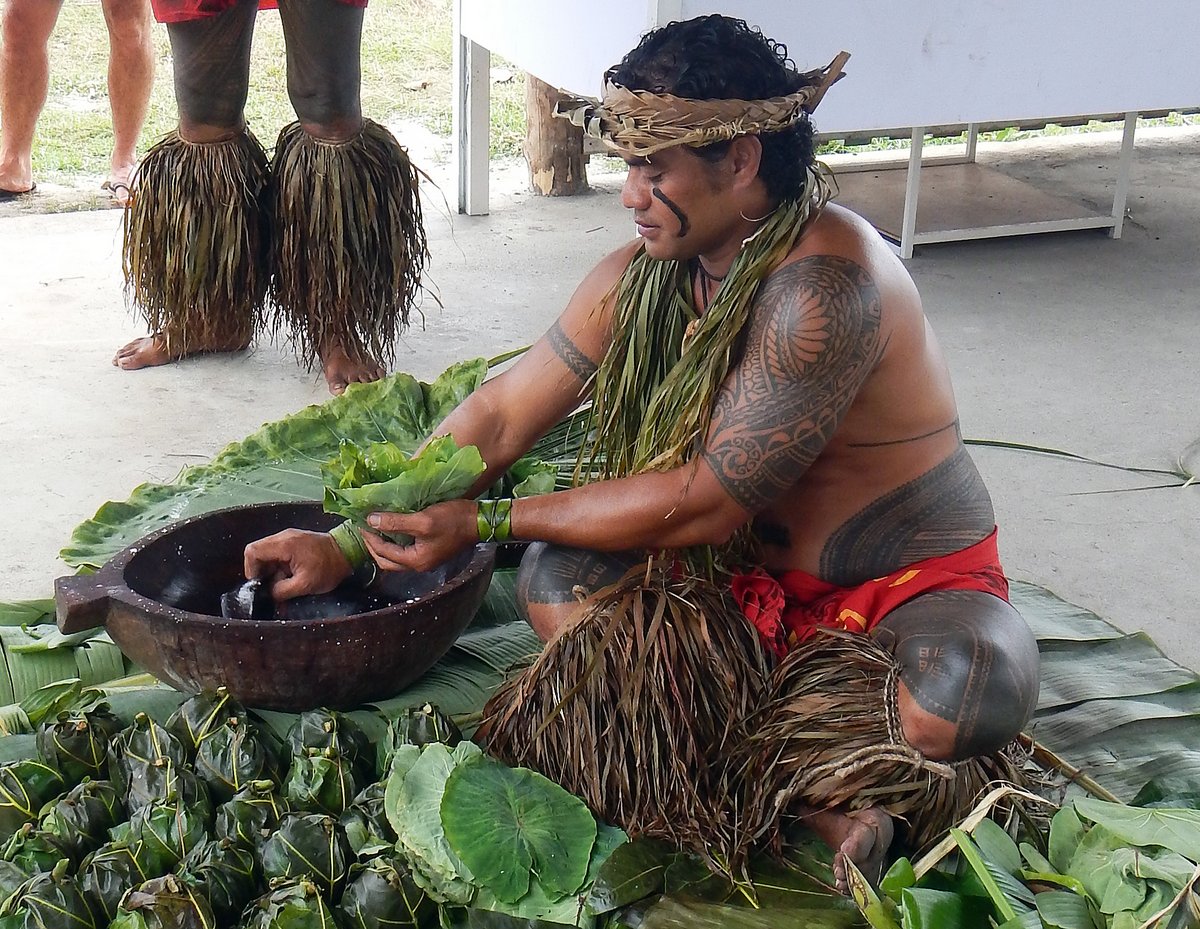
The presentation about cooking in a traditional Umu was interesting. The Samoans heat volcanic rocks in a fire until red hot and then spread them out on the ground. Food wrapped in coconut, taro and banana leaves is placed on the hot rocks and the whole thing is covered with green banana leaves. It typically takes half an hour for the food to be baked - they gave us samples of the food, which was tasty. I particularly liked the Palusami, which is Taro leaves cooked in coconut cream.
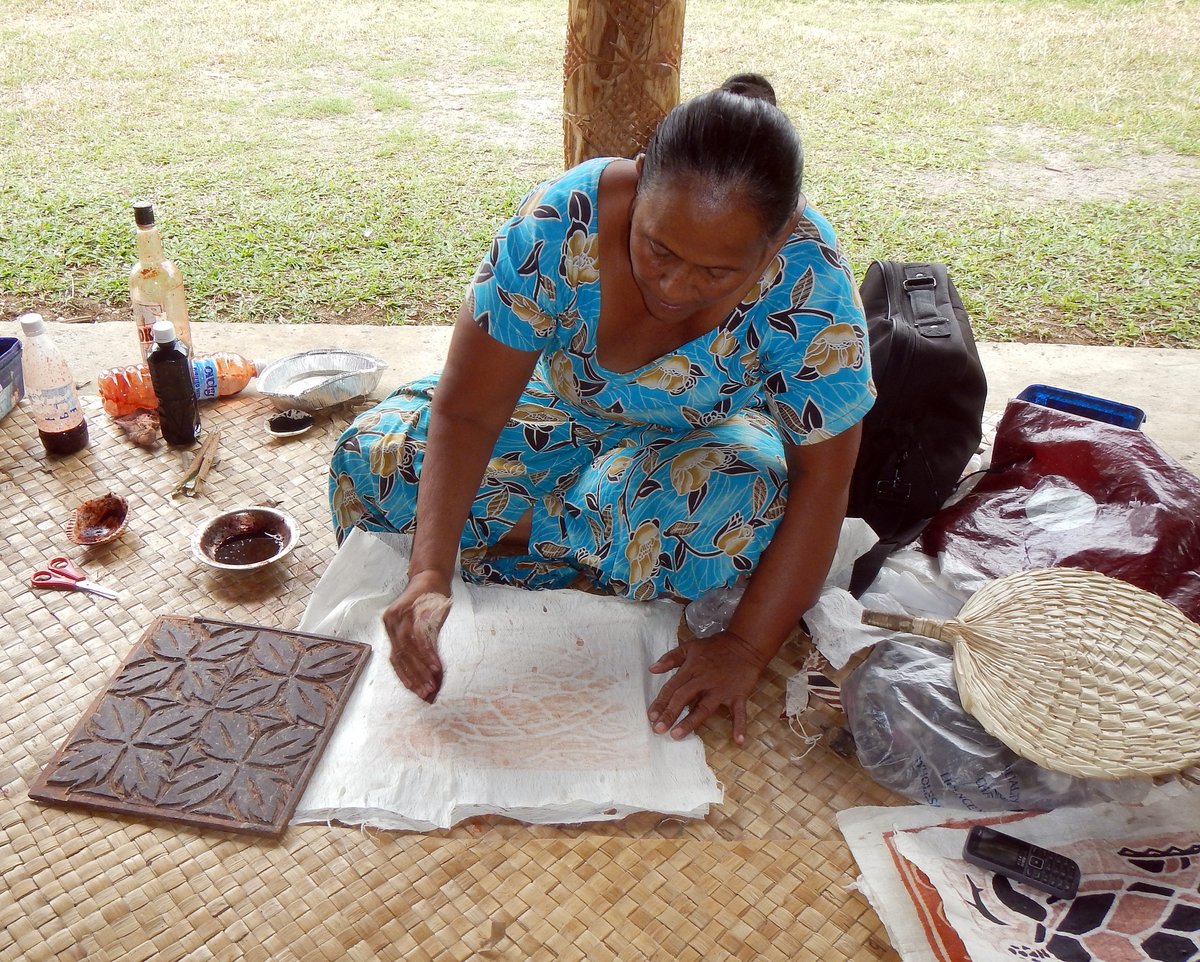
We watched a lady making Tapa cloth from the bark of a mulberry tree. She stripped the bark from a five foot long branch using a knife, then separated the inner part of the bark from the outer (which is discarded). The bark is then scraped with the serrated edge of shells using water to lubricate the bark. This process thins and spreads the bark out, going from three inches wide to six inches wide.
When the bark is thinned out, it's folded over into several thicknesses and is then pounded with heavy club to further spread it until it's over a foot wide and paper thin. It's then stretched out to dry slowly in a shaded, but breezy place. The lady then used semolina as a natural glue to stick several thicknesses together and natural dyes to print a pattern on it to produce the traditional tapa panels that can be seen all over Polynesia.
Another interesting display was traditional tattooing. The "full body" Samoan "Tatua" is a mental and physical challenge that is regarded as a Rite of Passage for young Samoan men. The tattoos are put on using tools with fearsome looking metal needles, hammered into the skin using a light stick-like mallet.
The designs are very dense taking eight, four hour sessions to do the full design and it looks to be an incredibly painful process. We were told that sometimes the person being tattooed is not strong enough (mentally or physically) and may have to have a couple of days rest between sessions. Once started, the Tatua has to be finished because an unfinished tattoo will bring great shame and loss of status to the young man and his family.
It was incredibly hot in the afternoon in the marina. By three o’clock, it looked like they had finished the canoe races, so I wandered down to see the organisers. Yes, they’d finished. I nearly skipped with joy on the way back. Fifteen minutes later, we’d obtained clearance from the Port Control and motored out to the anchorage. There was a nice strong breeze, so the boat soon cooled down.
Our plan is to leave at midnight tomorrow, so we tidied up a bit. Glenys rustled up dinner and we sat down below watching a movie - lovely!
19 September 2014 Apia to Nuiatoputapu, Tonga (Day 1)
We had a great night with a pleasant breeze coming through the hatches and the gentle rolling of the boat rocking us to sleep.
After an early breakfast, we walked along the sea front to the police station ready to watch the daily police brass band parade, which we'd heard at 0845 every weekday since we arrived. By 0900, it was obvious that for some unknown reason, they didn't have it today - bummer!
We continued into town and went to the Immigration office to clear out, which was very quick and easy. On the way back to the Port Office, we stopped off at McDonalds for our second breakfast - the lure of an Egg McMuffin was just too great. At the Port Office, we paid our harbour dues of $100US and managed to persuade Clare that we shouldn't pay for our two hated nights in the marina. Customs gave us our final clearance papers for a small fee of $15US and we were all done by half past ten.
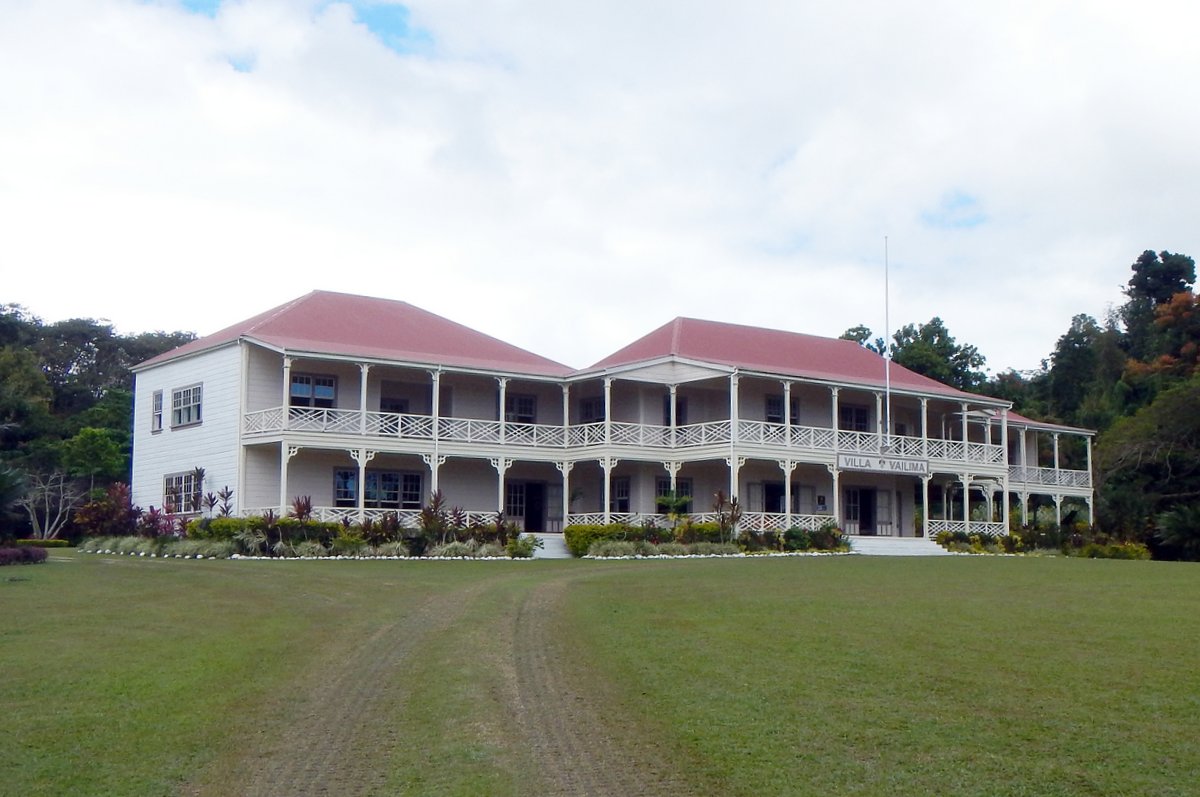
Having time to spare, we took a cab up to the Robert Louis Stevenson museum. It's a very grand colonial house that the author bought in the late 1800s after he made his fortune with Treasure Island, Kidnapped and Dr Jeckel and Mr Hyde. He had tuberculosis and retired to Samoa for the warmer climate.
A lovely lady gave us a guided tour of the house and was very good at explaining the Robert Louis Stevenson’s life in Samoa and how he got involved in helping the Samoan people through times of civil war. He was known as Tusitala which means storyteller in Samoan and was greatly respected and given a huge funeral when he died at an early age. We walked up a path from his house to his grave at the top of a hill - the path was built by Samoan chiefs as a sign of respect for Tusitala.
We bummed a lift back to town and went to the supermarket to do our final shopping before sailing to Nuiatoputapu, where we believe that there are no shops at all. Having spent the last of our talas, we retired to the boat and got ready for our 180 mile two-night sail. Dinner was early and we were in bed by seven o'clock.
The alarm went off at half past ten and we were on our way at eleven o'clock. It was pitch black with no moon and, to make things a little more interesting, a ferry was coming in as we were exiting along the leading line through the reefs. Using our AIS system, I was able to find out the name of the ship and called them up to declare our intentions and we agreed to pass starboard to starboard.
There was no wind in the lee of the island, so we motored for seven hours all the way around the north side of Upolu and through the straits between the two main islands. As we cleared the small island of Apolima, the south-east wind started to kick in and I could start sailing although it was very flukey.
20 September 2014 Apia to Nuiatoputapu, Tonga (Day 2)
By sunrise, we were sailing in clean winds and clear of all obstacles, so we settled down to a lovely day on a close reach with 6 foot seas, 15 knot winds and blue skies. We spent most of the day reading and catching up on sleep, with Glenys napping in the morning and me in the afternoon.
At four o'clock in the afternoon, we only had 80 miles to go and at 6.5 knots were going too fast, so we put two reefs in the main, rolled away the staysail and put four wraps in the genoa, which slowed us down to 5 knots.
Towards the end of my 7-10 watch, the wind picked up to 20-25 knots and veered by 20 degrees, so I rolled away some more genoa and, sure enough five minutes later, we had torrential rain, which lasted for 30 minutes as a big squall system passed over us. The rest of the night passed without incident with a nice 15-20 knot wind, 20 degrees forward of the beam.
21 September 2014 Apia to Nuiatoputapu, Tonga (Day 3)
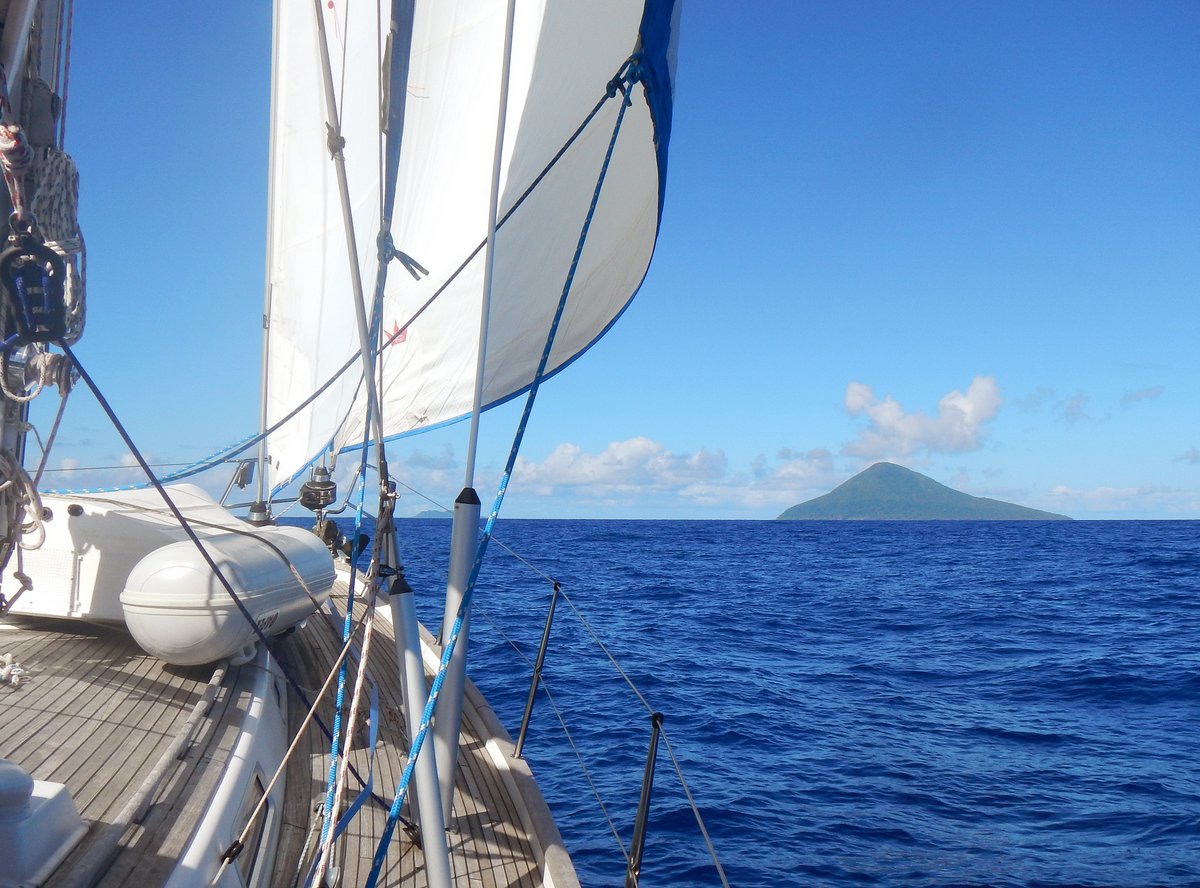
Around dawn, the wind dropped a little to 10-15 knots, so Glenys unfurled the genoa and main. At eight o’clock, we only had 18 miles to go and we could clearly see Nuiatoputapu and the impressive neighbouring island of Tafah which is a 600 metre high volcanic island that rises dramatically out of the ocean.
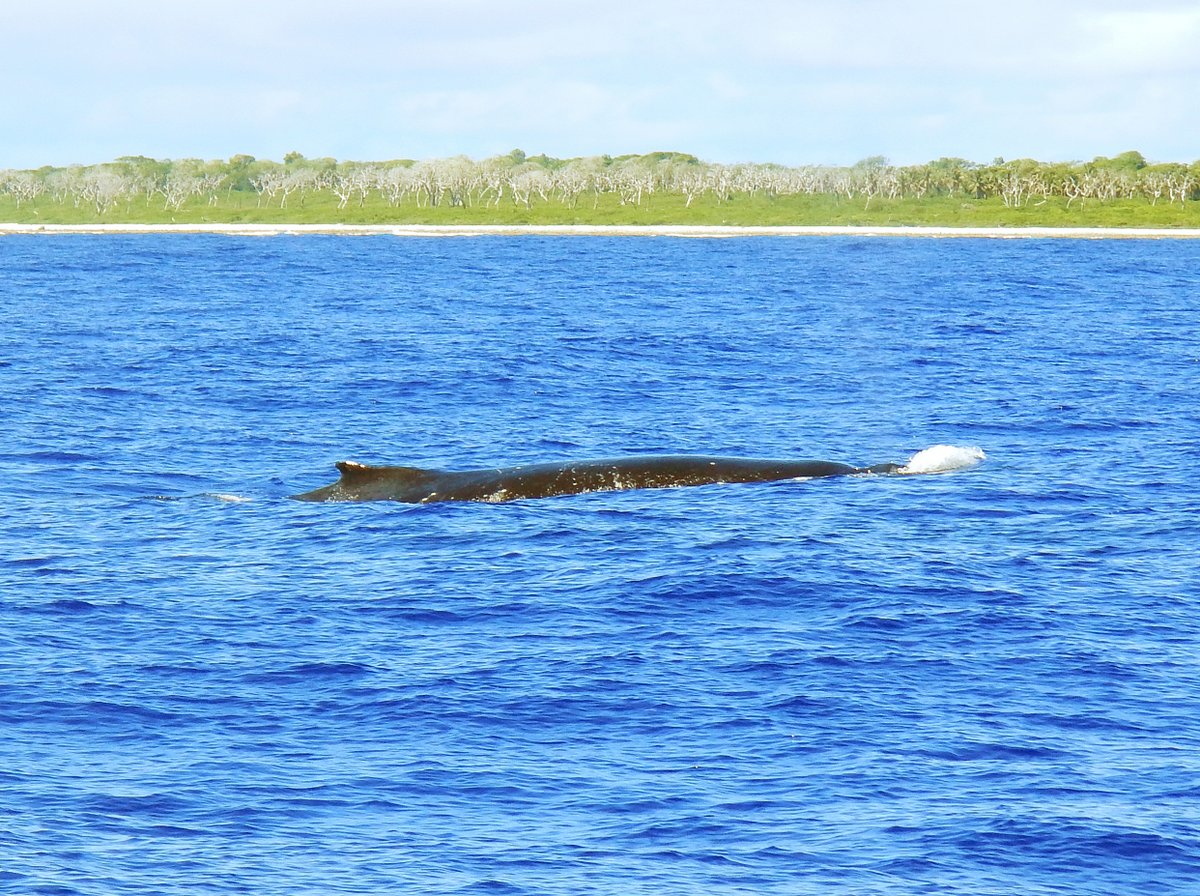
An hour later, the wind had dropped to 5-10 knots, so we turned on the engine and motor-sailed the rest of the way. When we were a few miles from the entrance, Glenys spotted a pod of HumpbackWhales surfacing just 25 metres on our port side. We immediately cut the engine and drifted along watching these huge creatures diving back down right next to our boat.
The pass into the Nuiatoputapu lagoon is narrow and shallow in spots, but thankfully we had good light to see the reefs. There were a set of leading beacons which were very accurate, although there seemed to be a shallow bar extending from the second starboard marker that we skirted around. Once through the pass we found good, deep water and some old decrepit markers on the edges of the reefs.
We anchored 50 metres off the village of Falehau in 10 metres on good holding sand. There were no other boats in the anchorage, which was a pleasant surprise. Within ten minutes, we were called on the radio by a lady called Sia, who told us that because it was a Sunday, we would have to stay on the boat and wait to be cleared in tomorrow. That was no problem - we spent the rest of the afternoon sleeping and reading.