
22 September 2014 Nuiatoputapu, Tonga
Two ladies, one from Quarantine and the other from Customs & Immigration arrived mid-morning, so I collect them from the dock and brought them aboard. Just as I finished the paperwork, Lyall Ika, the Health officer arrived, so I brought him aboard as well. Once the formalities were completed, they stayed for fifteen minutes chatting - very friendly.
After lunch, we went for short walk around the local area. The island is 4 miles long by 2 miles wide with a ridge running north-east to south-west. Only 800 people live on the island in three villages - Falehau, Vaipoa and the capital Hihifo.
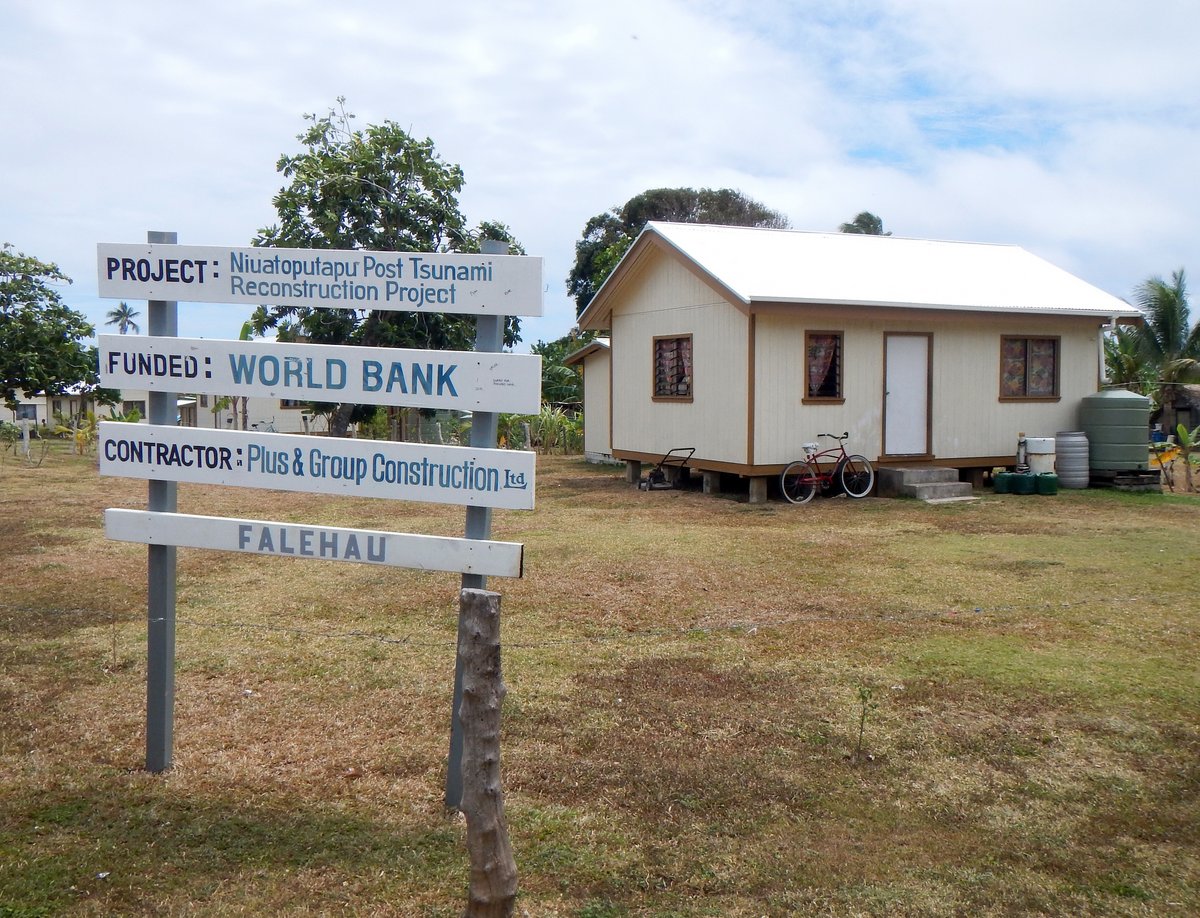
A Tsunami hit the island in 2009 which wiped out all the coastal villages including this one and everything has been rebuilt. Most of the houses are of a standard size and shape constructed from wooden panels - obviously a kit house provided by the government and aid from other countries. The villagers have all fenced off their small patches of land with barbed wire and chicken mesh, presumably to keep out the many pigs that are wandering around the place.
We found the Health Centre, which is a temporary hospital with only three tiny rooms for patients. We paid our $50US fee and then stayed chatting to Lyall who is training to be a doctor and, combined with the single practitioner nurse, comprises the whole medical team on the island. He says that most problems are related to diabetes and hypertension stemming from a poor diet. Interestingly pneumonia is also a problem here, which seems strange because the climate is so hot.
We went for a stroll through the upper Falehau village passing many Tsunami evacuation warning signs. The villagers speak little English, but kids learn it at school, so we had them practising their English on us. Most of the conversations went something like:
“What’s your name?”
“Glenys. What’s your name?”
“Joe”
“That’s a nice name.”
“Lolly, please…”
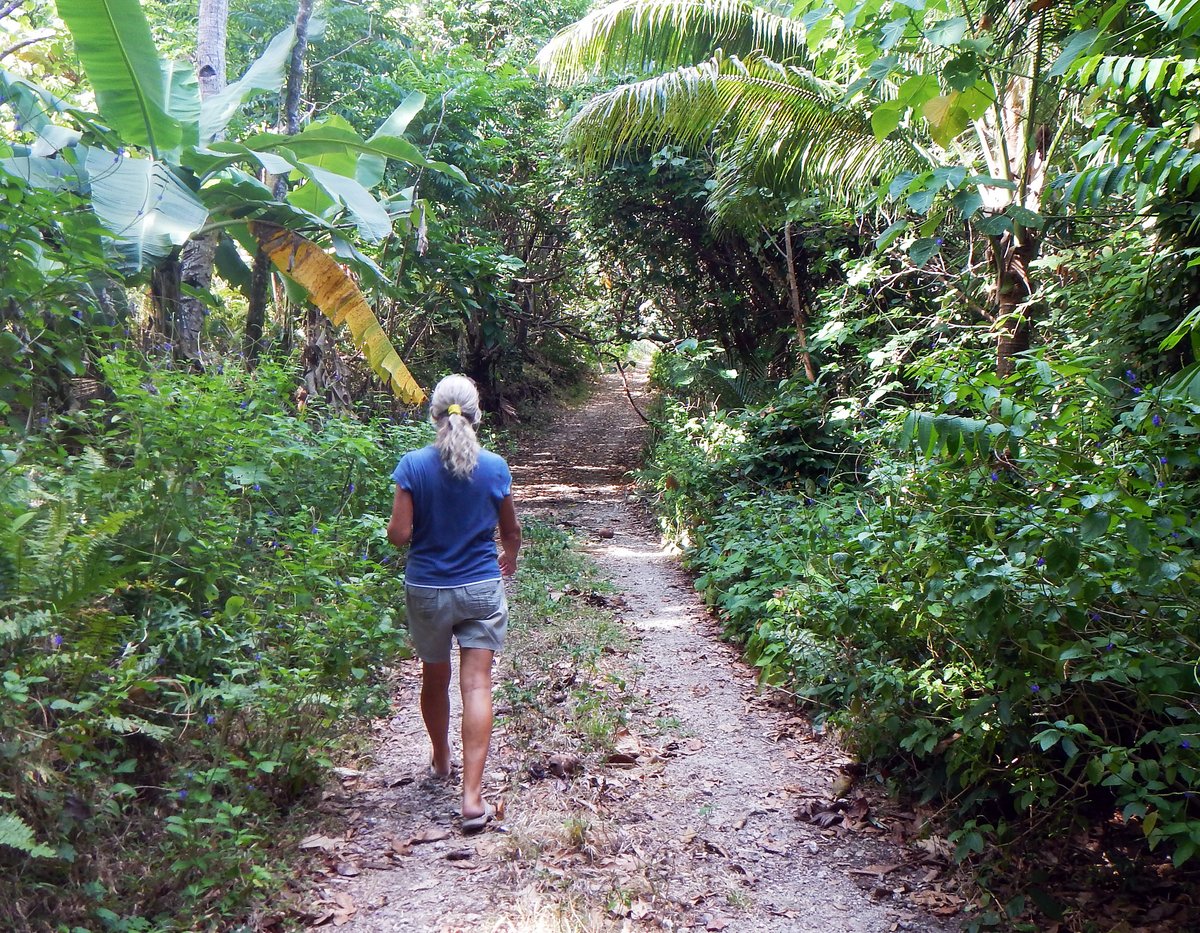
We walked through the village and along a dirt track on the south east side of the island, which goes past many small holding where the islanders are growing bananas, taro, breadfruit, papaya, mangoes and of course coconuts. It was a pleasant walk mostly in shade and followed the bottom of the ridge which splits the island in two.
Thomas and Annette on “Anke-Sophie” arrived in the anchorage later in the afternoon, so there are now two boats in the anchorage.
23 September 2014 Nuiatoputapu, Tonga
We walked started to walk along the hot road to Hihifo to pay the remaining clearance fees, but we didn't get very far before we were offered a lift in the back of a pickup truck for which we were grateful. The customs office and bank are in small porta-cabin type huts next to the high school and we’d soon paid our fees of $10US for Quarantine and $4 US for Customs (with no overtime, which was great.)
Hihifo is a sleepy, spread out village with one small grocery store, which doesn't have a lot of stock - we tried to buy a can of drink there, but they’d run out. However, we managed to find the bakery which is down a small path at the side of a community hall, over a rickety stile and into the garden of a small house. We were uncertain whether we were in the right place, so we shouted “Malo Lay Lay” (hello) and very friendly lady appeared and sold us two lovely warm loaves of bread.
We decided to circumnavigate the island and try to find the pleasant dirt track that we’d walked on yesterday, but we missed a turning somewhere and ended up having a long, hot walk along a road which had little shade and was quite a distance from the ridge.
After lunch, I went to run the water maker and the damn generator stopped running after 5 minutes. To my dismay, I found that the glass bowl on the bottom of the primary fuel filter had shattered. I obviously had no replacement and no chance of buying a replacement on this isolated island. After a lot of head scratching, I removed the broken filter assembly, rammed two 3/8 inch flexible fuel pipe onto the 1/4 inch copper fuel lines and fitted an in-line fuel filter, which is normally the secondary filter for the generator.
Fortunately, the copper fuel lines have flared ends so they seemed to be wide enough to fit inside the 3/8 inch pipe without leaking. The filter that I've used is much finer than the original one, but the whole thing seems to work, and I ran the generator & water-maker for an hour without any problems, so I'm a happy bunny.
We went to “Anke-Sophie” for dinner - they caught a tuna as they approached the island and wanted to share it with us.
24 September 2014 Nuiatoputapu, Tonga
We did some small jobs in the morning - the stitching on the leather cover on our steering wheel was perished and coming apart, so Glenys repaired a few sections. I sorted out the fresh water foot pump that has developed a crack and is slowly leaking our fresh water into the bilge. I had to bodge it with some epoxy and will replace the whole pump in New Zealand - another job for the Land of Plenty .
Later in the morning, we went out to the small island to the north-east of the anchorage and came across Nico (who is Sia’s husband) chopping wood to use for a fire to burn coral rocks down to lime. He tells us that they use it to soften the Pandanus mats that they make. During our chat, he said that he’d lost a lot of lures and wire recently, so I offered to give him some of my spare stuff.
We carried on around the island looking for shells and ended up out on the reef because the tide was out, where we met a couple of ladies gathering sea grapes (Limu), which is a kind of sea weed. They gave us a few to taste and, when we liked it, gave us a couple of handfuls to take back to the boat.
Back at the island, we came across Sia who had been sleeping under a tree with her daughter (also called Sia). We had a chat for a while and she told us how to best prepare the Sea Grapes - just remove the stems and mix with rich coconut cream. Sia said that she was keen to have a pot luck dinner with us and “Anke-Sophie”, so we asked her to call by later in the afternoon and we’d talk about it. We went for a snorkel but the water was murky and cold without wetsuits.
Back on Alba, we had lunch and then did a few more small jobs. Thomas came over and we compared notes on the weather forecasts - we’re both looking for east winds to go 170 miles down to Vava’u. It looks like there’s a bit of unsettled weather with strong south-east winds in a couple of days’ time, then some 15 knot east winds for two or three days before another low pressure ridge crosses the area. We either stay here for another week more or leave in three days’ time…
Sia and Niko turned up at about half past six, bringing along little Sia, who at 2.4 years old, is a little dynamo and was running around our small cockpit like a Tasmanian Devil. We chatted for a while and discovered that Niko spends at least six months away in Australia working on farms picking fruit. The islanders each have small plantations, which provide them with fruit and vegetables for personal use. The only export is Pandanus which doesn't make any one rich, so the islanders (like the Cook Islanders) go to New Zealand or Australia to earn money doing seasonal work.
We arranged to go for a hike with “Anke-Sophie” tomorrow on the ridge that runs along the island. Sia’s going to organise a teenager to guide us for $2.50US each person, which isn’t going to break the bank. We’re also invited to Sia’s house for a pot luck dinner tomorrow night - we've such a busy social calendar.
We ate the seaweed as a side dish to our dinner - it was okay, but nothing to rave about.
25 September 2014 Nuiatoputapu, Tonga
It rained overnight and the morning was very overcast and grey, but it was a good day to go hiking. We met up with “Anke-Sophie” and walked to Sia’s house, where we found Ika, our sixteen year old guide for the day. Another four of the village boys tagged along as well.
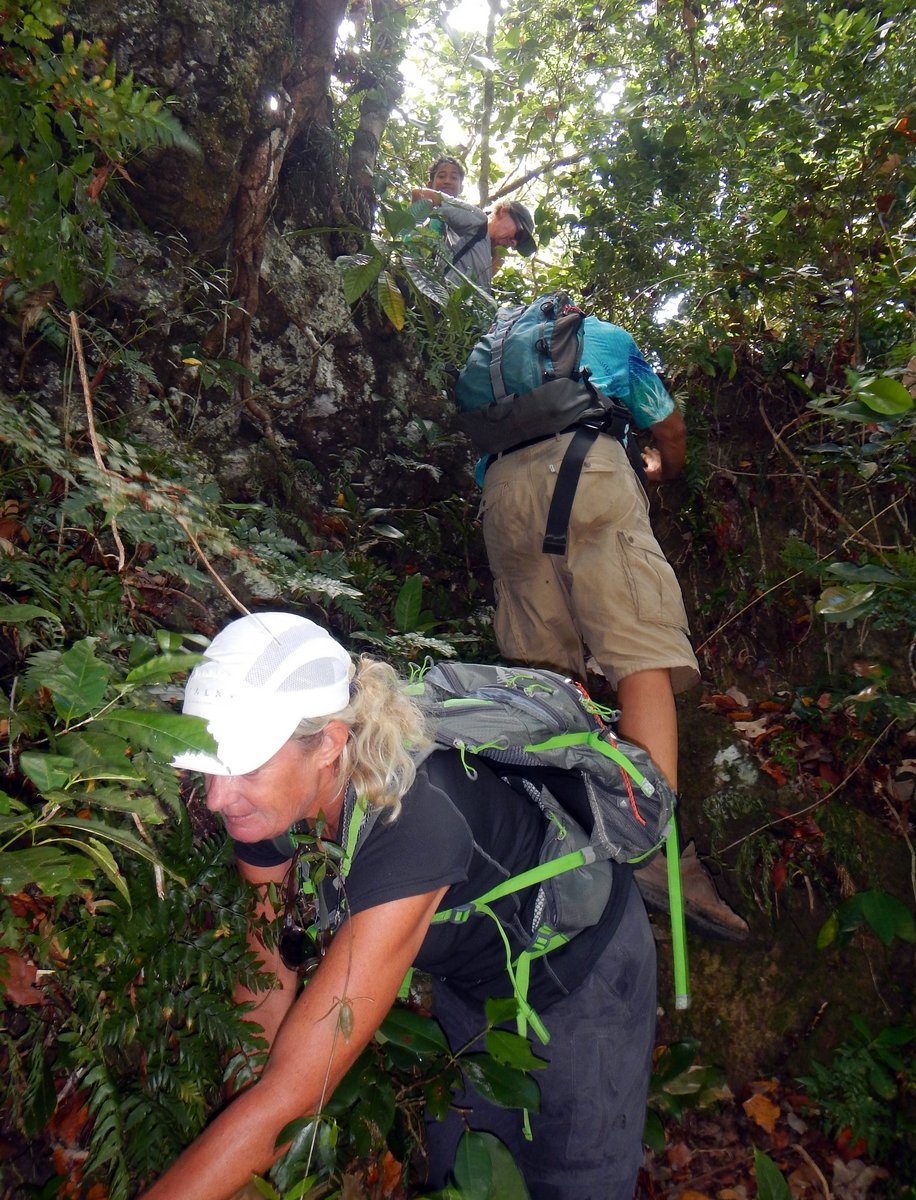
The start of the trail is past the medical centre and through the upper village. You pass a sign saying “Tsunami Safe Location”, then along a dirt track for 100 metres to an opening under a large mango tree on the right. The faint path goes along the edge of a barbed wire fence and then steeply straight up the side of the hill. It’s quite slippery and you have to use roots and trees to pull yourself up.
The top of the ridge is covered with trees for most of the way with the occasional clearing giving grate views of the island and surrounding reef. The terrain is varied with a few sections of steep scrambling using rock, roots and trees to get down or up. Our young guides were amusing in how concerned they were about our safety.
Ika picked up sprouting coconuts along the way and gave us all a snack of Uto. A little later he sent one of the young lads up a coconut tree to get some drinking coconuts. It’s amazing how fast these people can shin up a tall coconut tree.
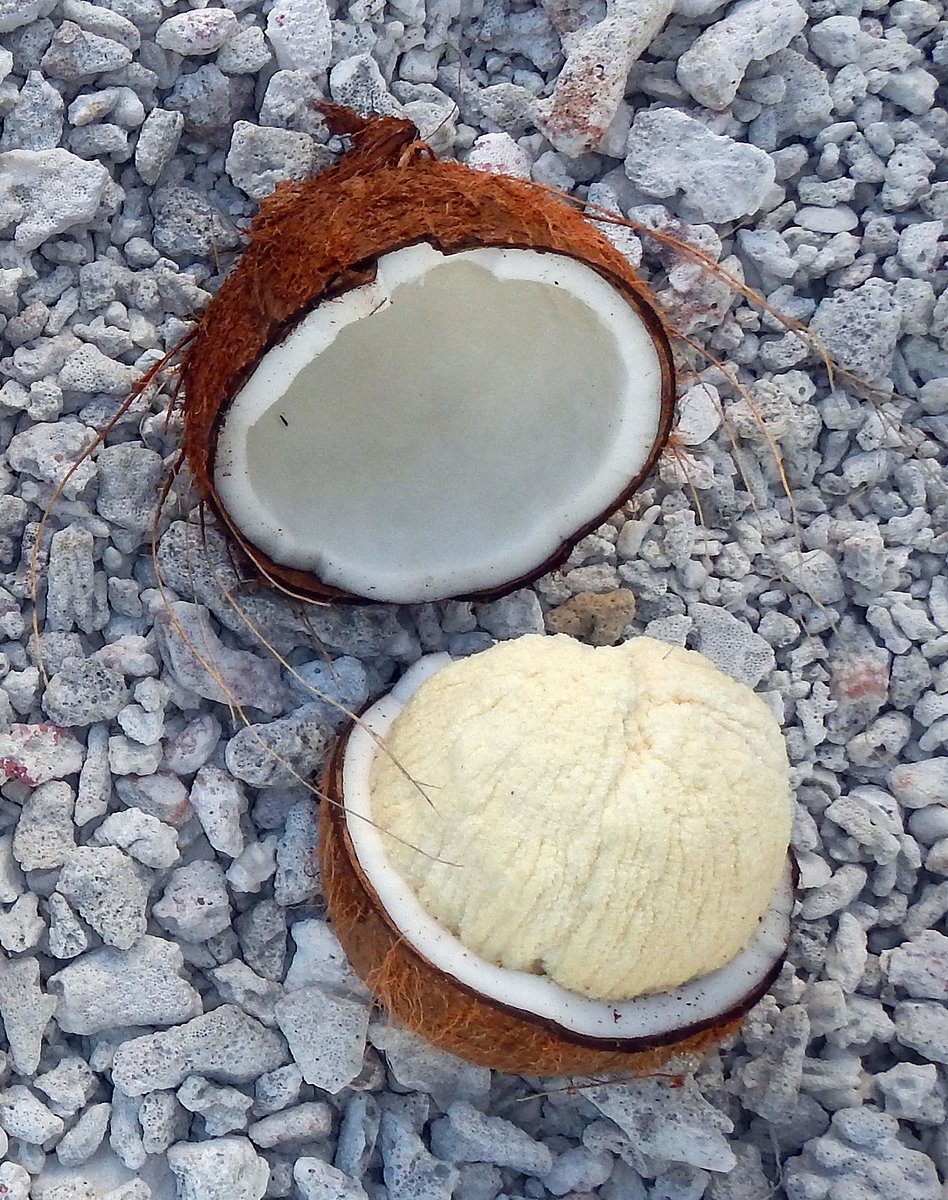
We dropped down the south-east side of the ridge and through the upper village of Hihifo, down to the bakery, where we let our guides go. We called in at bakery, ordered two loaves for tomorrow and then got a lift back in possibly the roughest pickup truck that we have yet seen in our travels. The driver could only go at 20 miles per hour and there were countless holes in the floor, but the guy was very nice. He dropped us off at Falehau and then turned around and went back to wherever he was going before he picked us up.
It rained for most of the afternoon, but stopped long enough for Thomas and Annette to come over for a couple of drinks before we all went to Sia’s house for a pot luck. We found Sia in her kitchen, which is just a rough wooden table under a breadfruit tree at the side of her house. She invited us into her house where another rough wooden table was set out with food that she’d already prepared - a salt beef stew and taro cooked in coconut milk. “Anke-Sophie” had brought a pasta dish and Glenys had prepared a version of Cassoulet with pork, so there was plenty to eat.
We were invited to sit on rough wooden benches while Sia chatted and made a sweet dish from boiled papaya and selmolina which is powdered Manioc root. Her house is one of the standard wooden buildings that we’ve seen all over the island and consists of a 18 foot by 12 foot lounge with two small bed rooms leading off - very basic.
Sia told us that they lost everything in the Tsunami including their house and all of their possessions, so they’ve started from scratch with the assistance of charity organisations and foreign governments. There was no warning of the Tsunami other than the sea being sucked back before the wave hit. Fortunately, the tidal wave first hit the volcanic island of Tafah, which is only 4 miles away, and this took the full force of the wave and split it into two. The middle village of Vaipoa was relatively unaffected while Falehau and Hihifo were wiped out - scary stuff.
We had a very pleasant evening with Sia and Niko who despite being very poor were gracious hosts.
26 September 2014 Nuiatoputapu, Tonga
It was a miserable day with overcast skies, 20 knot winds and the occasional squall. The weather forecast looks to be good to sail the 175 miles to Vava’u on Sunday 28th, so we walked along the road to Hihifo to see the Customs to get clearance to sail to Vava’u island group. The customs lady was really nice and we soon had the clearance form in hand.
We strolled down to the bakers and picked up two loaves for us and two for “Anke-Sophie”, then hiked back via the back road. This time we took a road on the left about ½ kilometre past the road for the baker, which took us up to a dirt track along the bottom of the ridge. It was a lovely walk, mostly in the shade, passing through small plantations rich with taro, banana and papaya. The trail came out at the upper village of Falehau just where we started the hike up the ridge yesterday.
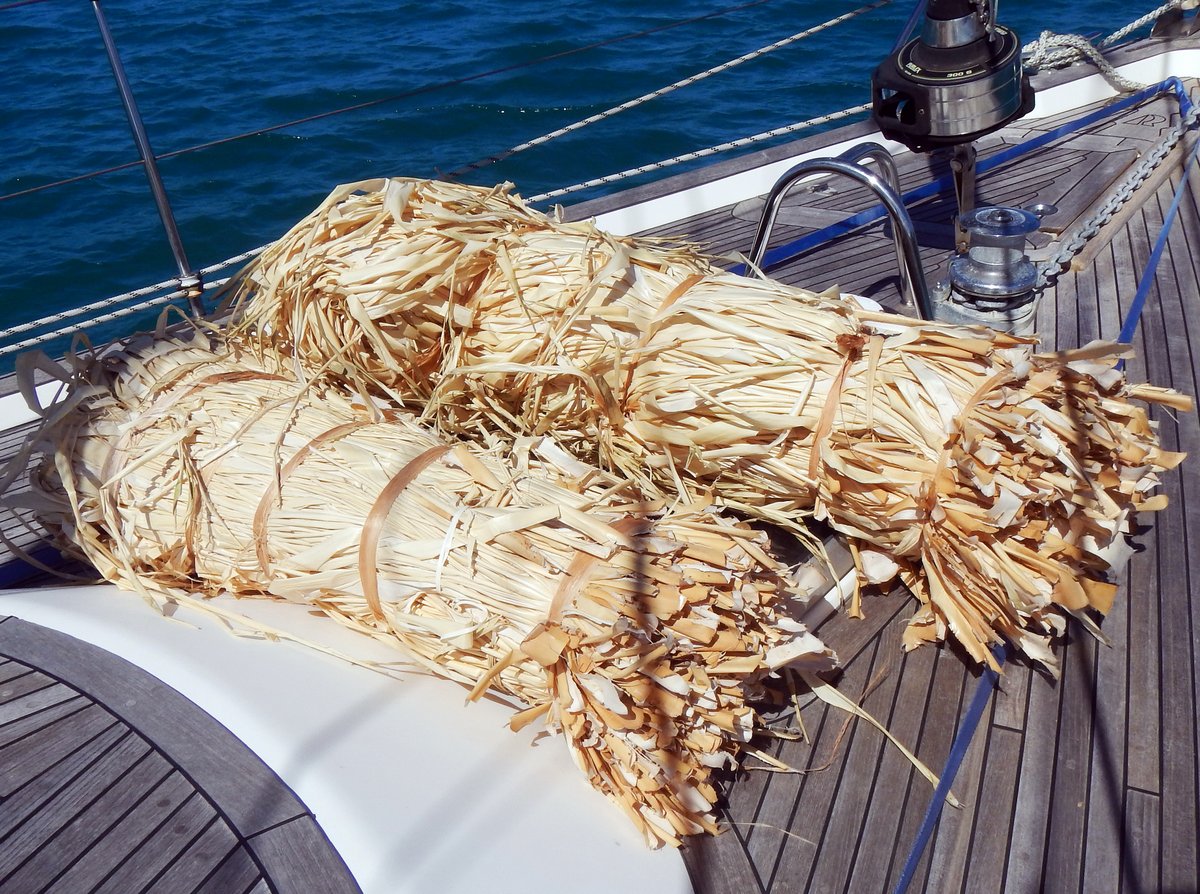
We called in and said hello to Sia, who showed us two big bundles of dried Pandanus that she asked us to take to Vava’u for her. We said that we’d pick them up tomorrow.
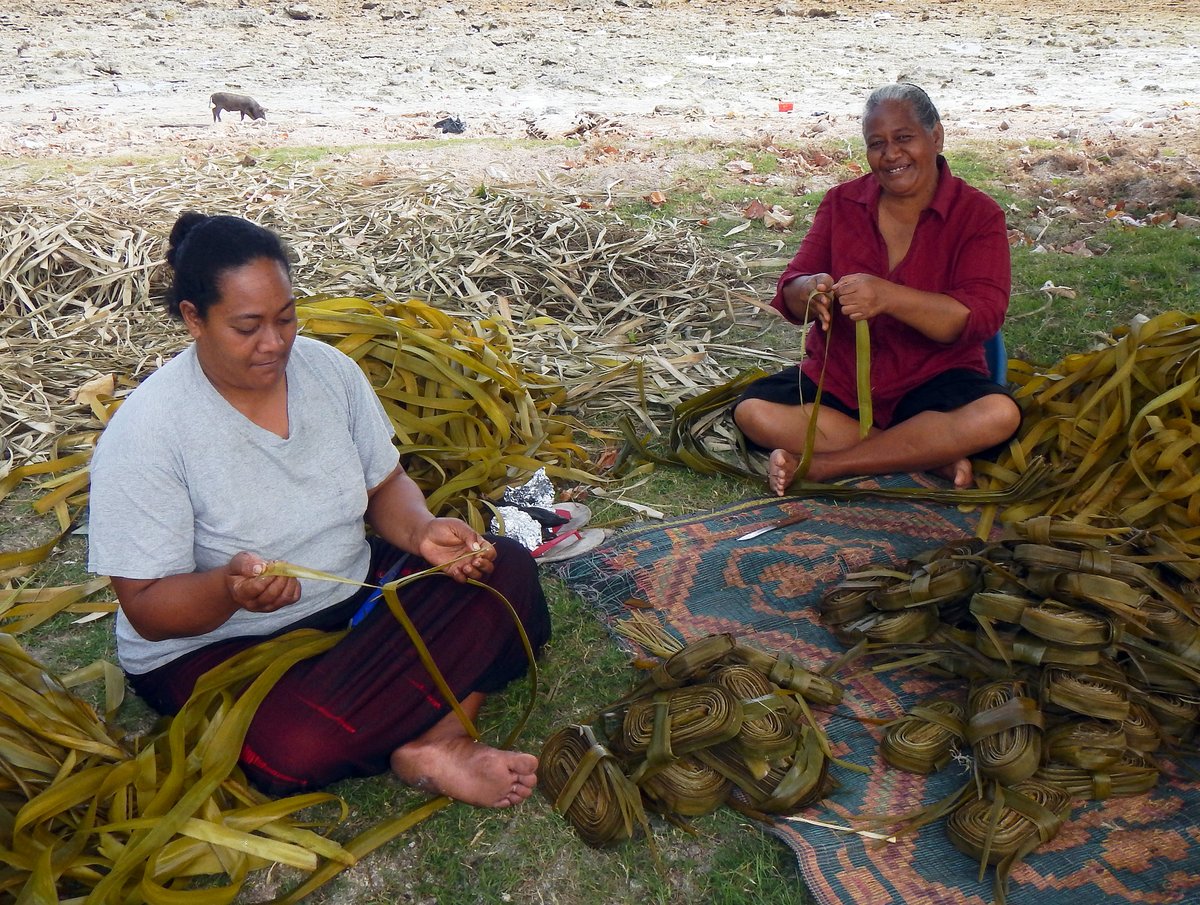
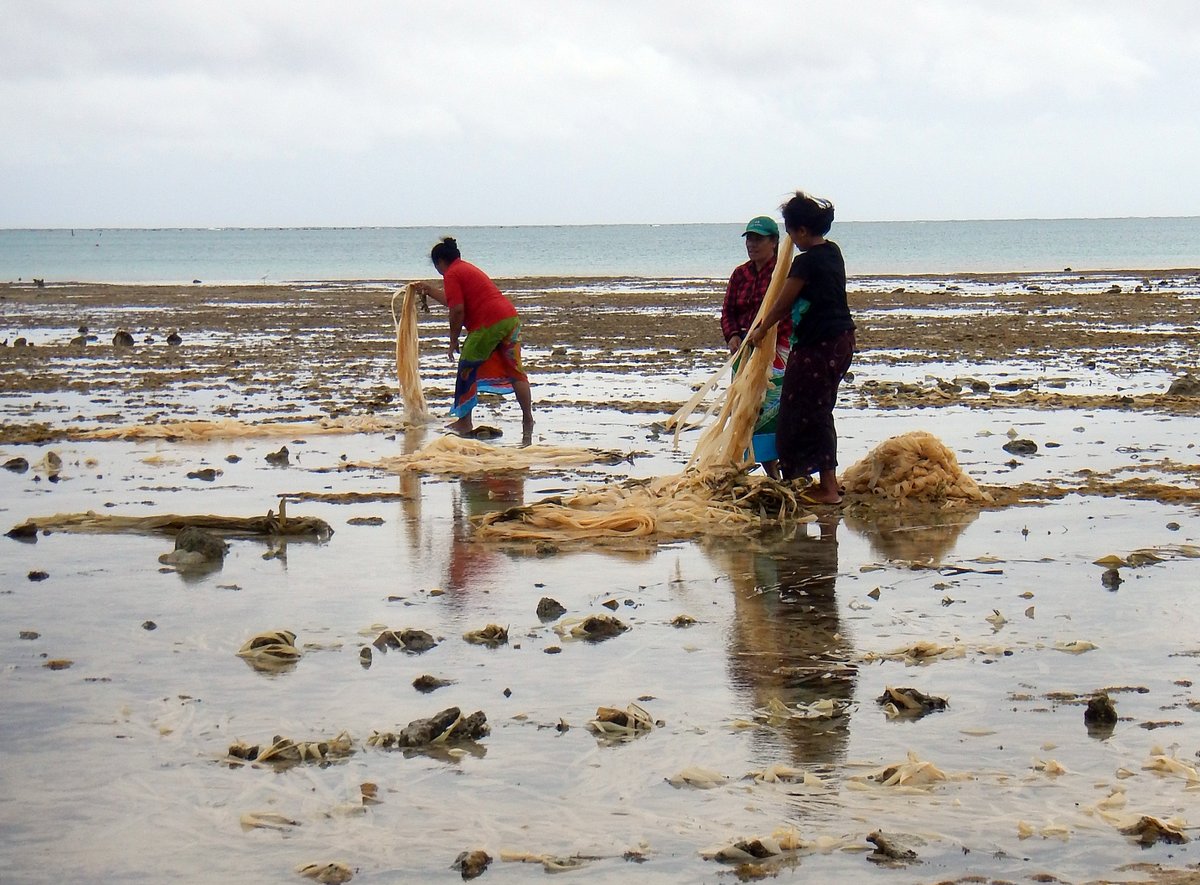
Pandanus is the major export from the island and we’ve seen people processing it in all three villages. It’s quite a laborious business. The plant is grown in the plantations and has a fleshy long leaf with spikes along the two edges and along the spine. After gathering a bundle of six foot long leaves, the first step is to strip off the spiky edges and the spine to produce two pieces of Pandanus leaf about six foot ling by one inch wide. This is rolled up into bundles and boiled in fresh water for over 12 hours.
The boiled Pandanus is then unrolled and the leaf is separated, stripping off the shiny top surface. The underside is discarded and the top surface is tied in a bundle with about fifty other pieces and, at low tide, is weighted down with rocks in shallow rock pools on the reef. These bundles are left to soak in the sea for a week - every day at low tide we’ve seen huddles of ladies out checking their Pandanus and rearranging it.
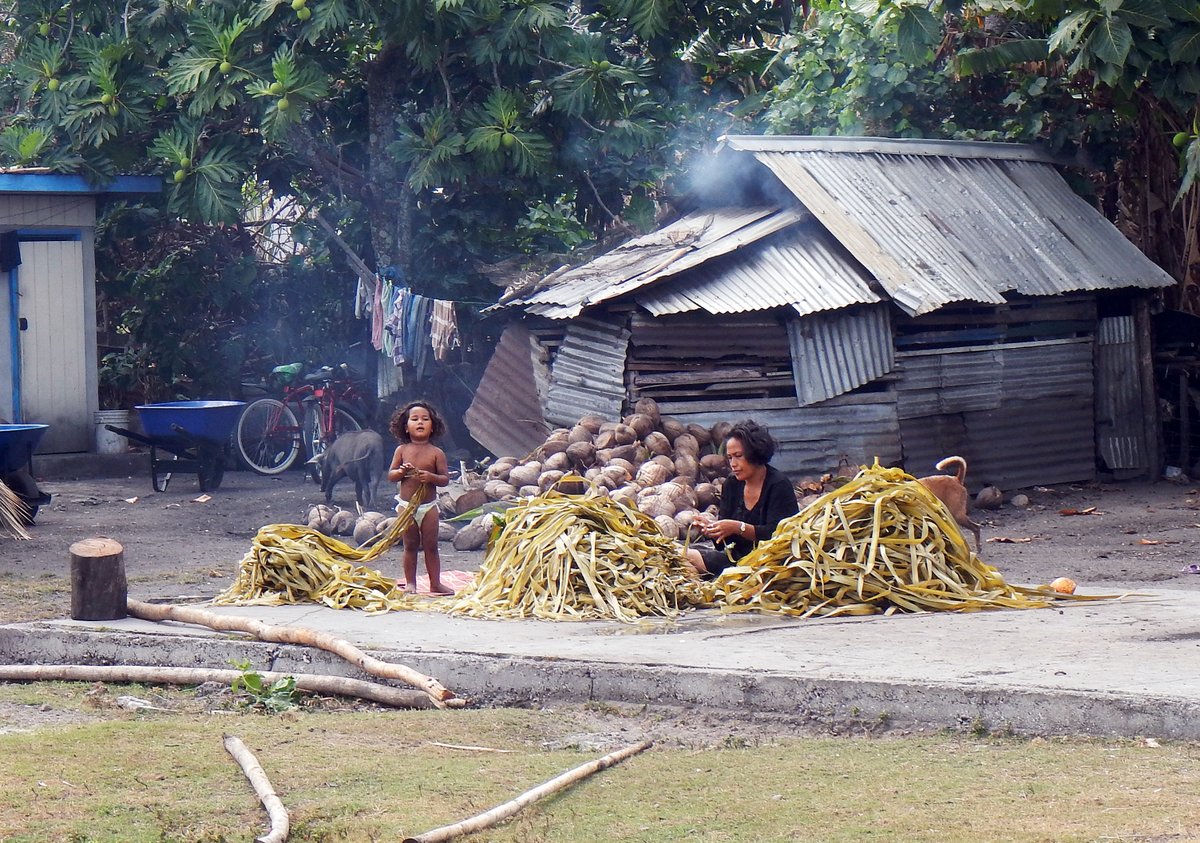
After the long soak in sea water, the Pandanus is washed in fresh water and hung out to dry - practically every house has some bundles of Pandanus hung out to dry. The washing and drying process is repeated a further two times during which the ladies coil and un-wrap the Pandanus in some way to remove curl from the it, ending up with soft, white, straight Pandanus.
As well as exporting the bundles of dried Pandanus, the locals do their own weaving. They use small wooden “combs” with sharp metal spikes spaced at about ¼ inch intervals to split the one inch wide dried Pandanus into consistent ¼ inch wide strips and then weave mats and decorative belts. Small mats are made as a kind of lava lava for special occasions and visiting officials, while big mats are made to give as special gifts.
The mats are too delicate to be used for floor coverings, but instead are normally hung on the wall. We’ve stopped and chatted to groups of three or four of ladies weaving one big mat, which might take them weeks to complete. A team of three ladies can weave an eight foot by three foot section per day for which they will receive $150 Pa’anga, which is not a lot of money.
We chilled out during the afternoon, while squalls passed overhead. I had to recharge our damn food fridge again. The leak is now so bad that I’ve had to leave my recharging gauges permanently connected to the compressor, so that I can recharge it every day. My number one priority when we get to Vava’u will be to find the leak and get someone to fix it.
27 September 2014 Nuiatoputapu, Tonga
The weather appeared to be a little more settled in the morning, but there were still lots of showers around. There’s a big high passing to the south of us, which is forecast to bring better east winds tomorrow.
We chilled out for the morning then, after lunch, went ashore to see Sia. Glenys took her some onions and swapped them for some taro leaves and a couple of breadfruit. We also picked up the two huge bundles of dried Pandanus to deliver to a relative in Vava’u. Back on the boat, being midly paranoid about insects, we put the Pandanus into bin bags and sealed it all up. We've stored it in our front cabin which is the only place that we can fit it.
With all our chores done, we put the dinghy on deck and got ready to leave before having an early night.
28 September 2014 Nuiatoputapu to Neiafu, Vava'u, Tonga (Day 1)
It wasn't a very nice day when the alarm went off at 0545 - grey skies and drizzling. I downloaded a GRIB file and, although the wind was 3-5 knots more than yesterday's forecast, it was still from the east.
We pulled up the anchor at first light and cautiously motored out of the pass without any problems, turning west to go around the leeward side of the atoll. Once clear of the reefs, we found that the wind was a little south of east, so we were on a close reach. The next four hours was frustrating as the wind gradually increased making us have to keep reefing and changing the sails. Finally after lunch it settled down to 25 knots, but the confused seas made it unpleasant.
The total distance for this passage was 180 miles, which at our normal average speed of 5 knots is 36 hours. Having left the pass at 0700, we needed to keep up our speed. Normally, if it's windy and confused seas, we slow down even more to make the motion more pleasant, but today we needed to press on, so we bounded along at 7 knots, which made it even nastier.
All we could do was hang on and read. Occasionally, a big wave would hit the side of the boat with a huge bang and Glenys had a total sense of humour failure when she got drenched by a particularly enormous one - her Anglo-Saxon expletives were impressive.
Thankfully, the wind started to drop as the sun set and, with only 15-20 knots, the first part of the night turned out to be quite pleasant, especially when the wind backed as well. At our four o'clock watch change, I had a squall line come through. Typical of the weather in this area, the wind dropped down to 10 knots, then in the space of a couple of minutes, it was up to 25 knots for ten minutes before dropping back down to 20 knots - very disconcerting.
29 September 2014 Nuiatoputapu to Neiafu, Vava'u, Tonga (Day 2)
Around dawn, Glenys had another nasty squall system come through, giving her heavy rain and 28 knot winds. By the time that I got up at seven o'clock, she was wet through and thoroughly fed-up. So after a quick breakfast, she went to bed to warm up.
By eight o'clock, we were still 26 miles from the entrance into the Vava'u group of islands. The sky had brightened up a bit, but the wind died down to 5-8 knots forcing us to start the engine. Unfortunately, the seas were still over six feet and very confused, so it was like being in a washing machine.
We motored for three hours and then the wind picked up to 10-15 knots, so we were able to sail right into the entrance into the Vava’u group of islands past some impressive cliffs and steep sided islands and rocks. It took a further 1½ hours to motor through to the well-protected harbour of Neiafu, where we picked up a mooring buoy amongst 20 or 30 other cruising boats. Neiafu is one of those places in the world where cruising boats congregate and most people doing the route to New Zealand stop here.
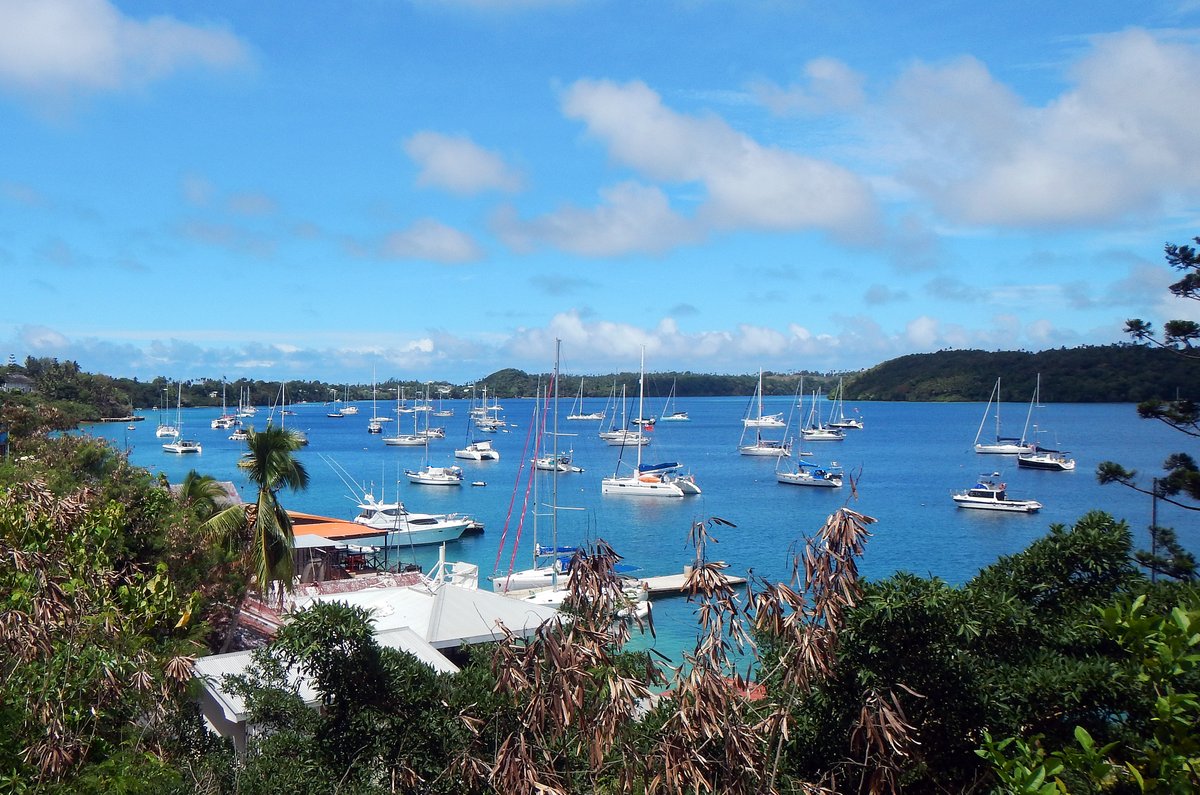
Being late afternoon, we quickly dropped the dinghy in the water to go ashore to get some Tongan money and some essentials like beer, but we didn’t get very far. We were met on the dock by Charlotte and Michael from “Salamander”, who showed us to the Aquarium bar where Grant and Carli from “Viandante” were already having happy hour beers at four o'clock. The day degenerated from there with pizza and chips being used to absorb the alcohol.
30 September 2014 Neiafu, Vava'u, Tonga
First thing in the morning, we moved to a mooring right outside the Aquarium bar to try to pick up their free wi-fi from the boat. I managed to get a connection, but it was so slow that it was useless. As we were having breakfast, Glenys pointed out a boat on a mooring next to us called “Flow”. When we were cruising in the Caribbean in the 1990’s, we had some good friends on a boat called “Flow” - could it be the same boat?
We went over to say hello and to our amazement, it was Horst and Karen who we’d last seen in Mexico in 1996! When we’d left the Caribbean bound for the UK, they carried on cruising for a few years and in 2004, they crossed the Pacific to New Zealand , where they have been living ever since. They are on a short, three month cruise up from New Zealand.
After catching up for a while, we walked into town to do some chores, calling in at the Customs to give them our internal clearance paperwork. After that, we went to the vegetable and craft market, bought a few vegetables, then to the supermarket for some beer and bread. We called in at the catholic church and found Catea, who came to the Aquarium bar to pick up the bundles of Pandanus that we brought for her from Nuiatoputapu.
The town of Neiafu is a bustling little place - very touristy with signs for whale watching tours everywhere, small cafes and restaurants on most corners, but there are still local Tongans walking about dressed in their Pandanus mats and the odd pig wandering across the road holding up the light traffic. Most of the grocery stores are very small, but we found a reasonable supermarket opposite the fire station, which stocks the basics including a case of Fosters lager for only $35US.
After lunch, we hung about on the boat trying to chill out, but it was very hot and humid - there’s a trough passing to the south of us and it’s sucked all the wind out of the area. Horst and Karen from “Flow” came over in the evening. Karen brought a big pan of stew, so we had that for dinner with some fried plantains and plenty of bread. We had a great time, reminiscing and catching up on the past 18 years.
- << Prev
- Next