
1 July 2014 Taina Bay, Tahiti
I worked on the generator water leak and found that the leak is in the stainless steel end of the water trap. In order to remove the large component, I would have to lift the generator up by at least a foot, which would be a marathon job. So, after a lot of agonising, I decided to bodge it by slapping on some marine epoxy to plug the hole.
It wasn’t easy. I was hanging upside down across our engine and could only just squeeze my hand into two small gaps under the generator, so I had to work with a mirror and keep taking photographs to check what I was doing.
It took over an hour to clear up the small area of stainless steel with a wire brush and some emery cloth. I then daubed the marine epoxy on with a long kebab stick which was a mission with my upside-down, mirrored view of the job. To make double sure, I put on another coat of epoxy in the afternoon and I’ll have to wait until tomorrow afternoon to let it cure before I can test it.

Glenys wandered off to the shops to get some more food and we had a quiet night in. Even though there are over a hundred boats in the anchorage, we don’t feel like socialising. It’s expensive to buy food and drink in the marina bars and we’d have a long wet ride from where we are. So far, I don’t have a good impression of Tahiti, but we’re able to get things done. I hope that our sail will be ready tomorrow.
2 July 2014 Taina Bay, Tahiti
Ho hum, we did even more jobs to pass the time. I tested our batteries, which have been low for the past few days. I’ve had to run the engine and generator to maintain the voltage, so I was worried that I might have one or more dud batteries. They all checked out okay, so it must be that we’re simply using more power than our solar panel and wind generator can provide - we’ve had quite a few windless, overcast days recently.
Hurrah! We picked up sail. Michele has put patches on five seams on the tailing edge and then added a six inch piece of sail cloth down the leech to strengthen the weakened sail material. He then put a double row of zigzag stitches down every seam. A new leech tape was then sewn on the leech with a new 4mm diameter leech line. Finally a new webbing loop was sewn on the tack of the sail to hook onto the roller furling. It all looks good and he says that it’s bulletproof now - we’ll see.
We put the sail on the mast and it seems to roll away easier than it did with our bulky patching, which is great. I tested the generator and it’s not leaking any more - more good news. We went to supermarket for a final shop and we’re all set to leave tomorrow.
Michael and Charlotte from “Salamander” invited us over for dinner to thank us for giving them our old Carib dinghy. Michael is a vegetarian and cooked up a fabulous starter and vegetable curry.
3 July 2014 Taina Bay to Cooks Bay, Moorea
We were up early and onto the fuel dock before anyone else. It felt good to top up the tanks without the faff of lugging diesel around in jerry cans. The last time that we were on a proper fuel dock was in Costa Rica, 7 months ago. To make things even better, we got it duty free and only paid $1 US per litre, which is really cheap. I don’t understand why they give duty free fuel because all the cruising boats would pay a lot more, but I’m not complaining.

We motored out of the Taapuna pass, where there were some impressive waves with surfers right next to the channel - scary stuff. There was no wind at all for the 15 mile crossing to Moorea, but it was pleasant enough and the silhouette of the island was stunning. I put up the main sail to stop us rolling in the swell and it was banging from side to side a little bit. The snatching on the main sheet caused one of the pulley blocks to explode with a tremendous bang which scared us both to death - another little job to do…
We anchored in Cook's Bay just off the Bali Hai hotel. It’s a very deep anchorage (around 20 metres) and there was no wind, which was causing the boats to swirl about, so it took us four attempts to anchor without being too close to another boat. Once we were settled, we had a chance to gaze at the anchorage, which is very spectacular with pointed mountain peaks rising steeply up from the bay.
The afternoon was airless and very hot, so we chilled out reading and napping. Later in the afternoon, we’d swirled around again and ended up close to “Jean Marie”, so we upped anchor and moved closer to the shore - that’s five attempts to anchor - it’s a record for us.
4 July 2014 Cooks Bay, Moorea
We were awoken at four o’clock in the morning by a tremendous crash as a very strong katabatic gust came shrieking down from the hills and tore our big sun awning loose. It pulled out some grommets and put a rip in the front. The worst damage was to a long boat hook that we have been using to keep the back end of the awning tight - it was bent 90 degrees and snapped in half when I tried to straighten it - more jobs.
In the morning, we ran the water maker and Glenys repaired the awning. After lunch, we jumped in the dinghy and motored 1½ miles out to the reef by the pass into the bay, but it wasn't very interesting and there was a lot of surge. However, this was the first opportunity that I've had to use my new underwater camera and, despite the poor conditions, I managed to get a reasonable picture of a Striped Surgeonfish.

On way back to Alba, we noticed that an American boat called “Wing Cutter” had dragged its anchor for hundreds of metres and was almost on top of "Ruby Slippers". We went over to give a hand and found John from "Ruby Slippers" in his dinghy desperately trying to push “Wing Cutter” away. It turned out that John was just a crew-hand and his skipper had gone out for the day, so he was unsure what to do.

I hopped on board “Wing Cutter”, but the owner had taken the ignition key with him and locked all the hatches, so I couldn't start the engine. I dropped a second anchor, which eventually held, meanwhile John paid out anchor rode to keep away. We then pulled up "Ruby Slippers" anchor and re- anchored upwind of the “Wing Cutter” - John was very relieved.
In the evening, we went to the Bali Hai hotel for happy hour (small beers $4US instead of $5US, so it wasn’t too happy). However, they put on a dancing show for their guests and we were able to watch the show. Six energetic dancers and a good band - these Polynesian girls can’t half wiggle their hips.
5 July 2014 Cooks Bay to Opunohu Bay, Moorea
Craig from “Wing Cutter” came over and gave me a bottle of rum for stopping his boat from dragging, which was nice. After breakfast, we sailed around to Opunohu Bay, which is only five miles.
We anchored amongst twenty other boats clustered between a public beach and the fringing reef. It's quite noisy with locals enjoying the weekend and there's a constant parade of kayaks, jet skis and tourist boats from the nearby hotels. However, the colour of the water is stunning and the mountainous peaks down the deep bay are impressive.
In the afternoon, we went snorkelling, but the nearby reef is very disappointing, with hardly any coral and the fish are terrified of people, which made taking photos very challenging. I saw a few new species of fish, but the photographs that I took were very poor.
In the evening, Robert and Heidi from “Nuwam” invited us over for a few beers and a glass or two of Kir, which we’ve not had for years.
6 July 2014 Opunohu Bay, Moorea
It was a lovely day, so we got up early to go for a hike. We took the dinghy to the head of Opunohu Bay and left it chained to a tree on a small beach. A road opposite the beach took us inland through farmland which looked very French with the neat fields and trees lining the side of the road.
The road meanders its way up hill, past a couple of archaeological sites and after 4 kilometres reaches the "Belvedere" (which means lookout in French). There's a great view of the North side of the island looking down on Cooks Bay and Opunohu Bay. The mountainous ridges around the valley are very impressive.

We went for a walk along some narrow paths that lead away from the Belvedere, which weave through the sub-tropical forest past giant tree ferns and lush vegetation. Most of the paths seem to eventually lead down the valley, but we were unsure where they would come out. We wanted to see the archaeological sites that we passed on the way up, so we retraced our steps and walked back down the road.
The ruins are well maintained, but as with all Polynesian sites, they’re not too exciting being mostly low stone platforms called Marae. These are built on sacred places where priests and chiefs used to perform religious ceremonies. Here’s a quote from a notice board at one of the sites:
Ahu-o-Mahine is a marae typical of the coast and is said to date back to the 17th century. It has a trapezoidal shape with a three stepped ahu (altar). A great part of the structure is made from worked round stones or naturally round stones. In the paved courtyard are two ofa’i turu’i (backrests) and ten ofa’i ti’a (upright stones). They are typical for structures related to the worship of Oro, god of fertility and war, whose rituals demanded human sacrifice.
We were back at the boat by lunchtime. While I chilled out for the afternoon, Glenys went for long walk around to Cooks Bay, to convince herself that there was nothing else to see ashore and found … that there was nothing else to see ashore.
7 July 2014 Opunohu Bay, Moorea
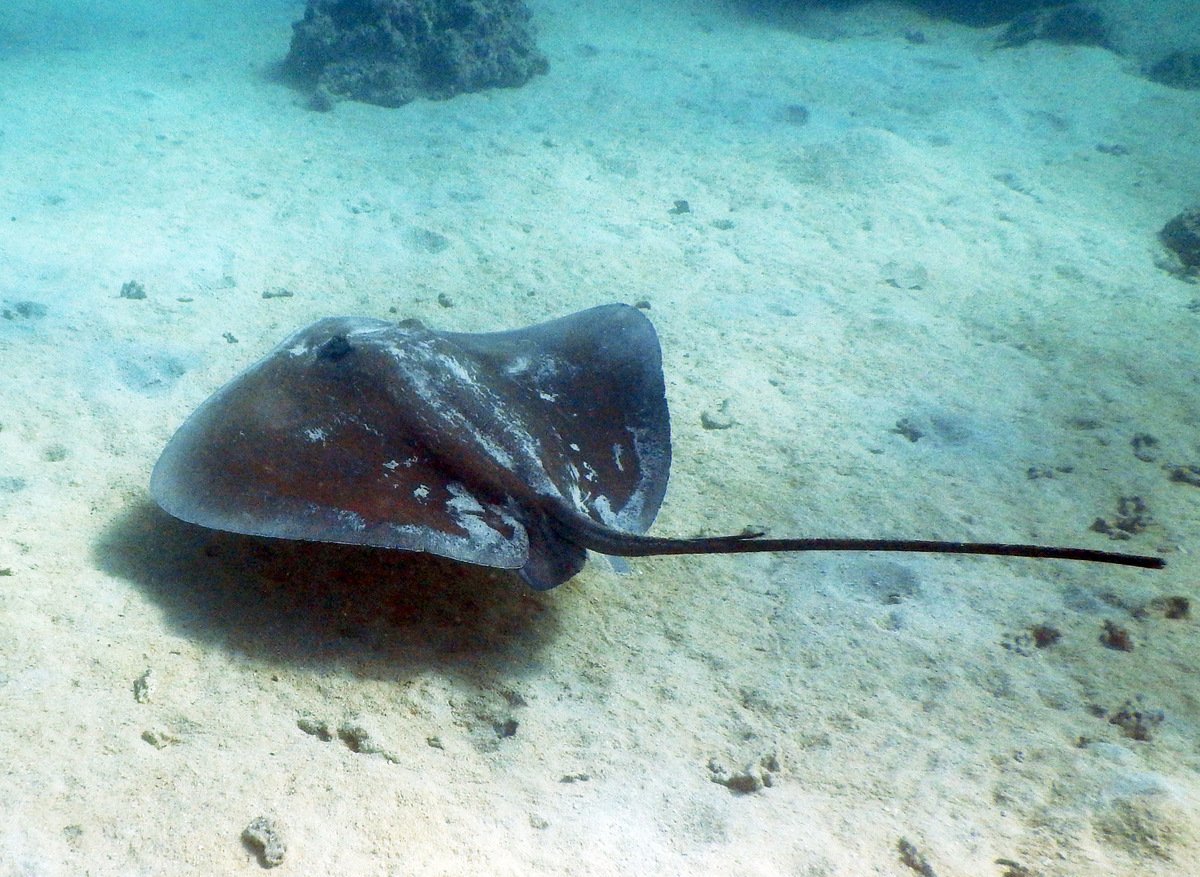
It was another beautiful day in a beautiful anchorage. We jumped in the dinghy and motored three miles along the sheltered channel inside the reef to Stingray City (near 17°29.24S 149°54.08W). This is a shallow sand bar just past the Intercontinental Hotel, where the local tour guides have been feeding stingrays and sharks for years.
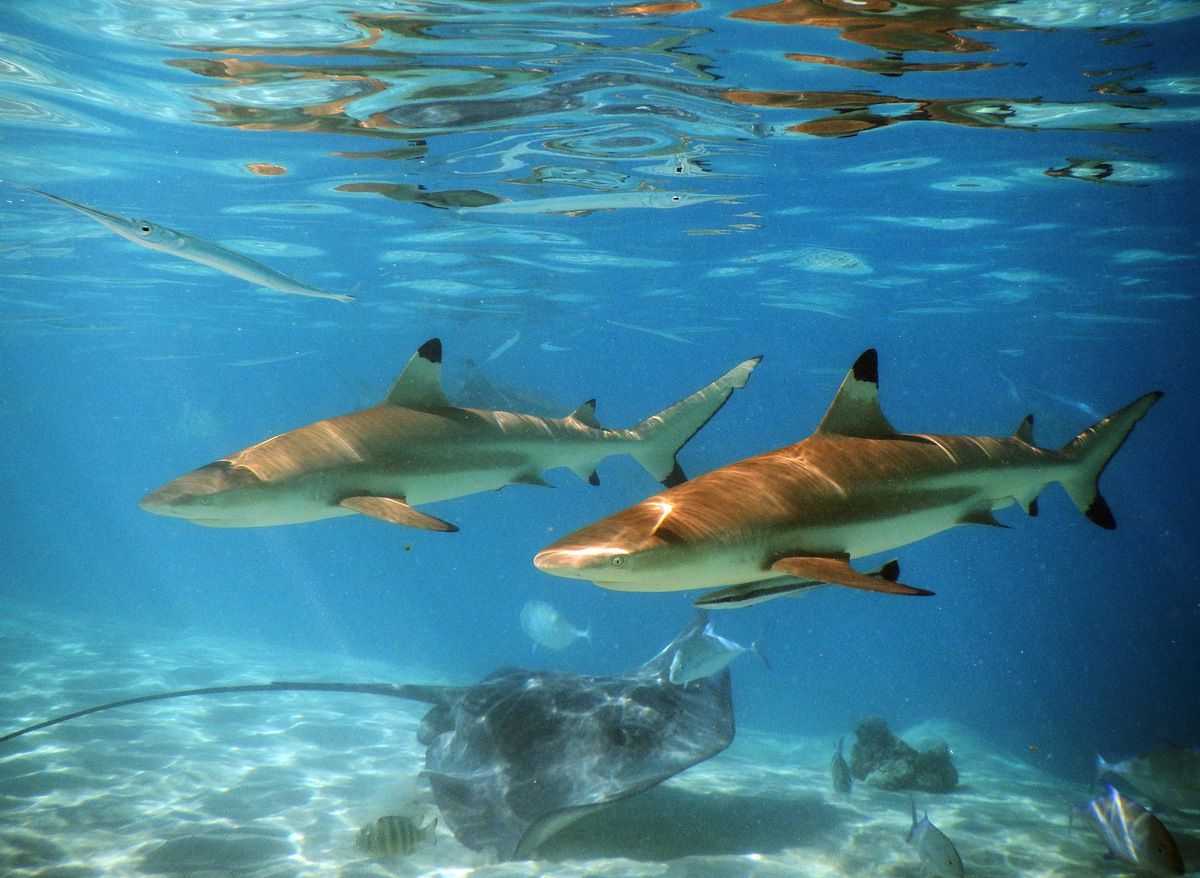
The Tahitian Stingrays are extremely friendly, climbing up you if you feed fish to them and all the time there are Blacktip Reef Sharks swimming around the edge of the action. At times, there are fifty or so tourists milling about in the chest deep water with sharks and stingrays swimming about between them all - it sounds like a circus, but is really good fun.
On the way back, we stopped off at some mooring balls that we’d seen next to some channel markers (near 17°28.87S 149°50.75W.) The snorkelling was very good with nice coral formations and lots of fish. Unfortunately I'd taken so many photos at Stingray City that my camera battery had run flat.
After lunch, I chilled out editing the hundreds of photos. Not surprisingly, I’ve got some nice shots of the Blacktip Reef Sharks. In the evening, we invited "Nuwam" and Paul & Monicke from "Full Circle" over for sun-downers.

8 July 2014 Opunohu Bay to Motu Murimahora, Huahine (Day 1)
We woke up to yet another lovely blue sky day, but there's a low pressure ridge coming in from the west, which will bring strong north winds and squally weather in a couple of days. Our next stop is the island of Huahine, 80 miles north-west, so we either leave today or stay here for another week. We love this anchorage, but time is passing and we have to be moving on.
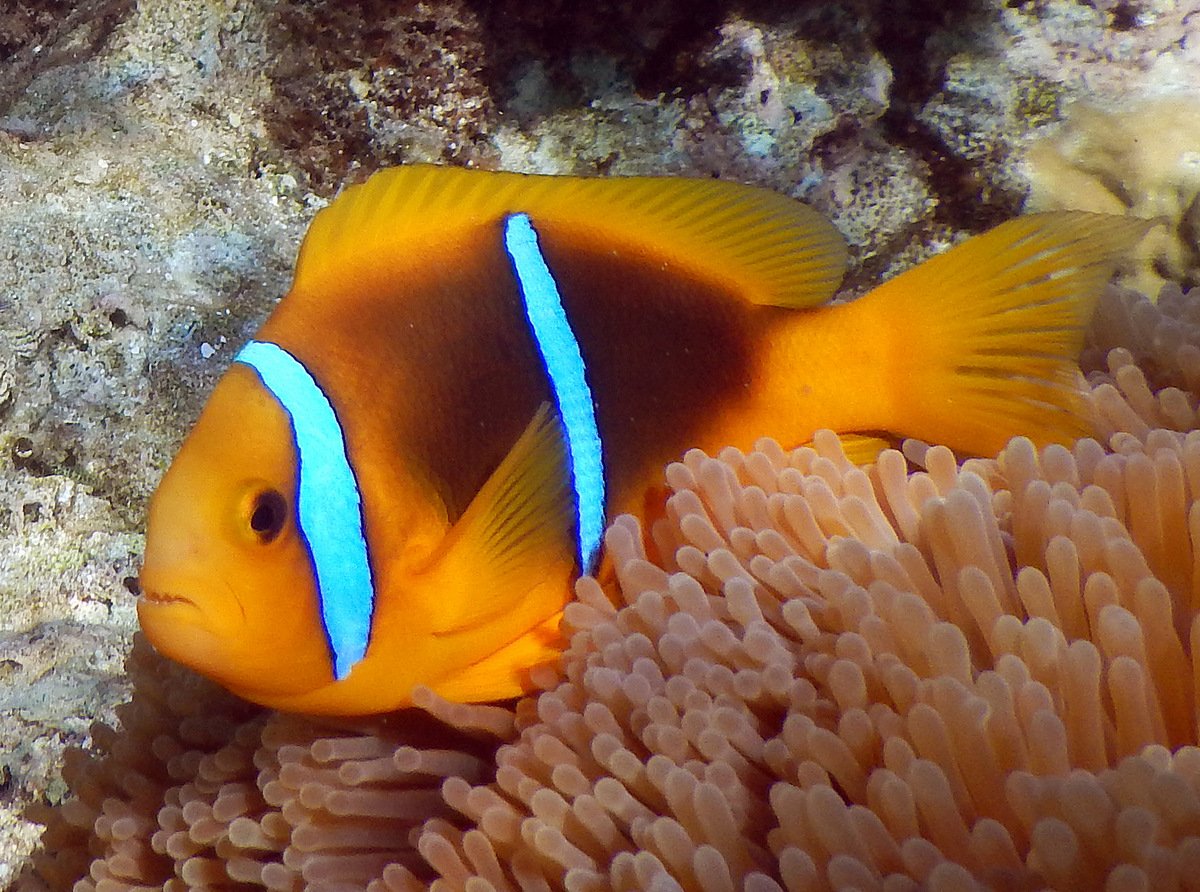
After a quick trip ashore to buy baguettes from the little grocery store next to beach, we went snorkelling. We'd been told that there was good snorkelling at the "Rose Gardens" just off the Hilton hotel. We found a mooring rope just by the marker post just past the Hilton, but the snorkelling wasn't that good. However, I found an Orange-finned Anemonefish lurking in a nice anemone and spent most of my time photographing the timid fish. (Glenys has become a "camera widow" because I'm so in love with my new camera.)
After lunch, we put the dinghy on deck, tidied up and prepared for the overnight passage to Huahine. We left at four o'clock, motoring out in to a very calm sea. I was hoping that the wind would pick up when we cleared the shadow of Moorea, but it didn't appear. Still, it was lovely motoring along at 5 knots with a bright moon and clear skies.
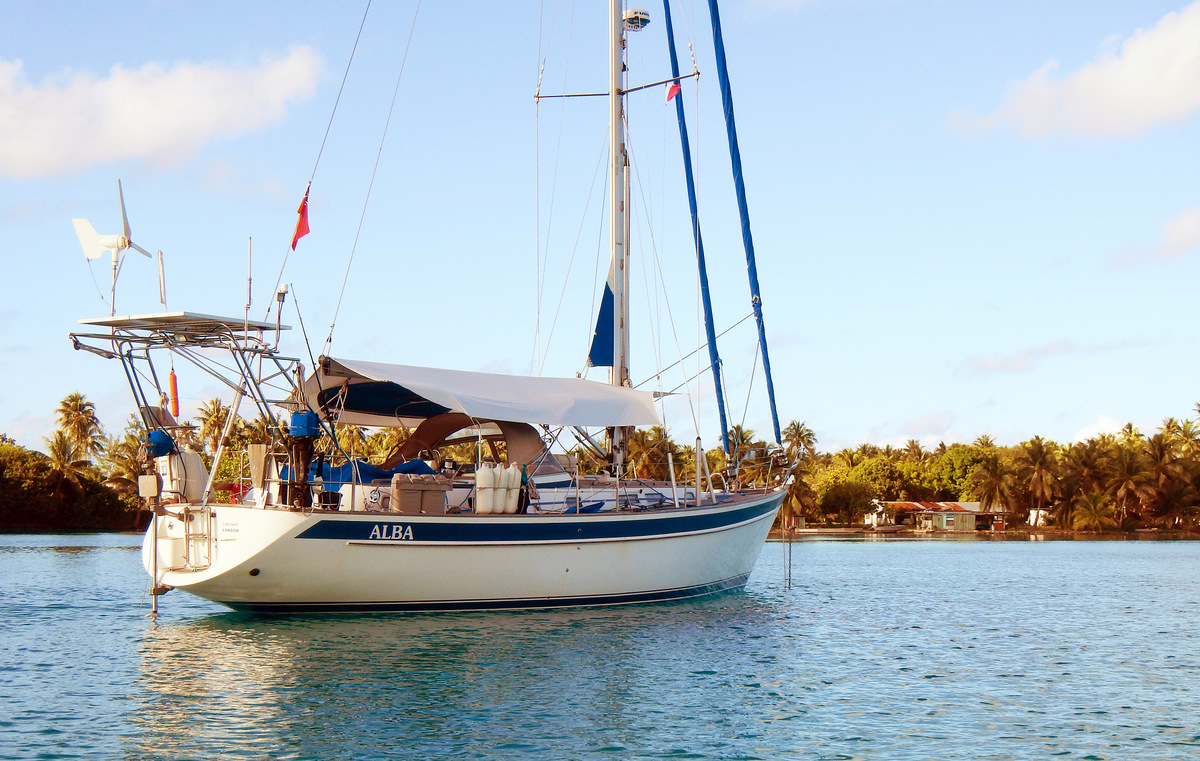
Unfortunately, it didn't last and, just after midnight, Glenys got soaked when a short, but heavy shower sneaked up on her. After that, we had a series of showers, some bringing 20 knots of wind, but the wind came from all sorts of directions and was short-lived, so it wasn't much use to us and we had to carry on motoring.
9 July 2014 Opunohu Bay to Motu Murimahora, Huahine (Day 2)
Just after dawn, the wind picked up enough for Glenys to unfurl the genoa and turn off the engine. We motored in through Passe Farerea and down a small channel to an anchorage off Motu Murimahora in 3.7 metres of water over sand (at 16-45.80S 150-57.60W). What a fabulous place, the water colour is stunning and the palm fringed motu looks lovely. I snorkelled around the anchorage and there’s room for at least ten boats here.
We chilled out in the morning, napping, reading and recovering from the night passage. Just before lunch, a local guy paddled up on a kayak. Glenys started to chat to him and then realised that he didn't understand her French and was talking very strangely. After a couple of minutes, we grasped that he was deaf and dumb.
He told us that his name was Paul by “writing” it on the deck with his finger, then pointed that he lived in a house ashore and insisted on giving us four coconuts that he’d prepared for us. After a lot of confusion, he told us that we were anchored in a good place and we said that we’d go ashore to visit him later. As he paddled off, we pondered the difficulty of talking to a deaf and dumb person in a foreign language.
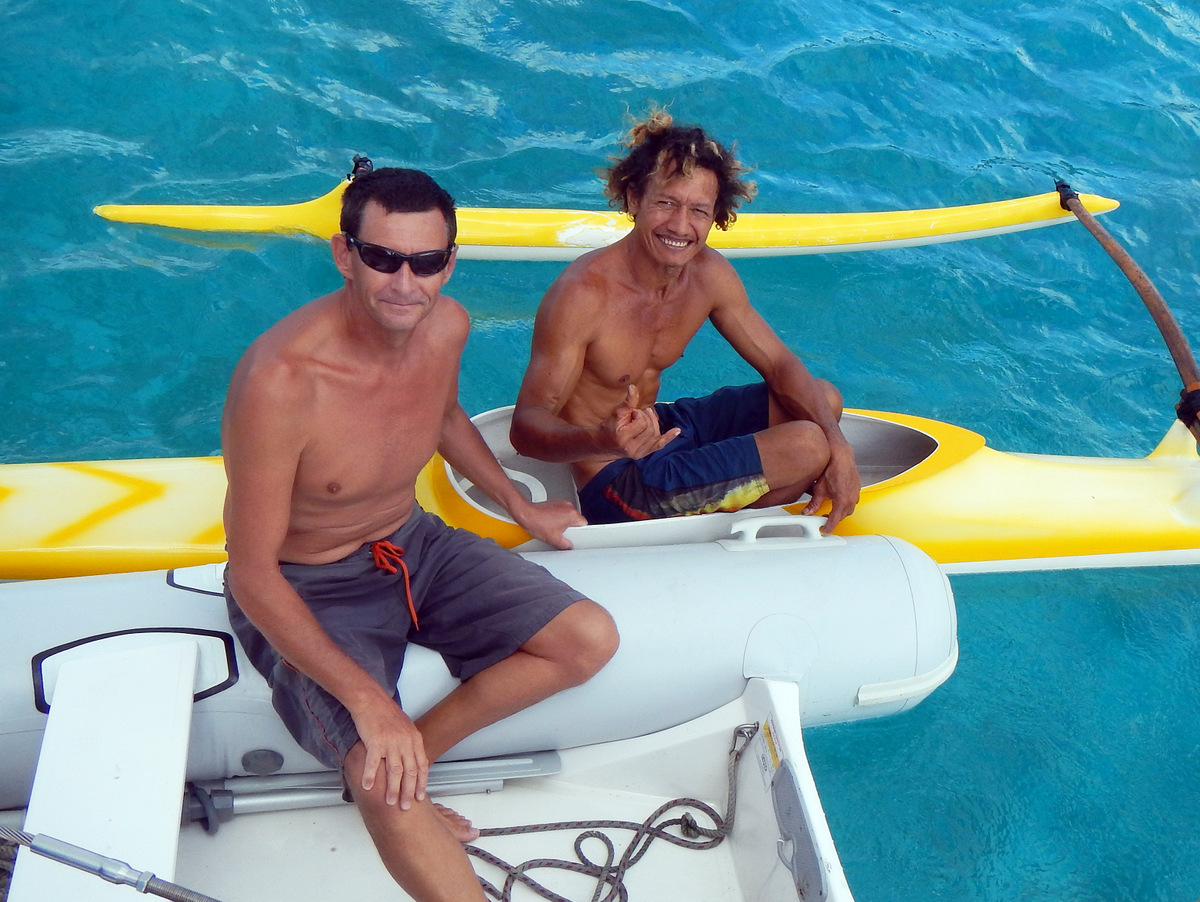
After lunch, we opened the coconuts that Paul had given us and harvested two litres of coconut water and a couple of bags of coconut flesh, which went into the fridge. We then went ashore and were met by the very enthusiastic and happy Paul, who showed us around his land. He’s been working hard to construct some docks on the edge of his land and we assume that he’s trying to attract more yachts to the anchorage. He has a strip of land that stretches across the motu to the windward side, which is very well maintained with mown grass under the coconut trees.
As he showed us around, I expressed interest in his copra production and he explained (in sign language) how he stacks the coconut halves on end to dry them. He then cut open a coconut that was starting to sprout leaves and to our surprise the inside was semi-solid - no water or coconut milk. Paul insisted that we have some and it was very good - slightly fibrous like a kind of candy floss.
He led us to the windward side of the motu and we went for a walk along the sandy beach, looking for shells of course. When we arrived back at Paul’s, he was trimming grass under the coconuts trees, but insisted on booting up a laptop and showing us some photographs taken by other boats that have stopped here. He pointed out where there was a hike up a hill on the mainland and I think that we’ve arranged to have a go in his outrigger canoe tomorrow. What a lovely bloke.
We were boiling hot by the time that we got back to the boat, so we went for a snorkel on the reef close to where we are anchored and it was very good - a bit of a current, but lots of fish.
10 July 2014 Motu Murimahora, Huahine
The trough has arrived, bringing strongish winds from the north, but weather is not too bad - a little overcast but hardly any rain. The anchorage is quite calm, but there’s a constant, strong current from the south, which makes the boat do odd things. Normally, we lie bow into the wind, but now the boat is trying to point into the current. The wind is from the totally opposite direction, so we’ve ended up lying side onto the wind. This is making us heel over to starboard about 5 degrees, which is unsettling, also the wind is blowing from the port side and is just plain weird…
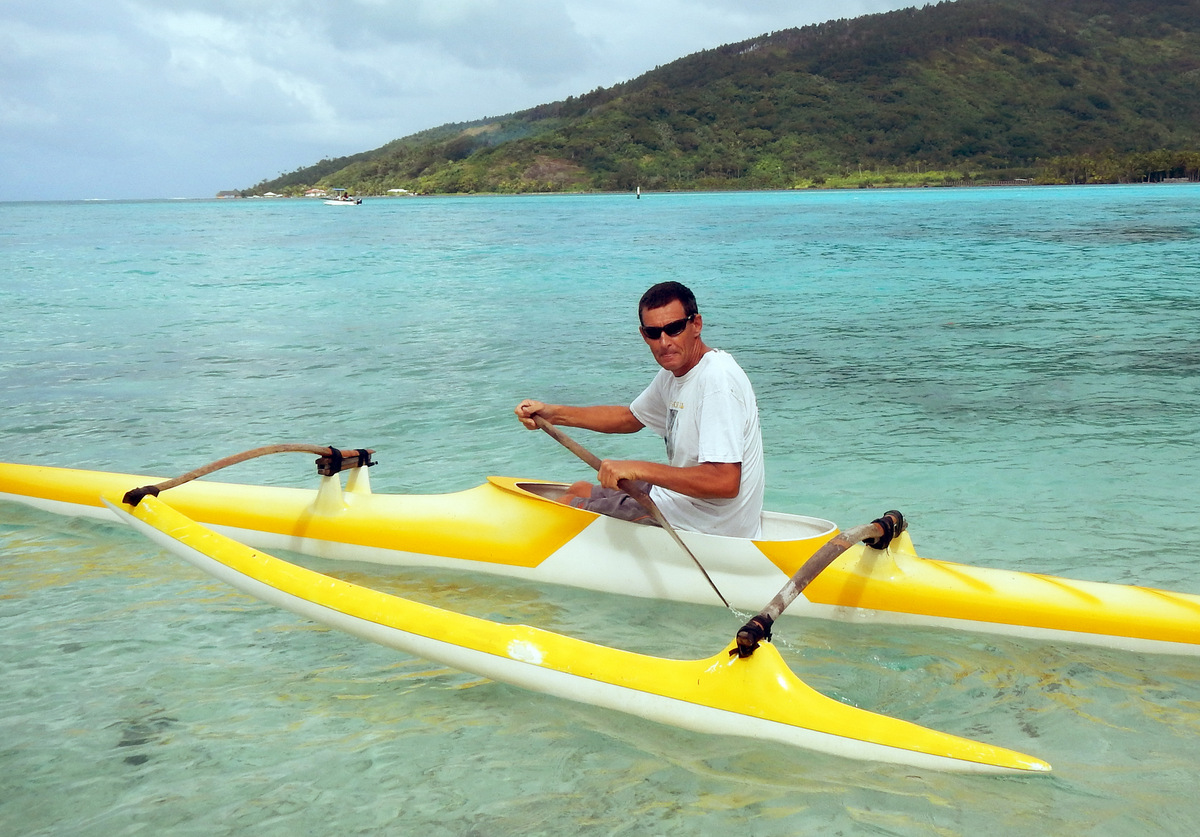
We went ashore and were met by Paul who immediately gave us a gift of six fish and then even cleaned them for us. With our fish tucked up in the dinghy, we then asked Paul if we could go paddling. Sure! He ran off and got is very sleek, light outrigger canoe from behind his house and launched it for us.
I had a go first and the thing is very fast in a straight line, but is a real pig to turn. The seat is above the water line and the whole canoe feels very tippy, especially when turning and the outrigger lifts off the water. I quickly learned to turn to port (towards the outrigger), which feels much more stable. Great fun, but it’s hard work paddling fast.
Glenys had a go next and look very unsteady as she paddled away. I had a problem with the outboard and was fiddling with it, so I missed exactly how she tipped it over, but it didn't take long before she was swimming… Paul and I rescued her, then Paul zoomed off south for some paddling exercise. There was no way that we could keep up with him with our small outboard, so we went back to the boat.
Paul called by an hour later and joined us for lunch of Pan-fried Fish - very nice. We found out that small snappers and groupers are okay to eat here, but the larger ones are not good. Most of our "chatting" with him was done with a pad of paper and the iPad to show photos and charts.
Paul went back ashore and we headed south down the boat channel to go snorkelling, but the current was incredibly strong, so we hung onto the dinghy and drifted back to the anchorage at 3 knots - good fun.
11 July 2014 Motu Murimahora, Huahine
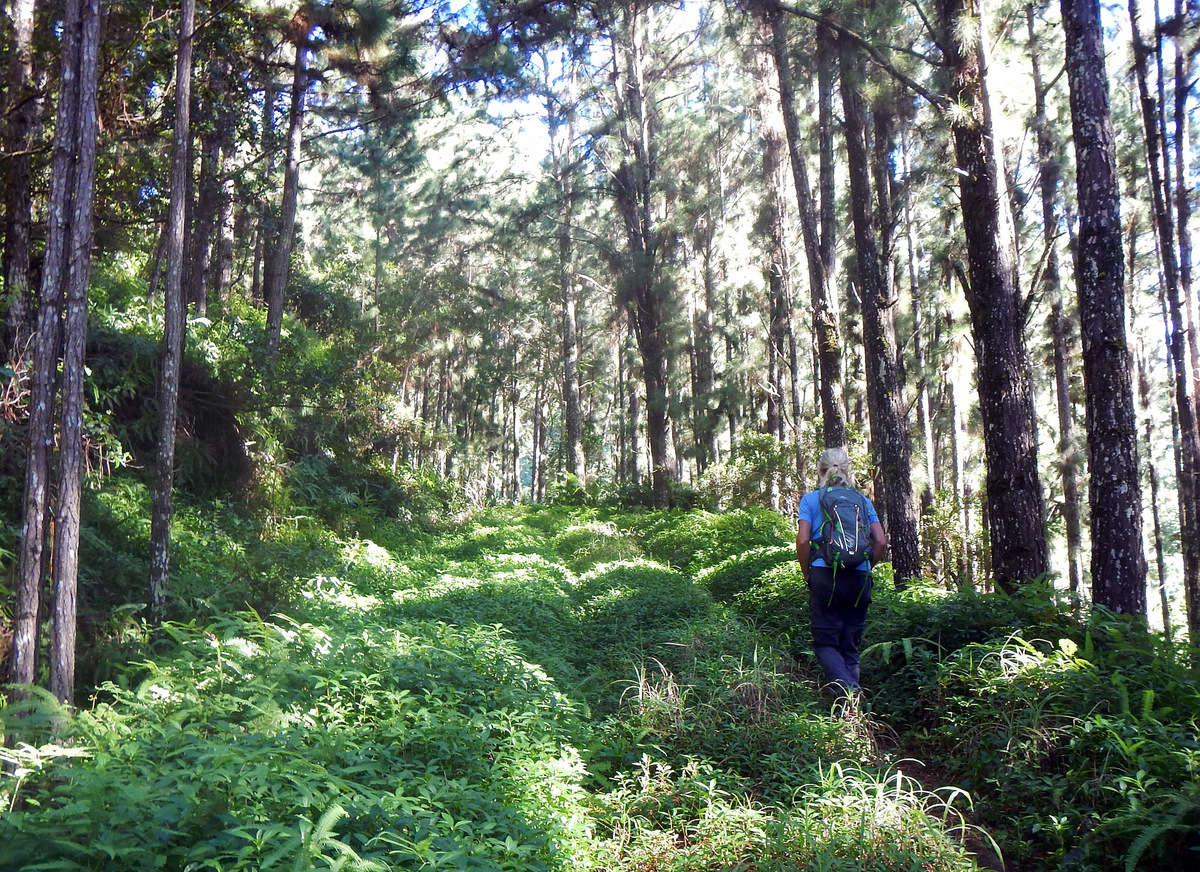
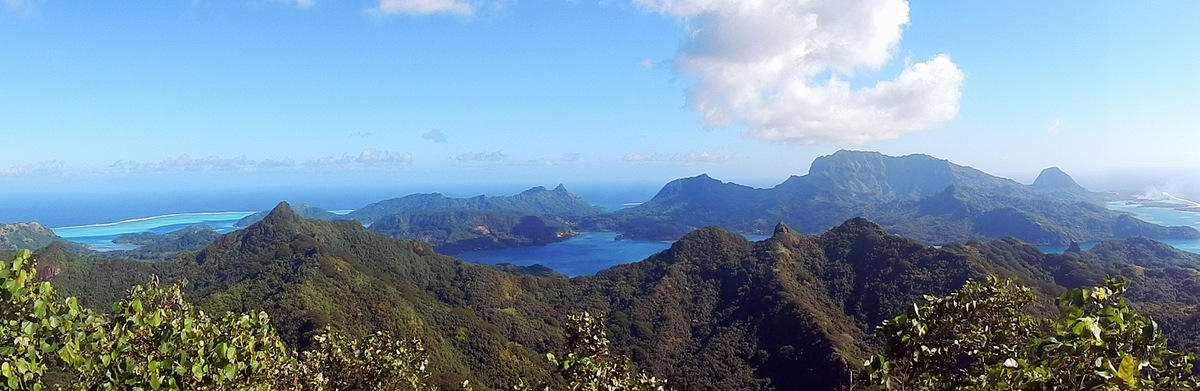
The strong 20 knot wind continued from the north, but it was a beautiful blue sky day. We managed to drag ourselves out early and went for a hike up the nearby Mount Pohue Rahi which is a pleasant walk to the top of the 460 metres high peak. We took our dinghy to the Tefarerii village dock and hiked up a track through some beautiful conifer woods. It took us 90 minutes to get up to the peak, where we had some stunning views of the island. (See our hiking article for more details.)
We were back on Alba by lunchtime and then I went snorkelling next to the boat while Glenys stayed on board chilling out after our exertions this morning. I got some more reasonable photos of Butterflyfish.
12 July 2014 Motu Murimahora, Huahine
It was another day with strong winds from the north and overcast with showers, so we chilled out in the morning. Paul came by later in the morning and stayed chatting for an hour. He brought us some more coconuts and a huge bag of shells for Glenys. We’d put together some small bits of fishing tackle as a gift and gave him a filleting knife that we had to spare.
After lunch we went snorkelling to the north end of the motu where Paul said that it was good. It was okay, but a bit too shallow for us.
Went ashore to give Paul the photographs that we’ve taken while here and met Paul’s cousin who lives on the small motu next to the entrance channel. He could speak reasonable English and we gleaned a bit more information about Paul.
Paul was brought up on the motu and has lived there all of his life, but his parents and the rest of the family have moved onto the main island for work and left Paul behind to look after the land. It must be a lonely existence for him living here by himself, so it was nice to see that his relations are popping in to see him in this remote place.
We went for a walk along the beach then walked back to the dinghy through Paul’s land. He met us and we had another "signing" chat, then he walked with us to the dinghy, where he gave Glenys three beautiful Cowrie shells and had already put another four coconuts and some papaya in the dinghy for us. We've only been here three days, but feel like family - Paul gave us hugs before we stepped into the dinghy. A lovely person.
13 July 2014 Motu Murimahora to Fare, Huahine
The trough has passed over us now and we have an overcast sky with hardly any wind. We upped anchor at around nine o’clock and motored around to Fare, the main town on this small island arriving just before noon.
The town anchorage is just to the north of the entrance channel, but there was still some swell from the north and the boats at anchor there were rolling, so we carried on into the bay and anchored on the reef at 16°43.18S 151°02.36W, which is on a shallow shelf about 1/3 mile from the town quay. There are some scattered rocks and coral heads, but we found a clear patch in 3.5 metres of water. The bottom looks to be broken coral and sand, but our anchor dug in nicely next to a rock. A strong current whips through the anchorage, keeping us pointing south.
After lunch, we jumped in the dinghy and went into town. Being a Sunday afternoon, everything was closed up, but we found out that there will be some sort of parade tomorrow morning because it’s Bastille Day and we’ve there’s dance competitions every night for the rest of the week because we’ve arrived right in the middle of the Heiva festival.
We walked around the small town and then a mile towards the airport to check out the small sports stadium where the dance competition will be held tomorrow night - there are small eating places there and the event starts at seven o’clock, so it looks like we’ll be eating out as well. On the way we stopped by a horse riding stables, but they charge $70 per person for a short two hour ride that sounds very touristy, riding along the beach and wading through water, etc, so we won’t bother…
14 July 2014 Fare, Huahine
After breakfast, I felt that we were a little too close to some very shallow water, so we pulled up the anchor to move out a little. We tried to re-anchor in a couple of places, but we just kept dragging, presumably on coral rubble, so we gave up and went over to the town anchorage, which now looked much calmer. I dropped the anchor in a nice big patch of sand, but when I snorkelled down to the anchor, I found lots of big coral heads under us, so I put a fender on the chain to try to lift it above the heads.
It was Bastille Day, so we went ashore to watch the festivities. The streets were lined with hundreds of locals and the first event was a long parade led by the police and firemen. Following them were groups of local associations and churches, mostly dressed in bright outfits and wearing beautiful leis.
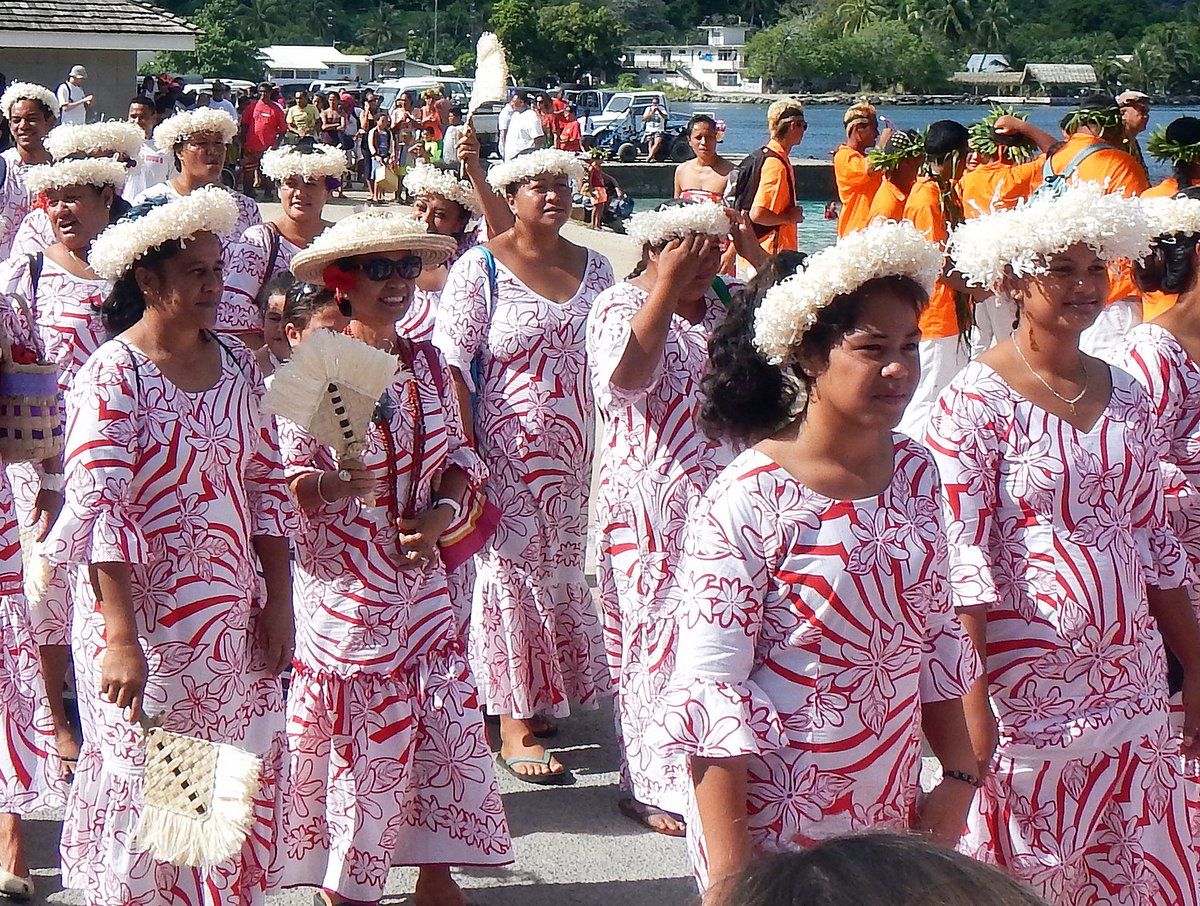
The groups gathered in the main square for a flag raising ceremony. Three flags were raised and three anthems were played - France, French Polynesia and Huahine. Interestingly, the Huahine flag was in the middle and the guys raising the flags were very careful to keep the Huahine flag the highest. The Huahine anthem was absolutely beautiful with every one singing the haunting polynesian tune. We were then treated to some traditional dancing accompanied by drums and ukuleles - very energetic with lots of hip wiggling.
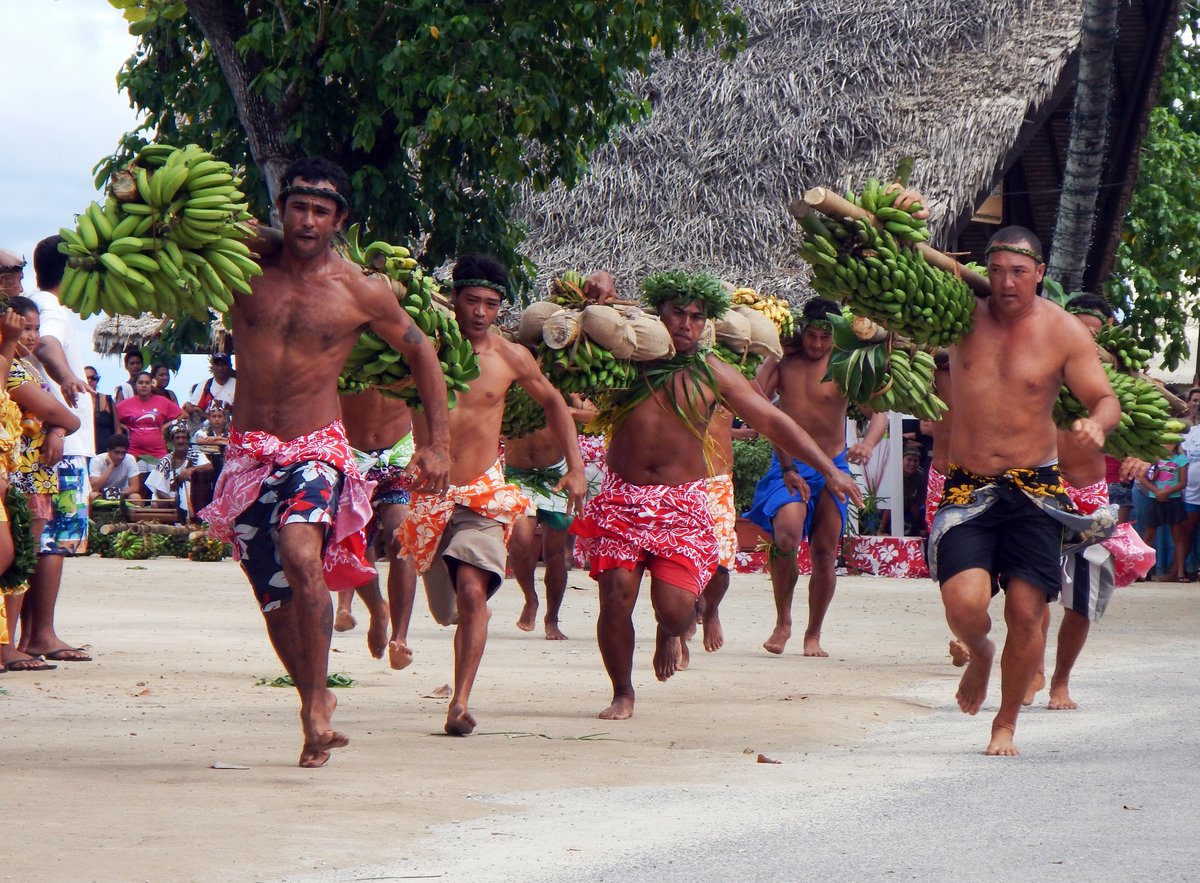
The final event was the Courses de Porteurs de Fruit (Race of the Fruit Porters). The race consists of each barefoot runner carrying a 3 inch diameter pole upon which is fixed bunches of bananas. The ladies carry a 40lb load and the men carry an 80lb load. As part of the Heiva festival, each of the six villages had entered competitors. It was great fun, with the crowd cheering on their village. The race lasted about ten minutes, so I guess that they ran a mile or so and were very tired when they return back to the square, heaving the heavy load off their shoulders into the hands of waiting assistants.
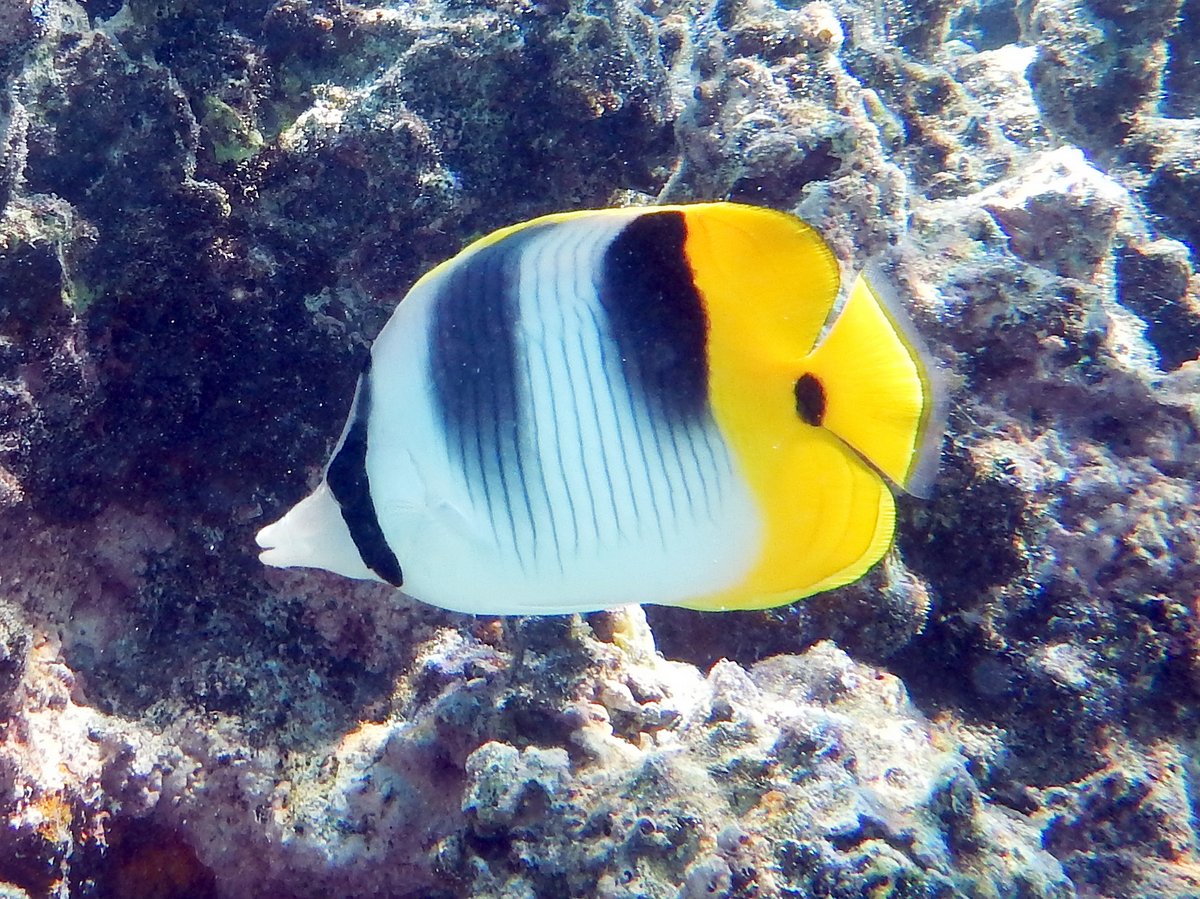
In afternoon, we went snorkelling next to a permanently moored tourist boat out on the reef between the two passes, where they feed sharks. We went to the east cardinal mark on the edge of the reef and then followed a series of sticks through the shallow water out to the moored boat. There was no one around when we got there, and close to the boat, we saw a dozen or so Blacktip Reef Sharks, who came to check us out, but kept their distance. There were also lots of Pacific Double-saddled Butterflyfish, which seem to be the most common type of fish in places where fish feeding is done. Even without food, they were swarming around us.
In the evening, Steve and Lili from “Liward” invited us over for sunset drinks .
15 July 2014 Fare, Huahine
There was no wind first thing in the morning and the boats in the anchorage were swirling around a little bit. Our chain had caught on a coral head and put us too close to “Liward” because they were swinging in a large circle than us. So, before breakfast, I had to snorkel down to free the chain. I man-handled the chain over to the other side of the coral heads, which was enough to put us a comfortable distance from “Liward”.
We hired a scooter and went for a tour around the islands. First we zipped around the smaller island of Huahime-iti. The road follows the coast and occasionally dips inland through some very lush farmland and vegetation. It’s only about 12 miles around the island, so we just stopped in a couple of places to stretch our legs. There’s a layby on the south east side of the island which has a stunning view looking down on the fringing reef with fabulous colours.
Back on the main island of Huahine Nui, the road climbs very steeply up - at one point, the poor little scooter was struggling so much that we could have walked faster, but it pulled through. There’s a rather boring lookout at the top of the hill and then the road drops down to the small village of Faie.
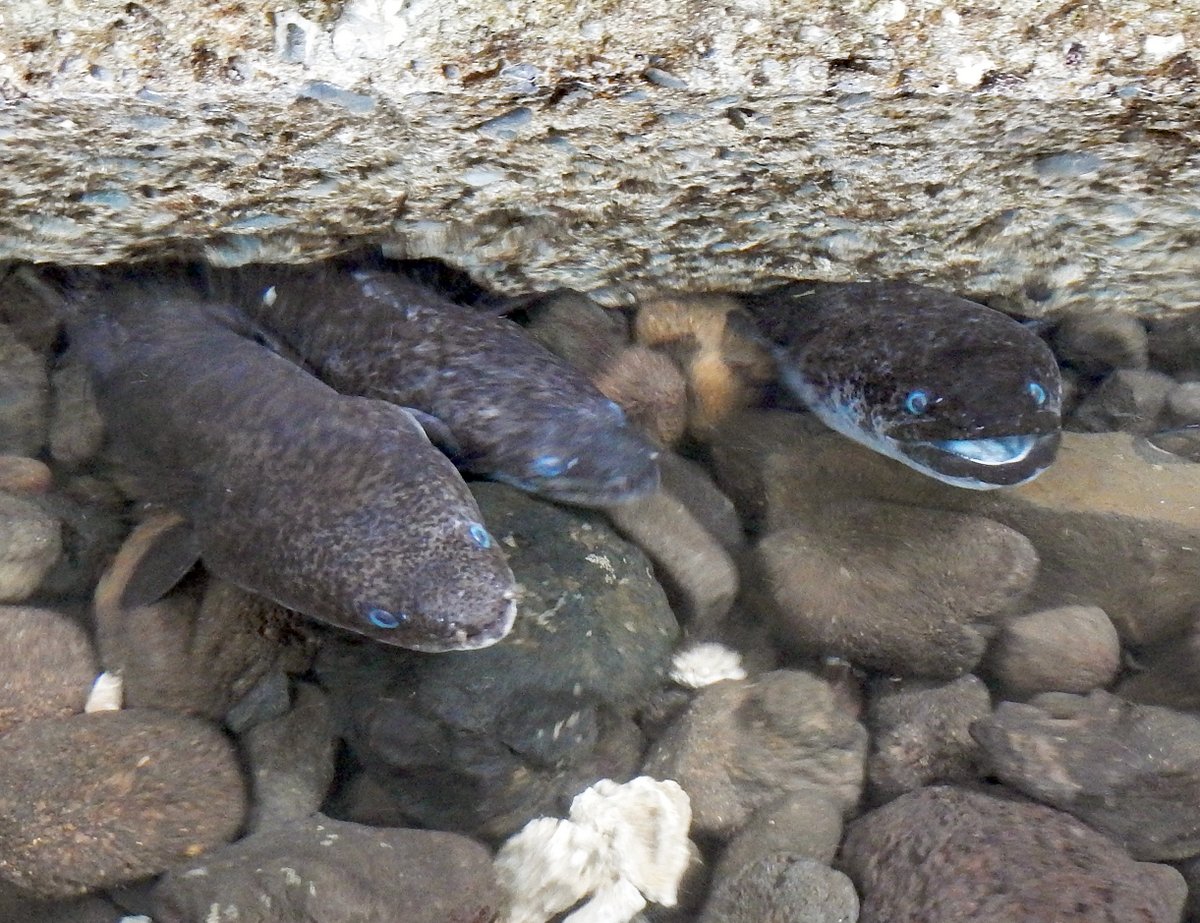
On the left hand side of the road in the village is small river flowing along a culvert. Here we found the sacred Blue-eyed Eels. These are large freshwater eels (about five feet long) that are fed by the local tour guides. They live in incredibly small holes on the side of the crumbling culvert and come out when fish is offered to them. It’s bit of a circus, but interesting nonetheless.
Just outside Faie, we stopped off at Huahine Nui Pearls and Pottery. They transported us and some other tourists out to their pearl farm a few hundred metres offshore. We were given a short talk on pearl production and then shown into the small pearl shop. They had some really nice jewellery, but much more expensive than the Tuamotus.
We stopped for a picnic lunch on a beach next to Marae Manunu and had just finished our baguette, when it started to rain. We rushed back to the bike and scooted off to the Maeva Archiological site hoping to get some shelter. Unfortunately, the small museum was closed, so we hunkered down in the entrance porch for a while.
Twenty minutes later, the rain was showing no sign of relenting, so we went for a walk up a trail, which would have been nice if it had been dry, but we got soaked to the skin and gave up after fifteen minutes. We drove back to the main town of Fare, dropped off the scooter and retired back to the boat to dry out.
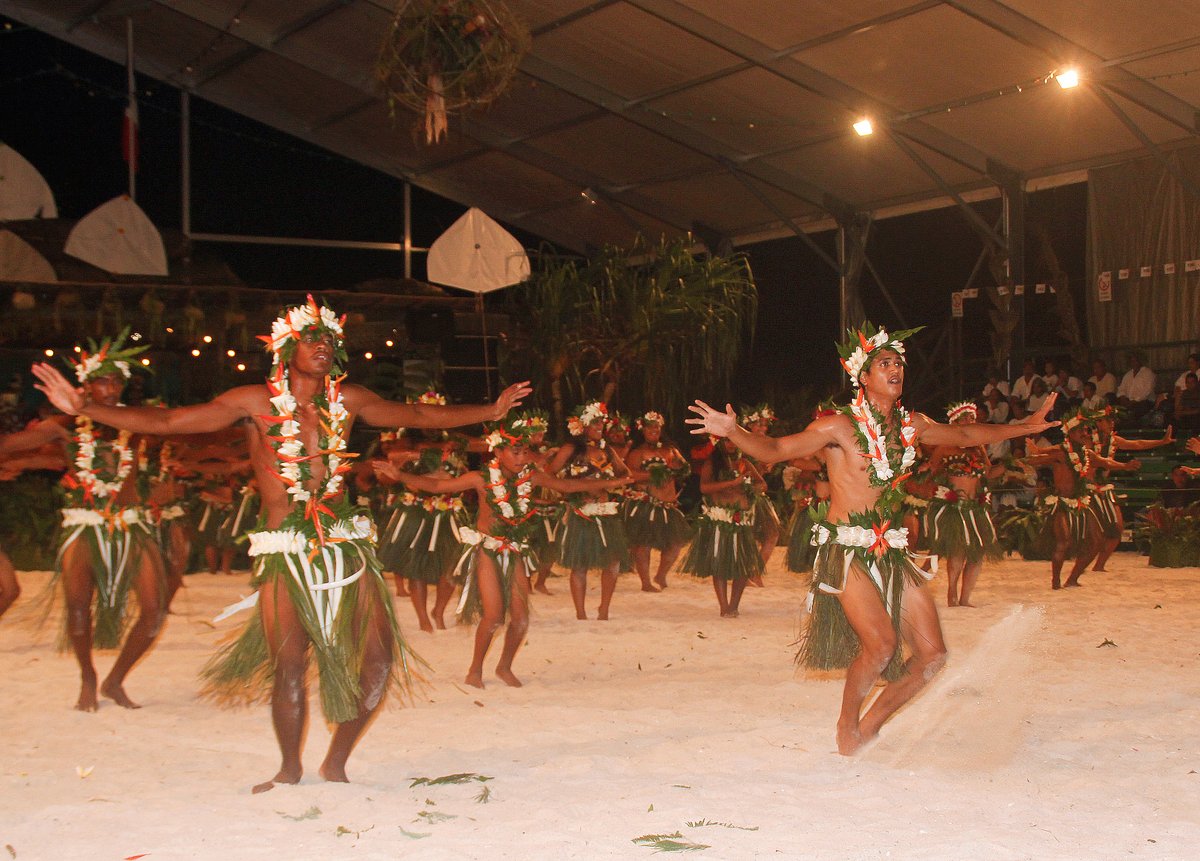
In the evening, we went out to the Heiva dance competition. The Heiva is a two week event where the eight main villages of the island compete in various events including running races, outrigger canoe races, singing and dancing. The event normally starts the weekend before Bastille Day, so this year it runs from 5th to 19th July. The sporting events take place during the day, but the singing and dancing happens at a small stadium just outside town, with one village singing and one dancing each night.
We managed to bum a lift out to the event, which was great because it was still raining. I had to sit in the back of a pick-up truck, but it was much drier than walking for twenty minutes. The small eating places were bustling and we had a great meal of steak and chips, but it took ages to arrive and we missed the singing event.
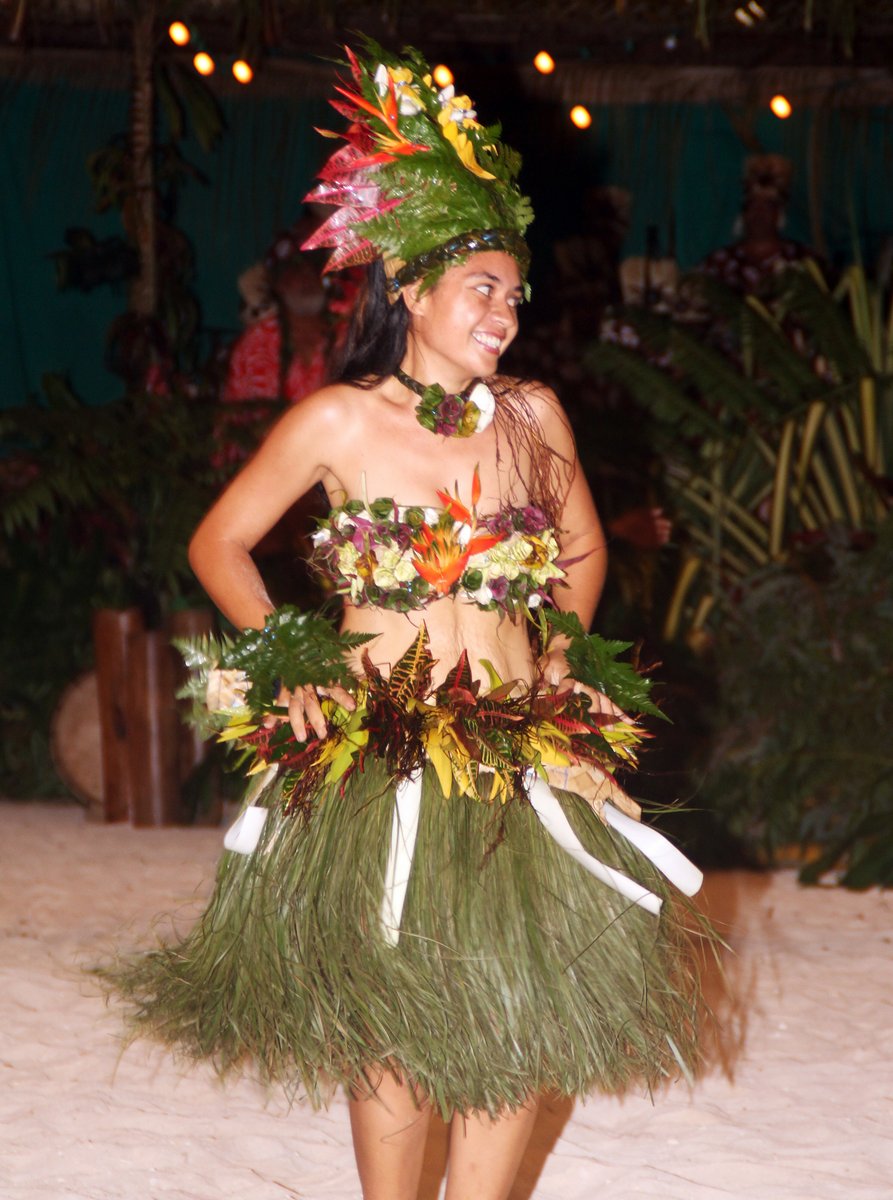
The arena was nicely decorated with woven palm leaves and flowers everywhere. There were tiered, hard wooden benches around the sandy arena giving us a great view of the action. There were around fifty dancers - half men and half women all dressed in costumes made from natural grasses and leaves. Interestingly they were all ages from small boys to more mature ladies and lots of different shapes from skinny, young teenagers to buxom, large ladies who didn't mind shaking their fatty bits at all.
The dancing and music was fabulous - men wiggling their knees and the women wiggling their hips and some great choreography. Every year, the judges choose a theme based around a traditional story - this year it had something to do with mystical mountain peaks, which are the last thing that a voyager would see as they left home and the first thing seen when they return home. We had a great time.
16 July 2014 Fare, Huahine
It was a horrible rainy morning, so we stayed in. Glenys got on with some chores and I worked on our web site, in particular my Marine Life photograph section. I’ve already published a very basic program, but it’s very simple and I wanted to make it easier to extend, so I spent most of the day re-programming it. I now have new code, but the program doesn’t work as well as it did this morning - very depressing.
It brightened up in the afternoon, so Glenys went for a stroll around town and did some food shopping. Later in the afternoon, the Hokulea arrived and was towed around to Haapu Bay. There was a little bit of excitement, with conch shells being blown, but nothing as grand as the event we saw when the replica Polynesian Voyaging Canoe arrived in Papeete after its passage from Hawaii.
In the evening, we were invited by Wil and Jenny onto “Full Monty” for a beer or two and then went out to the sports stadium to watch another village perform their dances at the Heiva festival. This time we went earlier, had a huge chow mein for dinner and made it to our seats for the singing. Some of the singing was lovely and tuneful, but a lot of it was chanting to drums, which I found a bit repetitive.
The dancing was again a big show with fifty or so dancers and very enjoyable. There were more drums tonight and a bigger gaps between the dances while the dancers changed costumes, with some guy droning on for long minutes in Polynesian. If we’d been able to understand what he was saying if might have been interesting, but the hard seat seemed to get harder the longer he talked. It was another great evening.
17 July 2014 Fare, Huahine
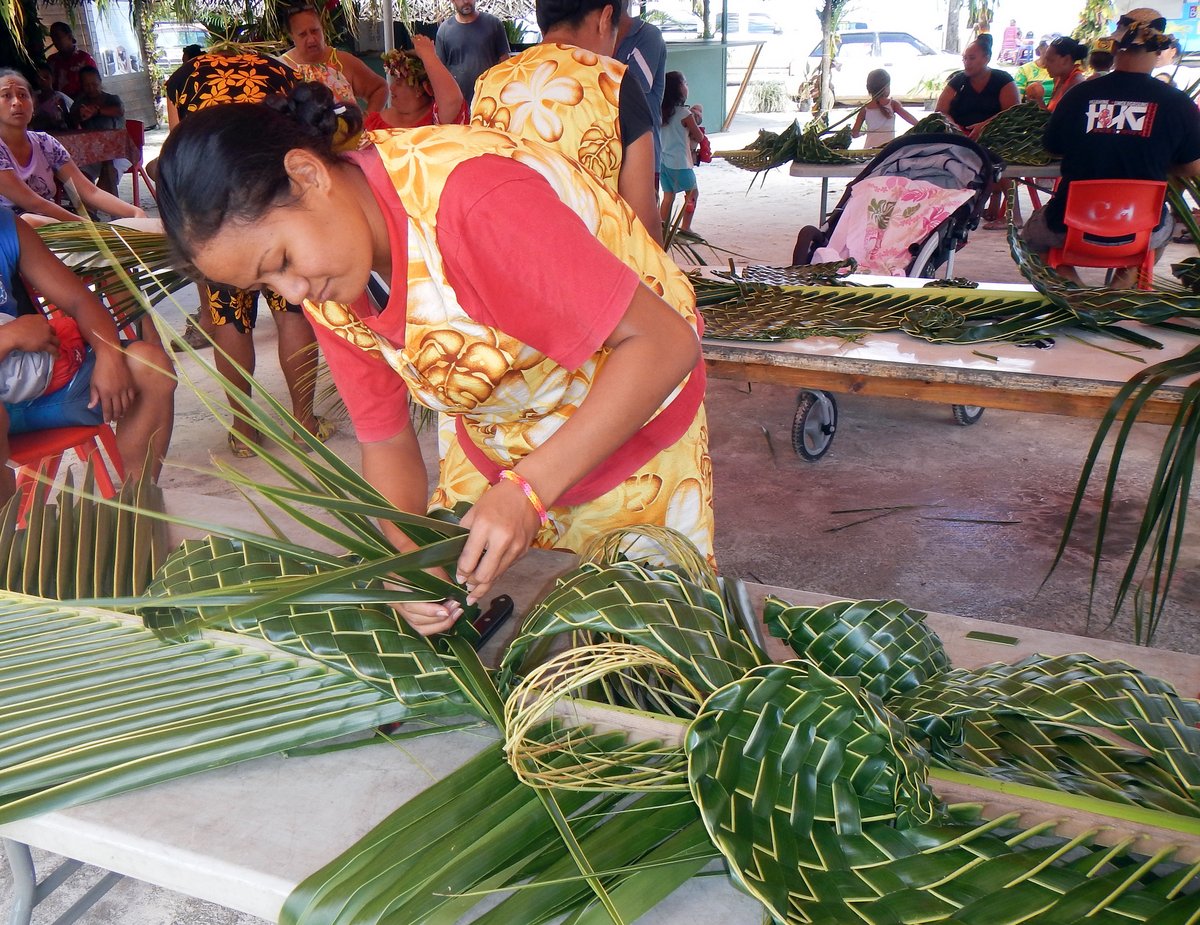
We wandered down to the small artisans market and watched a Heiva competition for palm leaf weaving. This sounds boring, but it was fascinating to watch the skilled locals produce lovely decorations from ten foot long palm leaves. There were different techniques, some stripping the green edges from the long leaves and weaving the remaining stem and others weaving the green leaves into intricate shapes and patterns.
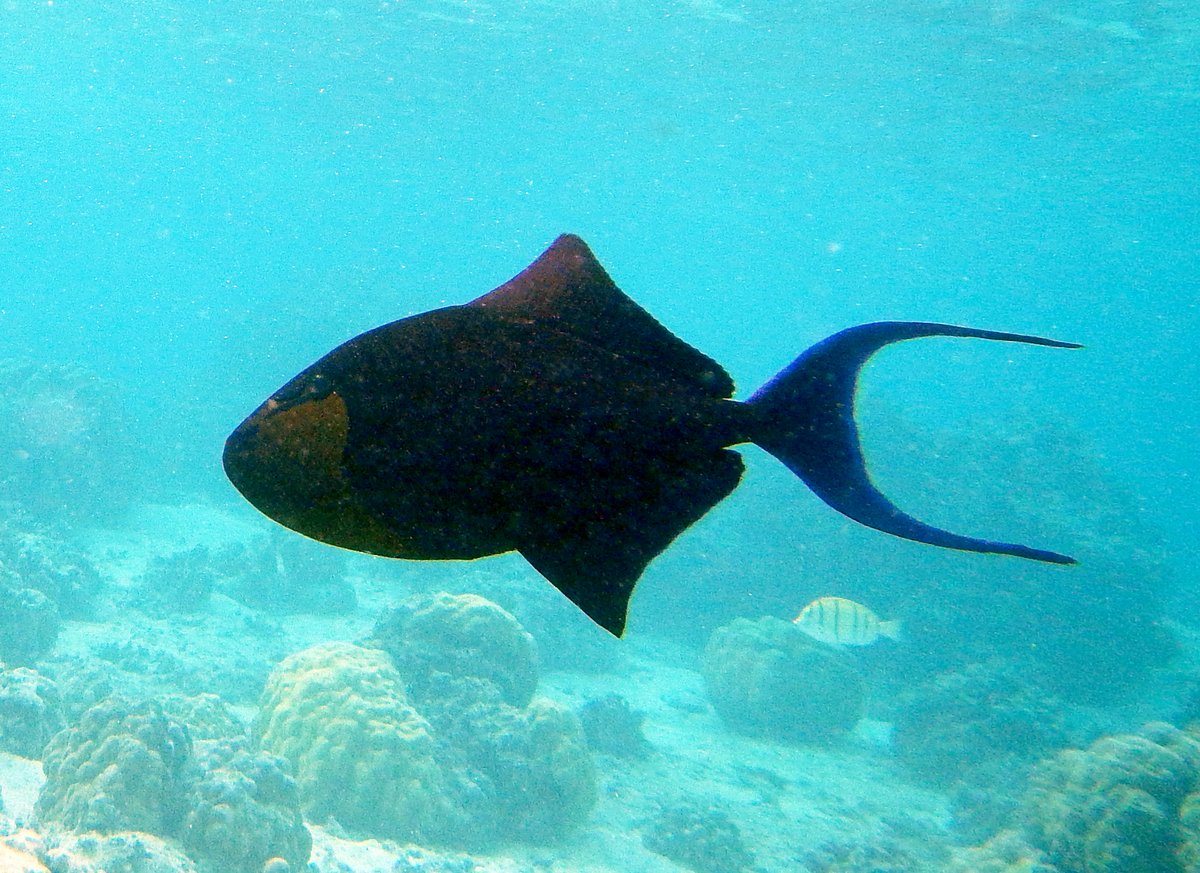
In afternoon, went out to the shark feeding boat for a snorkel, but there weren’t as many sharks as a couple of days ago - perhaps the sharks know that tourists don’t come out on a Thursday? Last time, we’d got close to a few Redtooth Triggerfish, which are normally very, very cautious. They’re almost black, so I’d rigged up my underwater camera with my underwater strobe - the tiny pocket camera looks a bit ridiculous on a huge tray and arm and the strobe is twice its size, but it seemed to work. I was hoping to get a good photograph, but none of the Triggerfish would come close enough - ah well.
We had a quiet night in - all Heiva-ed out now.
18 July 2014 Fare to Faaroa Bay, Raiatea
Huahine has been one of the best islands that we’ve visited in the Society Islands - it’s small enough to be very friendly, but big enough to have lots of things to do. However, we needed to move on. We had a struggle getting the anchor up. Despite putting a fender on the chain, we were caught on some coral heads again, so we had to manoeuvre about for ten minutes to get it free.
The 20 mile trip to Raiatea wasn’t very restful because there were lots of horrible showers around, giving us variable winds, so we had to keep changing the sails and putting the engine on. Thankfully though, the rain showers kept out of our way.
We motored through the Iriru Pass and into Faaroa Bay where we picked up a mooring. They’re provided by one of the charter companies and can be picked up for no charge, which is very handy because most of the bay is very deep.
We chilled out in the afternoon. I spent a couple of hours going through my underwater photographs and identifying fish. I never realised how many photographs of fish I've accumulated over the past few years - it’s a bit of a chore catching up with the identification process. I've still got over 100 fish and marine creatures to identify.
Amazingly, our friends on “Full Circle” arrived ten minutes after we picked up our mooring, so Paul and Monique invited us over for a sunset beer or two.
19 July 2014 Faaroa Bay, Raiatea
I woke up with a horrible head cold - blocked nose, headache and sore throat - it must have been the soaking that we got in Huahine.
After breakfast, we jumped in the dinghy and went up the Faaroa River, which apparently is the only navigable river in French Polynesia. It’s a pleasant little river and quite atmospheric when it gets narrower and the lush vegetation overhangs the water.
Near top of the river, we met a local guy called James who was guiding a couple of people in kayaks. We tagged along and he showed us around a couple of farms. James was obviously angling for us to buy some fruit and veg from him, but mostly it was taro, coconut and bananas. We’re not too keen on Taro, which is a starchy root vegetable (like a yam) and we’d still got half a dozen coconuts, so we bought a big stalk of bananas for $10 and shared it with “Full Circle”.
We chilled out in afternoon. Motivated by my cataloguing of fish photos, Glenys dug out her pile of shells that have been shoved in boxes and bags. She’s got quite a collection now and has started to identify them and take photographs, so that she can put them up on the website at some point in the future.
20 July 2014 Faaroa Bay to Pointe Tamapua, Raiatea
We had a horribly rolly night, because the swell comes in through the pass, which is right at the end of the bay. We had a very pleasant sail down to Motu Toa Toa and it was blowing over 20 knots from the north east by the time that we arrived. There’s a small basin in the lee of the island, but there were two charter catamarans already anchored there with a one right in the narrow entrance channel.
We temporarily anchored on the edge of the reef - dropped in 2.5 metres on sand and backed off. I went over in our dinghy and had a look at the anchorage and found that we might have been able to squeeze in, but it’s only 2.5 metres deep and in most places far too tight for my liking.
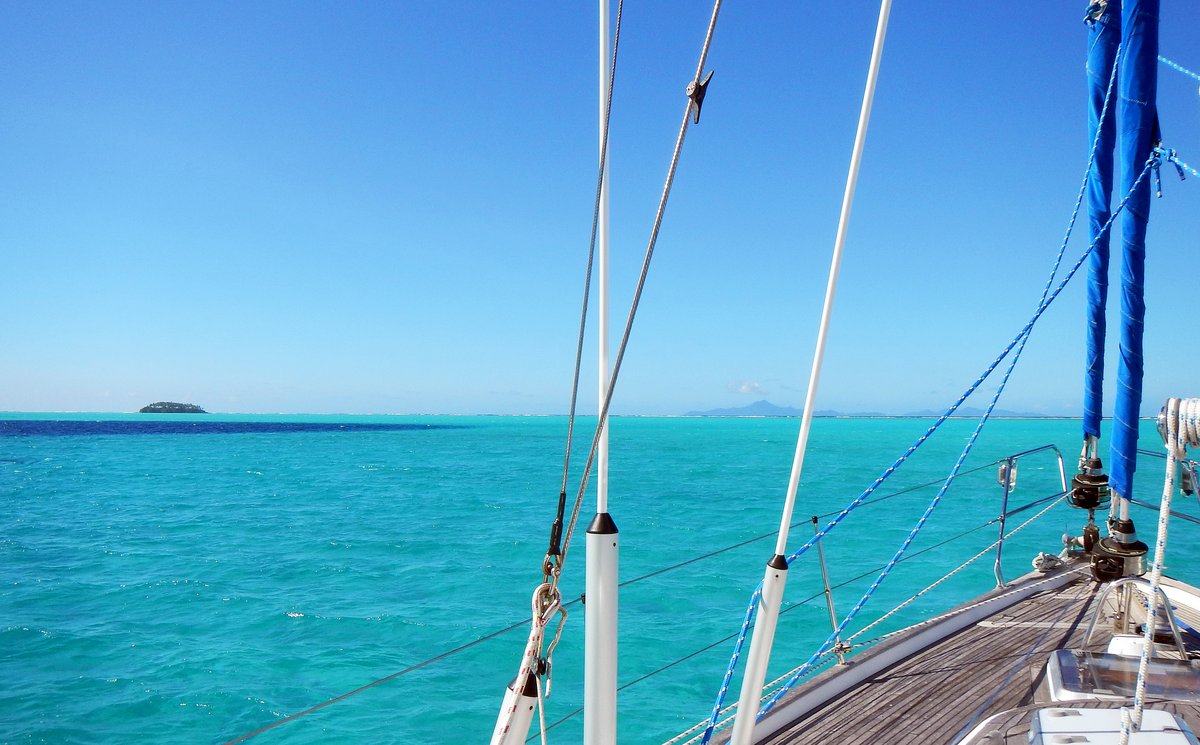
We went back towards Passe Teavamoa and anchored off Point Tamapua on a lovely sandy patch at 16°51.94S 151°21.04W in 3.5 metres of water. We’re in the middle of nowhere, just off the channel around the island. The water colours are stunning, there’s a reef ½ mile ahead of us and the view of Raiatea behind us is lovely. We went snorkelling on a reef that we found 50 metres to the south west of the anchorage on the edge of the channel. The reef is rocky, but is teeming with fish and has depths of between 3 and 8 metres, which is just perfect for us.
21 July 2014 Pointe Tamapua, Raiatea
It was a lovely peaceful night - the wind blew steadily keeping us nice and cool. Glenys did some chores in the morning. The work surface in the galley is pure white melamine, which stains very easily. Unfortunately, she’s found that if she uses bleach to clean it, the surface reacts and turns a horrible yellow colour. I recently sent an email to the HR dealer in the UK and he’s suggested using Bicarbonate of Soda, which to our amazement seems to work, so Glenys spent a tedious hour, scrubbing the work surface, which now looks much better.
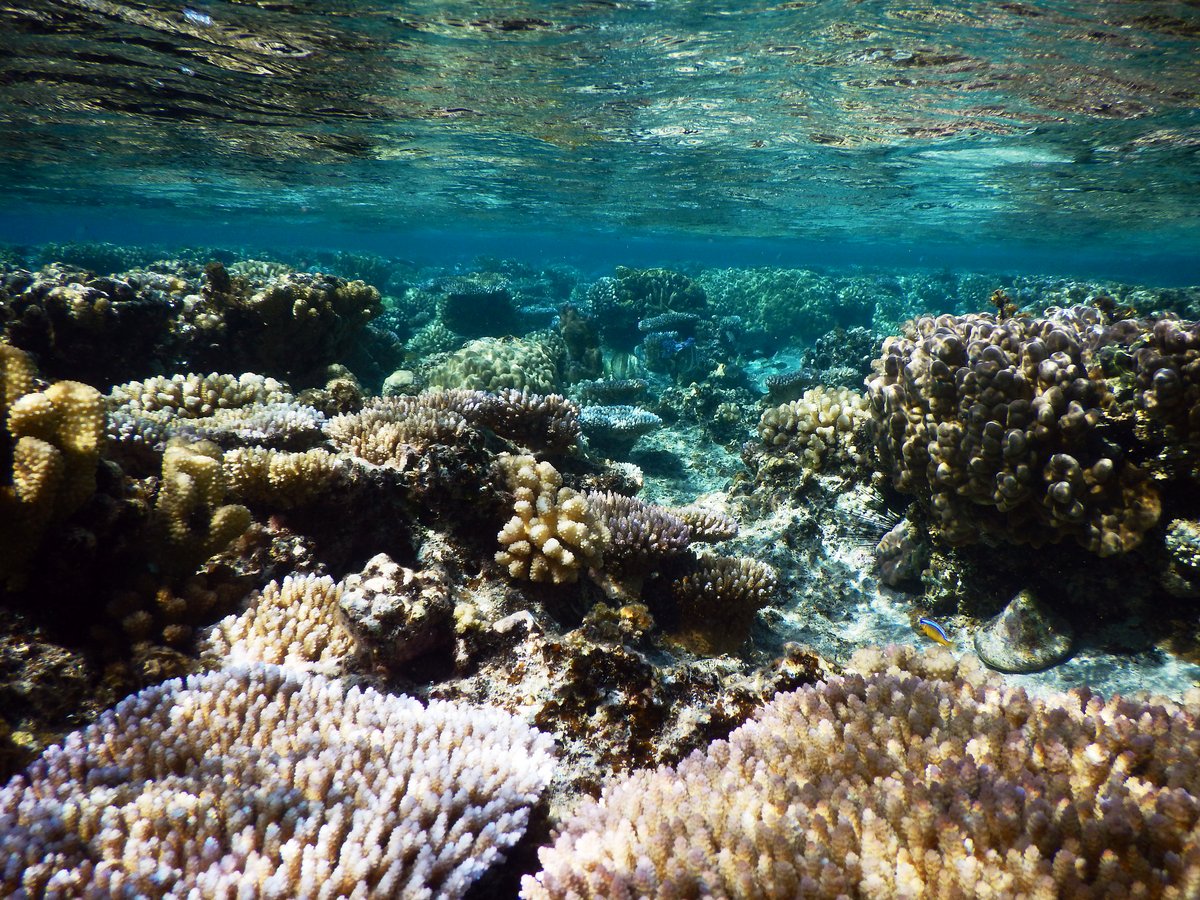
In the afternoon, we went snorkelling on the edge of the reef. There were large, two metre waves were crashing onto the outside of the reef only 20 metres away, but it was very calm where we dropped our dinghy anchor. It’s a beautiful bit of reef - the coral is in the best condition that we’ve seen in the Pacific. Glenys went off collecting shells, while I harried fish, trying to take photographs of them - they are so timid.
22 July 2014 Pointe Tamapua to Tapuamu Bay, Tahaa
We sailed up the east coast of Raiatea, which was a fabulous reach with 15 knot winds. The town dock in Uturoa is a long concrete quay, which is right in the middle of town (and free), but the wind was blowing hard directly onto the dock, so we gave it a miss.
We sailed up the west coast of Tahaa to Ilot Tautau. A couple of boats were anchored on a narrow sandy shelf just off the reef, but it’s quite exposed and the wind was blowing hard creating two foot waves, which were knocking the boats around. We ran away and anchored in Tapuamu Bay in 25 metres depth.
It’s the first time that we’ve anchored in such deep water and I was glad that I’d spent the time to splice 40 metres of ¾ inch rope onto the end of our 60 metres of chain. With 80 metres out, we have 60 metres of chain on the sea bed and 20 metres of rope to the boat - I hope that my splice is good.
After lunch, we hopped into the dinghy and motored a mile across to the small island to the south of Ilot Tautau There’s a 50 metre wide channel between the two motus, which has a snorkelling area called the Coral Gardens. We waded ashore onto the small motu and walked to the seaward side of the channel - we were in bare feet, so the stony path was a challenge.
At the far end of the island, we waded into the water and swam around the coral heads. The water is incredibly clear and the very healthy coral has created a labyrinth of narrow channels. The maximum depth of the water is six feet and at times the coral is just below the surface of the water. Local tour operators bring boat loads of tourists here and feed the fish, so all the marine life is used to people and as usual we had swarms of Pacific Double-saddled Butterflyfish around us looking for a handout.
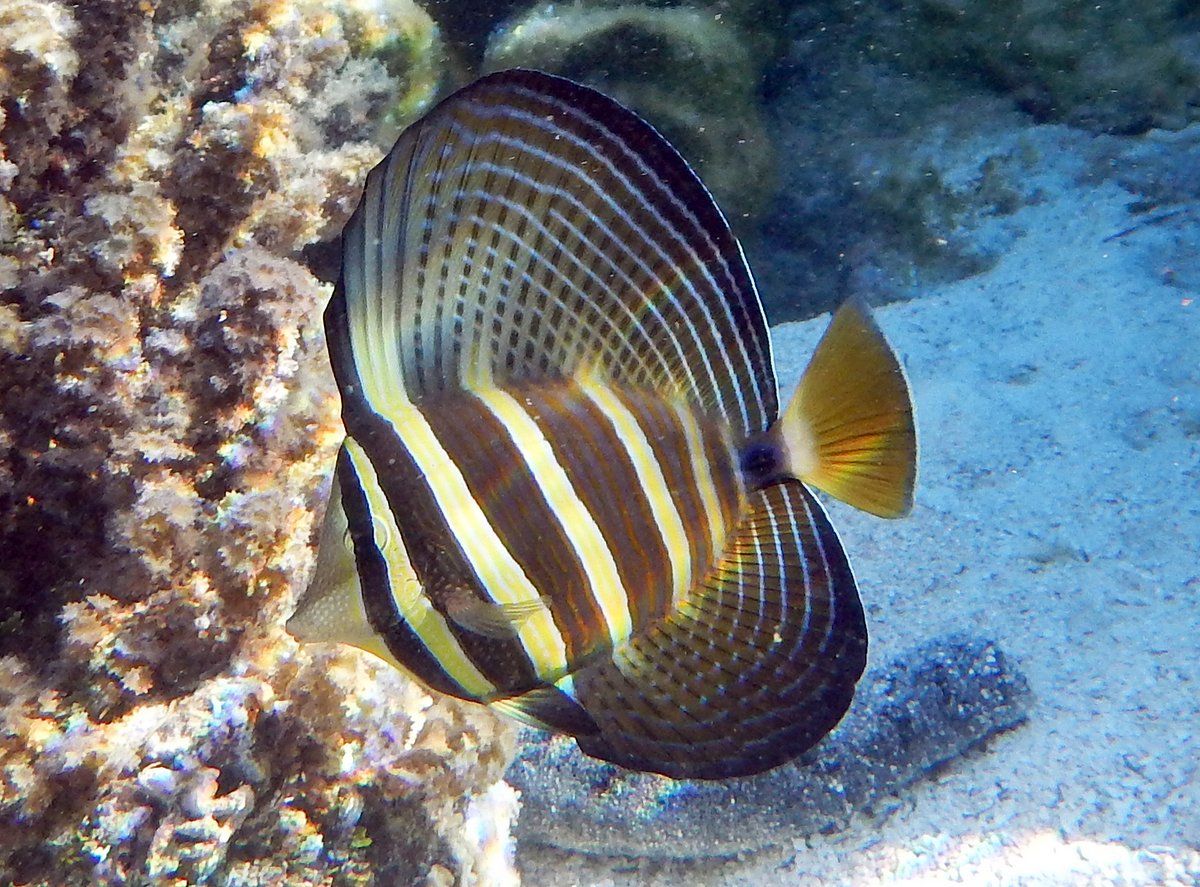
We stayed in the water for two hours and I filled up my memory card with photographs - I got a reasonable shot of a Pacific Sailfin Tang, which looks very impressive when it extends it's fins. A couple of tourist groups went past us. One group had twenty people, all in a long line, pushing off the seabed and the coral, churning up the water as they passed. Not the greatest way of seeing a lovely reef.
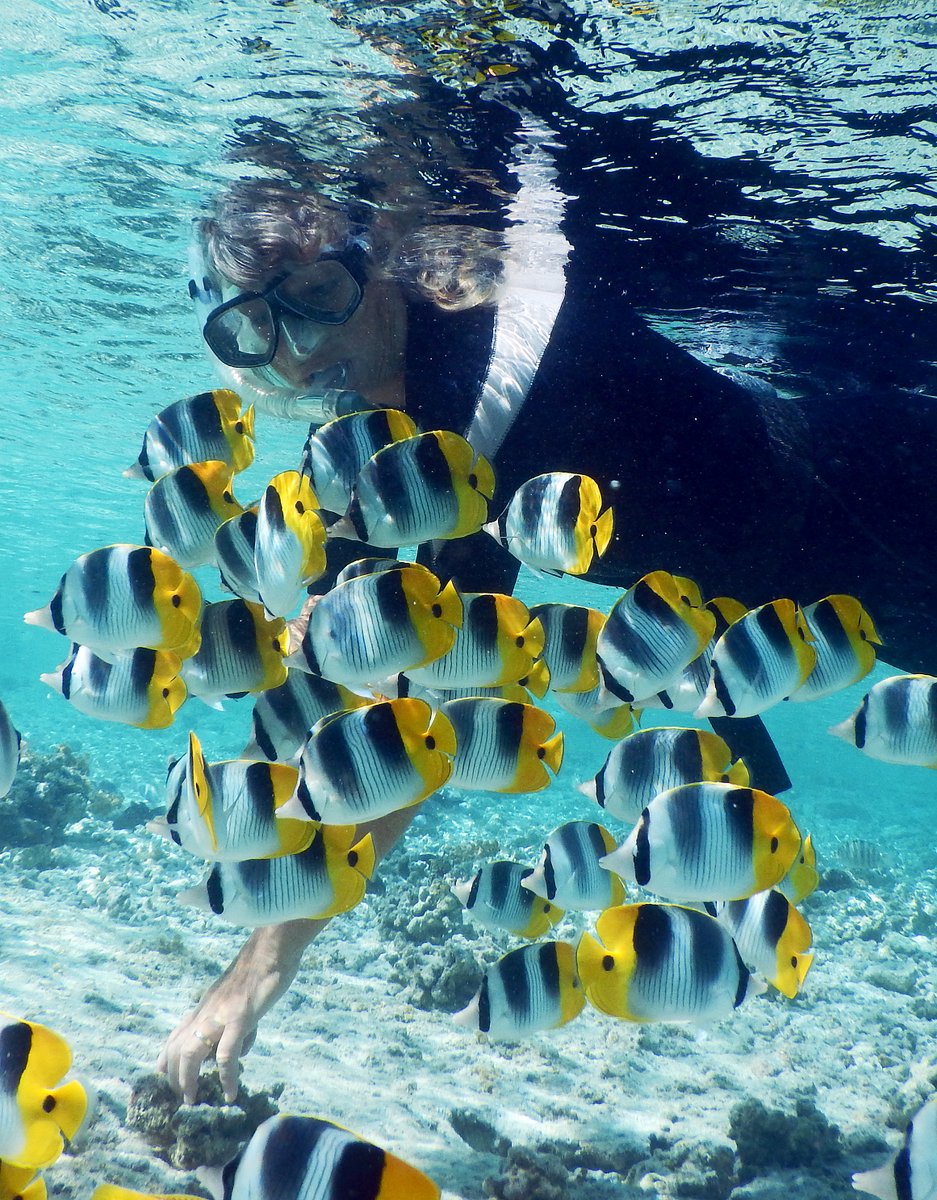
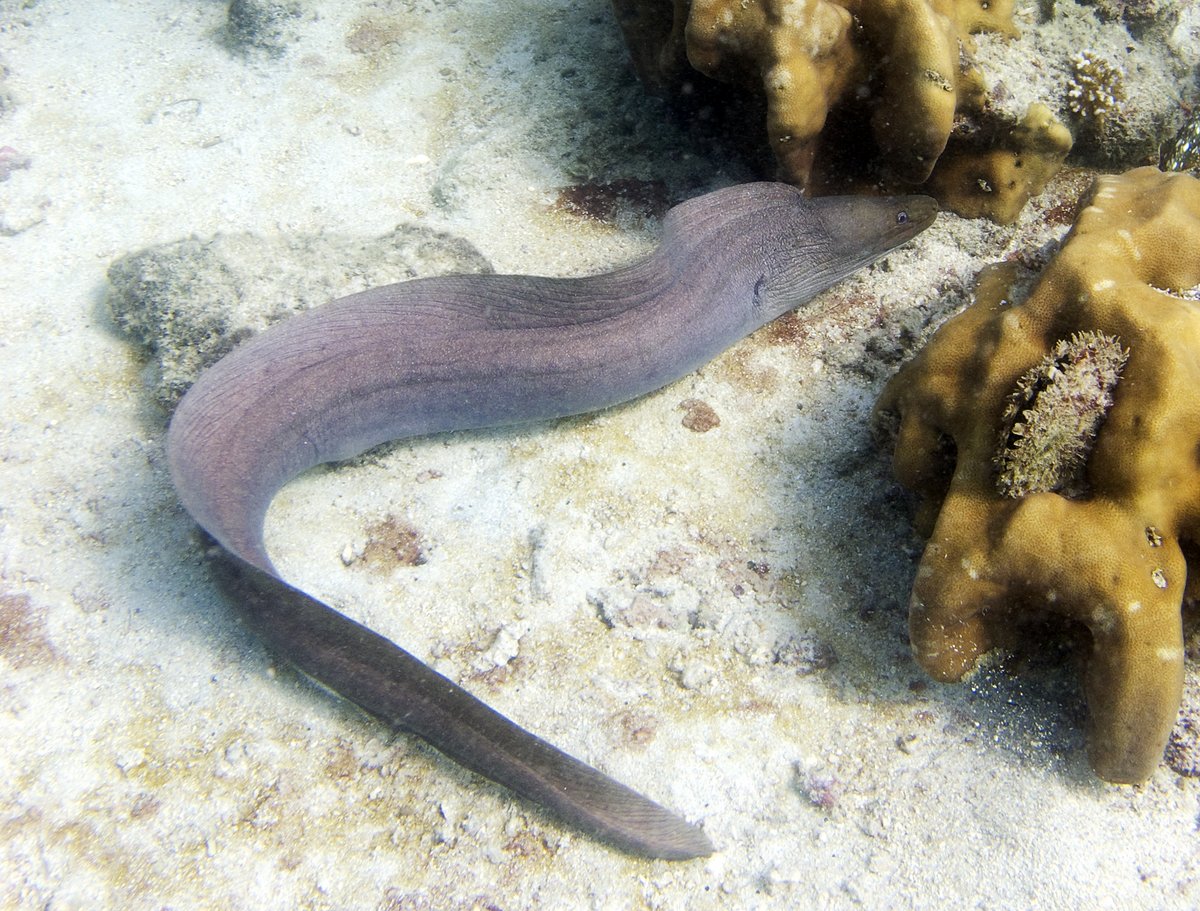
The tour guides all feed the fish, which I have mixed feelings about. It obviously changes the natural behaviour of the fish, but gave us good opportunities to get very close to marine creatures. At one point, a huge Green Moray Eel (I’d say 6 foot long) swam between Glenys’s legs and then turned back straight at her. It gave her a big fright, but it was obviously used to being fed. All in all, a fabulous place to snorkel.
23 July 2014 Tapuamu Bay to Mai Tai Anchorage, Bora Bora
My splice on the anchor chain held overnight and we didn’t end up on the reef. I did a baguette run to the small store ashore and then we pulled anchor and headed for Bora Bora, 25 miles away. We had to motor for the first hour, but once we’d cleared the lee of Tahaa, we had a cracking sail on a beam reach.
We went to the Mai Tai Marina, but all moorings were taken, so we had to drop the anchor in 27 metres of water, just at the edge of the mooring field.
While making lunch, Glenys discovered that the food fridge had completely defrosted. After ten minutes of total panic, I found that it had lost its charge of refrigerant, so I topped it up and left the gauges in place to monitor the rate of refrigerant loss.
In the afternoon, we went for walk around town - finding out where the gendarmerie is and of course the supermarkets. There’s a small dinghy dock just across the road from the Super-U supermarket, which is very convenient and the store looks to have everything that we would need.
Hugh and Brenda from “Scotia” invited us over for an evening jam session, so Glenys took her ukulele and I took my guitar. John from “Kika” was there with his fiddle and both Hugh and Brenda play the guitar, so we had a cracking time.
We've now completed a quarter of our voyage around the world - we started in Grenada at a longitude of 61°45W and we’re now at 151°45W. It’s taken us just over three years to get here, but we’re starting to move a little faster now and we’ll probably get to our half way point (in Bali, Indonesia) sometime next year.
24 July 2014 Mai Tai Anchorage, Bora Bora
We went for a dive with Hugh from “Scotia” and Harry from “Malua” on a couple of wrecks. (One is at 16°31.15S 151°44.34W at a depth of 23 metres and the other is lying on a reef at 16°31.15S 151°44.26W at depths between 15 metres and the surface.) The water was a little murky because it’s at the end of a bay, but both wrecks were interesting and there’s some good fish life especially on the second one. The dive sites are 160 metres apart, so we did them as two short dives.
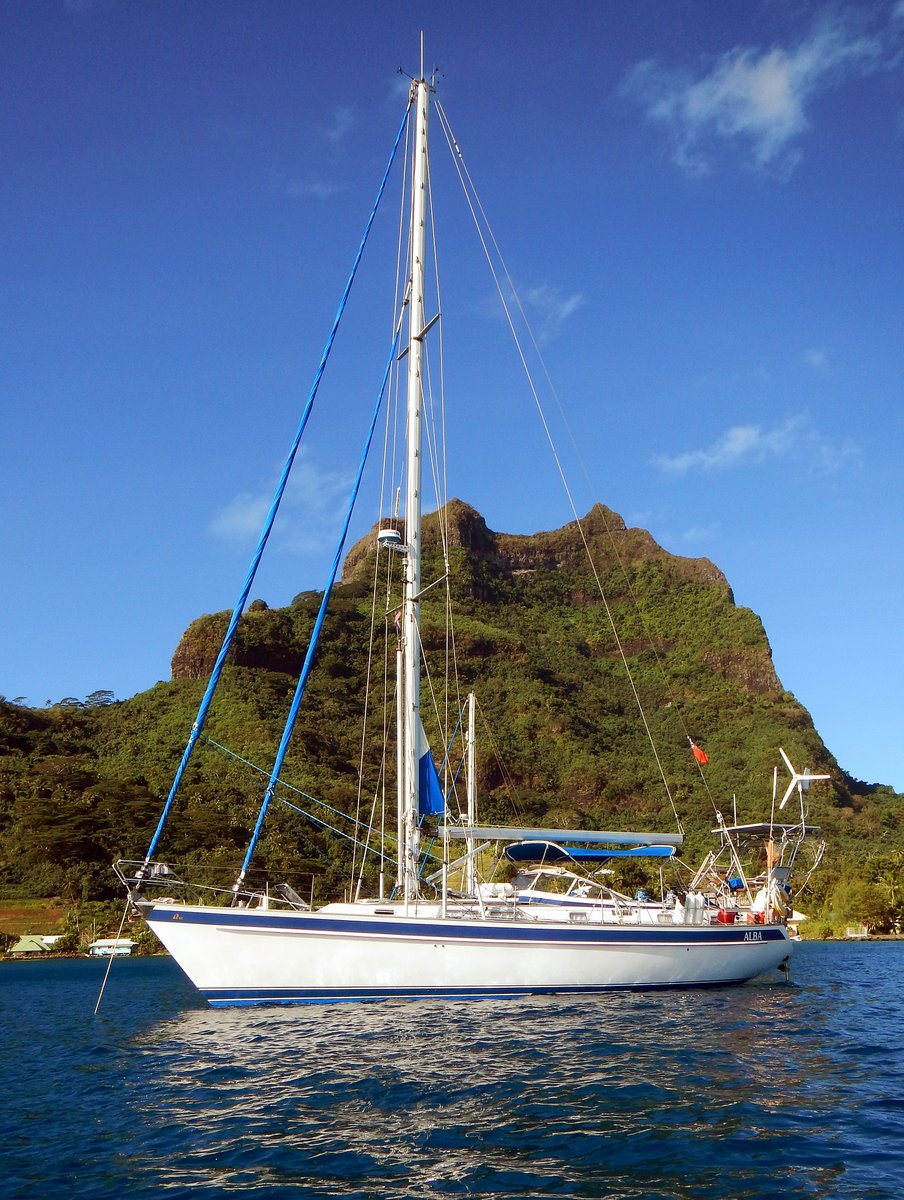
We chilled out in the afternoon and did nothing - we seem to have lost our motivation now that we've arrived at Bora Bora - it’s the end of French Polynesia and we've no plans other than stocking up with food and waiting for a weather window to sail to the Cook Islands.
25 July 2014 Mai Tai Anchorage, Bora Bora
Yesterday, I noticed that we have air leaks around the necks of our dive tanks, so I took off one of the valves and tried to clean up the seal and the surrounding seat. I ran the dive compressor and started to fill up the tank, but it still has an air leak.
I'm not sure what the seal is, so I called in at one of the dive shops to see if they could help me, but they were very offish and said that there was no one on the island who could inspect or repair tanks. I'm just going to leave the tanks partly filled and refill them just before we do our next dive - I'll have to get it sorted out properly in New Zealand.
On a positive note, the food fridge seems to be behaving itself and the pressure is staying steady at 10 psi - fingers crossed that we've only got a very tiny leak.
The latest GRIB files show that we’ll have north winds for a few days and then some very strong south-east winds kick in especially down in the south Cook Islands where there seems to be a wind acceleration zone created by a stationary high south of us. I guess that we’ll keep ourselves occupied over the weekend and see how it develops early next week.
In the afternoon, we hung about on the boat, Glenys pottering about with her shells, while I played with my program to display my fish photos. Now that Glenys is classifying and photographing her shell collection, I'm changing my fish application to be a more general “Collection” application so it can handle her shell collection as well. Here I am in the tropical “paradise” of Bora Bora, sat down below programming - what on earth am I thinking?
26 July 2014 Mai Tai Anchorage, Bora Bora
The anchorage turned rolly as swell came in through the pass in the strong north winds. Also there were big katabatic gusts coming down from the mountain above the anchorage, making it unpleasant. However, we decided to stay to watch a Heiva dance show in the evening.
The GRIB files still show strong 30 knot south east winds in the south Cook Islands and it will possibly cause big seas on our planned passage to the tiny Suwarrow Atoll, so we’re now considering going further north to the remote island of Penrhyn and from there heading to Samoa. We’d be doing an extra 250 miles, but I’d rather have an extra two days sailing in pleasant conditions than a shorter sail in big seas. We had a reasonable internet connection, so I spent two hours finding blogs of people who have already visted Penrhyn and it sounds like a great place.
We had dinner in one of the small, temporary restaurants set up for the Heiva. Tonight's event was the finale and seemed to be more of a cabaret put on for the tourists, who were paying $25 per seat. In typical Polynesian style, one side of the arena was not fenced off, so an hour before the event started, locals were spreading out ground sheets by the side of the arena and setting out their own chairs. We stood at the side behind them and had a great free view of the show.
27 July 2014 Mai Tai Anchorage to Motu Tupe, Bora Bora
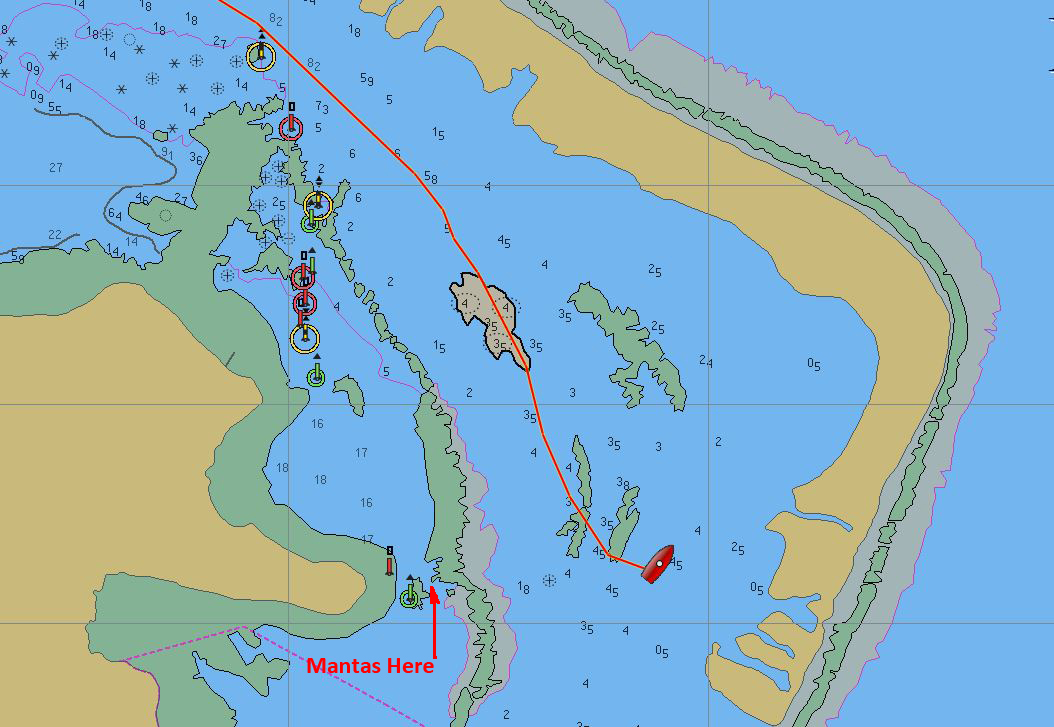
It was a nice day, so we motored around to the east side of the island and anchored off Motu Tupe at 16°29.36S 151°42.11W. The first four miles was easy and in deep water, but the last 3 miles was a little more fraught, being very shallow. There's a south cardinal buoy where the water went from 30 metres to 3.5 metres extremely quickly and we had to do a zigzag around a red buoy to follow the recommended route in the chart.
From there on, we saw depths between 2.9 metres and 5 metres over sand with weed patches. The water is crystal clear making it difficult to judge the depth. To make matters worse the chart is incorrect and showed us going across reefs which don’t exist. We just slowed right down and eventually anchored in 3.5 metres on brilliant white sand near to a large flashy hotel with apartments built over the water.
The main reason for coming over this side of the island is to snorkel with Manta Rays tomorrow morning. So, after lunch, we jumped in the dinghy and went to check out where to go. There's a narrow channel between reefs at 16°29.39S 151°42.66W where we've been told the Mantas come to feed. We didn't see any today, but some people on a tourist boat confirmed the location was correct and that they'd seen one earlier. We had a long snorkel anyway - it’s a nice bit of reef.

28 July 2014 Manta Anchorage to Bloody Mary’s, Bora Bora
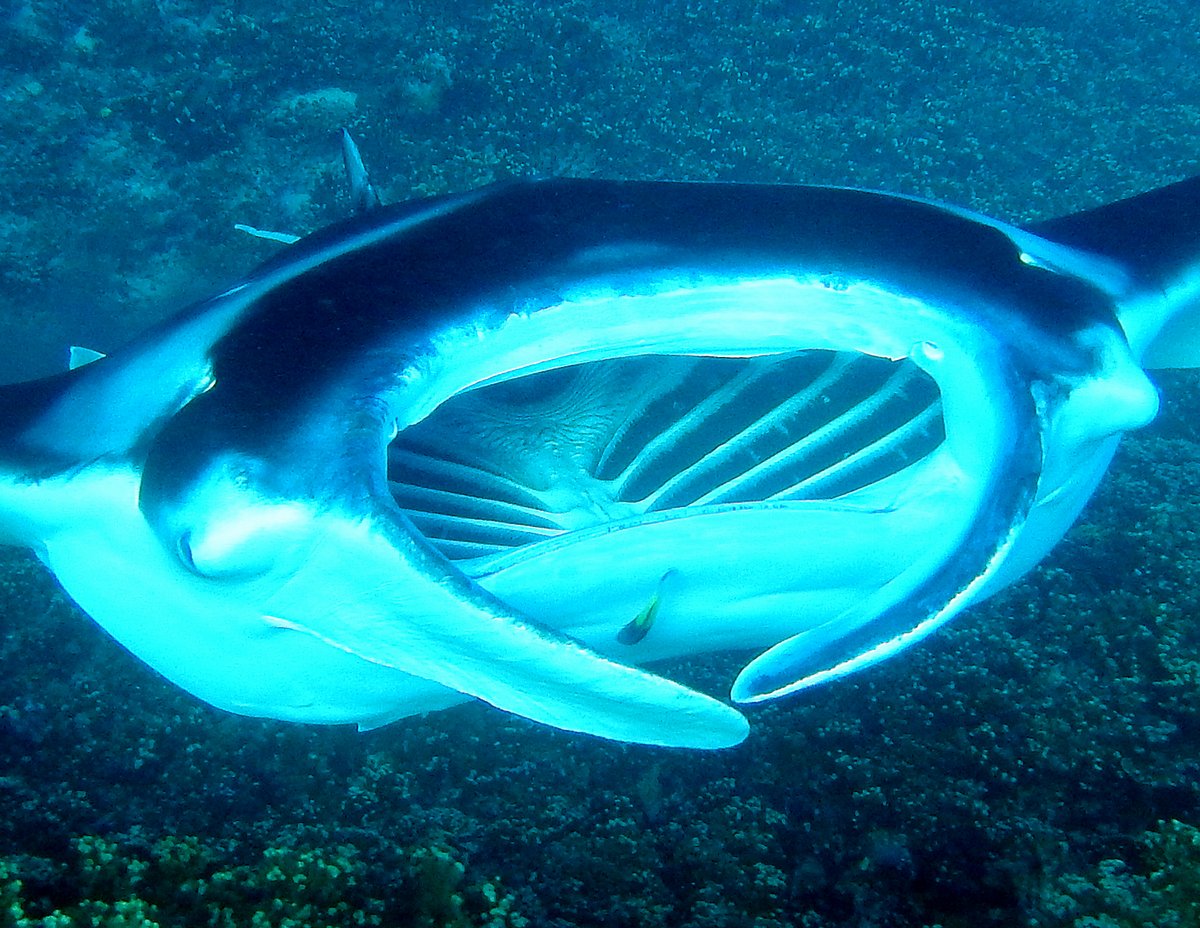
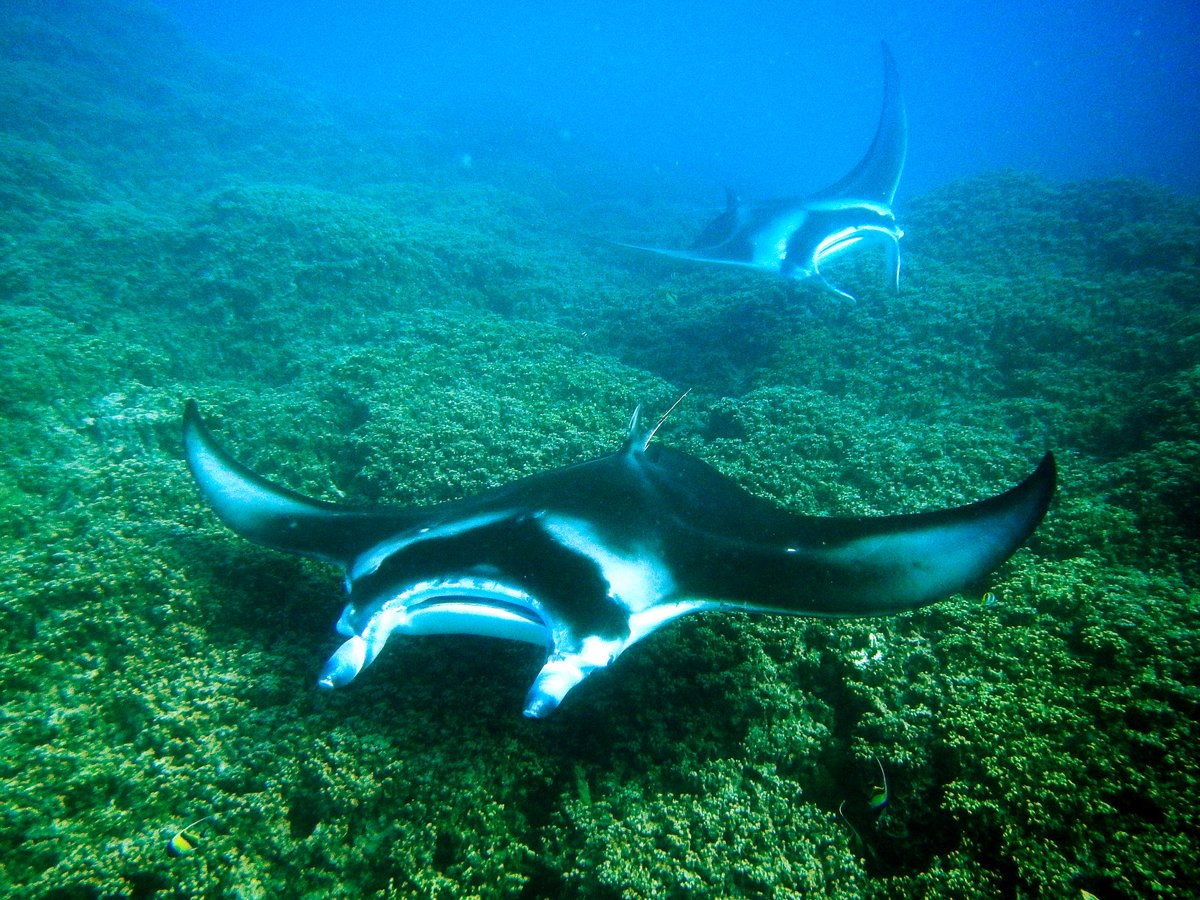
Just before eight o'clock, we went snorkelling with the Manta Rays and it was fabulous. We were there for over an hour and must have had over 30 sightings of these magnificent creatures - at one point, we had five in sight at the same time. With wing spans of 6-9 feet, the huge creatures glide through the narrow channel with slow flaps of their wings.

They have a kind of scoop at each side of their heads, which they use to help funnel plankton into their huge mouths. When this is not being used, it is rolled away and then looks like a pair of horns. Provided you keep a few metres away, they are mostly unconcerned about people and I was able to get some good shots of them close up including a view straight down the mouth of one.
By nine o'clock, the tourist and dive boats had started to arrive, so we called it a day and motored back around to the main town and across to Bloody Marys restaurant for lunch to celebrate our 34th wedding anniversary which was a couple of days ago.
This waterside restaurant used to have 8 moorings, but now there are only two - one seems to have a permanent live-aboard on it and the other mooring is poorly maintained with the spliced loop nearly worn through. Someone has tied a bowline loop in the rope below the splice, which looked okay, so I tied into that - the weather forecast is for settled conditions.
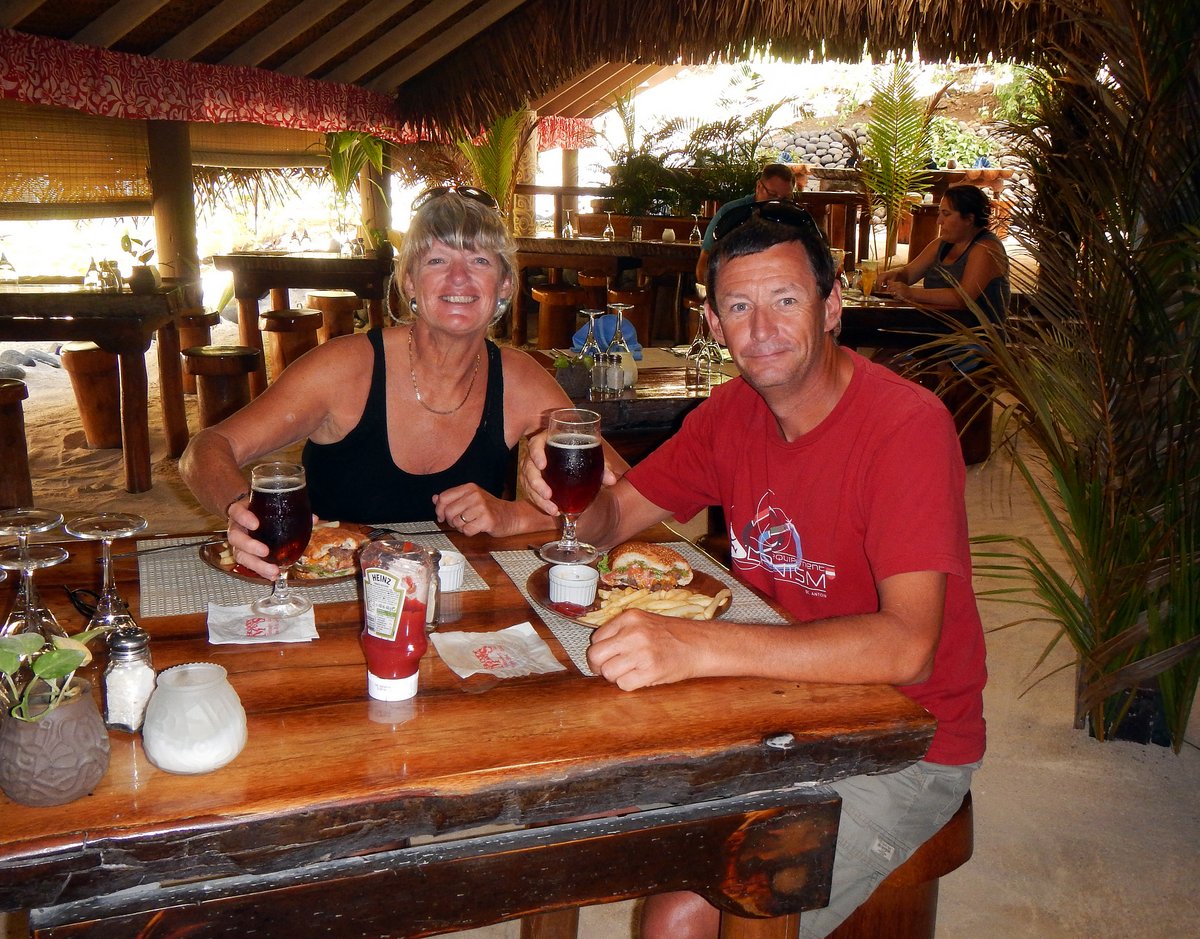
We had a lovely lunch of cheeseburger and chips washed down by a couple of pints of Hinano Amber, which is like an IPA beer. Of course, Glenys just had to finish off with a Bloody Mary. It cost us about $40 for lunch and drinks, which is very good value for French Polynesia.
We chilled out for afternoon, Glenys continued researching Penrhyn and I edited my photos of Manta Rays. I was a bit disappointed because the water was full of plankton and the colours are very muted. I edited them in Photoshop as best I could and some shots have come out okay, but I think that I should have altered the white balance on my camera before taking the photos.
29 July 2014 Bloody Mary’s to Mai Tai Marina, Bora Bora
I had a terrible night. There were big katabatic gusts screaming down from the surrounding hills and I was very worried about the dodgy mooring that we were tied to. If the mooring parted, then we probably wouldn't notice anything until we hit the reef a mile down wind - I wish that we'd anchored.
In the morning, we went back over to the main town and picked up a mooring at the Mai Tai Marina. I downloaded a GRIB file that showed that there's a band of gale force winds with lots of rain (and I guess squalls) arriving here in 3-4 days' time. The furthest north that it gets is 12 degrees south. Penrhyn is at 9 degrees south, so if we leave tomorrow, we should be 200 miles north of the bad weather when it arrives and should have pleasant 15-20 knot trade winds. We decided to go for it, otherwise we'll be trapped here for another week.
It's 590 miles from Bora Bora to Penrhyn, which will take us 4-5 days. Once we get there, we'll probably stay for a couple of weeks before sailing to Western Samoa, which will take 7 days. Penrhyn only has a supply ship visit every 3 months, so we'll probably not be able to buy any food while we're there, meaning that we need enough food and fuel to last a month.
We left our dinghy on the mooring and motored over to the fuel dock, where we were told that they'd run out of diesel, but we'd be able to get some tomorrow - bummer. We scurried back to our mooring and then whizzed into town. I went to the Gendarmerie to clear out, while Glenys nipped to the supermarket to get baguettes for lunch.
The clearance was very simple. I just had to fill in two forms and show him our passports. The officer wanted to see Glenys to confirm her identity, but when I told him that she'd gone to get baguettes, he just shrugged, said it was nearly lunchtime and gave me the clearance anyway. I then had to walk to the post office to mail a copy of the customs form back to Papeete.
After lunch, I dropped Glenys off at the supermarket then went back to the boat to do a few chores. I ran the watermaker and checked the food fridge - it seems to have held the pressure. I've no idea what happened - perhaps we’ve got a microscopic leak that has dumped the refrigerant over the past year, since we had it repaired in Jamaica. While I had the floor boards up, I gave the drinks fridge its two week top-up.
I joined Glenys in the supermarket and helped her get our two trolley loads of food and drink back to the boat. While we were passing the fuel dock, Glenys noticed that they'd removed the covers from the diesel pumps, so I went over and discovered that they now had diesel. So, after loading the shopping aboard, we dropped our mooring and went to the fuel dock, where filled up with duty free fuel.
A busy day, but by five o'clock, we had full tanks of fuel, water and at least a month's supply of food, so we're ready to go.
In the evening, we went over to happy hour and chatted to Al from "Erie II". He's called in at Penrhyn twice in the past year (going to and from Hawaii) and had a great time there. There are only 400 inhabitants on the island and it sounds like they are very friendly, inviting cruisers into their homes, taking them fishing, etc. In return, the cruisers have been giving the islanders goods that they don't have and helping them repair things. We're looking forward to getting there.
30 July 2014 Bora Bora to Penrhyn, Cook Islands (Day 1)
We were up early and I downloaded a GRIB file, which confirmed that we should be okay going to Penrhyn - the nasty strong winds should be staying well south of us. Glenys gave me a shopping list and sent me off to the supermarket to spend the last of our Polynesian Francs. Meanwhile, she started cooking food for the first couple of days at sea because we thought that it might be a bit bouncy and it'll take a couple of days for us to regain our sea legs. When I got back, I lashed the dinghy on the foredeck and made sure we were all shipshape.
We dropped the mooring at 10:30 and motored out through the pass into a very lumpy sea, with a 12 foot swell. The first couple of hours were difficult with variable winds in the lee of the island and we had to gybe the genoa a few times before the wind settled down to a constant direction.
Unfortunately, the wind was directly behind us, so I then had to spend half an hour on the rolling foredeck, rigging up the spinnaker pole and fixing the genoa out to starboard. We put a preventer on the main boom and fixed that out to port, then rolled off downwind. The wind was good with 15-22 knots across the deck, but the sea was horrible with the big 4 metre waves pushing us around.
I went to bed for a couple of hours in the afternoon and when I got up, the wind had backed 20 or 30 degrees, so we gybed the genoa and altered course onto a broad reach. There was no change by nightfall apart from the seas thankfully quieting down a little.
There was no moon, but the clouds cleared away and we had a good night with bright starlight illuminating the sea. It was very rolly and as usual, both of us found it difficult to sleep in between our three hour watches.
31 July 2014 Bora Bora to Penrhyn, Cook Islands (Day 2)
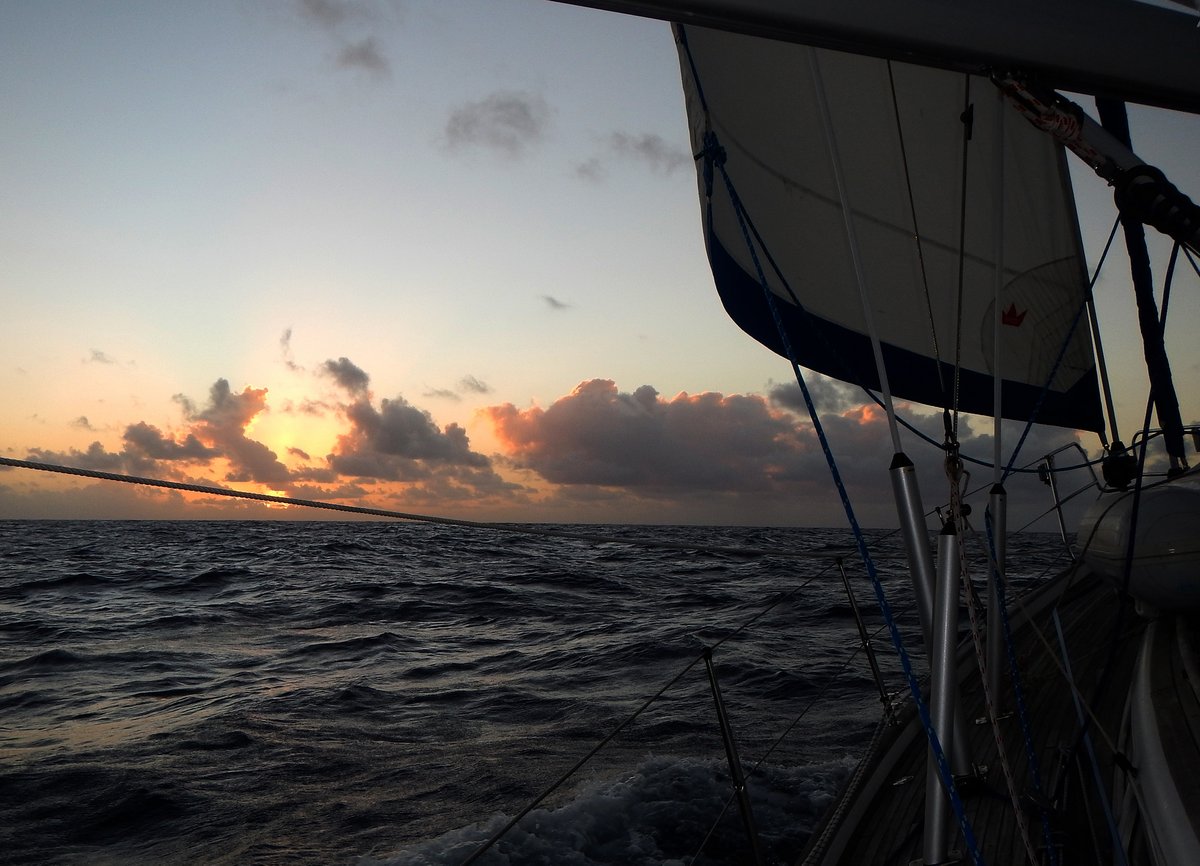
Dawn found us still on a broad reach doing 5-6 knots in 6-9 foot seas with east winds at 15-20 knots. It was sunny with fluffy white clouds - perfect trade wind sailing.
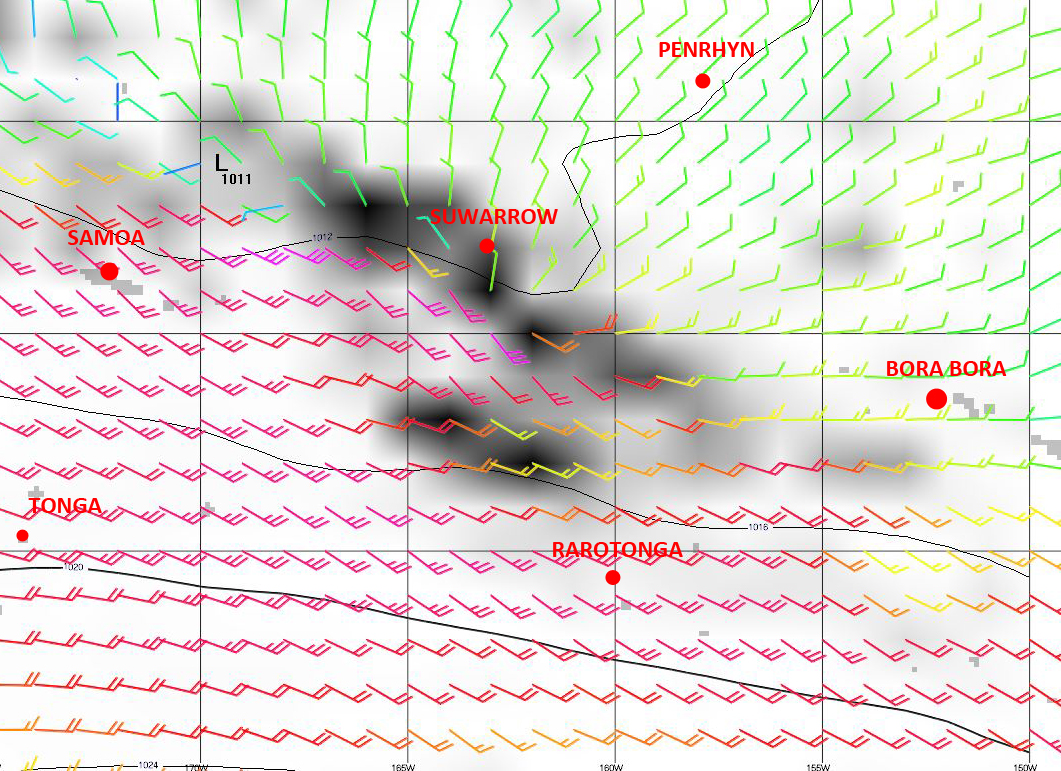
I checked into the Goodbye Isabella net (which is still going) and gave them our position. On this leg of the so called "Milk Run" across the Pacific, there are three main routes through the Cook Islands to Samoa and Tonga, 1200 miles away. Most boats take the south route through Rarotonga or the middle route through Suwarrow Atoll and only a few take the longer northern route through Penryhn. It will be interesting to monitor the weather that each route gets over the next week.
I downloaded a GRIB file and the forecast is still for gale-force winds south of 12 degrees south. There's a big high that has stalled to the south of us and it's creating a compression zone in the easterly trade winds. It also seems to be sucking the South Pacific Convergence Zone down to the southern Cook Islands bringing squalls with heavy rain and wind.
It looks like Rarotonga will have over 30 knots winds from this evening for five days; Suwarrow will have strong squalls in 2 days’ time and, hopefully the worst that we'll get will be a bit of rain and 15 knot north east winds in 3 days’ time when we’re approaching Penrhyn - fingers crossed.
The day continued to be fabulous and the seas dropped a little more, so it was idyllic sailing. We'd had such good weather during the day that I didn't even reef the main, which is our usual practise overnight.
On my 7-10 watch, I heard a bang from the aft deck and found a Red-footed Booby standing there with its wing caught on the Hydrovane adjustment rope. Using a towel to prevent the bird using its vicious looking beak on me, I managed to free its wing. It looked tired, so I decided to let it have a ride for the night - it wasn't going to go hungry because it had regurgitated half a dozen squid onto our deck (nice!)
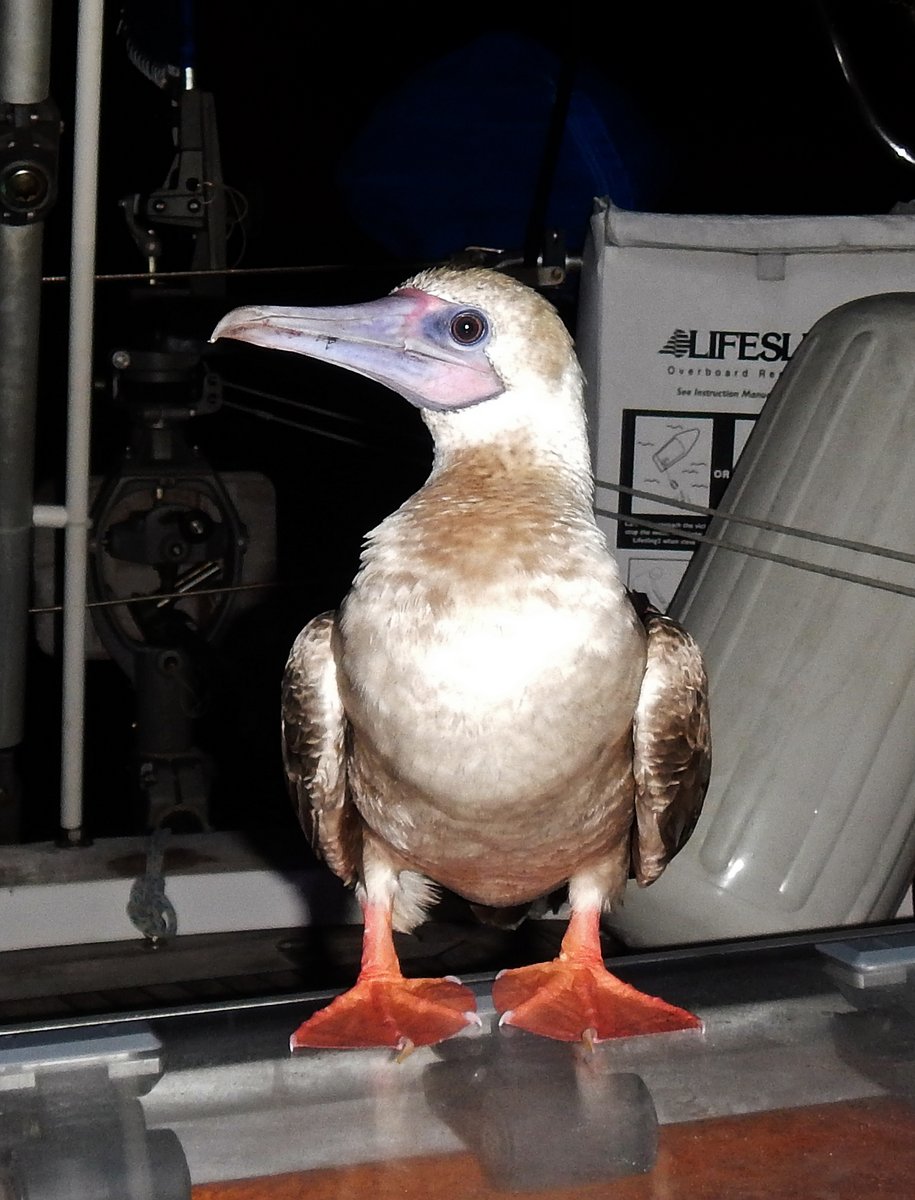
Unfortunately, five minutes later it was stood at the back of the cockpit eyeing up a comfy cushion. Now I like having close encounters with wildlife, but sharing our cockpit with a full sized booby was too much. I tried to shoo it away onto the aft deck, but it kept coming back. I then tried to get it to go forward on to the front deck, but it was not having any of that, so I grabbed it with a towel and tossed it over board. It seemed to get the message and didn't come back.
At 0400, the wind had veered to the south east and I gybed the genoa across so that it was poled out to starboard – I'm glad that I left the spinnaker pole rigged up. Other than that we did nothing at all during the peaceful and star-lit night.