
1 June 2014 South East Anchorage, Kauehi, Tuamotus
It was another lovely morning with a nice 20 knot wind and fluffy white clouds against a blue sky. Unfortunately, Glenys discovered Weevils in a packet of milk powder and had to clear out one of her cupboards inspecting everything for the pesky little devils. Most of the open packets of powdered produce had to be tipped overboard and the cupboard cleaned with a wash of bleach.

More boats have been slowly arriving over the past few days and we now have quite a community of nine boats spread along the anchorage. We arranged to have lunch ashore with “Nuwam” and “Vanupieds”, then Courage from “Lil Explorers” found out and it turned into a major event with all the boats attending. In all there were probably 20 adults and a dozen kids, so it was good fun meeting new people. In the afternoon I went over to “Nuwam” with my guitar and we had a bit of a music session.
2 June 2014 Kauehi to Rotoava, Fakarava, Tuamotus
We were up at the crack of dawn and motored to the pass, which was very calm, so I guess that I got the tides right. There wasn't much wind and it was almost directly behind us, so we had a slow, rolly, 40 mile passage to Fakarava. It took us six hours to get to the north pass, which is very wide and presented no problems. Once inside the atoll, the wind was dead on the nose, so we motored all the way to the town of Rotoava.
There isn't a specific anchorage here; instead boats are spread out along the shore of the motu. We tried a couple of places, but our anchor just dragged. We eventually found a good spot in 11 metres of water opposite the church (at 16°03.74S 145°37.18W). There are lots of coral heads in this area, but I managed to hit a sandy patch.

We've established a routine when we anchor amongst the coral heads. I drop the anchor into the biggest sandy patch that we can find, with a small buoy attached to the anchor, so that we can see where it is. I then let out our normal amount of chain (4-5 times the depth) and slowly reverse the boat to set the anchor. Glenys then backs up hard on the anchor while I keep my foot on the chain to feel if it is dragging or caught on coral.
Once we’re happy that we’re dug in, I pull up the chain and clip two fenders to the chain at 40% and 70% of the length of chain, so with 50 metres out, we have fenders at 20 metres and 35 metres. The fenders are there to suspend the chain above the sea bed and to stop the chain wrapping around coral heads. The size of the fenders depends on the depth of water - if it’s deep then a bigger fender is needed at the 40% position because the fender gets dragged down deeper and collapses with the water pressure.

With the anchor dug in and the fenders in position, I put on my mask and fins and dive down to check that all is well. I first check that the anchor is dug into sand and adjust the length of the rope on the anchor buoy, so that it floats just above the anchor. I then check that the chain is not wrapped around any coral heads. Most of the time, the chain will have caught on something, so I physically lift the chain over the coral and position it so that it is straight. Lastly I check the fenders to make sure that they are lifting the chain above the coral heads - repositioning them if necessary.
This is a lot of faffing about, but so far it had worked well and we haven’t had our chain seriously wrapped around any coral heads. I check the anchor chain every day and reposition it if we've snagged on anything. We don’t usually put a buoy on the anchor, but I find that it really helps here and gives a good indication if the anchor chain is snagged on a coral head.
3 June 2014 Rotoava, Fakarava, Tuamotus
As usual when we get to civilisation, the first thing we did was to go shopping for food and drinks. We weren't sure where to put our dinghy, but a local guy let us use his wooden dock, which is about 300 metres north of the church is on a small beach. It appears that many of the beaches are private.

There are two small stores near the church, both of which had a reasonable selection of things. They’re not very good for fresh vegetables, but have plenty of frozen meat, drinks and canned goods. We stocked up with drinks - orange juice, coke, milk and I was pleased to see that they sold cases of beer in cans.
After lunch, we had a stroll around the village, which is spread out along the main road. The church is pretty, being decorated with shells and wood carvings. We stopped off at a couple of small shops selling Black Pearls and arranged to visit the Hinano Pearl Farm tomorrow.
When we got back to the dinghy, there was a large Nurse Shark hanging around the dock - it’s the first one that we've seen in the Pacific.

4 June 2014 Rotoava, Fakarava, Tuamotus
We went to the Hinano Pearl farm, which was very interesting. The Black Pearls of French Polynesia are world-renowned and the majority of the pearls come from the Tuamotus. The old fashioned method of diving for pearls has been overtaken by pearl farming because of the depletion of natural stocks and the pearls produced by the farms are bigger, rounder and of higher quality.
The process of creating a cultured pearl is called a graft. A small 6mm diameter ball made from shell (called a nucleus) is surgically placed into the gonad of a 2 year old young oyster. At the same time, a small piece of Mantle tissue from another oyster is place alongside the ball. The Mantle is the organ that produces mother of pearl, which in turn builds the oyster's shell.


Eighteen months later, the pearl is removed and, if the pearl is of good quality, then another larger nucleus ball is placed in the oyster. There's a 40% chance of producing a saleable pearl on the first graft and a 70% chance on the second graft, but the quality of the pearl produced after the second time is reduced, so an oyster is normally only used to produce 3 or 4 pearls.

The quality of a pearl is determined by its roundness, size, colour, lustre and lack of flaws. The Tahitian Black-lipped Oyster produces mother of pearl that spreads from pearly white to iridescent rainbow colours ending at the edge of the shell. By selecting the Mantle tissue from oysters that have good iridescence, a skilled grafter can affect the colour of the pearls produced.

If the grafting process is rejected by the oyster, then a small misshapen pearl is usually produced by the inserted mantle tissue. These are called "keshi" and are made from solid mother of pearl. Some pearl farmers leave keshi in place for over five years to allow the oyster to grow them bigger.

We were told that pearl farming is not as profitable as it used to be because the larger farms negotiated a low wholesale selling price with the China (who is a major bulk buyer of pearls) and the whole market is now depressed. Lots of pearl farms have closed down and the Hinano Pearl farm currently only harvests enough pearls to sell locally.
We watched the process of harvesting oysters that are too old to grow another pearl. They are simply opened up, the pearl removed and a small muscle is removed, which is the only edible part of the oyster. The owner’s wife was removing the pearls from the oysters and dumping them rather unceremoniously into an old plastic bottle ready to be sorted.
After our interesting little tour, we went into their pearl shop and Glenys was in heaven. This was to be her belated birthday present and she eventually chose two earrings and a nice single pearl for a pendant. She also bought 14 loose pearls, which we had drilled ready to make into other jewellery and couldn't resist 3 other pearls which were already set into clasps. All in all, we walked out with 20 Polynesian Black Pearls with a variety of quality and only spent a total of $500US.


In the afternoon, we went for a walk along the road heading north towards an old lighthouse. It was a couple of miles and a pleasant walk – nice to stretch our legs.
5 June 2014 Rotoava, Fakarava, Tuamotus
It was my birthday today – no presents of course, but I’m going to be buying myself a nice underwater camera as a belated birthday present because my old one has died. We were intending to sail down to the south of the atoll, but the weather was horrible with grey overcast skies and the occasional shower, so we decided to stay.

Glenys dragged me off to the grocery shops, which had a better stock of vegetables today because the weekly cargo ship arrived this morning. She actually managed to buy some lettuce, tomatoes and a bag of frozen broccoli. We stocked up with baguettes and retired back to the boat to chill out.
I spent most of the afternoon messing about with music and my guitar, working out how to play an old blues song. Glenys chilled out reading. It was a quiet and very relaxing day. The small boulangerie in town didn't have any cakes, so Glenys made me some Banana Bread for my birthday cake.
6 June 2014 Rotoava to South Pass, Fakarava, Tuamotus
We woke up to a stunningly beautiful day with blue skies and light winds - an amazing change from yesterday. After our forced stay yesterday, we were both keen to get moving and upped anchor at eight o'clock. The wind was 6-12 knots in the morning, so we drifted along slowly following the marked channel long the east side of the atoll. We were hard on the wind for the first hour, but the channel soon turned more south and allowed us to fly our asymmetrical spinnaker. It was idyllic sailing.
There are two high pressure areas in the far southern ocean which are due to bring northerly winds in a couple of days’ time. We’re not sure how strong the winds are going to be and how long they are going to last because the forecast keeps changing. The anchorage by the south pass is pretty exposed to northerly winds, so we stopped on the way down to look at a backup anchorage. It looks to be well protected from north-west and even west winds, so if it gets gnarly down in the south pass anchorage then we’ll head back there.
The wind dropped off to less than 5 knots in the afternoon and even with the spinnaker up, we were only doing 2 knots, so we turned on the engine and motored for a couple of hours. We went into an anchorage to the west of the south pass, which is behind a set of reefs and needed some serious eyeball navigation - thank goodness that we had good light conditions. 
We anchored at 16°31.42S 145°28.47W in 7 metres of water amongst the inevitable coral heads, but there are large patches of sand. I picked a spot where there is a shallow reef to the north-west of us, which I hope will give us a little protection when the north winds kicks in. This is a lovely spot with crystal clear water and small motus with sandy beaches and palms trees in the distance. There are seven boats in this huge spread-out anchorage.
7 June 2014 South Pass, Fakarava, Tuamotus
The trough arrived with a vengeance bringing horrible black skies, north winds and squalls with 25-30 knot gusts. The reefs around us gave a some protection, but there were still 2 foot waves hitting our bow.
At around ten o'clock, there was a lull in the squalls and it was around high water, so we tried to cross the reef to get to the south pass, where there is supposed to be excellent snorkelling, especially at high water slack. Unfortunately another huge black squall was rapidly approaching and, in the poor light, we couldn't see a clear path over the very shallow bar, so we turned tail and ran back to the boat, scrambling aboard just before the torrential rain hit us.
The remainder of the morning was punctuated by strong squalls, so we hunkered down and put up with the pitching boat. Later in the afternoon, the skies miraculously cleared, so we jumped in the dinghy again to go snorkelling. The tide was going out, so we had no chance of crossing the reef and went around.
It’s an incredible 2 miles to get around the reef and, as we were approaching the pass, we could see that the tide was still ripping out very strongly. We decided that it would be too dangerous to get into the pass - we didn't like the idea of being swept out into the middle of the Pacific Ocean if the outboard failed, so we turned around and headed for a more sheltered place to snorkel.

We stopped on the north-east tip of the reef, which was quite nice. Not a huge amount of fish or coral, but clear water. Within ten minutes, we had two Black Tip Sharks circling us, which unnerved Glenys, so we called it a day and headed back to the anchorage. The weather had deteriorated again by the time it was going dark.

8 June 2014 South Pass to Kaukuraroa, Fakarava, Tuamotus
It was a miserable night. The wind wasn't particularly strong, but we had 2 foot waves all night, so we were bouncing around and the anchor was snatching making a horrible noise. I was also worried that we might be getting close to some shallow coral heads as we veered around, so I didn't sleep very well at all.
The skies were still grey and grim at dawn. I downloaded a GRIB file and the north winds looked like they would be around for a few more days, so we waited for a gap in the showers and upped anchor. It was a shame that we didn't get to scuba dive or snorkel in the south pass, but the weather was against us.
We motored north along the boat channel and weathered a couple of big squalls with heavy rain and gusts over 25 knots. On the way, “Viandante” passed by heading in the opposite direction - we haven’t seen them since Ecuador. We chatted on the VHF radio and they have to be in Tahiti in a few days’ time, perhaps we’ll catch up with them there.
Another rain shower hit us as we dropped anchor in the Kaukuraroa anchorage at 16°17.07S 145°31.39W in 10 metres of water. It’s in the middle of nowhere, beautifully well protected from the north and flat calm - we like it. We were hoping to be alone here, but “Largh” was already here and “Adina” came in a couple of hours after us.
We invited David & Katrina from “Largh” and Tim and Suzie from “Adina” over for a few beers. David brought his Melodian and Katrina brought her flute, so Glenys dug out her concertina and they played us some Irish folk music.
9 June 2014 Kaukuraroa, Fakarava, Tuamotus
We slept like logs last night - this anchorage is perfect for these north winds. It was a lovely sunny morning, but the weather forecast shows that the trough is still lurking about and we expect to get this unsettled weather for at least another day or two, before the east trade winds kick back in. Our plan is to stay here for another couple of nights and then head back to Rotoava.
Later in the morning, we jumped in the dinghy and went snorkelling off the western side of the reef next to the anchorage. The sea bed drops off fairly steeply, but the coral thins out from about ten metres depth, so it wouldn’t be a good dive. It was a pleasant snorkel though. There are some nice coral heads and some huge groupers around - one of them was a good four feet long and must have weighed over a hundred pounds. We also spotted a small octopus scuttling around on the coral, which we watched for five minutes - I must buy another camera.
To get over Glenys’s fear of the small Blacktip Reef Shark, I gave Glenys our six foot long pole spear, which seemed to give her more confidence. We saw a couple of the small sharks, but she was happy to carry on snorkelling for an hour, knowing that she could poke one if it came too close.
The weather deteriorated in the afternoon, so we chilled out. I had a marathon session on my guitar, playing for four hours. By six o’clock, Glenys had had enough and dug out her MP3 player while making dinner.
10 June 2014 Kaukuraroa, Fakarava, Tuamotus
We had a weather system go through in the small hours of the morning, which gave us strong south winds. This anchorage is unprotected from the south, so by four o’clock in the morning, we had two foot waves crashing onto the coral beach, which was now only 50 metres behind us. We were pitching badly and the anchor was snatching, so I put another snubber rope on the anchor chain and let out a bit more chain.
We didn’t get much sleep after that, but the wind gradually abated and started to veer around to the west, where there’s a reef giving some protection. By eight o’clock in the morning, it was a lovely peaceful anchorage with a light west wind.
I downloaded new NADI and GRIB files, which shows that the trough is slowly moving across us and the winds should be clocking through the north and then the east by the 12th. So, despite our horrible night, we stayed.
It turned into a very nice day; we went for a walk along the rocky shore, looking for shells, then after lunch went for another snorkel on the reef next to the anchorage. In the evening, Trevor and Ruth from “Nakiska” invited us over for sundowners.
11 June 2014 Kaukuraroa to Rotoava, Fakarava, Tuamotus
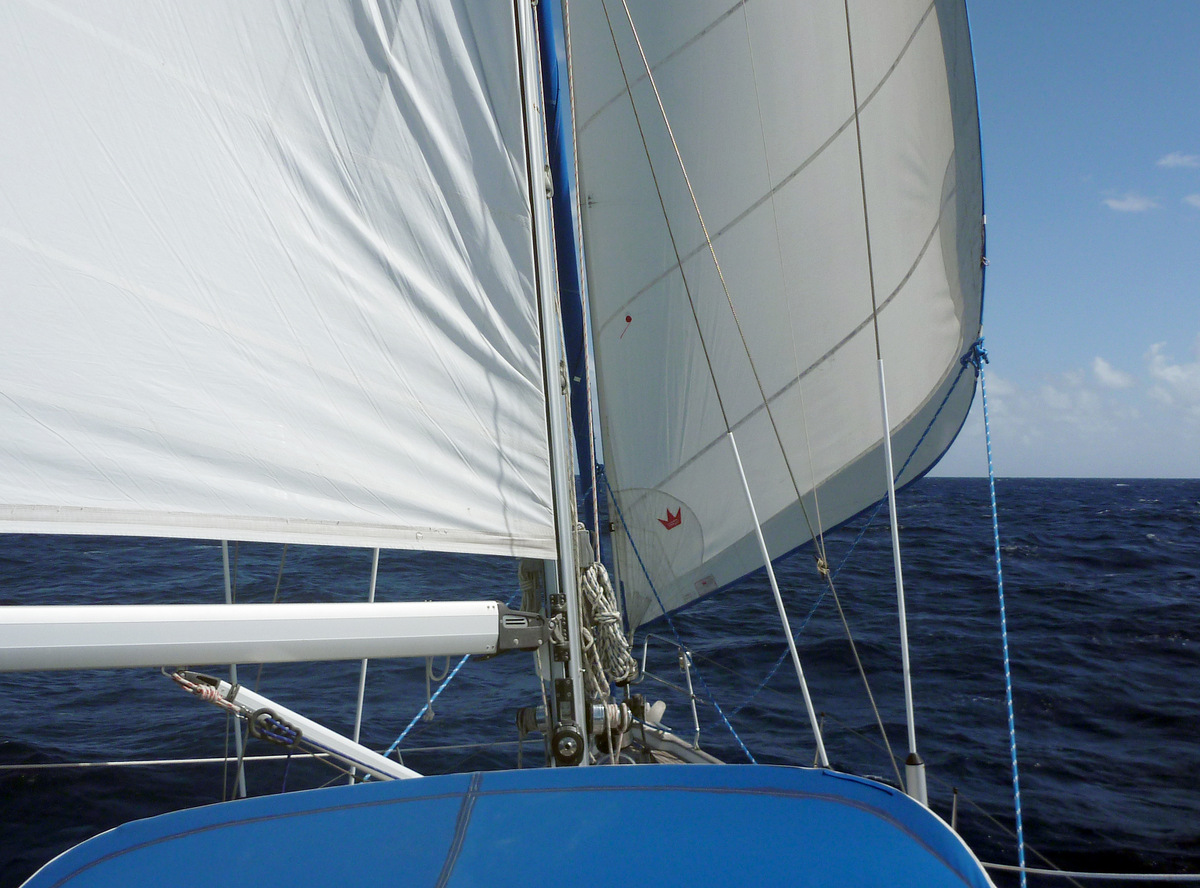
It was another beautiful day - this weather is so hard to predict. We upped anchor after breakfast and had a fabulous sail north up the inside of the atoll. We were hard on the wind for most of the way, but with flat calm seas it’s a pleasure.
We anchored near the church off Rotoava. and, as before, we were in among the coral heads. The water depth was around 13 metres, so it was a bit of a struggle to dive down and have enough time down there to mess around, but I managed to manhandle our 60lb anchor over a four foot coral head and into a small sandy patch. I also had to move our chain around a couple of coral heads, but then the anchor dug in and I was happy.
There are over fifteen boats in the anchorage and more heading up from the south pass. Everyone has been staying put in the horrible north winds that we’ve had, but most people are now getting ready to move. Our next destination at Toau Atoll is a popular one, so we’re going to leave early in the morning and try to beat the rush.
After lunch, we went ashore and stocked up on basic provisions - we should be in Tahiti in just over a week, so there wasn’t too much to lug back to the boat. “Nuwam” and “Vanupieds” arrived late in the afternoon, so we were invited over to “Vanupieds” for a rum punch or three.
12 June 2014 Rotoava to Anse Amyot, Toau, Tuamotus
We were up at the crack of dawn and set off on the 40 mile passage to Toau. There was still a 3 knot tide going out of the Fakarava pass and, despite the wind being with the current, there were some very large overfalls in the middle of the ¾ mile wide channel. The breaking waves were on the outside of the channel, presumably caused by the massive volume of water rushing out and hitting the static water outside.

We sneaked around the eastern side of the pass staying well within the 10 metre contour. I figured that the current would be weaker and the waves would be smaller on the windward side of the pass. The strategy worked because we only hit the waves for 50 metres or so and they were relatively small.
We watched another yacht coming into the atoll, which went straight through the middle of the pass. They were motoring against the current and hitting big waves, making little progress. We watched them struggle for 10-15 minutes with their mast whipping 40 degrees from side to side and pitching very badly - it looked horrible.
It was another lovely, trade-wind day with blue skies and fluffy white clouds. The wind was a little on the blustery side at 20-25 knots, but we were going downwind and we had a cracking sail down the windward side of the atoll.
The main anchorage on Toau has nine moorings and we’ve heard that anchoring is limited and challenging, so we were keen to get there before the crowd. There’s a classic comedy sketch by Ben Elton called “Gotta Get a Double Seat” in which he talks about standing in a bus queue and then pushing past people to get on the bus, anxious to grab a double seat all to himself. Well, our mantra for the day was “Gotta Get a Mooring”.
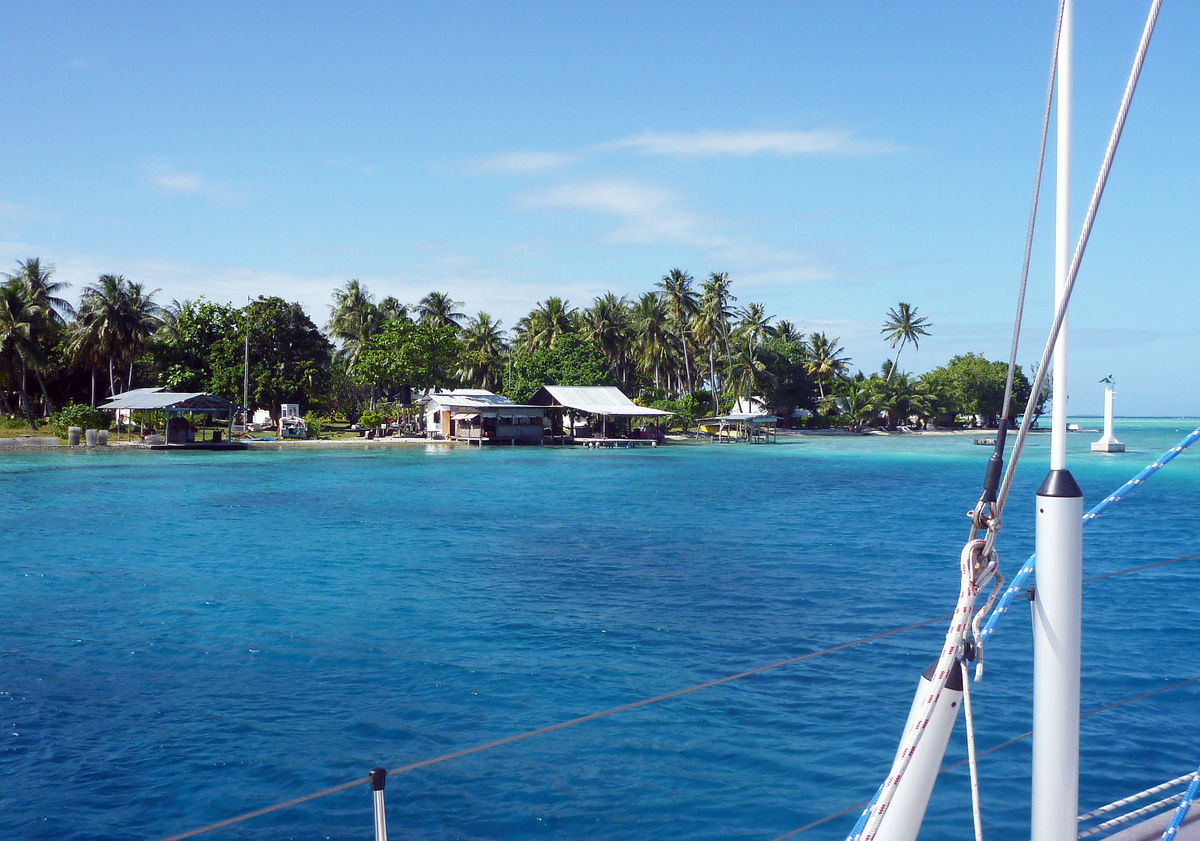
We arrived at Anse Amyot at around one o’clock and thankfully there were five moorings still available. It’s a lovely anchorage in a small bay inset into the atoll’s fringing reef - it’s not possible to get into the atoll through this bay because there is a very shallow reef blocking the way. The colours of the water are stunning in the bright sunshine and there are the ever-present coconut palms on the white sand shore.
There is only one couple living on this remote motu - Valentine and Gaston, who have installed the moorings and do evening meals for cruisers occasionally. After lunch, we went ashore and chatted to Valentine - her husband, Gaston had gone to Fakarava for the day. The moorings cost $7 per night and we would get three nights free if we eat ashore. However, tomorrow is her wedding anniversary, so she’s not sure when she’ll being doing a dinner.
We went snorkelling on the reef at the east side of the anchorage which is very good. We saw half a dozen large Blacktip Reef Sharks in the deeper water under our mooring as well as a couple of Spotted Eagle Rays cruising along the sandy sea bed. There were also shoals of Unicornfish which have a weird spike sticking an inch or so out of the front of their heads.
During the afternoon, other cruisers arrived and by the end of the day, there was only one mooring available - we’re glad that we had an early start.
13 June 2014 Anse Amyot, Toau, Tuamotus
First thing in the morning, there was a horrible squall with heavy rain, but then it brightened up and we went scuba diving on the wall that runs for a mile in either direction outside the anchorage. We went in company with “Field Trip” and “Adina”, mostly for the security of having someone nearby if our outboard failed - it’s a long way to drift to Tahiti.
We motored through the 4 foot swell to 15°47.53S 146°08.81W and dropped the anchor in 8 metres of water on the narrow shelf next to the wall. (There is supposed to be a dive mooring at 15°47.46S 146°08.69W, but we couldn’t find it.) There was very little current, so we dropped down the 60° wall to 25 metres and then headed east. The water was very clear and we saw lots of fish and hard coral, but unlike in the Caribbean, there are hardly any soft coral or sponges - I must find out why.
We chilled out in the afternoon, re-filling the dive tanks and topping up our water tanks. “Nuwam” and a couple of other boats arrived in the afternoon and the anchorage is now very full.
14 June 2014 Anse Amyot, Toau, Tuamotus
In the morning, we went for a dive with Robert from “Nuwam”. We took our dinghies to 15°48.8S 146°10.08W and dropped the anchor close to some grottos on the top of the reef.
Before exploring the grottos, we dropped down the reef wall to 20 metres and headed east, but it was very similar to the dive that we did yesterday. The top of the reef was much more interesting with lots more small reef fish. We found some big Humphead Wrasses in the grottos and a large Whitetip Reef Shark was swimming around in a cave in one of them.
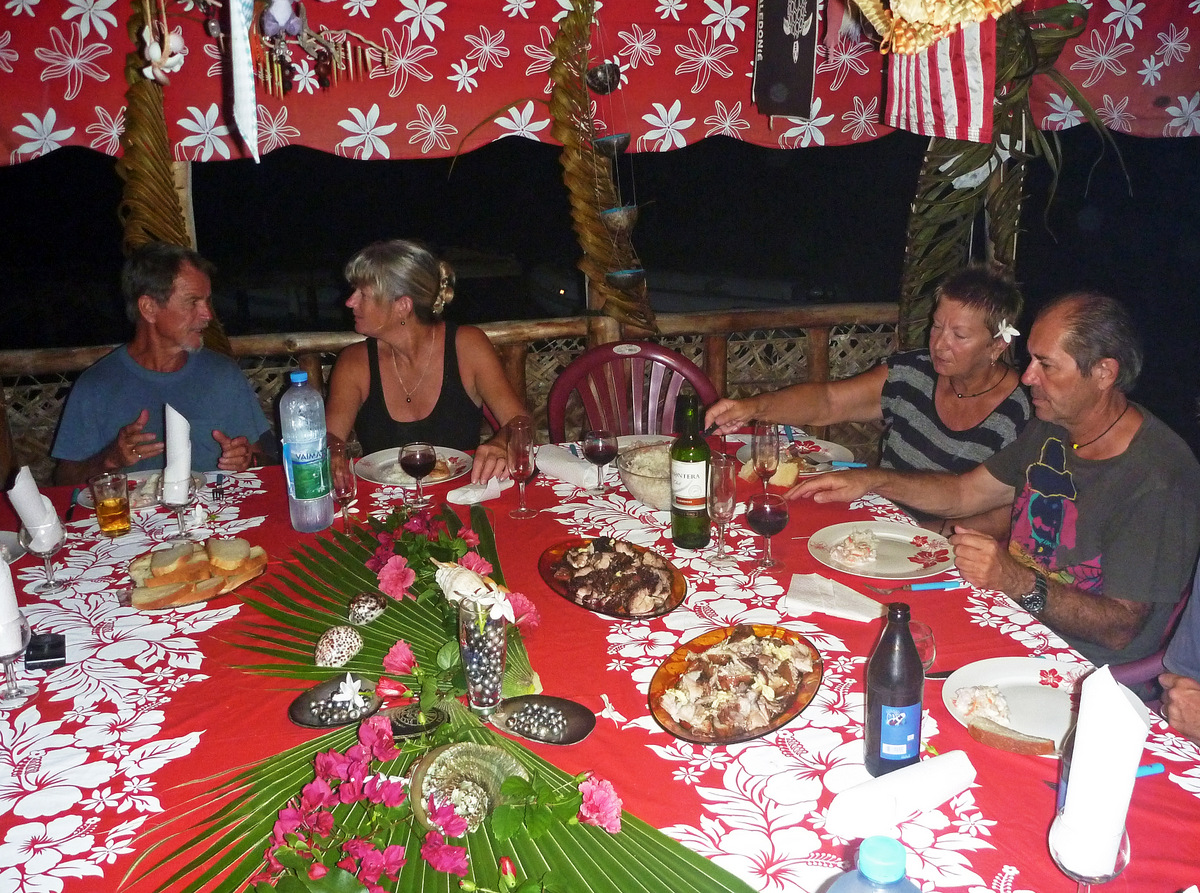
We chilled out in the afternoon and went ashore for an evening meal prepared by Valentine and Gaston. There was quite a crowd of us with fourteen people from “Nuwam”, “Full Circle”, “Natisca”, “Adina” and “Andiamo”. Valentine and Gaston prepared a lovely meal of Poisson Cru, suckling pig and barbequed chicken. Given the rough and ready appearance of their buildings, I was very surprised how nicely they had set up a dining table with a beautiful decoration in the middle made from palm leaves, flowers and bowls of loose Black Pearls.
15 June 2014 Anse Amyot, Toau, Tuamotus
In the morning, the water in the anchorage was cloudy due to the tide flowing out of the atoll bringing sediment with it, so we jumped in the dinghy and motored to the outside reef. We only had to go ¼ mile to be back in clear water.
We snorkelled for an hour, at depths from 3 metres to ten metres and saw lots of reef fish, including more large Snappers and Humphead Wrasses. I really miss having an underwater camera - there are endless photo opportunities in this clear water, but I’m just going to have to wait until we get to US Samoa in August - only 60 days and counting.
After lunch, we went snorkelling in the reef on the south-west side of the anchorage which was very good. It’s amazing how many sharks there are out here - every time we get into the water, we see at least one. We saw four or five Blacktip Reef Shark swimming around the boat this morning; on the outside reef at least ten sharks including some Whitetip Reef Sharks and this afternoon there were two very large Grey Reef Sharks swimming around the deeper part of the reef. One looked so fat that we think that it was pregnant (or had just eaten someone). They seemed very interested in us so we moved away to shallower water.
16 June 2014 Anse Amyot, Toau, Tuamotus
We love it here in this anchorage, but it getting time to move on to Tahiti. I downloaded a GRIB file this morning and there looks to be another trough around the area in the middle of the week, so we’re planning to stay for a few more days and leave on the 18th or 19th. It’s an awkward distance of 220 miles, which will take us between 36 to 44 hours, so we’ll probably leave late afternoon and spend two nights at sea.
After breakfast, we went for walk on the island. Initially, we walked along the leeward side hoping to find some sandy beaches, but the shore is lined with mangroves and other shrubs, so the going was difficult. We had three dogs come with us who led the way for a while until they decided to abandon us and go fishing, leaving us a bit lost in the thick undergrowth. We found our way back to the coconut groves and made our way across to the windward side looking for shells.
Glenys noticed some strange Sea Cucumber creatures in a rock pool, which appear to anchored in holes in the rock, but then extend themselves like snakes, with their mouths sifting through the sand. We saw two different species.
After lunch, we went snorkelling on the south-west side of the anchorage again. I’m getting so desperate to take underwater photographs that I took our small Panasonic “tough” camera. It’s supposed to be waterproof down to 5 metres, but I’ve not used it in the water for a couple of years, so I was nervous that it might not be waterproof anymore and we’d lose our only camera. However, it seemed to survive and, in shallow water and bright sunshine, the photographs that it takes are okay.
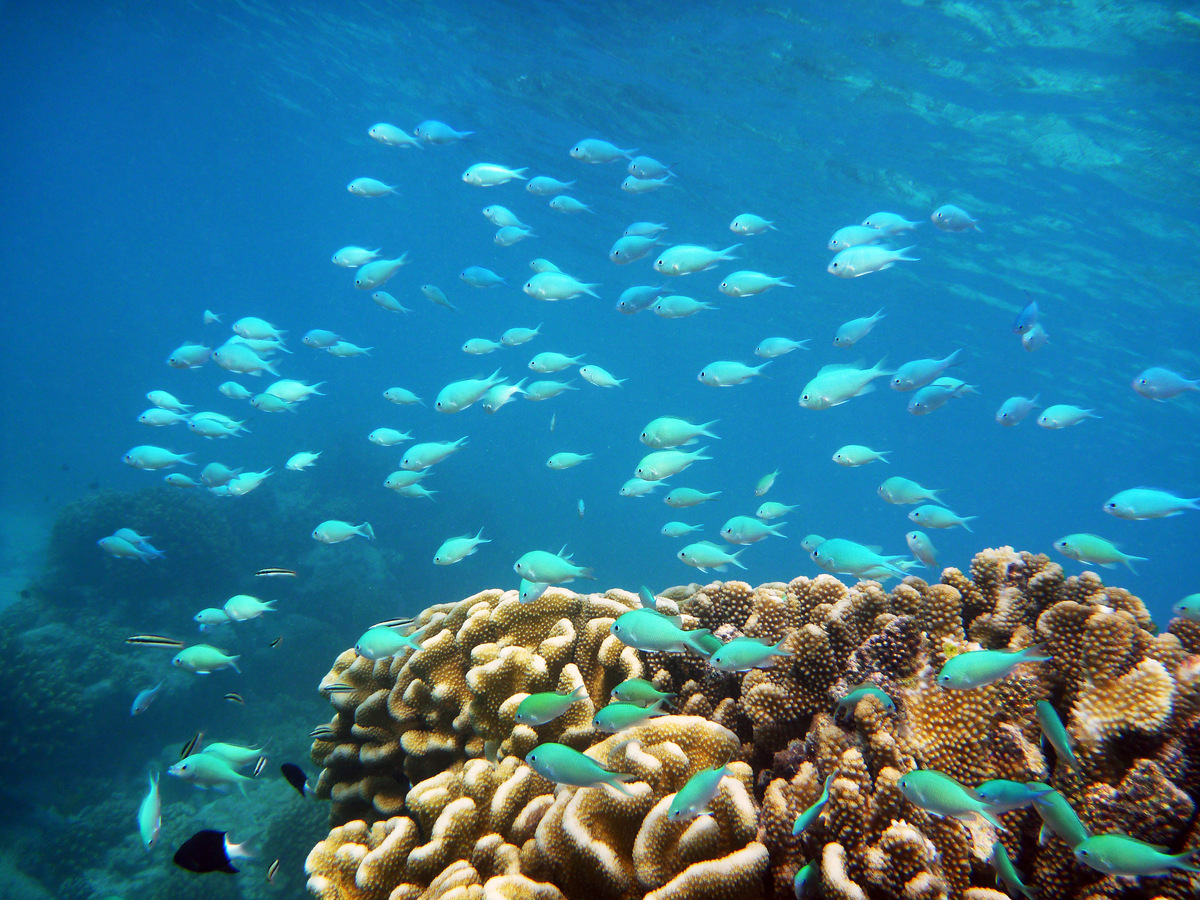
There are lots of varieties of colourful Butterflyfish here, but without photographs, I’ve been unable to identify them because the differences are rather subtle. I've now been able to identify quite a few including the lovely Ornate and Recticulated Butterflyfish.
“Lil Explorers” arrived in the afternoon and had caught a King Mackerel on the way in. They kindly gave us a couple of huge chunks, so Glenys made us a Thai Fish Curry for dinner.
17 June 2014 Anse Amyot, Toau, Tuamotus
Glenys went raving mad and spent all morning baking because she was tired of having lots of bits of food hanging around in her fridge and wanted to make some things to eat during our two night passage to Tahiti. She made Empanadillas from some left over fish, a loaf of bread, Cinnamon Rolls, a Quiche, Oven Baked Vegetables and even a Pizza for tonight.
After lunch, we went snorkelling again and I spotted a Network Pipefish, which is a tiny, thin fish like a straightened-out seahorse. It was incredibly well camouflaged and only 10 cm long.
“Lil Explorers” gave us a Coconut Crab that they had been given by a family on a motu at the other end of this atoll. These are very strange creatures, like a kind of land-based lobster, which live in underground burrows and come out at night to eat coconuts. They use their powerful front claws to rip open the coconut and get at the meat.

I went ashore to ask Valentine how to cook it and she offered to cook it for us, so we went ashore just before dark. Gaston boiled it for fifteen minutes until it turned red like a lobster. After letting it cool for a while, Gaston dissected it and showed us which parts to eat. The legs and claw hold most of the meat and it tastes fabulous - like very tender crab infused with the flavour of coconut.
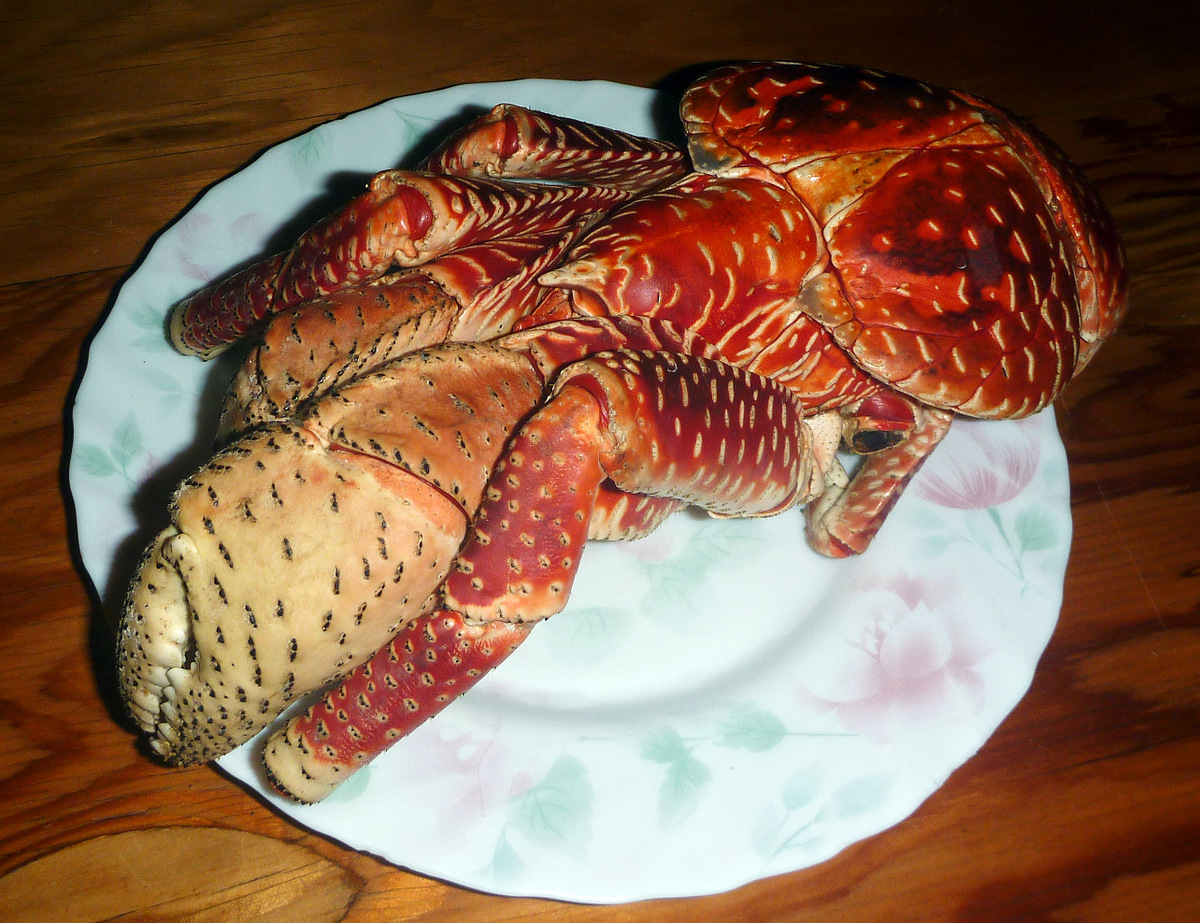
The tail is weird. Gaston showed us how to remove a small patch from the tail and then pulled out the intestines. The remaining “gloop” is an unpleasant brown colour and is considered a delicacy on bread -they call it Foie Gras. We didn't like it very much - it’s very oily and bitter and definitely an acquired taste.


18 June 2014 Anse Amyot, Toau, Tuamotus
It was a miserable overcast morning with heavy showers. The GRIB file showed light winds today, picking up to 15 knots from the south east overnight. After that the winds should pick up to 20 knots which will be ideal for our two night trip to Tahiti, so we decided to stay another day and leave tomorrow.
Motivated by being able to take underwater photos again, I worked on a set of web pages to display my underwater photographs on our web site. It’s a little bit clunky at the moment, but I’ll be able to refine it over the following months - it gives me something to exercise my atrophying brain.
In the evening, we went ashore for another meal - Valentine gave us a big discount because it was our second time and she wanted to fill seats because she only had six other people attending. They served up Poisson Cru, a chicken curry and barbecued lobster, which Gaston had collected by wading on the outer reef shallows at three o'clock in the morning.
it onto the davits. Unfortunately, as I was getting the foot pump, the hose end that fits into the valve snagged on something and pinged into the water. I immediately jumped into the water to try to find it, but couldn't see it. Glenys threw me a dive mask and then I saw the ominous, ghostly shapes of half a dozen sharks circling below me, attracted by the bright light and my “interesting” silhouette - I flowed out of the water into the dinghy at high speed.
19 June 2014 Anse Amyot to Papeete, Tahiti (Day 1)
It was a beautiful morning with clear blue skies, so we got on with a few jobs getting ready to leave in the afternoon for Tahiti. Glenys made a fish stew to eat on the passage, while I ran the water-maker and recharged the drinks fridge which was gurgling and due its bi-monthly fix of refrigerant.
I checked the bilges and had to pump out a couple of gallons of water. I thought that the leak was coming from a sea cock in the engine compartment, but after further investigation found that we had a leak in a fresh water filter above the sea cocks. We don't use this filter and I've had problems with it before, so I disconnected the pipes and simply re-joined them with a plastic connector. Hopefully that will sort out the problem.
Back at the boat, I put on our rear spotlight and stepped into the dinghy to pump it up and lift
All the other boats in the anchorage departed later in the morning, leaving us in splendid isolation. We went for a snorkel at the edge of the anchorage, which once again was lovely. For a change, we didn't see any sharks while snorkelling, but as I checked the bottom of the boat, I found over twenty Remoras and hundreds of reef fish under our hull, with ten or so Blacktip Reef Sharks circling the shoal - with no other boats in the anchorage, they'd obviously gathered under Alba.
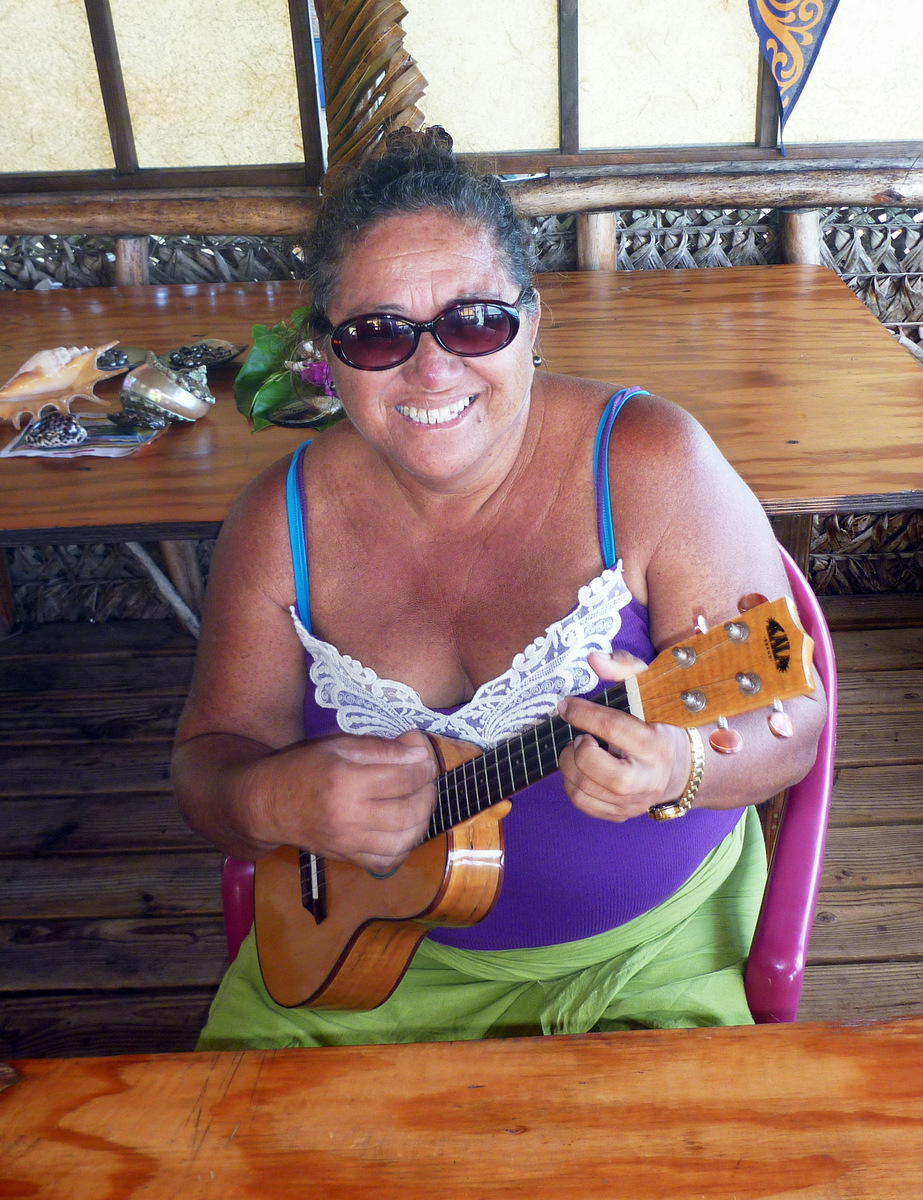
After lunch, we went into say goodbye to Valentine. Glenys gave her a bag of coffee that we bought in Costa Rica and Valentine gave us both a black pearl, which was a nice surprise. While chatting to her, I noticed a ukulele and found out that Valentine plays - we wish we'd known before because we could have brought our instruments ashore and had a session, oh well.
Back on the boat, we put the dinghy on deck and tidied up, ready to leave before dark. I hate leaving port late in the afternoon - all the hanging around makes me nervous and we never have time to settle down to sailing before dark.
By four o'clock, there was a huge bank of dark clouds approaching, so we dropped the mooring and scurried out to sea before the rain arrived, which it did fifteen minutes later, giving us over 25 knots of wind. The huge squall passed over us by the time the sun set at half past five, but the seas were very lumpy giving us a horrible motion and making me feel queasy after a week in a sheltered anchorage.
The first half of the night was horrible - pitch black, with a constant stream of squalls. Each squall gave us winds as low as 10 knots and as high as 30 knots and constantly changing directions, so it was very uncomfortable, especially when the rain came.
To make matters worse, the autopilot was playing up and twice changed course over 90 degrees, causing us to luff up into wind the first time and to have a crash gybe the second time. Fortunately, we had a preventer on the main and our boom brake to stop any damage. I'll have to buy a new flux-gate compass in Tahiti.
After the second time the autopilot freaked out, I turned it off and set up our Hydrovane which struggled in the very variable conditions, but it was much better than worrying about another crash gybe. At our watch change at one o'clock, we had a cracker of a squall, which gave us winds over 30 knots and torrential rain. Despite having our rain screens zipped to the bimini, I got drenched while I stood at the wheel, helping the Hydrovane through the worst of it for fifteen minutes - I was not a happy bunny.
Once the big squall had gone through, the wind settled down to 20-25 knots from the south east and the remainder of the night was pleasant (in comparison).
20 June 2014 Anse Amyot to Papeete, Tahiti (Day 2)
The morning brought brighter skies with intermittent cloud bands, which varied the winds, but not as much as yesterday. I had a three hour sleep in the morning dragging myself out of bed just in time to have lunch. Glenys had a couple of hours’ kip in the afternoon.
By early afternoon, a blanket of grey cloud had crept across the sky, bringing with it the occasional shower and strong 25 knot winds. The wind direction stayed pretty consistent for most of the day putting us on a beam reach, which was rolly in the 8-10 foot seas and not very restful.
As we ate dinner at five o'clock, the sky brightened to the south and east of us and a line of clear skies approached from the south-east. We even got a glimpse of the two highest peaks of Tahiti, which were now only 55 miles away.
The wind dropped to 10-15 knots overnight and the skies remained clear, so we had a lovely night sail sliding along at 4-5 knots in rapidly calming seas.
21 June 2014 Anse Amyot to Papeete, Tahiti (Day 3)
By dawn, we were still ten miles away from the port entrance, so we left the sails reduced and slowly sailed along the fringing reef watching the sun rise over the mountainous island of Tahiti and gazing at the impressive silhouette of Moorea only fifteen miles away. We arrived at the channel into Papeete at 0700, which was perfect timing.
We called up the port captain and he gave us clearance to enter the channel, but as we approached, I saw a fast catamaran ferry approaching from Moorea and decided to let them in first, turning the boat 360 degrees to show them our intent. I'm glad that we did because they went screaming into the narrow channel at over 30 knots.
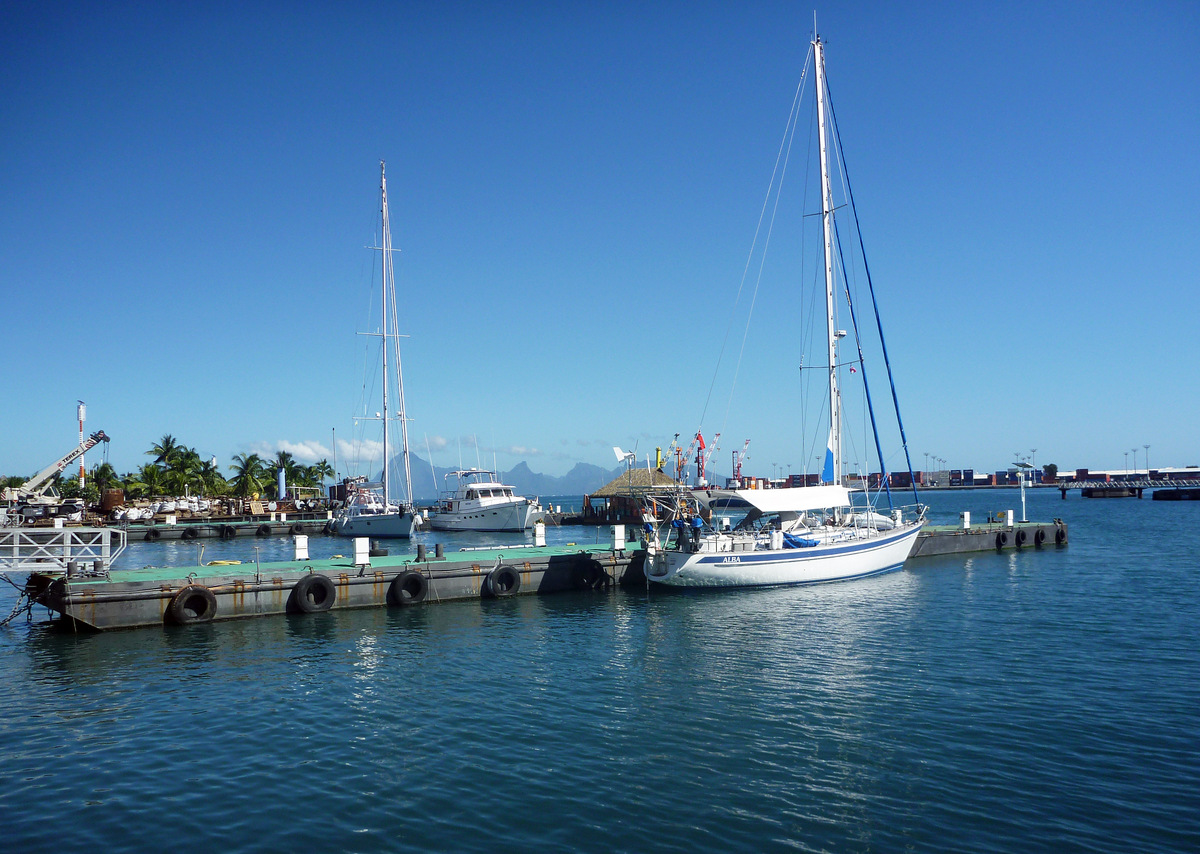
Dodging the numerous outrigger canoes paddling across the sheltered port waters, we motored to the town dock, where we found only one other cruising boat on the floating pontoon. We were expecting to find the dock very busy, but the other boat said that they’d been there for three days and hadn't seen anyone else.
There’s building work being done on the waterfront and there have been some minor thefts from boats, which seems to have scared other cruisers off. To us this was a great bonus as there was plenty of room for us to moor side-to the dock instead of having to mess around with a med-moor.
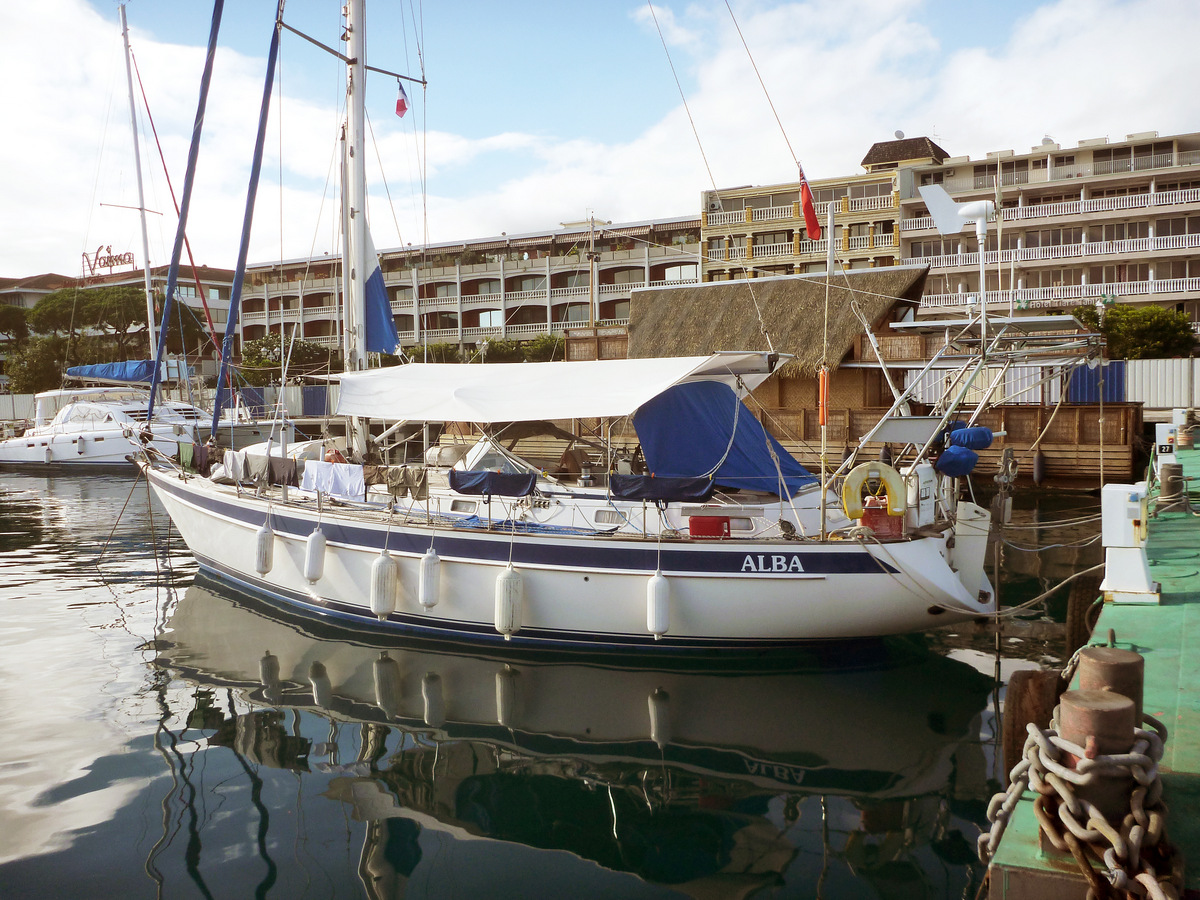
The Town Quay. is right in the centre of the town close to a big supermarket and the central market as well as numerous other shops and parks. There’s an industrial area about ½ mile away, which has hardware store and chandlers - our credit cards are going to take some serious damage.
We wandered along the pleasant sea front to the Dockmaster, but his office was closed because it’s a weekend, so we walked to the Central Market, which has a fruit and vegetable market on the ground floor and an artisan market on the first floor. Continuing our reconnoitre, we trudged out to the industrial area and found out where the hardware store and chandlers are located - everywhere closes from midday on Saturday until Monday, so we bought a baguette and headed back to boat for lunch then a siesta.
Later on in the afternoon, we walked towards the supermarket and spotted a very exclusive pearl jewellery shop called Robert Wan, which has an excellent little museum. It’s free to get in and the exhibits show the history of pearls from early free diving to modern pearl farming techniques. They obviously want you to buy some of their fabulous jewellery, but the prices are outrageous - tens of thousands of dollars is an average price tag.
The supermarket was a sensory overload being the biggest and best stocked supermarket that we've seen since Ecuador. We said that we wouldn't go mad buying food, but then I saw a lamb shoulder and just had to buy it. This just had to be accompanied by a bottle of wine or three…
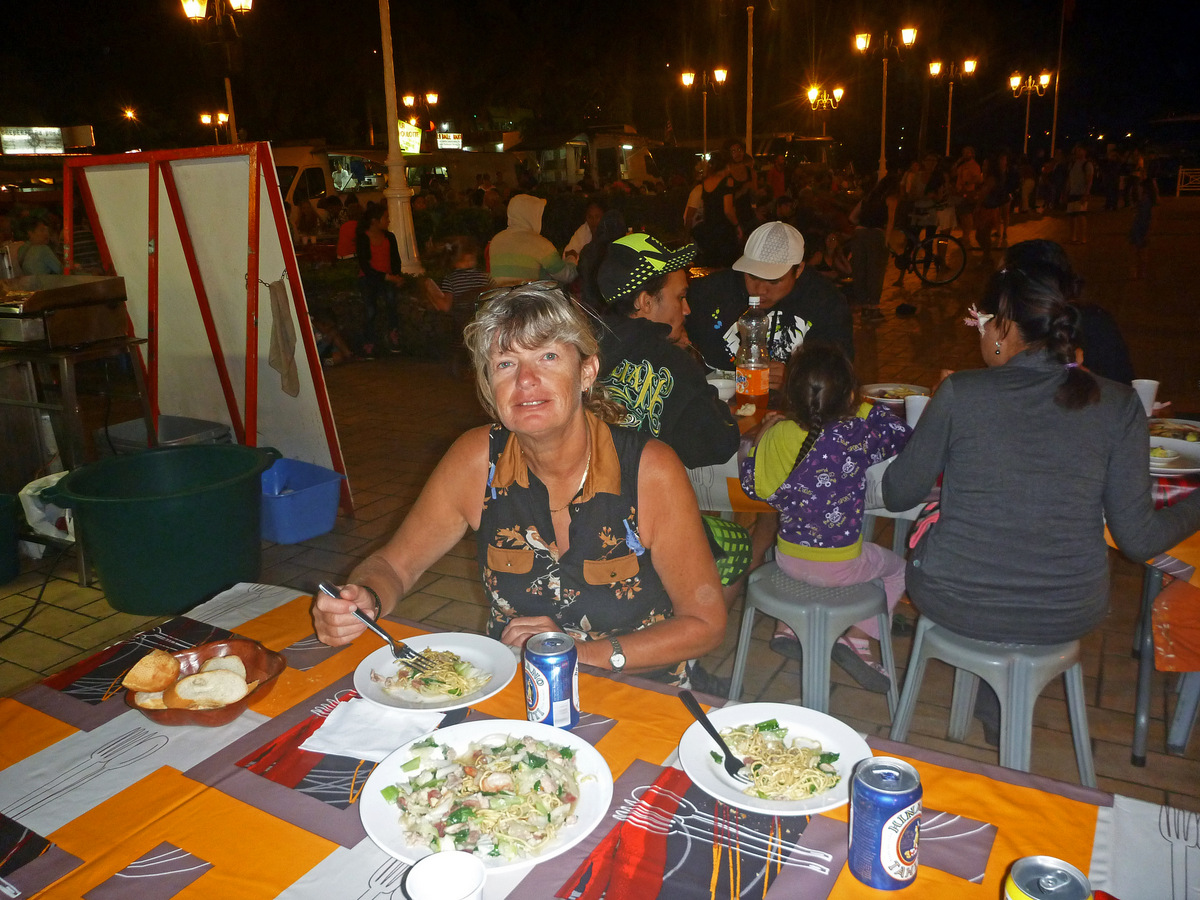
In the evening, we strolled along the waterfront to an area where mobile food trucks called Roulettes are set up every night. This is a big operation, with twenty or so Roulettes each having tables and chairs set out for 50 or so people. After wandering around for a while, taking in the happy atmosphere and watching some of the ukulele bands playing, we shared a huge, tasty Chow Mein for only 15 dollars.
22 June 2014 Papeete, Tahiti
We've got a really good internet connection from a hotel across the road, so we were able to talk to our son, Brett on Skype for an hour - first time for about three months. Glenys took advantage of the free water on the dock to do some washing. She was hoping to dump it all into a laundry, but they charge an outrageous $20 per load and we’re not paying $100 to get our laundry done.
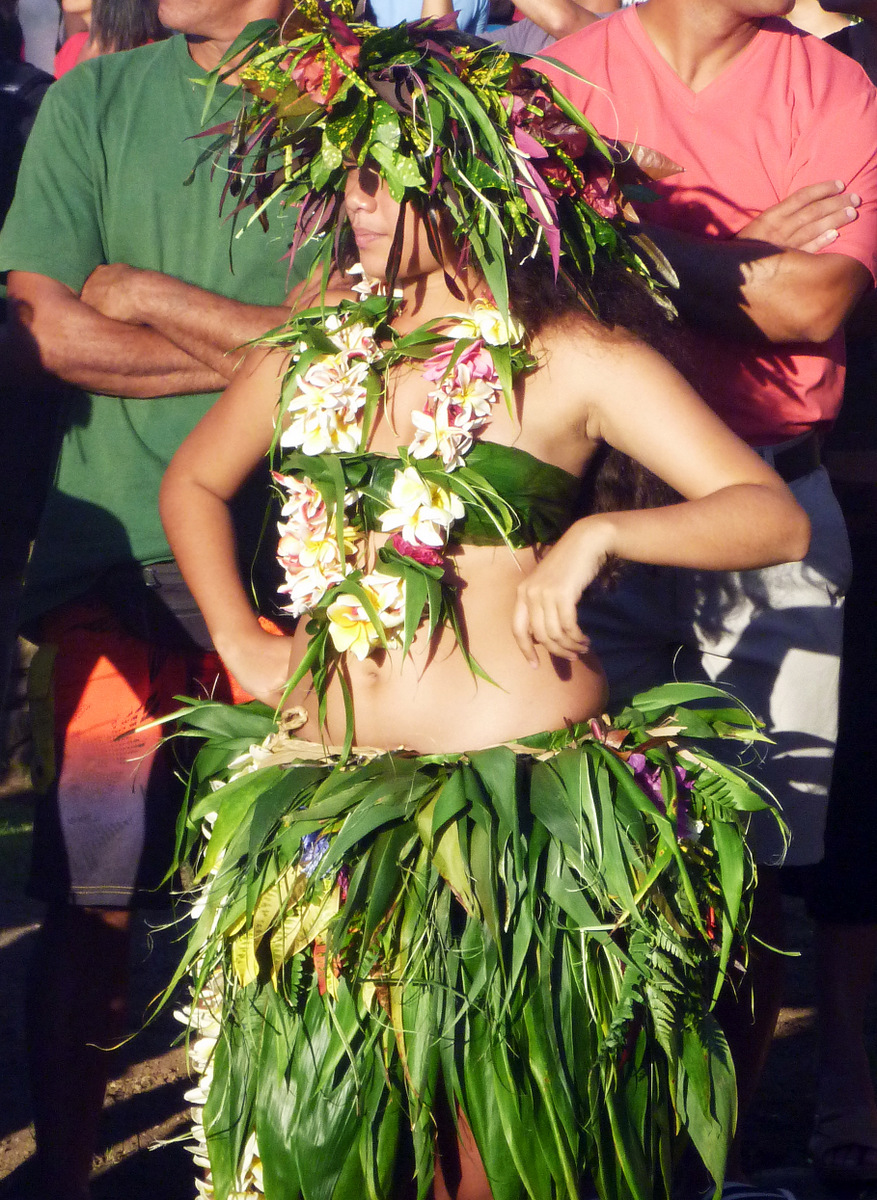
Later in the morning, we walked to the supermarket and, on the way back, discovered something going on in the waterfront park. Teams of people were setting up TV cameras, so we asked one of the TV crew, who told us that a traditional boat was arriving from Hawaii and there was a big welcoming event later in the afternoon.
After lunch and another small siesta to catch up on lost sleep, we walked back to the park to watch the arrival of Hokulea. This is a double hulled voyaging canoe similar to the ones that Polynesians used to travel huge distances, hundreds if not thousands of years ago. Hokulea was built in the 1970’s and was completing a voyage from Hawaii to Tahiti using only traditional navigation methods and knowledge of stars, sun and current.
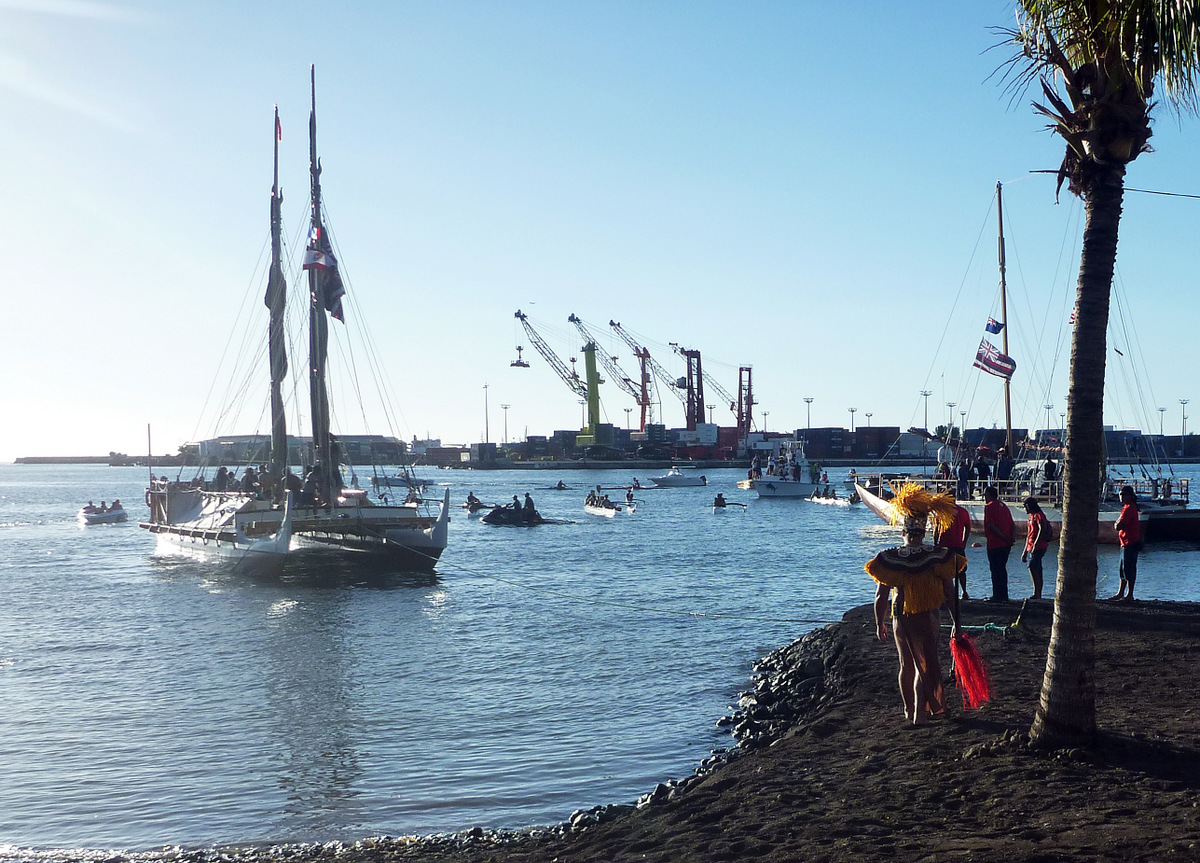
It was a fabulous afternoon. Dozens of outrigger canoes paddled out to meet Hokulea with local ladies dressed in traditional pareau and flower garlands on their heads. The voyaging canoe arrived at the beach accompanied by a flotilla of canoes and powerboats. A huge crowd had gathered to await them and there was lots of play acting starting with a lady chanting a welcome across the water as they approached.
Hokulea tied up to some moorings and the crew swam ashore, but were kept in waist deep water while a guy dressed as a fierce chief strutted around on the beach listening to the captain of the Hokulea pleading to be allowed to land. The chief eventually relented and the crew were greeted with great rejoicing and garlands of flowers.
The event was attended by the President of French Polynesia, who took part in the ceremonies, with very little security around him - just one Tommy Lee Jones look alike trailing behind him. The crew and dignitaries were taken to a cleared grassy area, where we were all treated to a couple of hours of traditional Polynesian singing and dancing - grass skirts and wiggling hips abounded...
After the event, we stumbled across Robert and Hiedi from “Nuwam” and ended up going to the Roulettes again, then for a beer. We only had one beer because a round of four beers and one small bottle of water cost nearly $30 - God knows how the locals can afford to get drunk here.
23 June 2014 Papeete, Tahiti
It was Monday morning and the start of a couple of days of running around. Our first stop was at the Dockmaster office, where we met Ken who's a really helpful guy and gave us the low down on the local area and the formalities. We then walked about a mile to the customs office and sorted out our final clearance into French Polynesia and obtained a duty free fuel certificate, which was fairly effortless.
While in the area, we walked to API Yachting to see about getting our sail repaired, but the owner was out and I don’t think that there would be much chance of getting it done quickly. I tried to ring the owner a few times during the day, but he never answered, so I’ve given up on him.
Our Caribe dinghy is now on its last legs and I have to pump it up two or three times a day, so we’re hoping to buy a new dinghy here. We wandered around the chandlers, but there’s a very poor choice of RIBs available. We found a 9.5 foot Zodiac for $5,300US and slightly smaller 9 foot Apex for $3,900 US. The Apex is the last of a line - the salesman said that they’ve fallen out with Apex and are not going to be selling them any more. He knocked off about 20% and gave me a deal at $3,150 US. I went away to think about it.
We then spent hours wandering around the chandlers and hardware stores looking at what was available and buying a few things. Everything is twice as expensive as it is in the USA, so we quickly revised our buying list to only getting essentials - I'm getting more keen on visiting US Samoa and having parts delivered out there. The most exciting thing was finding a plug cutter which will allow me to make 10 mm teak plugs for the deck - I lead such a shallow life.
In the afternoon, at the request of the Dockmaster, we moved the boat onto a “med” mooring. This simply involved picking up a thick mooring line, attaching it to our bow and then carefully man-handling the boat around 90 degrees, so that we are now stern to the dock. It means that the Dockmaster can fit more boats on the dock, but is pointless at the moment because we’re the only boat here. Unfortunately, getting ashore a lot more difficult now because we don’t have a passerell or plank and are having to swing off the davits and leap onto the dock.
We finally had our Roast Lamb for dinner with a nice bottle of red wine, which was wonderful.
24 June 2014 Papeete, Tahiti
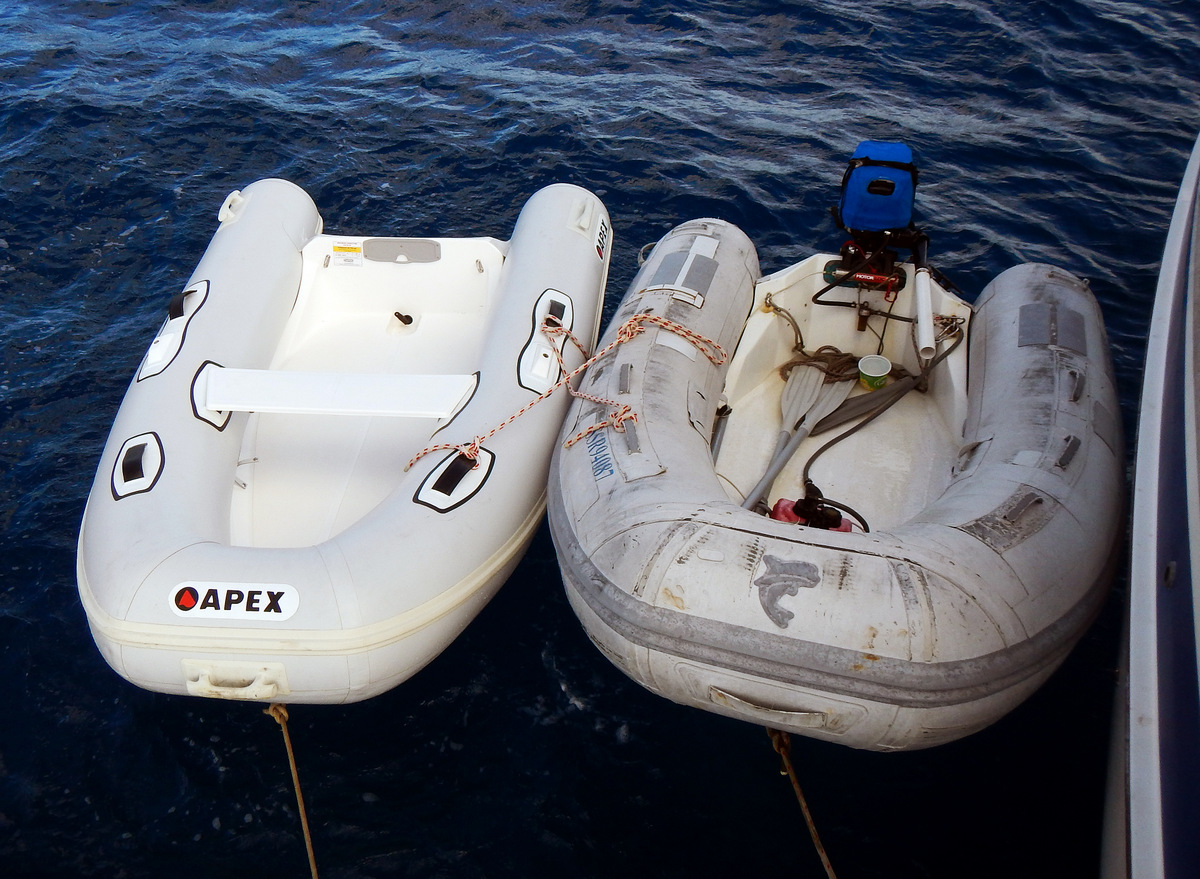
We decided to buy the 9 foot Apex dinghy, which on the specifications is only slightly smaller than our old 9 foot Carib dinghy. I walked over to the chandlers, paid for the dinghy and then got them to fill in a duty free form, so that I can get $435US refunded.
It’s a bit of a palaver - I have to get the form stamped by customs when we arrive in the next country and send it by post back to the Customs office here in Tahiti. The customs office then tells the chandlers to refund the money to us, which will get transferred to our bank account. It’s a hassle, but it means that we get a new RIB dinghy for $2,700 US, which is a great price.
Having made our major purchase, I wandered around for another couple of hours, further hammering our credit card by buying some more essential parts for the boats.
Glenys paid the Dock Master the $40/day berthing fee and then strolled around town. She went to the colourful Central Market and had three pearls mounted onto a leather bracelet for $7 and had the pearl that Valentine gave me in Toau put onto a leather necklace for $8. She also managed to get some New Zealand dollars, which we’ll need if we visit the outer islands of Cook Islands and Tonga, where there’ll be no banks.
In the afternoon, Glenys did some more browsing around town, while I rushed around looking at waterproof, “tough” cameras. I eventually found four good shops with cameras and after a lot of agonising bought a Nikon AW110, which is waterproof down to 18 metres and should be good for taking pictures while snorkelling. Electronic goods are nearly twice as expensive as in the USA, but the camera I bought has just been replaced by a newer model, so it was a good price. It’s had good reviews, so I can’t wait to try it out.
25 June 2014 Papeete to Taina Bay, Tahiti
We were up at crack of dawn and followed a buoyed waterway, which goes around the island inside the fringing reef. The channel goes around the airport, so we had to call the Port Control a couple of times to gain permission to pass both ends of the runway. As we left Papeete harbour, a local guy in a single outrigger paddled up behind us and kept with us at six knots for a couple of miles, using us as a shield against the wind and waves.
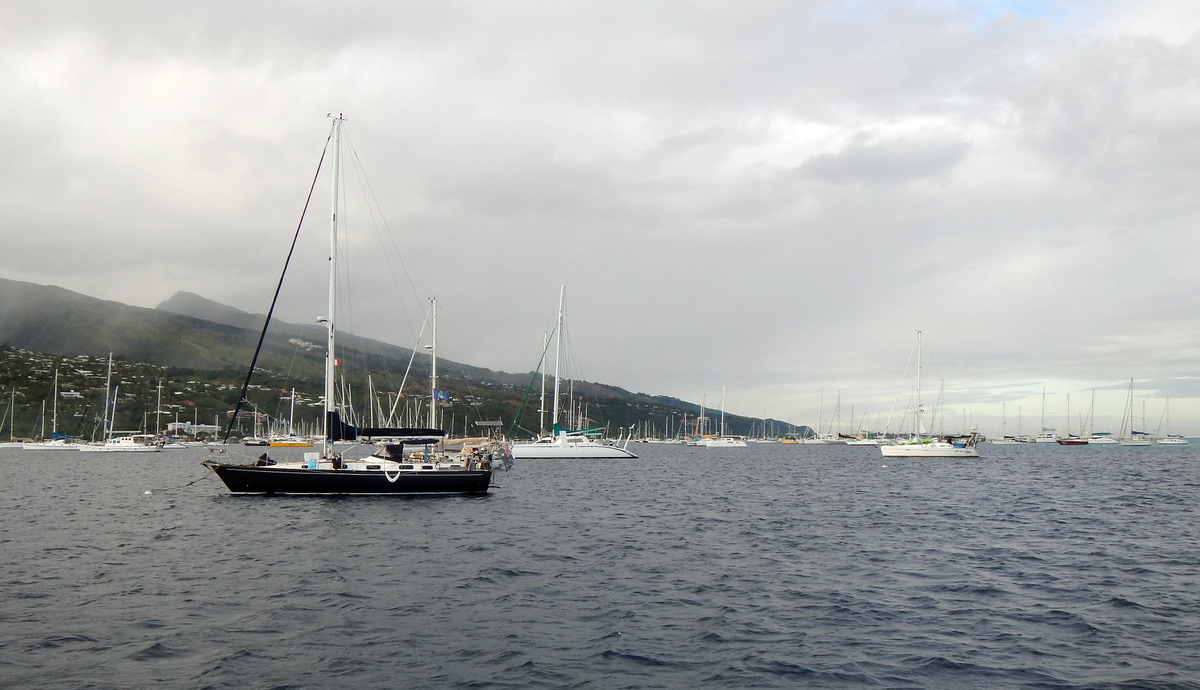
The anchorage outside Marina Taina is packed with cruising boats, some on mooring buoys and some at anchor - there’s got to be over 100 boats out here. We were fortunate to be able to pick up an available mooring near to “Nuwam”. The anchorage is 18 metres deep and with so many boats and swirling winds, it’s easier to be on a mooring - at only $40 per week, it’s a bargain.
We put the dinghy in the water and went ashore to have a look around. It’s like being in Falmouth Harbour in the West Indies. The outside dock of the marina is dominated by very expensive super-yachts with their 100 foot masts and 100+ foot hulls gleaming in the sun. There’s not much in the marina itself - a couple of small chandlers, a couple of bar/restaurants and some dive shops.
There’s a Carrefour supermarket about ½ mile down the road, which is large and has a good selection of food items and well as clothes and household goods, so we spent a couple of hours wandering around - the weirdest thing that you can buy is a whole carcass of veal, presumably spit roasting is popular here.
On the way back to the boat, we called in at a trimaran called “Samba”. The owner, Michele, does sail repairs on a large platform on the back of his boat. He’s a nice guy and seems to know what he’s talking about, so we’re going to get him to repair our main sail. After lunch, we took the mainsail off the mast and got it into a bag just before a couple of strong squalls hit us. This damn weather is so variable.
26 June 2014 Taina Bay, Tahiti
First thing in the morning, we took the sail over to “Samba” and agreed that Michele will replace the leech tape, put a 6 inch wide reinforcing patch all the way along the leech and do a few other small repairs. It’s going to cost us $900US to do the job, but it’ll be a relief to have it repaired properly and especially to have a leech line again, which will stop the irritating fluttering of the trailing edge of the sail.
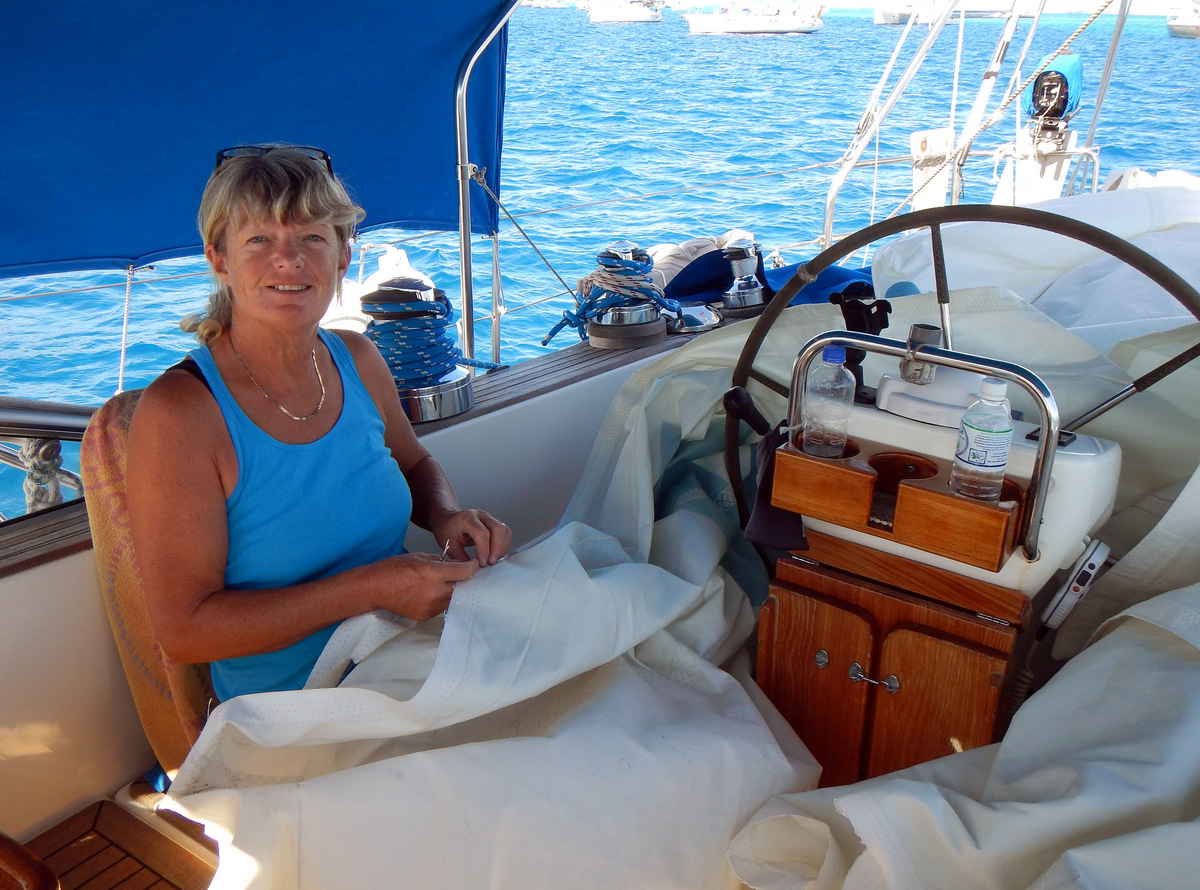
Having received a firm quote, we took the sail back to Alba and spent the morning unpicking the old leech tape and all of the repairs that we’ve done on our way across the Pacific. I dropped the sail off at “Samba” and Michele says that it should be ready on 1st July.
In the afternoon, we picked up our new dinghy and towed it back to Alba. I put the 15hp outboard onto it and we went for a quick spin. It’s slightly smaller than our old Caribe dinghy, but planes well. Unfortunately, the bow is nowhere near as high and, in the 1-2 foot waves going back upwind, we got soaked, which is annoying, but there’s not a lot we can do about it, we’ll just have to get used to it.
Alan on “Victoria” invited us over for dinner in the evening. We last saw him in Ecuador in January, so we had a lot to catch up on. He came via Easter Island and had a good time there, but trashed his main sail and genoa while heading for the Gambier. He was forced to miss out the Tuamotus and come straight here for repairs - the Pacific Ocean is rather brutal on boats.
27 June 2014 Taina Bay, Tahiti
There’s a huge low pressure area tracking to the south west of Tahiti, bringing a big low pressure trough and north winds across our area. Last night was horrible with strong squalls and torrential rain. The morning wasn’t any better, so we hunkered down below. After rushing around for the past week, it was nice to do our thing and chill out.
Glenys did some sewing, making some new shower curtains and I slaved over a hot computer editing photographs and our website.
In the evening, we went ashore to a bar in the marina and caught up with some other cruisers, including Michael and Charlotte from “Salamander”, who we've not seen since Nuku Hiva.
28 June 2014 Taina Bay, Tahiti
We gave our old Carib dinghy to “Salamander”, who are thinking of upgrading their 3hp outboard and want to try out a RIB. It’s sad to see it go and I'm still not too sure about the new Apex dinghy, but we've bought it and have to get used to it.
We went to the supermarket and did a big shop, loading two trolleys full of food and drink. The supermarket doesn't do deliveries, so we trundled the trolleys for ½ mile along the pavement back to the marina. It’s an accepted thing to do - there were fifty or so trolleys lined up in the marina, presumably, someone from Carrefour comes to get them.
We've been in Tahiti for a week now and have done nothing apart from running about and doing jobs. Taina Bay is an impersonal place even though there over 100 boats at anchor - it’s just too big and spread out. We can’t wait to get away from here and feel trapped because we have to wait for our sail to get fixed.
Glenys made a Roscoff Salad for dinner, which is a delicious prawn and potato salad. It only has a few ingredients, but it’s the first time for months that she’s been able to get them all at the same time.
29 June 2014 Taina Bay, Tahiti
I spent five hours servicing the engine and generator. Both are fine apart from a small leak around the shaft of the sea water pump on the generator, which I removed. I have a spare pump, but it’s faulty and needs repairing as well. I'm going to take them into town tomorrow and see if I can get new seals and bearings or get someone to repair them for me.
For the rest of the afternoon, we chilled out - I played my guitar messing about with Guitar Rig, which is a computer program that acts a guitar amplifier with lots of cool effects like echo and distortion. I can make my acoustic guitar sound like a heavy metal electric guitar, much to Glenys’s dismay.
We invited Grant & Carli from “Viandante” and Michael & Charlotte from “Salamander” over for a few beers. All of us were in Bahia de Caracas in Ecuador, so we did some reminiscing and caught up on our various adventures getting here. They are all 25 years younger than us and it’s funny (if a little depressing) how they talk to us like they would to an older aunt and uncle.
30 June 2014 Taina Bay, Tahiti
First thing in the morning, we caught a bus into town and spent the morning wandering around. I walked miles looking for seals and bearings for the water pump, but only managed to find some seals. They cost $30 each for a simple lip seal, so I just bought one to fix the immediate problem - no point in servicing a spare pump at these prices.
We called in at the Harbour Master and told him that we were leaving on the 3rd July. He will only give us a national clearance to continue up the islands to Bora Bora, so we weren’t able to buy any duty free booze. Apparently, you can only get duty free if you are leaving Papeete directly for a foreign port.
On the way back to the boat, we called in on the sail maker and found that he hasn’t started the sail yet. Michele loves football and we’re half way through the World Cup, so I suspect that watching the matches is slowing him down somewhat. He says we should have it by the 3rd July.
I stripped down the sea water pump, replaced the seal and fitted the pump to the generator. I seem to have sorted out the problem, which is pleasing.
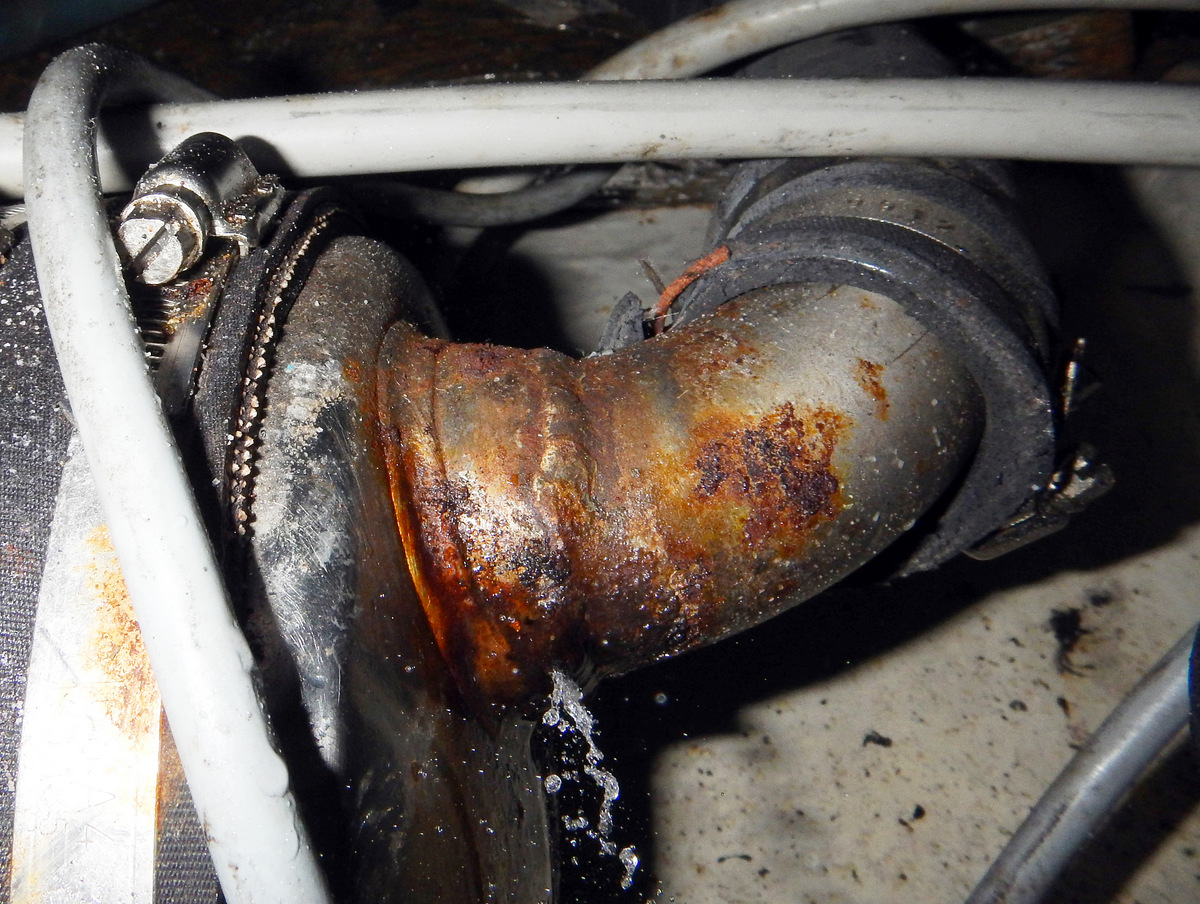
I ran the generator to make water and also topped up the refrigerant on the drinks fridge. While I had the floor panel up, I noticed that we still had water in the main bilge and found that there was a steady trickle of water coming from the engine bilge. Further investigation revealed that we have a water leak in the exhaust system for the generator, which is hidden below the generator and impossible to get at without lifting the generator up - oh miser!