
1 May 2014 Hanamoenoa to Taiohae, Nuku Hiva (Day 1)
We did a scuba dive in the morning off the northern headland of the bay. It was a pleasant dive following the headland to the west and then heading north. The depth dropped to 17 metres on the tip of the point, but then shallowed out to a coral plain at 10 metres around the corner. There were lots of fish around and we saw another Spotted Eagle Ray cruising around above us. Some very big Snappers were very curious and kept making close passes and we found a small Lionfish hiding away under a rock shelf – the first one that we’ve seen in the Pacific.


The afternoon was spent filling dive tanks, making water, getting the dinghy on deck and tidying up ready for an overnight sail to the island of Ua Pou (pronounced “Ooa Poe”).
We left at sunset and had mixed wind for the first few hours until we got out of the lee of Hiva Oa. The rest of the night was lovely with a 15 knot wind on the beam and reasonably calm seas. At our one o’clock change of watch, the wind and swell was coming from the North-east, so we decided to course and headed for Nuku Hiva because we felt that the anchorage at Ua Pou might be exposed to waves and very rolly.
2 May 2014 Hanamoenoa to Taiohae, Nuku Hiva (Day 2)
The lovely 15 knot wind continued until just after dawn, when we hit a lull and had to motor for an hour or so. When we got sailing again, we hooked a big Dorado. It took me 20 minutes to land it and the five foot long fish weighed 27lbs – the biggest that I've caught to date.

The anchorage of Taiohae is ¾ mile wide, which is a good job because there must be 50 boats anchored in the bay. We did our normal meander through the anchorage to look for a spot close to the dinghy dock, but all of the boats were pointing in different directions and it was very difficult to know where their anchors were, so we plonked ourselves in the middle of the bay, a long way from other boats.
By the time we’d got ourselves settled it was nearly eleven o’clock and from bitter experience knew that the town would be shut down from 11 to 2, so we chilled out, had lunch and took our time to get the dinghy back into the water. I put our 15hp outboard on the dinghy because we are so far from the dinghy dock and to my complete amazement it started after the third pull – not bad after being stored for ten weeks.
Around three o’clock, we whizzed over to the dock in the north east corner of the bay and tied up with the other 20 dinghies behind the small breakwater. There are a couple of small cafes, a dive shop and a place called “Yacht Services”, which does laundry, fills cooking gas bottles, hires cars, provides free internet, etc . It all seems very cosy and organised with cruisers sitting around in the cafes, chilling out while surfing the internet.

After chatting to a few cruisers at the dock, we walked around town, which is spread out along the shore line. There are only two small supermarkets, which have all the essential things apart from vegetables and fruit – we only saw potatoes, onions and one bag of carrots that Glenys grabbed as soon as she saw it. We’re a bit disappointed because the supermarkets in Hiva Oa were better.
Other cruisers have told us that there’s a small farmers market tomorrow at the un-Godly hour of five o’clock in the morning. It’s supposed to be a bun fight with locals and cruisers grabbing vegetables as soon as they are put out. We don’t think that we’re that desperate (yet!)
3 May 2014 Taiohae, Nuku Hiva
I paid $5 for an hour’s internet on the boat so that I could download our email - the first time for five weeks. We received 200 emails, but there was nothing of great importance, thank goodness.
After breakfast, we went ashore – Glenys wandered around the shops, while I parked myself in Yacht Services and, using their free wifi, did some more surfing on the internet, updating our website and sorting out a few bits of admin. Glenys did well and found a small store that actually had some vegetables – pak choi, cucumber & green peppers, so she was very pleased with herself.
After lunch, Lonnie and Bona from “Good News” brought over their genoa because in a moment of madness, I’d said that Glenys would repair it for them. We set up the sewing machine in the cockpit and Glenys then spent a few hours repairing a tear along a seam and re-stitching the sacrificial strip. It was worth it because they kindly gave us a couple of boxes of “Clos” wine.
In the evening, we were invited to dinner by Glen and Erin on “Sundance”. Glen had bought a third of a goat from a hunter in Vanuatu and wanted to share a Goat Curry with us. We had a very pleasant evening and met Joe, Sally, Larry & Vicky from “Cygnus”, who came over for drinks after dinner. I’m quite excited because Joe and Larry both play the guitar and we’re going to get together at some point in the next couple of weeks – first time that I’ve met some other guitar players for ages.

4 May 2014 Taiohae, Nuku Hiva
In the morning, we went for a seven kilometre hike over to Colette Bay. We walked around the bay towards the west and first visited the Cathedral, which is a nice open church with some impressive wooden doors and more of the lovely religious wood carvings, which abound in the Marquesan churches.

Further along the shore road, we came across an archaeological site, which contains a number of “Pae pae”, which are stone platforms used as foundations for ancient Marquesan houses. The whole site was rebuilt twenty five years ago for a cultural festival and has a number of modern sculptures and Tiki made by local artisans.
At the west end of the bay, we started to walk up a dirt road past some very nice houses. I love the way that everywhere in the Marquesas is clean and tidy and with flowering shrubs and fruit trees wherever you look - so different to Central and South America.
It was a 20 minute grind up the dusty, steep road to a ridge. Once over the col, the road is more shaded and gently descends to Colette Bay, which has a beach with black sand and a few homesteads growing Noni fruit. This strange knobbly fruit tastes bitter and has a strong pungent smell, but is sold as a juice that is supposed to cure a wide range of ailments including cancer, heart disease and even HIV.

We didn’t stay long because I’m paranoid about “Nonos”, which are tiny little flies that live on the beaches of the Marquesas and are supposed to be ferocious leaving behind very itchy bites. So far, touch wood, I’ve not been bitten, but that might be because whenever we’ve been near a beach, I’ve heavily sprayed myself with Deet.
We retraced our steps back to the dinghy dock, chatted to some of the cruisers at the café and retired back to the boat for a quiet relaxing Sunday afternoon, dozing and reading.
5 May 2014 Taiohae, Nuku Hiva
We had half a mind to try to leave today, but this place is like a huge magnet for cruisers and it just didn't happen. Our morning was spent food shopping. Glenys hunted out vegetables and we stocked up with drinks – beer, coke and Orangina, which with rum, has become my favourite tipple. We had so much stuff that the supermarket gave us a lift back to the dinghy dock, which was useful.
The afternoon was taken up with more chores – washing clothes, collecting our cooking gas bottle, last minute internet and getting fifteen gallons of diesel, which was extortionate at almost 12,000 Polynesian francs ($120). By the end of the day, we were feeling pretty exhausted.

Dave and Jan from “Baraka” invited us over for sun-downers. They've just finished their six year circumnavigation and are heading off to Hawaii tomorrow, then back to Seattle in the States. Jan says that she’s feeling a bit weary with cruising and is now looking forward to being back home. Having only gone 20% of the way around the world, I wonder when we’ll feel the need to stop.
6 May 2014 Taiohae to Baie Hooumi , Nuku Hiva
We made sure that we didn't go ashore this morning, so that we wouldn't be sucked into the cruiser vortex and stay another day. Instead, we had a leisurely breakfast and upped anchor at about ten o'clock. The wind was dead against us as we motor-sailed ten miles east under some very impressive sea cliffs into Controller Bay.
There are three bays and we chose the smaller, eastern one, Baie Hooumi, which is very dramatic. It is surrounded by steep sided hills with rocky pinnacles reminiscent of the Bay of Virgins in Fatu Hiva. There’s a sandy beach at the head of the bay with some buildings – we believe that there’s a small village there, but we didn't venture ashore. We anchored in the middle of the bay in 7 metres of water.
We had a very musical afternoon with Glenys playing her ukulele and me playing my guitar – practising in case we meet up with “Cygnus”.
The clouds built up during the afternoon and a big squall system passed to the south of us, bringing rain showers and strong katabatic gusts dropping down from the surrounding hills. Unfortunately, these gusts were coming from seaward and we ended up with a large cliff to our stern. Even though I felt that the holding was good and the cliff was 50 metres behind us, I found it unsettling, so we upped anchor and moved a little further out into 10 metres of water.
Thankfully, the gusts stopped late in the afternoon when the squall system moved away and we had a lovely settled night.
7 May 2014 Baie Hooumi to Anaho Bay, Nuku Hiva
We motored around to Anaho Bay, passing under some sheer sea cliffs that were more impressive than the ones that we saw yesterday. There’s a knife edge ridge along the headland, which looks like it would make a great scramble, but I think that some climbing gear would be needed to do it – unfortunately, all ours is back in the UK.

Several times during the two hour slog into the wind, we were accompanied by pods of dolphins including Spinner Dolphins, who entertained us with huge leaps out of the water, while doing a 360 degree spin. It’s the first time that we’ve ever seen this.

Halfway along the coast, we passed by our friends on “Vanupieds” and “Nuwam”, who we haven’t seen since October. We chatted on the VHF radio and they are planning to leave for the Tuamotus in a week’s time, so we might finally catch up with them there. They left Isabela in the Galapagos three hours before we arrived and we only missed them by an hour this time, so we’re gradually catching them up.
The anchorage at Anaho Bay is lovely, with a white sandy beach fringed by a coral reef. Behind the shore line, the land slopes up to a rocky ridge with some impressive cliffs. There’s a small village ashore scattered among the swaying coconut palm trees.
The anchoring here is a little bit tricky because the seabed slopes slowly to 10 metres and then suddenly rises to a metre or less over the coral reef. We motored around for ten minutes until we were happy with a spot in 12 metres and put out 50 metres of chain. The only other yacht in the anchorage left in the afternoon, leaving us in splendid isolation for an hour, but a catamaran and two other sailboats arrived soon after and anchored close to us – God knows why because there’s plenty of room here.
We went snorkelling. At first we looked near the cliffs on the west side of the bay, just around the corner from the anchorage, but the water looked dark and gloomy, dropping very quickly down to 10-15 metres. There was also a strong current and lots of small jellyfish in the water, so we went back to the reef to the west of the anchorage which was very good. There are lots of coral heads and the reef gradually slopes down to 10 metres. As well as lots of reef fish, we spotted a large Octopus and a large White Tipped Shark in the deeper water. When we saw it again (or another one) over the shallower reef, we decided to call it a day and got out of the water.

8 May 2014 Anaho Bay, Nuku Hiva
In the morning, we decided to walk around the bay to a farm. When we landed the dinghy on the beach, we chatted to a very friendly guy who was cleaning some fish. He gave us directions to the farm and also to Hatiheu, a village over the ridge to the west. While chatting to him, Glenys spotted some goat’s skulls sitting on top of a boat and asked about getting hold of some goat meat. He said that he had some, so we arranged to meet him at his small pension later.
It’s a lovely walk to the farm, which is very close to Baie Haatuatua, to the east of the anchorage and over a small hill. The path leads through the outskirts of the village past a few houses and a small church. Again the place is beautiful with fruit and flowering trees scattered around the attractive, neatly kept buildings. The houses are very open plan with shutters rather than glass windows and there are often brightly coloured pieces of fabric hanging up to act as screens. The climate here is obviously very benign.
The path follows the bay around to the east, dropping down to the beach and then under a rocky cliff, before climbing through thick vegetation over the small hill. At the top of the hill, the blue waters of Baie Haatuatua can be seen with the farm before it.
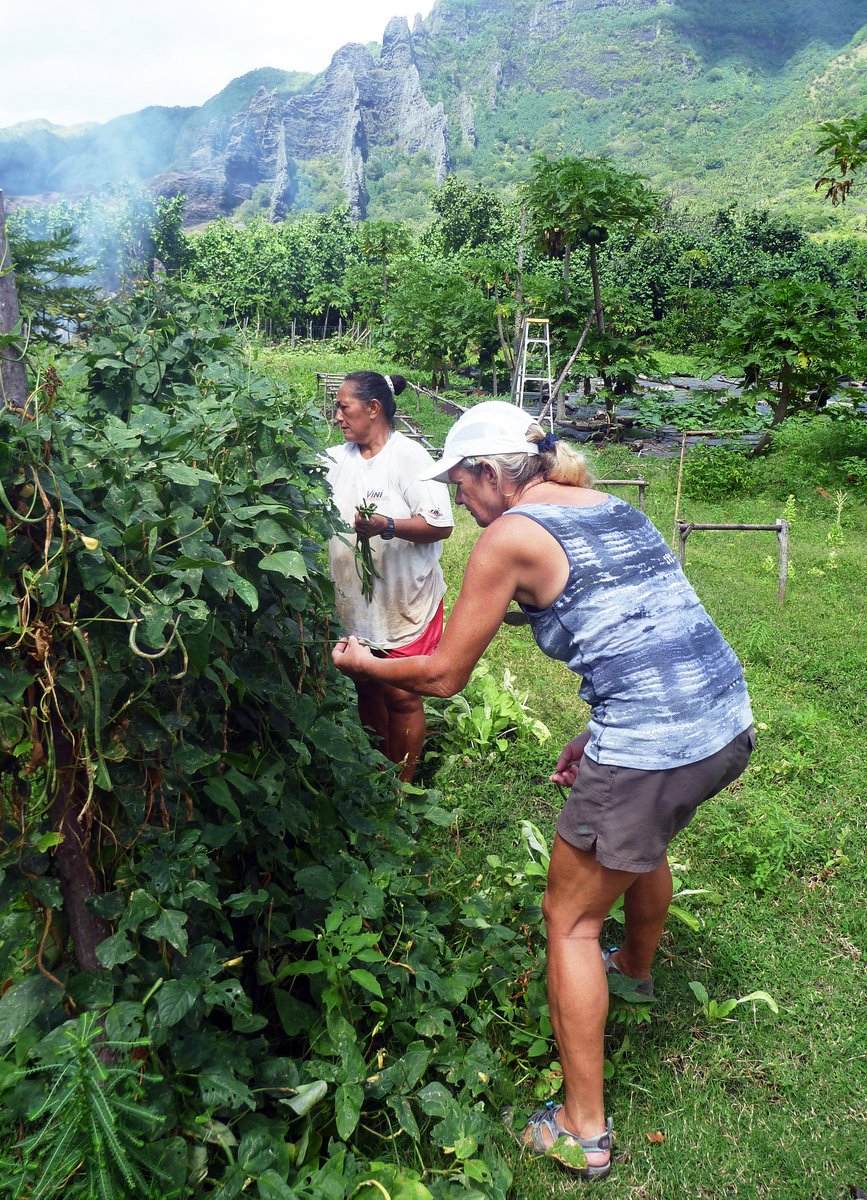
The farm is operated by a small family and they are really nice people. As soon as we arrived, they cut open a Pamplemousse to refresh us after our 45 minute hike before they even asked us what we wanted. It’s a very isolated farm, with the only way in and out being along the rough path back to Anaho. Twice a week, they take their produce to the markets at the main town of Taiohae - everything is put onto pack horses and it takes a few hours to walk over to Hatiheu where the roads starts and they can load their goods into a pickup truck.
We spent an enjoyable half an hour, wandering around the farm, picking fruit and vegetables with the lady. It was a good haul - we came away with aubergines, green beans, tomatoes, basil, chilli peppers, melon, cucumber, bread fruit and, of course, the inevitable bananas and pamplemousse.
After our buying frenzy, we walked on a little further to the beach in Baie Haatuatua. It’s a huge beach with white sand and blue water, but being on the windward side of the island, it’s covered in flotsam and jetson, which as usual is mostly plastic. We didn't stay long.
Weighed down with 20 kilograms of fruit and vegetables, the walk back seemed much longer. Back at the village we hunted out the guy that we’d chatted to earlier and he gave us a huge slab of goat meat out of his freezer. In return we agreed to give him a small bottle of rum, which we’ll drop in to him tomorrow.
The weather in the afternoon was horrible, with strong gusts of wind and rain showers, so we hunkered down and chilled out. Glenys made a huge pan of Goat Curry for dinner and still had about 2lbs of meat which she stuffed into her now full freezer compartment.
9 May 2014 Anaho Bay, Nuku Hiva
It was a nice day, so we walked over to the village of Hatiheu. The trail was quite steep leading up to the col on the ridge high above Anaho, but it was well maintained being the only way out of the village. There were an incredible number of coconut and mango trees all the way up the valley and the path was littered with mangos in various states of decay.
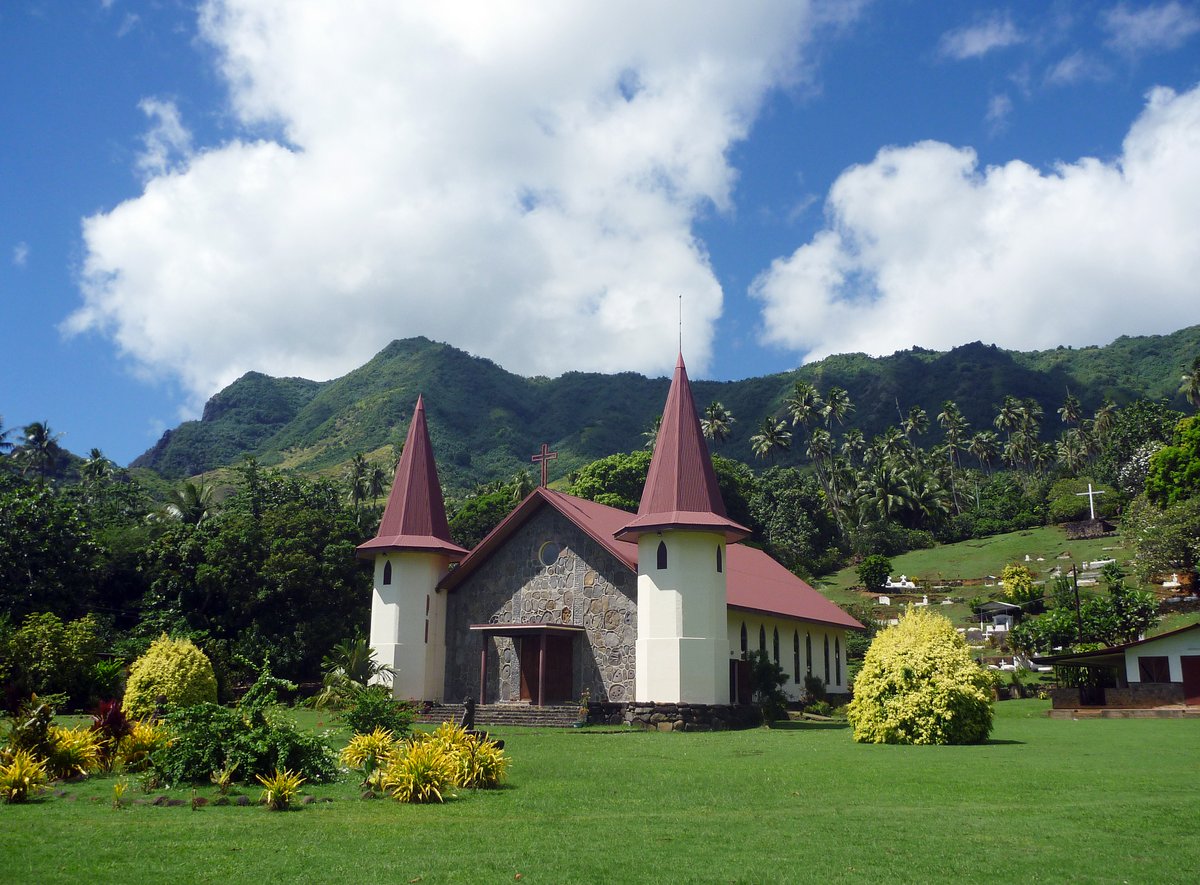
It took us over an hour to get over to Hatiheu, which is a pleasant village strung out along a large bay. There are a couple of small grocery stores and a big restaurant, which charges over $20 per head for a meal – we didn't stop. As usual in the larger Marquesan villages, they have a lovely church which seems overly large for such a small community. We asked the local policeman for directions to the archaeological site of Hikokua, which was a short fifteen minute walk along the main road/dirt track to Taiohae.
Hikokua is a well maintained place, but as with the other Marquesan archaeological sites, there’s not a lot to see – just a set of stone platforms and a few well-weathered stone carvings. The locals have obviously realised the shortfall in their tourist attractions, so there are modern stone sculptures dotted around these sites to add interest, which makes it difficult to know what you’re looking at. We walked further along the road, came across another more overgrown site, then walked back to town.
The locals around this part of Nuku Hiva are very friendly – several people offered us lifts and one guy who stopped to chat gave us a huge green spiky fruit that he was carrying home, telling us that it was called a Sour Sop and would be ready to eat in two or three days.
On the way back to Anaho, we collected mangos from the path and picked them from the trees. By the time, that we arrived back in the village, I was lugging 18lbs of mangos – some green for Kuchela; some half ripe for Chutney and some ripe ones for breakfast.
Glenys still had enough Goat Curry left for dinner and she pan-fried some Breadfruit to go with it. We've never been great fans of breadfruit, having had very stodgy servings in the West Indies, but the chips that Glenys made were very nice – slightly sweet, reminiscent of roasted parsnips.
10 May 2014 Anaho Bay, Nuku Hiva
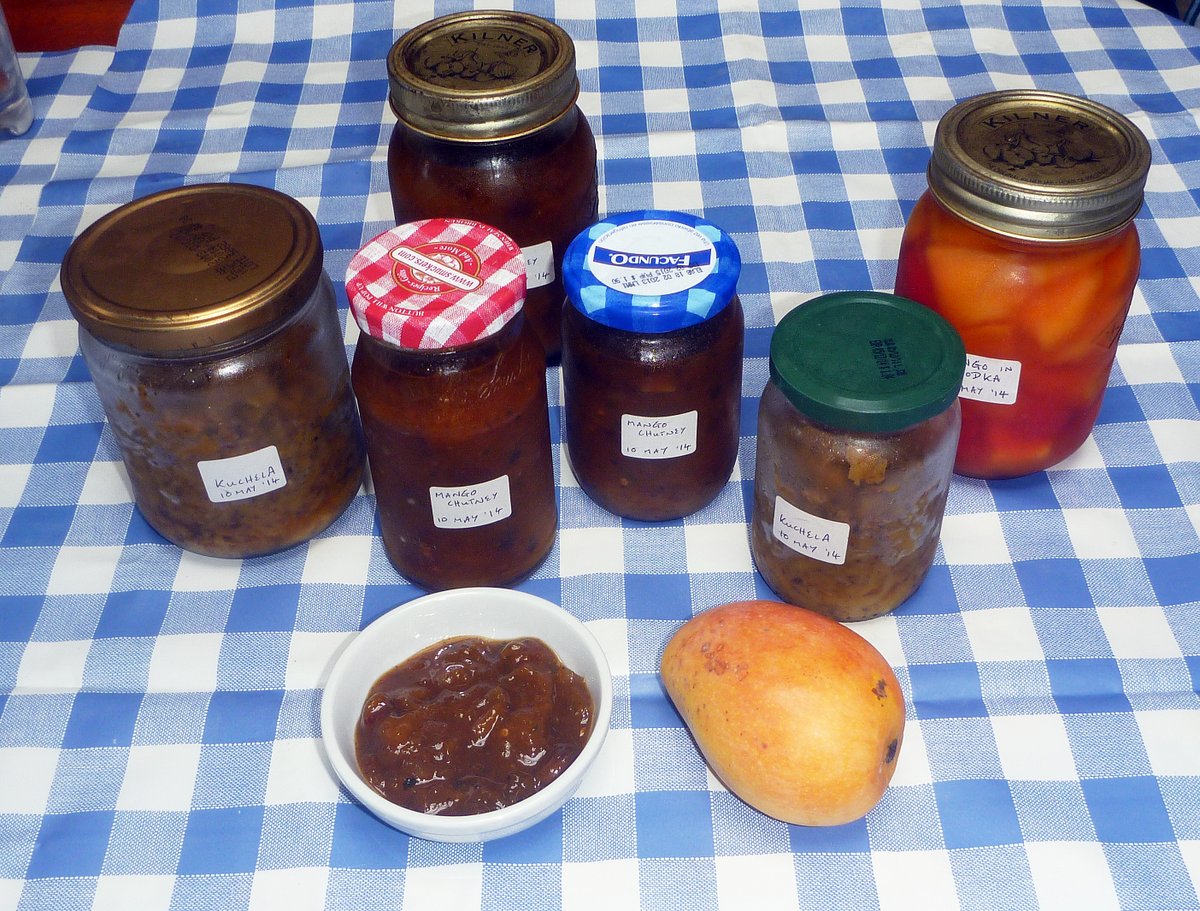
After our long walk yesterday, we decided to have a quiet day pottering about on-board. I did some catching up on editing photos and our website while Glenys processed the mangoes that we’d collected yesterday. She made some Mango Chutney, Kuchela, a mango rum punch, mango salsa and potted some mangoes in vodka. After all this, she still has fifteen unripe mangos stored away in paper to see how long they will last.
In the afternoon, I managed to motivate myself to do a couple of jobs. I recharged the drinks fridge and traced the persistent water leak that has been slowly filling up our bilge over the past month. It’s only about a litre a week, but it’s damn annoying. I checked the water maker pipework and there are a few weeping joints, but nothing urgent. Sea water is still slowly seeping up through the floor of the aft bilge outside the aft heads, so the sealant that I put around the stern tube last August hasn't stopped it. The rudder shaft seals are still weeping, so I also need to keep an eye on that.
I eventually found a leak in the fresh water system on a filter housing in the engine compartment, which is producing one drip every few seconds, which is enough to slowly fill up our bilge. None of these are major problems, but I've now got another four jobs on my growing list.
A Coast Guard cutter came into the anchorage and the customs went around the anchorage inspecting the boats. I was a little bit nervous because I’d casually told the gendarme in Hiva Oa that we only had six litres of spirits on board and I knew that we had more. They arrived mob-handed with five beefy guys crowding into our cockpit with an officer filling in a form.
When they got to the amount of spirits on-board, I said approximately eight litres, but that wasn't good enough - they wanted to know exactly and wanted me to pull it all out onto the saloon table. I decided to be completely up-front and dug out all the bottles hidden away in the front lockers. It was a right assortment of rum bottles which we’ve accumulated from Jamaica, Cuba, Panama and Ecuador. It all added up to about 13 litres, but they seemed unconcerned that we had more than originally stated.
Four guys then wandered around our boat, opening lockers and even lifting floor boards, so I was glad that I’d declared everything. Interestingly, one of the things that they asked about specifically was black pearls. I’d heard that pearls should only be bought from official agents – I guess so that they can be taxed properly. We’re hoping to be able to buy low cost pearls directly from the pearl farms in the Tuamotus, so if we do we’d better be careful.
11 May 2014 Anaho Bay, Nuku Hiva
I woke up realising that we ought to be heading to the Tuamotus sometime next week, so I downloaded a GRIB file and checked the weather forecast for the first time for a couple of weeks. There doesn’t seem to be anything bad around, so it looks like we could go anytime.
I started re-reading our information about the Tuamotus, which are a set of low-lying coral atolls, 500 miles to the south west of here. It’s very important to arrive at the narrow passes into the atolls at slack water, so I checked our iPad and chart plotter for tidal information. I found that the iPad was showing incorrect tidal information for our current position, which is a bit worrying - it seems to four or five hours out. The last time that it was connected to the internet was in Ecuador, so perhaps it think that it’s still there?
Worried about not having any tide information, I had a wander around the five boats in the anchorage asking if they have any official tide tables for the Tuamotus, but interestingly everyone relies on their chart plotters. I’m going to see if I can down load some tide tables from the internet when we get back to Taiohae.
While I was going around the anchorage, I discovered that Dennis from “Pamela” is a very good guitarist, so when I called at his boat, we had a chat about guitar playing and he invited me over to have a music session with him after lunch. Dennis has been playing for over twenty years, so I learned a lot and verified that my basic technique is okay. I had a great time showing him how I played various tunes and he showed me lots of different ways of playing the same thing.
In the evening, we had a jam session on “Kika”, with John playing jigs on his fiddle, Dennis improvising a rhythmic backing and me trying to keep up with both of them - it was a little cramped in “Kika’s” small cockpit with nine people and three instruments. As well as Dennis and Pamela from “Pamela”, David and Bella from “Admetus” were there.
12 May 2014 Anaho Bay, Nuku Hiva
We both love Anaho Bay. It’s by far the best anchorage in the Marquesas that we’ve visited and how we imagined the South Pacific to be. The bay is sheltered from the swell, the towering hills are impressive, there’s a lovey white sand beach fringed by coconut palms, good snorkelling, great hiking, no mosquitos in the anchorage and the locals are very friendly. But, unfortunately, we've been here nearly a week and it's time to move on.

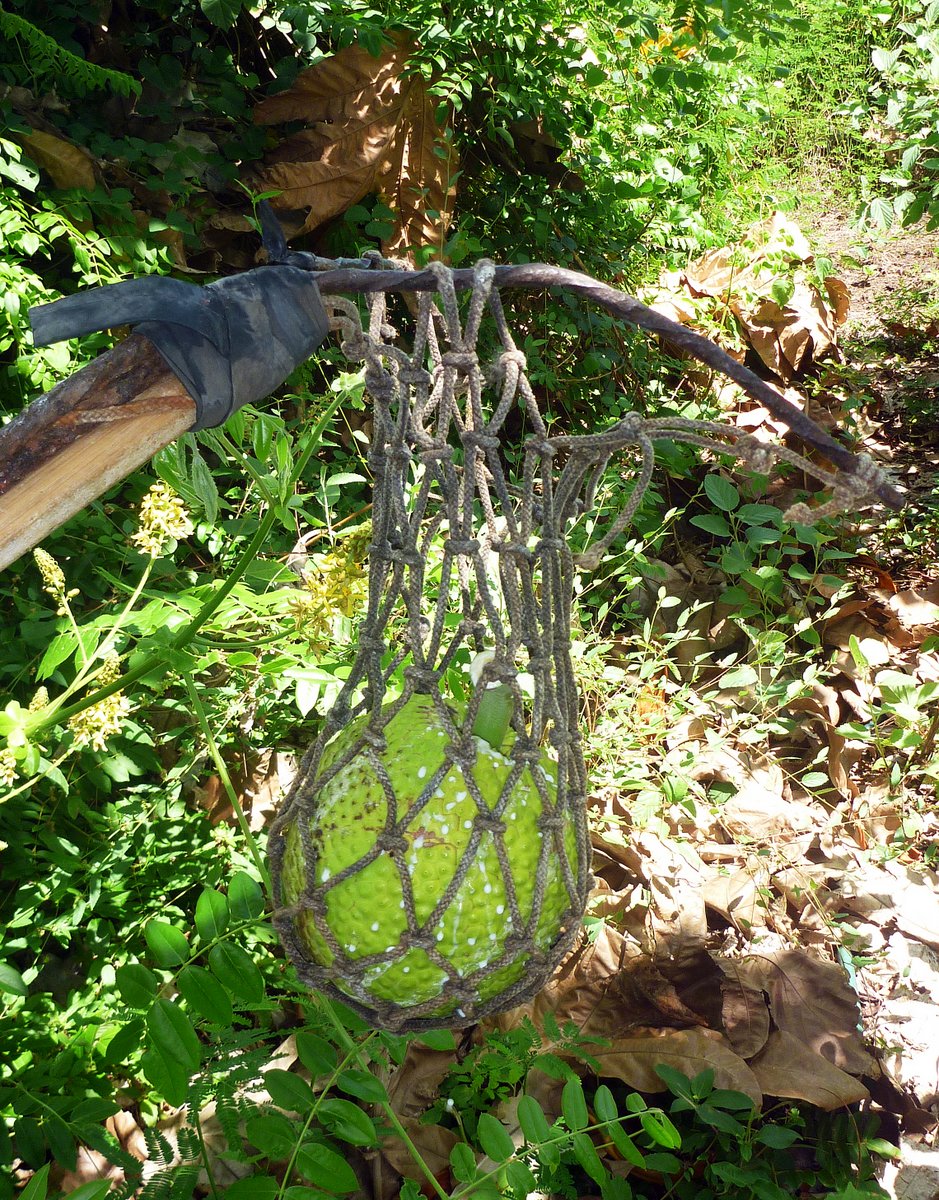
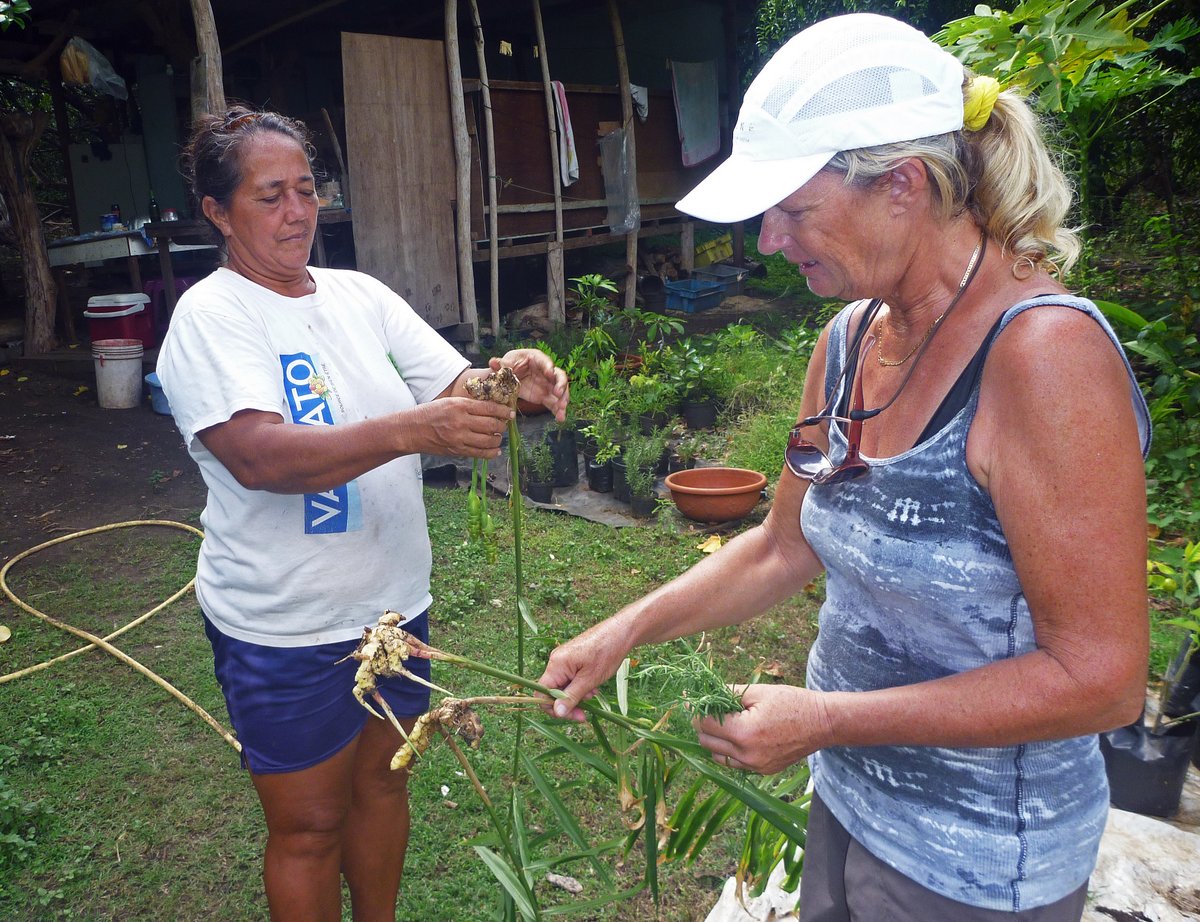
It was a nice day, so we went for a walk to the farm, where Glenys topped up her stocks of tomatoes, aubergines and bought some fresh ginger and other herbs. I’ve enjoyed both visits to this farm because it’s interesting to see how they grow and pick their produce. Today, they dug up some fresh ginger roots for us and showed me how they use a net on a pole to harvest Breadfruit. I also discovered that breadfruit should be picked when it’s a yellow-green colour not green.
On the way back to the boat we saw a couple of Manta Rays gliding along over the shallow reef. They look very strange from above, with their wing tips sticking slightly out of the surface as they fly along underwater.

After lunch, Glenys pulled out her sewing machine and did some small repairs to our big sun awning that was damaged in the strong winds a few days ago.
I was motivated by yesterday’s musical sessions and sorted through my music, refocusing my playing and what I need to learn. I’ve been playing finger-style without a pick for a year or so and have now decided to have another go with a pick, so I’ve restarted the “Learn & Master” video guitar course that I originally used to teach myself.
In the middle of the afternoon, Colin from “Kika” came over in a mild panic because John was perched on the rocks on the shoreline having dislocated his right shoulder while trying to climb into their dinghy after snorkelling. With the help of David from “Admetus”, we got him on board “Kika” and he was obviously in a lot of pain.
Fortunately, John is a doctor and has a supply of morphine and other painkillers on board. John had dislocated his shoulder previously in the middle of their Atlantic crossing, so Colin had experience in how to manipulate the arm back into its socket. We tied a rubber tourniquet onto John’s left arm and John inserted the needle for a catheter into one of the veins on his own left forearm. Meanwhile, Colin put 20 mg of Morphine into a syringe and injected it intravenously through the catheter.
John sat in front of David with his armpit supported by David’s knee. Colin stood in front of John and gripping his upper arm firmly, pulled it across and up into the socket. It took two attempts, but the arm went back into the socket with an audible (and slightly sickening) popping sound. The relief on John’s face was immediate. By this time, the morphine had seriously clicked in and John was pain-free and very, very happy.
13 May 2014 Anaho Bay to Taiohae, Nuku Hiva
Before we left, John from “Kika” came over to drop something off and seemed to be in good spirits despite the trauma yesterday. He said that his shoulder is a bit painful, but nothing too bad.
We motored out of the anchorage and I started to pull out the mail sail, but it jammed half way out. We have in-mast reefing where the sail is rolled up inside the mast with a narrow ½” wide vertical slot where the sail comes out. Unfortunately, we had some creases in the leech of the sail which had jammed inside the mast. All my usual tricks of winding the sail back in tighter, lifting the boom and using the outhaul all failed, so we went back to the anchorage.
Once we anchored, I donned my climbing harness and went up the mast. By lots of pulling and winding the sail in and out, we managed to free the sail from the slot. The leech had tucked over double at the top of the sail and so it was winding twice the thickness all the way down. Combined with the patches and strengthening tape that we put on the leech in the middle of the Pacific, this was enough to jam the sail in the slot. I’ll have to keep a careful eye on the leech when rolling it away until we get the sail properly fixed.
With our minor crisis averted, we motor-sailed out of the anchorage and hit very gusty 25 knot winds as we rounded the headland. To make matters worse, the seas were horribly confused as the large oceanic swell hit the rocky coast and bounced back. We also appeared to have a one knot current against us, so it was a tough hour going the first three miles.
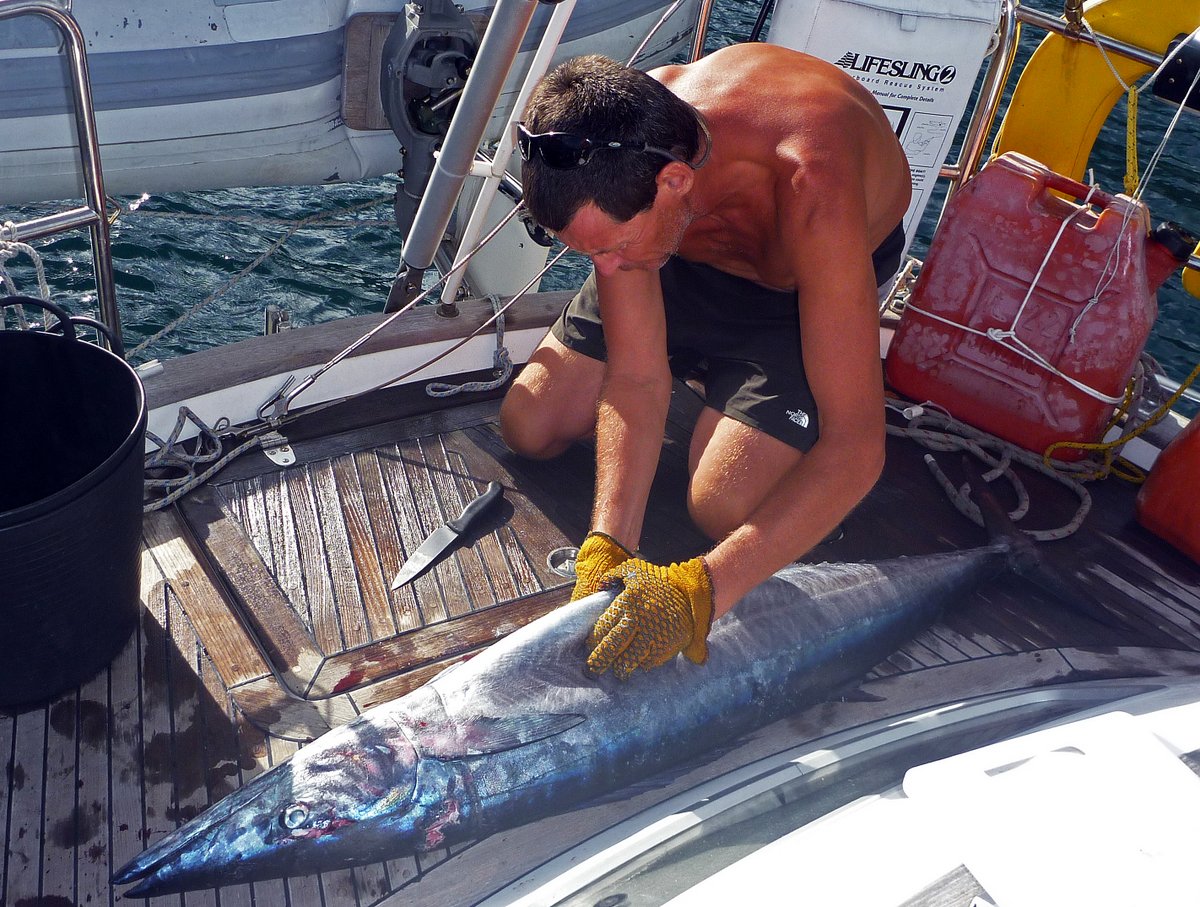
Just as we were ready to make the final tack around the headland, my fishing line went zipping out. We were in no state to deal with a fish, so I simply increased the tension of the clutch and we dragged the poor fish along with us for half an hour until we were in a better position. Even so the fish put up a good fight and I was very, very pleased to land a huge 36lb Wahoo. This was the first Wahoo that I’ve ever caught and what a monster – it was a real mission to lift the gaffed fish on board.

We were hoping that we’d be able to sail once we rounded the headland, but the fickle wind kept heading us, so we gave up and motor-sailed along the east coast of the island. The motion was horrible, so I lashed my precious Wahoo down on the aft deck and covered it with a wet towel to keep it cool.
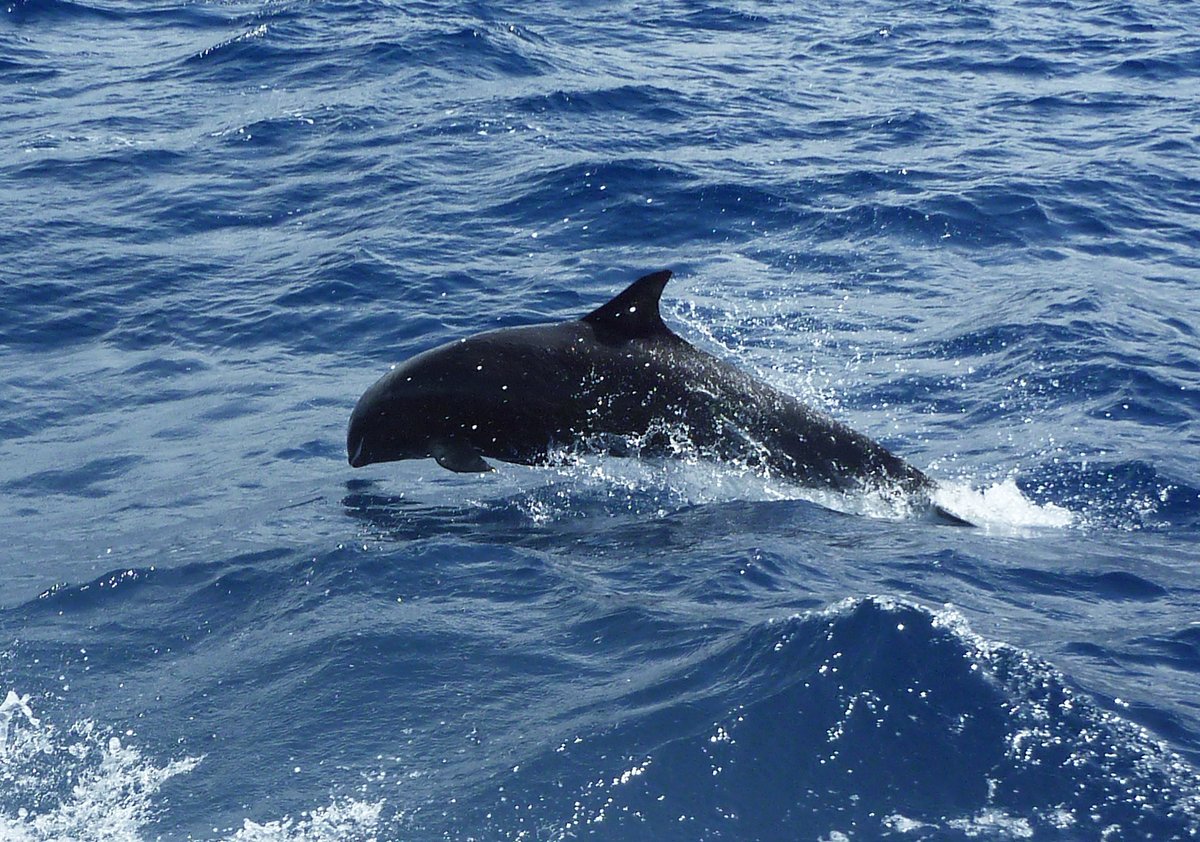
As we bashed our way along the coast, we were joined by pods of dolphins and Pigmy Killer Whales. These oceanic whales are about the size of common dolphins, but have flat heads with no beak. They were very enthusiastic, leaping out of the water and playing around our bow wave. Normally Pigmy Killer Whales are rarely seen, but big pods of them gather around Nuku Hiva, so we were very privileged to observe them at such close quarters.
It took us four and a half miserable hours to reach the anchorage in Taiohae - even though we motor-sailed most of the way. The anchorage was very rolly and unpleasant after the lovely calm anchorage that we’d just left.
While Glenys tidied up the boat after the chaos of our short bouncy passage, while I filleted the huge Wahoo. We only had space in our fridge for one quarter of the huge fish, so I jumped in the dinghy and ran around the anchorage giving fish to friends – I was very popular. We had pan-fried fish, chips and peas for dinner – breadfruit chips of course.
14 May 2014 Taiohae to Daniel’s Bay, Nuku Hiva
The coast guard had been telling cruisers that a large 2-3 metre southerly swell was heading towards the Marquesas and were expecting the anchorage to get very, very rolly with braking waves close to the shore. We decided that we would run away to Daniel’s Bay which is supposed to be much more protected.
We’re planning to leave for the Tuamotus in a few days, so this would be our last chance to buy provisions for a month, so Glenys ran off to the supermarket while I sat in Yacht Services and used their wifi internet. Glenys got a lift back from the supermarket and we ferried the shopping back to the boat.
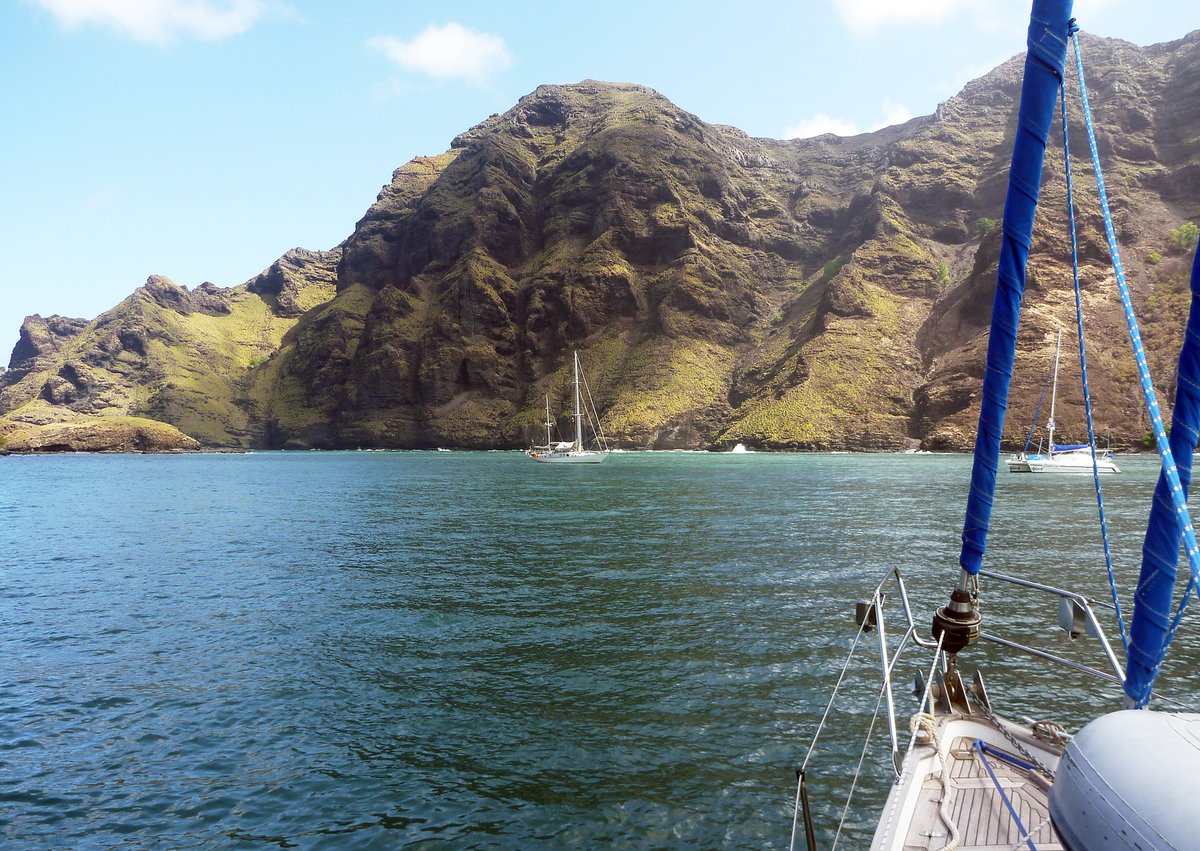
After a lunch of lovely fresh baguette, we waited for some rain showers to pass over and then motored five miles around to Daniel's Bay. The anchorage is very spectacular with steep cliffs guarding the narrow entrance, which is difficult to spot from seaward – a perfect pirate hideaway. We anchored in 8 metres with three other boats. Although the bay appears to be totally enclosed by land, some swell was creeping through the narrow channel and making it a little rolly, but nothing as bad as Taiohae.
It rained on and off all afternoon, so we hunkered down for the rest of the day – Wahoo in Peanut Sauce for dinner.
15 May 2014 Daniel’s Bay, Nuku Hiva
We had a horrible night - the wind was making us swirl around, so that sometimes we were side onto the swell coming in to the anchorage making us roll and at other times the waves were hitting our stern and making a loud slapping noise. The sugar scoop at the stern of our boat is hollow fibreglass and the sound is amplified like a drum, so it’s a horrible, constant noise. Eventually, at four o'clock in the morning, I cracked up and moved into the front cabin where I slept a little better.
Most of our day was spent catching up on jobs. Glenys got on with some cleaning and sewing jobs, while I gave our dinghy a bit of tender loving care. The poor thing is on its last legs because the Hyperlon fabric has finally perished after nine years of the tropical sun. I lifted it onto the foredeck and tried to find the leaks that are forcing me to pump it up twice a day.
I found serious leaks around the big patch that I put on the starboard tube a few weeks ago, but couldn't find the leak in the front tube. Unfortunately, we didn't have a patch big enough to go over all of the leaking patch and I thought that it would cause more damage to try to remove it, so I put a layer of rubber caulking sealant around the patch to try to slow down the leak and then I’ll put on some small patches over the edges tomorrow.
16 May 2014 Daniel’s Bay, Nuku Hiva
The dinghy was still unserviceable, so we were forced to stay on-board all day. Glenys finished off patching the dinghy, while I sorted out the water leak in the engine room and then repaired a leaking seal in the front toilet - one of my least loved jobs.
Glenys made Panzanella for lunch, which is a great way of using up stale baguettes – tastes delicious. In the afternoon we chilled out. I spent most of afternoon watching video guitar lessons and playing the guitar. I'm back to basics re-learning how to use a pick and it’s all simple stuff. Glenys is being driven crazy as I play crappy tunes like Jingle Bells and Yankee Doodle to cheesy backing tracks.
Daniel's Bay is not one of my favourite anchorages. It has impressive cliffs all around it, but with the overcast conditions that we've had it’s very gloomy and the constant rolling from the swell is very irritating. It seemed a little calmer today, so I chanced sleeping in the aft cabin again.
17 May 2014 Daniel’s Bay, Nuku Hiva
It was a horrible night, with rain and huge gusts of wind, which continued into the morning. We'd planned on hiking up to a nearby waterfall, but resigned ourselves to another day on-board and decided to get ready to leave for the Tuamotus tomorrow.
I spent all morning trying to figure out the tides for the entrance into the Kauehi Atoll. The current rushes in and out of the small passes in through the reef at up to 8 knots, so it's important to get it right. You would think that it would be a simple thing to look up, but I looked at two different electronic charts, a program called wxtide32 and the tide tables from NOAA and none of them were the same. There’s 90 minutes difference between all the sources, so I guess that we’ll have get there at the earliest slack water and eyeball it.
The rain stopped after lunch, so we pumped the dinghy back up and went ashore. It was around two o'clock by the time that we'd landed on the beach, so we didn't really have time to walk to the waterfall, but we thought that we’d give it a good try. The path from the beach leads around the bay to a small village.
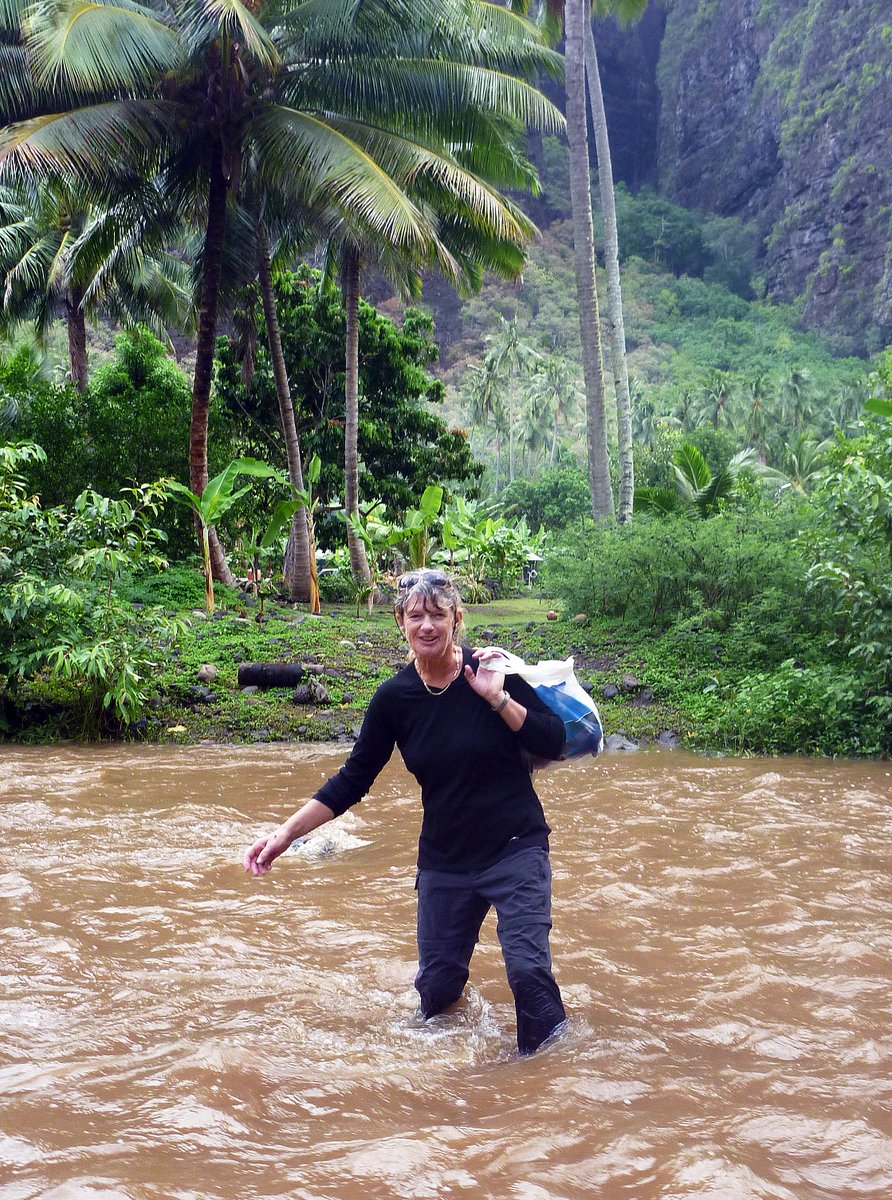
On the way, we had to wade across a 30 foot wide river to get to the village, which was running fast and two foot deep after the heavy rain we'd had this morning. Fortunately, we met a local guy and his son who led the way. We chatted to him after fording the river and agreed to call at his house on our way back to buy some fruit.
It was a nice, but muddy walk towards the waterfall, going past tidy small-holdings where the locals grow bananas, pineapples, pamplemousse and other produce. Unfortunately, after a kilometre we were stymied by another ford over a river. I waded in up to my thighs, but the current was very strong. We would probably have made it across okay, but I was worried that the river might flood even more and we wouldn't be able to get back across.
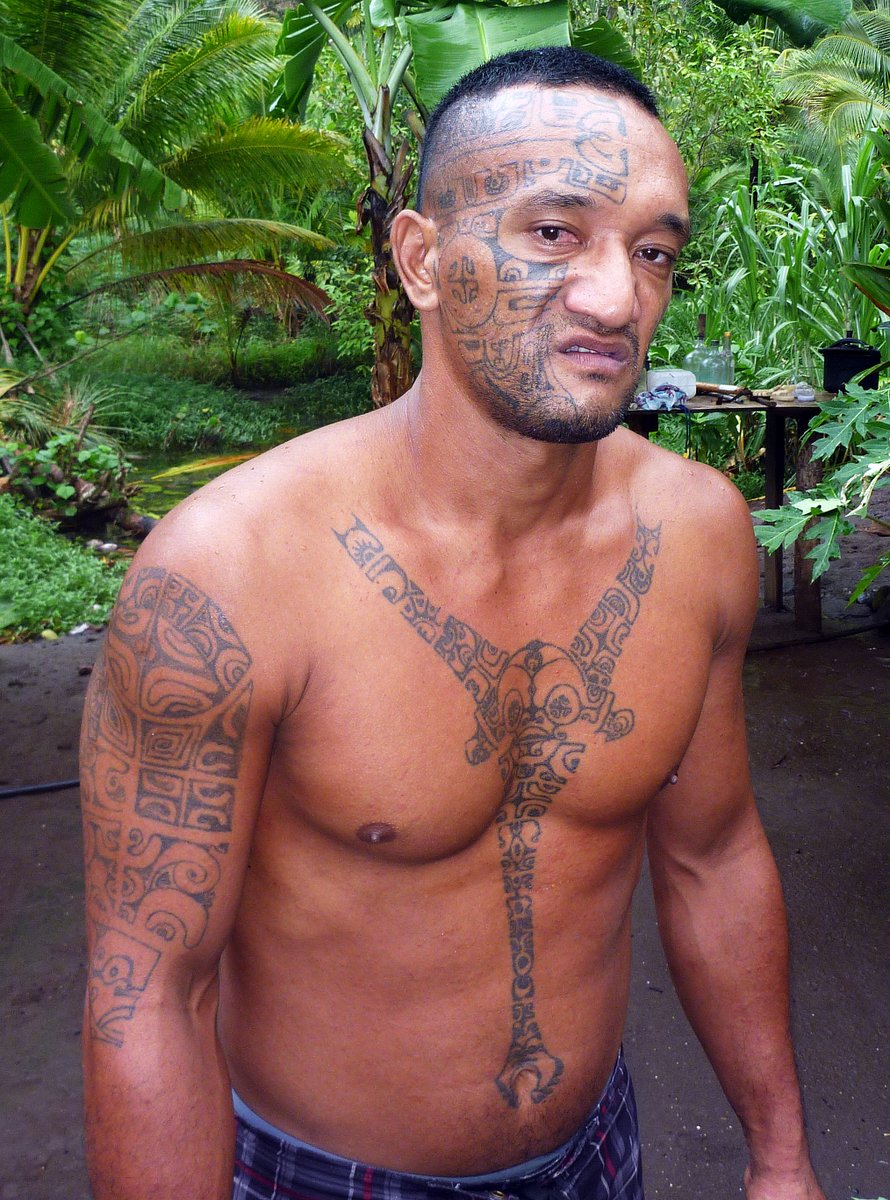
On our way back, we picked up limes and lemons that were lying on the path and then bought 10 huge pamplemousse, 8 oranges, 30+ bananas and some star fruit from the guy that we met earlier. He had a fabulous set of tattoos, which he said were done in the traditional way – not with a machine. When I asked to take his picture, he snarled making himself look fierce, presumably like his cannibal ancestors would have looked. You wouldn't want to meet him in a dark alley...
To get back to the beach, we had to haul our fruit over the river, which seemed a little more flooded, so I think that we made the right decision in turning back. After going for a walk and chatting to the locals, I feel a bit better about this anchorage, but it still won’t make it onto my favourites list.
Back on the boat, I decided to run generator, but the damn thing wouldn't start - just what we need the night before we go on a five day passage. It fired up a couple of times then cut out. Suspecting a fuel problem, I quickly found a fuel leak and traced it to a small leak in a rubber fuel line. Fortunately the hole was near the end of the rubber hose, so I was able to cut some off. After a few attempts to start it, bleeding the fuel system between goes, I got the generator running – sorted in 25 minutes and what a relief.
18 May 2014 Daniel’s Bay to Kauehi, Tuamotus (Day 1)
It was half past nine by the time that we'd tidied up and prepared ourselves for the 525 mile passage to Kaeuhi atoll in the Tuamotus. As we went out of the narrow entrance to the bay, there was a big six foot swell coming straight in, so it's not surprising that it was a little rolly in the anchorage.
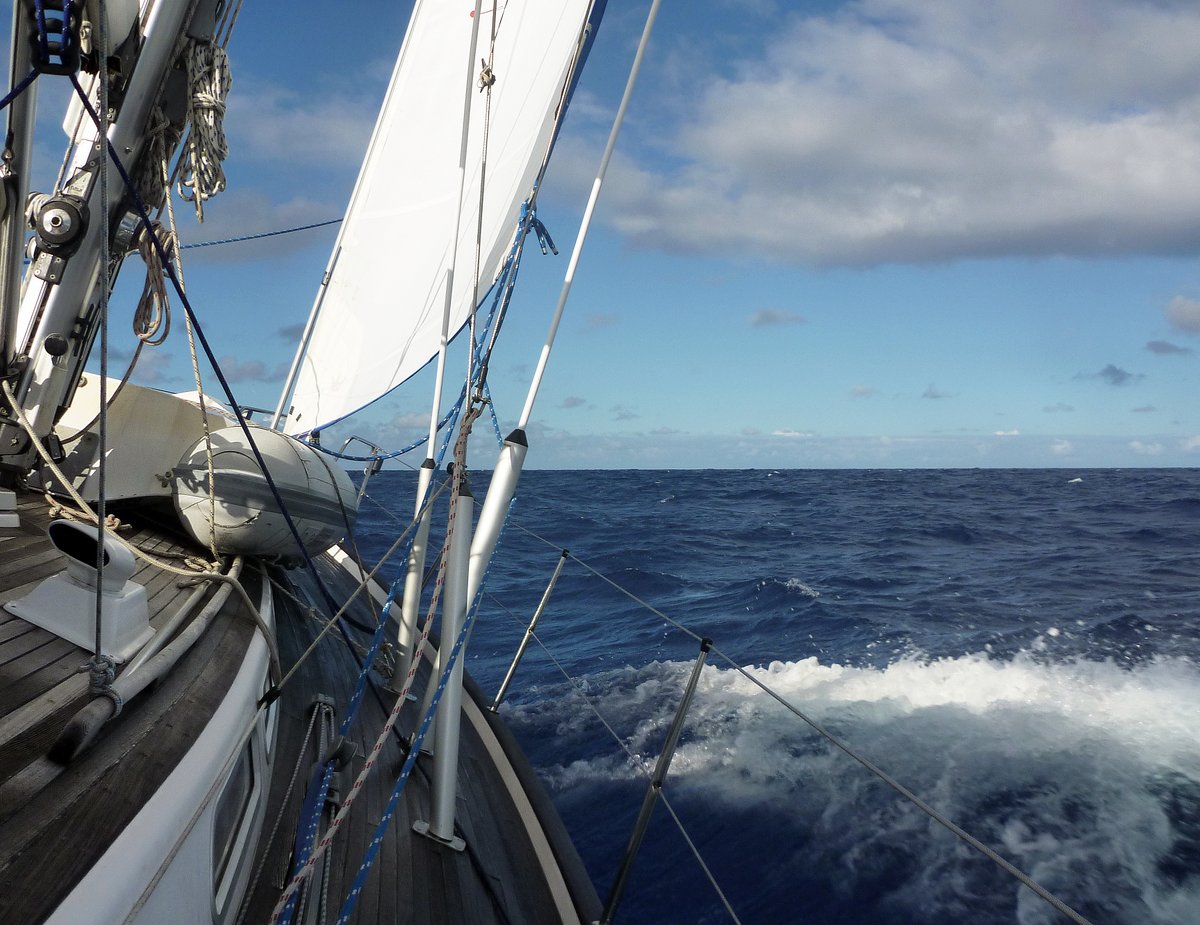
As we sailed away from the island, there was a very nice 15 knot wind from the south-east that boded well for our south-west course and we had a good day sailing on a boisterous reach. The wind was a little inconsistent, but we had a favourable current of at least a knot. As usual, we were both a little restless on the first day of this passage, finding it hard to settle into it.
The Tuamotus are on a different time zone to the Marquesas, so we decided to alter our clocks to the Tuamotus time of -10 UTC. Having changed all of the clocks on board, we then realised that sunset would be at 1700 hrs, which wouldn't fit in very well with our normal three hour watches. We normally have dinner just before sunset and then Glenys goes to bed at 1900 hrs. Being on Tuamotus time would mean that she'd be sitting around in the dark for an hour, so we changed our clocks to -9 UTC and are now running in the Alba time zone.
We had an unpleasant night. The sky was overcast and we had small shower systems passing over us every hour or so. As each system approached, the wind would drop to 10 knots and veer, then increase to over 20 knots and back as the system went overhead. It was made worse because it was so dark that we couldn't see the showers approaching. Rather than keep reefing every time, we left the sails alone and lived with bobbing along with slatting sails in the lulls and then screaming along for ten minutes when the shower hit us. If the squall was strong, then we would run downwind for a few minutes until it had abated - not very restful.
Amazingly, at our 0400 watch change, a cargo ship loomed over the horizon and passed just 1.5 miles to our starboard. Naturally, when it was close to us, the wind picked up to 25 knots and we had a bouncy ride for ten minutes, not daring to run downwind towards the ship. I guess that it was a freighter taking supplies from Tahiti to Nuku Hiva
19 May 2014 Daniel’s Bay to Kauehi, Tuamotus (Day 2)
The night might have been unpleasant, but at least we did 155 miles in the last 24 hours and we’re over half way there. The morning was overcast with the occasional shower accompanied by the same gusty winds that we had last night. Unfortunately, the prevailing wind veered by 20 degrees putting us harder on the wind making it a bouncy ride and forcing us to put a second reef in the main.
I tuned into the Isabella Net, which I set up just before we left Isabella in the Galapagos and was pleased to see that it’s still going. It was originally called the “Goodbye Isabella Net”, but as most people are already in the Marquesas and Tuamotus now, they’ve dropped the “Goodbye”. The net seems to be dominated by Australians, who check in every day, so the nature of the net has changed to be a lot more chatty – I don’t think that I’ll bother again.
Glenys served up a Quiche for lunch , which she sensibly made before we set out and kept for a rough day. The afternoon was much brighter and the wind gradually backed 15 degrees allowing us to ease the sheets a little bit. It was a more pleasant night with clear skies and the wind was much more consistent at 15-18 knots more or less on our beam.
We’ve slotted into our three hour watch system. It was a struggle sleeping the first night, but we’re both getting some sleep now - both of us are watching the clock waiting to go back to bed after each night shift.
20 May 2014 Daniel’s Bay to Kauehi, Tuamotus (Day 3)
At our eight o'clock morning fix, we'd done 294 miles with 231 miles to go. In the previous 24 hours, we’d done 155 miles, so Kauehi was tantalisingly close with an outside chance of getting to the pass tomorrow afternoon. To give us time to get safely to an anchorage, we'll have to get through the pass at 1500 hrs. I did some calculations and found that we'd need to average 7-1/2 knots for 31 hours - there's no chance of that, so we're now resigned to sailing at the more relaxed speed of 5 knots and getting there on the morning of the 22nd - only another two nights.
By mid-morning, the wind had dropped further to 10-15 knots, so we unfurled all three sails and were gliding along at 5-6 knots for most of the day with blue skies and calm seas.
During her watches, Glenys has been catching up on posting a load of recipes to the Galley Slave section of our web site. She has a small A5 folder with various photocopies and hand written recipes that she's gathered over the years and she's finally knuckled down to put them into her cookbook. It's quite a bit of work to get it into the correct format and, of course, there are no photographs of the dishes yet, so I can look forward to her preparing some meals that we've not had for a while, just so that we can photograph them.
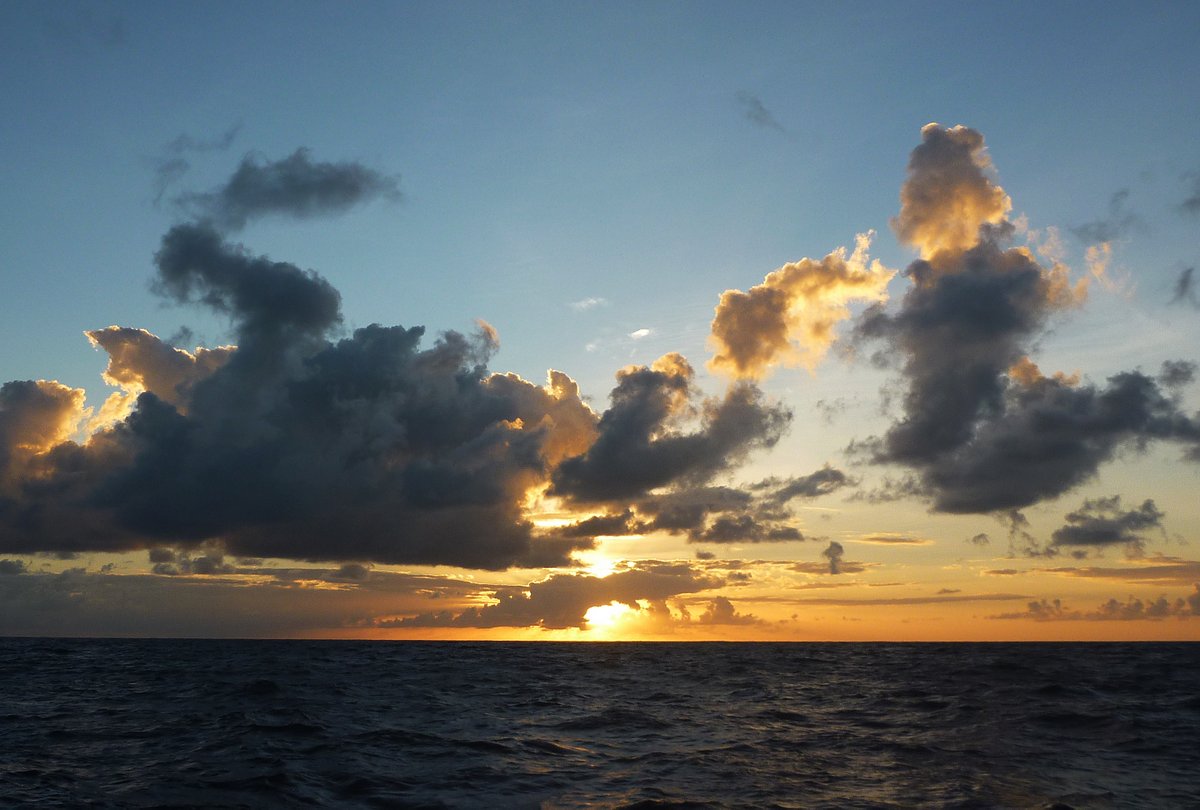
As darkness fell, the wind picked up to 15-18 knots and we could see more clouds around, some with obvious rain showers, so I put two reefs in the main ready to handle squally conditions. It was a very pleasant night until Glenys's 4-7 watch when a big squall hit giving her 28 knot winds and torrential rain. She ran downwind to reduce the apparent wind, but of course that meant that the rain hammered into the cockpit, so when I got up to give some moral support, she was drenched through to the skin.
21 May 2014 Daniel’s Bay to Kauehi, Tuamotus (Day 4)
It was a tough morning with 20-25 knot winds at 60 degrees off our port bow. We beat upwind with a heavily reefed main and just the stay sail, but at least it was sunny most of the time. The GRIB file that I downloaded showed that this wind will continue for the next 48 hours and then there'll be a patch of very squally weather for a few days, so we need to find somewhere nice and sheltered to anchor.
Kauehi is an oval shaped atoll approximately 12 miles long with a fringing reef enclosing a huge, deep lagoon. There's only one entrance through the reef, which is on the south-west side, so it should be okay to enter in these strong south-east winds. Tearavero, the main settlement, is on a small, low-lying island (called a motu) in the north- east corner of the lagoon, but only has good protection from the east, so we're planning to go to an anchorage in the south-east corner behind a few small motus where there should be good protection from the south-east.
I had another look at the tides for the entrance into the lagoon. The fringing reef around the atoll is only a maximum of a couple of metres, so the prevailing swell that crashes on the reef forces water into the lagoon. Since there's only one pass out of the reef, all this extra water flows out of the lagoon through the pass causing a significant change in the tidal flow of water - if the wind and waves are stronger, the bigger the effect.
The normal maximum tidal current in and out of the 200 metre wide pass at Kauehi is 4 knots, but since the wind will have been blowing at 20 knots from the south-east for a few days, I think that the current will be increased by one knot when it's coming out and decreased by one knot when it's going in. In addition, the time for slack water at high tide will be one hour earlier and slack water at low tide will be one hour later.
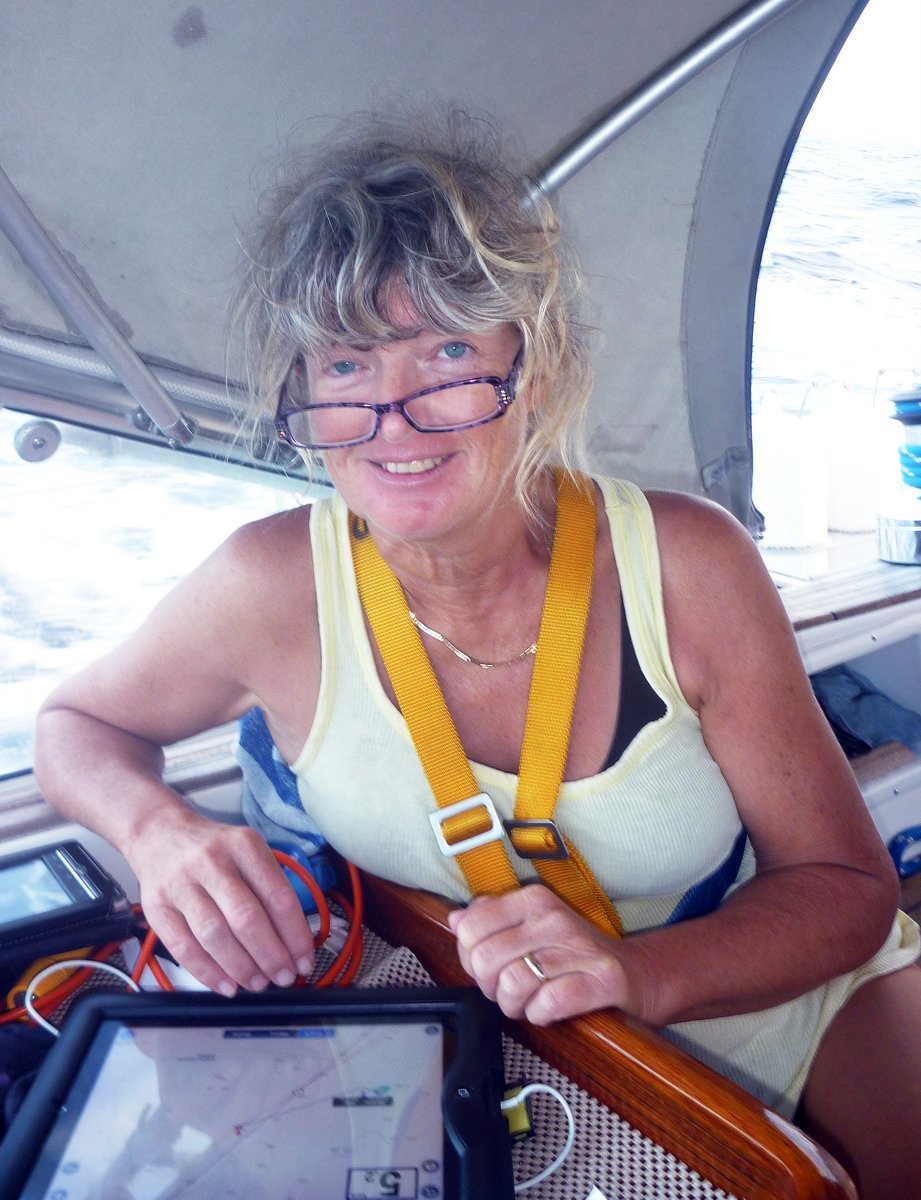
To make matters a even more complicated, I have conflicting information about the times of high and low tide - four different sources give me a total discrepancy of 90 minutes. So, my best guestimate is that the maximum current on the inflowing tide will be 3 knots and the time of the slack current at high tide will be somewhere between 10 and 12 o'clock in the morning. My brain hurts.
The three knot current is not a problem in itself because we could motor at seven knots if we needed to. However, the strong current rushing in through the narrow pass causes swirling eddies and a strong wind against the current can cause large standing waves which can be a major problem. Our master plan was to sail past Kauehi during the night and heave-to until seven in the morning, then make a slow approach to the entrance at nine o'clock and look at the actual conditions of the water going in through the pass, before committing ourselves.
After lunch, the wind abated a little and thankfully backed, so that we were on a beam reach making the afternoon very pleasant. At sunset, we only had 35 miles to go, so I put another heavy reef in the main and rolled away some of the stay sail in an attempt to slow down, but with 18-22 knots on our beam, we were still going along at 4-5 knots over the ground.
It was a nice sail for the first half of the night, if a little worrying sailing between two very low lying atolls, which have no lights. The channel between them was over eight miles wide, but it was still very unnerving to know that there were dangerous reefs only a few miles away in the pitch blackness of the night. I shudder to think how anyone managed to navigate around here before the invention of GPS.
We hove-to at around four o'clock and dawn found us two miles off the pass waiting for the tide and better light to head across the lagoon - we'll be heading directly into the sun, so it will be nigh on impossible to see any reefs until later in the morning.
22 May 2014 Daniel’s Bay to Kauehi, Tuamotus (Day 5)
We waited until half past nine before starting to go through the pass - at which time I'd guesstimated the current to be 1-2 knot going into the lagoon. Looking through binoculars, I could see some standing waves in the pass. They didn't seem too bad, but just in case, we rolled away the genoa and turned on the engine.
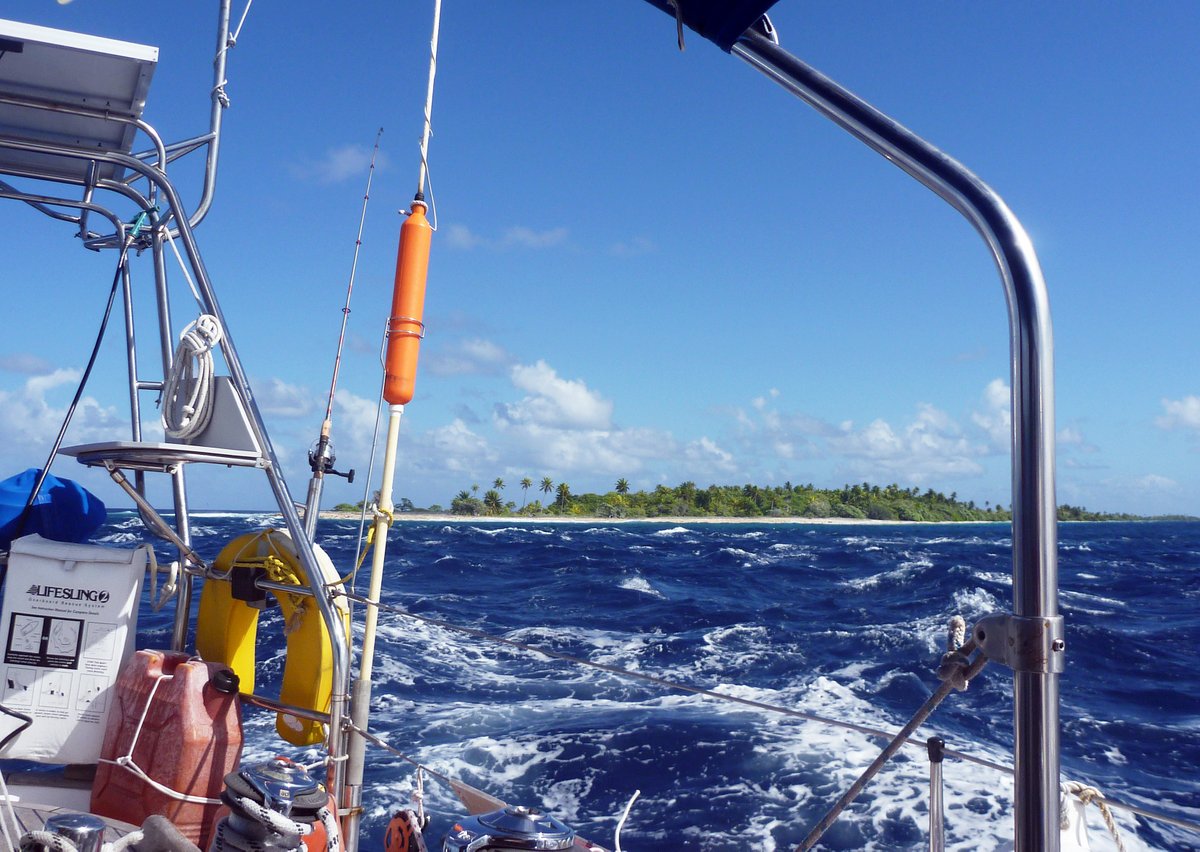
I think that we got it about right - we had the current with us and the standing waves were only a couple of feet high, so we soon powered through them. Once inside the lagoon, we motored east, straight into the wind. The water was 30-50 metres deep without any hazards apart from one small reef at 15:56.39S 145:04.69W, which must be a pinnacle rising up from 30 metres to just under the surface.
There are lots of places to anchor all along the long motu on the east side of the atoll, which gives excellent protection from north-east to south winds. I'm afraid that we suffered from "empty car park syndrome" and dithered about trying to decide where to park our boat, eventually settling down at 15:56.35S 145:03.38W.
The main reason for our indecision was that we were trying (and failed) to find a place to anchor that had a clear patch of sand. Everywhere seems to have coral heads dotted around in the sand. These are substantial lumps of coral that stand 3-6 feet off the sandy seabed and are perfectly suited to snag anchor chains. The water is 10-12 metres deep, so with 50 metres of chain out, any change in wind direction is likely to cause our chain to snag on a coral head.
Not only is this a problem when we come to lift our anchor, but it also shortens the amount of chain available. When the wind increases, we rely on the weight of the chain hanging down to absorb some of the snatch forces in strong gusts. If the chain is wrapped on a coral head, then we would lose this cushioning effect and more load would be placed on the chain & the windlass - not a good thing, some people have had their windlasses destroyed because of coral heads.
With this in mind, I’ve tied a couple of fenders onto the anchor chain to lift it off the sea bed and hopefully stop it snagging on coral heads. It took me a couple of hours of experimenting with different sizes of fenders and the position of them along the chain, but I think that I've got it sussed. With 50 metres of chain out, I've got a large fender at 20 metres and a smaller one at 30 metres. This lifts most of the chain off the sea bed, but leaves the first 15 metres on the sand.
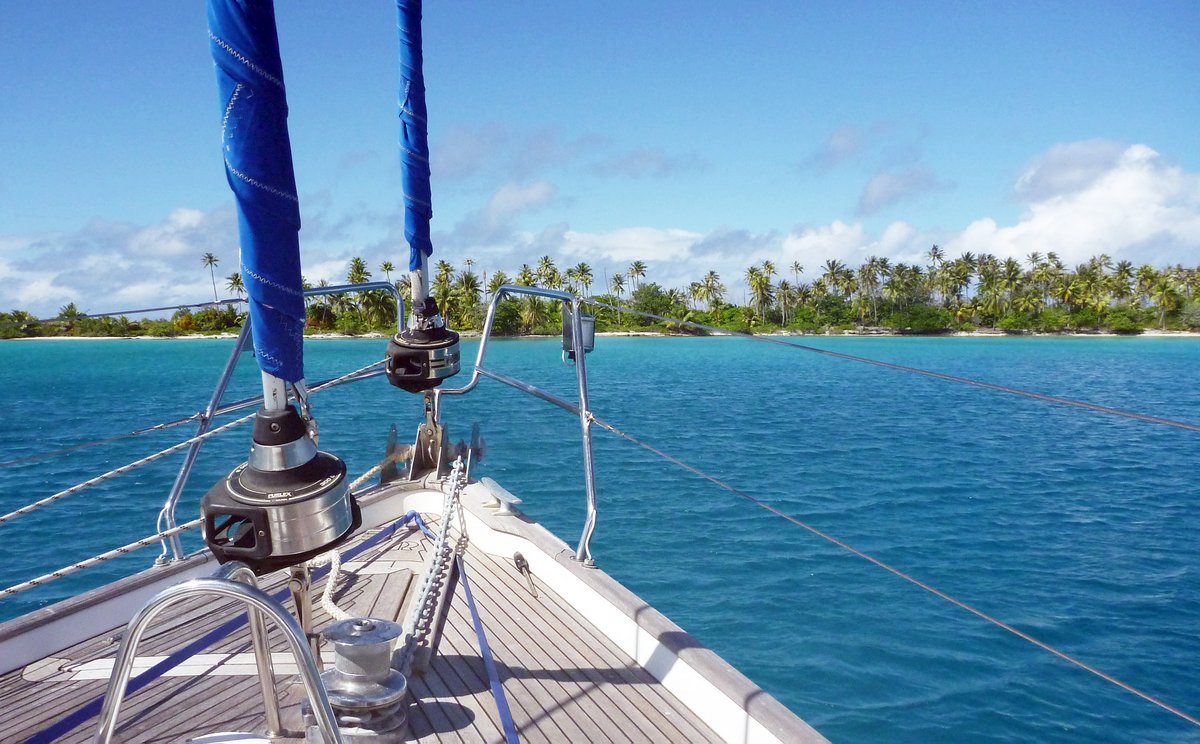
We finished our various chores by four 'clock, cracked open some nice cold beers and chilled out - reading and gazing at our surroundings. This really is a lovely anchorage - the water is multiple shades of blue leading up to the white beach of the motu with palm trees swaying in the trade winds. To make things even better the water is flat calm, which is a great relief after the rolly anchorages of the Marquesas.
We had dinner early and the thing that struck both of us is that there’s no sound here. We’ve been so used to the constant blast of wind, the thrum of sails and the slamming of water into the hull that this is a shock to our systems – my ears are actually ringing because it’s so quiet.
23 May 2014 South East Anchorage, Kauehi, Tuamotus
We had a very quiet day, resting and catching up on a few things. Glenys spent quite a long time on her cookbook, entering some more recipes from all the scraps of paper that she’s accumulated over the years. I messed about catching up with my blog and then played the guitar for most of the afternoon.
It’s very strange that we didn't feel the need to go ashore or go swimming, even though we've been on board for six days, perhaps tomorrow…
24 May 2014 South East Anchorage, Kauehi, Tuamotus
We did some jobs in the morning, including dropping the main sail because we have yet another rip in it. This time the stitching on a one foot section along a seam has pulled away. The stitching must be getting weak on all of these seams and, because we have no way of tensioning the leech, the constant flapping is putting additional strain on the sail. On the plus side the sail material itself seems to be strong. We rolled the sail up and left it in the cockpit to tackle tomorrow.
In the afternoon, we went for a walk ashore. The motu stretches for miles around the perimeter of the atoll, but is only a few hundred metres wide. We first set off to walk across to the windward side, walking across rough bleached, broken coral. These atolls were formed millions of years ago when volcanic islands (similar to the Marquesas of today) sank into the sea under their own weight. As the land disappeared the surrounding coral was left behind, continuing to grow, forming a circular atoll. The small motus are literally formed from broken, dead coral and inhabited by salt tolerant plants. It’s very desolate on the windward side.
We walked along the windward shoreline, looking for shells. Glenys picked up a few, but they’re mostly worn smooth by the crashing waves. There’s a large cairn which I guess has been built by cruisers, so we added our own coral rocks to it. We eventually cut back to the leeward side and came across the remains of a building and a small dwelling that appears to be used as a temporary home for people collecting coconuts and making copra.
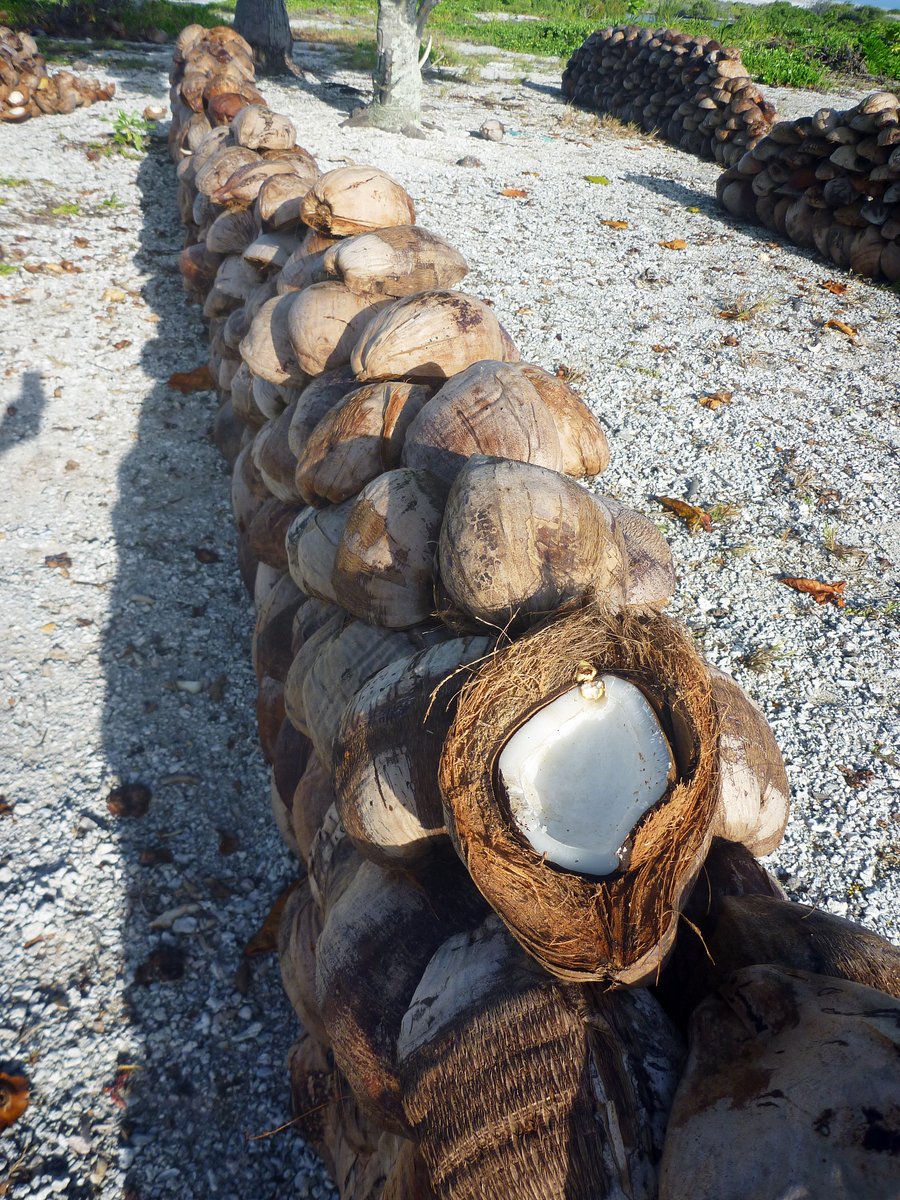
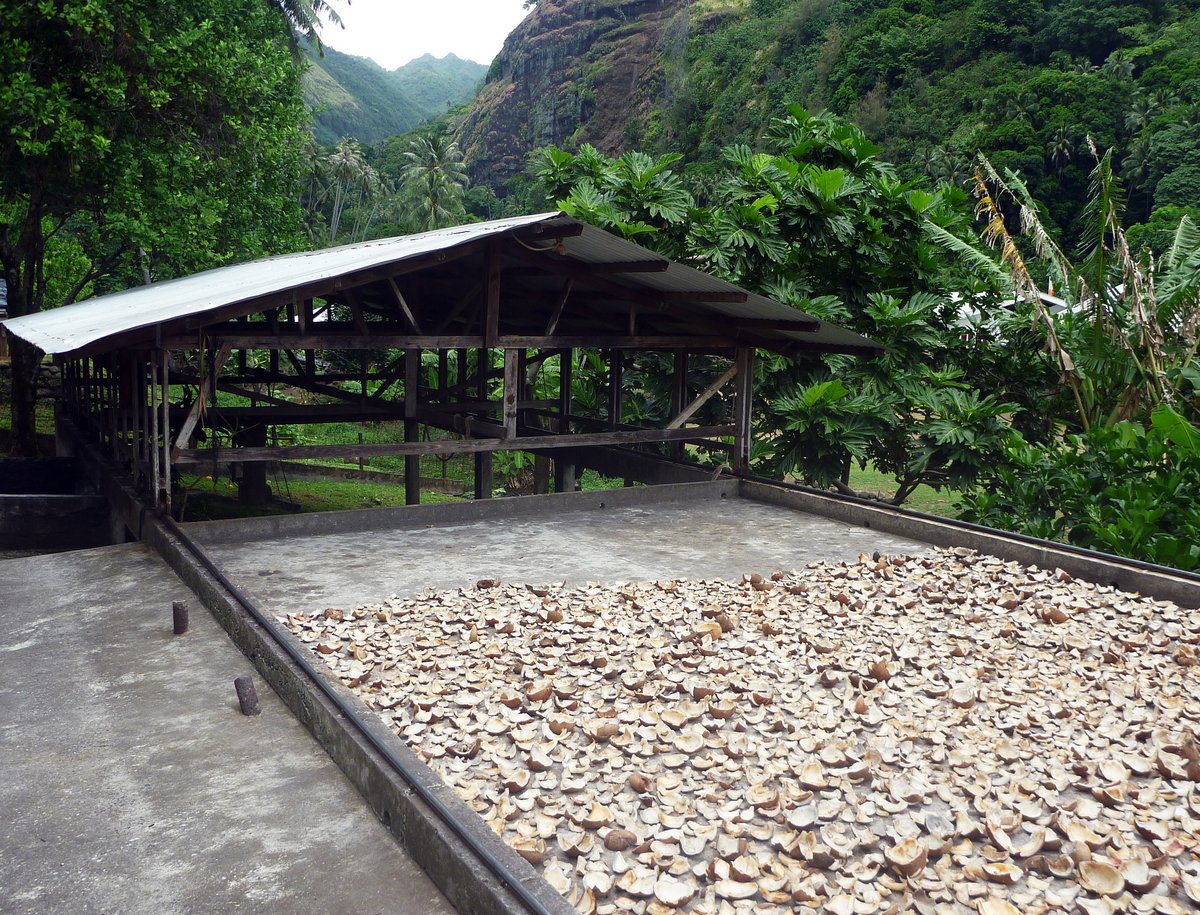
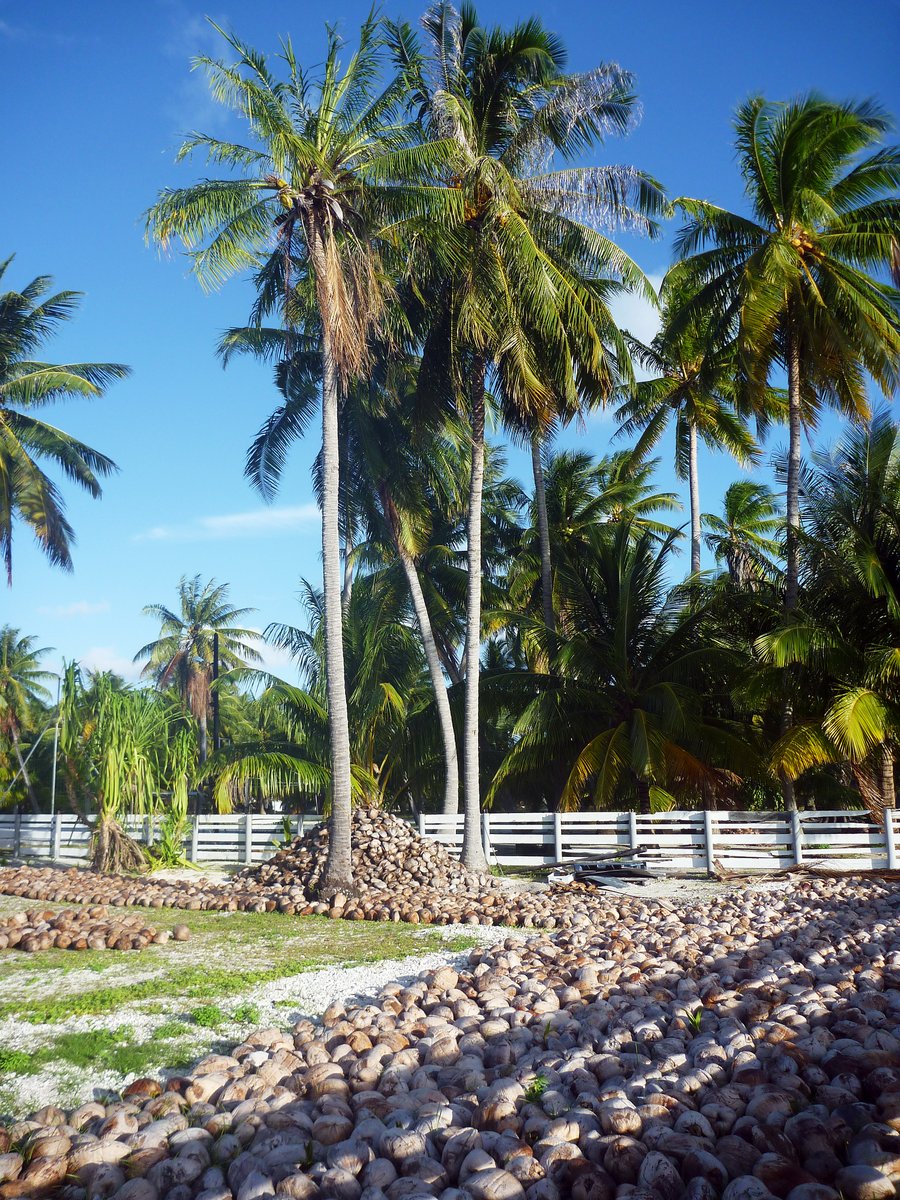
Copra production is found throughout French Polynesia and used to be the main industry of the Tuamotus until tourism and pearl farming took over. Coconuts are collected from the ground, split in half using a machete, then left to dry in long “walls” for a few days. The coconut flesh is extracted using a curved metal tool called a “pana”, and then laid out on concrete slabs to dry in the sun. These drying tables have roofs that can be slid into place when it rains. The Copra is shipped to Tahiti where it is pressed onto oil to be sold to food and cosmetics companies.
Back at the boat, I dived down to check our anchor chain and it’s lying on the sand alongside a huge coral head, so my cunning plan of using fenders to suspend it isn’t working. We look to be okay as long as we don’t get any very strong winds from the south east.
25 May 2014 South East Anchorage, Kauehi, Tuamotus
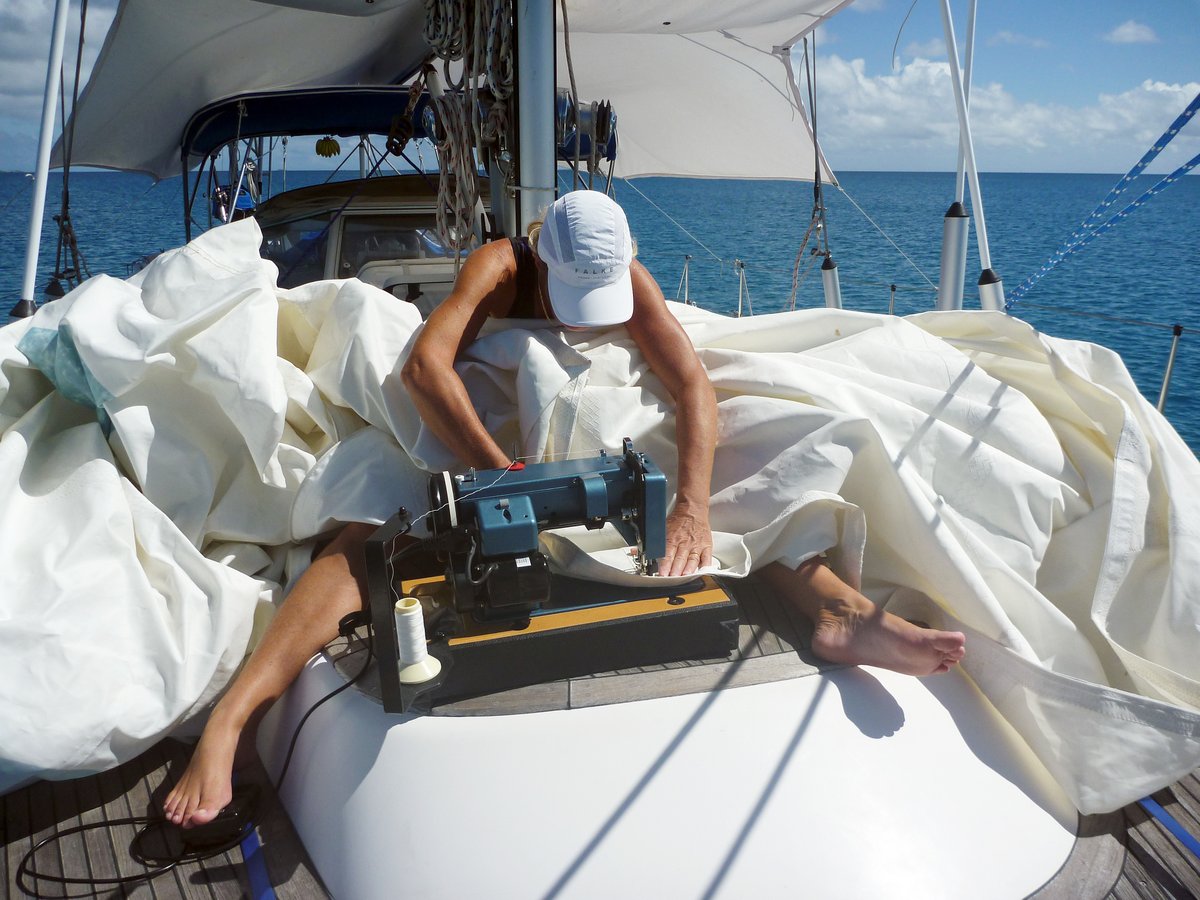
It was a nice day with light winds, so we set the sewing machine up on the front deck and worked on the main sail. Glenys first hand-stitched the one foot long tear to hold to hold it in place then put three rows of zigzag stitching along the seam. We then spent three hours reinforcing each of the other 14 seams with two rows of stitching.
The biggest problem with working on the main sail is that it is so big and bulky. The sewing machine only has a one foot arm, so we’re restricted on how much physical material will fit underneath it. We only managed to sew four feet of each seam from the leech, but hopefully that will be enough - all the problems that we've had so far have been at the leech.
I’m fairly convinced that the fabric of the main panels is still in good condition, so I don’t think that we need a new sail just yet - we need to find a sail loft that will be able to replace the leech seam and run a couple or rows of stitching down each seam. We’ll have to try to find a sail maker when we get to Tahiti.
Later in the afternoon, we went snorkelling. I first checked the anchor chain which was caught on a coral head, so I dived down to 10 metres and untangled it. We then went and had a look at the shallower coral heads – it was okay, but there’s a light dusting of sediment on everything and the fish are all quite small. However, I did have three sightings of a Black Tipped Shark – now was it three different sharks or the same shark three times?
Glenys looked around for a few minutes and then went back to the boat to clean the water line, which is in a disgusting state with 8 inch long green fronds and large Gooseneck Barnacles. We last cleaned the hull in Fatu Hiva only a month ago – it’s amazing how quickly stuff grows here.

26 May 2014 South East Anchorage, Kauehi, Tuamotus
The list of stuff that we have to buy for the boat is growing, so we both spent the morning looking through marine and sail-making catalogues and producing a list with catalogue numbers and rough costs. When we get to Tahiti, we’re hoping that we’ll have a decent internet connection and will be able to compare prices from various suppliers.
We have three choices – buy in Tahiti; buy in the USA & get it shipped to US Samoa; or wait until we get to New Zealand. Unfortunately, we ought to buy some things quite soon, such as a dinghy, so we might have to accept the higher cost for things in Tahiti.
In the afternoon, we got on with some jobs. Glenys did some sewing repairs and cleaned more of the waterline, while I looked at our battery monitor and the fluxgate compass which have both been playing up. I pulled the fluxgate compass apart, but couldn’t see anything obviously wrong. The gimbal seems to be smooth enough, so all I did was to put a few drops of WD40 onto the small connector contacts to try to clean them a bit. I’ll have to keep an eye on the autopilot.
27 May 2014 South East Anchorage to Tearavero, Kauehi, Tuamotus
We went over to Tearavero which is the only village on Kauehi. There was hardly any wind when we left and it’s only ten miles, so we motored. On the way, we spotted a few fishing buoys. We’re not sure if they were a pearl farm or individual fishing traps, but we gave them a wide berth. There was also a small reef just under the water at 15°56.17S 145°03.73W – we’re glad that we were keeping a good watch out.
The conditions were so calm that we took the opportunity to re-calibrate the flux-gate compass, after I’d had it in pieces yesterday. This involves motoring around in slow 360 degree circles while the autopilot works out the deviation of the compass. After the process was completed, I slightly adjusted the reading so that it accurately matched our main magnetic compass and the “course over the ground” reading from our GPS. Embarrassingly, this is the first time that I've done this in three years of living on the boat.
Halfway to the village, a big squall hit us giving us 30 knot winds and nil visibility, so we turned off the engine and drifted a-hull for fifteen minutes until it had passed by. Unfortunately, the rocking and rolling affected the fluxgate compass and it was 20 degrees different from the magnetic compass after the squall. Perhaps I'm going to have to get a new one.
We looked at the recommended anchorage to the west of the village, but it was 12-15 metres deep and the charts show that the shoreline dries at low tide, meaning that we would only be able to get ashore at certain times of the day. So, we carried on around the reef to a much nicer anchorage to the North of Tearavero at 15°48.97S 145°06.49W.
It’s a fabulous anchorage being 5-10 metres deep and very well protected from the south to north east. We anchored in 7 metres of water, quite a way from the beach because it’s very shallow close to the shore with lots of coral heads - the water colours are stunning when the sun shines. “Ameho” is the only other boat and has been here for nearly a week, so they gave us a bit of local knowledge.
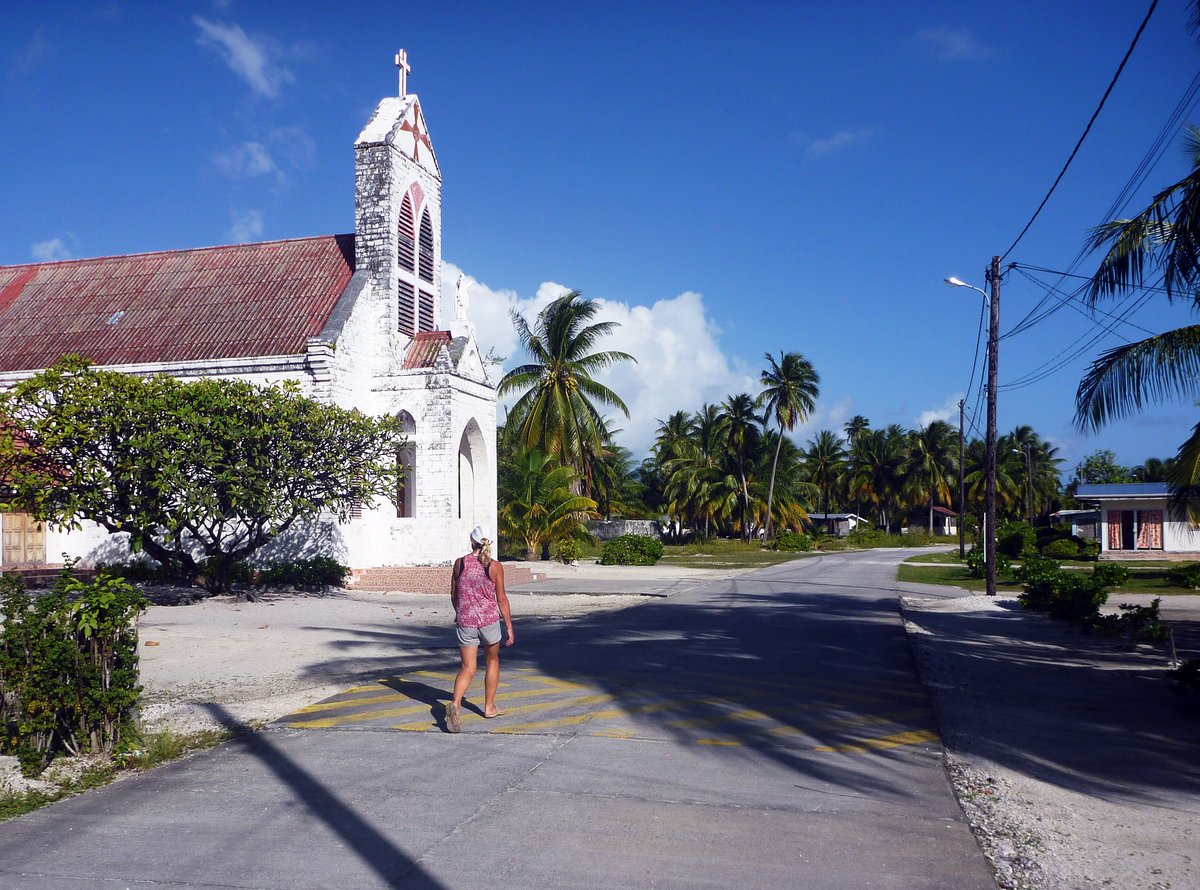
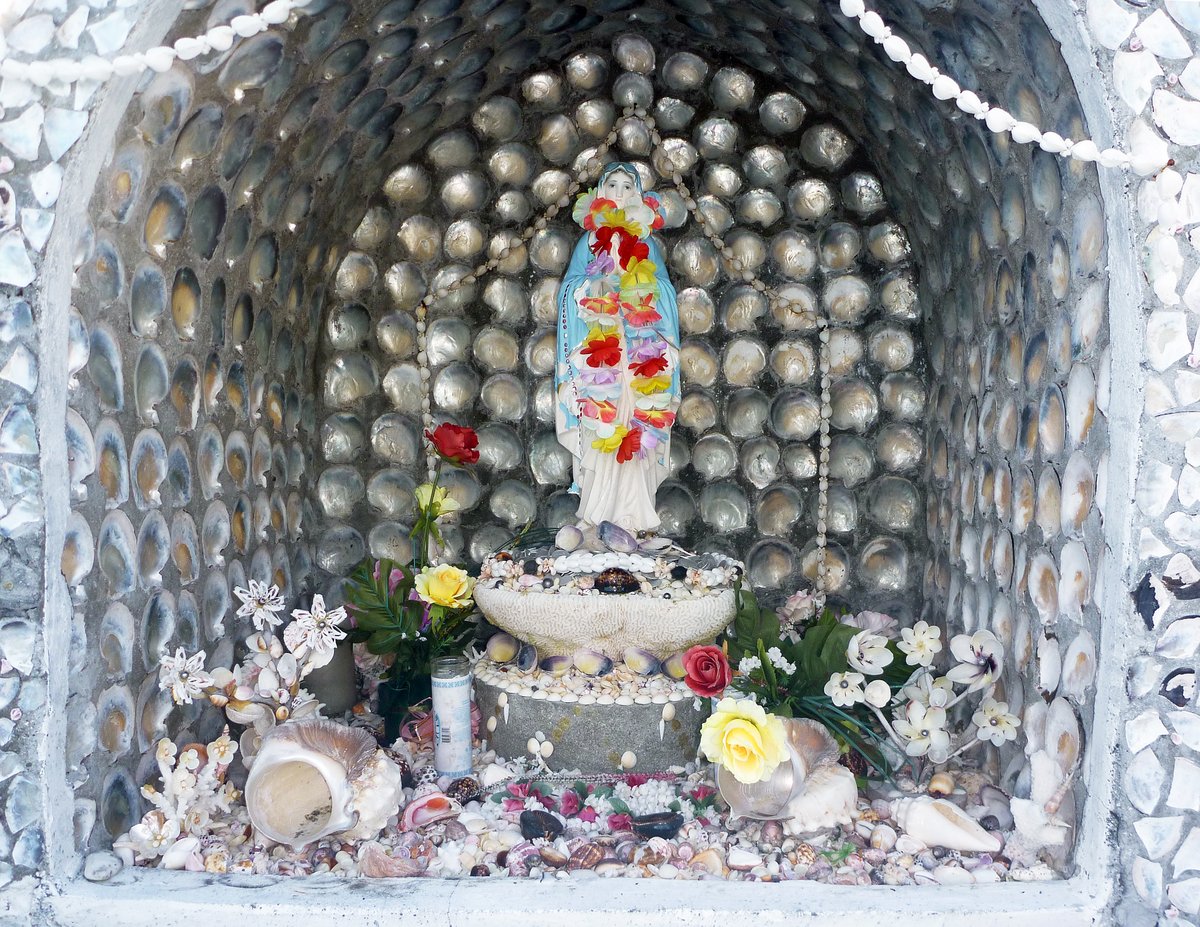
We went for wander around the village, which didn't take long. There’s a nice little church with shell decorations and one small shop which is only open in the morning. I guess that there are about 300 people living here and it would seem that the major industry is copra, because there are piles of coconuts in practically every house.
28 May 2014 Tearavero, Kauehi, Tuamotus
There used to be many pearl farms in this atoll, but there is now only one, which is run by the husband of the lady who runs the grocery store in the village. Didier from “Ameho” told us that they had organised a visit to this pearl farm, so we went in early to see if we could tag along on the trip. The lady at the store thought that there was no problem with us going along on the tour, but was uncertain when her husband would be back from the south end of the atoll.
We went back to the boat and called in on “Ameho” who said that they’d agreed to meet the guy at 11:30. We all went ashore at the arranged time, but he didn't show up. His wife said that he’d be back in an hour or so. Didier said that he’d ring him on his mobile phone, so we all traipsed back to our boats to wait. By two o'clock in the afternoon, I’d had enough waiting around and we gave up – Didier had tried to call the guy every 30 minutes, but he never answered his phone. We’ll just have to visit a pearl farm at the next atoll.
I went snorkelling, but the water was very cloudy with only a few metres visibility. However, there are lots of tiny fish and beautiful stands of Stag Horn Coral. I was dismayed to see the harm that our anchor chain has done to the coral – a few large stands of staghorn coral have been smashed to pieces even though I've tried to suspend our chain above the coral heads with a fender. Looking at the damage, I wonder if it would be better to let the chain drop down to the sea bed. It will snag on coral heads, but may do less damage.
29 May 2014 Tearavero to South East Anchorage, Kauehi, Tuamotus
It was a miserable morning with 25 knot easterly gusts as squalls passed overhead. After breakfast, I tried to call our friends on “Vanupieds” who were due to arrive today and to my amazement, “Lil Explorers” called me back. We've not seen them since we went up the Rio Sambu in the Darien region of Panama last October, so it was great to hear from them. They were still 25 miles outside the atoll heading for the south-east anchorage, so said we’d meet up with them later.
“Vanupieds” called us back and so did our other friends on “Nuwam”. They were both approaching the atoll, so we arranged to meet them at the south-east anchorage. We tidied up and then headed off for the short ten mile trip. A few minutes later, we wished that we’d stayed at anchor because the wind picked up to 30 knots, making it very uncomfortable. We were okay for the first 20 minutes because we were on beam reach, but we then had a very uncomfortable hour, motor-sailing hard on the wind with just a scrap of jib out.
Robert from “Nuwam” called us up on the VHF to confirm that the anchorage had good protection because they were also suffering, motoring directly into the strong wind and only making 1-2 knots headway. We dropped the anchor in the South-east Anchorage just after mid-day and thankfully, the water was lovely and calm in the lee of the motu. “Vanupieds” arrived mid-afternoon and “Lil Explorers” arrived just before dark making it just four boats in this lovely place. The afternoon remained very unsettled with squalls coming through, but by eight o'clock at night the skies had magically cleared – very weird.
Claudia & Tierry from “Vanupieds” and Robert & Heidi from “Nuwam” came over for sun-downers. We've been bumping into them every so often since we first met them in the USA in June 2012 - the last time was in October last year, so we had lots of catching up to do.
30 May 2014 South East Anchorage, Kauehi, Tuamotus
The weather was still grotty with squalls, so we pottered around on the boat for most of the day. We went over to visit “Lil Explorers” to catch up on their adventures for the past six months. It was total chaos. Courage and Shannon have five kids and a teenager on-board their huge catamaran and they hadn't managed to tidy up after their four day passage from the Marquesas. To make matters worse, it was Intrepid’s birthday and the kids were very excited, running around and creating more mess. We stayed for an hour and returned to the tranquillity of Alba.
The weather was a bit better in the afternoon, so went for a snorkel on an isolated coral pinnacle that we’d passed by on our way to Tearavero. It’s very spectacular dropping down from the surface to 12 metres depth, yet it’s only 20 metres in diameter. Unfortunately, we were only there for a couple of minutes before a six foot White Tipped Shark swam close beneath us and then came back over the top of the shallow reef to check us out. It seemed too interested in us, so we ran away.
We’re not too sure how to handle sharks, mostly because we've not seen enough of them to be able to read any patterns in their behaviour. While we've done scuba dives with sharks, we've always been in a bigger group and it’s a lot more unnerving to encounter on when there’s just two of us. Logically, there’s no reason why a smallish shark should attack us larger humans, but are they territorial or get aggressive in close proximity? I just don’t know.
Back at the boat, I snorkelled on some of the coral heads in the anchorage and saw quite a few large, 2 foot long grouper, which would be great to eat, but there’s the constant threat of Ciguatera, so it’s not worth the risk. I really must try to talk to a local about which fish are safe to eat. Another reason not to spear-fish in these atolls is that, in some places, we've been told that you have less than a minute to get a dead fish out of the water before a shark arrives…
31 May 2014 South East Anchorage, Kauehi, Tuamotus
It was lovely day, so we went back to the pinnacle (15°56.17S 145°3.73W) to do some snorkelling, this time with reinforcements - “Nuwam”, “Vanupieds” and Courage & Cassidy from “Lil Explorers” came with us. This time, I equipped myself with our 6 foot long pole spear as a shark deterrent - it probably wouldn't stop an attacking shark, but it made me feel better.
The snorkelling on the pinnacle is excellent. The water is clear and there are large schools of good sized snappers, with grouper prowling around below. Some of the grouper are four foot long monsters - I had a great time diving down to 12 metres and checking out the fish. The grouper are cautious, but not terrified like in other places where there is lots of spear-fishing.
The White Tipped Shark appeared after twenty minutes, but kept close to the sea bed and away from the eight noisy splashing humans on the surface. I felt much braver being armed with my pole spear and with the odds of being bitten reduced to 8:1, so I dived down to get a closer look at it. I must have watched the shark for fifteen minutes and in that time I never saw it catch a single fish. It was constantly swimming around the reef and through tunnels in the rocks, I guess looking for isolated or slow moving fish. It didn't seem interested in us at all.
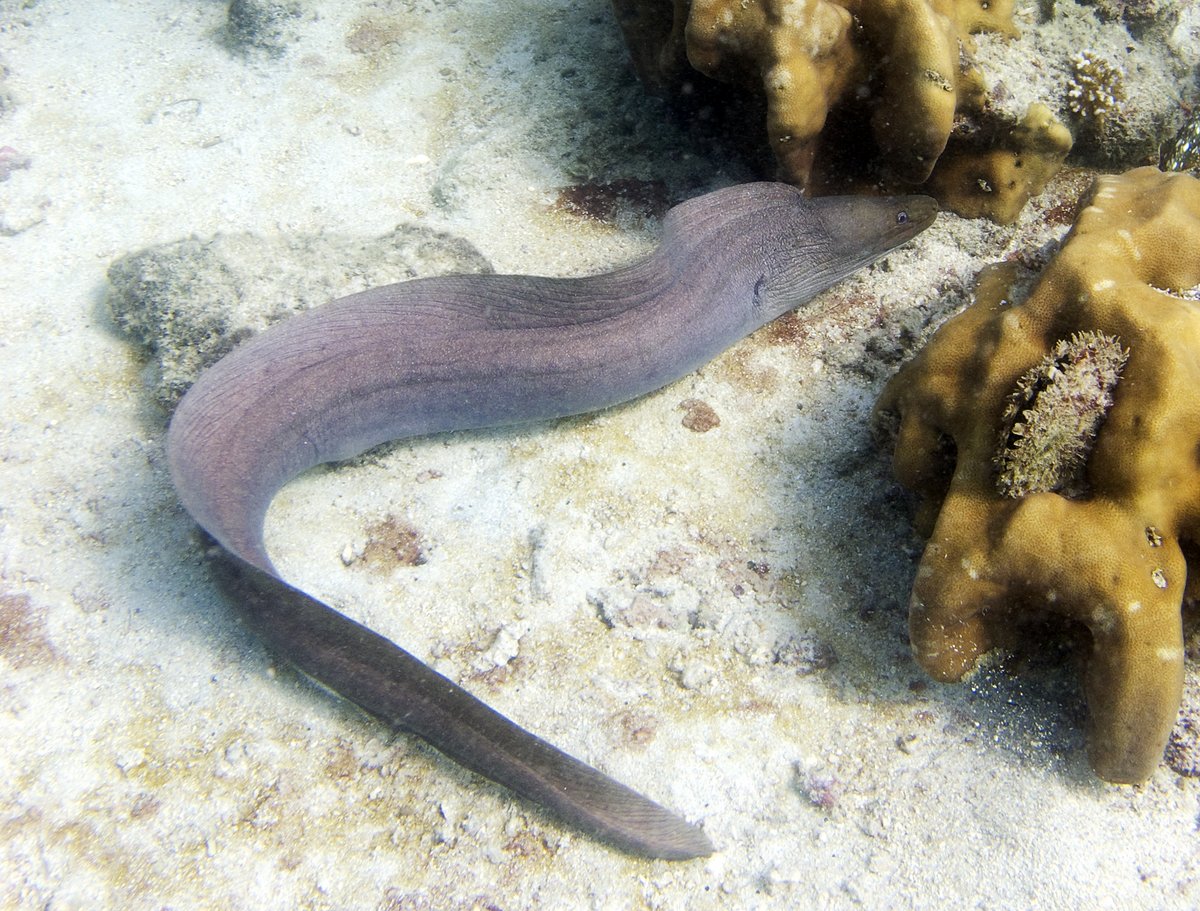
In the afternoon, Glenys went ashore for a walk along the windward side of the Motu, while I stayed on board pottering about and going for a snorkel in the anchorage. Again I saw many large grouper, so I guess that the locals don’t hunt them. I also saw a huge Green Moray Eel.
We went for drinks aboard “Nuwam” with “Vanupieds” and had a good evening, but drank a little too much rum.