
8 May 2014 Anaho Bay, Nuku Hiva
In the morning, we decided to walk around the bay to a farm. When we landed the dinghy on the beach, we chatted to a very friendly guy who was cleaning some fish. He gave us directions to the farm and also to Hatiheu, a village over the ridge to the west. While chatting to him, Glenys spotted some goat’s skulls sitting on top of a boat and asked about getting hold of some goat meat. He said that he had some, so we arranged to meet him at his small pension later.
It’s a lovely walk to the farm, which is very close to Baie Haatuatua, to the east of the anchorage and over a small hill. The path leads through the outskirts of the village past a few houses and a small church. Again the place is beautiful with fruit and flowering trees scattered around the attractive, neatly kept buildings. The houses are very open plan with shutters rather than glass windows and there are often brightly coloured pieces of fabric hanging up to act as screens. The climate here is obviously very benign.
The path follows the bay around to the east, dropping down to the beach and then under a rocky cliff, before climbing through thick vegetation over the small hill. At the top of the hill, the blue waters of Baie Haatuatua can be seen with the farm before it.
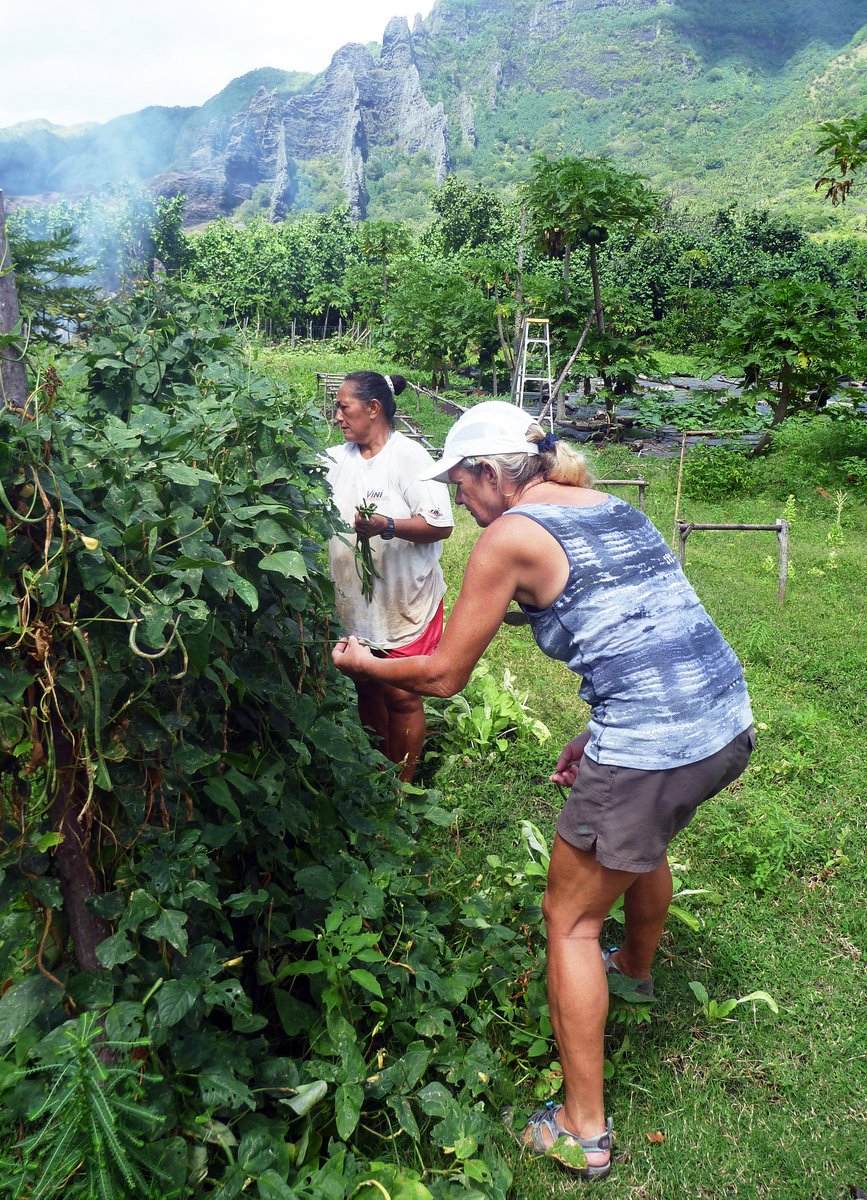
The farm is operated by a small family and they are really nice people. As soon as we arrived, they cut open a Pamplemousse to refresh us after our 45 minute hike before they even asked us what we wanted. It’s a very isolated farm, with the only way in and out being along the rough path back to Anaho. Twice a week, they take their produce to the markets at the main town of Taiohae - everything is put onto pack horses and it takes a few hours to walk over to Hatiheu where the roads starts and they can load their goods into a pickup truck.
We spent an enjoyable half an hour, wandering around the farm, picking fruit and vegetables with the lady. It was a good haul - we came away with aubergines, green beans, tomatoes, basil, chilli peppers, melon, cucumber, bread fruit and, of course, the inevitable bananas and pamplemousse.
After our buying frenzy, we walked on a little further to the beach in Baie Haatuatua. It’s a huge beach with white sand and blue water, but being on the windward side of the island, it’s covered in flotsam and jetson, which as usual is mostly plastic. We didn't stay long.
Weighed down with 20 kilograms of fruit and vegetables, the walk back seemed much longer. Back at the village we hunted out the guy that we’d chatted to earlier and he gave us a huge slab of goat meat out of his freezer. In return we agreed to give him a small bottle of rum, which we’ll drop in to him tomorrow.
The weather in the afternoon was horrible, with strong gusts of wind and rain showers, so we hunkered down and chilled out. Glenys made a huge pan of Goat Curry for dinner and still had about 2lbs of meat which she stuffed into her now full freezer compartment.
9 May 2014 Anaho Bay, Nuku Hiva
It was a nice day, so we walked over to the village of Hatiheu. The trail was quite steep leading up to the col on the ridge high above Anaho, but it was well maintained being the only way out of the village. There were an incredible number of coconut and mango trees all the way up the valley and the path was littered with mangos in various states of decay.
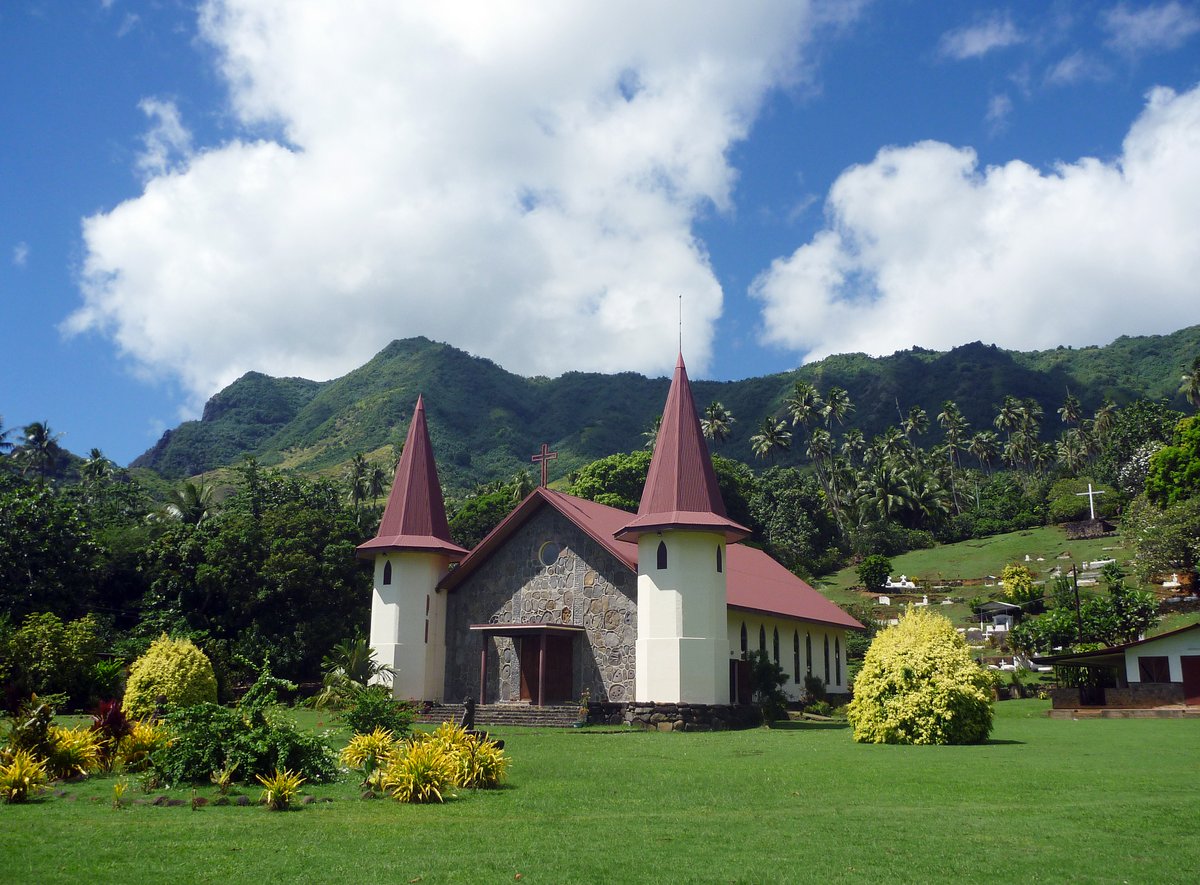
It took us over an hour to get over to Hatiheu, which is a pleasant village strung out along a large bay. There are a couple of small grocery stores and a big restaurant, which charges over $20 per head for a meal – we didn't stop. As usual in the larger Marquesan villages, they have a lovely church which seems overly large for such a small community. We asked the local policeman for directions to the archaeological site of Hikokua, which was a short fifteen minute walk along the main road/dirt track to Taiohae.
Hikokua is a well maintained place, but as with the other Marquesan archaeological sites, there’s not a lot to see – just a set of stone platforms and a few well-weathered stone carvings. The locals have obviously realised the shortfall in their tourist attractions, so there are modern stone sculptures dotted around these sites to add interest, which makes it difficult to know what you’re looking at. We walked further along the road, came across another more overgrown site, then walked back to town.
The locals around this part of Nuku Hiva are very friendly – several people offered us lifts and one guy who stopped to chat gave us a huge green spiky fruit that he was carrying home, telling us that it was called a Sour Sop and would be ready to eat in two or three days.
On the way back to Anaho, we collected mangos from the path and picked them from the trees. By the time, that we arrived back in the village, I was lugging 18lbs of mangos – some green for Kuchela; some half ripe for Chutney and some ripe ones for breakfast.
Glenys still had enough Goat Curry left for dinner and she pan-fried some Breadfruit to go with it. We've never been great fans of breadfruit, having had very stodgy servings in the West Indies, but the chips that Glenys made were very nice – slightly sweet, reminiscent of roasted parsnips.
10 May 2014 Anaho Bay, Nuku Hiva
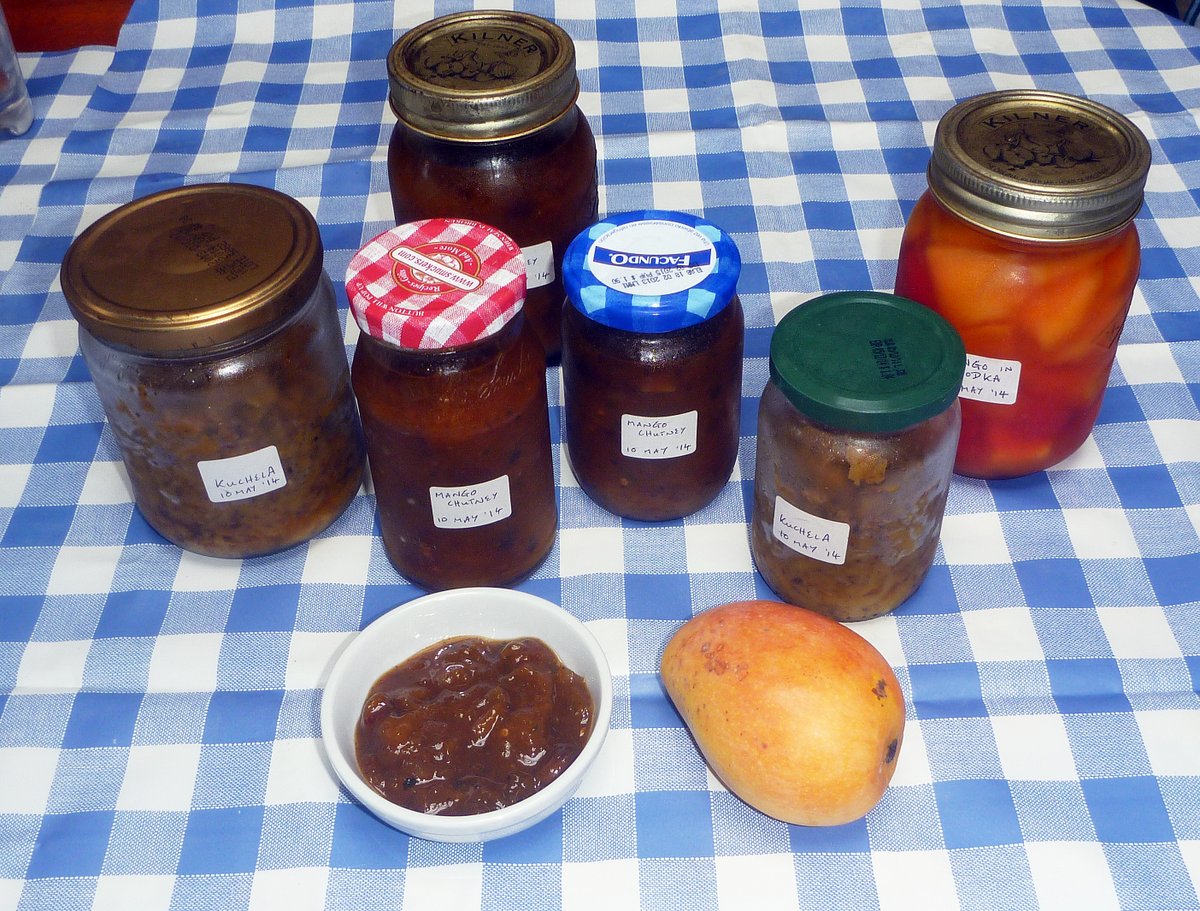
After our long walk yesterday, we decided to have a quiet day pottering about on-board. I did some catching up on editing photos and our website while Glenys processed the mangoes that we’d collected yesterday. She made some Mango Chutney, Kuchela, a mango rum punch, mango salsa and potted some mangoes in vodka. After all this, she still has fifteen unripe mangos stored away in paper to see how long they will last.
In the afternoon, I managed to motivate myself to do a couple of jobs. I recharged the drinks fridge and traced the persistent water leak that has been slowly filling up our bilge over the past month. It’s only about a litre a week, but it’s damn annoying. I checked the water maker pipework and there are a few weeping joints, but nothing urgent. Sea water is still slowly seeping up through the floor of the aft bilge outside the aft heads, so the sealant that I put around the stern tube last August hasn't stopped it. The rudder shaft seals are still weeping, so I also need to keep an eye on that.
I eventually found a leak in the fresh water system on a filter housing in the engine compartment, which is producing one drip every few seconds, which is enough to slowly fill up our bilge. None of these are major problems, but I've now got another four jobs on my growing list.
A Coast Guard cutter came into the anchorage and the customs went around the anchorage inspecting the boats. I was a little bit nervous because I’d casually told the gendarme in Hiva Oa that we only had six litres of spirits on board and I knew that we had more. They arrived mob-handed with five beefy guys crowding into our cockpit with an officer filling in a form.
When they got to the amount of spirits on-board, I said approximately eight litres, but that wasn't good enough - they wanted to know exactly and wanted me to pull it all out onto the saloon table. I decided to be completely up-front and dug out all the bottles hidden away in the front lockers. It was a right assortment of rum bottles which we’ve accumulated from Jamaica, Cuba, Panama and Ecuador. It all added up to about 13 litres, but they seemed unconcerned that we had more than originally stated.
Four guys then wandered around our boat, opening lockers and even lifting floor boards, so I was glad that I’d declared everything. Interestingly, one of the things that they asked about specifically was black pearls. I’d heard that pearls should only be bought from official agents – I guess so that they can be taxed properly. We’re hoping to be able to buy low cost pearls directly from the pearl farms in the Tuamotus, so if we do we’d better be careful.
11 May 2014 Anaho Bay, Nuku Hiva
I woke up realising that we ought to be heading to the Tuamotus sometime next week, so I downloaded a GRIB file and checked the weather forecast for the first time for a couple of weeks. There doesn’t seem to be anything bad around, so it looks like we could go anytime.
I started re-reading our information about the Tuamotus, which are a set of low-lying coral atolls, 500 miles to the south west of here. It’s very important to arrive at the narrow passes into the atolls at slack water, so I checked our iPad and chart plotter for tidal information. I found that the iPad was showing incorrect tidal information for our current position, which is a bit worrying - it seems to four or five hours out. The last time that it was connected to the internet was in Ecuador, so perhaps it think that it’s still there?
Worried about not having any tide information, I had a wander around the five boats in the anchorage asking if they have any official tide tables for the Tuamotus, but interestingly everyone relies on their chart plotters. I’m going to see if I can down load some tide tables from the internet when we get back to Taiohae.
While I was going around the anchorage, I discovered that Dennis from “Pamela” is a very good guitarist, so when I called at his boat, we had a chat about guitar playing and he invited me over to have a music session with him after lunch. Dennis has been playing for over twenty years, so I learned a lot and verified that my basic technique is okay. I had a great time showing him how I played various tunes and he showed me lots of different ways of playing the same thing.
In the evening, we had a jam session on “Kika”, with John playing jigs on his fiddle, Dennis improvising a rhythmic backing and me trying to keep up with both of them - it was a little cramped in “Kika’s” small cockpit with nine people and three instruments. As well as Dennis and Pamela from “Pamela”, David and Bella from “Admetus” were there.
12 May 2014 Anaho Bay, Nuku Hiva
We both love Anaho Bay. It’s by far the best anchorage in the Marquesas that we’ve visited and how we imagined the South Pacific to be. The bay is sheltered from the swell, the towering hills are impressive, there’s a lovey white sand beach fringed by coconut palms, good snorkelling, great hiking, no mosquitos in the anchorage and the locals are very friendly. But, unfortunately, we've been here nearly a week and it's time to move on.

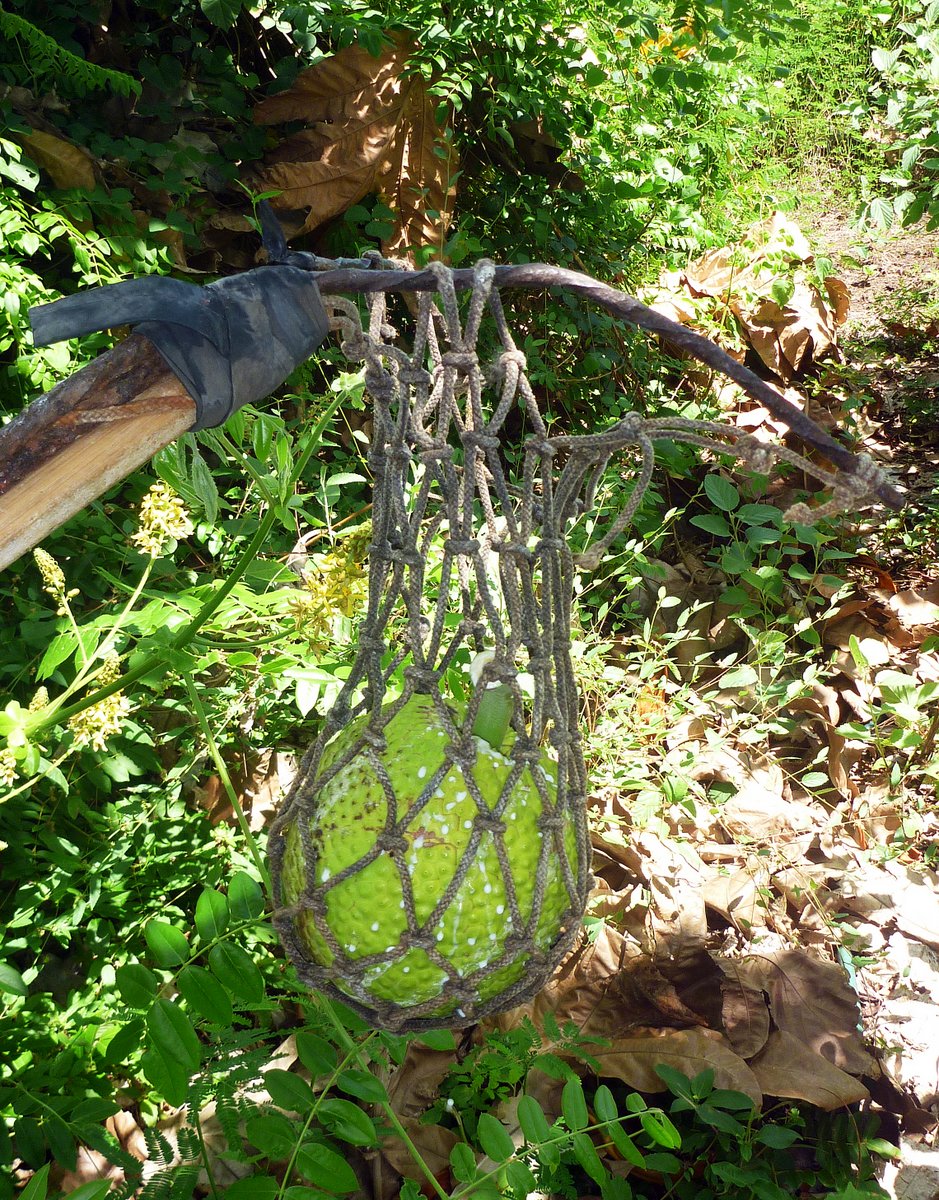
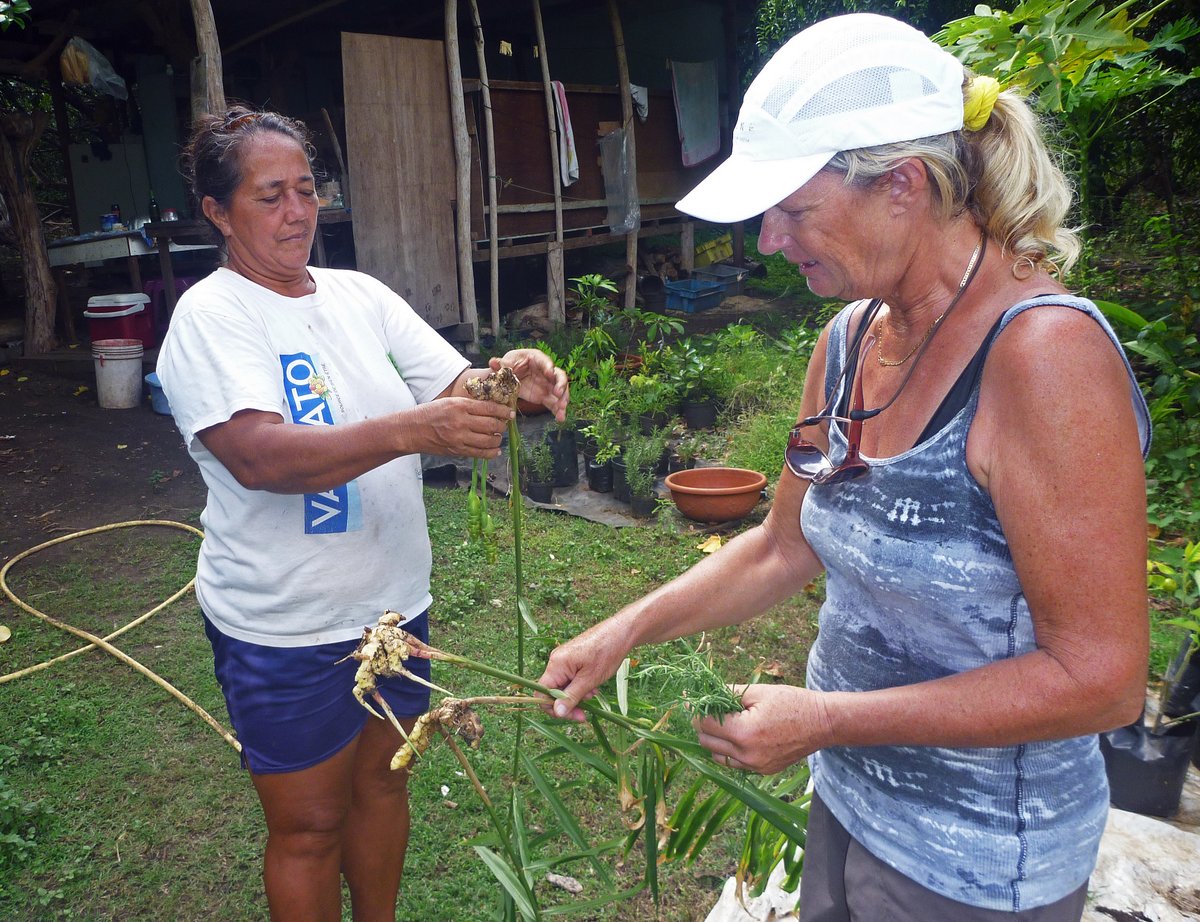
It was a nice day, so we went for a walk to the farm, where Glenys topped up her stocks of tomatoes, aubergines and bought some fresh ginger and other herbs. I’ve enjoyed both visits to this farm because it’s interesting to see how they grow and pick their produce. Today, they dug up some fresh ginger roots for us and showed me how they use a net on a pole to harvest Breadfruit. I also discovered that breadfruit should be picked when it’s a yellow-green colour not green.
On the way back to the boat we saw a couple of Manta Rays gliding along over the shallow reef. They look very strange from above, with their wing tips sticking slightly out of the surface as they fly along underwater.

After lunch, Glenys pulled out her sewing machine and did some small repairs to our big sun awning that was damaged in the strong winds a few days ago.
I was motivated by yesterday’s musical sessions and sorted through my music, refocusing my playing and what I need to learn. I’ve been playing finger-style without a pick for a year or so and have now decided to have another go with a pick, so I’ve restarted the “Learn & Master” video guitar course that I originally used to teach myself.
In the middle of the afternoon, Colin from “Kika” came over in a mild panic because John was perched on the rocks on the shoreline having dislocated his right shoulder while trying to climb into their dinghy after snorkelling. With the help of David from “Admetus”, we got him on board “Kika” and he was obviously in a lot of pain.
Fortunately, John is a doctor and has a supply of morphine and other painkillers on board. John had dislocated his shoulder previously in the middle of their Atlantic crossing, so Colin had experience in how to manipulate the arm back into its socket. We tied a rubber tourniquet onto John’s left arm and John inserted the needle for a catheter into one of the veins on his own left forearm. Meanwhile, Colin put 20 mg of Morphine into a syringe and injected it intravenously through the catheter.
John sat in front of David with his armpit supported by David’s knee. Colin stood in front of John and gripping his upper arm firmly, pulled it across and up into the socket. It took two attempts, but the arm went back into the socket with an audible (and slightly sickening) popping sound. The relief on John’s face was immediate. By this time, the morphine had seriously clicked in and John was pain-free and very, very happy.
13 May 2014 Anaho Bay to Taiohae, Nuku Hiva
Before we left, John from “Kika” came over to drop something off and seemed to be in good spirits despite the trauma yesterday. He said that his shoulder is a bit painful, but nothing too bad.
We motored out of the anchorage and I started to pull out the mail sail, but it jammed half way out. We have in-mast reefing where the sail is rolled up inside the mast with a narrow ½” wide vertical slot where the sail comes out. Unfortunately, we had some creases in the leech of the sail which had jammed inside the mast. All my usual tricks of winding the sail back in tighter, lifting the boom and using the outhaul all failed, so we went back to the anchorage.
Once we anchored, I donned my climbing harness and went up the mast. By lots of pulling and winding the sail in and out, we managed to free the sail from the slot. The leech had tucked over double at the top of the sail and so it was winding twice the thickness all the way down. Combined with the patches and strengthening tape that we put on the leech in the middle of the Pacific, this was enough to jam the sail in the slot. I’ll have to keep a careful eye on the leech when rolling it away until we get the sail properly fixed.
With our minor crisis averted, we motor-sailed out of the anchorage and hit very gusty 25 knot winds as we rounded the headland. To make matters worse, the seas were horribly confused as the large oceanic swell hit the rocky coast and bounced back. We also appeared to have a one knot current against us, so it was a tough hour going the first three miles.
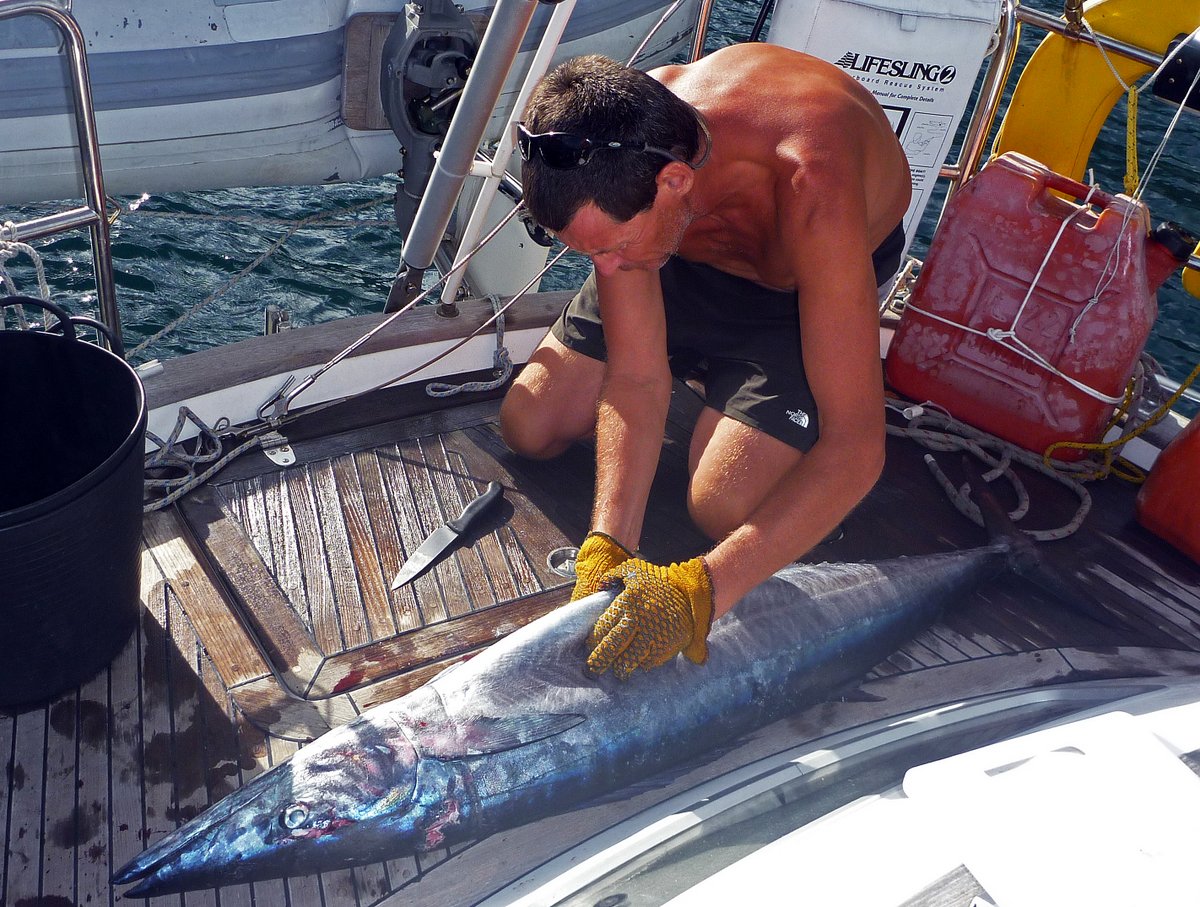
Just as we were ready to make the final tack around the headland, my fishing line went zipping out. We were in no state to deal with a fish, so I simply increased the tension of the clutch and we dragged the poor fish along with us for half an hour until we were in a better position. Even so the fish put up a good fight and I was very, very pleased to land a huge 36lb Wahoo. This was the first Wahoo that I’ve ever caught and what a monster – it was a real mission to lift the gaffed fish on board.

We were hoping that we’d be able to sail once we rounded the headland, but the fickle wind kept heading us, so we gave up and motor-sailed along the east coast of the island. The motion was horrible, so I lashed my precious Wahoo down on the aft deck and covered it with a wet towel to keep it cool.
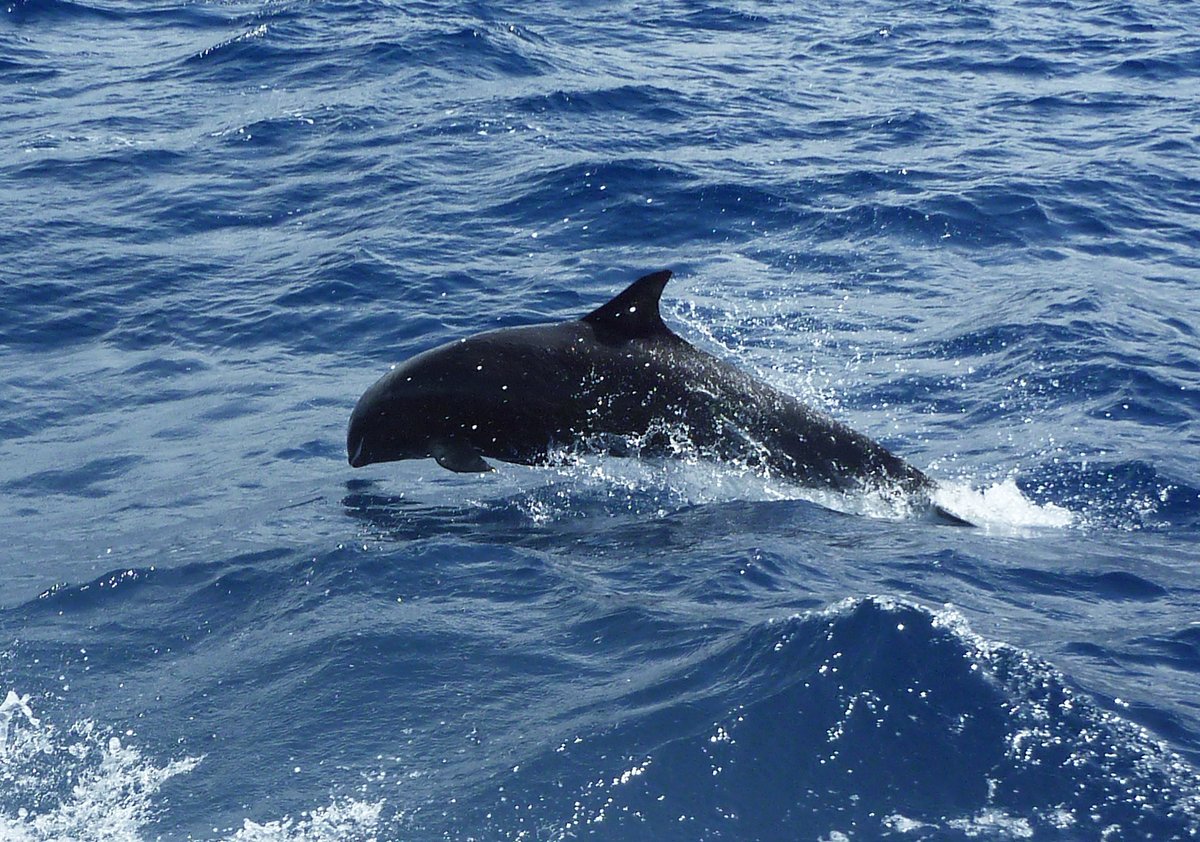
As we bashed our way along the coast, we were joined by pods of dolphins and Pigmy Killer Whales. These oceanic whales are about the size of common dolphins, but have flat heads with no beak. They were very enthusiastic, leaping out of the water and playing around our bow wave. Normally Pigmy Killer Whales are rarely seen, but big pods of them gather around Nuku Hiva, so we were very privileged to observe them at such close quarters.
It took us four and a half miserable hours to reach the anchorage in Taiohae - even though we motor-sailed most of the way. The anchorage was very rolly and unpleasant after the lovely calm anchorage that we’d just left.
While Glenys tidied up the boat after the chaos of our short bouncy passage, while I filleted the huge Wahoo. We only had space in our fridge for one quarter of the huge fish, so I jumped in the dinghy and ran around the anchorage giving fish to friends – I was very popular. We had pan-fried fish, chips and peas for dinner – breadfruit chips of course.
14 May 2014 Taiohae to Daniel’s Bay, Nuku Hiva
The coast guard had been telling cruisers that a large 2-3 metre southerly swell was heading towards the Marquesas and were expecting the anchorage to get very, very rolly with braking waves close to the shore. We decided that we would run away to Daniel’s Bay which is supposed to be much more protected.
We’re planning to leave for the Tuamotus in a few days, so this would be our last chance to buy provisions for a month, so Glenys ran off to the supermarket while I sat in Yacht Services and used their wifi internet. Glenys got a lift back from the supermarket and we ferried the shopping back to the boat.
After a lunch of lovely fresh baguette, we waited for some rain showers to pass over and then motored five miles around to Daniel's Bay. The anchorage is very spectacular with steep cliffs guarding the narrow entrance, which is difficult to spot from seaward – a perfect pirate hideaway. We anchored in 8 metres with three other boats. Although the bay appears to be totally enclosed by land, some swell was creeping through the narrow channel and making it a little rolly, but nothing as bad as Taiohae.
It rained on and off all afternoon, so we hunkered down for the rest of the day – Wahoo in Peanut Sauce for dinner.