
15 May 2014 Daniel’s Bay, Nuku Hiva
We had a horrible night - the wind was making us swirl around, so that sometimes we were side onto the swell coming in to the anchorage making us roll and at other times the waves were hitting our stern and making a loud slapping noise. The sugar scoop at the stern of our boat is hollow fibreglass and the sound is amplified like a drum, so it’s a horrible, constant noise. Eventually, at four o'clock in the morning, I cracked up and moved into the front cabin where I slept a little better.
Most of our day was spent catching up on jobs. Glenys got on with some cleaning and sewing jobs, while I gave our dinghy a bit of tender loving care. The poor thing is on its last legs because the Hyperlon fabric has finally perished after nine years of the tropical sun. I lifted it onto the foredeck and tried to find the leaks that are forcing me to pump it up twice a day.
I found serious leaks around the big patch that I put on the starboard tube a few weeks ago, but couldn't find the leak in the front tube. Unfortunately, we didn't have a patch big enough to go over all of the leaking patch and I thought that it would cause more damage to try to remove it, so I put a layer of rubber caulking sealant around the patch to try to slow down the leak and then I’ll put on some small patches over the edges tomorrow.
16 May 2014 Daniel’s Bay, Nuku Hiva
The dinghy was still unserviceable, so we were forced to stay on-board all day. Glenys finished off patching the dinghy, while I sorted out the water leak in the engine room and then repaired a leaking seal in the front toilet - one of my least loved jobs.
Glenys made Panzanella for lunch, which is a great way of using up stale baguettes – tastes delicious. In the afternoon we chilled out. I spent most of afternoon watching video guitar lessons and playing the guitar. I'm back to basics re-learning how to use a pick and it’s all simple stuff. Glenys is being driven crazy as I play crappy tunes like Jingle Bells and Yankee Doodle to cheesy backing tracks.
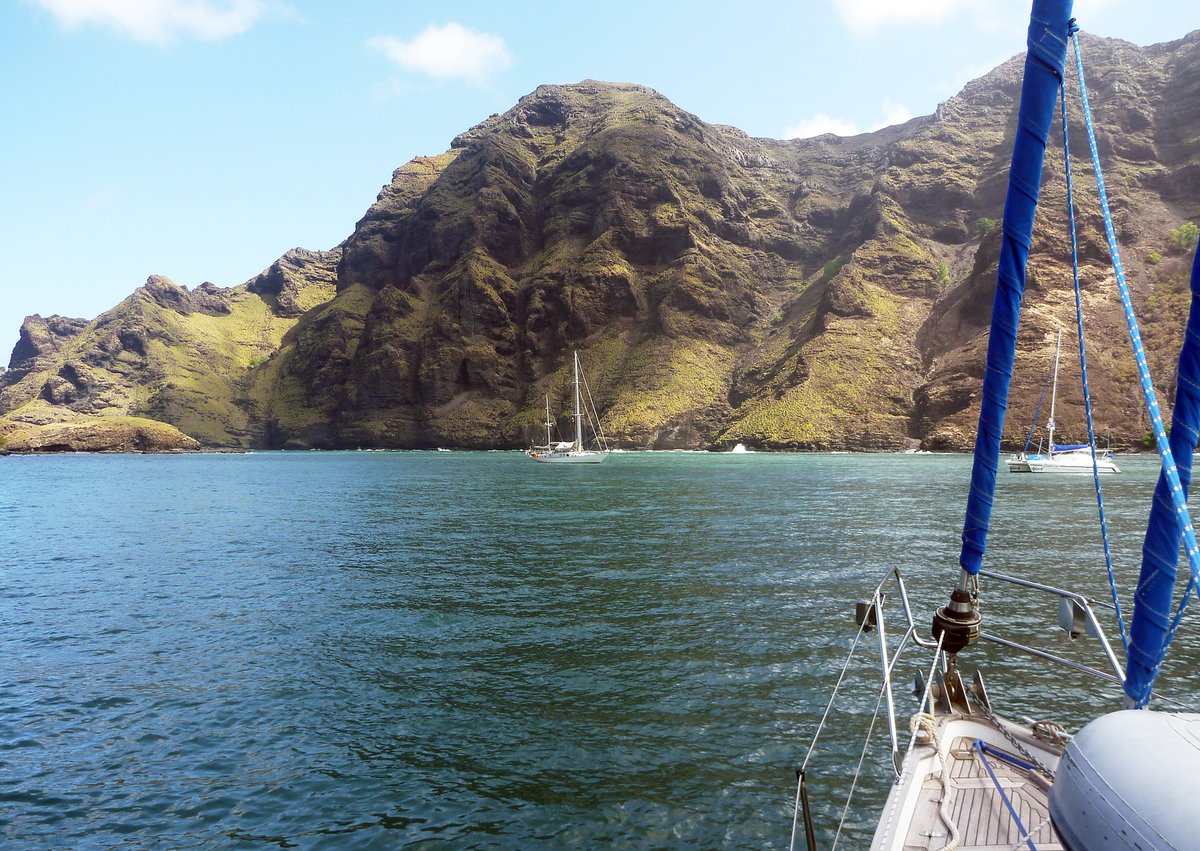
Daniel's Bay is not one of my favourite anchorages. It has impressive cliffs all around it, but with the overcast conditions that we've had it’s very gloomy and the constant rolling from the swell is very irritating. It seemed a little calmer today, so I chanced sleeping in the aft cabin again.
17 May 2014 Daniel’s Bay, Nuku Hiva
It was a horrible night, with rain and huge gusts of wind, which continued into the morning. We'd planned on hiking up to a nearby waterfall, but resigned ourselves to another day on-board and decided to get ready to leave for the Tuamotus tomorrow.

I spent all morning trying to figure out the tides for the entrance into the Kauehi Atoll. The current rushes in and out of the small passes in through the reef at up to 8 knots, so it's important to get it right. You would think that it would be a simple thing to look up, but I looked at two different electronic charts, a program called wxtide32 and the tide tables from NOAA and none of them were the same. There’s 90 minutes difference between all the sources, so I guess that we’ll have get there at the earliest slack water and eyeball it.
The rain stopped after lunch, so we pumped the dinghy back up and went ashore. It was around two o'clock by the time that we'd landed on the beach, so we didn't really have time to walk to the waterfall, but we thought that we’d give it a good try. The path from the beach leads around the bay to a small village.
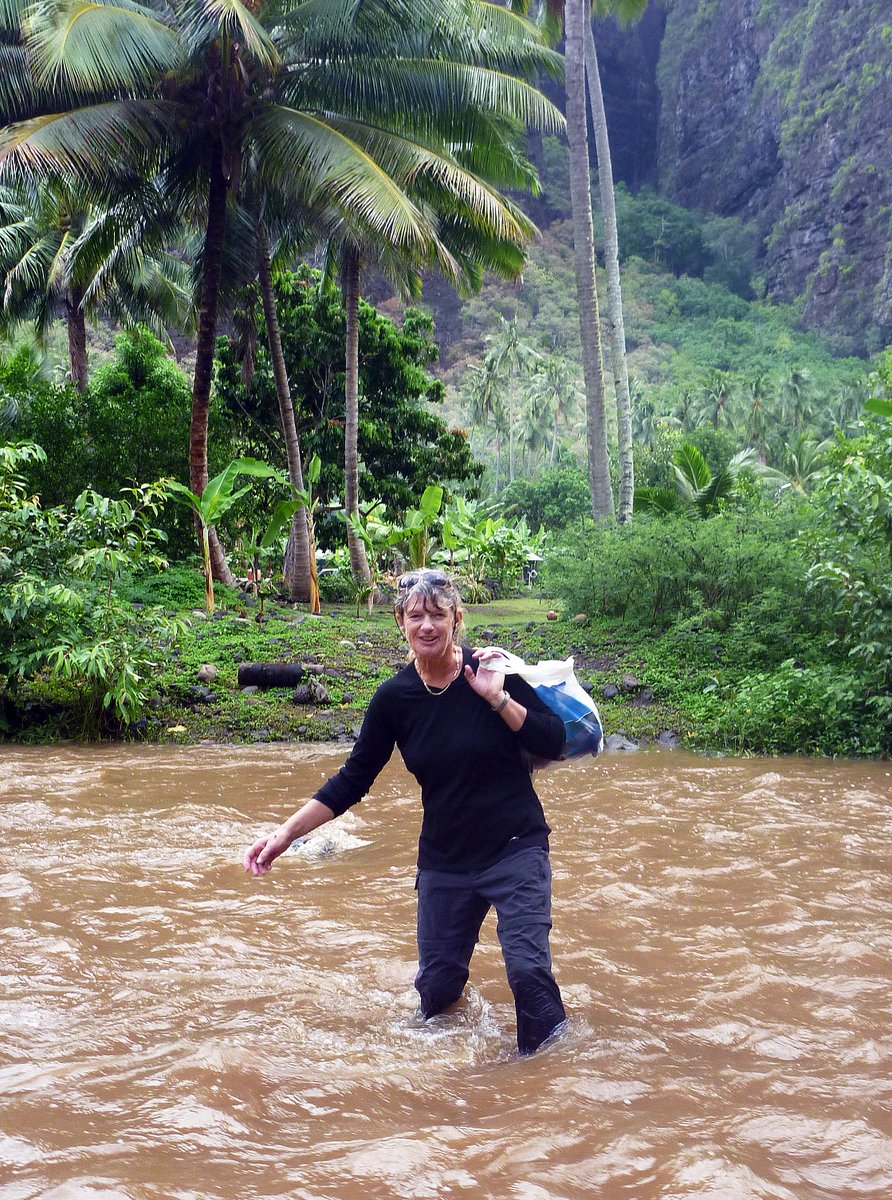
On the way, we had to wade across a 30 foot wide river to get to the village, which was running fast and two foot deep after the heavy rain we'd had this morning. Fortunately, we met a local guy and his son who led the way. We chatted to him after fording the river and agreed to call at his house on our way back to buy some fruit.
It was a nice, but muddy walk towards the waterfall, going past tidy small-holdings where the locals grow bananas, pineapples, pamplemousse and other produce. Unfortunately, after a kilometre we were stymied by another ford over a river. I waded in up to my thighs, but the current was very strong. We would probably have made it across okay, but I was worried that the river might flood even more and we wouldn't be able to get back across.
On our way back, we picked up limes and lemons that were lying on the path and then bought 10 huge pamplemousse, 8 oranges, 30+ bananas and some star fruit from the guy that we met earlier. He had a fabulous set of tattoos, which he said were done in the traditional way – not with a machine. When I asked to take his picture, he snarled making himself look fierce, presumably like his cannibal ancestors would have looked. You wouldn't want to meet him in a dark alley...
To get back to the beach, we had to haul our fruit over the river, which seemed a little more flooded, so I think that we made the right decision in turning back. After going for a walk and chatting to the locals, I feel a bit better about this anchorage, but it still won’t make it onto my favourites list.
Back on the boat, I decided to run generator, but the damn thing wouldn't start - just what we need the night before we go on a five day passage. It fired up a couple of times then cut out. Suspecting a fuel problem, I quickly found a fuel leak and traced it to a small leak in a rubber fuel line. Fortunately the hole was near the end of the rubber hose, so I was able to cut some off. After a few attempts to start it, bleeding the fuel system between goes, I got the generator running – sorted in 25 minutes and what a relief.
18 May 2014 Daniel’s Bay to Kauehi, Tuamotus (Day 1)
It was half past nine by the time that we'd tidied up and prepared ourselves for the 525 mile passage to Kaeuhi atoll in the Tuamotus. As we went out of the narrow entrance to the bay, there was a big six foot swell coming straight in, so it's not surprising that it was a little rolly in the anchorage.
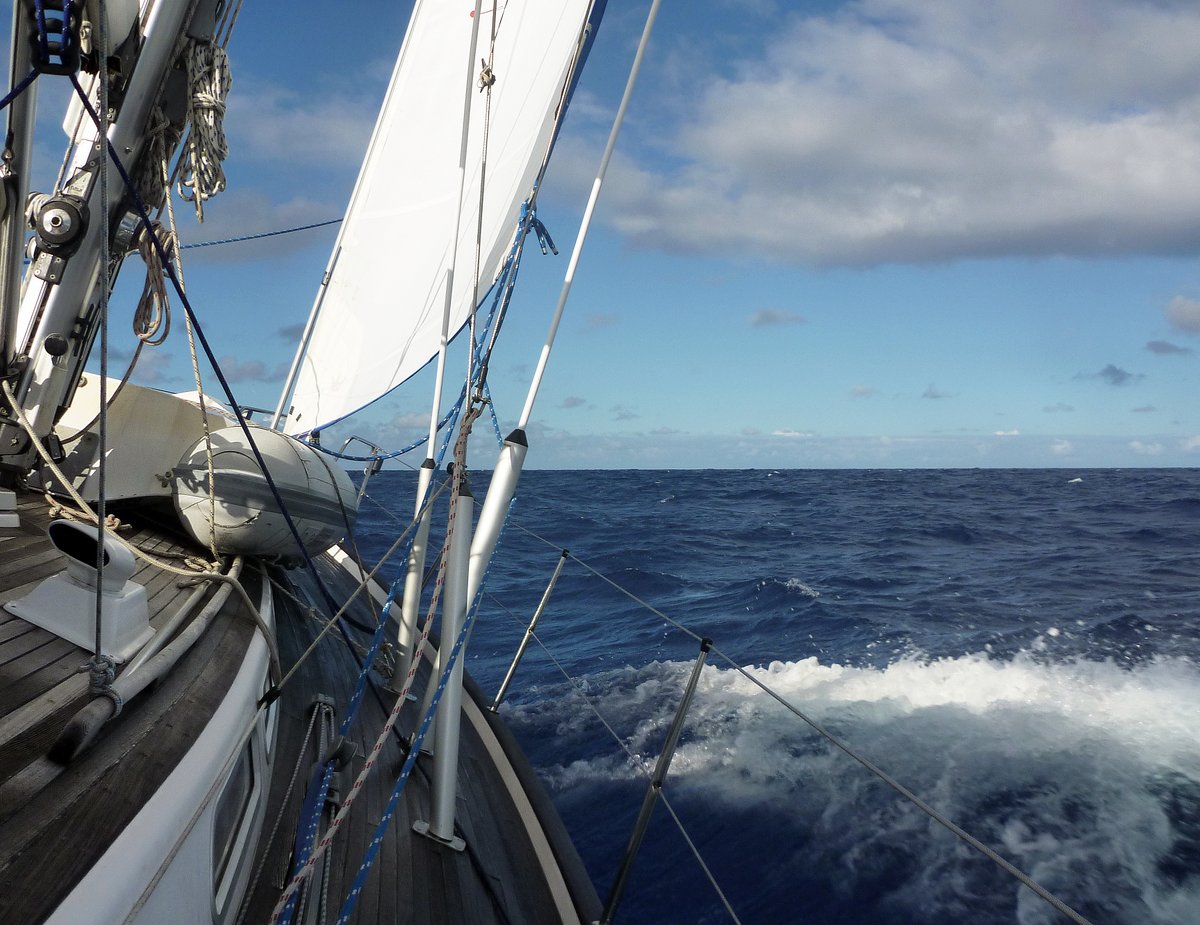
As we sailed away from the island, there was a very nice 15 knot wind from the south-east that boded well for our south-west course and we had a good day sailing on a boisterous reach. The wind was a little inconsistent, but we had a favourable current of at least a knot. As usual, we were both a little restless on the first day of this passage, finding it hard to settle into it.
The Tuamotus are on a different time zone to the Marquesas, so we decided to alter our clocks to the Tuamotus time of -10 UTC. Having changed all of the clocks on board, we then realised that sunset would be at 1700 hrs, which wouldn't fit in very well with our normal three hour watches. We normally have dinner just before sunset and then Glenys goes to bed at 1900 hrs. Being on Tuamotus time would mean that she'd be sitting around in the dark for an hour, so we changed our clocks to -9 UTC and are now running in the Alba time zone.
We had an unpleasant night. The sky was overcast and we had small shower systems passing over us every hour or so. As each system approached, the wind would drop to 10 knots and veer, then increase to over 20 knots and back as the system went overhead. It was made worse because it was so dark that we couldn't see the showers approaching. Rather than keep reefing every time, we left the sails alone and lived with bobbing along with slatting sails in the lulls and then screaming along for ten minutes when the shower hit us. If the squall was strong, then we would run downwind for a few minutes until it had abated - not very restful.
Amazingly, at our 0400 watch change, a cargo ship loomed over the horizon and passed just 1.5 miles to our starboard. Naturally, when it was close to us, the wind picked up to 25 knots and we had a bouncy ride for ten minutes, not daring to run downwind towards the ship. I guess that it was a freighter taking supplies from Tahiti to Nuku Hiva
19 May 2014 Daniel’s Bay to Kauehi, Tuamotus (Day 2)
The night might have been unpleasant, but at least we did 155 miles in the last 24 hours and we’re over half way there. The morning was overcast with the occasional shower accompanied by the same gusty winds that we had last night. Unfortunately, the prevailing wind veered by 20 degrees putting us harder on the wind making it a bouncy ride and forcing us to put a second reef in the main.
I tuned into the Isabella Net, which I set up just before we left Isabella in the Galapagos and was pleased to see that it’s still going. It was originally called the “Goodbye Isabella Net”, but as most people are already in the Marquesas and Tuamotus now, they’ve dropped the “Goodbye”. The net seems to be dominated by Australians, who check in every day, so the nature of the net has changed to be a lot more chatty – I don’t think that I’ll bother again.
Glenys served up a Quiche for lunch , which she sensibly made before we set out and kept for a rough day. The afternoon was much brighter and the wind gradually backed 15 degrees allowing us to ease the sheets a little bit. It was a more pleasant night with clear skies and the wind was much more consistent at 15-18 knots more or less on our beam.
We’ve slotted into our three hour watch system. It was a struggle sleeping the first night, but we’re both getting some sleep now - both of us are watching the clock waiting to go back to bed after each night shift.
20 May 2014 Daniel’s Bay to Kauehi, Tuamotus (Day 3)
At our eight o'clock morning fix, we'd done 294 miles with 231 miles to go. In the previous 24 hours, we’d done 155 miles, so Kauehi was tantalisingly close with an outside chance of getting to the pass tomorrow afternoon. To give us time to get safely to an anchorage, we'll have to get through the pass at 1500 hrs. I did some calculations and found that we'd need to average 7-1/2 knots for 31 hours - there's no chance of that, so we're now resigned to sailing at the more relaxed speed of 5 knots and getting there on the morning of the 22nd - only another two nights.
By mid-morning, the wind had dropped further to 10-15 knots, so we unfurled all three sails and were gliding along at 5-6 knots for most of the day with blue skies and calm seas.
During her watches, Glenys has been catching up on posting a load of recipes to the Galley Slave section of our web site. She has a small A5 folder with various photocopies and hand written recipes that she's gathered over the years and she's finally knuckled down to put them into her cookbook. It's quite a bit of work to get it into the correct format and, of course, there are no photographs of the dishes yet, so I can look forward to her preparing some meals that we've not had for a while, just so that we can photograph them.
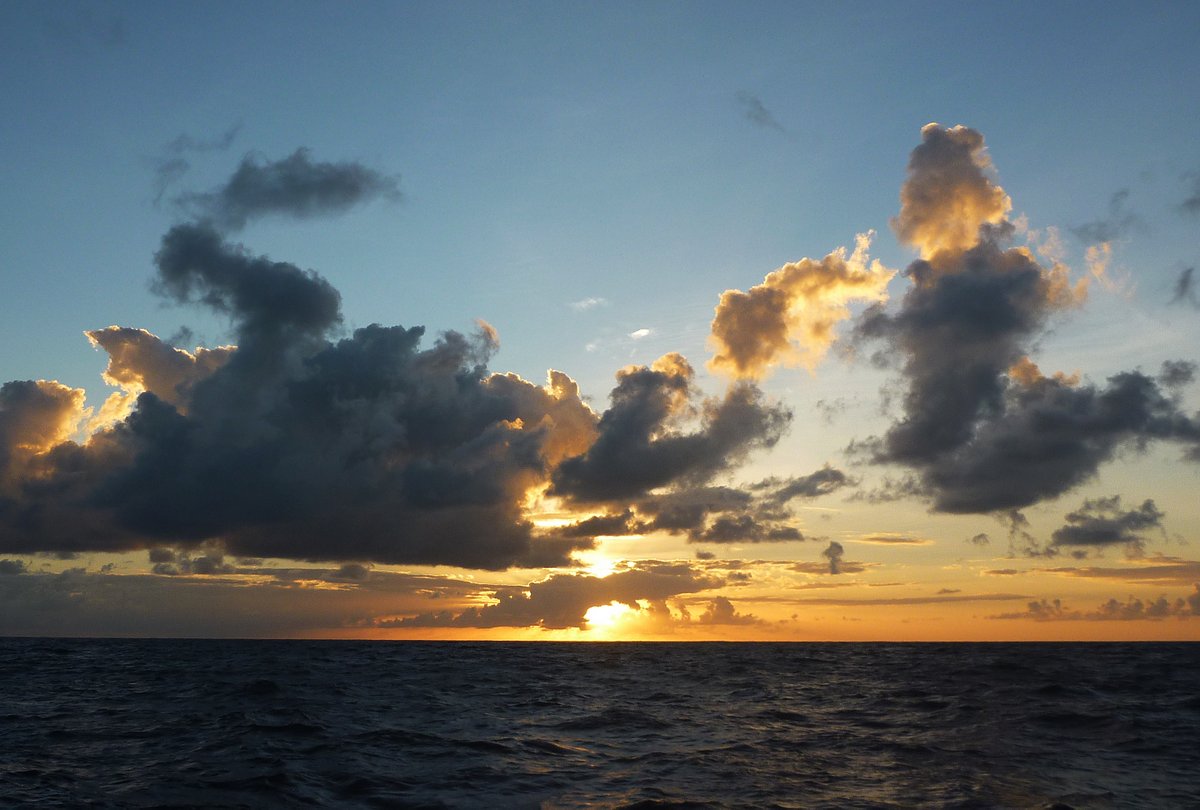
As darkness fell, the wind picked up to 15-18 knots and we could see more clouds around, some with obvious rain showers, so I put two reefs in the main ready to handle squally conditions. It was a very pleasant night until Glenys's 4-7 watch when a big squall hit giving her 28 knot winds and torrential rain. She ran downwind to reduce the apparent wind, but of course that meant that the rain hammered into the cockpit, so when I got up to give some moral support, she was drenched through to the skin.
21 May 2014 Daniel’s Bay to Kauehi, Tuamotus (Day 4)
It was a tough morning with 20-25 knot winds at 60 degrees off our port bow. We beat upwind with a heavily reefed main and just the stay sail, but at least it was sunny most of the time. The GRIB file that I downloaded showed that this wind will continue for the next 48 hours and then there'll be a patch of very squally weather for a few days, so we need to find somewhere nice and sheltered to anchor.
Kauehi is an oval shaped atoll approximately 12 miles long with a fringing reef enclosing a huge, deep lagoon. There's only one entrance through the reef, which is on the south-west side, so it should be okay to enter in these strong south-east winds. Tearavero, the main settlement, is on a small, low-lying island (called a motu) in the north- east corner of the lagoon, but only has good protection from the east, so we're planning to go to an anchorage in the south-east corner behind a few small motus where there should be good protection from the south-east.
I had another look at the tides for the entrance into the lagoon. The fringing reef around the atoll is only a maximum of a couple of metres, so the prevailing swell that crashes on the reef forces water into the lagoon. Since there's only one pass out of the reef, all this extra water flows out of the lagoon through the pass causing a significant change in the tidal flow of water - if the wind and waves are stronger, the bigger the effect.
The normal maximum tidal current in and out of the 200 metre wide pass at Kauehi is 4 knots, but since the wind will have been blowing at 20 knots from the south-east for a few days, I think that the current will be increased by one knot when it's coming out and decreased by one knot when it's going in. In addition, the time for slack water at high tide will be one hour earlier and slack water at low tide will be one hour later.
To make matters a even more complicated, I have conflicting information about the times of high and low tide - four different sources give me a total discrepancy of 90 minutes. So, my best guestimate is that the maximum current on the inflowing tide will be 3 knots and the time of the slack current at high tide will be somewhere between 10 and 12 o'clock in the morning. My brain hurts.
The three knot current is not a problem in itself because we could motor at seven knots if we needed to. However, the strong current rushing in through the narrow pass causes swirling eddies and a strong wind against the current can cause large standing waves which can be a major problem. Our master plan was to sail past Kauehi during the night and heave-to until seven in the morning, then make a slow approach to the entrance at nine o'clock and look at the actual conditions of the water going in through the pass, before committing ourselves.
After lunch, the wind abated a little and thankfully backed, so that we were on a beam reach making the afternoon very pleasant. At sunset, we only had 35 miles to go, so I put another heavy reef in the main and rolled away some of the stay sail in an attempt to slow down, but with 18-22 knots on our beam, we were still going along at 4-5 knots over the ground.
It was a nice sail for the first half of the night, if a little worrying sailing between two very low lying atolls, which have no lights. The channel between them was over eight miles wide, but it was still very unnerving to know that there were dangerous reefs only a few miles away in the pitch blackness of the night. I shudder to think how anyone managed to navigate around here before the invention of GPS.
We hove-to at around four o'clock and dawn found us two miles off the pass waiting for the tide and better light to head across the lagoon - we'll be heading directly into the sun, so it will be nigh on impossible to see any reefs until later in the morning.