
15 April 2014 Galapagos to Marquesas (Day 20)
I dragged myself out of bed at half past seven and staggered into the saloon to find Glenys kneading bread dough in the galley - nice to know that we're going to have fresh bread today.
So far, we've done 2,700 miles with only 330 miles to go. In the last 24 hours, we’ve done 150 miles, so if we manage to keep up this pace, then we'll arrive in the afternoon of the 17th, which would be nice. Otherwise, we might have to heave-to off Fatu Hiva for a night, which would be a tad frustrating.
There were 10 boats on the SSB net this morning, all doing fine and enjoying this very settled weather. We had a quick straw poll of where each boat was making landfall - four (including us) are going to Fatu Hiva, four to Hiva Oa and two are going further on to Nuka Hiva.
I was sat in the cockpit in the morning when I suddenly heard a large exhaling sound next to the boat. I whipped my head around and caught sight of a large black shape just off our starboard quarter. It surfaced again about two boat lengths away and then disappeared. It had a reasonably large fin, was bigger and darker than a dolphin, so we think that it was some kind of Pilot Whale.
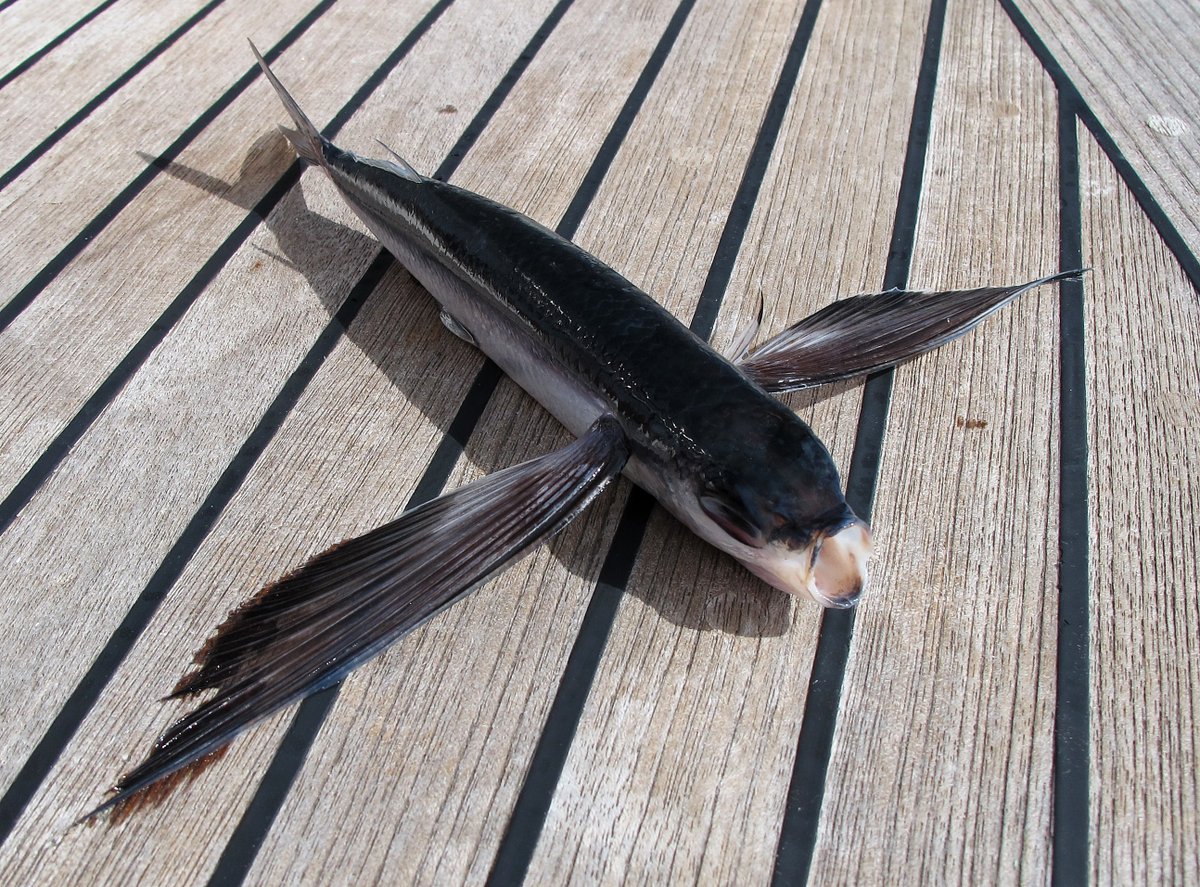
Though fleeting, this is the first sign of life that we've seen for 20 days apart from a few sea birds, the four fish that we've caught and a few million Flying Fish of course. This stretch of ocean is the most barren that we've sailed. We were expecting to see pods of dolphin occasionally, but none have appeared so far - perhaps they're just shy.
In the last week, I seem to have been attracting huge fish to my fishing lures. I've been using wire traces and thought that perhaps the smaller fish are spotting the thicker trace, so I made up a blue squid lure with a 60lb translucent monofilament trace and put it out on my rod. It didn't work, I still didn't get a sniff of a bite all day.
The wind fluctuated between 12 and 18 knots throughout the day, and also varied in direction slightly, so we had to gybe the genoa a few times. Having the main held out to starboard with a preventer and the spinnaker pole fixed out to port is working very well for us. If the wind comes from 90-135 degrees on our port side, then we pull the genoa to starboard on a broad reach.
However, if the wind backs to 135-180 degrees on our port side, then the genoa (set to starboard) loses wind in the lee of the mainsail. So we simply pull the genoa out to port on the spinnaker pole and, in a wing-on-wing configuration, the genoa has clean air again. It's magic. We even had the stay sail out to starboard as well for most of the day, which gave us a little more speed.
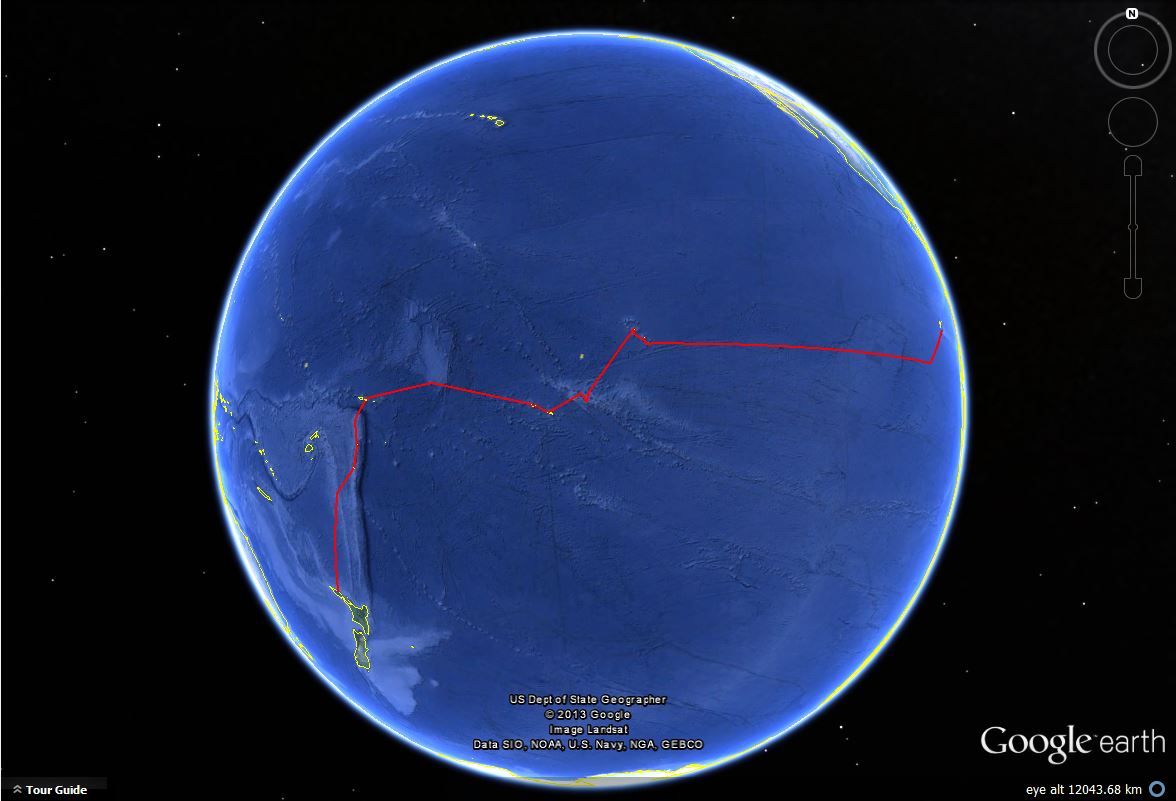
In an idle moment on my first night watch, I created a path on Google Earth, which shows our planned route across the Pacific from Galapagos to New Zealand. When I'd finished, I zoomed out to show the whole planet and it's amazing how big the Pacific Ocean is - it almost covers one half of the Earth. It's very humbling to think that we're crossing that huge expanse of water.
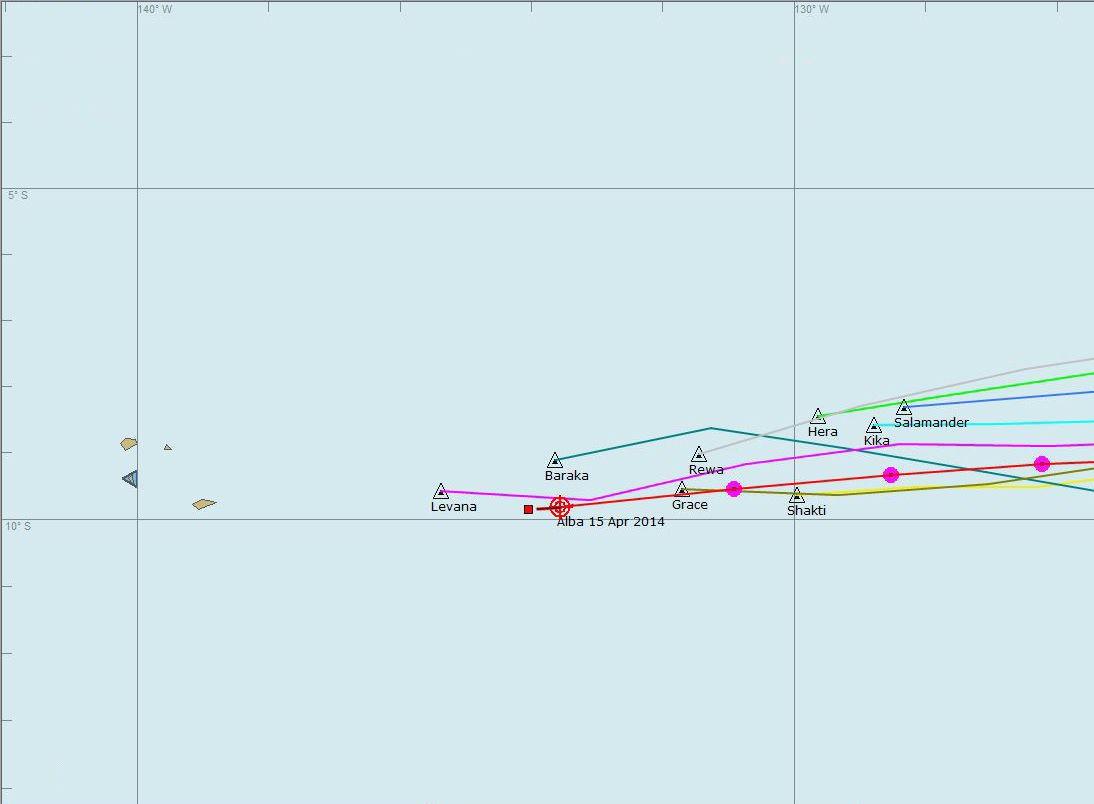
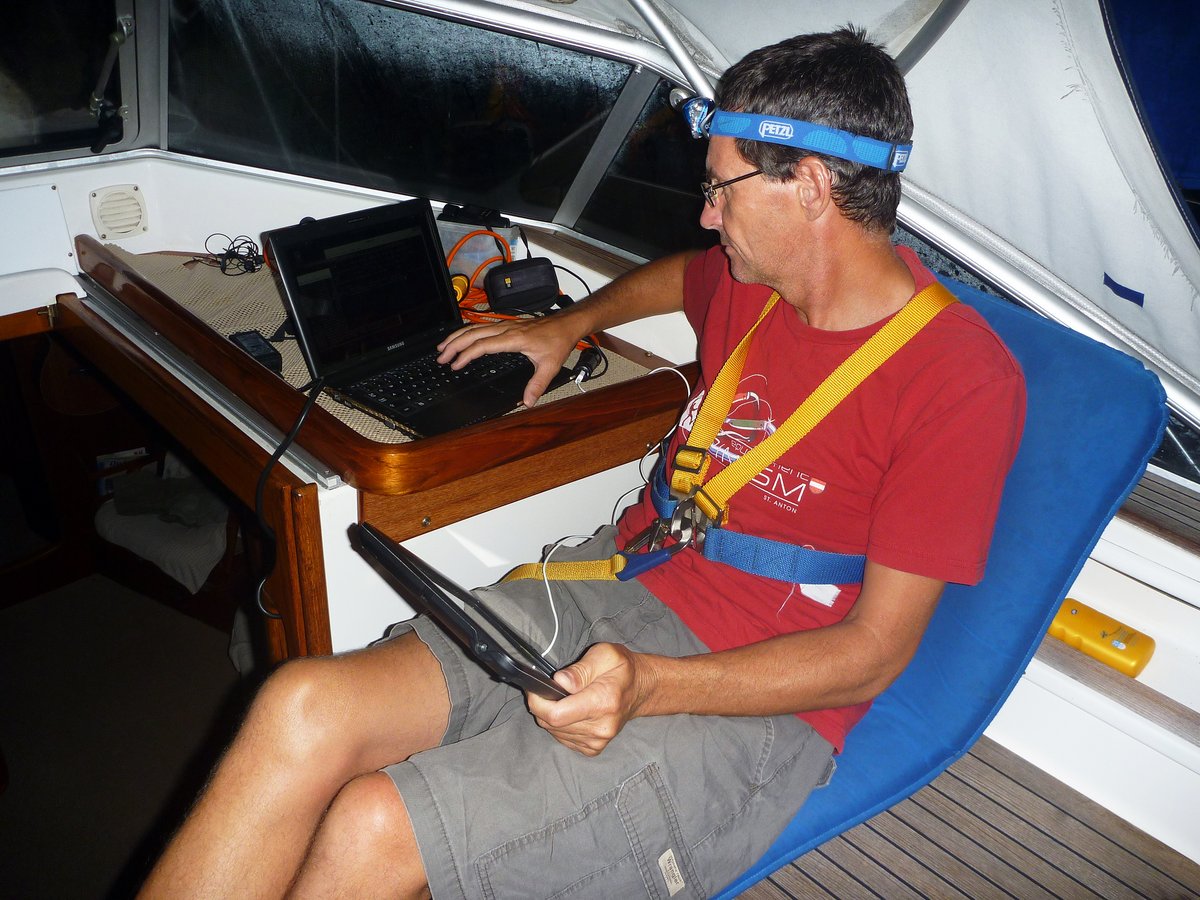
We crossed longitude 135 degrees west, so I turned the clocks back during the night. The Marquesas is on a very strange time zone of - 9.5 hours, so the clocks went back 1-1/2 hours. I came up with a cunning plan to adjust our night watches so that we each got an extra 45 minutes in bed. Glenys struggled to understand my convoluted logic and she's suspicious that I've wangled 1-1/2 hours extra in bed just for myself - as if...
It was a lovely night again with a bright moon - one couldn't ask for nicer sailing conditions. We kept all our sails out - full main, genoa poled out wing-on-wing and even the stay sail was deployed. We're now on a mission to keep up our boat speed to make sure that we make landfall on the 17th.
16 April 2014 Galapagos to Marquesas (Day 21)
I woke at half past six and couldn't get back to sleep - a combination of time zone changes and my excitement that we were nearly at the end of our passage. At 0800, we had 165 miles to go, so there was a good chance the we would drop our anchor in Fatu Hiva the next day.
There were 10 boats on the SSB net, all doing fine. "Baraka" was about the same distance from Fatu Hiva as we were and so they should be arriving at the anchorage around the same time. We had light 10-15 knot winds all day with the direction slowly backing to be from the east by late afternoon, so we had a very relaxing day, ending up running dead down wind.
Before dinner, Glenys went into the front heads to have a shower, and I was down below receiving a weather email, when suddenly the boat turned to hard to starboard. By the time that I'd got up to the steering wheel, we had hove-to with the main backed - thank goodness that I had a preventer on the main boom.
I turned the boat back onto the correct heading and saw that, once again, the heading on the autopilot was different to our magnetic compass, this time it was out by 50 degrees. This was the fourth time that the autopilot had freaked out and it seemed to happen when Glenys was in the front heads - what on earth was she doing?
When she came up to the cockpit, she ran through everything that she had just done - she went to the toilet, had a shower holding the shower head in her hand and then ran the shower pump. It was more or less exactly the same thing that I do. The flux gate compass for the autopilot is in a cupboard on the other side of the shower room bulkhead wall - perhaps she builds up a lot of static electricity and had discharged it when she switches on the light or something?
We ran through everything that she did in the front heads again in great detail - where she stands, what she holds, how she braces herself while on the toilet and what she leans against when she's showering, etc. The only thing that she did different to me was she leans against the bulkhead wall when she's showering.
I went into the shower room and banged on the bulkhead wall and to my amazement, the autopilot turned to port and the flux gate compass corrected itself. Mystery solved - we must have a loose connection or an intermittent fault on the flux gate compass. At least we know that all we need to do is bang on the wall if it goes wrong again...
At sunset, we had 100 miles to go, but the wind had dropped right off and we were only managing 3-4 knots through the water. Fortunately, we had a favourable 1 knot current pushing our speed over the ground up to 4-5 knots, so there was a fighting chance that we'd have less than 50 miles to go at dawn and we could motor the rest of the way.
It was a lovely moonlit night and calm enough that I could listen to my French language course. We've been in spanish speaking countries for well over a year and I never got to grips with the language. I could speak enough Spanish to be able to get by as long as I could wave my arms around and point, but I couldn't have a conversation other than "I want", "Where is", etc. It was very frustrating not to be able to have a "chat" with the locals.
We'll only be in French Polynesia for three or four months, but I'm determined to speak French better than I can Spanish. I learned French at school for four years and have spent many weeks on holiday in France, so I should be able to pick it up a bit easier - I just need to put the effort in...
At 0400, we were still plodding along at 3-4 knots through the water and had 50 miles to go, so we weren't doing too bad, but it seemed frustratingly slow especially with the sails slatting as we rolled in the light winds.
17 April 2014 Galapagos to Marquesas (Day 22)
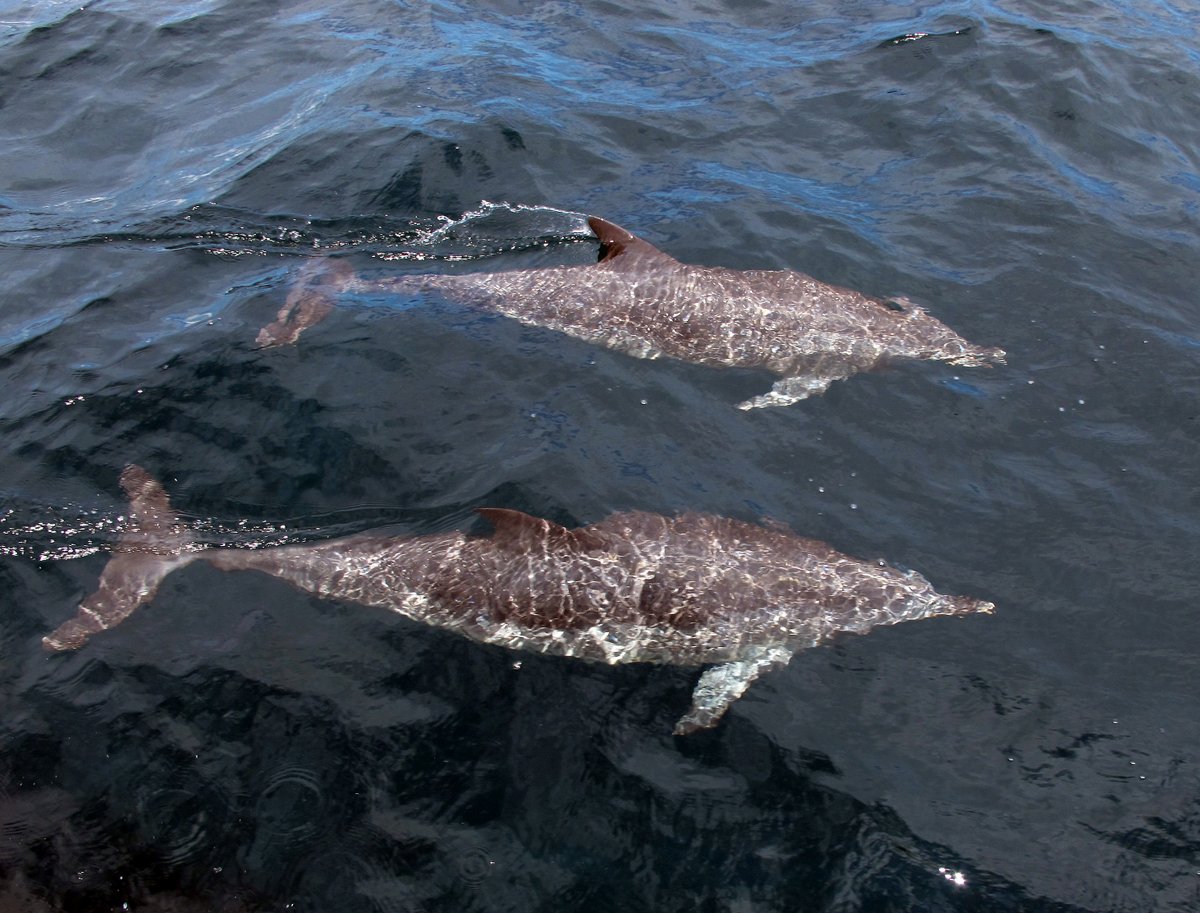
When I got up this morning, I found Glenys kneeling at the bow of the boat taking photographs of dolphins - our first in 3,000 miles of sailing across the Pacific Ocean. Their skin was very mottled with large random patches of pale colour, almost like they had been sunburnt and peeled.
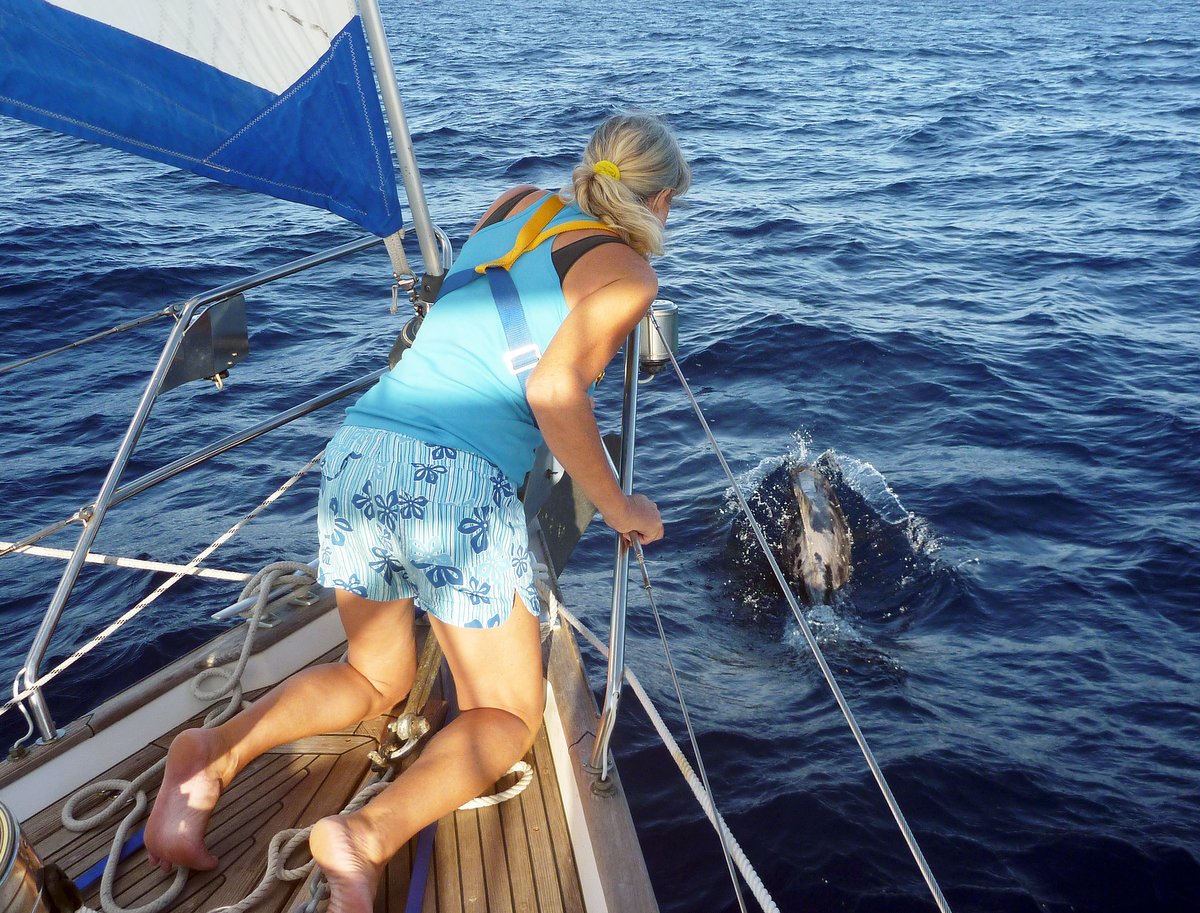
I'm tempted to name them Marquesan Scruffy Dolphins, but I'm pretty sure that they were Pantropical Spotted Dolphins. According to our Whales and Dolphins book, young dolphins of this species have no spots and the spots grow larger as the dolphins mature, to the extent that they appear to be large patches .
When I looked up from watching the antics of the dolphins, I could see the faint outline of the mountainous island of Fatu Hiva ahead of us. We were still plodding along at 5 knots over the ground, but with only 35 miles to go, we'd definitely be there by the afternoon.
At 0830, I called into our SSB net and there are now 16 boats on the roll call. A group of six other boats left the Galapagos a few days after us and have found our frequency, so they're going to keep it going after we all make our landfalls. It's been a very useful net and good to hear from the other boats out here - I'm glad that I made the small effort to organise it before we left Isabella.
It's funny how the net morphed from being a loose collection of boats calling each other up, to quite a formal net with a structure. At first, I was acting as the main initiator of conversations, but my radio isn't very powerful, so I soon handed it over Sasha on "Levana", who could talk to the more distant boats. Then Dave from "Baraka", who has a very good radio, started to initiate the conversations and, by default, became the "Net Controller". The new boats are now discussing who's going to be the formal Net Controller when Dave makes his landfall today.
After the net, I couldn't resist getting the spinnaker out. It was such a beautiful day with a light 10 knot breeze. Glenys was all for sitting in the cockpit reading her book, but my enthusiasm won her over. Funnily enough we didn't have much more boat speed because I had to roll away the genoa and the stay sail and then heavily reef the main sail because it kept taking the wind from the spinnaker. It looked pretty though.
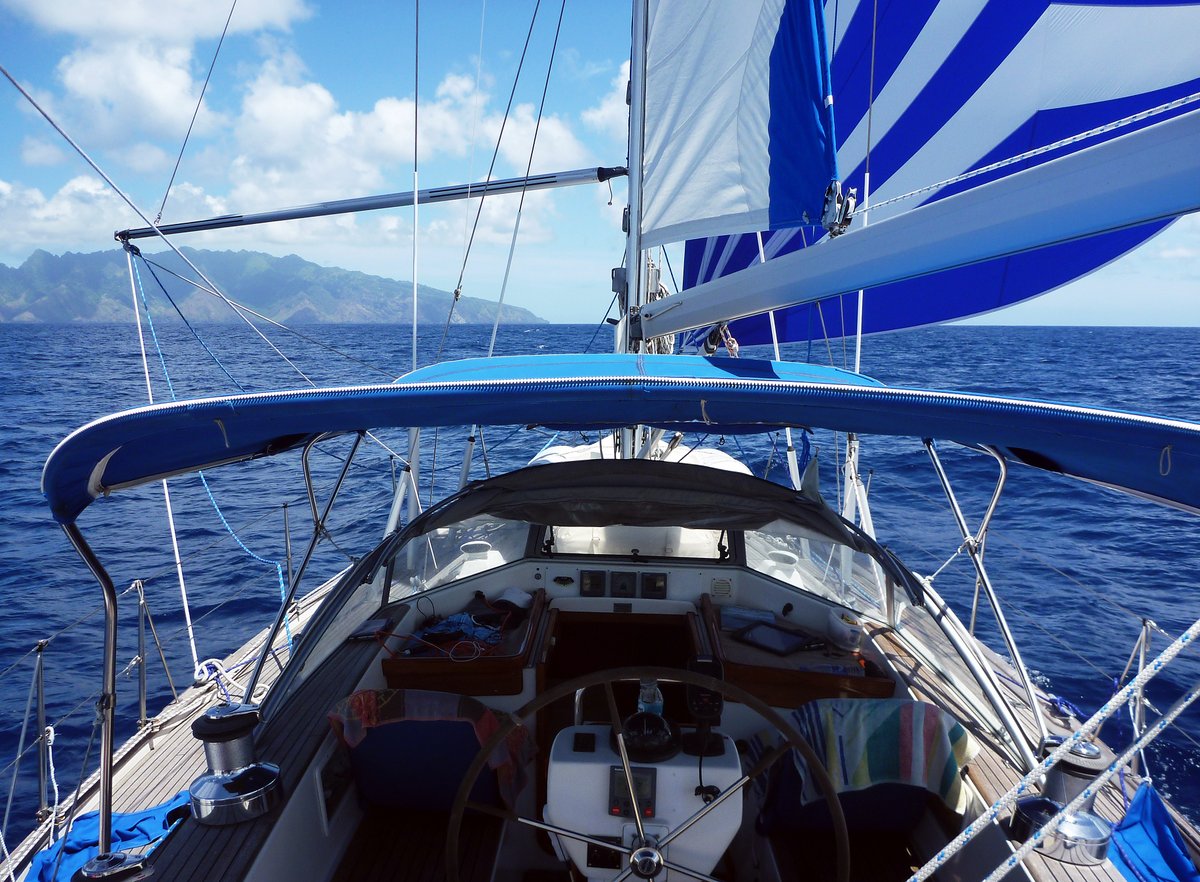
By two o'clock, we were approaching the north of Fatu Hiva and the wind picked up around the end of the island. I was expecting an acceleration zone, so we were ready to quickly trip the spinnaker and sleeve it. We then had a great sail for half an hour with main and genoa as we rounded the island. The wind dropped when we hit the leeward side, so we turned the engine on and scurried around taking the pole down and making the boat look presentable - we might have been at sea for 21 days, but there are certain standards to be maintained.
There were thirteen other boats already anchored in the Bay Of Virgins and the seabed drops off very, very steeply from ten metres. One minute you're in 50 metres of water then suddenly you're in ten metres. We wandered around for fifteen minutes and tried to anchor in five metres at the head of the bay, but the bottom was just rock and we dragged. We eventually found a spot in 10 metres between the north side of the bay and the other yachts, but it took two attempts before we were happy. We're close to the rocky shore, but I think that we'll be okay.
The anchorage is very spectacular and I can see why people rave about it. The bay is surrounded by very steep, high slopes covered in coconut palms and other vegetation. Huge pinnacles of conglomerate rock thrust up from the green slopes. At the head of the bay is a valley with the village and beyond that there's a pass through steep cliffs that leads to some very impressive slopes climbing up to a knife-edge ridge 900 metres above us.
The sailors who frequented this bay in the 1600s, originally named it "Baie de Verges" (Bay of Penises), but the missionaries who followed were outraged and slipped an "i" into the name making it the "Baie de Vierges" (Bay of Virgins).
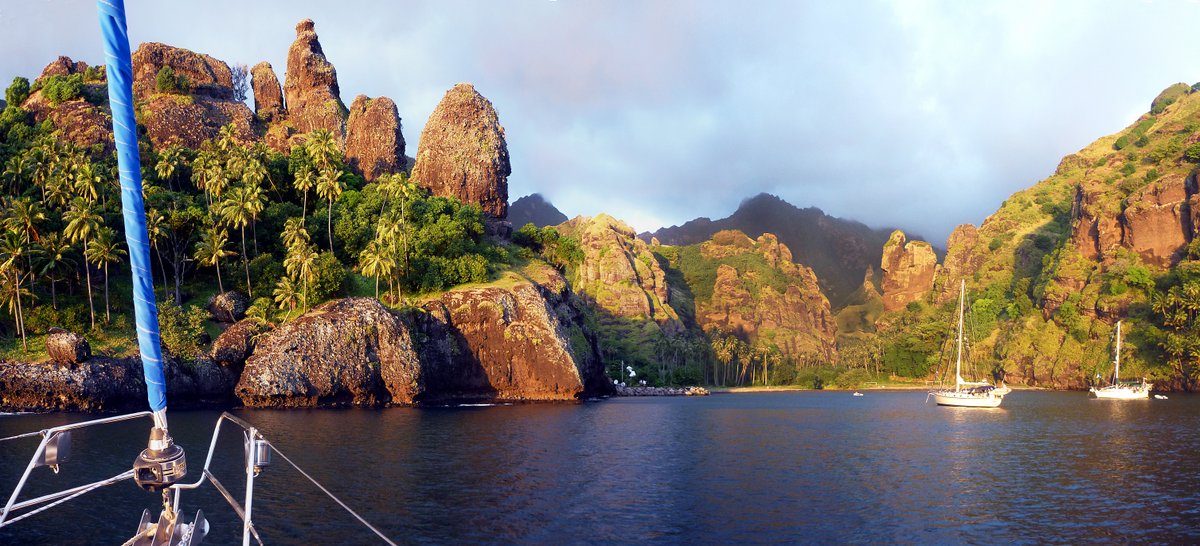
Once we were anchored, we cracked open a cold beer - it was the best beer I've ever had... This last three weeks has been the longest time that I've been without drinking alcohol since I was a teenager. Funnily enough, I haven't missed my evening beer when we were at sea, but it was the first thing in my mind when the anchor dug in...
Just as night fell, a small boat with three local guys came over and traded us a big bunch of bananas and four pamplemousse for a small bottle of rum. They probably got the better end of the deal, but we weren't bothered because we got some fresh fruit and we were keen to try the famous Marquesan pamplemousse, which are huge grapefruit that are supposed to be quite sweet – but we left that pleasure for tomorrow and, not surprisingly, had an early night.
18 April 2014 Bay of Virgins, Fatu Hiva, Marquesas
We were up fairly early because we couldn't sleep with a new place to explore. The pamplemousse that we had for breakfast was very tasty and juicy, but still needed some sugar – someone told us later that they’re sweet when ripe later in the season. We enjoyed it and no doubt will be eating lots more.
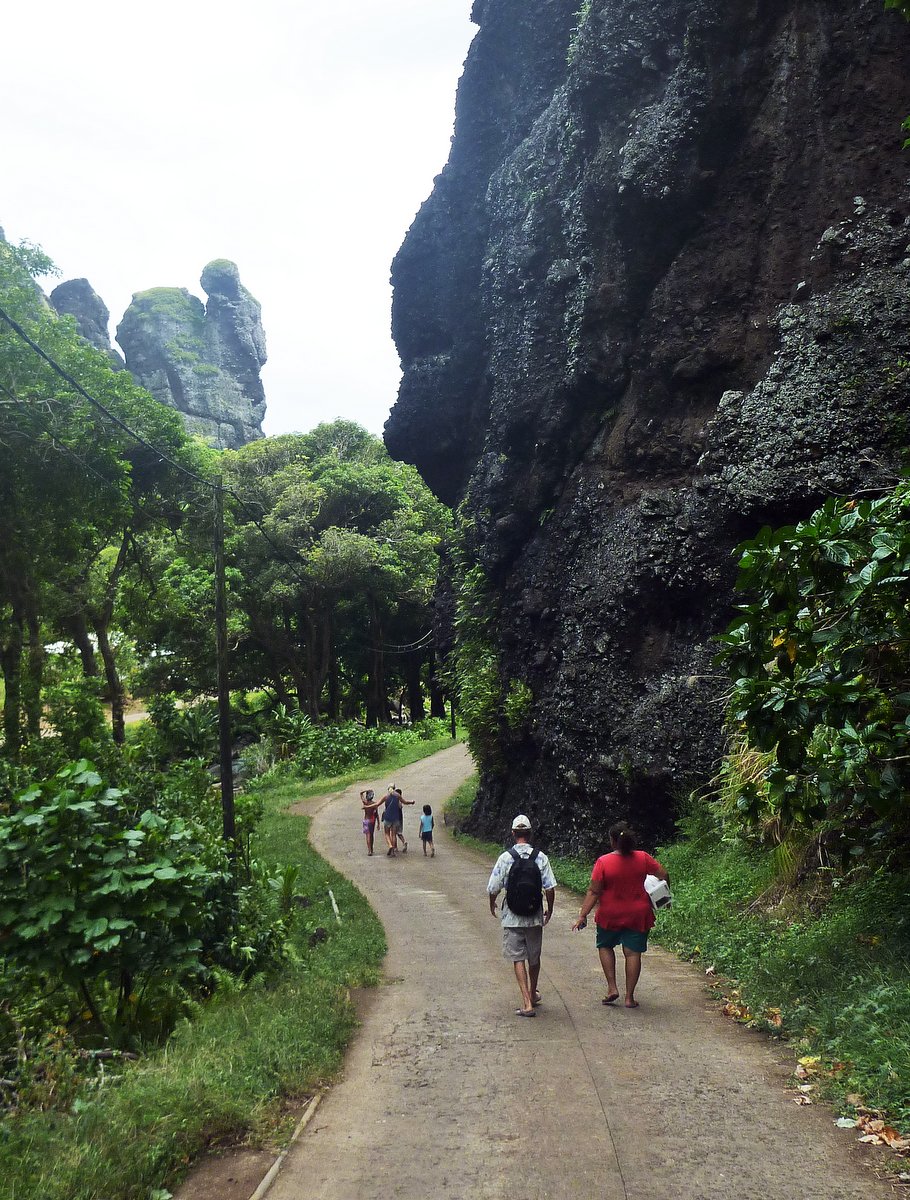
We pottered around on the boat for a few hours, tidying up and I did a bit of admin, printing out some documentation ready to clear in. We dropped the dinghy into the water, put on the small outboard and went ashore, leaving the dinghy tied up to a concrete dock behind a breakwater. Within minutes, we had ladies coming up asking if we wanted to have a traditional Marquesan dinner. We politely declined for now.
The village is very tidy with small single story concrete houses. Each of the houses has their own gardens which are nicely maintained and there are fruit trees and flowering bushes everywhere you look. But it’s the surrounding landscape that constantly catches the eye. Huge cliffs surround the village and beyond them are very steep, verdant slopes going up to the ridges high above.
We walked along the concrete road from the dock and came across a small grocery shop, where we met Dave and Jan from “Baraka”. There was also another cruiser who had some Polynesian Francs and he kindly changed $20 for us, so that we could buy some bread. Well actually, the shop had run out of bread, but they were going to make another batch for the cruisers that were milling about – we had to go back in an hour.
We went for a stroll with Dave and Jan further along the road and were accompanied by a young lady and three kids, who were obviously intent on selling us some fruit. The village is bigger that I first thought and is spread out along the valley. We walked as far as a steep bend in the road and decided that was enough exercise for our passage-atrophied legs.
Several times, we were invited into houses to look at wood carvings. This island is known for wood carvings, which are lovely, but they're a little too large for our small boat and are quite expensive – the cheapest starting at $30 US. They will sell cheaper (with the incentive of a bottle of rum), but I think that we’ll wait until we find a nice small carving of a Tiki.
When we got back to the dock, Glenys bought a bag of oranges from the lady and swapped a pack of playing cards for another pamplemoose with one of the boys.
After lunch (and a short nap), we jumped into the water and started to clean our hull which was disgusting, covered in green algae and Gooseneck Barnacles. The algae was at least half way up the hull and some of it was very tenacious – after three hours of scraping and scrubbing, we’ve done three quarters of the hull.

We had Dave and Jan from “Baraka” over for sun-downers.
19 April 2014 Bay of Virgins, Fatu Hiva, Marquesas
We had a quiet chill-out day. I caught up with sorting through editing all my photographs and updated my web pages, while Glenys read a book and stared at the scenery.
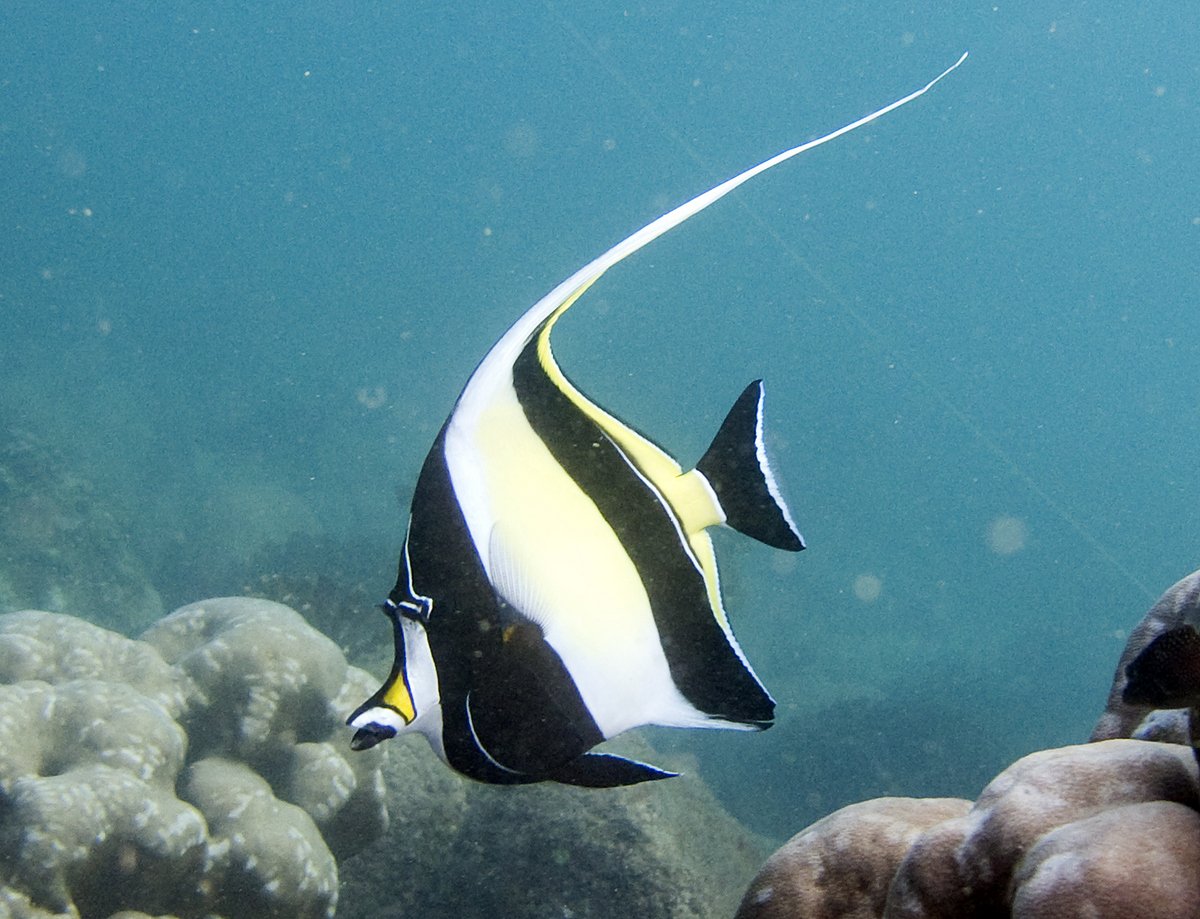
In the afternoon, I jumped into the water and went for a snorkel along the rocky shore only 25 metres from where we’re anchored. It’s a nice rock reef that drops of very steeply to 8 metres with some coral and a fair number of fish. The water visibility was 8-10 metres, so it was very pleasant - I saw quite a few Moorish Idols.
By the time that I swam back to the boat, Glenys was in the water scrubbing the growth off the hull so I joined her and spent a couple of hours until the job was done. Alba looks nice and clean for now.
There are lots of big, one-inch long Wood Wasps in the anchorage; they fly slowly around the boat with their long legs dangling behind them, checking out everything. We’re not sure what they’re after, but they’re not aggressive and move if gently shooed away. However, this afternoon, Glenys went to get some bananas that were hanging on the arch and unfortunately, grabbed a banana that had one of these wasps on it. The sting that she got was very painful. She went into a state of shock and cried out, “I'm not going to die, am I?” We’re now very careful to look around before we grab hold of anything.

“Shakti” and ”Salamander” arrived today and all the boats that were on our little SSB Net were invited over to “Dragonfly” by Jill and Al – as you can imagine there were lots of “No shit, there I was” stories about our respective Pacific crossings.
20 April 2014 Bay of Virgins, Fatu Hiva, Marquesas
We went for a hike up to the waterfall up at the head of the valley. Being Easter Sunday, a lot of the villagers were inside the church as we walked past, so we didn't have an escort of cheeky kids walking along with us. We strolled through the village, around a steep s-bend in the road and took the next dirt track on the left, where someone has built a small cairn.
This dirt road took us through lush farmland past banana trees, coconut palms, copra drying sheds and hedges of flowering shrubs - very, very pretty. After fifteen minutes, the road petered out when it converged with the river and the path to the waterfall went up sharply to the left. From there it was a pleasant walk through woodland along a path strewn with lovely big flowers.
We reached the waterfall after another fifteen minutes of steep walking and, although there wasn't much water, the waterfall is an impressive sight being over 100 foot high. After taking a few photographs, we retraced our steps back to the main road, where we decided to turn left and go for a walk further along the road.
The concrete road grinds up remorselessly at about 20 degrees, so it was a bit of a shock to our little legs. At each of the switchback bends, we were rewarded with fabulous views of the valley and the ridges towering above. We also had great views looking down at the village of Hanavere and the occasional, fleeting glimpses of the anchorage beyond. After an half an hour, I was on a mission to get to somewhere that would give us a good view down on the anchorage.
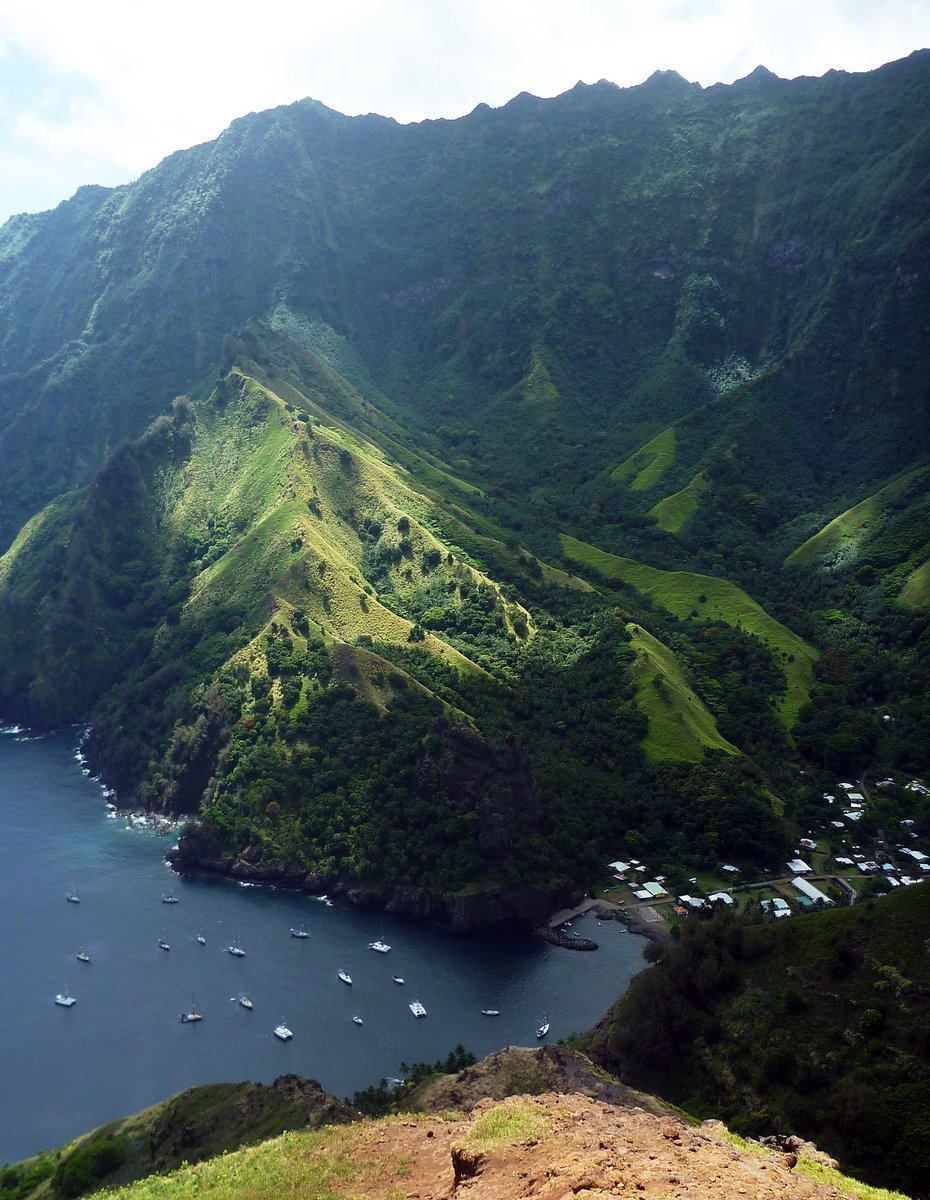
After another hour of trudging, we arrived at a radio relay station perched very high on the hill overlooking the anchorage and, by scrambling down to a slightly lower hilltop, I was finally able to get a good view down onto our boat and take some photographs.
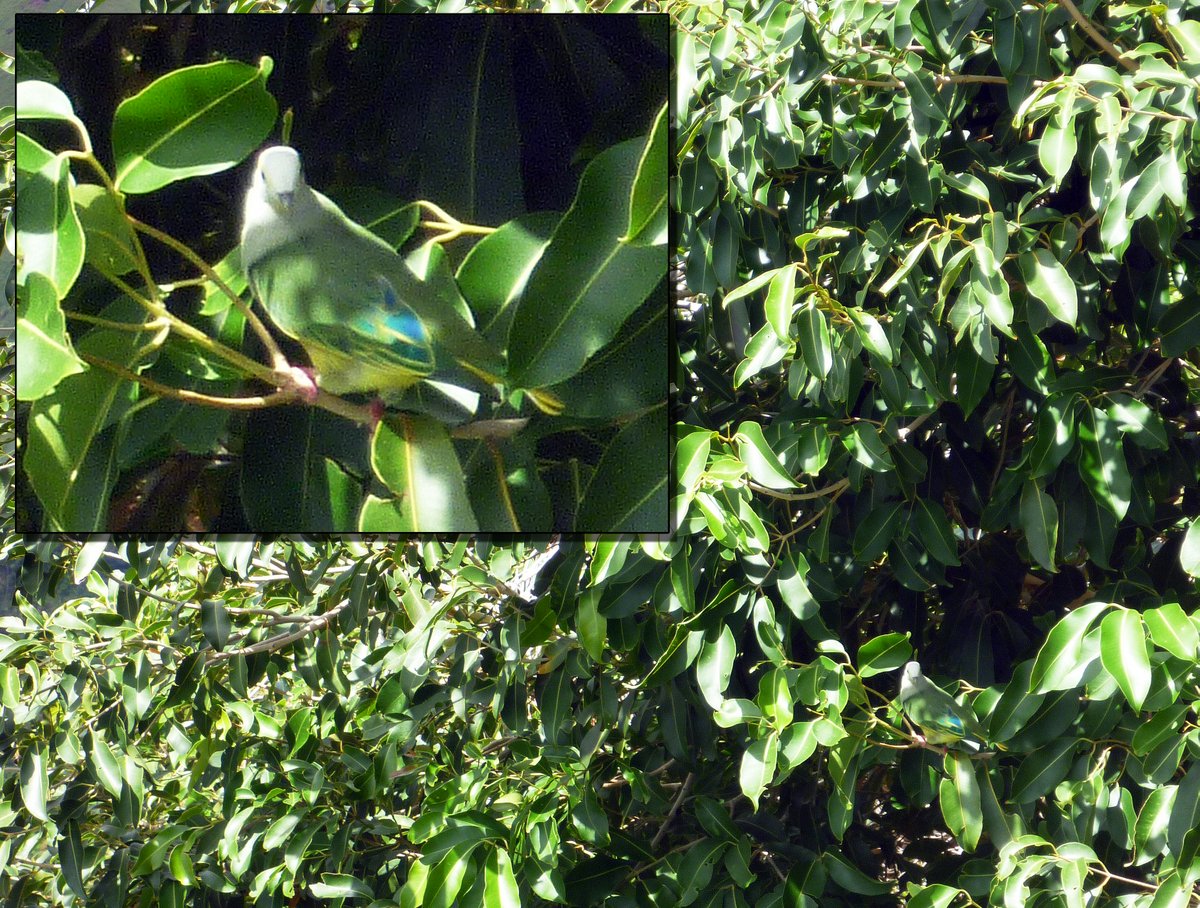
Feeling pretty tired, we turned around and walked back down the road, stopping occasionally to watch pairs of lovely, white Tropicbirds having a whale of a time riding the air currents high above the valley. We also spotted a pretty bird that looked like a small dove, but with green wings, which blended in very well against the green leaves of the trees - I believe that it was a Fruit Dove.
It took us an hour to walk back to the village quay, arriving back at the boat at two o'clock. We were knackered, so the rest of the afternoon was spent dozing and chilling out. We had another early night.
21 April 2014 Fatu Hiva to Atuona, Hiva Oa
We jumped out of bed at seven o'clock, and half an hour later were motoring out of the bay heading for a small island called Mohotani, which is conveniently on the way to Hiva Oa where we had to go to clear in. The anchorage at Atuona is notoriously rolly and crowded, so the plan was to stay at Mototani overnight and leave very early the next day to get to Hiva Oa in the morning, clear in, buy some provisions and run away.
We had a great reach across to Mototani, which is a very impressive 500 metre high island. The wind deserted us as we went along the leeward side of the five mile long island, so we motor sailed towards the anchorage at the northern end. By two o'clock, we were halfway along the island and had another look at the chart.
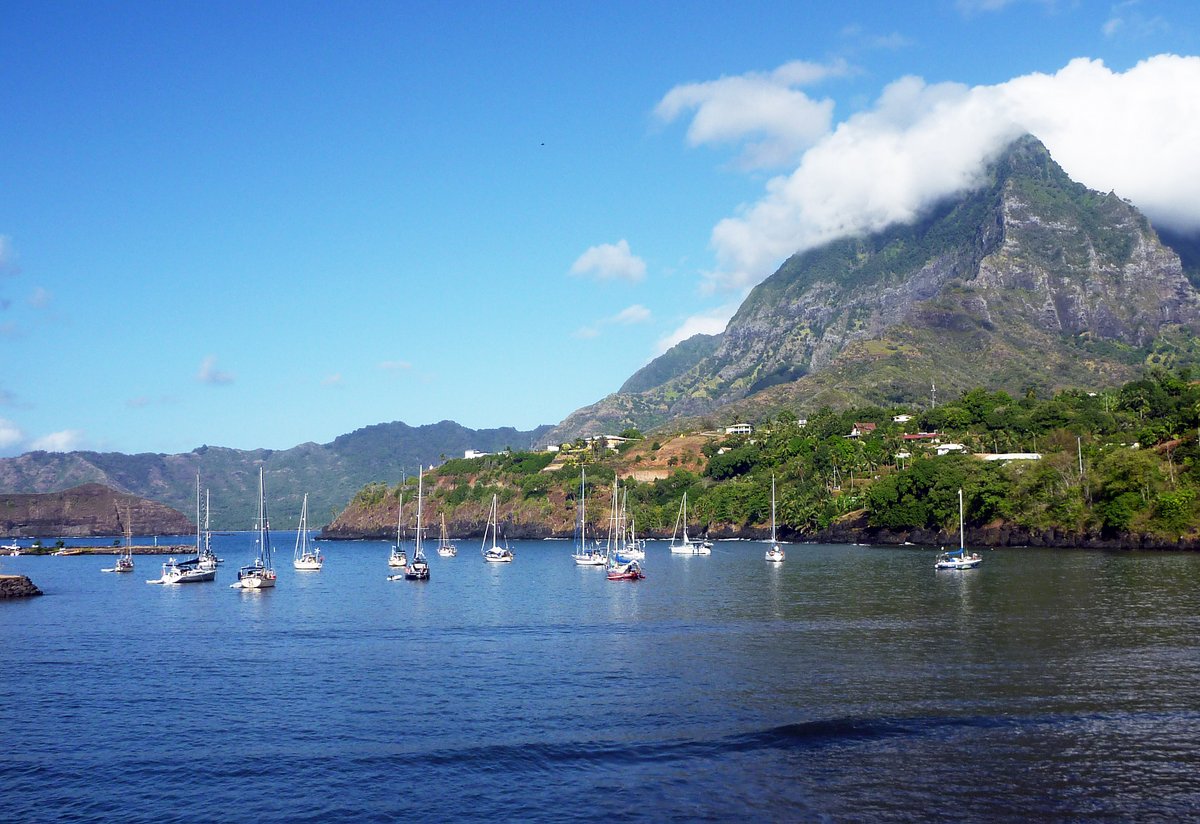
The wind was coming from the east and we thought that the only anchorage on Mototani may be untenable. Atuona on Hiva Oa was still a three hour sail away so, as we were running out of time, we opted to head straight for Atuona on Hiva Oa. On the way, we had a huge pod of Spinner Dolphins jostling for position to ride our bow wave.

I was very nervous about going into Atuona harbour because I was expecting it to be very crowded with a back log of boats waiting to clear in after the Easter holidays, but it wasn't too bad. The anchorage is behind a large breakwater and the boats weren't rolling too much. The port authority make all yachts anchor in water shallower than 5 metres leaving the deeper water for ferries and cargo ships to manoeuvre into the commercial dock - most of the anchorage is between 2 and 4 metres deep.
We wandered around for ten minutes checking the depth and decided to anchor just behind "Hera". It was a little tight, but the water was a little bit deeper on the east side of the bay. We dropped our bow anchor and I was just putting out a stern anchor when an obnoxious American from "The Beguine" came over in his dinghy and TOLD me that my anchoring wouldn't work and that I'd be too close to him.
I briefly thought about arguing, but couldn't be bothered, so we pulled up the anchor and moved towards the middle of the bay. I found out later that the same guy had been shouting at Maarten from "Hera" about his anchor buoy. Normally cruisers go out of their way to be polite and helpful, but this American guy is obviously an A-hole.