
22 April 2014 Atuona, Hiva Oa
There's a one metre tidal range here and having bow and stern anchors out means that we don't swing with the tide. Last night, it was very noticeable when the tide was going out because we had water slapping under our sugar scoop.
We got up at seven o'clock to find "Bellatrix", a small 28 foot yacht, only ten feet from our stern. Tim, a single hander from Estonia, was up on his foredeck adjusting his bow anchor. He didn't have a stern anchor out and was swinging in the tide, so I let out some scope on our stern anchor and shortened our bow anchor.
When we were settled, I went over to say hello and apologise for being too close, but he said that it was his fault, that he only had one anchor and was going to move further into the bay. What a nice bloke - he restored my faith in human society after my ugly contact with the loud-mouthed American yesterday.
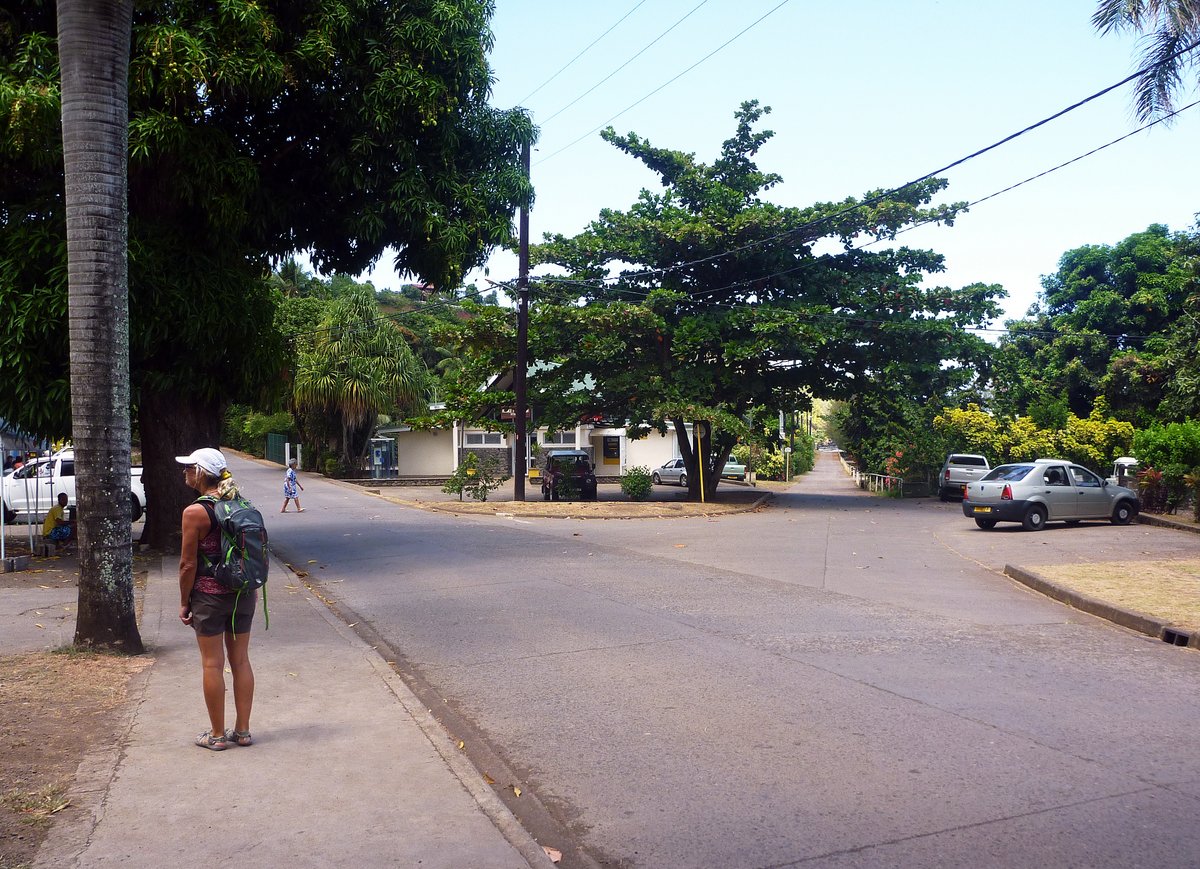
After breakfast, we walked into town, which took 30 minutes, but it was a pleasant walk in the cool of the morning. Atuona is a nice little town and everyone is very friendly. The locals are all heavy set with large round faces and look very severe at first, but soon break into smiles and seem to be a happy bunch. I'm not surprised because this is a beautiful island with fruit literally falling off the trees.
Our first stop was at the Gendarmerie to clear in. I was a little nervous thinking that we might be in trouble for stopping at Fatu Hiva, but the young police officer was very helpful and we only had to fill in one form with no questions asked about when we arrived, etc. It was all done and dusted within fifteen minutes, probably the quickest (and cheapest) clearance that we've done for years.
The officer didn't stamp our passports and told us that as EU citizens, we were allowed to stay indefinitely in French Polynesia. This is great news, especially when compared to the hassle that people from non-EU countries have to go through. They have to use an agent, have to have a visa before they arrive and often have to post a bond with a bank of about $1000 per person. At long last, I've found a good reason to be a member of the European Community.
We called in at the Post Office to post our customs form off to Papeete and buy a SIM card for our phone. While we were in the Post Office, we met John from “Kika" who was chatting to Marie Jo, a local lady who acts as a taxi service, does laundry, organises tourist trips, etc. We arranged to go for a day trip around the island with John and his crew the day after tomorrow.
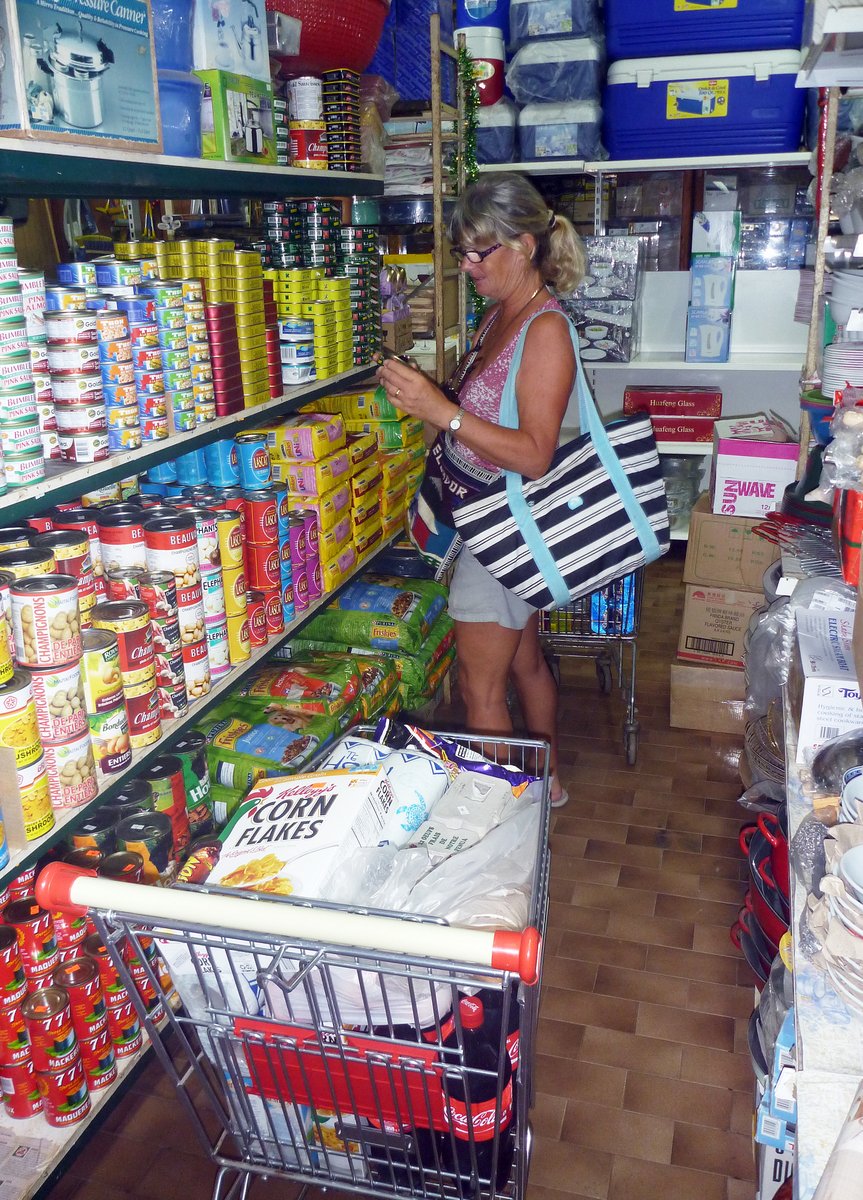
With our administration all done, we wandered down the main street calling in at a few small grocery stores, until we came across a large(ish) supermarket on the road leading out of town. It was very well stocked, so we went into a shopping frenzy, stocking up with drinks, vegetables and other essentials - we even found some lamb cutlets. They were very expensive at six for $14, but I couldn't resist them - we've not seen lamb since we were in the USA in 2012.
We asked the supermarket to call Marie Jo, who picked us up and dropped us at the dock for $6. She then took away two bags of laundry, which should be back tomorrow. We were back on the boat just after midday eating lovely fresh baguette for lunch.
After our resoundingly productive morning, the afternoon was a relaxed affair. In the evening we invited over the four other boats that were on the “Goodbye Isabella” net over for drinks – Maarten and Bea from “Hera”, Dave and Jan from “Baraka”, John and his crew from “Tika” and Robert and Lucie from “Grace”. We also invited Tim from “Bellatrix”. It was a little cramped with thirteen people in our cockpit, but everyone seemed to have a good time.
23 April 2014 Atuona, Hiva Oa
We had to get up early again, not because we were doing anything in particular, but because the town shuts down between eleven o'clock and two o'clock. We walked into town and visited the Gauguin museum.
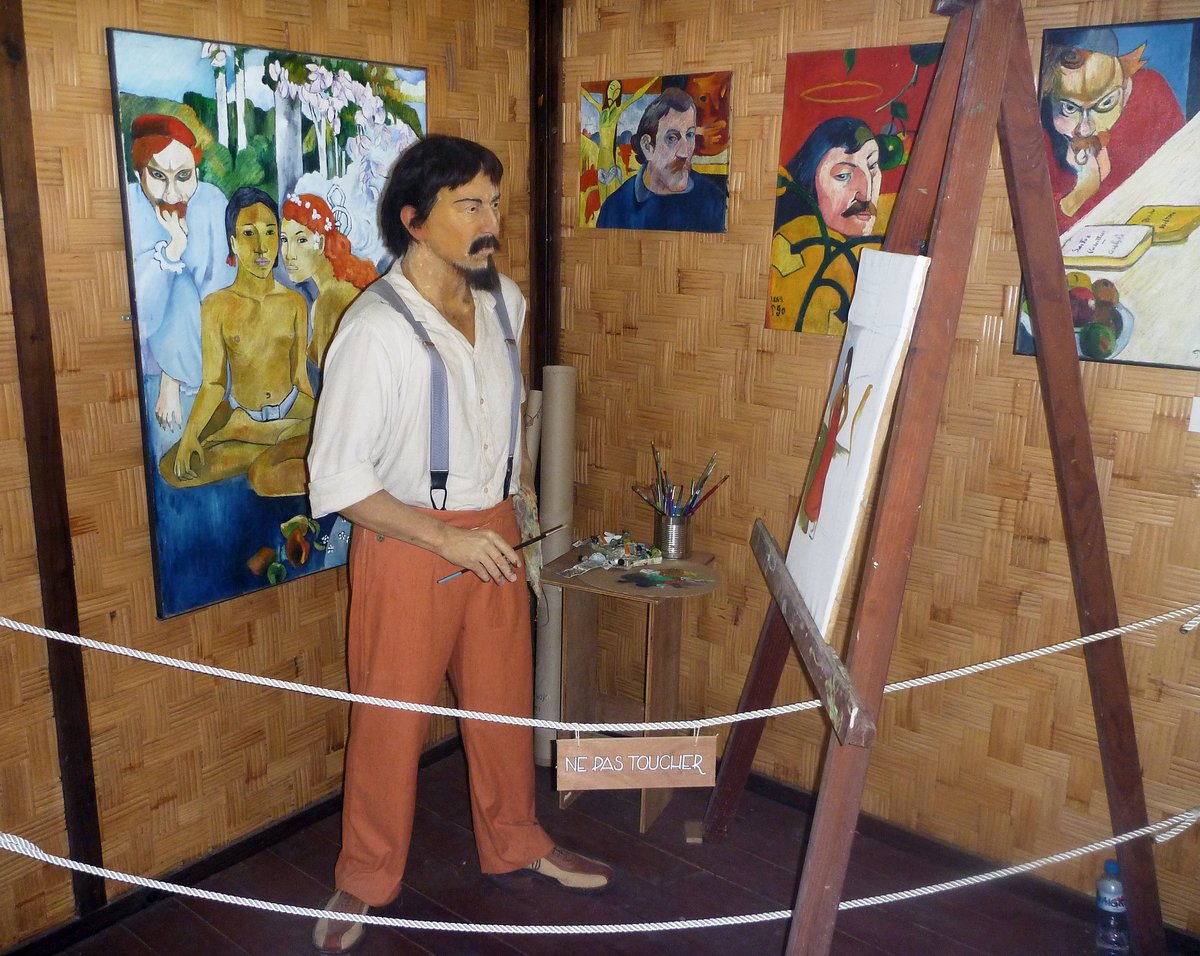
Paul Gauguin was a French artist who moved to Tahiti in the late 1800s and ended up in Hiva Oa. I'm not too enamoured by his painting, but visiting the museum was one of the few things to do in town. There’s an interesting replica of the house in which he used to live, with a good wax figure of Gauguin painting a picture. A Belgium musician called Jacques Brel also lived here, but having never heard of him, we didn't cough up the $3 fee to visit his museum.
We wandered around town for a while, visiting an Artisan exhibition – wood carvings, jewellery made from seeds and printed cloth abound, but nothing caught Glenys’s eye. After stopping off at a supermarket to buy some baguettes and paté, we walked up to the cemetery perched on a hill above town. We hunted out the graves of Brel and Gauguin and then sat down on a pleasant grass bank overlooking the town & the bay to have our picnic lunch. You can’t beat fresh baguette and paté on a nice sunny day.
There wasn't much else to do in town, so we walked back to the boat expecting to have a chill out afternoon. Unfortunately, a Swedish-flagged Hallberg Rassy 40 called “Blue Horizon” had dragged their stern anchor and collided with “Grace” while both sets of crew were on-shore. Some of the cruisers had reset “Blue Horizon’s” stern anchor, but they were still too close to “Grace”.
When Stigg & Siv from “Blue Horizon” came back, they started to re-anchor and somehow broke the rode for their stern anchor. The water in the anchorage is very brown and murky, with visibility of about 1 foot, so Stigg was forlornly rowing around the anchorage, dragging a dinghy anchor, trying to find his stern anchor. I went to give him a hand, but after fifteen minutes it was apparent that trawling around hoping to snag the anchor rode was not going to work.
I asked Stigg to tell me where they thought the anchor was and dropped a buoy to mark the spot. I then put on my snorkelling gear and started diving down 3-4 metres and swimming in a grid search pattern using the buoy as a reference. After 45 minutes, I finally found the anchor rode – the anchor was 25 metres away from where they thought it was. They were very happy to have their anchor back and I enjoyed the technical challenge (and the bottle of wine that they gave me later).
24 April 2014 Atuona, Hiva Oa
We went on a tour of the island with Dave & Jan from “Baraka” and John, Peter & Colin from “Kika”. Marie Jo drove us around in her four wheel drive pick-up truck on the only road that crosses the island. It wasn't really a guided tour because she didn't tell us anything about the places that we visited, but just dropped us off and let us wander off to look at tikis and petroglyphs on our own.
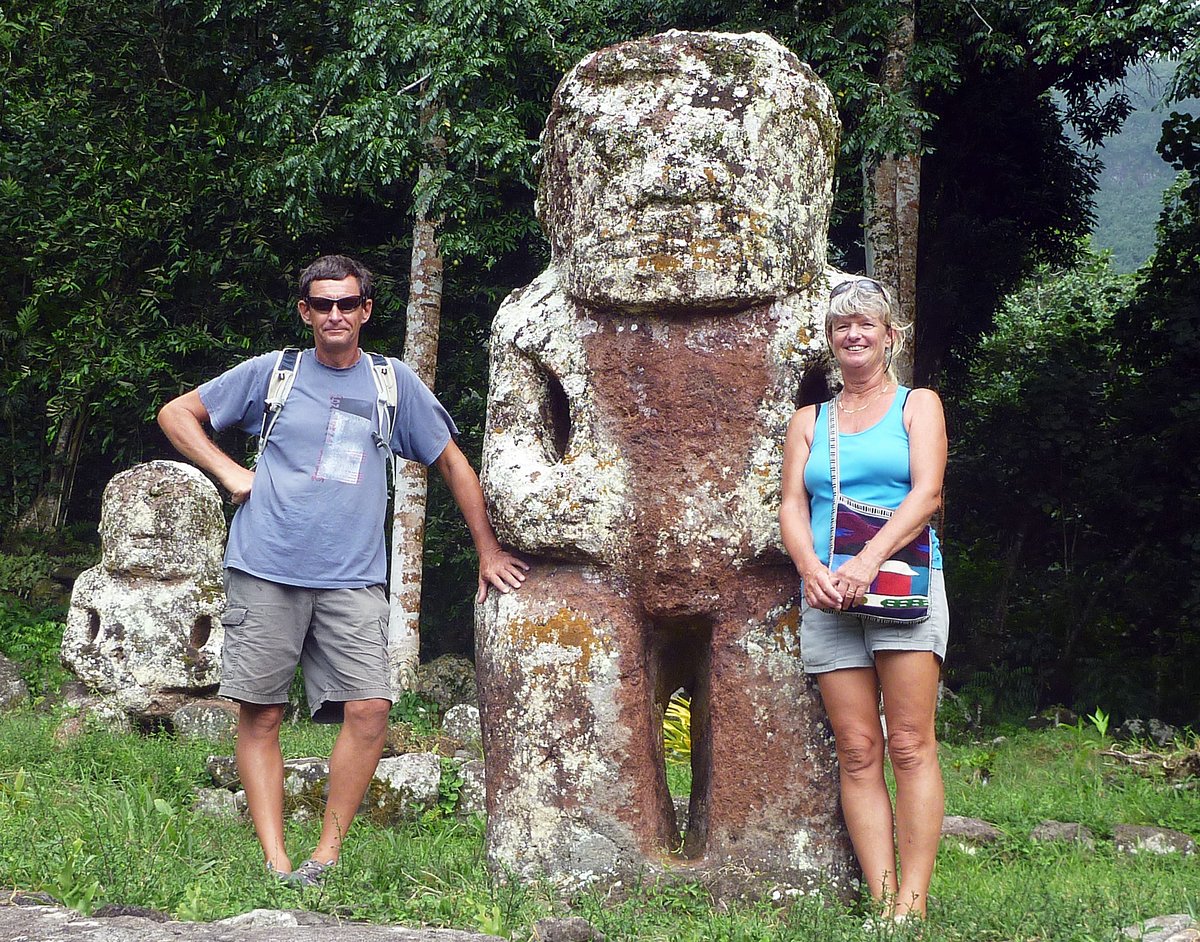
Tikis are carved stone statues, similar to, but not as grand, as the famous statues on Easter Island. It's believed that the tikis on Easter Island were actually carved by Marquesans who had journeyed there hundreds of years ago. Petroglyphs are drawings chiselled into rock by the same ancient Marquesans.
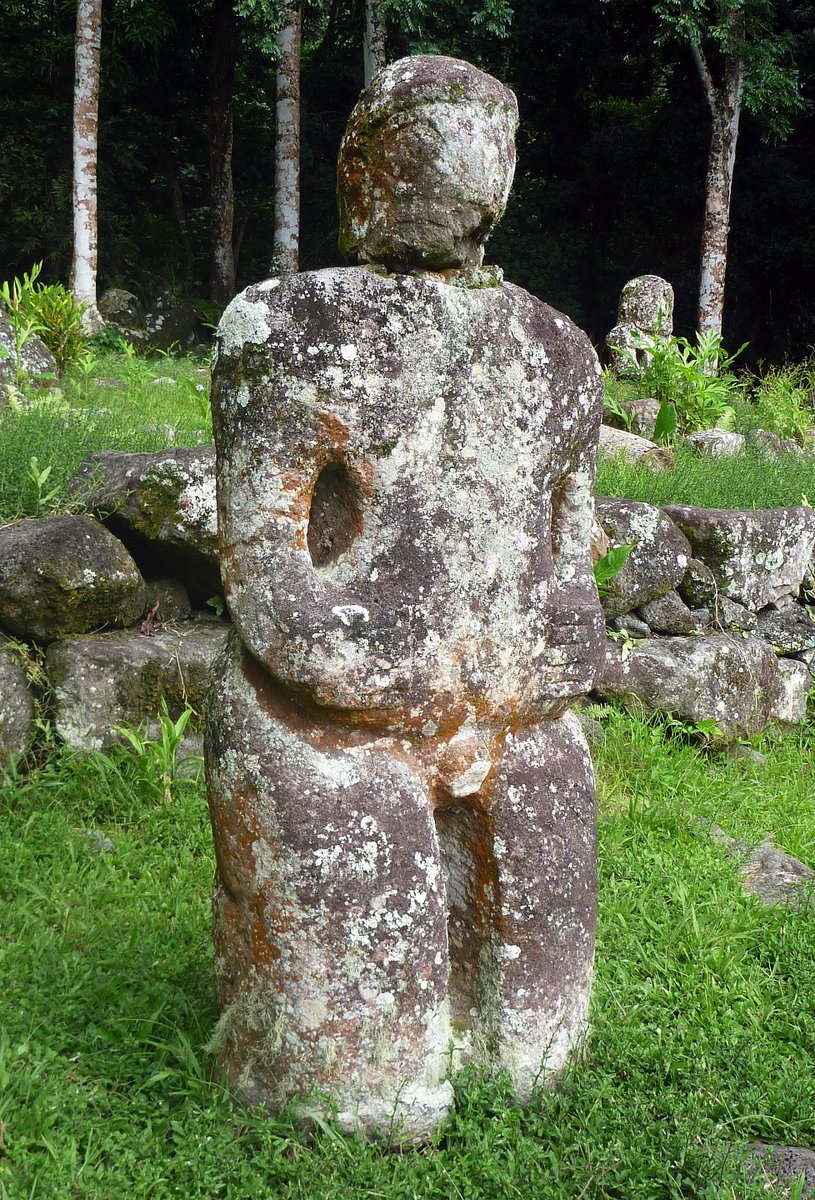
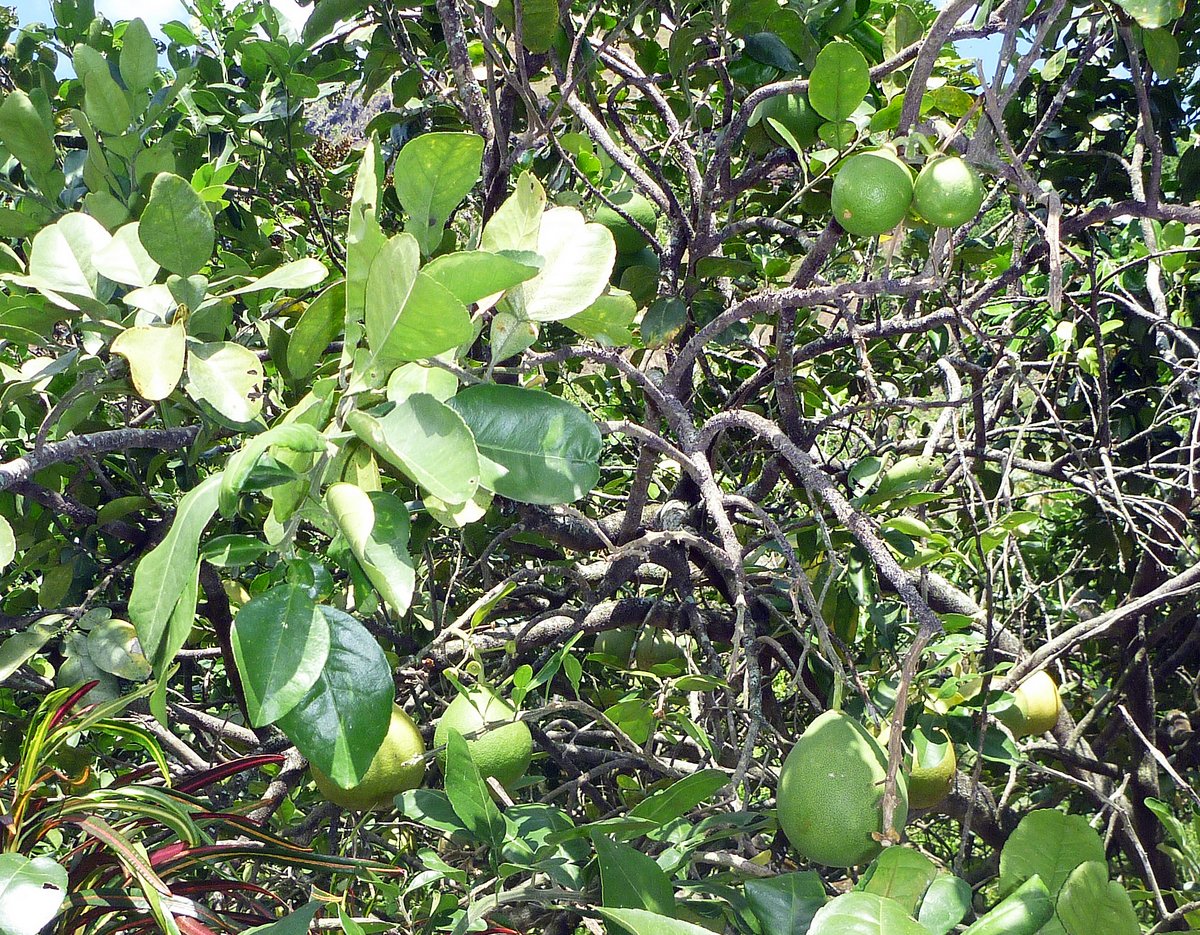
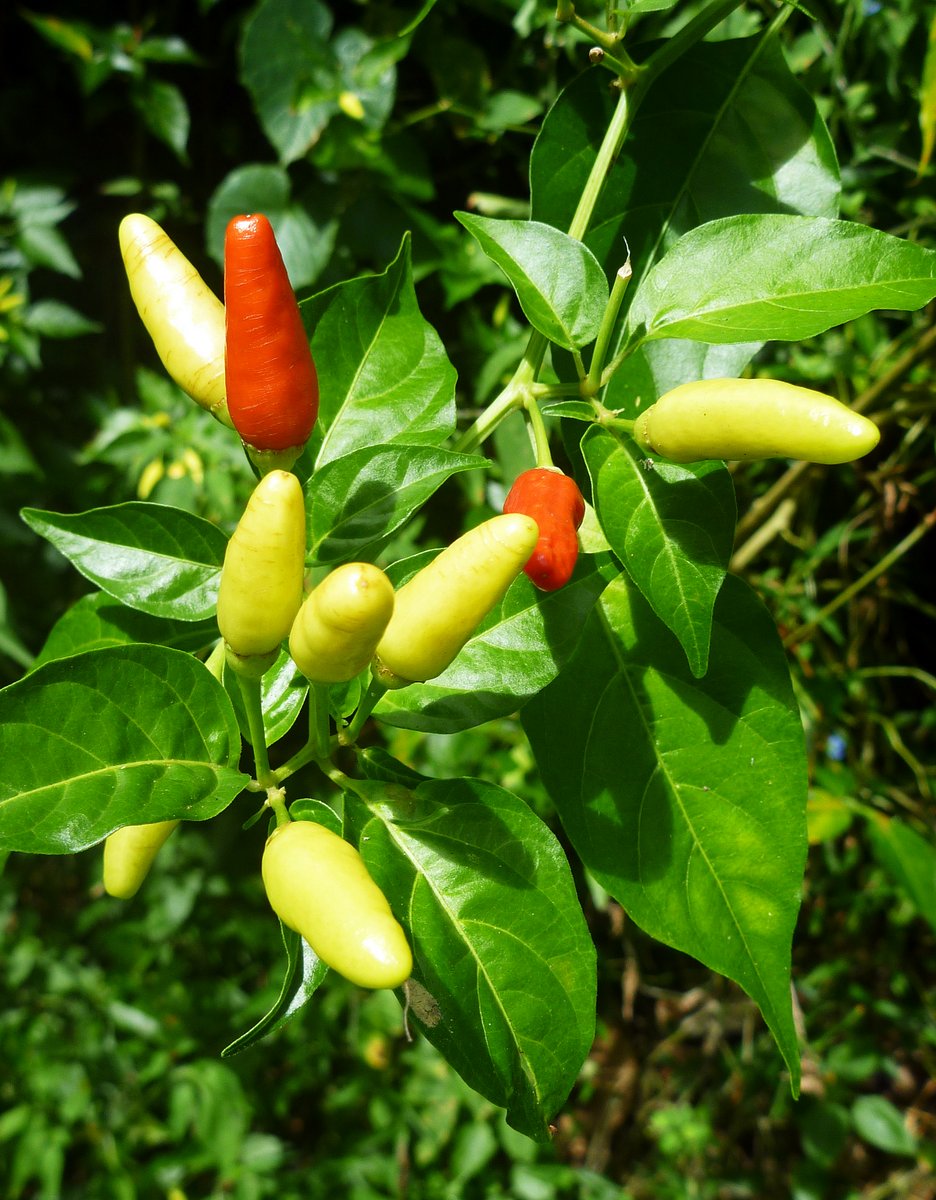
We visited the site of the Laughing Tiki and the large archaeological site of Iipona at Puamau, where we saw the largest tiki west of Easter Island and other ancient structures such as platforms built from stones that were used for prayer and human sacrifice. The ancient artifacts were relatively interesting, but we mostly enjoyed talking to Marie Jo and asking questions about Hiva Oa and the plants as we travelled across the island. She helped us to collect Pamplemousse from a couple of places and we picked small hot chilli peppers that seem to grow everywhere.
After visiting the Iipona site, we stopped off at a small restaurant in Puamau called Chez Therese and had a fabulous lunch. We had Poisson Cru (raw fish in coconut milk); Poipoi (a kind of dumpling made from fermented breadfruit mixed with manioc flour); Fried breadfruit; Par boiled breadfruit; Fried chicken; Rice; and a fabulous salad with grated mango on top. It was all delicious - the Poisson Cru was absolutely gorgeous and even the breadfruit was good. Glenys chatted to the lady who prepared the meal about recipes and she insisted on giving Glenys some watercress, mangos and a huge one foot long bean pod that she called Haricot Verte.
There’s only one road that crosses the island from Atuona to Puamau and it’s a very, very rough dirt road for much of the way, winding its way along and down knife edge ridges. We suffered a flat tyre on the way to Puamau, so Marie Jo was very worried all the way back - if we had another puncture in the middle of nowhere, it would have been a big problem - we only saw about six other vehicles on the trip and in most places there was no phone signal to call for assistance. Fortunately, we made it safely back to the boat.
25 April 2014 Hiva Oa to Hanamoenoa, Tahuata
We were up early again and hitched a lift into town to try to get an Internet connection at the Post Office. There’s an internet wifi signal at the anchorage, but it’s incredibly slow and intermittent and to make matters worse, there’s ten cruisers trying to get access all the time. I lost five dollars yesterday when the system took money from my credit card and then failed to give me a login, so I've given up on it.
Unfortunately, the internet signal at the Post Office was so bad that it wouldn't even give me the login page, so we gave up and went to the supermarket to buy a few things. There’s a real French influence in the grocery stores here, with French pastries and of course, lovely warm baguettes standing upright in plastic crates. However, one has to be quick because the locals swoop in on the crates when they arrive and grab armfuls of the wonderful smelling bread.
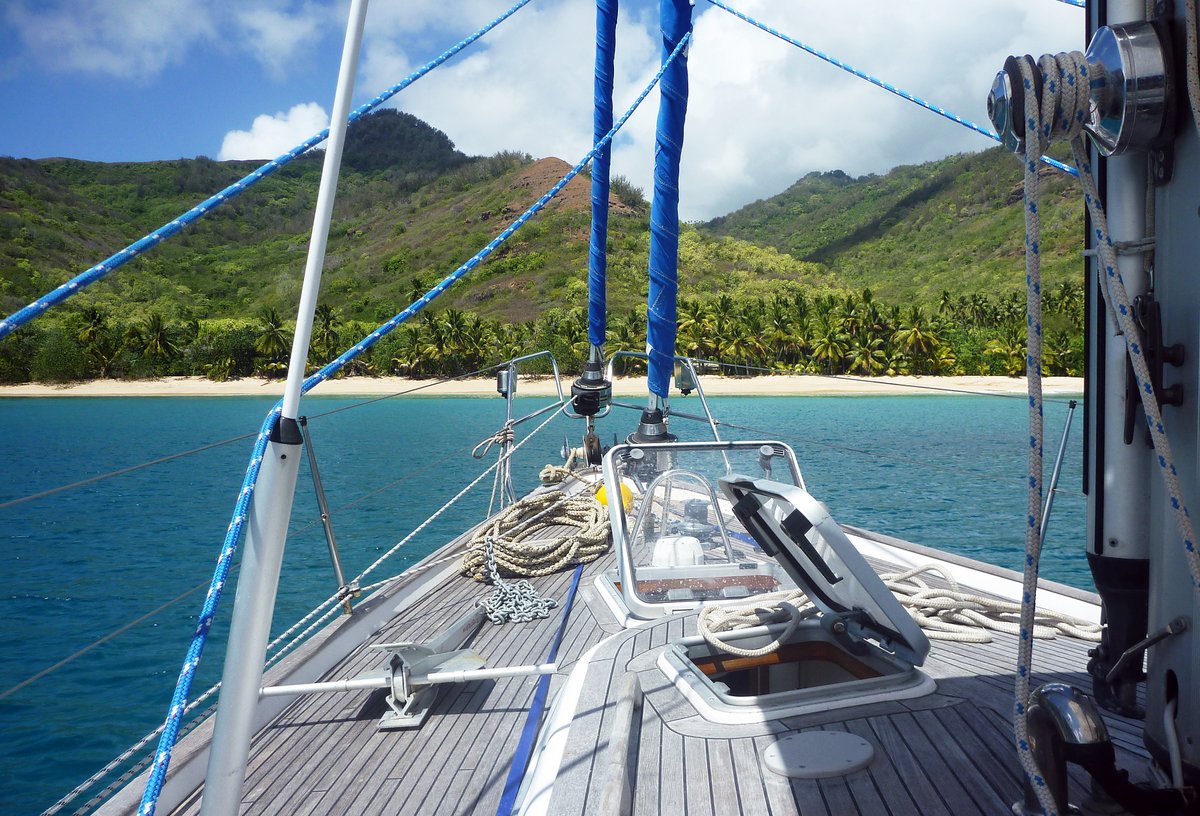
We hitched a lift from Marie Jo back to the boat, pulled up anchor and had fabulous sail across to Tahuata. It was only ten miles, so Glenys was more tolerant than usual and I was allowed to crank up the sails while we beat out of the bay in 15-20 knot winds. After three years on the boat, I think that I'm finally starting to like sailing just for the pure joy of it. We went upwind like a witch for 30 minutes and then eased the sails to a broad reach when we rounded the headland.
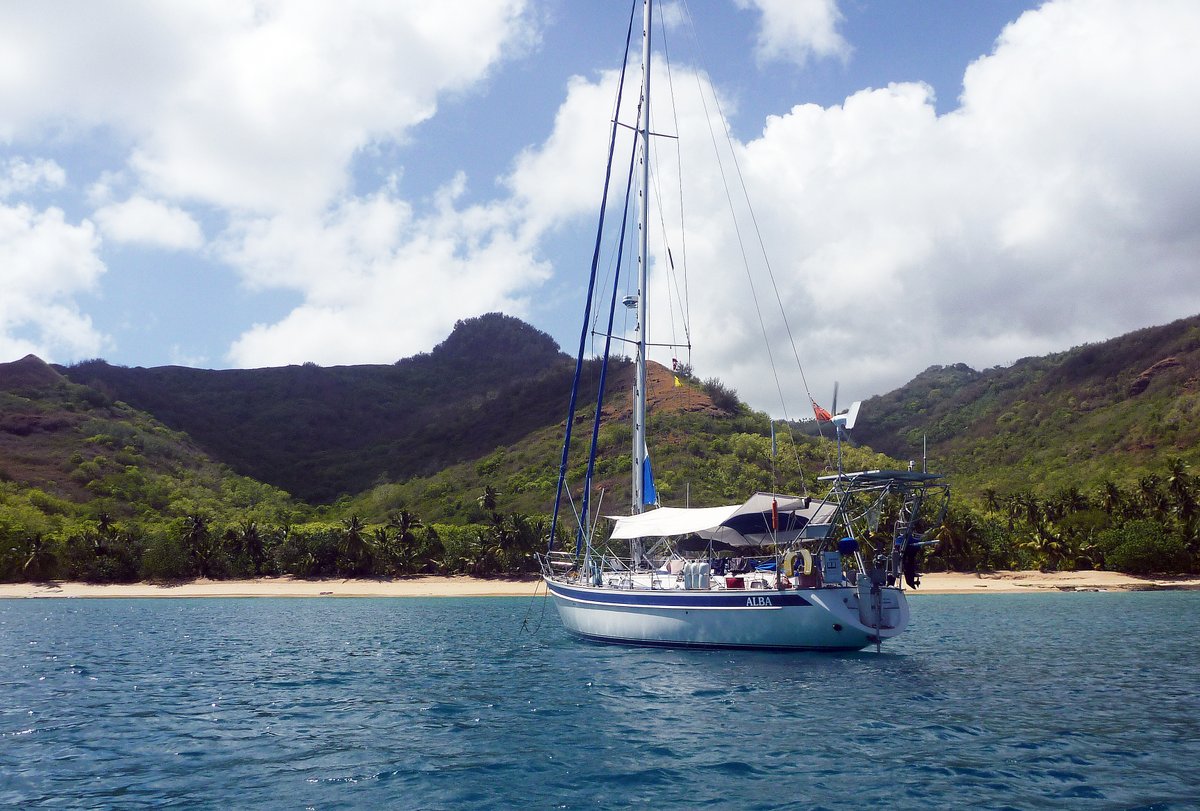
Two hours later, we were anchored in Hanamoenoa, which is a beautiful bay with a white sand beach, fringed with coconut palms swaying in the wind. There were only three other boats in the anchorage, so it was lovely for an hour until three huge Australian catamarans arrived and plonked themselves between us and the beach, ruining our view - oh well...
I went snorkelling on the northern headland of the bay and managed to spear 4 red pan fish. I also saw a Manta Ray, a couple of Spotted Eagle Rays and a four foot Black Tipped Shark came over to check me out – I was glad that I’d finished spearfishing and had my catch back in the dinghy. After my shark encounter, I decided to call it a day and retreated back to the boat.


We had the fish for dinner – one was okay, but the others had very chewy flesh and weren't very pleasant. It’s a bit difficult to know what to catch here because Ciguatera is problem in bigger fish like grouper and snapper – I need to talk to some locals about what is safe.
26 April 2014 Hanamoenoa, Tahuata
With nothing planned for the day, we had a lie in – first time for ages. I really like this anchorage, there always seems to be some wind and there’s just a gentle rocking motion from the slight swell that gets in here.
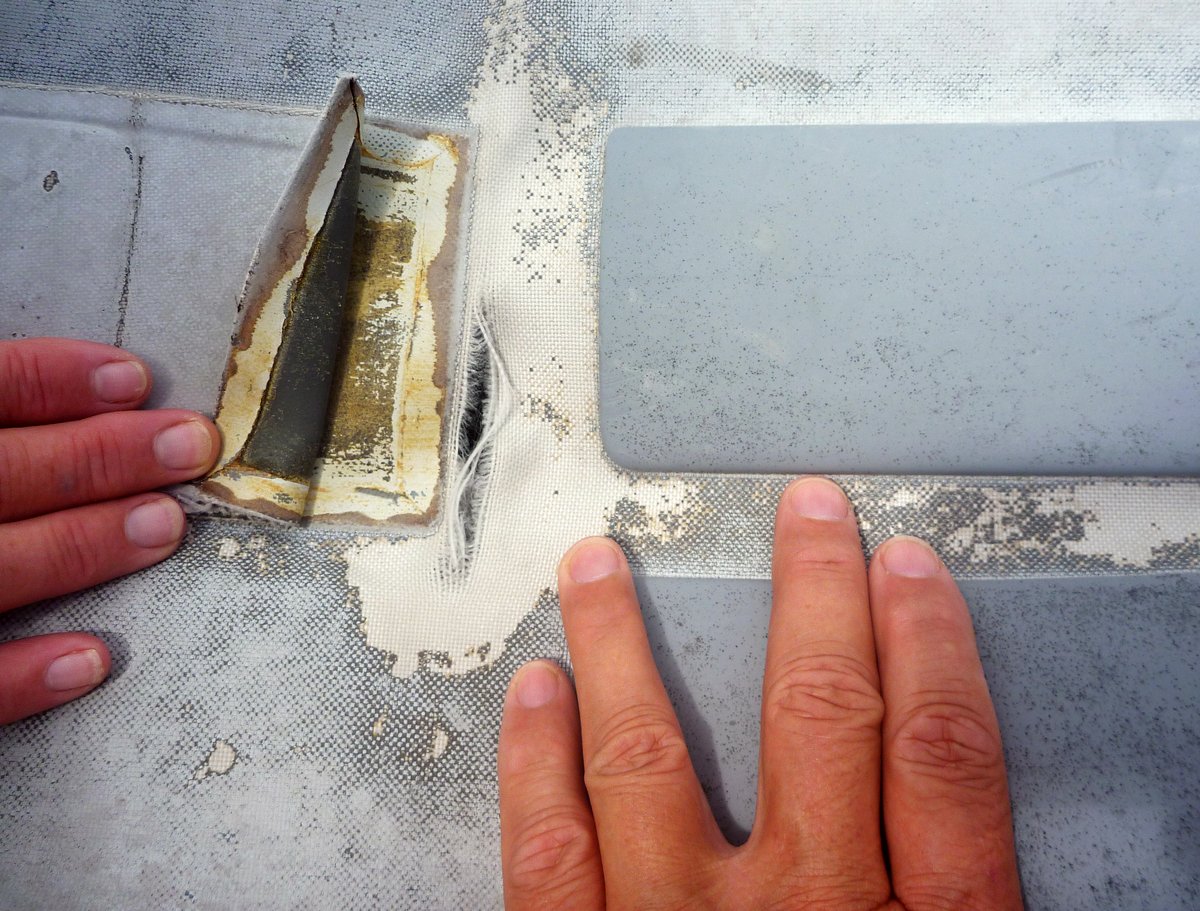
We had a day of catching up on jobs. One of the tubes on the dinghy went completely flat this morning and I discovered that it had a two inch tear where the Hyperlon fabric has gotten so thin that it just wore out…
I lifted it on deck and used most of our Hyperlon patching material to repair the tear and to add some reinforcing patches to other areas that are badly worn. The rubberised outer coating on the fabric has now perished and we’re through to the fabric in a lot of areas now – it’s in a very sorry state and I hope that it keeps going and doesn't fail completely while we’re in the middle of nowhere.
Later in the afternoon, we went snorkelling on the southern headland and had to swim all the way there and back because dinghy was still on deck. The site was okay, but not as good as the northern headland. We must have swam over half a mile and, by the time that we got back to the boat, Glenys felt exhausted and not very well. She made dinner and then couldn't face eating it – she even left half a can of beer which means that she must feel really poorly.
27 April 2014 Hanamoenoa, Tahuata
Glenys had a rough night and kept waking up. She felt very ill this morning and has a dodgy tummy, so we think that she’s picked up some kind of virus. She had a quiet day resting.
The dinghy inflated okay this morning, but I think that we need to buy a dinghy sooner rather than later. We may be able to buy one in Papeete when we get there in four weeks’ time, or alternatively we could call into US Samoa in August and order one directly from the USA, which might be much cheaper.
We now have quite a few expensive things on our shopping list - a dinghy; radar; chart plotter; AIS transceiver; a spare drive for the autopilot and some other specialist spares. I'm trying to figure out whether it would be cheaper to call in at US Samoa rather than waiting until we get to New Zealand, so I spent the morning looking at marine catalogues making up a list of things that we need. I’ll try to get quotes and work out what to do – either way we’re going to be spending over $10,000 by the look of things.
While Glenys was having an afternoon nap, I went snorkelling with John and Colin from “Kika” on the tip of the northern headland. It’s a really good snorkelling spot and we saw two Mantas and a more Spotted Eagle Rays. We watched three Spotted Eagle Rays spiralling around each other in a kind of vertical column – they looked like they were playing.
John and Colin didn't have any fins, so when we got back to the anchorage, I lent them our fins and showed them how to dive down underwater. It was a revelation to them that they could get down to 5 metres, so I think that they’ll be buying some fins when they get to civilisation.
Glenys was feeling slightly better in the evening and had something to eat, but went to bed early.

28 April 2014 Hanamoenoa, Tahuata
Glenys was still feeling ill and exhausted, so she had a quiet day resting and I spent most of the day trying to repair my Canon G11 camera.
Just before we left the Galapagos, the telescopic lens jammed in the fully extended position and won’t retract. I tried blowing compressed air from a dive tank around the lens to see if there was any grit stopping the lens mechanism, but that didn’t make any difference. The camera is five years old and it’s not worth spending $300 getting it repaired, so I decided to try to take the camera to pieces to see if I could fix it.
Three hours later, I’d managed to disassemble it – lots of very small screws and scary little connectors holding the various parts together. The lens mechanism is right at the heart of the camera, so I had to strip everything around it and document every step with photographs. Just as I was pulling off the cover to the lens assembly, I found a broken cable – these are incredibly small thin pieces of mylar plastic with printed wiring. I don’t know whether I broke it while I was fiddling around or whether it was already broken and the cause of the fault. Either way it’s buggered.
I am in despair. I use this camera for all of my underwater photographs and take it out every time that we go snorkelling or diving. If I was back in the UK, I would use this as an opportunity to upgrade my camera rig and would have already ordered a new camera and underwater housing. Unfortunately, I probably won’t be able to buy one for months. I might have a chance in Papeete when we get there in June, but it’s unlikely, so maybe this is another thing that we get sent to US Samoa in August.
So, for at least the next four months, I’m unable to take underwater photographs, while we sail thorough the Tuamotus and other South Pacific islands with pristine reefs and crystal clear water – Oh Miser!
Late in the afternoon, I went for a snorkel by myself on the northern headland and saw a couple of Manta Rays, one of which swam five feet underneath me – if only I’d had a camera…
29 April 2014 Hanamoenoa to Vaitahu, Tahuata
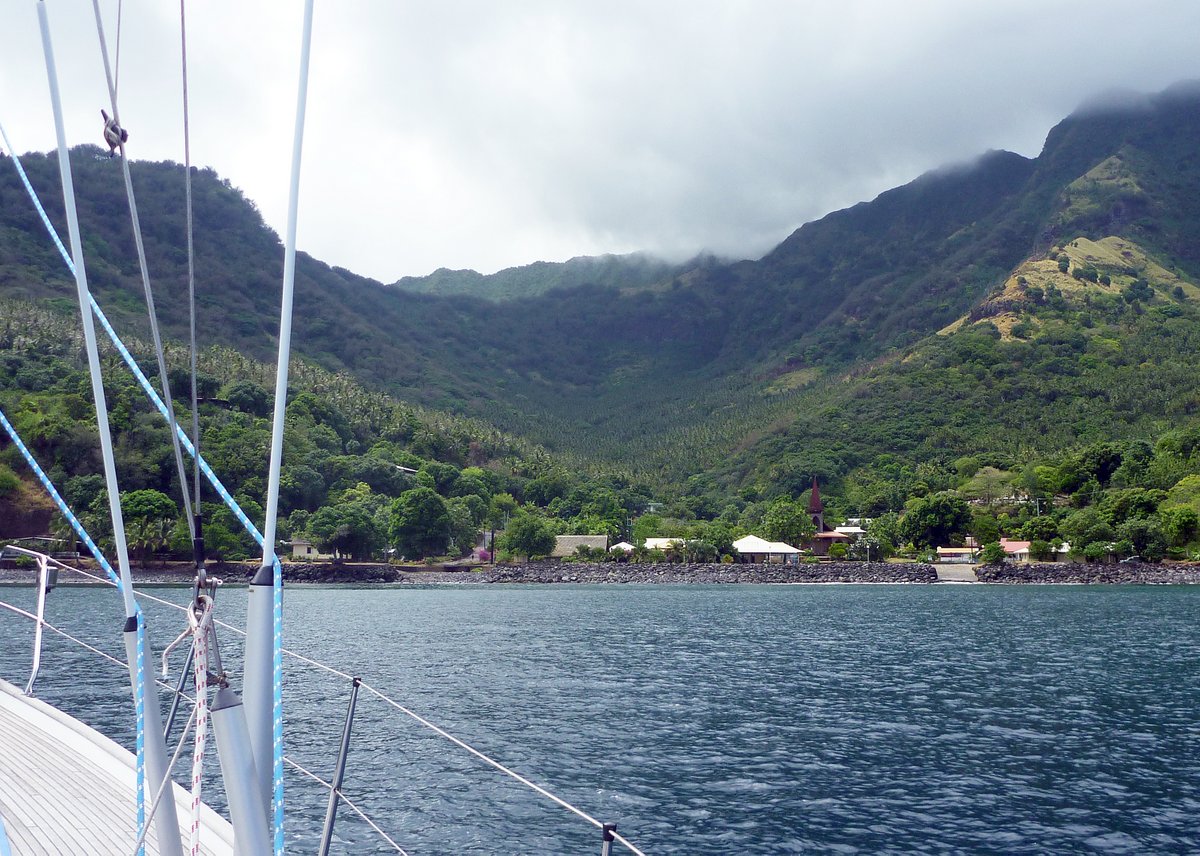
There’s not much improvement in Glenys – this tummy bug is exhausting her. We decided that a change in scenery was needed, so we sailed a few miles down the coast to the small village of Vaitahu and anchored amongst four other yachts. It’s a pleasant anchorage surrounded by steep hills reaching up to a ridge line 900 metres above us. The weather wasn’t very good with rain showers passing through, so we spent the morning on-board.
We’ve not had an internet connection since we left the Galapagos a month ago and I’ve been trying for two days to send an email to our son Craig via satellite phone. It’s a small email, but I have to attach a small image of my signature and these emails are not getting through to him. We’ve been talking to him by text messages on our mobile phone, but we’re now running out of credit, so shortly we’ll be incommunicado. It’s very frustrating.
We went ashore in the afternoon and had a walk around the tiny village. It’s all very neat and tidy, but everywhere was closed up, including the two small grocery stores and the post office, so we’re not able to buy a top up card for our mobile phone. There’s a very impressive looking church, which seems out of place in this small village - we’re told that the villagers built it themselves.
The other cruisers in the anchorage have told us that the village stores have run out of practically everything, but there’s a cargo ship due to arrive tomorrow. I believe that the supply ship comes in every three weeks, so it will be a big event on the island. It will be interesting to see how they will unload everything because waves are constantly crashing against the village’s tiny dock.
30 April 2014 Vaitahu to Hanamoenoa, Tahuata
I woke up at the crack of dawn and just had to try to send the email to Craig again. I read some of the technical blurb on the satellite phone email system and decided to bypass their “clever” compression system. It worked! Craig sent us a text message that used up the last of our credit on our phone, but at least he got his email.
The cargo ship arrived in the middle of the morning and we could see a large number of pickup trucks lining up on the shoreline. A huge crane on the ship swung into action and lifted a flat-bed barge down into the water, then started to unload its cargo. The barge ferried the cargo to the small concrete dock and then held station against the strong surge while a JCB unloaded the crates of cargo onto the quay where the locals were soon grabbing their goods. The only thing being exported from the island were sacks of dried copra and empty diesel drums.
After an hour of watching the operation, I dropped Glenys ashore on a mission to find a phone card and get some bread. The store was open, but there was no bread available and the shopkeeper told Glenys that he wouldn't be receiving any more supplies until another cargo ship comes in on the 4th of May. However, she did manage to buy a mobile phone top up card from a guy who sells them as a bit of side line – he charged her $12 for a $10 card, but was apparently very nice about it.
After lunch, we decided that there was little point in staying at Vaitahu – it’s an impressive place with the hills towering above, but a little gloomy with a black rocky shoreline. We upped anchor and went back to Hanamoenoa and what a difference a couple of miles makes. The water here is blue and the verdant green of the coconut palms contrasts beautifully with the white sand beach – it lifts the soul.
We went snorkelling on the northern headland again and saw three Spotted Eagle Rays swimming in formation around one particular rock, which I think was a cleaning station where small wrasses come out and pick off parasites. They were very unconcerned about us, even when we dived down to within a few metres of them. We're planning to do a dive at this site tomorrow.
“Salamander” turned up in the late afternoon, so we invited Michael and Charlotte over for sundowners.
- << Prev
- Next