
7 March 2014 Santa Cruz, Galapagos
We woke to another blue sky day. Most of the big tourist ships had left the anchorage and the port looked less manic in the bright sunshine. While we were eating breakfast in the cockpit, we had Blue Footed Boobies diving into the water catching small fish that had gathered under our boat. Meanwhile, below the poor fish, there were half a dozen Wahoo herding them into a tight shoal and then dashing up to snap up a mouthful.

From dawn, we’d had lots of boat traffic going past us with big wakes. It appeared that we were anchored in the main route between the town dock and the ships in the outer anchorage, so we moved closer towards the shore. Puerto Ayora has a reputation of being very rolly when any swell comes into the bay. There isn't much swell at the moment, but I put out a stern anchor to keep our bow pointed into the swell, just in case.
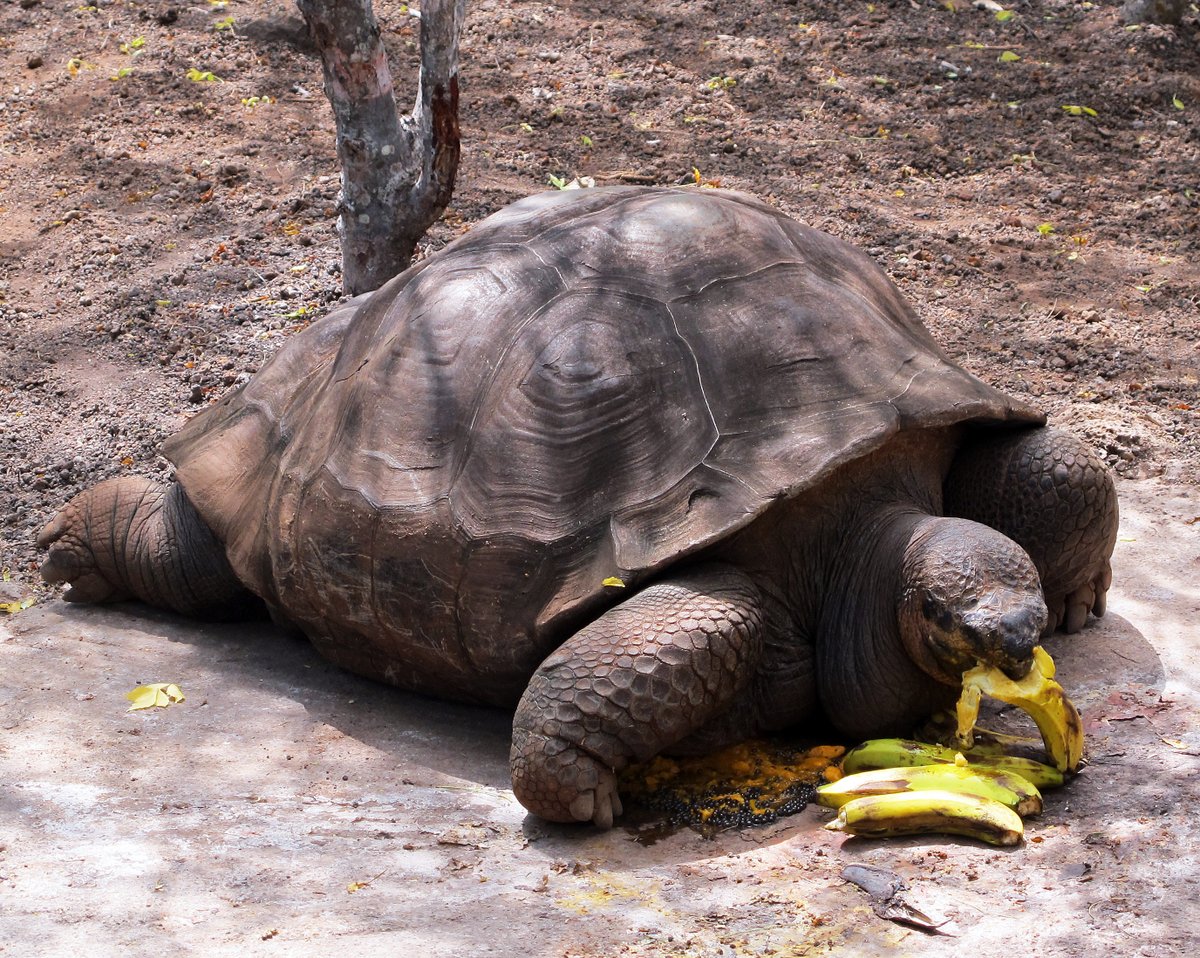
Once we were settled, we caught a water taxi into town and had our usual wander about checking out the supermarket and vegetable market, both of which look pretty good. We then walked out to the Darwin Centre, which is a research centre where they breed Galapagos Tortoises. It was interesting to see the small baby tortoises, which when they are only three years old, are the size of the fully-grown pet tortoises that we have in the UK. It’s incredible that they keep growing to such a massive size.
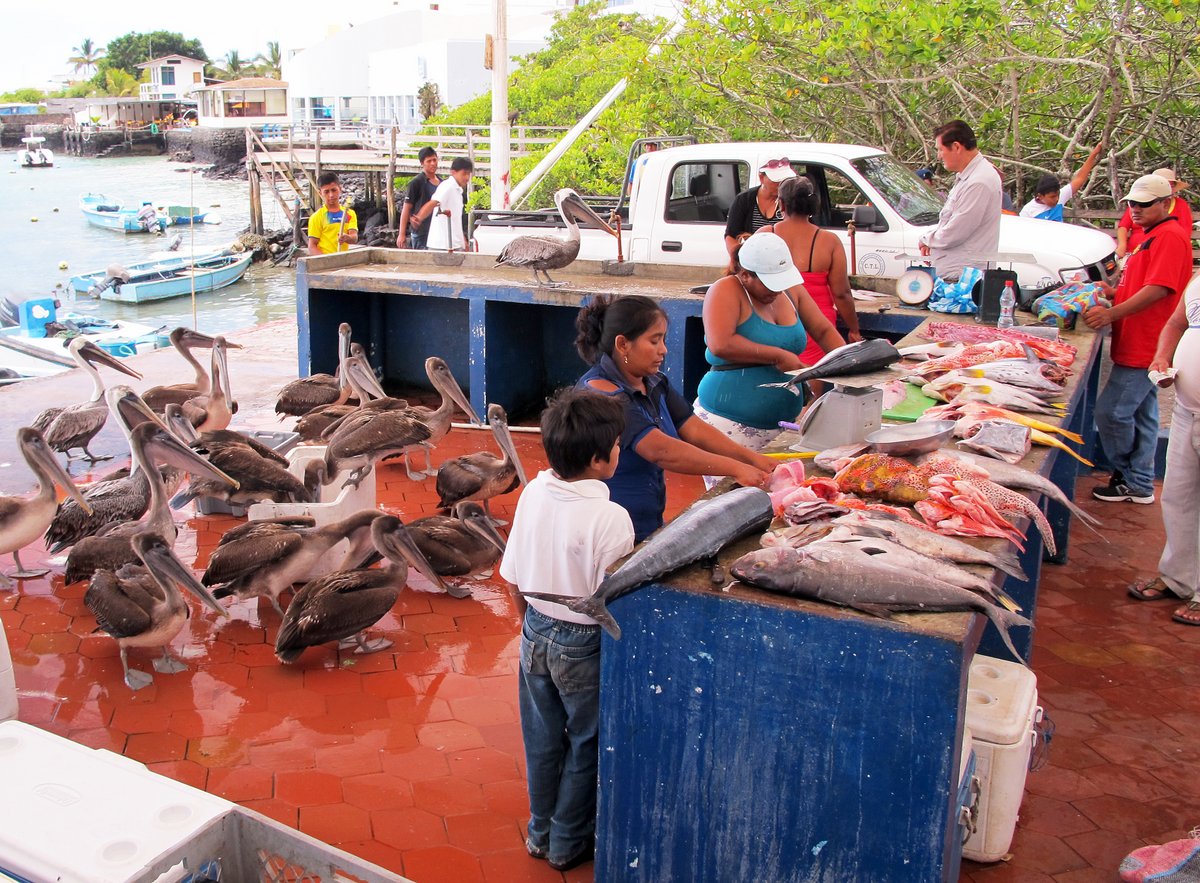
On the way back from the Darwin centre, we stopped off at the Fish Market, which has turned into a small tourist attraction because Sea Lions and Brown Pelicans hang about waiting patiently for scraps from the people cleaning the fish.


While walking around earlier, I’d noticed that there were a lot of small local restaurants on Charles Binford Street just off the main high street. So, rather than paying the $15 tourist prices in the posh restaurants on the Malecon, we went back there. We had a delicious shrimp soup followed by a pan-fried fish with rice and salad for $3 including a glass of Guava juice.
In the evening, we went over to “Sundance” for a beer or two. They also have a stern anchor out to hold themselves in to the swell. Unfortunately, a Polish boat anchored close to them three days ago without a stern anchor and is swirling around in the tides, whereas “Sundance” stays roughly in one position. While we were aboard “Sundance”, the Polish boat was only six feet away.
Glen and Erin have tried to talk to the owner, but he has been very rude and has ignored them. If the Polish boat hits “Sundance”, then he is liable for any damage because he anchored last, but looking at the boat, they are probably not insured and couldn't afford to pay for any damage. So what do you do? Despite being the aggrieved party, I would have moved two days ago – I couldn't stand the hassle…
8 March 2014 Santa Cruz, Galapagos
It was Glenys’s 57th birthday today and I had to remind her – it’s those aluminium pans, you know! We've both agreed to stop buying each other presents and this is the third year running that I've not bought her anything, but I've promised to buy her some black pearls when we get to the Tuamotus.
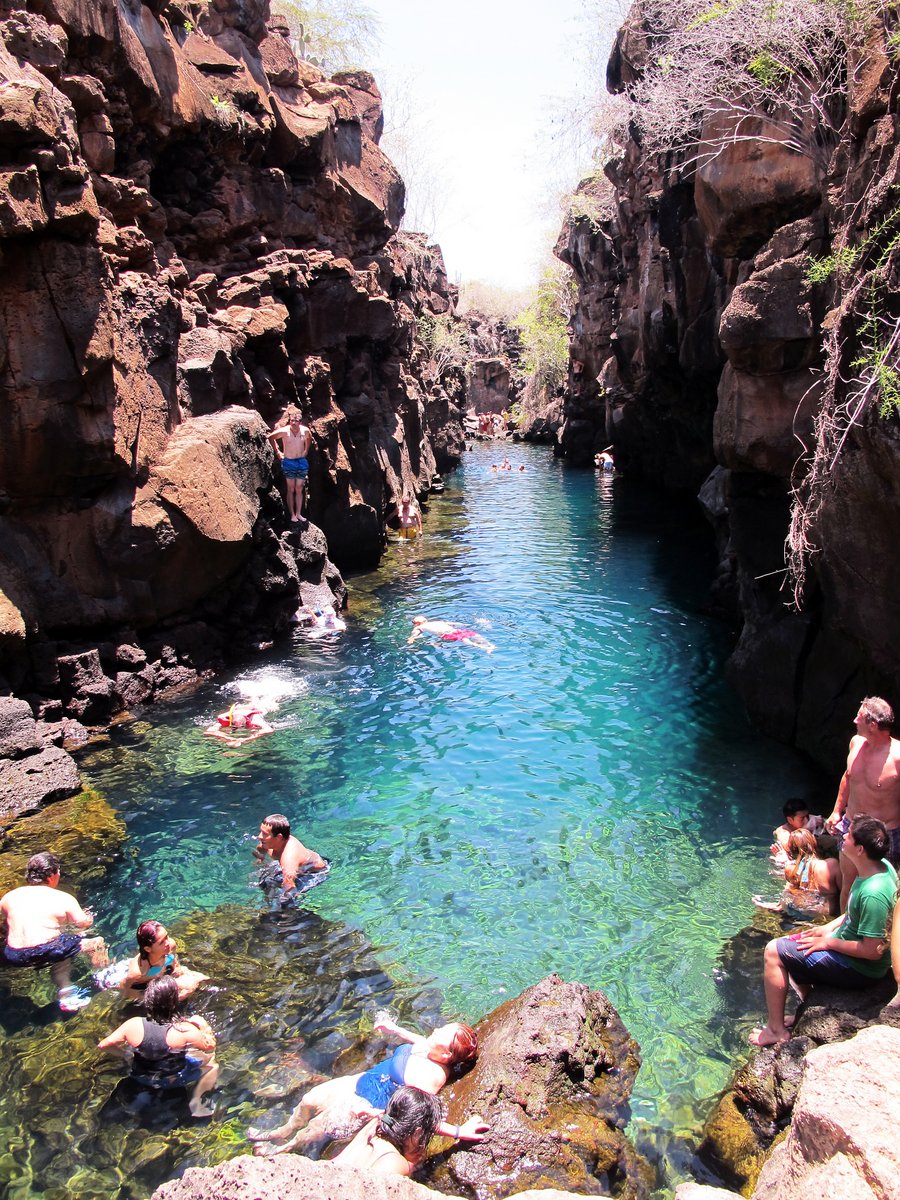
We went for a walk to Las Grietas. We took a water taxi from our boat to the dock at Angermaeyer Waterfront Hotel and then walked along a good footpath for 20 minutes. The path goes across the Playa Punta Estrada and then around a lagoon. The landscape is barren, but there are countless Darwin Finches darting about. Charles Darwin studied the small differences between these rather boring finches, which led to his famous Theory of Evolution.

Las Grietas is a long, steep sided canyon filled with sea water. The main attraction, apart from simply swimming in the cool, crystal-clear water, is to climb up the steep sided cliffs and jump off.
It was Saturday, so the place was packed with locals all having a whale of a time. We only stayed long enough to have a swim and jump off the cliffs a couple of times and then walked back to Playa Punta Estrada. We tried to go snorkelling, but unfortunately, the tide was out and we couldn't get past the shallows at the head of the bay, so we gave up and retired back to the boat where we chilled out for the rest of the afternoon.
Last night, we watched a BBC documentary on the Galapagos Islands and one of the things that David Attenborough talked about was the way that Mangrove Seeds drift across wide expanses of sea and plant themselves when they drift ashore. The seeds are about six inches long and float horizontally when in salt water, but then float vertically when they are in brackish water. In this vertical configuration, when they touch land, they plant roots and are very effective colonisers of shore lines. We've been poking around mangroves for the past three years, but I've never noticed these seeds. Today, I saw hundreds of them, even finding one floating vertically in the shallow water off Playa Punta Estrada.

We went for a stroll around town in the evening. There were loads of locals wandering about with their kids near the square just off the town dock - most of the older boys were zooming about showing off their prowess with skateboards. Meanwhile vendors were setting up beer and food stalls and a band was setting up huge speakers on the stage overlooking the square. We grabbed a beer and did a bit of people watching.

Down at the fish market, plastic tables had been set out and people were buying fresh fish and having it cooked on the spot served with a plate of rice and plantains. We wandered over to the street with the local restaurants and found that it had been blocked off and the street was covered with tables and chairs. Large groups of tourists were arriving to eat barbecued fish for $12-15 per head – a long way from the $3 charged during the day when the locals eat there.
Glenys fancied some stodge, so we ended up in a very American looking bar, having fish burger and chips. Glenys treated herself to a Blue Booby Marguerite for her birthday, which was errr… very blue. Back at the square, the band showed no sign of starting for hours, so we gave up and were in bed by half past nine – we’re getting old…
9 March 2014 Santa Cruz, Galapagos
It was another beautiful day, so we walked to Playa Tortuga. It’s a long three kilometre walk along a paved path to the beautiful white sand bay. “Tortuga” means “Turtle” and the beach is a favourite place for Green Turtles to lay their eggs. We walked along the edge of the sand dunes and saw several turtle tracks coming out of the sea, leading to obvious nests. We were very lucky to find a small hatchling, which was struggling in the hot sun. Being the only one visible, we assume that it was the runt of the clutch and its brothers and sisters had already made it to the sea.

Although you’re not supposed to touch the wildlife, Glenys felt sorry for it and carried it to the sea, where the tiny two inch long turtle seemed to recover a little, but still seemed confused about which direction to go. At least we gave it a fighting chance. Unfortunately, I forgot to put a memory card in my camera and so I have no photos of the cute little thing – what an idiot…
There are lots of Marine Iguanas along the beach both swimming in the sea and strolling along the sand. We also spotted a few juvenile black tip sharks swimming at the edge of the sea in water that was only a few inches deep – strange behaviour.

At the west end of the beach, there’s a big lagoon with another lovely beach. Like the main beach, there were hundreds of people enjoying the good weekend weather. Glenys and I went snorkelling, but the water close to shore is very murky, so we swam several hundred metres out into the middle of the bay where the visibility improved to 4 metres allowing us to see an octopus and a huge 1 foot wide clam. We swam back along the mangroves which line the shore and had a great time observing Marine Iguanas swimming a few feet away from us – if only I had my camera…
We were back on the boat by mid-afternoon and went to “Salamander” for a barbeque in the evening.
10 March 2014 Santa Cruz, Galapagos
We got up early and went on a tourist trip to North Seymour Island. It cost us $135 each, but we bit the bullet because other cruisers have said that it’s well worth it. The itinerary consisted of a bus ride to the north end of Santa Cruz, a boat ride to a beach for snorkelling, lunch and then a 2 hour wander around North Seymour Island, which is a breeding site for Blue Footed Boobies and Frigatebirds.

The bus journey takes 30 minutes and it was interesting to see the way that the terrain and vegetation changed as we moved away from the coast up into the highlands. Near to the coast, the landscape is very dry and the vegetation is cactus and scrubby trees. The road then goes through lush farmland covered with trees, grassland, cattle grazing, vegetable crops and even fields of bananas. As we climbed higher, the vegetation became a kind of scrubby forest with strange trees covered with hanging moss and lichen.
The trees are called Scalacia and were one of the first plants to colonise the newly formed volcanic island hundreds of thousands of years ago. It is a unique species derived from a type of Dandelion and covers the higher slopes of all of the Galapagos Islands. The trees that we saw were growing to a height of 10 metres and looked very primeval.

The bus dropped us off at a small dock in the channel between Santa Cruz and the smaller island of Baltra. Bizarrely, the main airport for the Galapagos is on Baltra and all passengers have to be transported to a dock, loaded onto small ferry boats for the 400 metre trip across the channel and then onto buses to their destination. I believe that the airport was built by the American Air Force when they had a base here.
Our boat was a nice 55 foot sport fishing boat and we had a pleasant motor in calm water to the Las Bachas Beach, where we had an hour to snorkel or stroll along the beach. Glenys and I went snorkelling, which was okay, but again the visibility was very poor at only 2-5 metres. We didn’t spot anything new, but had a nice time swimming with a couple of Leatherback Turtles in the shallows.
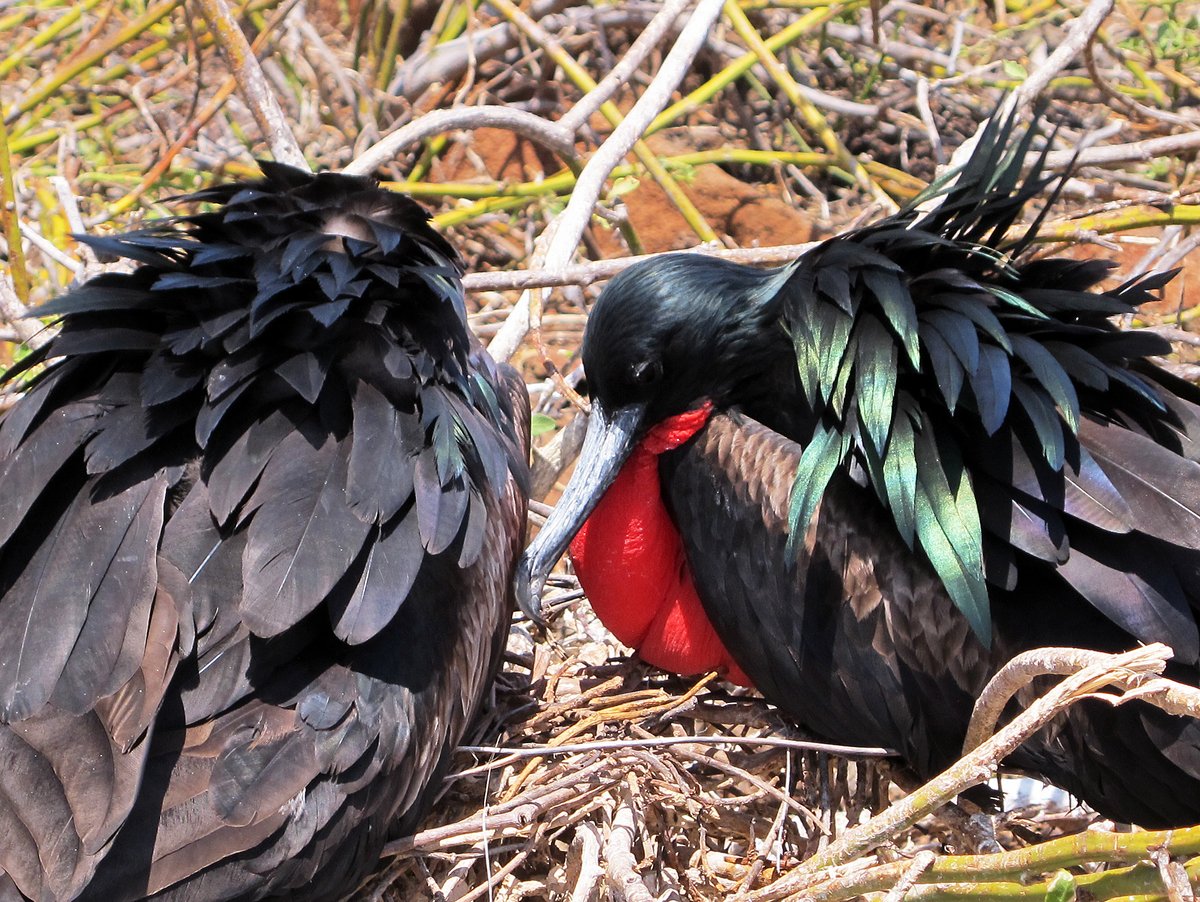
The walk around North Seymour Island was very interesting. At this time of year, Magnificent Frigatebirds are breeding and there were hundreds of males sat on their scruffy nests with their bright red pouches inflated trying to attract a female. As we walked around, we saw the various stages of the life of the Frigatebird, from small fluffy chicks hidden beneath a protective parent to older chicks preening themselves on the nest while their parents were out fishing. We were told that young male Frigatebirds have a white head and chest, while females have a black head and white chest – it’s only the mature males that have red pouches.
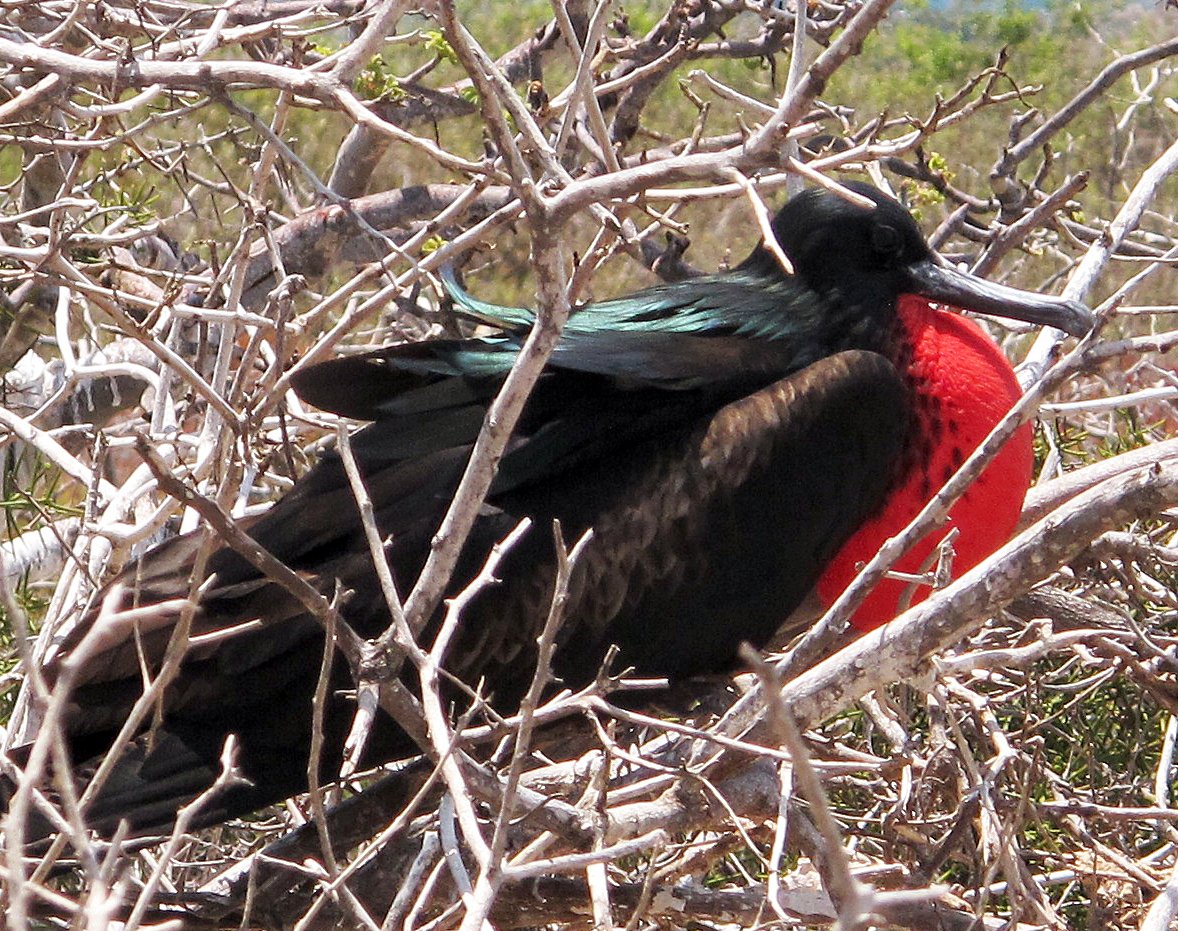
Unfortunately, there were not many Blue Footed Boobies around. This was a pity because I was looking forward to seeing their courtship dance, which is supposed to be comical, with much foot stamping and contorted body positions. Ah well, maybe I’ll see it somewhere else.
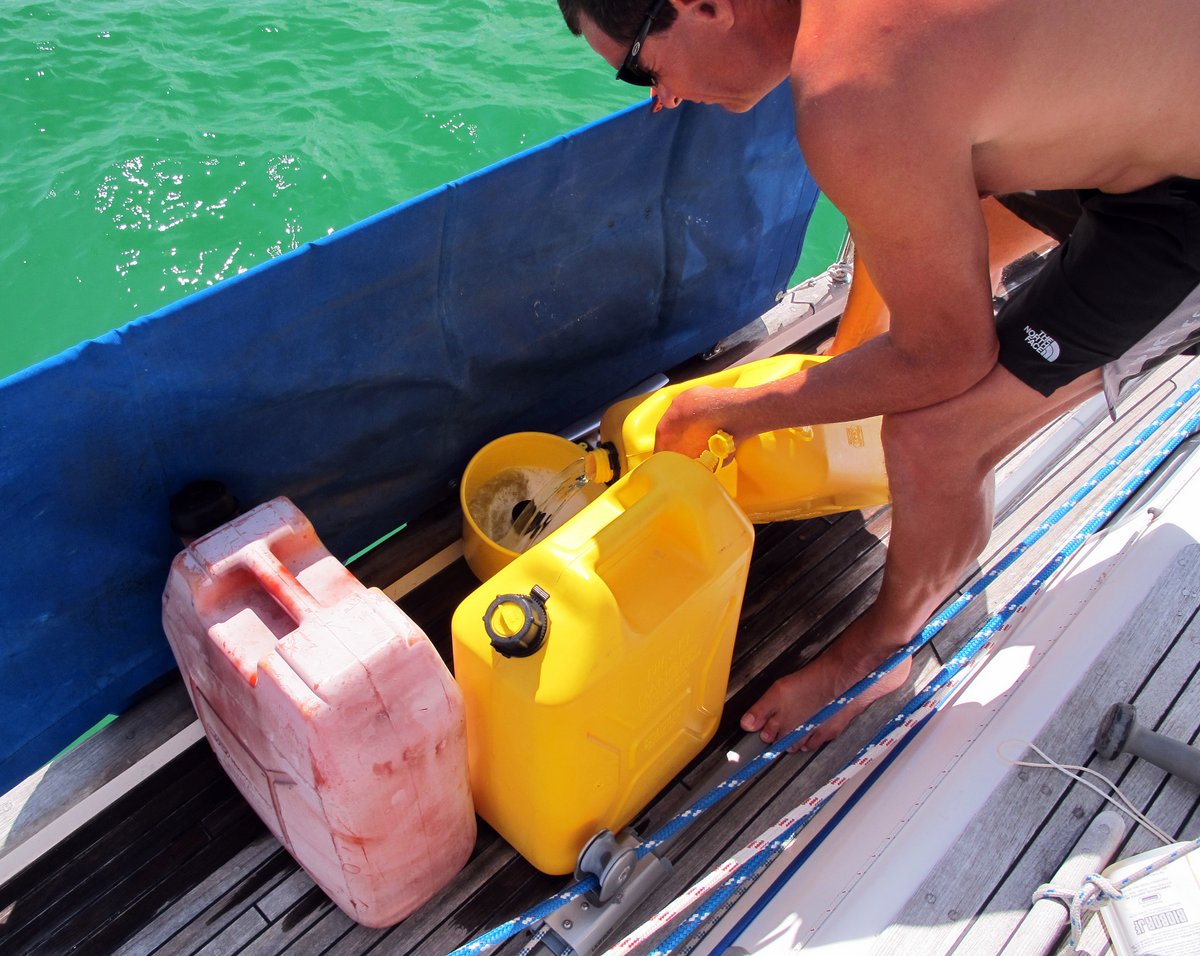
The bus started to overheat on the way back to town, so the driver turned around and we had to wait while they filled up the radiator. In typical Ecuadorian fashion, they only had a one gallon drinking water container and had to keep shuttling back and forth in their inflatable to get the fresh water from the sports fishing boat – it took them 40 minutes.
11 March 2014 Santa Cruz, Galapagos
Having been tourists for the past week, it was time to catch up on some chores. Glenys dragged me off to the “big” vegetable market, which only occurs on Saturday and Tuesday mornings. It opens at 0600 and one is supposed to go there very early to get the best produce. We arrived at 0900 and there weren’t that many stalls - Glenys thinks that the normal market on Avenue Baltra has a better selection. After buying lots of vegetables, we walked along to the normal market, where there are several good butchers.
After lunch on board, we tackled the tedious task of getting diesel. Our agent, Irene, had dropped off a document permitting us to buy up to 60 gallons of diesel. We took our three jerry cans ashore and caught a taxi to the fuel station on the outskirts of town, which cost $3 for the return trip. At the fuel station, we had to go into an office, where our paperwork was checked. There was a little bit of confusion when I tried to explain that I wanted to do two or three trips getting about 15 gallons each time, but the guy understood eventually.
I was issued with another slip of paper, which stated the number of authorised gallons. I’d told him fifteen gallons and tried to emphasise “approximately” because I really wanted to fill all three containers to the brim and didn’t know how much that was going to be. I gave the form to the pump attendant, who set the pump to cut off at 15 gallons. There was total confusion when I said that I wanted more, but the taxi driver came to our rescue and persuaded the pump attendant to reset the meter.
We went back to the boat, poured our 18.7 gallons of diesel into the tank, then went back for more. This time I got a slip of paper for 20 gallons thinking that I should over-estimate. When I only took 18.5 gallons, the pump attendant was even more confused (and annoyed) that I hadn’t taken all 20 gallons. After a bit of chaos, he charged me for 19 gallons, but gave me a receipt of 20 gallons – how weird is that?

Back at the boat, we only managed to pour in 1½ jerry cans before our diesel tanks were full, so on our third trip, I asked for 7 gallons to top up our two jerry cans and pleased the pump attendant by taking the exact amount. The most annoying thing about the whole process is that we have to pay $5.03 per gallon when the Ecuadorians only pay $1.04 per gallon. It’s a load of administrative nonsense and then we’re charged FIVE times the pump price.
12 March 2014 Santa Cruz, Galapagos
We climbed out of bed early and walked to Playa Tortuga (this time with a memory card in my camera.) We walked along the edge of the sand dunes again, looking at the turtles nests, but didn’t see any hatchlings this time. However, it was a nice walk and we saw lots of tracks where the large female turtles had dragged themselves up the beach.
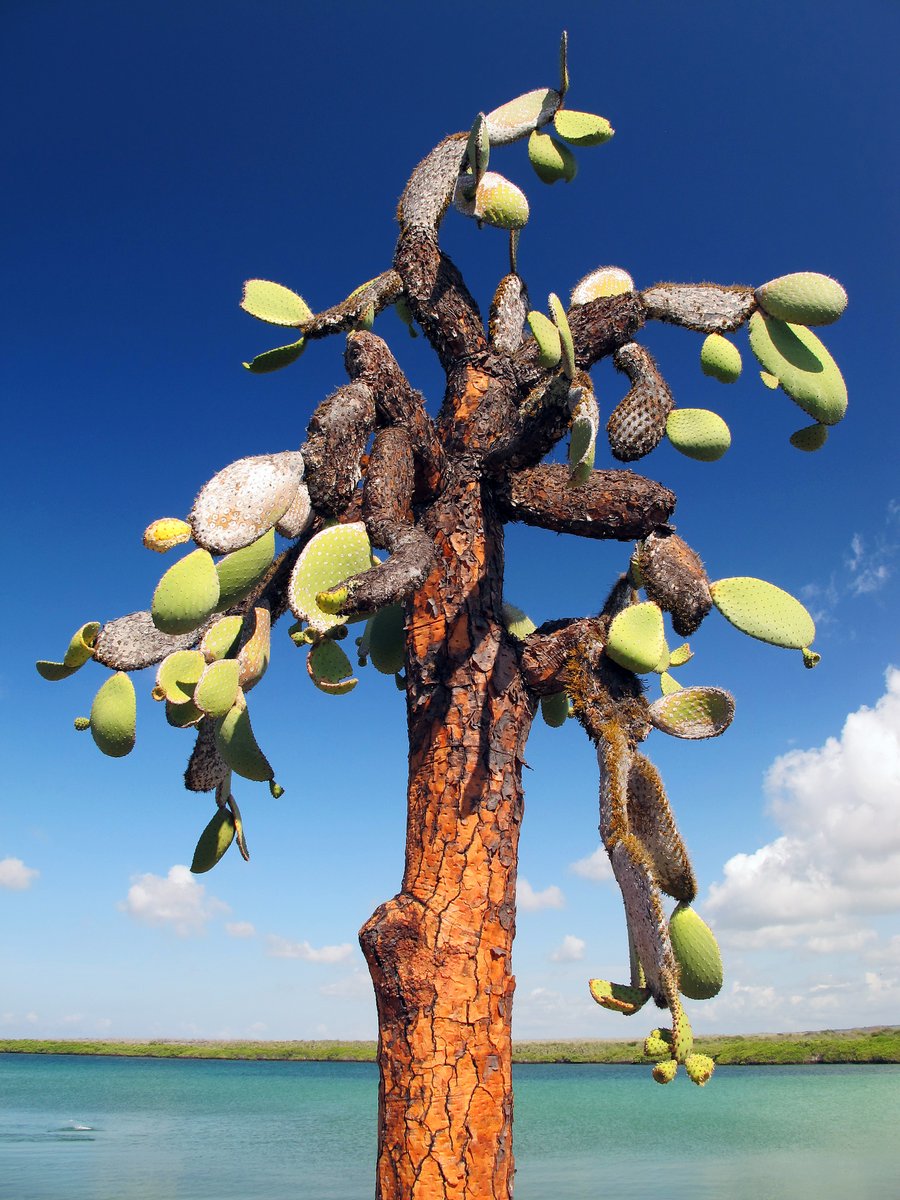
On the peninsula, at the end of the beach, is a wonderful patch of Galapagos Giant Cactus. These are the only cactus in the world that grows like a tree and have trunks that look like wood where the plants store large amounts of water. The cactii look very strange, seeming to grow out of the bare volcanic rock.
We had a nice snorkel along the rocks at the edge of the lagoon, spotting some small Black Tip Sharks and swimming with a couple of Marine Iguanas. We then walked back to the main beach where there was a small pool that had been created as the tide went out. The water was very clear and six small Black Tip Sharks had been trapped there. It was really fascinating to swim with them and watch as they moved around the legs of people standing in the pool.

After a long hot trudge back to town, we treated ourselves to an Almuerzo before heading back to the boat to chill out. Later in the afternoon, I wandered into town to try to buy some boat parts.
There are two chandlers – ElectroNautica on Charles Binford street and Bodega Blanca on Seymour street, both just off the Malecon. They both have a fair range of parts – Electronautica specialises in electronics and I guess can repair electronic equipment, while Bodega Blanca is more of a general hardware store with some marine parts. I didn’t do very well and only bought a snap clip and an impellor for our Mercury outboard. Everything else on my list was either not available or they’d run out. I dream of going to a West Marine store.
Our zarpe was dropped off in the afternoon, so we’re all ready to leave for Isabella in the morning. It's about time to go because the anchorage has been very bouncy for the past couple of days - I've very glad that we've got a stern anchor keeping us pointing into the 2-3 foot waves.
13 March 2014 Santa Cruz to Isabella, Galapagos
The alarm clock woke us up at the crack of dawn. I jumped into the dinghy and pulled up the stern anchor, while Glenys sorted out the awning and tidied up. We were motoring our of the anchorage at half past six.
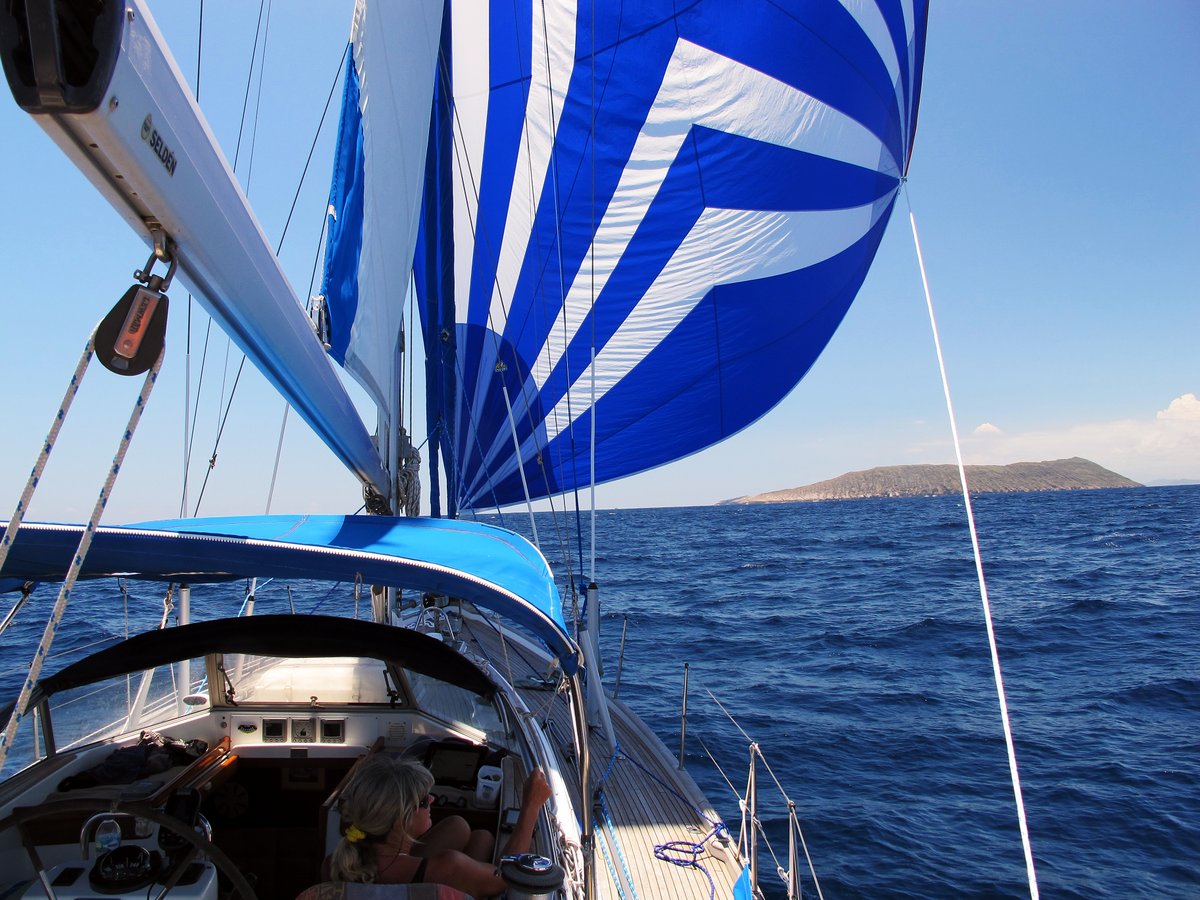
The wind was fickle for the first hour, while we motored away from the effect of the land, but it then picked up enough to fly the asymmetrical spinnaker. Even after nearly three years living on Alba, I’m still learning how to sail. The wind was coming from our port aft quarter and the spinnaker kept collapsing and re-inflating with a bang – very annoying. Eventually, I put two reefs in the main sail and pull it amidships, which worked a treat because the main wasn’t preventing the wind from hitting the spinnaker.
Once we’d got the sails set up correctly, we had a fabulous sail in calm seas and blue skies. We even had a pod of Bottle Nosed Dolphins join us for a while.

We sailed to the south of a small island called Isla Tortuga. It’s a spectacular sight being the remains of the rim of a two mile wide volcanic crater that sticks up from the ocean. Half of it has been eroded by the sea leaving behind a crescent shaped island. We were planning to sail through the middle of the crater, but as the area is uncharted and we were under spinnaker, we kept to the south side of the rocky circle.
Having gybed the spinnaker as we passed the island, we headed off to Puerto Villamil on Isabella, arriving at four o'clock in the afternoon. There are ten other cruising boats anchored here and it took a while for us to find a place that is out of the swell. The anchorage is lovely with blue water and we were very excited to see our first Galapagos Penguins zooming about us seeming to fly underwater with their short stubby wings.

I went ashore to meet J.C. Soto who is the agent here. He’s taken our documents and told me that he needs a few days’ notice when we want our International Zarpe. Strange to think that when we leave here, we’ll be sailing for 25 days…