
23 March 2014 Isabella, Galapagos
As it was Sunday, we had a chill out day.
I managed to get an internet connection, so I spent all day reading up on how to hack into routers and wireless connections. I’ve previously downloaded a hacking toolset called Kali-Linux, so today I downloaded documentation on how to use the tools. I struggled to get anything working today, but I’m going to spend time on our 25 day passage to the Marquesas, learning how to use the tools. I’m going up a step from a Silver Surfer to become a Silver Hacker.
Glenys wandered into town in the afternoon and booked us onto a hike to a nearby volcano tomorrow.
24 March 2014 Isabella, Galapagos
We were up early to go on a hiking trip. A rickety open-sided truck with hard wooden seats drove our group of fourteen people up to the slopes of the Sierra Negra volcano. As on our trip on Santa Cruz, the landscape changed from volcanic plains with cacti, to lush farmland as we went higher and further inland.
It was a pleasant walk through green vegetation up to the rim of the Sierra Negra Volcano, which is the second largest active volcanic crater in the world with a diameter of ten kilometres. It’s a very impressive sight. The volcano last erupted in 2005 and the floor of the crater hundreds of feet below is covered by unearthly, black lava and ash, which is nicely contrasted by the green slopes of the crater rim.

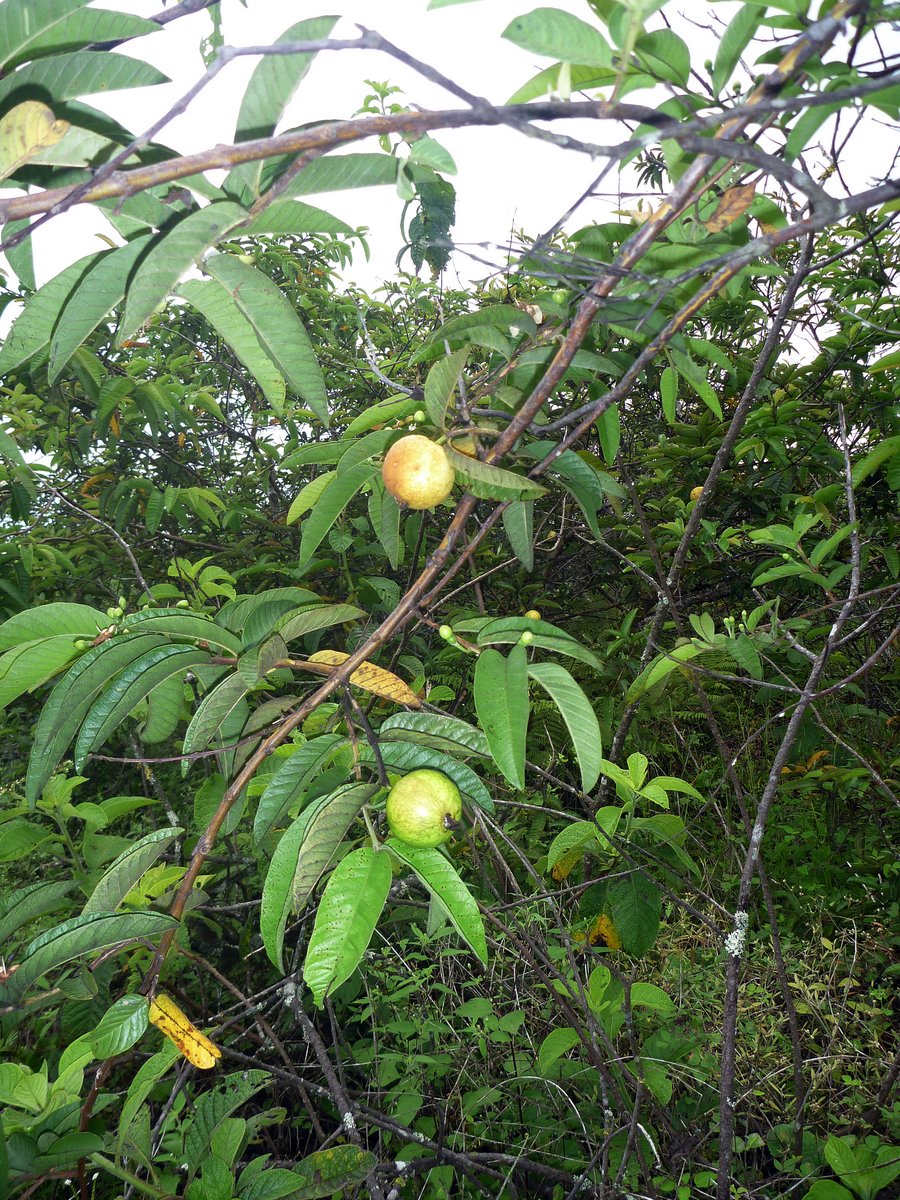
The path took us along the volcano rim, walking between low Guava Trees, which our guide told us is a very invasive species that is slowly forcing out the native plants. We were allowed to pick the ripe, yellow fruits, which were the size of a small plum and tasted pleasant. The fruit has hundreds of seeds and I can see why it's so prolific.
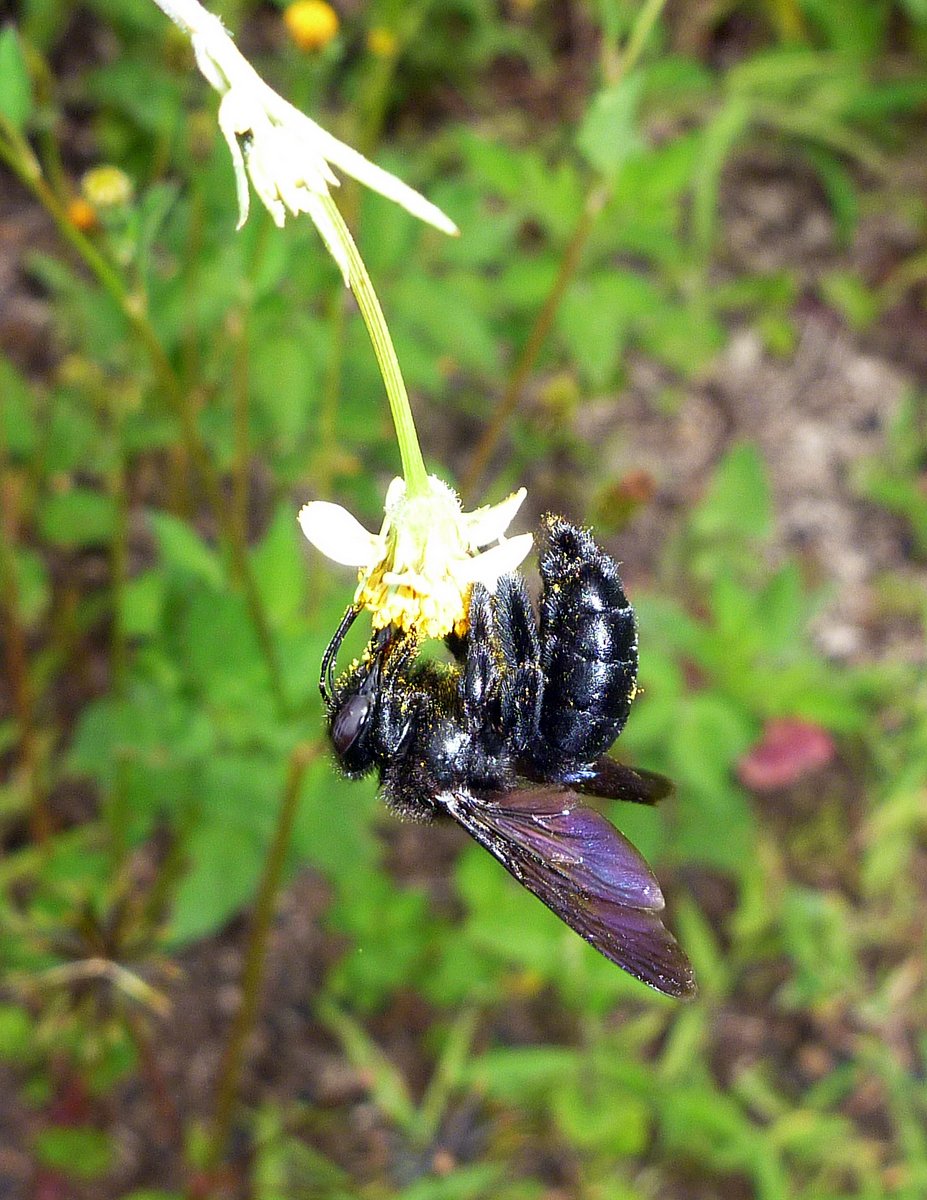
I finally managed to get a reasonable photograph of a Galapagos Carpenter Bee. We've often seen these jet-black bees buzzing around and know that they are the only native bee on the Galapagos Islands. What makes them very interesting is that they prefer yellow flowers, so therefore, all the native flowers on the Galapagos Islands are yellow – if the Carpenter Bee doesn't like the colour of the flower then it simply doesn't get pollinated.
Our guide led us on to the slopes of Vulcan Chico, which is a smaller volcano that erupted about thirty years ago. Very little vegetation has managed to grow on the desolate lava fields – just a few cacti and the odd Scalacia Bush, which is a type of Dandelion that seems to grow out of the bare rock. We walked along the very rough path looking at strange lava formations, including hollow lava tubes formed when the outside of a lava flow cools and the hot magma continues to flow away.

The guide explained that the lava contains a lot of iron, which is why the new lava is black and the older lava turns brown as the iron oxidises and goes rusty. The path led us to areas where there were sulphur deposits giving a sharp contract of colour in the bleak landscape. We had a couple of interesting hours wandering around before we had to head back to the verdant slopes of Sierra Negra and the eight kilometre hike back to the bus. It was a great day out and good value at $30 per person.
Back on the boat, I downloaded another GRIB file and, while the weather still looks unsettled above six degrees south, it doesn't seem to be changing much, so we've decided to leave in a couple of days’ time. We told J.C. Soto, our agent that we want to leave on the 27th March – gulp!

David from “Rewa” invited a few boats over for a cocktail hour -he’s got a big 55 foot ketch and plenty of space. It was good to meet some of the other cruisers whom we've not met before. Quite a few boats will be leaving over the next few days, so we’ll have some company – we’re going to set up a schedule to chat on the SSB radio each day to see where everyone is and what weather they have.
25 March 2014 Isabella, Galapagos
I was up early sorting out some administration and producing a list of jobs to do before we leave for the Marquesas.
We needed to renew the insurance for our boat. I’d already received the final quotation and “just” needed to pay the premium. Internet banking is great for most of the time, but the banks keep changing their security processes. Our bank has suddenly decided that if I want to send money to someone that isn't already set up on my account, then they will contact me by phone to validate my identity. The Catch 22 is that the web site won’t let me enter a foreign mobile phone number, so they can’t contact me. After an hour of frustration, I've had to send money to my son, Craig, and asked him to send the money onto the insurance company.
I worked out a frequency and time for our little SSB radio net and then spent a couple of hours going around the nine boats that are leaving in the next week. Most of my time was taken up chatting about the best strategy for the route from the Galapagos to the Marquesas. We’re all in the same mind set of heading south/south west until we pick up the trade winds, but I'm more worried about the horrible looking band of weather shown on the GRIB files around 6 degrees south – there seemed to be a lot of rain and possible squalls, which I’d like to avoid. I’ll just have to play it by ear.
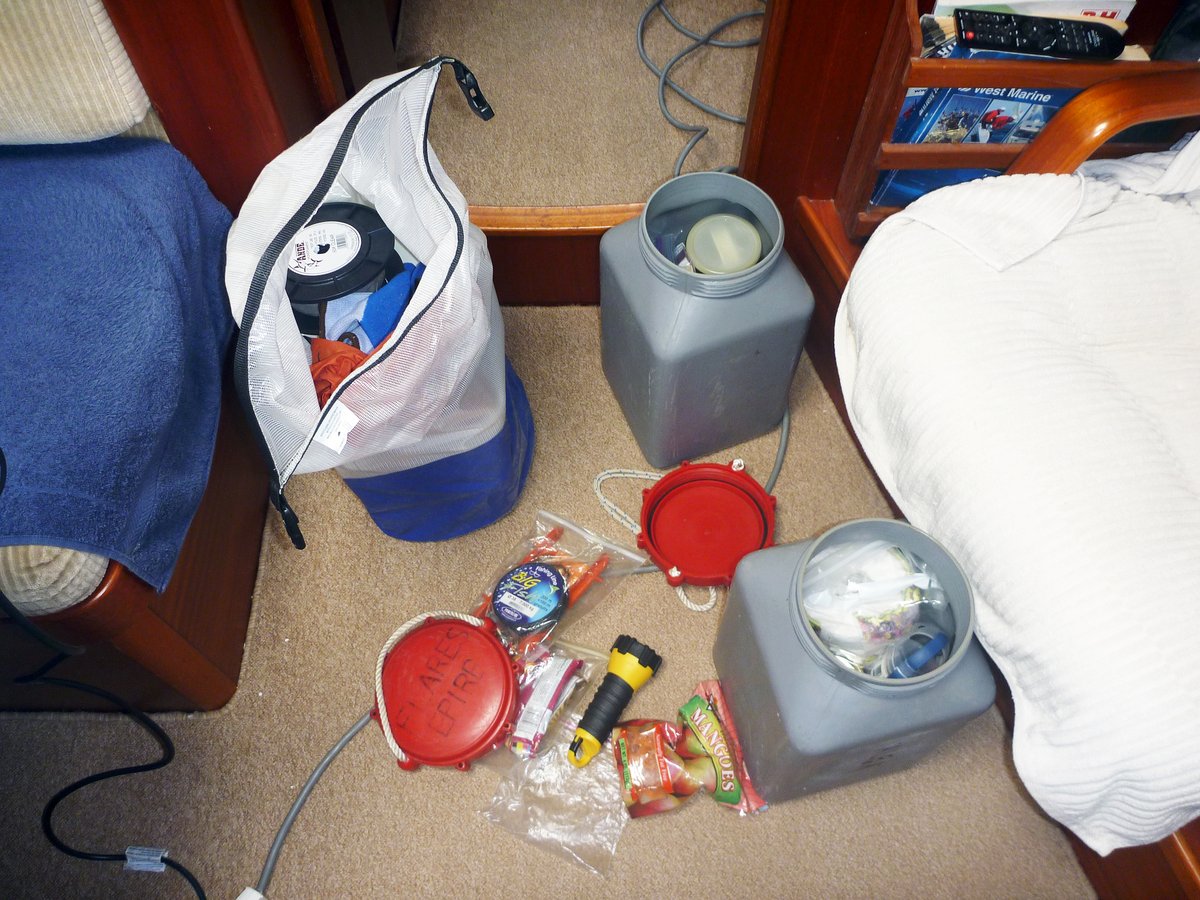
Meanwhile Glenys sorted through our "Grab Bags". These are three waterproof containers, which we'll be trying to take with us in the life raft if we have to abandon ship. Having read a few horror stories of people being ship wrecked and spending weeks surviving in a small life raft, we have been very thorough in what we want to take with us. There are flares, knives, fishing tackle, a plastic cutting board, torch, handheld GPS, first aid, food, etc. There's even a pair of tights to sieve plankton for when we get very, very desperate.
Later in the afternoon, Glenys dragged me into town to go shopping and we ended up lugging back three heavy bags of groceries as well as a big bag of laundry. The road into town is a kilometre of loosely packed volcanic dirt. Taxis and pick-up trucks are constantly driving between the dock and town, leaving clouds of dust in their wake. It’s really playing havoc with Glenys’s eyes because she wears contact lenses - we’ll be glad not to have to trudge this route for much longer.
We had “Salamander” over for a few beers in the evening.
26 March 2014 Isabella, Galapagos
We're planning to leave for the Marquesas tomorrow, but there were still fifteen jobs on our To Do List - the biggest one being to finish off cleaning the hull. Five days ago, Glenys spent a couple of hours cleaning the waterline and already we had green slime growing where she had cleaned – she had to spend an hour doing it again. I spent a couple of hours snorkelling down to the deeper parts. The propeller had a light crusting of barnacles and algae which needed scraping off; the rudder had a few large clams & barnacles growing in the more hidden recesses; and some of the through-hull fittings needed the judicious use of a long screwdriver to winkle out big barnacles & clams - these are very fertile waters.
The rest of the day was spent pottering about doing small jobs and, by the end of the afternoon, all we had left was to walk into town to do our final provisioning, followed by another hot dusty walk back to the dinghy dock.
Two days ago, we told our agent, J.C. Soto that we wanted to leave on the 27th, but as expected, our zarpe was not ready and we've got to pick it up tomorrow at nine o'clock. J.C. is a really helpful guy and tries to sort everything out for us cruisers, but the system defeats even him. I dropped off our gasoline container with J.C. yesterday and hopefully it will be filled by tomorrow, but who knows.
We had a quiet night in. I've tentatively worked out a route for our passage. We’re going to hedge our bets and aim for 6°S 94°W, which is a course of 210°, but this will obviously be subject to the wind direction – we’ll make sure that we use any wind to the greatest advantage.
27 March 2014 Galapagos to Marquesas (Day 1)
Both of us were up early, unable to sleep because we were excited about leaving today. While we were waiting for our zarpe, I pottered about tidying up and doing a few small jobs, while Glenys cooked up some meals for the first few days at sea.
Our agent, J.C., finally called us just before ten o'clock and I zipped ashore to meet him at the Port Captain's office where I picked up our International zarpe. J.C. then hailed a taxi, took me to his house to pick up our jerry can full of petrol and told the taxi to drop me off at the dinghy dock - it cost me $25 for 5 gallons.
Back at the boat, we hauled the dinghy on deck, had a final tidy up, sent a couple of emails to family and left the anchorage at 1230. After clearing the harbour, we set a course of 210°M and thankfully had enough wind to sail. The wind was coming from the south-east at 8-14 knots, so we were on a very pleasant reach.
After a couple of hours, we hooked two fish. Glenys luffed up and eased the genoa sheets to slow down and I managed to land a nice 15lb Bigeye Tuna on the birds line, but the fish on my rod got away. It must had been a bigger Bigeye Tuna because it hit at the same time and the line screamed out. I was in serious danger of getting to the end of the line on the reel, so I put on some heavy brake, the fish bent the hook straight and got away.

I had to gaff the fish that I landed and it bled profusely while flailing about, so both I and the aft deck were covered in blood. I made four cuts on the fish - in both gills and behind the lateral fin, then put a rope around its tail and dropped it back into the water to bleed it out while I cleaned up the bloody mess.
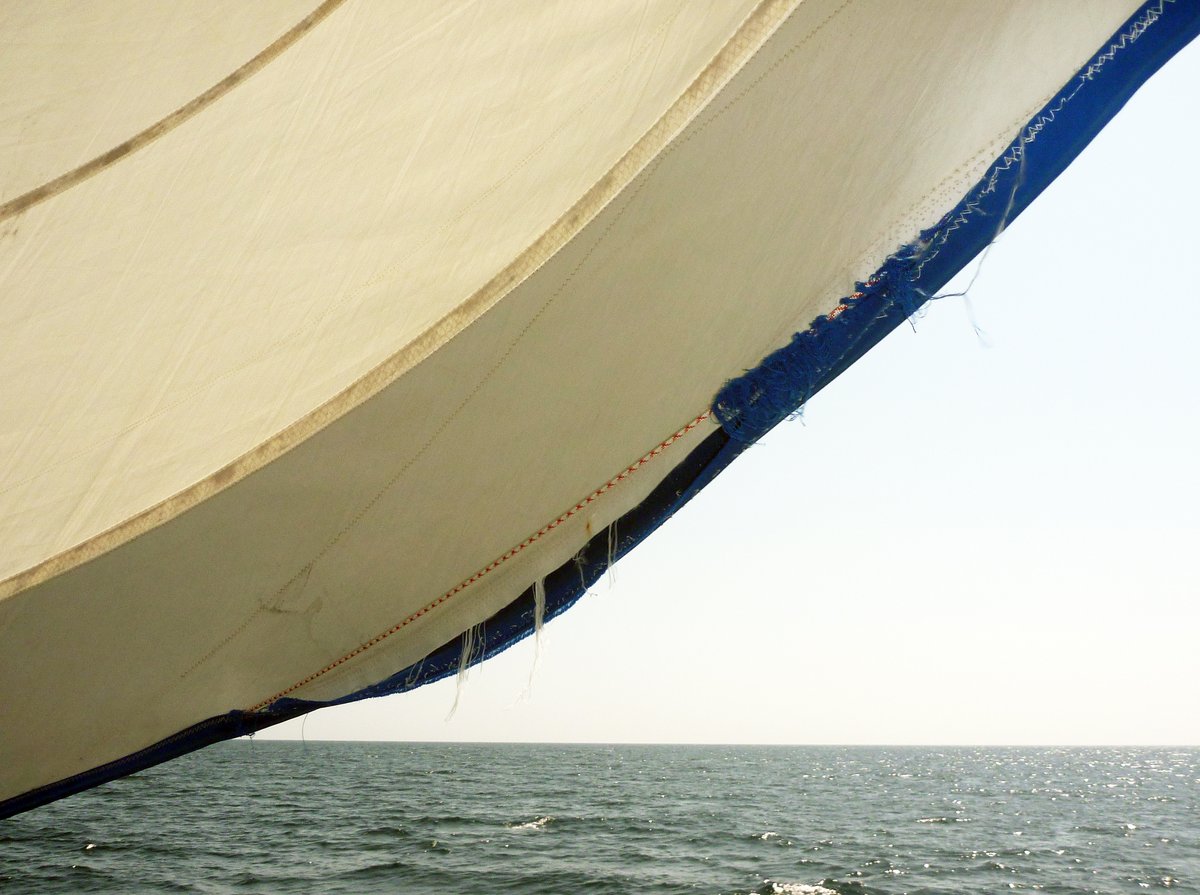
It must have taken fifteen minutes to land the fish and clean up, meanwhile the genoa and stay sail were flogging, which was a big mistake. When we headed back on course, we found that a six foot length of the stitching on the sacrificial strip on the genoa had come undone and there was also some damage to the stay sail - not a good start to our 3,000 mile passage.
It took Glenys two hours to hand stitch both sails, but the repairs look nice and strong - with luck they will last the journey. Fortunately, the seas were very calm, so doing the repair wasn't too traumatic.
The wind stayed with us all afternoon, veering slightly towards the south and, as it went dark, we were still on a close reach with 8-10 knot winds and calm seas, which was lovely. Unfortunately, the wind disappeared a couple of hours later and we had to turn on the engine.
We've adopted the tactic of running the engine at 1500 rpm, which only gives us a boat speed of 4.5 knots, but should only use 1.6 litres of fuel per hour, meaning that we can motor for 11 days and cover 1200 miles. If we ran the engine at 2,000 rpm, we would have a boat speed of 6 knots, but would use twice as much fuel meaning that we could only motor for 5.5 days and only cover 800 miles. "Slower but further" is the name of the game - we've got all the time in the world.
The wind picked up at three o'clock in the morning and we were able to sail, albeit at only three knots, but at least we were moving and the main sail wasn't banging about. It only lasted four hours before it died again.
28 March 2014 Galapagos to Marquesas (Day 2)
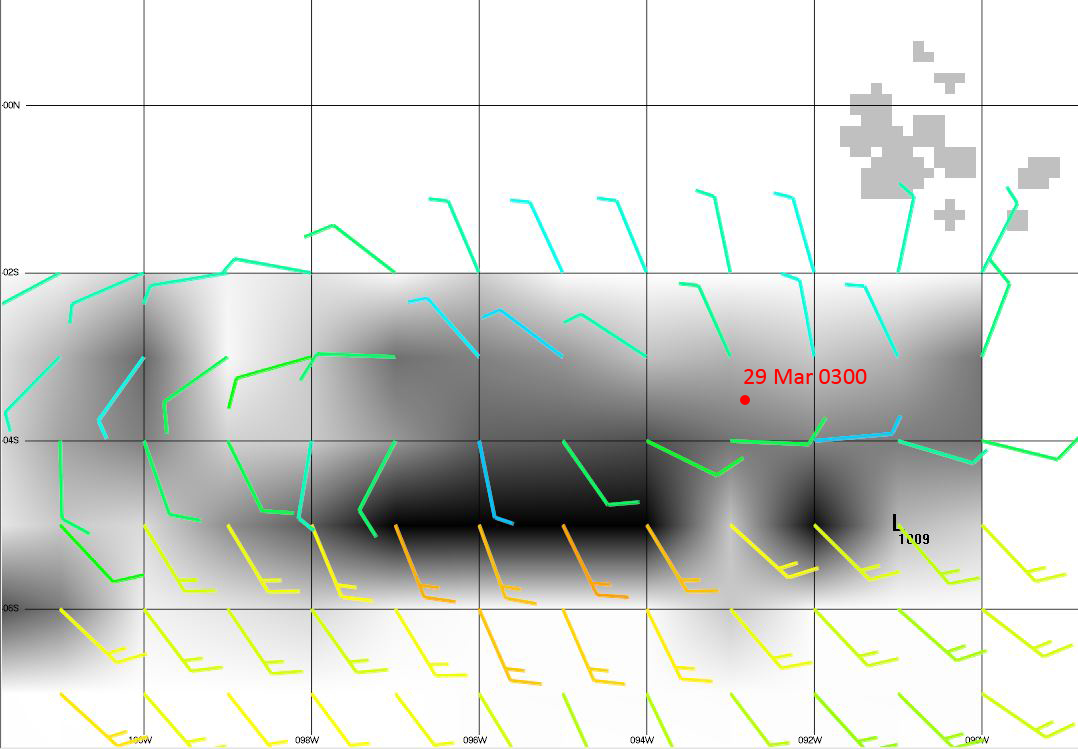
After breakfast, I downloaded a GRIB file via our satellite phone, which shows that the unsettled weather of the ITCZ is still between 4°S and 7°S (we’re at 2° 18’S). The GRIB file shows heavy rainfall and 20 knot winds in various areas of the ITCZ over the next seven days and we've got to pass through it to get to the south-east trade winds. My biggest worry is encountering squalls and lightning.

The wind picked up at nine o'clock, so we were able to fly the spinnaker, but it only lasted for two hours before we had to turn the engine back on. We motored all day with the wind staying below five knots and constantly changing direction.
I switched on the SSB radio at midday and chatted to the other boats on our little radio net. There's six of us out here; "Baraka" are a day in front of us and the other four ("Shakti", "Kika", "Hera" and "Levana") are all within 30 miles of us. We're all heading down towards 5 or 6 degrees south looking for steady winds. "Baraka" is 120 miles ahead and still has variable weather.
Our afternoon was a quiet affair, reading and napping. Glenys cooked some of the Bigeye Tuna for dinner, which was delicious. It has a nice, light coloured meat, much nicer than the dark red meat of the Bonitos that we've been catching recently. I wonder how much difference it made to bleed the fish for ten minutes?
As darkness fell, it started drizzling and the rain continued on and off for most of the night. The wind finally returned at 0100, but bizarrely, it was coming from the west. However, it was only 10-14 knots and the sea was calm, so the motion was quite comfortable even though we were sailing hard on the wind.
By 0300, the wind had dropped to 5-10 knots and veered to the north-west, so we were on a reach, but worryingly, I saw flashes of lightning in the clouds. Ten minutes later, the wind had backed around to the south and increased to 20 knots, so I had a hectic time tacking both sails, then rolling away the stay-sail and reefing the genoa.
We continued on a close reach with heavy rain making life unpleasant. Soon the wind had increased to 25 knots, so I had to put another reef in the main and roll away more of the genoa. By this time, Glenys had got out of bed and was providing moral support – there was no moon and it was as black as the ace of spades out there.
An hour later, the wind started to drop and then suddenly backed to the north-east. After ten minutes, we were getting 30 knots winds from behind us with torrential rain. The autopilot was struggling with the confused seas and strong gusts, so I hand-steered for an hour. We only had a scrap of genoa out, and I had the heavily reefed main pulled centrally to stop us rolling. At one point, we recorded 42 knots with the wind behind us.
We had no idea where the centre of the weather system was, so all we could do was to head south west. The wind finally started to abate at dawn.
I went forward to investigate a flapping noise and found to my horror that we had a large eight foot rip in the mainsail. The wind was still blowing 20-25 knots and the seas were horrible, but we had to get the mainsail down before it ripped even more. We turned into wind, motored slowly into the big waves, and then had a ten minute struggle on the bucking foredeck to get the large mainsail down and man-handled into the cockpit.
29 March 2014 Galapagos to Marquesas (Day 3)
The tear in the mainsail was from the leech along a seam for eight feet. Fortunately the stitches had failed along the seam itself, which "just" needed to be re-stitched, but the sail cloth had ripped a foot from the leech and would need reinforcing with a patch.
After agreeing a plan of action, I went to bed for a short kip because I'd been up for eight hours, leaving Glenys sewing the seam by hand with our brilliant Speedy Stitcher. She spent three hours sitting in the cockpit, surrounded by the bulky mainsail, hand sewing the seams. The job was made more difficult by the constant rolling of the boat in the confused seas and, to make matters worse, it absolutely threw it down, so she got soaked through to the skin.

When the leech of the sail ripped, it pulled out the leech tensioning line, which runs inside the leech seam. We spent half an hour trying to thread this 65 foot length of 4mm line back through, but only managed to get 20% of the way before we gave up - the leech would just have to stay un-tensioned.
I talked to the other boats on the net and most of them had experienced the bad weather, but we'd had the highest winds. Interestingly, "Kika" were 60 miles to the east of us and had had a pleasant night - these squall systems are very localised.
After lunch, we dragged out our Sailrite sewing machine and Glenys set it up on the saloon floor. She didn't want the heavy machine on the saloon table in case it slid off in the constant rolling. We cut out a couple of sailcloth patches to repair the damaged leech and pulled the damaged part of the sail down below. It then took a couple of hours to put on the patches and zigzag stitch along the damaged seam to reinforce the hand stitching.
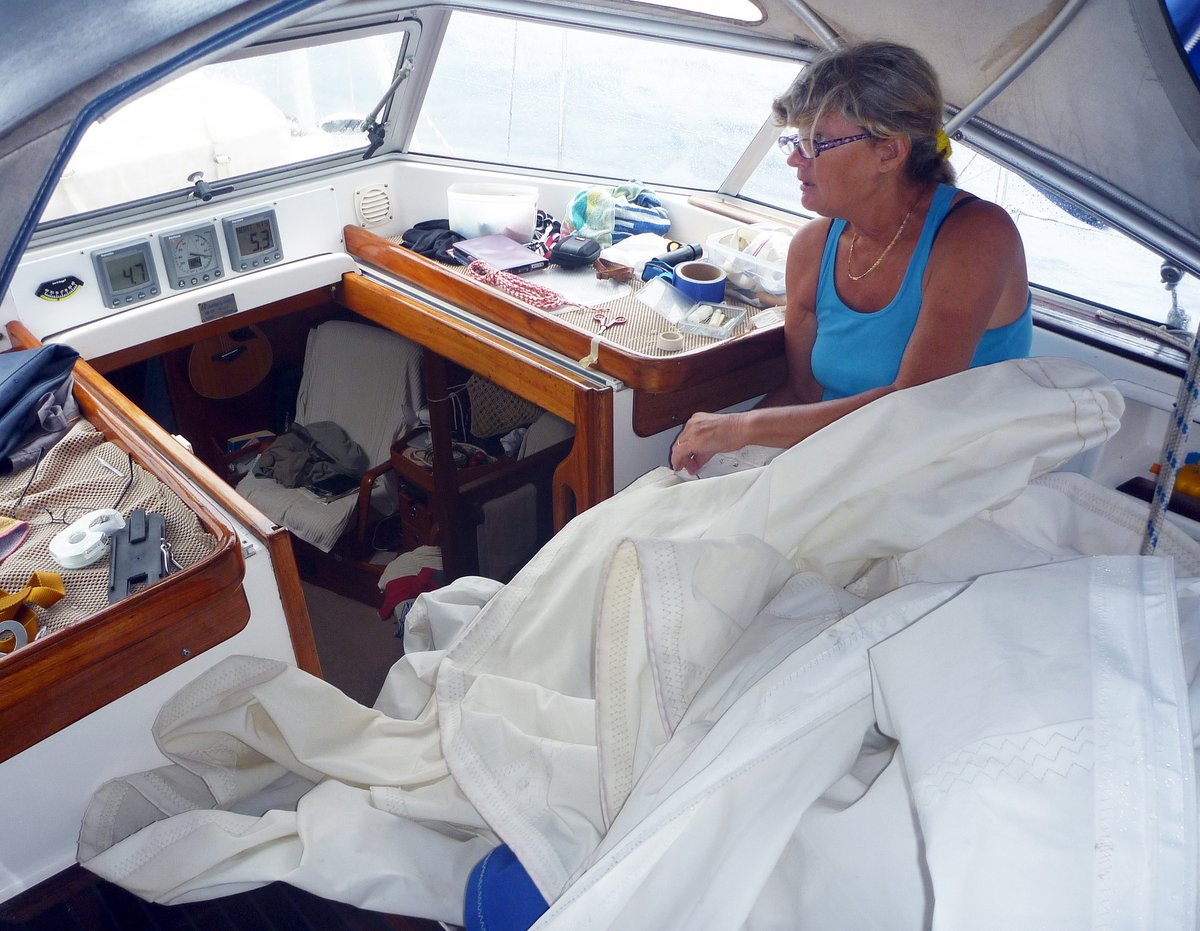
We finished the repair by four o'clock. Glenys did most of the eight hour job, with me assisting when necessary. Thankfully, we came out of the heavy rain just before the sail was ready to put back on the mast. It took fifteen minutes to man-handle the large sail up on the pitching deck and hoist it. The repair looks good although the leech is fluttering because we have no way of tensioning it.
By this time, the wind had backed to west-south-west at 15 knots, so we were able to sail south. A couple of hours later, as darkness fell, the rain finally stopped and the heavy cloud cover was starting to lighten up. Unfortunately, the wind also started to drop, so by eight o'clock at night, we were motoring south-west again in the rapidly calming seas.
By ten o'clock, the wind had backed even more to the south and increased to 8-12 knots, so we could sail south-west once again. The rest of the night was wonderful, gliding along at 3-5 knots in calm seas - even the stars came out.
30 March 2014 Galapagos to Marquesas (Day 4)
Dawn brought us blue skies and the lovely 10-14 knot south wind continued. After a marvellous breakfast of fruit cocktail and yoghurt, Glenys went to bed for a couple of hours and I downloaded some weather information via satellite email. Having been clobbered by the squall, I've now developed a very keen interest in the weather.
I received an email from Karsten Staffeldt, who’s an amateur weather router living in Panama. I've sent him our current position and he's sent me back a text forecast with details of the surface forecast, a description of a satellite image, the position of the Inter Tropical Convergence Zone (ITCZ), etc. It's great information and a very useful addition to GRIB files, which are raw data from a computer weather model. Unfortunately, this is the first email that I've received from Karsten while we've been underway, so I didn't have his take on the squall until after the event.
Karsten tells me that the crappy weather that we had is called a "Trough System" or a "Secondary ITCZ". These systems are uncommon, but when they occur, they happen in March and April and can move rapidly in any direction. Karsten says that the current system will dissipate in the next two days and we should have south to south-east winds at 10-15 knots as we travel south west.
I downloaded a GRIB file, which confirmed that the Secondary ITCZ is dissipating and the south winds will become stronger SE trade winds as we get further south. However, the GRIB file also shows an area of strong rainfall forming in three days’ time, which could possibly be another Secondary ITCZ. It stretches west for hundreds of miles and comes down to 6°30’ South, so I plan to head down to 7° South before heading west.
I wanted to see if I should have predicted the squall, so I reviewed the GRIB files that I've downloaded over the last few days. I found that the 24 and 48 hour forecasts predicted the Secondary ITCZ in the general area, but 180 miles further south. Only the GRIB that I received the morning after the squall, showed heavy rainfall in the correct place, so I'm a bit happier that I couldn't have forecast it.
The fabulous conditions continued into the afternoon and, at dusk, the wind had increased to 12-15 knots and backed to 160°, allowing us to ease the sheets a little to maintain our course of south-west. We had a lovely sail overnight. The wind backed even more to near south-east, so we were on a beam reach for half of the night - it looks like we've finally reached the trade winds.
31 March 2014 Galapagos to Marquesas (Day 5)
During the morning, we passed 7°S, so hopefully we'll now be clear of the Secondary ITCZ. We had a go at turning 20 degrees more west, but the wind came abaft the beam causing the apparent wind to drop and we slowed down to four knots. This in turn caused us to roll more and the sails to slat, so we went back on a south westerly course. The wind is forecast to increase over the coming 24 hours, so we decided to wait until we had stronger winds.
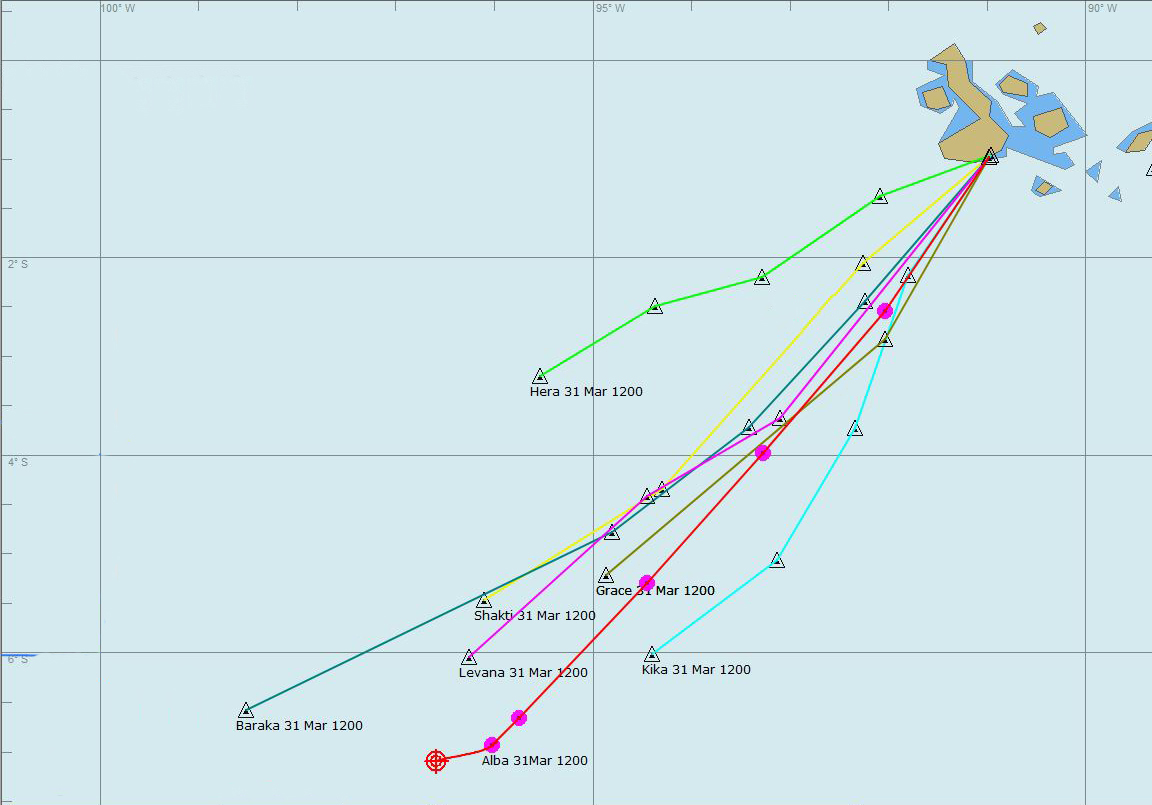
I chatted to other the other boats and took their positions as usual - we now have seven boats checking in and everyone is doing fine. After I signed off, I entered everyone's positions for the last four days into our chart plotter program and it's interesting to see the differences in our tracks. Alba’s track follows a bearing of 210 degrees down to 7°S; “Kika” kept to the east of us; “Hera” have started out on the classic route of going down to 3 degrees and then following the rhumb line and the rest are now "cutting the corner" and taken a course more to the west. All of us (apart from “Hera”) are through the Secondary ITCZ. I hope that “Hera” time their crossing well.
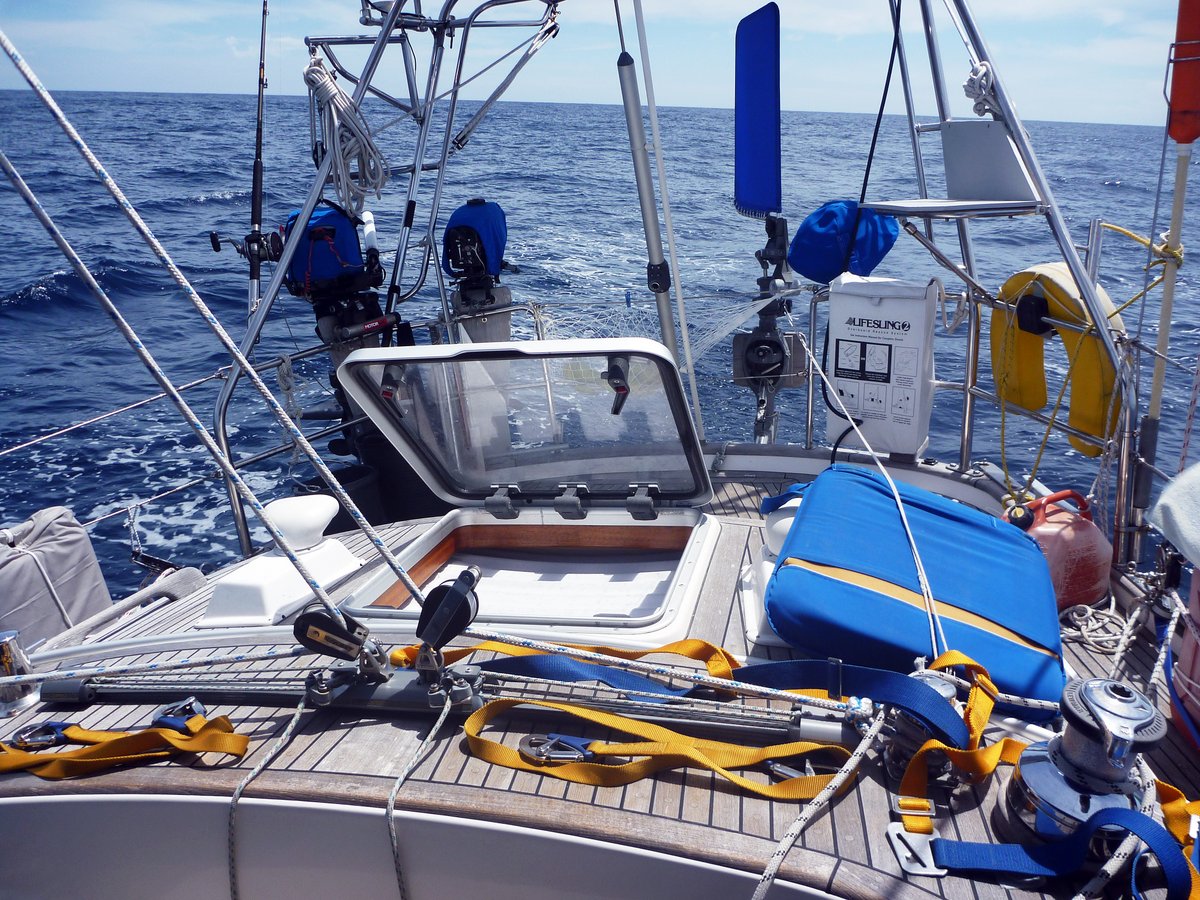
In the afternoon, the wind picked up a little, so we bore away 30 degrees and started our run towards the Marquesas. The wind was 50 degrees off our port quarter, and the sails were slating, so we rigged up our spinnaker pole to starboard and poled out the genoa. I put a preventer on the main and off we went on the rhumb line to Hiva Oa.
We have the spinnaker pole rigged up with an up-haul and two down-haul lines, so that it's held rigidly in position. The genoa sheet is led through a snatch block on the end of the pole, which reduces friction and more importantly reduces chafing on the sheet. It's a great set-up allowing us to leave the pole in position and to roll the genoa in and out as needed.
We finished off the last of the Bigeye Tuna last night, so I put out two fishing lines and in the late afternoon caught two small Dorado. One looked to be 3 or 4 lbs, but the other one was a 1 lb tiddler - we kept them both of course. Cleaning Dorado is so much easier than Tuna, which is bloodier and much harder to fillet having tougher skin.

Just as I finished filleting the fish, the wind picked up to 20-25 knots, so we put two reefs in the main and four wraps in the genoa. As the sun went down, we had 50% cloud cover, 20 knot winds from the south-east and we were rolling along at 5-6 knots. We also had half a knot of current pushing us along, which was handy.
We had a pleasant night with consistent winds and 6-8 foot waves. Most of the time we're rolling gently every two seconds, but every few minutes, a large wave will catch us and roll us violently over 30 degrees. Everything bangs in the lockers and anything not held down flies through the air, but after six rolls we settle down. Then, a few minutes later, we're holding on for dear life again.
The rolling isn't too bad when you're on watch because you can feel the boat being lifted up by a big wave and grab hold of something, but it's hard to sleep. Despite wedging ourselves against the bulkhead, the violent roll always rolls us to some extent. Ah well, only 2,450 miles to go.
- << Prev
- Next