
1 February 2014 Bahia de Caraques, Ecuador
I had an admin day catching up on our bank statements after our two week spending spree. I paid our marina bill which added up to over $850, which was a little painful, but not too bad for two months’ worth of mooring fees, laundry, customs fees, etc.
Glenys just pottered about for most of the day – she’s got a cold and is feeling sorry for herself.

In the afternoon, I continued to sort through and edit our photos, which is turning into a right mission.
2 February 2014 Bahia de Caraques, Ecuador
I couldn't bring myself to start any jobs this morning, so I messed around sorting out music for some of the songs that I'm going to learn to play on the guitar this year - it’s not a simple process. Having decided on a tune, I search on YouTube for lessons on how to play it. Then I search for guitar tabs which basically show the chord progression and the lyrics. Unfortunately, most of the time the guitar tabs are in a different key to the lesson and the lesson might be in a different key to the original song, so I end up having to rewrite the tabs into the correct key – it’s quite time consuming.
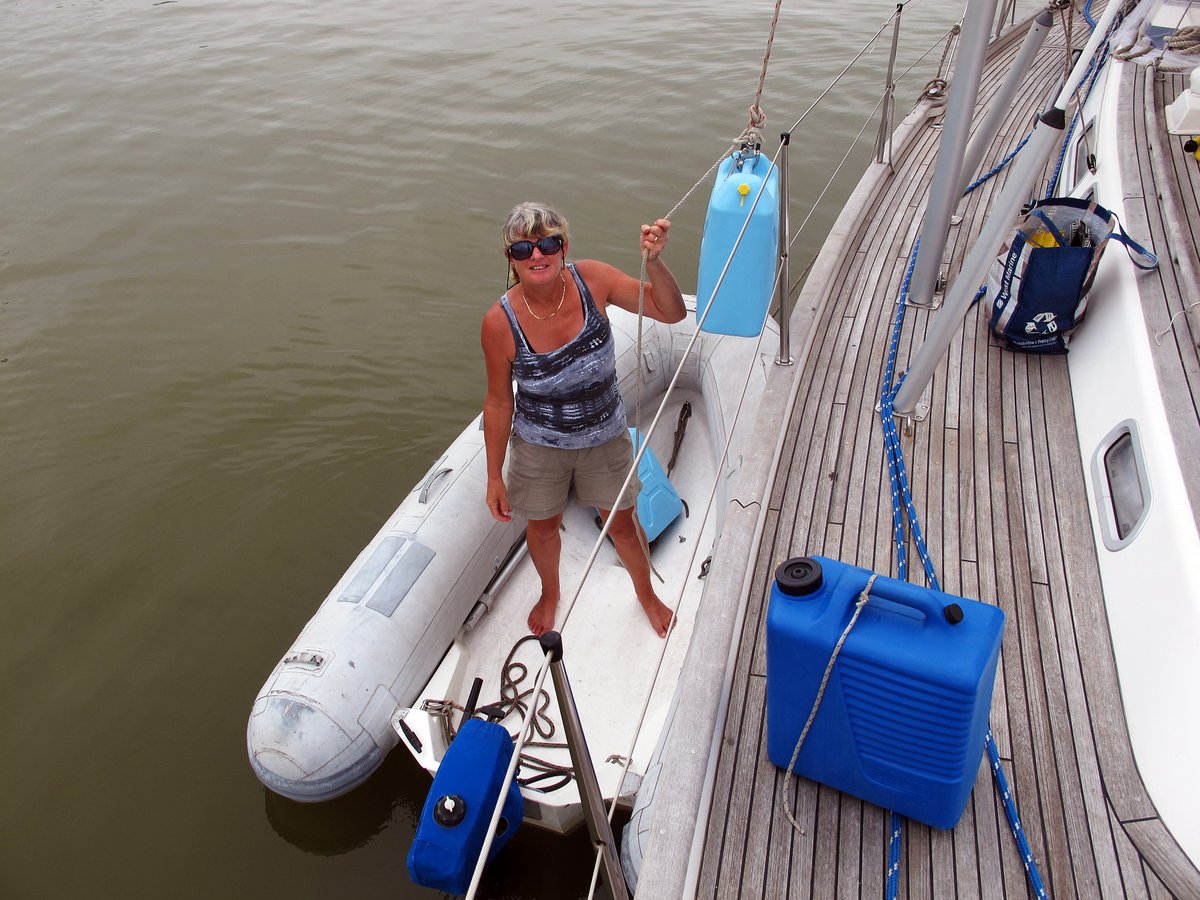
Glenys was feeling better today and got out her sewing machine. She altered the Hydrovane vane cover after I'd had the frame shortened by two inches. She then made a start on some covers for our jerry cans that are being stored on deck. Hopefully the covers will stop the plastic being degraded by the intense sun.
I spent some time in the afternoon working out where and how to mount the jerry cans on our deck. Up to now we've just had them lashed to the guard rails wires with a bit of rope. This won’t be good enough when we sail across the Pacific because they’ll end up chafing with the constant motion - we've got about 10,000 miles of sailing ahead of us this year.
3 February 2014 Bahia de Caraques, Ecuador
Glenys went off to Chirije with a group of ex-pats who live in Bahia. It’s an archaeological site with a small eco-lodge and was an ancient seaport occupied by the Bahia culture between 500 BC and 500 AD. These seafaring merchants traded Spondylus shells and crafted ornaments and as far north as Mexico and as far south as Chile. Unfortunately, with typical Ecuadorian organisation there was no one around in the eco-lodge and the small museum was shut, so all they did was to walk around on the beach for a while hoping to find some artefacts – no chance.
I managed to motivate myself enough to do some jobs. About eighteen months ago, we had the cupboard doors replaced in our front heads. I foolishly had them made from one inch thick, Medium Density Fibreboard (MDF). The carpenter in the USA said that he had some professional primer paint that would seal the doors, but after four months they were starting to swell because water had soaked in. They are now in a terrible state, swelled up to 1½” thick with paint flaking off. I started to make two new doors from ½“marine plywood, cutting the basic panels and gluing them together.

Three weeks ago, I emailed some drawings to a fabricator in Manta to get a quotation for a stainless steel bowsprit for our spinnaker. I’ve not heard anything back despite sending him a couple of reminders over the past couple of days, so I printed off the drawings with the intention of sending them to the fabricator with Geovanny, the taxi driver who does a lot of work for the marina and cruisers. A couple of boats arrived yesterday, so I knew that Geovanny would be coming to the marina to collect their passports and take them to the Immigration office in Manta, which is 60 kilometres away.
As usual, nothing is that simple. There’s no one who speaks good English in the office and I didn’t trust that they’d understood exactly what I wanted, so I thought it best to speak directly to Geovanny. I ended up wasting about two hours going ashore and trying to meet Geovanny, but he didn’t show up.
4 February 2014 Bahia de Caraques, Ecuador
Apparently, Geovanny turned up at about eight o’clock last night, picked up the passports, but didn’t take my bowsprit drawings. He’s allegedly going to pick them up tomorrow. Anyway, I finally received an email from the fabricator, who says that he’s had computer problems and he’ll get me a quote tomorrow – I won’t be holding my breath.
Glenys finished off the two covers for our jerry jugs and I finished off the two cupboard doors for the front heads – I just need to paint them now.
We were invited over to “Albion” for sunset drinks with George and Tuuley, who arrived a couple of days ago. Steve and Patty from “Armagh” were also there – we last met them in the Perlas islands in October.
Over dinner, we watched a brilliant film called “Captain Philips”, which is about a container ship that was hijacked in the Indian Ocean by Somali pirates. It was very scary to see how four armed men in a panga could so easily capture a huge ship with 20 crew. A small boat like ours wouldn’t stand a chance even if we were armed – I might not sleep tonight.
5 February 2014 Bahia de Caraques, Ecuador
We took off main sail and genoa, so that Glenys could do some maintenance work on them. She removed the webbing at the tack and head of the sail and shortened the loops, so that we can get some more tension onto the luff of the sail. Her Sailrite sewing machine did a sterling job, stitching through 10mm of webbing and sail.
I dug out the paint for the cupboard doors, which we’ve been carrying around in a bilge for 18 months. Unfortunately, the tin was very rusty and when I tried to clean it up with a wire brush, the metal just collapsed, so the paint is useless.
I went out to buy more from a paint shop on the sea front, but it wasn’t easy. The guy wanted to sell me some “lacquer” at first, but then he realised that I didn’t have a spray gun and I wanted to brush it on. I managed to explain that I wanted matt paint, so the guy nodded wisely and said “enamel”, which didn’t sound right either. So I bought a small pot of top coat and a smaller tin of primer, to try out – it only cost $5 for the lot. Back on the boat, I painted a test piece of plywood with the primer. It’s weird, gloopy, transparent stuff more like varnish than paint. I thinned it down and brushed it on and we’ll see how it all works tomorrow.

I’ve still not received an email quotation for the bowsprit, so in desperation, I sent a text message to his mobile phone and, surprise, surprise, I got a reply back within ten minutes. Apparently, he’ll get a quote to me soon.
6 February 2014 Bahia de Caraques, Ecuador
We were up early and went ashore to pick up our anchor chain. I was in the dinghy fending off the rough sea wall, while Glenys lowered the chain over the wall down to me. Even at high tide, I was bouncing off the rocks below the water. Back at the boat, we dragged the chain out of the dinghy and laid it out on the deck in 5 metre loops so that I could put markers on the chain at ten metre intervals.
We’ve read that many of the anchorages in French Polynesia are very deep, some places being 30 metres, so our 60 metres of chain won’t be enough – we’ll need at least 90 metres of scope at 3:1 ratio. Rather than buying more chain, which is heavy, expensive and probably unattainable here, I spliced a 40 metre long rope to our 60 metre chain. What a mission – it took me a couple of hours, but now we’ve got 100 metres of anchor rode which will allow us to anchor in most places.
We put the main back on the mast. Glenys has done a good job and it fits perfectly – I can now get enough tension on the luff, which will hopefully make the sail easier to furl away and give us slightly better performance upwind – not that gentlemen go upwind...
Glenys moved onto the genoa and made a new Velcro flap to allow us to tension the foot of the sail. Unfortunately, our brilliant sewing machine couldn’t cope with the extreme thickness of the new flap on the thick sail, so she had to hand-sew a few bits. She also hand-sewed a new leather protection strip around the grommet in the clew of the sail. This was made easier with a fantastic little device called a Speedy Stitcher Sewing Awl – it’s got an incredibly sharp hollow needle that easily pushes thread through 10mm of sail cloth.
I put a couple of coats of top-coat paint onto my test panel and the paint is rubbish. It’s more like an emulsion and I can scrape it off with my finger. Why on earth can’t I buy good old oil-based wood paint here? There’s one other paint shop in Bahia, but that looks more chaotic that the one I went to, so I’ll have to try to get some in Manta when I go in next week.
I had a text message conversation with the fabrication shop about the bowsprit. I think that he’s finally looked at the drawings because he’s telling me that he can’t get hold of any Grade 316 stainless steel, but can make it from Grade 304, which is not as corrosion resistant to sea water. I’ve told him to give me a quote for it made in Grade 304.

Communicating by text messages in Spanish is a pain in the neck, but the guy doesn’t seem to be able to work with email. With an email, I can copy and paste his replies into an on-line translation tool, but with texting I have to laboriously type it out. To make matters worse, when I send him a message, I have to work out the Spanish on-line and then type it into the phone. Predictive texting is great when working in English, but the bloody phone doesn’t like Spanish words – “por” becomes “porn” and “quiero” becomes “quiver” – nightmare.
7 February 2014 Bahia de Caraques, Ecuador
I finally got a quote from the fabrication shop (by text). It’ll cost $250 for the bowsprit, so I told him to go ahead and make it and hopefully, it’ll be ready to pick up at the end of next week. After congratulating myself on arranging all of this, the fabrication guy then texted me to tell me that I needed to pay a 50% deposit before he would start – how on earth do I do that when he’s 60 kilometres away? Eventually, he texted me his bank account details and I had to spend over an hour going to the bank and depositing $125 into his account.
We pulled the genoa out onto our deck and did a detailed inspection. It’s looking a bit worn in several places, so Glenys spent a few hours reinforcing the zigzag stitching and repairing a few worn patches. The sail is massive when it’s unrolled and it was a real mission to manoeuvre it in our small saloon without scratching all of our lovely woodwork.
While I was running around this afternoon, I managed to get bitten three times by damn mosquitos. The little buggers always get me on my lower legs and their bites itch like mad on the thin skin around my ankles. Fortunately, our little bite zapper seems to sort it out. I bought this little device in the UK - you hold it over the bite and press a button a few times which generates small electric shocks on the bite. Sounds weird, but it really works (especially with some anti-histamine cream rubbed on as well.)
8 February 2014 Bahia de Caraques, Ecuador
We had a bit of a rest from jobs today. Glenys spent most of the day reading up on the Marquesas using a pilot book that we have borrowed from “Albion”. She’s making notes on the various anchorages and what we can do on each of the various islands. A lot of the information is very sketchy and the pilot book is about ten years old, so she’s been relying on other cruiser’s blogs to find out more recent information.
I finally managed to finish off editing our photographs and have got our website up to date – I was five weeks behind.
I motivated myself in the afternoon and finished the anchor rode by doing some whipping on the rope end and putting on some markers so that I know how much scope I’m putting out. I then put it all away in the anchor locker, checked the windlass and shackled the chain onto the anchor. We’re starting to feel like we’re ready to go – the sails have been repaired and we again have our anchor ready to use. I’ve got a few more critical jobs to do next week, but we should be good to leave as planned on the 21st.
9 February 2014 Bahia de Caraques, Ecuador
Glenys continued with her research of the Pacific islands, while I did some investigation about where we’re going to go after New Zealand. Our plan had been to stay in New Zealand until April 2015 and then sail up to Fiji and Vanuatu for five months. We’d then go south down to Australia in September 2015 for the cyclone season and then sail up to Indonesia the following year.
Unfortunately, the best time to sail up through Indonesia is August, so that would mean that we’d be in Australia for nearly a year and we’re not sure that we want to spend that long there. After great debate, we decided that we’re not going to stop in Australia at all – the regulations for entering with a boat are very strict, so it’s too much hassle. We’d rather fly to Australia for a “road trip” from Malaysia or somewhere.
On the other hand, Indonesia is a tricky place to cruise because of their draconian regulations and some security concerns. So, we’re planning to join the “Sail Indonesia” rally, which leaves Darwin at the end of July and arrives in Singapore in October. This means that we’ll have to sail directly to Indonesia from Vanuatu. Our revised timetable will give us 2-3 months in Melanesia and then a long 1,700 mile sail through the Torres Straits in July to meet up with the rally - it looks something like this:
| Mar 14 | Galapagos |
| Apr 14 | Sail from Galapagos to Marquesas (3,000 miles) |
| May 14 - Sep 14 | Cruise Polynesian islands |
| Oct 14 | Sail from Tonga to New Zealand (1,100 miles) |
| Nov 14 – Mar 15 | New Zealand |
| Apr 15 | Sail from New Zealand to Fiji (1,100 miles) |
| May 15 – Jun 15 | Fiji & Vanuatu |
| Jul 15 | Sail to Indonesia (1,800 miles) |
| Aug 15 – Oct 15 | Cruise Indonesia |
| Nov 15 onwards | Malaysia & Thailand |
It’ll be lots of sailing for eighteen months, but then we can chill out in Malaysia and Thailand for a year.
In the afternoon, we were invited to Alberto’s apartment for a pool party and barbeque. It was a good turnout with about ten cruisers there and a similar number of ex-pats, who live in Bahia. Most people disappeared as the sun was going down, but Glenys seemed to be in a mood to party, so we stayed drinking with Alberto and his mate, Curtis - big mistake. I wouldn't say that Glenys was drunk, but by ten o’clock, she was in the pool in her bra and knickers and had lost a contact lens – those rum cocktails were very strong.
I managed to persuade her to go home and had to support her as we staggered back to the marina. We poured ourselves back onto the boat at eleven o'clock – I think that Pedro (the night watchman) was a little concerned about us because he followed us in his boat and made sure that we got home safely.
10 February 2014 Bahia de Caraques, Ecuador
Not a great surprise, but Glenys was feeling a little “fragile” this morning, so after dragging herself out of bed at half past nine, she went into town to wander around aimlessly for a while. Meanwhile I got on servicing some of our winches.
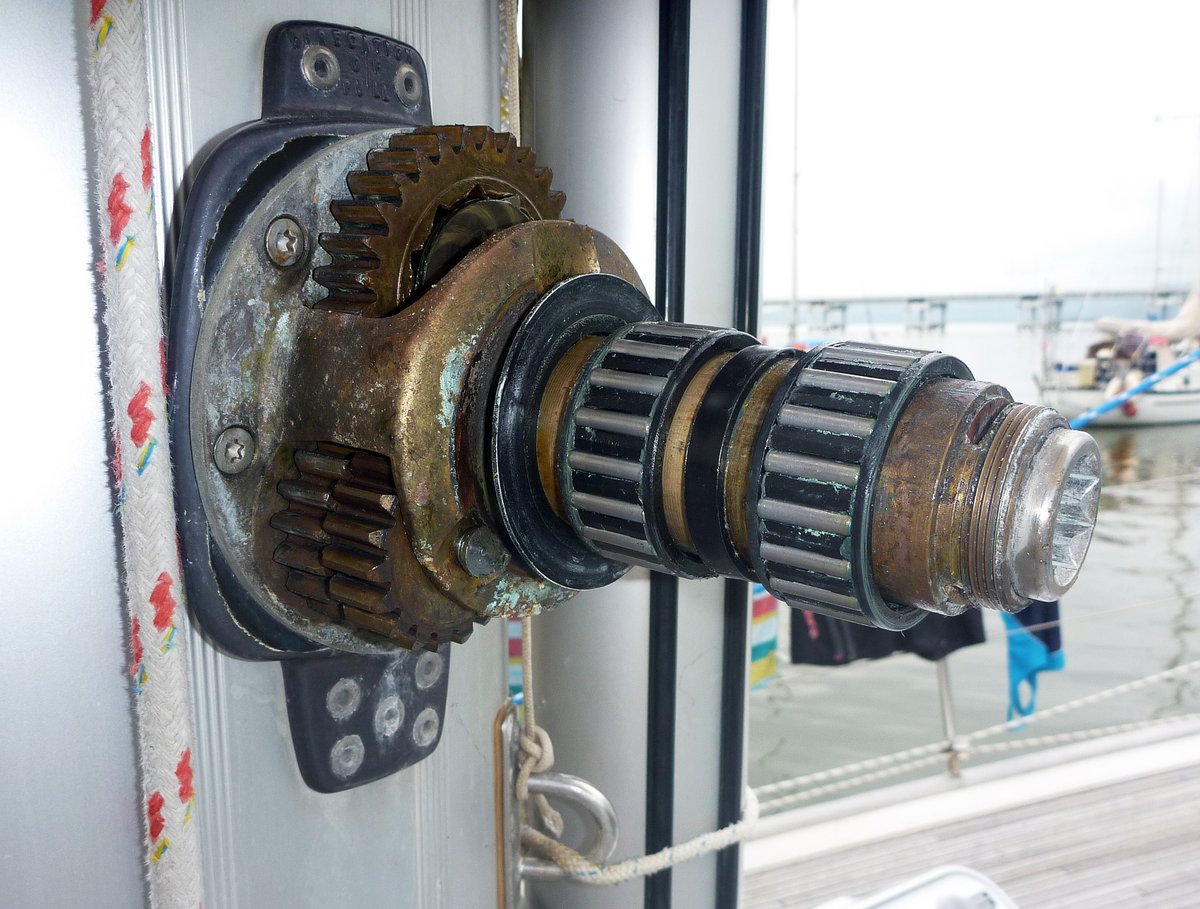
I’ve been a little slack in my preventative maintenance and I was shocked to find out that the last time I serviced a winch was eighteen months ago and that was only because it had started to seize up. It took me most of the day to service four winches. I’ve probably said this before, but our Lewmar winches are a beautiful piece of engineering. They take incredible loads and work wonderfully, yet I can take them apart and service them with nothing more than a screwdriver (used as a lever), a load of rags and some fresh grease.
Glenys didn’t feel much better in the afternoon, so she just did a few runs ashore to get water from the dinghy dock, then sat in front of the laptop browsing the internet.
11 February 2014 Bahia de Caraques, Ecuador
I arranged to go to Manta with Geovanny the taxi driver tomorrow. We need to pick up the new bowsprit, get some boat parts and do a big food shop, so Glenys did a detailed stock take of her provisions.
She found that some of her flour had weevils, so she then had to inspect every single bag of dry goods on the boat. It wasn’t good news - all of her rice and most of her flour was tipped over board. Her pasta was okay because it’s been kept in plastic jars with tight lids. She suspects that the problem came from some big bags of rice that she bought in Panama and has spread because she kept one opened bag in a locker. The little buggers spread from there. They’re tenacious little devils boring their way through plastic bags.
I finally got around to repairing the dinghy floor. We developed a crack in the fibre glass hull about four months ago and I patched it up with epoxy resin, but it only lasted a few weeks before my patch cracked. We’ve been putting up with water in the bottom of the dinghy for months. This time I put two pieces of thick, reinforced fibreglass matting on both side of the hull and made the patch a lot bigger, so I’m hoping that it will strong enough.
12 February 2014 Bahia de Caraques, Ecuador
Glenys spent most of the day working on the dinghy. She cleaned the fibre glass hull which had become filthy in this estuary and then painted my fibreglass repairs with some white bilge paint. She also tried to find the slow leaks that we’ve got in two of the tubes, with no success. The leaks are not too bad, but I’m worried that the Hyperlon fabric on the tubes is starting to breakdown and has become porous.
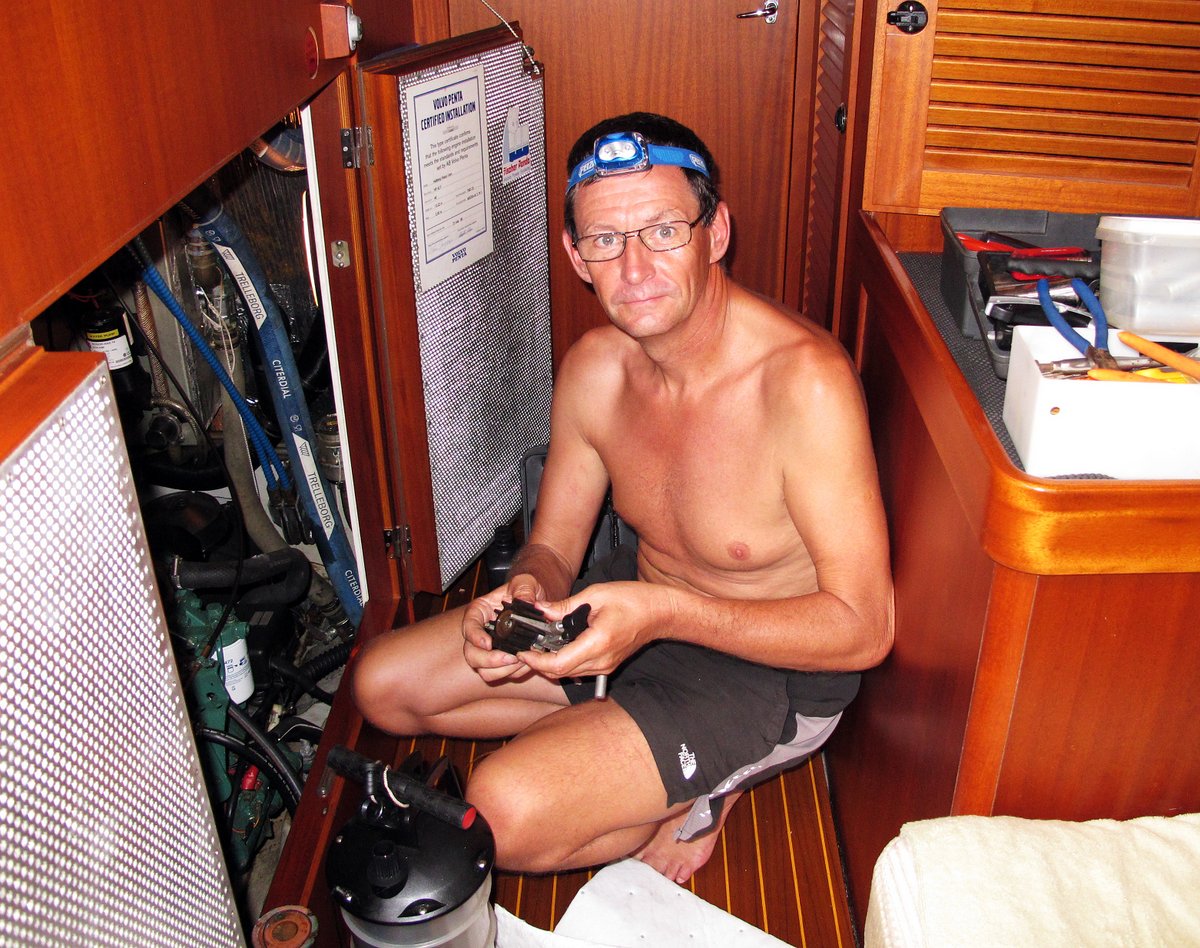
I spent all day servicing the generator and engine. I really hate doing this job because I have to change the oil and the diesel filters and it makes such a mess, although I’m gradually getting more organised after three years of doing the job. It all went fairly well, but I’m a bit concerned about the starter motor on the generator. There’s 2 mm of play between the motor and the engine flange and tightening the bolts has no effect. I suspect that there are some captive nuts inside the engine flange that are loose and that might mean the generator has to be taken apart – not a pleasant prospect. That’s another job on the list of things to do in New Zealand.
In the evening, we invited over “Albion” and “Armagh” for a beer or six.
13 February 2014 Bahia de Caraques, Ecuador
I woke up this morning realising that when we leave Ecuador, we’ll finally be free of American 110V mains electricity. The rest of the world uses 220V, which is the voltage that most of our appliances use on the boat. We have two exceptions to this – the air conditioning unit and a small heater that we bought in the States. There’s no point in lugging these things around with us because we can only use them in marinas and they’ll be useless from here on – after running around the anchorage, I finally sold it to the marina for $50.
We spent the morning preparing shopping lists for tomorrow’s spending spree in Manta. Glenys has a long provisioning list which will hopefully keep us going for three months. I’ve got a list of boat parts to top up my spares inventory after the jobs that we’ve done here.
In the afternoon, I worked on our 15hp outboard. I separated the lower gearbox assembly from the engine to inspect the water pump and change the impellor. The lower unit hasn’t been looked at for a couple of years, so I was very nervous about things being seized up, but it went fairly well. The water pump is in a sad state with a broken bolt and dodgy looking seals, but all I could do was to put in a new impeller and put it back together. I’ll buy a replacement water pump and service kit when we get to New Zealand and hope that the engine holds out until then.
In the evening, Glenys made an Ecuadorian dish called Seco de Carne, which is a kind of Beef Stew with Tamarind – very tasty.
14 February 2014 Bahia de Caraques, Ecuador
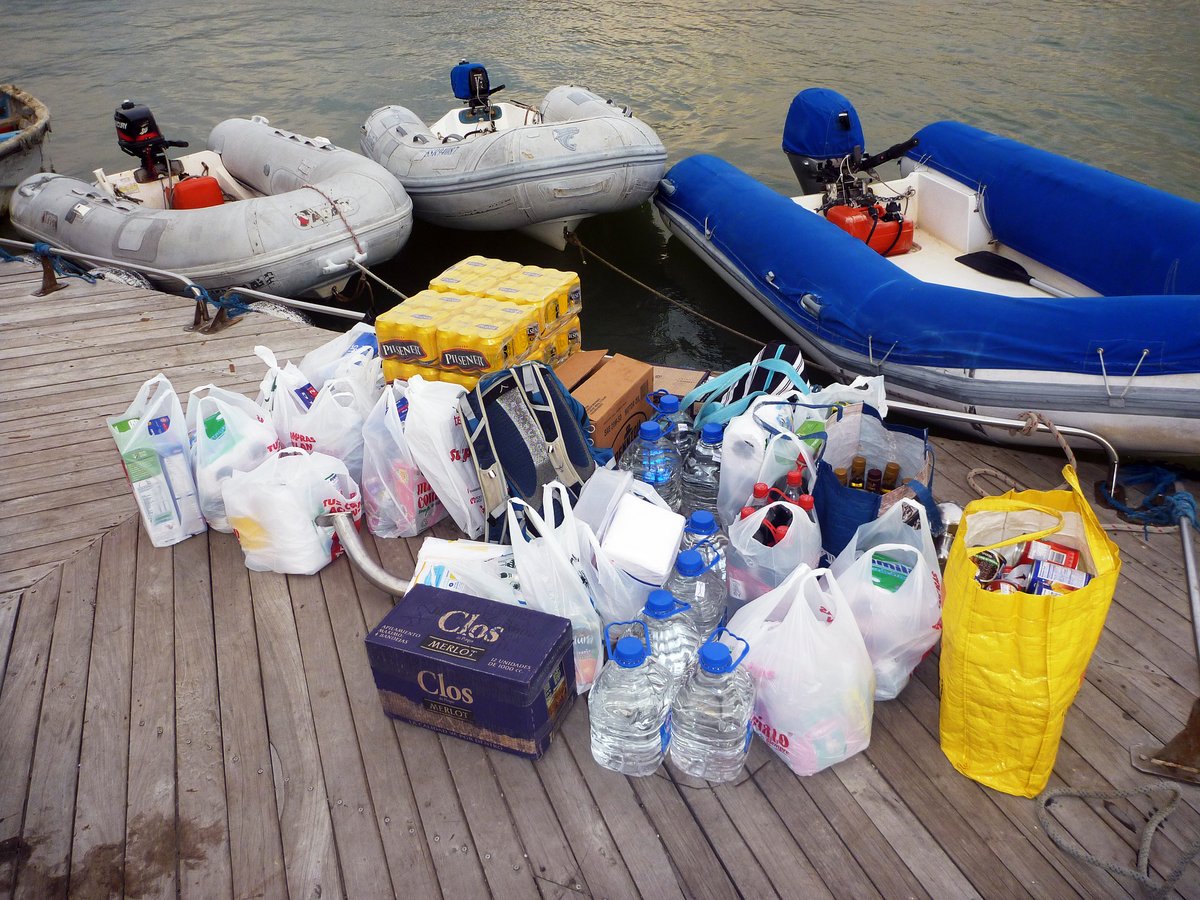
We went into Manta with Geovanny and blew $1,200, half of which was at the supermarket and half of that was beer and booze. Alcohol is very expensive in French Polynesia, so we’ve bought eight cases of beer, 20 litres of red wine and 10 bottle of rum – we’d have bought more, but we couldn’t store any more on the boat. Glenys stocked up on canned and dry goods and was particularly happy to find tinned tomatoes – she’s not seen them anywhere in Ecuador over the past three months, so she bought 15 cans of the stuff.
While Glenys was in the supermarket, Geovanny ran me around town for a couple of hours buying various things for the boat (or trying to.) It’s so difficult to get anything faintly to do with sail boats. It’s very frustrating knowing that I can go on-line in the UK and get stuff delivered directly to my house within a couple of days. Instead, I spent hours driving around Manta trying to find things like spark plugs and pump impellors – no such luck.
We picked up the new Bowsprit, which looks to be the correct size, but they haven’t polished it to a mirror shine like I would have expected. Still, it looks strong enough and we can polish it up somewhere along the road to New Zealand.
I talked to the marina office about clearing out and leaving on the 21st. They said that I’ll need a National Zarpe and will not need to clear out of Immigration, but my boat papers will need to be sent to Manta to the Navy (or somebody) to tell them that we’re moving on. Unfortunately, they also said that I’ll need to give them a copy of my Autographo, which is a kind of cruising permit for the Galapagos, but my agent in the Galapagos (Bolivar) hasn’t sent it to me yet. I’ve emailed him requesting a scanned copy – watch this space...
15 February 2014 Bahia de Caraques, Ecuador
Glenys spent most of the morning stowing away all of her provisions, then bizarrely went into town to buy some food for lunch. I pottered around in the morning doing a few small jobs with some bits that I’d bought yesterday. I’ve had no response from Bolivar in the Galapagos, so I emailed him again.
Yesterday, I tried to find some decent satin wood paint in Manta, but had no success, so I decided that I’d have to use the crappy paint that I’d bought a week ago. I painted on the weird undercoat which looks more like varnish - at least it should be waterproof and hopefully will survive until we get to New Zealand, where I think that we’ll make a new set of doors.
In the afternoon, Glenys finally motivated herself to do some more varnishing and spent a couple of hours sanding down the frame around the companionway down into the saloon. It was a nightmare because she had to mask off the whole area to try to stop the dust from dropping down into the saloon. Unfortunately, the wind picked up and kept blowing dust down below, so she then had to spend another hour vacuuming up the mess. She put on one coat of varnish and it looks much better.
I started to fit the bowsprit. I had to drill two 11mm holes in the side plates of the bow roller, which is made from 5mm thick stainless steel - it wasn’t easy. The bow roller is right at the front of the boat and the only way that I could get to it was to suspend myself in the bosun’s chair on the outside of the hull. I then had to tie myself to the pulpit to hold myself in position while I drilled the hole.
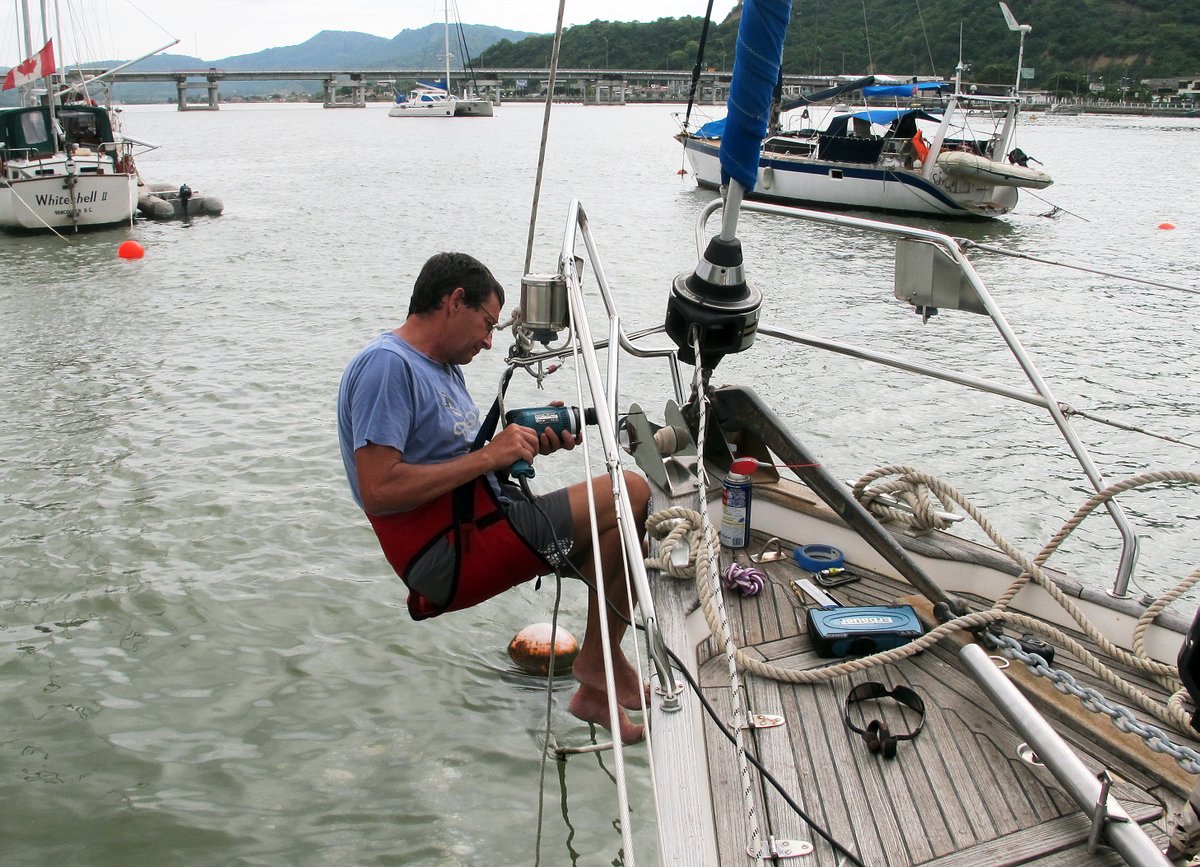
The first hole went okay because I was able to drill a small 5mm hole first and then gradually open up the hole with larger drills. The second hole was more of a problem because I had to drill through the first hole and my small drills weren’t long enough. Unfortunately, using the larger drills wasn’t as effective and I ended up blunting the drills and then work hardening the edge of the hole, so the drills wouldn’t cut at all. I then tried using a Dremel grinder and small files, but I couldn’t get good enough access to the hole because there’s so much other stuff in the way. After two frustrating hours, I gave up and had a beer.
16 February 2014 Bahia de Caraques, Ecuador
It was a Sunday and we’d planned to have the day off, but I woke up determined to drill that damn hole. I dug out my “Drill Doctor” and spent half an hour sharpening my drills. I had to regrind the drill bits several times as they became blunt, but the newly sharpened drills eventually cut through the work hardened stainless steel. A couple of hours later, I’d fitted the deck plate and it looks good.
We went out for lunch and a stroll along the beach and then chilled out for the rest of the afternoon (apart from a bit of painting and varnishing.)
I’d not received any response from Bolivar about the autographo, so I sent him another email and, in desperation, I sent an email to another agent (J.C. Soto in Isabella) who works for the same Agency. That seemed to work, because within an hour, I received a scanned copy of our autographo, which was a relief.
17 February 2014 Bahia de Caraques, Ecuador
I think that it’s hit us both that we’re going to begin our journey across the Pacific Ocean in four sleeps' time, so we attacked our job list with enthusiasm. Our main task for the day was to clean our water tanks and pipework because we've been getting whiffs of a bad egg smell from some of the taps.
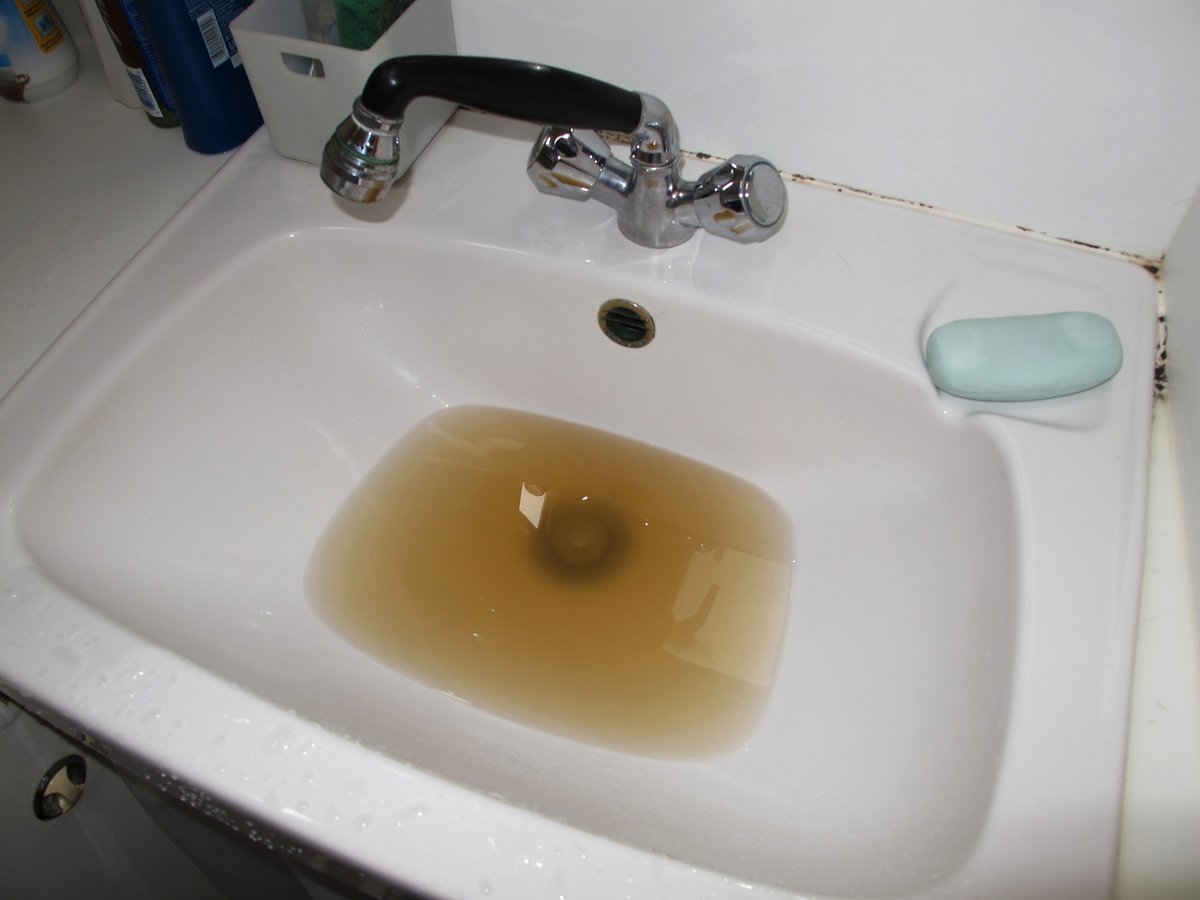
We drained out the water from the tanks and refilled them with 60 litres of water into which we'd poured 2 litres of Clorox. We ran some of this 3% bleach solution through all the taps on the boat and left them to soak for a few hours. Then it was simply a matter of running the remainder of the treated water through each of the taps and then pumping through another 60 litres of fresh water. The water coming out of the taps at the beginning was a disgusting brown colour - it was about time that we did it.
In the afternoon, while Glenys went to do some more provisioning, I inspected the roller furling gear and greased the lower bearings. I then went into the marina office and told them that we 're leaving on the 21st and made sure that they understood that we want a National Zarpe for the Galapagos and don't need to clear out of immigration. I also confirmed that the pilot would be onboard at 0730, to give us time to get to the sand bar before high tide at 0800.
The Ecuadorian's are voting at local elections on Sunday 23rd and they're really going to town with the campaigning. It seems that every few hours there's a noisy procession of cars going along the Malecon promoting one of the numerous political parties. Each party has a distinctive colour and a number instead of a name, presumably to make it easier for everyone to cast a vote.
18 February 2014 Bahia de Caraques, Ecuador
We had another busy day of jobs. Glenys cleaned out our main bilge and engine room bilge with degreaser while I pulled apart our aft cabin to check the steering gear, the autopilot and the batteries. It all looks pretty good apart from signs that we've got a very small leak of sea water coming from the seals on our lower rudder bearing. I'm a bit annoyed about this because it took me two days to replace the damn seals in July. I'll have to keep an eye on it.
In the afternoon, Glenys did her final bit of sewing and made some new lifelines for us to clip into when working on deck. I checked the wiring for our radar, which has been giving us intermittent problems - everything looked fine and the radar seems to be working at the moment. I also checked the cooking gas pipework and tested for leaks.
After servicing the 15hp outboard a few days ago, I finally got around to putting it onto the dinghy and giving it a test. I had to adjust the gear shift rod because it was jumping out of gear when at full lock, but everything else was fine. I must admit that I enjoyed zooming around the bay for half an hour - much more fun than our tiny 2.5 hp outboard that we've been using here.
In the evening, we invited Alberto and Curtis around for a meal ,which was very pleasant. Alberto has a residency visa and is allowed to vote in the elections. I found it interesting that the Ecuadorians get fined if they don't cast their vote, so there's nearly 100% turnout for every vote. A little Draconian, but surely that's more democratic than in the UK where less than 50% of people actually vote.
19 February 2014 Bahia de Caraques, Ecuador
I topped up our diesel tank from our jerry jugs and dinghied over to the petrol station to refill them. Diesel only costs $1.05 per US gallon here and foreigners are not normally allowed to buy it at domestic prices because large foreign boats were taking advantage of the low cost. They're a bit more relaxed about it here in Bahia, but will only let us fill a couple of jerry jugs per day. I could have bought the fuel through the marina, but they charge $2 and it's easier to get it myself.
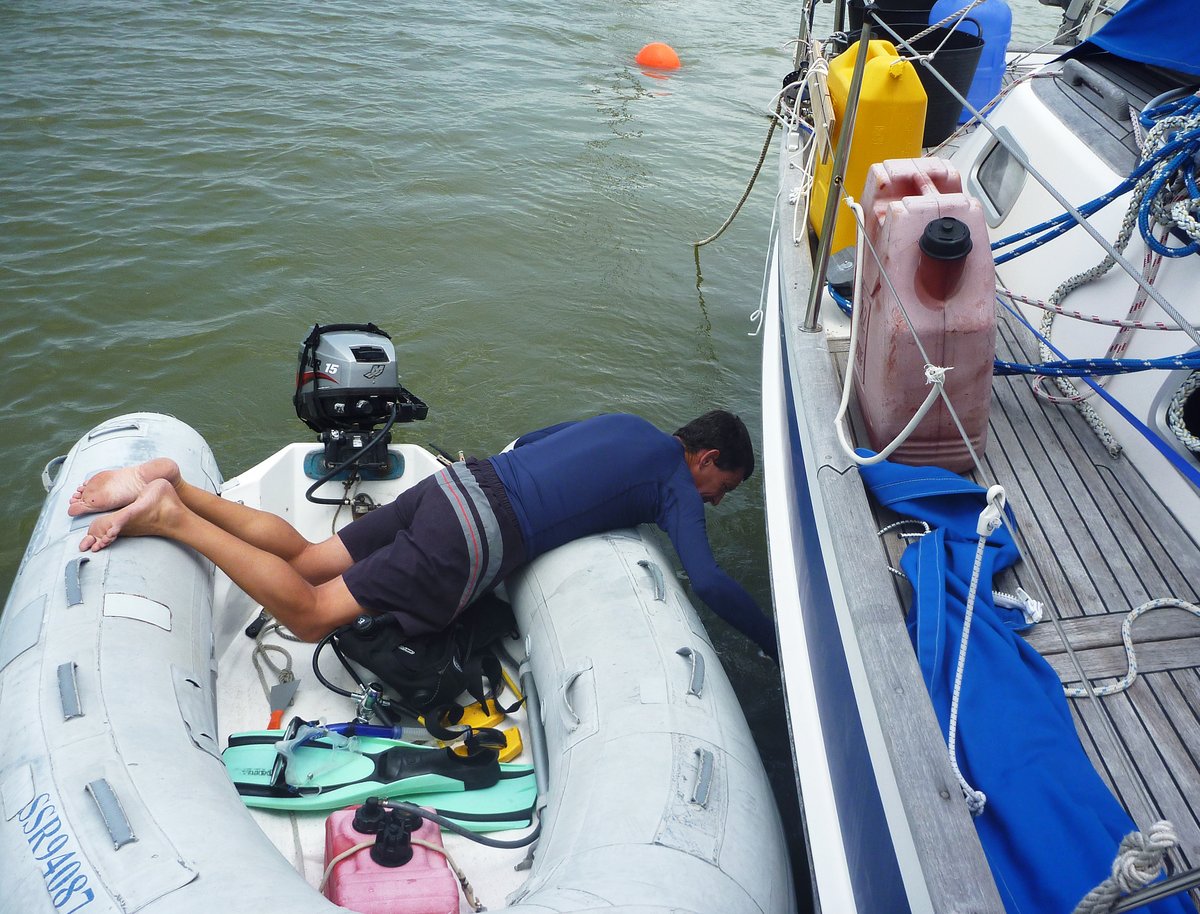
My big job of the day was to clean our propeller. I dragged out my scuba diving gear and braved the foul brown water. The prop had at least a 1 inch thick coating of huge barnacles and it took me over 15 minutes to scrape the damn things off - I had to work by touch because the visibility was less than 6 inches. While I was in the water, I also spent 90 minutes cleaning the water line to remove thick slime and barnacles. I was only able to clean down a couple of feet from the surface - we plan to stop at an anchorage when we leave here to finish the rest of the hull.
I was a bit knackered after my two hours of graft, so I spent the afternoon pottering about checking the satellite phone, getting the water maker back on-line and checking our navigation instruments. In a blinding bit of seamanship, I even put the way-points to the Galapagos into our chart plotter - I normally forget and end up doing it when we're under way.
The health inspector came aboard and gave us his clearance out to the Galapagos. We might actually go the day after tomorrow.
We went out for a pizza with “Albion” and Armagh”. There's only a few days to the elections on the 23rd and the political parties are not allowed to campaign after midnight tomorrow, so there were lots of campaigners in town dressed in their brightly coloured t-shirts. Another strange Ecuadorian law is that from midnight on the 21st, there's no alcohol served anywhere in Ecuador until the elections are over - I don't like the sound of that...
20 February 2014 Bahia de Caraques, Ecuador
We were up early and went for breakfast with Alberto in one of the small food stalls on the sea front – they only serve Encebollada, which is a Tuna soup traditionally served as breakfast around here. It sounds weird to have fish soup that early in the morning, but it’s delicious.
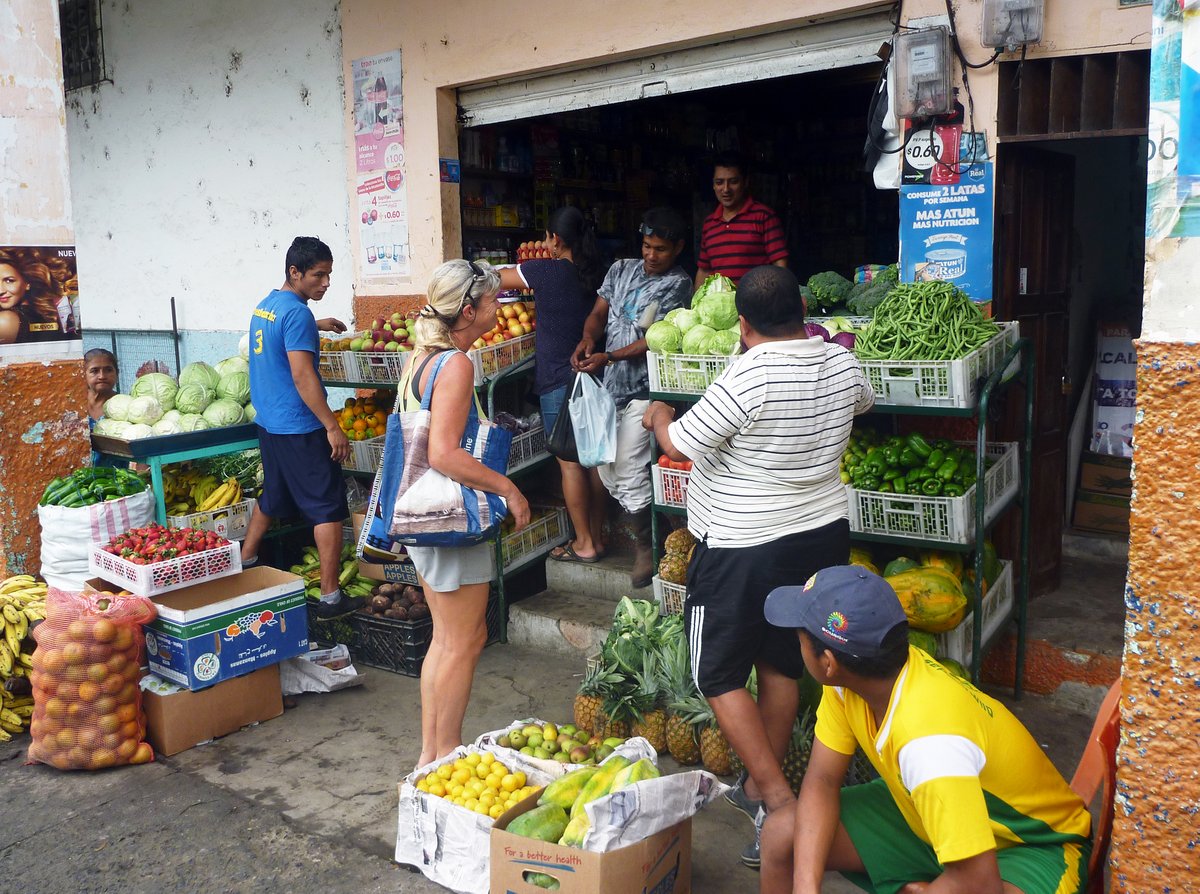
Having suckered me into town, Glenys proceeded to drag me around the shops doing some more provisioning. She then got on with storing food, vacuum packing some meat and cooking enough food for the first few days at sea.
I tidied up our front cabin which has been used as a painting room for the past week, then fitted the newly painted cupboard doors in the front heads – the Ecuadorian paint that we've been forced to use looks terrible, but the doors are so much better than the old water-logged ones. I stowed the sewing machine away and dragged out the spinnaker - we're expecting light winds on our passage to the Galapagos.
Just after lunch, I went into the marina office to pay our bill and pick up up our clearance documents. The national zarpe and temporary importation documents were waiting for me, but as I checked them, I saw that the importation document hadn't been stamped by the Customs officer. We then had a hour of chaos, while they rang the customs office in Manta (80 kilometres away) to be told that the document would have to go back to Manta to be properly stamped.
The marina's initial solution was that they'd arrange for the document to be taken to Manta by taxi and brought back today. However, when I said that they'd have to pay the $60 taxi fare (because it was their fault), there was a bit of back peddling and they're now going to get a document courier to take the form to Manta and then get it over to my agent in the Galapagos. They rang Bolivar in the Galapagos, arranged everything and hopefully it will be there when we arrive - don't hold your breath...
Back on the boat, I carried on tidying up, put the dinghy on deck and pottered about for an hour checking ropes and stuff on the deck. I even got out my fishing stuff - I'm ready to go now.
Glenys made Viche de Camaron for dinner - that's two traditional Ecuadorian soups in one day…
21 February 2014 Bahia de Caraques to Galapagos, Ecuador (Day 1)
I had a very restless night and woke up worrying about the turbo on our engine. Last week, I checked the waste gate lever on the engine and found that it was stiff. Since then I've not investigated any further and my subconscious was obviously reminding me. So, I was up at six o'clock googling away finding out how the turbo works and whether I had a major problem.
Thankfully, it appears that this waste gate is only there to relieve high pressure in the turbo and that should only happen at very high rpm, which we never do. However, I'll see if I can free it up when we get to the Galapagos and I'll make note to remove and de-coke the turbo when we get to New Zealand - this list is getting longer.
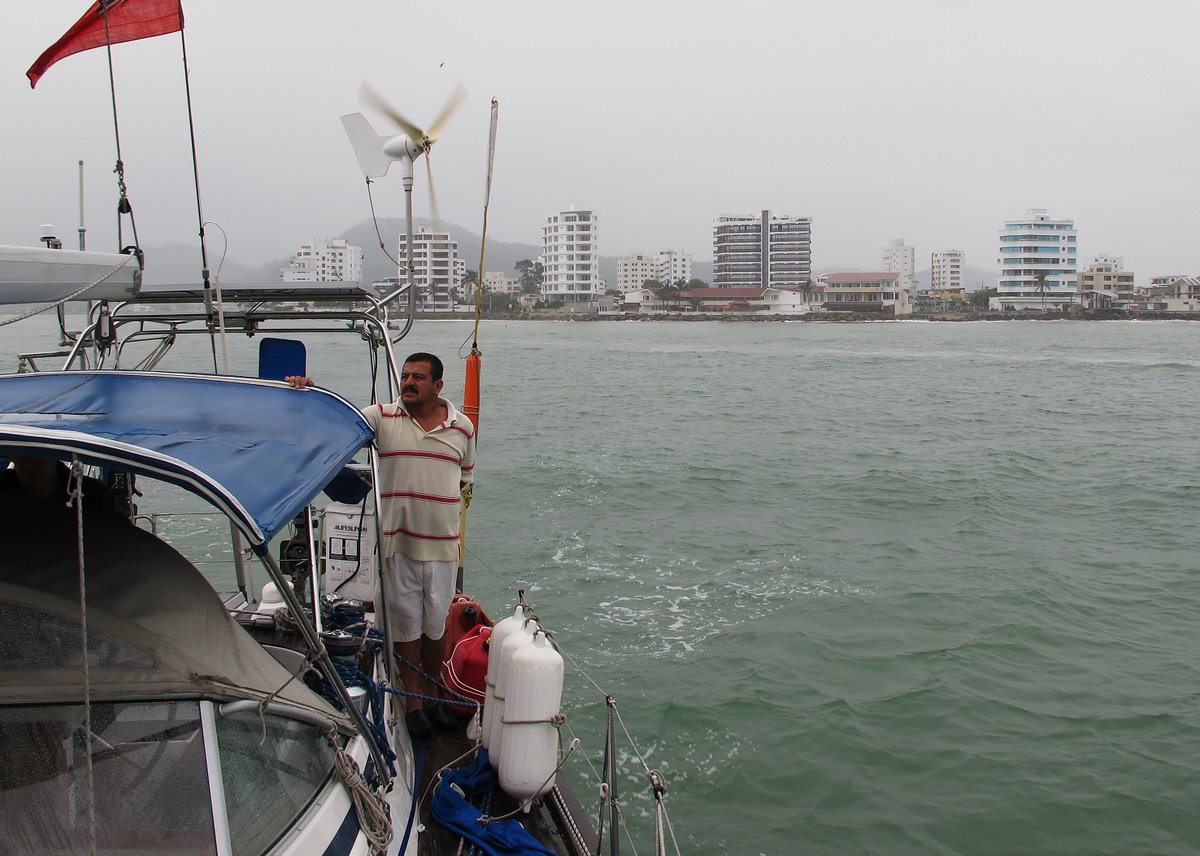
The pilot, Pedro, arrived well before half past seven and we had an uneventful, but nail-biting trip out through the shallows at the estuary mouth - the minimum depth that we saw was 2.7 metres, giving us loads of room under our 2.0 metre keel. It was raining quite heavily, with poor visibility and not a very nice start to our journey.
Pedro was expecting another yacht to be waiting to come in, but there was no sign of it, so he went back into the estuary. Ten minutes later, we heard the boat calling Puerto Amistad on the VHF radio, but no one was replying. Knowing the trouble that we had coming in, I gave the guy a call on the radio and volunteered to ring Tripp on my mobile phone.
Unfortunately, Tripp told me that it was too late now because it was just after high tide, so the yacht would have to wait outside until tomorrow morning. No surprise, but the skipper of the incoming boat was not at all happy when I relayed Tripp's message to him. The poor guy was single-handed and had busted a gut to get here in time for high tide, to be told that he had a 24 hour wait because he was 10 minutes late. I felt sorry for him, but there was nothing that I could do.
We had a lovely sail in the morning. The sun came out and we had a nice 15 knot wind from our port aft quarter, which pushed us the fifteen miles to Cabo Posada, where we anchored in the lee of the headland. There was quite a swell coming into the anchorage making us roll badly, but we were only there to clean the bottom and check the propeller.
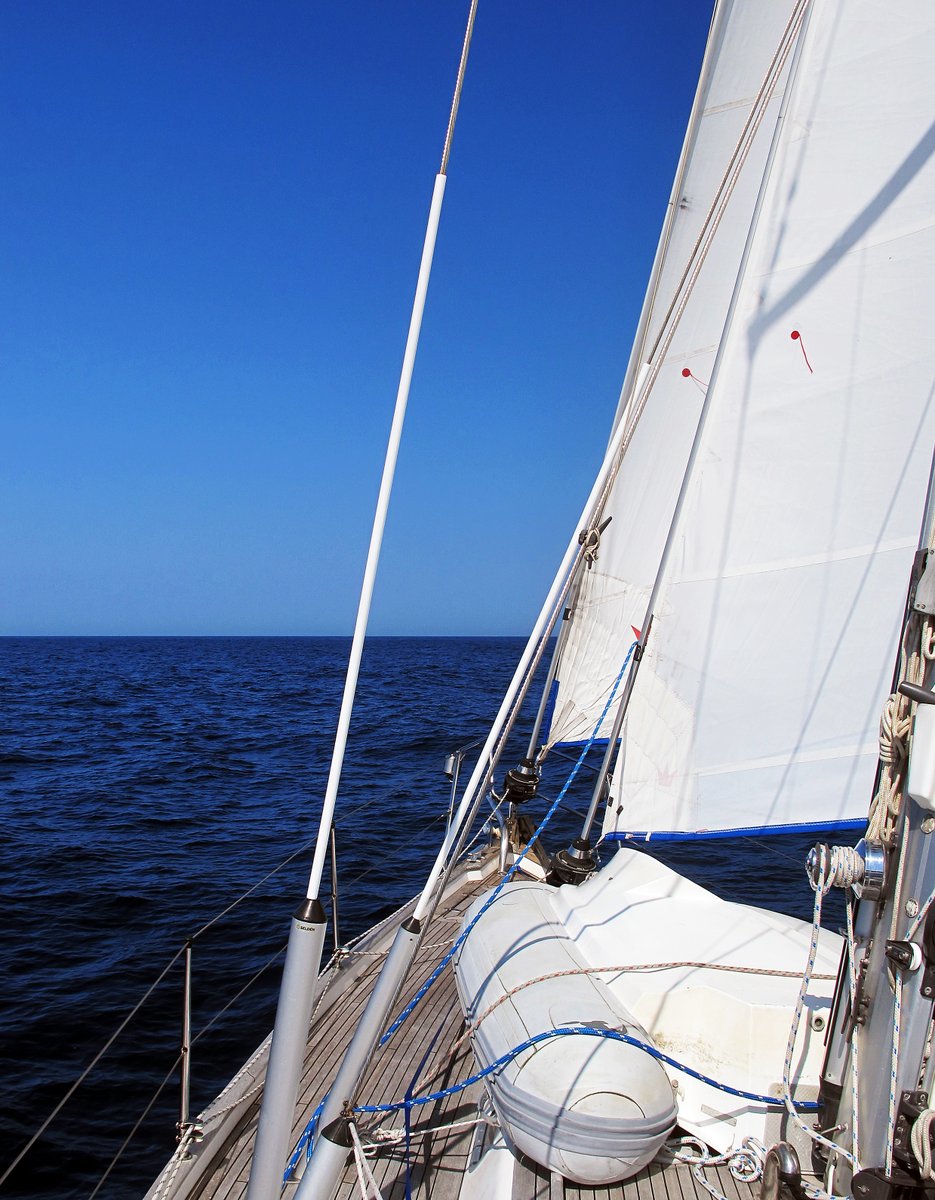
I put on my scuba gear and spent 90 minutes scraping away with a small metal scraper. The propeller was pretty clean after my efforts the other day, but the hull was coated in a thick green-brown algae and had large barnacles every foot or so. I decided to scrape off all of the barnacles, but only scrape off some of the algae, hoping that by uncovering some of the anti-foul paint, the algae will be killed off while we're sailing for five days.
It was hard work, especially because the boat was rolling up to 20 degrees as I was doing the grotty job. After an hour of swimming sideways, upside-down and bouncing of the constantly moving hull, I was feeling decidedly nauseous. By the time I climbed back on board, I was in great danger of throwing up, so I sat and stared at the horizon while Glenys stowed the diving gear.
We were under way by two o'clock, but by this time, an on-shore sea breeze had started, switching the wind from the south-east to the west; directly where we wanted to go - bummer. We tried to beat upwind, but after trying both tacks, we decided that we'd be better to motor away from the shore to get back into the prevailing south winds.
I was still feeling seasick, so I went to bed for a couple of hours and left Glenys to it. By late afternoon, we were finally able to sail hard on the wind on port tack.
After dinner, we settled down to our normal three hour watches starting with me going to bed at seven o'clock. We had a fabulous night's sail with calm seas and 5-12 knot winds from the south, bumbling along at 3-5 knots on a reach.
We had a few anxious times with shipping. I had to call up a big freighter, who looked to be on a collision course with us - thankfully they changed course after my call and went astern of us. Glenys was dodging fishing boats on one of her watches. She spotted the flashing lights of a long fishing net, but disconcertingly, the fishing boat didn't put on any lights until she got close and then turned them off after she went past.
22 February 2014 Bahia de Caraques to Galapagos, Ecuador (Day 2)
Dawn saw us on a pleasant reach at five knots with overcast skies and thankfully no rain. At eight o'clock, we'd only done 70 miles with 470 miles to go.
The wind gradually dropped during the morning, so I dragged out our spinnaker. It took us 30 minutes to rig it up, roll away the two head sails, remove the running backstay and get it flying. Our new bowsprit worked well and kept the tack of the sail well away from the pulpit. We were still on a close reach and ripped along at 5-6 knots in 7-10 knot winds in glorious sunshine.
By three o'clock in the afternoon, the wind had picked up a few knots, so I went up front to drop the spinnaker. Glenys steered us downwind and I released the tack of the sail, so the spinnaker flew like a flag behind the mainsail. I then pulled the sock down to douse the spinnaker, but as I was lowering the socked sail, the damn spinnaker halyard slipped off the winch and slid through my hand for a few metres until I grabbed it.
Fortunately, I stopped the sleeved spinnaker from falling into the sea, but I picked up a rope burn in the palm of my right hand. I shoved the spinnaker into its sail bag and left it clipped to the guard rail. Back in the cockpit, Glenys gave me some "Burn Free" gel to put on the rope burn, which did a good job. Twelve hours later, there weren't any bad blisters or pain - good stuff.
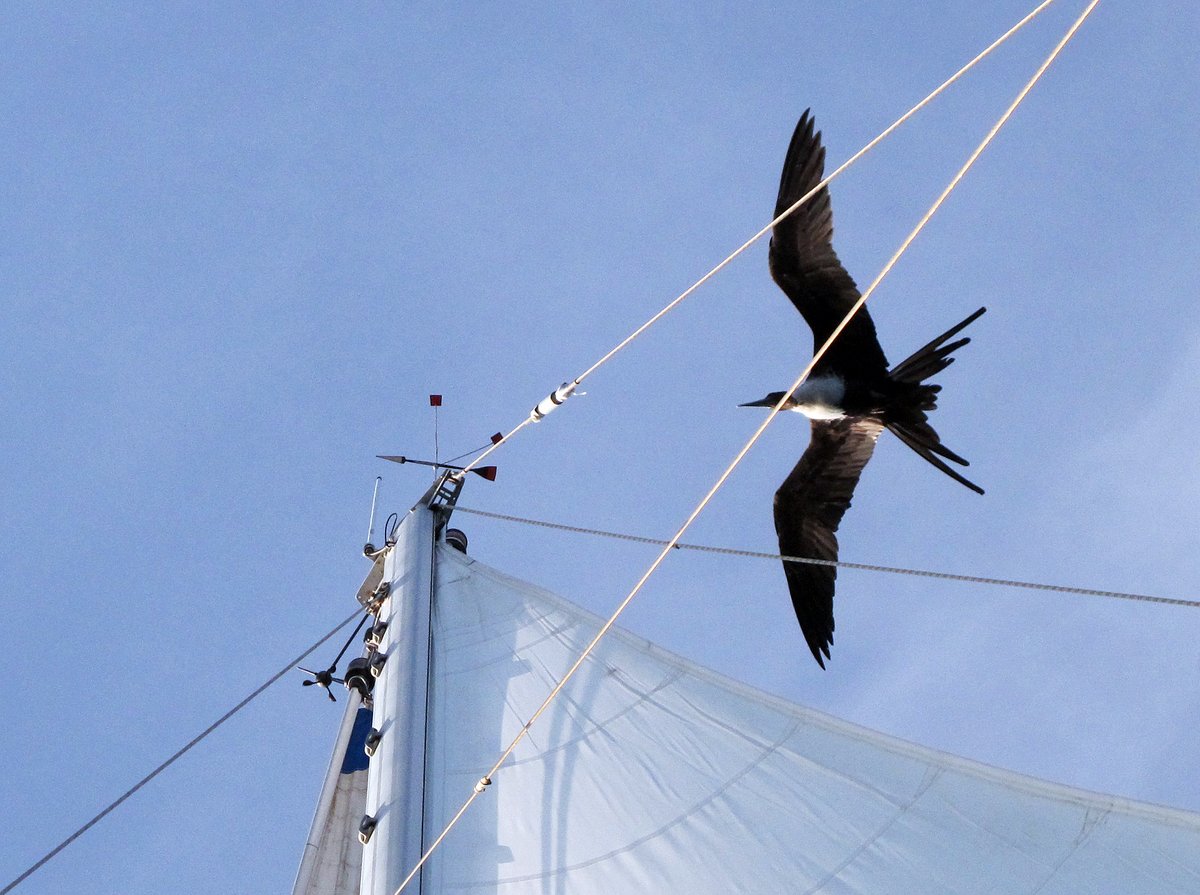
Our major entertainment of the day was trying to scare away a frigate bird that wanted to land on the top of our mast. It gave up after ten minutes of circling around - probably because I've got an anti-bird spike on my Windex, rather than our enthusiastic efforts to shoo it away.
We decided to swap watches, so Glenys served up a nice Cassoulet for dinner, then went to bed leaving me on the 7-10 watch. The wind picked up to 15 knots in the evening and veered 30 degrees putting us fairly hard on the wind, so I put a reef in the main and we flew along at 6.5 knots. We continued to get stronger gusts and by one o'clock, we had a reef in the genoa as well to cope with 20 knot gusts over the deck. Despite being hard on the wind, the motion was okay because the seas weren't very big and even with the reefs we were doing seven knots.
It was a lovely clear night, with bright stars and a quarter moon that came up just after midnight. Now that we're on the equator, the "cut out" in the moon is horizontal, which looks very strange to me, having lived in the northern hemisphere all my life (where the cut-out is on the top, right hand side of the moon.)
23 February 2014 Bahia de Caraques to Galapagos, Ecuador (Day 3)
The wind dropped to around 10 knots after daylight, so Glenys shook out the reef on the genoa and we bobbed along at 5.5 knots on a close reach. I took advantage of the early 4-7 watch and had an extra hour in bed - luxury!
While Glenys went to bed for a couple of hours, I downloaded a GRIB file which showed that the wind will drop over the next few days - we'll probably end up motoring, but at least there's nothing nasty ahead.
I checked in on the Pacific Cruisers Net and had a very good signal on our SSB radio, so changing the antenna cable seems to have sorted out my problem. This is the first time that we've checked into this radio net and it was lovely to have friends from various places around Central America call up and say hello.
I dug out my fishing gear, but despite trolling two lines all day, we didn't get a single bite. We had great weather during the day - blue skies, 10-14 knot winds and calm seas, so we sailed along at about six knots on a close reach, which was very pleasant.
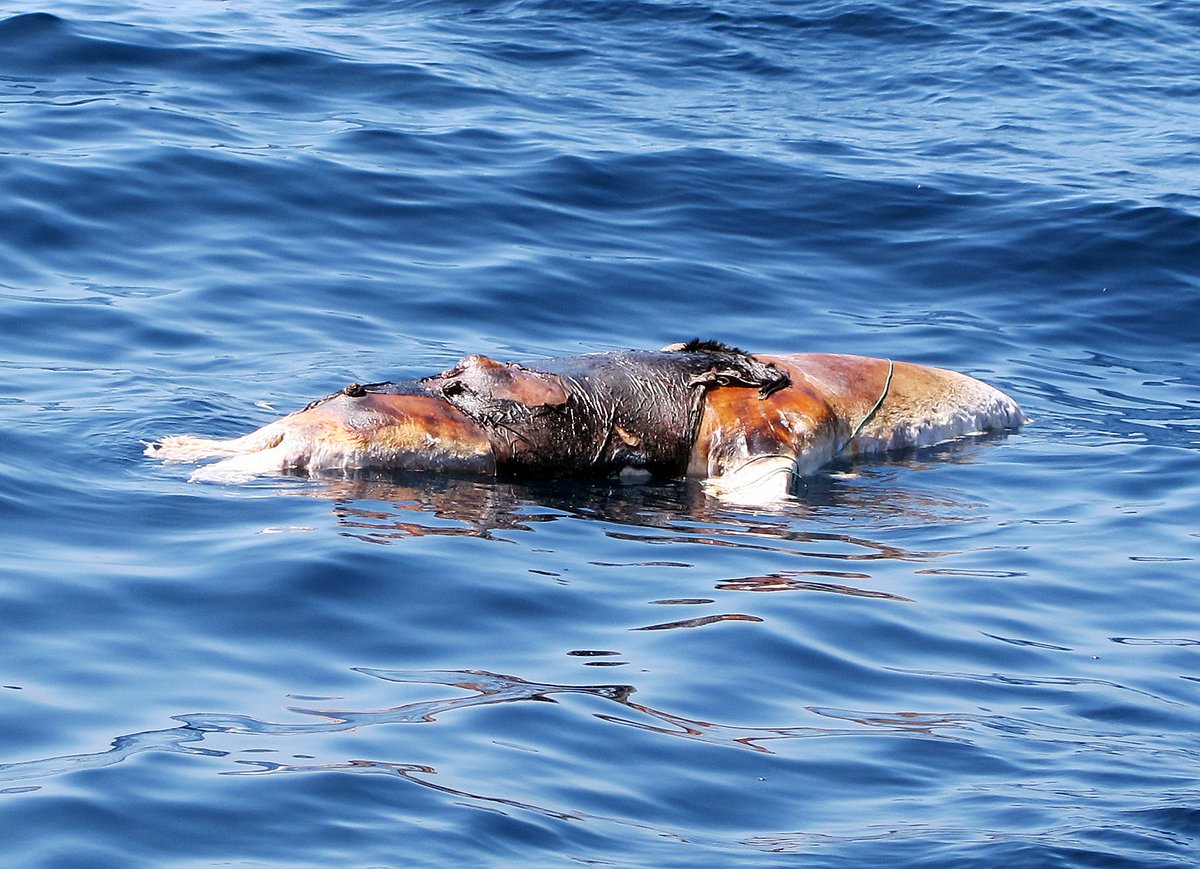
During the morning, I spotted a strange floating object and sailed over to investigate. It was the remains of a large mammal (a small whale, I think) that had been caught up in rope. It was bloated; had already lost its tail to predators and stunk to high heaven. I didn't get too close.
Glenys and I both seem to like the changes in watches - I'm now on 7-10 and 1-4, while Glenys does 10-1 and 4-7. She loves seeing the sun rise, and I like the fact that I'm only being woken up once during the night and can wake up naturally at the end of the 4-7 watch. We were thinking of alternating the watches every day, but it was a big disruption to our sleeping patterns to change over. Perhaps when we sail to the Marquesas we'll change every five days or so.
The good weather continued all day, but the wind started to drop after dark and Glenys had to turn on the engine at one o'clock in the morning. After that we motored along in very calm seas with fabulous stars. We have a star gazing app on our iPad, which is great for identifying stars & planets and helps to keep us occupied on long, dark night watches.
At four o’clock, we just had enough wind to sail again, so we turned off the engine and drifted along at 3-4 knots for a few hours.
24 February 2014 Bahia de Caraques to San Cristobal, Galapagos (Day 4)
Unfortunately, the wind disappeared altogether just after dawn, so Glenys motored for a while until I got out of bed and we could put up the spinnaker. There was only 3-5 knots of breeze, so, even with the spinnaker, the best that we could manage was a couple of knots of boat speed, but at least the sea was very calm and the sun was shining.
We persevered with bobbing along until noon, when it was decision time. The GRIB file that I downloaded in the morning showed these light winds would continue for at least two days.
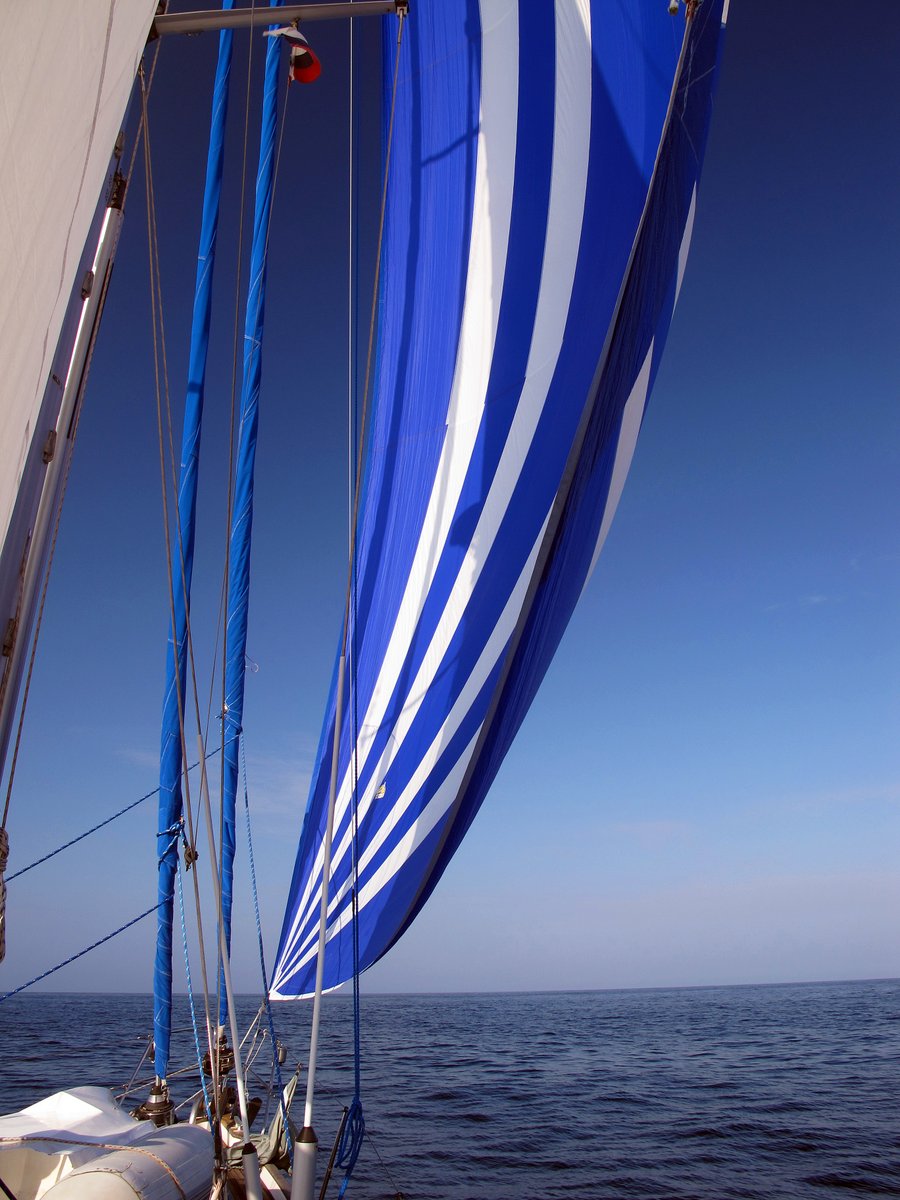
We were 180 miles from our destination - we either started motoring to arrive tomorrow afternoon, or we took another two or three days to get there. We'd probably have to motor each night anyway, because I don't want to fly the spinnaker in the dark, so we decided that we'd might as well go for it and turned on the engine.
The rest of the day and night was uneventful - motoring along at 6-7 knots in the calm seas. Once again, we didn't have a single bite on our two fishing lines even though I deployed our normally lethal Cedar Plug.
Before we moved onto Alba, I ran a computer business that was based around Microsoft products, so for the last 30 years, I've been very anti-Apple products. That was until we bought an iPad. We initially bought it as a backup chart plotter because it has a built-in GPS receiver and we were able to buy Navionics charts that cover our route around the world for only $200.
The iPad is now a permanent feature in our cockpit when underway. As well as using it for navigation, we have a star-gazing app which is useful for identifying stars and planets; an app for identifying fish and I use it to make notes for the web site. I've even started to watch movies on those long night watches - what would we do without it?
Another major use for the iPad is for reading PDF files. When we find interesting information on a website, we print the web page as a PDF for reading later when we don't have internet access.
I spent most of the day and night on our beloved iPad reading information that we've gathered on French Polynesia. Once we get to the Marquesas, we'll be sailing 2,500 miles to New Zealand, sailing through seas with thousands of islands. With only six months to spend in the area, it's a complex logistical exercise to work out which places we want to visit. After 10 hours of research, I have a rough plan for the Marquesas and the Tuamotus - only another 1,800 miles to research.
25 February 2014 Bahia de Caraques to San Cristobal, Galapagos (Day 5)
At dawn, we were still motoring along in calm seas and 4-5 knot winds - Ho Hum...
By ten o’clock, I could see land and it was starting to get exciting. My day was made even better when I finally hooked a fish - a nice fat Tuna. It didn’t take long to get it aboard and I gutted it immediately, just to get it out of the way.

It always takes longer than you think to approach land and this was no exception. At midday, we were motoring around the south side of the island with 10 miles still to go and a current against us. At least there was some wildlife to look at. We’d not seen anything for four days apart from a few Boobies, one Frigate Bird and a dead whale, but now we were surrounded by pods of dolphins, a plethora of seabirds and we even spotted a sea lion.


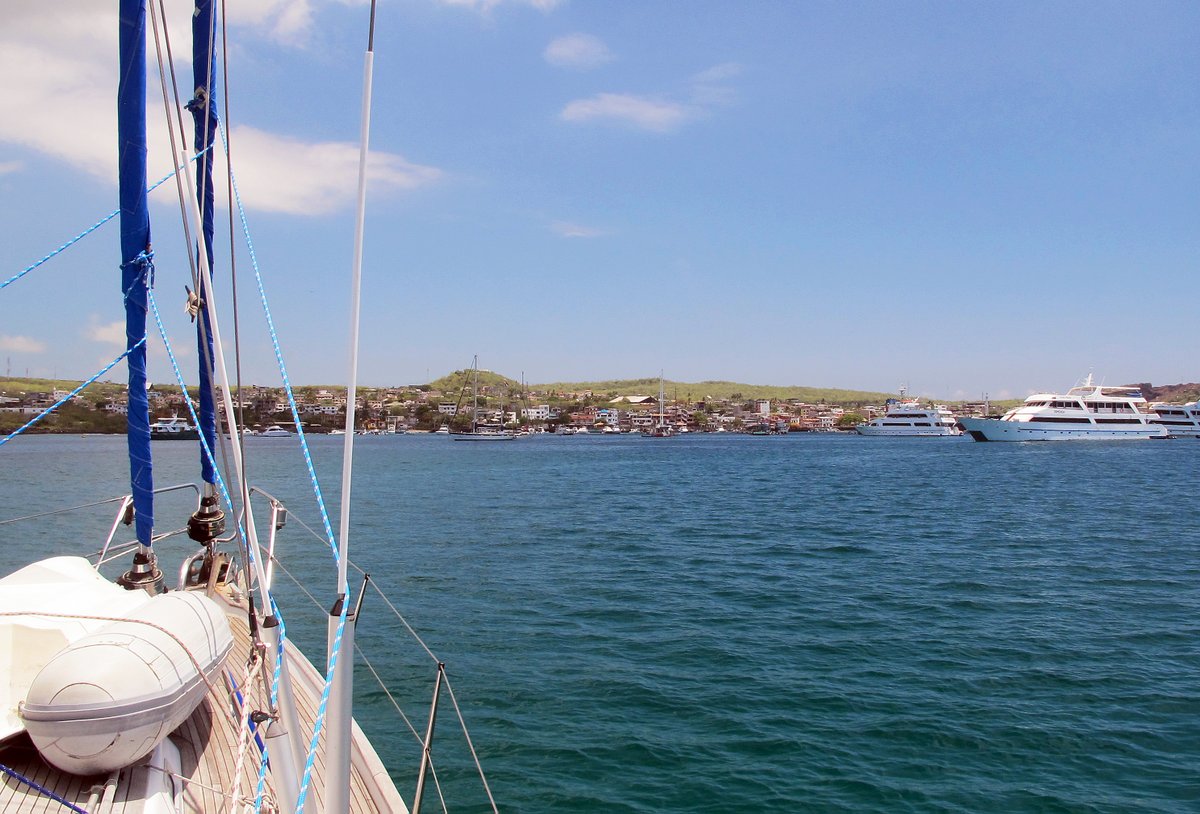
We finally motored into Puerto Baquerizo Moreno on Isla San Cristobal at half past two in the afternoon and it looked lovely in the sunshine with sparkling blue water. There were only 4 or 5 other sail boats in the anchorage amongst the hundred local pleasure and commercial boats. Unfortunately, the sail boats were all facing in totally different directions making it a real challenge to anchor. We eventually took a gamble on where everyone’s anchor was lying and dropped our anchor in a large space next to some yellow commercial moorings – at least we know that they are on a fairly short scope.
Glenys got on with tidying up, while I lashed some big fenders onto our sugar scoop as a deterrent to the sea lions, which allegedly try to climb on board any unprotected boat at night. They might look cute, but I'm told that the mess that they leave behind if they get on board stinks to high heaven and is a bugger to clean up. Let’s hope that my defences are effective.
It only took an hour for our agent, Bolivar Pesantes to come on board. He doesn't speak any English, so we had a difficult conversation, but he took away our passports, a copy of our boat papers and the two zarpe documents that we’d been given in Bahia. I asked him if he’d received the Temporary Importation document that had caused so much stress back in Puerto Amistad – but his reply was simply "It’s not necessary". He left us with a crumpled copy of our expensive autographo and a hefty bill for $1,054!!!
Bolivar was back within an hour with a boat load of people from the national park authority. One asked me questions about disposal of garbage, holding tanks, our anti-foul paint and do we use biodegradable cleaners – of course. He asked me if we had a fumigation certificate to which I truthfully replied “No” and went on to say that I’d been told that we didn't need one if we came from mainland Ecuador – he said that I needed to talk to Bolivar. I just shrugged and thought that I’ll just keep my mouth shut and see what happens.
The guy then wrote out a couple of notices on A4 paper in Spanish and English that warned “No Garbage in the Sea” and taped them up above our fridge. Meanwhile two girls and another bloke were wandering around the boat taking photographs of things like the holding tank, some oil absorbent pads that I have stored away and lastly my spear gun which (of course) I'm not allowed to use here.
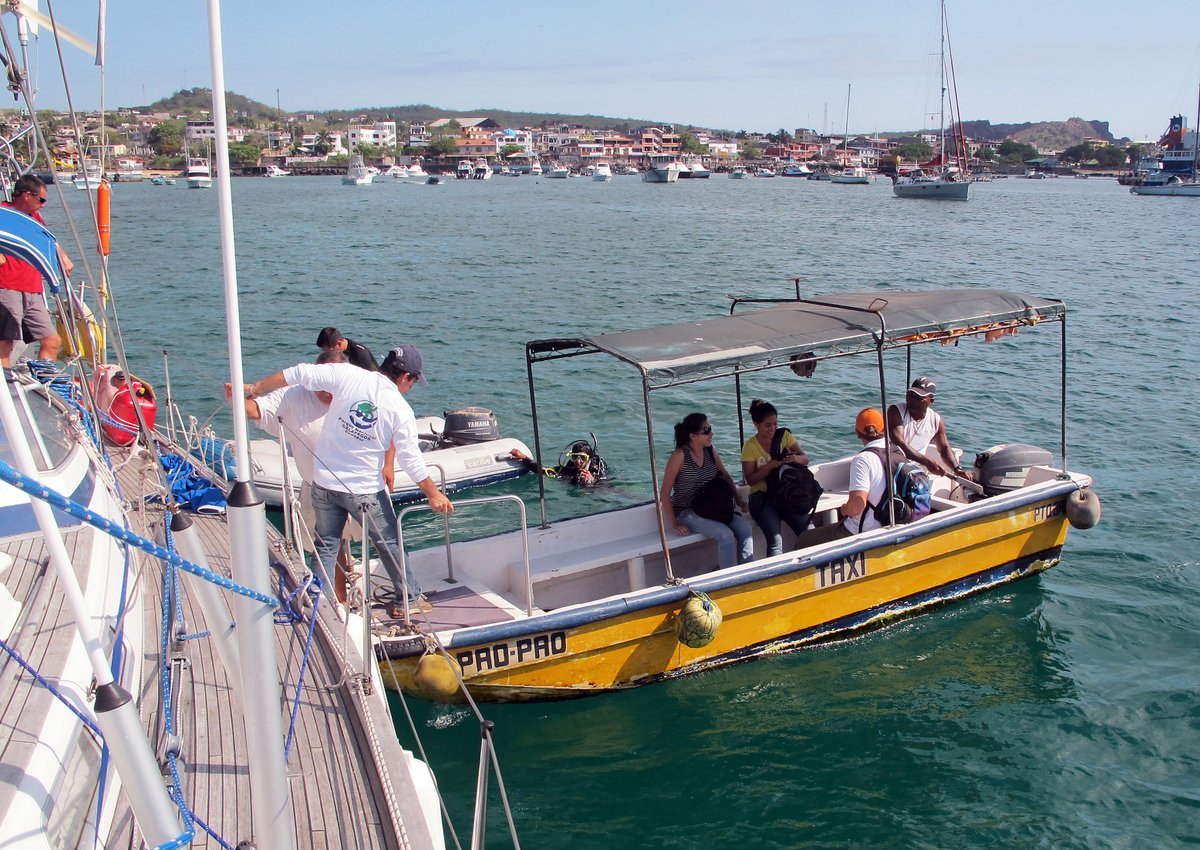
More worryingly, two guys turned up with scuba gear and proceeded to inspect the hull of the boat. I gave it a fair cleaning before we left mainland Ecuador, but there's still a large amount of green slime on the hull and I'm pretty sure that I missed some barnacles. I don’t know what they’ll do if they think that our hull is too dirty because they just went away.
Bolivar came back a couple of hours later with the Port Captain and the Agriculture Inspector. The port captain diligently filled in his form and I signed it. The Agriculture Inspector asked us if we had any animals, plants or fruit. We said no and were surprised when he didn’t go below to have a look himself – not very good pest control. I’m sure that it will be a lot tougher in New Zealand. He also knew that we didn’t have a fumigation certificate because a box was crossed on his form, but he didn’t say anything about having the boat fumigated, thank God.
I went down below with Bolivar and paid his bill in cash. While I had him alone, I asked about the hull inspection and was it a problem, he just shrugged and said it was the Park Authority and there was “No Problema”. I guess that the Parks Authority have no powers at the moment - fingers crossed.
When we had the last of the officials off the boat, we collapsed and ripped open a cold beer. Glenys made some Seared Tuna for evening nibbles, which was delicious.
We were in bed early, looking forward to going ashore tomorrow. A group of sea lions have taken over a powerboat moored nearby and it was strange to hear the sound of them arguing amongst themselves as we fell asleep.
26 February 2014 San Cristobal, Galapagos
Even though we were still very tired, we got up at quarter past seven because Bolivar said that he’d be coming at eight o'clock to drop off some tourist information. He hadn't turned up by nine o’clock, so I put the dinghy into the water and we went to say hello to a couple of our neighbours – Glen and Erin on “Sundance” and Paul and Monique on “Full Circle”. “Sundance” invited us all over for sunset drinks.
While we were chatting to Erin, she told us that nearly twenty of the” Round the World ARC Rally” boats had failed their hull inspections, then been told to leave Galapagos waters and not come back until their hulls were clean. They apparently had to sail 70 miles away from the islands and then heave-to waiting for divers to come out and clean their hulls in the middle of the ocean (they weren’t allowed to do it themselves for some reason.) Some of them were out there for THREE days. We returned to Alba hoping that our hull would pass the inspection.
Bolivar turned up at half past nine, at which point we realised that we hadn't turned the clocks back and were an hour ahead of the local time. We’d got up an hour too early – bummer. I again asked Bolivar about the hull inspection and he again shrugged it off and told us that the Parks Authority was having a political battle with the port captain and the other authorities.
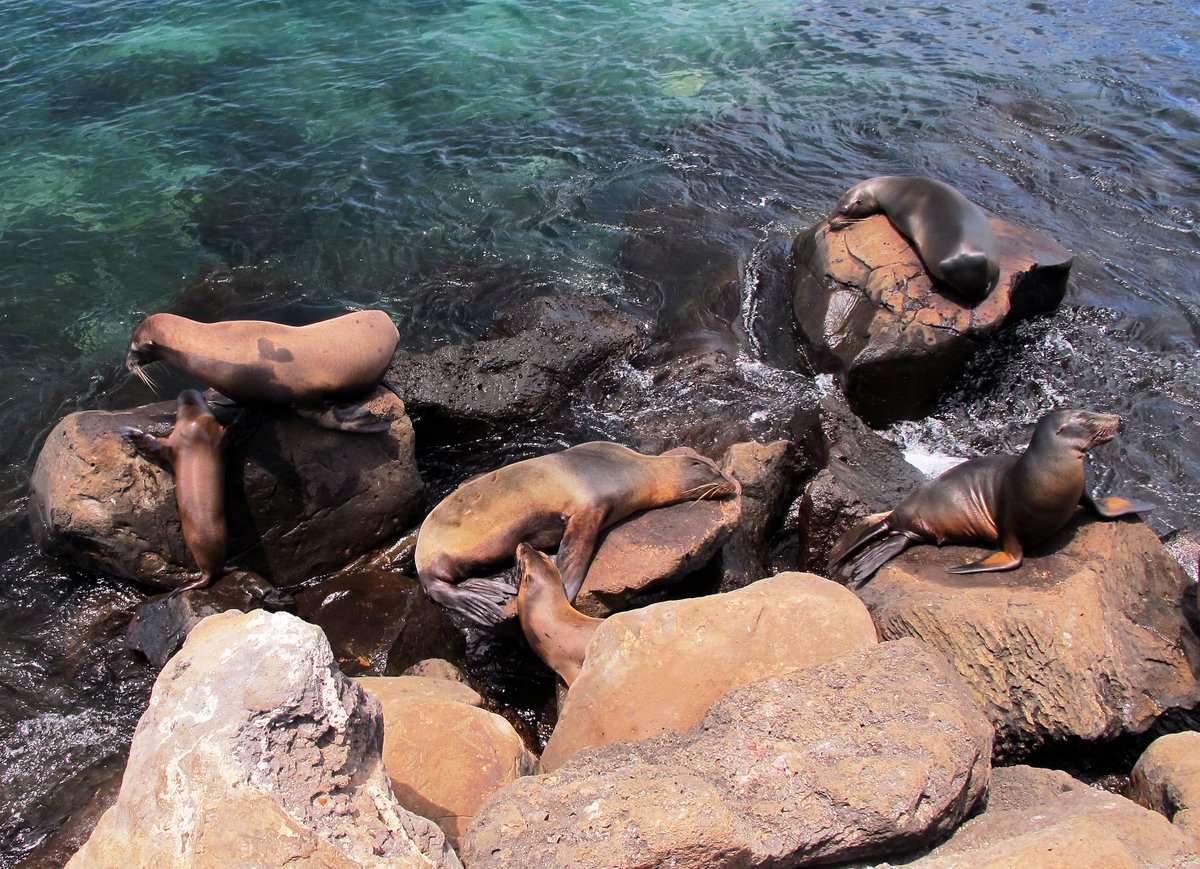
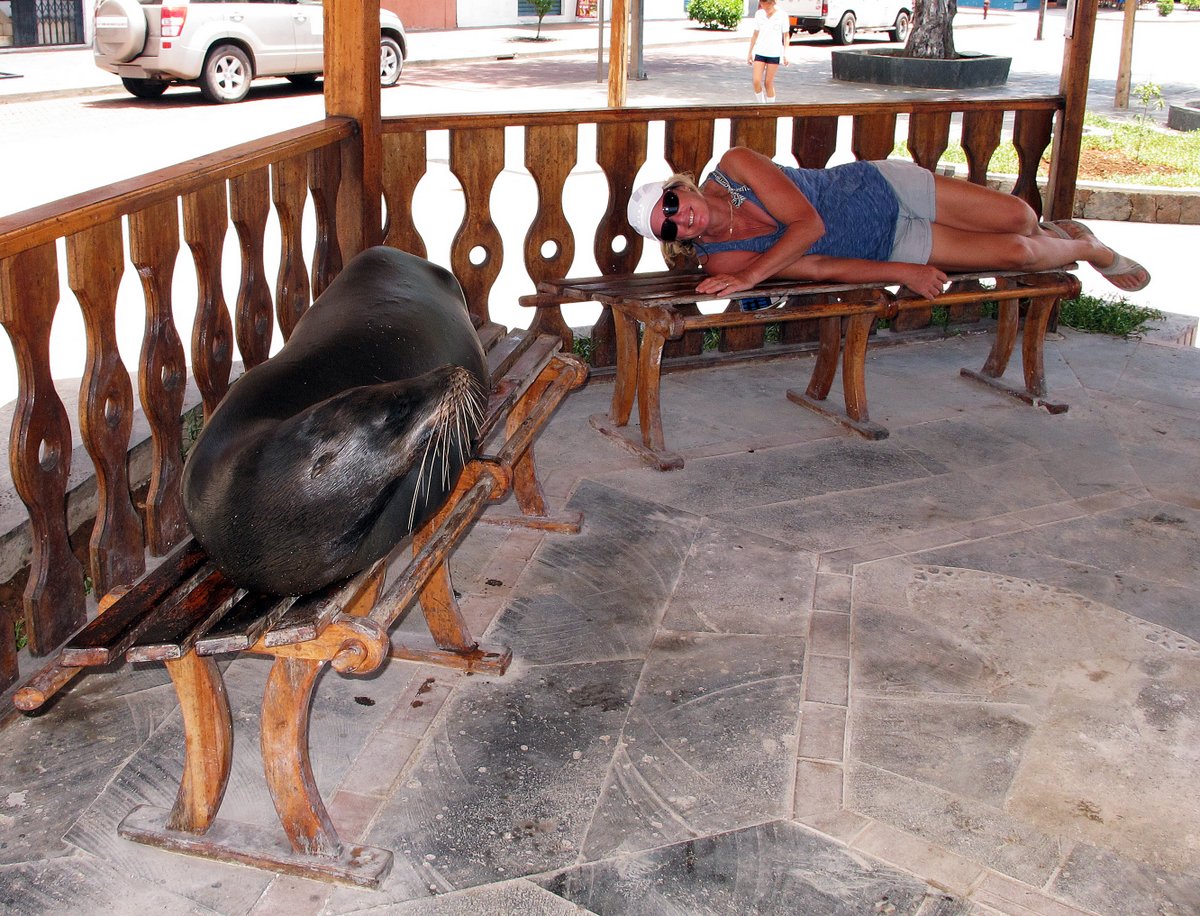
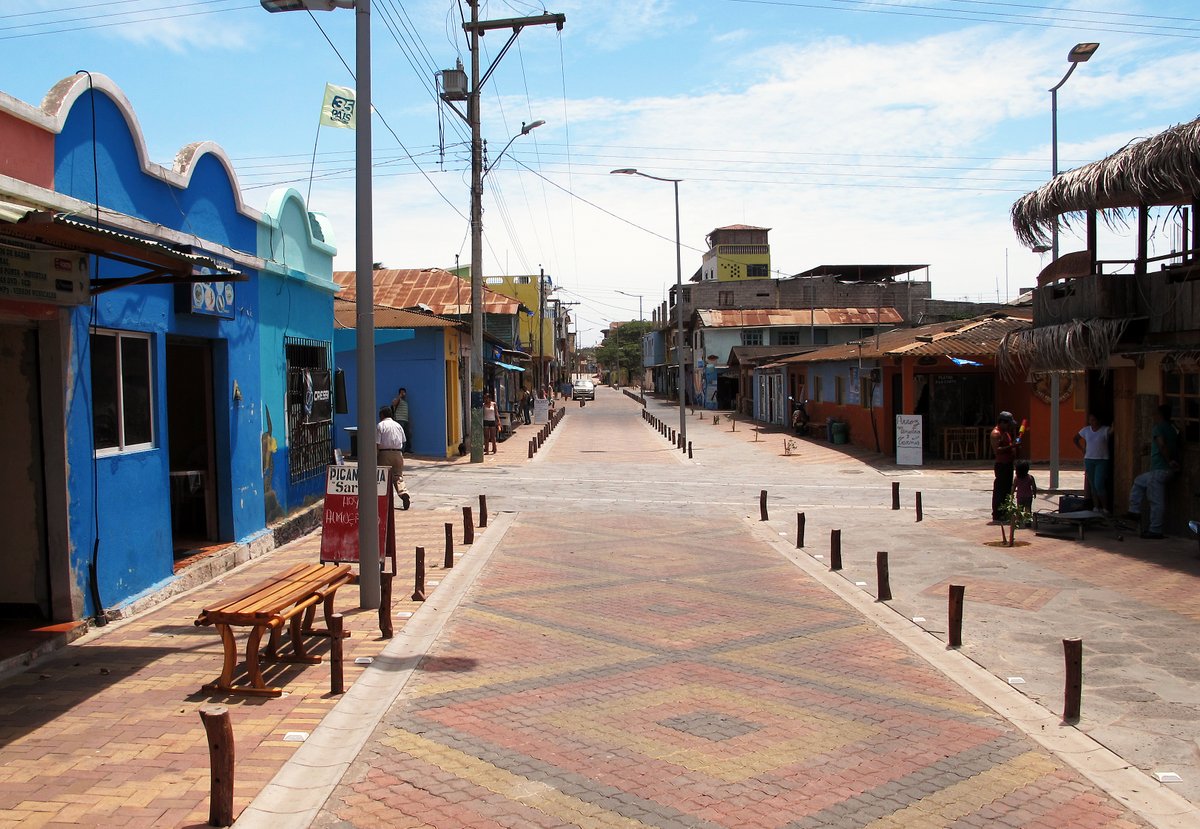
We went ashore and walked around the small town. The first thing that struck us was the number of Sea Lions that are hanging around the Malecon – there are hundreds. They’re all along the rocky shore line, on the small beach and can be even be found occupying the bench seats along the Malecon. There’s a walled-off area with water slides that is obviously intended to be a sea-water pool for humans, but the Sea Lions have taken it over. There are lots of young Sea Lions swimming about, so they seem to be using it as a kind of nursery.

Having taken lots of photographs, we wandered around the small town, checking out the market and shops. They’re typical small Ecuadorian tiendas, but have all the basics, so Glenys is still satisfied that she’ll be able to buy what she’ll need over the next month without diminishing her stock of provisions.
We had lunch in one of the small restaurants on the Malecon, then I went to an Internet café to sort out some things. We've been really privileged to have a good wireless connection on the boat for the past three months, so going back to an Internet café was a bit of a shock to my system. I ended up balancing my laptop on a tall stool while sitting on an office chair. The speed of the Internet wasn't too bad, but I’d forgotten to take the power supply for my laptop and also the memory stick that contains my passwords, so my visit was cut short and I was unable to do the administration jobs that I’d intended - very frustrating.
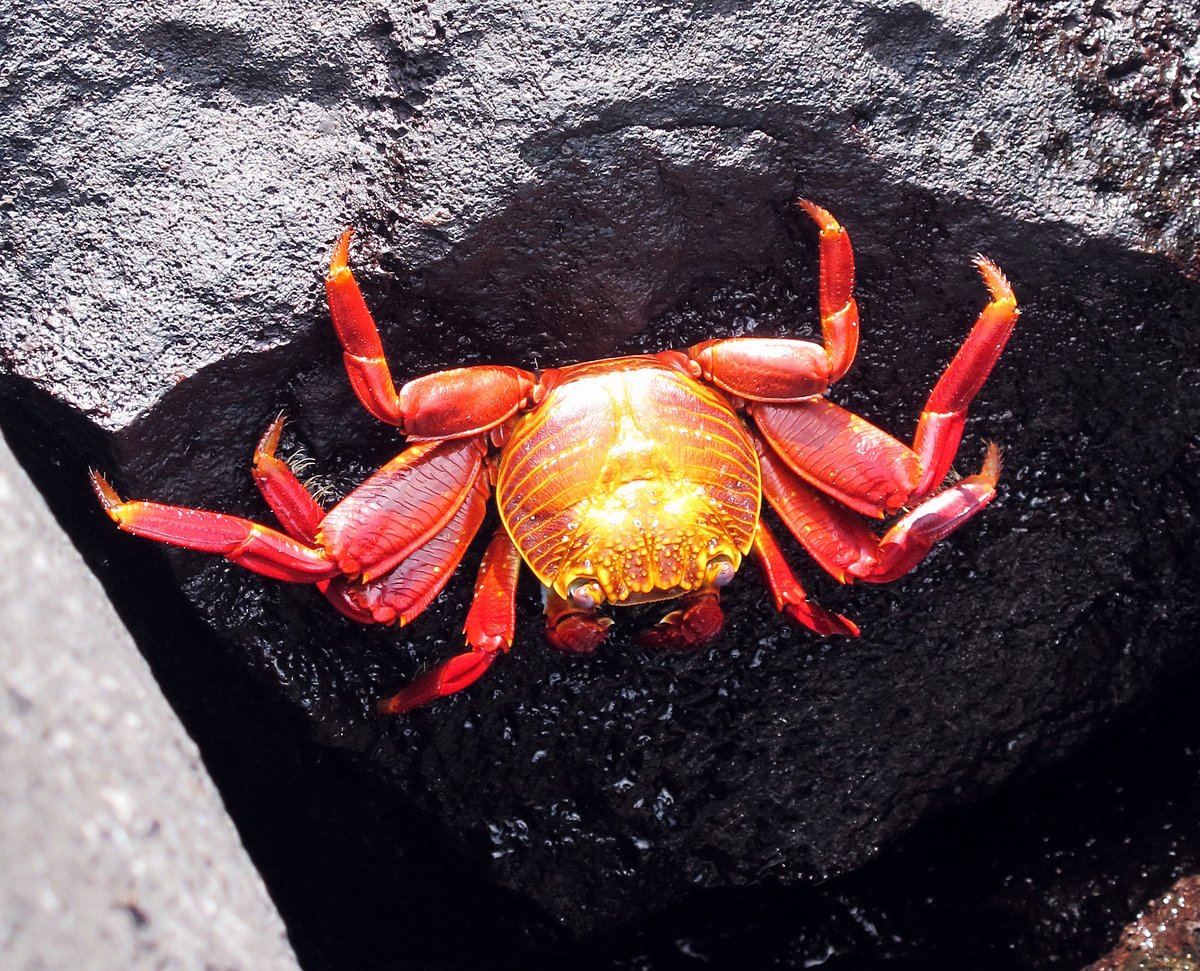
We walked to Playa Mann, which is a small, pretty beach just outside town. Not only did we see more Sea Lions, but I saw my first Marine Iguana and took a couple of nice photographs of the brightly coloured Sally Lightfoot Crabs – there were hundreds of them scuttling around on the rocks. We then walked to the Interpretation Centre, which has some interesting information on how the islands were formed and the environmental problems facing the land and its people. However, it was disappointing that there wasn't more information on the unique species of animals for which the Galapagos are famous.

Back at the boat, we went for a swim to cool down and then chilled out for a couple of hours.
Just before we were going out in the evening, Bolivar turned up and told us that there was a problem. The Parks Authority had issued him with a formal notice that the organisms on our hull were a bio-hazard to the Galapagos environment. We were ordered to leave the boundaries of the National Park (which extends out for 40 miles) and not to return until our hull was free of said bio-hazards. The Parks Authority was expecting us to leave immediately, sail out for more than 40 miles and then to have our hull cleaned in the middle of the Pacific Ocean, before returning.
Bolivar had arranged for divers to clean our hull (at a further cost of course). The plan was to leave at dawn, sail out to International waters, and then return to port with a clean hull before dark. The Park Authority would then inspect our hull again the following day. We didn't have much option – the alternative was to leave the Galapagos and start the 25 day sail to the Marquesas tomorrow.
We agreed to Bolivar’s plan and went over to “Sundance” to drown our sorrows. We met Selim and Nadire from “Keyif”, who had also been caught by the same regulations and had agreed to the same scheme. Interestingly, “Sundance” and “Full Circle” hadn't had any divers inspecting their hulls when they arrived and so had escaped the wrath of the Park Authority.
27 February 2014 San Cristobal, Galapagos
We didn't sleep well at all, worrying about the whole plan and things that could go wrong. Both of us were awake at quarter to five and got up before the alarm went off. We were pulling the anchor up at quarter past five as the sky started to brighten in the pre-dawn. The wind was very light and, as usual when heading around an island, the wind blew directly from the direction we were heading, so we had to motor – more damn expense...
We motor-sailed all morning, arriving in international waters at eleven o'clock and, two hours later, were heading back to Puerto Moreno with our clean hull.
There was still no wind when we were coming back, so we motored most of the time, using the sails whenever the breeze picked up enough and we had a cracking sail for 20 minutes as we approached the anchorage. We anchored in the same place as before just as the sun went down and cracked open a beer – a very strange day.
I've not had a chance to dive down and look at how well they've cleaned the hull – all I can hope is that we’ll pass the inspection and they haven’t scrubbed off too much of our expensive anti-foul paint.
While travelling out and back, we came up with a list of things to discuss with Bolivar. We’re mostly concerned about Bolivar’s gung-ho attitude to the paperwork and regulations. Our passport visas expire tomorrow; we don’t have a signed and stamped copy of our “Temporary Importation” document and the documents we received from the Environmental Ministry have an observation that we haven’t got a Fumigation certificate. We’re planning to give Bolivar the Spanish Inquisition tomorrow about procedures and the paperwork that we should have.
28 February 2014 San Cristobal, Galapagos
We decided to have a chill-out day, but fate didn't let us. I played on my laptop for a couple of hours and then went for a snorkel around the boat to see how well the hull had been cleaned. They've done a good job - probably too good because we seem to have lost a lot of anti-foul paint. Nevertheless, I spotted some barnacles remaining, so I scraped them off – I didn't want the parks authority moaning about a few barnacles. Also, the sea cocks were still a bit clogged up with barnacles, but a bit of scraping with a long screwdriver soon sorted that out.
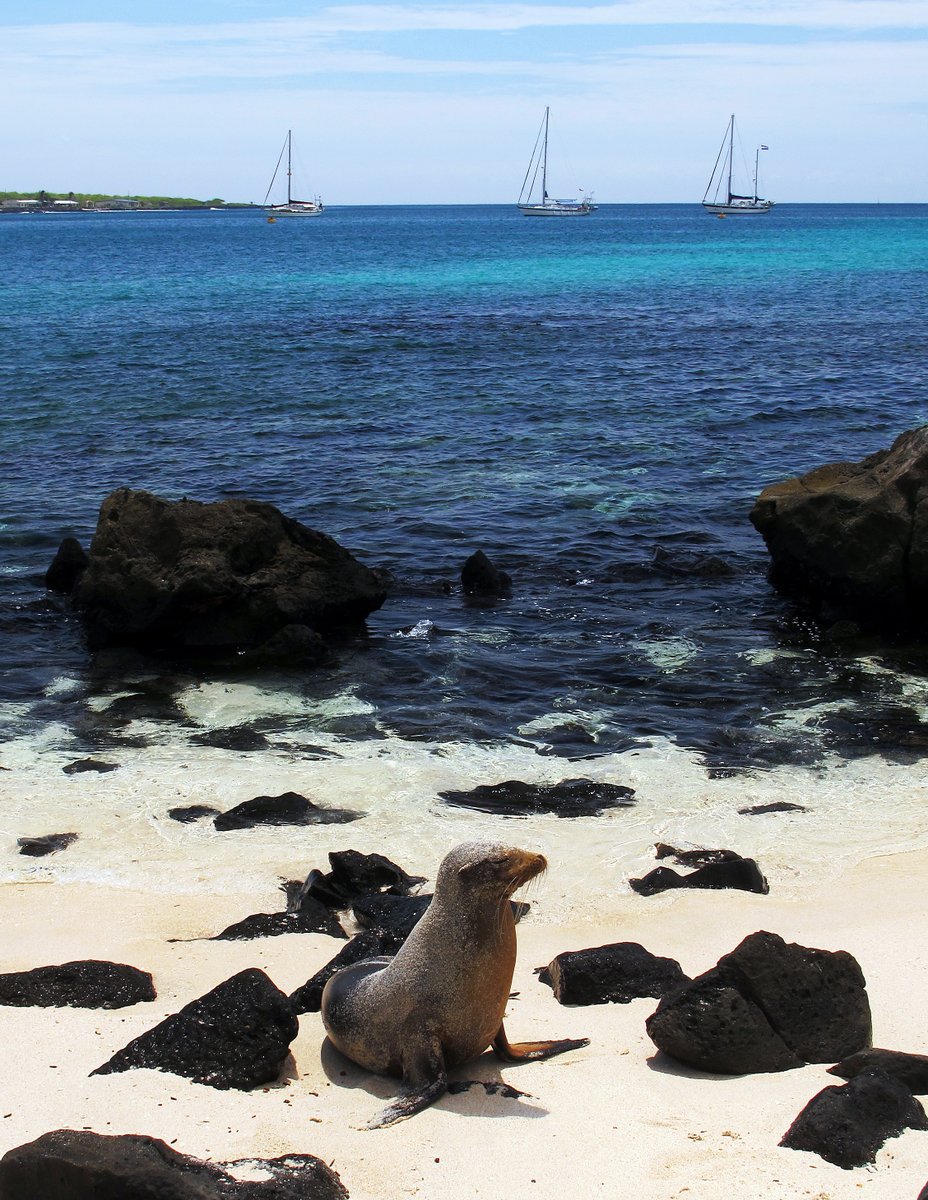
While snorkelling around, a couple of sea lions come over to check me out, but they disappeared before I could get my camera. I've no doubt that I’ll get some good pictures of sea lions over the next few days – I'm looking forward to snorkelling with them at a beach where youngsters like to play.
Meanwhile, Glenys was using up the last of the town water that we’d put into our tanks in Bahia by doing some cleaning jobs. She then ran the taps and drained the tanks completely. We started the generator and the water maker, which was okay for about ten minutes and then I heard the generator running very erratically, slowing down then speeding up. Don’t Panic Mr Mannering! I turned off the water maker and stopped the generator.
I had a look at the generator and couldn't see anything obvious. I tried to restart it, but it wouldn't start. Bloody great timing – it would go wrong when we have no water in our tanks.
I decided that it must be a fuel problem – diesel engines just need fuel and air. I bled the fuel system – no joy. I changed the fuel pump relay that has caused me problems in the past – no joy. There’s a bypass switch which allows me to turn on the fuel system when the generator isn't running. I spent an hour using this switch to test the electric fuel pump, fuel filters and fuel cut-off relay - I had lots of fuel going all the way to the injector pump.
I then checked the air filter and tried to start the generator without the air filter in place – no joy. I bled the fuel injectors again by trying to start the generator; there was some fuel and air bubbles, but not a lot of fuel. I was now scared that the injector pump was broken.
I read through the manual for the generator and also a book on diesel engine maintenance. One possibility was that the exhaust system was blocked and causing problems. This tied up with the fact that we’d been getting some black deposits coming out of the underwater exhaust. I spent over an hour removing the exhaust elbow and replacing it – it’s a bugger to get at... There was nothing blocking it. After five hours, I was now in despair – everything pointed to the injection system.
I re-read the manual and decided that it had to be a lack of fuel. I took off the fuel cut-off valve going into the injector pump and tried to start the generator. Bingo! No fuel going into the injection pump! I had fuel when I used the bypass switch, but no fuel when the starter button was pressed. I had Glenys try to start the generator while I pressed the bypass switch and miraculously it started.
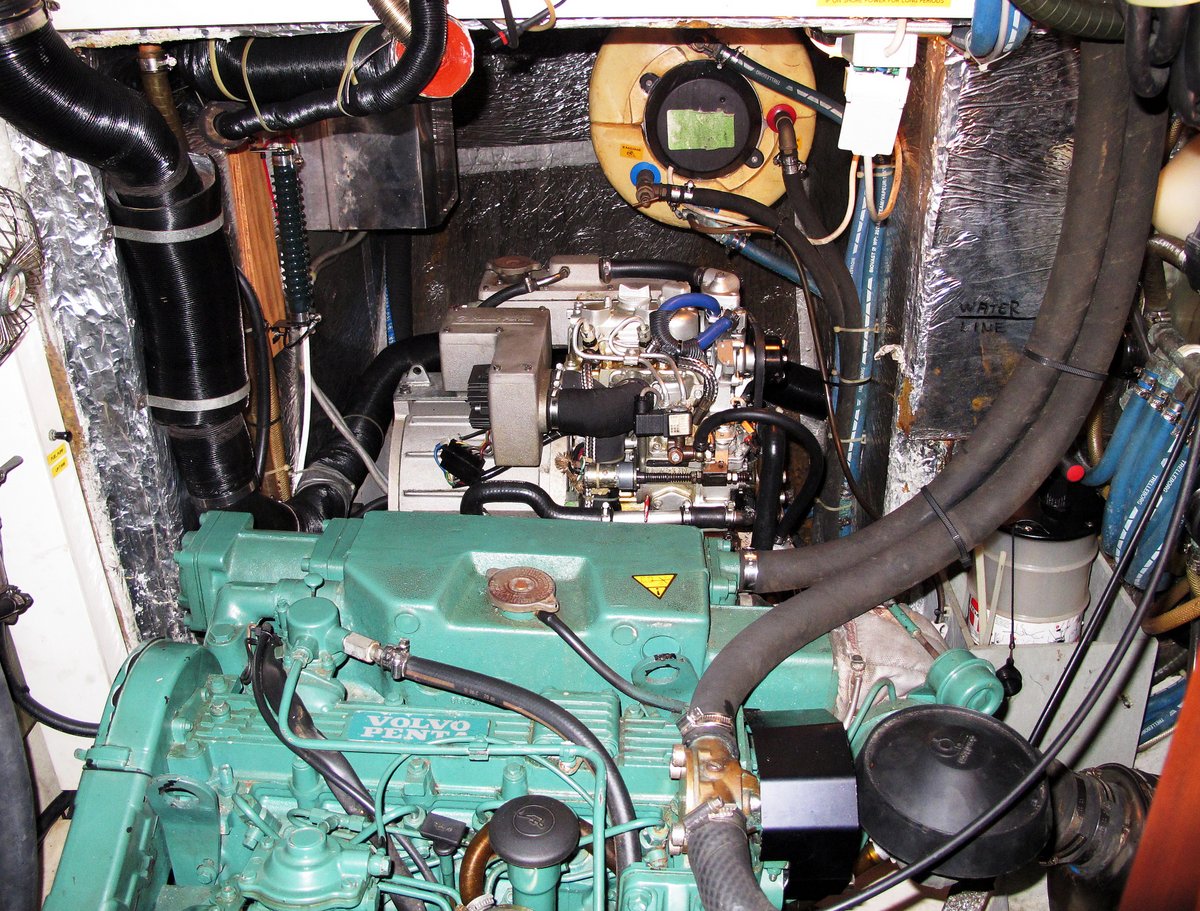
I looked at the circuit diagram for the generator and after 30 minutes of testing, isolated the problem down to some loose connectors on the oil temperature switch. The bypass switch also bypasses some of the safety sensors as well… Ten minutes later, I had a working generator and was producing water. After six hours of graft, we’re able to have a shower tonight.
By the time that I’d cleaned up, it was Miller Time. The divers from the Parks Authority hadn't bothered to turn up – obviously our bio-hazard is not that important to them.
Bolivar came by and dropped off our passports which have exit stamps – as far as immigration is concerned we have left the country… He tells us that this is okay because there are no immigration officers in Isabella where we will leave for the Marquesas. I asked about all the other paperwork and he tells us that we'll be fine - we don't need a Fumigation Certificate and the Temporary Import document is not important. I hope so after the hassle that we've had so far.
Bolivar told us that there’s a four day holiday from tomorrow – Mardi Gras. He’s going to Isabella and returning on the 5th, so we can’t go to Santa Cruz until then – not such a bad place to be trapped.