
14 September 2015 Loh Buaya to Loh Serau, Komodo
It was another early start. We were ashore at the ranger station at 0700 because we’ve been told that the Komodo Dragons are more active in the mornings. We did the two hour hike with other cruisers from “Dream Catcher” and “Flour Girl”.
The Komodo Dragon is the largest living species of lizard, growing to a maximum length of 3 metres and weighing up to 70 kilograms. As a result of their size, these lizards dominate the island, hunting and ambushing prey including invertebrates, birds, and mammals.
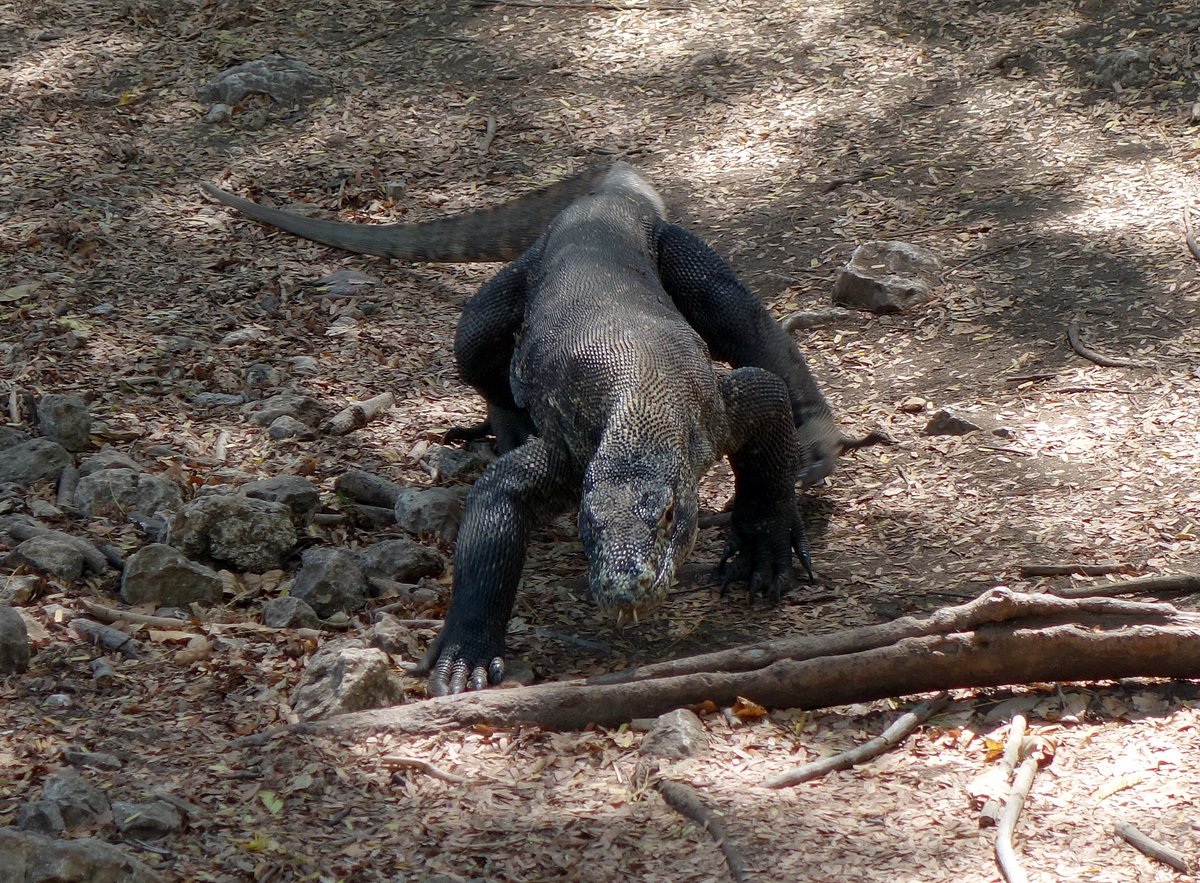
It has been claimed that they have a poisonous bite, this is not true - instead they have two glands that secrete an enzyme which helps to kill larger prey. The diet of big Komodo dragons mainly consists of Deer and Water Buffalo, though they also eat considerable amounts of carrion. The dragons’ legs allow them to sprint short distances, lifting their tails as they run.
Komodos often rise up on their hind legs just before attacking and the tail can deliver well-aimed blows that will knock down a weaker adversary. Their best weapons are their sharp teeth and dagger-sharp claws, which can inflict severe wounds. Komodo dragons also occasionally attack humans, so all the guides carry long forked poles to keep them away.
Mating begins between May and August, and the eggs are laid in September. About 20 eggs are deposited in abandoned megapode nests or in a self-dug nesting hole. The eggs are incubated for seven to eight months, hatching in April, when insects are most plentiful. Young Komodo dragons are vulnerable and therefore dwell in trees, safe from predators and cannibalistic adults. They take 8 to 9 years to mature, and are estimated to live up to 30 years.
We spotted several Komodo Dragons close to the buildings of the Park Ranger station. They’re attracted by the smell of food from the kitchen and the rangers still hand out the occasional scraps to them which act as nice little snacks for the huge lizards, so I guess that it’s worth their while hanging about.
The hike was very interesting; we spotted a few Komodo Dragons and also a water buffalo, some deer, wild pigs, megapode (a bird) and Long-tailed Macaque monkeys - all of which make a good meal for a hungry dragon. The water buffalo and deer were brought to the island by people from Flores, but they are now wild.

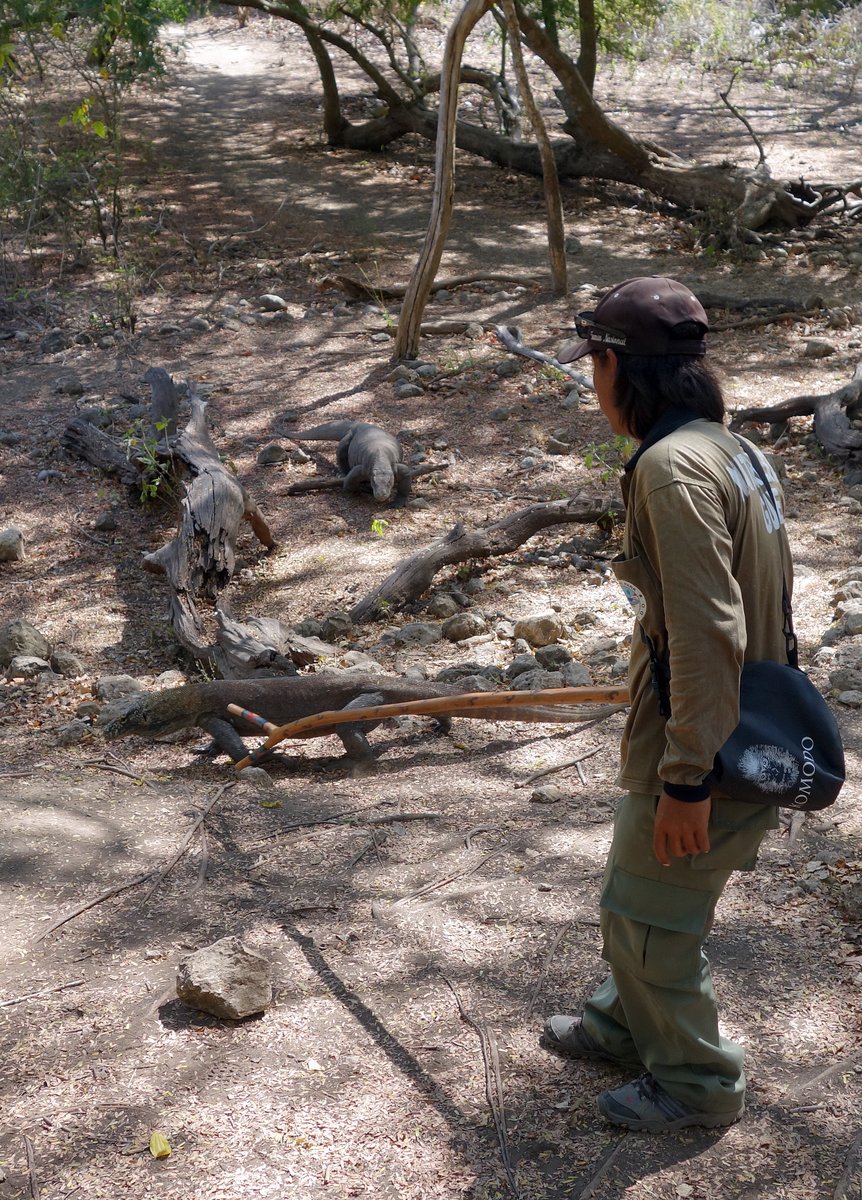
Near the end of the hike, we were shown a large female dragon who was guarding her nest. As we kept our distance from the very suspicious reptile, a young male dragon came wandering along the path. One guide used his forked pole to keep the male off the path and away from our group, which the dragon wasn't happy about. The female suddenly ran towards us to chase off the male and chaos ensued with cruisers backing away rapidly, while the two guides fended off the male (who was trying to run away through the middle of us) and the female (who was trying to chase him off). Very exciting stuff and showed us how fast these apparently docile creatures can move.
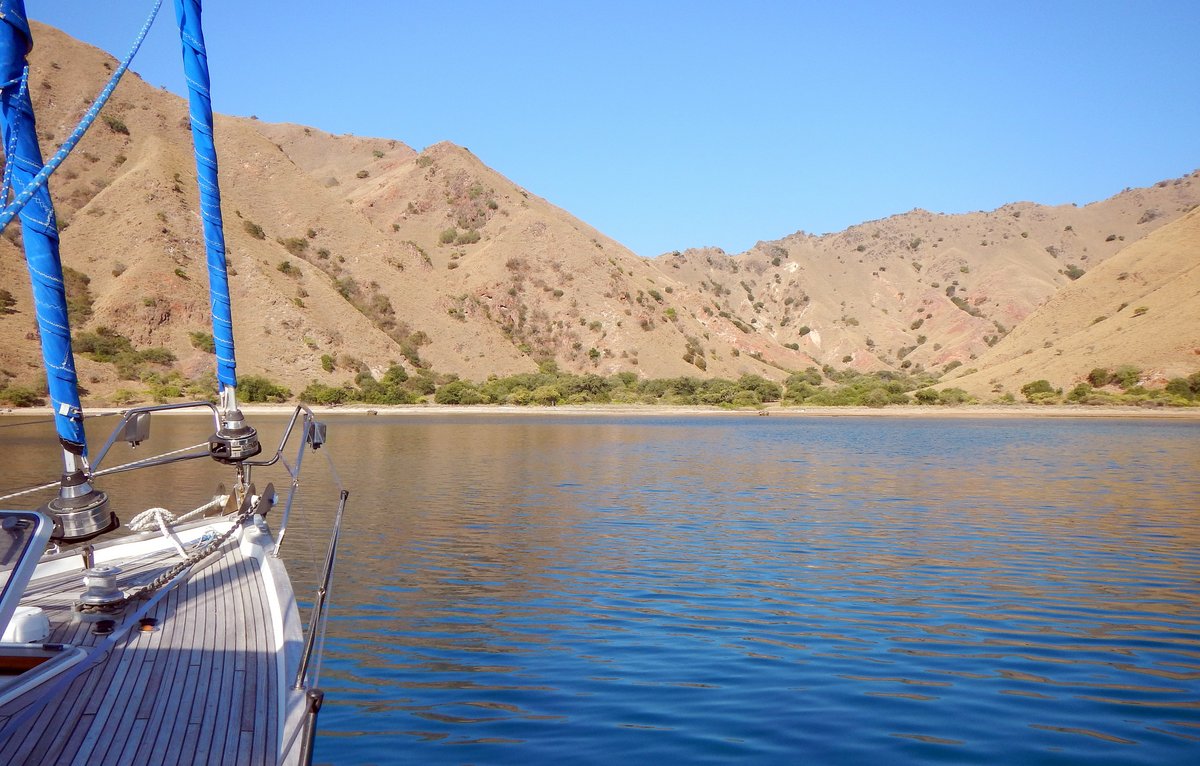
By the time that we arrived back at Alba, the tourist boats had descended on the bay, so we upped anchor and motored north to Loh Serau on Komodo Island, where we found a big patch of sand in 8 to 10 metres of water (08°26.75S 119°27.11E). It’s a lovely peaceful anchorage, the water is crystal clear and there’s no one else around.
We've been told that we’re not allowed to anchor in water less than 35 metres anywhere in Komodo National Park. This is a bit awkward and annoying especially because there are no moorings provided for visiting yachts. Apparently, every time that someone puts down a mooring, the local fishermen cut it away and steal the rope. I felt a little uneasy about anchoring here, but it’s at the far edges of the Marine Park and it’s doubtful that there will be any patrols out here.
15 September 2015 Loh Serau, Komodo
We chilled out in the morning, Glenys pottering about while I set about sorting out and editing the hundreds of photographs that I've taken over the past four days.
After lunch, I went for a dive by myself on the sandy area under the boat to practise some of my camera technique. I’ve not been happy with some of the photos over the past few weeks, so this was an opportunity to take pictures of boring subjects, trying out different settings. Hopefully, I’ll be producing better photographs in the future.
I still had some air left in the scuba tank, so I spent 30 minutes cleaning some of the hull. The propeller was a mess being covered with a 2-3 mm layer of hard growth and the hull is starting to grow barnacles especially Gooseneck Barnacles. I finished the propeller, but had only just started on the barnacles, when I heard a loud knocking on the hull.
When I surfaced, there was a park ranger boat tied to our stern with two of the rangers on board giving Glenys a hard time. We weren't expecting to see anyone at this most northern bay in the Marine Park, so it was a shock to see them. Despite my paranoia, they didn't seem to be at all worried about where we had anchored, but wanted to see the receipts for our park fees.
I dragged out the receipts that we’d received in Rinca yesterday and they decided that we’d already paid for yesterday, but we were ordered to go to the nearest ranger station to pay for today. This is 15-20 miles away and we didn't want to waste time doing this tomorrow, so the rangers agreed to accept the money directly from us. They wanted 150,000 rupiah per person per day -that’s $10US each - very expensive considering that they don’t have any moorings about.
If they’d been “old-school” officials, I would have suspected them of wanting to pocket the money, but they seemed to be earnest young men, so I made them write out a receipt and then took a picture of them in case there was any problem tomorrow with other rangers.
16 September 2015 Loh Serau to Amoramor, Lombok (Day 1)
We lifted the anchor before seven o’clock and motored north-west in a flat calm sea heading for the small island of Gili Air on the west side of Lombok. The wind soon picked up to 5-10 knots, but we carried on motor-sailing for an hour until the wind increased to 10-15 knots because there are very strong currents in the area.
The wind died as we passed to the north of Pulau Banta, but once clear of the island, we had a good sail for the rest of the day. Glenys caught a small tuna while I was having my afternoon nap. After dark, we stayed 5-6 miles off shore and followed the curve of the land, having to gybe the sails a few times as the wind changed along the coast.
The wind died completely just after midnight then slowly came back from the west - directly on the nose. By half past one, it had backed and increased enough to sail again - it’s hard work sailing along a coast. For most of the night we had a favourable one knot current.
This evening, we passed longitude 118°41.1E, which means that we’re exactly on the other side of the world to Prickly Bay in Grenada where we started our circumnavigation - we've travelled half-way around the world! We left Grenada on the 11th January 2012 and have sailed 22,513 nautical miles in the 3½ years that we've been wandering.
17 September 2015 Loh Serau to Amoramor, Lombok (Day 2)
In the morning, we had good wind and were doing over 7 knots over the ground. With 80 miles to go and 12 hours to sunset, it was touch and go whether we’d be able to get to the island of Gili Air before dark. The north coast of Lombok doesn't have any good anchorages and our research hadn't found any on the west coast either, so it was either get to Gili Air or heave-to for the night.
Unfortunately, the wind started to die later in the morning and by lunchtime we were resigned to spending the night hove-to.
Just after lunch, “Red Herring” appeared on our AIS and I chatted to them on the VHF. They spent a couple of days at Palau Moyo and are now heading directly to Bali. I explained that we faced a night hove-to and Karen came back a little later saying that she had found an entry in “Catamini’s” blog from a couple of years ago and they had anchored at a place called Amoramor on the west coast of Lombok.
I checked it out on the chart and it looked okay for a night stop. It was 30 miles away, so we could just make it before dark if we averaged six knots. We turned the engine on and hoped that we wouldn't meet a strong counter-current.
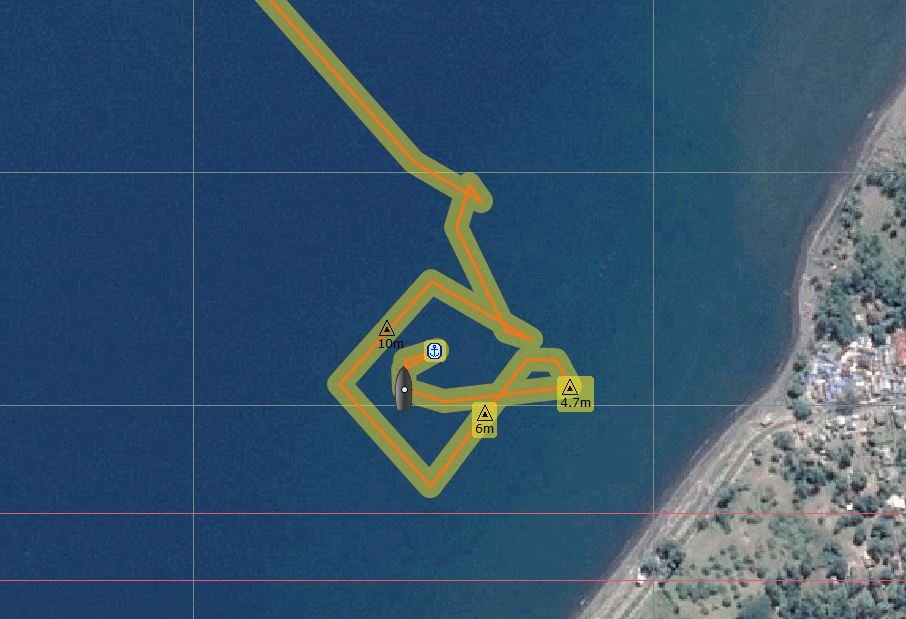
We arrived at the anchorage by half past five. Amoramor is a small fishing village with a black sand beach - more a road-stead than an anchorage. There wasn't any depth information on our charts and the sea bed is black sand making it impossible to judge water colours especially with the overcast sky that we had. We carefully motored in a rectangle, plotting out the depths between 6 and 10 metres, then anchored in the middle at 08°14.076S 116°17.705E.
It seems to be good holding, but there isn't much protection from the swell and we’re bobbing about a bit. However, it’s better than being at sea and we just had time to get a cold beer and watch the fishermen coming out to lay their nets before the sun went down.
18 September 2015 Amoramor to Gili Air, Lombok
It wasn't too bad a night, a bit rolly and we had waves slapping the stern as the current moved us around, but we slept well. There was absolutely no wind in the morning, so we motored all the way to Gili Air. It’s a tourist island and the shore line of the small one mile diameter island is packed full of restaurants and bars - as we motored around the island, we could see hundreds of people on the beach that fringes the whole island.
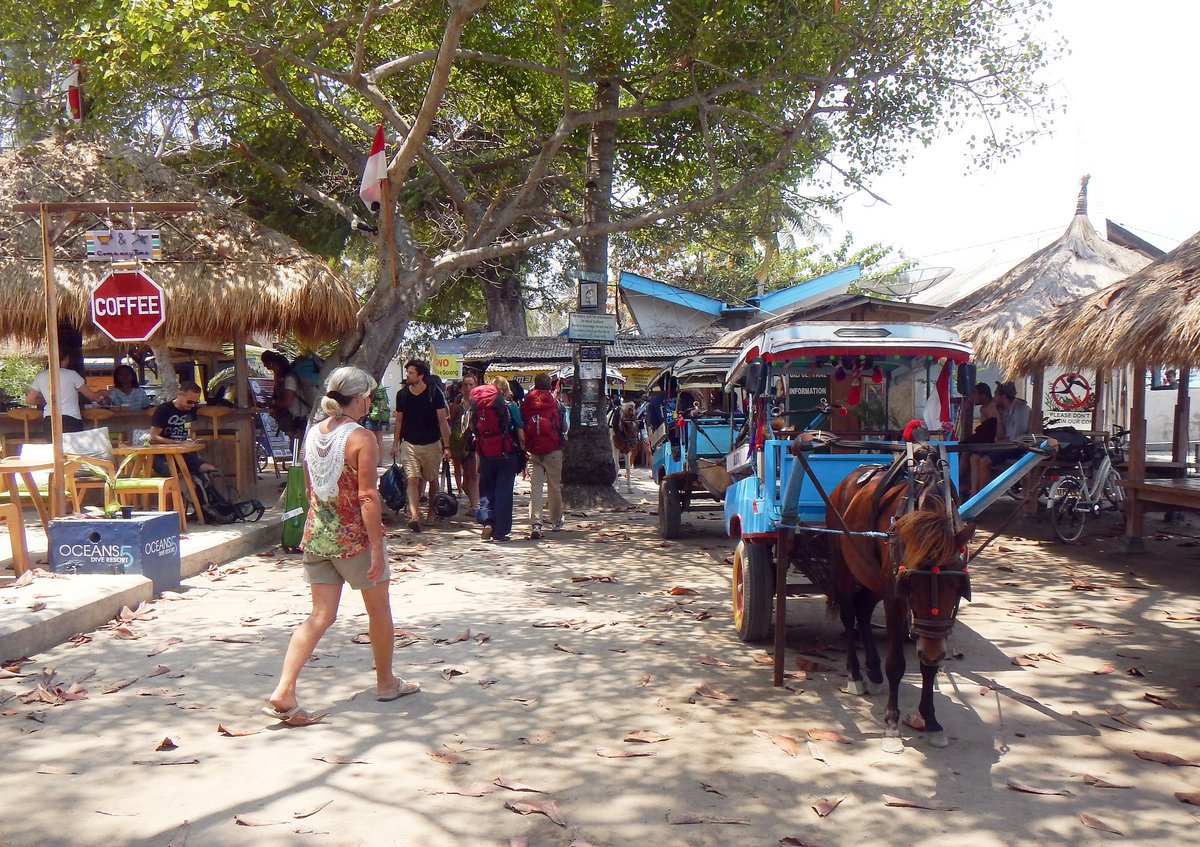
The small harbour was crammed with scores of local boats on moorings or pulled up on the beach and there were eight or so yachts at anchor or on moorings. We picked up a mooring, but a guy on a power boat told us that we’d get kicked off, so we went to anchor further out in 20 metres of water (08°22.00S 116°04.89E).
We went to chat to “Parlay” to get some local knowledge, then went ashore to grab lunch. There’s a narrow track which runs parallel to the beach, lined with small shops, dive centres, restaurants and small hotels. There are no cars or motor bikes allowed on the island, so the locals use small carts pulled by ponies to move heavy goods and act as taxis for tourists. It was quite a shock to our systems to see so many tourists, but it’s a relaxed place to chill out.
Having had our fill of Malaysian food over the last couple of months, we ignored the local Warungs and opted for burger & chips and a couple of cold beers at a touristy beach bar - luxury. We then wandered around for a while buying a few things at a small grocery store and we've booked a dive for tomorrow morning.
We spent the afternoon on-board Alba. There’s a constant stream of small ferries that power through the anchorage, bringing tourists from mainland Lombok or Bali. These don’t slow down as they enter the harbour and their bow waves can be up to a metre high, so we have everything stowed away like we’re at sea. Fortunately, they stopped in the late afternoon and we had a very peaceful night.
19 September 2015 Amoramor to Gili Air, Lombok
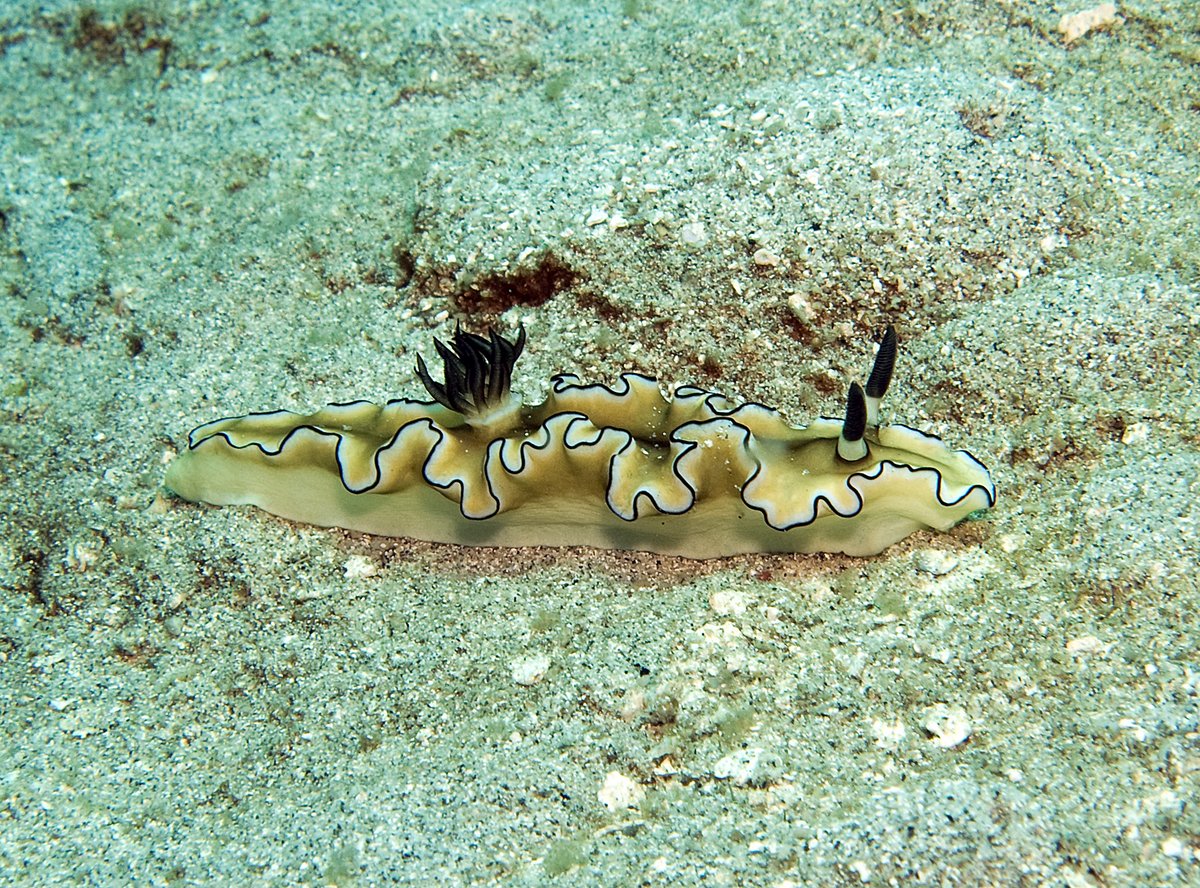
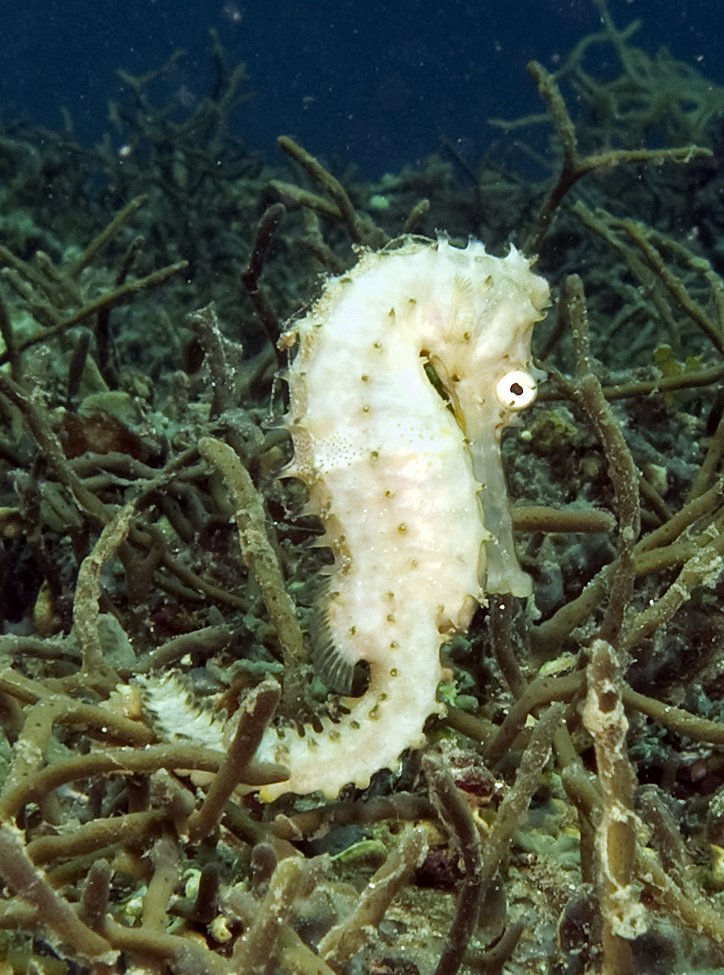
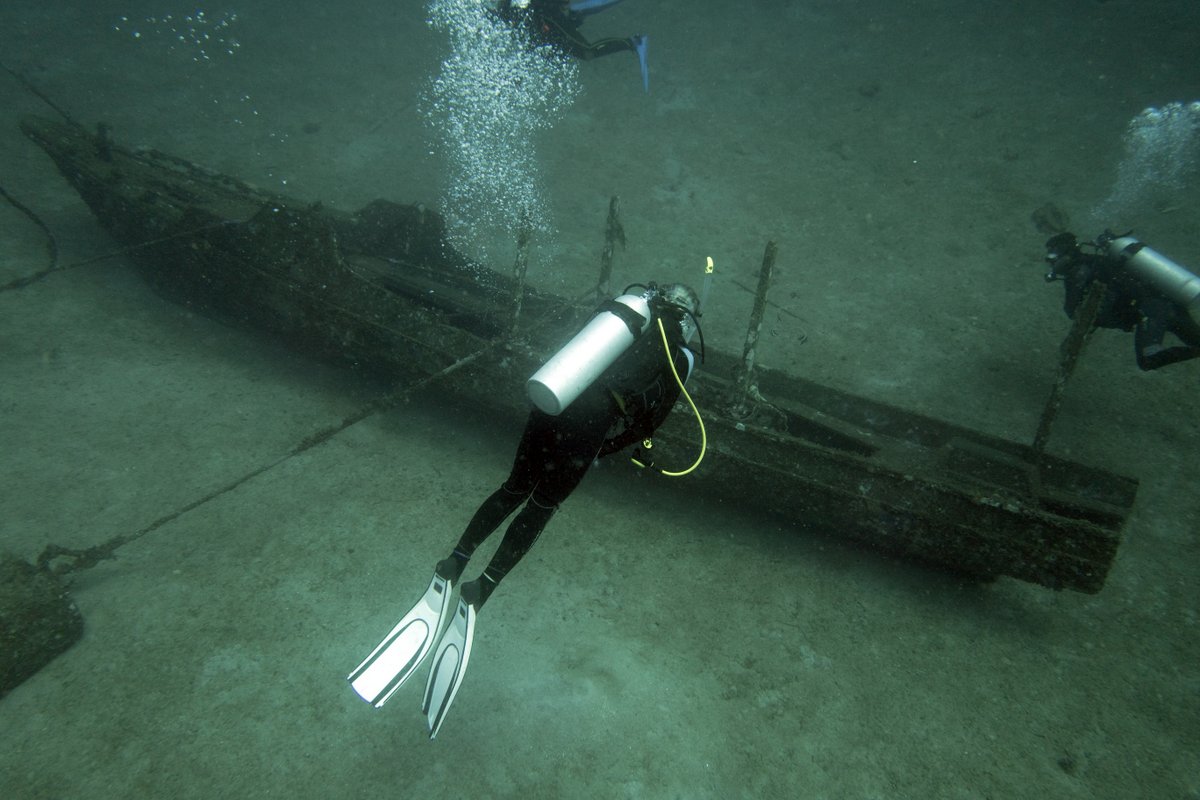
We went diving in the morning. The dive centre took us to a small bay on the Lombok mainland where we first looked at a couple of small wrecks and then swam across a huge sandy area to a shallow rubble area. It was a muck dive, so the whole point was to try to find small creatures, but the environment was a bit dull and all my photos came out muted - I need to reassess how I'm using my strobe. However, we saw some new creatures including a Dark Margin Glossodoris and a Tigertail Seahorse.
It was very, very hot in the afternoon with hardly any breeze, so we lounged about reading and dozing (and hanging on whenever a ferry went by).
20 September 2015 Gili Air to Lovina Beach, Bali (Day 1)
We spent the morning walking on the beach, doing a circumnavigation of the island - only about three miles. It’s a pleasant beach, but most of the coast line is packed with hotels and lodges and where there’s a gap, the locals are building. We had lunch in one of the beach side restaurants - Malaysian food this time.
On the way back to Alba, we spotted that “Laragh” had arrived, so we stopped by and chatted to David and Katrina catching up on their adventures over the past few weeks. They had a good time at Benteng on Selayar, but only three rally boats made it there.
They've been trapped at Medina Bay Marina waiting for their visas to be extended. It took three days to get their passports back and cost twice as much as we paid in Bau Bau. The whole process has been a nightmare with travel to the immigration office taking a whole day. Some people have spent over a week getting their visas sorted out, which is a horrible waste of time. Apparently Medina Marina is subject to swells and is very rolly, so having to wait there was very unpleasant.
We spent the remainder of the afternoon getting ready to sail to the north of Bali overnight. It’s an awkward distance of 75 miles taking 15 hours at an average of 5 knots and would be a push to try to do it in one day.
We upped anchor half an hour before sunset and motored for an hour until we cleared the western most Gili Island, when we were able to set a course of north-west and pull out our sails. There was a strong 20-25 knot winds from the south-west, so it was a boisterous sail. The wind slowly backed and we were going too fast, so we rolled away the main and the genoa and sailed on a broad reach with just the stay sail.
Just after our one o'clock watch change, the wind died completely and we motored the rest of the night.
21 September 2015 Gili Air to Lovina Beach, Bali (Day 2)
We picked up a sea breeze for an hour after dawn, but ended up motoring into the anchorage at Lovina Beach. We were met a few miles out at sea by a local boat called “Peter Pan”. He came to within 20 metres and then motored alongside us. He didn’t say anything, but seemed content to sit there and watch us for an hour all the way into the anchorage. He later came by and offered us his services to get water, fuel, laundry, etc. It seems that each yacht gets adopted by one of the local boats.
We anchored just after nine o’clock at 08°09.59S 115°01.30E. There are 16 rally yachts in the anchorage, who have all timed their arrival for a welcome party advertised for tomorrow. Unfortunately, it doesn’t look like it’s going to happen.
As in the other places that we’ve visited, the rally was timed to be here for a local event that was happening anyway. The Lovina Beach Festival is taking place, but it doesn’t start until the 27th. I don’t mind that there is nothing official going on here, but it would have been nice to have been told. We’ve rushed to get here in time for the events and have missed a few good anchorages, where we could have stopped and relaxed.
It’s like the rally organisers are not telling us about changes because they don’t want any hassle, but they’re starting to get hassle anyway as several boats have been sending stroppy emails to them, moaning and asking them to confirm the timetable in other places. There’s a lot of politics going on because the main event organiser in previous years has left Sail Indonesia and joined the rival Sail2Indonesia rally and he seems to be doing a better job.
We spent the morning sorting ourselves out and catching up with “Red Herring” and then dozed for the afternoon catching up on some sleep. These one night passages really take it out of us - we never seem to get enough sleep because we don’t get into the watch routine.
In the late afternoon, we ventured ashore and had a quick look around the place. Lovina Beach is a full-on tourist place. The shore line is full of restaurants, bars and small shops selling batik sarongs, clothes and wood carvings to tourists. There’s a small main street which leads up to a busy road going along the coast.
We had a beer in a bar by the beach and then went for a pizza in one of the many restaurants - it was okay, but not quite Pizza Hut.
22 September 2015 Lovina Beach, Bali
“Red Herring” had arranged a day trip out for us, so we picked them up and pulled the dinghy upon the beach. After dropping off a bag of laundry, we went to meet our guide, Wayu. There was some confusion at first because he had only expected Karen and Graham, so the car that he’d arranged was too small. He rang someone else who turned up in a crappy four-seat car, which we refused to get in, so he finally arranged a nice air conditioned people-carrier, which is what we were expecting.
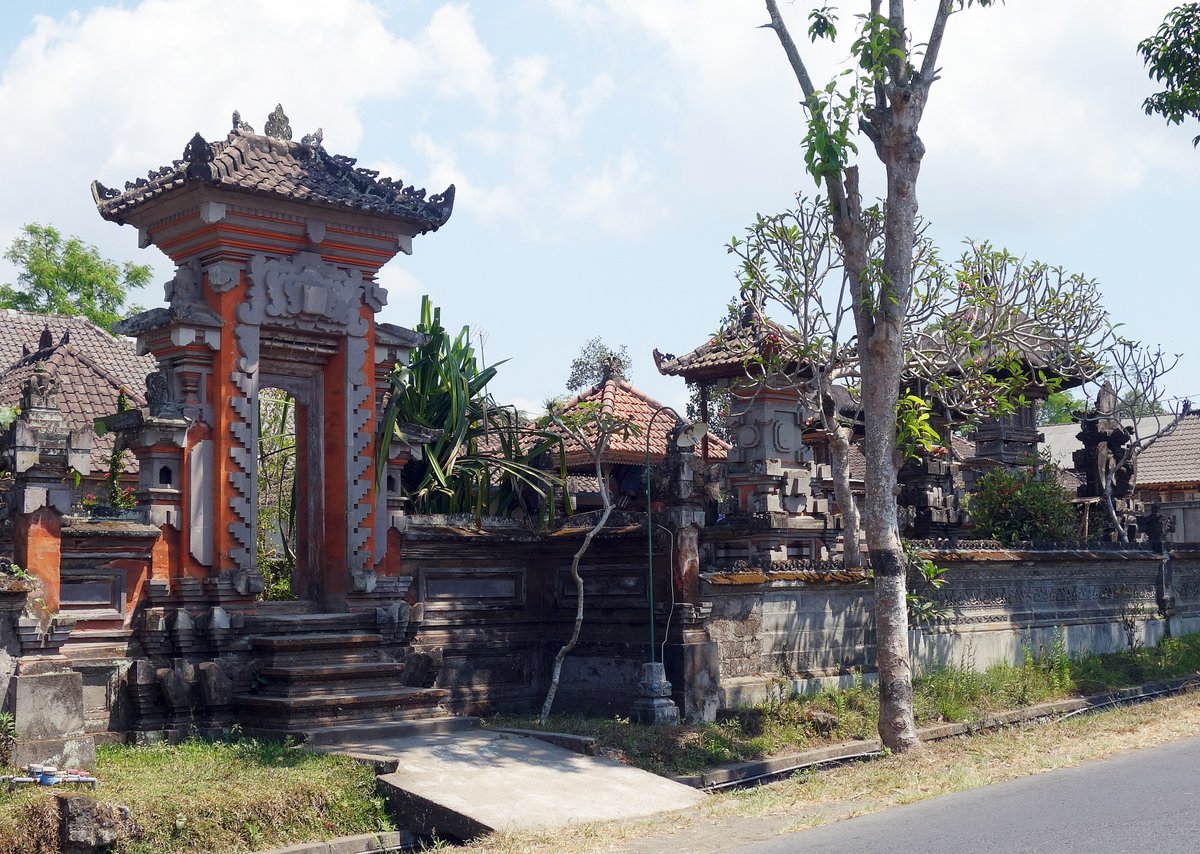
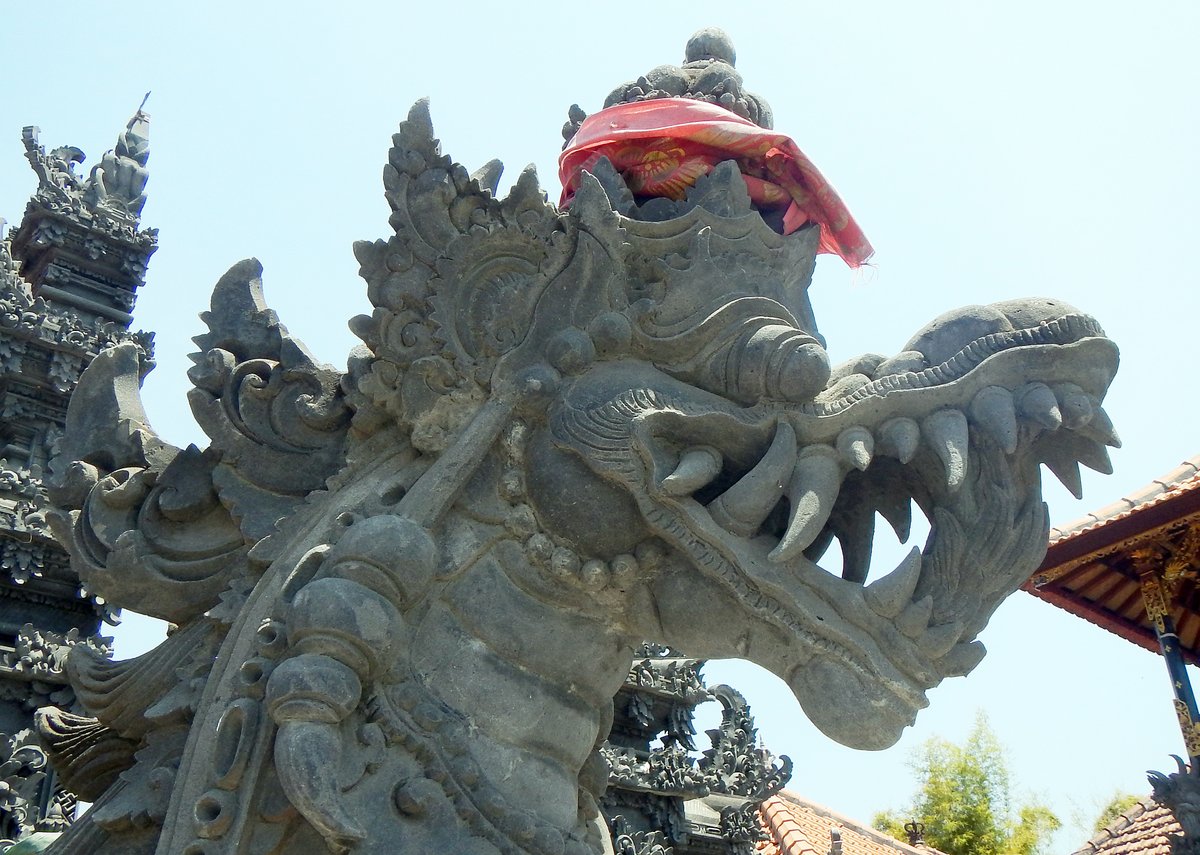
Our first stop was at Munduk Falls, which was a pleasant little stop. Bali is mostly Hindu and it’s very interesting to see the number of temples and shrines about the place. There was even a small shrine at the waterfall, which was shrouded in yellow and white material, denoting it as a shrine for the water spirits. There were many small offerings in front of the shrine.
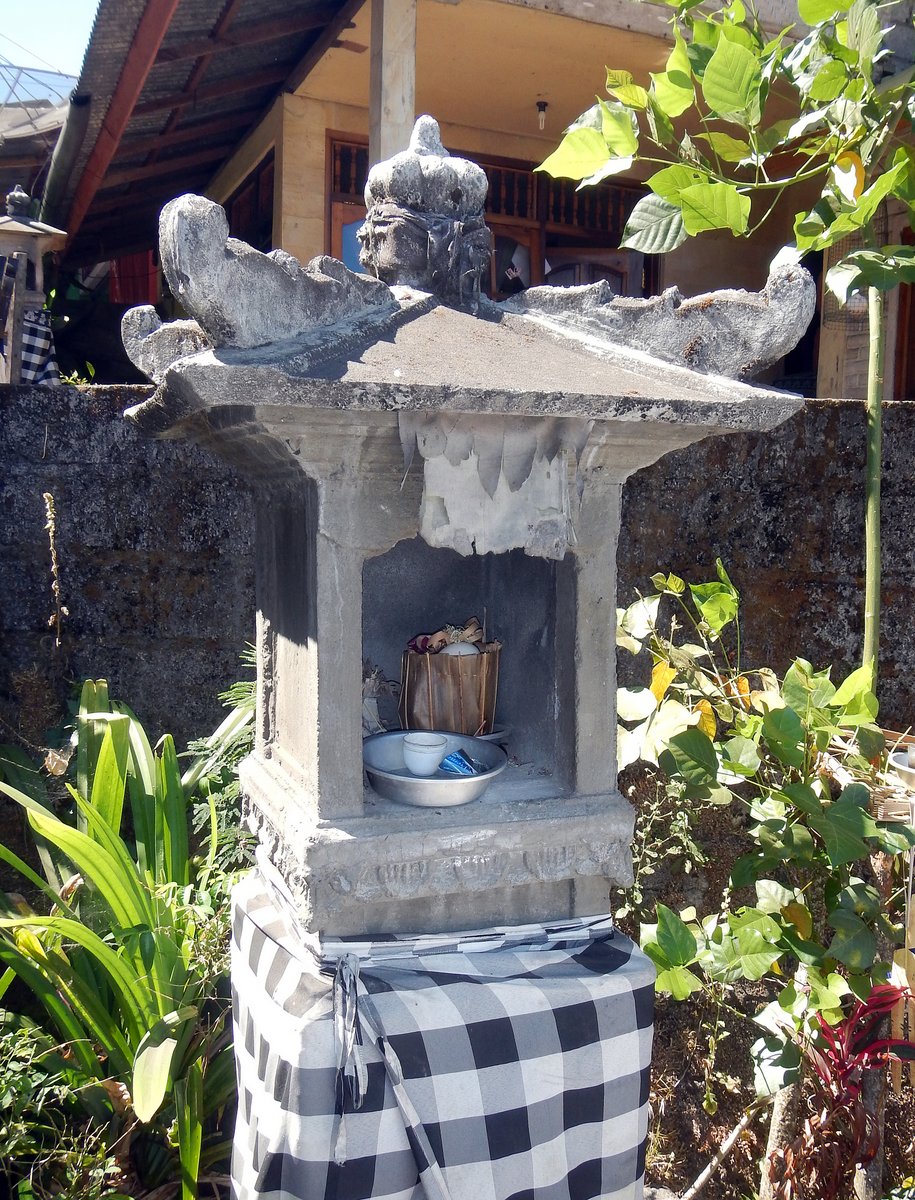
Each village that we passed had a village temple and then most houses have a small shrine outside the front door. Wayu explained that normally a house has at least two shrines. The first one is outside the front gate and is wrapped in a black and white sarong - its purpose is to protect the house from bad spirits. The other shrines are for ancestors and specific Hindu gods depending on the family caste. The larger, wealthier families have their own temple within the house walls with many shrines.
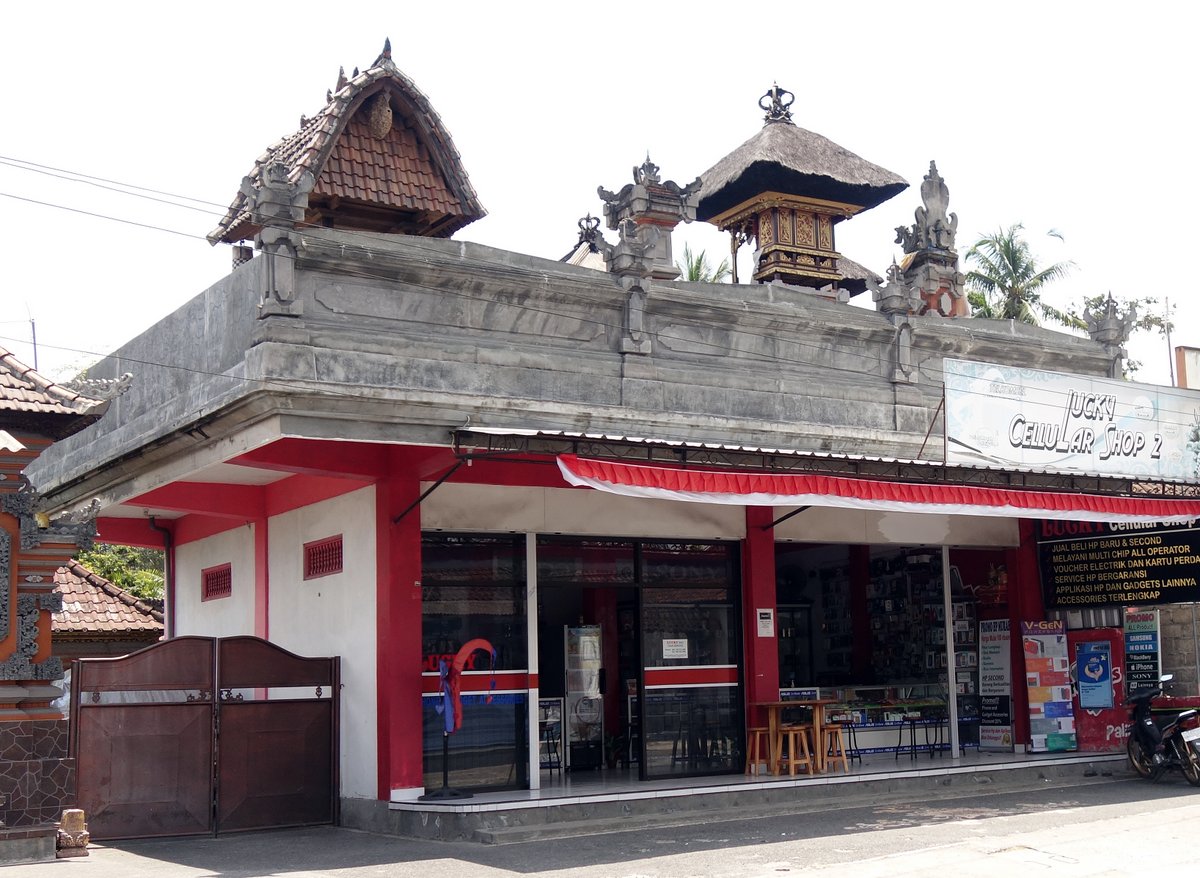
Many businesses will have a shrine outside their front door and larger businesses and government offices may have their own small temple. Where space is limited in small towns, it's not uncommon to see Rooftop Temples
Traditional houses have a walled enclosure with separate buildings for living - kitchen, bedrooms, etc. The main gate into the enclosure is traditionally very narrow to make it more difficult for evil spirits to enter. As an extra safeguard, there is often an extra small wall directly inside the gate which you have to walk around to get inside - spirits can only travel in straight lines and they get confused when they hit the inner wall.
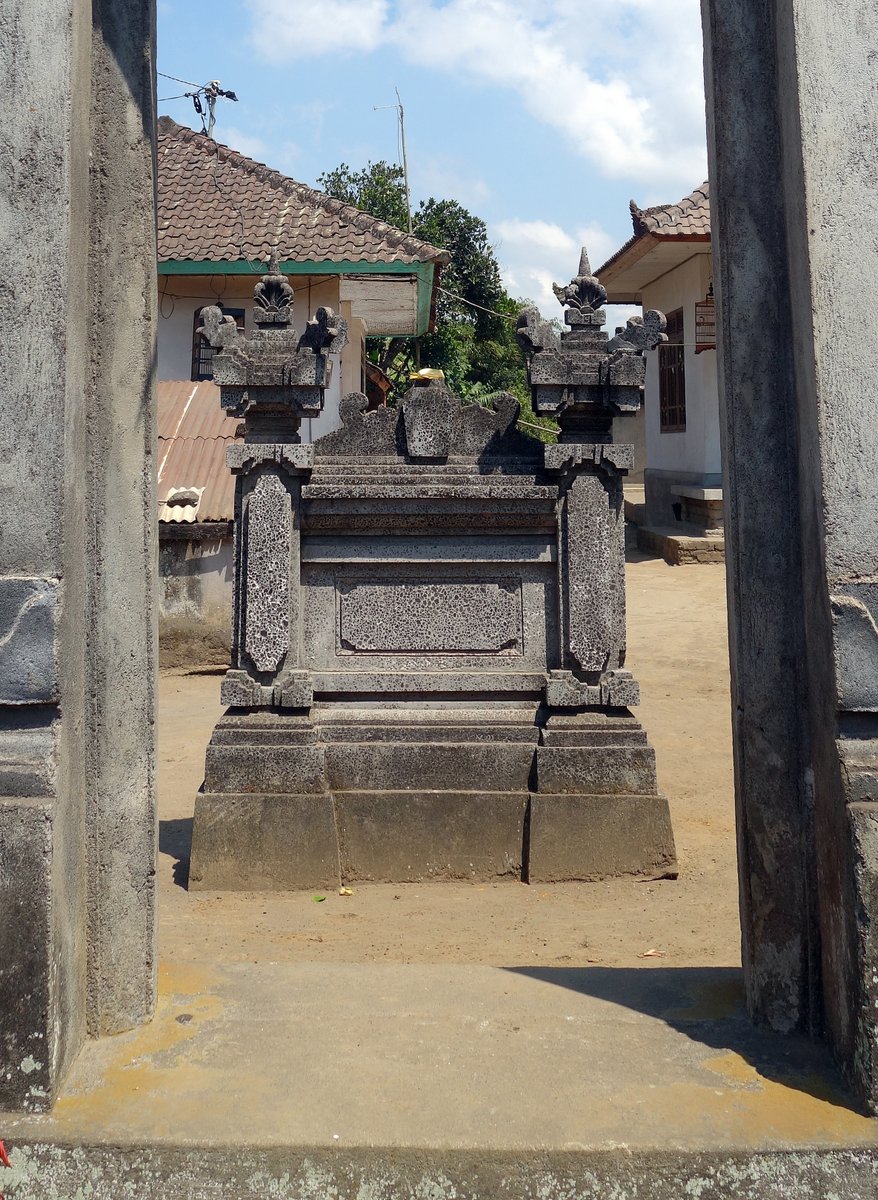
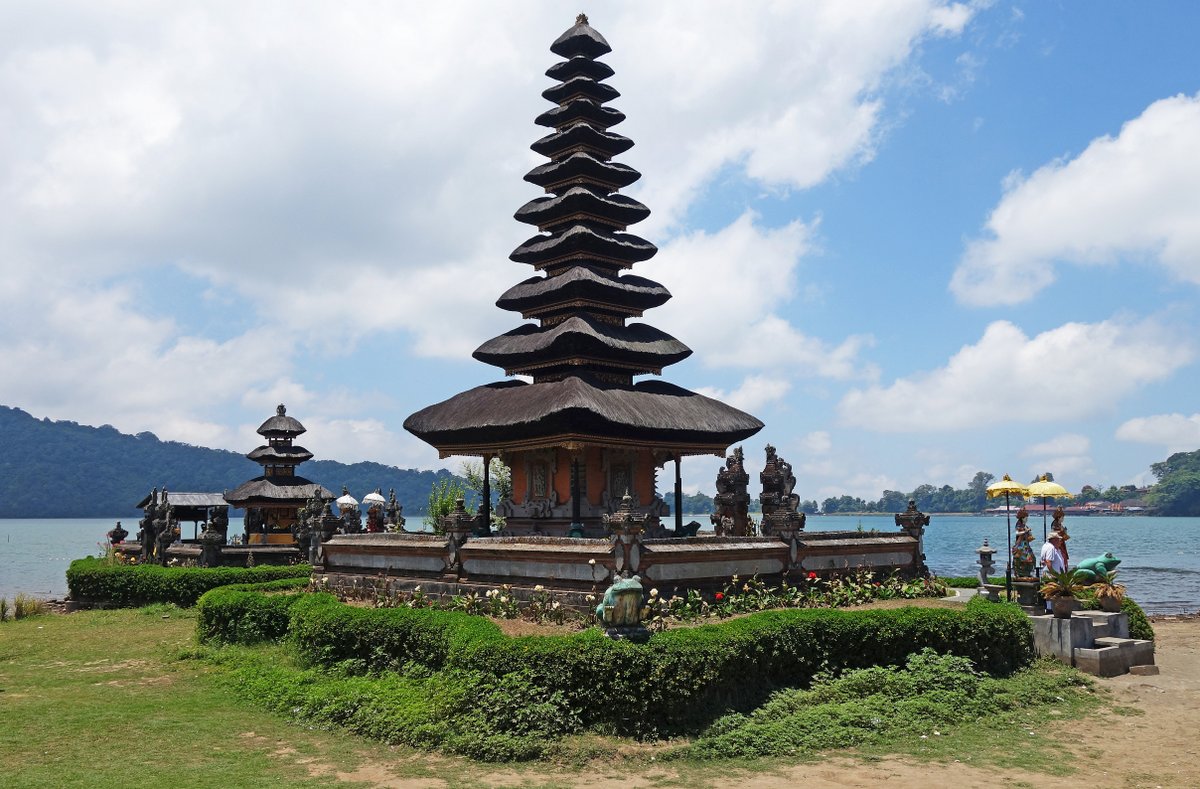
We visited Pura Ulun Danu Beratan, which is a large temple located on the edge of Beratan Lake. This dates from 17th century and worships the main three Hindu gods (Brahma, Vishnu & Shiva), as well as the lake goddess, Dewi Danu. The temple is one of the major temples in Bali and a section of the temple is often surrounded by water making it very photogenic. Unfortunately, being the end of the dry season, the level of the lake was very low, so the iconic temple was surrounded by scrubby grass and tourists - oh well.
It’s a huge sprawling temple complex, but the most interesting stone carvings and statues are inside the walled compounds that we were not allowed to enter. We could see lots of tiered shrines, which have a different number of tiers for the different gods - 11 tiers for Vishnu; 7 tiers for Brahma and 3 tiers for Shiva.
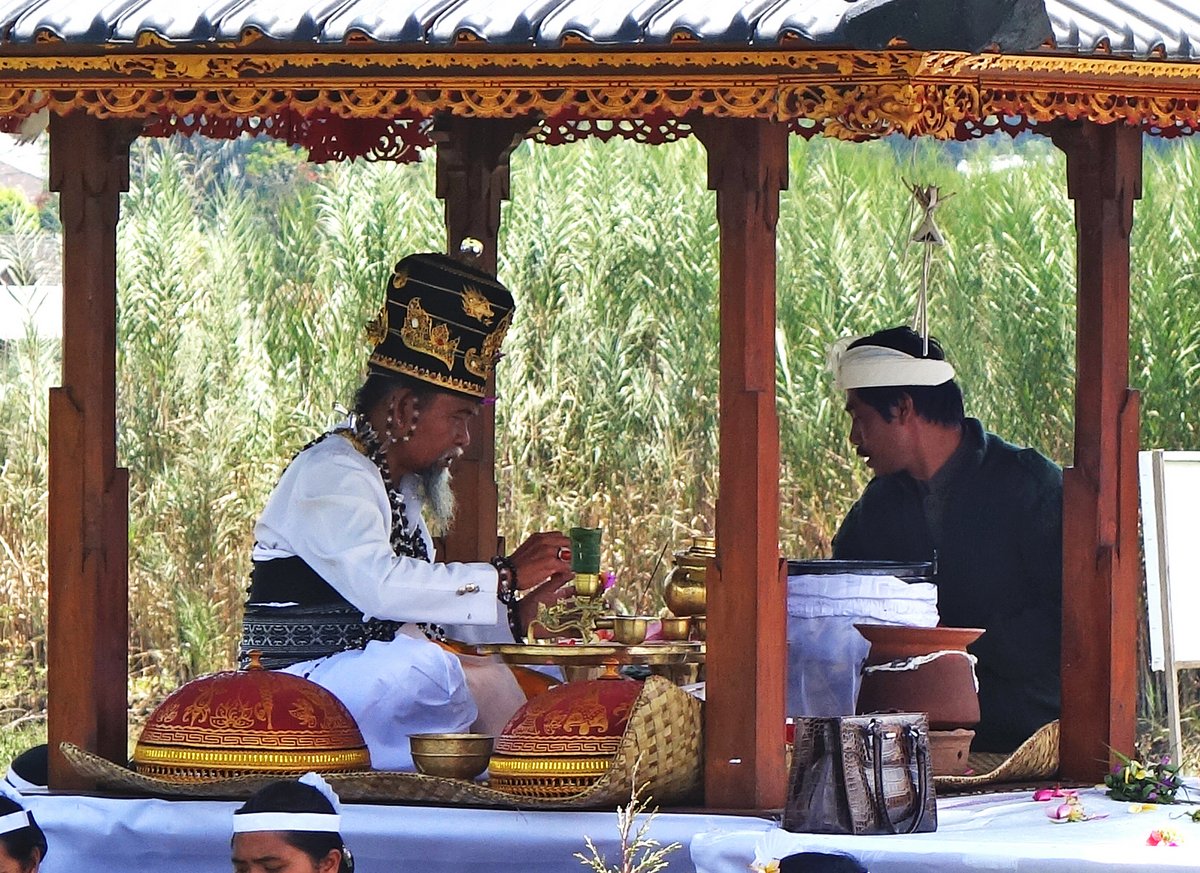
While at the temple, we came across some locals taking part in a purification ritual. A special Hindu ceremony is taking place tomorrow at a nearby village and the villagers had come to this important temple to purify the items to be used in the ceremony. It all looked very grand with a High Priest (Pedanda) sitting on a raised platform, blessing things.
I wasn’t particularly impressed by the temple, but that’s probably because we just wandered aimlessly about the place. Wayu had stayed outside with the car because he didn’t want to pay to come in - we should have paid his entry ticket and we’d have got a lot more out of the visit.
After lunch, we went to Tamblingan Lake and paid 350,000 rupiah ($25US) for a guide to take the four of us on a short tour of the forest and lake. It was a great one hour hike through some lovely forest and then we had a paddle back across the lake in a dugout canoe. On the way, we saw three temples - one was an ancient temple site in the forest; one was a large private temple on the edge of the lake belonging to a wealthy family; and the other was a big water temple used for ceremonies to bless the water spirits in the lake.
We piled back into the car and were taken to a region called Munduk, which is a vast rice growing area. Wayu took us for a 30 minute stroll along the dykes of some terraced rice paddy fields, explaining a little about the crop. They have four crops per year and all the water comes down small canals from the lakes that we visited earlier in the day. There were lots of ducks wandering about the paddy fields, which are brought in to help with the rice crop -they eat grubs and insects that could damage the rice plants and provide a natural fertiliser.
We were back before sunset - it was a long, but enjoyable tourist day out for only 700,000 rupiah ($50 US) for the four of us…