
12 June 2015 Port Sandwich to Ranon, Ambryn
We were up early and had breakfast while we motored out of the bay. I wish that we could stay and linger for a few days because it’s such a such a peaceful place, but we only have two more weeks here in Vanuatu before we have to do a 1,000 mile passage to the the Louisaides in Papua New Guinea and still have a lot to do in Vanuatu.
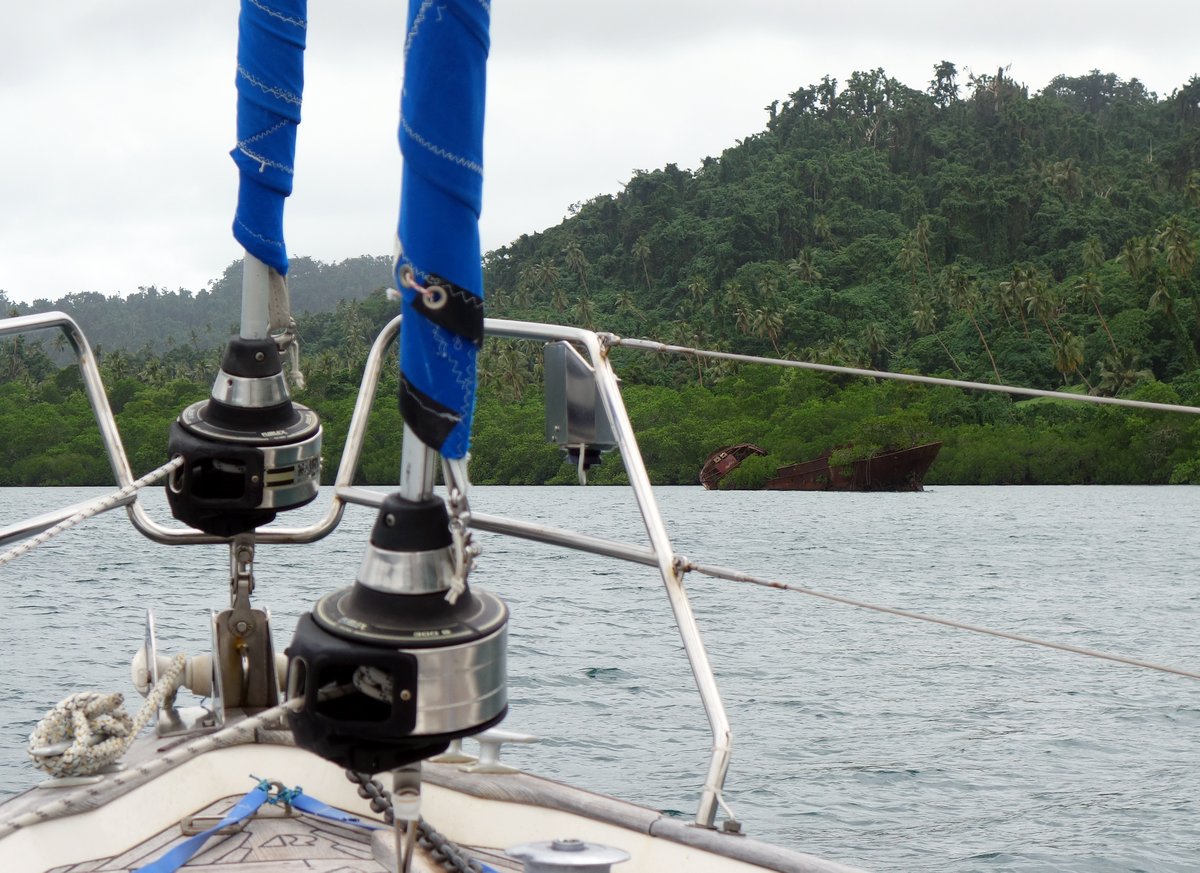
The wind picked up outside the bay and we found that we were on a close reach for the ten mile trip across the channel between Malekula and Ambyn. I’d put in our usual, cautious 1½ reefs in the main, but half way across we had over 25 knots, so I had to reef a bit more. Twenty minutes later, we came into the shadow of the Ambryn and the wind died completely.
We motored up the lee of the volcanic island and could clearly see the main active volcano which is called Mount Marum. The mountainous nature of the island meant that we soon had katabatic winds giving 35 knot gusts, so we rolled away all of the sails and motored the ten miles to Ranon.
The sea bed shelves slowly from over 100 metres deep and we anchored in 10 metres on black sand 50 metres off the beach. The village of Ranon is spread out along the shore and doesn’t look particularly attractive.
We went ashore and walked for 45 minutes up to the village of Fanla, which is a Kastom village where they put on ROM dances for tourists. There’s a dirt road which heads north along the edge of the shore and after about ½ mile, there’s a small path off to the right, which goes up steeply following a small gorge. We walked past it thinking that it led to someone’s garden, so had to walk a bit further and follow another dirt road that branched off ½ mile further on. (The small path is a shortcut back up to this road.)
As we walked into Fanla, we met a guy called Freddy, who said that he could arrange a ROM dance tomorrow. It’s going to cost us $50US each, but we agreed and arranged to be back at nine o’clock tomorrow. On the way back down, we started to have doubts about the whole thing… So the first guy that we meet in a village is able to organise this special dance for two people the very next day? There was nothing we could do about it - we’ll see what happens tomorrow.
Back on the boat, Glenys noticed that “Lil Explorers” had popped up on our AIS, so we contacted them and said that we’d meet up on Sunday. AIS is great and shows other boats within 20 miles, but I sometimes miss the mystery of arriving in an anchorage wondering who’s there.
It was a lovely clear night, so we had a fabulous display of stars with the red glow of the volcano over the island.
13 June 2015 Ranon, Ambryn
Our man Freddy met us on the beach, which was a bit of a surprise because we’d told him that we didn’t need a guide. Call me paranoid, but my first thought was that he was going to try to stiff us for a fee for guiding us up to Fanla. I was wrong though, he’d come down to go to the grocery store in Ranon and had waited to walk up with us.
Our doubts in his ability to organise the ROM dance soon faded because it turns out that Freddy is the brother of one of the chiefs in Fanla and he’s one of the few people allowed to make the traditional masks for the ROM Dance.
Fanla is a traditional Kastom village steeped in tradition and “Majick”. Having a volcano on the island gives great powers to sorcerers and Ambryn is the magic capital of Vanuatu. The men in the village go through a grading process over many years and have to perform various rituals to increase their grade, which seem to mostly involve killing pigs.
Most of the men have a large number of pigs - Freddy has 19. On some animals, they remove the top teeth to allow two of the lower teeth to grow abnormally in a six inch diameter circle. It takes five years to grow a complete circle and these “Tuskers” are greatly prized for grading rituals.
Many of the more powerful chiefs/sorcerers cook and eat their meals alone in tabu places, where women are not allowed to go. Freddie showed us around the village and pointed out a number of places that were tabu - one belonging to his father who is buried in the place where he used to prepare his meals.
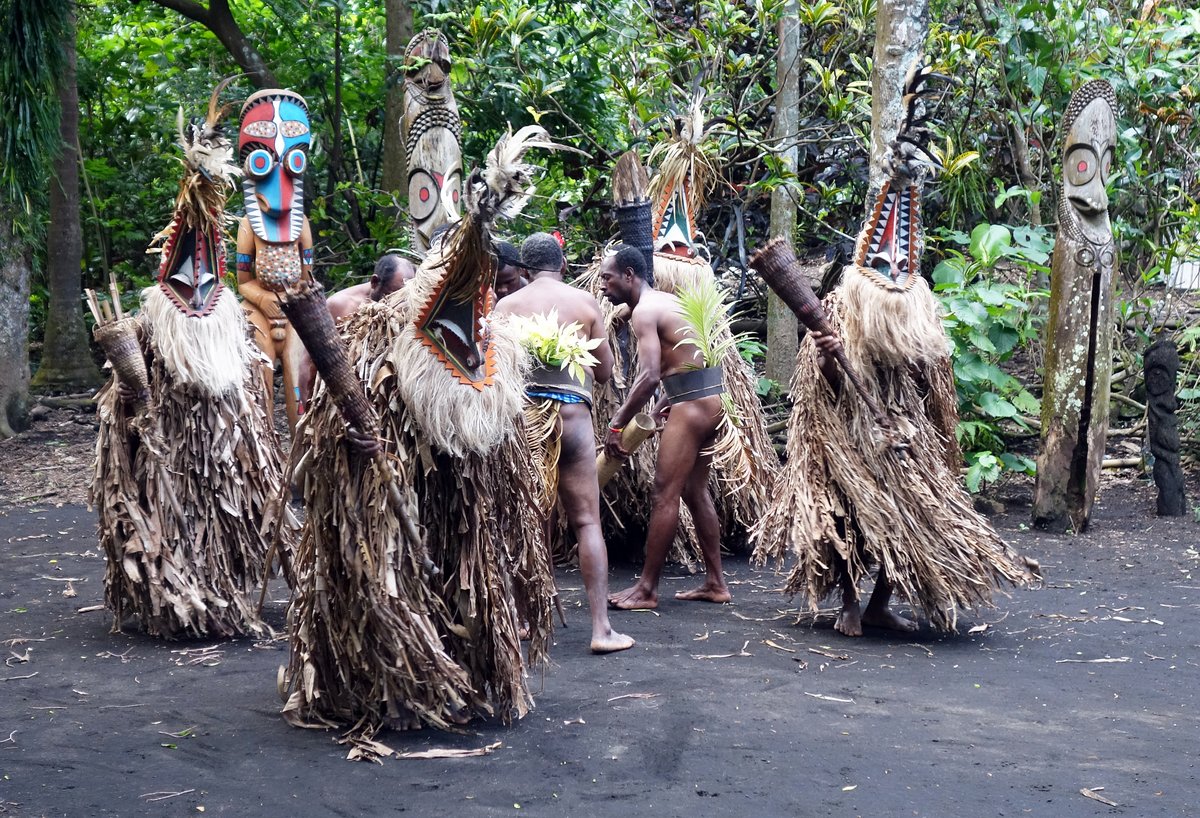
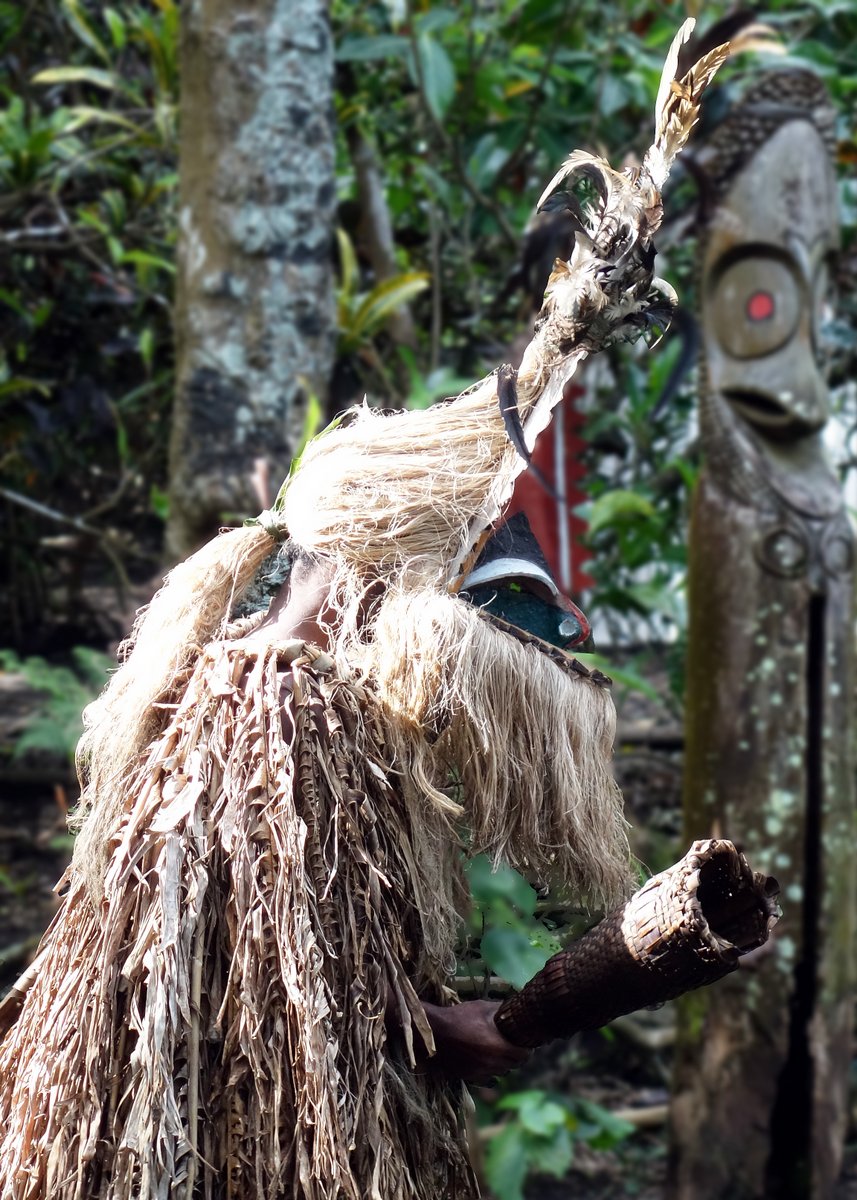
The ROM dance was good - it's a traditional dance and ritual that is one of the levels in the grading process. Some of the dancers are dressed in large masks and costumes made from Pandanus leaves, while the others dance in the middle chanting and drumming, wearing only nambas (penis pouches). There were only four dancers in ROM masks, so I suspect that they were a little short-handed for our display, but it was enjoyable.
We walked back down to Ranon and spent the afternoon wilting in the heat with no wind. Our friends on Lil Explorers arrived after dark, so we’ll see them tomorrow.
14 June 2015 Ranon to Wali, Pentecost
It was a miserable night with shrieking gusts of wind howling down from the mountain making the boat veer around and heel over. Morning brought an overcast sky with light drizzle and we still had the gale-force katabatic gusts.
We went over to “Lil Explorers” to catch up on their travels since we last saw them in French Polynesia. They spent Cyclone season in Tonga, then went to US Samoa and from there headed here to Vanuatu. It was good to see them again, although slightly chaotic with their five children running about and plaguing each other.
After lunch, we decided that we didn’t want another night of these katabatic winds, so we upped anchor and set off on the 15 miles trip to Pentecost Island. I put 2½ reefs in the main and we pulled out the stay sail, which was just about right because we faced 35 knot gusts as we left the anchorage. As we cleared the island, the wind settled down to 25-30 knots and the waves weren’t too bad at 3 metres.
We dropped anchor just north of Wali, village. The anchorage is more of a road-stead being on a long straight beach. It’s sheltered from the main brunt of the prevailing south east winds, but there’s still some swell and wind waves bouncing us around a bit. Tomorrow we’ll go and look at the famous Land-diving tower, which inspired the current day bungee-jumping.
15 June 2015 Wali to Asanvari Bay, Maewo
I was up early, keen to go ashore to look at the Land-diving tower. Having pulled our dinghy up the steep pebble shore, we were met by Luke Fargo, who in 1978 was responsible for setting up land-diving in this village and making it accessible to tourists. Each year, the villagers build a 30 metre high wooden tower, tie thick vines around their legs and then dive from the tower.
Unfortunately, the land-diving only occurs on a Saturday and we’d just missed it. However, “Lil Explorers” had seen it a couple of days ago and have given us some video and photographs. Luke Fargo took us up a steep slope to the tower and told us all about it.

The activity only takes place in April, May and June because at any other time of year the vines do not have enough elasticity and would snap. This corresponds with the time of year best suited to plant yams and land-diving has become a ritual to ensure a good harvest of yams. Only men take part in the activity and there is a strict progression path with young boys starting at lower heights and progressing upwards over a period of years.
I was fascinated by the tower. It’s made from rough-hewn tree trunks and branches lashed together by small vines. The tower is perched on the edge of a steep slope and supported by thick vines leading to trees at the top of the slope. At each level of the tower there are small hinged platforms, which the flexible vines pass over. The platforms are supported by small sticks, which break when the vine becomes tight and acts as a shock absorber.
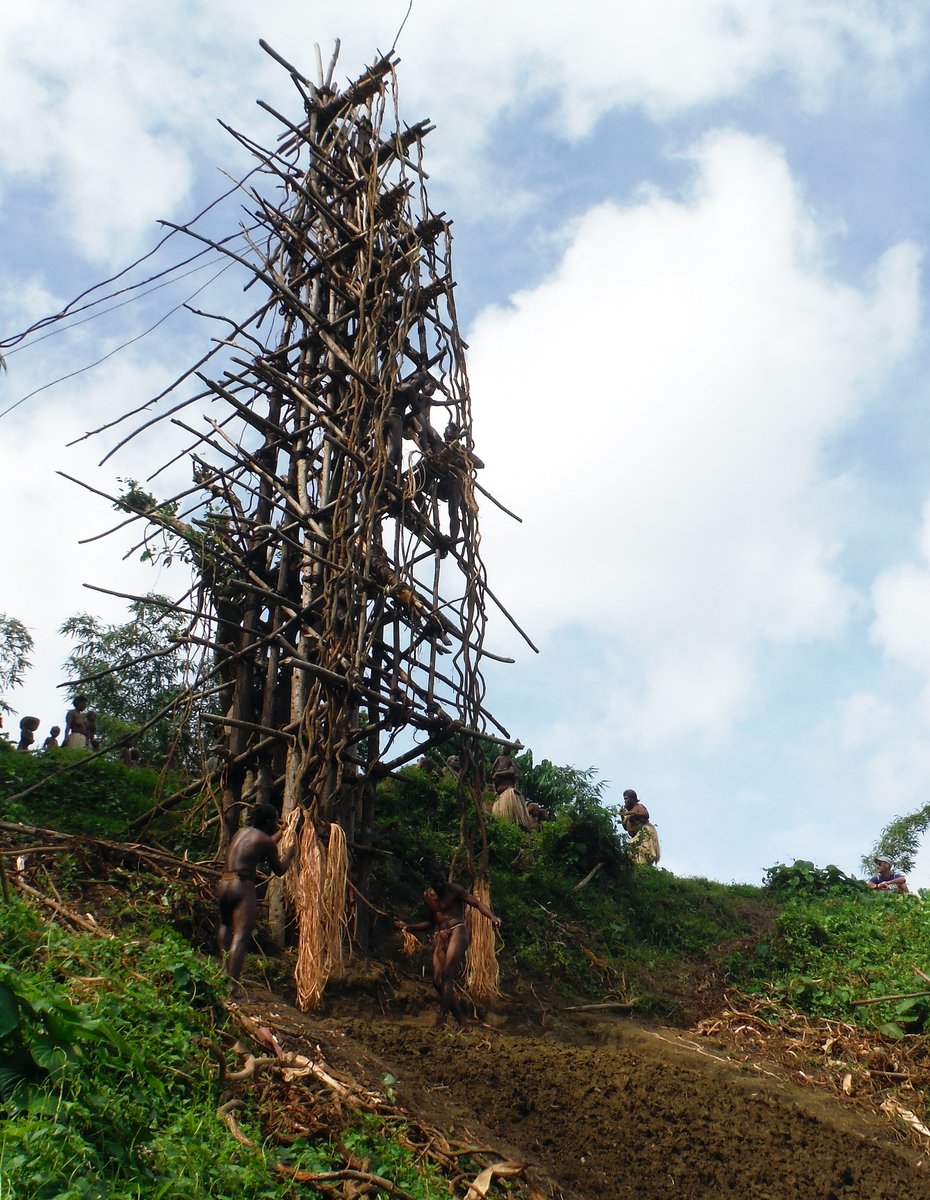
The vines are roughly one inch thick and there is one for each leg. The chief of the tower, who controls everything, determines how long the vine should be for each jumper. The perfect length is when their head just touches the ground - too long and they hit the ground and too short and they swing back into the tower. The landing area is at a slope of 45 degrees and is well dug over earth making a “landing” a little softer.
The video that “Lil Explorers” took shows how the dive ends abruptly - nothing like the slow gentle deceleration of the modern day bungee jump.
We were back on the boat by nine o’clock, so we headed north to Asanvari Bay on the next island of Maewo. Halfway along Pentecost, we were amazed to watch a swordfish leap out of the water only 20 metres to the side of our boat. It jumped three times in succession, flashing blue and silver in the sunshine and then with a final splash, disappeared - incredible.
The 35 mile passage was variable with hardly any wind for the first couple of hours; pleasant down-wind sailing in 15 knots for an hour; and then howling 35 knots katabatic gusts at the top of the island. The short 5 mile jump across the channel between islands was bouncy with 3 metre seas and 25-30 knot winds, so we were glad to arrive at the anchorage.
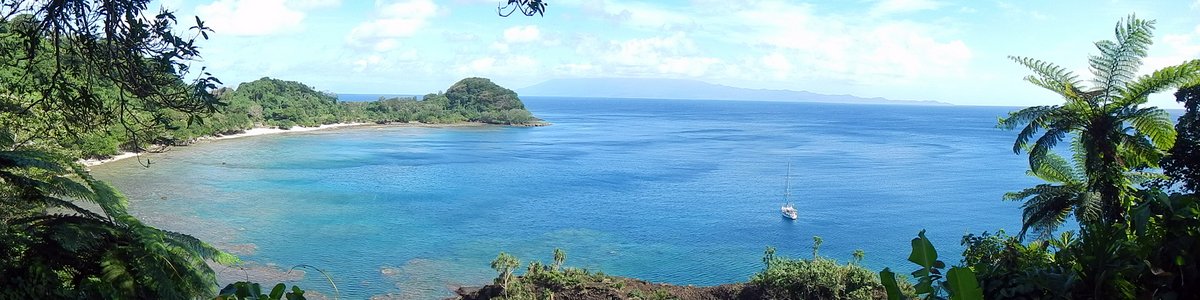
Asanvari Bay is a lovely sheltered harbour, just around the most southern headland of Maewo. It’s very deep and we had to motor around for a while to find a spot where we could anchor in 15 metres of water in some sand, but far enough away from the shallow reef surrounding the shore. There was only one other boat in the anchorage, but the wind swirls around and made it a challenge to know where their anchor was.
There’s a big waterfall ashore and guy called Alex has built a lovely little bar right next to it, so we went over for a couple of beers in the evening and met John and crew from “Wind Change” from Australia.
16 June 2015 Asanvari Bay, Maewo
We had a chill-out day. I caught up on my diary and photographs, then read a book and did some research about Indonesia. We’ve got very little information about the anchorages in Indonesia, so I need to get on the internet and download some blogs and maybe buy a cruising guide. I’ve had an email conversation with a British boat called “Spruce”, who are on the Sail Indonesia Rally, so I might be cheeky and get them to bring a few things out from Australia for us.
Glenys read a book and pottered about - she even got out some of the new shells in her collection and started taking photographs of them.
In the evening, we went over to the Sparkling Waters Bar and had a couple of beers. Alex only built the place two years ago and was hoping that he’d get 100 yachts a year, but last year there were only 50 turned up. He’s only had a few boats this year and is worried that Cyclone Pam will have put more people off coming.
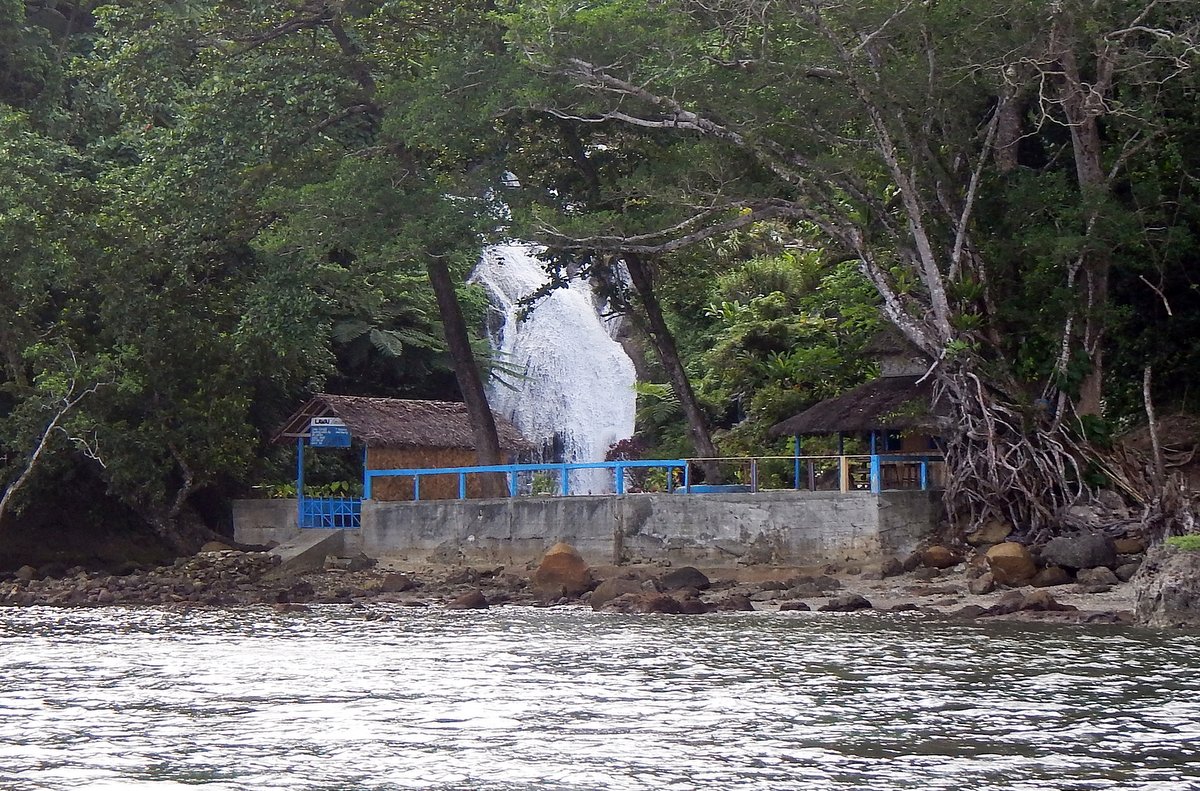
Alex is still in the process of doing the finishing touches to the bar and the main problem he has is access from the anchorage. There’s a one metre tide here and the shoreline is all rocks and reef, so it’s a mission getting ashore and trying to stop your dinghy bashing into rocks all the time. Without using dynamite to make a channel, I’m not sure what the solution is.
While we were there, I spent twenty minutes sorting out Alex’s guitar. It’s a cheap Chinese model, which only had five strings and one of those was very rusted. I used a wire brush to clean the rust of the head mechanisms; oiled them and then replaced the two bass strings with some old strings from my guitar - it’s not perfect by any means, but at least it sounds a bit better.
We’ve finally run out of the wine that we bought in New Zealand, so the 60 bottles of duty free wine stored in our aft heads have been calling remorselessly. The customs have sealed the boxes with labels, but the glue on the labels is not very good and they peel off easily.
So, we’ve come up with a cunning plan to drink some of the bottles of wine with twist-off caps and then re-fill them with water mixed with black acrylic paint. We’re hoping that the customs officers will only give the bottles a quick glance (if they bother to inspect them at all). Hopefully, our little subterfuge will pass undetected and we won’t have Alba impounded and have to spend five years in a hell-hole of a jail.
17 June 2015 Asanvari Bay, Maewo
At seven o’clock, we were woken by a knocking on the hull. I staggered on deck to find a guy in a dugout canoe with a large bag of hot bread. Did I want some bread? Hell, yes! I bought a large loaf for $2 and collapsed back into bed.
After our decadent breakfast of fresh bread, boiled eggs and jam, we went ashore and were met by a nine year old girl called Lynn and two other small boys, who tagged along with us. We wandered about the village for ten minutes, but couldn’t find anyone. None of the children spoke any English, so we were a bit unsure where to go. Lynn saw our confusion and decided to lead us in a circular tour of the village, which is large and spread out.
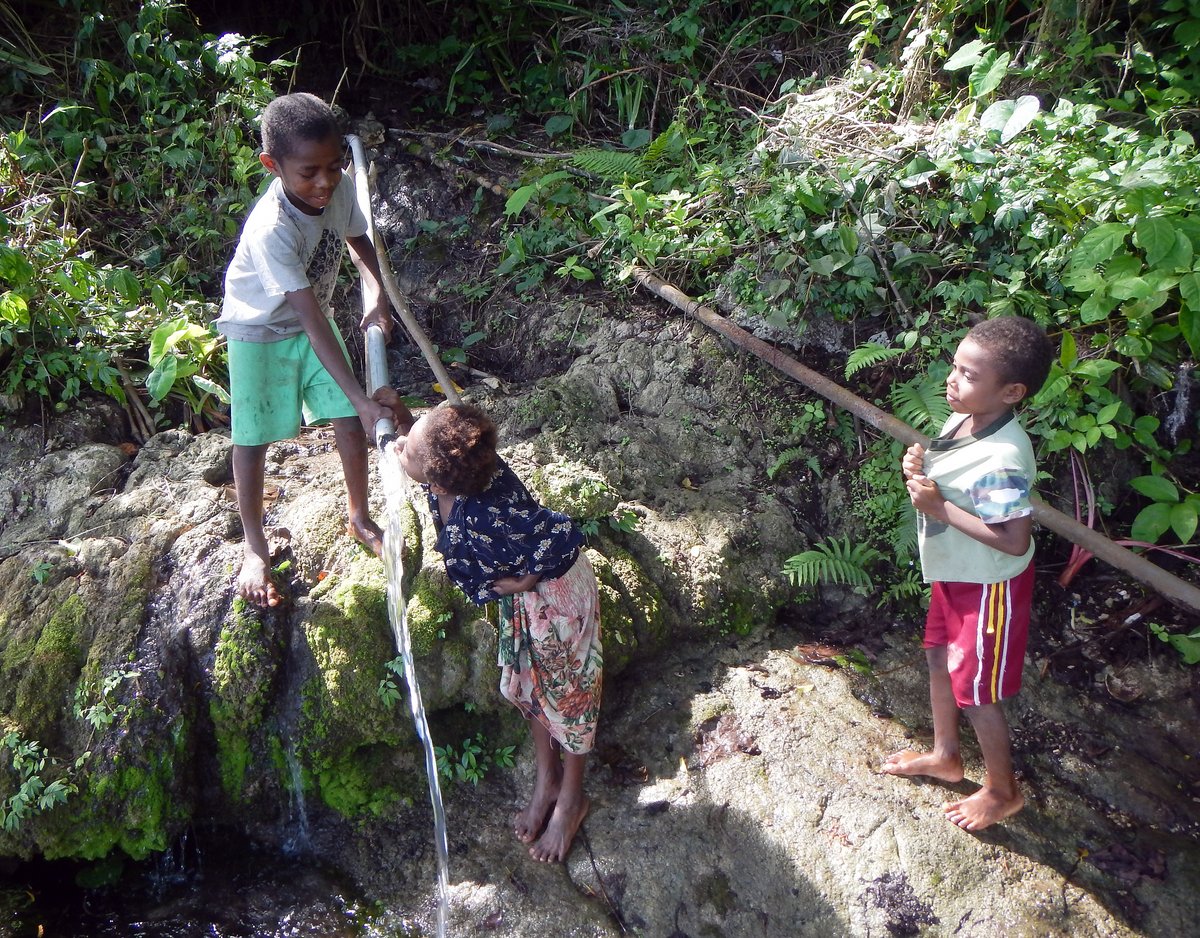
Eventually we met a young lady called Lucy who told us that everyone had gone to a wedding in another village - all 200 people. She was a nurse and had stayed behind to deliver a baby that was expected today. Lucy acted as translator and we asked Lynn if she would guide us on a walk to the waterfall and then back.
The kids were great fun, looking after us and taking us along a narrow path to Alex’s bar. We indicated that we wanted to get above the waterfall, so Lynn decided that we’d climb up the edge of the waterfall, which was interesting. At the top of the waterfall, we came upon a path, so we headed right and climbed up towards another village.
On the way, the kids insisted on stopping off at a small grove of Cocoa trees to pick some pods. They then smashed them open on a rock and sucked the Cocoa seeds - there’s a bitter, lemony coating on the outside of the seeds - a natural sweet. We also saw Taro growing in flooded soil like a paddy field, around which flew brilliant red Dragonflies. (I later found out that the Taro is called Water Taro and is sweeter than normal Taro.)

After lunch, I went snorkelling around the headland to the south of the bay, but the reef was mostly rock with a small amount of hard coral and there was a strong current, so I soon gave up. As I went back into the edge of the bay, I came across a large pinnacle just off the shore, which was again rocky reef, but had a spectacular wall that dropped off to 30 or 40 metres. There were lots of large Snappers and other predatory fish swimming around on the outskirts of huge shoals of smaller fish - nice.

Back at boat, I had a look at our anchor chain, which was wrapped around a few coral heads. I’d tied a fender on the chain when we anchored, but it wasn’t in the correct place and had been dragged down to the sea bed at 15 metres, collapsing with the water pressure. Glenys pulled up 20 metres of chain and I tied two fenders higher on the chain at 35 metres. When Glenys let out chain to a total of 50 metres, it seems to better - the chain is now suspended above the coral heads.