
14 May 2015 Port Patrick to Port Resolution, Tanna
We were up at the crack of dawn to sail 45 miles across to the next island, Tanna. The wind was from the ESE at 12-18 knots, so we had a fabulous reach with blue skies and 2 metre swell – lovely.
Our Navionics charts show absolutely no detail of the Port Resolution Bay, so we relied on a couple of old pilot books that we've acquired. The entrance into the wide bay was no problem (Approach: 19:30.916S 169:29.017E; Entrance: 19:31.360S 169:29.831E).
The water is murky, so it’s difficult to see the reef which extends a long way from shore, so we did a few tentative circuits to check the depth before anchoring at 19:31.543S 169:29.794E in 4 metres of water.
Our friends on “Full Circle” were already anchored a little further out and were rolling a lot in the swell that creeps into the anchorage, so we put out a stern anchor to keep our bow pointing into the waves. Once we’d got the anchors sorted out, the motion was okay with a slight rocking and pitching.
By the time that we’d anchored it was four o'clock, so we chilled out on-board and will go to look around tomorrow.
15 May 2015 Port Resolution, Tanna
We nipped over to see “Full Circle” to get the lay of the land and while we were there, Stanley came paddling over in his dug-out canoe. Stanley is the village chief and is organising any aid brought in by cruisers as well as providing transport if needed. He told us that there are five small villages spread around the bay and another one ten miles away that will benefit from our supplies. Stanley is holding onto everything until there is enough to share out.
We went back to the boat and gathered together about a third of our remaining aid, then went ashore. A guy called David met us on the beach and, with a handful of kids, helped us to lug the stuff up the hill to their village. Stanley started to sort through it all before storing it away, so we left him to it and wandered around the village.
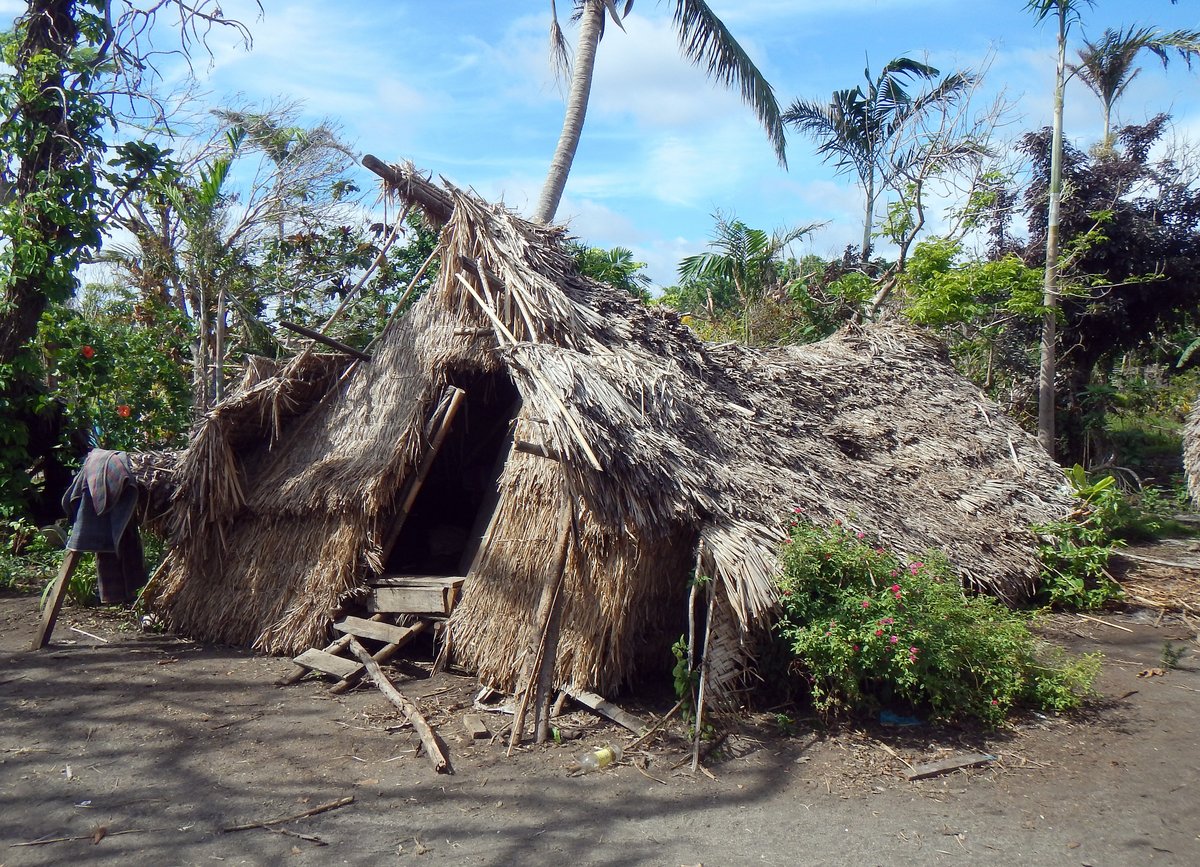
There are many trees blown down and a few houses that haven’t been repaired yet, but people seem to be happy enough. Big waves came into the bay during the cyclone and have undercut the soft earth cliffs causing trees to fall over the edge - last night we heard a terrific crash as a huge banyan tree toppled over the edge.
In the afternoon, we went for a snorkel off the beach on the east headland. It was okay, but the water is murky after the cyclone, so my photos were rubbish. “Anke-Sophie” arrived late afternoon, so we had them over for a few beers.
16 May 2015 Port Resolution, Tanna
Overnight, the wind increased to 25 knots and veered from ESE to SSE, so the wind was coming from directly behind us and we were hanging off the stern anchor. The chop caused by the wind was slapping against the sugar scoop on our stern making it difficult to sleep, so I got up at dawn. The swell coming into the bay was almost non-existent, so I dropped the stern anchor and we swung bow into the wind, which was much, much better.
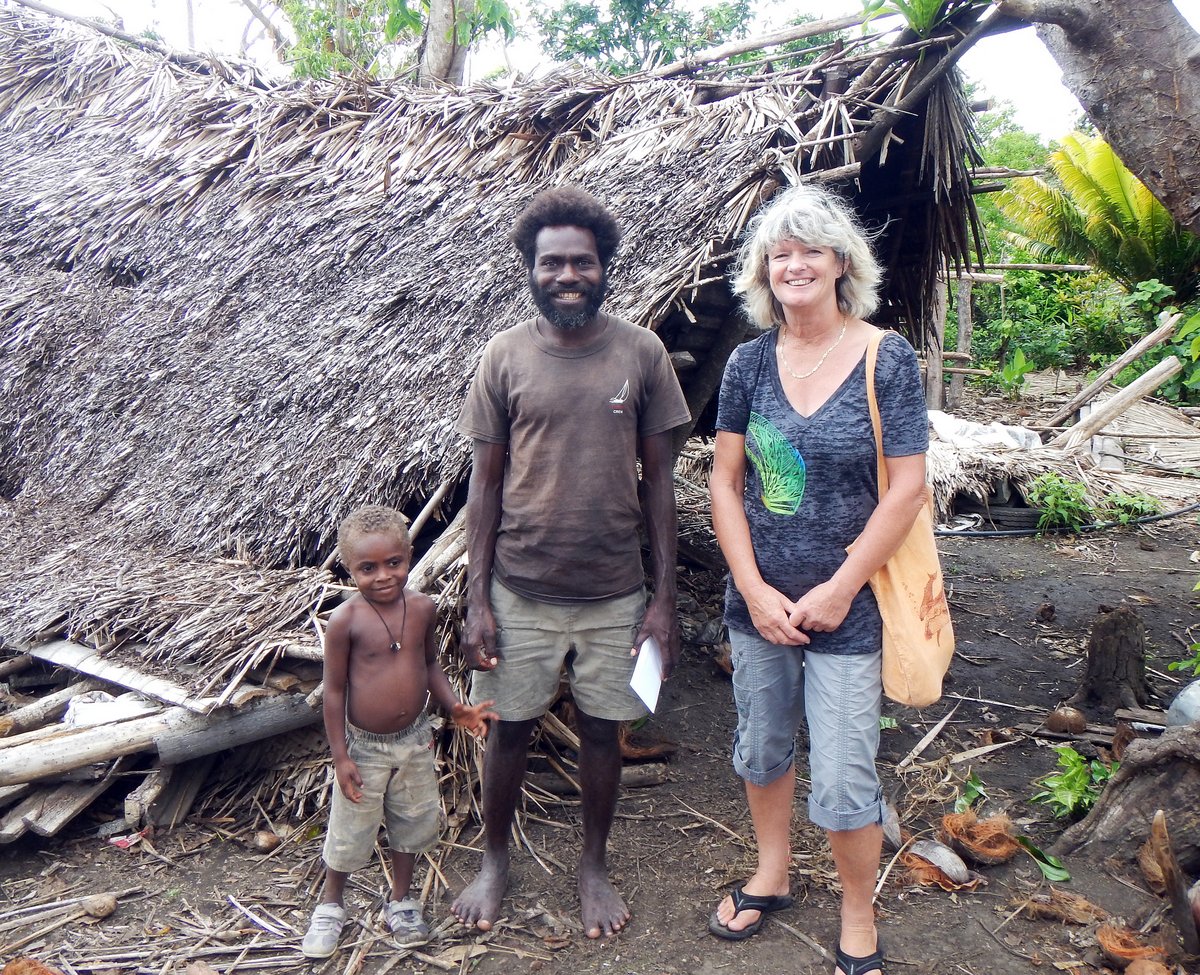
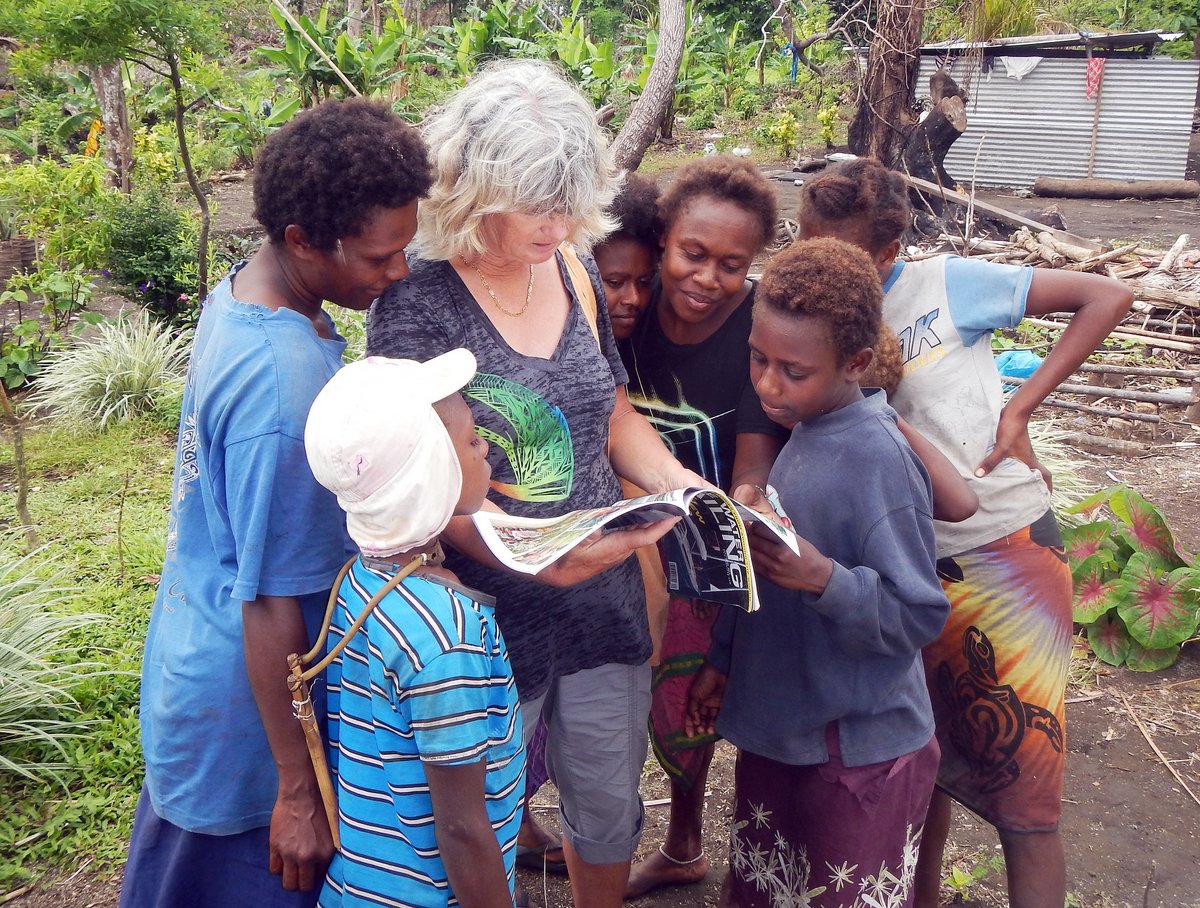
After breakfast, we went ashore to search out some friends of “Tenaya”. Jim and Katie were here in 2011 and 2012 and have sent us some money and photographs to hand out to various people. As soon as we landed on the beach, we found Werry, who runs the Port Resolution Yacht Club – this is a small building on the headland owned by the community, but there’s not much happening there.
Walking through the village, we stopped to give an envelope to Stanley, who showed us that his house and kitchen were damaged by the cyclone. The villagers are in the process of re-building houses - on average, it takes 7 days to build a house from scratch. His house has been cleared away, but as chief, his will be the last house to be rebuilt.
Our next stop was to visit Serah, who used to run a small restaurant for tourists, but it was also flattened by the cyclone. They are half way through rebuilding it – the wooden frame is complete and they are waiting for bamboo to be delivered from another village to make the walls. She hopes to be up and running in a couple of weeks.
We wandered to the next village along the “main road” which is a rucked, dirt track. By asking around, we finally found the house of Patrick, but his wife told us that he was out helping to rebuild a church in another village. It was only fifteen minutes’ walk, so we decided to go and find him. We were guided there by a gaggle of children and dogs, walking along the main road and then up a steep dirt path to the top of a hill.
Patrick and a couple of guys were taking the wooden frame of the demolished church apart, getting ready to rebuild it. This little village and the church is in a wonderful airy spot overlooking the bay, but terribly exposed to the cyclone and the church just collapsed. We gave Patrick his envelope and chatted a while. He asked me if I was mechanically minded and it turned out that he has a strimmer that doesn’t work, so we said that we’d go to visit tomorrow.
It was a miserable afternoon, with gusty winds and heavy rain showers, so we called off our planned excursion to the nearby volcano and chilled out. “Anke-Sophie” and “Arradonna” came over for a few beers.
17 May 2015 Port Resolution, Tanna
It was Sunday, so we chilled out in morning, catching up with a few chores.
After lunch, we went to see Serah to give her a 20lb propane tank that we’d bought in New Zealand – it’s steel, so it will just rust away on the boat. They don’t have the correct fitting for the regulator, but should be able to sort it out in the main town of Lenakel. We also dropped off a bag full of kitchenware – cups, pans, etc. to replace some of the things that they’d lost when their restaurant blew over.
Serah made us a cup of the coffee that is grown and processed on Tanna. She grows a small amount of coffee herself and is able to take the raw beans over to a large plantation who then process it for her, giving her a percentage of the finished product. She also presented Glenys with a lovely two metre square, woven pandanus mat, which was very nice of her.
When we arrived at Patrick's house, Glenys went to chat with Nellie, while I found Patrick working on his strimmer. It started, but kept cutting out and also the stop switch wasn't working. I decided that the carburettor must be dirty, so I stripped it down and sprayed carburettor cleaner into all the ports that I could see. When I put it all back together, it wouldn't start at all - damn! Unfortunately, it was now late in the afternoon and we had to go, so we said that we'd come back tomorrow.
Back at the "yacht club", we met up with "Anke-Sophie" and "Aradonna" and climbed onto a pickup truck accompanied by Werry and Stanley, to go to see the Mount Yasur volcano. We had an interesting ride, bouncing along a dirt track through dense forest, passing a couple of villages and even some holiday bungalows.
Access to the volcano is controlled by a government organisation and there is a $38US charge. After paying the entry fee, we drove up a very rough track to the foot of the volcano cone. From there it was a steep ten minute walk up to the crater rim.
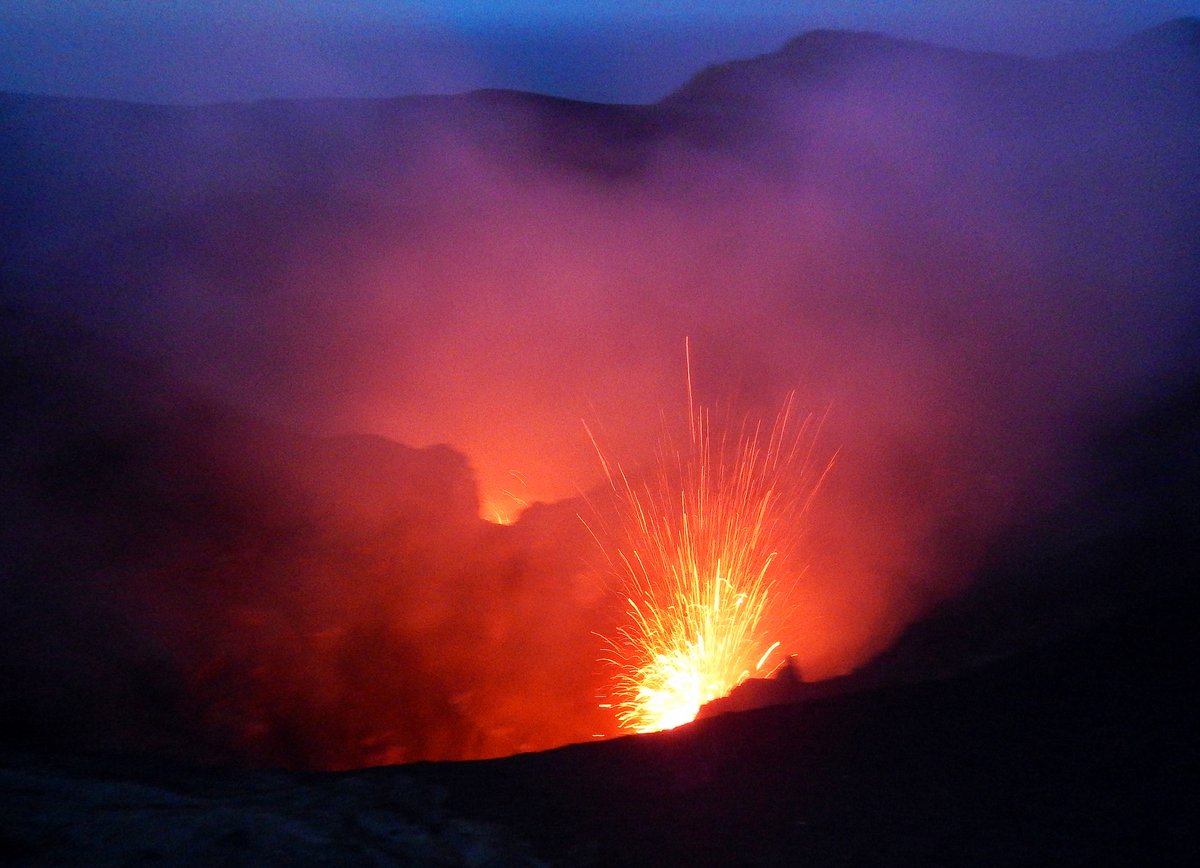
Mount Yasur has been actively spewing out lava and ash for over 800 years. In 1774, Captain Cook was drawn to Port Resolution after seeing the fiery glow of the volcano. There were a few other groups of tourists and locals, stood on the narrow crater rim, looking down into the caldera a few hundred feet below. Huge fountains of molten lava are blasted skywards by explosions and you can hear the large, cooling rocks ricocheting off the steep slopes. It’s an incredible sight.
We arrived just before sunset and the natural firework show became even better as the sun went down. I walked clockwise around the rim for a few hundred metres, where I had a fabulous view down into the caldera. Below me was a 45 degree slope covered in ash and pumice with no guard rails, so one slip along the narrow rim would see me sliding helplessly down into the bowels of the earth.
The only downside to the trip was the strong winds, which kicked up clouds of sharp volcanic sand. By the end of the evening, we were covered with ash and our eyes were full of painful grit. The walk back down to the pickup truck in the dark was a challenge as the path is unmarked and we were half blinded by the stinging sand.
Back at the village, we had a meal in a tiny little restaurant run by a lady called Leah. She served a mildly curried chicken, with rice and six different dishes of taro, cassava and island cabbage cooked in coconut milk - very nice although the chicken had just been hacked up into one inch chunks (bone and all), so it was a bit of a challenge to our western palates.
18 May 2015 Port Resolution, Tanna
I didn't sleep well last night, worrying about how to fix Patrick's strimmer. So, while Glenys packed a few children's clothes in a bag for Nellie, I dug out some tools to take ashore.
We walked to Patrick's house where Glenys went to see what Nellie was doing and I found the strimmer. After a bit of fiddling, I discovered that I hadn't tightened one of the bolts holding the carburettor in place. With a few turns of a screw and I had the thing running okay - phew! I then replaced the wires leading to the stop switch and soon had that working as well, so Patrick was well pleased.
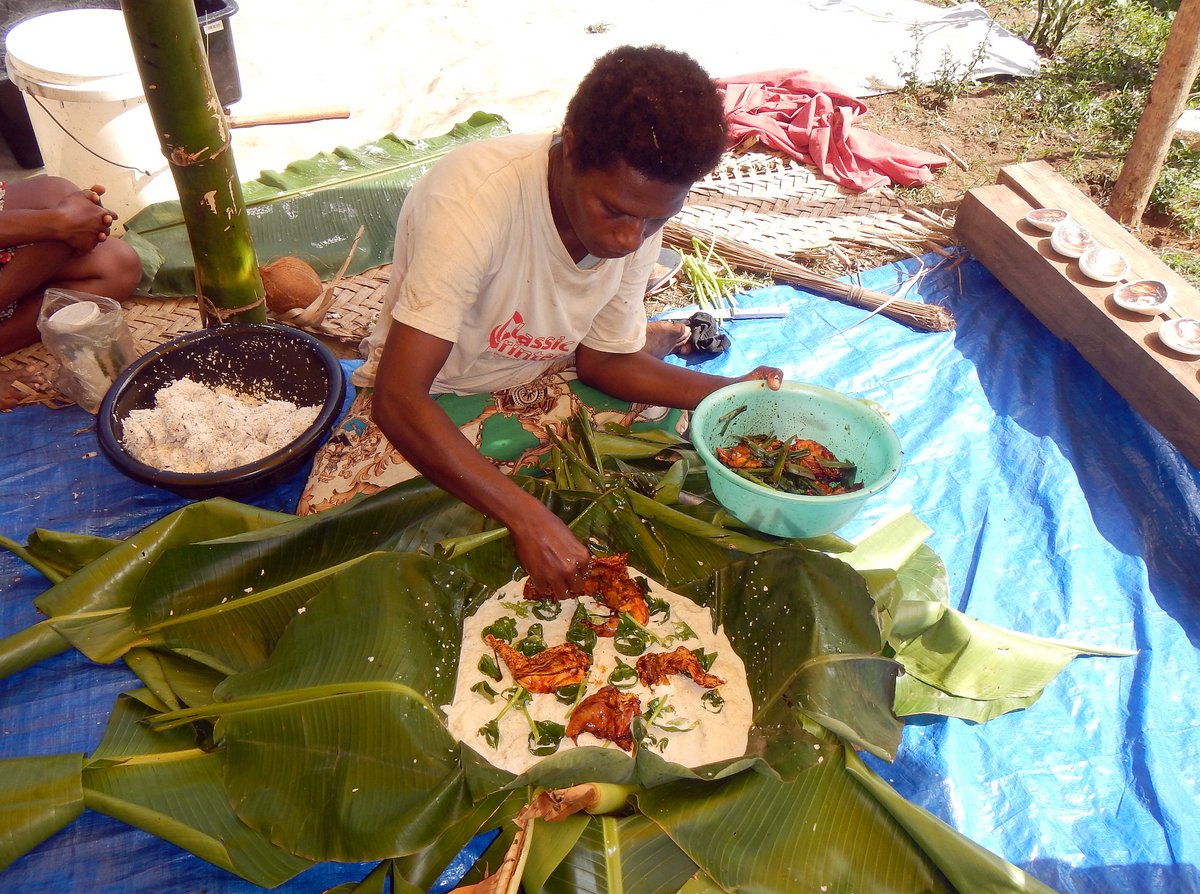
Glenys found Nellie surrounded by family making Laplap, which is a traditional dish made from grated taro or kasava. Nellie used a large 500mm aluminium pan and first lined it with banana leaves. Taro root was then finely grated on top of the banana leaves. Meanwhile, someone was grating coconut and squeezing it to make coconut milk.
Once the pan was full of grated taro, Nellie mixed in some coconut milk to make a creamy dough. She then folded island cabbage leaves into tubes and inserted them into the taro mixture to create pockets. More coconut milk was then squeezed on top. Some children were dispatched to catch a cockerel, but after much laughing and chasing, it fell to Patrick to corner the errant bird. The scrawny chicken was plucked and chopped up into pieces, then laid on top of the Laplap mixture.
More coconut milk was poured over everything and the banana leaves folded over the top to make a kind of lid. The whole pan was placed in the centre of an open fire and hot stones were placed on top. More banana leaves were placed over the stones and another pan used to weight the whole thing down.
By the time the preparation of the Laplap was finished, Steve, Dinky and Henk from "Pikuditu" had arrived. It takes an hour to cook the Laplap, so Patrick offered to take us to look at his gardens. I was interested to see how quickly things grow in the fertile soil on this island - Cyclone Pam hit Tanna only nine weeks ago and Patrick already has crops of taro, beans and peppers ready to harvest.
Back at the village, Patrick presented us with some woven baskets and necklaces made from seeds, then Nellie served the family and us the Laplap. It was very tasty - the grated manioc had solidified to the consistency of cake and the chicken was tender. She doled out huge plates for everyone, but Glenys and I asked to share one plate, which was a good job because it was very filling.
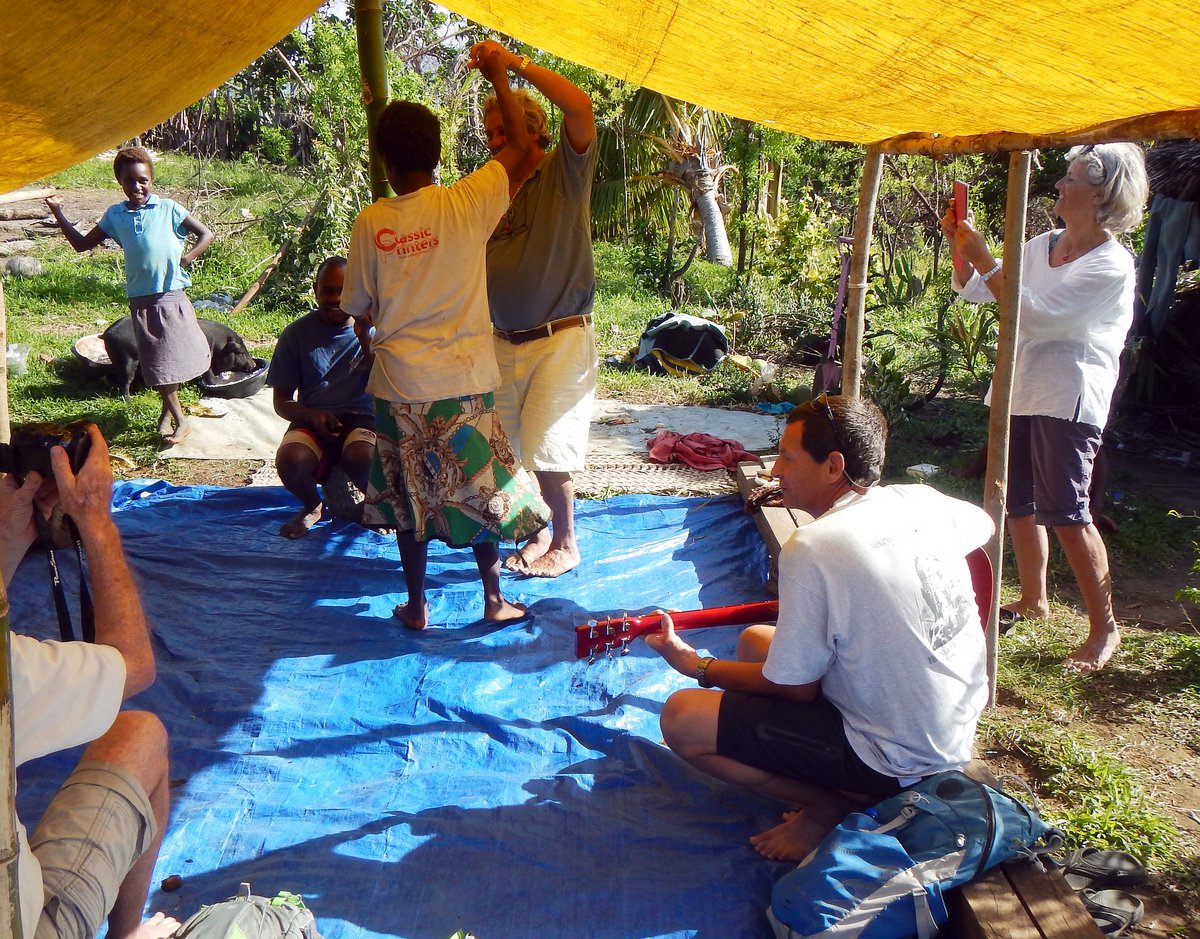
"Pikuditu " were here last year and they had brought a new guitar for Patrick's church. I couldn't resist having a play and the family laughed with delight when Steve asked Nellie to dance while I sang "Jamaica Farewell". Mid-afternoon, we said our farewells and retired back to the boat. The people here are so friendly that it feels like we've been here for more than four days. Unfortunately, it's time to move on and we'll be sailing away tomorrow.
19 May 2015 Port Resolution to Dillon’s Bay, Erromango
We were up at the crack of dawn and sailing by half past six. We had a fabulous broad reach along the edge of Tanna. Once around the headland, our course was 30 degrees more downwind, so I put our spinnaker pole out to starboard and we rolled downwind doing 6 to 7 knots for most of the way. Just off the south-west tip of Erromango, I hooked a fish, but it snapped the hook off before I could get it on board - I despair.
We anchored off the beach off Dillon's Bay in 8 metres of water. “Anke-Sophie” arrive fifteen minutes later. For a change, the water here is very clear despite being next to a river mouth. A guy called David paddled out to chat to us. He is building a “yacht club” and acts as a liaison for the cruisers visiting the village. We arranged to drop off our aid tomorrow morning.
20 May 2015 Dillon’s Bay, Erromango
The people are distributing any aid to their community and we had a little ceremony where we were formally welcomed and I told everyone that these things had been donated by people in New Zealand. There was also a guy who was a representative of the government, so David was keen for me to tell everyone that we’d been told not to bring any food into the country and he then repeated by words in Bislama, so everyone understood why we had no food.
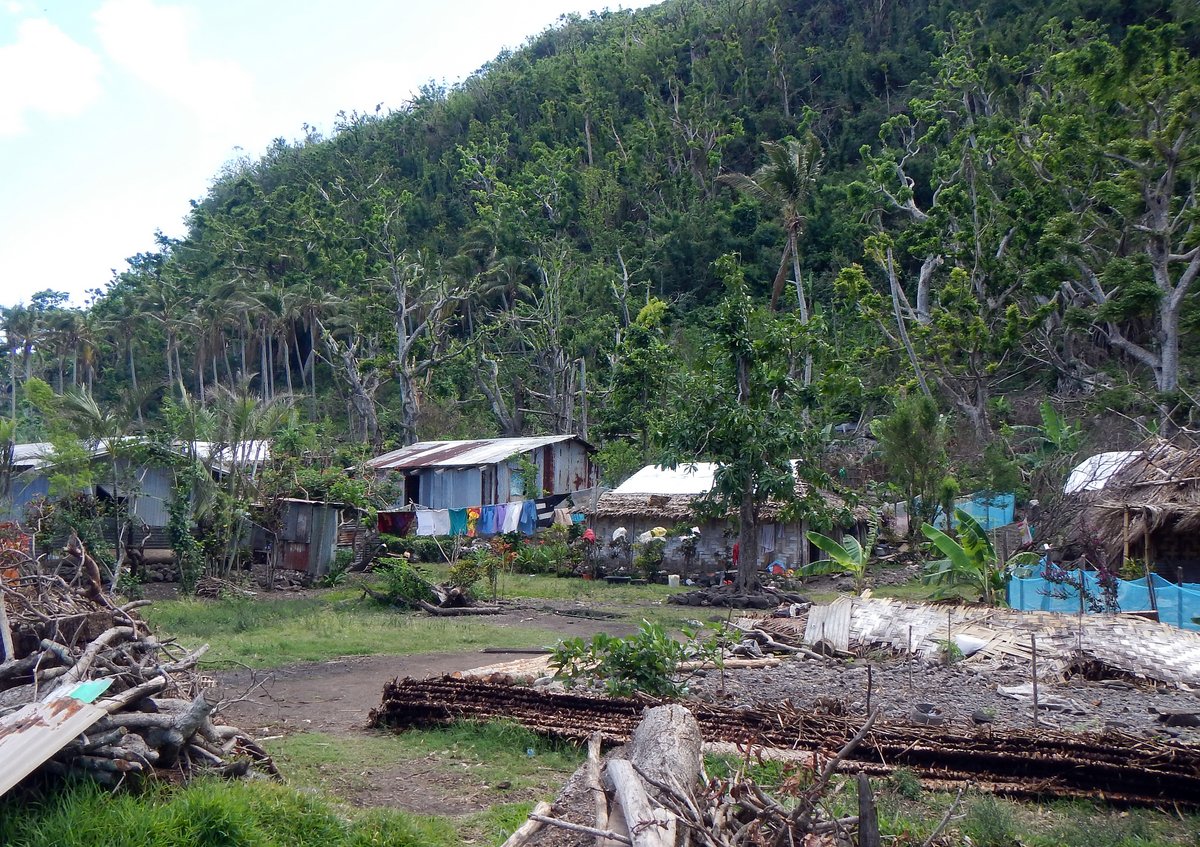
David then took us for a walk around his village, first showing us the clinic where I dropped off an inhaler and spacer. The school was our next stop. They have two separate schools - one French-speaking and one English-speaking, which face each other across a playing field.
Up to 1980, Vanuatu was run jointly by France and Great Britain in a strange administration called The Condominium. The early French and English settlers hated each other and there were separate police forces, courts, jails, health systems and schools. After Vanuatu’s independence, there is still a dual education system and parents decide whether their children will speak French or English. Most decide to have some children learn English and some French.
David then took us along the river and showed us the villagers’ garden. He told us that the river broke its banks during the cyclone and all their crops were swept away. There are not many coconuts on the trees and all bananas and papaya were blown away. He said that the soil is not as rich as the volcanic soil in Tanna, so things take longer to grow, hence their need here for food aid.
It’s lovely up the river, which is wide and there are several large pools, which are great for swimming - Glenys couldn’t resist going into the cool water and then walked back to the village dripping wet. David showed us the “Yacht club” that he’s been building for seven years. It’s a two story concrete building, in a lovely spot overlooking the bay and it will be a restaurant and bar when he’s finished it.
We jumped into our dinghies and motored a mile up the coast to look at some burial caves. The tide was out, so to get to the shore was a challenge. We managed to paddle to within 50 metres of the beach, but then had to walk across the coral, dragging the dinghy with us. Our dinghy has a deep v-hull, so despite putting the wheels down, it was a struggle and our nicely painted aluminium hull now has a few dinks.
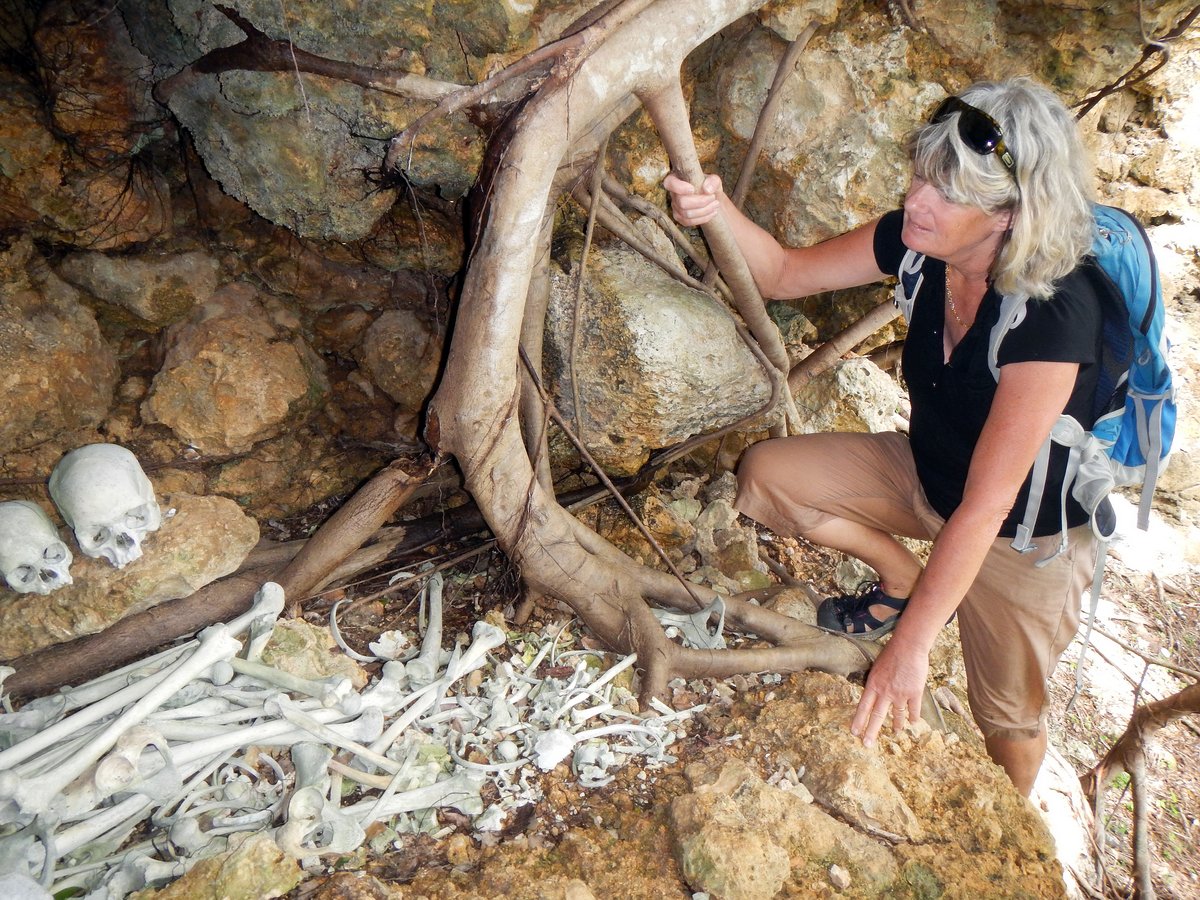
It was only a short walk up a steep hill to the two caves, which until 100 years ago was the main way to bury important elders. One cave has had a rock fall so we couldn’t go in, but the other is a small depression up a cliff, which is a short scramble, hanging onto tree roots. Inside the cave are human skulls and bones. David told us that this practice of burial was abolished by the missionaries and now everyone is buried underground.
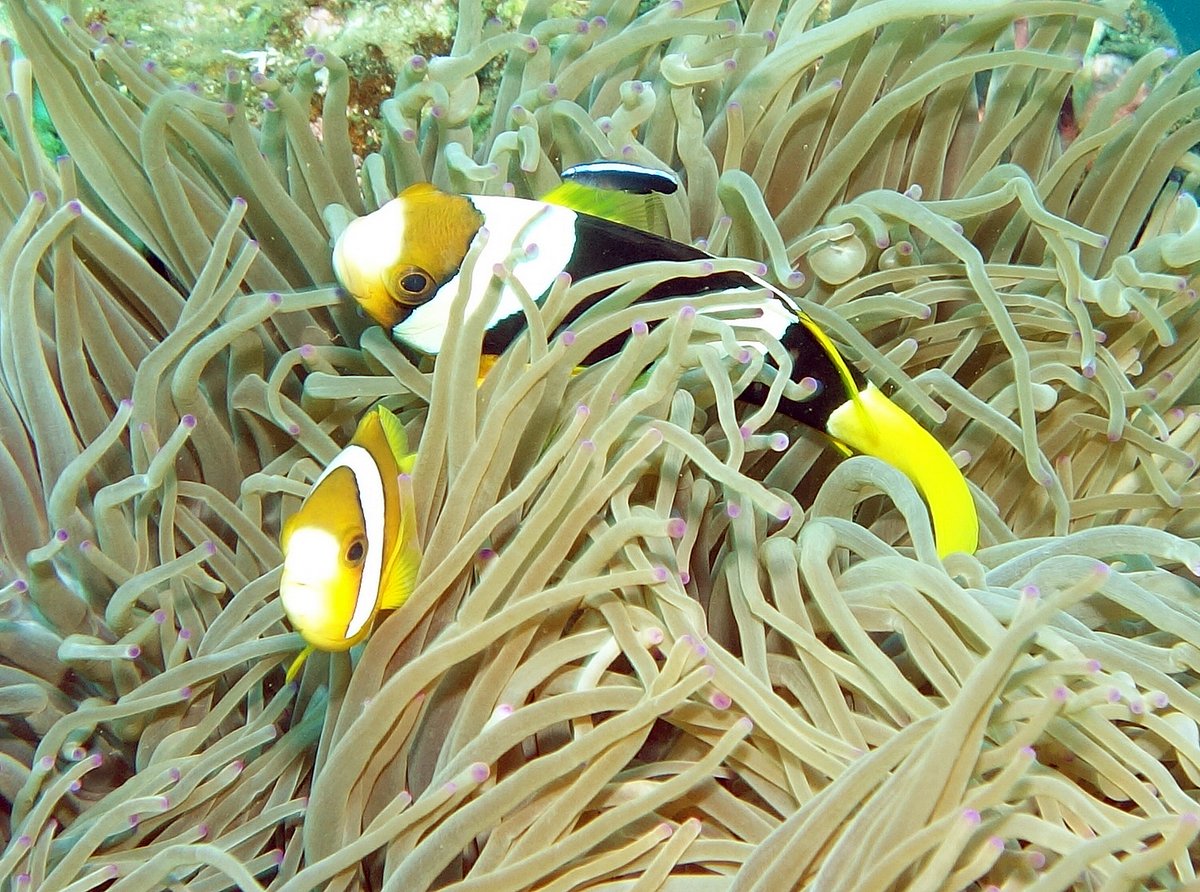
Back at the boat, we had a late lunch and then I went snorkelling off the nearby headland, which was very good - reasonably clear water in depths to 15 metres. The reef is all hard coral on rock with no soft corals yet, but there was plenty to look at. I practised with my new camera and got a reasonable picture of a Clarke's Anenomefish.
21 May 2015 Dillon’s Bay to Port Vila, Efate (Day 1)
In the 1840’s, Erromango was infamous for hostile cannibals and was responsible for most attacks on trading ships. To counteract this, the islanders were required to swim out to the ships to trade their sandalwood.
Glenys’ maiden name is Williams, so we were interested to hear about two missionaries called John Williams and James Harris who arrived here in 1839. A few days before they landed, some traders had murdered five villagers, so the locals were hostile. The chief told the missionaries to stay near their boat, but when they came further ashore, they were killed and eaten.
When we told David that we were interested in this event, he took us along the river where we scrambled up a bank and found a small plaque commemorating John Williams. The cannibals laid the body out on the rock then chipped out the outline before cooking the missionary and eating him.
The missionaries and traders were held responsible for bringing whooping cough, dysentery and measles to the island - these epidemic diseases eventually reduced the population from 10,000 to only 400. The last missionary killed on Erromango was James Gordon in 1857.
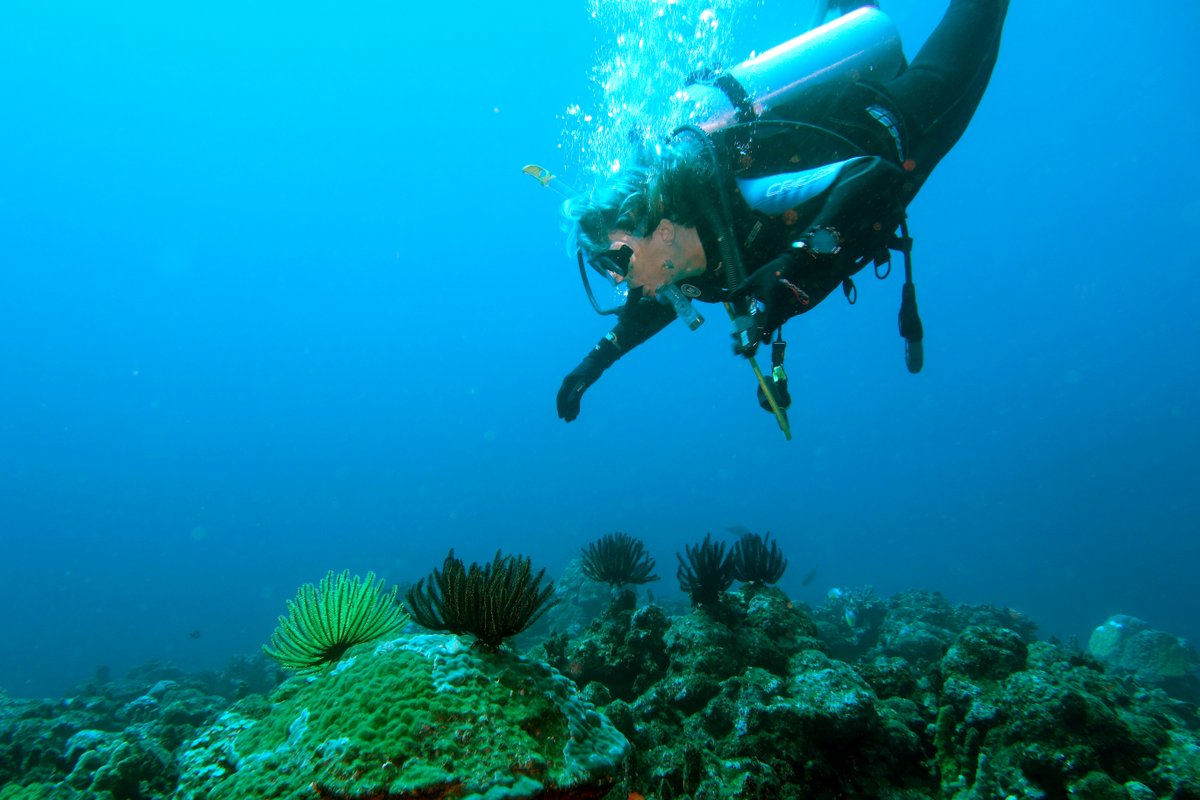
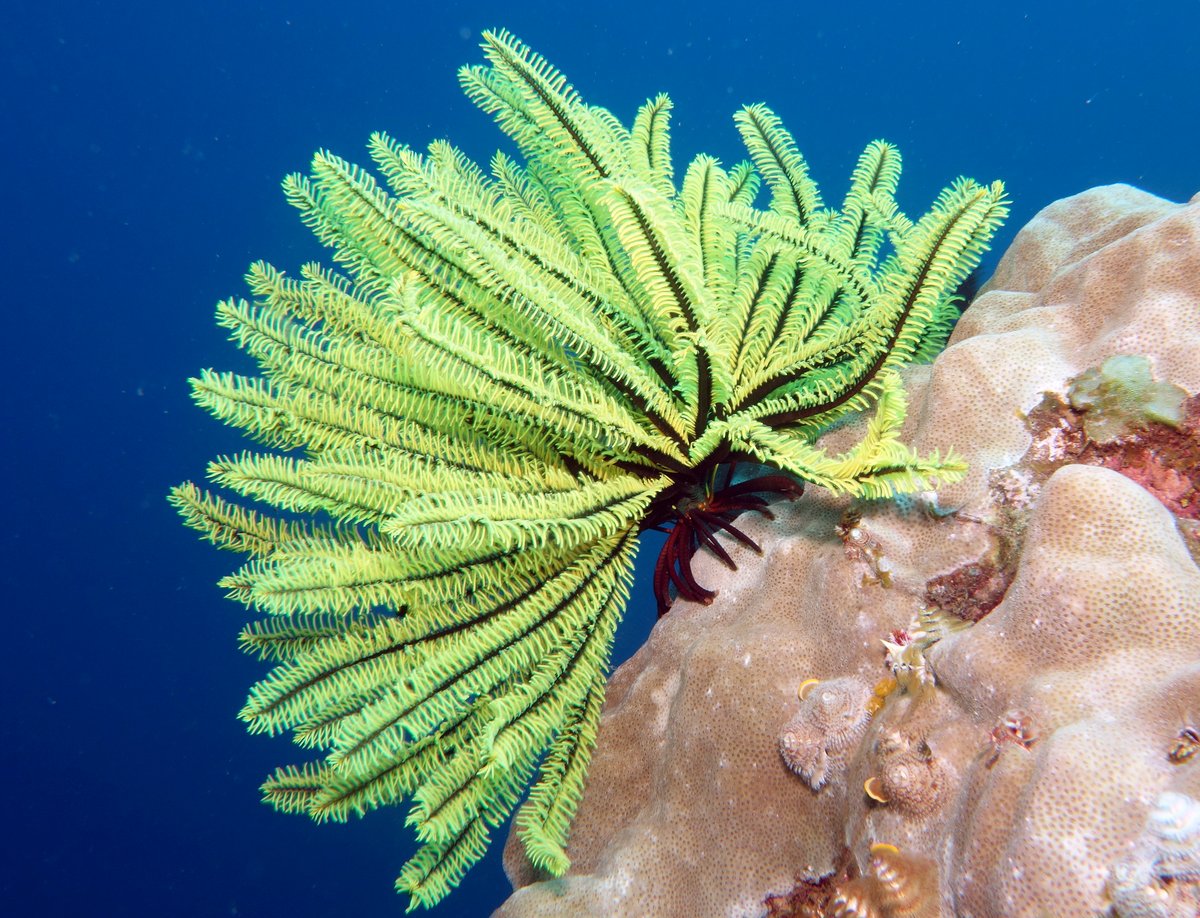
It was a lovely, sunny day, so we dragged out our scuba gear and went for a dive off the headland north of the village. We dropped our anchor in 6 metres of water over rocky reef and then swam away from the shore following deep channels in the reef down to 25 metres where we turned around and retraced our route. The visibility was good and there were lots of hard corals and Bennett's Featherstar, but no soft corals.
Just before four o’clock, I went ashore and picked up Thomasee, who we’d agreed to take to Port Vila with us. He works for the government and is going to Port Vila to report on the current disaster status of Erromango and to plead their case for more aid.
We upped anchor as soon as we’d got the dinghy stowed away and set sail before the sun went down. There wasn’t much wind for the first three hours, so we had to motor. However, the swell soon started to build up and Thomasee began to look a little sick, so I sent him to bed at half past six, where he stayed for most of the trip.
The wind picked up to 20 knots from the east, so we were on a broad reach, but the sea was terribly confused and we rocked and rolled all night, making it almost impossible to sleep. We only had 80 miles to go, so I rolled away the main and we sailed with just a scrap of genoa out, doing 5 knots all night.