
28 October 2016 Siem Reap to Battambang, Cambodia
We were up early and picked up from our hotel by a bus company to take us to Battambang. It was a very pleasant three hour trip on an air-conditioned mini-bus arriving at 11:00. It was total mayhem when the bus pulled to a stop with dozens of Tuk-tuk drivers crowding around, shouting and holding up various signs. We hadn’t arranged for anyone to pick us up, so Glenys pointed at a young driver holding a sign offering free drop-off at the Delux Villa hotel where we were staying and he latched onto us like glue while we picked up our luggage.
We later discovered that the Tuk-tuk drivers aren’t paid by the hotels, but offer free drop off in the anticipation of taking the tourists on tours. Our man, Pen, hung around outside the hotel reception while we checked in and discussed the various things that we could do in Battambang. Of course, when we came out, we arranged for Pen to take us out in the afternoon.
After dumping our bags in our very nice air-conditioned room, we stepped out for lunch, but struggled to find a restaurant. The markets are usually a good bet, but the various stalls in the market looked dodgy and there was nothing nearby. We ended up in a very westernised bistro by the river, which was okay. Of course, on the way back to the hotel, we found Street 121, where all the restaurants had been hiding.
Glenys has come down with a bad cold and was feeling so grim that she could hardly eat her lunch, so she stayed in the hotel room, while I went out on the tour that we’d booked.
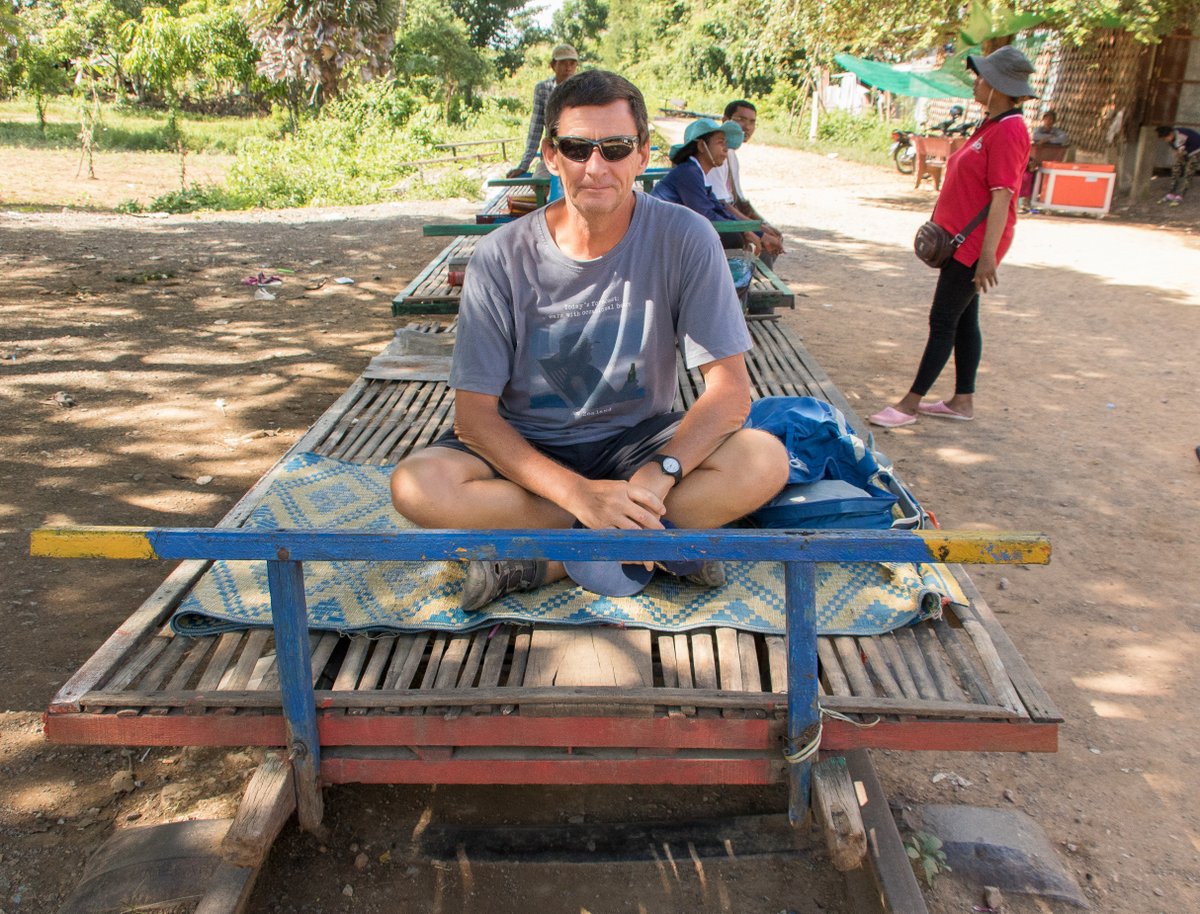
Our Tuk-tuk driver, Pen, took me to the Bamboo Train, which is a bizarre rail journey. The French colonial government built a railway system in Cambodia, but it’s largely abandoned after the Khmer Rouge regime shut it down in the 1970s. The resourceful Cambodians started to make use of this unused resource and built small self-powered little trains which are 3m * 2m wooden platforms covered with bamboo slats, sitting on top of two sets of barbell-like wheels.
The trains are very simple, but an elegant design. Each axle of the bamboo train has two large roller bearings and hemispherical cut-outs in the cross member of the platform - the platform simply rests on the axles by gravity. The power is provided by a small 5hp petrol engine (like on a lawnmower), which drives the rear axle using v-belt. This engine is mounted on a loose piece of wood, which is moved backwards using a wooden lever. As the wooden lever is pulled, the engine moves backwards, tightening the v-belt and powering the rear axle – pull harder, go faster.

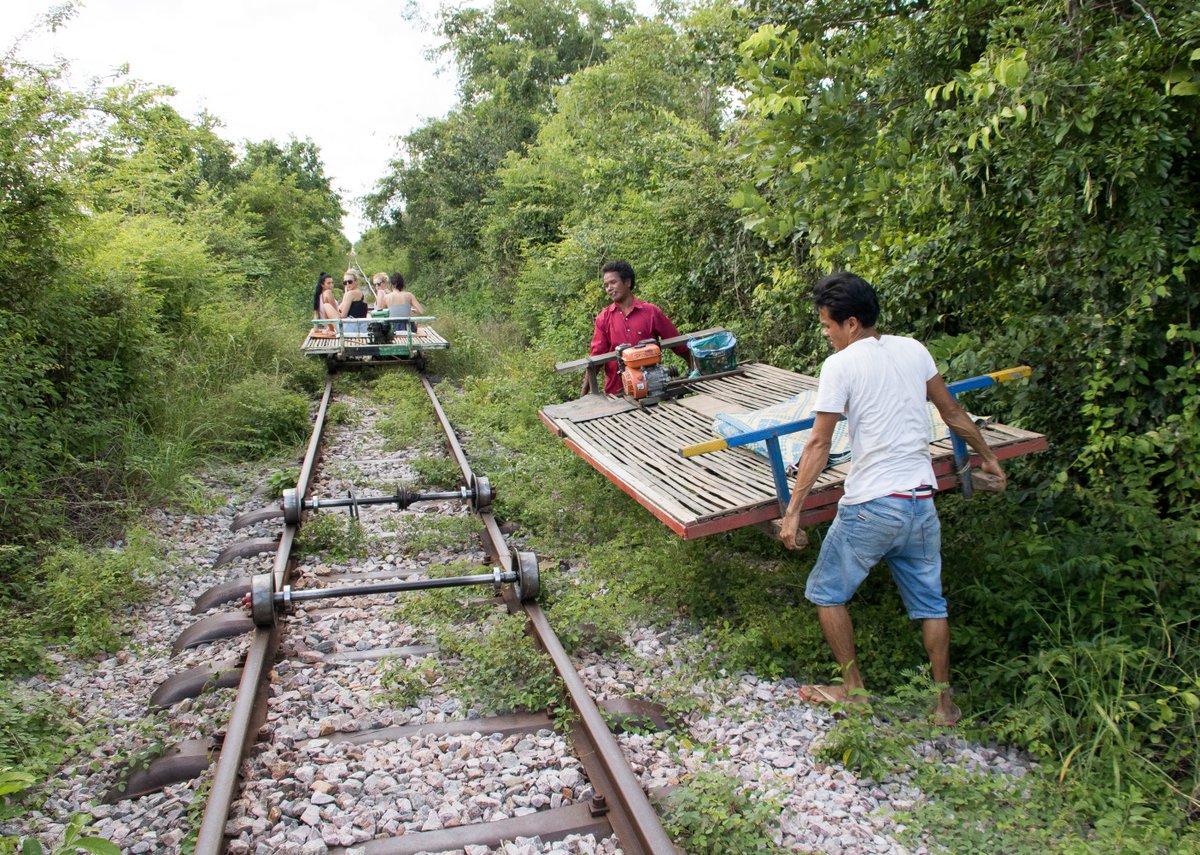
The bamboo trains are now only a tourist attraction, the main one being in Battambang along seven 7 kilometres of warped, misaligned rails. There are about twenty of these bamboo trains operating on the single track, going backwards and forwards all day. The trains take tourists to the end of the track and back. Of course at the end of the track, there are a number of stalls selling souvenirs.
It’s great fun whizzing along a foot from the ground on a kind of magic carpet. The top speed is only 20-25 miles an hour, but feels more because you are thrown about by the poorly maintained track and no suspension.
One of the interesting problems is what to do when one train meets another coming in the other direction on the single track. The construction of the trains makes the solution simple. One of the trains is quickly pulled apart and put on the side of the track which the other train goes past. It’s kind of like a game of chicken, but the rule is that the train with the least number of passengers has to get off. Being on a train by myself put me in a poor negotiating position, so I had to get off four times, but that just increased the fun of it all. The trip takes about 20 minutes each way and was great fun.
I was then driven to Phnom Sampeau, a hill eleven kilometres southwest of Battambang. Pen walked with me up the hill, telling me that he lives close the hill and, before he was a Tuk-tuk driver, he used to guide tourists up the hill.
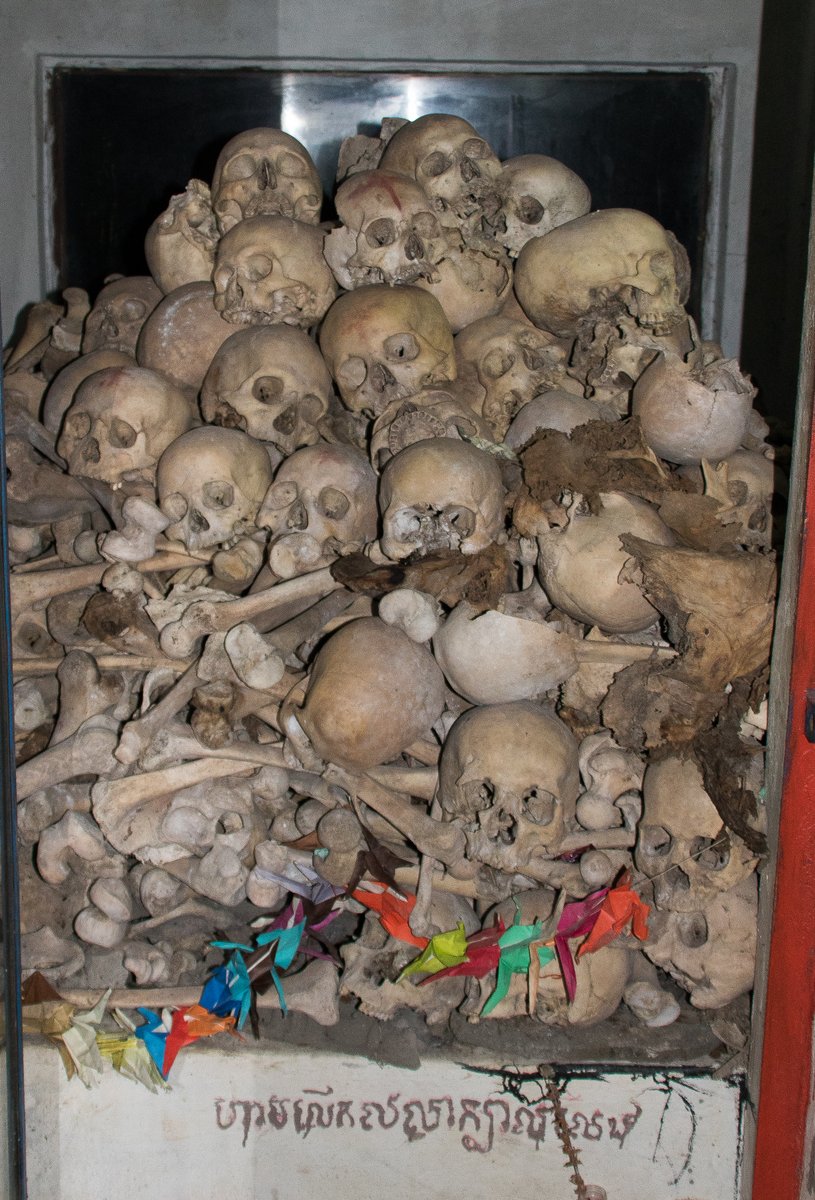
Our first stop was at the Killing Caves. This is our first contact with the genocide carried out by the Khmer Rouge led by Pol Pot in the late 1970s in which over two million people died. Pen took me to a Buddhist temple, which was commandeered by the Khmer Rouge and turned into a prison housing 500 people. The Khmer Rouge interrogated the prisoners, extracted a confession and then bludgeoned the victims to death and dropping their bodies into a set of caves.
There’s a shrine at the bottom of one of the caves with a glass fronted cabinet displaying the skulls and bones of some of the 10,000 people murdered here - very grisly.
Pen and I walked up to the top of the hill, where there are some pagodas. These are not particularly interesting, but there’s a good view of the surrounding area, which is incredibly flat for miles and miles, covered with paddy fields.

We walked back down the hill via a series of dodgy, crumbling concrete steps, had a beer and waited for 17:30 when bats start to fly. There’s a huge cave system at Phnom Sampeau, which is home to millions of Asian Wrinkle-lipped Bats. Just before sunset, the bats leave the cave to spend the night eating flying insects over the rice fields. It’s a spectacular sight with the bats streaming out in a 20 metre wide band, which snakes about the sky.

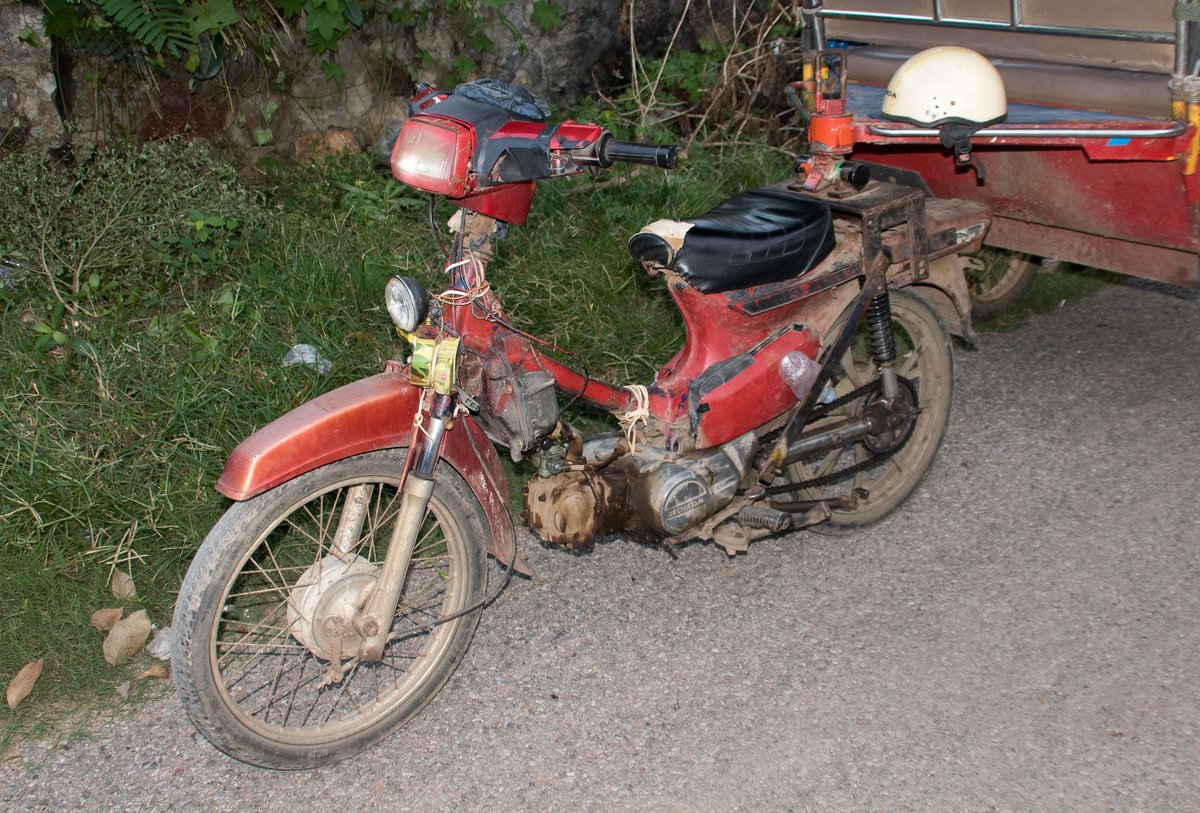
Pen told me that he used to guide tourists up to the top of mount Phnom Sampeau, but two years ago he managed to buy his Tuk-tuk. Unfortunately, his motorbike is very old and dilapidated, so he loses business because tourists want to travel in faster, flashy Tuk-tuks. He’s saving to buy a new one which will cost him $300US. I said that it didn’t bother me about how his motorbike looked - of course, we then we broke down twice on the way back, because his chain came off.
29 October 2016 Battambang, Cambodia
Glenys booked us on a cookery course at the Coconut Lili restaurant. There was only one other person on the course, so it was good fun. Lili (a bloke) first took us to the local market to show us around and buy some ingredients. We’ve obviously spent a lot of time in Asian markets, but the Cambodian markets have many strange things, such as frogs (skinned of course), so it was interesting.


Typically, Cambodian men go out to work and the women stay at home to look after the house and the children, so the market goers were mostly women, bustling about and haggling to get the price down. Lili told us that there are three levels of pricing - the lowest is Women who haggle every day; the next highest is Men who rarely go to the market and don’t know the going price; and the highest price is Tourists. Being a male tourist, the odds of me being overcharged are obviously very high.
Back at the restaurant, we prepared four dishes - Spring Rolls, Tom Yam Soup, Fish Amok, Coconut desert. It was all very interesting and at lunch time, we ate our own food, which was fabulous - the Fish Amok is a traditional Cambodian dish, easy to make and very tasty. The course cost $10 each, which is a bargain considering that you get a four course lunch out of it. Lili was a very good teacher and spoke excellent English.

In afternoon, we chilled out in the hotel room and in the evening, went to a circus. This is run by the Phare Ponleu Selpak Performing Arts School, which is a not-for-profit organisation that provides courses for local children giving them a path to employment as a performer. The evening was a mixture of dance routines with a clown-like story with some impressive gymnastic circus tricks.