
8 November 2013 Isla Secas, Panama
It was a lovely day, so we motored around to another island to the south west of Isla Cavada. There’s a lovely anchorage off a white sandy beach between two smaller islands (07 57.72N 082 02.88W) – it’s the first white sand beach that we’ve seen in the Pacific and is fringed with coconut palms making it stunning. We anchored in 5-6 metres on great holding sand.
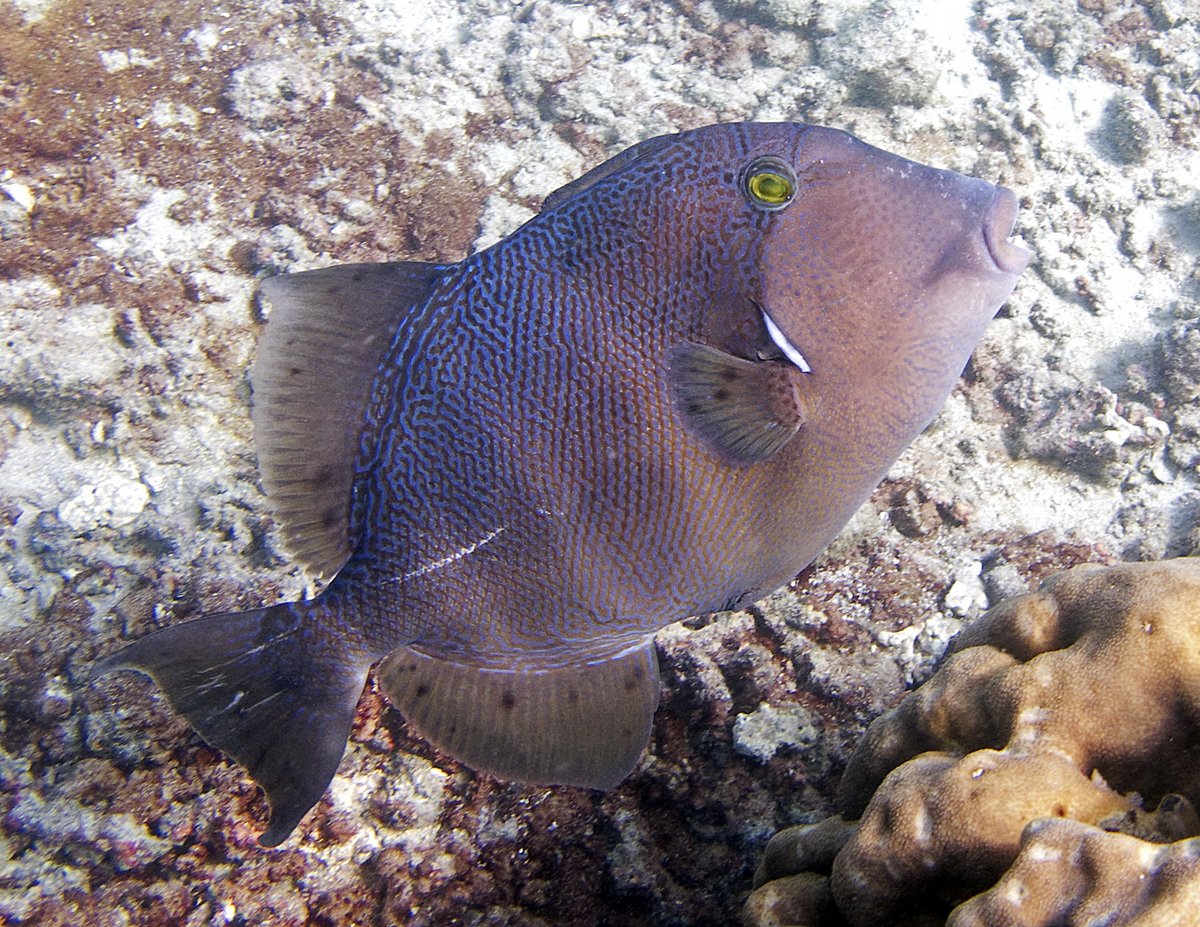
We had a good snorkel around the bay. The visibility was the best that we’ve seen so far and we spotted quite a few more fish that were new to us, including a large Triggerfish. Unfortunately, some swell comes into the anchorage making it rolly, so in the afternoon, we headed back to Isla Cavada, where we knew it would be more settled.
9 November 2013 Isla Secas, Panama
We’re planning to head west tomorrow, aiming to arrive in Golfito in 2 or 3 days’ time – the immigration office is shut on Mondays, so we can only clear in from Tuesday to Friday. The authorities in Costa Rica will want four copies of our ship’s documentation, passports, crew list, exit zarpe from Panama and yellow fever vaccination certificates. It took me a couple of hours to scan and print the documents – what a pain.
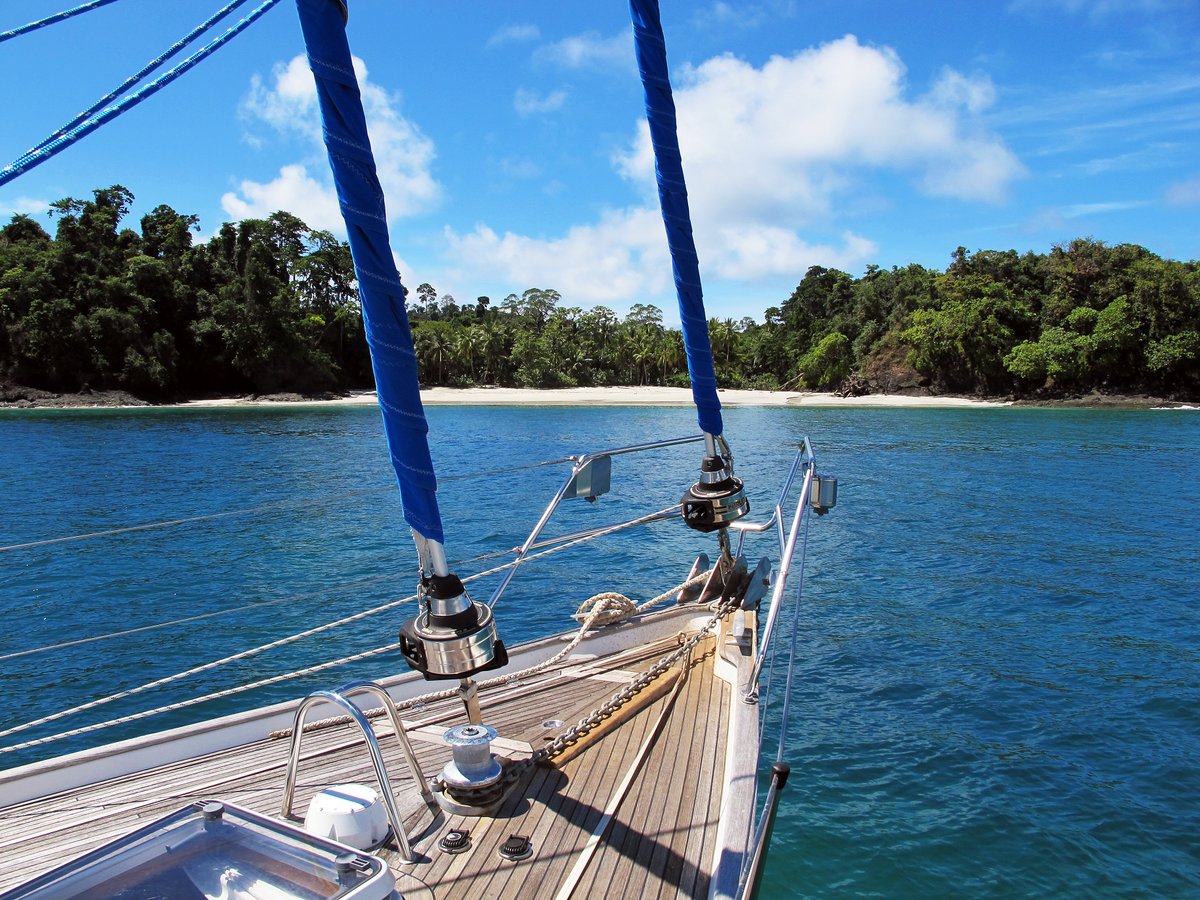
In the afternoon, we went snorkelling off the south point of the small island to the east of the anchorage. It was very good – rocky, but with coral and probably ten metres deep in places. We saw a good collection of fish including a very impressive looking Moorish Idol with a long fin. Unfortunately, Glenys is getting stung by some kind of small jellyfish. It doesn't seem to affect me, but she’s coming out in big itchy lumps. We’ll have to try to get her a full length, thin wetsuit before it puts her off snorkelling.
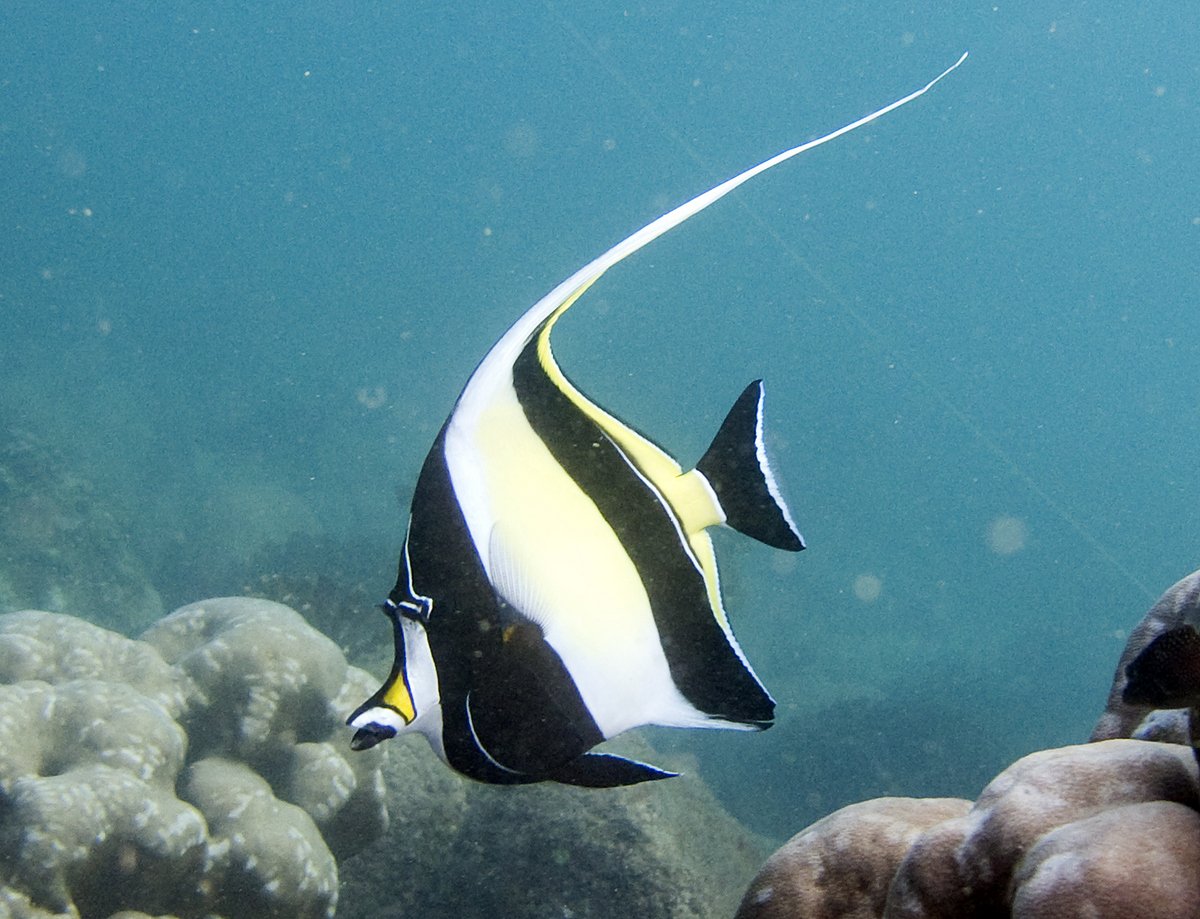
We tidied up the boat after four days in an anchorage, getting ready to sail first thing in the morning. We’re not going to be using the dinghy much when we get to Golfito and we've heard that the Costa Ricans are a thieving bunch, so we lifted our 15hp outboard on deck and I've chained it to the arch. We’ll use our little 2.5hp outboard to get to shore, which I think will be okay in the sheltered harbour.
10 November 2013 Isla Secas to Punta Balsa, Panama
It was back to travelling again. The alarm went off just before dawn and we were under way twenty minutes later. We were heading west into a light head wind (again), so all we could do was to motor. It was a very uneventful 50 mile trip and more than a little irritating to be passing 3 miles to the south of Isla Parida half way, where we didn’t want to stop because of the exorbitant marine park fees.
I had a successful day’s fishing. I lost a small Dorado, which threw the hook by leaping out of the water as I got it close to the boat, but then I landed a nice 4lb Bonito and a large 12lb Dorado – more than enough to last us a few days.


It was a little bit of a struggle to anchor at Punta Balsa. The sea bed drops of very steeply – one minute you’re in 5 metres and then 30 metres away you’re in 20 metres. We found a shallow bank where the cruising guide says to anchor, but we couldn't get the anchor to hold. We tried a couple of times in 7 metres, but it felt like it was dragging on coral rubble. Eventually, we anchored in 10 metres and the anchor held well – it may be snagged on a rock or in good holding sand, who knows?
11 November 2013 Punta Balsa to Golfito, Costa Rica
We had a rolly, restless night and left at the crack of dawn – the anchor came up cleanly, so I guess that the sea bed was sand. It was a mission to get around Punta Barica – nine miles skirting around the shallows and the island at the end of the headland. The sea bed shelves so quickly along this coast that I was panicking when the depth sounder dropped from over 100 metres to 40 metres. To make matters worse, the wind and waves were against us most of the way.
After an hour and a half of motor-sailing, we were able to turn the engine off and sail for a couple of hours. The skies were overcast for most of the rest of the day and the wind was very fickle, so it was frustrating - sailing for an hour, then motoring for an hour. In the afternoon, we had a great sail across Golfo Dulce on a close reach for a couple of hours, with sunshine for a change, but as we approached our destination, the skies over Golfito looked like the depths of Mordor.
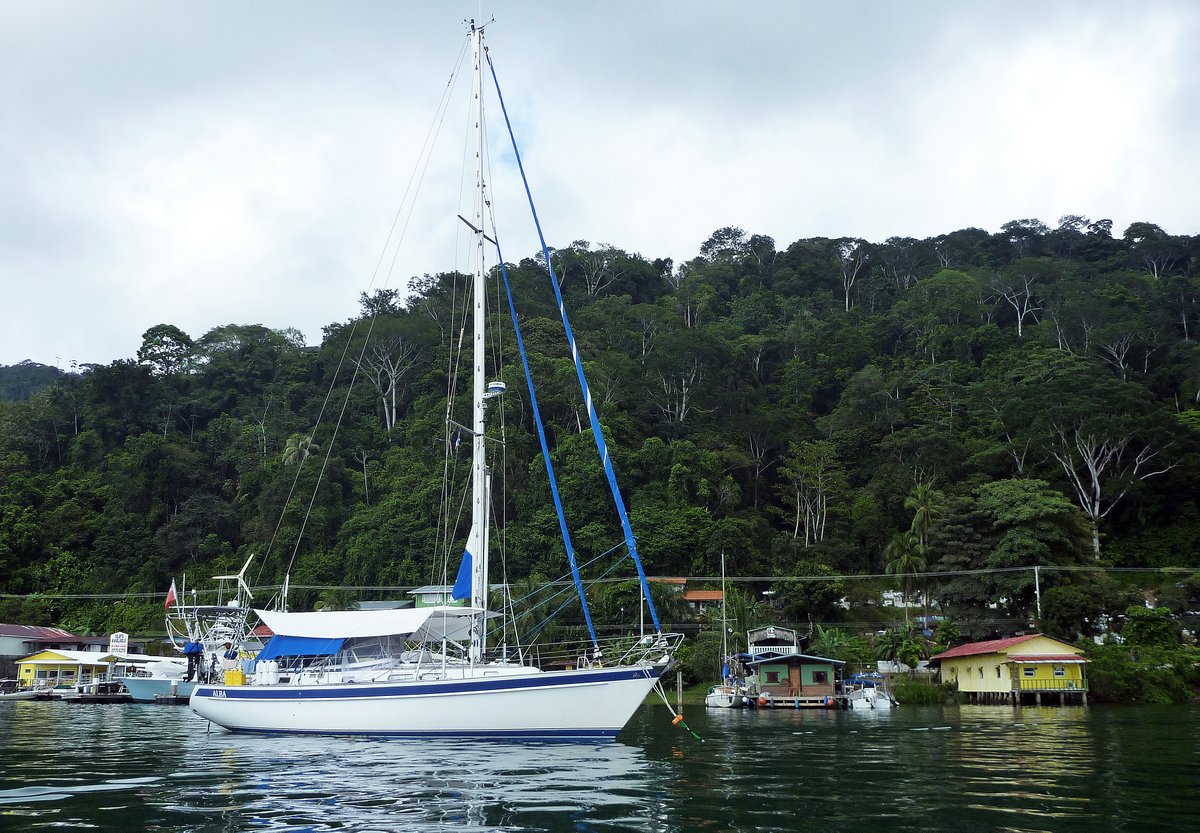
The torrential rain started when we were three miles out of Golfito and continued with a vengeance until we were anchored (with the odd flash of lightning and rumble of thunder.) It dropped down to a fine drizzle for fifteen minutes allowing us to put up our rain protection flaps, before it started to lash it down again. We retired below and watched a movie with a plate of Dorado with Creamy Mushroom Sauce.
The lightning was pretty bad in the evening. All I could do was hope and pray that we wouldn't be hit. We've managed to survived five months in Panama’s rainy season and it would be a bummer to be hit now - a mere week before we head south into a drier climate. (Touch wood and whistle.)
12 November 2013 Golfito, Costa Rica
I woke up at what I thought was quarter to seven, but it turned out to be quarter to six because Costa Rica is in a different time zone. Glenys got up at half past seven – oops that’s half past six.
After a couple of hours hanging about, we went ashore to Land Sea Services, where we met Tim, the owner of this cruiser-friendly facility. I say facility because it’s not a marina or a yacht club. Tim is an ex-cruiser that has settled here and has a number of moorings which he rents out for $8 per day. He provides various services for boats including laundry, water and a cruiser’s lounge area with an internet connection. It’s a nice set-up, but unfortunately, there are no cruisers here apart from one single-hander who’s a bit odd (as most single-handers tend to be.)
We arranged to pick up a mooring later in the day because Tim confirmed that there has been a spate of thefts on anchored boats and we’ll be much safer on a mooring close to shore. Alba is the only boat at anchor at the moment and, being about ½ mile from shore, we stick out like a sore thumb.
Tim changed us $20 worth of the local currency (Colones). The exchange rate is 500 Colones to 1 US dollar, which is going to take some getting used to after using dollars for the past six months.
We went to clear in, starting at the Immigration office, which was a short ten minute walk down the road. When we showed our documents, the immigration officer gave us a hard time because we didn't have a Panamanian exit stamp in our passports. He didn’t speak any English, so it was difficult to explain that our agent in Panama had sorted out the exit paperwork and hadn't got our passports stamped. Having gone through our paperwork, he told us to go back in an hour and a half and pointed vaguely at their computer system. We went to a local supermarket, bought some food and went back to the boat.
At the appointed hour, we went back to the Immigration office and were kept waiting for another thirty minutes until another Immigration officer turned up and processed our papers. He spoke good English and told us that he’d been checking in a large powerboat and a US Coast Guard ship. It took another twenty minutes to get through the paperwork, explaining why we had no exit stamp in our passports and also why our exit zarpe from Panama was dated the 4th October – where had we been for the last five weeks?
Clutching our stamped sets of documents, we caught a taxi to the Customs arriving just before noon (not a good time to be going to a government office.) To my great surprise, a lady immediately started to process our papers, but then told us to come back in an hour.
The customs office is just outside a duty free zone, where locals can buy expensive items like TVs and domestic appliances without paying any import duty. I believe that every Costa Rican gets an annual allowance to buy duty free goods. Outside the entrance into the duty free zone is a noisy, busy market area full of stands selling clothes, hats, electronic items, etc. Fortunately, there are also some small “Tipico” restaurants – we retired to one for lunch. The food was basic rice and beans with a bit of meat and fairly bland, but a bit of hot pepper sauce soon sorted that out. It was surprisingly expensive costing us $20 for two meals and two soft drinks.
We arrived back at the customs office at one o'clock and were then kept waiting for another ninety minutes. I was getting more and more frustrated because the lady processing our papers just kept saying a little bit longer – she couldn't speak any English and it was hard to communicate. Eventually, another customs officer appeared and sorted out the paperwork. It appears that he was out of the office - I guess that he was probably clearing in the power boat and Coast Guard ship (or out on a long lunch.)
Feeling like the character in Edvard Munch’s painting “The Scream”, we got into a taxi to go and do battle with the Port Captain. We shouldn't have worried, a nice efficient lady had us sorted out in less than two minutes – we were so grateful. The whole process took five and half hours, but on the bright side it didn't cost us anything apart from higher blood pressure.
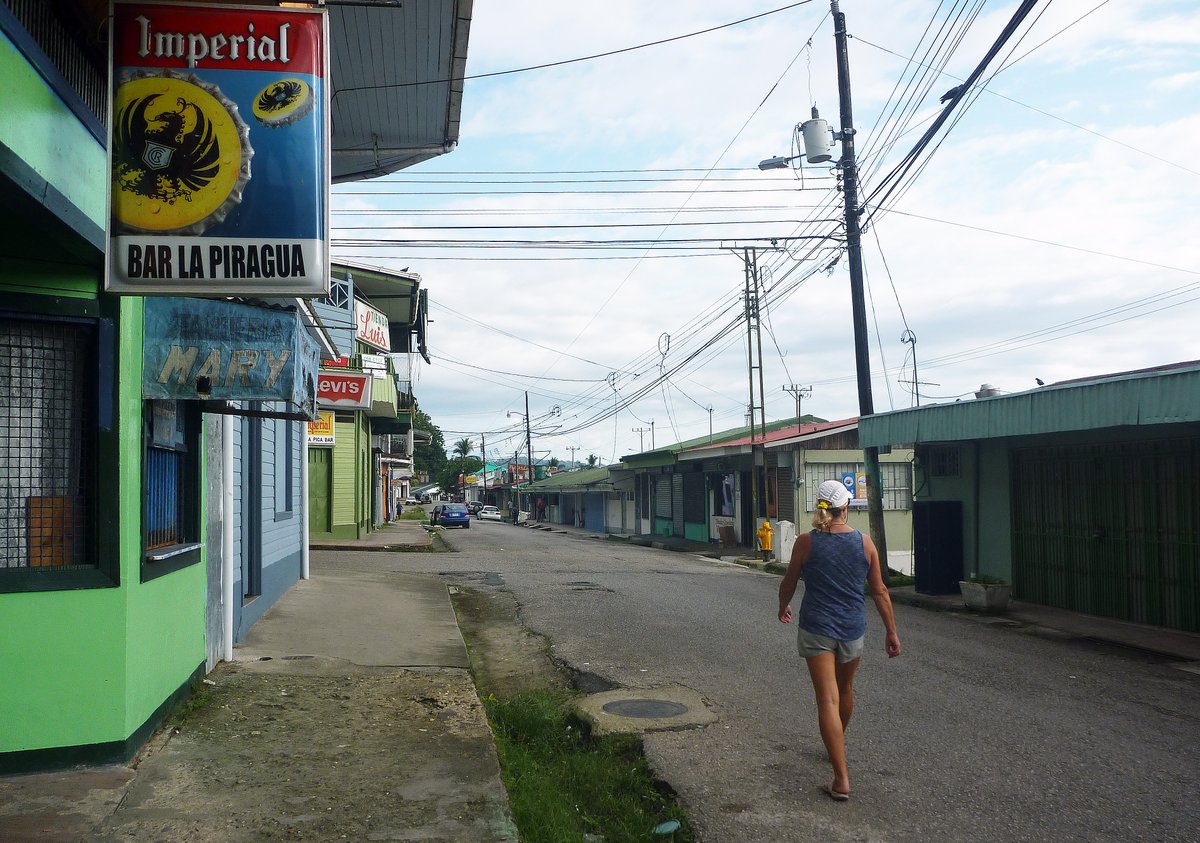
We walked back to the boat, stopping at a few shops on the way. Golfito is a strange place with a road running along the shoreline and steep mountainous jungle towering above it, so there’s not a lot of level land available. Consequently, there’s no real town centre and everything is spread out along the road. The place reminds us of Trinidad – but more run down.
Back at the boat, we pulled up our anchor, picked up the mooring and collapsed.

13 November 2013 Golfito, Costa Rica
We were woken up at one o'clock by the sound of an air-raid siren, followed by the sirens of police cars and a fire engine. A fishing boat in a nearby dock had caught fire and was blazing away with huge flames. This section of the shoreline is packed with small marinas and docks and a fire could easily spread, so it was a little nerve-wracking to have such a big blaze only 400 yards away. Fortunately, they soon had it under control and we could crawl back into bed.
There’s a very good internet connection in the cruiser’s lounge, so we took advantage of it and got on with some serious browsing for most of the day. I finished off our Tax Returns and submitted them on-line. It was tedious, but worth the effort because they’ll be refunding us £400.
We got an email from the marina manager at Shelter Bay, John, saying that two letters have arrived for us. They were sent from the UK in August, so it took nearly three months for the mail to find its way to the correct address in Panama. One of the packages contains a spare pair of contact lenses and glasses that Glenys left behind, so we've asked our friends on “Vanupieds” to pick the mail up for us. They’re going across the Pacific next year, so we should see them somewhere along the way.
Glenys is getting desperate to go horse riding and the best place seems to be on the Peninsula de Ora, which is a short ferry ride away. There’s a national park on the peninsula and it’s supposed to be one of the best places to see wildlife in Costa Rica, so she looked at going over for one or two nights. Unfortunately, the accommodation is either very cheap/rough hostels or luxury “Eco-lodges” which cost over $200 per night. By the time that we add the cost of the ferry, taxis and the horse-riding at $55 each, it all sounds very expensive, so we’ll probably not bother and save our money for travelling in Ecuador.