
26 July 2013 Shelter Bay Marina, Panama
It was our 33rd wedding anniversary today and we both forgot until I switched on my laptop and received a reminder. I gave Glenys a kiss and that was the end of our celebration - who says romance is dead.
I went to see the Boat Yard Manager to make sure that we would be hauled out tomorrow. To my horror, I had to pay up-front for the haul out and for seven days on the hard – that’s another $1,000 leaking out of our bank account. Back on the boat, I depressed myself further by reconciling our bank accounts and discovering how much we’ve spent in the past month.
Glenys took a load of washing to the launderette and sweated in the 35 degree heat with 80% humidity – welcome back to Panama… Then in the afternoon, she went to the shopping mall on the marina courtesy bus to buy some provisions.
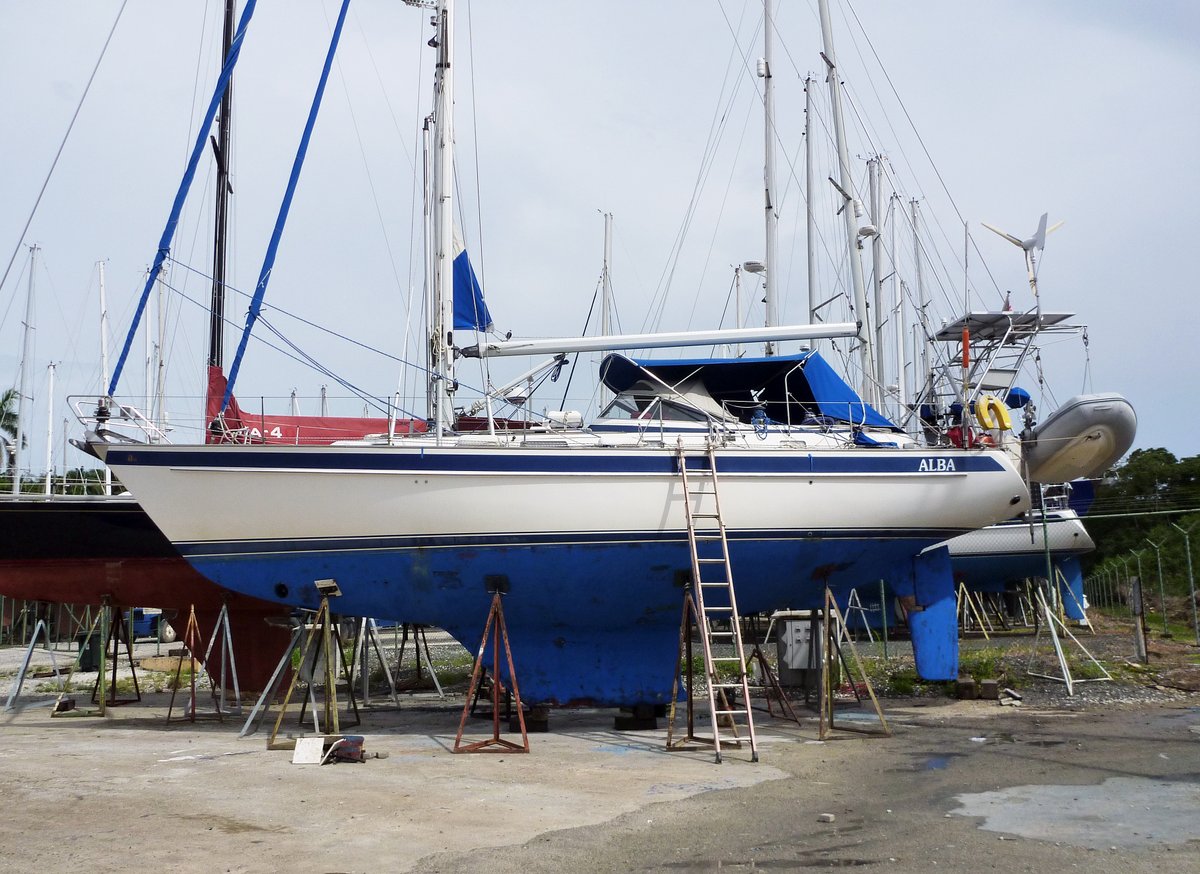
I spent the rest of the day updating my to-do-list and preparing for the haul-out.
We have six main jobs to do:
1. Replace the Lower Rudder Shoe – this holds the bottom of the rudder in place. The bearing surface has worn, making the rudder rattle when we’re going down wind. So I've carried a new Lower Rudder Shoe back from the UK.
2. Replace the Upper Rudder Bearings and Seals – we have a slight leak from the seals, so I've decided that while I'm working on the rudder, I might as well replace the top bearings.
3. Sort out the leak in aft bilge – we have water seeping up through the floor of the bilge through small cracks. I've been told by Hallberg Rassy that the water is probably seeping past the outside of the stern tube, so I have to seal it.
4. Change the engine timing belt
5. Change the leaking crankshaft oil seal on the generator
6. Apply anti-fouling paint to the hull. It was only done a year ago, but we’ll probably not haul out again until we’re in New Zealand in eighteen months’ time.
I'm hoping that if all goes well, we’ll only be on the hard for a week…
27 July 2013 Shelter Bay Marina, Panama
We were up early and motored around to the haul-out dock. Every boat yard has a different procedure for hauling out and this was one of the most thorough that I've seen– the boat yard foreman (Victor) actually dived into the water to make sure that the slings were in the correct place and weren't going to damage anything underwater.
Once we were out of the water, the bottom of the boat looked pretty good with very few barnacles and only a bit of green slime, but I had them give it a good pressure wash – we've already bought three gallons of anti-foul paint which should be enough for two full coats of paint.
By late morning, they’d moved Alba into the working boatyard, secured the stands and we had the air conditioner working - it was very pleasant on board again. After lunch, it took a great effort to drag myself outside into the heat and start work.
I managed to remove the propeller without too much trauma, but removing the cutlass bearing housing was a mission. I didn't have a pipe wrench big enough to do the job, so I wandered around and borrowed some tools from Dave on “Elisium” and Jerry on “Vida Dulce”. Dave kindly came over and gave me a hand to get the damn thing off – it took two of us to get it to unscrew from the stern tube.
I then cut away the fibre glass sheathing from the Lower Rudder Shoe, but couldn't move any of the seven bolts holding it in place, which have very large screw-driver slots rather than hex keys. I’ll have to come up with a solution tomorrow.
We have a large inventory of paper charts that cover the Caribbean, which we no longer need if we’re going across the Pacific Ocean, so Glenys took fifty charts to the marina lounge and left a notice on the notice board that there are free charts available.
Pretty exhausted, we fell into bed at half past eight.

28 July 2013 Shelter Bay Marina, Panama
It didn't rain for most of the day, so I managed to get a fair amount of work done, but it was all frustratingly slow. My aim was to replace the upper seals and bearings on the rudder shaft, which was easier said than done.
I removed the mattresses from the aft cabin, exposing the top end of the rudder shaft and the steering mechanism, then spent an hour making sure that I understood exactly what I needed to do and documenting the positions of the various components – I need to get everything back into the original positions to make sure that it all works correctly.
It took me over an hour to remove the autopilot arm and the steering quadrant. I then removed the upper bearing assembly – that took another couple of hours because everything was seized and in a tight location. At one point, the instructions from Hallberg Rassy say “Slide off the upper collar and radial bearing”, what I actually did was to “struggle for an hour, while hanging upside down, hammering the bearing using a large screwdriver and a 2lb lump hammer, ensuring that knuckles on both hands are bruised.”
With the upper bearing assembly removed, I loosened the lower bearing assembly and tried to lower the rudder as per the instructions, but the lower bearing assembly was firmly seized in place. After an hour of “coaxing” with my trusty 2lb lump hammer and anti-seize oil, I managed to move the locking collar about an inch, but I couldn't get it off the shaft.
I think that I'm going to have to remove the rudder completely, so I separated the Lower Rudder Shoe from the skeg. This wasn't simple either – I had to grind a chisel to fit the slots in the seven screws that I couldn't budge yesterday, but after an hour, I had the bolts out and the shoe removed. The rudder is now only supported by the seized lower bearing assembly, but I still can’t get it to drop down – very frustrating.
We packed up at five o'clock and had dinner on-board. I was so tired that I went to bed half way through watching a movie – I'm obviously not used to this physical labour.
29 July 2013 Shelter Bay Marina, Panama
First thing in the morning, I went into the boat yard office and arranged for the yard to prepare the bottom of the boat and to apply our three gallons of anti-foul paint. It’s going to cost $500, but it saves us three days of hard labour and means that I can concentrate on the rudder problem, which is more critical.
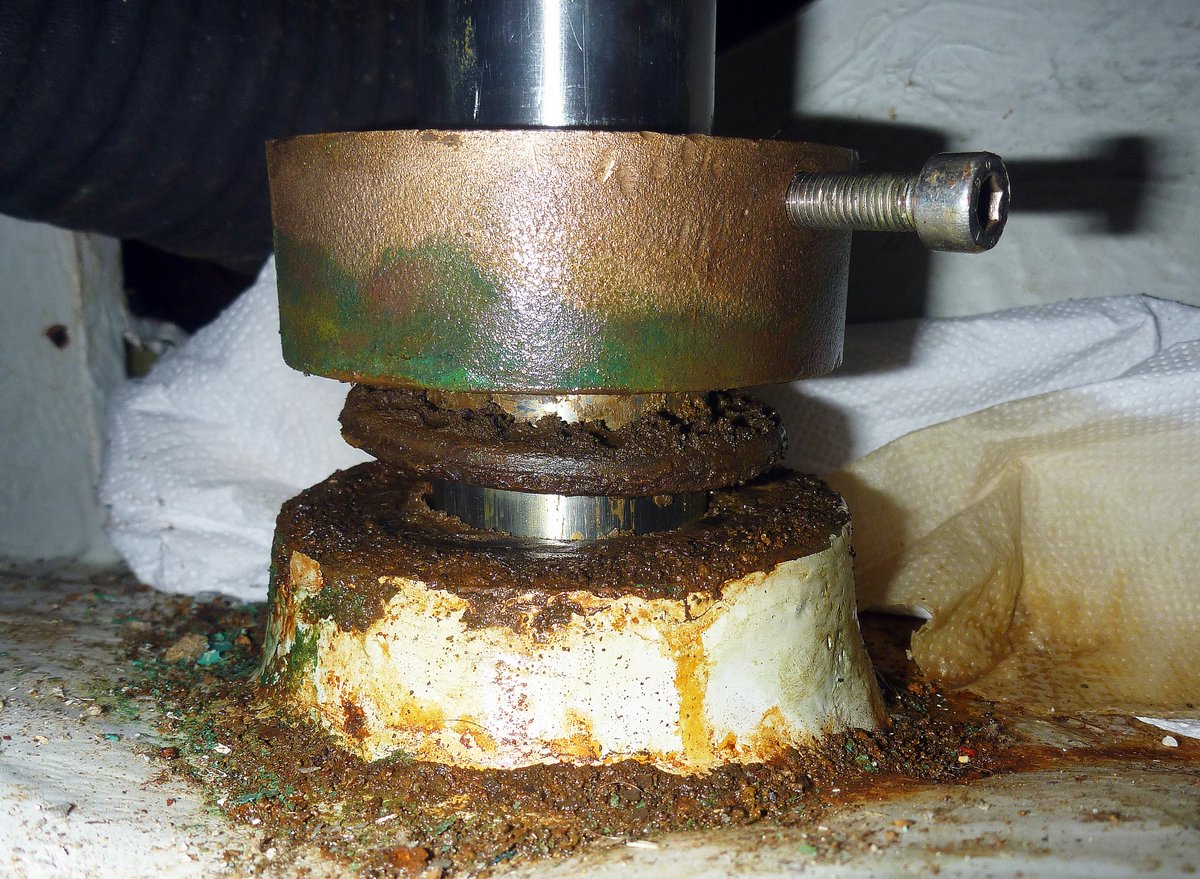
It threw it down first thing in the morning, but by ten o'clock it was dry enough to work outside. I spent an hour trying to twist, lever and hammer the bearing assembly on the rudder, but couldn't shift it. I asked Greg, the local mechanic, to have a look at the problem. He spent another fifteen minutes twisting, levering and hammering the bearing assembly with his sledge hammer, but we weren’t any further forwards.
After a quick discussion, Greg agreed with me that the only way that we were going to shift it was to heat the bearing assembly to expand it a little and then to hammer the rudder shaft down to lower the whole rudder out of the boat. Using his propane torch, Greg started to heat the bronze sleeve around the bearing assembly, but after a few minutes, the valve on his propane torch started to leak and it flared up with 2 foot high flames. Fortunately, I had a fire extinguisher close to hand and soon put it out – it's the first time that I've had to use an extinguisher in earnest. Greg was okay – he just lost some hairs off his forearm.
Greg went off to find another propane torch, so I had a "bash" at knocking the shaft down and discovered that I could move it! By the time he came back ten minutes later, I’d managed to move the shaft by two inches – heating the bearing collar had obviously worked. I told Greg that I could finish off by myself and, two hours later, I had the rudder lowered to the ground with the bearing assembly & the leaking shaft seals removed.
I spent the remaining part of the afternoon cleaning the various parts and fitting the replacement seal and lower bearing. This was more complicated than it should have been because I had to grind out the inside of the bearing which was too tight on the rudder shaft and I also had to re-tap the locking screw holes in the locking collar. By the end of the day, the rudder was suspended on the lower bearing assembly – all I have to do now is to refit the upper bearing, and reconnect the autopilot and steering mechanism.
Glenys spent most of the day cleaning the topsides with “Off & On” which is a marvellous, if highly toxic chemical, which really whitens up the fibreglass.
We went to the bar for happy hour and dinner.
30 July 2013 Shelter Bay Marina, Panama
The electricity went out again last night. I've been told that the local villains drop a tree onto the electricity cable running along the side of the road and when the power goes off, they roll up a substantial length of the copper cable and steal it. It happens quite regularly.
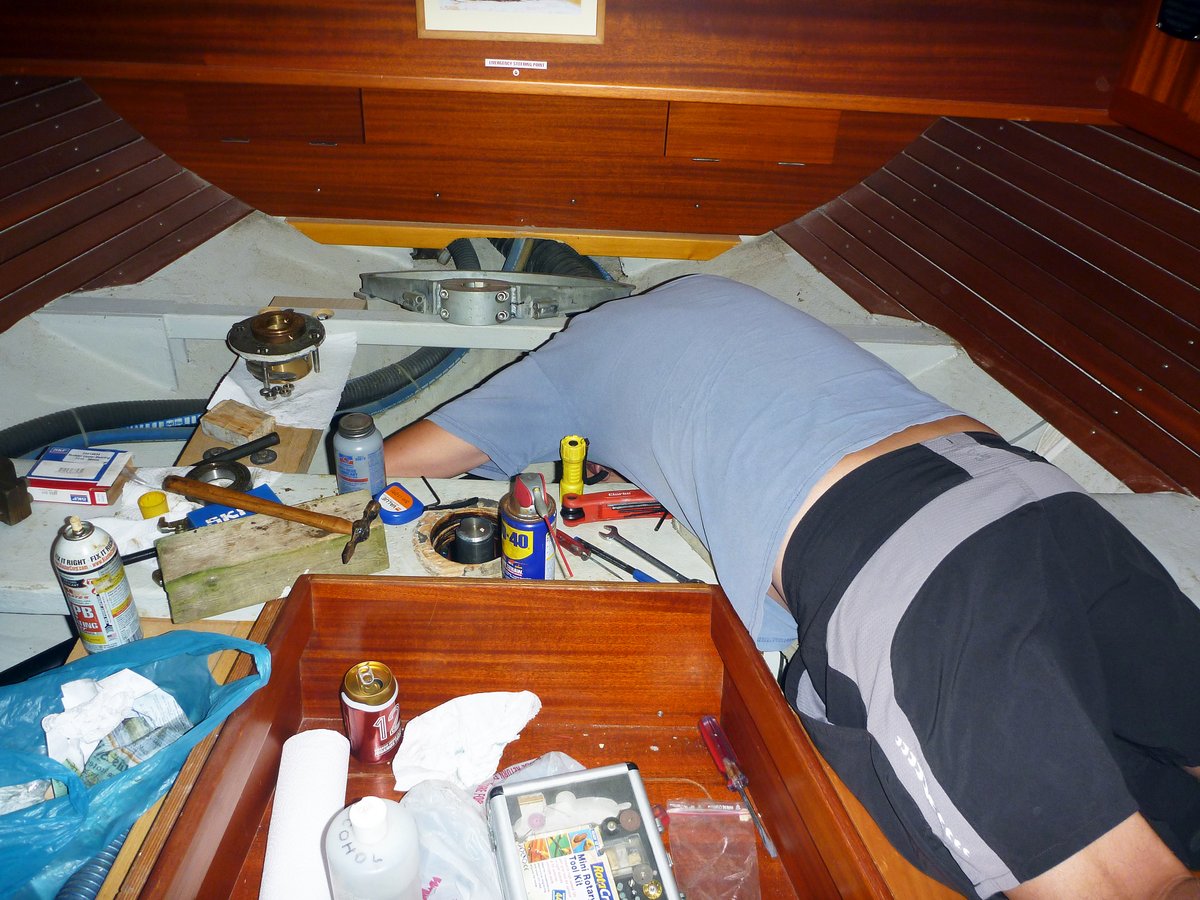
Glenys went off to the shopping mall, while I continued to put the rudder bearings and steering gear back together. It all went fairly well, with only a couple of traumas and I had it all finished by two o'clock in the afternoon. Meanwhile, the yard labourers were working on the bottom of the hull, preparing the surface for the anti-foul paint.
With the upper bearings sorted on the rudder, I tackled the Lower Rudder Shoe. This is a large phosphor bronze casting which splits into two halves, fitting onto the bottom of the skeg and has a bearing surface that holds the bottom of the rudder shaft. To ensure a tight fit to the skeg, the inside of the casting is filled with runny polyester paste.
I’d already removed the old shoe a couple of days ago, so I first chipped away the old polyester filler around the skeg, so that I could dry-fit the new shoe in place. As expected, none of the seven mounting holes in the new casting lined up with the holes drilled though the skeg, so I blocked them off with polyester filler ready to re-drill tomorrow . Actually, Dominique from “Kea” did it for me – he’s on the catamaran next door to us and used to run a fibre-glassing business back in France. He kindly offered to help me with the small bits of fibre-glassing that I have to do over the next couple of days.
Dominique and his wife (who is also called Dominique) are repairing the hull of their catamaran after they dragged onto a reef in the San Blas islands. They were hit by a very strong 60 knot squall and, despite running both of their engines, their two anchors didn't hold and they ended up on a reef. A small freighter happened to go past a couple of hours later and towed them off the reef and to Shelter Bay Marina for $1,500US (which is a bargain.) They've suffered extensive damage to both rudders and the bottom of their hull, but fortunately Dominique has the skills to repair it.
We had a quiet night in – a nice rotisserie chicken that Glenys bought at the supermarket today – yummy.
31 July 2013 Shelter Bay Marina, Panama
We had another huge thunderstorm in the early hours of the morning and it was still raining when we dragged ourselves out of bed. However, it soon started to brighten up – this seems to be the weather pattern here.
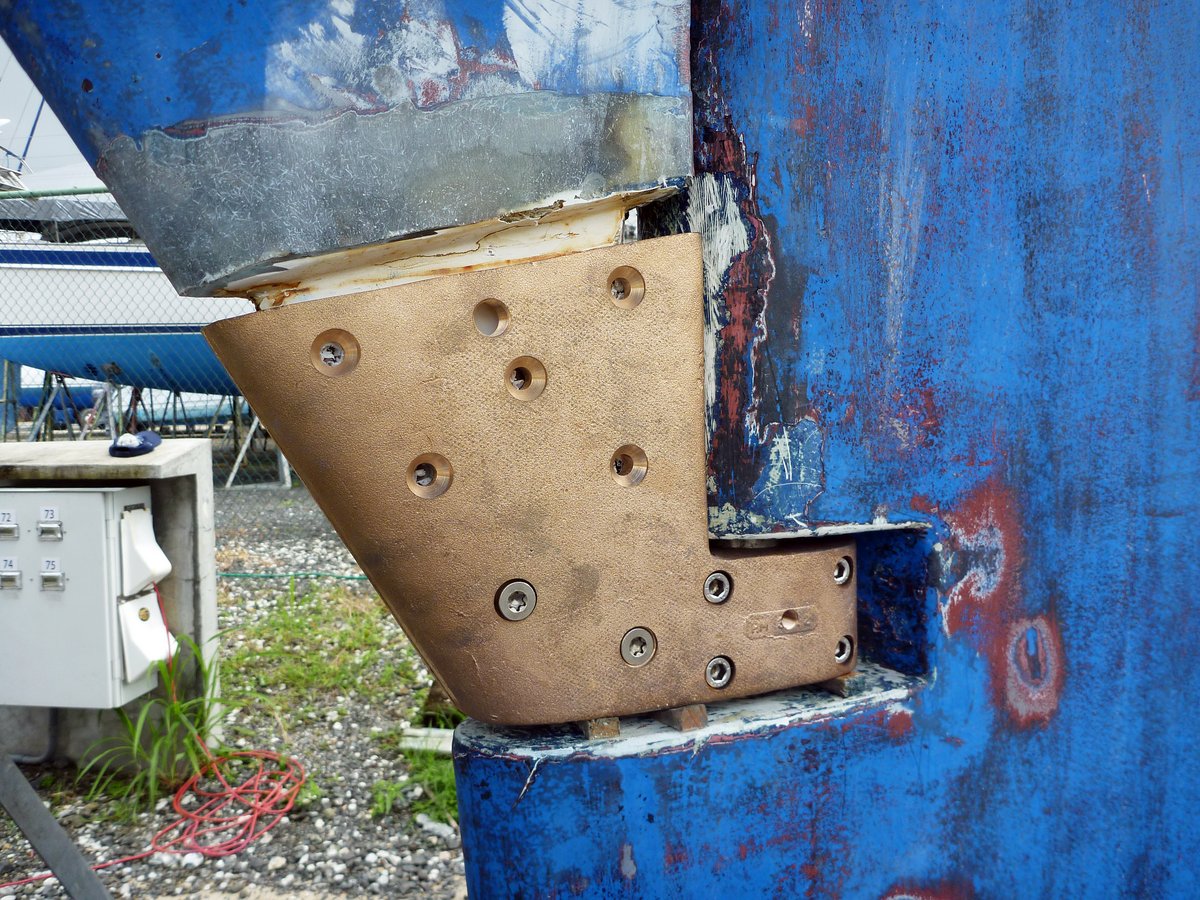
I spent most of the day fitting the Lower Rudder Shoe to the skeg. It took ages to drill the five new holes through the fibre glass skeg because I had to keep putting the shoe on and off to ensure that the holes lined up correctly. Once I had the shoe bolted up and held in place with wedges, Dominique came over and poured some very runny polyester filler into the cavity between the shoe and the skeg, effectively moulding the skeg to the inside of the shoe casting. A little later, he came over and used some thicker polyester paste to fair the outside of the casting to be flush with the rest of the skeg.
All I had to do then was to cut off the ends of the bolts protruding through the side of the casting and pump some grease into the bearing journal.
Once finished, I turned my attention to the stern tube. I've been getting water seeping past the stern tube and appearing in the aft bilges, so I want to put some sealant around the stern tube. I spent an hour scraping out the old sealant. It’s a bugger of a job because the sealant is at the bottom of a 30 mm deep slot that is only 4 mm wide. The only way that I could do the job is to use a very small screwdriver as a scraper - very tedious.
I've now got to put the new sealant around the stern tube, but ground to a complete standstill because I can’t figure out how to do it with the supplies that I have. I really need a syringe; a small diameter, two inch long tube; and some sealant that is fairly runny. The tube of 4200 sealant that I have is far too viscous and the nozzle is far too wide – Glenys is going to go to the hardware store tomorrow morning to try to buy some syringes.
The yard labourers put the first coat of anti-foul on today – they've not painted the rudder because I'm working on it, but they’ll be able to do that tomorrow. Things are looking good – I just need to sort out sealing the stern tube and we’ll be able to get back into the water.
- << Prev
- Next