
8 June 2013 Red Frog Marina, Panama
It was my “official” 57th birthday today. While I've been getting older, I've noticed that my eyebrows are getting bushier and have horrible long, grey, wiry hairs. In an attempt to stop me looking like Dennis Healey, I've been plucking the offending hairs out with tweezers. God knows how women cope with doing this all the time because it bloody hurts. Glenys has obviously become weary of me moaning about the pain because she’s bought me a Nose and Eyebrow trimmer for my birthday – old age is a terrible thing.
It absolutely threw it down in the morning, but this didn't stop Glenys the washing woman, dashing off to use the laundry room – she’s done six loads of washing since we arrived here. I chilled out using the very fast internet connection and ordered some more things to be delivered to the UK.
Thankfully, the rain stopped in the afternoon and the BBQ party was a great success with 30 or so people attending. The BBQ was good, the band was good and the free beer and rum punch was even better.
Later in the afternoon, we started to walk over to Red Frog Beach on the other side of the island, but a guy pulled up in a golf cart and offered us a lift. He turned out to be the manager of the villa project that is being built on the island and took us for a guided tour of the place. There’s quite a little community of small villas that have been built on the side of the hill overlooking the sea. Most of them have been bought by people who rent them out to holidaymakers – it’s very tastefully done but I wouldn't like to live there because it’s such a false environment.
9 June 2013 Red Frog Marina, Panama
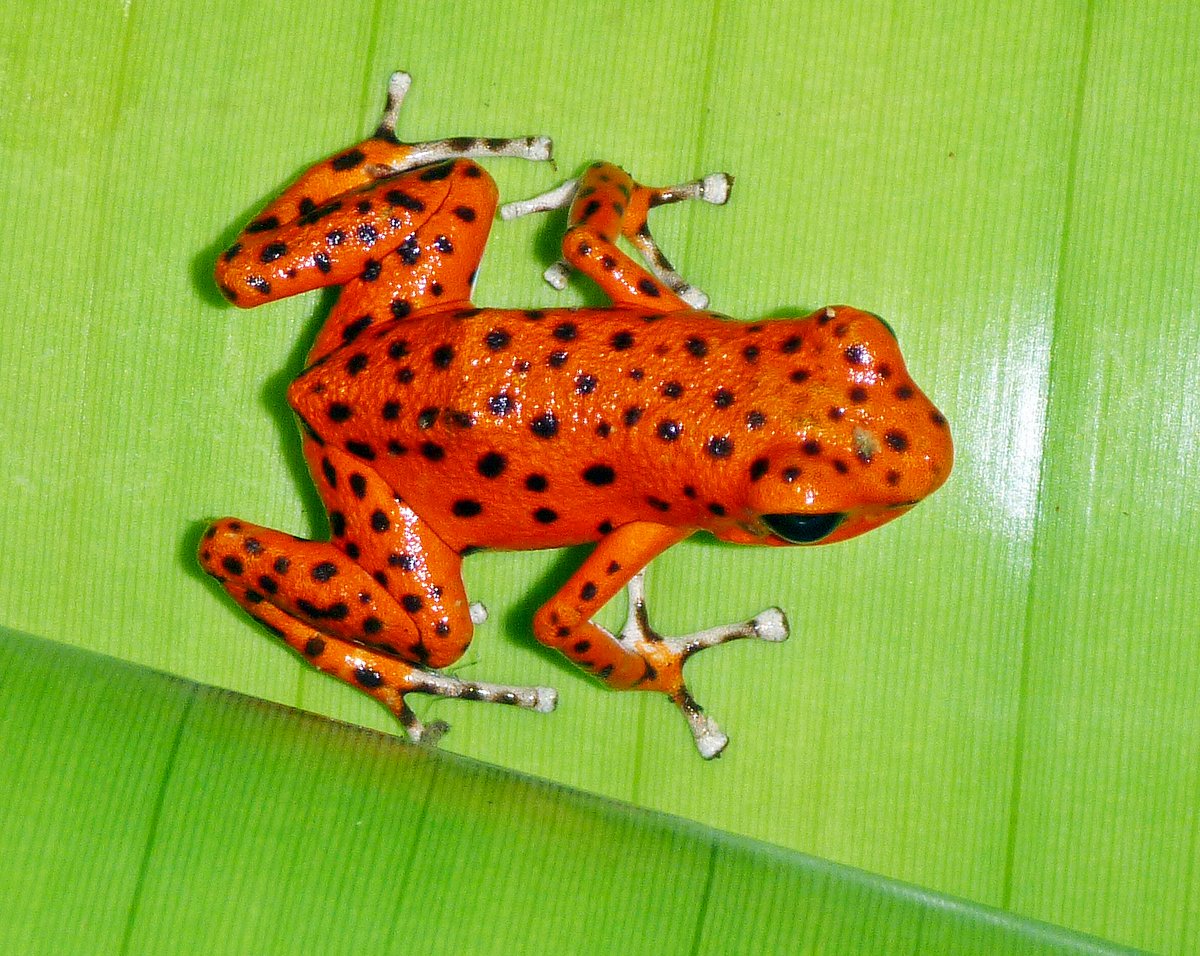
It was a much nicer day, so we went for a walk along a trail that leads through the jungle to one of the remote beaches on the island. We've heard that there are three toed sloths on the island, so we were keen to see one of them. Also, this island (Bastimentos) is famous for a red variety of Strawberry Poison Dart Frogs – hence Red Frog Marina.

We didn't know whether to look up into the trees for sloths or down at the ground for frogs, so our progress was very slow, but it was great to be back in tropical rain forest again with the sounds of many bird calls around us. After an hour of desperate searching, we finally spotted a couple of the frogs and they are tiny - they’re only ¾ inch long. I was so excited to find them and took lots of photos, one of which I'm rather proud of.
The bright colour of the frog is a warning to potential predators that they carry very nasty toxins, which the indigenous Indians use on blow dart tips. We've been told that these toxins are so nasty and so novel, that they have attracted the attention of biochemists, who are interested in figuring out how they work, and whether they might have practical uses for human medicine. Their efforts have been used to create a pain-killing drug that is said to be two hundred times more powerful than morphine.
We’ve also been told that the colour of the frogs on Bastimentos is unique and that frogs on other islands in the Bocas have different colours – on Pope Island they are green; on Cerro Brujo, dark blue; on Nancy Key, orange; and on Bocas Island, green and yellow with black polka-dots. The collector in me wants to go and photograph all the different colours…
Having terrorised the little frogs for ten minutes, we wandered on looking for sloths and found one high up in a tree. We could clearly make it out with our binoculars, but it was too far away to get a photograph unfortunately. Our walk finished on north Beach and we wandered back spotting one more frog crossing a path. Good little trail.
We filled up with water at the marina, bought some petrol for the outboard and went all of 400 metres to an anchorage just outside the marina. We had a quiet afternoon, browsing the internet and playing musical instruments.
10 June 2013 Red Frog Marina, Bocas, Panama
The weather forecast was for thunderstorms and showers, so we decided to stay in here for another day. A large squall came through just before lunch with gusts of 30 knots and torrential rain, so we’re glad that we stayed put.
We spent most of the day taking advantage of the good internet connection and reading up on the Galapagos and Easter Island - we’ve heard that it’s very expensive to stay in the Galapagos Islands and we’re trying to decide whether to bother to go there.
The regulations in Galapagos seem to constantly change and there’s a great deal of confusion about what the fees are – the cost seems to vary depending on which island you clear in at. We’ve heard estimates between $600US and $1,200US to stay for a month. In addition, to see most things you have to go on guided tours, which on average seem to cost $100+ per person, so it would be very easy to spent $2,000US over a few weeks. After reading lots of online information and blogs, we’re still not sure how much it will cost. I sent an email off to a clearance agent in Isabella in the Galapagos, hopefully he'll reply in a few days.

Another major decision that we have to make is whether to go directly to the Marquesas with the hundreds of people who cross the Pacific each year, or whether to go to the Gambier Islands stopping off at Easter Island and Pitcairn Island. Not many people go that route because it can be difficult to anchor at both Easter Island and Pitcairn Island, but the opportunity to see these to remote places is almost too much to resist. The trouble is that the Marquesas sound beautiful as well…
Perhaps we’ll sail Galapagos – Easter Island – Pitcairn – Gambier Islands – Marquesas. That would be 4,200 miles instead of 3,000 miles directly from Galapagos to the Marquesas, but the voyage would be split up into 4 smaller passages, the longest being the 2,000 mile trip to Easter Island. Sounds like a plan to me.
11 June 2013 Red Frog Marina to Dolphin Bay North, Bocas, Panama
It was a nice sunny day today, so we upped anchor and headed for the Bocas Town anchorage. There's a very shallow patch of reef in the outer part of the anchorage that we needed to avoid. The inside of the reef is fairly shallow, but we managed to motor through it when we arrived here from St Andres last week - the shallowest depth that we saw then was 2.5 metres.
It's quite a long way around the reef, so I decided to go through the shallow area again, where there are a few boats on moorings. All went well until the depth dropped quickly down to 2.5 metres and then slowly decreased until we started bumping the bottom at 2.0 metres. We were still moving, so thinking that this was an isolated shallow patch, I increased the engine power and ploughed ahead. 25 metres later, we were hard aground with the depth gauge reading 1.8 metres. Glenys looked aghast at me and asked, "What were you thinking?"
We were at low tide, but unfortunately, the tides here are not at regular 12 hour intervals and the next useful high tide was in the middle of the night - very embarrassing. My first cunning plan was to use the dinghy to heel Alba over using a spinnaker halyard and to try to plough on to get through to the anchorage 50 metres ahead. We managed to push ourselves another 10 metres onto the sand bank before we couldn't get any further.
By now, we'd attracted a lot of attention, and a few people came over to offer help and advice. Comments like "It's very shallow here"; “We’re at low tide now, wait for it to come up” and "Lots of people go aground here" were not what I wanted to hear. We gave up and had a regroup, sitting in the cockpit, while Glenys shook her head and repeated, "What were you thinking?"

I put on my snorkelling gear and went to survey the sea bed. We'd made an impressive, one foot wide furrow in the sea grass that stretched 50 metres behind us. It didn't look very promising ahead of us either - it was hard to gauge the depth, but it looked to be getting shallower before we would be in the anchorage 50 metres away.
I decided on Plan B - rather than waiting for over 12 hours for high tide, we'd go back the way that we came. I tied a long rope from our dinghy to the bow of Alba and combined with Glenys using the bow thruster and the main engine, we remorselessly pulled our home around 180 degrees.
I then reattached the spinnaker halyard to our dinghy and pulled Alba over as much as I could while Glenys powered forwards. I could only induce a heel of 10-15 degrees because the outboard propeller was cavitating and the dinghy was veering around all over the place. In addition, we had to stop every few minutes while I repositioned myself, so our progress was very slow, but at least we were moving.
Twenty minutes later, Glenys gave me the thumbs up as she got back into deeper water. The trauma wasn't quite over because, in her enthusiasm to get to even deeper water, Glenys powered away. I'm in the dinghy with a rope running from the top of Alba's mast to the aft end of the dinghy, so I'm being pulled backwards through the water and water is rapidly flooding over the transom. I was in great danger of being pulled under water, which wouldn't be good for the outboard engine. After much screaming and shouting, I managed to attract her attention and didn't sink.
After a few deep breaths, we quietly motored the long way around the reef and anchored safely in 4 metres of water. Totally traumatised, we had a quick sandwich to restore our blood sugar levels and went into town to buy some provisions.
Fully laden with enough food to last a week, we sneaked out of the anchorage and headed for Dolphin Bay. We'd heard on the morning cruiser's net that the Valley of the Frogs Restaurant does a horse riding trip, so we were keen to try it out. Dolphin Bay is a three mile wide, enclosed lagoon with two small channels giving access. We entered via the eastern channel and had been told to look for a green house. Well, we couldn't see it, so I made a general call on the VHF radio and immediately had a guy called Brent giving me directions to find the place. We eventually found it tucked away behind a small headland.

At five o’clock, a panga pulled alongside and Brent introduced himself and said that a few people were going over to the restaurant, so we joined them. There was a large group of ten people gathered; all ex-pats who have bought property in the area. They all communicate by VHF radio and have set up the Bocas Emergency Network (BEN) and they run the cruisers net in the morning. Most of them are cruisers who have put roots down here. They were a friendly group and the meal was good and very filling - $14 for two huge meals. The restaurant owners are 7th Day Adventists and therefore don't serve alcohol, so I had to zip back to Alba to get a few beers.
I sat next to Robert (BEN 68) who only moved into the area two weeks ago. He and his wife, Julie have just bought a property with Cocoa trees and a small chocolate making operation. It sounds interesting, so I said that we’d go over the day after tomorrow and have a tour of his place. Meanwhile, Glenys arranged for us to go riding tomorrow morning.
12 June 2013 Dolphin Bay North, Bocas, Panama
It was bloody horrible weather and raining heavily, so Glenys went over and cancelled the horse riding.
We managed to get an intermittent Internet connection, so I ordered a few more spares to be delivered to the UK. Glenys continued reading about the various places and routes in the Pacific and we've more or less decided that we'll go to Easter Island. This means that we can be in the Galapagos Islands a month earlier than the crowds, go to Easter Island, Pitcairn and the Gambier Islands and still be in the Marquesas by May. So our plan now is:
Jul 2013 Fly back to UK
Aug 2013 East Panama & San Blas
Sep 2013 Transit the Panama Canal
Oct to Dec 2013 Ecuador
Jan 2014 Galapagos
Feb 2014 Easter Island
Mar 2014 Pitcairn & Gambia
April 2014 Sail to Marquesas
May to Oct 2014 Pacific Islands
Nov 2014 Sail to New Zealand
Sounds easy enough, but we’ll probably be sailing 9,000 miles from Panama to New Zealand which that’s quite a way in only 14 months – we’ll be at sea for 20% of next year.
The torrential rain reduced to light drizzle in afternoon, so the local Indians came out in their dugout canoes and started to fish. This is certainly a tranquil, beautiful place and little reminiscent of the Lake District with green pastures, mountains in the distance – and the rain. However, we have Bottlenosed Dolphins splashing around the boat and small rays gliding past just showing their wing tips like some strange type of shark. The jungle is never far away and around five o'clock, the parrots start to fly overhead on their way to night time roosts. They always fly in pairs, taking a very straight route and are constantly squawking, which is now our signal to open a cold beer.

As the sun went down, we had an invasion of flying creatures with four wings, so Glenys put up the mosquito netting to keep the little devils out. We found out later that these are flying termites, which shed their wings just like we get flying ants in the UK, but these are twice as big - yuk!
13 June 2013 Dolphin Bay South, Bocas, Panama
We pulled up our anchor and started to motor across the bay to the Cocoa farm owned by Robert and Julie. On the way, they met us in their panga and said that they were going into town today, so we said that we'd meet up with them either this afternoon or tomorrow morning. We continued across the lagoon, anchored off their property at the south side of Dolphin Bay and got on with some jobs.

Robert & Julie turned up at half past three, so we went ashore to have a look around. Their property is on the mainland and covers 80 acres, which has been carved out of the native jungle. They have a good sized house, but there are no services – no electricity, no water, no telephone, there isn't even a road within ten miles. So they have solar panels for electricity, catch rain water, use the VHF radio for communication and their transport is a panga with a 115hp outboard. It’s like living on a boat.
We had a guided tour of the property, which was set-up by another ex-pat, 16 years ago. The land is very well maintained with good paths and some landscaped areas near to the house. The whole property is essentially still rainforest with tall trees providing a canopy for the cocoa trees which are growing in the shade. Two Indians from the nearby village come in and tend the land for $40US per week – and that’s a good wage around here.
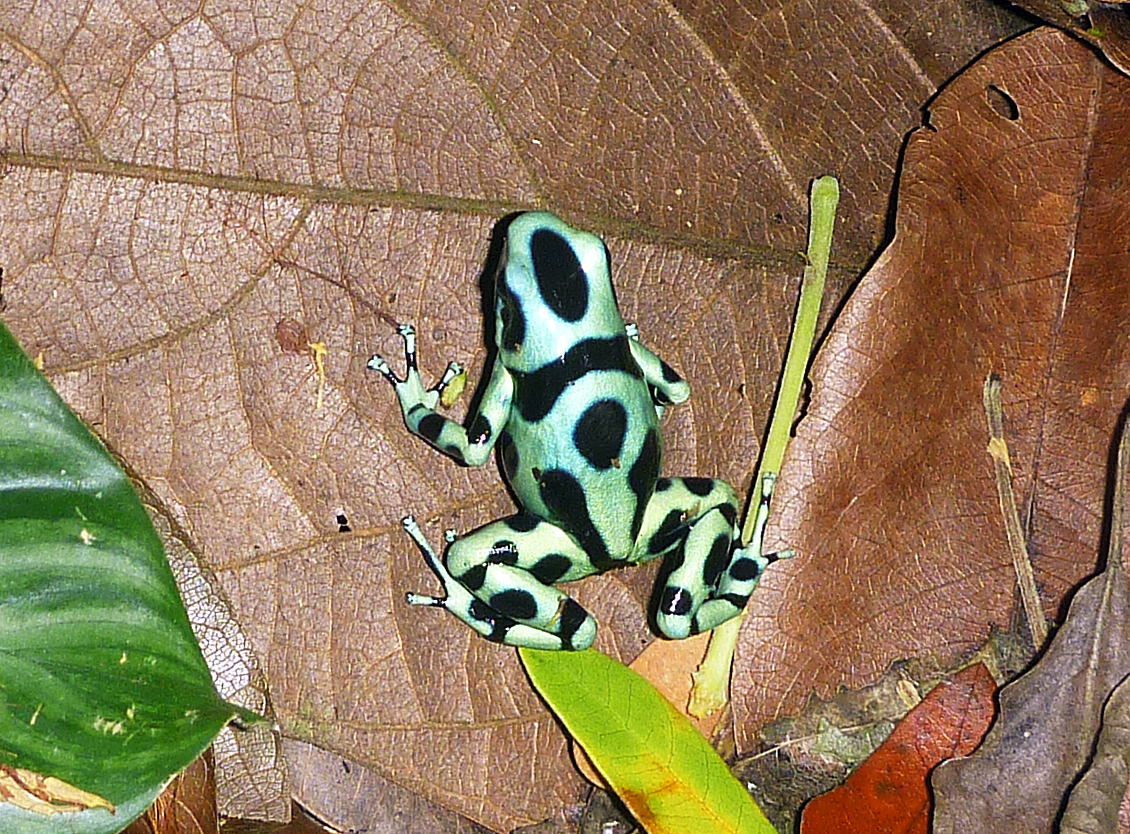
We saw another species of Poison Dart Frog - this one is light green with big black blotches; it’s also much larger being two inches long. Robert is a font of knowledge and showed us various plants and trees as we walked around – I was most impressed with the Walking Palm that he showed us – it puts down air roots and can slowly move at a rate of one foot per year across the ground to get better sunlight.
The cocoa trees have tiny white flowers that only open for a single day. The flowers have both male and female sex organs and are only pollinated by a particular type of gnat, which lives on rotting cocoa husks that are left on the tree. If a flower is pollinated then a cocoa pod will grow. Strangely, the flowers can pop up anywhere on the tree, so pods grow in very peculiar places on the tree such as the middle of the main trunk rather than on the ends of branches.
The cocoa pods are harvested twice a year when they turn yellow – September being the next crop. If there aren't enough ripe pods to process efficiently, then Robert will get the local Indians to go out into the jungle and harvest wild Cocoa pods for which he pays $0.04 each. The Indians like this work because they can earn hundreds of dollars in a short period of time.
The beans are removed from the yellow pods and put into three foot long wooden boxes and left to ferment for four or five days. The fermented beans are laid out on a drying platform and dry in the sun, which takes about a week. The dried beans are then taken into the chocolate making shed for processing into chocolate (and when I say shed, I mean a 12 foot long shed…)

The previous owner has assembled a collection of very Heath Robinson, home-made processing machines. The beans are first placed in a roasting machine which is made from an old propane gas cylinder with a small 12 volt motor rotating it over a propane burner. Next, the beans are put through a grinder which has a home-made ducting system using a woodworking sawdust extractor to separate the lighter husks from the heavier cocoa bean granules (called “Nibs”). The Nibs are put through the machine three times to ensure that all of the husk material has been extracted.
The Nibs are pure chocolate and look like coffee granules. Some people like to eat them raw because they are very high in antioxidants, but they were too dry and bitter for my taste. These Nibs are then put through another, finer grinding machine a few times, which releases the oil out of the granules and turns it into a runny chocolate slurry. The chocolate is poured into ½ lb moulds and put into a freezer overnight. The next day, it’s wrapped and sold to local shops and restaurants.
Robert currently only does two manufacturing sessions a week and produces about 20 lbs of chocolate per week, which sells at $15US per pound. As Robert says, it’s a hobby at the moment, but they are planning to develop some more products like making soap containing chocolate husks as an ex-foliate. We sat on their veranda drinking cold beers as the sun went down looking out at Alba swinging gently in the light breeze – what a nice place.
14 June 2013 Dolphin Bay South, Bocas , Panama
We motored back to Valley of the Frogs restaurant and went horse riding. Our guide, a young Indian girl, took us towards the rain forest. It’s obvious that the whole island used to be covered in jungle, but this farm land has been cleared for cattle and is now lush grass land. It’s quite hilly despite being on a small island and we traversed some steep slopes on narrow footpaths.
The terrain became more wooded and then turned into lush rain forest as we rode into the Valley of the Frogs. We walked for a while along the jungle path, looking for frogs and other wildlife. The Poison Dart Frog are similar to the ones on Bastimentos, but these ones have blue feet. We were hoping to see some wild monkeys, but the guide couldn't spot any. It was a fantastic 1½ hour ride – all walking, but very interesting terrain.
Back on the boat, we chilled out for an hour, had lunch then decided to go to the next bay through a small channel. The channel was okay, but the weather wasn't. Half way through the channel, the wind picked up as a squall line approached. The skies darkened, so we couldn't see any changes in water colour and our electronic charts show nothing of this area.
We slowly edged our way into an anchorage past some very shallow areas and dropped the anchor in 6 metres. As we backed down on our anchor, the depth dropped to three metres. The squall was rapidly approaching, so we gave up and ran away. The squall hit us as we were motoring back through the channel – bad timing. We went back to the anchorage off Green Acres where we knew that the holding was good.