
15 June 2013 Dolphin Bay South to Palos Lagoon, Bocas, Panama
The weather forecaster on this morning’s cruiser’s net said that there was a large area of rain heading our way. After our minor trauma with the squall yesterday, we were keen to get around to the next anchorage before the rain arrived, so we were on our way just after eight o'clock.
We motored through the channel into Palos Lagoon and anchored off a small bay near the Rana Azul restaurant. There’s a shallow bar across the cove with a narrow entrance through it, but again, we had insufficient light to see the water colours properly, so we had to anchor about ½ mile from the shore. The shoreline is part of the Panamanian mainland, covered in lush jungle and we could hear the eerie calls of Howler Monkeys in the distance. We've been told that Howler Monkeys never go down to the ground, so as jungle is cleared, the monkeys can become isolated in an area. They are not found on the islands in the Bocas, so this is the first time that we've heard them in Panama.

While we were walking around the Cocoa farm yesterday, I spotted a calabash tree and asked Robert if I could have one of the dried calabash gourds. We've never found a suitable lampshade for our cockpit light, so I've decided that I'm going to make one from this calabash - sometimes I think that I've got too much time on my hands.
We had a reasonable internet connection, so I started off by looking for information how to dry and process a calabash shell. To my surprise, I found a whole craft industry devoted to the processing, carving and painting of gourds. Two hours later, I knew how to sort it out and had picked up some ideas on how to decorate my lampshade.
Fortunately, my calabash was well dried and hard – it can take several months to dry a fresh green gourd taken straight from the tree. I cut off the bottom, which revealed a black, stinking mess of seeds and gunk. This was quickly dumped overboard before putting the gourd in a bucket of fresh water for twenty minutes to soften up the remaining vegetable matter inside.
Using a spoon, I scraped out the inside of the calabash and then used a pan scrubber to scour the outside surface. I cut off the stem and drilled an 8mm hole in the top to fit an electrical cable and I now have a gourd ready to be decorated. It still stinks, so it's been banished to hang on the arch to dry some more.
I spent most of the rest of the afternoon, trying to design a pattern to decorate my lampshade. I couldn't figure out how to draw a pattern because it’s a spherical surface. I spent ages cutting out a piece of paper like a geonomic projection and wrapped it around the calabash. Unfortunately, this gave me a very strange shape to work and I gave up on that idea. I've decided to keep it simple and will have three compass roses and a few star constellations. The idea is to make draw the shapes on the surface in pencil and drill a series of small holes along the lines, which will hopefully let light shine out onto the underside of the bimini.
16 June 2013 Palos Lagoon, Bocas, Panama
In the morning, I continued designing my lampshade by drawing a simple compass rose and working out which star constellations to use. I then started the laborious process of drawing the design on the curved surface - not an easy process. By lunchtime, I’d only managed to layout the guide lines and drawn one compass rose.
Being Sunday, the local ex-pats all gather at the Rana Azul restaurant for lunch, so we joined them. It was a good turn-out with thirty or forty people there. We’d met a few of them earlier in the week and others came up and introduced themselves, involving us in the occasion – we had a good time. The restaurant serves fantastic pizzas, so I made a determined effort to eat a whole medium pizza and was extremely bloated by the time we left.
We were back on the boat at four o’clock and I spent the remaining daylight drawing the other two compass roses onto the lampshade and drilling 200 small holes outlining one of the compass roses – only 500 holes to go.
17 June 2013 Palos Lagoon to Bocas Del Toro Town, Panama
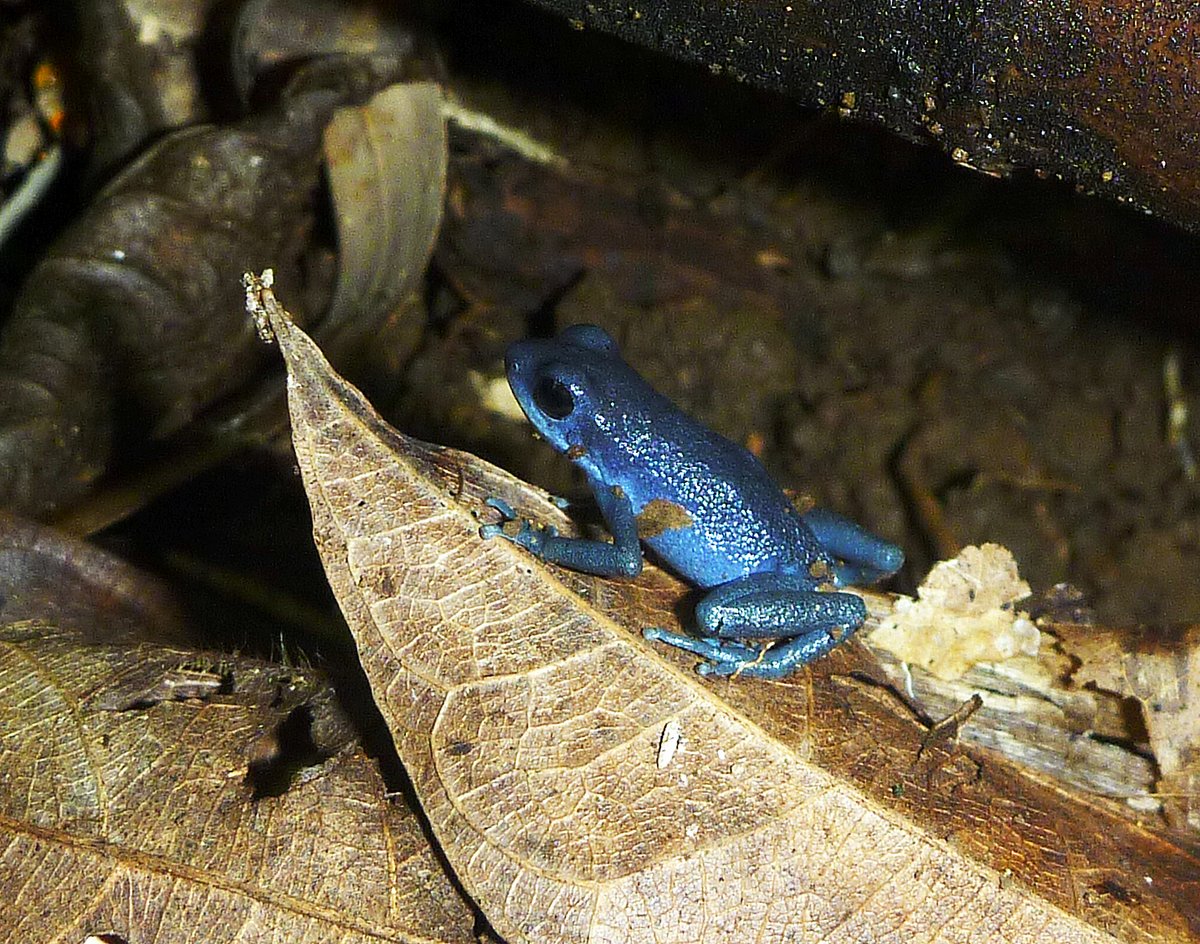
It was a lovely day, so we jumped in the dinghy and went across to Jim Jackson’s property. One of the Ex-pats had told us that we could go for a walk on this land. Jim died three years ago and has donated his property to the Smithsonian Institute, but before he died, he laid out an impressive set of paths around his property, all cut out of the native jungle. It’s very well maintained and has many crop trees (cocoa, banana, etc) growing in the shade of the natural rainforest canopy. We spent a pleasant hour or two wandering around and spotted yet another variant of the Poison Dart Frog – this one was blue.
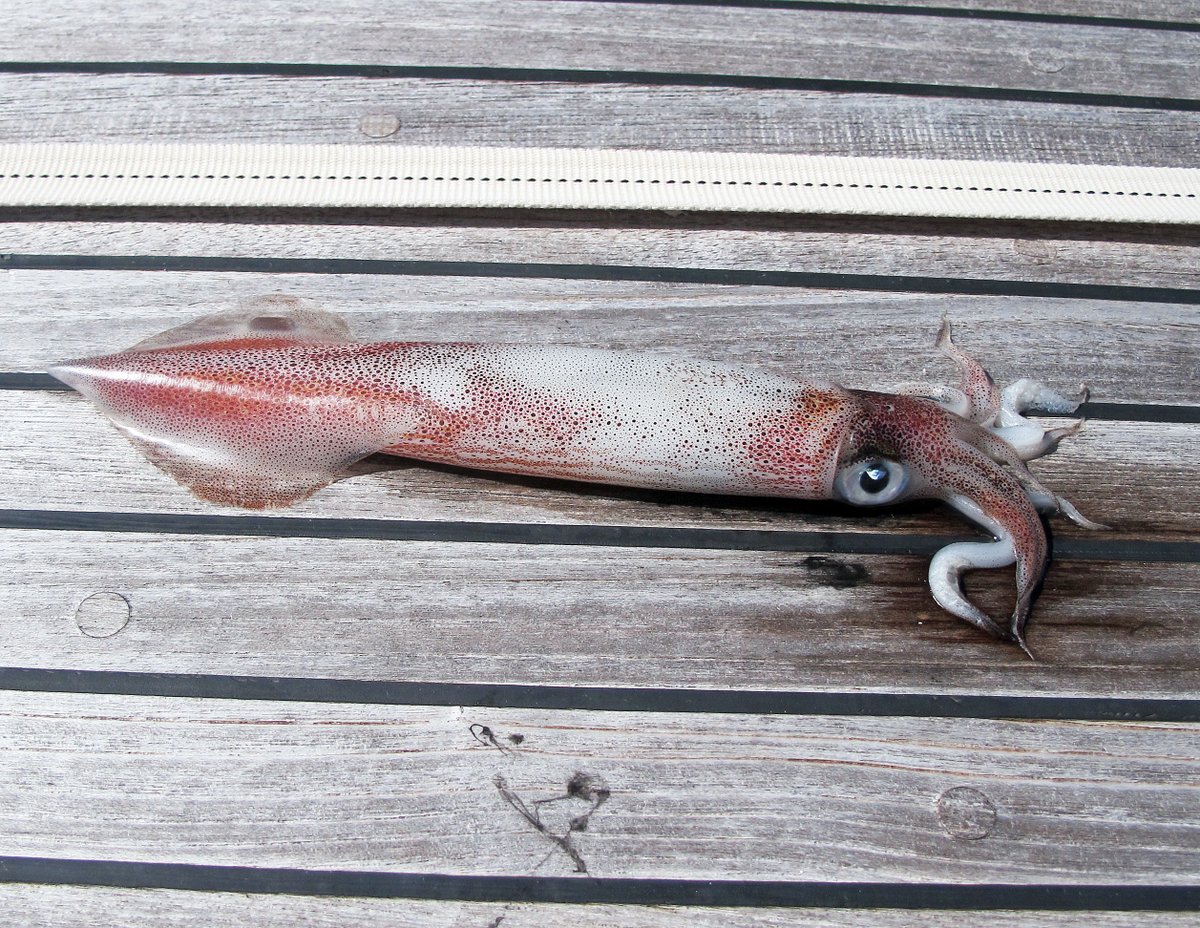
Back on the boat, I started to get ready to leave and found an eight inch long squid on our front deck. We’ve found small fish on our deck in the past but never a squid. Something must have really scared it for it to leap six feet out of the water onto our deck…
We motored back to the Bocas Town anchorage and wandered into town to re-provision after a week out in the boonies. While Glenys was dropping off some laundry at the Bocas Marina, I spotted a small notice board outside the marina bar giving detailed instructions on how to wash a cat:
1. Put both lids of the toilet up and add 1/8 cup of pet shampoo to the water in the bowl.
2. In a smooth movement, put the cat into the bowl and close the lid (you may have to sit on the lid.)
3. At this point, the cat will self-agitate and make ample suds. Never mind the noises that come from the toilet, the cat is actually enjoying this.
4. Flush the toilet three to four times. This provides a power wash and rinse.
5. Stand well back and quickly open the lid.
6. The cat will rocket out of the bowl and streak through the boat/house.
7. Both toilet and cat will be sparkling clean.
It’s amazing what handy tips we pick up while cruising.
Later in the afternoon, I drilled another 300 holes in my lampshade before the battery on my drill ran out. Only another 200 damn holes to go - sometimes, don’t you wish that you’d never started something.
18 June 2013 Bocas Del Toro Town, Panama
We woke to the rumble of thunder, and then 20 minutes later we had heavy rain. This put a hold on our plans to hire a couple of push bikes for the day. This weather is totally unpredictable – the weather forecast always says “chance of thunder storms”. Yesterday we had blue skies and fluffy white clouds and this morning it looked like the depths of Mordor. We’re planning to leave tomorrow to sail overnight to Portobello, but we’ll just have to wait and see what the weather is like in the morning.
Amazingly, the weather cleared by eleven o’clock, so we headed out and hired a couple of bikes – only $5 per day. We went along the east coast of the island to check out the surfing beaches. We eventually found a place where a dozen surfers were strutting their stuff in six foot waves – they all looked pretty good to me.
We retraced our route because the road just seemed to peter out and stopped off at a small road side restaurant where lots of locals were eating. Glenys had a bowl of soup for $2, which had lots of unidentifiable animal parts, but was incredibly tasty – soup is always a good choice in these places.
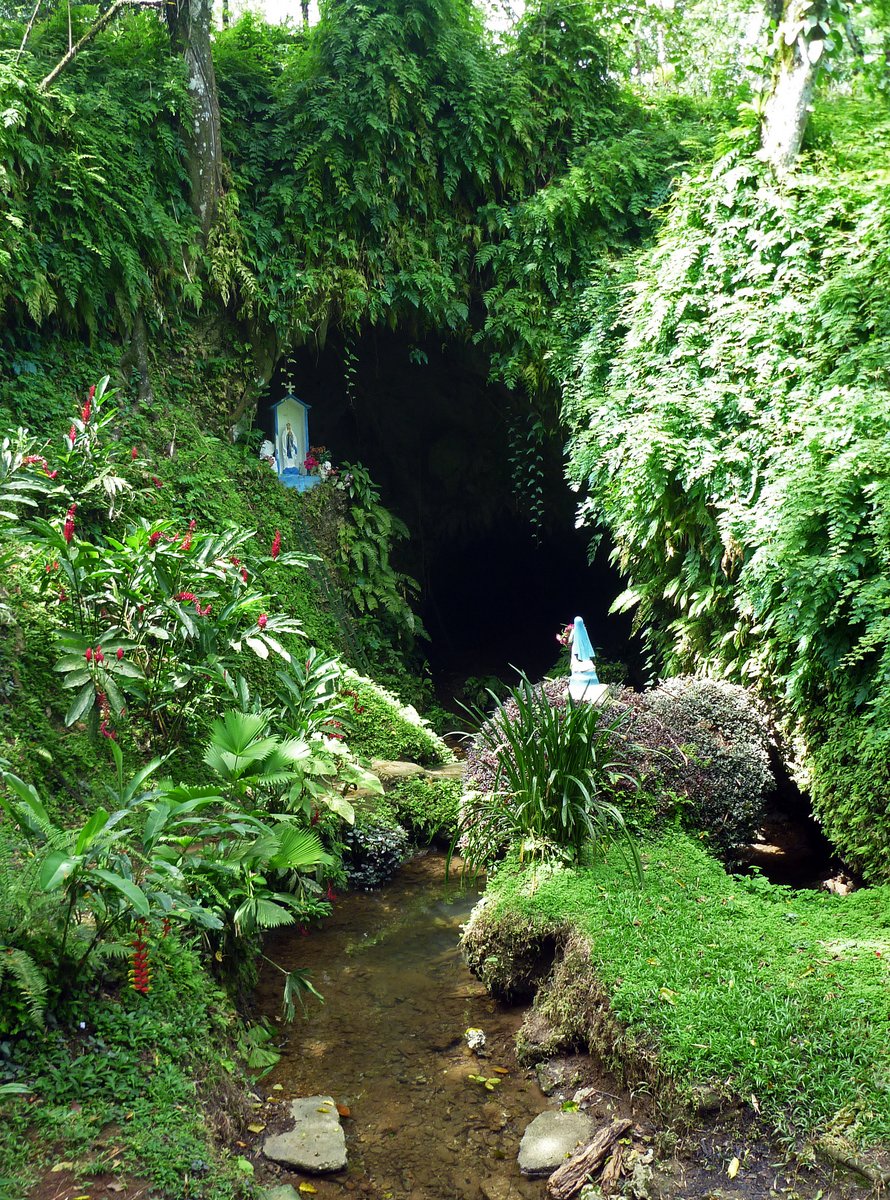
After lunch, we rode 7 kilometres to a bat cave. It was a right mission with plenty of hills, especially on the bikes that we had, which were more suitable for going shopping than tackling steep hills – no gears. Apparently, the Virgin Mary has appeared twice to people in the entrance to this cave, so the locals have built a small shrine there and there are two statues of the Virgin Mary at the entrance, presumably in the location of the apparitions.
There was no one around, so we changed into our swimming things and waded into the cold water of the cave. Unfortunately, our small head torches were too dim to go very far into the cave, but we saw the bats and had a nice cooling plunge in the stream. As we walked back to our bikes, a lady appeared (not the Virgin Mary) and asked us for $2 as an entrance fee – a bargain because they keep the place very tidy.
The trip back down the hill was great and we returned the bikes at around three o’clock – four hours of riding is quite enough for my little legs. We did some final provisioning ready to leave tomorrow.
19 June 2013 Bocas Del Toro Town to Portobello, Panama (Day 1)
It was a grey overcast morning and the GRIB file showed a patch of heavy rain to the east of us – exactly in the direction that we want to go. I chatted to “Captain Ron” who does the weather forecast on the cruiser’s net and he said that the rain system is tracking south west and the afternoon should be dry. The weather looks to be getting more unsettled at the weekend, so we decided to go for it today – we’re going to get wet anyway.
I nipped ashore and picked up our zarpe giving us permission to sail from here to Portobello. It’s a right palaver – I had to fill in a form, then the officials had to fill in two forms and two very detailed receipts. It cost me $13.70.
I just made it back to the boat before it started to rain. Putting on my swimming shorts, I stowed the dinghy on deck and got Alba ready to sail. By the time that I’d finished, it was raining heavily – at least I got a nice cooling shower.
The weather system fizzled out by half past one, so even though it was still drizzling and overcast, we upped anchor and set out through the Canal des Bocas del Toro. This channel goes past the surfing beaches that we looked at yesterday and there were big, six to eight feet waves rolling in, but caused us no problems because they weren't breaking. We had to go six miles out to sea before the water depth increased to 100 metres and the waves settled down to a longer, spaced-out ocean swell.
There was hardly any wind and what we had was coming from all directions, so all we could do was to motor all day heading directly east. By evening, there were thankfully no signs of thunder storms in our path, but we could see some systems more out to sea.
20 June 2013 Bocas Del Toro Town to Portobello, Panama (Day 2)
There wasn’t any change to the wind overnight, but we were increasingly worried about lightning as time went on. We could see huge flashes of lightning to the north of our route, but couldn’t see any rain activity on our radar – all we could do was worry.
At around seven o’clock, the wind picked up to 10 knots from the south east so I was able to start sailing, but it was short lived and an hour later we were motoring again. I went for a nap, but at ten o’clock I was woken up by Glenys because we were heading straight into a dark weather system. I flicked on our radar, but there was no major rain activity (so there was nothing to try to dodge) so we just kept motoring east. Five minutes later, we had 30-35 knot winds from the east, but there was very little rain. We had 30 minutes of strong winds, but it finally abated and the skies cleared as we approached the harbour of Portobello.

There were many more boats in the harbour than I expected – I guess around 50 sailing boats and a few bigger ships. We motored around and spotted “Vanupieds” and “Nuwam”, who we met on the east coast of the USA last year. There are a lot of derelict boats and scruffy live-aboard type boats over by the town, so we anchored in 10 metres of water at the northern side of the harbour, where most of the other yachts appear to be cruisers.
After lunch, we went into town and what a scruffy, run down place it is. Portobello used to be the greatest Spanish fort in Central America and there are the remains of three fortresses. Gold was brought to Panama City from Peru and the Orient and carried overland to Portobello, where it was loaded onto Spanish Galleons and shipped back to Spain. This obviously attracted the attention of English Privateers and the city was constantly attacked by pirates and the Royal Navy, being finally demolished in 1739 by Admiral Edward Vernon.
Today the locals’ homes stand in between the ruins of the colonial fortifications and some of the neighbourhoods look decidedly dodgy. The Port Captain wasn't in his office, so we wandered around and met a few of the local ex-pats - English Dave, Irish Dave and Consignment Dave are the ones that stick in my head. They all arrived by sailing boat and just got stuck here.
We were feeling too weary to wander around for very long, so we retired back to the boat to have a nap and chill out. We had a quiet evening and were in bed by half past eight – this sailing lark is exhausting.
21 June 2013 Portobello, Panama
We wandered into town again and managed to find the port captain. He was just finishing off the clearance papers for a yacht that had arrived from Columbia bringing eight back-packers into Panama. This is a very popular way for these young people to get across the border - I believe that most of them stop off in the San Blas islands for one night. It sounds like it’s a very lucrative operation for the yacht owners, but it must be very crowded on these sailing boats – Alba is certified to carry 12 people, but I can’t imagine having that many people on board, they must sleep on the decks.

Once we’d received our clearance papers from the very friendly port captain, we went for a look at one of the forts. It’s run down, but there are lots of cannons lying about and there were ten or so people working on rebuilding the fort, which is interestingly made from blocks cut from coral. I’ve heard that the town is a World Heritage Site, so they must be getting funding from that. There’s a look-out fort perched 300 feet up the hill overlooking the bay, so we trudged up the eroding dirt steps and were rewarded by a very nice view of the bay.
We had a wander around town again and went into the local church (Inglesia de San Felipe), where there’s a six foot statue of a Black Christ. This is an important shrine in Central America and people come from as far away as Costa Rica to attend the Festival de Cristo Negro which occurs on the 21st October every year. It’s supposed to be quite a spectacle. After the sun sets, the statue is paraded down the streets of Portobello, while pilgrims dressed in purple robes and thorned crowns dance and drink until the small hours of the morning – a pity that we’ll miss that one.
There are a lot of vultures around the town, which are not as wary as the ones that we’ve seen elsewhere. You can see them perched on walls and roofs all over town, so this is not a place where I’d like to go to sleep outside. The locals dump garbage in a clearing next to the port captain’s office and a bulldozer clears it away every so often. The vultures are all over the garbage, picking away at the bags like seagulls do in the UK, but this is much, much scarier.
“Vanupieds” and “Nuwam” came over for a beer or two and we caught up on everyone’s adventures for the past six months.