
22 February 2013 Cozumel to Banco Chinchorro, Mexico (Day 2)
As we headed further south, the wind picked up to 25 knots still from the south east, so the motion of the boat just got worse as the night progressed. Glenys had a sense of humour failure about the weather, mostly because she found it impossible to sleep on her off-watches.
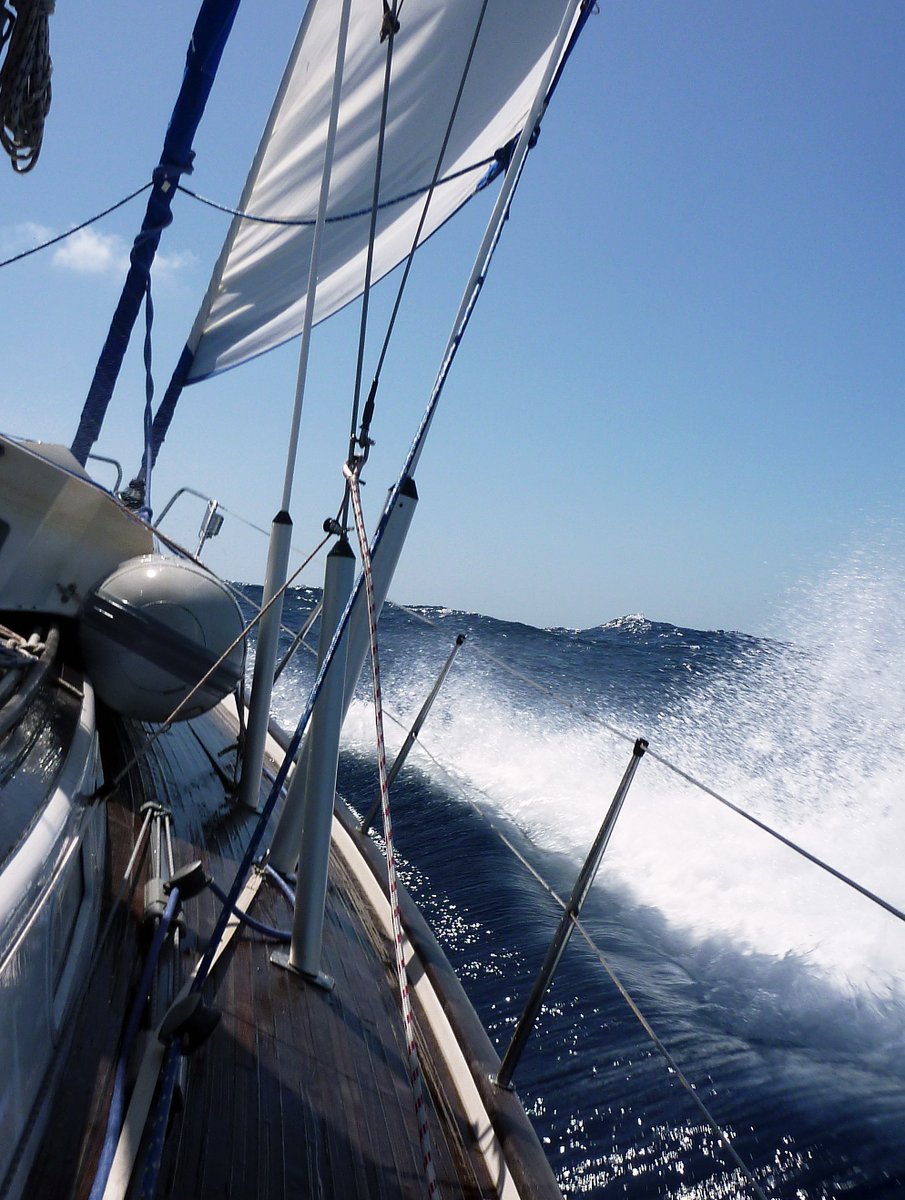
By dawn, we were 10 miles north-east of Bahia Espiritus Santos. It was now blowing 25-30 knots and we were heavily reefed, still crashing and banging upwind as the seas increased. I was worried that the entrance through the reef into Bahia Espiritus Santos would be difficult and possibly dangerous in the big seas, so I decided it would be better to carry on for another 35 miles to Cayo Norte in the Banco Chincorro.
I was very concerned that we’d told “La Isla” that we were going to Bahia Espiritus Santos, so I tried for an hour to call them on the VHF radio, but to no avail. I had no idea where they were, so we just had to leave them to their own devices and carry on. This is one of the reasons that I don’t like cruising in company - I was very worried that they had no decent charts, but what could I do?
The next eight hours were horrible. The winds picked up even more with gusts over 30 knots and the seas just got bigger. In addition, we couldn't hold a direct course to Cayo Norte, but were gradually being forced to the west - if I tried to head up too much, then the big waves were just stopping us dead. We still had a 2 knot current against us, which made matters worse, and I was getting concerned that we wouldn't make the anchorage in daylight, so my only option was to motor-sail and head up as much as possible to reduce our cross track error.
We were taking big waves across our deck, which was slamming a wall of water into the spray-hood and soaking the cockpit most of the time. All we could do was to cower under the spray-hood and accept that we were getting wet. It was miserable even though the sun was shining. To make matters worse, Glenys discovered that we had sea water running out of one of the head-linings and dribbling down onto the carpet – oh miser!
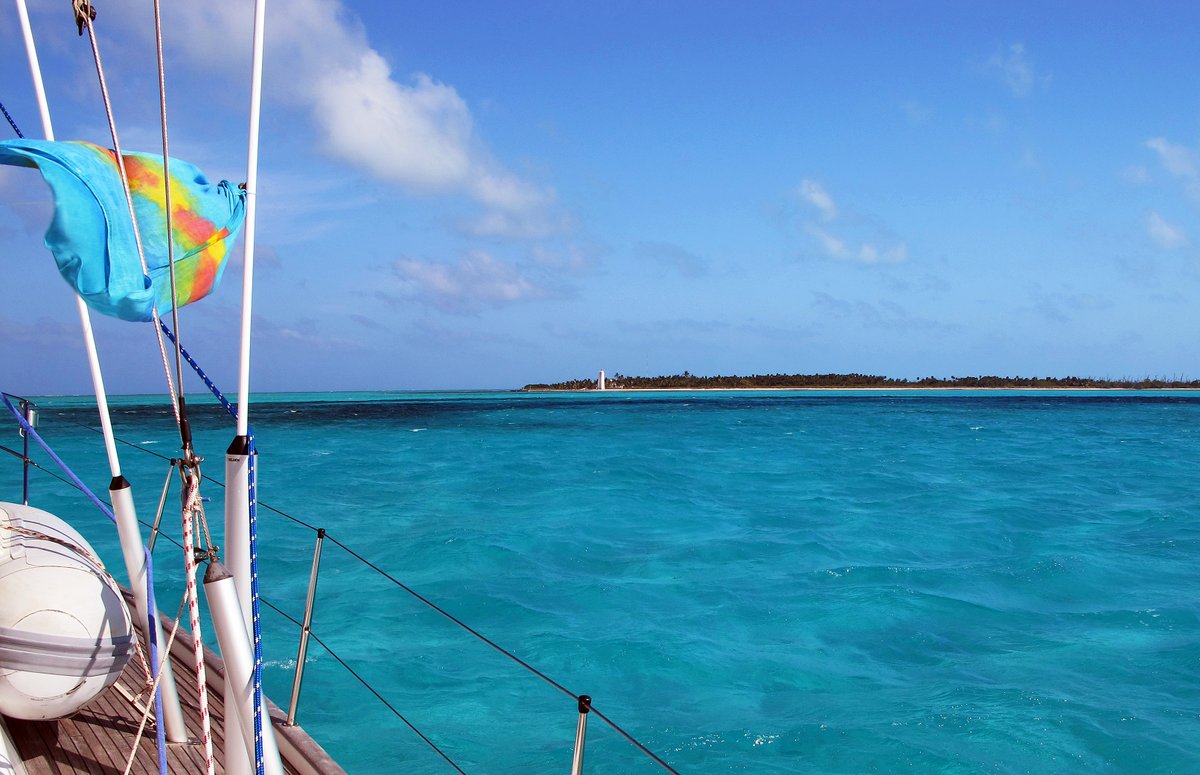
We were very, very grateful to anchor in the atoll of Banco Chincorro at about three o'clock The water is very shallow behind the reef, so after a little bit of exploring, we ended up anchoring about ½ mile from the small island of Cayo Norte. The holding was very good in white sand and the water is very clear - the water colours are stunning.
After a fifteen minute rest and a sandwich to fortify us, we began sorting out the chaos. Glenys spent half an hour washing the cockpit and hatches to get rid of all the sea water crystals, while I investigated the leak above the headlining. I found that there was a loose hose on a fibreglass vent housing that goes through the side of the cockpit hull – the moulded pipe for the hose has been broken sometime in the past and has been bodged with some tape and silicone sealant. The heavy seas have obviously been too much for the repair – I’ll have to fix it tomorrow. All I could do today was to remove the soggy carpet and clean up the seawater on the head-lining and walls.
Just as we were starting to relax with a beer, a pirogue with four soldiers came out from the island. They were heavily armed with machine guns, but were very friendly and just needed to know the boat name, our names and where we were heading. We told them that we’ll probably be staying for two or three days. There are about twenty soldiers out here defending the Mexican territory. They asked us for some “refresco”, so we gave them a glass of coke each – even though I offered, they didn't want beer because they were on duty.
It was a weary couple of sailors that climbed into bed at half past eight. Glenys then found that her side of the bed was wet through. I found that we have another leak in the deck above one of the lockers where she keeps her clothes, so they’re all wet through as well – she wasn't happy as she changed the bed sheets...
23 February 2013 Cayo Norte, Banco Chinchorro, Mexico
It was blowing a hooley in the morning with gusts over 30 knots, so I reviewed the grib file and weather forecast that I downloaded two days ago - this strong wind will be with us for another three days. Ah well, I can think of much worse places to be stuck for a few days. We’re anchored at the north end of a 20 mile long atoll surrounded by coral reefs. There are a few small islands within the atoll and were anchored next to the most northern cay – it’s stunning.
However, we had no time to explore paradise. We spent most of the day sorting out the chaos caused by the various water leaks that we found yesterday. Glenys rinsed her wet clothes in fresh water, but then had to wash down some of the rigging before she could hang out her washing without picking up any salt crystals. She then washed down the spray-hood and bimini because they were massively salt encrusted. Then she washed down the carpet that had been soaked in sea water.
Meanwhile, I removed and resealed three bolts on a deck fitting that I think have caused the leak in her clothes locker. The other leak proved to be a little bit trickier, but after a bit of deliberation, I've found a bit of plastic pipe that just fits inside the broken hose fitting on the vent box. I used MarineTex to stick it in place. Hopefully that will hold and I can finish it off tomorrow.
It’s a little bit bouncy where we’re anchored, so at lunch time, we pulled up the anchor and had a brief excursion around the area, but the sea bed appears to be stones and rubble as we went further south, so we couldn't get the anchor to set and after a couple of goes we gave up and retreated back to our original place. It’s not too bad and at least the sun’s shining.
I mopped out the engine compartment, which had four inches of water in the bilge below the engine. I can’t see any leaking hoses and it’s obviously sea water, so all I can surmise is that the stern gland was leaking when we were motor-sailing up-wind yesterday. Perhaps I should tighten the bellows on the PSS shaft seal?
I ran the generator and started up the water maker, but after five minutes, the generator cut-out with a high temperature warning light – don’t panic! After some investigation, I found that the sea water impellor has a broken vane, so I changed it and it seemed to run okay for an hour. I couldn’t find the vane that has broken off, but hopefully it has passed through the heat exchanger and out of the exhaust.
It was nice to finally relax, crack open a cold beer and watch the sun go down.
24 February 2013 Cayo Norte, Banco Chinchorro, Mexico
I downloaded a grib file on our satellite phone today and it shows that these strong south-east winds are going to continue for another three days until Tuesday, when a weak low pressure ridge will form over the area. This should give light variable winds until six days’ time when a strong Norther hits the Yucatan peninsula. We’ll probably sail down to Belize on Wednesday. It will be an overnight sail again, but hopefully the winds will be much lighter than the epic getting here. Our main concern is to be tucked up somewhere safe when the cold front comes through.
We had a very slack day – the constant howling of the 25 knots winds and the choppy anchorage is starting to wear on us. I caught up on editing my photographs and writing this diary, then finished off epoxying the leaking fibreglass vent housing. The repair looks pretty good, if I say so myself, but we’ll not know if it’s successful until we’re in another heavy sea. Glenys chilled out and read more about anchorages in Belize – I think the imminent threat of a Norther has focussed her mind.

After lunch, I thought that it would be good to get off the boat and go for a walk on the island. We dropped the dinghy into the water and then lowered the outboard down on our small hoist, which proved to be a real challenge in the bouncy 25 knots conditions. I gave up trying to connect the fuel tank because I was being thrown around too much, so we decided to stay on-board. We read our books and had a nap – we’re obviously catching up on lost sleep from the horrible passage here.
Later in the afternoon, the wind dropped below 20 knots and the seas abated a little, so we jumped in the dinghy and went ashore. It’s very, very shallow at the west side of the dock – our outboard grounded for a second or two before I managed to lift it out of the water. Fortunately, there was no damage done to the propeller.
A couple of soldiers met us on the dock (one looking very official with his clipboard), but they were quite happy for us to come ashore. We found out that there are twenty soldiers based here and they come out for thirty days and then have thirty days back on the mainland – not a bad posting in my humble opinion. We had a 30 minute walk along the beach which was fantastic after three days’ trapped aboard Alba.
Glenys rustled up a nice Chicken Paella for dinner, which we ate in front of the TV. “Yindee Plus” gave us a copy of the first three seasons of Battlestar Galactica and I'm afraid that we’re totally addicted now – we’re on season 2, episode 6 and it’s hard to stop…
25 February 2013 Cayo Norte, Banco Chinchorro, Mexico
The wind was still blowing 20-25 knots from the south-east. It was too windy to go snorkelling, so we settled down to another day lurking about. Glenys baked some bread and banana bread, then tidied up her clothes, now that I’d sealed the deck leak above her clothes locker.
I spent the morning on my laptop sorting out the next updates for my web site – I even spent a few hours creating a PDF copy of Glenys’s cookbook, which I’ll post onto the web site when it’s completed.

In the afternoon, I connected the hose to the repaired cockpit vent, so hopefully that will sort out that deck leak. I then tackled the aft toilet – the waste water pumped out of the toilet has been slowly seeping back into the bowl. It was one of those jobs that just escalated. I removed the joker valve which is a one way valve designed to stop this back-wash happening. Sure enough it was all built up with lime scale and distorted. I had a spare joker valve, but first I had to scrape some build-up out of the fitting. Then when I reassembled it, I found that the toilet didn't work at all, so I had to take the whole pump off and clean up some other parts. Not pleasant…
I downloaded another weather forecast and the cold front is still forecast to bring 30 knot winds on Friday night/Saturday - in four days’ time. Unfortunately, the winds look like they might still be too strong for us to go tomorrow, so it’s hurry up and wait again.
26 February 2013 Cayo Norte, Banco Chinchorro, Mexico
The weather forecast showed 20 knot south-east winds veering south. There’s a weak low pressure area that is building over to the west of us and it should be bringing variable winds and probably some showers from tonight until 1st March. The cold front is looking to be very strong and we want to somewhere safe before it hits us. We decided to wait until tomorrow to let the big seas subside – we’ll probably have to motor anyway.
It’s 100 miles to the Eastern Channel, which is a big ship entrance through the reef into the protected waters of Belize. We’re expecting a 1-2 knot current against us all the way, so we’re planning to leave at first light tomorrow and we should be there within 24 hours. It’s another overnight sail, but at least we’ll be able to enter the Eastern Channel at night, if we make better time than 4 knots.
I spent most of the morning looking at charts and cruising guides to work out where we’re going to wait out the Norther and I have a few candidates. Ideally, we’ll be able to get to Dandriga by lunchtime on the 28th and clear in. We should then have time to go across to one of the cays and find a nice secure anchorage. If we can’t get to Dangriga in time, then we’ll go to clear in after the Norther has passed.
By lunchtime, the wind had dropped below 15 knots and it was a beautiful day, so after a fabulous lunch of scrambled eggs on toast with Glenys’s freshly made bread, we jumped in the dinghy and went snorkelling. The inside of the fringing reef is very shallow and has a lot of surge, so it wasn't too good. In fact it was more interesting on the sand where Alba was anchored – at least there we found a big Barracuda and a cute little reef squid.

I took my underwater camera out for its first outing for nearly a year and I now remember how frustrating underwater photography can be, especially because my equipment is not very good. I think that the most frustrating thing is the shutter lag on my Canon G11 camera – I click the shutter and it takes the camera a second or so to take the actual picture, by which time the subject has usually moved… The only solution is to invest a couple of thousand pounds in a decent SLR and underwater housing, but it’s not going to happen…
27 February 2013 Banco Chinchorro to Water Cay, Belize
We were up early and slowly navigated ourselves clear of the reef at around half past seven. The wind was 10-15 knots from the east, so we had a lovely sail in calm waters along the west side of the fringing reef. The depth of the water changes dramatically from more than 200 meters to shallow reef in a very short distance. The reef wasn't breaking, but it was easy to see how far we were away by the change in the water colour from dark blue to a lovely light turquoise. We were escorted by a pair of Bottlenosed Dolphins for a while.


By midday, we'd cleared the south end of the reef and the seas got a little larger, but nothing drastic, so we were able to get on with things other than just reading or staring at the endless sea. I checked the aft bilge and we've definitely got a leak somewhere, but after fifteen minutes of pulling up floorboards and searching, I can't find where it's coming from.
The wind dropped in the middle of the afternoon and we had motor for five hours, but after that had a pleasant sail. We were expecting to have a strong current against us for this passage, but we didn't encounter anything at all. This meant that we were way ahead of schedule and would be arriving at the Eastern Channel at around midnight. I don't normally enter strange ports at night in the Caribbean, but I expected the lights to be reliable in this channel because it's the main entry for large ships going to Belize City.
I went to bed at seven o'clock, but Glenys had me out of bed an hour later to give her moral support because two cruise ships were coming north out of the Eastern Channel. They passed us safely, but it’s very difficult to see their navigation lights with the bright deck lights blazing away all over the ship.
As expected, we arrived off the entrance at midnight and easily navigated up the wide, deep channel, although several of the lights were different from the ones shown on our charts. Thankfully, we had a bright, full moon and it was good to drop anchor at one o'clock just off the shipping channel in the lee of Water Cay and crawl into bed.
28 February 2013 Water Cay to Garbutt Cay, Belize
The alarm went off at half past five – groan! Only four hours sleep, but we don’t have the luxury of hanging about today. Our plan was to sail twenty miles to Dangriga and clear in before lunch time, so that we can be tucked up somewhere nice in the afternoon before the Norther arrives tomorrow night.
We pulled up the anchor before the sun came up and motored across 12 Feet Bank, passing just behind a huge cruise ship that was sneaking up the ship channel towards Belize City. The wind was light from the south, but it was a pleasant motor in the flat calm seas - I think that I'm going to enjoy sailing in this fantastic area protected by the huge barrier reef.
We approached Dangriga town, heading towards the entrance to a small river, where we knew that we could dock our dinghy. As the depth slowly dropped to 5 meters, I handed over the wheel to Glenys and started to walk towards the bow to drop the anchor. A few seconds later, the depth suddenly dropped to 2 meters and we ground to a halt. Glenys spun the wheel and slammed on full power, heading away from the shore. The depth dropped to 1.8 meters - we were definitely aground, but we slowly dragged ourselves off the sand bank. Phew!
We anchored a little further away from the shore, put the dinghy in the water and went into town, motoring up the small river. There's a very shallow sand bar across the river mouth - probably only one foot or so at low tide and it comes out a long way, hence our grounding. We tied up to a small dock and walked down the main street to the Immigration and Customs offices. It's a quaint, run-down little town, very reminiscent of the Windward Islands.

The town of Dangriga is the second largest town in Belize and the cultural centre for the Garifuna people. The saga of the Garifuna is not one of Britain's finest historical moments. In the seventeenth century, shipwrecked African slaves were swept up on the shores of St Vincent where they hooked up with the Caribs and Arawaks and created a new people. The Garifuna people then fought against the English rule of St Vincent. In 1790, they eventually surrendered and all 4330 of them were deported. After being moved around various parts of the Caribbean and many deaths, only 1485 Garifuna people finally arrived in Honduras. From there they settled in Belize.
The check-in procedure was fairly simple and only took an hour. We only had to visit the Immigration and Customs officers. I found them very pleasant, but as usual, a little pedantic. It was nice to be able to communicate with them in English instead of struggling with Spanish. The customs guy confirmed that it would be much more complicated to clear in at other ports of entry – we’ll probably come back here to clear out.
The customs guy recommended a small eating place called "Tanya's Kitchen", which was great. It’s only a small wooden shack with three tables, but the rice and beans with pork was brilliant. It’s nice to be back to West Indian style cooking.
Our next stop was..... You guessed it - a supermarket, then a hardware store to buy some more refrigerant for our leaking fridges, then the local vegetable market and back to Alba by half past one.
After a short rest, we motored eight miles across to Garbutt Cay and anchored off a group of seven small mangrove cays with a fishing camp on shore. For some reason there are pine trees ashore, which bizarrely, make it look very much like Maine in the north east of the USA.
We collapsed with a cold beer and had an early night.
- << Prev
- Next