
21 July 2016 Pulau Penjalin, Anambas
A massive thunderstorm passed about four miles to the east of us giving ominous rumblings of thunder. “Amulet” said that they saw a water spout starting to descend from the clouds, but fortunately, it dissipated. We watched and waited a while, but cracked up at 08:00 and left. It was only 8 miles to the next anchorage, so we motored with an eye on the various squalls around us. Fortunately, we only had a little rain and then it cleared up nicely.

We anchored at the south-east corner of Pulau Semut at 03°23.12N 106°17.39E in 12 metres on good holding sand. As with the previous two anchorages, there's not much swinging room between the surrounding reefs, so we only put out 40 metres of chain. This is a lovely spot, with two beaches with bordered by coconut trees and a very shallow pass between the islands, giving beautiful blue colours.
When we were settled, I had a look at the wind generator and found that the 30A fuse was shattered. I replaced it with a 25A fuse and that seems to have sorted it out, but why had the fuse blown up?
Although the skies remained gloomy, we went snorkelling in the afternoon. There’s a reef alongside the anchorage, which has some interesting coral heads at a depth of 4-8 metres, but the water is full of sediment, I guess because we’re in a channel. We had a look on the north-east side of Semut Island, where the water was much clearer, but we were back to rocky reef again at depths between 6-12 metres.
22 July 2016 Pulau Semut, Anambas
I ran the dive compressor and filled two scuba tanks so that we could go for a dive. We anchored our dinghies in 6 metres of water at the south side of the anchorage (approximately 03°23.070N 106°17.428E). We headed north down the reef until we met the sand at about 17 metres. Turning east, we followed the edge of the reef until we had used half of our air and then ascended to 10 metres returning to the dinghies.
The visibility was very poor (5 metres) where we anchored the dinghies, but improved dramatically as we headed east out of the channel. When we turned around the visibility was 20 metres. The coral is in good condition although everything is covered by a fine layer of silt. It was a reasonable dive considering the conditions and I spotted my first Tomato Anemonefish, which are localised to this region.
.jpg)
It was a lovely sunny afternoon, so we hid from the sun and just pottered about on the boat.
23 July 2016 Pulau Semut to Pulau Mubur NE, Anambas
It was a lovely morning, clear and sunny, so we hung around until about 10:00 before pulling up the anchor to go five miles around the corner to the bay at the north of Pulau Mubur. Unfortunately, by the time we got there some horrible looking black clouds had built up from the south and the reduced light made it difficult to see the reefs.

We had a look at a possible anchorage at 03°22.90N 106°13.37E, but the depth was 15 metres close to the reef. “Amulet” snagged their anchor on coral near 03°23.07N 106°13.48E and another possible anchorage at 03°23.13N 106°13.58E was again 15 metres deep and, without being able to see the surrounding reefs, we felt it wasn’t safe.
By this time, the black clouds had covered the sky and the wind had picked up to south 25 knots. “Amulet” decided to give up and headed for Tarempa. We thought that the system might pass over quickly, so we anchored at the south side of Pulau Tenggiling at 03°22.69N 106°13.98E in 5.5 metres. This is a lovely spot, where “Sea Monkey” had spent a couple of nights, but it’s completely exposed to the south.
After waiting for fifteen minutes, the wind showed no signs of abating, it began to rain and two foot waves were starting to build up. With shallow reef only 20 metres behind our stern, we felt a little uncomfortable, so we pulled up the anchor and headed south for a couple of miles to a likely looking bay, which we have called Pulau Mubur NE.
The water gradually went from 35 metres to 15 metres and then more quickly down to 5 metres. We dropped the anchor in 7 metres depth at 03°20.73N 106°13.59E in between two edges of the reef. We settled back to a depth of ten metres. The anchor chain rumbled a little, but then held well, so I guess that we’re in sand with a few coral patches. The wind dropped, but the rain kept going for three hours - it was a grey day.
I snorkelled down to look at the anchor and found that it was well buried in the sand. However, we seemed to be close to reefs at either side of us, but I decided that we were okay. At about five o’clock, I started to get nervous that we were too close to the reef to the east, so we pulled up the anchor and tried to re-anchor a little further out. We dragged at 10 metres and 12 metres, but then managed to get the anchor fully set at 8 metres - probably a boat length further out than we were before. We’re still a bit close to the reefs, but I think we’ll be okay.
24 July 2016 Pulau Mubur NE to Pulau Tenggiling, Anambas
Well, we didn’t crash into the reef last night - it was a beautiful calm night. It was a lovely morning as well, so after breakfast we did a little survey of the anchorage and found that the water shelves more slowly at around 18 metres going deeper. The next time that we come here, we’ll anchor in 20 metres depth around 03°20.80N 106°13.58E. The two fringing reefs are 70-80 metres away from this point and will give ample swinging room. I suspect that the sea bed will be soft mud, so we’ll let the anchor settle for a while before backing it in.

After our little survey, we went back to Pulau Tenggiling and what a difference a day makes. Yesterday we had 2 foot wind waves caused by a 25 knot south wind pushing us onto a lee shore and today was beautifully calm and sunny. The water colours are fabulous.
We went for a snorkel on the north east side of Palau Wi (the small island to the south of the anchorage). It was pretty good. There’s a lot of damaged coral, but there are interesting coral heads and some large fish dotted about.
This weather is really changeable because by 11:00, the wind had picked up to 20 knots from the south and big black squalls were approaching again. We upped anchor and headed off towards Tarempa and on the way we had strong 20-25 knot winds against us with lashing rain. We arrived in Tarempa at around 14:00 and (again) it took two attempts to anchor. I think on the first attempt we were a little too close to the causeway and in coral/rubble.
“Amulet” invited us for drinks in the evening.
25 July 2016 Tarempa, Anambas
Last night we had a big squall come through with strong gusts, so I had to get out of bed to check whether we were dragging our anchor. Normally, I’m not too concerned by 30 knots winds, but the holding in this anchorage is dubious and we only have 60 metres of chain out in a depth of 22 metres - that’s only 2.7:1 scope… However, our Rocna anchor is doing its job and we’re fine.
We went into town with “Amulet” and visited the Immigration office to try to get our visas extended by 30 days. Initially, there was some confusion about what we wanted because of language difficulties, but eventually we managed to get them to understand that we wanted an extension. They then said that we had to return a week before our visas expire because they could only give us 30 days from when they issue the new visa.

I showed them my passport stamps from last year where we had a 60 day visa extended to 90 days only 25 days after our arrival. They went into a huddle and finally agreed that they could do the same and give us a 30 day extension now. The first step was for us to write a letter to them requesting an extension to our visa. They then told us to come back a couple of hours later.
The senior immigration officer came out and had a chat to us, introduced his wife who just happened to arrive in the office and we all had our photographs taken together.
We went for a walk to the tourist office where we wanted to know about the events planned for Independence Day. They said that they hadn’t been told yet, but something would be happening and perhaps we should be back in Tarempa a couple of days before the 17th in case something exciting was happening.
Glenys produced a brochure, which they had given me week ago and pointed to a picture showing wood carvings that were being produced in Air Asuk. Unfortunately, it turns out that the picture is three years old and the person (single) who was doing this carving has died. There don’t seem to be any other handicrafts going on, but one guy suddenly appeared out of the back office with a couple of Hand Carved Boats which they gave us as a gift.

We stayed chatting in the tourist office for an hour and, by the end, we had a crowd of twenty tourist personnel all looking at our photographs and having a great time. Of course, there was the obligatory group photo at the end.
After doing some provisioning and lunch back at the boat, we ventured out in the pouring rain to the Immigration office, where we were told that we each had to fill in a visa application form. With this complete, we were given a bill for 300,000 Rupiah (£15) each and I took the bill to the bank to pay.
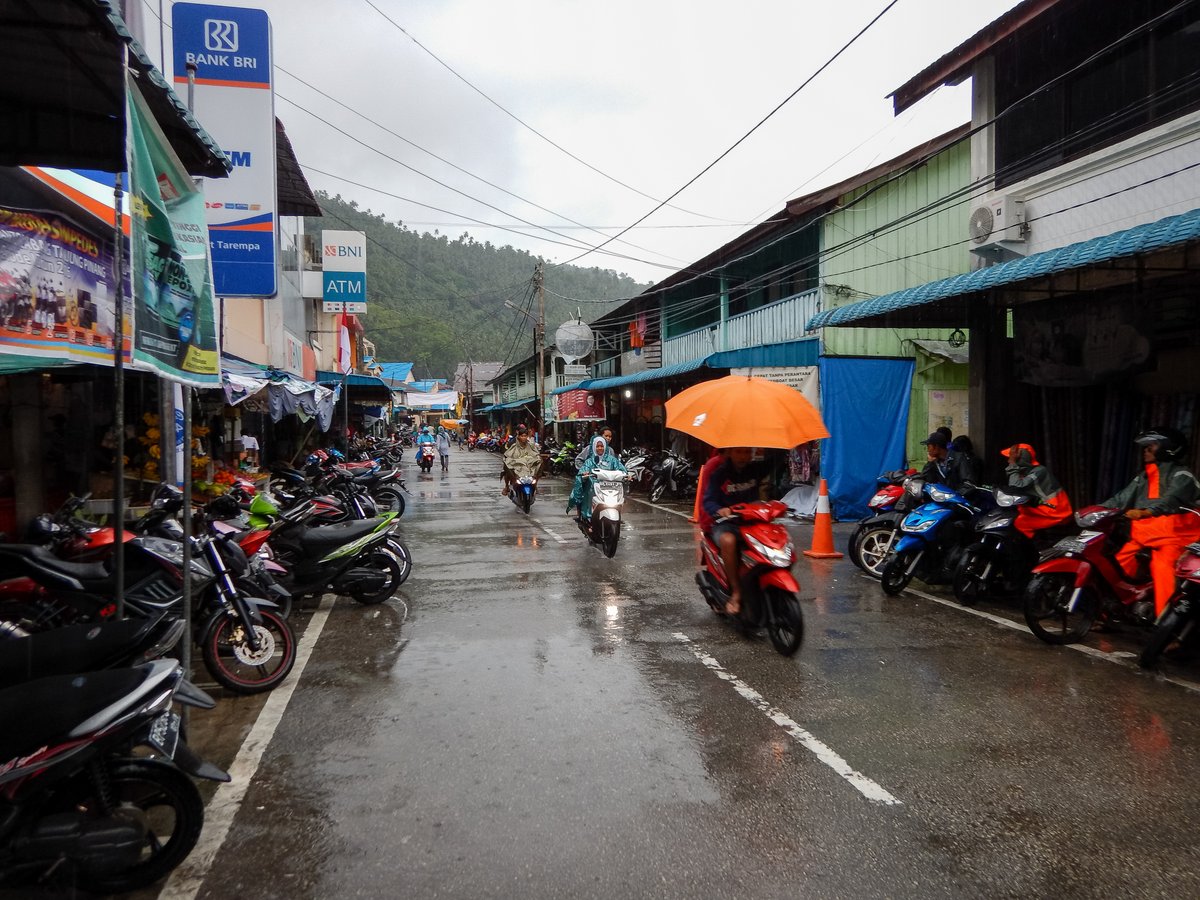
Upon my return with the receipt, they apologised and said that they had a problem with the internet connection to their on-line system and we should return in three days.
We told them that we wanted to sail to Jemaja on Wednesday 27th, so could they sort it out more quickly? They apologised and said that they would try to sort it out tomorrow and then confessed that they’d never done a visa extension before, so didn’t quite know what else they’d have to do. It doesn’t bode well, but we’re not too bothered because this weather is appalling and we might be stuck here for a few days anyway.
This afternoon, I turned to the Dark Side. After five years of bemoaning that many cruisers adorn their boats with (non-regulation) coloured strobes when at anchor, I’ve succumbed and finally bought a couple of Flashing Lights. When we were anchored in Pulau Semut, we were in a channel used by the local fishermen and they are very much used to seeing flashing lights close to the water.

Our normal (regulation) fixed white light is on our mast head, 65 feet above the water and the worry is that the fishermen travelling at night may not look up and could crash into us. Both “Amulet” and “Sea Monkey” have strobe lights and I’ve reluctantly come to the conclusion that it’s a good idea in remote places where there are fishing boats moving around at night, so I’ve splashed out 100,000 rupiah (£5.00) on two battery operated, flashing lights (one green and one red), which I will use sparingly.
It rained all afternoon with no wind and no sun, so our batteries were low by the end of the day. We had to run the generator for a couple of hours to top up the batteries and used the opportunity to make some water, which is a bit strange considering the amount of rain water that we could have directed into our water tanks today.

In a moment of madness this morning, I convinced Glenys to buy a kilogram of squid. We keep being offered squid (Indonesian “Cumi”) by fishermen, but always say no because we don’t know how to clean them. So I spent over an hour stood in the galley cleaning the squid, which is not difficult, but is very time-consuming and messy. We now have a lot of squid to eat - Glenys made a Nasi Goreng with Cumi for dinner.
26 July 2016 Tarempa, Anambas
At 02:00 last night, we were woken by banging on the hull. I staggered out of bed dragging on some shorts and found a Navy boat alongside us. After a little bit of confusion, a young officer called Mr Tigor asked if he could come aboard to ask us some questions. Sure, what else do I have to do in the middle of the night?
He was very polite and just asked questions about where we had come from and where we were going. I showed him a copy of our clearance papers (thank goodness that I’d had the foresight to photocopy them because Immigration still have the originals). We had a pleasant chat about our life aboard Alba for fifteen minutes and, after a photo session, they disappeared off into the night. I’m guessing that Mr Tigor was just curious about what we are doing here, but it would have been more sociable to come visiting in daylight hours.
I’d just about fallen into a deep sleep when the Call To Prayer came booming over the loudspeakers at 04:30. I slammed the hatch shut and tried to get back to sleep. I fitfully dozed as the sun rose; finally giving up at 06:30 and wearily climbing out of bed.
After breakfast, we went into town, first calling at the Immigration Office who had managed to get a good enough internet connection yesterday evening. They took our photographs, fingerprints and our signature, which was a long drawn out process taking over an hour. We then had to pay an extra 55,000 rupiah (£3) each for the biometric processing, but by 11:00 we had our visa extensions all stamped up in our passports. We are able to stay in Indonesia until the 24 September - what a great result.

The weather is still a little unsettled, with squalls around, but there’s nothing particularly nasty on the GRIB files, so we're going to leave Tarempa tomorrow. With that in mind, we did some more shopping, buying last minute vegetables and drinks and then retired back to the boat for the afternoon.
The sea water pump on our engine has had a small leak for the past couple of months, so I removed the Speedseal cover plate and cleaned it up. The Speedseal is supposed to seal just with an o-ring, but the plate is worn causing the leak, so when I replaced it I squeezed on some silicone gasket compound to back up the o-ring. I need to order a new SpeedSeal plate.
I'd only just got the engine re-assembled, when a huge squall came through that gave us a few gusts of 45 knots and our minimal anchor chain scope of 2.7:1 wasn’t enough to stop us dragging in the soft mud. We dragged about 40 metres and stopped over a 8 metre deep reef, so we waited until the squall calmed down a little bit, started the engine and re-anchored, which took three attempts until we were happy. We’re again anchored in 20 metres, but couldn’t find anything shallower. Perhaps it’s time to buy more chain.
It was our 36th wedding anniversary, so we went out for a meal at the Sakura Inn with “Amulet” and Rick & Marietta from “Going Easy Too”, who arrived this afternoon.
27 July 2016 Tarempa to Pulau Ayam, Anambas
The alarm woke us up at 06:00, so that we’d have plenty of time to sail 35 miles today to Jemaja. I knew that we’ll not have internet again for a couple of weeks, so I did a little bit of email admin before we left.
Yesterday while we were re-anchoring, I thought that the windlass seemed to be struggling and I’m worried that the electric motor is now underpowered. I suspect that the carbon brushes in the motor are worn and if the motor fails then we’ll have hell of a job getting the anchor up. I’m a bit annoyed at myself for not carrying some spare brushes - they probably only cost a few pounds, but it’s unlikely that I’ll be able to get any out here in the Anambas. I sent emails off to Lofrans support and a dealer in the UK to see if they can supply me with some spare brushes.

We started to pull the anchor up, but found that the chain was caught on something on the seabed (probably coral). It took us ten minutes of motoring about to get the chain free with the poor old windlass taking another beating, but we were soon on our way.
There were only light winds at the beginning of the passage, but after a couple of hours, the wind picked up enough for us to sail albeit 20 degrees further north than the rhumb line. We had a cracking sail - hard on the wind, but in fairly calm seas and the wind backed by almost 40 degrees as we approached our destination, which was very handy. The sail was so enjoyable that we actually did two tacks and sailed into the anchorage - I don’t think that we’ve done that this year…
As we passed the north of Pulau Telaga, there was some excitement when the fishing reel started to whizz out. It was a big strong fish - maybe a big Tuna? Then it leapt out of the water, its silvery body flashing in the sun - even better, it might be a Wahoo. I fought the fish to the side of the boat with the gaff ready and then saw that it was a big Barracuda - I was gutted. Barracuda are notorious for carrying Ciguatera and we never eat large specimens. The hook was firmly buried in its top jaw, so I waited until the fish was very tired and cut the trace close to the hook to release the fish.
We dropped the anchor in Pulau Ayam at 02°59.53N 105°48.43E in 9 metres of water on soft sand. The anchorage is lovely with a huge sandy patch in front of a beach - there’s enough room for a dozen boats in depths between 8 and 15 metres. There’s a shallow reef next to the anchorage, north of 02°59.57N.
Even though it was overcast and dull, we went for a quick snorkel at the eastern side of Pulau Ayam, which was okay with some pretty coral.
28 July 2016 Pulau Ayam, Anambas
It was a lovely day today, with blue skies and 10-15 knot winds, so we had a snorkelling day. We tried several spots around the anchorage including the reef in the middle of the bay and the shallow reef in the pass heading west, but both were uninspiring. The shore of the mainland to the east of the anchorage was even worse being just rock.

After lunch, we went to the north-east side of Pulau Ayam and anchored our dinghy in the second bay at around 03°00.28N 105°48.79E. There’s a rock awash at the east side of the bay which is an impressive pinnacle dropping down to 12 metres. The snorkelling was the best that we found in the area, but mostly rocky reef.
29 July 2016 Pulau Ayam to Padang Melang, Anambas
It was a beautiful calm, sunny morning, so we chilled out waiting for the sun to get higher. “Amulet” decided that they would go through a shallow passage between Pulau Ayam and the mainland, but I’ve woken up with a cold (a.k.a. Man-Flu) and I wasn’t feeling particularly dynamic this morning, so we took the long way around the island.
On the north-west corner of Pulau Island, we spotted a traditional Indonesia boat at anchor, with racks of dive tanks on the deck. Glenys hovered around while I jumped into the dinghy to go and have a chat. It was difficult with the language barrier, but I sussed out that they are doing a government survey of the state of the reefs in the Anambas. They gave me a few pointers for good dive sites in the area, but they may be too exposed for us.
Surprisingly, in the 50 minutes from when we upped anchor, huge black clouds had formed and we narrowly avoided heavy rain. We briefly looked at a large bay, which the locals tell us is called Tukan Bay. It looks to be a lovely anchorage in a well-protected bay with a white sand beach fringed by coconut palms. The sea bed gradually slopes from 15 metres to 7 metres and it looks like sand. We may come back here if we have time.
We looked at another anchorage at the south-east side of Telok Mampo Bay at 02°58.60N 105°45.20E. The sea bed is gently shelving sand and the anchorage would be a good place in strong south-east winds, but there’s two large stone piers being used to unload barges. It’s not very pretty.

With the sun once again shining and a pleasant 15 knot wind, we crossed the three mile wide Telok Mampo Bay, avoiding a couple of shallow spots in the middle including a large, shallow reef. We anchored in the western corner of the bay off a small village called Padang Melang at 02°59.63N 105 43.76E. This is a fabulous anchorage in 5 metres of water over firm white sand, which is a blessing in the Anambas Islands . There is enough room for more than 50 yachts to anchor here.
Ashore, the village is neat and tidy and is appears to be geared up for tourists with Palapas dotted along the edge of the 3 mile long beach and there are even showers on stands. However, there were no tourists in sight and the few small Warangs (restaurants) were closed. As usual in the Anambas, the locals were very friendly and helpful. A nurse called Yanti stopped to chat to us and she’s going to arrange for us to have two motorbikes tomorrow to explore the island.
We strolled off to find the hospital where we’ll meet Yanti tomorrow and then returned to the beach, where we had a chat to a group of half a dozen young men. In many parts of the world, one would be intimidated by such a group, but the Indonesians are so nice and polite. They were shy at first and we started the conversation, but we were all soon lined up for a photo shoot.
30 July 2016 Padang Melang, Anambas
My Man-Flu isn’t too bad at the moment and I managed to get a reasonable night’s sleep. At about 08:30, together with “Amulet”, we went ashore and walked to the hospital where Yanti lent us two motor bikes. She wasn’t going to charge us, but we insisted on giving her 50,000 Rupiah for each bike, which is what we paid in Tarempa.
After filling up with petrol at the local store (from water bottles of course), we headed off into Letung, which is the major town of Jemaja. On the way, there’s a new road heading south and a roundabout - yes! - a roundabout. Having ignored the roundabout and just carried straight on, we came into Letung, which is a long and thin town with buildings on stilts on one side of the road and houses built on land at the other side.

There’s a small town square next to a volley ball court and we found the local market, which unfortunately had finished by the time that we arrived. The locals told us that you have to be there well before 09:00. The town is small and cute, but has a good collection of small shops selling a wide range of good including hardware and food of course.
We came across a lovely little shop which sold watches and perfume. The back wall was covered with shelves upon which stood dozens of 1 litre aluminium bottles filled with perfume. The counter in front of the shelves displayed a collection of small coloured perfume bottles and a list of dozens of famous brand perfumes such as Chanel, Paris Hilton and Armani. Customers can buy any of the (counterfeit) perfumes or can mix their own. Glenys spent a happy ten minutes in there until she settled for a bottle of David Of for 35,000 Rupiah (£1.75) - it might not smell nice, but it wasn’t expensive.
After a drink in a bar overlooking the sea, we hopped back onto our bikes and turned south at the roundabout heading for the Air Terjun Neraja waterfall. The new black tarmac road soon turned into an old concrete road and we had a pleasant, if occasionally bumpy ride into the interior of the island. We passed through areas of farmland where rice was being grown and other places where cattle were being raised, but most of the island is sub-tropical forest interspersed with small vegetable and banana gardens.

After an hour, we arrived in a small village, which had a dis-proportionally large road sign at a cross roads pointing left to Air Terjun Neraja. That road gradually petered out and stopped at a dirt path, which after 200 metres led to the waterfall. It was a pleasant little place and at least there was some water cascading down here. On the way back, we stopped at the crossroads and had a basic, but very tasty Mee Goreng for lunch in a tiny Warung.

Back at the village, Yanti invited us into her house, where we met her husband Mohammed. We stayed for half an hour chatting and then arrange to meet them in a nearby restaurant tomorrow afternoon. We were back on the boat by 14:30, where I crashed out because I felt very weary with a relapse of my Man-Flu.
31 July 2016 Padang Melang, Anambas
I had a particularly unpleasant night with a tickly cough, a runny nose and heartburn, so we had a very quiet morning. “Going Easy Too” arrived in the middle of the day.
Together with “Amulet” and “Going Easy Too”, we met Yanti and her friends in a small restaurant - there was her sister Ika, a male nurse called Fadli and two doctors. It’s a very basic Warung, but the food was good. They ordered Gong Gong for us, which a shellfish caught locally. The 30mm long shells are boiled in very salty water and the creature can easily be pulled out of its shell by a kind of claw. They served it with a very hot chili sauce - it was very tasty.

After our appetiser of Gong Gong, we had a choice of Bakso (Fish ball soup with vermicelli) or Soto (Chicken soup with vermicelli). The food was good and we had a good chat. Yanti and her friends were born in different parts of Indonesia and have come here under government contracts to work at the hospital. This meant that they couldn’t answer some of our questions about the local traditions, but they asked some other ladies in the Warung who were brought up on Jemaja.

We asked about the local traditional dance called Gobang, which is partly a play, with the dancers enacting stories. The tradition still exists, but the dances are only performed at weddings and other special events. There is a local troupe of dancers, but they charge 2,000,000 rupiah (£100) for a performance.
The islands 5 miles to the north west of here are rumoured to be a base for pirates who allegedly operate in the area. Chris and Nancy from “Amulet” are very worried about being boarded and are refusing to go to these islands. They say that an oil ship was high-jacked by some Indonesians somewhere off these islands a couple of years ago and they are convinced that these islands are still dangerous.
Again, I asked the local people about pirates in the area and everyone said that there is no problem - there may have been a long time ago, but not now. Once again, people are surprised by the questions. This doesn’t convince “Amulet” and their negative waves are starting to affect Glenys, so she’s now worried about going to these islands - fear is very insidious, even if it’s unfounded, and “Amulet’s” anxiety is starting to wear me down.
After our meal, we took Yanti and her friends out to our yachts to show them around. It was a short visit, because it was going dark and a huge thunderstorm was approaching, but they loved being on board and took lots of pictures. The thunderstorm was a cracker with very strong winds and bolts of lightning as it passed over.
- << Prev
- Next