
1 February 2017 Chidiyatapu, Andaman Islands
We had a chill out day. My jellyfish sting is still looking angry, but it’s better than yesterday, so I nipped ashore and organised for us to go diving tomorrow morning with Lacadive.
For the rest of the day, we worked on researching the Maldives. We have various blogs and cruising notes written by other boats that have passed through the area in recent years, so we extracted information on anchorages, copying and pasting it into a summary document, which will act as our cruising guide while we are there. We also have a set of KAP charts, which are essentially Google Earth Images.

The Maldives has hundreds of small atolls and sand bars where it would be possible to anchor, but with only seven or eight weeks there, it will be hard to choose where to go.
2 February 2017 Chidiyatapu, Andaman Islands
We were up at 06:15 and loaded our gear into the dinghy to go ashore for breakfast at the Lacadive Scuba Centre. Unfortunately, there was a very low tide and it was impossible for us to get ashore, so we rang the dive shop and arranged for them to come and pick us up from Alba. We did two dives on the north coast of Rutland Island.
The first was called Suwarmundi and starts in a bay at 11°25.80N 092°41.01E. From the sandy anchorage, we headed south west to the rocky reef and then headed east to the point. There wasn’t a huge amount of coral, but there was a good variety of fish and a rocky wall where there were half a dozen Painted Lobster hiding under rocky ledges. At the end of the dive, we were led further east across sand flats where there were Garden Eels.

The second dive was called Stingray City and started off as a muck-dive under a pier at 11°27.64N 092°40.69E, where there were some interesting fish. We then headed north-east across sand flats populated with rocky outcrops, numerous old tires and Bluespotted Stingray. It was an interesting dive and we spotted a lovely little Pale Headshield Slug.


Both dives are exposed to swell and current, but you could do both dives by yourself - restrict yourself to the bay at Suwarmundi and dive under the pier - forget the sandy area. Two other dive spots in the area are the Pinnacle at 11°28.68N 092°42.21E and a Wreck at 30 metres - there’s a red mooring ball on the wreck about 150 metres to the south west of the pinnacle. Both are exposed to current, so go at low or high tide.
We had a great day out and were treated to a nice curry lunch at the dive centre. With our own equipment, it cost us 2,700 rupiah (£27) per person per dive and was well worth the money.
3 February 2017 Chidiyatapu to Port Blair, Andaman Islands
It was another early start because we wanted to head north to Port Blair against the north winds and we’ve observed that the wind picks up towards midday. It was a boring three hour passage, motoring directly into the wind and waves, but we arrived in Port Blair by 10:00 and got on with some jobs.

While Glenys did a bucket load of washing (literally) and hung it out to dry, I put 60 litres of diesel into our fuel tank from our three jerry cans. There’s nowhere to get diesel here, so jerry-jugging it is the only way to go. The Customs officer told me that it was illegal for foreigners to buy diesel from the local petrol stations, but he then told me that they turn a blind eye to “small” amounts. It’s a ridiculous situation because the Andaman’s are 300 miles from the nearest land and it’s 800 miles to Sri Lanka, so everyone needs fuel.
After lunch, we rang a local taxi driver called Vijay (tel: 993 326 1914), who speaks reasonable English and is used to running cruisers around to provision and get fuel. By one o’clock, we were in Vijay’s ancient Ambassador taxi cab and he took us around town. First stop was an ATM to get cash and then the vegetable market. Unfortunately, the Mubarad Hypermarket (which didn’t look very “Hyper”) and the alcohol store were closed for lunch (which lasts from 13:00 to 15:00), so we cut our trip short, picked up some bread, filled three jerry cans with diesel and headed back to the anchorage.
Vijay had quoted me 200 rupiah (£2) per hour, but on the way back he started to say that he had a minimum charge of 500 rupiah, which pissed me off a little - I hate it when I agree a price and then people start to wheedle a better deal. After a little friendly discussion, I agreed that I’d pay him two hours, which was fair - it would have taken us four hours to do it by ourselves.
We were back on Alba by 15:00, so while Glenys stored her provisions, I poured a further 40 litres of diesel into our fuel tanks, which are now full. With two empty jerry cans, I decided to go back ashore; grab a tuk-tuk and buy some more fuel. As I walked towards the main road, our man Vijay was cruising by, so I agreed 200 rupiah for him to take me to town and back to get diesel and stop at the alcohol shop.

There are apparently only a handful of places in Port Blair where you can buy booze and it seems to be highly regulated. Forget the nice off-licenses that we have in England, here it’s a dingy back-street place. The shop is a counter opening on to the street, which is protected by thick steel bars. There’s a crowd of men jostling for position and shouting orders through the bars, where guys that look like East-end Gangsters hand out half bottles of hard liquor to grasping hands. I was only able to buy 12 bottles of Kingfisher beer because one person can only buy 6 bottles per day (I had Vijay’s ration).
4 February 2017 Port Blair, Andaman Islands
By nine o’clock, we were handing our dinghy to the cheery Mupardee, who always seems to be hanging about the dock to make a few rupees from cruisers who happen to turn up. The sailing season in the Andaman’s is only a few months long, so I wonder what he does for the remaining nine months.
We caught a tuk-tuk to Aberdeen Jetty where the ferries depart for Ross Island. After buying a ticket for 200 Rupiah (£2) each, we were allocated to the good ship Sophia at 09:30. It was barely-controlled chaos in the waiting area on the loading dock, with hundreds of Indian tourists milling about clutching tickets. Every so often an official would call out the name of the next boat to depart and part of the crowd would surge forwards towards the barrier. Our boat was 30 minutes late, but the colourful spectacle was fun to watch.
Ross Island was the administrative centre of the British. In 1860, a penal colony was established and the land cleared by 200 convicts overseen by 50 soldiers. The colony grew in size and in its glory days, there were 500 people living on the island, with a palatial Governor’s residence; frequent garden parties and their own bakery producing European luxuries like croissants.

The Japanese captured the island in the Second World War and thereafter the buildings went into a steady state of decline. The island is now owned by the Indian Government who is maintaining the historical aspects of the island. We spent a pleasant couple of hours strolling around looking at the many old buildings, which seem to be held up by the tree roots growing all over them.
We had an excellent lunch of Butter Chicken and Vegetable Dopiaza at the New Lighthouse restaurant, which is only 200 metres from the Aberdeen Jetty (next to the small aquarium). The ground floor looks a bit functional, but there’s a lovely upstairs room, which is big enough for half a dozen tables and is a light breezy place overlooking some nice gardens.
After lunch, we strolled up to the Cellular Jail, which shows a very different side to the British in India. Despite the luxury of Ross Island, the Andaman’s was a penal colony, primarily populated by political prisoners caught rebelling against the British Empire. An official investigation into the penal colony found that the conditions were better in the Andaman Islands than in other Indian jails, so (shockingly) measures were put into place to make the conditions more arduous.

The British Government decided that solitary confinement and hard physical labour was just the ticket and specially built a huge seven wing, three story high prison called the Cellular Jail. This contained 500 individual cells where prisoners were kept in solitary confinement. In rotation, the inmates were taken to work houses where they were tasked with producing coconut oil, some spending all day pounding coconut husks while others were chained to a yoke and forced to grind the oil.

The prisoners were given impossible production targets and failure to achieve the quota inevitably led to beatings. It was a cruel place, managed by vicious people. Many inmates went on hunger strike and are regarded as martyrs by the Indian people - they were basically Freedom Fighters against the oppressive British rule. It’s a sobering place.

After having a large lunch, we always have the dilemma of what to eat in the evening. Our predicament was solved tonight by Glenys suggesting bacon butties - she has bacon? Bring it on! What a perfect day, Indian Curry for lunch then Bacon, Tomato and Brown Sauce butties for dinner.
5 February 2017 Port Blair to Havelock Beach #7, Andaman Islands
We were up early again - faced with another 20 mile upwind bash. When we were ready to leave, I called Port Control (with some trepidation) and sure enough, there was confusion about clearance papers. They kept us hanging about for fifteen minutes while they checked their records and allowed us to leave port - I’m not looking forward to the clearing out process.
The wind was lighter than expected and we were able to sail for a couple of hours out of the four hour trip to Beach#7, Havelock Island. We anchored in 11 metres of water at 11°58.89N 092°56.88E on nice firm sand. The anchorage is lovely, with a long white sand beach and well protected from the prevailing north-east winds.
In the afternoon, we tried the snorkelling on the headland to the west of the anchorage. The water was fairly clear, but there was hardly any coral and the sea-life was uninteresting. We looked in a few different places, but the reef is mostly rock. Glenys was feeling a little nervous because she’s read that an American tourist was killed by a crocodile on this beach only five years ago, so we soon gave up on the snorkelling.
In the evening, we were invited by Peter and Lynne for sun-downers on “Sun Chaser”. It looks like we are the only two cruising boats in the Andaman Islands at the moment.
6 February 2017 Beach #7, Havelock, Andaman Islands
After a lazy start, we took the dinghy ashore. There’s a persistent swell coming into the bay, which doesn’t make Alba roll, but causes breaking waves on the beach, so we had to carefully time our approach, darting in between the big waves. We managed to pull it off with both of us remaining fairly dry.
We strolled along a path in the pleasant shaded area behind the tree line and onto the main road leading from the beach, where there are small restaurants and shops selling souvenirs. About 400 metres along the road, we found a small place renting motorbikes for 400 rupees per day plus 100 rupees for a litre of petrol.

The road is in very poor condition and it took us 20 minutes to drive the five miles into main town of Laccam, which is spread out along a good condition road. There’s a vegetable market and small supermarket next to the central roundabout; turning west took us down to the main ferry dock; and turning east took us past scores of small hotels and diving shops. We called in at Barefoot Divers, who are supposed to have the best boats and equipment - we’ve arranged to go on a two-tank dive trip on the 8th.
We had lunch at Barefoot Bayside Brasserie, which is next to the Ferry port. They couldn’t provide many of the items on the menu and the curry that we had was bland and uninspiring - one to cross off the list. There wasn’t much else to do or see in town, so we jumped back on the bike and headed back. About a mile from Beach #7, we stopped off at the trailhead for Elephant Beach.
It’s a very nice 2 kilometre walk through rain forest down to the beach, where the snorkelling is supposed to be very good. There were huge patches of mud despite there being no rain for weeks, so I guess that it would be treacherous after rain. The tourist blurb warns of leeches and “reptiles” after heavy rain. I’m guessing that by “reptiles” they mean snakes - we read in the local paper that a man in Port Blair had discovered a King Cobra in his house…
The beach used to be frequented by wild elephants, but alas they are no more. However, we did see plenty of elephant tracks in the mud, so I guess that someone must bring elephants down the trail. There were jet skis whizzing about, so we didn’t bother to go to the commercial “Elephant Beach”, we stared at the blue sea for a minute; scurried back to the shade of the forest and walked back to the motorbike.
Back at Beach #7, we couldn’t resist buying a couple of samosas for our evening meal (despite eating huge curry for lunch). Worryingly, the breaking waves seemed to be a little larger than in the morning, but we managed to launch the dinghy without being flipped over.

7 February 2017 Beach #7 to Beach#3, Laccam , Andaman Islands
First thing in the morning, we did a few chores, including running the water-maker to top up our tanks and then motored around to Laccam Harbour. We asked Havelock Port Control for permission to anchor to the east of the ferry terminal and then looked for a place close to Beach#3, which is where Barefoot Divers are based. Our initial attempt was close to a reef at 12°02.167N 093°00.053E in 8m, but the anchor dragged, rumbling away over what I assume was coral rubble.
The water visibility was only about 5 metres, so we couldn’t see the bottom, so we just headed a little further away from the reef and anchored at 12°02.229N 092°59.944E in 11.5 metres. The anchor seemed to hold well with no ominous rumbling noises. I snorkelled down to check the anchor and found it was buried deep into nice white sand, so that’s good enough for me. We’re rather exposed, but should get some protection from the reef to the east of us. It’s fine in these very settled conditions, but in strong winds it would be bouncy. The good news is that we’re only about 500 metres away from Barefoot Divers.
After lunch, we went snorkelling on a reef at 12°02.096N 093°00.392E. There’s a mooring on the point of the reef and it’s one of the better places that we’ve snorkelled in the Anambas with at least some coral. Unfortunately, the visibility was poor - we went at low tide, so I’m not sure if that was a contributory factor.
8 February 2017 Beach#3 to Henry Lawrence Island , Andaman Islands
After a surprisingly peaceful night, we were up at 06:00 and dinghied ashore to go diving with Barefoot Divers. They took us out on an old wooden boat, which was sea worthy enough, but not very comfortable despite there only being seven paying divers - fortunately the sea conditions were benign.
The first dive was at Johnny’s Gorge (12°03.833N 093°09.431E), where there’s a strong mooring. Our party of four descended to 25metres down the mooring line because there was a strong current. The dive guide then took us on a whirl-wind circumnavigation of the circular reef - too fast in my humble opinion. However, the visibility was excellent and the fish life is extraordinary with huge grouper and snappers hanging in the current. There are lots of hard and soft corals, which escaped the bleaching event in 2010.
The second dive was at Broken Ledge (12°06.787N 093°08.716E), where there’s another mooring. It was a similar dive to the first one, but slightly shallower at 23 metres. There are some nice gullies to swim through and lots of coral. The visibility was good, but there was a fair amount of sediment in the water causing me problems with backscatter on my photographs. We saw some nice Hawksbill Turtles, large Clown Triggerfish and lots of Lionfish.


We were back on Alba by three o’clock, so we pulled up the anchor and moved six miles to a more protected anchorage at the south tip of Henry Lawrence Island, dropping the anchor in 15 metres at 12°05.05N 093°04.18E. It’s a nice looking anchorage in front of a fringing reef protecting a white sand beach and it’s well protected from the north. At dusk, a spotted deer came foraging on the shore.
9 February 2017 Henry Lawrence Island , Andaman Islands
Early in the morning, while the day was still cool, we went for a dinghy ride to explore the mangrove shoreline of the island. There’s a nice little bay next to the anchorage, but as we headed north-west, a very shallow reef extended out for hundreds of metres keeping us away from the more interesting mangroves. There’s a river mouth 2½ miles from the anchorage, but we gave up when we were halfway there and returned to Alba.
In the middle of the morning, we motored 6 miles to anchor off Inglis Island in 6 metres of water at 12°08.05N 093°06.51E. It’s a very pretty anchorage with beautiful water colours and a sand spit reaching out from the island. The beach is protected by a fringing reef.
After lunch, we went out snorkelling, first looking at the south-east side of the island, but it was all rock and not very interesting. I had a very brief glimpse of the back of a Dungong as it dived down under the water, but we couldn’t find it again. The south side of the island was all broken reef, but the fringing reef right next to the anchorage was very good - the best snorkelling that we’ve done in the Andamans so far. Some coral has survived the bleaching event and there are plenty of fish flitting about.
We invited “Sunchaser” over for a few beers - apparently they saw another yacht yesterday.
10 February 2017 Inglis Island to North Button, Andaman Islands
We were woken by the loud thump-thump of a single cylinder engine coming into the anchorage. I jumped out of bed and watched a fishing boat approaching “Sunchaser”. One of the fishermen had broken his forearm while hand-starting the engine and was asking for help. It wasn’t a compound fracture and his arm was still straight, so Peter reckons he’d broke either his radius or ulna. Peter bandaged it tightly; put it in a sling and the guys headed off to do some fishing.

After running the water maker for an hour, we headed north, first having a look at the anchorage off Outram Island at 12°12.38N 093°05.65E. It looked to be about 10 metres deep and well protected from the North-east, but looks like Crocodile country with extensive mangroves. We next looked at Middle Button Island, which is more of a challenge, with a seabed that slopes up steeply to the fringing reef on the tiny island. I think that the best place to anchor would be at 12°16.34N 093°01.35E in 15-20 metres, but there are coral heads about and it’s exposed to the north east.
We carried on to North Button Island and anchored at 12°18.82N 093°04.09E in a large patch of sand in 15 metres depth. There are coral heads around and the sea bed slopes off, but the island is bigger than Middle Button and the reef extends to the east giving more protection from the north-east. We’ve anchored next to some limestone cliffs and it’s a stunning place, with a white sand beach and beautiful water colours.
After lunch, we went snorkelling. There’s an interesting rocky reef directly in front of the cliffs in 6-10 metres depth - not much coral, but plenty of fish and some nice little caves and ledges to poke under. So far we have been spectacularly unsuccessful in catching any fish, so I grabbed my spear-gun and shot a couple of Sweetlips for dinner. I’m not sure if we’re allowed to use a spear-gun, but there’s nobody around.

We went for a short walk on the beach, but it was too damn hot to stay for long. Glenys found a few shells, but nothing spectacular. A small fishing boat chugged in at sunset and anchored close to the shore, other than that we’ve only seen a sport-fishing boat that stayed for fifteen minutes. Nice Anchorage.
11 February 2017 North Button to Long Island, Andaman Islands
We woke to find a 10 knot east wind blowing a 1-2 foot chop into the anchorage, making us pitch a fair bit. This was an unexpected wind direction, so we waited a few hours, but it wasn’t getting any better, so we ran away. We headed west and anchored at the south end of Long Island at 12°21.62N 092°55.55E in 4 meters (chart datum). It’s a very pleasant anchorage off a long beach and is protected from the east by a long reef.

After lunch, we landed the dinghy in the middle of the beach (where the local fishermen beach their boats) went for a stroll ashore. The village is spread out around a headland with a big jetty on the west side. Past the jetty, we found a couple of government run “resorts”, which were all closed up. At the point of the headland, there’s a large Cricket/Football/Village Green, which seems to be the centre of action, with cows, goats and the odd donkey grazing.

Near the village green, there are a few small shops where we were able to buy some bananas, tomatoes and “Bombay Mix”. The local Hotel Laxima is in the same area. It’s not really a hotel; it appears that the Indians like to call their restaurants, hotels. Well, when I say restaurant, it’s got two rickety tables and was deserted when we were there. The only interested party was a cow wandering around the front of the building. We didn’t bother trying to find the proprietor.
Recently, the Indian Government has been tackling corruption and the “Black Economy”. Indians like to deal in cash or gold and distrust all banks, trying very hard not to pay any tax. The government has responded in a very draconian way by withdrawing certain denominations of bank notes. This caused chaos with people queueing for days to exchange the withdrawn notes and trying to get cash out of ATMs, which weren’t able to dispense the new notes.
The government are now putting up signs everywhere, which are trying to get everyone to “Go Digital”. They want people to use credit cards and e-commerce, which I assume will allow them to easily monitor transactions and increase their tax revenues. This might be a good idea in Bombay or Mumbai, but the signs are everywhere in the Andamans, where access to the Internet is impossible and people are more interested in the health of their goats - money on a plastic card is incomprehensible.


As we strolled back to the boat, a German guy suddenly appeared on the path. It turns out that there’s a backpacker lodge about five minutes’ walk from the beach called “Blue Planet”. To get to it, start at a run down building in the middle of the beach and the path to the lodge heads north just to the east of this building. Follow the yellow arrows painted on the concrete path for a few hundred metres to the lodge. The lodge looks good and they actually serve food, so we’re planning to hike to Laliji Beach tomorrow morning and then have lunch at the Blue Planet Lodge.

12 February 2017 Long Island, Andaman Islands
“Sunchaser” arrived yesterday afternoon, so Peter and Lynne came along with us on the hike to Laliji Beach. The lady at Blue Planet lodge said that we should get permits from the Forestry offices, which are apparently free of charge, but we decided that being on a yacht might cause too much bureaucracy, so we went without. There was no sign of anyone official on the hike.
The walk starts right next to Blue Planet and was very pleasant through some impressive forest with huge trees looming overhead. Lalaji beach was very ordinary, with a few half-constructed buildings and nothing much else. Clouds had built up and it was looking very gloomy, so we didn’t even bother to go for a swim. We sat and rested for ten minutes and set off back to Blue Planet - it only took us three hours for the round trip. We had a very tasty curry for lunch and then retired back to our boats for a rest.
For the past week, I’ve been frustrated by the terrible internet, but I finally managed to download a GRIB file this afternoon. It shows that there is a good northeast, 15 knot wind at the moment, but a high pressure area is going to build over the next few days and will give light winds between here and Sri Lanka for the next two weeks. We have to leave before the 22nd when our visas run out, but in a week, we will have no wind, so we’ve decided to leave as soon as possible. The plan is to cut our stay here short; sail 50 miles to Port Blair tomorrow and then clear out on Tuesday 14th.
We went over to “Sunchaser” for a few beers.
13 February 2017 Long Island to Port Blair, Andaman Islands
We were up before the cockerel crowed and set off as the sun rose. It was a mixed sail - close reaching for the first couple of hours and then a beautifully smooth, two hour broad reach as we went past Havelock Island. The final two hours were pretty gnarly as we lost the protection of Neil Island and had to cope with the confused 2 metre waves coming from Thailand. Nevertheless, we made good time and arrived in Port Blair at 13:30, where we found four other yachts that have just come over from Thailand.
Our original plan was to clear out tomorrow, but we decided to try to get our provisioning, refuelling and clearance done today. I rang Vijay Taxis; arranged for a car for 14:30 and topped up our diesel tanks with two jerry cans - we’ve only used 40 litres during the last week, so that made the refuelling easier. Mupardee was waiting for us at the dinghy dock as well as Rajah, a friend of Vijay, who ferried us around.

Our first stop was at the Harbour Master where we had to write out a list of every place that we’d anchored with the arrival date & time and the departure date & time. They calculated our port fees at 3,316 rupees (£33) by a convoluted calculation linked to our gross tonnage. Once we’d paid our fees, we were shown into the Harbour Master’s office, who formally signed our No Objection Certificate (NOC) which proves that we’ve paid up and that he has released us.
The next stop in the clearance process was Customs, but we first nipped off to the market to buy vegetables, soft drinks and half a dozen samosas. It was just after 16:10 by the time that we arrived at customs and fortunately, they were still open. They quickly issued our port clearance document - after filling in several ledger books of course. I was expecting a very grand, formal certificate, but instead it was a disappointingly small scrap of A5 paper, with many rubber stamps to make it look official.
There was then some confusion about the location of the Immigration office. The taxi driver didn’t speak very good English, so I ended up speaking to Vijay on the phone, which didn’t help much because he doesn’t speak English very well either and seems to have a terrible phone. We finally found the Immigration office, where there was more discussion, but we were eventually told that we had to see the Immigration team that was clearing in the other four boats.
On the way back to the dinghy dock, we stopped off to fill my two jerry jugs with diesel. It was total chaos in the petrol station, with lorries, buses ,cars, tuk-tuks and motor bikes all jostling for position at the pumps. There’s no such thing as politely queuing here – horns are tooting, people shouting and engines revving. It took fifteen minutes to get served.

Back at the dinghy dock, we met Vijay who told us that the Immigration were still out on the water, so we piled our stuff into the dinghy and found the officers on a catamaran. They’d just finished, so we were invited on board and our clearance was soon sorted out. We were back on Alba by 17:30, tired, but pleased to get everything sorted out today.
Glenys stowed away her provisions and then cooked three meals – one for tonight and two for the first two nights at sea. We’re all ready to leave in the morning.
14 February 2017 Port Blair to Galle, Sri Lanka (Day 1)
We were up at six o’clock and I did some adjustments to our rigging. Yesterday while we were hard on the wind, I’d noticed that the front lower shrouds and the intermediate shrouds were a little loose, so I went up the mast and tightened them by half a turn. I’ll keep an eye on it and might have to tighten a little bit more.
We then lifted the dinghy on deck, battened everything down and at 07:30, I called Port Control to ask for permission to leave. To our astonishment, it was very simple – I gave them the number from our Port Clearance document, the number of souls on board, our destination, ETA and we were allowed to leave. Phew!
It took us an hour to get out of the port, bashing into 4-6 foot waves and against the wind, but we were soon past Ross Island and able to ease the sheets. The next four hours were unpleasant because we had 2 metre confused seas on the beam, but by lunch time, we’d turned the corner and were running straight downwind with the genoa poled out to port, heading on a course of 245 degrees directly for Sri Lanka, 800 miles and 7 days away.
The Andaman Islands are on the same time zone as Mumbai which is much further west and consequently its been going dark just after 17:30 which is far too early , so we moved all of our clocks forward by an hour and went onto an Alba time zone. This worked out well because we were able to watch the sun go down while having dinner and it was dark when Glenys went to bed at 19:00.
Overnight, we had a steady 15-20 knots of wind and a 2 metre swell directly from behind us, so we made good time, but we rolled and rolled and rolled. We’d be okay for a minute, but then a wave would catch us wrong and we’d roll up to 30 degrees every three seconds for a minute. We’d then settle down with a gentle roll for a minute and then have another minute of chaos... It’s very wearing hanging on all the time and difficult to sleep.

15 February 2017 Port Blair to Galle, Sri Lanka (Day 2)
We’re either getting used to the rolling or the conditions are getting better because life on board seemed to be more pleasant in the morning. So far, we’ve seen nothing apart from the sky, the sea and flying fish.
My small task this morning was to remove the satellite phone from the box sealed by customs and download a weather forecast. The GRIB file shows that the wind should continue at NE 15 for the next four days and then, on Sunday 19th will drop to 5 knots, meaning that we’ll be motoring for at least 24 hours.
I calculated a routing using qtVlm, which works out the fastest route based on the forecast weather. It predicts that we’ll arrive on the 20th, which is a day earlier than I expected – although we’re not getting excited yet. Strangely, qtVlm wants us to curve 50 miles south of the rhumb line – I can’t see any reason to do that, so we’re going to sail down the rhumb line for another day and see what route qtVlm calculates tomorrow.
During the afternoon, the wind backed by 30 degrees, so the apparent wind went from dead behind to our starboard quarter and thankfully, the rolling decreased. We kept the genoa poled out to starboard and put a reef in the main at sunset.
It was dark for my 7-10 watch, but the moon came out at 23:00 and the rest of the night was idyllic, bowling along on a broad reach at over 6 knots with 15-20 knot winds.
16 February 2017 Port Blair to Galle, Sri Lanka (Day 3)
Dawn brought us a pleasant day with 50% cloud cover and a very consistent 15-20 knot wind. I downloaded a weather forecast and the wind is expected to increase by a few knots over the next couple of days, but will still die on the 19th.
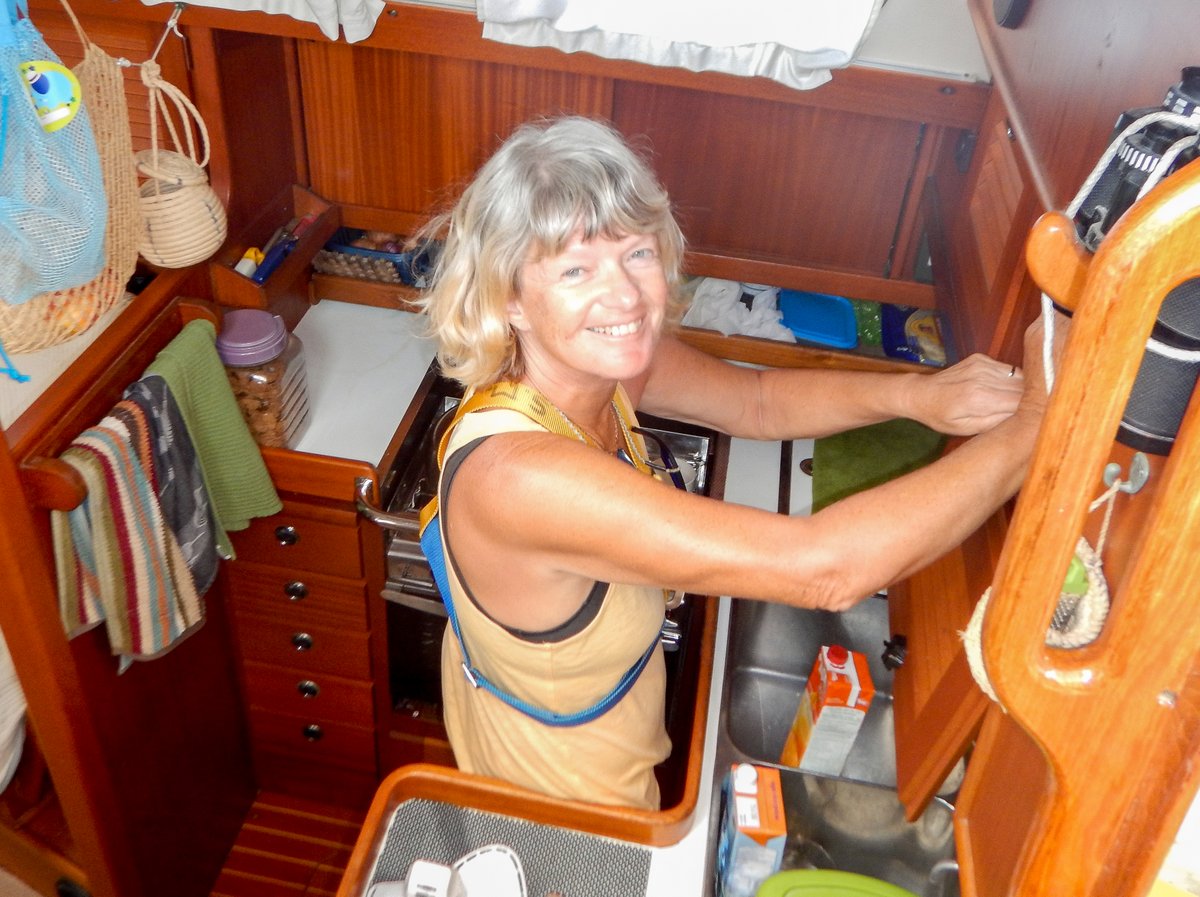
I played with my qtVlm routing software, using it to calculate the fastest route with just the wind data and then another routing with the wind and current. Interestingly, the routing using only the wind data was mostly along the rhumb line, but the routing using the wind & current data looped about 50 miles south of the rhumb line – obviously to take advantage of the predicted 0.5 to 1 knot currents, which swirl around in this area.
The Wind-only route was 507 miles taking 3 days 21 hours 45 mins, whereas the Wind-and-Current route was 540 miles taking 3 days 20 hours 25 minutes. That’s an 80 minute time saving (1.2%), but an extra 33 miles to travel. However, IMHO, the tiny 1% difference is insignificant when compared to the accuracy of the GRIB forecasting, so we’re going to continue to plod along the rhumb line, which is the shortest distance.
We didn’t touch the sails all day, just rolled along with the wind behind us. When I woke up from my afternoon nap, Glenys pointed out a small fishing boat that we’d passed a couple of miles back. It seemed very small to be 400 miles away from anywhere, but I guess we’re in an even smaller boat.
The night was uneventful, sometimes we’d roll violently for a while, but most of the time we were peacefully gliding along under the moon and stars. We didn’t see any other fishing boats or ships – we’re all alone in the middle of the Indian Ocean.
17 February 2017 Port Blair to Galle, Sri Lanka (Day 4)
At our 07:00 watch change, we’d done 458 miles with 386 miles to go. We’ve been doing 160 miles a day for the past two days, so if we can maintain our boat speed, we’ve got a very good chance of getting to our destination early on Monday 20th. The latest weather forecast still shows good 15-20 knot winds until Sunday 19th, when it will drop to 5 knots, so we’ll probably be motoring for the last 24 hours.

As we head east, the time zone is changing by one hour for every 15 degrees of longitude (900 miles) that we travel. Sunrise has been getting 10 minutes later every day and this morning it was at 07:00 (Alba Time Zone). Glenys prefers the sunrise to be well before the end of her 4-7 watch, so we put the clocks back one hour this morning, which just so happens to be the Sri Lankan time zone of GMT+5.5.
For the past couple of days, we’ve had an annoying, intermittent, metallic creaking coming from the lower part of the mast. There are lots of potential sources – the boom gooseneck, the rod kicker, the in-mast furling and various rope jammers & blocks. It sounds like something is slightly moving when it shouldn’t, but it’s been difficult to isolate. After standing next to the mast for half an hour this morning, I suspected the rod kicker and rigged up a secondary kicking strap to take the load off the rod kicker - the creaking went away.
The Rod Kicker has been a damn nuisance for a few years now and the bracket on the mast has ripped off twice. While we were on the hard in Phuket, I spent a lot of time and effort in strengthening the attachment of the bracket, so this noise is damn irritating. I’m going leave the backup kicking strap on and make sure that there’s not something else creaking – thank goodness it wasn’t a fault in the in-mast furling.
We had a fabulous day – these are great sailing conditions, although the constant rolling is annoying at times. The boat is doing one roll every three seconds, which is 28,800 rolls per day – the old saying of “One hand for the boat” is being strictly observed. As usual, it’s taken us a few days to settle into life on passage, but we’ve now slotted into a routine of three hour watches overnight with Glenys sleeping as much as she wants after breakfast and I sleep for a few hours in the afternoon. We only see each other at watch changes and mealtimes.

Just before lunch, a fishing boat motored straight towards us with a guy on the bow waving a shirt to attract our attention. We’ve heard from other cruisers that the Indian/Sri Lankan fishermen like to come alongside yachts and ask for cigarettes, booze and clothes. Sometimes they will trade for fish. Unfortunately, they don’t care that there are six foot breaking waves and we’re surfing down them. Last year, our friends on “Adina” sustained some serious damage to their boat when one of these fishing boats accidently crashed into them.
The fishing boat manoeuvred within 20 metres of us and looked very determined, but with lots of waving, pointing ahead and shouting “No” to them, they got the message and backed off. They followed close behind us for a few minutes and then with some friendly waving continued on their way – phew! We’re going to have to keep a better lookout from now on.
We romped along in the afternoon, sometimes surfing down the bigger waves. The first half of the night was very dark, with heavy cloud cover and no moon, but the wind stayed at 20 knots and we made good time. A half moon rose at midnight and transformed the night, giving us very pleasant sailing. I passed three fishing boats on my 7-10 watch, but we didn’t see any more.
18 February 2017 Port Blair to Galle, Sri Lanka (Day 5)
In the past 24 hours, we’ve had a cracking run of 174 miles (average 7.2 knots) with 15-20 knot winds and a favourable current. At 07:00 this morning, we only had 203 miles to go, so if we can average 6 knots, we should arrive before sunset tomorrow. The latest GRIB forecast shows similar winds & current for today and overnight, so it looks very possible.
It’s Sunday tomorrow and I was worried about extra costs for a weekend arrival, so using our sat phone, I emailed our agent in Galle and he’s confirmed that there’s no overtime charges – its the same outrageous cost every day of the week.
This morning, we saw our first fishing buoy. We passed within 50 metres of a black flag and there was a white float about 25 metres from the flag – I couldn’t see any other flags or floats. I assume that they are long-line fishing with a fishing line suspended from floats between two flags, miles apart. Hopefully the main line will be several metres under the surface and as long as we don’t hit a flag or a float then we should pass over it.
The day started off overcast and grey, but with a consistent 15-20 knot wind. As we moved into the afternoon, the wind started to gust up to 25 knots and dark patches of rain squalls were bubbling up around us.
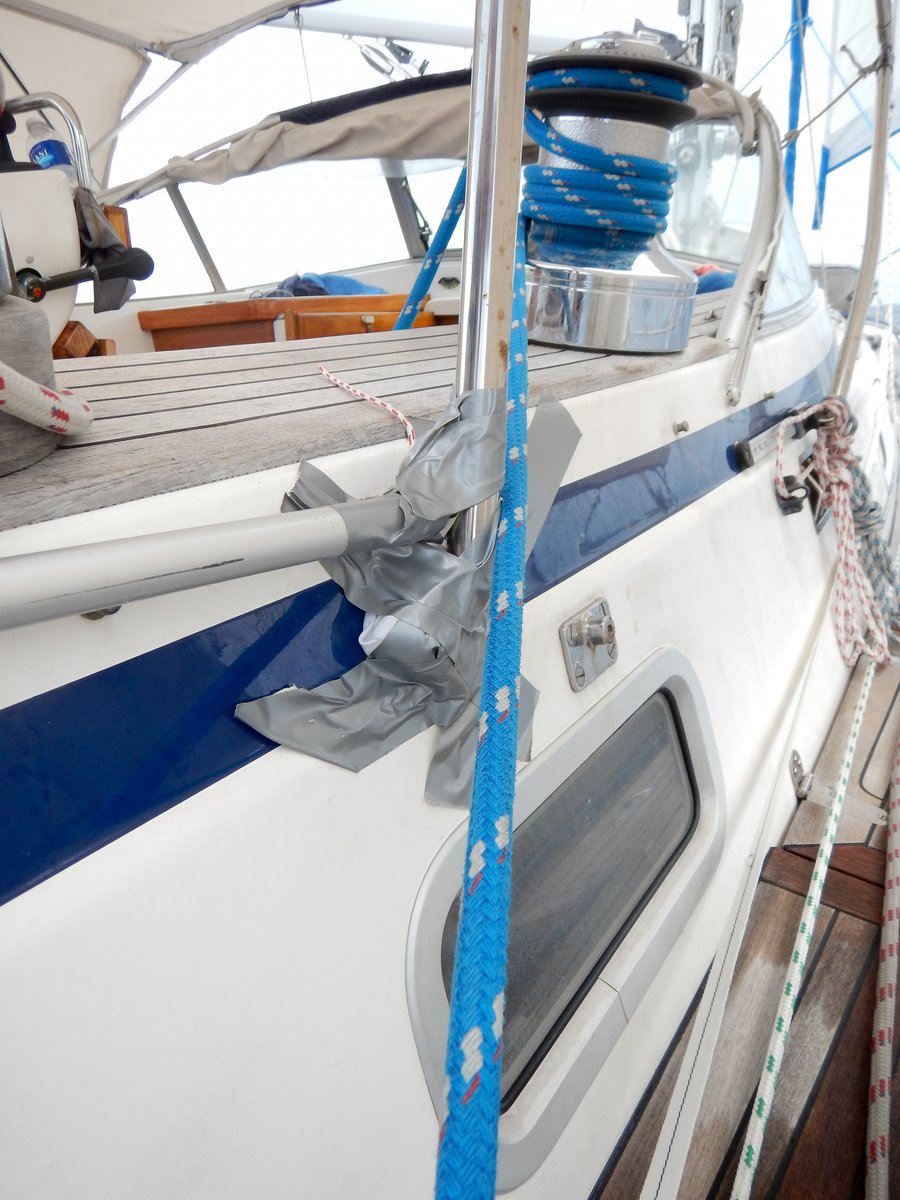
We reefed the main and the genoa, but as Glenys was winching in the genoa sheet, she leaned on the bimini frame and the bolt holding the frame leg snapped off. Unfortunately, half of the bolt has been left behind in the deck fitting, so it took us ten minutes of inventive use of 3mm line; a piece of wood; and some duct tape to bodge a way of holding the frame in place. I’ll repair it properly when we get to Mirissa.
We managed to avoid the squalls until about four o’clock, when one overtook us and heavy rain started. Within 10 minutes, the wind had veered by 45 degrees and was increasing rapidly, so I braved the lashing rain and went on deck to roll away the main sail. By this time, we had 35 knots of wind, so we turned dead downwind and ran for ten minutes with about ¼ mile visibility, hoping that the two nearby ships would keep clear of us. We could see on our AIS that they were both within a mile of us, but we couldn’t physically see them because of the driving rain.
The wind gradually dropped down to 5-10 knots, leaving us in big, confused seas with no boat speed, so rather than wallowing about, we started the engine and headed off towards our destination. By this time we needed to have dinner, but we were being bounced around by the big waves, so Glenys abandoned the idea of cooking a Spanish Omelette and rustled up a one-pot beef stew from tins, which was surprisingly good being enhanced with Heinz tomato soup and Tabasco sauce. As darkness fell, we were only 30 miles from the Sri Lankan coast, but still had 120 miles to go to Galle.

My 7-10 watch was pretty miserable – it was pitch black with persistent rain; we were being thrown around by the confused waves; and every few minutes, the sky was being illuminated by huge flashes of lightning. The wind was very fickle, varying from 8 knots to 16 knots, so with the uncertainty of another squall, I left the main furled away and motor-sailed with just the genoa. There were scores of ships on the AIS and I passed a few fishing boats, so it was a busy three hours.
The wind picked up to a steady 15-20 knots allowing Glenys to sail for most of her 10-1 watch albeit just with the genoa. By this time, we had a 2-3 knot current pushing us along, so we were making good speed across the ground. The rest of the night turned out to be lovely. We raised the main sail at 01:00 and had a cracking close reach as we curved around the south side of Sri Lanka. With the strong current, we were doing over 9 knots across the ground at times.
19 February 2017 Port Blair to Galle, Sri Lanka (Day 6)
The wind started to drop just after dawn, so we motor-sailed, trying to stay in the deep water where I thought that the current would be stronger. Around the south of Sri Lanka, the sea bed comes steeply up from 2,000 metres to 50 metres in a couple of miles, so the ocean currents are concentrated and strong.
This steep gradient also brings up nutrients from the lower ocean and that means that the sea life is abundant, which brings Blue Whales to the area. These are the largest Mammals in the world and eat krill, which I guess proliferates in this area. Whale Watching is a boom industry in Sri Lanka and we sailed past scores of two-deck boats packed with tourists coming out of Mirissa. Unfortunately, we didn’t see any whales despite making a slight detour to follow the Whale Watching boats.
We arrived in Galle at midday and were told by Galle Port Control to anchor outside the harbour to await an inspection by the Navy - we anchored at 06°01.82N 080°13.34E in 8 metres on sand. A small Navy boat appeared about an hour later and three guys stepped on board - their boat headed back to the harbour. They wanted a crew list; a copy of our passports and a copy of our port clearance from the Andamans. After a quick tour of the boat, they seemed happy and told us to pull up our anchor and head into the port.

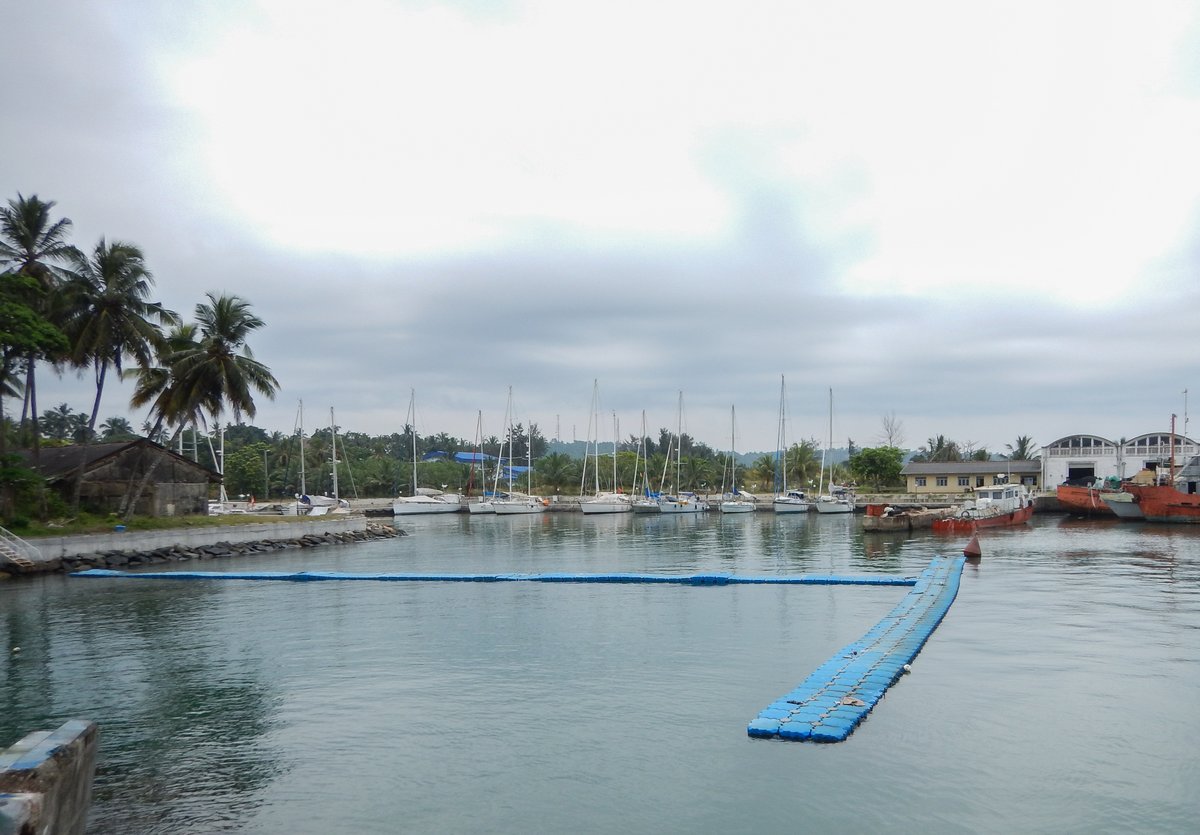
They directed us through the port, past some dodgy, blue, floating pontoons and into the new “Marina” - in previous years, cruising yachts have tied up to the dodgy blue floating pontoons. The marina is a rectangular boat basin with concrete walls and steel loops onto which one can tie ropes. There were about 15 boats already in the marina, with space for only 3 or four more.
We had to “Med-moor” which involved dropping our anchor and then reversing back to the quay side. I haven’t done this for years, but thankfully there wasn’t much wind, so I managed to get in without any serious damage. The three Navy guys disembarked.
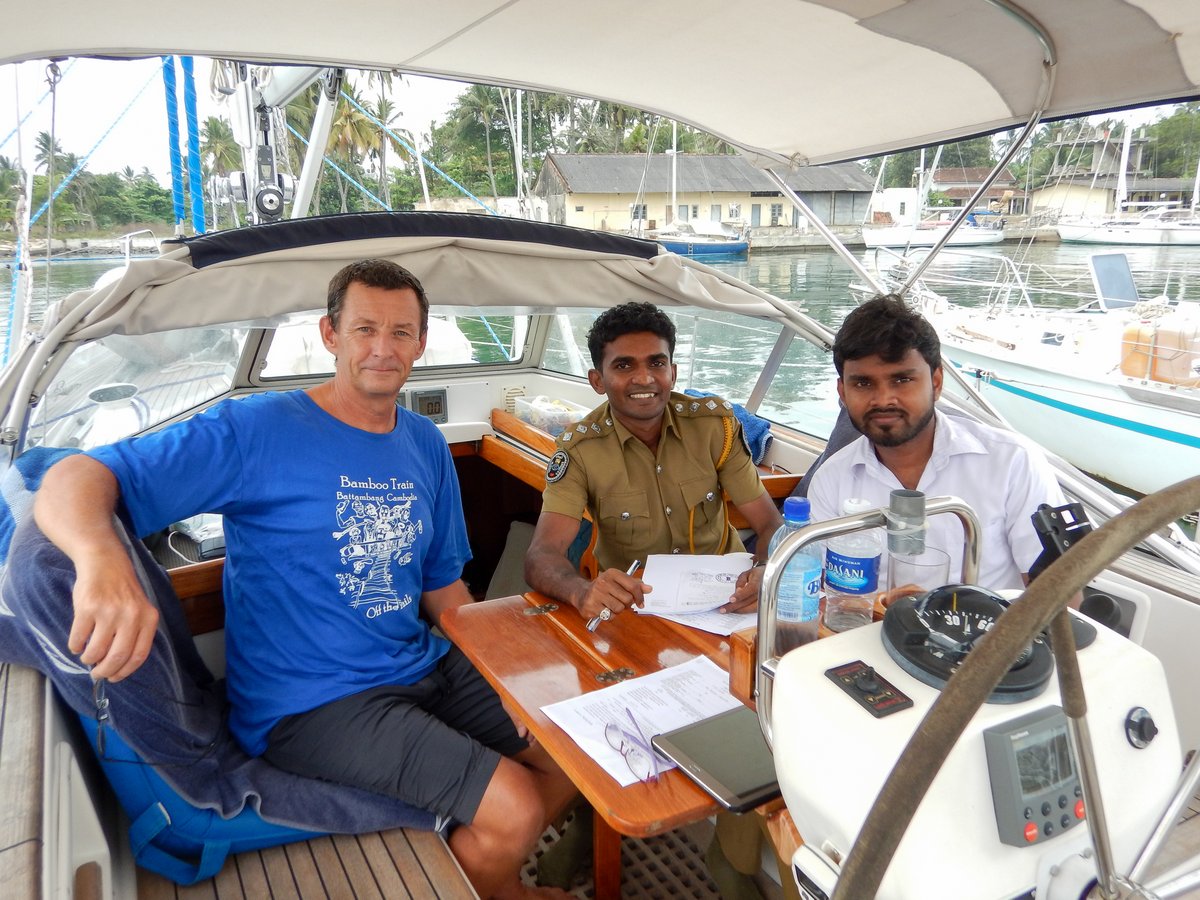
Our agent was waiting for us with a couple of Customs officers. They came on board and had me fill in a Customs declaration form, on which I truthfully listed our booze without any problems. They had various requests for documents, which our (expensive) agent hadn’t told us about, so I had to create some documents and print them out while they waited. The strangest document was a “Nil List” on which I had to state “No controlled Drugs”, “No Fire Arms”, “No Animals” etc.
The young customs officer was very chatty and a nice guy, but there was an awkward moment when he said that most captains offer a small gift. It was a very mild suggestion and he seemed almost embarrassed to ask, so I stared him in the eye and shook my head slightly. The moment passed and every one was friendly again and we had our photos taken. Other boats have had a harder time and have handed over small items.
The Immigration officer soon appeared, but refused to board the boat. To be fair, it was a six foot leap to the dock and you had to swing on our stern arch to get back on-board - even “Rock Climbing Glenys” refused to go ashore. I took our passports and crew lists ashore and the officer stamped the various forms, while stood on the dockside. He took our passports away and our agent returned them thirty minutes later.
We then had an hour’s wait for the Health Inspector. Apparently they don’t work on weekends, so he made a special exception to come and clear us. It was a quick visit. I had to fill in the usual form stating that there hadn’t been any deaths or outbreaks of contagious diseases on board and he asked to see our Yellow Fever vaccinations, but I think that was only because we confessed to having them.
Once we were finished with the formalities, I told the agent that we wanted to leave in the morning, so he went off to prepare the clearance for us to go up the coast to Mirissa. Glenys was feeling very weary and couldn’t face the death leap to the dock, so I wandered off by myself to find an ATM to get some cash and then buy SIM cards to give us access to the internet. It’s very much like the Andamans with tuk-tuks, motorbikes and buses roaring past at high speed.
Back at the boat, we were so tired that we had dinner watching a movie and fell asleep on our chairs before crawling into bed at ten o’clock.
20 February 2017 Galle to Mirissa, Sri Lanka
I woke at two o’clock knowing that I’d been bitten by mosquitos. I climbed out of bed and spent fifteen minutes putting up mosquito screens; plugging in our insecticide heaters and wandering about the boat swatting mosquitos with our zapper - 12 confirmed kills. Glenys slept soundly throughout this mayhem despite me turning on all of our bedroom lights.
We had a quiet morning until our agent turned up at 09:30 and gave us a very impressive clearance document allowing us to go to just 20 miles to Mirissa. We called Port Control and received permission to leave. On our way out of the port entrance, I noticed a guy at a military-looking tower, waving a red flag. He looked very agitated and seemed to want us to return to the harbour. I called up Port Control, who then tried to call the Navy.
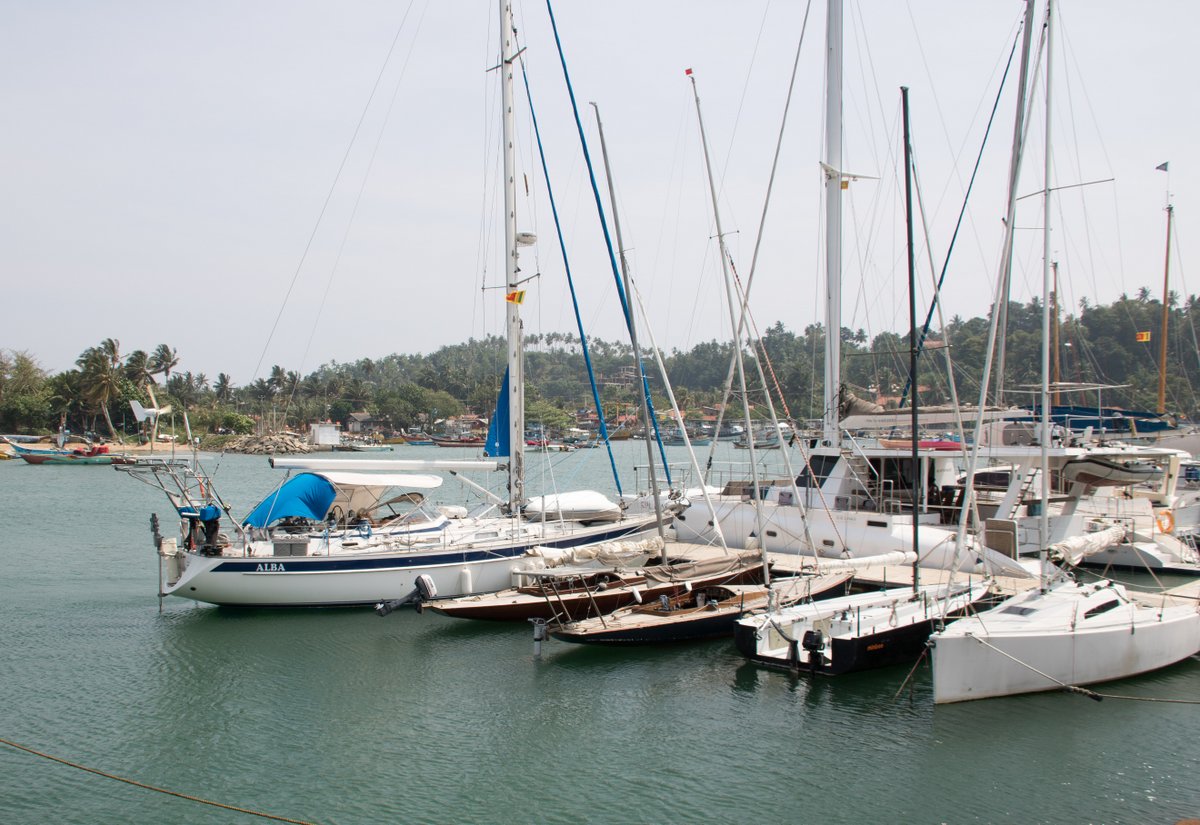
I hovered outside the port entrance; thinking about the fierce Sri Lankan Civil War, which only ended 8 years ago. Suddenly a big, powerful Navy gunship roared out of the harbour straight towards us (gulp!) The Navy boat carried on past us, so I called Port Control who asked if I could still see a red flag. “Errr, No.” They simply responded “OK, you can go”. I guess that I wasn’t supposed to leave while a Navy boat was exiting the port.
We had a very boring three hour passage to Mirissa , motoring in calm seas against a 5 knot wind. As we turned the corner into the small harbour, we could see the floating docks belonging to Sail Lanka Charters. The manager, Alex, had told me that we had to go port side-to, onto the first finger pontoon as we entered the port.
It was chaos - Alex wasn’t there. There was a finger pontoon, but it was half submerged with two guys frantically trying to jam a big float underneath it. Nobody seemed to be in charge as we hovered around. Fortunately, Anthony from “Wild Fox” (also moored in the harbour) was talking to the dock guys and then shouting instructions & advice to us.
Eventually, it was agreed that I didn’t want to go onto the sinking pontoon, so the Sail Lanka guys moved one of their two catamarans out of the way and we squeezed ourselves onto a tiny, 6 metre long finger pontoon. Fortunately, they gave us a rope connected to a huge mooring that we tied onto our port aft cleat, which will keep the pressure off the pontoon.

Once I felt that Alba was safe, I chatted to the friendly guys working on the Sail Lanka boats and looked around. Everyone seems very welcoming and there are two Coast Guard boats about ten metres behind us, so I don’t think that security will be a big problem. The harbour itself is a riot of colour with hundreds of local boats including whale-watching boats and a vast variety of fishing boats. I think I’m going to like this place.
A tuk-tuk driver called Suranga introduced himself to us and told us that our friends Tom & Susie on “Adina” had recently contacted him to say that we were arriving. We asked him to take us to the local town of Weligama, where we bought a few things at a supermarket, which was (relatively) very good after the thin pickings in the Andamans. Suranga also took us to buy some local “Lion” beer which we had to buy at a “Wine Shop” - behind iron bars similar to the Andamans, but a little bit posher.
We collapsed back on the boat and had a quiet night.
21 February 2017 Mirissa, Sri Lanka
We had an administration day. Glenys had to spend all morning rearranging our two week land trip around Sri Lanka because we’ve arrived here a week early. While we were in Thailand, she booked most of the accommodation, but has had to cancel it all and start again. We’re planning to leave here on Friday 24th and be away until the 10th March. Meanwhile, I caught up on editing photographs and publishing my blog.
If we’d stayed in the Andamans for our full visa allowance of 28 days, then we would have been starting our passage today, so I downloaded the GRIB file for the next 14 days and ran a routing in qtVlm. It looks like we would have had a horrible passage, motoring for 5½ days and we would have less than 10 knots behind us for the other two days. I’m rather pleased with myself for my snap decision to leave a week early.

In the afternoon, I went for a walk around the harbour to try to capture the colourful mayhem in photographs. The fishing boats are packed 10-deep around the main quayside, with fishermen sat in the shade repairing their nets. Wherever there’s some floor space, fish are laid out on sackcloth to dry in the sun. It’s an interesting place.
22 February 2017 Mirissa, Sri Lanka
The company who owns this small marina also manufacture fibreglass boats and they have the facilities to do most kinds of boat repairs - they even have a sail loft. I removed the fitting for our bimini and they are going to remove the broken bolt for me. Also, the exhaust on our engine has developed a small hole in the stainless steel end cap. I tried to bodge it with some epoxy, but it’s still leaking, so I removed it and I’m going to get it welded up.
I’d finished my little jobs by 10:00, so we went for a walk into Mirissa. It was very pleasant walking down the narrow roads - apart from the danger of being hit by speeding tuk-tuks as they scream around the corners. Mirissa is spread out along a main road and doesn’t have centre - mostly it’s small hotels, tourist shops and restaurants.
We walked back along the main Mirissa beach, which has lovely white sand with breaking waves. The beach is lined with bars, restaurants and touts selling whale-watching trips – it’s also packed with hundreds of white tourists, baking in the sun.
As it was near lunchtime, we walked back through the fishing port, and at the end of the breakwater, up a small road towards the Weligambay Villas hotel. We walked through the hotel complex and up a steep road that became a dirt track and then descended to the right down to a beautiful little cove called Secret Beach.

There’s a small beach, which is protected from the swell by a line of rocks, and a restaurant set under the trees with rough wooden tables set out in the sand. There were about twenty people there and it was a very chilled out place. For lunch, we had Devilled Squid and Garlic Prawns, which was very tasty.
In the afternoon, I removed and cleaned out the exhaust elbow on our engine. It had a lot of build-up of carbon and hard salt deposits, so it took an hour of chipping way with a screwdriver to get it looking presentable again.
23 February 2017 Mirissa, Sri Lanka
We packed our rucksacks ready for our two week land trip and then chilled out for the rest of the morning. In the afternoon, the repaired bimini bracket and the exhaust end cap were delivered back to us, so I leapt into action and soon had both of them fitted. I ran the engine for an hour and all seems to be fine. We’re now looking forward to going on holiday.
24 February 2017 Mirissa to Kandy, Sri Lanka
I woke up at six o’clock with a nagging worry about leaving our home in this “marina”. The finger pontoon is only about 6 metres long and Alba is 13 metres long, so a considerable length of our boat was sticking out past the pontoon. In addition, the severe rocking and rolling caused when the fishing and whale-watching boats roar past is causing chafing of the rope tied to our centre cleat.
I backed up the centre rope and ran a long rope from our starboard stern cleat to the shore. With the heavy mooring line to our port stern cleat, we are now moored much better and I will be able to sleep at night. There are a few small yachts on the inside of us, which are now blocked by our shore line, but they don’t seem to get used very often and they can always lower the stern line into the water to sail out over it.
Suranga, our tuk-tuk driver, arrived at 08:00 and whisked us off to Matara to start our land trip around Sri Lanka.
25 February to 9 March 2017 Sri Lanka Road Trip
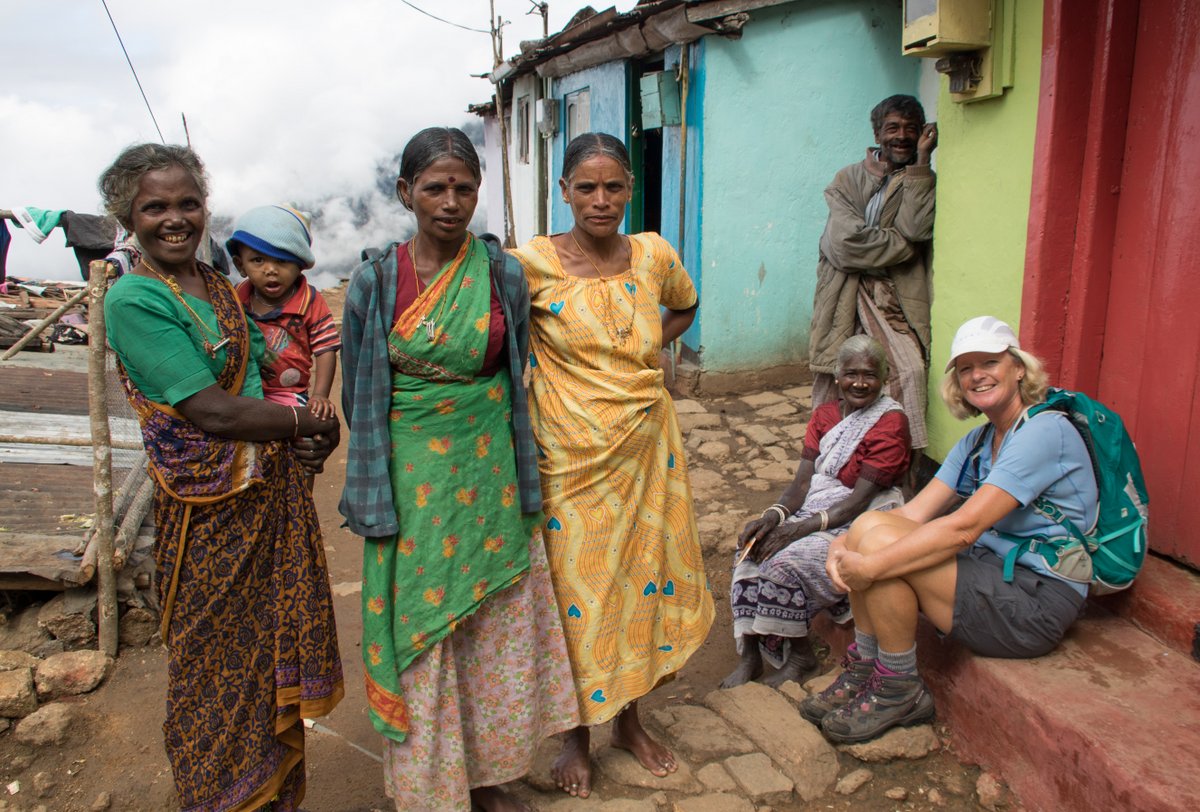
We had a fabulous two weeks travelling around Sri Lanka. It’s a country with a diverse range of environments from the sandy beaches to the temperate hill regions where tea is grown. We started in Kandy, which used to be the country’s capital and then headed north-east to Sigiriya for some serious cultural temple gazing, also managing to fit in an evening safari at the Kaudulla National Park, where we saw wild Indian Elephants.
After a short stay back in Kandy to learn about tea making, we boarded a train up to the Hill Country where we did some lovely hikes around the tea plantations. We stopped in Ohiya, Hautale and Ella. A short trip to Udawalawe National Park for a couple more safaris completed our trip and then we headed off back to Mirissa.
We saw some lovely temples (both Buddhist and Hindu); ruins of 12th Century cities; wild elephants, scores of birds; and marvelled at the scenery in the mountains. The food was fabulous – having Sri Lankan curry three times a day for 13 days was outstanding. Glenys was shown how to cook some traditional Sri Lankan dishes, so I'm looking forward to eating Prawn Curry, Sri Lankan Dhal and Brinjal Salad in the future.
I’ve published a separate article for our Sri Lanka Road Trip.
There are more photos in our Photo Album section.