
16 February 2017 Port Blair to Galle, Sri Lanka (Day 3)
Dawn brought us a pleasant day with 50% cloud cover and a very consistent 15-20 knot wind. I downloaded a weather forecast and the wind is expected to increase by a few knots over the next couple of days, but will still die on the 19th.
I played with my qtVlm routing software, using it to calculate the fastest route with just the wind data and then another routing with the wind and current. Interestingly, the routing using only the wind data was mostly along the rhumb line, but the routing using the wind & current data looped about 50 miles south of the rhumb line – obviously to take advantage of the predicted 0.5 to 1 knot currents, which swirl around in this area.
The Wind-only route was 507 miles taking 3 days 21 hours 45 mins, whereas the Wind-and-Current route was 540 miles taking 3 days 20 hours 25 minutes. That’s an 80 minute time saving (1.2%), but an extra 33 miles to travel. However, IMHO, the tiny 1% difference is insignificant when compared to the accuracy of the GRIB forecasting, so we’re going to continue to plod along the rhumb line, which is the shortest distance.
We didn’t touch the sails all day, just rolled along with the wind behind us. When I woke up from my afternoon nap, Glenys pointed out a small fishing boat that we’d passed a couple of miles back. It seemed very small to be 400 miles away from anywhere, but I guess we’re in an even smaller boat.
The night was uneventful, sometimes we’d roll violently for a while, but most of the time we were peacefully gliding along under the moon and stars. We didn’t see any other fishing boats or ships – we’re all alone in the middle of the Indian Ocean.
17 February 2017 Port Blair to Galle, Sri Lanka (Day 4)
At our 07:00 watch change, we’d done 458 miles with 386 miles to go. We’ve been doing 160 miles a day for the past two days, so if we can maintain our boat speed, we’ve got a very good chance of getting to our destination early on Monday 20th. The latest weather forecast still shows good 15-20 knot winds until Sunday 19th, when it will drop to 5 knots, so we’ll probably be motoring for the last 24 hours.

As we head east, the time zone is changing by one hour for every 15 degrees of longitude (900 miles) that we travel. Sunrise has been getting 10 minutes later every day and this morning it was at 07:00 (Alba Time Zone). Glenys prefers the sunrise to be well before the end of her 4-7 watch, so we put the clocks back one hour this morning, which just so happens to be the Sri Lankan time zone of GMT+5.5.
For the past couple of days, we’ve had an annoying, intermittent, metallic creaking coming from the lower part of the mast. There are lots of potential sources – the boom gooseneck, the rod kicker, the in-mast furling and various rope jammers & blocks. It sounds like something is slightly moving when it shouldn’t, but it’s been difficult to isolate. After standing next to the mast for half an hour this morning, I suspected the rod kicker and rigged up a secondary kicking strap to take the load off the rod kicker - the creaking went away.
The Rod Kicker has been a damn nuisance for a few years now and the bracket on the mast has ripped off twice. While we were on the hard in Phuket, I spent a lot of time and effort in strengthening the attachment of the bracket, so this noise is damn irritating. I’m going leave the backup kicking strap on and make sure that there’s not something else creaking – thank goodness it wasn’t a fault in the in-mast furling.
We had a fabulous day – these are great sailing conditions, although the constant rolling is annoying at times. The boat is doing one roll every three seconds, which is 28,800 rolls per day – the old saying of “One hand for the boat” is being strictly observed. As usual, it’s taken us a few days to settle into life on passage, but we’ve now slotted into a routine of three hour watches overnight with Glenys sleeping as much as she wants after breakfast and I sleep for a few hours in the afternoon. We only see each other at watch changes and mealtimes.

Just before lunch, a fishing boat motored straight towards us with a guy on the bow waving a shirt to attract our attention. We’ve heard from other cruisers that the Indian/Sri Lankan fishermen like to come alongside yachts and ask for cigarettes, booze and clothes. Sometimes they will trade for fish. Unfortunately, they don’t care that there are six foot breaking waves and we’re surfing down them. Last year, our friends on “Adina” sustained some serious damage to their boat when one of these fishing boats accidently crashed into them.
The fishing boat manoeuvred within 20 metres of us and looked very determined, but with lots of waving, pointing ahead and shouting “No” to them, they got the message and backed off. They followed close behind us for a few minutes and then with some friendly waving continued on their way – phew! We’re going to have to keep a better lookout from now on.
We romped along in the afternoon, sometimes surfing down the bigger waves. The first half of the night was very dark, with heavy cloud cover and no moon, but the wind stayed at 20 knots and we made good time. A half moon rose at midnight and transformed the night, giving us very pleasant sailing. I passed three fishing boats on my 7-10 watch, but we didn’t see any more.
18 February 2017 Port Blair to Galle, Sri Lanka (Day 5)
In the past 24 hours, we’ve had a cracking run of 174 miles (average 7.2 knots) with 15-20 knot winds and a favourable current. At 07:00 this morning, we only had 203 miles to go, so if we can average 6 knots, we should arrive before sunset tomorrow. The latest GRIB forecast shows similar winds & current for today and overnight, so it looks very possible.
It’s Sunday tomorrow and I was worried about extra costs for a weekend arrival, so using our sat phone, I emailed our agent in Galle and he’s confirmed that there’s no overtime charges – its the same outrageous cost every day of the week.
This morning, we saw our first fishing buoy. We passed within 50 metres of a black flag and there was a white float about 25 metres from the flag – I couldn’t see any other flags or floats. I assume that they are long-line fishing with a fishing line suspended from floats between two flags, miles apart. Hopefully the main line will be several metres under the surface and as long as we don’t hit a flag or a float then we should pass over it.
The day started off overcast and grey, but with a consistent 15-20 knot wind. As we moved into the afternoon, the wind started to gust up to 25 knots and dark patches of rain squalls were bubbling up around us.
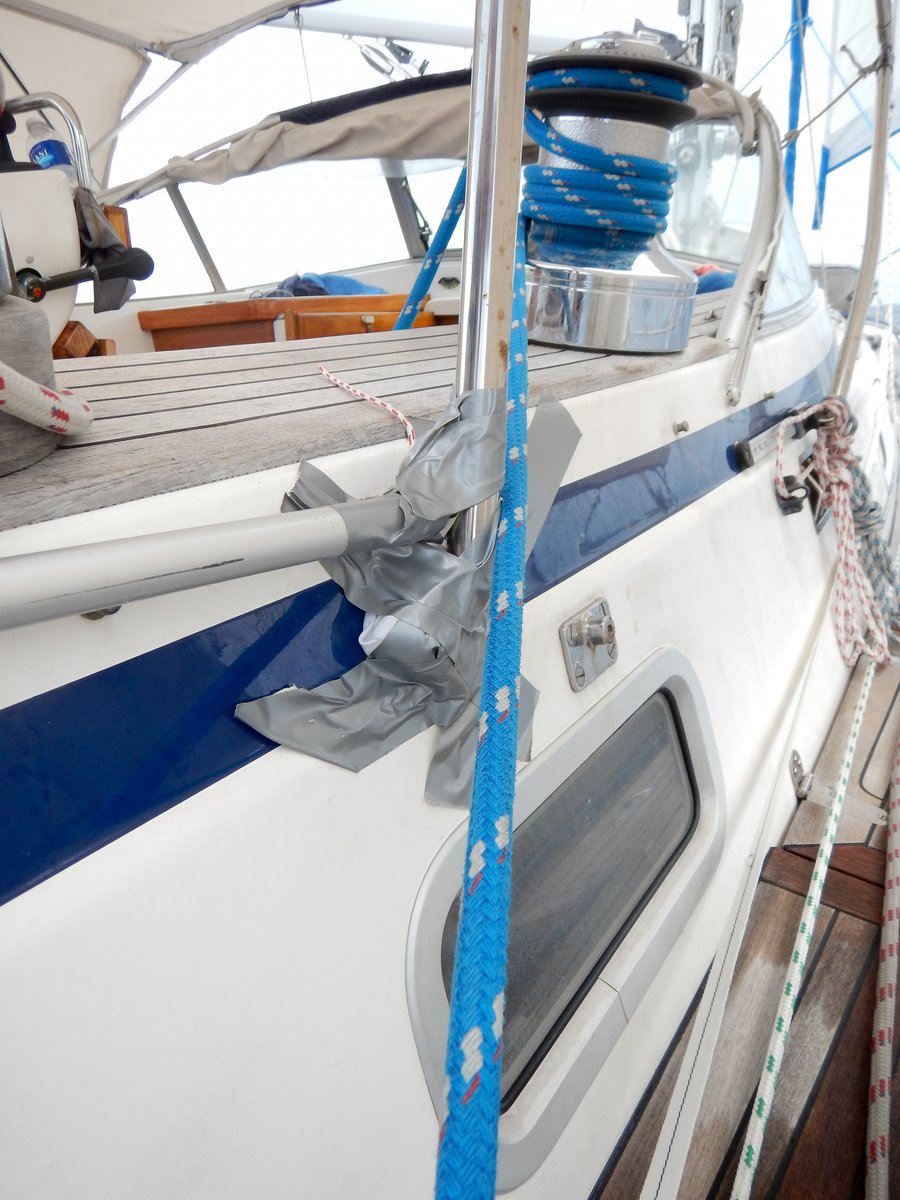
We reefed the main and the genoa, but as Glenys was winching in the genoa sheet, she leaned on the bimini frame and the bolt holding the frame leg snapped off. Unfortunately, half of the bolt has been left behind in the deck fitting, so it took us ten minutes of inventive use of 3mm line; a piece of wood; and some duct tape to bodge a way of holding the frame in place. I’ll repair it properly when we get to Mirissa.
We managed to avoid the squalls until about four o’clock, when one overtook us and heavy rain started. Within 10 minutes, the wind had veered by 45 degrees and was increasing rapidly, so I braved the lashing rain and went on deck to roll away the main sail. By this time, we had 35 knots of wind, so we turned dead downwind and ran for ten minutes with about ¼ mile visibility, hoping that the two nearby ships would keep clear of us. We could see on our AIS that they were both within a mile of us, but we couldn’t physically see them because of the driving rain.
The wind gradually dropped down to 5-10 knots, leaving us in big, confused seas with no boat speed, so rather than wallowing about, we started the engine and headed off towards our destination. By this time we needed to have dinner, but we were being bounced around by the big waves, so Glenys abandoned the idea of cooking a Spanish Omelette and rustled up a one-pot beef stew from tins, which was surprisingly good being enhanced with Heinz tomato soup and Tabasco sauce. As darkness fell, we were only 30 miles from the Sri Lankan coast, but still had 120 miles to go to Galle.

My 7-10 watch was pretty miserable – it was pitch black with persistent rain; we were being thrown around by the confused waves; and every few minutes, the sky was being illuminated by huge flashes of lightning. The wind was very fickle, varying from 8 knots to 16 knots, so with the uncertainty of another squall, I left the main furled away and motor-sailed with just the genoa. There were scores of ships on the AIS and I passed a few fishing boats, so it was a busy three hours.
The wind picked up to a steady 15-20 knots allowing Glenys to sail for most of her 10-1 watch albeit just with the genoa. By this time, we had a 2-3 knot current pushing us along, so we were making good speed across the ground. The rest of the night turned out to be lovely. We raised the main sail at 01:00 and had a cracking close reach as we curved around the south side of Sri Lanka. With the strong current, we were doing over 9 knots across the ground at times.
19 February 2017 Port Blair to Galle, Sri Lanka (Day 6)
The wind started to drop just after dawn, so we motor-sailed, trying to stay in the deep water where I thought that the current would be stronger. Around the south of Sri Lanka, the sea bed comes steeply up from 2,000 metres to 50 metres in a couple of miles, so the ocean currents are concentrated and strong.
This steep gradient also brings up nutrients from the lower ocean and that means that the sea life is abundant, which brings Blue Whales to the area. These are the largest Mammals in the world and eat krill, which I guess proliferates in this area. Whale Watching is a boom industry in Sri Lanka and we sailed past scores of two-deck boats packed with tourists coming out of Mirissa. Unfortunately, we didn’t see any whales despite making a slight detour to follow the Whale Watching boats.
We arrived in Galle at midday and were told by Galle Port Control to anchor outside the harbour to await an inspection by the Navy - we anchored at 06°01.82N 080°13.34E in 8 metres on sand. A small Navy boat appeared about an hour later and three guys stepped on board - their boat headed back to the harbour. They wanted a crew list; a copy of our passports and a copy of our port clearance from the Andamans. After a quick tour of the boat, they seemed happy and told us to pull up our anchor and head into the port.

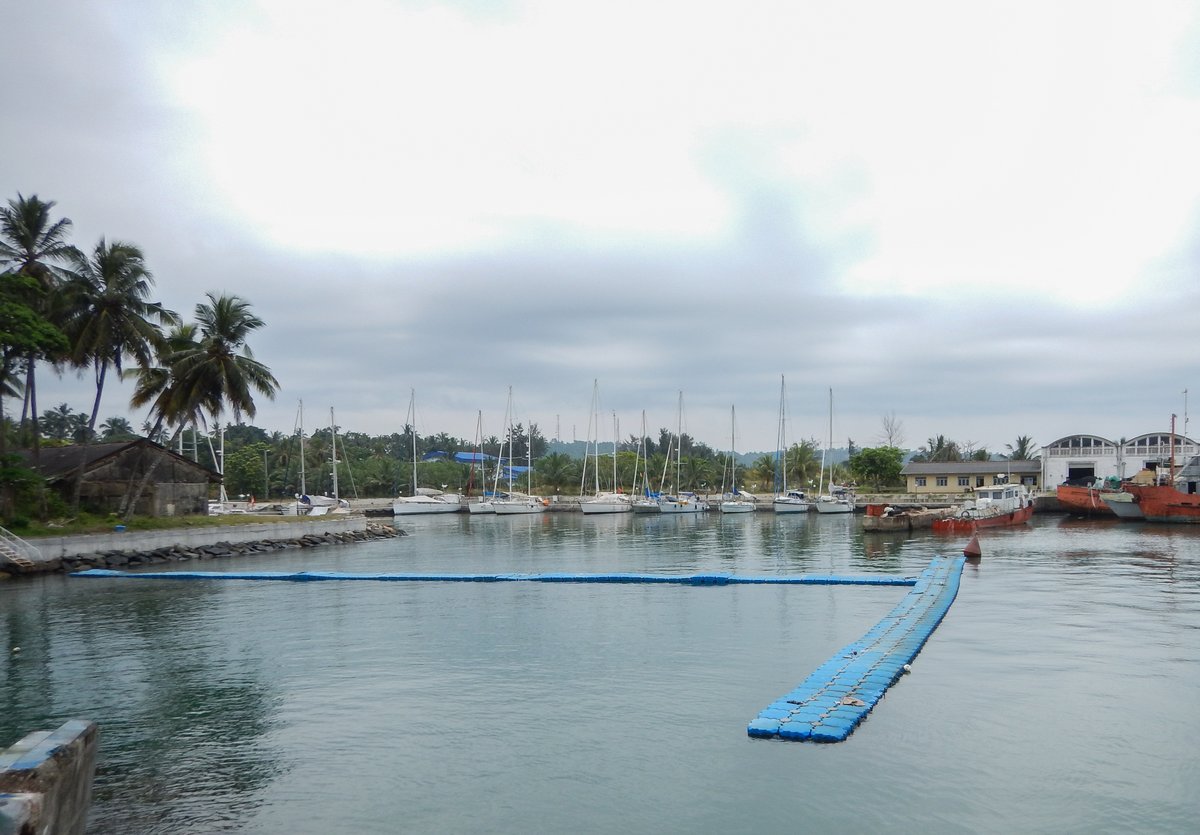
They directed us through the port, past some dodgy, blue, floating pontoons and into the new “Marina” - in previous years, cruising yachts have tied up to the dodgy blue floating pontoons. The marina is a rectangular boat basin with concrete walls and steel loops onto which one can tie ropes. There were about 15 boats already in the marina, with space for only 3 or four more.
We had to “Med-moor” which involved dropping our anchor and then reversing back to the quay side. I haven’t done this for years, but thankfully there wasn’t much wind, so I managed to get in without any serious damage. The three Navy guys disembarked.
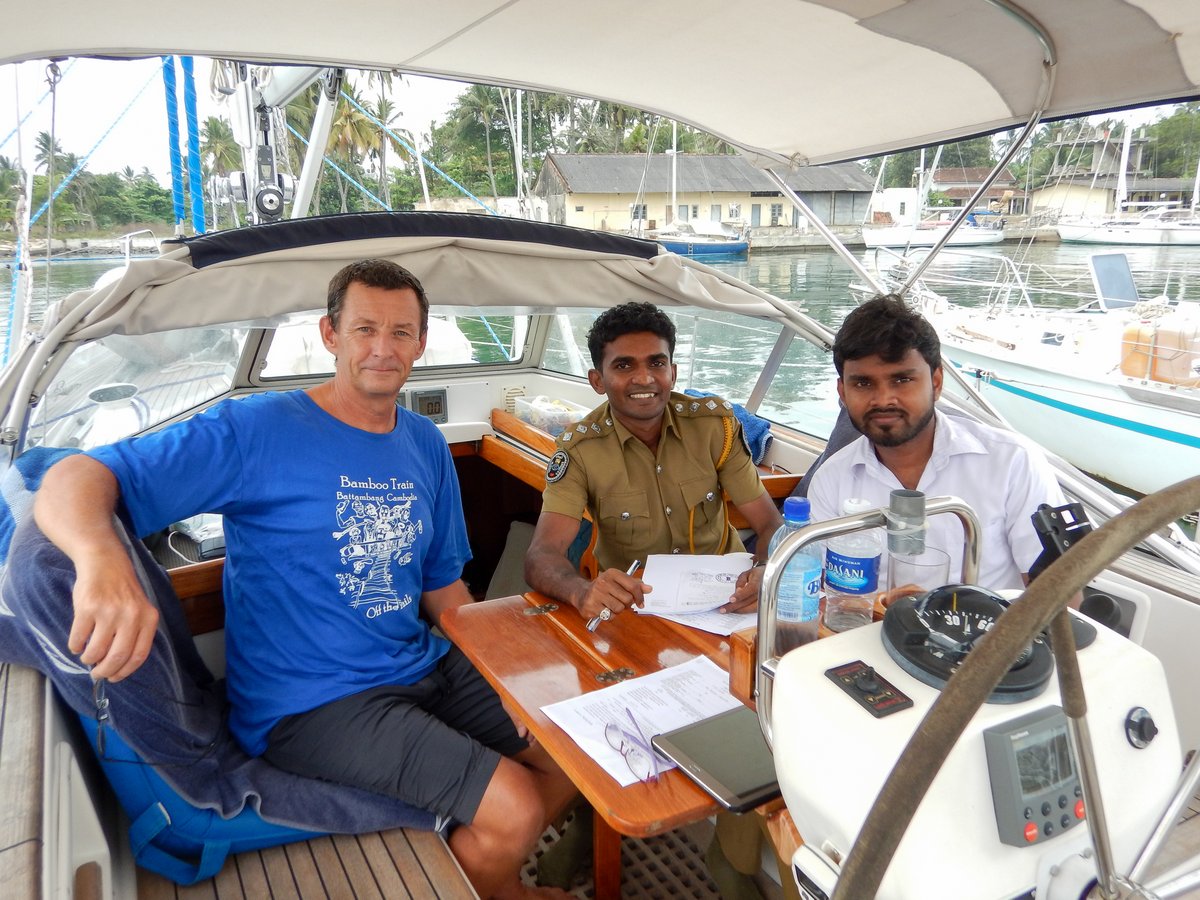
Our agent was waiting for us with a couple of Customs officers. They came on board and had me fill in a Customs declaration form, on which I truthfully listed our booze without any problems. They had various requests for documents, which our (expensive) agent hadn’t told us about, so I had to create some documents and print them out while they waited. The strangest document was a “Nil List” on which I had to state “No controlled Drugs”, “No Fire Arms”, “No Animals” etc.
The young customs officer was very chatty and a nice guy, but there was an awkward moment when he said that most captains offer a small gift. It was a very mild suggestion and he seemed almost embarrassed to ask, so I stared him in the eye and shook my head slightly. The moment passed and every one was friendly again and we had our photos taken. Other boats have had a harder time and have handed over small items.
The Immigration officer soon appeared, but refused to board the boat. To be fair, it was a six foot leap to the dock and you had to swing on our stern arch to get back on-board - even “Rock Climbing Glenys” refused to go ashore. I took our passports and crew lists ashore and the officer stamped the various forms, while stood on the dockside. He took our passports away and our agent returned them thirty minutes later.
We then had an hour’s wait for the Health Inspector. Apparently they don’t work on weekends, so he made a special exception to come and clear us. It was a quick visit. I had to fill in the usual form stating that there hadn’t been any deaths or outbreaks of contagious diseases on board and he asked to see our Yellow Fever vaccinations, but I think that was only because we confessed to having them.
Once we were finished with the formalities, I told the agent that we wanted to leave in the morning, so he went off to prepare the clearance for us to go up the coast to Mirissa. Glenys was feeling very weary and couldn’t face the death leap to the dock, so I wandered off by myself to find an ATM to get some cash and then buy SIM cards to give us access to the internet. It’s very much like the Andamans with tuk-tuks, motorbikes and buses roaring past at high speed.
Back at the boat, we were so tired that we had dinner watching a movie and fell asleep on our chairs before crawling into bed at ten o’clock.
20 February 2017 Galle to Mirissa, Sri Lanka
I woke at two o’clock knowing that I’d been bitten by mosquitos. I climbed out of bed and spent fifteen minutes putting up mosquito screens; plugging in our insecticide heaters and wandering about the boat swatting mosquitos with our zapper - 12 confirmed kills. Glenys slept soundly throughout this mayhem despite me turning on all of our bedroom lights.
We had a quiet morning until our agent turned up at 09:30 and gave us a very impressive clearance document allowing us to go to just 20 miles to Mirissa. We called Port Control and received permission to leave. On our way out of the port entrance, I noticed a guy at a military-looking tower, waving a red flag. He looked very agitated and seemed to want us to return to the harbour. I called up Port Control, who then tried to call the Navy.
I hovered outside the port entrance; thinking about the fierce Sri Lankan Civil War, which only ended 8 years ago. Suddenly a big, powerful Navy gunship roared out of the harbour straight towards us (gulp!) The Navy boat carried on past us, so I called Port Control who asked if I could still see a red flag. “Errr, No.” They simply responded “OK, you can go”. I guess that I wasn’t supposed to leave while a Navy boat was exiting the port.
We had a very boring three hour passage to Mirissa , motoring in calm seas against a 5 knot wind. As we turned the corner into the small harbour, we could see the floating docks belonging to Sail Lanka Charters. The manager, Alex, had told me that we had to go port side-to, onto the first finger pontoon as we entered the port.
It was chaos - Alex wasn’t there. There was a finger pontoon, but it was half submerged with two guys frantically trying to jam a big float underneath it. Nobody seemed to be in charge as we hovered around. Fortunately, Anthony from “Wild Fox” (also moored in the harbour) was talking to the dock guys and then shouting instructions & advice to us.
Eventually, it was agreed that I didn’t want to go onto the sinking pontoon, so the Sail Lanka guys moved one of their two catamarans out of the way and we squeezed ourselves onto a tiny, 6 metre long finger pontoon. Fortunately, they gave us a rope connected to a huge mooring that we tied onto our port aft cleat, which will keep the pressure off the pontoon.

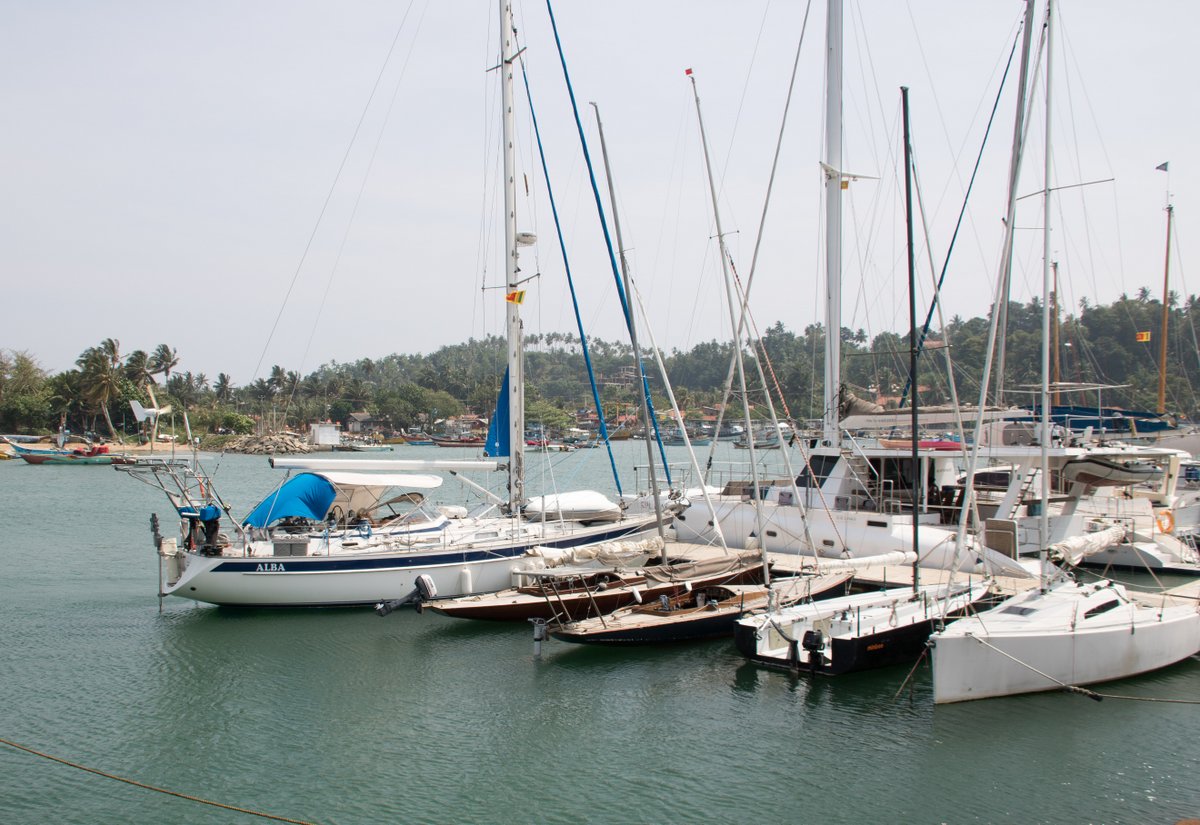
Once I felt that Alba was safe, I chatted to the friendly guys working on the Sail Lanka boats and looked around. Everyone seems very welcoming and there are two Coast Guard boats about ten metres behind us, so I don’t think that security will be a big problem. The harbour itself is a riot of colour with hundreds of local boats including whale-watching boats and a vast variety of fishing boats. I think I’m going to like this place.
A tuk-tuk driver called Suranga introduced himself to us and told us that our friends Tom & Susie on “Adina” had recently contacted him to say that we were arriving. We asked him to take us to the local town of Weligama, where we bought a few things at a supermarket, which was (relatively) very good after the thin pickings in the Andamans. Suranga also took us to buy some local “Lion” beer which we had to buy at a “Wine Shop” - behind iron bars similar to the Andamans, but a little bit posher.
We collapsed back on the boat and had a quiet night.