
20 March 2017 Uligama to Dhiffushi, North Male Atoll (Day 1)
I woke up exasperated about the fact that we won’t be able to go ashore at any of the “inhabited” islands and decided that our best bet was to try to join the Sail Maldives Rally. I emailed our agent, Assad, who contacted the organiser of the rally, who said that we are welcome to join. I chatted to the organiser (Haneef) on the phone and he’s sent me a list of their planned anchorages for the next 10 days.
I’d done all this while Glenys was still in bed. Fortunately, after she’d woken up, she agreed that it was a good idea to join the rally, so we confirmed with the rally organisers. The rally will be arriving in Himmafushi on the 22nd March. This is 10 miles north of Male and 190 miles from here, so we decided that the best plan would be to sail overnight and join the rally as soon as possible. We’ll be sailing past a big chunk of the northern half of the Maldives, but there’s still 200 miles of atolls to explore in the southern half, which should keep us occupied for eight weeks.
At 10:30, Hammad texted me to say that our cruising permit was now sorted out, so we went ashore. He’d found us a big papaya and two breadfruit, which Glenys had asked for, and handed over the Cruising Permit. The document is valid for thirty days and is a single piece of paper that states that we can only visit two places - Kulhudhuffushi and Male. It also says very clearly that “This permit allows visiting only permitted islands and places”.
We paid $780US as a down-payment on our fees and ran away. By 12:00, we were on our way out of the anchorage and motoring in nil winds, heading for Dhiffushi, N Male Atoll, where we will join the rally.
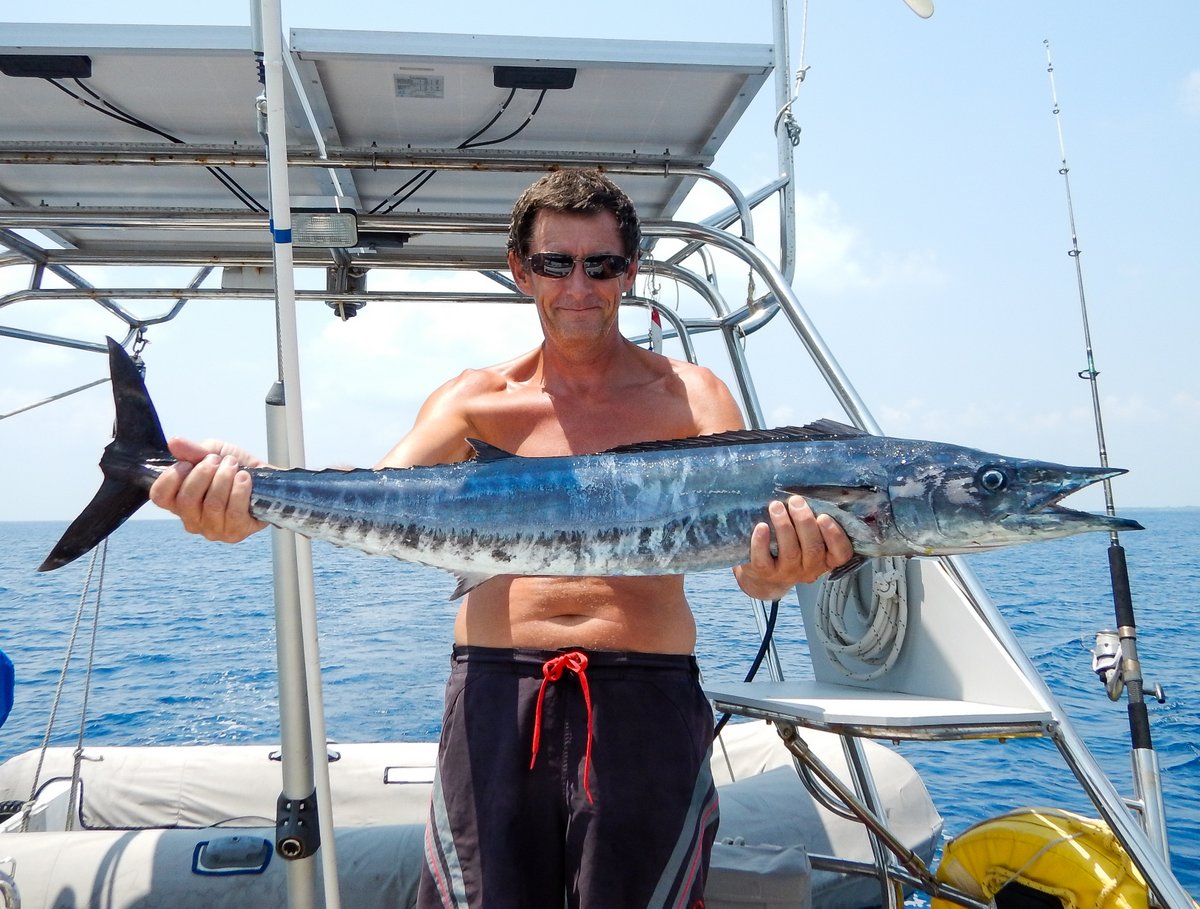
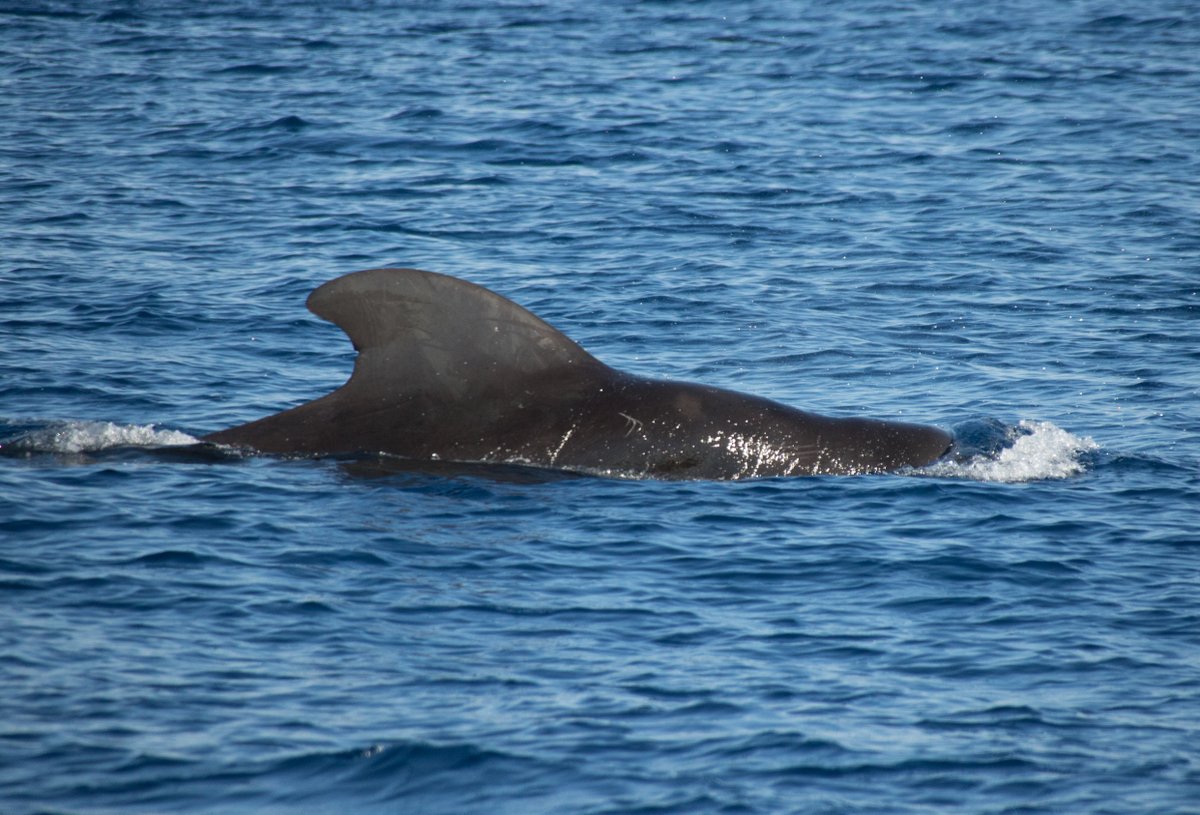
We had a very hot afternoon motoring through the top of North Thilandhunmathee Atoll and then out to sea following the eastern edge of the various atolls heading south. The big excitement of the day was catching a 6kg Wahoo. It’s the first fish that we’ve caught for months, so I was pleased with myself. Later in the afternoon, we saw another group of Pilot Whales, but the moment soon passed and we were back to motoring monotony again. The night was more of the same remorseless motoring.
During the night, I checked our paperwork (I was very bored) and found that after all the waiting, we’ve been given the Cruising Permit for another boat! I’m kicking myself for not checking it properly before we left, but we were just so grateful to get the document and be on our way. Goodness knows how they will sort this one out, now that we’re 200 miles away.
21 March 2017 Uligama to Dhiffushi, North Male Atoll (Day 2)
Dawn brought no wind, so we lounged about all day, motoring hard to get to Dhiffushi before dark. I spent a few hours down below catching up on editing photographs and doing my blog. Glenys read a book.
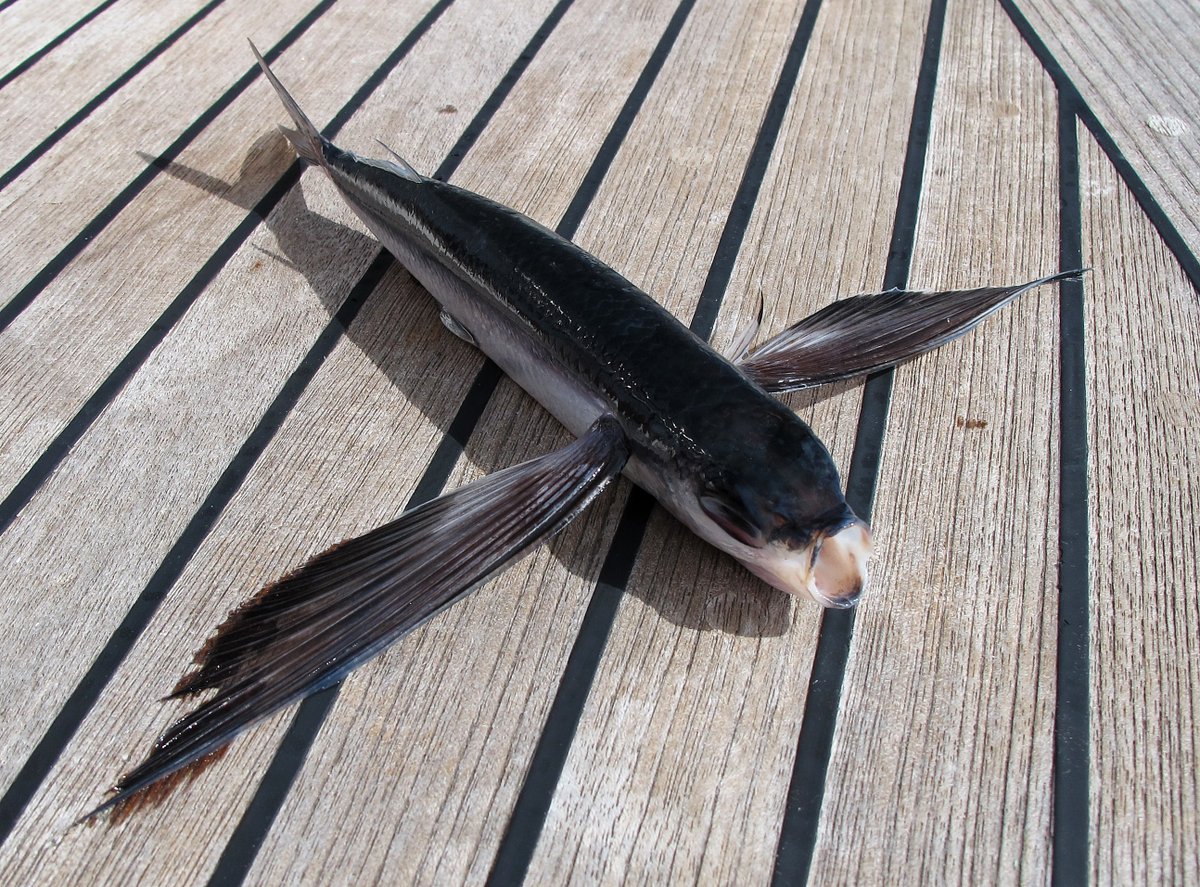
Every time that I stuck my head into the cockpit, I would see a Flying Fish scooting across the calm seas. They are fascinating to watch - popping out of the water and gliding on their wings; then as they lose speed they dip their tails into the water, give a few waggles and accelerate to maintain their glide. I’ve been trying for years to get a decent photograph, but each time I go to the front deck they never appear - I stand there for five minutes and then give up - I don’t have the patience to be a wildlife photographer.
We arrived in the anchorage at Dhiffushi at 15:30 and dropped our anchor at 04°26.99N 073°42.17E in 10 metres of water. There are about ten other boats on the rally and one guy zipped over in his dinghy to tell us that everyone was going ashore at 16:30 for a welcoming ceremony. OK; sort the dinghy out; get the awning up; have a shower and hurry ashore.
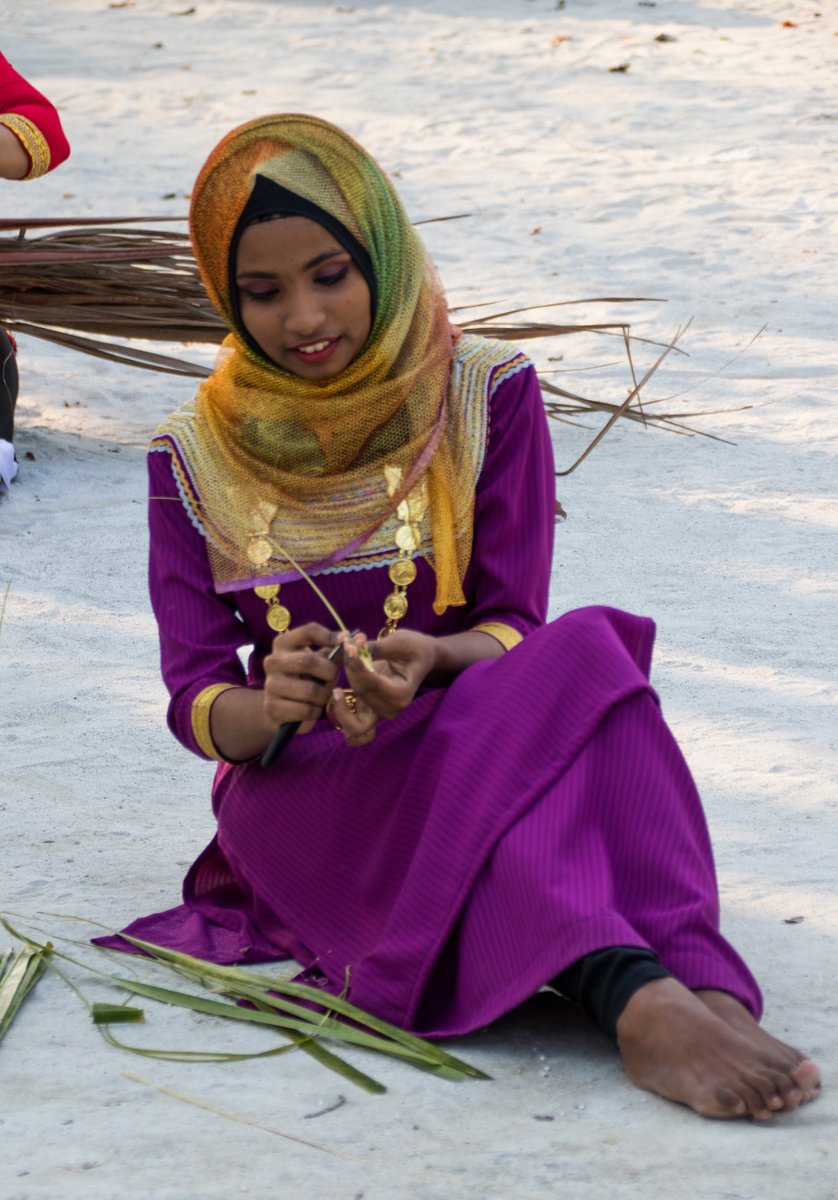
Dhiffushi has about 1,000 people and has a few guest houses run by the local people, so there were a few white tourists on the small beach. The welcoming ceremony was quaint, with a short traditional dance by a group of ladies and then another group of ladies sat on the ground in front of us and demonstrated some of the traditional skills of the islanders, such as making coir rope (from coconut fibres), threshing rice and weaving coconut fronds.
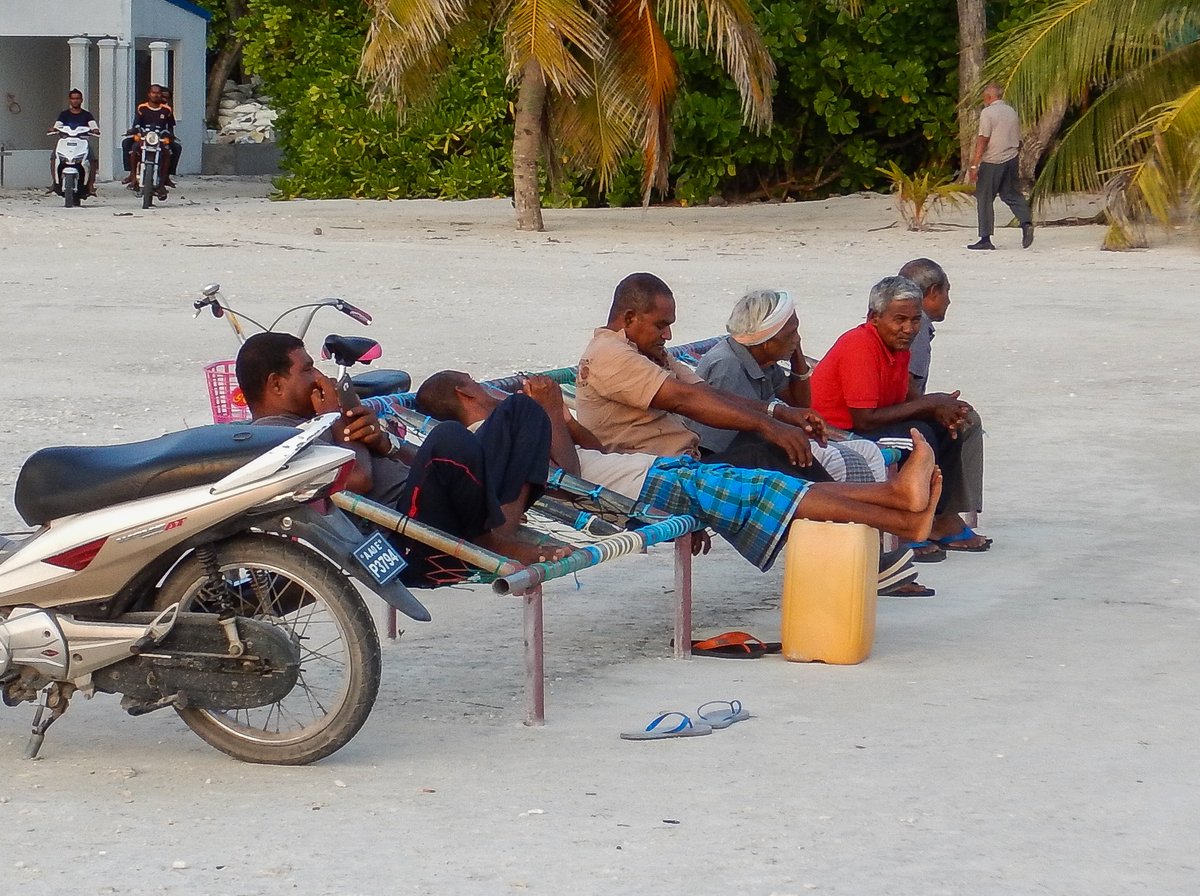
We were then escorted around the village, which was similar to Uligama on a very rectangular grid pattern, but it was a little more “lived in”. It was interesting to see the numbers of Jolis around the town - these are a cross between a deck chair and a hammock and are the traditional Maldivian chair. Originally, Jolis were made entirely from the coconut tree, with a wooden frame supporting a rope seat made from coir rope. Nowadays they are made from synthetic rope and steel tubing.
Everyone retired to the Rally’s Mother Ship, which is a 70 foot catamaran power boat, with two decks. The top deck is a huge open space, the size of a tennis court, while the lower deck is more like a night club complete with a mirrored ball on the ceiling. We all congregated on the top deck, where the organisers had laid on free, ice-cold beer - bring it on!
22 March 2017 Dhiffushi to Himmafushi, North Male Atoll
After our long overnight passage and our indulgence in free beer, we had a lie-in until nine o’clock. Half an hour later, John from “Atea” called by to say that they were going to do a wreck dive and did we want to come? Yes, please. We leapt into a frenzy of filling dive tanks and getting the gear ready, only just making it before John, Eric and Chantelle arrived in “Hokulea’s” dinghy.
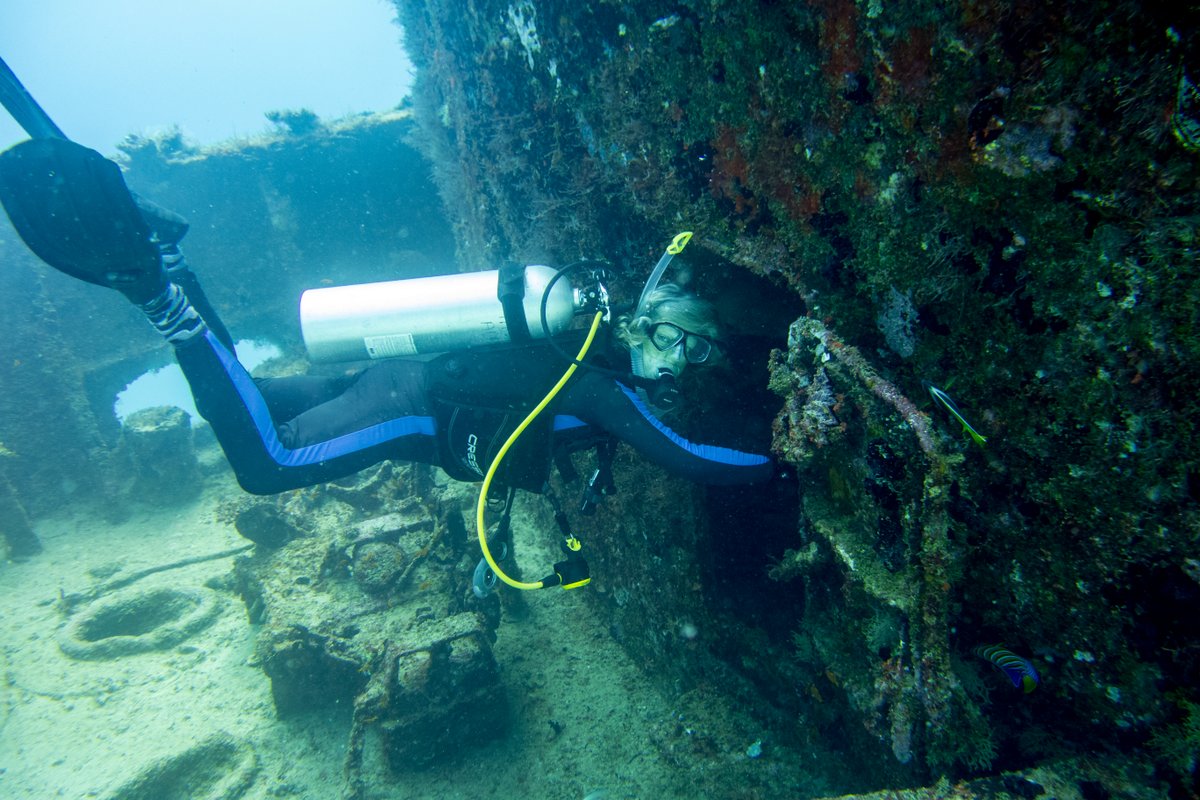
It was 1½ miles to the dive mooring at 04°27.483N 073°40.831E. The wreck is at 20 metres directly west of the mooring and was only put in place five years ago, so there’s not a huge amount to see, but it was a pleasant dive in clear water. The highlight was finding a Peacock Mantis, lurking at the edge of his little cave.

Back on the boat, we washed the dive gear, lifted the anchor and had a lovely sail in a 10 knot west wind, giving us a nice beam reach. There was a very obvious 4 metre deep channel through the reef, which took us into the protected lagoon at Himmafushi. We anchored at 04°18.32N 073°33.58E in 8 metres of water amongst a few coral bommies.
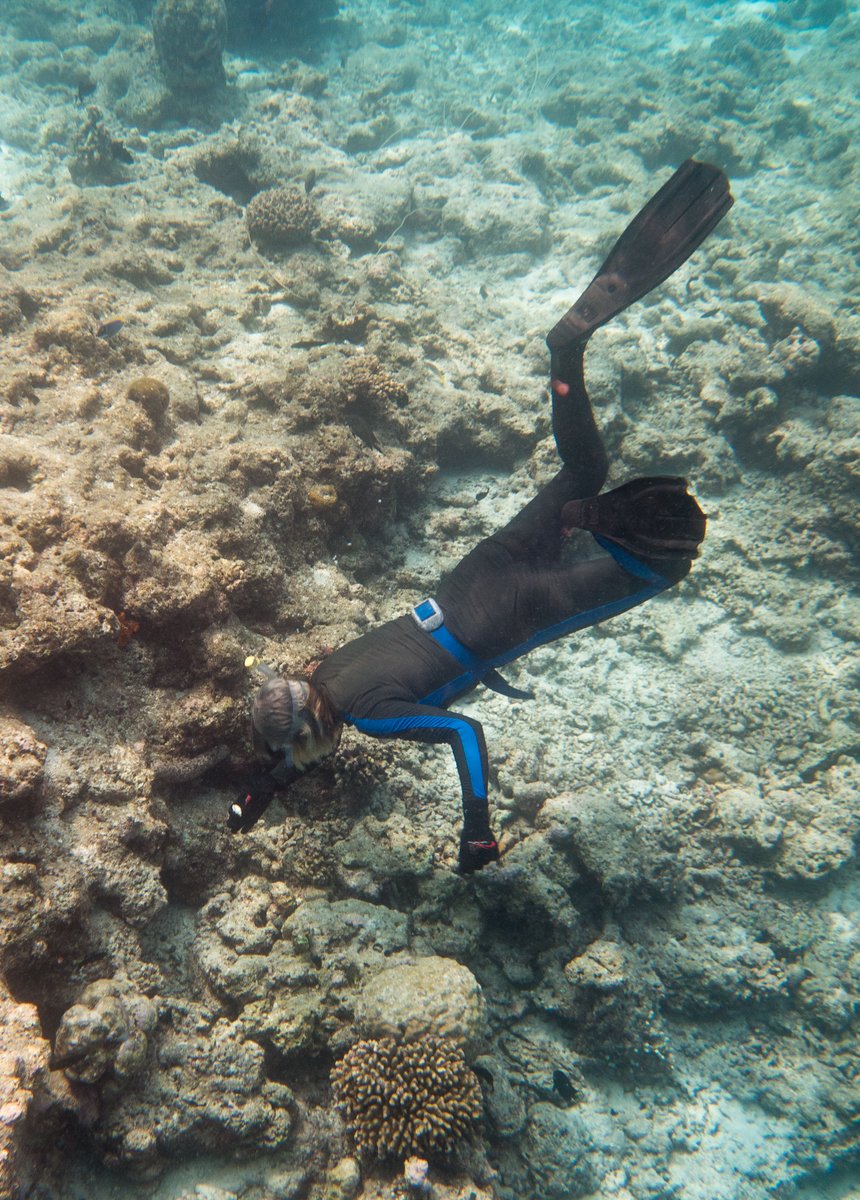
After a short rest, we donned snorkelling gear and swam across the fringing reef to the drop off. Unfortunately, it was disappointing with mostly bleached coral. There’s an incredible thermocline, with bath-temperature water on the surface and cooler water once you get down to five metres, but even the deeper reef was bleached out.
We've been told that the Rally has arranged for the Rally participants to anchor in Hulhumale without having to pay the $50US per metre anchoring fee, so the plan is to go there tomorrow. (We later found out that the Hulhumale Authority is not going to charge any visiting cruisers, but this may change.)
23 March 2017 Himmafushi to Hulhumale, North Male Atoll
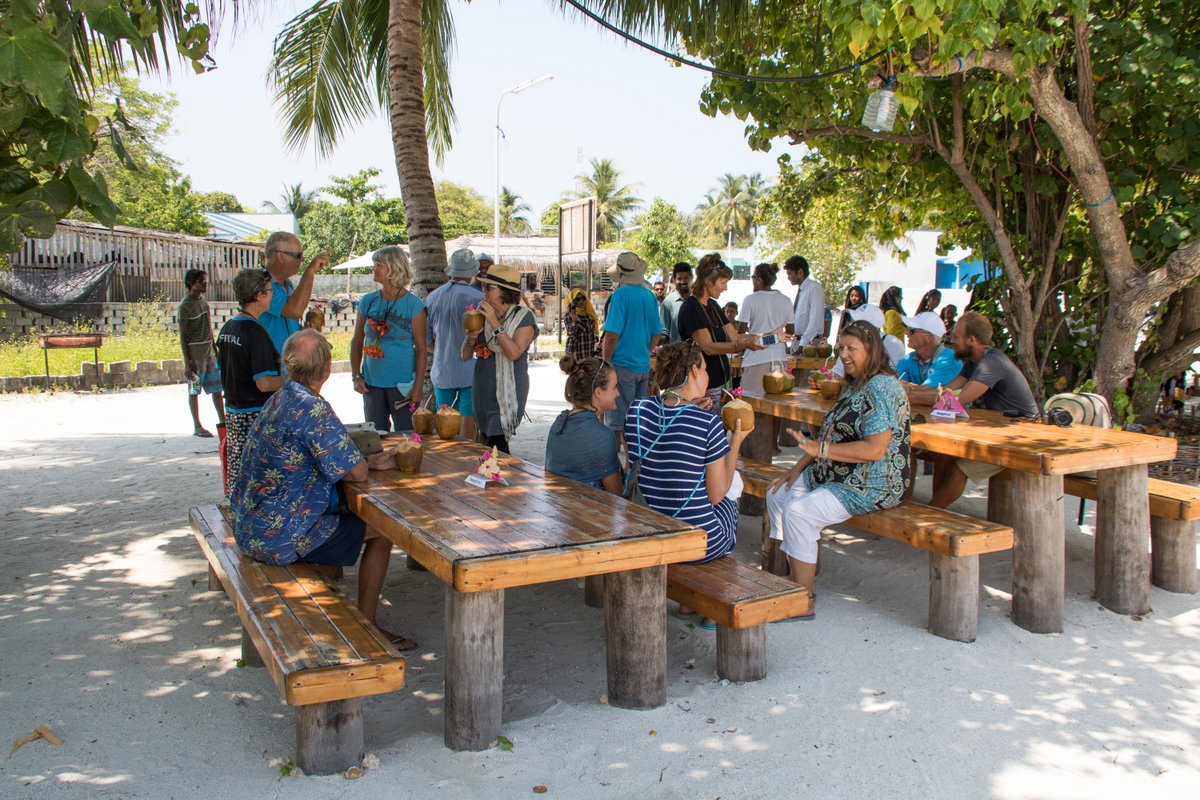
There was a “welcoming ceremony” in morning, which consisted of a lot of hanging about; a small flower garland handed out by some school kids; a drinking coconut; a short dance by the kids and a walking tour of the island. On the plus side, they provided a good buffet lunch with some interesting local food.
While we were hanging about, I had a discussion about the cruising permit with John on "Atea", who spent three months in the Maldives last year. He confirmed that the official line has always been that we can't visit any islands apart from the four listed on our Cruising Permit. Last year, "Atea" went ashore whenever and wherever they wanted - as did everyone else that we’ve talked to.
I think that Assad is taking the "official" line and that the Customs might want to be a little stricter this year, but we would be very unlucky to have any problems visiting inhabited islands.
All of the three small islands that we’ve visited so far have Guest Houses for tourists and some souvenir shops and dive operators, so it's unlikely that the locals would be bothered about us going to their island. We'll have to think about what we'll do when we leave the rally in a few weeks' time, but for now, I'm going to ignore all the politics and start enjoying myself...
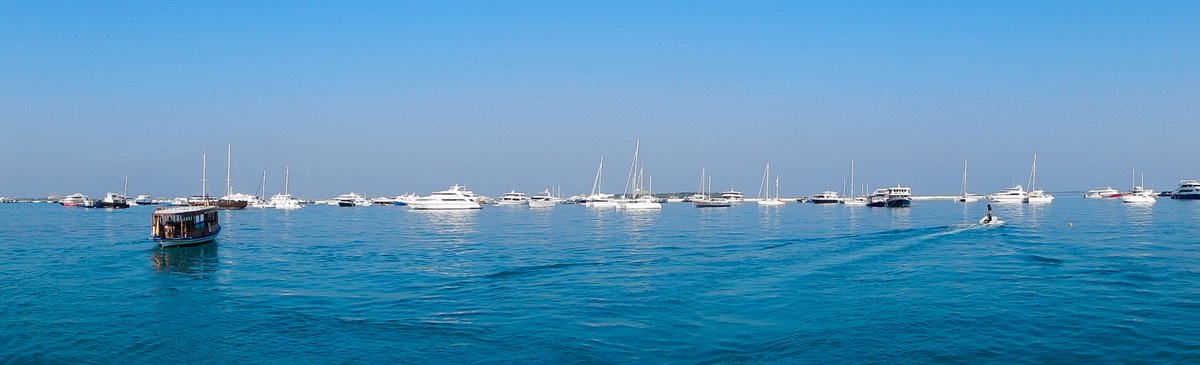
After lunch, we all rushed off to our boats to motor six miles to Hulhumale - it was like the “Wacky Races”, with boats roaring out of the anchorage. The entrance through the breakwater into the Hulhumale anchorage at 04°13.17N 073°31.93E is wide and at least 4 metres deep and once inside the depth drops to 10 metres. The anchorage is very, very crowded with scores of live-aboard tourist boats swinging on moorings or with three anchors out.
It took us two attempts, but we managed to squeeze into a space at 04°13.45N 073°32.21E. We were anchored in 10.5 metres, but only put out 30 metres of chain to reduce our swinging circle - it seems to be very good holding on sand. The anchorage is busy and noisy with international jets and sea planes flying overhead; dinghies whizzing about; fishing boats milling; and in the channel to the east of the anchorage, huge barges ply back and forth bringing hard-core to the land reclamation project to the north.
24 March 2017 Hulhumale, North Male Atoll
After breakfast, we went snorkelling with “Jackster” and “Ngawala”. There’s supposed to be a world-class dive spot called Banana Reef, which we believed to be one of the two reefs about ½ mile to the north west of the northern channel into the anchorage. (At 04°13.46N 073°32.21E and 04°14.04N 073°32.00E). Both of these reefs are completely dead and just a pile of rubble.
However, there were a lot of fish, so we drift-dived the northern one, with Dave from “Jackster” volunteering to stay in his dinghy as support. There were lots of Giant Moray Eels, but nothing much else of note. The other reef had less current and was marginally better, but only worth twenty minutes of our time.

In the late afternoon, we went ashore and wandered around Hulhumale. It’s a massive reclaimed island designed to meet the expanding housing and commercial property demands of Malé, the capital city, which is drastically overpopulated. The reclamation was started in 1997 and is planned to be completed in 2020.
The town is obviously a “new town” with multi-storey apartment buildings laid out in a very rectangular pattern - like 1960s UK council houses. It’s not a pretty place, but they have a pleasant formal park and the supermarkets are well stocked. Glenys bought a few more provisions and we took home some “Short Eats” bought from a café.
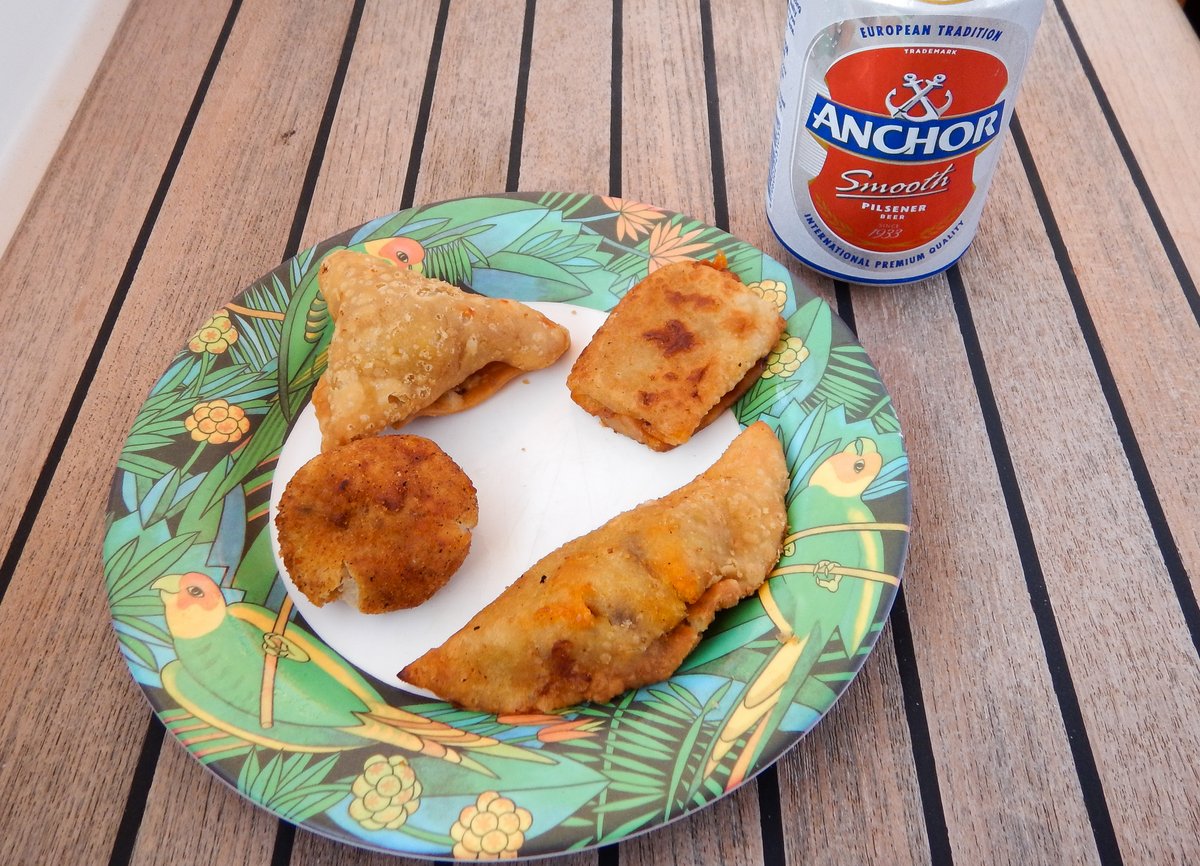
Unfortunately, we’ve arrived at Hulhumale at the start of a weekend, when the live-aboard tourist boats have their change-over. Just before dark, dozens of the huge 100 foot long boats turned up and it was mayhem. They all seem to drop their main anchor and then put out two more anchors 75 metres away on long ropes.
One of the live-aboard dive boats anchored about 15 metres in front of us , which was way too close, but there was no way that they were going to move - they were so near that their aft deck lights were illuminating our whole boat. We didn’t want to have our dinner in the cockpit staring at them, so we had bacon and grilled tomato butties down below while watching a movie.
25 March 2017 Hulhumale to Emboodhoo, South Male Atoll
We didn’t sleep particularly well, but thankfully the big live-aboard boat didn’t bang into us. I got up in the middle of the night and they still had lights blasting away, but at least they had someone on anchor watch.
After an early breakfast, we went into Male on the local ferry. We were hoping that the place would be interesting because it’s one of the most densely populated cities in the world (with a population of 133,000 in an area of 2.2 sq. miles). However, we weren’t impressed - it’s just a big town full of shops. There were no interesting places to visit, apart from a large mosque (not allowed in), the Sultan’s Park (closed) and a museum (yawn). It didn’t help that they had a power cut and lots of shops were closed because they couldn’t operate their tills.
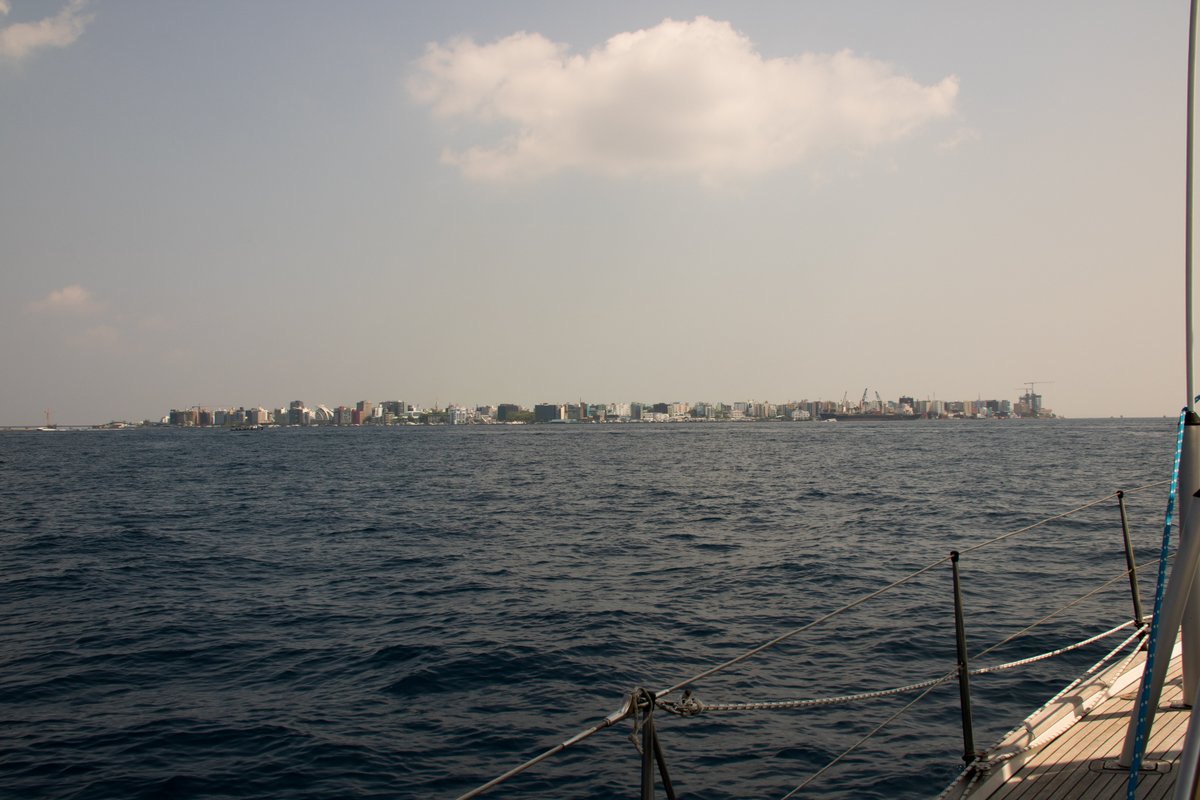
We were back at Hulhumale by 12:00, where we called in at a supermarket to buy some more provisions, before heading back to the boat. After a quick sandwich, we pulled up the anchor and ran away from the chaos. It was interesting to motor past Male - much better than visiting it.
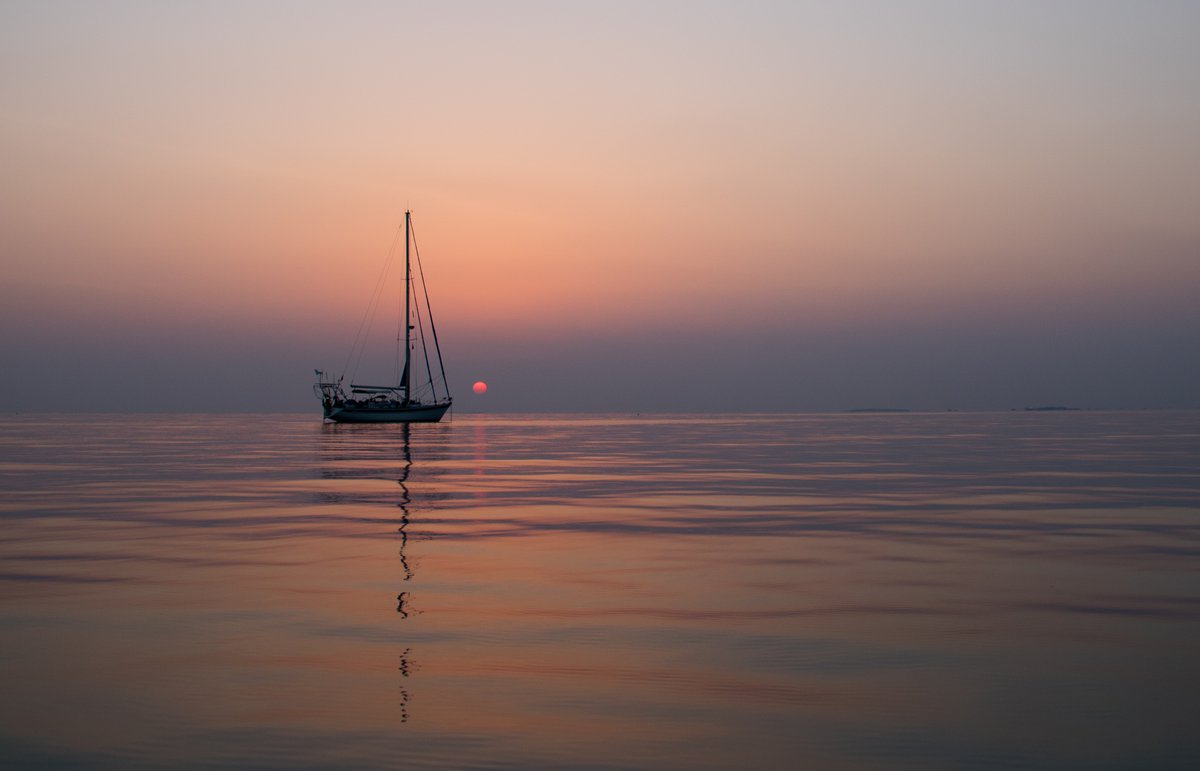
We headed down to South Male Atoll and entered through a narrow pass at 04°07.48N 073°27.53E, which was very deep and easy to navigate in good light - it goes right past a big resort. Working our way across the atoll, we motored to Emboodhoo, going through the fringing reef at 04°05.46N 073°30.79E. We anchored at 04°05.65N 073°31.23E in 12 metres of water on lovely sand.
26 March 2017 Emboodhoo, South Male Atoll
Mid-morning, we jumped in the dinghy and went snorkelling in the pass to the south of the anchorage. There was a strong current, so we drifted with the dinghy down both sides of the pass. It was all very disappointing with bleached coral along the whole channel. There were plenty of fish, but the lack of colourful coral makes it look so depressing.
For lunch, we had Fish Curry Butties - we still have two more days’ worth of the Wahoo to finish off. In the afternoon, we went snorkelling on some coral pinnacles inside the lagoon, but again, the coral is completely bleached and broken off in huge chunks. It’s such a pity; we could see that the pinnacles used to be fabulous coral reefs, but no more. We’ve not done any decent snorkelling in the Indian Ocean - I hope that it will get better.
We had a quiet evening, watching a movie - Pan-fried Wahoo, Breadfruit chips and peas.
27 March 2017 Emboodhoo to Mathiveri, North Ari Atoll
The organisation of the Sail Maldives Rally is a bit chaotic. Two days ago, we were told that the next stop was at Guraidhoo, which is 10 miles south of Emboodhoo. Last night they told us that we have to go to Mathiveri, 45 miles west of Emboodhoo, so we had to get up at 06:00. The 15 knot wind was from the WNW, so we were motoring almost directly upwind.
After a couple of hours, we heard on the radio that some of the boats were going to Rasdhoo Atoll, so we headed there, which was even more up-wind. It was a grey, overcast day and it seemed pointless to just stay one night in Rasdhoo, so a few miles out, we changed our minds; bore away and headed for Mathiveri. At least we were able to sail for a few hours.
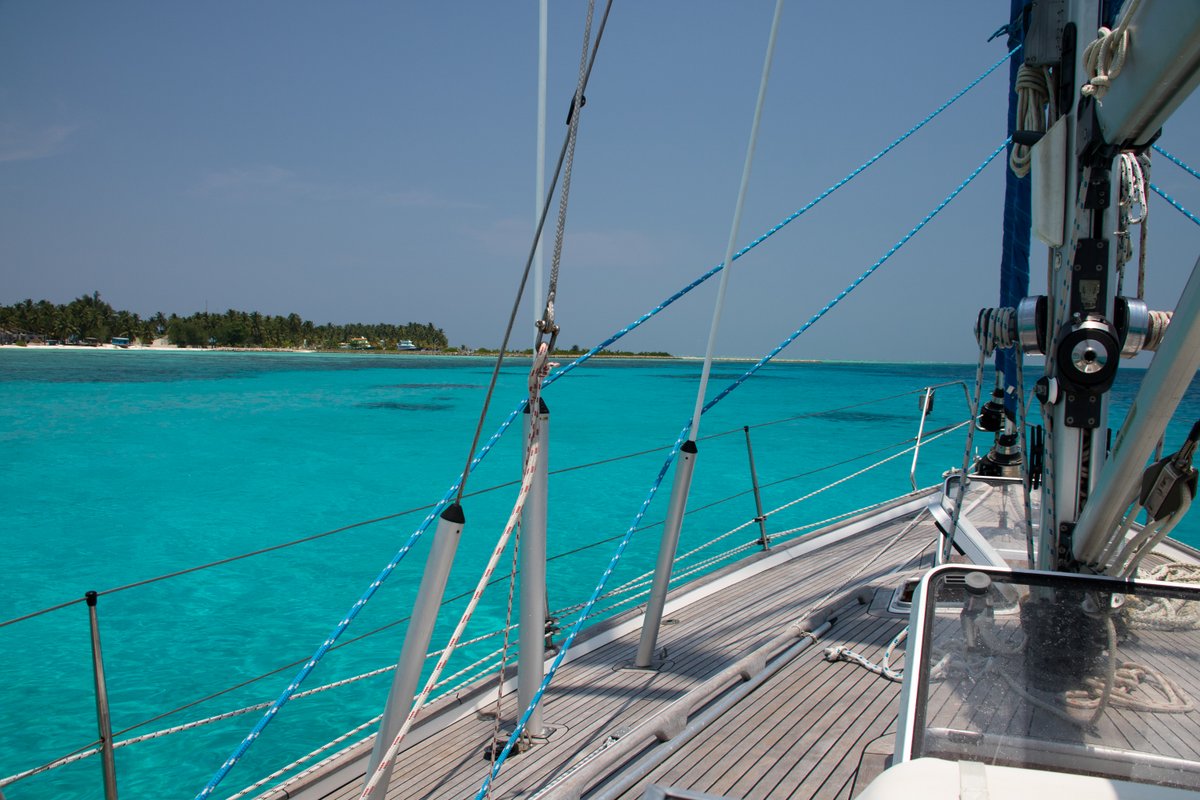
On the way, we checked out a couple of coral reefs where we thought that we might anchor overnight, but the reefs were well below water and with the strong 15 knots wind, the anchorage would be bouncy. Frustrated, we continued to Matherveri and anchored at 04°11.44N 072°45.11E in 5 metres on sand in between coral heads. I was worried about swinging into the fringing reef if a squall came through, so we put out a second anchor. It's a beautiful anchorage with stunning water colours.
Fortunately, the skies cleared a little and we were able to go snorkelling around the boat, which (surprisingly) still has some live coral. There’s plenty of sea-life, so I’ll be happy to stay here for a few days. By nightfall, no one else had turned up - it looks like some boats are still in Male and the rest have stopped at Rasdhoo Atoll - as I said, the rally is a tad chaotic!
28 March 2017 Mathiveri, North Ari Atoll
After breakfast, we popped into the village and spoke to Aslam, one of the Council members. He confirmed that there was a welcoming ceremony at 16:30 and told us the best places to go snorkelling and diving.
We headed north from the village to a wrecked sail boat. It was sunk about a year ago, so didn’t have any reef growth on it, but it was interesting to snorkel around. It still has a windlass, winches and hatches - in most places around the world it would have been stripped by now.
Our next stop was at an isolated reef at 04°11.74N 072°45.89E, which was interesting. The coral is all dead, but there’s still a large number of fish around. We were pleased to have an encounter with a Devil Ray, which was cruising along the north side of the reef. We also saw a couple of Blacktip Reef Shark. The south side was shallower and didn’t have as many fish.


Back at the boat, I started to fill our dive tanks, but the damn generator started to run slow then fast and eventually stalled the dive compressor. I spent a miserable hour in the hot engine compartment getting it going again. There was a nasty rattle and vibration, which turned out to be the heat exchanger bouncing about because the two hose clamps holding it had broken.
The irregular running was another issue, which I isolated to the fuel relay being loose in the relay holder. It looks like the female connectors have become loose, so I attempted to force them closed, but the fuse holder is in an awkward place and it was a struggle using a torch and a mirror to see what I was doing. After a few attempts, I managed to get it going again, filled the dive tanks and ran the water maker for 30 minutes to make sure that all was well.
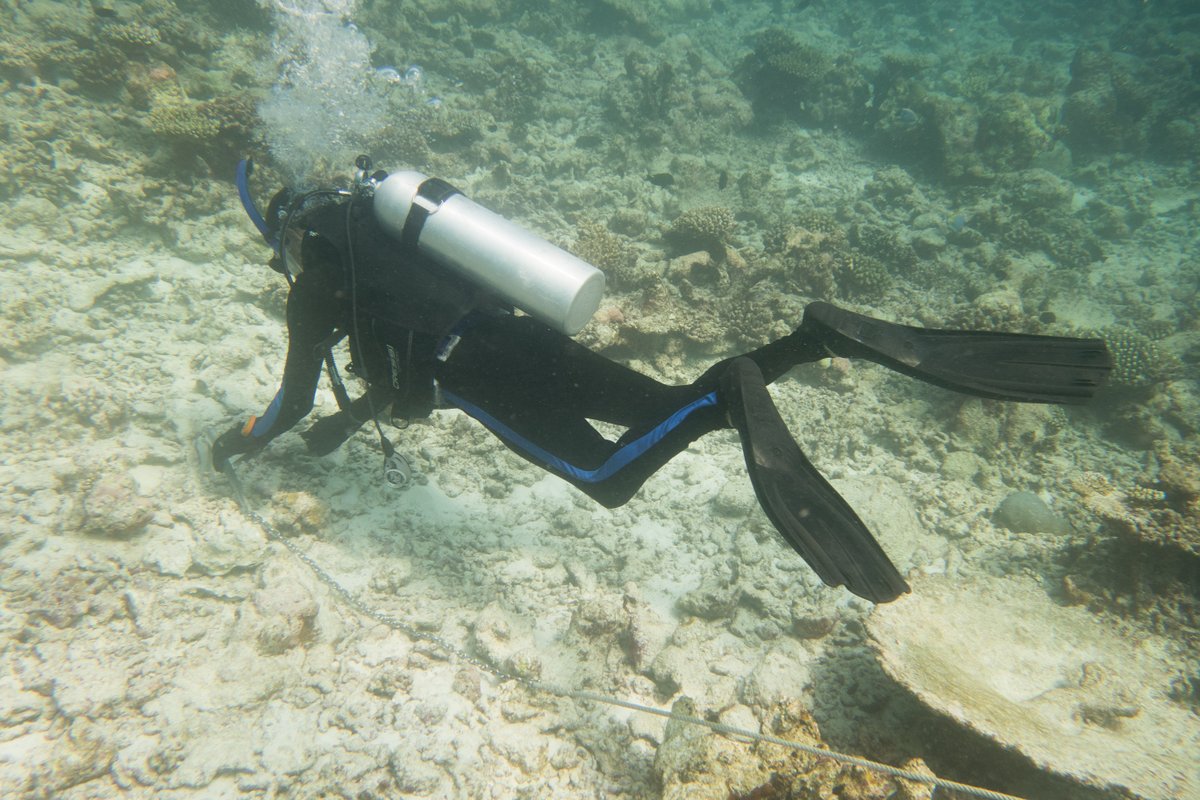
Finally, we went for a scuba dive at 04°10.92N 072°44.68E. It was a shallow dive on a flat reef in depths between 6 and 14 metres. Again the coral was bleached and in very poor condition, so it wasn’t the best dive that we’ve done.
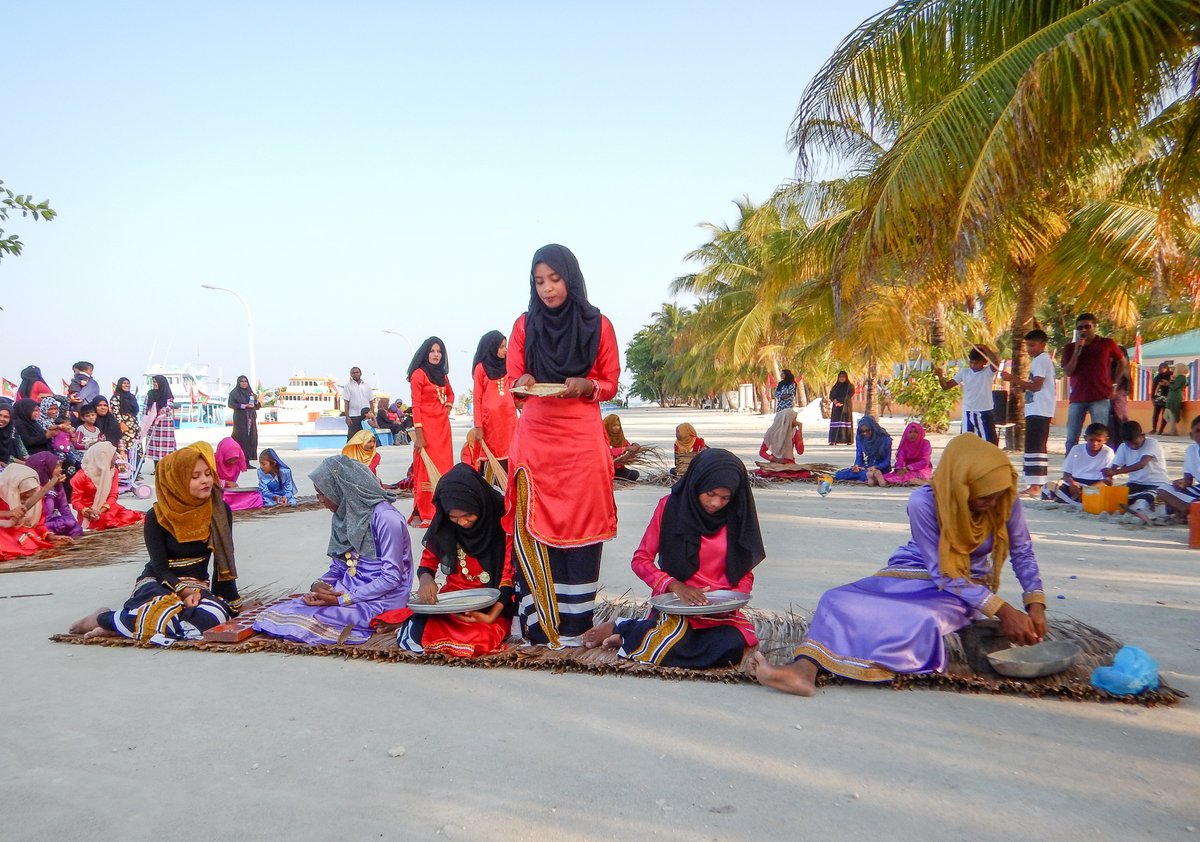
There was a welcoming ceremony in the late afternoon. It was embarrassing because only four yachts have arrived, so the eleven cruisers were heavily outnumbered by the 100 villagers who turned up. Nevertheless, everyone was friendly and a group of teenagers demonstrated various local crafts. We were then taken for a tour around the island.
Each island has a Council, who manage the island’s resources. They are keen to promote tourism and especially their locally owned guest houses. The villages that we have seen are very similar with streets of hard packed sand laid out in a regimented rectangular grid. Nevertheless, it’s interesting to walk around and chat to the locals about their way of life.
29 March 2017 Mathiveri to Maavaru Faru, South Ari Atoll
We left Mathiveri early and motored 20 miles down to Maavaru Faru, which is an isolated circular reef. We entered at the northern end of the reef and anchored at 03°52.432N 072°42.92E in 10 metres. As soon as the anchor was set, we jumped in the dinghy and went snorkelling. We tried in the channel around 03°52.51N 072°43.36E, but once again the coral was all bleached out.
Feeling desperate, we went out to the North East corner of the reef, but the seabed was sparse, scoured by the waves. We then noticed some tourist boats hanging about on the nearby drop off, so we swam out as they dropped snorkelers into the water. The boat crew told us that this was a Manta feeding station (03°52.72N 072°42.41E). We stayed there for fifteen minutes, but didn’t see any mantas. By this time we were feeling a bit exposed and retreated because we were ¼ mile from our dinghy and essentially out to sea - if a strong current set in then we’d be in trouble.
In the evening, Mick & Janice from “Zoa” and Tony from “Endymion” came for sundowners.
30 March 2017 Maavaru Faru to Dhigurah, South Ari Atoll
An early start saw us motoring south. Around midday, we stopped off at another isolated reef called Gorraalhuhau. The entrance pass was at 03°36.44N 072°48.53E and it was over 8 metres deep. We anchored on a sand slope at 03°36.57N 072°48.54E in 8 metres depth, then backed up into a small sandy patch, which was much shallower and surrounded by coral. It was very tight and it’s definitely a settled weather lunchtime stop.
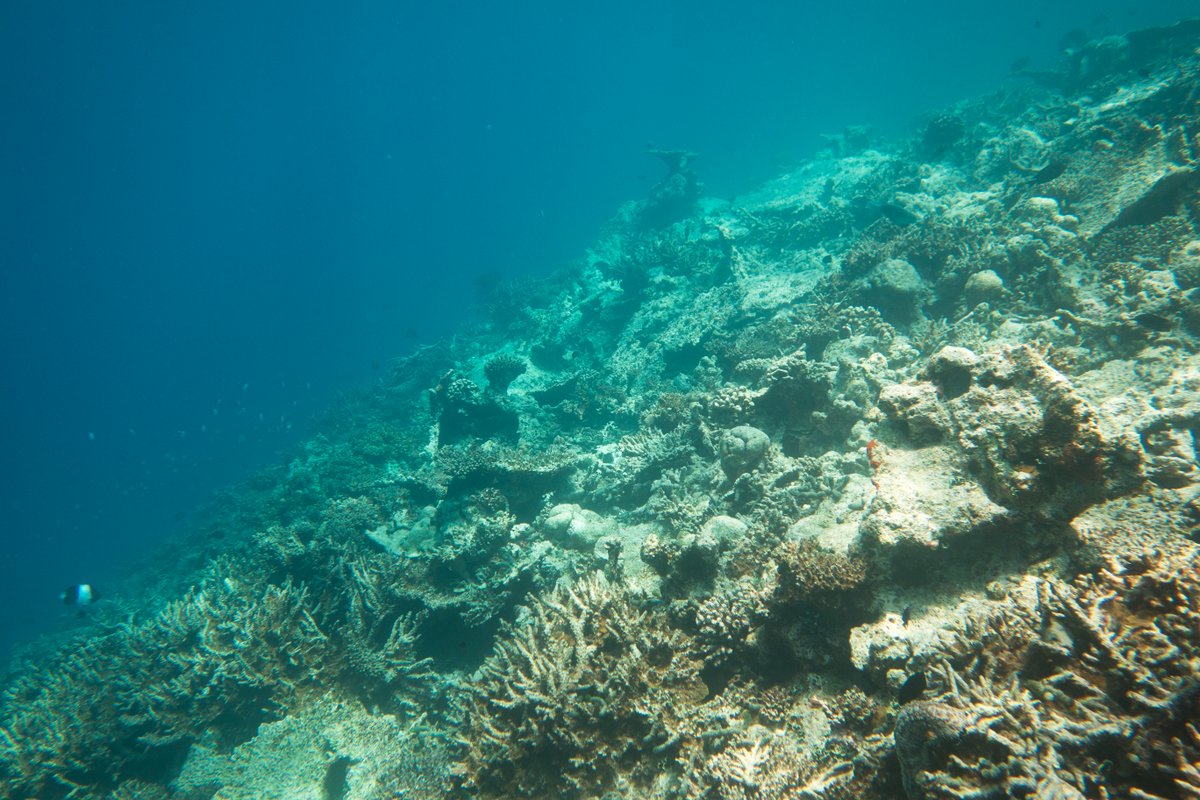
We snorkelled around the boat; and then we tried the eastern drop off; and then we went across to a sand spit where we’d seen a tourist boat dropping off snorkelers - everywhere, the coral is bleached out and dead. The colours are beautiful above the water, but below it’s like a moonscape - I felt like crying.
After lunch, we continued on to Dhigurah, crossing over the fringing reef at 03°32.38N 072°54.96E and anchored at 03°32.04N 072°55.50E. I went ashore and chatted to a dive operator, who offer dives for $65US per person and snorkelling with Whale Sharks for $65US. I declined because it’s just too much money, but he was still willing to have a chat about the diving in the area. He told me that in May 2016 there was a major bleaching event, which has killed off most of the coral in the shallow reefs in the Maldives. There’s still live coral in the deeper water (>20 metres) and in the channels where there’s a strong current, but you have to know where to go.
Back on the boat, I did some research on the problem:
Corals are marine invertebrates, which typically live in compact colonies of many identical individual polyps. Each polyp is only a few millimetres in diameter and has a set of tentacles surrounding a central mouth opening. An exoskeleton is excreted near the base. Over many generations, the colony thus creates a large skeleton creating coral reefs.
Most corals live in a symbiotic relationship with algae called zooxanthellae, which live within their tissues. Zooxanthellae are able to transform light energy into chemical energy and sugars (photosynthesis). Those sugars are directly transmitted to the coral host, and represents 80% of the coral's nutrition. Interactions between the two generate the brilliant colour of coral.
If the sea water temperature is raised above 31 degrees C, then the zooxanthellae over-produce nutrients and the polyps start to reject the zooxanthellae. If the high temperatures persist for a week or more the polyps will reject all of their plant partners and the coral loses its colour, turning white - called Bleaching.
Should the sea temperature fall quickly, the zooxanthellae will return to the polyps and the reef will slowly recover over the period of a year. If the high temperatures persist then the polyps will die. Algae grows on dead coral making it difficult for new colonies to form. However, if there are enough fish on the reef they can clean the algae away and allow corals to return, but this take many years even decades.
The Maldives has had a Bleaching Events in 1998, 2010 and 2016. The 2016 event is widely recognised as a Global Event caused by a severe El Nino episode. Many of the world's coral reefs were affected with even the huge Australian Great Barrier Reef suffering 90% bleaching.
In the Maldives, the estimates for the damage in 2016 vary between 60% and 90% of reefs being affected. My personal observations are that at least 90% of the shallow reef is dead, but I don't know about the deeper reef. It’s like the tale of the Emperor’s New Clothes - the Maldivians know that the coral is dead on the shallow reef, but nobody talks about it. Too much of their economy depends on tourists and diving.
I'm gutted. For decades, I’ve been dreaming of snorkelling and diving on the pristine reefs in the Maldives. We were planning to spend two months exploring the reefs, but now we only want to get into the water to cool down - snorkelling on the reef is simply depressing. To make matters worse, we’ve heard that the coral in Chagos has also suffered, so our planned four weeks in that isolated atoll might also be disappointing.
To add to problem, here’s hardly anything to do ashore on the islands. There are no historical buildings or other points of interest and the villagers are very reserved. The beaches are beautiful, but we only go onto beaches to land our dinghy or look for shells. There’s nowhere to hike or do any of the things that interest us.
With the dismal state of the reefs, Glenys and I have had some serious discussions about what to do and have decided that we’ll shorten our stay in the Maldives and are now planning to spend only two weeks in Chagos. This will give us an extra month, so we’re going to head south and spend the extra time in Rodrigues, Mauritius and Reunion. It’s a 1,000 mile passage to these islands, but other cruisers say it’s great there. We don’t know much about the islands, so we’ve started to read up about them…
31 March 2017 Dhigurah, South Ari Atoll
First thing in the morning, we went out on “Hokulea” to look for Whale Sharks, which are a big tourist attraction in this area. We cruised along the western side of the island along with a few tourist boats, but we didn’t see a single sign of a Whale Shark - I don't think that the tourists saw anything for their $65US boat ride.
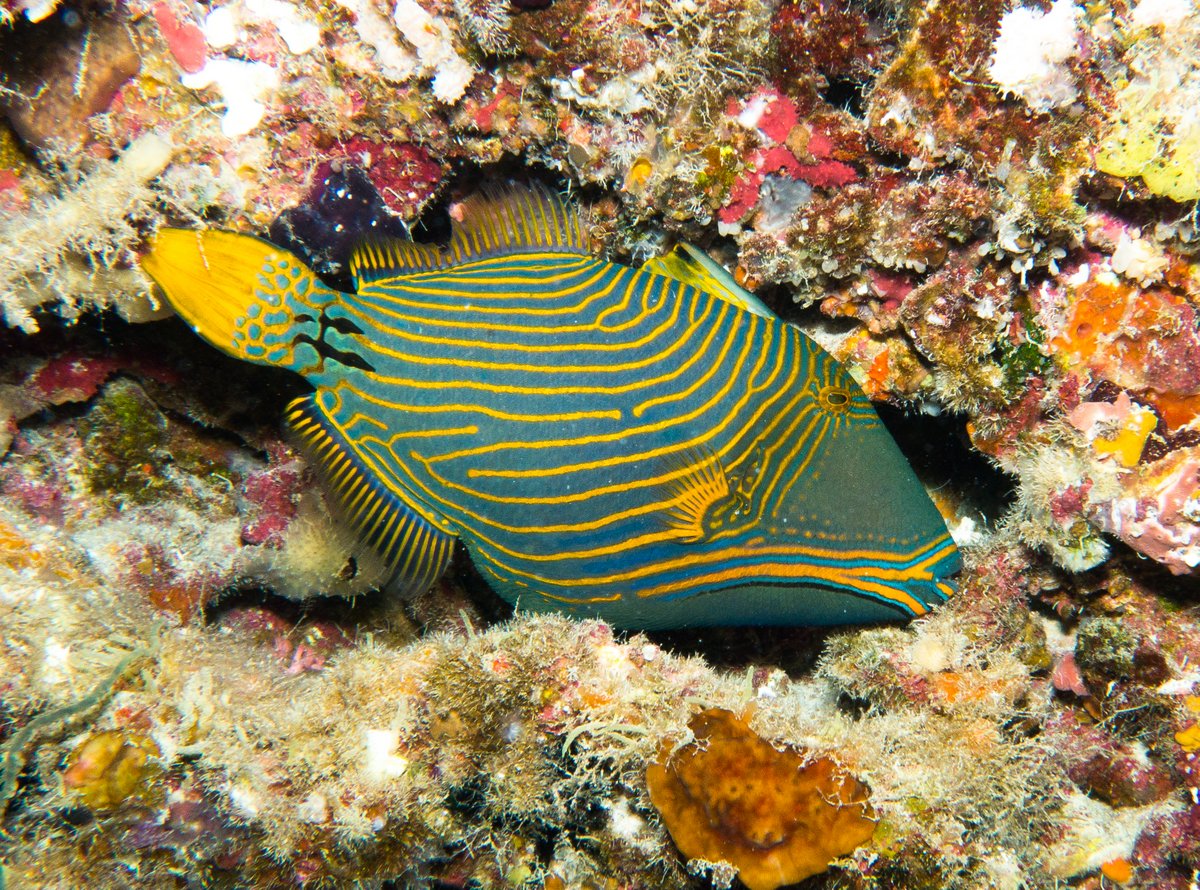
After a quick lunch, we went for scuba dive with “Hokulea”. We thought that there would be a strong current along the wall that we were diving, so we left our dinghy at anchor and entered the water from “Hokulea’s” dinghy about 400 metres back along the drop-off. (We started the dive at about 03°32.50N 072°55.17E and headed east.) It was a very pleasant dive along a steep, 70 degree wall. At 20 metres, there was some live coral, sea fans, colourful encrusting sponges and lots of fish, so I’m feeling a little bit better about the Maldives.
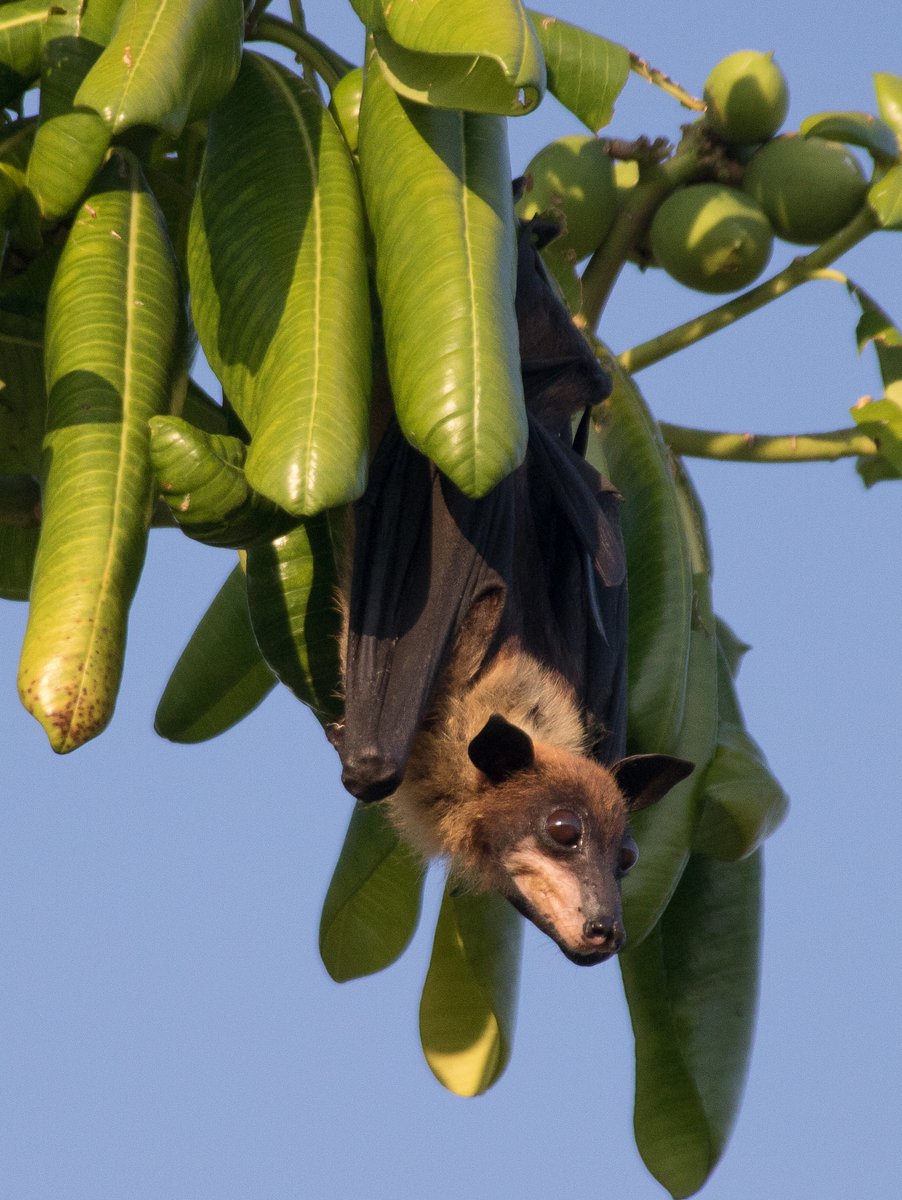
Later in the afternoon, there was a welcome event on the beach. This was in the same format as the other stops. A drinking coconut; a demonstration of traditional crafts by some ladies and then a walk around the village - looking at another colourful, tidy school and a health centre. No surprise, we ended up at the souvenir shops. I entertained myself by taking pictures of Fruit Bats, which are common here.
There are more photos in our Photo Album section.
- << Prev
- Next