
8 May 2017 Ile Fouquet, Chagos
It was a miserable day with squalls and heavy rain coming through, so we had a very quiet day on-board. Glenys pottered about, reading and cataloguing some of the shells that she’s found in recent months. I borrowed some disk drives from “Hokulea” and “Barbara Ann” and spent most of the day copying and cataloguing new movies and TV series.
We had one bit of excitement in the afternoon. A group of Giant Mantas have been swimming around the anchorage - we can see where they are because they are very close to the surface and their wing tips poke out. I grabbed my camera and jumped in the water, but even with Glenys pointing out where they were, I wasn’t able to get close enough to see them. At least it was good exercise…


In the evening, we watched a superhero movie, while the rain hammered down.
9 May 2017 Ile Fouquet, Chagos
The weather was a slightly better today. I downloaded a weather forecast and ran my routing analysis on qtVlm. The local weather is governed by the Inter Tropical Convergence Zone (ITCZ), which is bringing this squally weather to us.
However, for the passage to Rodrigues, I’m more interested in the broader wind speeds, which seem to be affected by large high pressure areas at around 40-50°S (We’re at 5°S and Rodrigues is at 20°S).
These huge systems slowly pass from west to east and the winds flow anti-clockwise around the high pressure areas. So, as they pass to the south of Rodrigues, the winds change from South-east to East - in East winds we wouldn’t be sailing as hard on the wind, which would make our passage more pleasant.
I ran my routing software with departure dates of today, 12th and 15th. I then did some analysis of the passage statistics and created a spreadsheet with statistics for the three planned departure dates (I have nothing better to do). It looks like the 15th would be a good day to leave, mostly because we would only be beating for 3 days instead of 5 days.
However, we’re not keen on leaving Chagos too soon, because there is a faint chance of a late cyclone developing in May, which we obviously want to avoid. Our permit for Chagos expires on the 26th May, so I’m hoping that another high pressure area will give us the same conditions in two weeks’ time.

While sailing down to Chagos, I noticed that the intermediate and lower front shrouds were still slightly loose (I last tightened them in the Andaman Islands). I went up the mast to tighten the intermediate shrouds by ½ turn and also carried out a visual inspection of the standing rigging. To my dismay, I found that we have a broken wire at the top on the starboard intermediate shroud.
The break is just inside the swaged fitting and I only noticed it because the wire has spread by a millimetre or two. I had a discussion with Eric from “Hokulea” who used to run a boat yard and the consensus is that it’s only 1 wire out of 19 wires and shouldn’t be a major problem, although I need to get it replaced as soon as possible -probably in Reunion. For my piece of mind, I’ve wrapped some tape around the shroud and fixed a hose clamp over the broken wire, just to hold it in place.
The good news is that the damaged shroud is on the starboard side of the mast. When we sail down to Rodrigues, the wind will be on our port side for all the way, so the good, port shroud will take most of the load. If we keep our running back stays tensioned to reduce any panting of the mast, then there should be very little load on the damaged fitting.
Glenys inspected the genoa and the staysail and found that she needs to reinforce some of the stitching, which has perished on the sacrificial strip - she plans to do it tomorrow if the weather remains dry.

The strong sun has also damaged the stitching on the dinghy cover to the extent that one of the seams is coming apart - we only made the cover two years ago, so it’s a surprise that the stitching has failed so soon. Glenys removed the cover and re-stitched all the seams as well as adding a few patches where the Sunbrella has worn.
In the evening, Mike and Proud invited us over to “Proud Cat” along with “Hokulea” and “LunaBlu”. Proud is from Thailand and made us a couple of delicious Thai dishes for dinner.
10 May 2017 Ile Fouquet, Chagos
The weather was variable again. Glenys finished off some sewing in the morning and I went fishing. I caught an Oriental Sweetlips and a large octopus! I’ve never processed or cooked octopus before, so I went over to see Eric on “Hokulea”, who showed me how to turn the octopus’ head/body inside out and remove the innards of the beast, which finally kills it. It’s better to do this while still in the water because ink squirts everywhere.

Octopus can be very tough when cooked, so I was instructed to go ashore and beat the creature against a rock for 20 minutes to tenderise it. There are no rocks ashore, so I used the hull of a wrecked catamaran. The technique is to shove your fingers into the body sack and swing the octopus overhead and slam it into the rock (I gave up after ten minutes as it seemed to be rather a lot of work.)
The octopus by now was a limp mass of slimy tentacles, so the next stage was to boil up a big pan of water and dunk the octopus into the water for one minute and remove from the water. The water is re-boiled and the process repeated another two times. By this time, the flesh of the octopus has firmed up and is more easily processed.

I cut out the beak-like mouth; sliced off the webbing on the arms; removed the tough skin on the head/body; cut off the larger suckers and sliced the octopus into 1 to 2 inch pieces. By the end of the process, I had a large bowl of octopus which I handed over to the chef. Glenys prepared a curry flavoured stock and boiled half of the octopus for 15 minutes in the pressure cooker. She then enhanced it into a Green Thai curry, which was delicious. The octopus was very tender and delicious.
“Jackster” arrived today, so we invited Dave and Jacqui over for sun-downers. Despite waiting a week in Gan for their clearance, they were unsuccessful and left without the correct papers. Ten boats did their clearance through the rally, paid all their fees, but only three received the correct documentation, the other seven left without clearance papers - the Maldives Rally was a total shambles.

11 May 2017 Ile Fouquet, Chagos
There was a very low tide this morning, so we went for a walk on Ile Fouquet. It was lovely walking along the west side of the long thin island, mostly in the shade. The long beach is gorgeous white sand, with overhanging coconut palms. We walked past the occasional colony of nesting Boobies; there were Coconut Crabs and Hermit Crabs scurrying about; and Blacktip Reef Sharks cruising around in the shallows.
With the spring tide, we even had time to walk back along the east shore, which is more rugged and exposed to the prevailing south-east swell. There’s a wide, shallow reef protecting the coast, which is normally underwater and here we found lots more Booby colonies. A couple of White Terns hovered overhead us for a couple of minutes, showing off their snowy white plumage and flying skills. All in all, it took us 2½ hours to womble around the mile-long island.

In the afternoon, I went for a snorkel, leaving Glenys to chill out on the boat. I was amazed to find that the visibility of the water was down to five metres - three days ago it was over 20 metres. It appears that there has been a plankton bloom and the water is now full of small particles.
I found a Mysterious Goby that I’d spotted a few days ago. I’d only had a fleeting glimpse last time because it dived into a burrow as I approached it. So this time, I very slowly inched forward and I managed to take a reasonable picture of it. The fish is a rather boring brown colour, but has a very long first dorsal fin and all of its fins flow around like a piece of seaweed. I can’t find any reference to a fish of this description, so perhaps it’s a “Neville’s Goby”?
-1.jpg)
12 May 2017 Ile Fouquet, Chagos
We went on an expedition over to Ile Anglais with “Hokulea” and “Proud Cat”. The long island is a couple of miles away on the west side of the atoll, so the outside reef is protected from the prevailing south-east swell. The outside reef sloped away gradually and was 50% dead, but the water was very clear. There were lots of large Snappers and Grouper around - I even saw a Scrawled Filefish, which I haven’t seen for ages. There were also quite a few sharks streaking in from the deep to check us out.
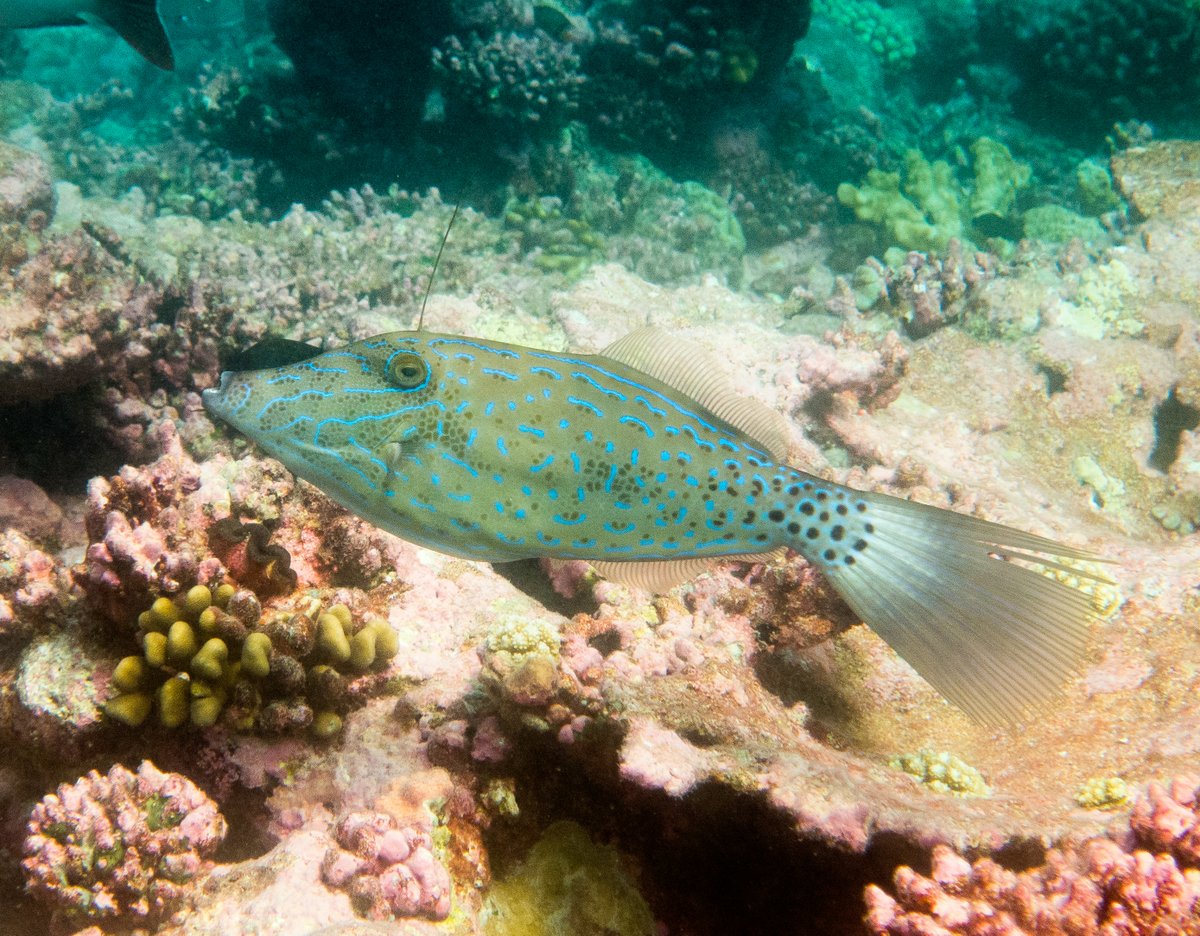
-1.jpg "Black-saddle Coral Grouper")
We stopped in the pass at the north end of Ile Anglais and snorkelled in the shallower water, which was clear and the coral was much healthier. Again there were large fish and sharks swimming about. By the end of the day, we’d seen five species of sharks - NurseShark, Blacktip Reef Shark, Whitetip Reef Shark, and the more aggressive Silvertip Shark and Grey Reef Shark.


After a lazy afternoon, we joined the other cruisers on the beach for sun-downers. With 12 yachts in the anchorage, there was quite a crowd of 25 people gathered around the bonfire, telling tall stories and swapping Ginger Beer recipes - everyone’s alcohol supplies are severely depleted.
13 May 2017 Ile Fouquet, Chagos
Together with “Jackster”, we took our dinghies 3½ miles down the atoll to Ile Boddam. It’s so nice in the anchorage at Ile Fouquet, that we can’t be bothered to take Alba down through the many coral reefs and then have to mess about with dodgy moorings. We thought that a day trip would be the best way of exploring the now abandoned settlement.
There’s a grim history to the evacuation of the Chagos Islanders, which is explained by a documentary called “Stealing a Nation”. I’ve gleaned the following information from various sources:
The Chagos Islands were first populated in the 16th Century, when the Dutch and French brought slaves to tend the coconut plantations. In 1814, the islands were relinquished to the British under the terms of the Treaty of Paris. Slavery was abolished, but the islanders stayed - working the coconut plantations or fishing. By 1960, there were 2,000 Chagossians living on the islands, mostly on Diego Garcia.
In the early 1960s, the British and USA governments secretly struck a deal whereby Diego Garcia would be leased to the USA as a military base. One of the conditions was that the USA wanted all of the Chagossians removed from the islands. British government memos from the time show that many devious schemes were thought up to remove the people without too much international outcry.
The British government set up a new official colony called the British Indian Ocean Territory (BIOT) and then claimed that the people living on the islands were “transient contract workers” - they insisted that there was no indigenous population on the Chagos islands. The government then started to systematically evict people from the late 1960s to 1973. Islanders who went to visit nearby Mauritius or the Seychelles were not allowed to return home; the government had all of the dogs on the Diego Garcia killed (mostly family pets); and essential supplies coming from Mauritius and the Seychelles were cut off.
Finally in 1973, the remaining islanders were loaded onto a cargo ship; only allowed to take one suitcase each and were dropped off at the docks in Mauritius. The Chagossians spoke an uncommon dialect of French and found it difficult to get work in Mauritius. Most ended up living in poverty in slums.
After many protests, the Chagossians were offered compensation of £3,000, but to receive the money they had to sign a legal document, which relinquished all their rights to return to Chagos. Many of the people could not read or write, had no legal counsel and in most cases pressed their thumb print onto the document - it is very unlikely that they understood what the legal document said.
In 2006, a British High Court Judgment ruled that the removal of the Chagossians was “outrageous & illegal” and granted them the right to return to their home land. The British government’s response was to commission a series of reports on viability of a community living on the Chagos Islands, which (of course) found that it was socially and economically unviable for the islanders to move back. No islanders were consulted during the investigations and the fact that they’d lived there for 200 years was ignored.

The US government had a 50 year lease on Diego Garcia, which expires soon. However, there is no chance that the Americans will let any Chagossians back to Diego Garcia, so the islanders only hope is to repopulate the Salomon Islands and Peros Banos, where there are the remains of two communities. Meanwhile the British Government has established BIOT as an International Marine Preserve, adding further obstacles to the return of the Chagossians.
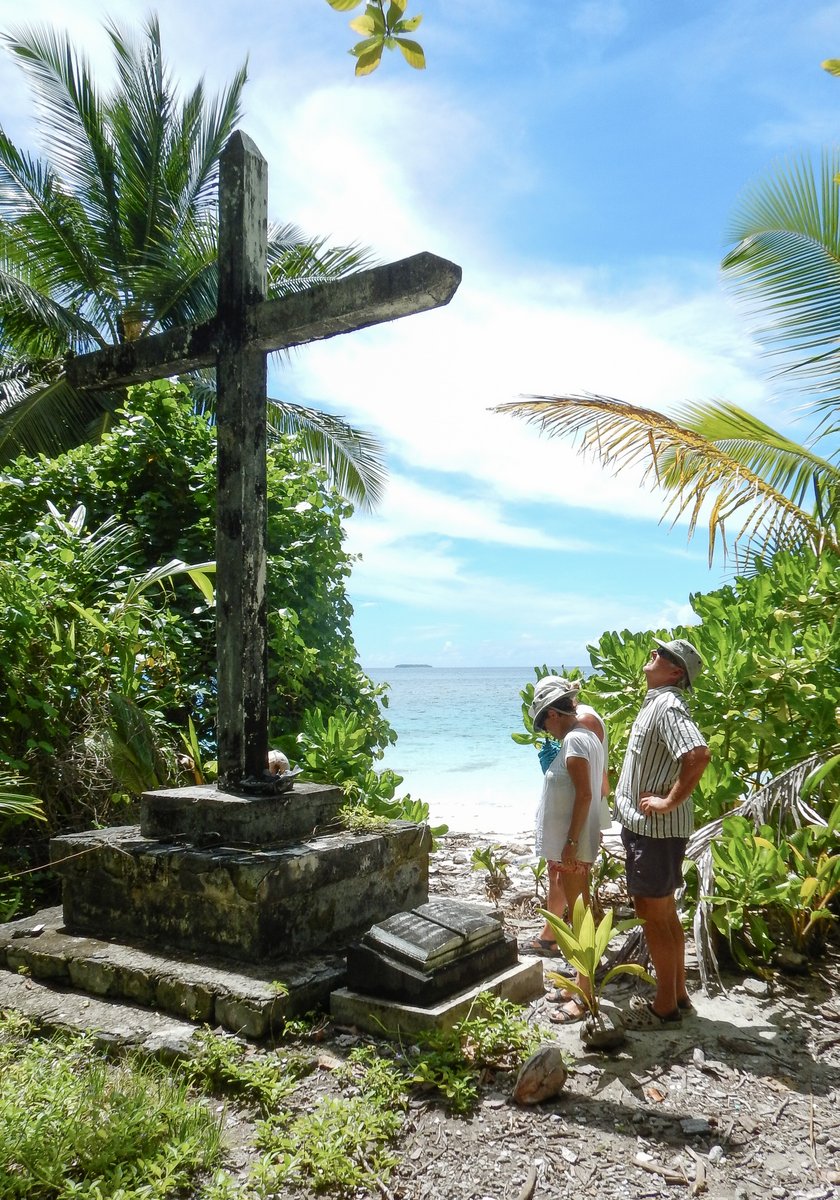
We landed by the stone dock and first walked past a large cross, which was constructed by a party of Chagossians who returned on a brief visit in 2006. There are a substantial number of buildings, which are now falling down and being slowly overtaken by the jungle growth. We wandered around for a couple of hours, trying to imagine what life must have been like on such a small island with a tiny community.
We found a few fresh water wells, a small church, numerous residential buildings and what looked like a small jail with four cells. The place is over-run by coconut and banyan trees. The only sign of life is the constant rustling of thousands of hermit crabs, scuttling around the leafy earth. We also saw several Coconut Crabs of various sizes.
The Solomon Islands atoll reminds us of the Penryn atoll in the Cook Islands, where a small community of 250 people live in two villages. The major problem in Penryn is that young adults want to move to New Zealand and Australia, looking for paid employment and a more modern way of life. It would be tough to start in Ile Boddam again and I wonder if a sustainable community is possible in this smaller atoll with less natural resources.

Many years ago, cruising boats were able to stay in Chagos as long as they wanted, which naturally lead to a group of yachty squatters staying for months on end. Not content with enjoying the pristine reefs and uninhabited islands, these people then started to make themselves “comfortable” ashore. They converted one building into a “yacht club” and started to dump their garbageashore - plastic chairs, old diesel containers, oil filters and we even came across a mast dumped behind a wall.

In previous years, yachts have picked up the moorings and spent all their time at Ile Boddam, but I can’t see why. The anchorage is thick with shallow reefs, the water is cloudy, the reefs are dead, there are mosquitos ashore and the “yacht club” is now a sad garbage dump.
On the way back to Ile Fouquet, we stopped off on a reef directly to the north-west of Ile du Sel. Despite the current plankton bloom, the water in this reef was very clear and, while much of the coral is dead, there are interesting pinnacles and caves dotted about. It’s one of the nicest places that we have snorkelled in Chagos.
In the afternoon, Glenys scrubbed the waterline, which was looking decidedly grim with Gooseneck Barnacles taking hold even though we last scrubbed it a few weeks ago. I went fishing because “Jackster” has let slip that they have more than enough beer on board and would be willing to trade some alcohol for fish. Unfortunately, I had a poor time and only managed to catch one medium-sized Oriental Sweetlips, but Dave and Jacqui took pity on me and traded the fish for two beers - Yahoo!

14 May 2017 Ile Fouquet, Chagos
Today was mostly cloudy with a blustery wind, so we pottered about on the boat. Glenys made some bread and I donned my scuba gear and had a go at cleaning the hull. We anti-fouled last Christmas and already the damn barnacles are attacking us. There’s a green slime all over the hull, which is covered with millions of tiny shrimp (looks like dust). We also have hundreds of Gooseneck Barnacles and then hundreds of normal, small barnacles.

I spent two hours scrubbing the slime away and scraping the barnacles off. The most time-consuming part was scraping away the small, white calcium disks that are left behind when I flicked off the barnacles. If I leave them in place then other barnacles will have a nice antifoul-free pad to attach to. Depressingly, I only managed to do 40% of the hull before I ran out of air.
The tiny shrimp, which seem to live on the thin growth on the hull, came off in clouds as I scrubbed the paint. Some of these drifted off to be gobbled up by fish, but many attached themselves to me. My gloves and wet-suit were covered by the time I’d finished. I just hope that none have managed to get inside my ears - I would imagine the constant clicking of a shrimp in one’s ear would be a tad irritating.
While I was underwater, I took some macro photos of the wildlife on our hull. It was challenging because the boat was bouncing about in the wind and current, so I won’t get any awards for the quality of the photos, but they give an idea of what’s going on. The shrimp range from 1mm to 4mm long and there's a huge variety of shapes. There's also a network of thin strands of a Microscopic Seaweed; Barnacles pushing aside the anti-foul paint; and complex structures of Tubes housing shrimps.


In the afternoon, I filled the scuba tanks and ran the water-maker. I didn’t have time to go fishing, so I went cap in hand over to “Jackster” and asked if I could start a beer tab. We already had one beer left in our fridge, so I took one beer on credit, promising to get a fish tomorrow. This trading lark sounds very serious, but it’s all just a bit of fun.
Glenys and I savoured our cold beers in the evening. We still have a couple of litres of wine left, so we’re rationed to one glass per night. The spirits stock is looking grim, with one tot of gin, 5 tots of rum and 1/3 bottle of brandy. The brandy was intended for cooking, but things are getting desperate.