
1 August 2017 Le Port, Reunion
In the morning, I replaced the switch for the low pressure pump on the water-maker. It’s been tripping out and I’m hoping that the new switch will sort the problem. My biggest fear is that the low pressure pump is faulty, which would be a nightmare to replace. Unfortunately, I can’t test the water-maker now because it’s pickled and I don’t want to run it until a few days before we leave the marina. Fingers crossed.
Just before lunch, I polished the repaired stanchion as best that I could and fitted it in place - it looks OK, but I’ll get it polished properly when we get to South Africa.
We spent the afternoon packing our rucksacks to go away for three days. Glenys nipped into town to buy sliced bread, cheese and salami for our lunches while up in the Cirque. We’ll carry it in because we’re not sure if we’ll be able to buy any provisions in the small villages where we will be staying.
In evening, Karen and Graham from “Red Herring” came around for dinner. We’ve been trying to catch up with them for a few months’ now, so we had a lot to catch up with.
2 August 2017 Le Port, Reunion
We caught a bus from the Le Port bus station up to Dos d’Ane (pronounced Doe Dan) and walked down to the river at a place called Deux Bras (Two Arms). The trail starts about 100 metres past the church and winds its way, 800 metres down a very steep slope, but it’s all in shady forest and the path is good.

After crossing the river at a ford, we walked along the river and then up the southern lower slopes of Piton Cabri, which is an impressive rocky hill with a fabulous looking ridge. It would be a great climb along the ridge to the summit, but would involve a night camping half way up, so is out of bounds to us.
As we progressed higher along the lower slopes, we had some great views of the Cirque de Mafate and the trail became steeper and steeper. The final push was grinding up hundreds of steps zig-zagging up a gully to the flat plain of Aurore. After a short rest to ease our quivering thighs, we strolled down to our accommodation at Aurore, arriving at 15:00.
Gîte le Fanjan was a pleasant place with two, 4-bed rooms in a new building. They had a dining room and a small well stocked shop where we were able to buy a few beers and a nice bottle of red wine, which cost only €5 - amazing considering that everything has to be carried or helicoptered into the valley.
It soon began to get cold in the late afternoon, so we climbed into bed and had an hour’s nap after our 6 hour hike. The Gîte had no common room and it was obvious that there was no heating anywhere, so we put on ALL of the clothes that we had including our down gilets and waterproof jackets and lurked in the dining room.
There was a family of four Austrians staying in the other room, so we had a pleasant dinner with them. The food was excellent - a chicken curry, a sausage curry, rice, salad and the obligatory lentils. It was enough to feed fifteen people, so we all tucked in with determination, but only managed to eat half of it.

The owner produced a bottle of Rhum Arrangé (Arranged Rum), which is a kind of liquor. The base ingredient is 70-proof white cane sugar rum into which is placed various herbs and fruit, such as orange, ginger and aniseed. It’s sweet and very strong, so we slept well.
3 August 2017 Le Port, Reunion
We left Aurore at 09:00 and walked for six hours to Ilet des Latinniers. Our route took us through a few villages - Ilet a Malheur, Ilet a Bourse and Grand Place. It was a good hike mostly through forest with some steep drops into river valleys and a few gruelling ascents. We stopped for lunch in Grand Place at a convenient picnic table - they are well geared for hikers in this valley.
From Grand Place, we had a steep descent down to a river and then an equally steep ascent to the village of Ilet de Latanniers, finishing along a narrow ridge - the village is perched on a small plateau beneath some impressive cliffs.
The Gite Cernot Jean Pau was a huge disappointment. Allegedly they have 40 beds, but the place is tacky, cramped and run down. The two toilets had no seat, the two showers barely functioned and the rooms were grim. Our private double room had the family chest freezer shoved in the corner. There was no storage space in our room and the evening meal was barely adequate for the four people at dinner - sausage curry, with rice and lentils. They still charged the premium price of €45 per person - obviously no pride in their establishment.
4 August 2017 Le Port, Reunion
Breakfast was grim - packaged dried toast, with butter and jam. They didn’t provide any hot milk for hot chocolate, instead we had a flask of hot water, with a tub of powdered milk and Nesquik. We didn’t hang around and quickly set off for the Canalization de Orangers.
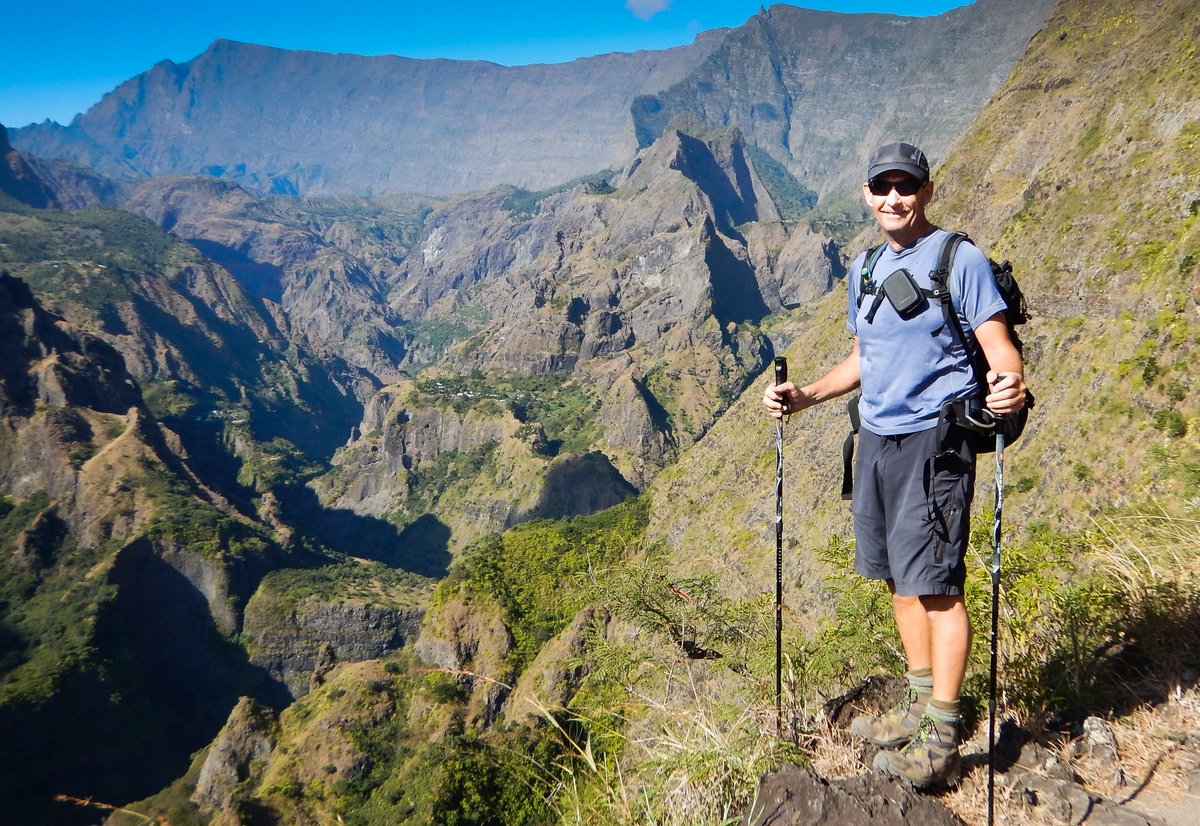
The route goes from the Ilet de Oranger to the village of Sans Sousi perched on the slopes overlooking Le Port. The trail is carved out of the steep-sided valley leading out of Mafate and was created along the route of a huge 18” diameter water pipe bringing mountain water from Mafate to the coastal population.
After a steep 20 minute hike from Ilet de Latanniers up to the trail, the remainder of the walk was on a very level path with some stunning views of the Mafate valley. There is very little shade, so we were glad that we had lots of water. The path goes under a waterfall, through a tunnel and is interesting for the first 4 hours. The last 40 minutes is boring, dropping down from the hill along a dirt road towards the bus stop at San Sousi.
There’s a bus stop at the end of the dirt road and we only had to wait for 30 minutes before a small bus stopped and took us down to St Paul. From there we caught a bus to Le Port and we were back on the boat by two o’clock - tired but happy.
5 August 2017 Le Port, Reunion
After our exertions over the past three days, we had a restful day. Glenys went off to St Paul to the local market to do some shopping without me trailing behind her moaning. I had a quiet day, catching up with editing my photographs and I started a Blues Guitar course that I’ve had for a couple of years, but it was too advanced for me at the time. After five years of playing, the course seems possible, so I’ll persevere this time.
6 August 2017 Le Port, Reunion
In a stunning act of forward planning, I had a look at the weather forecast - it’s about time that we moved onto Madagascar. The weather pattern is dominated by high pressure systems that trundle from west to east about 1,000 miles to the south of us. These pass by about once a week and bring strong south-easterly winds and big swells to the area, so we want to avoid that. There’s a patch of strong winds around the 10th, so it looks good to sail around Saturday 12th.
We spent the day doing small jobs - I fitted some small brass rubbing strips to the coach roof; ran the engine and the generator; and screwed a piece of plywood to the bottom of the teak grid in our front heads. All the joints have become loose and it’s like standing on a trampoline when we have a shower. It’s a real bodge job, but I hope that it will be strong enough to get us to South Africa where I can get a new teak grid made.
7 August 2017 Le Port, Reunion
We hired a car for four days and ran some errands. Cars are difficult to get at the moment because it’s the French school holidays, so we’re glad that we had the foresight to book the car four weeks ago. We did a big food shop in the afternoon, buying provisions to last us for a couple of months until we get to South Africa.
8 August 2017 Le Port, Reunion
We were up at the crack of dawn and set off on a tourist trip with Karen and Graham from “Red Herring”. Unfortunately the weather was terrible - we had low scudding clouds and rain as we headed towards the active volcano at the south end of the island. The volcano erupted a couple of weeks ago, so we were hoping to walk around the outer rim of the volcano, but the weather got worse and worse as we ascended.

Despite the grotty weather, we persevered and drove up the winding road to the volcano. The road turned into a muddy dirt track with large potholes causing us to reduce our speed to 5 miles per hour. The rain was lashing, the clouds were swirling around us and after ten minutes of bouncing about, we decided to abandon and run away. It was a pity because it’s supposed to be an impressive view.
As we drove down, we parked to visit the Volcano Museum, but everyone else was doing the same, so there was a huge queue stretching out of the entrance - run away! We headed for the south coast, which is where the lava flows when there is a large eruption. There are some impressive lava flows which have run down to the sea and destroyed the coastal road many times. We stopped off at a couple of tourist spots and had a pleasant, short hike along the coast.
Heading back north, we ran into terrible traffic around the city of St Pierre, which caused us to abandon our planned visit to a rum distillery - bummer. Apparently, the chaos was caused by Cane Sugar workers blockading the roads protesting that the government won’t increase the subsidies that the industry receives. France really needs someone like Margaret Thatcher…
We arrived back at the boat just before last light - a disappointing day and I was knackered after ten hours of driving.
9 August 2017 Le Port, Reunion
Back onto jobs today. Our engine starter battery has been running flat, so I bought another one and fitted it. I bought some engine oil and alternator belts from a car parts place called Garden Auto on the way to St Pauls - they have lots of filters as well. Meanwhile Glenys walked into Le Port to the Wednesday market - says it was good and came back loaded with very healthy looking vegetables.

After lunch, I checked the pressures on the fridges because the drinks fridge has been gurgling. Sure enough, the refrigerant pressure was down, so we must have a leak. I recharged the fridge with refrigerant, which is the first time I’ve had to do anything for the last two years since I had the fridges fixed in New Zealand - another job on the list for South Africa.
With only a few days to go before we leave the marina, I started up the water-maker. Thankfully, it ran okay for fifteen minutes, so hopefully changing the low pressure pump switch has worked.
Later in the afternoon, we headed off to the hyper market to do our final provisioning - we have enough canned food, rice, pasta and alcohol to last us for three months.
10 August 2017 Le Port, Reunion
The weather looks best to go on Sunday 13th, so I filled in the Customs departure form and sent it off to Jerome in the marina who has organised customs for clearance on Saturday morning with a departure at dawn on Sunday. This will allow us to get duty free fuel on Saturday afternoon.
It was our last day with a car, but the weather wasn’t looking good enough to do a long hike in the mountains, so we opted for a leisurely day trip to St Denis, which is the capital city of Reunion. It’s a nice town with lots of impressive colonial buildings and has very relaxed atmosphere for a capital city. Other than the architecture, there aren’t many tourist attractions and the only one that we wanted to visit was the Natural History Museum, which was closed for renovations - good planning to do it in the middle of the school holidays…

We had a nice, cheap Creole meal at a food stall on the sea front, where the wind was so strong that the occasional gust would blow the rice from our forks. St Denis is on the north coast and subject to the full force of the south east trades - very different to the sheltered life in the Le Port Marina, where it was flat calm when we drove back. After some more last minute provisioning,, we dropped the car off in the evening.
11 August 2017 Le Port, Reunion
With only two days to go before we leave for Madagascar, I dropped the dinghy into the water and checked the outboard, doing a bit of maintenance. I then lashed the dinghy on deck ready to brave the 3 metre swell and 25 knot winds.
After doing a few more errands, I pulled our dive compressor out of the cockpit locker and gave it a service, changing the air filter and the oil. This took most of the afternoon, mostly because it’s a pain to lift the compressor out of the locker and then replace it.
In evening, went out for a meal with “Hokulea” and “Jackster”. Eric and Chantal are heading back to the Maldives and staying in the Indian Ocean for another year, so we might not see them again.
12 August 2017 Le Port, Reunion
The Customs officer turned up at 09:00 (as arranged) and ten minutes later, we were cleared out. We motored around to the fuel dock and filled up with duty free diesel. With nothing else to do, we had a lazy afternoon. Glenys has developed a cold and feels a little fluey, so she went to bed in the afternoon. I hope that she’s better tomorrow.
We had a quiet evening. Glenys cooked enough to feed us for three nights at sea and we went to bed early.
13 August 2017 Reunion to Ile St Marie (Day 1)
The alarm went off at 07:00. Glenys was still feeling a little ill, but better than yesterday, so she wanted to leave. Expecting big waves outside the port, we drifted in the outer basin while we put the ropes and fenders away. I also rigged up our spinnaker pole to starboard, so it was 08:20 before we cleared the port – “Jackster” and “Red Herring” were at least an hour ahead of us.
About ½ mile from the port, we spotted the blow of a Humpback Whale only 200 metres from our bow, I scrabbled for my camera, but missed the classic photo of the whale’s tail stretching out of the water as it dived. It’s the mating season for Humpback Whales and we’re hoping to see more when we get to Ile St Marie.

The wind shadow of Reunion stretches dozens of miles to the west of the mountainous island, so we motored north-north-west for an hour until we were able to sail. The 3 metre swell built up faster than the wind and the waves were confused, throwing us about, making life very unpleasant.
After three hours, the wind had built to SE 20-30 knots and we were able to steer our required course of 305°T - the wind was on our starboard quarter. The large, confused seas were slewing us about, so I rolled away the main and set up the genoa poled out to starboard with the staysail out to port. It was better, but the motion was making us both queasy - Glenys because she was still fluey and me because I’ve not been at sea for 7 weeks.
The day wore on remorselessly. Continuing to feel a bit dodgy, we were unable to read for any length of time and just staring at the horizon makes the minutes pass very slowly. Glenys retired to bed in the morning and I had a couple of hours’ kip in the afternoon – being asleep helps the queasiness and certainly helps time pass quicker.
We had dinner at 18:00 before the sun went down. Fortunately, Glenys had made a lamb stew yesterday, so her time down below was restricted to a few minutes heating the food and ladling it into bowls. Neither of us felt up to eating much and Glenys soon went off to bed.
As night fell, I spotted a long line of clouds to the south of us, so I switched on the radar and could see a line of rain about five miles away, running parallel to our course - it looked like the clouds were streaming downwind from Reunion. I altered course ten degrees to the north hoping to get away, but the cloud system caught us at 20:00.
We didn’t have any rain or really strong wind, but the wind veered by 90 degrees, moving from our starboard quarter to our port quarter and then swinging back, varying in strength between 10 & 25 knots. It would have been very frustrating with the main sail up because we would have had to keep gybing, but with the poled-out genoa and staysail, we can easily handle a much wider range of wind direction. I just rolled the staysail away when the wind was on the port quarter, which slowed us down a little, but I could leave the genoa alone because being poled out, it works with the wind from either quarter.

Glenys’s 10-1 watch was just more of the same with the wind strangely staying at SSW for long periods – the forecast was for SE20-25. Glenys was looking decidedly tired and queasy at our one o’clock watch change, so I did a long watch until dawn, so that she could get six hours solid sleep.
From 4 to 7, there were long periods of heavy rain, which was blowing under our bimini rain panels, so I escaped the wet cockpit and went down below. By this time, I was feeling very tired, so I dumped some cockpit cushions on the saloon floor and slept on them. In order to keep a proper watch, I set a timer to wake me up every 15 minutes, so that I could pop my head up and check the sails and AIS. Doing 15 minute naps worked okay, but I wouldn’t like to do for days and days like the single handed sailors do.
14 August 2017 Reunion to Ile St Marie (Day 2)
The day started grey, but at least the rain soon stopped. By 10:00 the clouds had moved north leaving behind blue skies and 15-20 knot south-east winds. By midday, the wind had dropped to 12-18 knots, so we pulled the mainsail out to port and ran downwind wing-on-wing. The seas reduced to 2 metres and in the afternoon, we had idyllic sailing, albeit a bit slow at 4-5 knots – fortunately we had at least 1 knot of current with us, so we were making reasonable time.
Glenys was still feeling bilious, so she slept for a few hours in the morning and had another nap in the afternoon. The rest did her good and she was feeling much better by sunset – well enough to have some dinner. Hopefully, she’ll be back to normal tomorrow.
The good weather continued through the night, but the wind dropped a few knots and reduced our boat speed to 3 - 4.5 knots. It was lovely when the half moon came out at midnight, but it’s cold on the night watches. During the day we’re wearing shorts and t-shirts, but when the sun goes down, on go the fleeces. Last night, in the strong winds, I ended up wearing a fleece, a jacket, long thermal trousers and even a pair of socks. Tonight was a little warmer with the lighter winds – no need for long trousers and socks.

It’s amazing how attuned one becomes to the sounds of the boat. Alba doesn’t have many rattles or creaks, so a new noise is very noticeable. Tonight there was an intermittent creak/click on the mast a couple of times a minute. I knelt next to the mast for ten minutes (at 01:00) and worked out that it’s the mast bracket for the rod kicker moving very slightly when under extreme loads. I don’t think that it’s a problem because I reinforced the fitting a year ago and the annoying sound went away when I reduced the tension on the rod kicker.
15 August 2017 Reunion to Ile St Marie (Day 3)
At 07:00, we had 124 miles to go, so we planned to have a relaxed sail and arrive tomorrow morning. The wind stayed at 8-12 knots through the morning, but after lunch dropped a couple of knots more and came directly behind us, so that we were only sailing at 2.5 to 3 knots. This low speed combined with the 5 foot waves bounced us around, so the sails were constantly slating. However, we persevered because we had 1.5 knots of current with us and still had time to arrive tomorrow morning.
I put out a couple of lures because I’d heard that the fishing was good around Madagascar, but with a boat speed of 3 knots, I didn’t hold out much hope. When I pulled the hand line in a few hours later, the lure had gone, so something was tempted...
By 16:00, a bank of clouds overtook us and the wind dropped even more, so with 80 miles to go we started motoring. We then had showers all night, with the wind remaining light, but clocking around as rain clouds passed through.
16 August 2017 Ambodifototra, Ile St Marie, Madagascar
Glenys woke me at dawn, just as we were rounding the south end of Ile St Marie. We motored for 8 miles along the west coast and had four sightings of Humpback Whales. Unfortunately, the light was so poor that I was unable to take any decent photographs.

The skies remained grey and we were overtaken by a shower as we approached the harbour for Ambodifototra - the island’s only town. By 07:30, we were anchored at 17°00.13S 049°50.85E in 10 metres of water on sand/mud. The anchorage is a little rolly, but the inner harbour has moorings with no space to anchor.
After a quick breakfast, we dropped the dinghy in the water and I started our 15hp outboard, but the damn thing cut out on me and wouldn’t start again. This was really annoying because I specifically tested it twice in the week before we left La Reunion to make sure that it all worked. I removed the carburetor, took off the fuel bowl and sprayed everything with carburetor cleaner. After reassembling it all, it worked fine. I guess that the fuel had evaporated in the carburetor and gummed up the slow run jet.
It was half past nine before we headed into town with “Red Herring” to tackle the clearance procedures. We entered the small boat harbour and took our dinghies to the north side of the stone ferry jetty, where there are some sturdy iron hoops to lock our stainless steel chain painter. As expected a local came up and offered to watch our dinghies for us, but we politely declined because we were in a very public area in the middle of town.
My initial impressions of the town were that we’re definitely back in a third world country. The main street has chaotic small traffic - motor bikes, Tuk-tuks and bicycle taxis. Off the “main road”, the small streets are lined with small ram-shackled shops selling a plethora of items - rusting hand-made hinges; foam for mattresses; woven baskets; charcoal cooking stoves and iron cooking pots to put on them. Other stalls sell charcoal; snacks; and piles of second-hand clothes.

Our first stop was at the BFV Bank to get some cash – the currency is called the Malagasy Ariary and has an exchange rate of 4,000 to £1. Thankfully the ATM handled both Visa and Mastercard and dished out our cash. We took out 600,000 Ariary (£150) which was dispensed in 10,000 Ariary notes, so my wallet was bulging. Interestingly a guard at the bank made me take off my hat and sunglasses while I was using the ATM, so that the camera on the ATM could take a good image of me - first time that I’ve had to do that.
After a few false starts, we found the Police Station, which is on a small street just to the south of BFV Bank, heading away from the coast.
The police station is a small, scruffy white building partially hidden behind market stalls. We found a bored police officer sitting behind a rough wooden desk, who directed us into a small office with two people sitting at desks ladened with paper. It took 25 minutes of muttering and writing on forms for them to complete their paper work. Our passports were stamped with the visas (90 days for us and 60 days for “Red Herring”) and we were told that the Commandant had to sign everything. Unfortunately, the chief police officer was away from the station, so we had a lengthy 90 minute wait until he came back.
To pass the time, Karen and I popped out to the local Telma Telecom office and bought SIM cards for our phones. The guy was very efficient and within 15 minutes we both had SIM cards installed and 5GB of data available for 85,000 Ariary (£21). This is 20% of the cost of the same service in La Reunion and the internet is 4G - ten times faster on this tiny island than in first world La Reunion.
The Police Commandant turned up at noon and the visa process continued. We knew that the official cost of a 90 day visa was 140,000 Ariary (£35) and the clerk had already filled in a bill that we had to take to another office to pay. Now a photocopied receipt appeared and we were asked to pay 50,000 Ariary (£12.50) cash per boat for “the formalities for Immigration”. The receipt was stamped; the cash placed in an old fashioned “signing” book with the other documents and whisked away to the Commandant.

After the signing, we were handed our passports; the bill to be paid at the government cashier (“Le Consideration”) and the signed receipt for the “Formalities” cash. I’m guessing that the cash went straight into the Commandant’s pocket.
All government offices are closed from 12:00 to 14:00, so there was nothing to do except retire to a restaurant and have lunch. We took the dinghies from dodgy town dock around to a beach just on the northern side of the small boat harbour and pulled them up next to a nice friendly restaurant called the Terrasse Bar. They served a nice meal for 10,000 Ariary (£2.50) and large 650ml beers were 4,000 Ariary. Most of us had Zebu, which is a type of cattle that is popular in Madagascar, not only for eating but as a “workhorse”, pulling ploughs.
Suitably fortified, we dinghied over to Ilot Madame to complete our clearance formalities. We locked our dinghies to a concrete railing at the east side of the small island and found the Coast Guard in a small building nearby. They took us to a smaller office and called the customs officer, who apparently lives nearby.
The Coast Guard filled in a form, taking the details of boat and our intentions. The form said that we had to pay a fee of 60,000 Ariary (£15). Karen from “Red Herring” started to argue that this wasn’t an official payment and that we shouldn’t have to pay it, but she didn’t speak any French and so Glenys had to try to translate the arguments, which was difficult. We eventually gave in and paid the cash over. More troubling than the back-hander was that we were unable to get any Domestic Clearance from Ile St Marie to Mahajunga (or even Nosy Be).
Our next stop was at the Customs. The customs officer is an unpleasant man (think short, fat, sleaze-ball toad) who was only interested in getting his grift. He spoke a little English and the first order of business was to make it very clear that we were going to have to pay a fee - something along the lines of “I clear you, you pay money”. Karen was still smarting from the encounter with the Coast Guard, so she laid into Mr Toad demanding proof that we were supposed to be paying him a fee.

Mr Toad actually asked “How much did you pay the Coast Guard?” We refused to tell him so he said that the Customs fee was 60,000 Ariary (£15) and produced a very badly photocopied receipt. Karen persisted and said that this was obviously not an official receipt. Mr Toad responded with “we pay him and we don’t have to pay any more to customs”. I thought Karen was going to hit him when he called her a “difficult woman”… After a stressful ten minutes, we caved in and paid him his pound of flesh.
The psychology is interesting. We needed him to stamp our clearance and he wanted us rich westerners to pay him. The negotiations were severely complicated by our lack of French - it’s difficult to be eloquent when your French is limited to “Can I have two beers, please”. I guess that we could have haggled his fee down by using persuasive arguments, but with only £15 at stake, it’s hard to be motivated.
The other aspect to the process was to show us that he was powerful - at one point, he actually said “Owning a (rubber) stamp is Power in Madagascar.” Another thing that he did was to insist that we counted out the 10,000 Ariary notes onto the table, which I think, to his small mind, extended his victory as we humiliated ourselves by showing him our money. (I have heard that the locals throw the money onto the floor when they are forced to pay bribes.)
At the end of the customs process, we walked out with a stamped copy of our clearance from La Reunion and the tatty receipt, which didn’t even have the amount paid written on it - again no domestic clearance to the other side of the country. Karen hung back outside the door and was incensed to watch Mr Toad sweep up his ill-gotten gains and stuff the notes into his back pocket.
With a bad taste in our mouths, we wandered over to the government payment office which is unfortunately called “Le Consideration”. We were relieved to find that they were very professional, taking our bill; our cash and sticking a very official looking receipt in our passports under the rubber stamped visa. I think that was the only honest part of clearing in.
We retired back the boat, had a few beers & a sandwich and went to bed early.
17 August 2017 Ambodifototra, Ile St Marie, Madagascar
We had a quiet morning on the boat using the fast internet. Glenys is focussed on arranging a two week land trip in South Africa for when our son, Craig and his girlfriend Kristen come out to visit us in November.
I was concerned that we haven’t managed to obtain a Domestic Clearance, so I did some serious research looking back at emails from friends and blogs from other cruisers who went through Madagascar in the past few years.

There’s nowhere to get good information, but eventually I figured out that we need to get the Domestic Clearance from the Port Captain, who we haven’t found yet. Our friends on “Keyif” were fined $100US last year for not having one. There’s also something called a “Permis de Circulation”, which I think that we also get from the Port Captain.
At 11:00, we ventured out and had a walk around town. There’s not much to it and there’s only one small supermarket with basic supplies. Otherwise everything else has to be obtained from the many small ram-shackled shops and market stalls. The central market has twenty or so stalls selling vegetables and there are a few butchers displaying hacks of meat, which don’t look too appetising with the flies swarming about.
We called in at the tourist office and found out that the small zoo is closed today (Thursday) and Sunday. It’s a few miles away, so we’re planning to hire a scooter tomorrow, visit the zoo and then tour the island.
After lunch, we went across to Ile Madame to look for the Port Captain. Mr Toad, the customs man, intercepted us, but he didn’t have a clue what we wanted. I found the Coast Guard guys in their bar/recreation building and it took five minutes for them to grasp what we wanted and point us to the Port Captain’s office which has a sign “Navires Gen de Mer”.
The Port Captain’s office building is small, but tidy and even has a little garden outside. The officer was polite and knowledgeable, taking a scan of our ships papers on his computer (yes, a computer!) and told us that he would issue a Domestic Clearance to Mahajanga when we are ready to leave Ile St Marie. We confirmed that he would be available on weekends, but we said that we would be back early next week.

We retired back to the boat and chilled out for the rest of the afternoon. In the evening, we invited “Red Herring” and “Jackster” over for a few beers, where our frustration with the official corruption turned into a set of tall stories to be repeated for years.
18 August 2017 Ambodifototra, Ile St Marie, Madagascar
Together with “Red Herring”, we hired motorbikes for the day. They weren’t the best vehicles in the world - mine had a flat battery and the back brake was almost non-existent, but they only cost £12 for the day. Our first stop was to the petrol station to fill up with £5 worth of petrol. One of the guys from the rental shop followed us there to make sure that we completely filled up our tanks. Call me cynical, but I’m pretty sure that they syphon the petrol out of the bikes each night to make extra profit.
Just as we headed south out of town, we were stopped by a police checkpoint - I noticed that they were only stopping tourists. They wanted to see our vehicle papers and also our passports. We only had a photocopy of my passport and they wanted to see the original passport, in particular they wanted to see our visas. After a bit of arguing, they let us through, but warned that we should have our passports with us next time.
We drove south along the coastal road, which has a number of small resorts and some villages. After five miles, we came across the small zoo called Endemica, which is on a road junction. The sign is very hard to see and you have to look back to see the zoo gate. After paying the entry fee of 15,000 Ariary (£3.75), a lady guide took us around.
It’s a pleasant little place, but very dark and damp being dominated by large trees and vegetation. They have some snakes, one species of chameleon, a terrapin, a baby tortoise and two species of lemurs. Despite the lack of animals, we had an enjoyable trip and the guide showed us other things like a Vanilla plant, a small 10mm long Small Frog and showed us how to eat the fruit of the raffia tree - unpleasantly dry and bitter.


The Lemurs were interesting - some are in cages and there are about six roaming free. We saw a Common Brown Lemur and a Black and White Ruffed Lemur All of them are very attentive, waiting to be offered bananas and climbing all over you when you reveal one. They are quite gentle and I believe that they don't have claws, but have fingernails like humans.


I was particularly fascinated by the Chameleon. They were quite large and I took some good photographs and a video of a chameleon flicking out its long sticky tongue to grab an insect. There were two type of snakes a Boa Constrictor and a tree-dwelling snake called a Leaf-nosed Snake, which was really hard to spot amongst the branches.


Sadly, we were told that locals keep coming into the zoo and stealing animals - they’ve lost all of their 15 adult tortoises and three chameleons, which they believe were sold to foreigners.
Heading back north, we passed through town and were stopped by another police checkpoint. This time they let Graham and Karen through, but the policeman demanded to see our passports. After a little argument, he asked that we pay a fine now. I told him firmly that we wouldn’t pay anything and would go back to the boat for our passports. We had a stand-off for a minute and then I snatched the photocopy of my passport out of his hand; we climbed back on our bike and heading back to town.

After collecting our passports and getting the battery fixed on our motorbike, we headed north again. By this time it was after 12:00, so the policemen had gone to lunch. We carried on along the coast road passing through small villages. Some of the houses are concrete, single-story structures, but the majority are small wooden huts. I’ve been told that a family would have one or more sleeping huts and a separate cooking hut - they mostly use charcoal or dry wood for cooking. The walls and roofs of the Huts are predominately made from Travellers Palm.


We stopped off at a small hotel for lunch - Zebu and Calamari. The hotel is run by a local lady and is in a small fishing village, right on the beach in a very pretty spot. The owner’s daughter was heading up a community association through which the local villagers make crafts and sell to tourists through various shops. Glenys bought some hand woven Raffia table mats.
After lunch, we carried on heading north, looking at the local way of life. We came across a quarry, where guys were smashing big chunks of rock into smaller pieces using a sledge hammer - looked like damn hard work. Later on, we came across some grass roofed shelters, where people were using hammers to break chunks of rock into gravel, which was being graded into piles - I can hardly believe that people are doing this.
By 14:00, we were just past the small village of Lokintsy and we weren’t seeing anything new, so we turned back for town to visit the Pirate’s Cemetery. Ile St Marie used to be home to 1,000 pirates in the 17th and 18th centuries. Situated close to the trade routes from South Africa to South-east Asia it became a haven for notorious pirates including Captain William Kidd. Many pirates are allegedly buried in a small grave yard situated on a small hill at the edge of town.

Tourists have to pay to gain entrance to the grave yard and for a fee of 12,000 Ariary (£3) each, we had a personal guide, who spoke reasonable English and was very informative. It’s a good ten minute walk to the top of the hill and the little tour was interesting.
I chatted to the guide about the Madagascar way of life and he told me that the legal minimum wage in Madagascar is 133,000 Ariary (£33) per month, which is 6,000 Ariary (£1.50) per day. (The minimum wage in the UK is £56 per day - quite a difference.) Our guide said that if he worked for a tourist hotel then they would pay him twice the national minimum wage. Glenys tipped the guy 10,000 Ariary, which probably doubled his pay today.
Back at the harbour, we had a beer with “Red Herring” and “Jackster” at the Terrasse Restaurant before collapsing back on Alba.
19 August 2017 Ambodifototra to Ile Aux Nattes, Madagascar
After our little arguments with the police yesterday, I don’t want to be carrying our passports around with us all the time, so I photographed our passports and visas and printed out a piece of paper containing both. I also put the photographs on my phone, in case they want to see the colour version…
We left the town anchorage at 09:00 and spent an enjoyable three hours whale watching. It was a lovely day with calm seas and we had over twenty sightings. The first meeting was with a Mother and her Calf, who were chilling out, floating on the surface quite close to the shore. We went further out and saw whales breaching - launching themselves completely out of the water. Unfortunately, these were all at least half a mile away, but the splash generated by many tonnes of whale hitting the water was impressive.

There were half a dozen whale-watching boats around and their faster speed enabled them to get closer to the whales than we could with our pathetic six knots, but we still had many encounters. After a couple of hours, we’d had enough and headed for Ile Aux Nattes , where we anchored at 17°05.54S 049°48.56E in 5 metres over white sand. It’s a beautiful place with white sand beaches and swaying palm trees. There’s a slight swell coming around the island, but it’s only making us rock gently, which is not too bad.

After lunch, we pottered about for a while and I ran the water maker. Unfortunately, the new switch that I fitted for the low pressure pump tripped out on start-up and then tripped again after 45 minutes, so I turned it all off after the second time. It looks like there’s a problem on the low pressure pump and it’s drawing too much current both on start-up and when it gets too hot. I’m praying that it will last until we get to South Africa, where I plan to service or replace it.
The water is fairly clear in the anchorage, so I dug out my underwater camera, put on my new 1mm wetsuit and went for a snorkel for the first time in three months. The visibility was only about 5 metres, but there is coral on the reefs. There weren’t many fish where I went, but I had a good time, poking about and looking for new photo subjects. Another cool things was hearing the singing of the whales every time that I dived down. My enthusiasm only lasted for 15 minutes because it was chuffing cold and I was soon heading back to Alba for a hot shower.
20 August 2017 Ile Aux Nattes, Madagascar
Dawn brought us grey skies and a south wind which was bringing bigger waves into the anchorage and making us pitch. We had a couple of long, heavy rain showers, so we stayed on board doing some administration. Glenys was booking accommodation for a land trip in South Africa in November when our son comes out to visit us.
I spent all day doing research into anchorages in Madagascar and also started to produce a set of Cruising Notes about our impending passage from Madagascar to South Africa.
The sky brightened up in the afternoon and the wind backed to the south-east, so the swell reduced. Even so, we couldn’t motivate ourselves to get off the boat. All day, we could see whales just outside the anchorage - slow moving mothers and energetic males breaching.
21 August 2017 Ile Des Nattes to Ambodifototra, Madagascar
Sometime in the early morning, the damn wind picked up from the south again and we started pitching. It was difficult to sleep, so I was up at 06:00 and did some forward planning looking at anchorages around to the north-west coast of Madagascar. It’s 330 miles, so we either do it in one passage with 3 nights at sea or we break it up and do three one night passages, stopping at a couple of anchorages.
We have to pass around the northern tip of Madagascar, which is an acceleration zone for the south-east trade winds. Not only are the winds higher, but big waves are generated and previous cruisers have been hammered as they head west, so we need to make sure that we get there when the winds are relatively light. The weather forecast seems to show reasonable winds in a week’s time, so we’re going to aim for that.

The weather was mixed with some showers, so we abandoned the idea of walking around the Iles Des Nattes and pulled up the anchor to head back to town.
As we were sailing away from the anchorage, a whale was passing by, being pursued by a local whale-watching boat. They’re supposed to keep 300 metres away from the whales, but often approach to within 25 metres. This whale was moving quite fast. It turned away from the local boat and headed straight towards us. We didn’t have our engine running, so I don’t think that it saw or heard us until it was 25 metres in front of us at which time it turned left and swam down our starboard side. Glenys was at the wheel, hyperventilating, and I was taking photos.
Back at the Town Anchorage, we went ashore to buy some vegetables, topped up the internet on our SIM card and settled down for lunch in the Terrasse restaurant - I just HAD to have my last fix of Zebu before we leave Ile St Marie tomorrow. While we were eating, I heard a loud cluck behind me and turned to find a lady holding a live cockerel by the feet, trying to sell it to the owner of the restaurant - not something that would happen in the UK.
There are a number of peddlers who wander around town coming into the restaurants to sell Vanilla Pods. Madagascar is the world’s leading producer of Vanilla, which is the seed pod of a type of orchid, originated from Mexico. Interestingly, the plant can only be naturally pollinated by a particular Mexican bee, so all vanilla orchids around the world are hand pollinated, which is very labour intensive.

The pods are inspected every day and picked by hand when they are mature, but before they split open - another labour intensive process. There then follows a lengthy curing process. The pods are first put in hot water for a few minutes to stop vegetative growth. They are then wrapped in bundles in cloth for a week, which causes an oxidation process, making the beans go brown and developing the characteristic vanilla flavour and aroma.
A drying process takes 3 to 4 weeks followed by a conditioning process which is performed by storing the pods for five to six months in closed boxes, where the fragrance develops further. The processed fruits are sorted, graded, bundled, and wrapped in paraffin paper. This long and labour intensive process makes Vanilla one of the most expensive spices in the world, currently costing $500US per kilogram.
The peddlers who wander around the streets have a starting price of 600,000 Ariary ($200US) per kilo. With a local commodity so valuable, theft is a major problem and the vanilla farmers have armed guards protecting their crops. I wonder how these peddlers get hold of their vanilla pods?
After lunch, we headed back to the boat and I popped out to obtain our Domestic Clearance from the Port Captain. He filled in various forms and I had to pay 30,000 Ariary (£7.50) for one month’s port fees and 35,000 Ariary (£9.00) for processing the clearance. I was told that the port fees cover the whole of Madagascar, so I shouldn’t have to pay any more for a while.
The Port Captain issued the Domestic Clearance from here to Mahajanga, which is the last post before we head off to South Africa. I’m hoping that this strategy will mean that I don’t have to see any of the authorities in Nosy Be. He also told me that I don’t need a “Permis de Circulation” because he could only issue one for the Ile St Marie area and it’s only necessary if we were staying in one area for a long time. I may get stung for one of these “Cruising Permits” in Nosy Be, if I’m not careful.…
We invited George, Mairy and Angus from “Ngalawa” over for a beer or two. They arrived from Mauritius yesterday.
22 August 2017 Ile St Marie to Angontsy, Madagascar (Day 1)
I nipped into town to buy some bread and by 09:30, we’d upped anchor heading for an anchorage on the north end of the island. We had a nice downwind sail in the SW 10 knot winds. Unfortunately, the anchorage that we were aiming for looked to be exposed to the south-west waves, so we looked for somewhere else to anchor.

A long spit of land sticking out from the mainland looked to be suitable, with a gradually sloping sea bed that looked like sand or mud on the charts. I quickly used the excellent internet on our phone to have a look on Google Earth and it looked good. Glenys changed course while I dived down below to create some KAP charts of the new anchorage (using the excellent GE2KAP utility.) Twenty minutes later, we were sailing into the anchorage with my new KAP charts displayed on our OpenCPN chart plotter – I love having internet at sea...
We dropped anchor at Antsiaka at 16°50.29S 049°49.63E in a depth of 7 metres on good holding sand. We were well protected from the south-west wind waves, but a big rolling swell was coming in from the north-east causing big breakers on the beach. It wasn’t a problem in the anchorage, but we didn’t fancy landing the dinghy on the beach. There’s a village on the other side of the spit of land, but we couldn’t visit.
During lunch, we reviewed our plans and decided that we might as well start heading up the coast where we might find more interesting places. We plumbed for Angontsy Bay, which was 110 miles away, so if we left in the afternoon, we should easily get there by midday. By 15:00, we’d stowed everything away, put the dinghy on deck, topped up our water tanks and Glenys had cooked a Prawn Curry for dinner, so we upped anchor and headed north.

Unfortunately, the nice SW wind had disappeared and we ended up motoring for most of the way. When we cleared the north end of Ile St Marie, the north setting current disappeared and we had ½ to 1 knot of current against us for 45 miles as we crossed Baie D’Antongil. We picked up a very slight favourable current when we were north of Cap Masoala.
As the night went on, the clouds built up and we had a few “teasers” where the wind picked up to more than 10 knots, so we dragged out the genoa and turned the engine off, only to find the wind dying ten minutes later. There was a long 1½ metre swell from the north-east, but the motion was comfortable.
23 August 2017 Ile St Marie to Angontsy, Madagascar (Day 2)
At dawn, we were still 20 miles away from our destination. It was a lovely sunny day, but the wind stayed less than 10 knots from the south-east, so we motor-sailed downwind. In order to stay out of the way of local fishing boats, we’d spent the night eight miles offshore in water that was over 1,000 metres deep. As we approached land and came into water shallower than 100 metres, the current picked up to 1 knot in our favour. We saw no fishing boats last night, so we’d have been faster if we’d stayed closer to the shore.
We were approaching Angontsy at 11:00. It didn’t look very good – we had a 2 metre swell rolling in from the south east, which was pushing us towards the breakers crashing on the reefs. About ½ mile out, there was a very sharp line where the water became discoloured (sort of milky), which didn’t help our nerves. We followed the Navionics charts, using the following waypoints and all was well.
The sea bed slowly shallowed from 20 metres to where we anchored in 5 metres at 15°15.07S 050°28.46E. The swell is blocked by the outer reef and the anchorage is relatively calm. There’s a slight residual roll, but it’s very pleasant. There’ a fishing village ashore, which we would like to visit, but I can’t face getting the dinghy off the front deck and then having to put it all back.

When we were five miles out, I caught a nice Tuna, so my first job was to fillet it, so that Glenys could make us fresh Fish Butties for lunch.
Even in this remote place, we have a reasonable telephone and internet connection, so I downloaded a weather forecast. The wind looks like it will be a few knots more tomorrow, so we’re planning to leave tomorrow afternoon and sail directly around the Northern Cape. It’s 210 miles to the cape, so if we leave at sunset, we’ll have two nights at sea and arrive at the cape at daylight on Saturday (25th) and will be in an anchorage on the north-west coast by midday. The weather forecast predicts 20-24 knots for the next 5 days, so there’s no point in waiting.
We chilled out for the afternoon, having a nap and resting. I received an email from a friend, Andy who is starting to think about living on a boat in the future. One of his questions was related to how much does it cost to go cruising, so I did a little bit of analysis of our expenditure over the past 6 years and found that on average, we spend a staggering £47,000 per year. Half of this is spent on the boat and you can have a look because I’ve published a little article analysing our Expenditure. I’m still in shock, but I can’t see anywhere that I would want to make radical savings.
The anchorage became a little more rolly in the afternoon when it was high tide and the swell was sneaking over the reef. We watched a movie with our Tuna in a Creamy Sauce.
24 August 2017 Angontsy to Nosy Hara, Madagascar (Day 1)
The wind dropped during the night, so we were swinging about, making it a bouncy, rolly night with the swell slapping against the stern of the boat.

We spent the day doing a few chores. Having a reasonable internet connection, I did some admin and reconciled our bank accounts and credit cards. I then did some research into anchorages around Madagascar and created an article in the Cruising Notes section of our web site. It’s mostly a concatenation of other cruisers blogs for each of the anchorages.
Meanwhile the villagers were getting on with their lives. Some were paddling about in their dugout canoes with a hand line, while others were out with nets. One group were laying nets in a circle from the shore and then hauling it in. Glenys had dug out half a dozen bags of things to give or trade with them, but we were surprised that no-one approached our boat.
We called one fisherman over and gave him the head and carcass of the tuna that I filleted yesterday – it will make a good meal. He was very reticent to approach our boat and didn’t speak much French, so communication was difficult. I wish that we’d gone ashore now.
By 15:00, we were tired of waiting and sailed out of the anchorage. There was a SE 10-12 knot wind, so we were on a broad reach only doing 4 knots through the water, but with a favourable current, we were making 5.5 knots over the ground, which is fast enough to get us to the cape at the north of the island by dawn the day after tomorrow. In fact, I’m worried that we’ll be going too fast and we’ll have to heave-to while we wait for the optimal tides.
The tidal flow around Cap d’Ambre floods north at up to 3 knots. With 20-25 knot winds from the south-east, we want to make sure that we’re rounding the cape at slack tide or when the tide is rising. Attempting it when the tide is falling (when the tidal current is flowing south), would be very unpleasant with the waves building up because of the effect of wind against current.

High water is at 08:00 and low water is at 13:30, so we have two choices – aim to round the cape at 08:00, which might be a struggle if the wind drops tonight, or aim for 13:30. We decided it would be safer to go around at 13:30 because it’s easier to slow down than speed up.
I’ve created a waypoint, which is where we want to be at 11:00 on Saturday (12°03.45S 49°21.58E). This waypoint is the start of our planned route to round the cape – it’s 10 miles from the cape and only ½ mile offshore, where we’re hoping the waves will be smaller. Hopefully, we’ll be able to adjust our speed tomorrow.
We started the passage with the genoa and the main out to port, but soon after dark, the wind had veered by 30 degrees, so I poled the genoa out to starboard, so that we were wing-on-wing. The wind continued to veer and by 01:00, we were being forced east of our route, so we gybed the main, so that both sails were out to starboard. The wind is 30 degrees more west than forecast.
We had a new moon, but it soon disappeared and left us with a clear sky with a brilliant display of stars. The temperature plummeted when the sun went down, so I spent the night wearing a fleece and a windproof jacket.
25 August 2017 Angontsy to Nosy Hara, Madagascar (Day 2)
By 07:00, we’d done 85 miles at an average of 5.3 knots. The wind had picked up overnight and we were doing 6 knots over the ground. We only had 130 miles to go to my Waypoint, so if we maintained 6 knots, we’d be rounding the cape 6 hours too early. We needed to slow down, so I rolled away the main sail and reduced the genoa to a tiny scrap of sail, which dropped our speed to 2 knots. The plan was to sail slowly during the day and then have an easily achievable speed over night.

After breakfast, I went to make a cup of tea and I found that the cooker wasn’t swinging on its gimbal. The cooker is suspended on two small stainless steel fittings with a diameter of only 4mm and one of them has sheared off. This has happened before and I know that I have some spares, but it’s a fiddly 4 hour job and I can’t do it at sea. Glenys is going to have to struggle with dinner tonight.
We slopped along all day with a boat speed of 2 knots, but by 16:00, we’d still covered 34 miles in 8 hours – an average of 4.25 knots. There’s obviously a 2-3 knot current pushing us along and the wind is going to increase as we approach the compression zone around the headland, so we realised that we’re going to struggle to slow down any more.
Time to have a rethink. We had 90 miles to go to the Waypoint, if we could average 6.4 knots, which should be easily achievable with the 2-3 knot current, then we’d arrive at the Waypoint in 14 hours, at 06:00, which would put us at the cape just before at High Water. Sounds like a better plan than slopping around all night - the boat feels wrong going at 2 knots. We pulled out the main sail with two reefs; unfurled the genoa and set off at 6.4 knots speed over the ground. It felt so much better.
It always takes the boat a few minutes to get into the groove and settle down, so when we checked ten minutes later, we were doing 7.5-8 knots over the ground. Give me strength! We rolled away some of the genoa and tried again... By sunset, the wind had picked up to SE 20 knots, so we rolled away the mainsail and leaving us with just a heavily reefed genoa – it’s so hard to slow down. We spent the rest of the night adjusting the genoa to maintain a constant speed.
26 August 2017 Angontsy to Nosy Hara, Madagascar (Day 3)
Glenys woke me at 05:30, just as the sun came up. I’d had a slightly shorter off-watch sleep, but I wanted to be up for the last ten miles in case it was really rough. We passed through our Waypoint at 06:30 – a little late, but we had 20-25 knots of wind and would make it to the headland in time for slack water. The seas were 2 metres and became steeper as we approached the headland.

We sailed around the coast, starting off at 1 mile offshore, but gradually sneaking in to ½ mile as we passed the lighthouse. There were some impressive looking explosions of water as the large waves pounded the fringing reef. We’ve seen Humpback Whales every day that we’ve been in Madagascar and today was no exception - we had a dozen sightings while rounding the cape with whales leaping out of the water and tail splashing, obviously enjoying the waves.
It wasn’t too bad - we still had some current with us, so we were doing 6-7 knots over the ground until we passed the lighthouse. The wind continued to blow from the south-east, but gradually increased as we turned the corner and unfortunately, the current switched to be against us. It was frustrating to be battling against a three knot current - at times we were only doing three knots over the ground. As we headed south-west, the waves and the counter-current gradually decreased and we were able to make better time, but the wind picked up to 30 knots, so it was a wet ride.
It was only 4 miles to Mpaninabo Bay, where we dropped the sails and motored into the entrance. The Navionics charts show that there is a very narrow channel, but this proved to be wrong and we have 20 metres depth in a channel over 100 metres wide. The wind was still howling and we were motoring straight into it. To add to our woes, the tide was ebbing out of the large harbour and we had current against us, so we were only making 2.5 knots.
It was just over two miles to the place that I’d ear-marked as a reasonable anchorage, so it was going to take us an hour to go to have a look. The area around the bay was very bleak and if the anchorage was no good then the next good anchorage was 20 miles away, so we’d be having another long day. We decided to cut our losses and continue heading south, looking for a sheltered anchorage.
We were on a beam reach, with the wind gusting up to 35 knots, so we only pulled out the staysail, which was enough. On the way, we contacted “Red Herring” on the VHF and found that they’d anchored at a small island called Nosy Hao overnight, but they’d had 30 knots of wind and were bouncing about a little. They’d left for Nosy Hara, which we’d heard was a National Park and the park wardens were charging 55,000 Ariary (£14) per person per night, so we decided to have a look at Nosy Hao.

After negotiating our way through a channel in a reef, we found ourselves faced with a one mile bash directly into the wind. We rolled away the sails and motored directly into the wind, but it was hard work and the island looked very low with little protection from the howling wind. “Red Herring” called us to say that the anchorage in Nosy Hara was very calm and well protected, so we turned 90 degrees and sailed 8 miles south.
As expected, the wind dropped completely as we sailed into the wind shadow on the west side of the high, rocky island. However, as we sailed towards the bay, the wind switched to the south-west at about ten knots making the anchorage a little bouncy. We can’t win today…
I’m guessing that this south-west wind is caused by the strong Sea-Breeze effect in this area. During the afternoon, when the land is hotter than the sea, the air rises from the land causing the lower air to flow in from the sea (a Sea-Breeze). At night, as the land cools down, the air rises from the sea and the lower air flows from the land to the sea (a Land-Breeze).
We can expect this effect all the way down this coast of Madagascar, it will be more pronounced in certain areas depending on the shape of the coast. In some areas, the Land-Breeze enhances the prevailing south-east winds, so there are strong off-shore winds at night. Other cruisers have recommended anchoring on the west side of any island, which will be bouncy and exposed to the Sea-Breeze in the afternoon, but in the evening, it will calm down and be well protected from the stronger Land-Breeze during the night. By seven o’clock, it was calm in this anchorage.

We dropped our anchor in the bay of Nosy Hara at 12°14.51S 049°00.27E in 8 metres on sand. As soon as we’d settled, a small boat came out from the beach with three guys, who wanted us to pay the National Park fees of 55,000 Ariary (£14) per person per night. They didn’t speak any English, so I argued in my very poor French that we’d just sailed from Ile St Marie and were just looking for shelter for the night. I said that we wouldn’t be going ashore and would leave first thing in the morning, so I wasn’t going to pay. They gave up and went over to see the other boats - “Jackster” bribed them with a case of beer and “Red Herring” were out snorkelling.
We had an early night.
27 August 2017 Nosy Hara to Andranoaombi Bay
After breakfast, we upped anchor and sailed over to The Cathedral, which is a set of small craggy islands only 2.5 miles from Nosy Hara. We anchored off a nice looking beach on a small island at 12°15.63S 048°57.68E in 16m on sand.
After getting the dinghy off the deck and starting the outboard, we headed off to the beach and walked on land for the first time in six days. On the other side of the narrow island, we found eight guys in a fishing camp, some were sleeping under bushes, but a couple were making breakfast cooking small fish in a frying pan over a wood fire. Not many of the locals around here speak French, never mind English, but we managed to find out that they come from Diego Suarez and stay out here fishing.
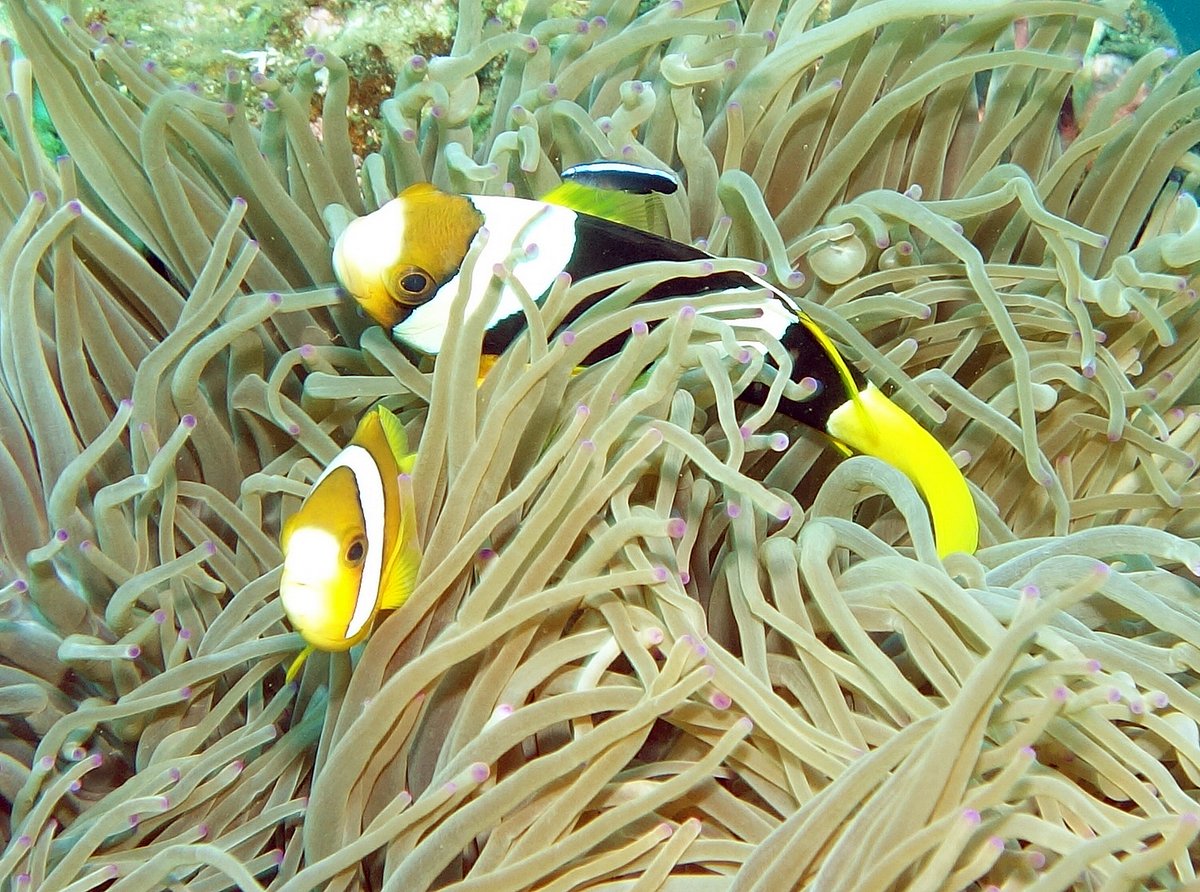
There wasn’t much else to see on the beach and the steep hillside is covered with thorny bushes, so we gave up and went snorkelling. We wore our new 1mm full length wet suits, but we were getting a little chilly after 30 minutes. The Reef was in very good condition, with no sign of bleaching. The fish were mostly very cautious and I saw no sign of grouper, snapper or other “game” fish, so I guess that there’s been lot of fishing here. I did see a few Clarke's Anemonefish and there were a lot of Moon Jellyfish around. I struggled to remember how to take underwater photographs after a three month layoff.



“Red Herring” called us on the VHF radio when we arrived back on the boat. They’d gone ashore at Nosy Hara and paid one person’s ticket because they weren’t carrying enough money. Apparently, the wardens were cross with us for not paying and have reported us to their headquarters. We may get hassle from the Coastguard further down the coast at Helleville. Goodness knows what we might get fined, but I’ll just have to argue that it was a misunderstanding and we thought that we didn’t have to pay because we didn’t stay long.
Apparently, the National Park stretches all the way from Cap D’Ambre to Cap St Sebastian, which is a 45 mile stretch of coast - a huge area. The Cathedral is part of the National Park, so we decided to leave the area and sail past Cap St Sebastian to Andranoaombi Bay. It was a pleasant sail, fairly hard on the wind and we arrived at 17:00, anchoring off a small village at 12°26.83S 048°46.25E in 7 metres of thick mud. We passed another three villages on our way in.
While we were anchoring, a guy turned up in his dug-out canoe. Interestingly, here they have a rough, but functional outrigger to give the boat stability. The guy came to trade with a bunch of bananas and some green coconuts. We weren’t quite ready for trading, so I was dragging out bags and grabbing stuff. We eventually gave him a t-shirt and some fishing hooks and he promised to bring us some Mud Crabs tomorrow.
Three other boats then followed with bananas, plantains and not much else. Most didn’t speak any French apart from one eleven year old girl, who spoke very good French. She was very good at negotiating and extracted a couple of t-shirts, fishing hooks, some fishing line, a pencil and a packet of biscuits for “Les Enfants”. She had a beaming smile and is going to be a force to be reckoned with when she grows up.
28 August 2017 Andranoaombi Bay to Nosy Mitsio
We had some kind of squall go through in the middle of the night, turning the calm peaceful anchorage into a bouncy one as the wind picked up to 20+ knots from the south - straight up the long harbour. I had to get up to check the anchor chain, but we had 40 metres out in 8 metres of water, so we had a good 5:1 scope. An hour later the wind suddenly switched off, but we had no rain - weird.
I was up at 07:00 and peeked out of the window to find a local guy hovering about waiting for us to appear. I lurked below for an hour, until Glenys had woken up and we’d had breakfast. The guy turned out to be Chief Jean Pierre from the main village, which is down at the entrance to the bay - a 1.3 mile paddle. We had a chat with him and he invited us to visit his village, to which we said we’d be there a bit later.

We spent the next hour putting together a bag of goodies to trade with them. When I say “Trade”, I really mean “give” because these people are so poor that we are really donating much more than we are receiving.
The village is next to a sandy beach at 12°28.01S 048°46.73E. We pulled our dinghy onto the beach and wandered into the village, asking for “Le Chef” or “Jean Pierre”, but it took us a couple of minutes to find a young man who spoke some French and finally twigged who we were looking for. (We were later told that the Malagasy word for Chief is “Fokotany”). He lead us deep into the village past numerous grass huts, with ladies pounding grain in huge mortars and rice laid out on mats to dry.
We found Jean Pierre digging charcoal from his Charcoal Pits. The villagers create a fire using any type of hard wood and when it’s roaring away, they cover it with something like a piece of iron shheting or leaves and then pile on some earth. The idea is to restrict the amount of oxygen, allowing the embers burn without flames. The carbonisation process continues overnight and the next day the villagers can dig up the resulting charcoal, which they use for cooking. I guess that each family has its own set of charcoal pits.

Jean Pierre led us back to his house, which is rather grand for the village, with corrugated iron walls and roof. We met his wife and some of their seven children, who range from three years old to twenty. They gave us some honey collected from wild bees. It didn’t look very appetising, being in a scruffy, old Coca Cola bottle, but we graciously accepted it. They said that they would get us some duck eggs.
We chatted for a while and they asked if we had various things. The most unexpected item was an SD card for their mobile phone and a spare battery. There is no telephone signal in the village, but they seem to use their phones as a camera and a music player. I don’t even have an SD card in my phone, so I couldn’t help them.

After a while, we said that we wanted to give them some things, so we were invited into their small home. The whole building is about 5 metres * 5 metres, spilt into two rooms by a corrugated iron wall. One room is a bedroom, full of bedding laid out on the floor and the other room is split again into two by a long curtain from ceiling to floor. One half acts as the living area and behind the curtain was a wood-framed double bed and some storage boxes.
The living room was only 2.5 metres by 2.5 metres, but it had a very grand looking sideboard and three arm chairs. I expressed admiration for the side board and Jean Pierre proudly showed us his DVD Player sat on top of the sideboard, insisting on playing a DVD, which attracted a small crowd of kids. The DVD player is powered by a 12V car battery and an inverter. They have a solar panel on the roof which charges the battery. They are obviously relatively wealthy.

It was fun handing out the various gifts - the room was packed with us, mum and dad, six little kids and three teenage lads hovering by the door. Jean Pierre nearly took my hand off when I presented him with a torch. He was delighted that it was a wind-up torch that doesn’t need batteries. His wife was pleased with the few cans of food and powdered milk; the teenage sons liked the fish hooks and line that I’d packaged together.
The kids munched on a few biscuits that we brought out, while mum grabbed them to try on some of the kids clothes that we’d brought. Some old webbing, a screwdriver, tooth brushes and tooth paste quickly disappeared into willing hands. The piece de resistance was pair of £2 reading glasses. Jean Pierre tried them on and was delighted when he could read, so was his wife - there’ll be some sharing going on.

Jean Pierre owns the village shop, which is a corrugated hut containing one set of shelves and piles of essential stuff like buckets, bowls, cooking oil, a few crates of beer, some tins of food and cigarettes. Occasionally during our visit, a villager or child would turn up and Jean Pierre would walk to the store to sell a few cigarettes or pour some cooking oil into the villager’s container.
After a while, I showed Jean Pierre a photograph of a chameleon and told him that I’d like to see one. He then took us for a walk around the village into his large garden to search one out. We walked past Zebu pens, which belonged to Jean Pierre and then entered his fenced-off garden, which contained Banana, Coconut, Lime, Orange, Jack fruit and Mango trees. There were other trees with strange looking fruits - all in all an impressive garden.
We didn’t find a Chameleon, but they spotted a small Madagascar Owl, sleeping in a low tree. I sneaked up and trying not to disturb it, took a couple of photos. One of Jean Pierre’s older sons, then grabbed hold of the bird to give us a closer look - there’s no concept of leaving wildlife untouched here. The poor owl had an abrupt awakening and looked suitably shocked, but we soon released it and it flew away to find a better perch.

On the way back to his house, Jean Pierre showed us one of the village’s six Wells. The roughly dug hole was about two metres in diameter and two metres deep. The water level was about one metre below ground level and he told us that in the rainy season the well can overflow. He pulled out a bucket of water and it looked very clean - it's a good job because the wells are the main source of drinking water for the whole village.


Back at Jean Pierre’s house, his wife asked Glenys if she had any moisturising cream. Glenys said she had, so after we’d said our goodbyes, Jean Pierre and one of his older sons followed us back to Alba. We invited them on board, gave them a cold drink and showed them down below. They enjoyed their visit, but soon set off to paddle the 1.3 miles into the strong wind.
By this time, it was nearly noon and the anchorage was very bouncy, with a 15 knot wind coming straight down the harbour, so we decided to head off to Nosy Mitsio, some 30 miles away. The wind was unkind to us for the first hour - we were hard on the wind and being forced 30 degrees off course. However, the sea-breeze veered as we left the peninsula and, after a couple of hours, we were able to hold a course directly to our destination.
We arrived in Nosy Mitsio just before sunset and anchored at 12°54.48S 048°34.70E in 8 metres on good holding sand. We collapsed and had fried Duck Eggs for dinner, which were fabulous.
29 August 2017 Nosy Mitsio, Madagascar
It’s been a bit hectic for the past few days, so we had a quiet day on-board. Glenys made some bread and I caught up on editing my photos and my blog. There’s a very sketchy internet signal here - good enough for emails but not much else.
I ran the water maker, but the low pressure pump cut out several times and even stalled the high pressure pump at one point. Air is being sucked into the 20 and 5 micron pre-filters, so I gave up after fifteen minutes.

After lunch, I did some serious investigation and traced the water pipes all the way from the seacock. There’s a t-joint just after the seacock which goes off to the salt water deck wash pump and I found air in the filter for that pump - we don’t use it very often. I ran it to purge the air and then continued along the pipe work, tightening up hose clips as I went.
I ran the low pressure pump and it worked OK allowing me to bleed air out of the pre-filters. I then tried to run the high pressure pump, but it wouldn’t start - it just hummed. I had a horrible feeling in the pit of my stomach - I’ve buggered it up. In panic, I tried it three more times - Hum, Hum and Hummm. This was a disaster, where were we going to get drinking water from?
I sat back and thought through what I’d done to the system. I’d only messed with the pipework, so what could be causing the problem? The low pressure pump worked, but the high pressure pump didn’t… Duhhh! I’d not started our 220V generator. Our inverter will drive the low pressure pump, but there’s not enough power to run the larger 220V motor on the water maker. I started the generator and everything worked. Phew - just a Senior Moment.
I ran the water maker for an hour. The low pressure water pump cut out a few times, but I was able to fill up our water tanks to brimming. I need to replace the low-water pressure pump at some point, but it’s going to take at least 11 days to get on shipped from Trinidad and then it might be held up by customs for weeks. We’ll probably be in Richard’s Bay in South Africa in six weeks’ time, so I’ll have to make do.
30 August 2017 Nosy Mitsio, Madagascar
We had a bit of a holiday today and sailed three miles to Nosy Ankerea anchoring at 12°50.73S 048°34.95E right next to a white sand beach in 8 metres of water on good holding sand. It was a bit rolly with a swell coming from the south-west and hooking around the island, but it we were only there for the day.
We went for a snorkel on the north side of the island, which was fairly good. The coral was in good condition, but there weren’t many fish - obviously a good fishing spot for the locals. After lunch, we went for a short walk on the beach. There’s the remains of a resort that closed down, but not much else of note. We then went snorkelling in a slightly different place while was similar to the morning
After sailing back to the main anchorage, “Jackster” invited us over for sundowners with Gary and Jackie from “Inspiration Lady”, who arrived today after a six night sail from Mauritius.
31 August 2017 Nosy Mitsio, Madagascar
The weather has been beautiful for the past few days, with blue skies and gentle breezes and today was another cracker, but it was time to get on with some boat maintenance. Glenys pottered about doing some washing, while I removed the cooker to repair the broken gimbal.

It wasn’t too bad a job. I’d had some spare gimbal “posts” made the last time that this happened, a couple of years ago. The broken gimbal was the original manufacturer’s one, which was press-fitted into the side of the cooker, so I had to remove the side panel and grind out the broken stud. After that, it was a simple job of bolting the two new gimbal posts into the side panels.
Meanwhile Glenys had given the cooker and the space into which it fits a damn good cleaning. There are places that are impossible to clean when the cooker is installed, so it was a pretty disgusting job.
I had the cooker reinstalled soon after lunch, so I spent the rest of the afternoon doing some smaller jobs - rewiring the 12 volt sockets in the cockpit and tidying up the wiring for our media player and TV projector.
The locals don’t seem to be bothered to trade with us. We’ve had a couple of canoes call by asking for things, but not bringing anything out. We’ve handed out a few small items like pencils and paper for kids and one guy wanted a dive mask. He showed me a horribly scratched mask, so I gave him a good mask and asked him to bring us some lobster or bananas. He never came back and we found out later that he’d scammed a mask from “Red Herring” as well, so I’m a little cross with him.
There are more photos in our Photo Album section.