
1 September 2017 Nosy Mitsio, Madagascar
After being here for four nights, we finally motivated ourselves enough to go ashore. We were met by a young man, who had been out to the boat and spoke a little English. We told him that we’d like him to show us around the village and then we wanted to go for a walk up the hills.
He didn’t quite grasp what we wanted and just walked us through the small village and then started to walk towards the hills. He obviously didn’t think that there was anything interesting about his village. We wanted to go walking by ourselves, so we parted company and asked him to get us some duck eggs and bananas. These never appeared. It’s like the villagers just can’t be bothered - so different to our experience in Andranoaombi Bay.

However, we had a pleasant walk up the small hills behind the village. The hillsides are covered with Satranas Palms (Bismarckia Nobilis), which are thriving in these arid conditions. The locals have a small industry of harvesting the leaves and drying them to sell as roofing.

There’s a resort called “Tropical Fishing” on the long beach. We had a chat with the French owner, who told us that he caters for fishing trips, but is closed until the season starts in October. He told us that the village has about 80 people and that they don’t do anything apart from fishing, selling him goats & Zebu and selling the odd bit of palm leaf roofing. They don’t even grow any vegetables - apparently the goats keep eating their vegetables and they can’t be bothered to build a sturdy fence.
I’ve had some email correspondence with “Echotec”, the manufacturer of our water-maker and they have told me that we can run the water-maker without the low-pressure pump as long as we purge the pipe work free of air before we start - we can do this using the “back-wash” valve. I ran the system for an hour and filled our tanks to brimming again - I’m going to run the water maker every day from now on to make sure that we have lots of water in case the system fails.

In the afternoon, I donned scuba gear and spent an hour cleaning the hull below the waterline. It’s in an appalling state with 1½ inch long green fronds of algae all over the hull, which sway like grass as the boat moves about. It took me 30 minutes to scrape the propeller clean, which just had a thin layer of flat encrustation and a few barnacles. However, the hull was a different matter, after 30 minutes, I’d only done a small patch. I’ll have to do the rest another day.
2 September 2017 Nosy Mitsio, Madagascar
We’ve been here for five nights, so we were planning to leave today, but I was so disgusted by our Hairy Hull, that we decided to stay another day and clean it. I filled a scuba tank and then we both started scrubbing - Glenys snorkelling on the surface doing the top two feet and me underwater with scuba gear doing the rest. After two hours of intense labour, we had a clean, blue hull. I’m pretty sure that we’ll go 1 knot faster now.
We spent the rest of the day pottering about, exhausted by the two hours of hard labour. In the evening we were invited for a beer of two on “Inspiration Lady”.
3 September 2017 Nosy Mitsio to Tsara Banjina, Madagascar
The alarm went off at 06:30, so that we could get an early start. Unfortunately, the weather had other ideas and, as we had breakfast, a huge cloud system spread from the east with rain in the direction we wanted to go. It started to clear an hour later, so we headed towards Tsara Banjina, which was only 12 miles away. We anchored at 13°01.47S 048°32.77E in 7 metres on good holding sand - the water is so clear that we can see the bottom, which makes a change.
We’re anchored quite close to the island and when the sea-breeze picked up during the day, we swung to face west, finishing up with a lee-shore only 30 metres behind us. Our strategy was to tuck in behind the island, so we would be protected from the strong land-breeze, which usually kicks in from the east at night. Nevertheless, it was very unsettling in the afternoon, when the sea-breeze strengthened to 15 knots, bringing 2 foot waves crashing onto the reef close behind us.

Tsara Banjina is a small private island with very attractive white beaches. We didn’t go ashore, but they don’t mind yachties going in to have a drink at their beach bar. They have a scuba dive operation, but at $75US per dive we gave that a miss.
As soon as our anchor had dug in, we went snorkelling, Glenys explored the rocky shore line next to the anchorage, while I had a look at an isolated reef 40 metres to the west of where we anchored (right next to a boat mooring). Both places were very good, but the isolated reef was very good and I spotted three types of Nudibranches - a Swollen Phyllidia, a Racing Stripe Flatworm and Another that I can’t identify.


Unfortunately, my underwater camera is playing up, so my photographs didn’t come out as good as I expected. I have a Strobe (an underwater flash gun) which is essential for taking photos of small critters, but it’s stopped working, so I have to use natural light, which makes life very difficult.
After lunch, I donned a scuba tank and did a 40 minutes dive on the isolated reef to try to find out what is happening to my camera and to give me some more time to take Natural Light photographs. I couldn’t get the camera to work despite trying numerous settings, but I had a nice time poking about. It’s only 8 metres deep, but there are thousands of fish, a couple of huge Grouper, hard coral, sponges, soft coral and I spotted more Nudibranches - it’s a very healthy reef.
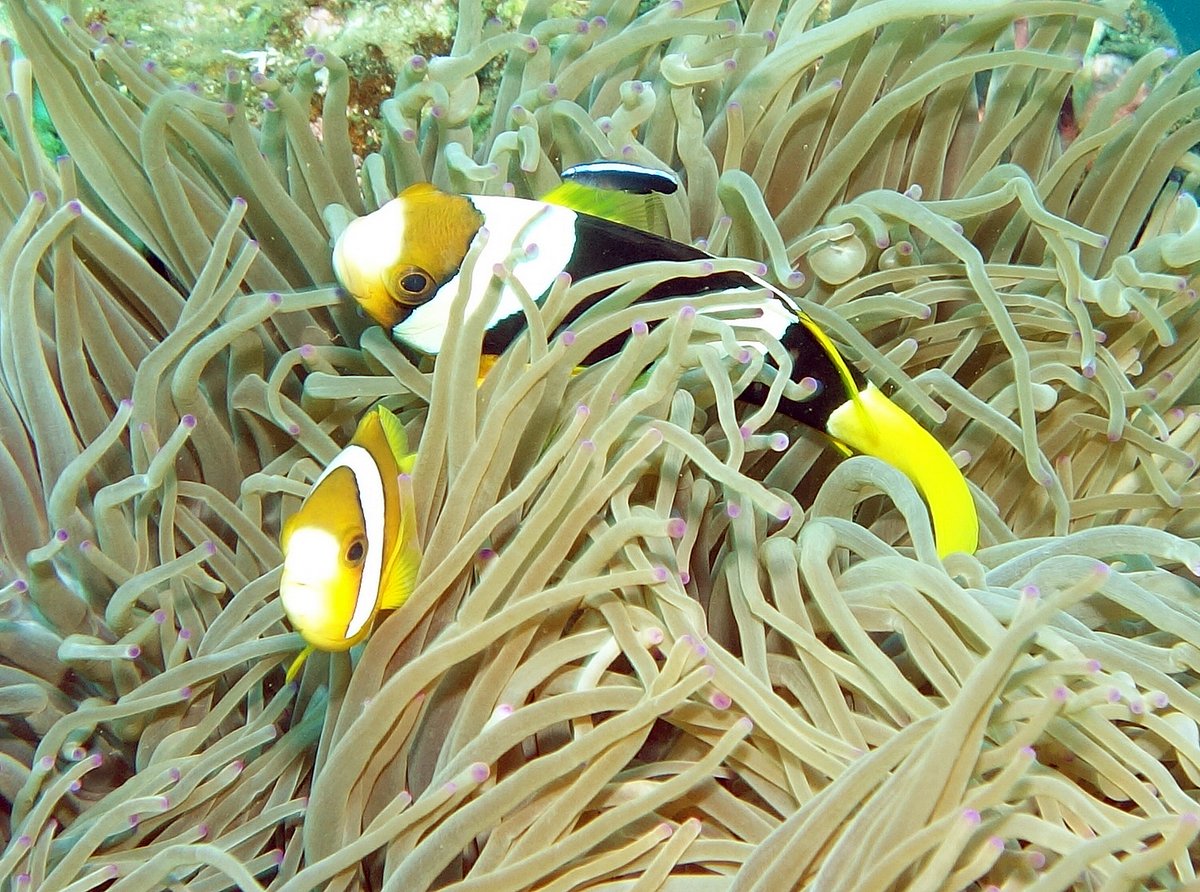
Later in the afternoon, we went snorkelling next to the rocky islands to the west of the anchorage. It was pretty good and we found some more Nudibranches; a Tiger Cowrie; and some Clarke's Anemonefish.

It went dark at 18:00, by which time the wind had dropped to 10 knots and backed to south-west, making it a more settled anchorage, but the expected strong land-breeze never materialised, so maybe we should have anchored a bit further away from the shore.
4 September 2017 Tsara Banjina to Sakatia , Madagascar
I woke up determined to sort out the strobe on my underwater camera. I put in a brand new set of alkaline batteries, but it still didn’t work. The strobe is a “slave” unit that flashes when it “sees” a flash from the main camera. The flash from the camera is transmitted along a fibre optic lead. I removed the strobe and pressed it up against the camera flash, triggered the camera and magically, the strobe fired.
It looks like the fibre optic lead is broken somewhere. A small amount of light is getting through, but obviously not enough to trigger the strobe. If I was in the UK, I could have one delivered tomorrow, but where on earth am I going to get one in Madagascar? It looks like I will be specialising in “Natural Light” photography until we get to South Africa.

We upped anchor at 09:00 and set off on the 35 miles trip to Sakatia. There wasn’t much wind at first, so while we were motoring, I made a few fishing lures and put out two fishing lines. At our half way mark, we had two simultaneous hits. Glenys started to haul in the hand line, while I reeled in the rod.
Unfortunately, the lines were crossed, so I let my line out a little, locked it off and helped Glenys bring in a nice Bonito. It took several minutes before I could haul my fish in, which was another Bonito, but by this time a shark had grabbed it, so I was left with just the head - bugger!
The afternoon sea-breeze kicked in and we were able to sail for a couple of hours. We looked at the bay where Sakatia Lodge is located, but there was a big swell coming in from the south-west, so we motored a couple of miles further north and anchored at the east side of Sakatia at 13°18.17S 048°10.74E in 8 metres on good holding mud. “Red Herring” and “Full Circle” are hiding here as well.
We invited Paul and Monique from “Full Circle” over for a few sun-downers. They have a Hallberg Rassy 46 and we first met them in the Galapagos Islands three years ago. We’ve spent time with them in various places around the world, but we haven’t seen them for over a year, so we had a lot of catching up to do.
While “Full Circle” were in the Maldives, Glenys contacted Monique and asked her to buy a small model boat from a particular island - Glenys had seen one, but hadn’t been able to buy one at the time. Monique carried it 2,000 miles for us, Bless Her...
5 September 2017 Sakatia , Madagascar
We had a quiet day. I spent most of my day on board “Full Circle” getting their satellite phone to send and receive email. My first challenge was that their laptop was all in Dutch. I was trying to do some fairly technical things - installing device drivers and configuring their network. Did you know that the Dutch for “Device Manager” is “Apparaat Beheerder” and “Cancel” is “Annuleer”? Well, it was a nightmare, so we decided to change the computer’s language to English because both Paul and Monique speak excellent English.

This seemingly simple task was also a nightmare because we had to download a “Language Pack”, which on our poor internet connection took ages… After lunch, I had another go and succeeded in sending and receiving emails through the satellite phone, which was satisfying.
In the evening, we were invited over to “Full Circle” for dinner and did lots more reminiscing.
6 September 2017 Sakatia to Crater Bay, Madagascar
Our plan was to sail to Crater Bay and then onto Hellville. Both of these places have a bit of a reputation for theft of outboards, so we stowed our 15hp outboard on deck and fitted the smaller 2.5hp outboard to our dinghy. We don’t use this small outboard very much and when I turned on the fuel, the fuel valve fell to pieces and petrol flooded out. I managed to stop the flow of petrol and then lifted the outboard into the dinghy to try to repair it.
After removing the valve, I found that a nut had fallen off the back of a spindle. Fortunately, it’s a simple valve, so I was able to find a nut that fits and reassemble the valve. After refitting the valve it only took half a dozen pulls to get the outboard started, which is a miracle since we haven’t run it for over six months.
We were able to get going by 10:00 and motored around to Crater Bay, with the light wind on our nose all the way. Crater Bay is a mass of yachts at anchor and on moorings, so we anchored to the east of everyone at 13°23.98S 048°13.25E in 12m of water on mud.
After lunch, we went ashore, where there’s a small scruffy boat yard and floating dinghy dock owned by the “yacht club”. There’s also a small restaurant, which is a favourite watering hole for the local yacht residents and transient cruisers.

The bay has long been a port for local boats, so there are dozens of traditional Dhows moored along the shoreline. These wooden boats carry cargos of Satranas Palm leaves, sacks of river sand, wooden poles, gravel, etc., to the island of Nosy Be. The Dhows are predominately sailed and it is a joy to see them weaving their way through the yacht anchorage, using the sea and land breezes to full effect.

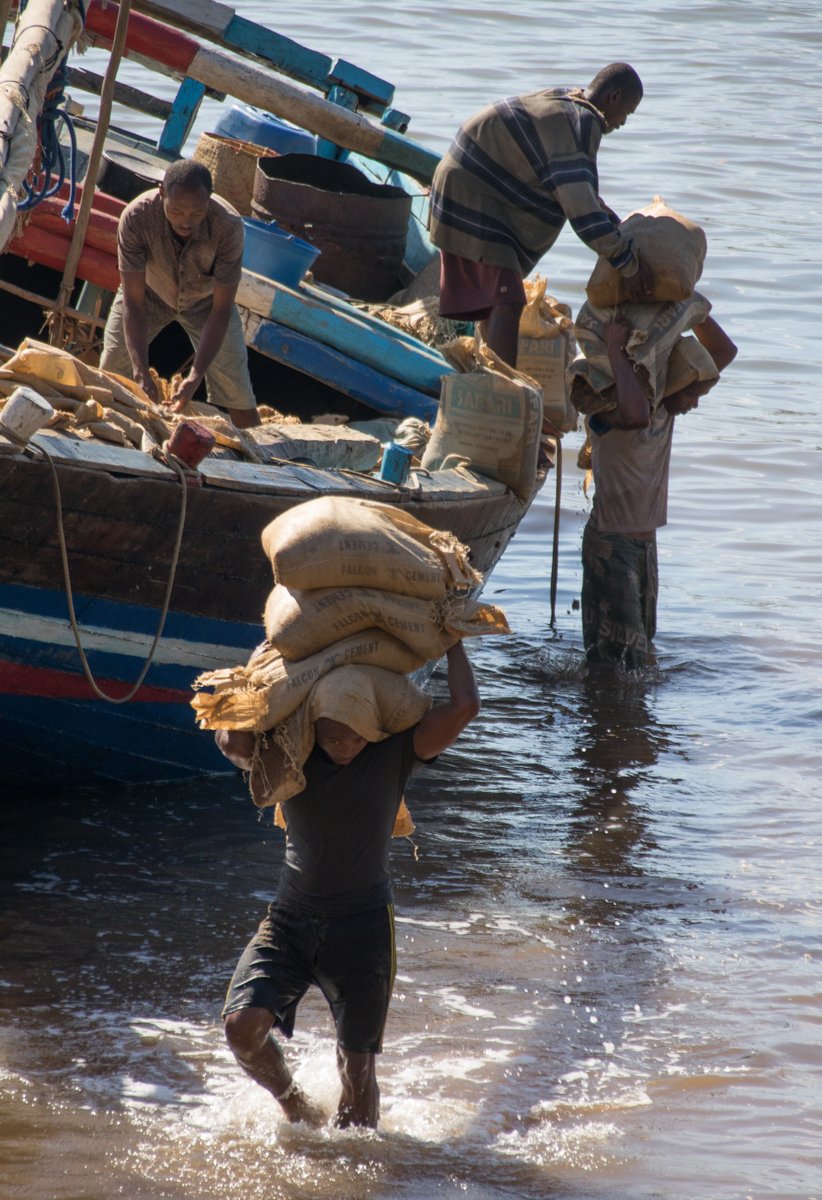
There’s a dusty road leaving from the yacht club, which goes past a thriving community, handling the building materials off loaded form the Dhows. This isn’t a port with warehouses and cranes, the people carry the goods from the Dhows, mostly balanced on their heads and store the materials under wooden shelters, waiting for distribution across the island.
We walked along the dusty road past wooden homes and small shops, until we came to a T-junction in the middle of the small town of Madirokely, which is spread along the main road. The town is a strip of small shops lining the road, selling the usual range of items. Turning left took us to a tourist beach, which had little of interest.
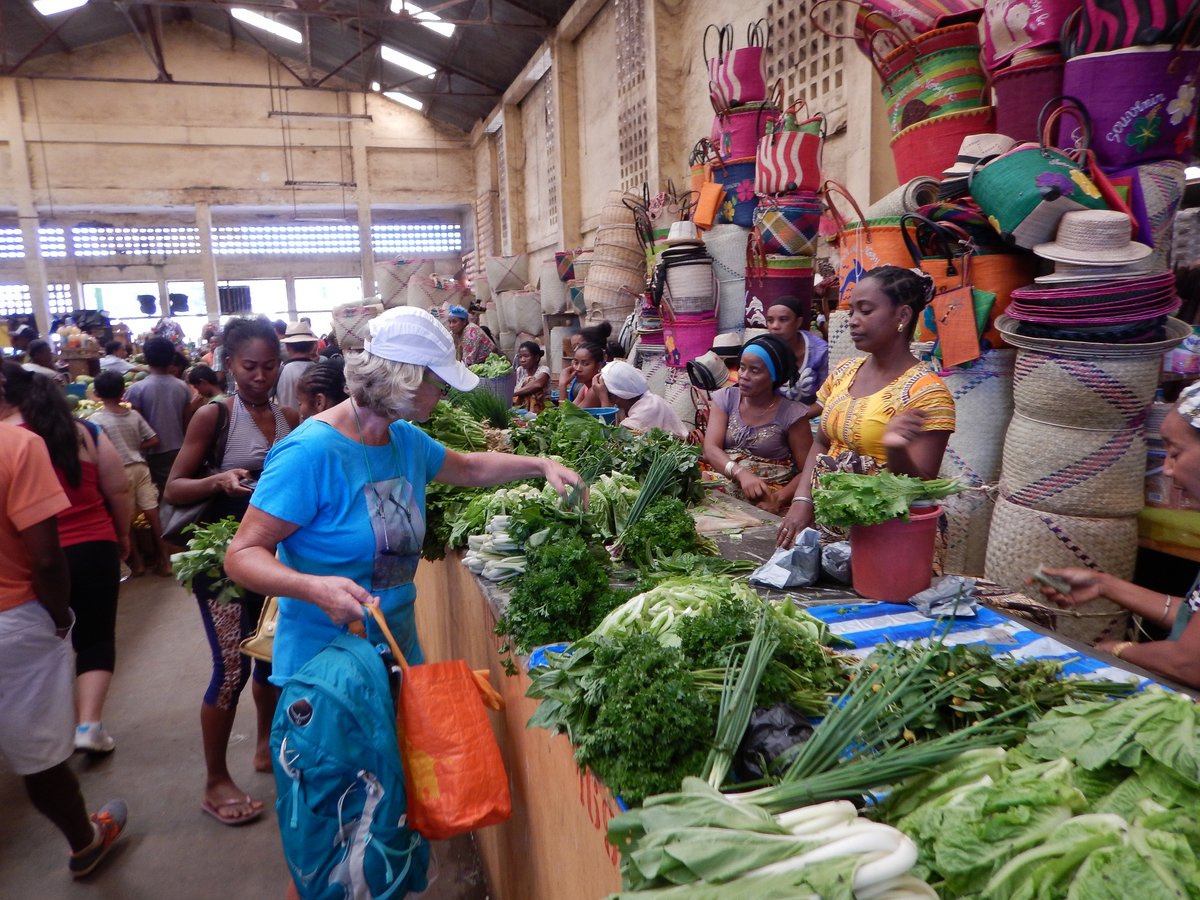
Walking back past the T-Junction, we found the local vegetable market, which was very poor. The place was swarming with flies, settling on the dried goods and vegetables. One young lady was sitting outside on the floor with a huge bowl of whitebait fish, frantically swatting away the thousands of flies buzzing around her and the fish. The meat was crawling. We bought some tomatoes and ran away.
The small supermarket on the main road was surprisingly good, with a fair selection of items, including a refrigerated meat counter, which was fly-less, so Glenys bought some chicken. They had some nice bread and we stocked up on as much beer and drinks as we could bear to carry down the long dusty road back to the boat.
7 September 2017 Crater Bay to Hellville, Madagascar
An hour after sunrise, the Dhows started to sail into the bay, taking advantage of the off-shore easterly breeze. Alba was directly in the path of several of the large cargo boats and we had the pleasure of watching these skilled sailors heading directly at us, then veering off downwind to glide past our stern. The wooden boats are old and battered and the sails are full of holes - I wish that we’d kept our old mainsail and given it to someone here.
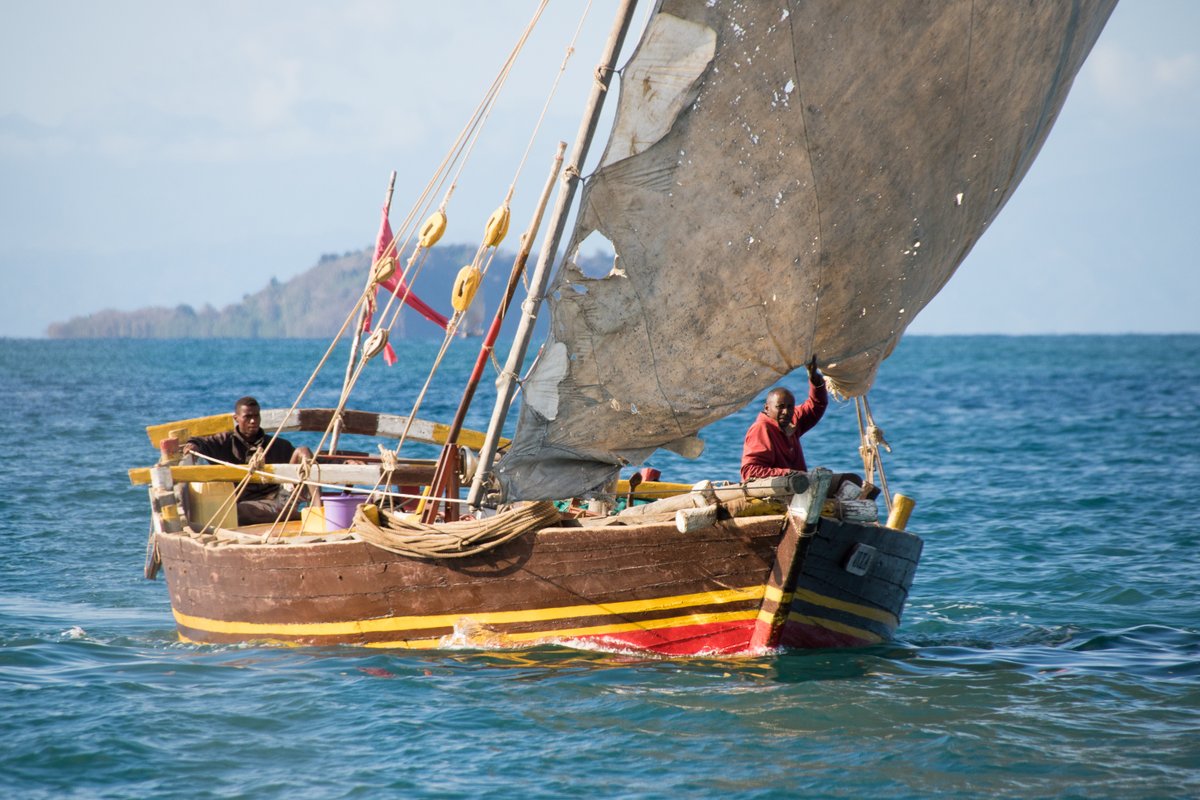
Watching the Dhows sail past, spurred me into going ashore for an hour to take some pictures of the activities. The cargo seems to be mostly building materials and is all offloaded by hand and head. I watched two young men carrying Sacks of Sand ashore. They were balancing FOUR, 20Kg sacks on their heads - that’s 80Kg (12 stone), and they just kept going and going. The sacks of sand were emptied onto the ground, where other guys shovelled it into a flat-bed truck. The sacks were returned to the cargo Dhow.
Other than the Dhows, there wasn’t much to keep us at Crater Bay, so we motored the six miles to Hellville, the capital of Nosy Be - only 6 miles away. We anchored at 13°24.45S 048°17.10E in 8 metres of water over good holding mud. By the time that we were settled, it was 11:00, so knowing that the shops close for several hours at lunchtime, we jumped in the dinghy and headed for shore.
We pulled up to the dock and were waved over to a concrete slipway at the south side of the main pier. The legendary Jimmy and Cool met us on the slipway and immediately took control of our dinghy carrying it up to the top of the slip. These two guys have made a living out of cruisers for many years.
Jimmy, who wears a red Mount Gay hat, speaks a little English and can help you get anything. For 50,000 Ariary (£12), he will accompany you around the tortuous process of obtaining clearance. Cool, who always seems to be wearing a red shirt and a cowboy hat, will look after your dinghy for 10,000 Ariary (£2.50) for the day or 5,000 Ariary for a short time. When you look at the chaos of the port, it’s worth the money.
As we walked away from our dinghy, we were stopped at a Police Post and a couple of seedy officers demanded to see our passports. We’d left them on the boat and so I showed them the photocopies of our passports and visas. They barely glanced at them and beckoned us into a small room, where they pulled out some US dollars and Euro coins and kept repeating “Ariary”.
I wasn’t sure whether they were asking for money or wanted us to change their ill-gotten cash, so I just kept repeating “I don’t understand” and eventually with shrugs we walked out. I really hate that the police officials are corrupt. In the UK, we can trust the integrity of the police, but it seems every Madagascan official is trying to get some grift from us.
We wandered into town and found that the supermarket is open all day, which was good news. We decided to get some fresh vegetables from the market and then tackle the supermarket after lunch. The wet market was better than yesterday, but there were a huge amount of flies again. However, there was a better selection of vegetables, so Glenys filled her shopping bag.
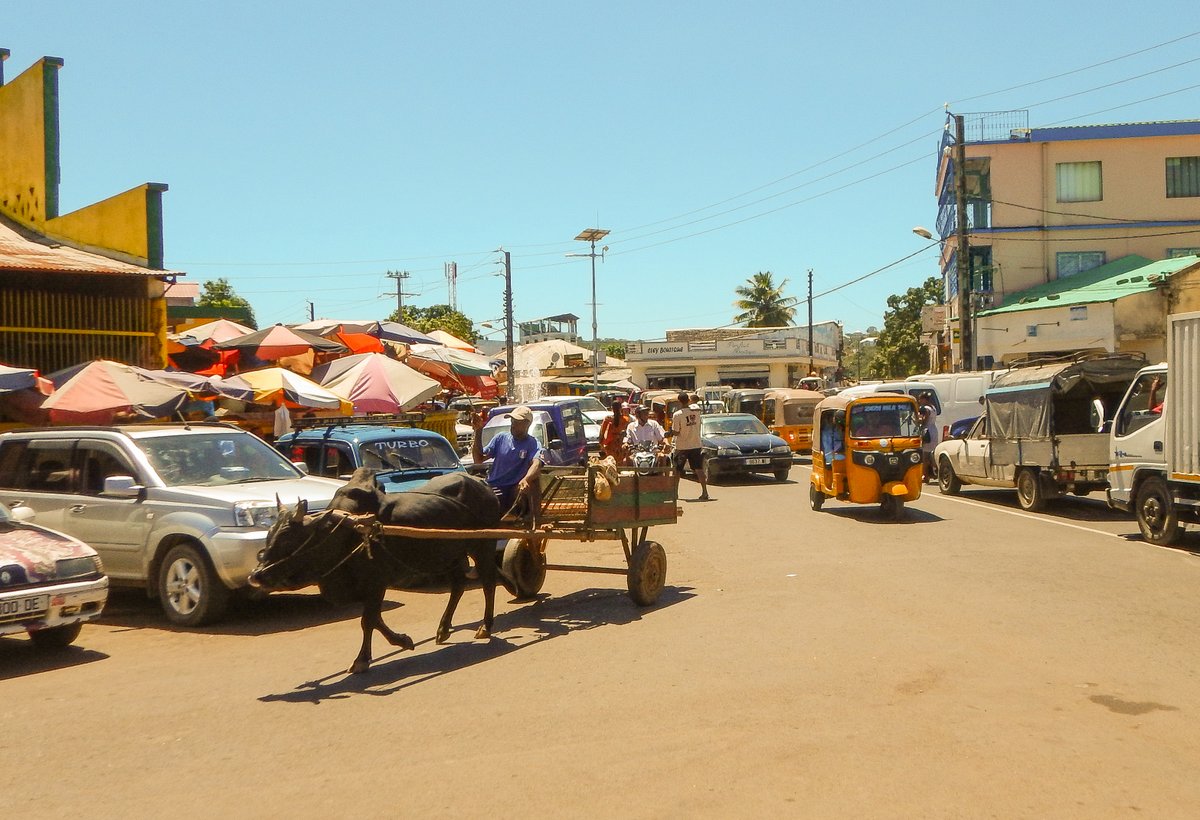
We walked back to the Nandipo restaurant, where we found Paul and Monique from “Full Circle”. The meal took at least an hour to arrive and was very average, so we won’t be going back there. After lunch, we went to the Shampion supermarket and stocked up for two weeks. They have cans of Three Horses Beer, so we bought a couple of cases and then caught a tuk-tuk back to the port.
There’s a port entrance, about 200 metres from the slipway where we left the dinghy and the tuk-tuk was stopped by a guard. When I asked to be let in, he put out his palm to be greased, to which I shook my head in disgust. We unloaded the tuk-tuk and had a little confusion about the fare, eventually paying 500 Ariary each and another 500 for the shopping - it’s only 37p, so I didn’t get too stressed out about it.
We just about managed to carry all of our shopping in one go, so we were glad that we had bought much more - otherwise I would have had to make several trips while Glenys guarded our shopping bags from the hordes of people milling about the port gates.
While lugging the shopping back to the dinghy, we were again stopped by the dodgy policeman, who beckoned us into the small office asking for our passports again. This time, once in the privacy of the office, he could see that we had lots of beer and was asking for a few beers. We pretended not to understand; kept telling him that our passports were on the boat and walked away.
Back at the dinghy, I arranged for Cool to get me some diesel, which worked out well. I dropped off three empty 20 litre containers and they returned them an hour later. The diesel cost 3,000 Ariary (£0.75) per litre and they wanted 20,000 Ariary (£5) for their transport and time, which was fair enough.
8 September 2017 Hellville to Russian Bay, Madagascar
We left Hellville at 09:00, but had no wind until 11:00, when the sea-breeze kicked in - I think that we should have waited until noon to leave. However, it was only 20 miles across to Russian Bay, and at least we were able to sail for a couple of hours.
When we were half way across, a pod of three Humpback Whales crossed in front of us - they were so close that we heard them blowing before we saw them.
After negotiating the narrow entrance into the huge bay, we anchored at 13°32.14S 047°59.90E in 10 metres on soft sand/mud. Russian Bay is a beautiful natural harbour and the first time that we’ve been ashore on mainland Madagascar.
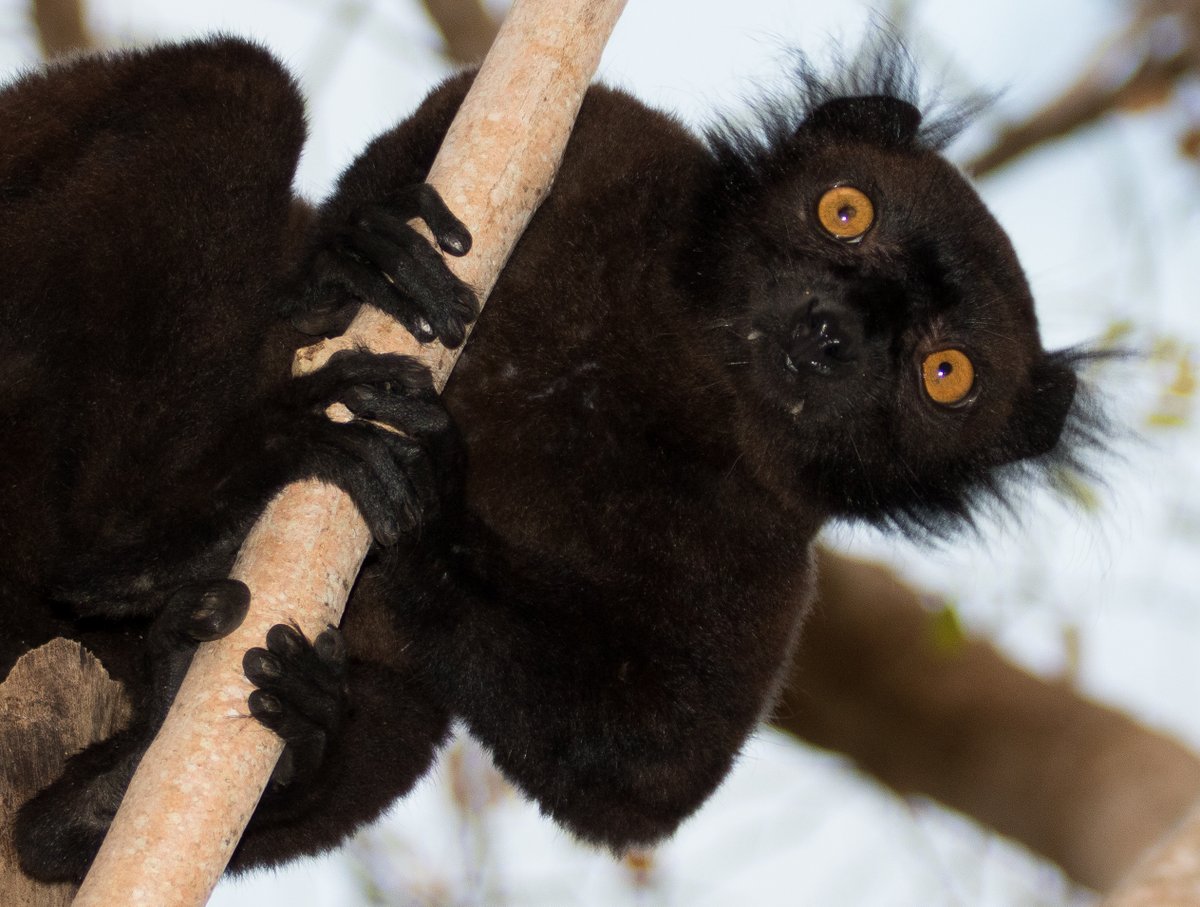
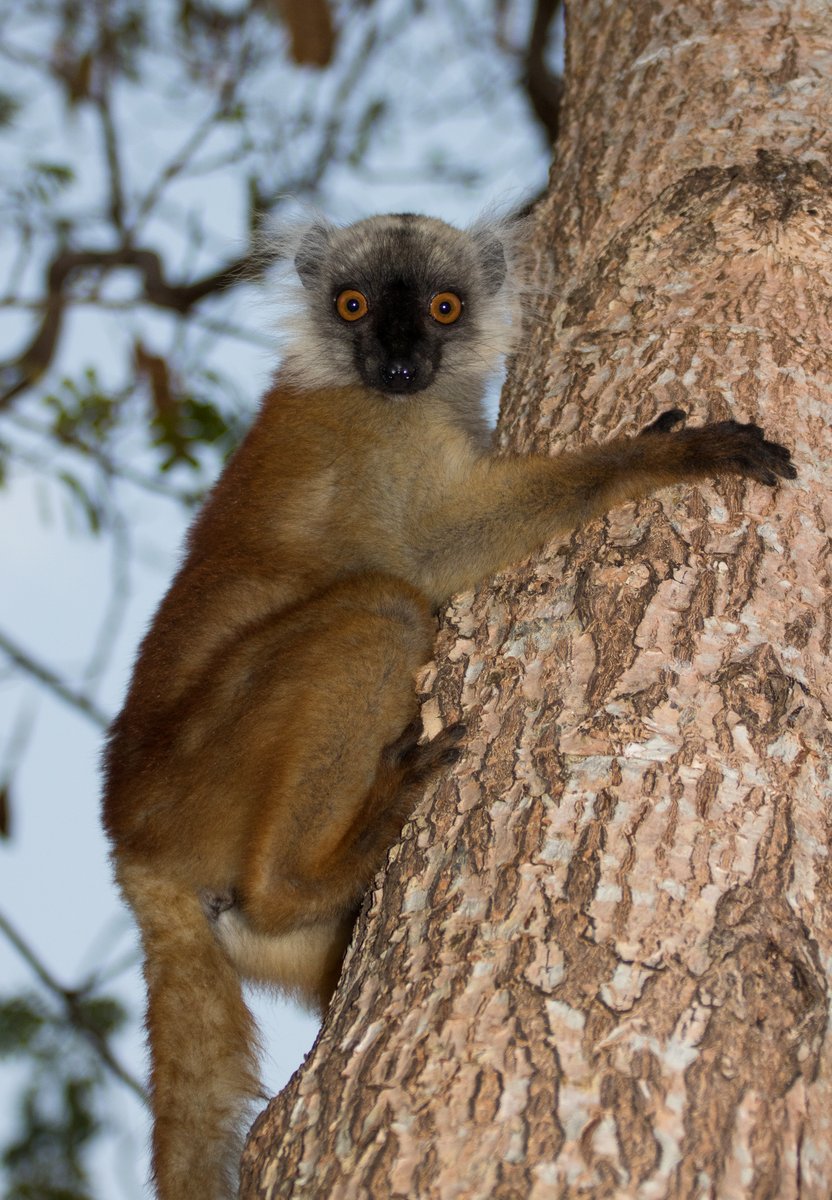
In the evening, we went ashore with “Jackster” to a small restaurant run by an Austrian guy called Andreas. We had to give him a few hours’ notice and had no idea what we were going to get for dinner - “might be fish or might be chicken”. Andreas serves cold beers, so we went over at 17:00 for pre-dinner sundowners and fed five, wild Black Lemurs that show up in the evenings. These Lemurs are only found in this region of Madagascar - the Males are jet black and the Females are a lovely honey brown colour. Of course, I took far too many photographs.

Dinner was slow coming, but very good with two large grilled fish, a chicken dish, a bowl of beans, rice, and green Papaya salad - it was more than enough for the four of us. As well as a few cold beers, we drank a bottle of red wine (Andreas doesn’t mind you taking your own wine) and, at the end of the meal, Andreas brought out some Rhum Arrange, so we had a very tipsy dinghy ride back in the dark.
9 September 2017 Russian Bay, Madagascar
We had a quiet day. In the morning, I caught up on editing my hundreds of photographs of Dhows, places and Lemurs. Glenys meanwhile worked out a timetable for our remaining time in this area. We are aiming to cross to South Africa in the first two weeks of October and it’s about 200 miles to Baly Bay, which is where we want to wait for a weather window, so we think that we should spend another week in this area and then start to head south around the 20th October.
In the late afternoon, we went ashore to Andreas’ bar for a cold beer and pick up a loaf of freshly baked bread that we ordered last night.
10 September 2017 Russian Bay, Madagascar
The alarm went off at 06:30 and half an hour later, we were sailing around the corner to Nosy Antsoha (also known as Lemur Island). It was only six miles, so just after eight o’clock, we were anchored at 13°30.90S 047°57.72E in 9 metres depth. The anchorage was very bouncy with 2 foot waves rolling in from the open sea, but the holding was good and we were only planning to stay for an hour or so.
We dinghied ashore and landed on the small beach, were we were met by a guide, who charged us 10,000 Ariary (£2.50) each for a tour. The guide led us off up a steep rocky path calling “Maki, Maki” and within a few minutes, we had several Lemurs jumping around and onto us. After feeding bananas to some Common Brown Lemurs and a couple of Black & White Ruffed Lemurs, we headed up the path.

The guide changed his call to “Sifa Sifa” and after a while some Sifaka Lemurs appeared. These are smaller than the other lemurs that we’ve seen and look very cute. They leap incredible distances between branches and, when moving along the ground, they jump sideways, which is amusing. One of the Black & White Ruffed Lemurs had followed us up the path and several times bullied the smaller Sifaka Lemurs, trying to grab the pieces of banana that we gave them.
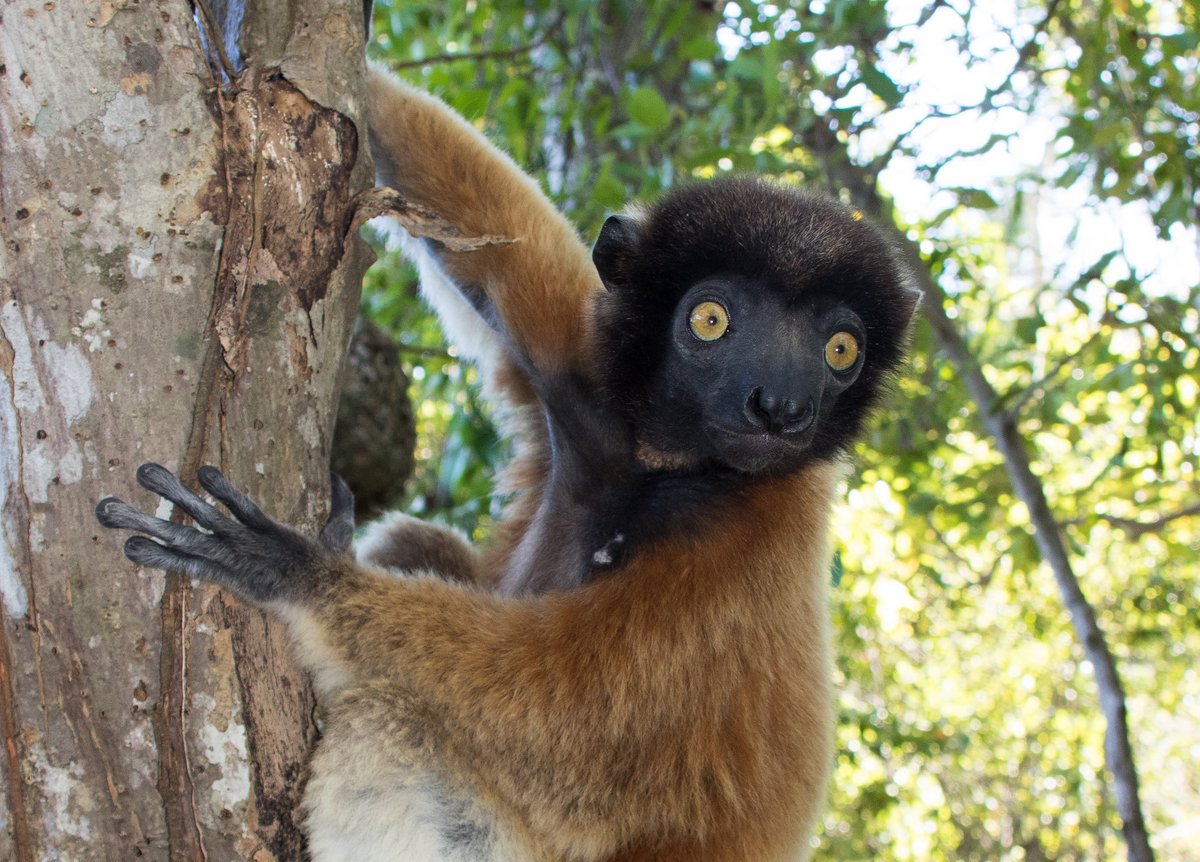
At the top of the small but steep island, there’s a thatched shelter with a double bed. We were told that you can stay here for €120 per night. It would be an interesting place to stay, if you were here on holiday. The 30 minute tour ended next to a dozen plastic bowls containing baby Green Turtles, which they release when an appropriate size. It was a nice little tour.
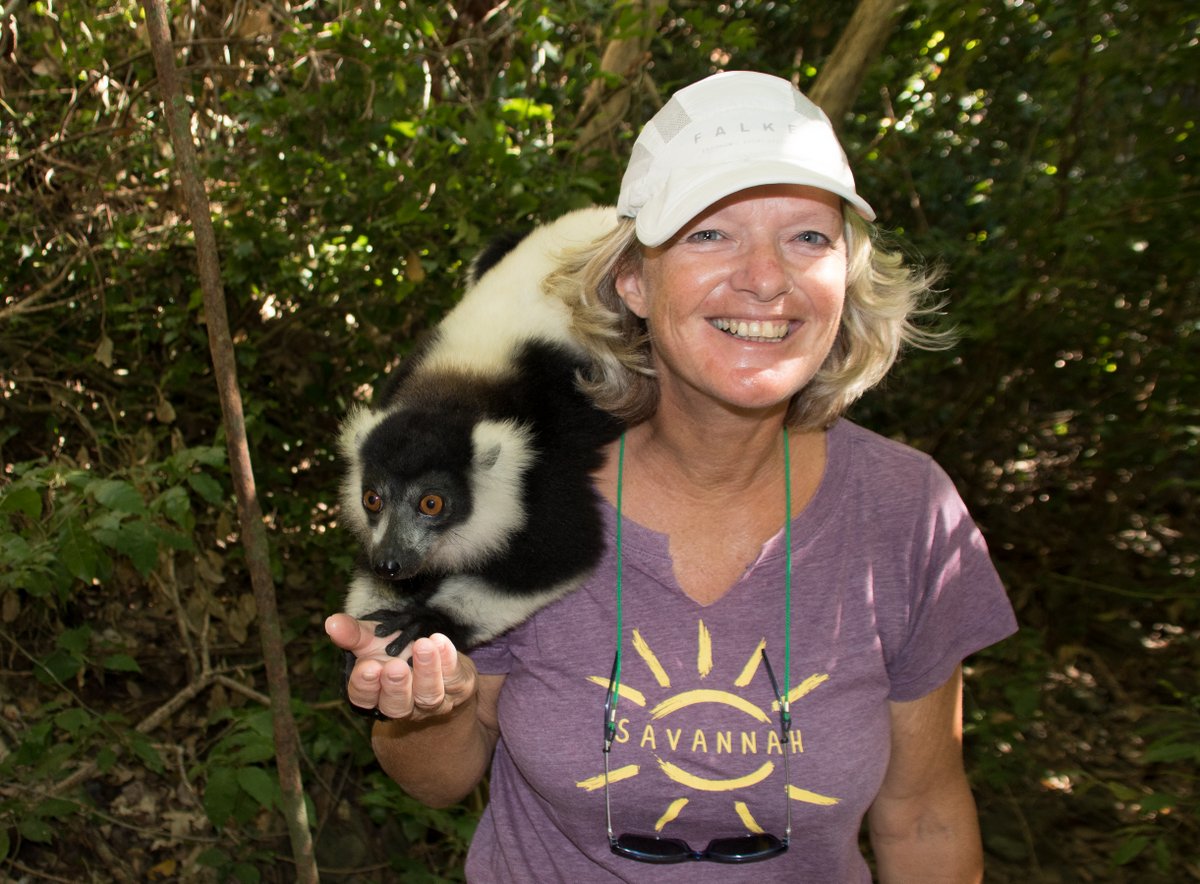
Back at the boat, the bouncy conditions hadn’t improved, so we upped anchor and sailed a few miles to the small island of Ankazoberavina, where we picked up a mooring at 13°29.31S 047°58.70E in 8 metres of water. There are two white mooring balls to the north of a large steel buoy marking the edge of a Marine conservation area - it’s not a National Park, so there’s nothing to pay.
The moorings are chained to large bommies and the one that we picked up, close to the steel buoy had wrapped itself around part of the bommie, so I couldn’t lift it out of the water with our boat hook. There was nothing else for it, I put on some swimming shorts and as Glenys manoeuvred us up to the buoy, I jumped in with the rope, passing the end through the mooring and back up to Glenys. I then snorkelled down to untangle and inspect the mooring rope - it looked very strong.
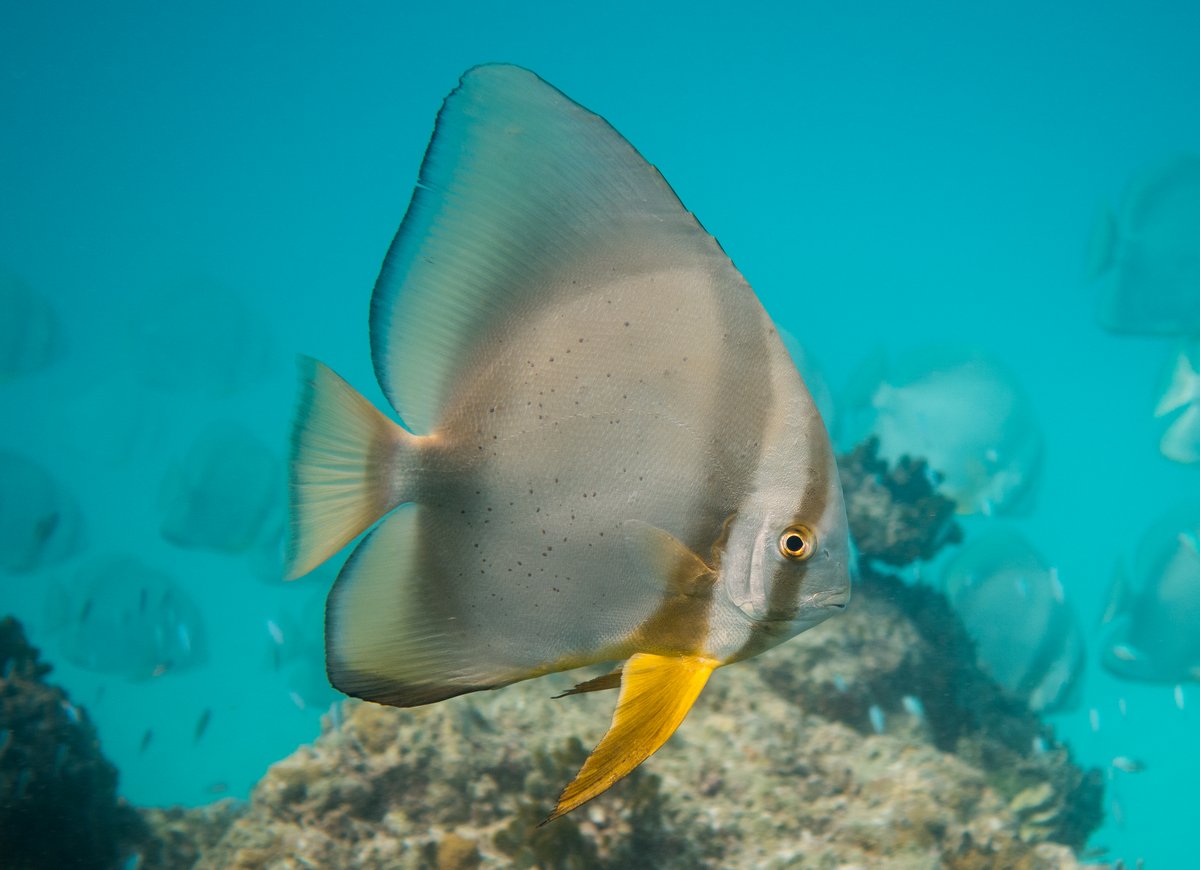
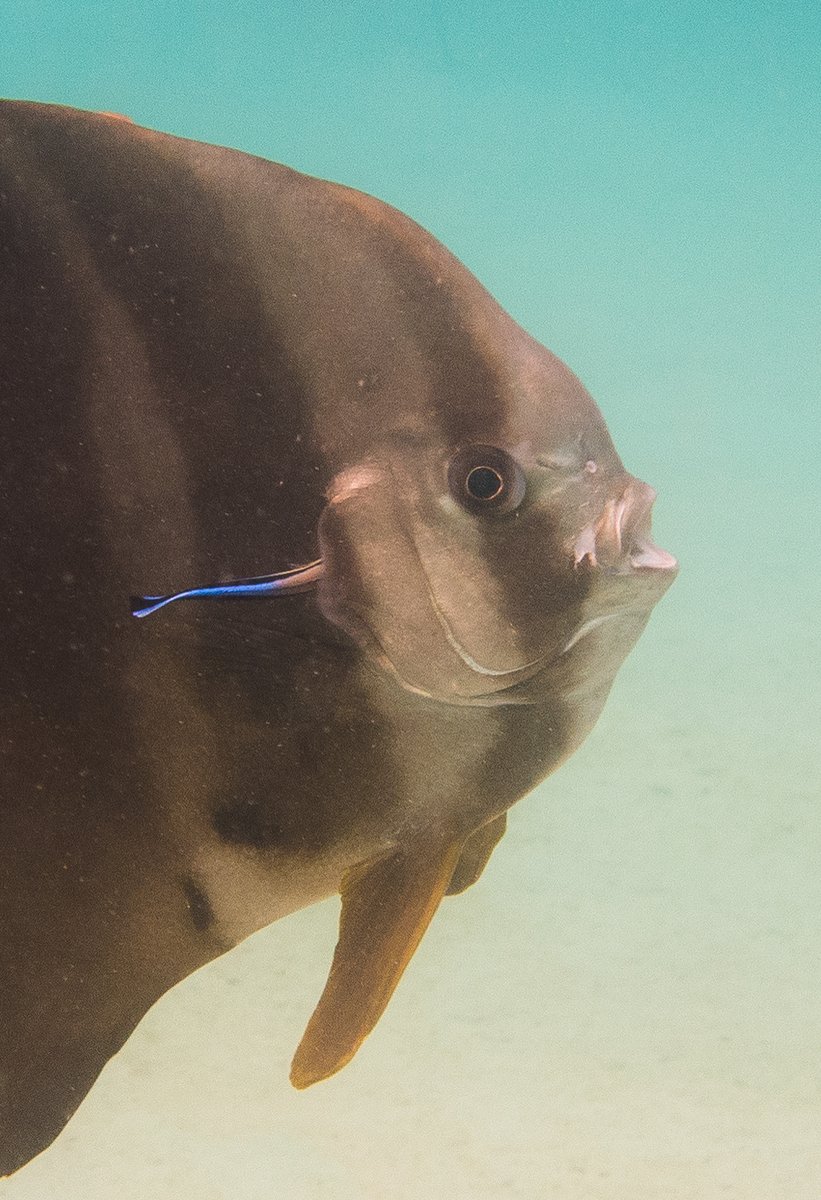
We’d been told that it was good diving here, but it didn’t look that good to me, so we just snorkelled on the many coral patches. The visibility was about ten metres; the coral was in fairly good condition and being a “no fishing” area there were plenty of fish. This included a number of large Circular Spadefish that were hovering around the cleaning stations, with Cleaner Wrasses darting in and out of their gills.
We stayed for a few hours and after lunch, sailed back to Russian Bay where we chilled out for the rest of the day.
11 September 2017 Russian Bay to Nosy Komba, Madagascar
We decided that we’d had enough of Russian Bay and headed for Nosy Komba. Once again, we were too impatient to go and instead of waiting for the afternoon sea-breeze, we left at 09:00 - we had very little wind, so we motored most of the 23 miles. If we’d have waited until midday, we would have had a cracking sail.
The anchorage at Nosy Komba is on the north-east corner at 13°26.54S 048°21.16E - we anchored in 10 metres of water. The village that we’re anchored off is a bustling place with tourist boats, restaurants and at least one dive operation. We’ll investigate tomorrow.

We had a quiet time for the remainder of the afternoon doing research into anchorages further south and downloading aerial photos into SAS Planet… I don’t often use this program, but the Google Earth images for this area are not very good, so my KAP charts are not as detailed as usual. SAS Planet can store Satellite images from Bing which are much better - we’ll be using this for the tricky anchorages further south.
12 September 2017 Nosy Komba, Madagascar
After beaching our dinghy at the Chez Yolande restaurant (13°26.60S 48°20.96E), we walked through the narrow sandy streets of the village. No cars, motorbikes or even Zebu carts are to be seen in the island, so everything is moved by hand.
Tourists come over to Nosy Komba for day trips and the village has scores of small souvenir shops selling wood carvings, Pandanus weaving, t-shirts etc. The villagers also specialise in making embroidered “Cutwork” table cloths that are hand stitched with parts of the material removed to give a lace effect. The streets and beaches are lined with a colourful display of the tablecloths rippling in the breeze.
Glenys bought a large, dark blue Table Cloth, which has a tropical theme and some nice details of Lemurs. She also found an interesting hand-stitched Tapestry which is 3ft * 2ft and depicts various aspects of Madagascar - village life, lemurs, Baobab trees, etc. Not a bad find for £10.


Another item on sale in many Madagascan streets is the Cola Nut. This can be bought as a 1” diameter nut for about 500 Ariary (£0.15) and slivers are chewed as a natural stimulant - as one guy told me, “It helps If you need to do a lot of work”. I found this information:
The Kola nut is the fruit of the kola tree, which is native to the tropical rainforests of Africa. It’s chewed in many West African countries, individually or in a group setting. It is often used ceremonially, presented to chiefs or guests.

Kola nuts comprise about 2% caffeine, as well as containing kolanin and theobromine. All three chemicals function as stimulants. The first taste is bitter, but it sweetens upon chewing. The nut can be boiled to extract the cola. The trees have yellow flowers with purple spots, and star-shaped fruit. Inside the fruit, about a dozen round or square seeds develop in a white seed-shell. The nut’s aroma is sweet and rose-like.
Kola nuts were used as a form of currency in some West African people groups. They are still used as such today in certain situations such as in negotiation over bride prices or as a form of a respect or host gift to the elders of a village should one move to a village or enter a business arrangement with the village.
Kola nuts are perhaps best known to Western culture as a flavouring ingredient and one of the sources of caffeine in cola and other similarly flavoured beverages.
In the 1800s, a pharmacist in Georgia, John Pemberton, took extracts of Kola and Coca Leaves and mixed them with sugar, other ingredients, and carbonated water to invent the first cola soft drink. His accountant tasted it and called it "Coca-Cola". Cocaine (but not the other extracts from the Peruvian Coca Leaf) was prohibited from soft drinks in the U.S. after 1904, and Coca-Cola no longer uses either Kola or Coca in its secret recipe.
We had a quiet afternoon and in the evening went to Chez Yolande for an evening meal with “Red Herring” and “Jackster”.
13 September 2017 Nosy Komba, Madagascar
We went ashore at 08:00 and strolled to the Lemur Park - we were advised to go early because the Lemurs don’t bother to show up later when they’ve been fed by groups of tourists. There’s a small park office tucked down a narrow side street next to a biggish souvenir shop. It’s not very well signposted, so we just asked around. We had to pay 4,000 Ariary each (£1), which included a guide and his bananas.

Most of the walk is along a dirt track, which is lined with dozens of stalls selling the inevitable carvings, basket work and cut-work table cloths. There are only Black Lemurs on the island and they are wild animals, attracted by the bananas handed out. We’ve already seen this species of Lemur, but our attention was grabbed by a female with a one-week old Baby clinging to the mother’s chest - very cute.

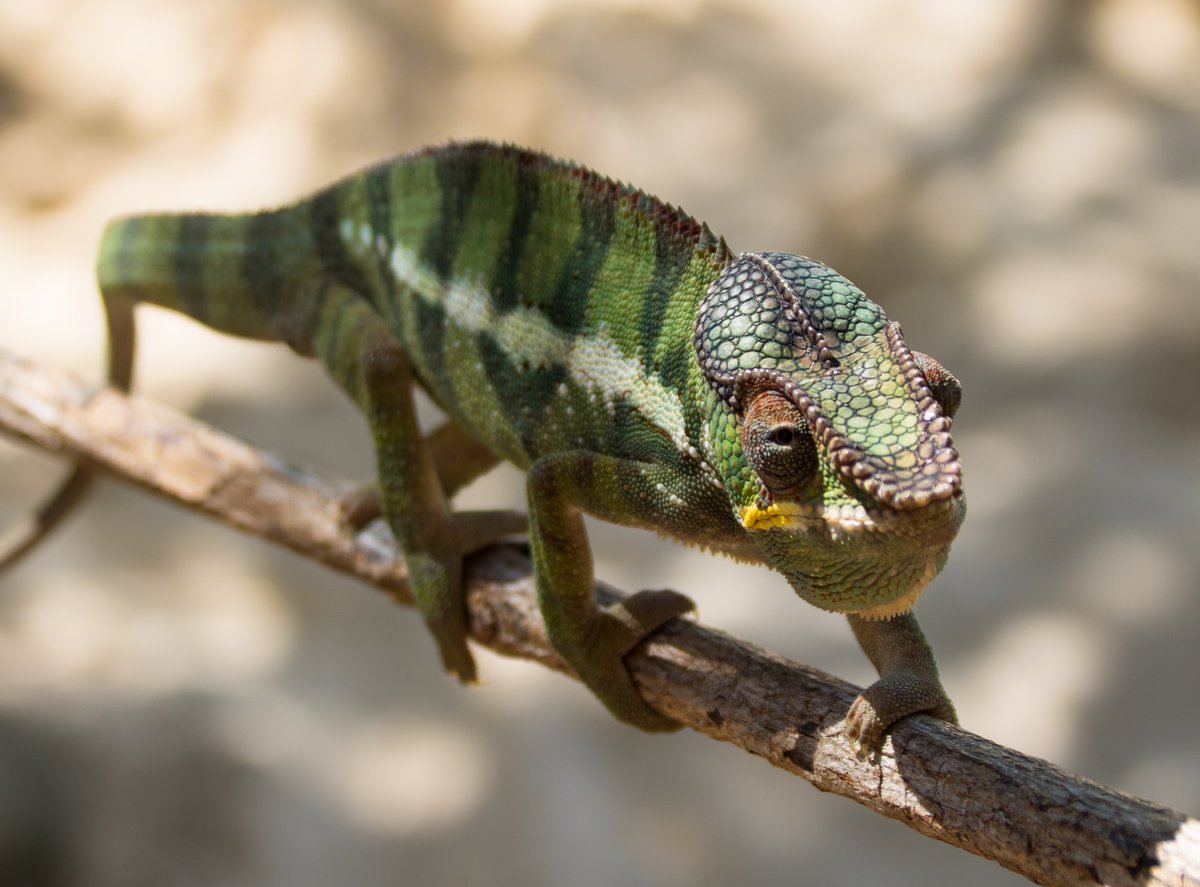
The guide spoke good English and was very knowledgeable, so it was an interesting little tour. He found us a Chameleon and showed us a couple of species of Tortoise that they are breeding. Along the way we bumped into Karen and Graham from “Red Herring”, so we went for a walk together up to the top of the island.
The guides try to charge you 20,000 Ariary to show you the way, but there’s no need - just get your guide to point you in the right direction at the end of the tour. We followed a well-used path which climbs steeply up to a few villages. There are a series of yellow and red paint marks on the rocks, which I believe are used for an annual mountain trial run - we followed the red marks.
The trail passes a few small farms and settlements and eventually comes to a Christian Shrine complete with a large white cross and a crucifixion - it was a surprise to see it as we rounded a corner. A little further on, there was a school off to the right and then, at a three way branch in the trail, we took the right hand path and walked into a very tidy looking village. The path started downwards at the village, so we retraced our steps and walked back down to our dinghy.

We didn’t walk down through the Lemur Park, but followed the main path down to the village, which came out next to Chez Yolande. So, if you want to walk up by yourself, turn left outside main entrance to Chez Yolande and head roughly south until you come to a set of concrete steps leading up past street vendors. At the top of these steps, bear right and you will come across the main path up the mountain, turn left and keep heading up, following the red paint marks on the rocks.
Foolishly, we’d only taken 500ml of water and no food, so we were feeling dehydrated and tired in the afternoon, so we had a long siesta.
14 September 2017 Nosy Komba, Madagascar
I had a terrible night, continually running to the toilet with a bad case of Bali Belly. It had slightly abated by morning, but I didn’t dare venture far from a toilet. We found out later in the day that Dave from “Jackster” had also had a rough night. The finger of blame lies strongly with the meal that we had at Chez Yolande because Dave and I both had Zebu brochettes.
We chilled out all day; I took a couple of Immodium in the afternoon and slept a lot.
15 September 2017 Nosy Komba to Hellville, Madagascar
After breakfast, we motored around to Hellville and anchored in the town harbour. “Red Herring” were already there, so we shared a dinghy, which we left in the capable hands of “Smiley” another of Jimmy’s associates. We all walked into town to the vegetable market and supermarket to do our final provisioning before we start heading south down to Mahajunga.
We’ll be clearing out in Mahajunga and expect to be buying more provisions there, but Glenys has bought enough drinks, dried goods and tins to last us for two months, so if we bypass Mahajunga, we won’t starve on the way to South Africa.
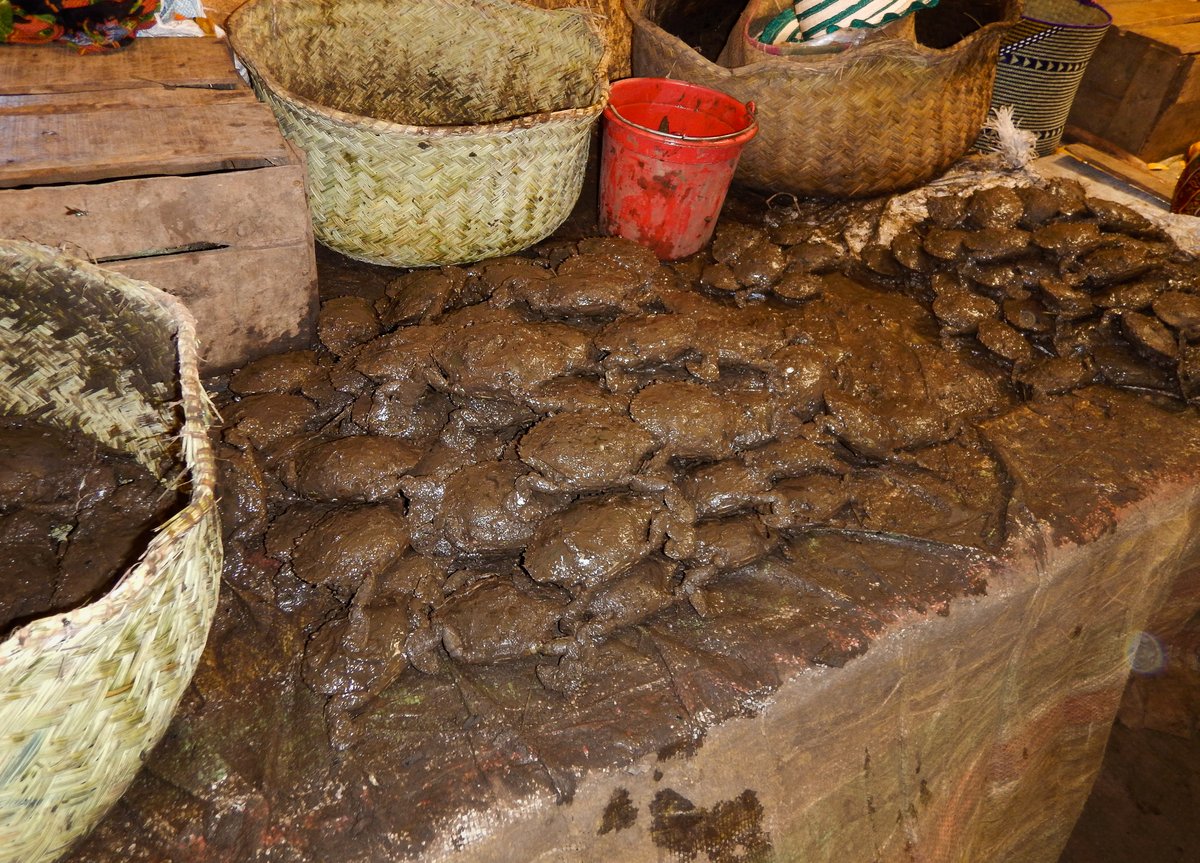
In many places, the villagers paddle out and offer us Mud Crabs, but we've so far declined. In the market there was a whole section devoted to Mud Crabs. They were slavered in gloopy mud, presumably to keep them fresh, but they didn't look particularly appealing. Maybe someone should teach them about presentation.
In the afternoon, we got some more fuel. I took three of our jerry cans and three of Red Herring’s jerry cans over to Jimmy, who charged us 35,000 Ariary (£8) for transport and his time in getting the fuel. It was worth it because all I had to do was drop off the jerry cans and pick them up 45 minutes later. By this time, it was 16:00 and the day was over.
16 September 2017 Hellville to Crater Bay, Madagascar
Up early again, this time to scoot the six miles around to Crater Bay to attend a cruisers’ lunch. Unfortunately, when I went to check the engine, I found a couple of litres of sea water in the engine bilge. Goodness knows where it’s come from. I traced through the whole of the sea water circuit and couldn’t find a leak. I mopped out the bilge and I’ll have to keep an eye on it.
We motored around to Crater Bay, dropped the dinghy in the water and headed off into town to buy a few more provisions that we couldn’t find in Helleville. The little supermarket in Madirokely is surprisingly good and we were able to buy some cornflakes and a nice loaf of bread.
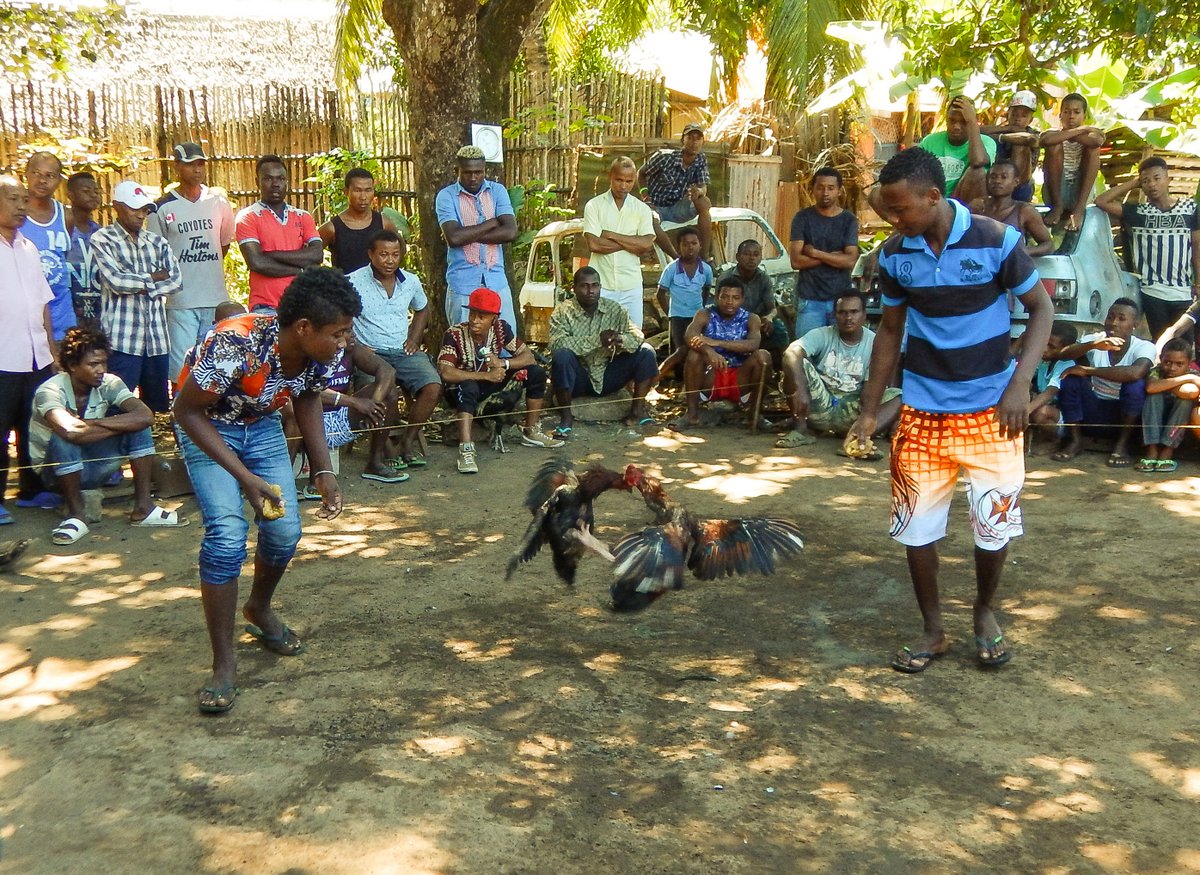
On the way back, we came across a large group of men stood in a circle shouting. It looked like a man-only thing, so Glenys walked a little way along the road, while I went to investigate - it was a cockfight. Two cocks were locked in combat, pecking each other’s heads and occasionally leaping up, lashing at each other with their feet. Their handlers were coaxing them to fight by (bizarrely) splashing water on their feet.
The crowd cheered every time that a bird grabbed the other in its beak and cheered again when a feather was plucked out. The men were obviously betting, because the fight itself was not very interesting. Thankfully, there wasn’t much blood, so I took one picture and left.
The pig roast at the restaurant next to the yacht club started at midday and was well attended by a gaggle of cruisers. Much beer was consumed and we caught up with a few boats that we haven’t seen since Chagos. Obviously, the afternoon was spent sleeping off the large lunch and alcohol, followed by Baguette Pizza and a movie.
17 September 2017 Crater Bay to Russian Bay, Madagascar
It was another early start and we were on our way by 07:00, motoring six miles to Tani Keli , a small island which is a Marine Park. We anchored at 13°29.24S 048°14.25E in about 12m on sloping sand, next to three small black moorings. The moorings might be strong enough for a yacht, but they were in 4.5 metres of water and possibly shallower, so we anchored. A Park Ranger boat arrived as soon as we dropped the anchor and we paid 20,000 Ariary each (£5).
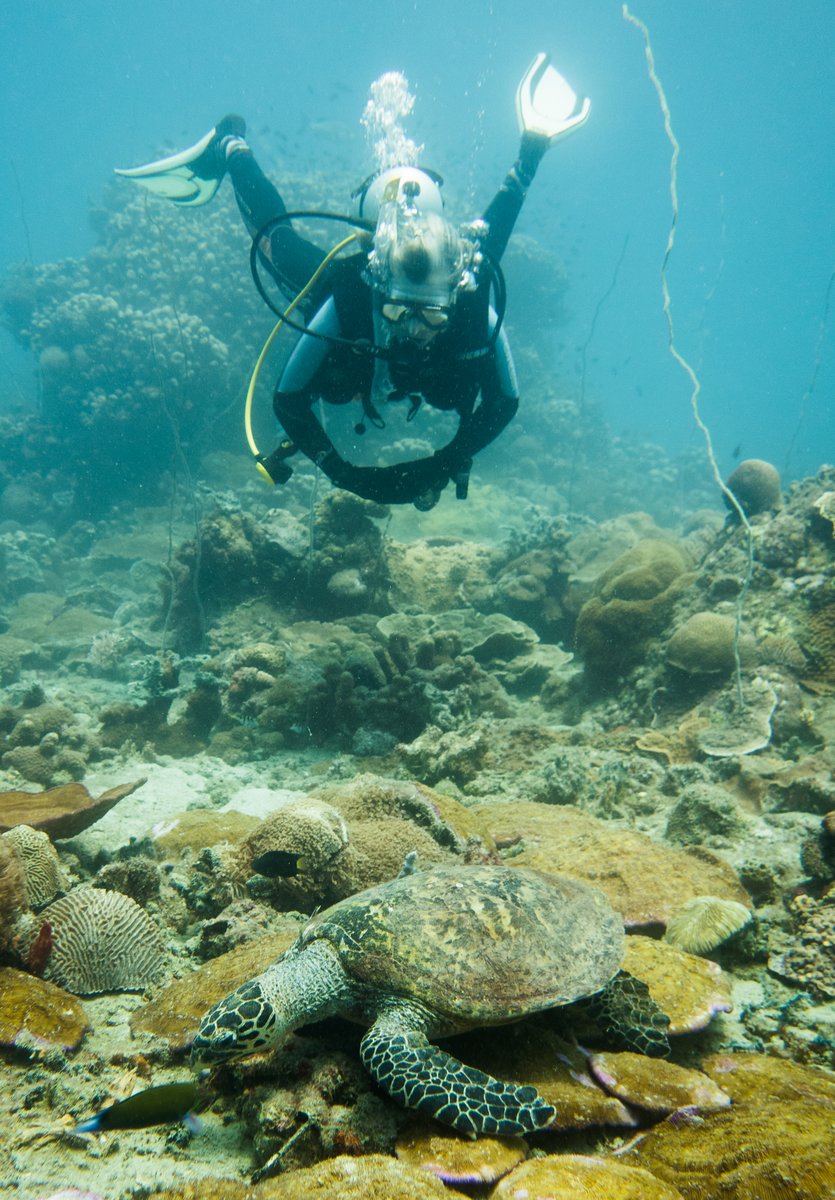
We did a scuba dive on the east side of the island, tying our dinghy onto one of two black moorings off the main beach at 13°29.01S 048°14.35E. We dropped into the water and headed south-east down the sand to 20 metres, following the bottom edge of the reef heading south. When we had used half our air, we came up to 12 metres and returned back along the reef until we hit the sand, then back to the dinghy. We started our dive at 10:00 with light winds, calm seas and encountered no current.
It was a great dive despite the visibility being only 10 metres. There were lots of big snapper, groupers and blue-spotted sting rays who were very unafraid (until I stuck my camera in their face). We saw six nudibranchs (2 species) and a similar number of big tiger cowries. A Hawksbill turtle popped over to say hello and we spent five minutes with it – it was very unconcerned. The hard and soft coral was in good condition and sponges were dotted around the reef - shows the value of a Marine Park.
We were told that there’s another dive on the west side at about 13°29.08S 048°14.00E, just off a small beach. A bit shallower, but we believe that this is the best place to see reef sharks.
When we arrived at 08:30, there was no wind and the anchorage was calm. By 13:00, we had 15 knots and 2 foot waves from the north, so we didn’t bother to do another dive or snorkel and headed off to Russian Bay. We had a great sail, with 15-20 knots. The wind was hard on our starboard bow, but in the flat seas it was a joy. A Dhow that was sailing across our bow, changed direction and came straight at us, passing a few feet away from our starboard side. They’d just come over to have a look at us.
We anchored in Russian Bay at the same place as before in 10 metres on good holding sand/mud. “Red Herring” are the only other boat in the huge anchorage - it’s much nicer than the busy Crater Bay.
18 September 2017 Russian Bay, Madagascar
We had a morning doing some chores. I ran the water-maker for 90 minutes and the low pressure pump is playing up again. I’m going to order a new one and have it delivered to Richards Bay in South Africa. The drinks fridge was gurgling, so I checked the refrigerant pressure. I’d topped it up to 14psi about six weeks ago and it was now down to 4 psi, so I topped it up again. We’ve definitely got a leak - another job on the list for South Africa.
We spent the rest of the day reading up on the anchorages south of here. It’s time to move on now because we want to be in Majunga in the first week of October, so that we can prepare ourselves for the 1,200 mile passage down to Richard’s Bay in South Africa. It’s about 150 miles down to Majunga and there are a lot of places to see, so with only two weeks left in September, we need to get a move on.

In the evening, we went ashore to Andreas’ Bar and had a few beers with “Red Herring”. The Black Lemurs showed up, but they’re becoming common place now - I was more interested in the most Vicious Duck in the World. I caught a glimpse of a Cockerel being chased through the bar by a huge black Duck.
Soon an almighty fight broke out. The Cockerel is the Cock of his flock of hens, but the Evil Duck obviously doesn't like him. Pinning the Cockerel down the Evil Duck started to pluck out feathers. The Cockerel fought back, but to no avail, he was defeated.
19 September 2017 Russian Bay to Honey River, Madagascar
Our plan was to go for a hike this morning, but Glenys woke with an upset stomach, so we decided to head off down the coast. We waited until 09:00 and then left despite the lack of wind because we wanted to visit Nosy Iranja on our way to Honey River. The wind picked up by 11:00 and we had a nice sail, even throwing in a tack as we approached the island.
We anchored at 13°36.13S 047°49.60E in 8 metres over great holding sand. It was horribly rolly, with a swell coming in from the North, but we were only staying for a couple of hours. The water was nice and clear, so we ran the water-maker over lunch and then went ashore. The island is a major destination for tourists, so the beach and the village were lined with souvenir stalls.
We walked up to a small lighthouse on the top of the small hill, which was designed by Eiffel - it’s made of steel and covered with rivets, so it looks vaguely like the Eiffel Tower. It only took us 10 minutes to walk up to the lighthouse and there wasn’t much else to do on the island, so we were back on the boat within an hour and, in company with “Red Herring”, “Luna Blu” and “Fortuna” set sail for Honey River.
The on-shore wind gradually dropped off during the afternoon, so we didn’t arrive in the anchorage until 16:30. We anchored at 13°42.74S 047°54.10E in 10 metres over mud. There are a couple of villages nearby and a small fleet of dugout canoes came out to meet us, annoyingly hanging about close to us while we anchored.

One by one the canoes approached us offering the same things - Honey and Mud Crabs. We didn’t want either and requests for Bananas and Shrimp were met with a shake of the head. They then asked for things - mostly fishing hooks, so we handed out a few sets, but we’re rapidly running out of them one guy asked for soap, which we handed over. I know that the people have very little, but I wish that they’d turn up with something different to trade. It’s difficult to know what to hand out when they are just begging.
20 September 2017 Honey River, Madagascar
It was a lovely peaceful night with no wind and flat calm water. In the morning, we pottered about enjoying the quiet place. In the afternoon, we put our 15hp outboard onto the dinghy and went exploring the huge river. High tide was at 16:00, so we had the current with us as we slowly pottered up the river.
The locals tell us that there are crocodiles in the Mangroves, so we kept close to the mangroves for a while, but didn’t see one. In fact, there isn’t much happening in the Mangroves - I expected to see lots of birds, but we only saw a few herons. We were soon bored of staring at Mangroves, so we roared up the river, passing a few small settlements.
Approximately four miles up the river, we came across a small village, where some guys were rebuilding a 10 metre long wooden boat, so we went ashore to have a look. They had removed a lot of old timbers, replacing them one-at-time to retain the original hull shape. One guy was chopping away at a log with an Adze, slowly shaping 25mm thick planks. The planks were fixed to the main timbers with Iron Nails, leaving 1 to 4 mm gaps that will be filled with caulking - they showed me that they use fibres from old sacks, so I guess it’s hemp.
We spent a fun half an hour chatting to them and gave them some things that we’d brought along with us - the rechargeable torch, was a winner again and they were happy with some clothes and fishing gear. Waving goodbye, we zipped back to the boat to relax for the rest of the afternoon.

In the evening, we invited the other boats over for sundowners - “Red Herring”, “Luna Blu” and “Fortuna”.
21 September 2017 Honey River to Nosy Antanimora, Madagascar
A light sea breeze started at 08:30, so we pulled up our anchor and motored out to sea. Unfortunately the wind was very fickle and kept dying out. We’re not very patient and I hate the sails bashing about, so we motored for an hour until the wind picked up properly at 11:00. The wind was coming from the west at 15 knots and with the flat seas, if was a joy to beat to windward.
We passed by Nosy Kalakajoro and carried onto Nosy Antanimora. We’d chosen an anchorage on the south side of a long sand spit, which looked very good from my satellite images and I thought that we’d have clear water and sand to anchor on. Unfortunately, the water was very murky and there are quite a few coral patches about.
We tried to go close to the shore, but retreated when the depth came up rapidly to 3.5 metres. We finally anchored at 14°07.04S 047°45.74E in 8 metres. I dived down to have a look and our anchor is buried in a nice, big sandy patch, but the boat is over a coral patch. With 40 metres of chain out, there’s a chance of the anchor chain snagging, so I clipped a fender onto the chain at 25 metres to lift it off the seabed.
It was a bit bouncy in the anchorage because it is exposed to the west wind and waves, but that died down gradually as it went dark.
22 September 2017 Nosy Antanimora to Nosy Saba, Madagascar
This stretch of coast is notorious for strong land breezes at night, which come from the south-east, so I had a restless night waiting for the wind to pick up and start bouncing us about. Fortunately, the wind was very light and we just had some choppy waves slapping on the side of the hull.
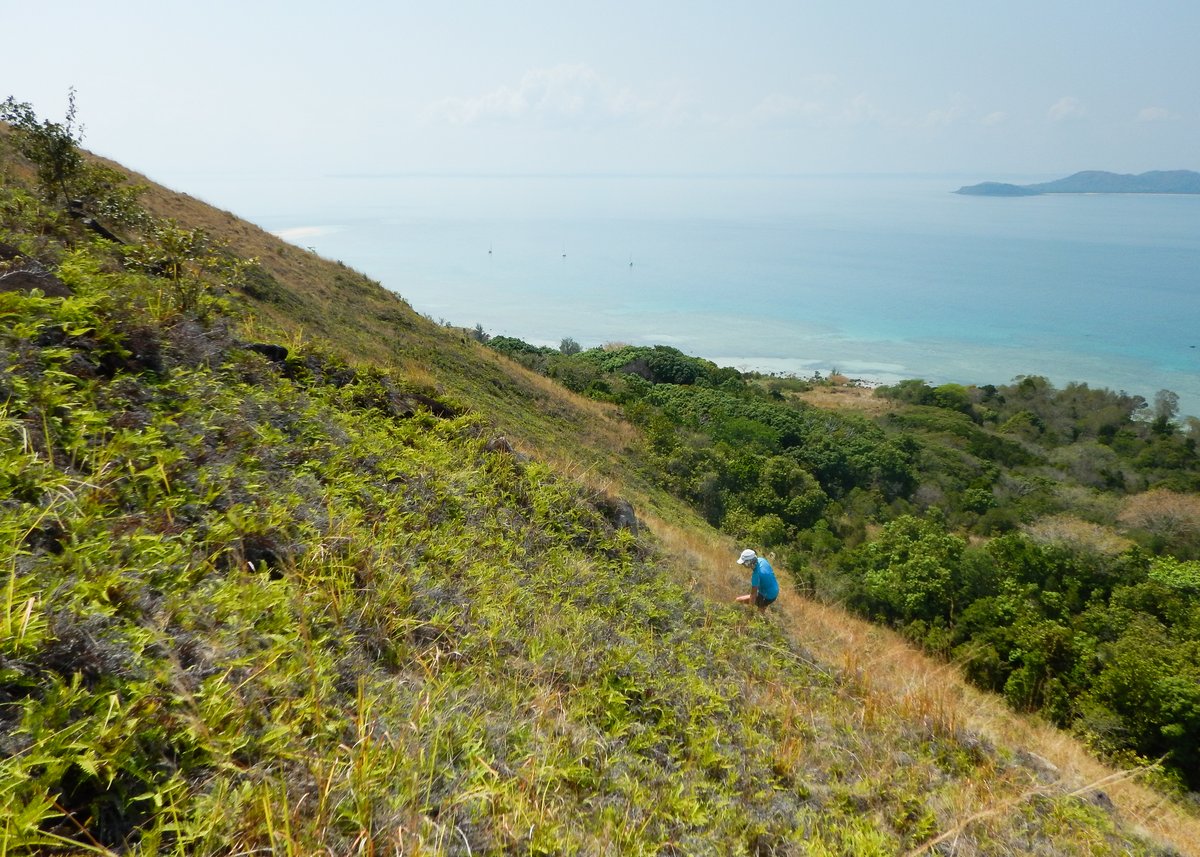
In the morning, there was a 5-8 knot land-breeze from the south-east, so knowing that the stronger sea-breeze wouldn’t kick in until midday, we went for a walk on the island, with the aim of climbing the 150 metre high hill. We walked through the village on the north-east side of the island, which is very tidy, but no one seemed to be interested in talking to us or pointing us to a path up the hill.
We found a path that led us past a well and towards the south-east beach where we’d landed the dinghy where we came across a group of buildings that turned out to be very low-key (empty) tourist accommodation. The guys here were a little more switched on and one walked with us for a few hundred metres to show us a path that ran south-west parallel to the beach. The path eventually climbed out of the bush and onto more open land, where we could see the hill, but within a few hundred metres we were back into dense bush.
Unfortunately, the indistinct paths seemed to be circumnavigating the hill, with no path leading up the hill (why would the locals want to go up there?). We dived into the bush and weaved our way steadily upwards. Eventually, we came out of the trees onto a 40-degree slope heading up the hill. It was covered with long grasses and ferns, with no sign of a trail, so I just headed up scrambling through the waist high vegetation, wondering if there were snakes on this island.
After a long and sweaty climb, we arrived at the top of the hill, which gave us a good view down to the anchorage. The hilltop was covered in long grass and no paths, so we headed down a ridge on the north side of the hill, through some more bush and found a path leading to the village. From there it was a quick walk around the beach back to the dinghy.
Back at the boat, we went for a swim and I snorkelled on the reef that was just under Alba. The water was murky, but the reef was in excellent condition with lots of sea life - I spotted a couple of Lionfish and a Swollen Phylidia. The fender on the chain was doing a fine job of keeping the chain clear of the reef.


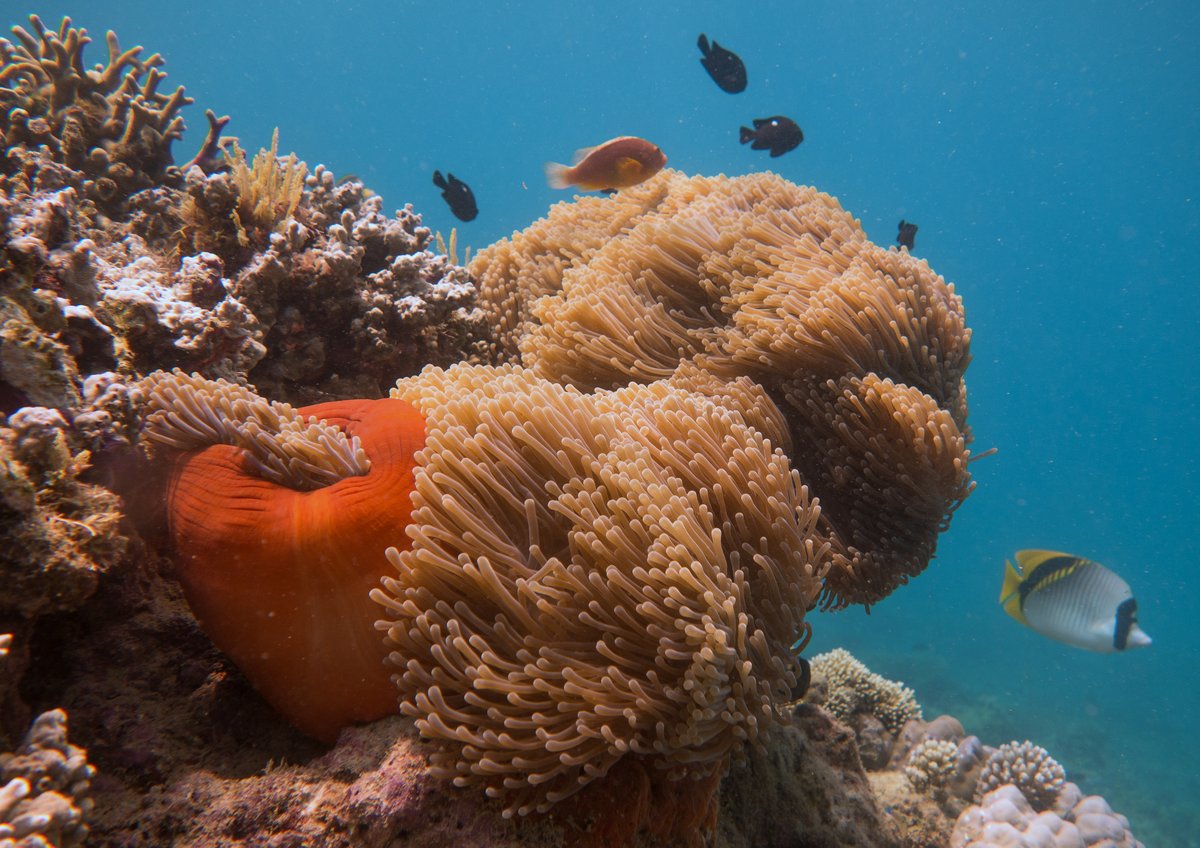
By midday, the sea-breeze had started, so we upped anchor and had a pleasant three hour sail to Nosy Saba, where we anchored in 20 metres of water at 14°21.86S 047°38.75E. It’s an awkward place to anchor because the sea bed comes up steeply from 25 metres and there’s a fringing reef around the island that is very shallow.
We motored close into the reef and went along at 6 metres, which gave us a track on our chart plotter showing the reef edge. This lets us work out how close we can anchor without the risk of swinging into the reef overnight, when the wind is likely to switch and put us on a lee-shore. We had a quiet night.
23 September 2017 Nosy Saba to Nosy Lava, Madagascar
It was another calm night with no off-shore breeze. Past cruisers have reported strong south-east winds in this area at night, so we must be in an unusual weather pattern. There was no wind in the morning, so we went for a walk around the island, following a dirt track that circumnavigates and leads to the resort on the north-west corner.
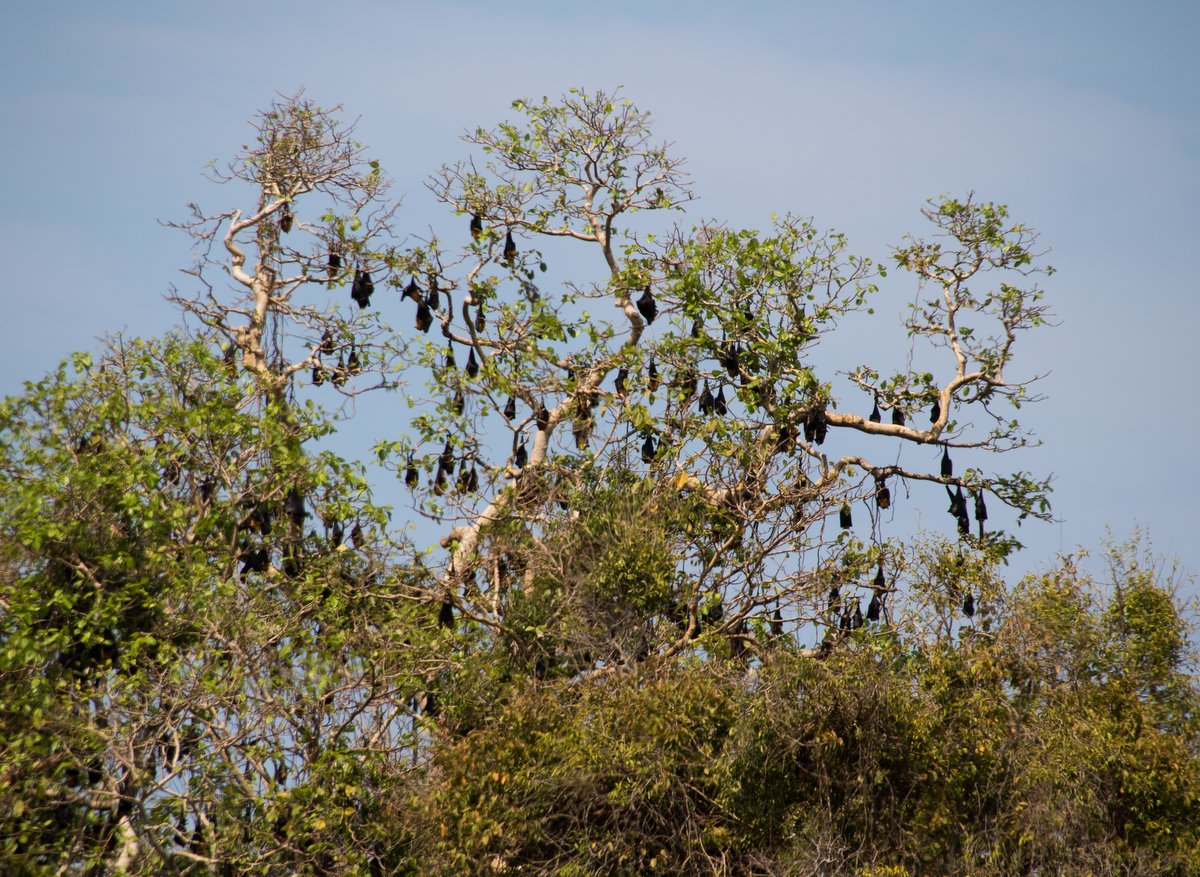
The island is about a mile in diameter and mostly arid apart form a small forest on the west side. We strolled through the resort and chatted to the manager, who told us that they have 26 bungalows, but had nobody staying at the moment - it seems that it’s a very quiet season. There was some interesting birds around including some very nervous guinea fowl, small green parrots and a few hawks. We also saw a large colony of Fruit Bats hanging in a tree.
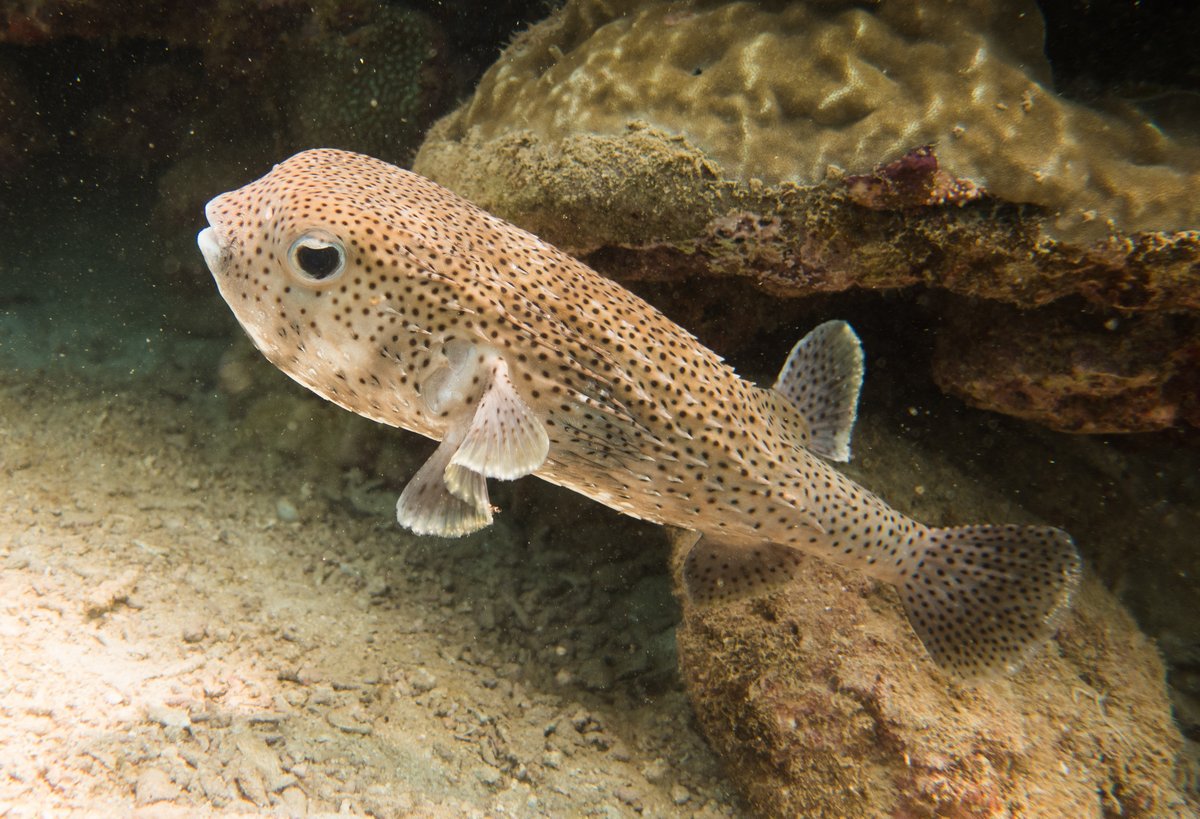
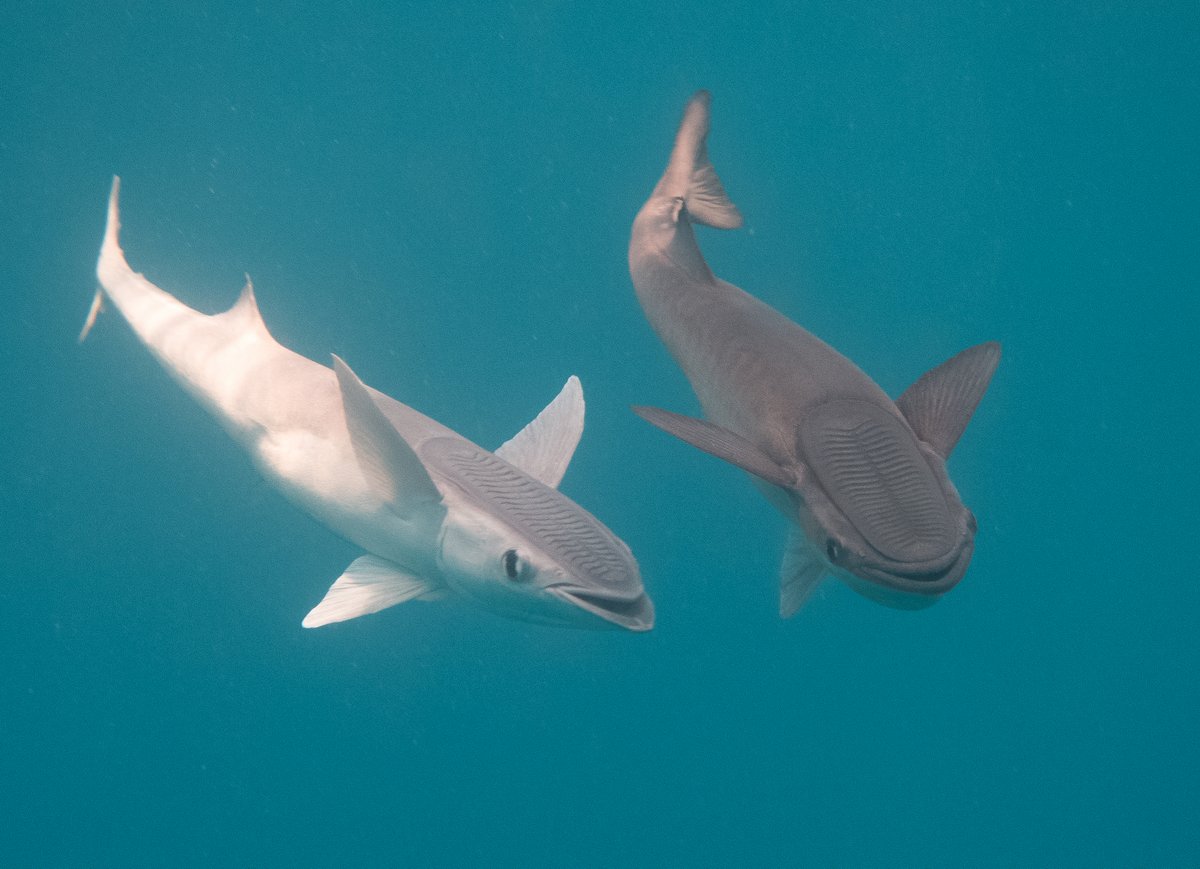
Back at the boat, we donned our wetsuits and went snorkelling on the reef by the anchorage, which was very good. The visibility was over 15 metres and the coral was very healthy. This would be the last snorkelling for a while, so we spent an hour there spotting lots of Skunk Anemonefish and a large Porcupinefish. When we returned to Alba, I spent fifteen minutes trying to photograph the five Remora who are living under our boat, but they are quick little devils.

Again, we left at midday and had a nice sail down to Nosy Lava. We initially anchored at 14°31.59S 047°36.48E in 6 metres in great holding sand, but the wind and persistent 1½ foot choppy waves were coming from the north, bouncing us about. “Red Herring” anchored further down the coast at 14°33.41S 047°37.81E, but they were still getting the chop. “Fortuna” and “Luna Blu” continued down to the south-east corner and found a place out of the wind waves, so we all herded down there.
Our final resting place was at 14°34.57S 047°37.39E in 12-14 metres of water. As usual, the reef came up sharply, but we appeared to be in good holding sand.
24 September 2017 Nosy Lava to Moramba Bay, Madagascar
With 35 miles to go to Moramba Bay, we left at 06:15, but there was very little wind. We motored for 30 minutes and then bobbed along in a light 5 knot wind while we ran the water-maker to top up our tanks. The wind then died completely, so we drifted around for a few hours waiting for the sea-breeze to arrive - Glenys played the ukulele and I caught up on my blog and editing photos.
I was able to get a brief internet connection, which was enough to download some GRIB files. It looks like there might be a good, long weather window on the 2nd October, which would enable us to start our passage down to South Africa. It’s too far in the future to have any certainty, but I think that we’ll be keeping a close eye on it from now on. It’s only 80 miles from Moramba Bay to Majunga where we will clear out, so I think that we’ll aim to get to Majunga on the 28th and then quickly onto Baly Bay to wait for the weather.
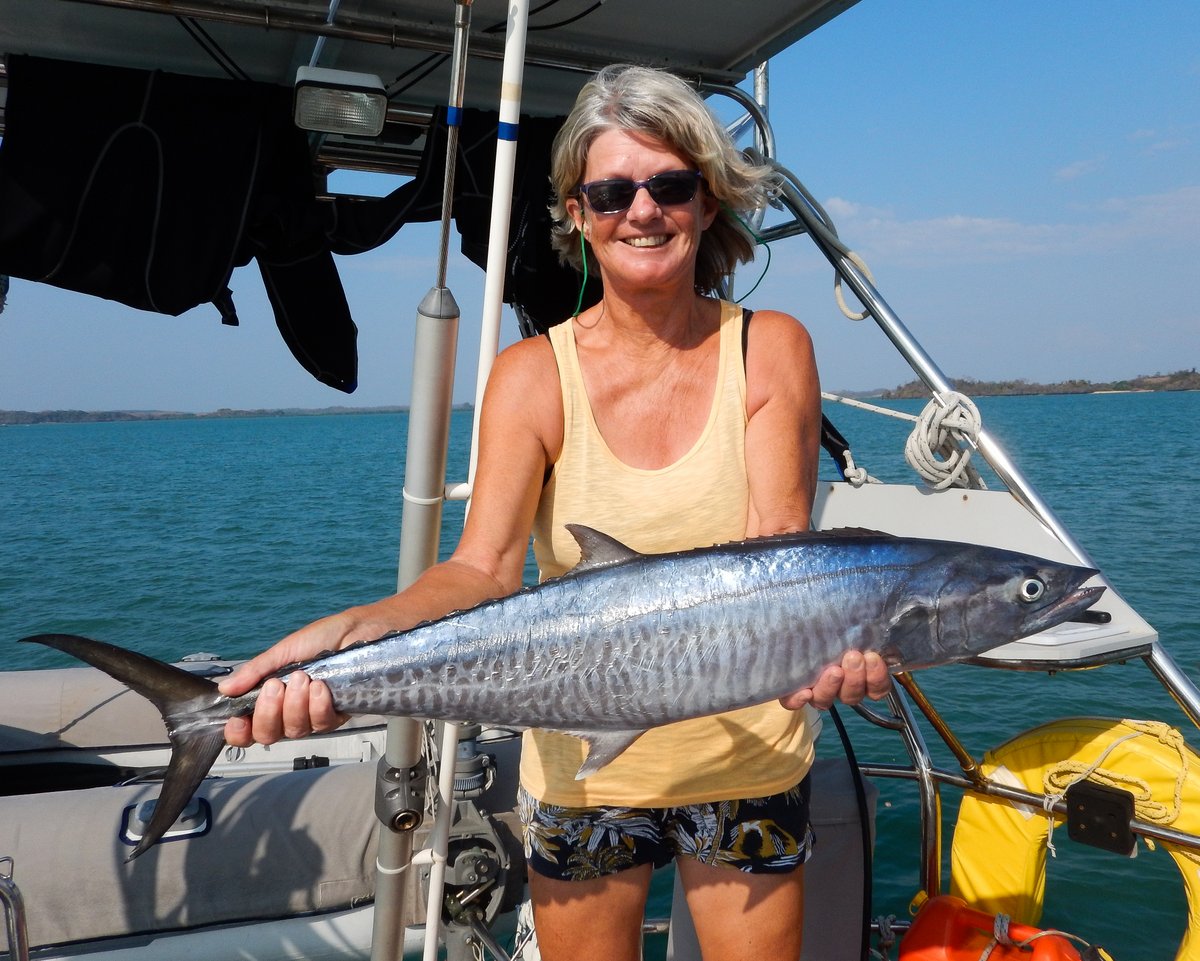
The wind finally picked up at 10:45 and we had a lovely sail as the wind freshened to 15 knots - it’s amazing how you can rely on the wind in this area. Glenys put out a fishing line and caught a nice Spanish Mackerel - fish for dinner!
We sailed into Moramba Bay and anchored at 14°53.23S 047°20.50E in 8 metres of water. There were already three boats in the anchorage, so we swelled the number to seven. It’s a lovely spot, so we’ll be staying for a few days.
25 September 2017 Moramba Bay, Madagascar
After all of our travelling for the last week, we had a quiet day on board pottering about. I spent most of the day doing research on the crossing to South Africa. We’re feeling a little apprehensive about the 1,200 mile passage because the weather systems come through every 3-5 days with the potential for strong southerly gales against the south-setting Mozambique Current, which can produce very steep and high seas.
I read various blogs and articles giving advice on the passage. The most common strategy (and the one that we will follow) is to head directly west from Cap St Andre towards the Mozambique coast. About 80 miles from the coast, we should encounter the Mozambique Current - a strong south setting current that will boost our passage speed.

As we head down the coast, we will be keeping an eye on the weather forecasts. If a southerly gale is forecast, there are three “bolt-hole” anchorages along the Mozambique coast, where we can go to hide until the bad weather passes. We can then hop 250 miles down to the next anchorage or, if the next weather window is long enough, go straight to Richards Bay. If you want to know more, I’ve concatenated all my research into one article called “Passage to South Africa”.
There looks to be a good weather window around the 3/4/5 October, so we’re going to stay one more day in Moramba Bay and then start heading down to Majunga to clear out.
In the evening, we were invited over to “Luna Blu” for sun-downers with “Red Herring”, “Continuum” and “Fortuna”. It looks like most of us are planning to sail down the Mozambique coast apart from “Red Herring”, who are thinking of going down the west coast of Madagascar and then making a 4-5 day passage across to Richards Bay.
26 September 2017 Moramba Bay, Madagascar
In the morning, we went ashore for a walk. We landed the dinghy on a deserted beach at the tip of the small peninsula, where there are some impressive Baobab trees. These trees have massive cylindrical trunks which can be up to 3 metres in diameter and the branches stick out at the top looking like roots, giving the tree the appearance of being upside down.

The trunk consists of a fibrous wood, which is used to store water and actually swells up in the rainy season. The Baobab tree is slow to grow and will live for several hundred years. Unfortunately, the Baobab tree is a critically threatened species in Madagascar, mostly due to the clearance of land.
We walked to a beach on the west side of the peninsula, where there is a very photogenic set of rocky islands made from (karst?) limestone and radically undercut by wave action. There’s an anchorage here, but it is exposed to the open sea and can be bouncy during the day and early evening, so we didn’t anchor there.
A lady called Bridget has a home on the beach and is planning to open a small restaurant and guest house there. While we chatted to her, we spotted a Coquerel Sifaka Lemur lurking up one of her trees. Bridget pointed us to a path that climbs up to the top of the little peninsula, which was a nice walk back to the dinghy.

We did some jobs in the afternoon. Glenys pulled out her sewing machine and repaired the dingy cover. A few patches were needed and the thread had perished on some of the seams.
I had another look to see if I could find the water leak on the engine. About ten days ago, I found a couple of litres of water in the engine bilge, but since then we’ve only been getting a few tablespoons of water, if anything. I can’t be 100% sure where it’s coming from, but there were some salt deposits below the sea water pump, so I’ve cleaned everything off and see if the salt deposits reappear. I checked my spares and thankfully, I have some spare bearings and seals for the pump, so if the pump fails completely, I’ll be able to repair it.
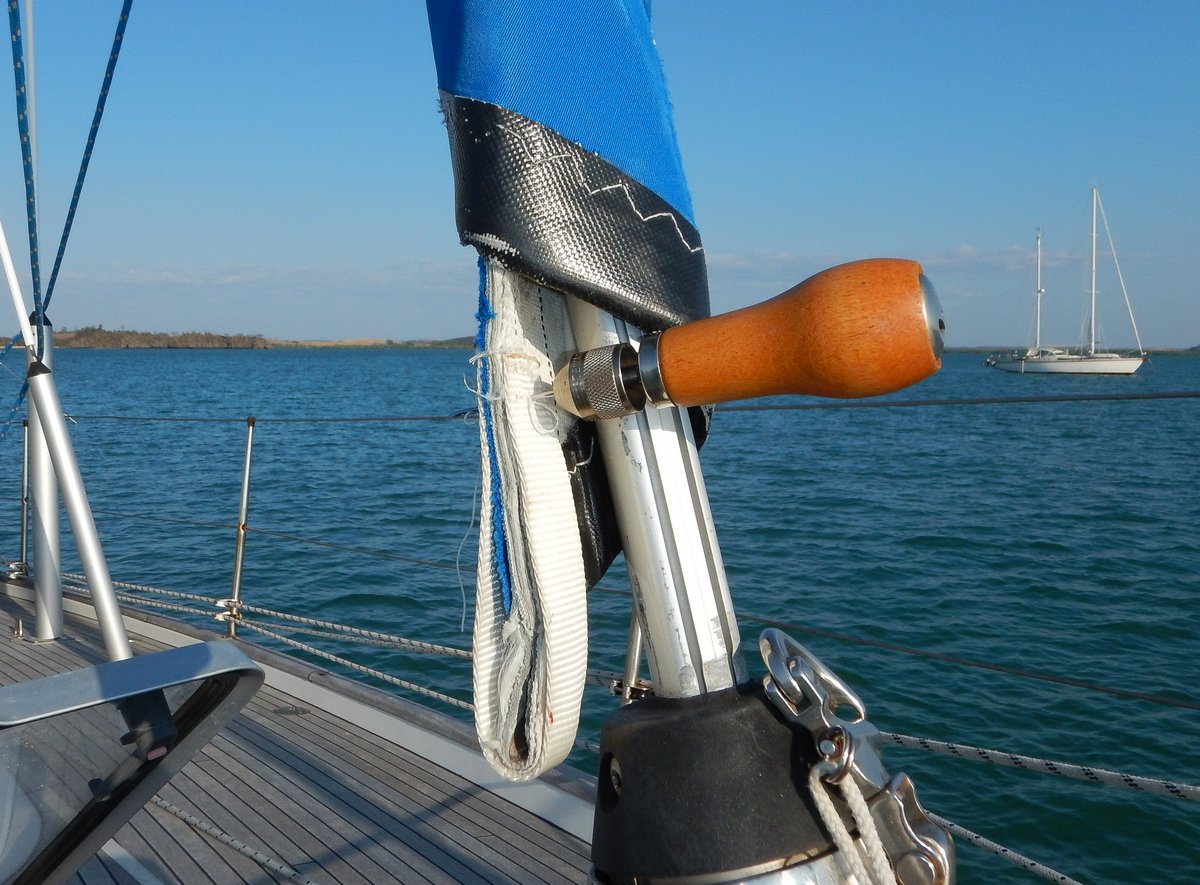
Later in the afternoon, I sewed an extra piece of webbing onto the tack of the staysail. There were two pieces of webbing, but one has perished in the sun. It was a mission sewing through 12mm of webbing and sail cloth, but our “Speedy Stitcher” once again handled the job.
27 September 2017 Moramba Bay to Mahajanga Bay, Madagascar
High tide was at 08:30, so we waited until 09:00 before we upped anchor, so that we could ride the out-going tidal current. Unfortunately, the off-shore land breeze wasn’t very strong today and we had to motor most of the way out of the estuary. By 09:30, we were in clear water, so we ran the water maker for an hour to make sure that our water tanks were full.
The sea-breeze picked up just before midday and we slowly sailed along with just our mainsail up. We only had 20 miles to go and the anchorages in Mahajanga Bay are renowned for being rolly, so there was no point in getting there too early.
“Luna Blu” and “Fortuna” were also moving south today and there was much discussion on the VHF radio about continuing on past Mahajanga Bay and anchoring on the coast further towards Majunga. We prevaricated - anchoring on the coast would be an open roadstead, with the on-shore sea-breeze making it an unpleasant place until late in the evening. We eventually decided to go into Mahajunga Bay and make an early start for the 65 mile passage to Majunga tomorrow.
At about 16:00, we anchored in Mahajamba Bay at 15°14.16S 046°57.84E in 8 metres of water. The wind and swell were coming from the north-west and we tucked in behind a bit of a sandy headland, which made it a fairly calm anchorage. We had 3 foot wind waves as we crossed the mouth of the estuary, so I wouldn’t have wanted to be on the east side of the bay. There’s large fishing camp ashore, which tells me that this is a good place to be.
28 September 2017 Mahajanga Bay to Katsepy, Madagascar
We had a very peaceful night until 03:00, when the wind picked up from the south-east causing some chop. We were planning to leave at 04:00, but both of us were awake at 03:00, so we dragged ourselves out of bed and left. We had a great sail along the coast in steady south-east winds allowing us to make 6-7 knots.
For the past couple of weeks, we’ve had a clunking sound coming from the propeller shaft, which starts as soon as our boat speed is above 6 knots. We have a fixed 3-blade propeller, which we allow to rotate as we’re sailing along. I’ve proved that the clunking sound is coming from the propeller by putting the gearbox in reverse while we are sailing - the noise stops when the propeller is not turning.

I’m pretty sure that the noise is caused by a worn cutlass bearing, which supports the propeller shaft near to the propeller and the shaft is “rattling” in the worn bearing. I thought that maybe the propeller was out of balance because we had a worn zinc on the end of the shaft, so we pulled over and anchored off the coast for 30 minutes, so that I could dive down and have a look.
The propeller is still firmly fixed to the propeller shaft and everything looked okay. The zinc was badly worn, so I removed it completely. Unfortunately, the rattling noise returned when we were back underway. It’s very, very annoying, but at least I know that the rudder and propeller are not falling off…
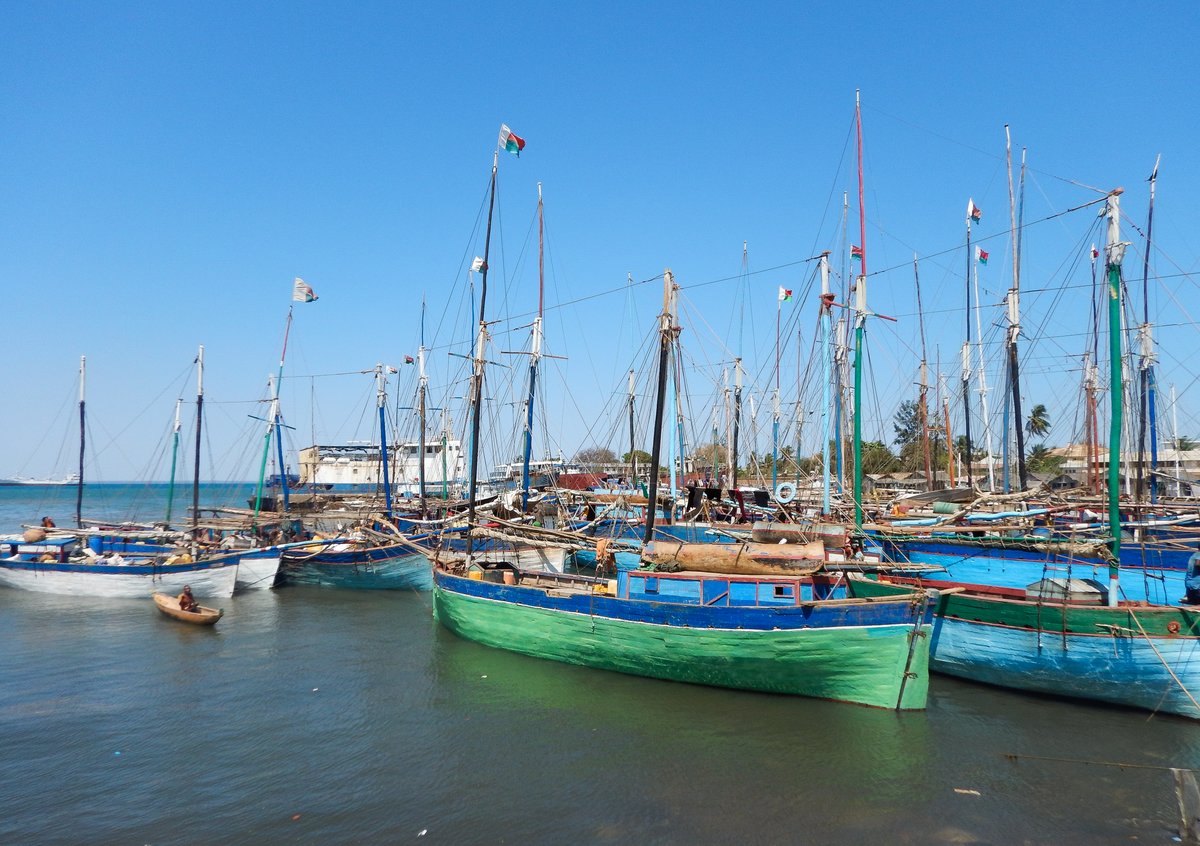
As we entered the Majunga Estuary, hundreds of Dhows were sailing in from their day’s fishing. They were running downwind and we were on a close reach, cutting across their path, so we had an enjoyable hour, dodging through the middle of the fleet, waving, laughing and taking lots and lots of photographs. It’s an impressive sight to see these small boats with huge sails screaming along in 20 knot winds.
We arrived in Katsepy at 15:30 and anchored at 15°46.11S 046 14.72E in 7 metres. “Luna Blu” and “Fortuna” had just arrived. They anchored off the coast last night and had a sleepless, rolly night until it calmed down after midnight.
Glenys and I jumped in our dinghy to go and have a look at what was available on Katsepy - we were interested in vegetables and diesel. The village is a score of shops and buildings on sandy streets. There were a few dreary looking vegetables for sale and a couple of small grocery stores, but the majority of the shops were selling food and snacks for the people who come here to catch a ferry across to Majunga.

A previous cruiser had reported a fuel station 200 metres along the road, but when we asked in the village, we were pointed to a small shop selling petrol in plastic water bottles and diesel in cooking oil drums. I didn’t like the look of that and even if there was a fuel station along the road, there didn’t seem to be any tuk-tuks in the village to transport our jerry jugs, so we didn’t investigate any further. We’ll get fuel and provisions when we go into Majunga city to clear out tomorrow.
Back on board, I looked at the engine. I found a few tablespoons of water in the engine bilge and salt crystals beneath the sea water pump, so it’s leaking. I’m not sure whether to leave it until we get to South Africa or whether to bite the bullet and try to change the seal before we leave.
My final job was to pour the diesel from our three jerry cans into the main tank, so that we can get diesel tomorrow. The fuel tank is full, so we will have enough fuel to motor 1,000 miles of the 1,200 mile passage to South Africa - if we have to.
29 September 2017 Katsepy, Madagascar
I was out of bed at 05:00. I couldn’t sleep because I was worrying about the sea water pump. The big danger of trying to repair it myself was breaking something, not being able to take it apart or put it back together. My only chance of getting engineering help or importing new pump was in Majunga. So my middle-of-the-night logic was that if I left the pump alone, then the seal may fail completely while on the 1,200 mile passage to South Africa. If I was going to repair it myself then I needed to do it before we cleared out. I decided to do it now - hence my early morning start.
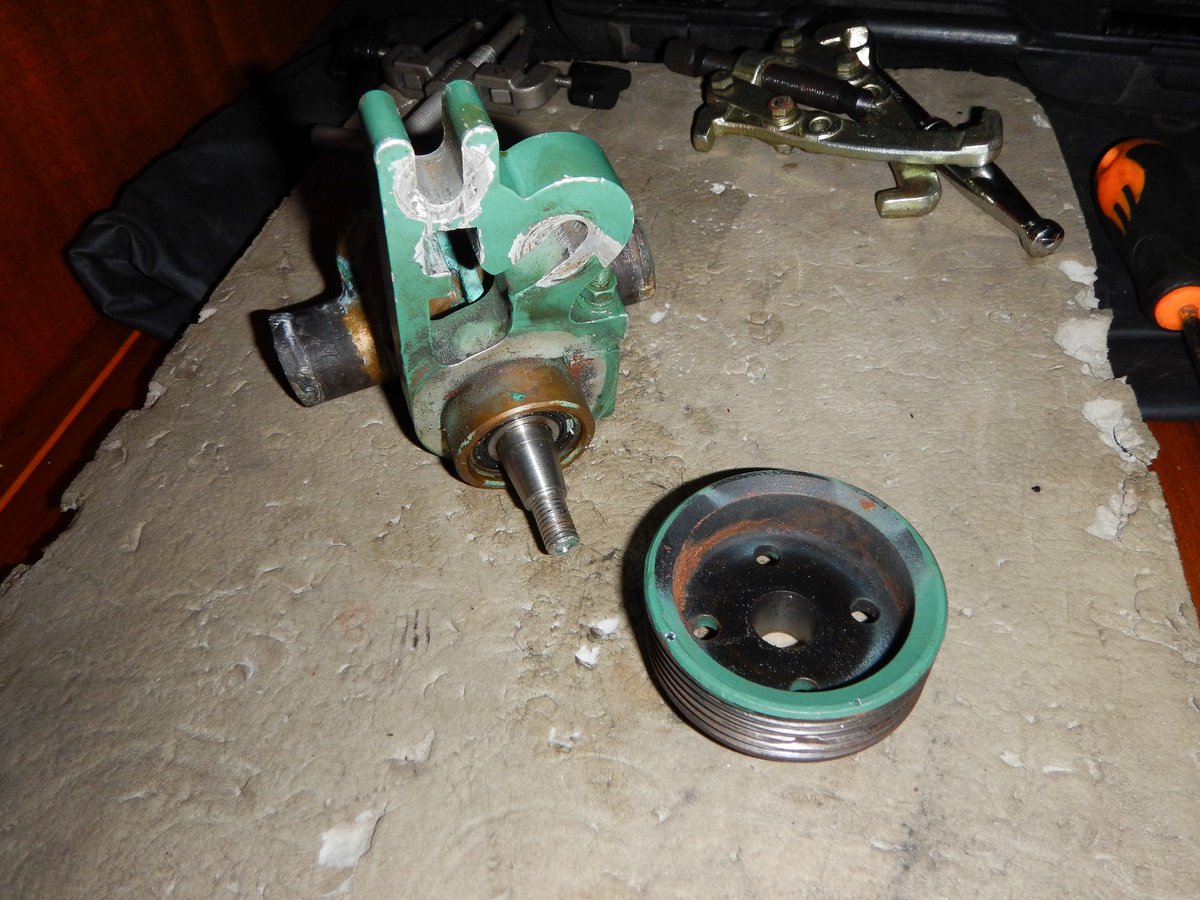
It took me 30 minutes to remove the pump and then 30 minutes to pull it apart. I had a few tense moments. The drive pully wouldn’t come off the pump shaft - I was desperately trying not to damage anything, but after a little perseverance with a gear puller, it popped off the taper. The next trauma was getting the shaft out of the pump body. My pullers didn’t work, so I eventually I took a deep breath and gave it a good smack with a nylon mallet and thankfully it came out.
The lip seal was obviously in bad condition and need to be replaced, but worst was that one of the two bearings was badly corroded. I could still turn the shaft by hand, but it was sticky and unsmooth. It tentatively tried to knock the bad bearing out, but it felt like it wasn’t going to come out easily, so I decided to leave it in place and just replaced the damaged lip seal.
When I put it all back together, with a new impellor, it turned ok, so I think that it will be good enough to get me to South Africa, where I can get it serviced properly. This was so traumatic to my mental health that I’m going to buy a new pump in and carry the old one as a spare - much easier to just change the water pump assembly.
I’d finished the job by the time that Glenys dragged herself out of bed at 06:45. I ran the engine for fifteen minutes and all seems to be good. Phew!
After a quick breakfast, we pulled up the anchor and sailed the six miles across to Majunga city. We initially tried to anchor at 15 43.80S 046 18.44E in 8 metres, which is next to the main port. The plan was to leave our dinghy on a concrete ramp at 15 43.56S 046 18.38E, which is near the main port. Unfortunately, there was a 20 knot wind howling from the east, causing 3 foot waves and after dragging once in the soft mud, we decided not to leave our home there.
Instead we motored around to a breakwater where we anchored in 7 metres at 15°42.90S 046°17.80E. The holding appeared to be soft mud - we were slowly ploughing backwards with our engine at a stump-pulling 2000 revs. However, it was a very sheltered anchorage, so we risked it. The other four boats arrived shortly after us.
We pulled our dinghy up onto a small beach at 15 42.69S 046 18.10E, where there are a number of local wooden boats pulled up on the beach. A couple of people helped us trundle our dinghy up to a palm tree around which we wrapped chain. Our helpers wanted to guard our dinghy, so we chose a middle aged lady who appears to live in a shack on the beach. Everyone was very helpful and helped carry our three jerry cans up to the main road, where we caught a tuk-tuk.
I showed the driver a photograph of the sign for the “Agence Portuaire, Maritime et Fluviale” (Port Captain) and he seemed to know where to take us. I had used Google Maps on my phone to work out the location of the Port Captain and Immigration, but the tuk-tuk driver went straight past the Port Captain and took us to the main port, which was okay because that’s where the Immigration office is located. (15°43.60S 046°18.65E).
We wandered in through the port gate and a guy directed us to Immigration, who were very pleasant, put exit stamps in our passports and charged us 40,000 Ariary (£10). He gave us a small receipt, but shoved the money into his pocket - Hmmm! (Our friends on “Wairima” were charged 20,000 Ariary and “Luci” was charged 30,000 Ariary, so who knows if the charge is official or not...)
Lugging our empty diesel jerry jugs, we walked ½ mile back to the Port Captain at 15°43.64S 046°18.27E. It was an interesting walk, which took us past the small cargo boat dock, which was bustling with wooden boats unloading a wide variety of cargo. The Port Captain’s office was very nice and the staff efficiently produced an outward clearance document and relieved us of 35,000 Ariary (£8). They didn’t want to see any other Madagascan documentation, so I guess that we could have obtained our port clearance without paying Immigration.
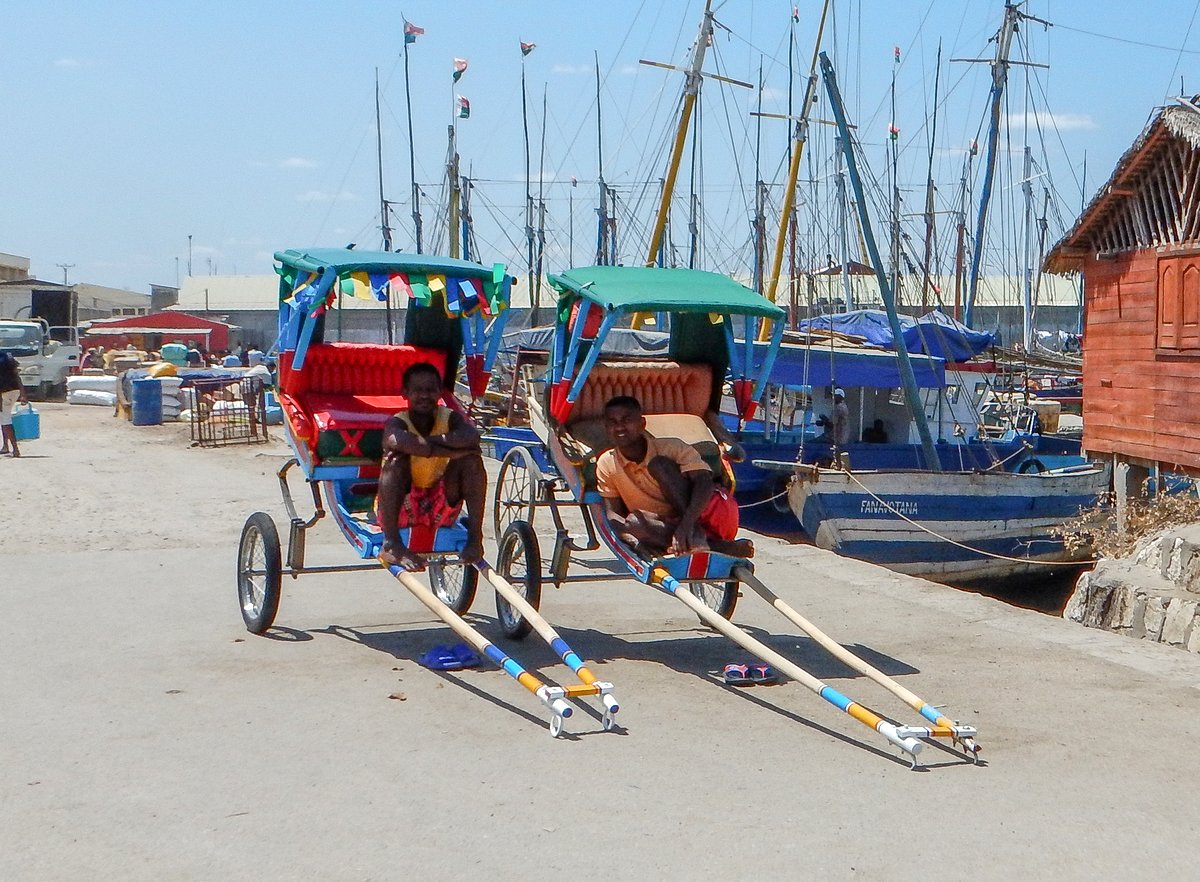
Flushed with success, we hailed another tuk-tuk to take us to the Leader Price supermarket. After leaving our empty jerry cans with the bag security guy, I left Glenys in the air-conditioned store and went out looking for an ATM. Majunga town is a scruffy, dusty place with a few nice colonial buildings, but it’s mostly rundown, concrete buildings. The preferred mode of travel appears to be tuk-tuks, but there are also many two person rickshaws around, being pulled by fit young men running along the road, often in bare feet.
I withdrew enough cash to allow us to buy 60 litres of diesel and returned to the supermarket. Glenys only needed to buy enough food to last for a couple of weeks, so we were soon climbing into another tuk-tuk, who took us to a petrol station, waited for us and then dropped us back at the beach with our dinghy. The going price for a tuk-tuk ride seems to be 1,500 Ariary (£0.37) per person per trip, but we still had some Ariary notes left, so I gave the guy 10,000 Ariary (£2.50), so he was well chuffed.
Our lady guard helped us launch the dinghy and I gave her 5,000 Ariary (£1.25), so she was really happy. We were back on the boat by 12:00 - an efficient operation, run with military precision.
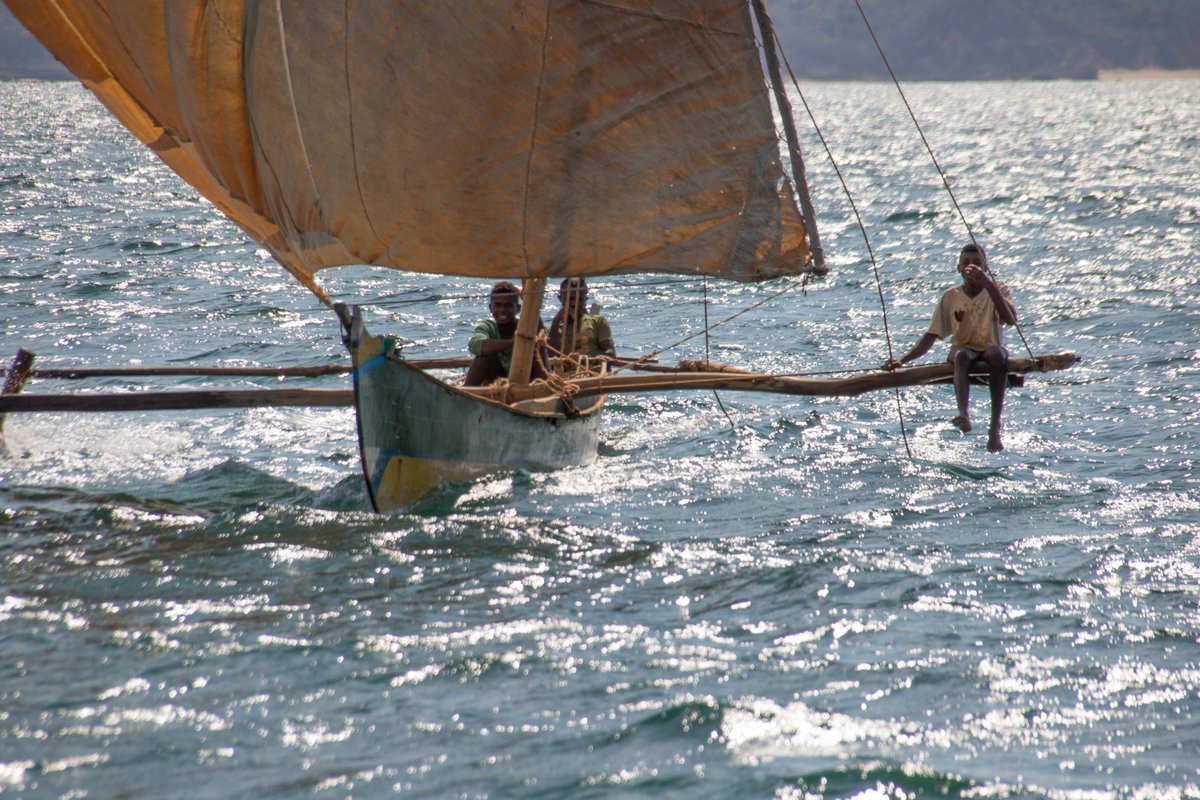
After lunch, we chilled out for a while and waited until the afternoon breeze picked up at 14:30 before we sailed back to Katsepy. Once again, the Dhows were sailing back to port on the sea-breeze - hundreds of them scattered across the horizon, it’s a fabulous sight.
After a long busy day, we collapsed into bed at 20:00.
30 September 2017 Katsepy to Baly Bay, Madagascar
The alarm went off at 03:00 and we were soon on our way, sailing the 70 miles to Baly Bay. It was very dark, but we only saw a couple of fishing boats, which was a relief. The wind was behind us for most of the way, so I poled out the genoa to port and we made good time.
The wind dropped for an hour in the late morning, so we ran the water maker for an hour to fill up our water tanks. I’m not using the low pressure pump, so the high pressure pump is sucking the sea water up through the filters and is also sucking in air somewhere. I had to stop the pump several times to vent the air out of the filters, which was a damn nuisance. I’m going to re-plumb the whole system in South Africa - my job list is getting longer.
We arrived in Baly Bay at 15:30 and anchored at 16°03.42S 045°17.64E in 5 metres for the night next to “Wairima”. We invited Alan and Vicky over for a beer and caught up on the gossip. They’ve been here for five days and are planning to leave tomorrow night, which is a little early for us.
There are more photos in our Photo Album section.