
7 September 2017 Crater Bay to Hellville, Madagascar
An hour after sunrise, the Dhows started to sail into the bay, taking advantage of the off-shore easterly breeze. Alba was directly in the path of several of the large cargo boats and we had the pleasure of watching these skilled sailors heading directly at us, then veering off downwind to glide past our stern. The wooden boats are old and battered and the sails are full of holes - I wish that we’d kept our old mainsail and given it to someone here.
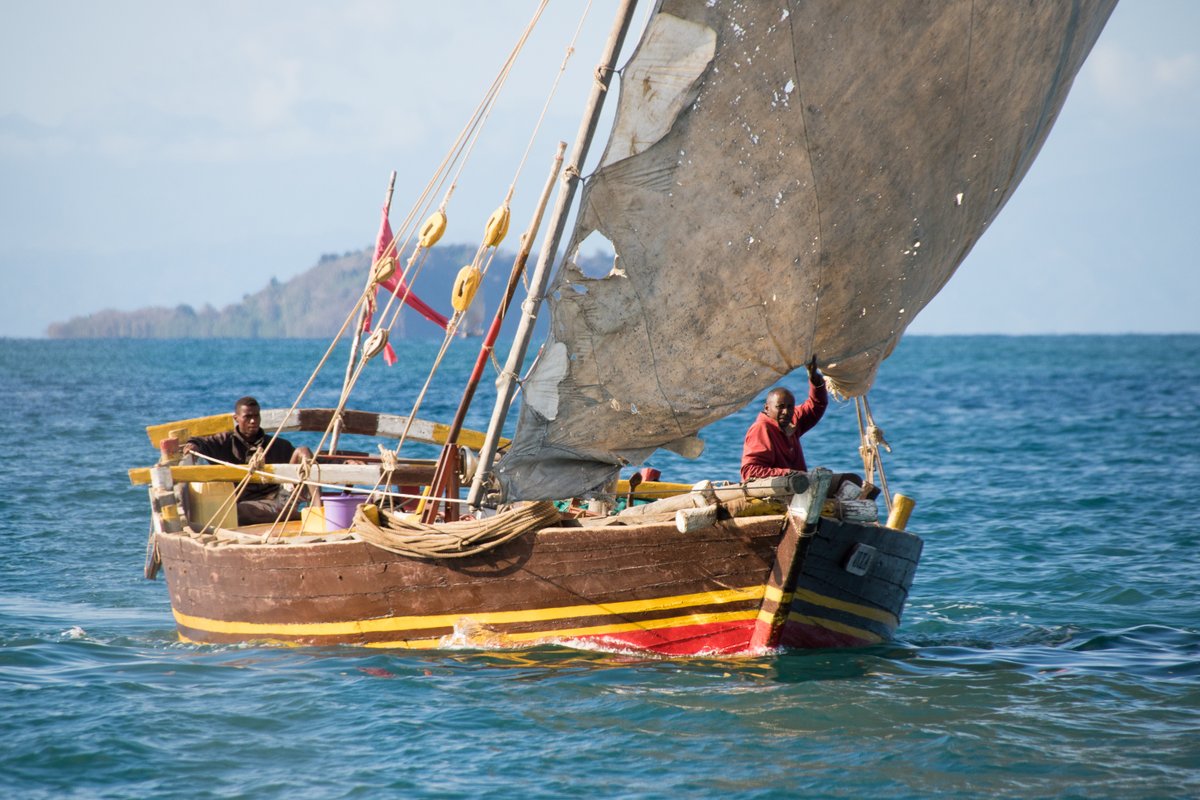
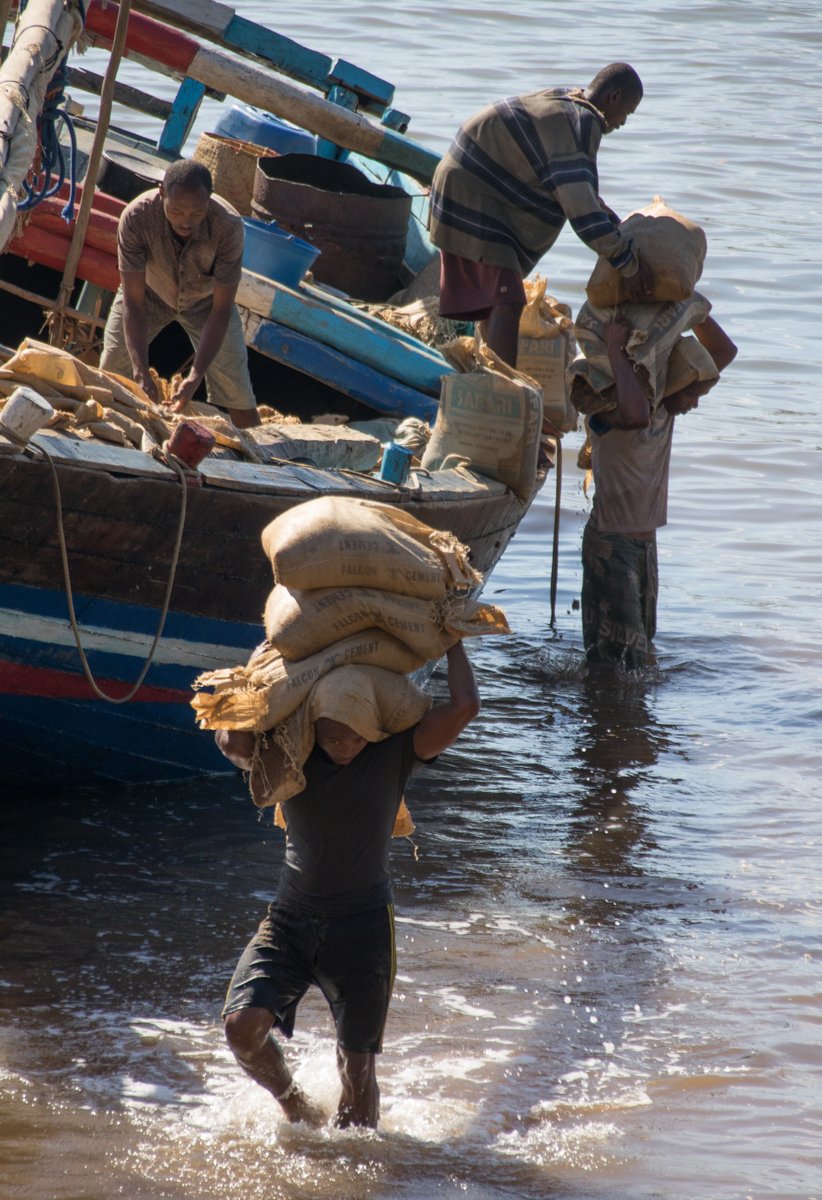
Watching the Dhows sail past, spurred me into going ashore for an hour to take some pictures of the activities. The cargo seems to be mostly building materials and is all offloaded by hand and head. I watched two young men carrying Sacks of Sand ashore. They were balancing FOUR, 20Kg sacks on their heads - that’s 80Kg (12 stone), and they just kept going and going. The sacks of sand were emptied onto the ground, where other guys shovelled it into a flat-bed truck. The sacks were returned to the cargo Dhow.
Other than the Dhows, there wasn’t much to keep us at Crater Bay, so we motored the six miles to Hellville, the capital of Nosy Be - only 6 miles away. We anchored at 13°24.45S 048°17.10E in 8 metres of water over good holding mud. By the time that we were settled, it was 11:00, so knowing that the shops close for several hours at lunchtime, we jumped in the dinghy and headed for shore.
We pulled up to the dock and were waved over to a concrete slipway at the south side of the main pier. The legendary Jimmy and Cool met us on the slipway and immediately took control of our dinghy carrying it up to the top of the slip. These two guys have made a living out of cruisers for many years.
Jimmy, who wears a red Mount Gay hat, speaks a little English and can help you get anything. For 50,000 Ariary (£12), he will accompany you around the tortuous process of obtaining clearance. Cool, who always seems to be wearing a red shirt and a cowboy hat, will look after your dinghy for 10,000 Ariary (£2.50) for the day or 5,000 Ariary for a short time. When you look at the chaos of the port, it’s worth the money.
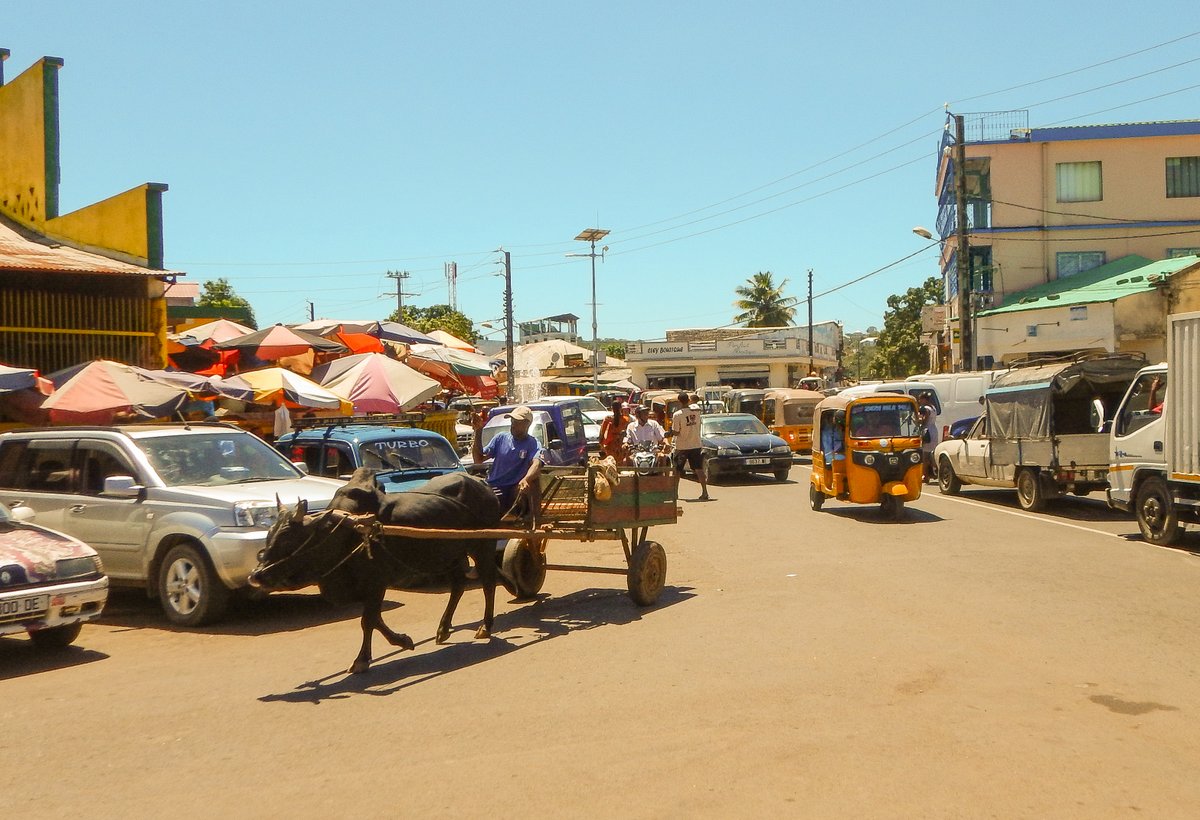
As we walked away from our dinghy, we were stopped at a Police Post and a couple of seedy officers demanded to see our passports. We’d left them on the boat and so I showed them the photocopies of our passports and visas. They barely glanced at them and beckoned us into a small room, where they pulled out some US dollars and Euro coins and kept repeating “Ariary”.
I wasn’t sure whether they were asking for money or wanted us to change their ill-gotten cash, so I just kept repeating “I don’t understand” and eventually with shrugs we walked out. I really hate that the police officials are corrupt. In the UK, we can trust the integrity of the police, but it seems every Madagascan official is trying to get some grift from us.
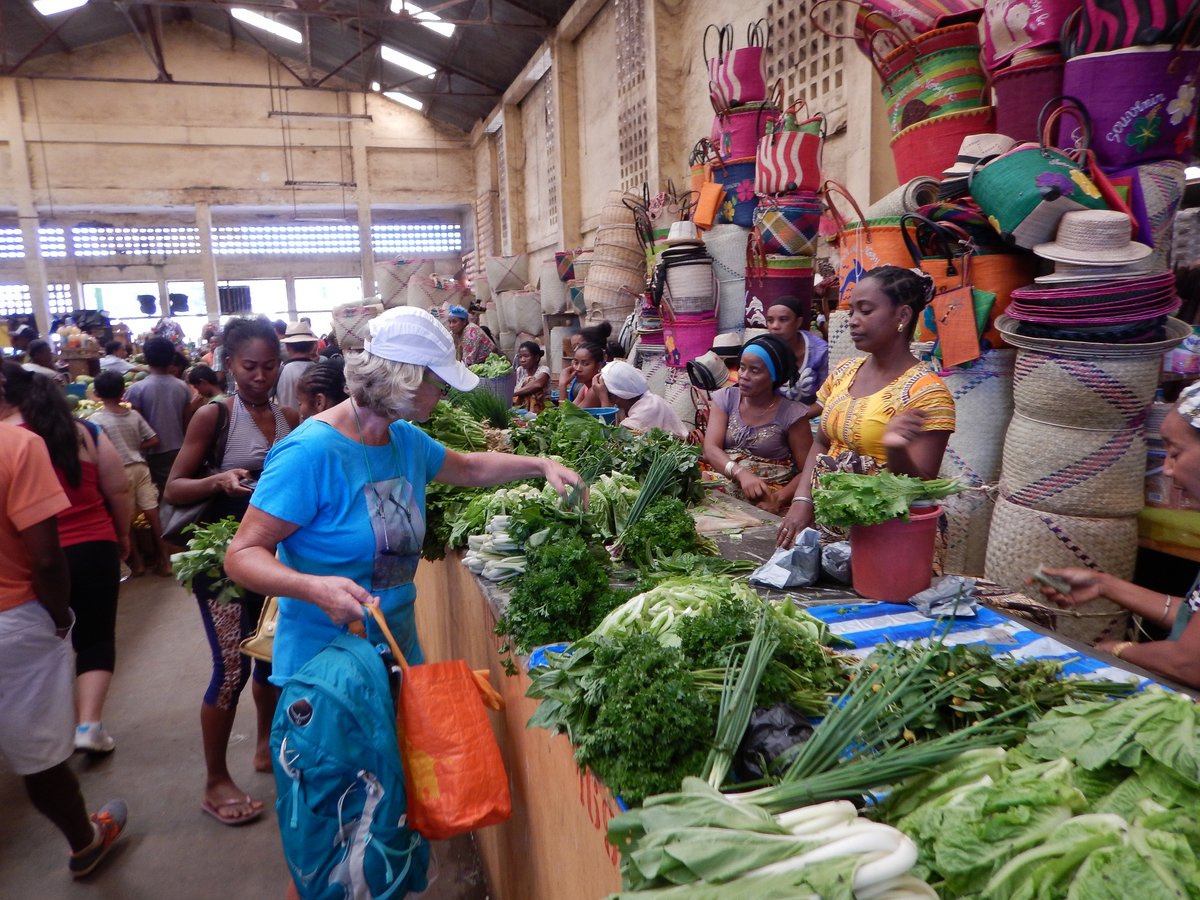
We wandered into town and found that the supermarket is open all day, which was good news. We decided to get some fresh vegetables from the market and then tackle the supermarket after lunch. The wet market was better than yesterday, but there were a huge amount of flies again. However, there was a better selection of vegetables, so Glenys filled her shopping bag.
We walked back to the Nandipo restaurant, where we found Paul and Monique from “Full Circle”. The meal took at least an hour to arrive and was very average, so we won’t be going back there. After lunch, we went to the Shampion supermarket and stocked up for two weeks. They have cans of Three Horses Beer, so we bought a couple of cases and then caught a tuk-tuk back to the port.
There’s a port entrance, about 200 metres from the slipway where we left the dinghy and the tuk-tuk was stopped by a guard. When I asked to be let in, he put out his palm to be greased, to which I shook my head in disgust. We unloaded the tuk-tuk and had a little confusion about the fare, eventually paying 500 Ariary each and another 500 for the shopping - it’s only 37p, so I didn’t get too stressed out about it.
We just about managed to carry all of our shopping in one go, so we were glad that we had bought much more - otherwise I would have had to make several trips while Glenys guarded our shopping bags from the hordes of people milling about the port gates.
While lugging the shopping back to the dinghy, we were again stopped by the dodgy policeman, who beckoned us into the small office asking for our passports again. This time, once in the privacy of the office, he could see that we had lots of beer and was asking for a few beers. We pretended not to understand; kept telling him that our passports were on the boat and walked away.
Back at the dinghy, I arranged for Cool to get me some diesel, which worked out well. I dropped off three empty 20 litre containers and they returned them an hour later. The diesel cost 3,000 Ariary (£0.75) per litre and they wanted 20,000 Ariary (£5) for their transport and time, which was fair enough.
8 September 2017 Hellville to Russian Bay, Madagascar
We left Hellville at 09:00, but had no wind until 11:00, when the sea-breeze kicked in - I think that we should have waited until noon to leave. However, it was only 20 miles across to Russian Bay, and at least we were able to sail for a couple of hours.
When we were half way across, a pod of three Humpback Whales crossed in front of us - they were so close that we heard them blowing before we saw them.
After negotiating the narrow entrance into the huge bay, we anchored at 13°32.14S 047°59.90E in 10 metres on soft sand/mud. Russian Bay is a beautiful natural harbour and the first time that we’ve been ashore on mainland Madagascar.
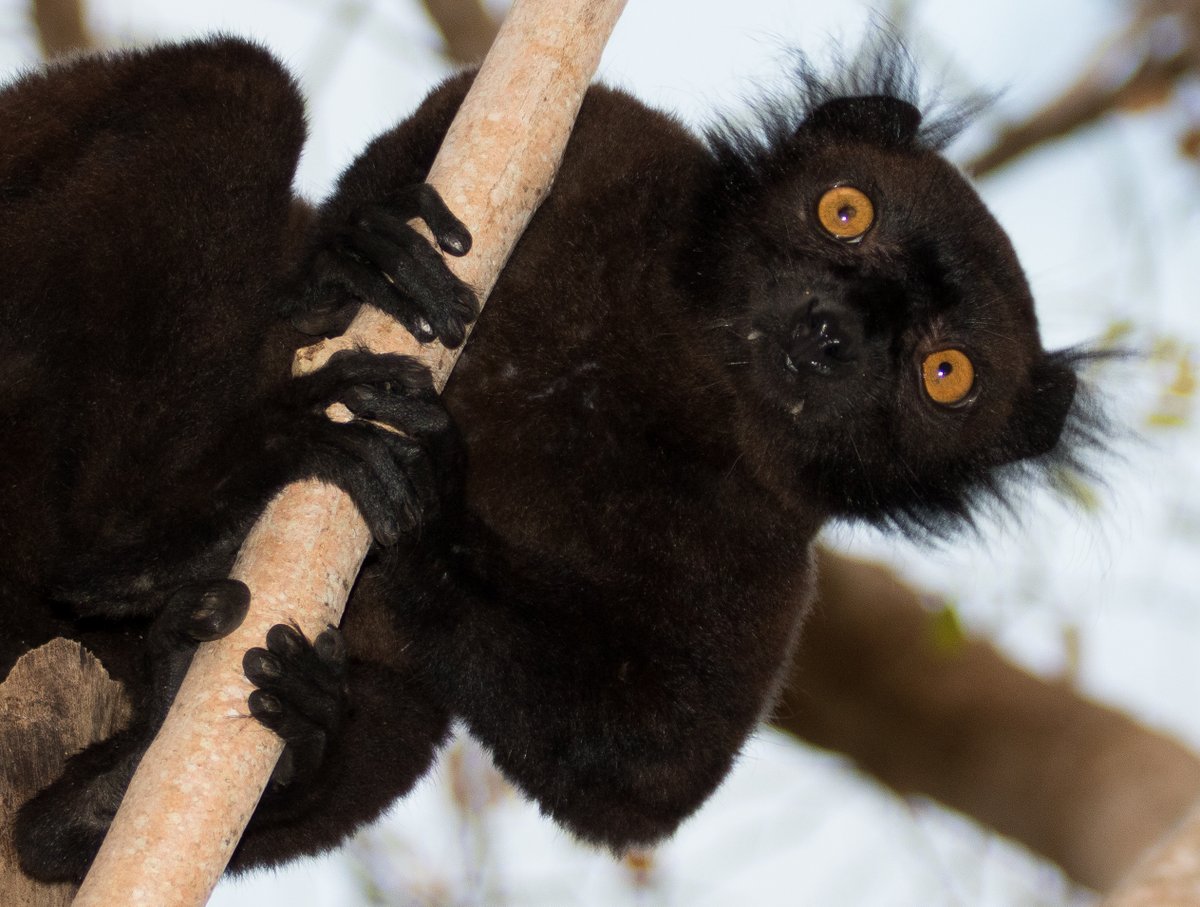
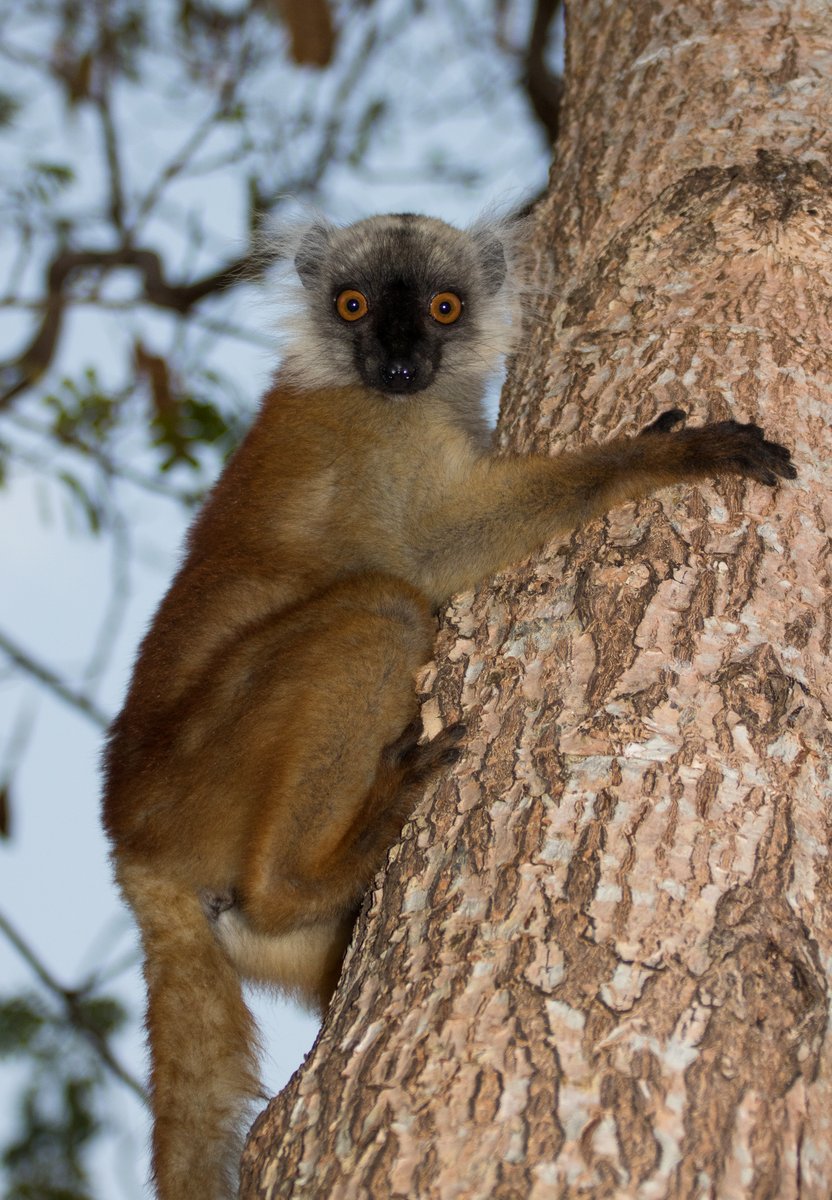
In the evening, we went ashore with “Jackster” to a small restaurant run by an Austrian guy called Andreas. We had to give him a few hours’ notice and had no idea what we were going to get for dinner - “might be fish or might be chicken”. Andreas serves cold beers, so we went over at 17:00 for pre-dinner sundowners and fed five, wild Black Lemurs that show up in the evenings. These Lemurs are only found in this region of Madagascar - the Males are jet black and the Females are a lovely honey brown colour. Of course, I took far too many photographs.

Dinner was slow coming, but very good with two large grilled fish, a chicken dish, a bowl of beans, rice, and green Papaya salad - it was more than enough for the four of us. As well as a few cold beers, we drank a bottle of red wine (Andreas doesn’t mind you taking your own wine) and, at the end of the meal, Andreas brought out some Rhum Arrange, so we had a very tipsy dinghy ride back in the dark.
9 September 2017 Russian Bay, Madagascar
We had a quiet day. In the morning, I caught up on editing my hundreds of photographs of Dhows, places and Lemurs. Glenys meanwhile worked out a timetable for our remaining time in this area. We are aiming to cross to South Africa in the first two weeks of October and it’s about 200 miles to Baly Bay, which is where we want to wait for a weather window, so we think that we should spend another week in this area and then start to head south around the 20th October.
In the late afternoon, we went ashore to Andreas’ bar for a cold beer and pick up a loaf of freshly baked bread that we ordered last night.
10 September 2017 Russian Bay, Madagascar
The alarm went off at 06:30 and half an hour later, we were sailing around the corner to Nosy Antsoha (also known as Lemur Island). It was only six miles, so just after eight o’clock, we were anchored at 13°30.90S 047°57.72E in 9 metres depth. The anchorage was very bouncy with 2 foot waves rolling in from the open sea, but the holding was good and we were only planning to stay for an hour or so.
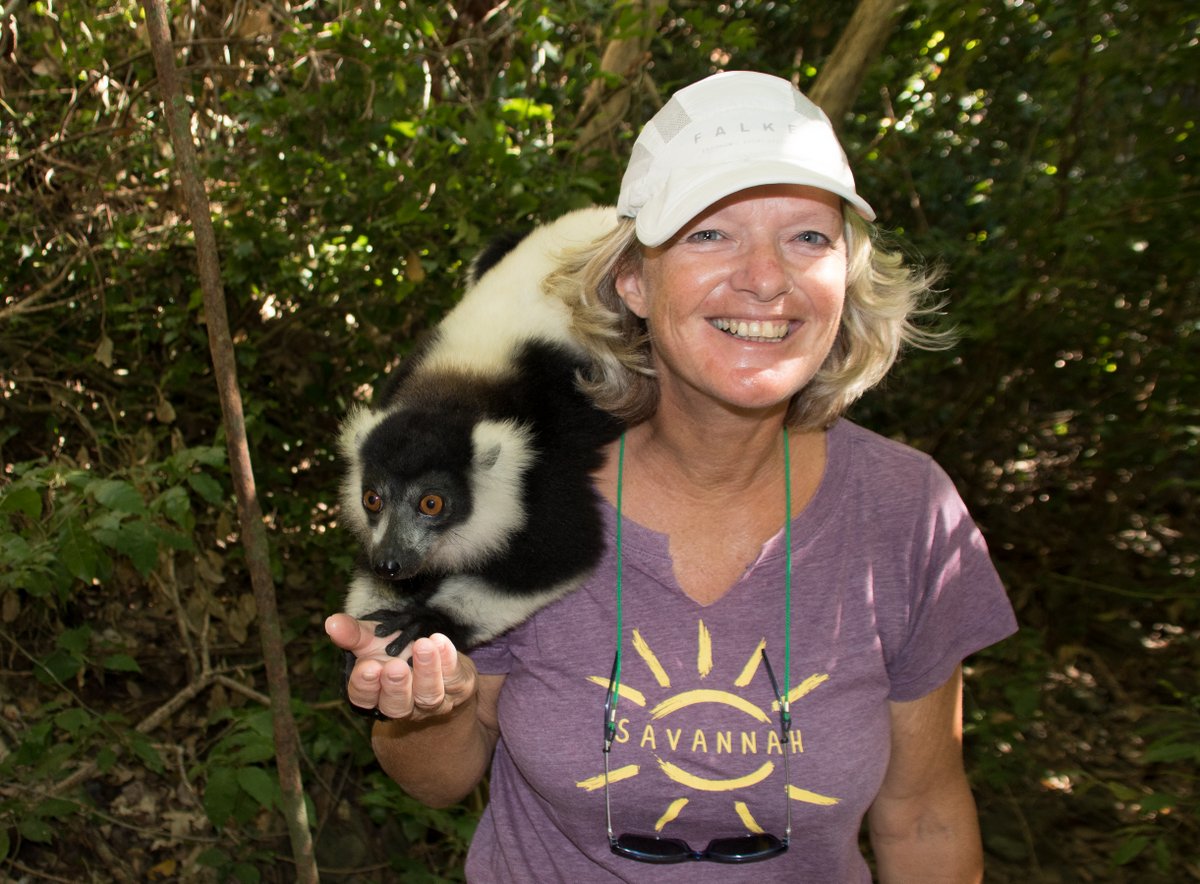
We dinghied ashore and landed on the small beach, were we were met by a guide, who charged us 10,000 Ariary (£2.50) each for a tour. The guide led us off up a steep rocky path calling “Maki, Maki” and within a few minutes, we had several Lemurs jumping around and onto us. After feeding bananas to some Common Brown Lemurs and a couple of Black & White Ruffed Lemurs, we headed up the path.

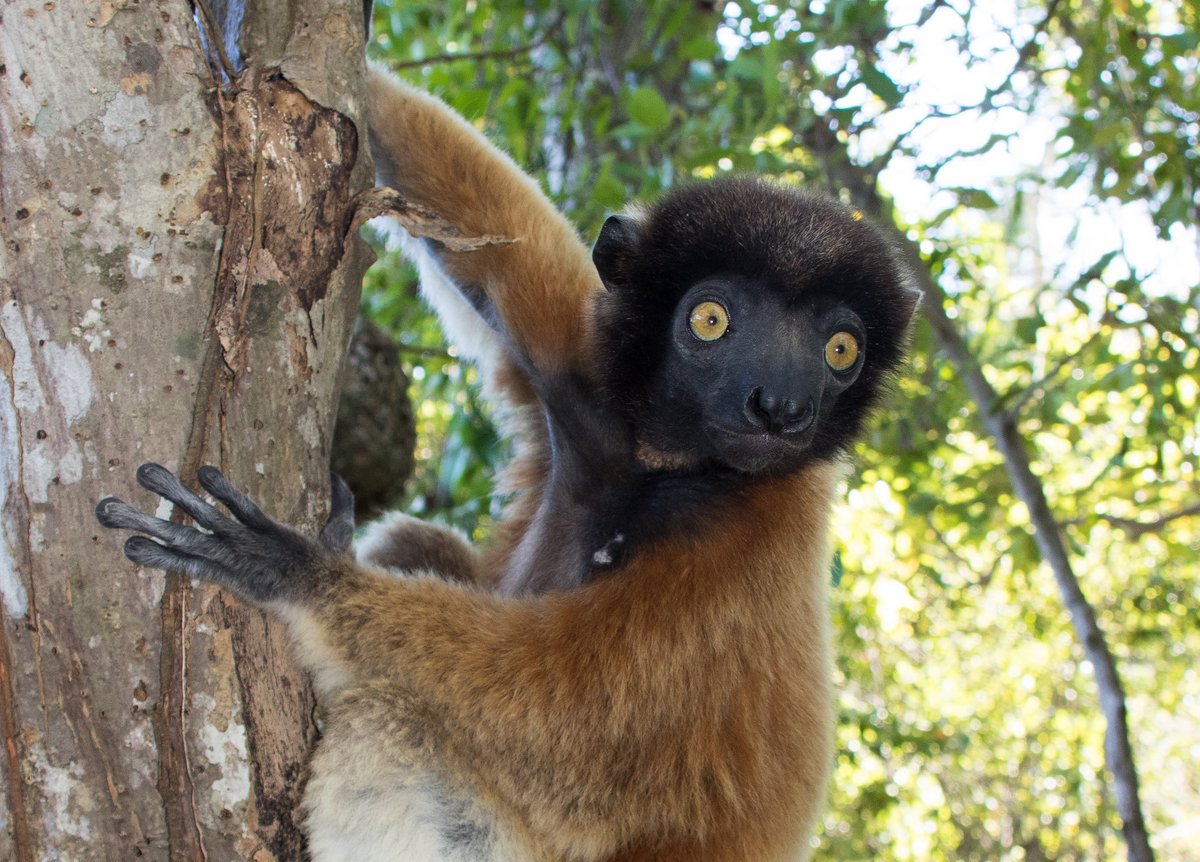
The guide changed his call to “Sifa Sifa” and after a while some Sifaka Lemurs appeared. These are smaller than the other lemurs that we’ve seen and look very cute. They leap incredible distances between branches and, when moving along the ground, they jump sideways, which is amusing. One of the Black & White Ruffed Lemurs had followed us up the path and several times bullied the smaller Sifaka Lemurs, trying to grab the pieces of banana that we gave them.
At the top of the small but steep island, there’s a thatched shelter with a double bed. We were told that you can stay here for €120 per night. It would be an interesting place to stay, if you were here on holiday. The 30 minute tour ended next to a dozen plastic bowls containing baby Green Turtles, which they release when an appropriate size. It was a nice little tour.
Back at the boat, the bouncy conditions hadn’t improved, so we upped anchor and sailed a few miles to the small island of Ankazoberavina, where we picked up a mooring at 13°29.31S 047°58.70E in 8 metres of water. There are two white mooring balls to the north of a large steel buoy marking the edge of a Marine conservation area - it’s not a National Park, so there’s nothing to pay.
The moorings are chained to large bommies and the one that we picked up, close to the steel buoy had wrapped itself around part of the bommie, so I couldn’t lift it out of the water with our boat hook. There was nothing else for it, I put on some swimming shorts and as Glenys manoeuvred us up to the buoy, I jumped in with the rope, passing the end through the mooring and back up to Glenys. I then snorkelled down to untangle and inspect the mooring rope - it looked very strong.
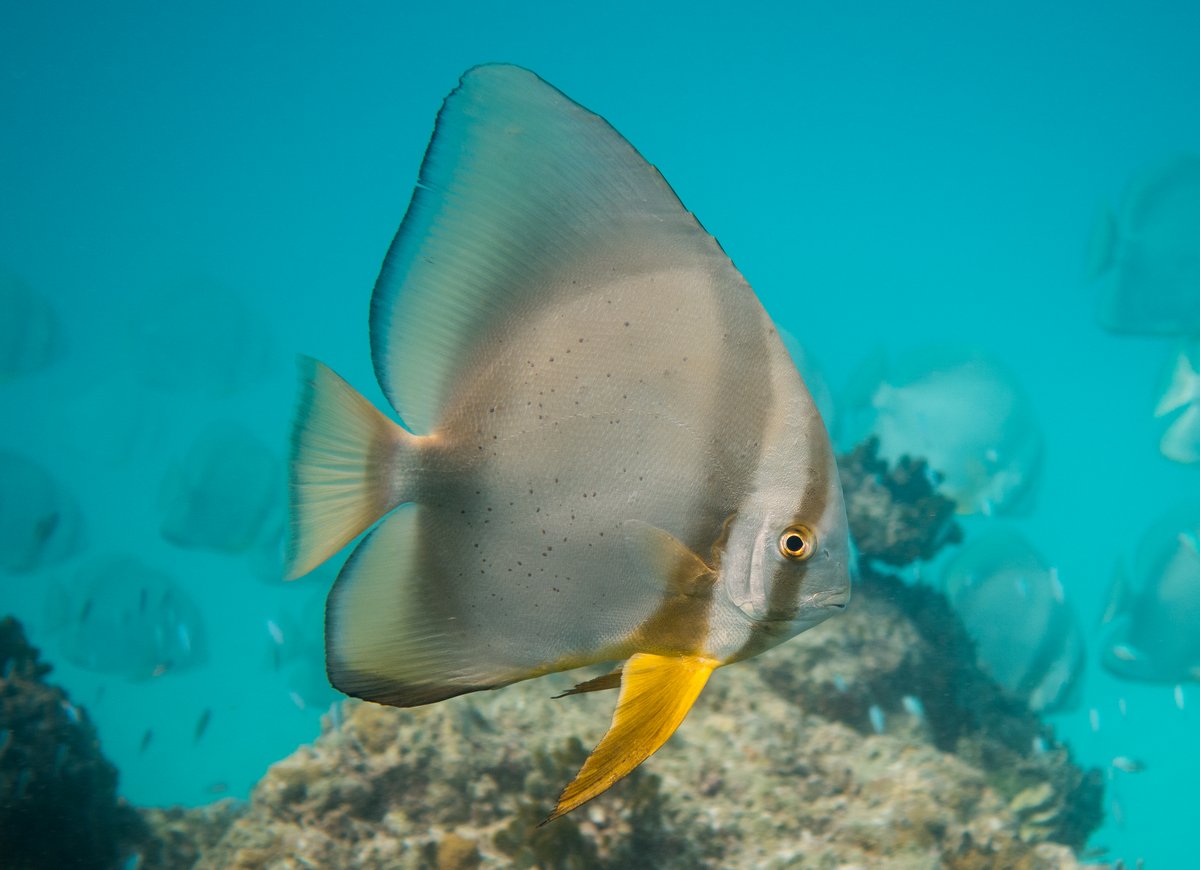
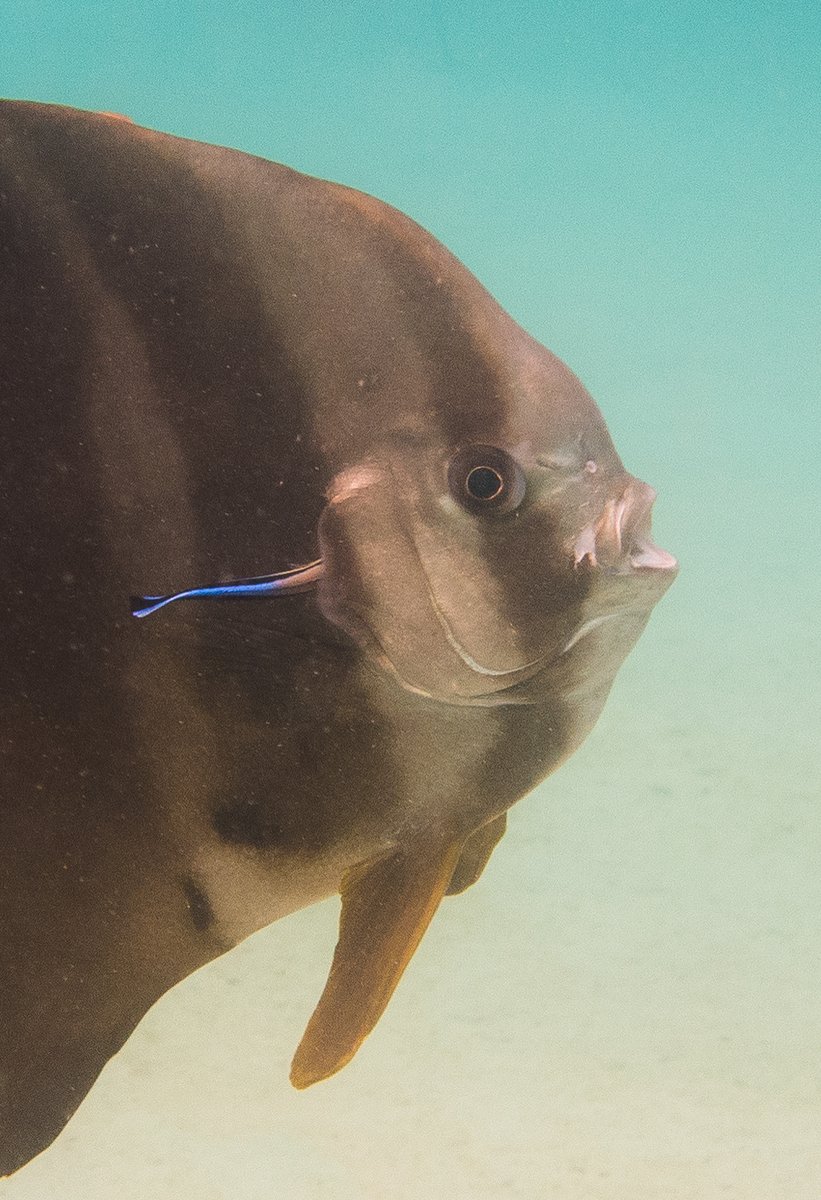
We’d been told that it was good diving here, but it didn’t look that good to me, so we just snorkelled on the many coral patches. The visibility was about ten metres; the coral was in fairly good condition and being a “no fishing” area there were plenty of fish. This included a number of large Circular Spadefish that were hovering around the cleaning stations, with Cleaner Wrasses darting in and out of their gills.
We stayed for a few hours and after lunch, sailed back to Russian Bay where we chilled out for the rest of the day.
11 September 2017 Russian Bay to Nosy Komba, Madagascar
We decided that we’d had enough of Russian Bay and headed for Nosy Komba. Once again, we were too impatient to go and instead of waiting for the afternoon sea-breeze, we left at 09:00 - we had very little wind, so we motored most of the 23 miles. If we’d have waited until midday, we would have had a cracking sail.
The anchorage at Nosy Komba is on the north-east corner at 13°26.54S 048°21.16E - we anchored in 10 metres of water. The village that we’re anchored off is a bustling place with tourist boats, restaurants and at least one dive operation. We’ll investigate tomorrow.

We had a quiet time for the remainder of the afternoon doing research into anchorages further south and downloading aerial photos into SAS Planet… I don’t often use this program, but the Google Earth images for this area are not very good, so my KAP charts are not as detailed as usual. SAS Planet can store Satellite images from Bing which are much better - we’ll be using this for the tricky anchorages further south.
12 September 2017 Nosy Komba, Madagascar
After beaching our dinghy at the Chez Yolande restaurant (13°26.60S 48°20.96E), we walked through the narrow sandy streets of the village. No cars, motorbikes or even Zebu carts are to be seen in the island, so everything is moved by hand.
Tourists come over to Nosy Komba for day trips and the village has scores of small souvenir shops selling wood carvings, Pandanus weaving, t-shirts etc. The villagers also specialise in making embroidered “Cutwork” table cloths that are hand stitched with parts of the material removed to give a lace effect. The streets and beaches are lined with a colourful display of the tablecloths rippling in the breeze.
Glenys bought a large, dark blue Table Cloth, which has a tropical theme and some nice details of Lemurs. She also found an interesting hand-stitched Tapestry which is 3ft * 2ft and depicts various aspects of Madagascar - village life, lemurs, Baobab trees, etc. Not a bad find for £10.


Another item on sale in many Madagascan streets is the Cola Nut. This can be bought as a 1” diameter nut for about 500 Ariary (£0.15) and slivers are chewed as a natural stimulant - as one guy told me, “It helps If you need to do a lot of work”. I found this information:
The Kola nut is the fruit of the kola tree, which is native to the tropical rainforests of Africa. It’s chewed in many West African countries, individually or in a group setting. It is often used ceremonially, presented to chiefs or guests.

Kola nuts comprise about 2% caffeine, as well as containing kolanin and theobromine. All three chemicals function as stimulants. The first taste is bitter, but it sweetens upon chewing. The nut can be boiled to extract the cola. The trees have yellow flowers with purple spots, and star-shaped fruit. Inside the fruit, about a dozen round or square seeds develop in a white seed-shell. The nut’s aroma is sweet and rose-like.
Kola nuts were used as a form of currency in some West African people groups. They are still used as such today in certain situations such as in negotiation over bride prices or as a form of a respect or host gift to the elders of a village should one move to a village or enter a business arrangement with the village.
Kola nuts are perhaps best known to Western culture as a flavouring ingredient and one of the sources of caffeine in cola and other similarly flavoured beverages.
In the 1800s, a pharmacist in Georgia, John Pemberton, took extracts of Kola and Coca Leaves and mixed them with sugar, other ingredients, and carbonated water to invent the first cola soft drink. His accountant tasted it and called it "Coca-Cola". Cocaine (but not the other extracts from the Peruvian Coca Leaf) was prohibited from soft drinks in the U.S. after 1904, and Coca-Cola no longer uses either Kola or Coca in its secret recipe.
We had a quiet afternoon and in the evening went to Chez Yolande for an evening meal with “Red Herring” and “Jackster”.
13 September 2017 Nosy Komba, Madagascar
We went ashore at 08:00 and strolled to the Lemur Park - we were advised to go early because the Lemurs don’t bother to show up later when they’ve been fed by groups of tourists. There’s a small park office tucked down a narrow side street next to a biggish souvenir shop. It’s not very well signposted, so we just asked around. We had to pay 4,000 Ariary each (£1), which included a guide and his bananas.

Most of the walk is along a dirt track, which is lined with dozens of stalls selling the inevitable carvings, basket work and cut-work table cloths. There are only Black Lemurs on the island and they are wild animals, attracted by the bananas handed out. We’ve already seen this species of Lemur, but our attention was grabbed by a female with a one-week old Baby clinging to the mother’s chest - very cute.

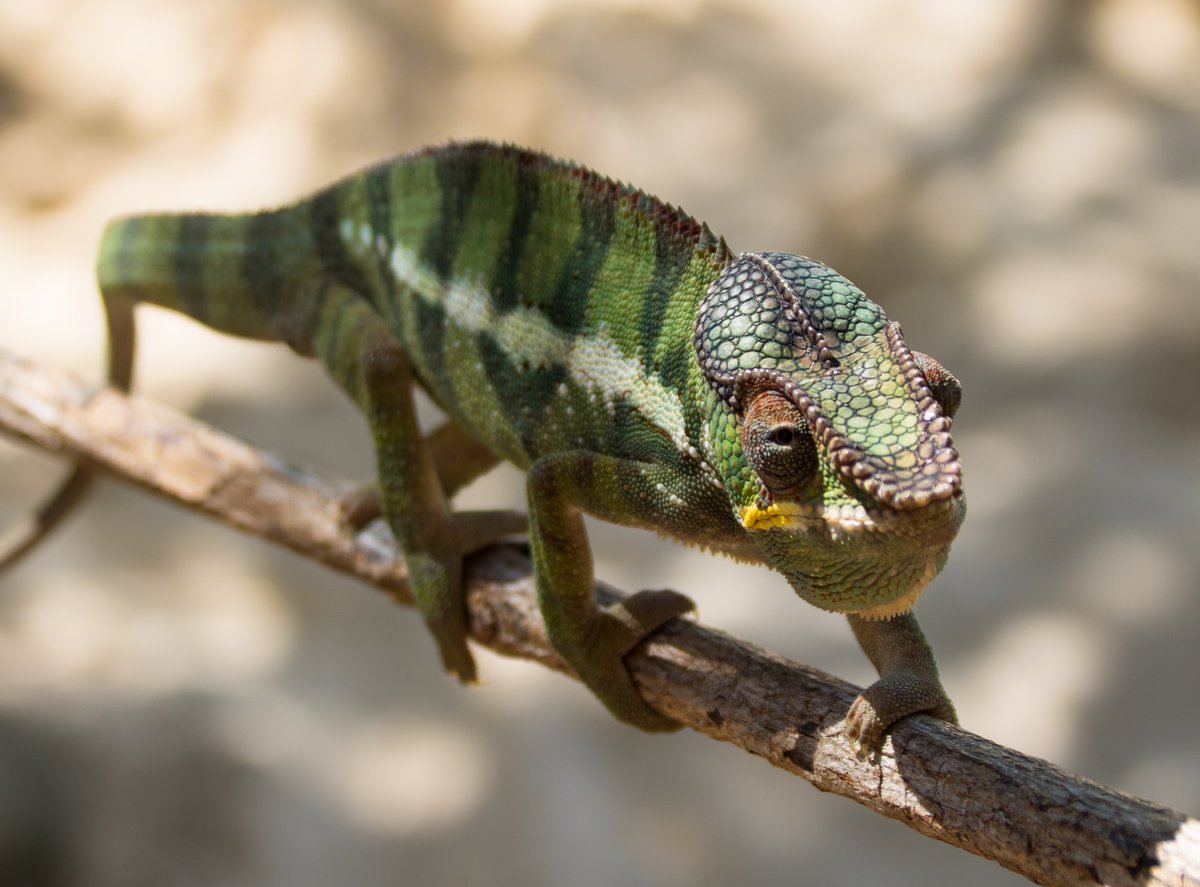
The guide spoke good English and was very knowledgeable, so it was an interesting little tour. He found us a Chameleon and showed us a couple of species of Tortoise that they are breeding. Along the way we bumped into Karen and Graham from “Red Herring”, so we went for a walk together up to the top of the island.
The guides try to charge you 20,000 Ariary to show you the way, but there’s no need - just get your guide to point you in the right direction at the end of the tour. We followed a well-used path which climbs steeply up to a few villages. There are a series of yellow and red paint marks on the rocks, which I believe are used for an annual mountain trial run - we followed the red marks.
The trail passes a few small farms and settlements and eventually comes to a Christian Shrine complete with a large white cross and a crucifixion - it was a surprise to see it as we rounded a corner. A little further on, there was a school off to the right and then, at a three way branch in the trail, we took the right hand path and walked into a very tidy looking village. The path started downwards at the village, so we retraced our steps and walked back down to our dinghy.

We didn’t walk down through the Lemur Park, but followed the main path down to the village, which came out next to Chez Yolande. So, if you want to walk up by yourself, turn left outside main entrance to Chez Yolande and head roughly south until you come to a set of concrete steps leading up past street vendors. At the top of these steps, bear right and you will come across the main path up the mountain, turn left and keep heading up, following the red paint marks on the rocks.
Foolishly, we’d only taken 500ml of water and no food, so we were feeling dehydrated and tired in the afternoon, so we had a long siesta.