
14 September 2017 Nosy Komba, Madagascar
I had a terrible night, continually running to the toilet with a bad case of Bali Belly. It had slightly abated by morning, but I didn’t dare venture far from a toilet. We found out later in the day that Dave from “Jackster” had also had a rough night. The finger of blame lies strongly with the meal that we had at Chez Yolande because Dave and I both had Zebu brochettes.
We chilled out all day; I took a couple of Immodium in the afternoon and slept a lot.
15 September 2017 Nosy Komba to Hellville, Madagascar
After breakfast, we motored around to Hellville and anchored in the town harbour. “Red Herring” were already there, so we shared a dinghy, which we left in the capable hands of “Smiley” another of Jimmy’s associates. We all walked into town to the vegetable market and supermarket to do our final provisioning before we start heading south down to Mahajunga.
We’ll be clearing out in Mahajunga and expect to be buying more provisions there, but Glenys has bought enough drinks, dried goods and tins to last us for two months, so if we bypass Mahajunga, we won’t starve on the way to South Africa.
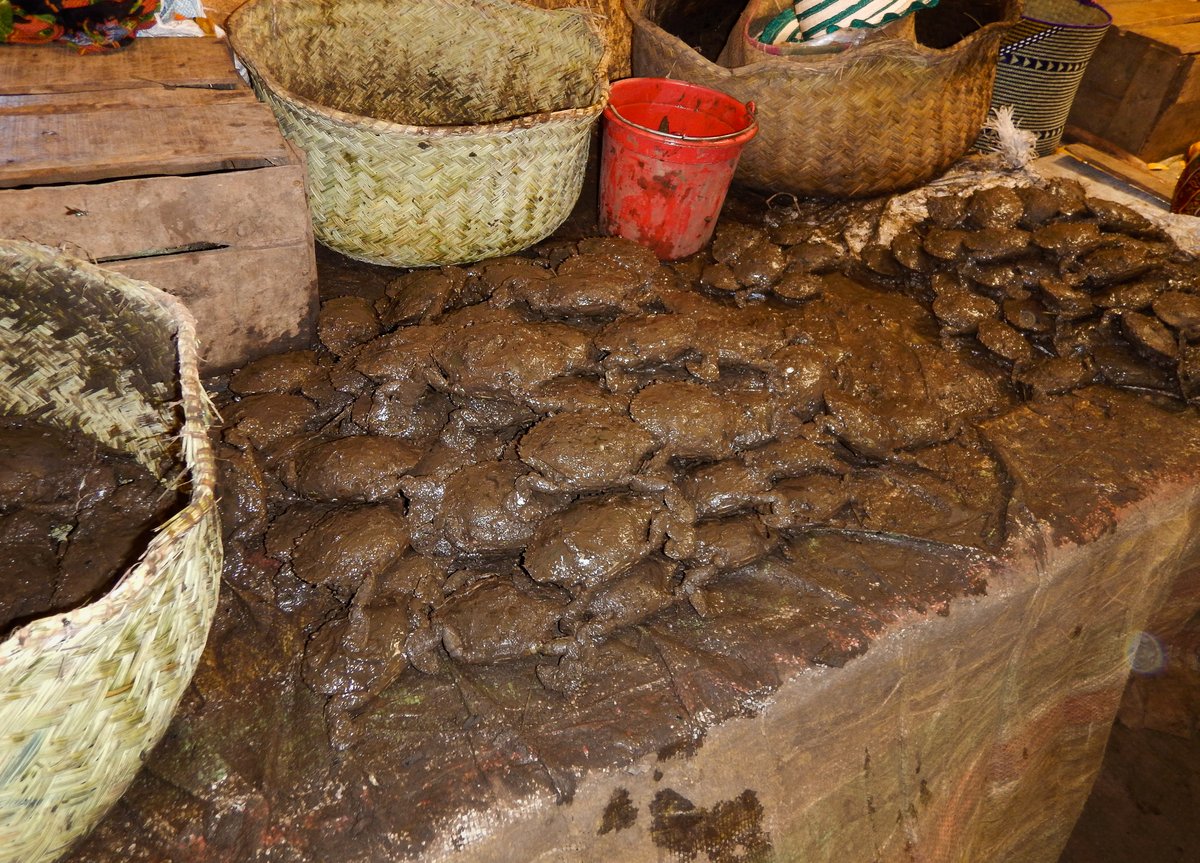
In many places, the villagers paddle out and offer us Mud Crabs, but we've so far declined. In the market there was a whole section devoted to Mud Crabs. They were slavered in gloopy mud, presumably to keep them fresh, but they didn't look particularly appealing. Maybe someone should teach them about presentation.
In the afternoon, we got some more fuel. I took three of our jerry cans and three of Red Herring’s jerry cans over to Jimmy, who charged us 35,000 Ariary (£8) for transport and his time in getting the fuel. It was worth it because all I had to do was drop off the jerry cans and pick them up 45 minutes later. By this time, it was 16:00 and the day was over.
16 September 2017 Hellville to Crater Bay, Madagascar
Up early again, this time to scoot the six miles around to Crater Bay to attend a cruisers’ lunch. Unfortunately, when I went to check the engine, I found a couple of litres of sea water in the engine bilge. Goodness knows where it’s come from. I traced through the whole of the sea water circuit and couldn’t find a leak. I mopped out the bilge and I’ll have to keep an eye on it.
We motored around to Crater Bay, dropped the dinghy in the water and headed off into town to buy a few more provisions that we couldn’t find in Helleville. The little supermarket in Madirokely is surprisingly good and we were able to buy some cornflakes and a nice loaf of bread.
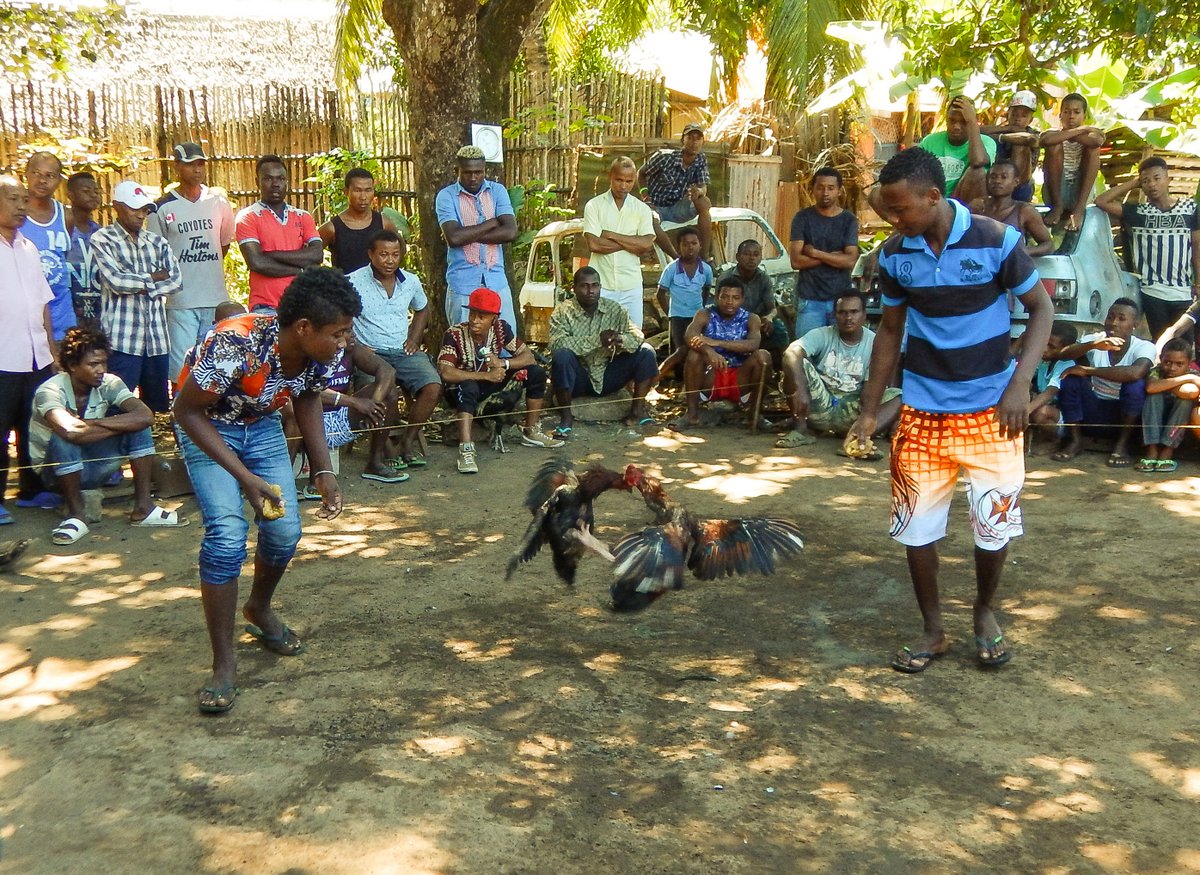
On the way back, we came across a large group of men stood in a circle shouting. It looked like a man-only thing, so Glenys walked a little way along the road, while I went to investigate - it was a cockfight. Two cocks were locked in combat, pecking each other’s heads and occasionally leaping up, lashing at each other with their feet. Their handlers were coaxing them to fight by (bizarrely) splashing water on their feet.
The crowd cheered every time that a bird grabbed the other in its beak and cheered again when a feather was plucked out. The men were obviously betting, because the fight itself was not very interesting. Thankfully, there wasn’t much blood, so I took one picture and left.
The pig roast at the restaurant next to the yacht club started at midday and was well attended by a gaggle of cruisers. Much beer was consumed and we caught up with a few boats that we haven’t seen since Chagos. Obviously, the afternoon was spent sleeping off the large lunch and alcohol, followed by Baguette Pizza and a movie.
17 September 2017 Crater Bay to Russian Bay, Madagascar
It was another early start and we were on our way by 07:00, motoring six miles to Tani Keli , a small island which is a Marine Park. We anchored at 13°29.24S 048°14.25E in about 12m on sloping sand, next to three small black moorings. The moorings might be strong enough for a yacht, but they were in 4.5 metres of water and possibly shallower, so we anchored. A Park Ranger boat arrived as soon as we dropped the anchor and we paid 20,000 Ariary each (£5).
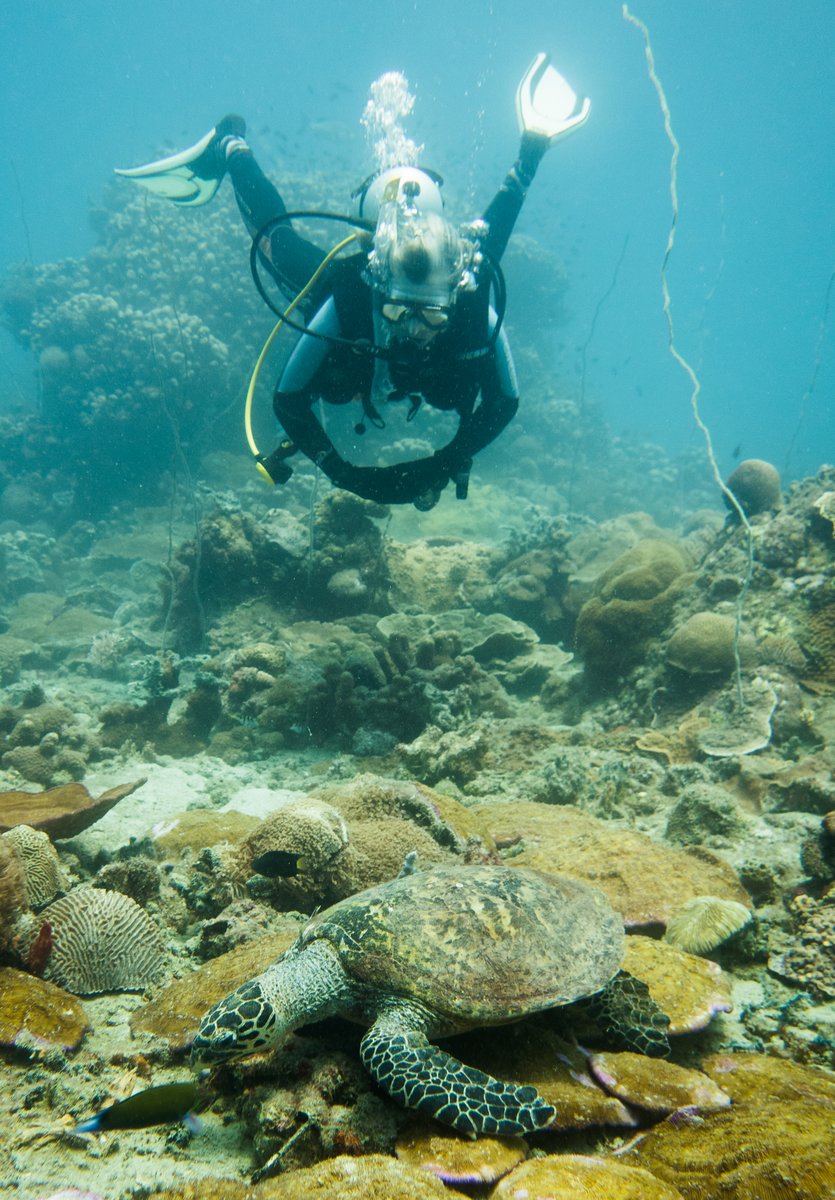
We did a scuba dive on the east side of the island, tying our dinghy onto one of two black moorings off the main beach at 13°29.01S 048°14.35E. We dropped into the water and headed south-east down the sand to 20 metres, following the bottom edge of the reef heading south. When we had used half our air, we came up to 12 metres and returned back along the reef until we hit the sand, then back to the dinghy. We started our dive at 10:00 with light winds, calm seas and encountered no current.
It was a great dive despite the visibility being only 10 metres. There were lots of big snapper, groupers and blue-spotted sting rays who were very unafraid (until I stuck my camera in their face). We saw six nudibranchs (2 species) and a similar number of big tiger cowries. A Hawksbill turtle popped over to say hello and we spent five minutes with it – it was very unconcerned. The hard and soft coral was in good condition and sponges were dotted around the reef - shows the value of a Marine Park.
We were told that there’s another dive on the west side at about 13°29.08S 048°14.00E, just off a small beach. A bit shallower, but we believe that this is the best place to see reef sharks.
When we arrived at 08:30, there was no wind and the anchorage was calm. By 13:00, we had 15 knots and 2 foot waves from the north, so we didn’t bother to do another dive or snorkel and headed off to Russian Bay. We had a great sail, with 15-20 knots. The wind was hard on our starboard bow, but in the flat seas it was a joy. A Dhow that was sailing across our bow, changed direction and came straight at us, passing a few feet away from our starboard side. They’d just come over to have a look at us.
We anchored in Russian Bay at the same place as before in 10 metres on good holding sand/mud. “Red Herring” are the only other boat in the huge anchorage - it’s much nicer than the busy Crater Bay.
18 September 2017 Russian Bay, Madagascar
We had a morning doing some chores. I ran the water-maker for 90 minutes and the low pressure pump is playing up again. I’m going to order a new one and have it delivered to Richards Bay in South Africa. The drinks fridge was gurgling, so I checked the refrigerant pressure. I’d topped it up to 14psi about six weeks ago and it was now down to 4 psi, so I topped it up again. We’ve definitely got a leak - another job on the list for South Africa.
We spent the rest of the day reading up on the anchorages south of here. It’s time to move on now because we want to be in Majunga in the first week of October, so that we can prepare ourselves for the 1,200 mile passage down to Richard’s Bay in South Africa. It’s about 150 miles down to Majunga and there are a lot of places to see, so with only two weeks left in September, we need to get a move on.

In the evening, we went ashore to Andreas’ Bar and had a few beers with “Red Herring”. The Black Lemurs showed up, but they’re becoming common place now - I was more interested in the most Vicious Duck in the World. I caught a glimpse of a Cockerel being chased through the bar by a huge black Duck.
Soon an almighty fight broke out. The Cockerel is the Cock of his flock of hens, but the Evil Duck obviously doesn't like him. Pinning the Cockerel down the Evil Duck started to pluck out feathers. The Cockerel fought back, but to no avail, he was defeated.
19 September 2017 Russian Bay to Honey River, Madagascar
Our plan was to go for a hike this morning, but Glenys woke with an upset stomach, so we decided to head off down the coast. We waited until 09:00 and then left despite the lack of wind because we wanted to visit Nosy Iranja on our way to Honey River. The wind picked up by 11:00 and we had a nice sail, even throwing in a tack as we approached the island.
We anchored at 13°36.13S 047°49.60E in 8 metres over great holding sand. It was horribly rolly, with a swell coming in from the North, but we were only staying for a couple of hours. The water was nice and clear, so we ran the water-maker over lunch and then went ashore. The island is a major destination for tourists, so the beach and the village were lined with souvenir stalls.
We walked up to a small lighthouse on the top of the small hill, which was designed by Eiffel - it’s made of steel and covered with rivets, so it looks vaguely like the Eiffel Tower. It only took us 10 minutes to walk up to the lighthouse and there wasn’t much else to do on the island, so we were back on the boat within an hour and, in company with “Red Herring”, “Luna Blu” and “Fortuna” set sail for Honey River.
The on-shore wind gradually dropped off during the afternoon, so we didn’t arrive in the anchorage until 16:30. We anchored at 13°42.74S 047°54.10E in 10 metres over mud. There are a couple of villages nearby and a small fleet of dugout canoes came out to meet us, annoyingly hanging about close to us while we anchored.

One by one the canoes approached us offering the same things - Honey and Mud Crabs. We didn’t want either and requests for Bananas and Shrimp were met with a shake of the head. They then asked for things - mostly fishing hooks, so we handed out a few sets, but we’re rapidly running out of them one guy asked for soap, which we handed over. I know that the people have very little, but I wish that they’d turn up with something different to trade. It’s difficult to know what to hand out when they are just begging.
20 September 2017 Honey River, Madagascar
It was a lovely peaceful night with no wind and flat calm water. In the morning, we pottered about enjoying the quiet place. In the afternoon, we put our 15hp outboard onto the dinghy and went exploring the huge river. High tide was at 16:00, so we had the current with us as we slowly pottered up the river.
The locals tell us that there are crocodiles in the Mangroves, so we kept close to the mangroves for a while, but didn’t see one. In fact, there isn’t much happening in the Mangroves - I expected to see lots of birds, but we only saw a few herons. We were soon bored of staring at Mangroves, so we roared up the river, passing a few small settlements.
Approximately four miles up the river, we came across a small village, where some guys were rebuilding a 10 metre long wooden boat, so we went ashore to have a look. They had removed a lot of old timbers, replacing them one-at-time to retain the original hull shape. One guy was chopping away at a log with an Adze, slowly shaping 25mm thick planks. The planks were fixed to the main timbers with Iron Nails, leaving 1 to 4 mm gaps that will be filled with caulking - they showed me that they use fibres from old sacks, so I guess it’s hemp.
We spent a fun half an hour chatting to them and gave them some things that we’d brought along with us - the rechargeable torch, was a winner again and they were happy with some clothes and fishing gear. Waving goodbye, we zipped back to the boat to relax for the rest of the afternoon.

In the evening, we invited the other boats over for sundowners - “Red Herring”, “Luna Blu” and “Fortuna”.
21 September 2017 Honey River to Nosy Antanimora, Madagascar
A light sea breeze started at 08:30, so we pulled up our anchor and motored out to sea. Unfortunately the wind was very fickle and kept dying out. We’re not very patient and I hate the sails bashing about, so we motored for an hour until the wind picked up properly at 11:00. The wind was coming from the west at 15 knots and with the flat seas, if was a joy to beat to windward.
We passed by Nosy Kalakajoro and carried onto Nosy Antanimora. We’d chosen an anchorage on the south side of a long sand spit, which looked very good from my satellite images and I thought that we’d have clear water and sand to anchor on. Unfortunately, the water was very murky and there are quite a few coral patches about.
We tried to go close to the shore, but retreated when the depth came up rapidly to 3.5 metres. We finally anchored at 14°07.04S 047°45.74E in 8 metres. I dived down to have a look and our anchor is buried in a nice, big sandy patch, but the boat is over a coral patch. With 40 metres of chain out, there’s a chance of the anchor chain snagging, so I clipped a fender onto the chain at 25 metres to lift it off the seabed.
It was a bit bouncy in the anchorage because it is exposed to the west wind and waves, but that died down gradually as it went dark.