
13 October 2017 Benguerra Island to Benguerra Sand Spit, Mozambique
We had a restless night. The wind swung to the south before we went to bed. It was only 5-8 knots, but we were worried that it was going to pick up and make the anchorage very uncomfortable. It was also annoying that when the wind veered, we ended up a couple of boat lengths directly in front of “Continuum”, but it was so dark that we couldn’t re-anchor.

We were up at 05:15, with the wind at 10-15 knots from the south bringing 2 foot waves into the anchorage. There was a discussion on the VHF and the consensus was to move at 06:00 - three hours before high tide. We had some waypoints through the sand banks to our next anchorage, which were a mixture of some waypoints from previous cruisers; information from a local boat; and inspection of Google earth images in KAP Charts.
The route looked deeper than 5 metres for most of the way, with the shallowest point being at the beginning. A local boat had told us that there’s a channel heading NE from our anchorage, but it didn’t look promising with wind waves and overcast, early morning skies. I dropped our dinghy into the water and picked up Graham from “Red Herring” to go and look at the “channel” using our portable depth sounder.
It wasn’t good. We recorded depths of 2.1 to 2.4 metres and it looked shallower further on. We were at half tide with a tidal depth of 2.5m. We’re approaching neaps at the moment and high tide is only 3.2m. Graham and I agreed that it was too risky to head off across uncharted sand banks especially because the wind would be pushing us forward and making it hard to stop. Not that I’m superstitious, but it’s also Friday the 13th…
There was a rapid change of plans. “Continuum” and “Mowana” with their shallower drafts, elected to stay at an anchorage a little closer to shore (at 21°51.27S035°24.90Ein a depth of 2m LAT). Meanwhile “Red Herring”, “Luna Blu” and we headed back north, re-tracing our route and then looping back south along what looked to be a much deeper and safer channel. It was 15 miles, but we were hoping that our destination would be a well-protected anchorage and it’s close to the pass that we will use when we finally go out to sea.
The start of the route south goes over a shallow sand bar and we were unsure what the depth would be. Fortunately, there was a local sport-fishing boat going out (“Big Bob”) and he told us that he had a minimum depth of 3.4m over the bar. We put a trace on his AIS and followed his track over the shallows and then down the channel - I love AIS. The minimum depth that we saw was 3.4m (0.2m LAT) and most of the route was over 7 metres deep.

The anchorage is close to a long Sand Spit and there’s a shallow-looking sand bar to the west of it, so we sailed very close to the end of the sand spit and then along the shore. The minimum depth that we saw was 7 metres (3.8m LAT), so we’ll be able to get out of the anchorage and into the pass at any state of tide.
(Our waypoints were: 21°44.68S 035°24.03E; 21°44.95S 035°24.76E; 21°45.44S 035°25.22E; 21°46.63S 035°25.23E; 21°47.23S 035°25.50E; 21°48.31S 035°26.62E; 21°48.48S 035°27.59E; 21°48.67S 035°27.60E; 21°48.92S 035°27.51E.)
We anchored at 21°49.03S 035°27.48E in 10 metres on good holding sand. It’s a huge anchorage about 0.5 miles long by 0.2 miles wide. The sand spit is a beautiful set of sand dunes - white coral sand, tufts of grass and nothing else. By the time that we arrived at the anchorage, the wind was blowing 20-25 knots from the SSE, but we were very comfortable with just 1 foot wind waves and no swell.
The weather forecast was not good reading. The SE winds will reduce tomorrow and then we will have north-east winds for 48 hours. If we left here tomorrow, we wouldn’t quite make it to Maputo before 25 knot winds arrive on the afternoon of the 16th. We could go down to Inhambane, but we’d then have to spend 36 uncomfortable hours in the strong southerlies in a poor anchorage and then wouldn’t be able to get to Maputo in time for the next southerly on the 19th.
Our only hope (Obiwan Kanobi) is to wait here until the afternoon of the 20th when we should have five days of favourable East and North-east winds to get us directly to Richards Bay. Such long range weather forecasts are inaccurate, but all we can do is wait and see what develops - at least it’s a beautiful anchorage.

After lunch, we had a quiet afternoon, catching up on some sleep and reading. Our relaxation was interrupted by some Park Rangers stopping by, wanting us to pay park fees. We produced the receipt from the rangers at Bazaruto and they were happy. So it is an official fee…
We had a quiet night, hunkered down below watching a movie. It’s very cold in this strong south east wind and we’re wearing thin fleeces in the evening. I guess that cold air is being brought up from the Antarctic by the low pressure system that is trundling eastwards below us . We’d better get used to it; it’s going to get colder as we head south.
14 October 2017 Benguerra Sand Spit, Mozambique
The wind blew at 20 knots all night, but the anchorage is well protected from the south-east, so we slept like logs. I downloaded the latest weather forecast, which now shows a small chance of leaving in the late afternoon on Wednesday 18th. The southerlies that arrive in Maputo on the afternoon of Friday 20th build up slowly, so we might be able to sail on a reach into Maputo with 10-15 knot SE winds, before stronger 20-25 knot winds arrive on Saturday morning. We’ll wait and see.
The sports fishing boat, “Big Bob” arrived and anchored close by us, so Graham and I went across to have a chat. He told us that this is a good anchorage in NE and SE winds, so we’ll stay here until we leave for South Africa. I asked if he had any fish and was delighted when he dragged out a couple of kilos of frozen Spanish Mackerel and didn’t want any money for it. The skipper told us that there’s a freshwater lake over by a large sand dune to the south of us that has Flamingos.

In the afternoon, we went for a walk with “Red Herring” and “Luna Blu”, aiming to find the flamingos. It was tough walking on the soft sand and after an hour or so we’d only walked 2 miles and had reached some buildings on the island at the beginning of the sand spit. This turned out to be a conference centre with two beautiful buildings constructed from traditional wood and reed. It was deserted apart from two guards who were very friendly and told us that the flamingos were normally on the sand flats, but weren’t there at the moment.
We decided to head back to the boat and, on arriving back at the dinghies, found that the beach had been invaded by 20 or 30 tourists that had been brought from some of the lodges. The guys from “Big Bob” were having a beer on the beach as well and told us that the sand spit is often busy being a popular day trip from all the lodges. Apparently, we should have walked a mile further along the east shore to find the flamingo lake. It’s something to do another day.
15 October 2017 Benguerra Sand Spit to Ponta Dundo, Mozambique
We had another settled night and woke to 10 knot NE winds. I have a morning routine now - I post yesterday’s diary to our “At Sea” blog (blog.mailasail.com/yachtalba) and then get the latest weather forecast. Today’s email from Des Cason gave a glimmer of hope:
“The latest grib shows a nice big fat high pressure system developing at 32S43E next Saturday 21/10 which will bring mainly E/NE conditions down the channel all the way to East London, south of Durban. All things being equal and if the forecast holds this indicates possible departure Bazaruto 18/10 00:00UTC with E15 or 19/10 06:00UTC with ENE10.
On Friday 20/10 06:00 you will get SE25 just south of Inhambane, but it doesn't come up the channel due to being blocked by a 1016mba High at 21S40E. By Friday 20/10 18:00 this SE has turned to ESE20 and then drops off and turns E and progressively NE as you get closer to Richards Bay. Let’s keep our fingers crossed for the high to set in and open the gap.”
This sounds very good. If we leave at dawn on Thursday 19th, we will have 12 hours of beating/heaving-to on Friday in SE25 winds, but we should be able to sail well from Saturday morning and arrive in Richards Bay at 18:00 on Sunday 22nd. The next southerlies arrive in Richards Bay on Monday 23rd at midday - a nice 18 hour safety window and, if the window closes up, we’ll have plenty of time to get to Maputo.

We did some chores in the morning. Glenys baked some bread and I topped up our fuel tank with the 63 litres of diesel from our three jerry jugs. I reckon that we now have 320 litres of fuel in our tank, which is enough to motor for 106 hours i.e. 586 miles, so we could motor all the way to Richards Bay if we need to.
The North-east wind picked up through the morning and, by lunch-time, we had 20 knots, which was raising 2 foot waves in the anchorage. There was a quick discussion on the VHF and then we all left and headed across to the south west corner of Bazaruto to Ponta Dundo. There’s a deep water channel quite close to the shore next to some trees and the least depth that we saw while going across was 7 metres.
(Our Waypoints were: 21°48.22S 035°27.56E; 21°47.87S 035°27.44E; 21°47.72S 035°27.20E)
We anchored at 21°47.61S 035°27.12E in 12 metres (9m LAT). We’re only 80 metres away from the shore, but it felt like good holding sand when we backed up on the anchor. There’s a swell hooking around the corner making it a bit bumpy, but it seems much more protected from the North-east winds than the previous anchorage. Ashore are some huge sand dunes that are obviously a tourist attraction, judging by the number of local boats and tourists milling about.
By the time that we’d run our water-maker to top up the tanks, the day was over. It was low tide at 18:00, so the bouncy waves reduced and we had calm conditions for our dinner. However, by 21:00 the tide was coming in at full flood, so the boat turned to face south with the wind from the north-east, making our rigging rattle and shake. It didn’t bode well for the night.
16 October 2017 Ponta Dundo to Benguerra Sandspit, Mozambique
It was a turbulent night as the tide pushed us back and forth. When the tide was ebbing we pitched into the wind; we rolled when we were sideways; and we were slapped up the sugar scoop when the tide was coming in. However, the wind was only 20 knots, so it was just very uncomfortable and not dangerous.
After breakfast, we went for a walk with “Red Herring” up the huge sand dunes. It was fabulous walking along the wind-swept ridges of pristine sand. It was very reminiscent of walking along snowy arêtes in the Alps, but we were blasted by sand instead of snow by the strong NE winds. From the top, there was a good view of our proposed route out to sea, which goes over a sand bar, but it was hard to see the best route through the many sand banks, some of which were breaking.

After a short stop overlooking a small lake packed with Herons and Ibis, we walked down to sea level and strolled back along the shoreline. When we arrived at the anchorage we could see mayhem as the boats were all pirouetting around in the strong current against the wind. Alba looked very close to “Luna Blu” and we couldn’t see whether or not we’d dragged, so we rushed back to the dinghy.

We hadn’t dragged, but it was very unpleasant on board. We were bouncing about, lying side onto the wind and “Luna Blu” were sailing around on their anchor - sometimes they were 100 metres away and within five minutes they’d be 20 metres away. I didn’t fancy the prospect of another boisterous night being only 80 metres from the shore, so we upped anchor and headed back to the sand spit anchorage.
We had a bouncy trip across, but it was only a mile or so. Once in the anchorage, the waves settled down and it seemed okay. We reported back to the rest of the fleet and they all decided to come over to join us.
Unfortunately, by 15:00, the tide was going out and once again, we had strong tidal currents pushing us against the wind. The afternoon was gnarly with the boat pointing sometimes downwind and sometimes sideways with NNE 20-25 knot winds hitting our stern. At least this anchorage has more space and we’re not close to a rocky shore.
The wind is forecast to continue from the NNE until tomorrow afternoon, when it will slowly veer to SE - I can’t wait because this anchorage will be nice and flat again. The SE wind will continue at 20-25 knots for 36 hours and, by the morning of Thursday 19th, the wind will have reduced to E 10-15. Fingers crossed, that’s when we will start heading south towards South Africa.

On passage we’re expecting E to NE winds for 24 hours and then the wind will come around to S20 - straight in the nose and not really what we want, but it’s fairly light and will only last 12-24 hours before backing East and then we’ll have NE winds to carry us to Richards Bay, hopefully arriving Sunday 22nd.
17 October 2017 Benguerra Sandspit, Mozambique
The weather forecast looks even better today. The south wind expected on the second day of the passage to Richards Bay is looking to be very weak and quickly passed, so we’re all planning to leave Thursday 19th at 14:00 which is just before high tide, which will give us the best conditions for exiting the bar.
The wind blew at NNE 20 all night which was OK until the tide started to go out at 03:00. Our bow turned south into the strong current and the waves remorselessly slapped our stern. The boat would turn slightly and then sail across the wind, heeling over 5 degrees. A few minutes later we would gybe, with some resounding slaps up the sugar scoop and then slowly sail the other way, heeling over degrees to the other side. It was irritating.
We dragged ourselves out of bed at 07:00 and all the boats were still pointing downwind with waves hitting our sterns. After breakfast, we went for a long walk with “Red Herring” - the other boats in the anchorage politely declined when we started talking about making sandwiches and taking lots of water for the hike.
Our aim was to walk 3½ miles along the windward beach to the huge sand dune at 21°52.17S 035°27.20E and hopefully find a lake that has Flamingos. We had a pleasant walk along the beach and after a couple of miles after a small pine tree wood, we headed up into the small sand dunes, where we could see a path leading inland. A local guy shouted to us and said that he would show us the Crocodiles, so we went with the flow.
Our guide led us along narrow paths which eventually came out to the south end of the larger of the three lakes. On the way I enquired about palm trees that had been chopped down to a few feet, the tops of which were covered by Small Baskets. He showed us that they were extracting sap from the palms, which was then fermented, turning it into palm wine - an alcoholic drink. He gave us a taste of the finished product which was quite pleasantly bitter, reminiscent of lemon.

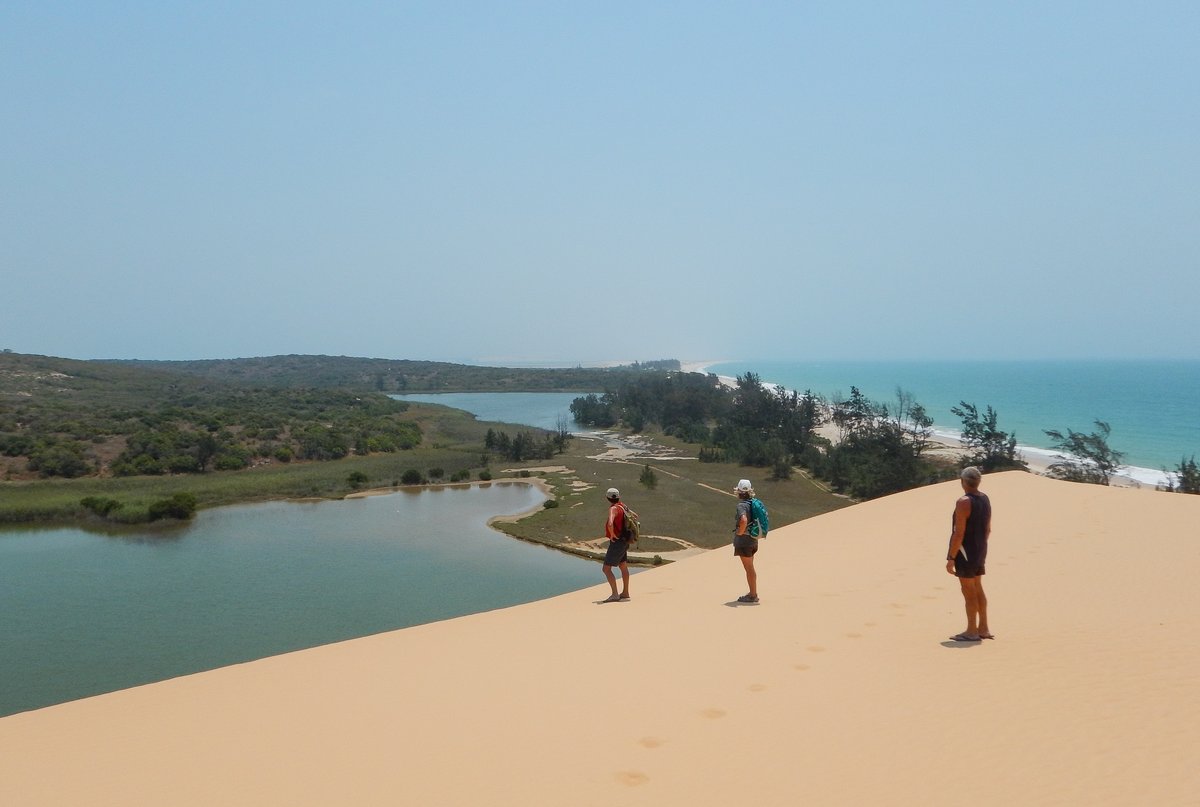
We were then led around the west side of the larger lake, but alas the crocodiles weren’t to be seen. Our guide led us to the smallest lake, which is directly below the huge sand dune, where there was a solitary Flamingo, so I took some photos and we said goodbye to our guide. We hadn’t expected to meet any one, so we hadn’t taken any “gifts” with us, but Karen gave the guy an old pair of sunglasses, which he seemed pleased with.

Our next objective was the huge sand dune, which I guess is a few hundred feet high. The first section up the face was very steep, but once on the ridge it was easy going. The sand dune is a bizarre geological formation, isolated and high above the rest of the land - I have no idea how it would have been formed. We had our sandwiches on the summit, staring at the fabulous view.
After a long walk back along the beach, we arrived back at the boat at 13:15 - a 4½ hour trek, so we were shattered. However, no peace for the wicked - it was high tide at 14:30, so we had slack tide at 14:00 and had to jump in the water to scrub the hull and replace the anode on the propeller. As well as the usual green slime, we’d picked up an impressive collection of goose-neck barnacles, which had to be scraped and scrubbed off.

By 14:40, the tide had changed and there was a significant out-going current, which brought the job to an end. We’d managed to remove most of the barnacles, but we need to have another go tomorrow. We chilled out for a few hours and went ashore for a sunset beer or two. Back on board, Glenys rustled up Chicken Mole, which we had with our last bottle of wine - it’s definitely time to go…
18 October 2017 Benguerra Sandspit, Mozambique
Overnight the wind veered to the south-east and picked up quickly. Just after midnight, I was woken by the uncomfortable motion and found that the wind was blowing 25-30 knots with the tide against the wind, raising 2-3 foot waves. Yesterday afternoon, “Fortuna” arrived and anchored near to us. When the wind picked up and swung us around, they’ve ended up only two boat lengths from us and at times they were less than that directly behind us.
We couldn’t raise them on the radio, so I resorted to shining our powerful search light at their hatches and blowing our little fog horn. They’d just arrived after a long passage, so it took a while to wake them up. Being the last boat to anchor, it’s their responsibility to keep their distance, but it was bad conditions to be trying to re-anchor in the dark without a moon, so they agreed that they would keep an anchor watch until the tide changed at 03:00 and hopefully conditions settled down.
Glenys and I didn’t sleep well and I got up half a dozen times to check that “Fortuna” were still clear of us. I’m annoyed with myself for not telling them to move yesterday afternoon, but if this was a normal anchorage, then they would have been fine, so it was difficult to tell them that they were too close.
By dawn, the wind was blowing hard from the SSE at 30 knots gusting to 35 knots, so it was gnarly and “Fortuna” were only 20 metres to our starboard side. Thankfully, after a bit of persuasion, they re-anchored at 10:00 at low tide, slack current, 100 metres away from us. I’ll sleep better tonight.

The weather forecast looks good. These strong SSE winds should start to abate this afternoon and then will back to ENE 10 by morning. We’re still planning on leaving at 14:00 tomorrow and during the first night we should have ENE 10. The second day looks like NE/ENE 10 and the south winds just don’t reach north enough to affect us. After that it should be NE to E winds at 5 -15 knots, which will be good for our south-west course to Richards Bay. With the lighter winds, we expect to arrive at dawn on Monday 23rd. The next southerly hits Richards Bay on the 25th, which gives us two days safety margin.
This weather never ceases to amaze me. The switch from NE to S happens within a few hours and it’s interesting to watch the barometer. It reached a low point of 1005mb yesterday afternoon and then started to rise, which heralds the switch from NE to S. By dawn this morning, the barometer read 1015mb and at lunch time it was 1016mb. When it starts to drop again, then the wind will slowly back to the east and we start all over again.
I find it very strange that we get no rain with these radical changes in wind direction and strength. We haven’t had any rain for six weeks and that was only a short-lived squall.
I drank my last beer on the beach last night, but Karen from “Red Herring” said that she could give me a six-pack. At midday, the wind was still blowing a hooley, so I couldn’t get into the dinghy to go to collect it without getting soaked through. At 14:00, I cracked up, donned my swimming shorts and a cagoule; and set off into the 30 knot winds. I spent a couple of hours on “Red Herring” sorting out some computer stuff and chatting about the plan for the passage.
The wind remained strong, but at sunset it had dropped to 20 knots and the sea state was much calmer.