
22 January 2018 Cape Town, South Africa
I was up early taking the staysail halyard to riggers so that they could splice the shackle on for me. We then paid our bill at the marina and toddled off to clear out. It’s about 1½ miles to the Port Control building, so we were glad that we still had a car.
We went into the cylindrical port authority tower and were given a clearance document by the receptionist. She told us that she’s allowed to do the clearance provided that the yacht is in the Royal Cape Yacht Club, otherwise you have to go to the Harbour Master’s office and fill in more forms, which can take a long time.
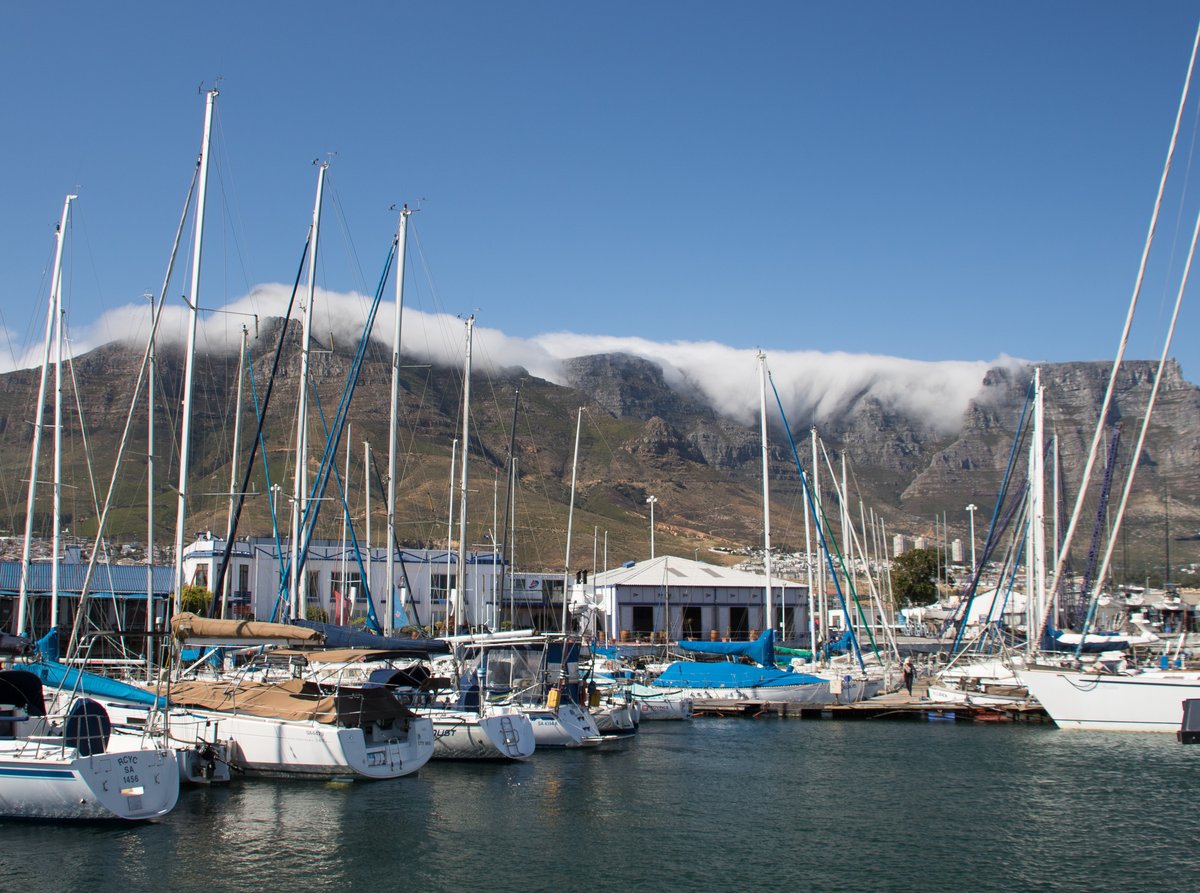
Immigration and Customs are in another building on the way back to the Yacht Club and we soon had their forms filled in and our clearance was completed by 09:30. There’s a north wind forecast for today and tomorrow morning, so we’re planning to leave on Wednesday 24th. Our visas run out at midnight today, so we told the authorities that we’re leaving today. We’ll be “Undesirables” if we are caught, but we’ll just stay in the marina, so that chance of having to show our passports is negligible.
I dropped Glenys off at the boat and drove off to buy some engine filters & fill up the car with petrol. We dropped the car off in town just before lunch.
We walked around town looking at some of the tourist “attractions” - Chiappini St has many brightly coloured buildings, originally Cape Malay people. We walked through Company's Garden and found a nice restaurant at Greenmarket Square, where there are lots of souvenir stalls and buskers. It’s okay for a big city, but I’d rather be in a small village somewhere.
The most interesting thing was going to the Namibian Tourist office (25th Floor, Atterbury House, Riebeeck Street). A very nice lady chatted to us for 30 minutes about Namibia and things to do there and we walked off with a bagful of tourist brochures. The view of Cape Town from their office window is impressive.
Back at the boat, there was a cold 15 knot wind from the north, so I’m glad that we decided to wait a couple of days. In the evening, we went out for a meal at the bar with “Full Circle” - this time the kitchen stayed open long enough to get a meal.

23 January 2018 Cape Town, South Africa
We woke to the sound of fog horns out at sea. There was no wind and the dense fog didn’t clear in the marina until 10:00. We got on with a couple of jobs - Glenys did a final load of laundry and I replace the primary diesel filter on the engine. We then installed the new staysail halyard and hoisted the stay sail. After filling our water tanks, we were ready to leave tomorrow.
Over the next 4-5 months, we will be sailing about 6,000 miles with 45 days at sea, but for some reason, I feel fairly calm about it - shouldn’t I feel more worried? Have I forgotten something or maybe we’re very well prepared, (touch wood!)
Over the past two weeks the boat has become very dirty with sand and grime brought in by the gale force winds. All of the ropes are dirty, the standing rigging has a layer of greasy dirt and whenever we touch anything on deck we have to wash our hands. Unfortunately, with the water crisis, we can’t wash the decks down with fresh water and the sea water in the marina is dirtier than the boat. We’ll just have to suffer until after we have left.
We had a final dinner in the bar with “Full Circle” and had an early night.
24 January 2018 Cape Town to Lüderitz, Namibia (Day 1)
It was a glorious blue-sky morning and we managed to leave by 08:00. There was a 8-10 knot west wind, putting us on a close reach, but the seas were only about 1 metre, so it was very pleasant sailing. The wind dropped occasionally, so we had to start the engine a couple of times. By 14:00, the wind had backed to the south and increased to 20 knots, so we put the spinnaker pole out to port and ran downwind wing-on-wing.

We soon fell into our routine and the day passed quickly. The sea conditions were much better than we had between Richards Bay and Cape Town, so it was pleasantly normal. Despite the sunny day, the wind was cold and we both wore fleeces during the day. “Dreamcatcher” left Cape Town at the same time as us and were doing a similar speed, so we had a chat on the VHF after dinner.
The dirt accumulated on the ropes and rigging is driving us mad. Every time we have to do something, we have to wash our hands. Unfortunately, the boat is rocking and rolling too much and we can’t be bothered to wash everything down. We’ll have to wait until we get to Lüderitz.
By nightfall, we had 20-25 knot winds and 2 metre seas. We rolled away the main and ran downwind with just the genoa. The temperature dropped further, requiring jackets, long trousers, socks, gloves and a woolly hat – we’re glad that we’re heading north back to the tropics. ½
25 January 2018 Cape Town to Lüderitz, Namibia (Day 2)
We had another glorious blue-sky morning with a south 22-28 knot wind. At 08:00, we’d done 152 miles, which is a good daily run for us – it’s helped that we’ve had ½ - 1 knot of current with us for most of the way. We continued the day with just the genoa, occasionally reefing a little if the wind picked up and gybing a couple of times as the wind changed direction slightly.

Having the spinnaker pole out all the time is so flexible. I think that the boat rolls less with the genoa poled out to windward. To reduce chafe, we run the genoa sheet through a snatch block at the end of the spinnaker pole. We had one minor incident when the snatch block broke with a bang – a bolt connecting the block to the shackle had corroded over the last seven years. It only took ten minutes to gybe the genoa, lower the pole and reinstall a new snatch block – most of that time was finding out where the hell I’d stowed the spare block.
Despite the cloudless sky, it was another cold day. We had various flaps zipped onto the bimini to try to block the wind, but it finds its way under them – we’re not really set up for cold weather sailing. Late in the afternoon, we ran the engine for 30 minutes, so that we could have a hot shower.
The clear skies and steady wind continued after dark, but by our 01:00 shift change, the moon and stars disappeared behind a layer of cloud. It was damn cold. At 04:00, the wind started to drop and we encountered a counter current, so with our reduced boat speed, our speed over the ground decreased to 4.5 knots.
26 January 2018 Cape Town to Lüderitz, Namibia (Day 3)
Dawn revealed 90% cloud cover and the wind continued to drop, so at 07:00 Glenys turned on the engine. After pulling out the mainsail to starboard, we motor-sailed all morning. At 08:00, we’d made a 24 hour run of 160 miles. With 170 miles to go, we’re hoping to get to Luderitz tomorrow morning.

I tried to get a weather forecast via our sat phone, but I struggled. For some reason, the modem driver wasn’t working and I had to delete it and manually reinstall the driver. I then managed to send the request email to saildocs (well, I think it went), but I received nothing back. I then discovered that my annual subscription to the Mailasail compression service had expired. It’s not easy sometimes...
Fortunately, “Dreamcatcher” were only 8 miles behind us and I was able to get a weather forecast from Martin. It looks like we’ll have light winds until mid-afternoon and then the south wind will pick up to 25-30 knots by 04:00 tonight. It will continue to be windy tomorrow, which is not good news because Luderitz suffers from strong katabatic winds, so we might have gusts up to 50 knots when we arrive.
At 13:00, the wind picked up enough to sail and we had a little bit of current with us. It was idyllic sailing all afternoon with blue skies, 15 knots of wind directly behind us and a smooth 1.5 metre swell. The wind slowly backed, forcing us west of our required course, so just before sunset, we bit the bullet and spent 15 minutes gybing the spinnaker pole to starboard and the main to port.
The wind gradually increased during the night and at 03:00, with 25-30 winds, I rolled the main sail away completely, so we were running with just a genoa. We were still doing 6 - 7 knots boat speed plus ½ - 1 knot of current with us. If anything, it was colder than last night - thank goodness we bought some drinking chocolate in Cape Town to keep our spirits up.
27 January 2018 Cape Town to Lüderitz, Namibia (Day 4)
This weather is amazing - we had another blue-sky morning with consistent south 20-25 knot winds. At 08:30, we heard Dreamcatcher talking to Luderitz Port Control and they said that Immigration would only be available until 12:00. We still had 12 miles to go, so we turned on the engine and started to motor-sail, aiming to get into the port in time to clear in. On the way, we chatted to Stefan from “Sabir”, who arrived a few days ago. He gave us some useful advice and told us about a mooring that was available.

As we approached Cape Daiz, the birdlife increased substantially, with gannets, cormorants and seagulls fishing. We’ve seen quite a lot of Shearwaters and the occasional Albatross during the passage, but nothing like the numbers here. A large pod of Dusky Dolphins joined us and exuberantly surfed in the waves alongside us for 15 minutes.
Other cruisers have reported that the winds increase dramatically around Cape Diaz, so we heavily reefed the genoa and continued motor-sailing. It wasn’t too bad around Cape Diaz with the odd gust up to 30 knots, but we had 35 knot gusts as we reached towards Luderitz Port. The approach channel was directly up-wind and we were glad that Stefan was waiting to thread our ropes through the eye of a mooring.
We were tied up by 10:15. There was no time to rest, I had to get the dinghy into the water, so that we could get ashore and clear in. Despite the howling 30 knot winds, it didn’t take long and thankfully the outboard started without any problem, so we were ashore by 11:00. We tied up to a floating dock at the end of a pier. We’re told that the floating dock is used for tourist boats, so we tied up as close to the pier as we could.
The Immigration and Customs office are in two buildings, which we found by walking down the dinghy dock to the main road and turning right. We spotted the sign for the customs office just before you got to some gates into the main port opposite a supermarket called OK Foods. “Dreamcatcher” were already waiting for the Immigration officers, who were apparently “on their way”.

They didn’t turn up until after noon, but we soon had our passports stamped with 90 day visas. Customs were fairly quick, stamping one form and handing back to us. Port Control is inside the main port - to gain access you have to walk around the port wall to the main gate. They only took copies of our passports and ship’s papers. We had to pay $80Nam (£4) to immigration and $100Nam (£5) to customs for overtime.
We walked out of the port main gate and up the high street to where there are two telecom offices either side of the post office. Most shops close on Saturday afternoon, so we just made it to the MTC office before they closed at 13:00. We bought a SIM card for our phone that gives us 3GB for $465Nam (£23).
By this time, we were feeling tired, so after buying a loaf of bread, we went back to the boat and chilled out for the afternoon. The wind picked up more, blowing over 40 knots, which was very wearing - I hope that it’s not like this all the time. We had an early night, thankful that the wind was starting to drop.
28 January 2018 Lüderitz, Namibia
We woke to another blue-sky day and pleasingly light winds. After breakfast, we visited a British guy called Andy, who lives on a trimaran near the dock. He helps to rent out various moorings and generally helps cruisers. All of the moorings belong to either cray fishing boats or diamond mining boats who go out for a week at a time, but want their mooring when they come back to port.
Andy thinks that the mooring that we’re on belongs to a cray-fishing boat and he doesn’t know when they will be back. However, this is the high season for cray-fishing and normally the boats come in to port to unload their catch, refuel and then go out again. It’s a bit unsettling to know that we might be kicked off at any time and it will be difficult to leave the boat to do some land travel.

The alternatives are to anchor close to Andy at 26°38.43S 015°09.45E, or move to another mooring across the port. We’ve had mixed reports about the anchorage, which is soft mud - some cruisers have found it to be good and others couldn’t get the anchor to set.
(Update: “Peregrine” came in after us and his Rocna held well at 26°38.43S 015°09.45E, but he then put out a second anchor to be sure in the strong winds. There’s also an Amel anchored at about 26°38.10S 015°09.33E, who has held well in the 40+knots on a single anchor. )
Andy has an alternative mooring on the west side of the ship channel, but it’s a little more exposed and a long way from the dinghy dock. We later checked with the Port Control officer, Sam, who said that he had no problem with us moving over that side of the port. We’ll sleep on it.
We wandered around town. It’s a Sunday, so there weren’t many shops open and not many people on the streets. There are a few restaurants, a couple of medium sized supermarkets and the architecture is old colonial German. The town obviously used to be very prosperous with some large buildings and a huge disused railway station.
In 1487, Bartolomeu Dias discovered the bay on which Lüderitz is situated and erected a padrão (stone cross) on the southern peninsula. In the 18th century Dutch adventurers and scientists explored the area in search of minerals, but did not have much success.

Further exploration expeditions followed in the early 19th century during which the vast wildlife in the ocean was discovered. Profitable enterprises were set up, including whaling, seal hunting, fishing, and guano-harvesting. Lüderitz thus began its life as a trading post. The town was founded in 1883 when a German, Adolf Lüderitz bought the bay and some of the surrounding land from the indigenous Nama tribe.
In 1909, after the discovery of diamonds nearby, Lüderitz enjoyed a sudden surge of prosperity with a diamond rush. In 1912, the adjacent diamond mining settlement of Kolmanskop was built. The diamonds were initially recovered by gangs of men crawling along plucking diamonds out of the sand; more than 1 million carats were recovered in the area in just 20 months.
From 1920 onwards, diamond mining was concentrated further south in places like Pomona and Elizabeth Bay. This development consequently led to the loss of Lüderitz’ importance. Today, Lüderitz has a strong fishing fleet and supports the seabed diamond mining operations.
We walked up the main street, which soon dissolved in to a dirt road leading off into the desert. A right turn took us up a sandy street to a small rocky hill, which begged to be climbed. From the top, we had a great view of the town and the surrounding desert - it looks like a real frontier town.
For lunch, we called in at the Garden Café, next to the waterfront, which was very nicely Germanic, serving sandwiches made from home-made bread rolls - an interesting little place. We chilled out for the rest of the afternoon and had a quiet night in.
29 January 2018 Lüderitz, Namibia
There was no wind at all this morning and a light sea mist. We decided to move over to the other mooring on the west side of the port. We’re a bit isolated out here, but the mooring looks strong and we can relax about being thrown off. Andy tells me that the mooring is owned by a diamond dredger that is on the hard and won’t be back for at least a month.
Being a Monday, we went into town and talked to the tourist information office; the one tour operator; and the car hire company. Rather than hiring a 4 wheel drive car and heading off by ourselves, we decided to do some tours with “Namib Offroad Excursions”. It’s a small operation run by a guy called Heinz, who’s really friendly and has lived in the area all his life. He’ll customise tours for us and more importantly, he’s the only operator who can get permits into the Restricted Areas owned by the diamond mining companies.

We’ve managed to talk “Dreamcatcher” into coming with us. Tomorrow, we’ll visit Kolmanskop, a deserted mining town and drive around the desert on the Luderitz Peninsula. We’ll then spend half a day exploring another deserted mining town called Elizabeth Bay. Finally, we’re going on a two day, 4*4 drive into the Koichab Sand Dunes - nobody else is allowed into the area and we’ll be camping overnight, so it should be fun. The whole package is going to cost £290 per person - not bad for four days.
In the afternoon, I did some research on the diamond industry and found that diamond mining accounts for 20% of Namibia’s foreign income. There are half a dozen, 60 foot long diamond dredgers that are based in Lüderitz. They go out to sea for a week at a time, using a scuba diver and a long hose to suck gravel from the sea bed and then grading it down to diamond-rich gravel. When they come back into port, there is tight security around the boats until the cargo is taken from the boat to be shipped inland to a diamond processing plant.
30 January 2018 Lüderitz, Namibia
We went on a morning tour to Kolmanskop, which is a deserted mining town that is slowly being reclaimed by the desert sands.
In 1908, the worker Zacharias Lewala found a diamond while working in this area and showed it to his supervisor, the German railway inspector August Stauch. Realizing the area was rich in diamonds, German miners began settlement, and soon after the German government declared a large area as a "Sperrgebiet” (Forbidden Zone), starting to exploit the diamond field.

Driven by the enormous wealth of the first diamond miners, the residents built the village in the architectural style of a German town, with amenities and institutions including a hospital, ballroom, power station, school, skittle-alley, theatre and sport-hall, casino, ice factory and the first x-ray-station in the southern hemisphere, as well as the first tram in Africa. It had a railway link to Lüderitz.
The town started to decline after World War I when the diamond-field slowly started to deplete. By the early-’30s, the area was in decline. Hastening the town’s demise was the discovery in 1928 of the richest diamond-bearing deposits ever known. These were on the beach terraces 270km south of Kolmanskop, near the Orange River. Many of the town’s inhabitants joined the rush to the south, leaving their homes and possessions behind. The new diamond find merely required scouting the beaches as opposed to more difficult mining. The town was ultimately abandoned in 1954.
We arrived at 08:30, which gave us an hour before the start of the official tour. Heinz showed us around some of the buildings not included in the tour such as the hospital and the school. It was good to be able to view these without hordes of other tourists invading the buildings - over 100 people visit Kolmanskop each day.
The official tour is very good and informative, describing the way of life in the 1920’s. The people lived well in the town with ice, fresh water and lemonade being delivered to each house every day by the small gauge train. The bowling alley has been reconstructed as well as some of the shops and the shopkeeper’s house. It’s very interesting to wander around and see the way that the sand is slowly taking over the buildings.

In the afternoon, Heinz took us for a drive out into the desert on the Luderitz Peninsula in his 4-wheel drive mini bus. One soon gets bored with looking at the desolate landscape, but Heinz was very informative about the history of the town, showing us where they mined Penguin guano; an old whaling station; Flamingos; and fortified walls built by Scottish troops during the First World War.
31 January 2018 Lüderitz, Namibia
It blew a hooley all day. I caught up on some administration, while Glenys swabbed down the decks and deck equipment with sea water to remove the thick layer of grime that we’d picked up in Cape Town. We still need to wash the ropes, but we’re currently rationing ourselves with the drinking water because we can’t run the water-maker in this port - the water is too murky.
For the past few days, we’ve had a huge diamond factory ship called the Debmar Pacific in port. I gleaned this information about the ship:
In recent decades, geologists realized that because diamonds could be found in Namibia’s Orange River, there was a good chance they could also be detected at sea, swept there by the current. As it turned out, the underwater gems were among the world’s most valuable stones — with far greater clarity than diamonds mined on land.
DeBeers uses survey ships and drones to investigate vast stretches of the ocean, looking for areas that might be worth exploring. Ships like the Debmar Pacific are then sent out to dredge the most promising areas.
The Debmar Pacific, which often stays at sea for over a year, uses an airlift drill of 6.8m diameter that bites into the ocean floor somewhere between 90m to 120m beneath the surface. Most of the diamonds are close to the surface, so it does not go deeper than six feet beneath the seafloor.

Every year, the ship will mine around 5 sq km of sea bed. Four anchors keep the ship in position while drilling is underway. They work 24 hours a day and only consider stopping production when the swell hits five metres.
The process recovers sediment from the sea bed, which is sucked up into the vessel above. The gravel is de-watered and sized, with waste dispensed over the side of the ship. The graded gravel is then passed through a Dense Medium Separation plan, which produces a diamond rich residue that is flown by helicopter for further processing.
Other, more modern ships have a Remotely Operated Subsea Tractor, which trundles about the sea bed extracting gravel. These more sophisticated ships take the diamond extraction process further and have x-ray detection machines to find the diamonds in the diamond rich residue. The diamonds are automatically sealed into tin cans and flown off the ship.
There are more photos in our Photo Album section.
- << Prev
- Next