
1 February 2018 Lüderitz, Namibia
We went on another tour with Heinz - this time to see the old mining town of Elizabeth Bay. Just past the entrance to Kolmanskop, there’s an entrance into the "Sperrgebiet” (Forbidden Zone), where Heinz had to show our permits to enter. They have searching rooms where people are x-rayed and have full body searches to stop diamond smuggling.
The Forbidden Zone is huge - 300 kilometres along the coast and 100 kilometres inland. There are several active diamond mines including one at Elizabeth Bay. Diamonds were mined off and on at Elizabeth Bay from 1911 to 1948 with major interruptions due to world wars and economic recessions. The mine was reopened in 1991 with modern infrastructure and the workforce now lives in Lüderitz.
It’s 28 kilometres from Elizabeth Bay to Lüderitz and most of the way, we drove on a well graded road - the workers in the new mine use the road to commute to Lüderitz. The landscape is barren, rocky desert and the only wildlife that we saw all day was three Black-backed Jackals.

In 1926, a small town was built at Elizabeth Bay to house mineworkers and their families. This was abandoned in 1935 and it is quickly returning to the desert - a windswept place of fragile ruins. Heinz took us on a tour of the place, telling us stories about the people who lived and worked here. There was a huge diamond processing plant, which crushed and then graded the gravel, reducing it to a size that would yield the most diamonds for the area. Men then sifted through the gravel and picked out the diamonds.
The town housed white Germans in style, with single men sharing a house while married couples had their own six room houses. Black workers were housed in dormitories with mattresses on the concrete floor separated by three foot high walls - very crowded. The black workers would have a two year contract, separated from their families, while the white workers were allowed to bring their families.
There was a large “Casino” - a social club with a restaurant and bars; a school; and a train line linked the town to Kolmanskop and Lüderitz. The ruins of the buildings are deteriorating faster than in Kolmanskop, because the town is right next to the sea and battered by the wind. There is no sweeping sand like Kolmanskop and the crumbling walls stand bare and skeletal.
A small pack of Brown Hyenas has taken residence in the ruins. They feed on a large colony of Cape Fur Seals in a bay about 4 kilometres to the north of Elizabeth Bay. We weren’t lucky enough to see them, but we did see many tracks, their white scat and they have dragged seal carcasses into a boiler room in one building - it stank to high heaven.
It’s Crayfish season and Heinz got us 2 kg of live Crayfish, which we ate with relish in the evening.
2 February 2018 Lüderitz, Namibia
It was another windy day - we had blue skies, but the wind picked up to over 40 knots in the afternoon. The wind on the GRIB files shows only 25 knots gusting to 30 knots, but Lüderitz is in a wind acceleration zone. There’s a huge area of sand dunes to the north of here, which heats up during the day. The hot air rises, pulling in air from the surrounding area, so at Lüderitz, air is pulled in from the south adding 10-15 knots onto the prevailing south wind.

We had a day pottering around the boat. I reviewed the way that our navigation electronics are linked together and made some slight modifications. For my future reference, I then made some notes about NEMA and the way I have it configured.
The wind was making everything rattle on the boat and I went on deck several times during the day to check for chafing and things coming loose. In the afternoon, we heard a worrying metallic clunk on the deck. I went to investigate and after some searching found a pin from a shackle lying on the coach roof, which had come from the mainsail outhaul.
The wind had been rattling the end of the main sail so much that the shackle had unscrewed. I replaced it and put some seizing wire on the pin. I noticed that the eye on the end of the outhaul has been chafing, so I need to spice a new eye on tomorrow.
3 February 2018 Lüderitz, Namibia
Thankfully the wind had died off, so we spent the morning doing some chores, going into town to the supermarket. I had an upholsterer glue the sole of one of Glenys’ sandals back together - they isn’t a cobbler in town and I figured that he’d have some decent glue.
We also did a couple of runs to get drinking water - there’s a lot of sediment in the water in the harbour and we don’t want to clog up our filters by running the water-maker. Fortunately, there’s a water tap on the east side of the waterfront square, which has plenty of clean water and it’s not too far to lug the heavy 20 litre jerry cans back to the dinghy. I’m told that the water is very pure - it comes from an underground river in the desert.

As it was a Saturday, there were lots of people wandering around town. Many of them were carrying big bags of “Top Score” maize meal. “Pap,” or maize meal porridge, is a staple for most Namibians. It is eaten anytime of the day, but especially with dinner. Many Namibians only eat one meal a day, so it tends to be a big dinner with lots of Pap. It’s boiled to the consistency of porridge or mashed potatoes and typically eaten with fish. Pap itself doesn’t have much taste - it’s a cheap carbohydrate that fills you up,
In the afternoon, we went for a stroll around town, going up to the iconic Victorian Gothic church on the hill. We then headed out to Shark Island, which is a rocky peninsula next to our anchorage, which was a notorious concentration camp for the German Empire.
The land and bay of Luderitz was bought in 1883 from the indigenous Nama people. The Nama are the largest group of the Khoikhoi people, most of whom have largely disappeared as a group, except for the Namas. The early German settlers called them Hottentots and they were nomadic farmers and cattle owners.
From 1904 to 1907, the Germans, who had colonised present-day Namibia, waged war against the Nama and the Herero (a group of Bantu pastoralists), leading to the Herero and Namaqua genocide in which they killed at least 80% of the Nama and Herero populations. About 19,000 German troops were engaged in the conflict, of which 1,000 died. Germany officially recognized the genocide in 2004 and at that time their newpapers reported 65,000.

The war was motivated by the German desire to establish a prosperous colony which required displacing the indigenous people from their agricultural land. Large herds of cattle were confiscated and Nama and Herero people were driven into the desert where they starved or died of dehydration. Captured prisoners were interned in concentration camps on the coast, for example at Shark Island. Additionally, the Nama and Herero were forced into slave labour to build railways and to dig for diamonds during the diamond rush.
The Shark Island camp operated between 1905 and 1907 during the Herero Wars. Between 1,000 and 3,000 Africans from the Herero and Nama tribes died here as a result of the tragic conditions of forced labour. Their labour was used for expansion of the city, railway, port and on the farms of white settlers. There are still legal battles for compensation taking place between Germany and the Namas.
There’s now a pleasant camping area on the headland, but we turned right just after the port and clambered down to the rocky coast line, where there were plenty of Gannets, African Oystercatchers and Cormorants to watch.
4 February 2018 Lüderitz, Namibia
It was really cold in the morning, with a light wind from the north bringing in a damp, thick fog. We cowered down below with the hatches and companionway closed until 10:00 when we met Heinz and “Dreamcatcher” ashore to go on Koichab Dune Tour. Heinz and his son Jurgen had brought two 4x4 trucks and we were soon on our way along the only road out of town.

About 20 kilometres in land, we turned onto a faint trail leading across the desert, which is hard-packed, rocky sand. In the early days of the Luderitz settlement, goods were taken inland on ox-carts, which took days to cross this barren patch of desert. Heinz stopped next to some remains of a wooden ox-cart which have been well preserved by the hot dry climate. There’s very little vegetation and no sign of water, so it’s easy to see how the Herero and Nama tribes died in their thousands when forced out here by the German Empire in 1905.
We continued on passing rocky hills and after an hour came to the edge of the Koichab Sand Dunes, where there is an underground river. The water is 10-20 metres below the surface and is very pure. This is the source of the drinking water in Luderitz and there is a pipe line through which water is pumped to the town, 40 kilometres away. There are trees and bushes here which send down long roots to seek the water - the first sign of greenery since we left Luderitz.
After a lunch of Frankfurters in buns, Heinz and Jurgen let some air out of the tyres of the trucks to give better traction in soft sand and we headed off into the Dunes. We then had great fun, driving up and down the sand dunes, sometimes making it up the steep slopes and sometimes not…
The sand on the dunes is very fine and very dry, so it flows like cooking salt. The prevailing wind blows the sand up the west slopes and deposits sand on the east slopes. Heinz tells us that the angle of the leeward slopes is 38°, but it seems a lot steeper than that when you are driving down it. At one point Jurgen got stuck when trying to drive back up a slope and had to be towed off. Great fun.

We stopped several times to look at the stunning scenery and once to have a play at dune sledging. Good fun on a simple waxed board, but the long walk back up was so hard that I only did it once.
We saw a few Oryx, which are a large antelope, but they were all very shy and cantered away upon hearing us approach. They are very well adapted to living in arid conditions and can exist by eating only the sparse desert grass from which they derive most of their water needs. They concentrate their urine and absorb all possible moisture from their faeces, which look like hard black beans.

After three hours of driving through the vast area of dunes, we arrived at our campsite in a protected hollow between the dunes. Heinz and Jurgen gave us collapsible tents and bed rolls, so we soon had our tent perched on a flat area overlooking a stunning view of the dunes. We had a few beers while watching the sun go down, which enhanced the red colour of the sand.
For dinner, we had Oryx steaks and Boerewors sausages cooked on a braai, which went down well with a bottle of red wine. The stars came out in the clear sky and, after chatting by the campfire for a while, we retired to bed - a great end to a fabulous day.
5 February 2018 Lüderitz, Namibia
We didn’t sleep well because it was boiling in our tent with absolutely no breeze. Glenys and I were up before dawn and climbed to the top of a nearby dune to watch the sun rise. It was well worth the effort because it was beautiful to watch the sun chase the shadows from the dunes, especially knowing that there was no one else within 40 kilometres of our camp.
Heinz regularly uses this place as a campsite and has set up an interesting camp toilet. An old metal oil drum is sunk into the sand on the other side of a small ridge. Heinz has a toilet seat screwed to a piece of plywood that fits over the oil drum. A spade painted with the words “Engaged” is placed on the ridge and whenever anyone goes to the loo, they stick the spade upright in the sand. It’s a stunning view when sat on the toilet.

After a breakfast of bread and jam, (it’s definitely not haute cuisine on this trip), we packed up camp. Some diesel was poured into the toilet oil drum and the contents were incinerated. Apart from a few tyre tracks and footprints, there was no sign that we’d been there.
We had a last bit of fun driving out of the extensive sand dunes and then drove along a gravel road through the stony desert, following the water pipe back to Luderitz. It was an excellent trip - a tad expensive at $3,500 NAB (£175) each, but we saw a very special place.
Back at the boat, we found that one of the two ropes attaching Alba to the mooring was hooked around our keel. I managed to release it without too much drama, but the rope is covered with our blue antifoul paint, so I guess that we’ve lost patches of our new antifoul.
We had a quiet afternoon, catching up on lost sleep and an early night.
6 February 2018 Lüderitz, Namibia
We had a slow start to the day. I set about editing the scores of stunning photos that I took of the Dune Trip and didn’t bother to check the weather forecast until 10:30. We were planning to leave for St Helena after the 10th, but it looks to be very windy on the 10th and 11th and then there’s a few days of very light winds. The best time to go appeared to be tomorrow, so we decided to go for it. Starting a 1,335 mile trip tomorrow? Don’t Panic Mr Mannering!
I rushed off to do a couple of trips ashore to fill our water jerry cans at the stand pipe and topped up our water tanks.

After lunch, we went shopping to buy enough provisions to see us across the South Atlantic Ocean. There will be slim pickings in St Helena and nothing in Ascension Island, so we have to be self-sufficient for 6 - 8 weeks until we get to Jacaré in Brazil.
In the evening, we went out for a meal with Martin & Maggie from “Dreamcatcher”. We went to the Barrels pub, which had a great atmosphere and did good food.
7 February 2018 Namibia to St Helena (Day 1)
I woke to the disturbing sound of no wind. Thinking that we’d probably be motoring away from Namibia, I worked out that we had used 35-40 litres since we left Cape Town. I poured one of our 21 litre jerry jugs into the main tank and refilled it in town. We now have 420 litres of fuel in the tank plus 63 litres in jerry jugs - enough for 160-240 hours of motoring depending on how fast we run the engine. We could motor for 1,000 miles out of the 1,335 miles to St Helena
Another thought that occurred to me in the early hours of the morning was that I ought to check the propeller after the mooring line had been caught around the keel a few days earlier. The thought of jumping into the cold, dirty water was not appealing, but it had to be done. I didn’t intend to be in the water very long, so I just put on my 1mm skin suit for protection against the nasty looking jellyfish pulsating around our boat. The 9.5°C water literally took my breath away, but the propeller and stern gear all look OK.
We zipped ashore to buy the diesel and fill up another three jerry cans of water. Glenys spent our last Namibia dollars on some carvings and a painted fabric from a local guy in the waterfront square. By the time that we’d lifted the dinghy on deck, most of the morning had gone and we dropped the mooring at 11:10.

There was some wind outside the harbour, but unfortunately it was from the NNW – not good when our required course was NW. The today’s forecast showed a small high pressure system next to the coast, so we motored for an hour to get away from the land. The NNW wind persisted and picked up to 15 knots, so we pulled out the sails and sailed west, pointing as high as we could.
Three hours later, after passing through a nil wind area, the wind backed to the SSW at 5-12 knots – we’d escaped the land effect and were into the prevailing winds. We poled the genoa out to port and sailed wing-on-wing, slowly heading towards our destination, 10 days away.
About 20 miles out to sea, we came across several large groups of Cape Fur Seals (20 or more) hunting together, which is something that we haven’t seen before.
Unfortunately, the wind remained fickle all afternoon and into the evening, occasionally veering by up to 90° and dropping down to 5 knots - at times our boat speed dropped below 2 knots. Normally, we would crack up and start the engine, but we have to preserve fuel on this long passage.
Thankfully, a few hours after dark, the wind picked up to 8-10 knots and backed to the south-west putting us on a beam reach, allowing us to roar along at 4 – 5 knots.

At our 01:00 watch change, there were four fishing boats within sight - all without AIS. One was particularly close and appeared to be coming directly at us. We were only doing 4 knots, so I turned on the engine and increased our speed to 7 knots, but the fishing boat changed course, still coming directly at us. Glenys turned on our deck light to illuminate our sails, but he kept remorselessly heading for us – I could clearly see his bow despite it being a dark night.
I powered us around 180°, which backed the sails, but this was no great problem in the light 8 knot winds with the mainsail preventer in place. I gunned the engine and motored at 7 knots in the opposite direction. This seemed to confuse him, but he then started to turn towards us again. Glenys was screaming into the VHF radio, “Fishing boat on our port bow, this is sailing vessel Alba.” After a couple of calls, he stopped turning towards us and we slowly drew away from him.
I continued motoring away from him for ten minutes, slowly circling back on course and he disappeared off into the night. We turned the engine off and sailed away at 3-4 knots, keeping a beady eye on the other fishing boats. Goodness knows what the hell he was doing – was it malicious or was he just coming to have a look at the “interesting” sailing boat?
An hour later, I was motor-sailing again because the wind dropped to 5 knots again and our boat speed was less than 2 knots. To make matters worse, we had a ½ knot current against us, so we weren’t going anywhere and there were still fishing boats around. We continued motoring until dawn.

8 February 2018 Namibia to St Helena (Day 2)
It was a miserable, cold, grey morning with a light 5 knot SSW wind and a sea mist wetting everything on deck. While we were in Luderitz, our decks, rig and ropes were covered in sand and dirt blown from the desert. Unfortunately, the condensation from the sea mist isn’t enough to wash everything, instead we now have wet muck on every surface and have to wash our hands every time we adjust a rope or go on deck.
Last night, Glenys and I agreed a strategy of only motoring at night – it’s so depressing doing a three hour night watch and only going 3 miles. Like good little sailors, we turned the engine off at 07:00 and then slopped around, only managing an average boat speed of 1 knot.
I downloaded a GRIB weather forecast, which showed there’s a trough coming through causing these light SSW winds, which will persist all today and all tomorrow. Early on Saturday 10th, we should get SSW 15-20 for a few days. The good news is that the water temperature has risen by 1½° to 11°C.
At 09:00, I cracked up and turned on the engine – I’d had enough of the sails slatting and the boom banging as we rolled in the remorseless swell. I reasoned that we’ve still got enough fuel to motor for at least 5 days – that’s 2 days until the wind arrives plus a reserve of 3 days to get us into St Helena.
Bizarrely, 30 minutes later, the wind suddenly veered by 180° degrees and increased to 8-10 knots from the north. We still had the spinnaker pole set out to port, so I had to spend 15 minutes stowing the pole, swapping the running back stays and gybing the sails, so that we could turn the engine off and sail hard on the wind on starboard tack making 3.5 - 5 knots.

We have a constant stream of Shearwaters and Albatross flying past us, who are struggling to stay aloft in the light winds. I spent a while trying to photograph them, but the sea mist kept fogging my lens and the dull conditions made for dull pictures. It was frustrating – sometimes I waited for ½ hour and none came near; and at other times I’d spot one very close, but by the time that I’d scrabbled for my camera, it was gone. It kept me occupied for a while.
The wind dropped and backed to dead ahead at midday, so we started the engine again. The cold, saturating mist persisted and we heard the mournful sound of a ship’s fog horn when it passed three miles in front of us – we knew it was there because of the wonders of AIS. We dug out our fog horn, which is a small human-blown horn like you’d use at a football match. Glenys made an effort at sounding it, but it’s unlikely that the ship heard us because our horn’s range is probably only ½ mile.
I went to bed at 13:30 and, as I was snuggling down under the duvet (in the only warm place on the boat), I heard Glenys pulling out sails and cranking winches. When I surfaced three hours later, we were cracking along at 6 - 7 knots on a port beam reach with 10-12 knot winds. To make things even better, the fog had lifted and the sun was shining.
The wind continued into the night until 23:00, when it dropped again. After 3 hours of motor-sailing, the wind veered by 30 degrees and picked up to 8 knots from the west putting us close hauled with 5 knots boat speed. We continued sailing until dawn.
9 February 2018 Namibia to St Helena (Day 3)
What a difference a day makes. After yesterday’s cold fog, this morning we had blue skies, light winds and a calm sea. Even better is that the sea has turned into a nice blue colour instead of the chilly green that we’ve had for the past few weeks. It’s definitely feeling warmer with the sea temperature up by 7°C to 16°C . There’s no need for jackets or woolly hats, although a thin fleece and socks were still required for breakfast.
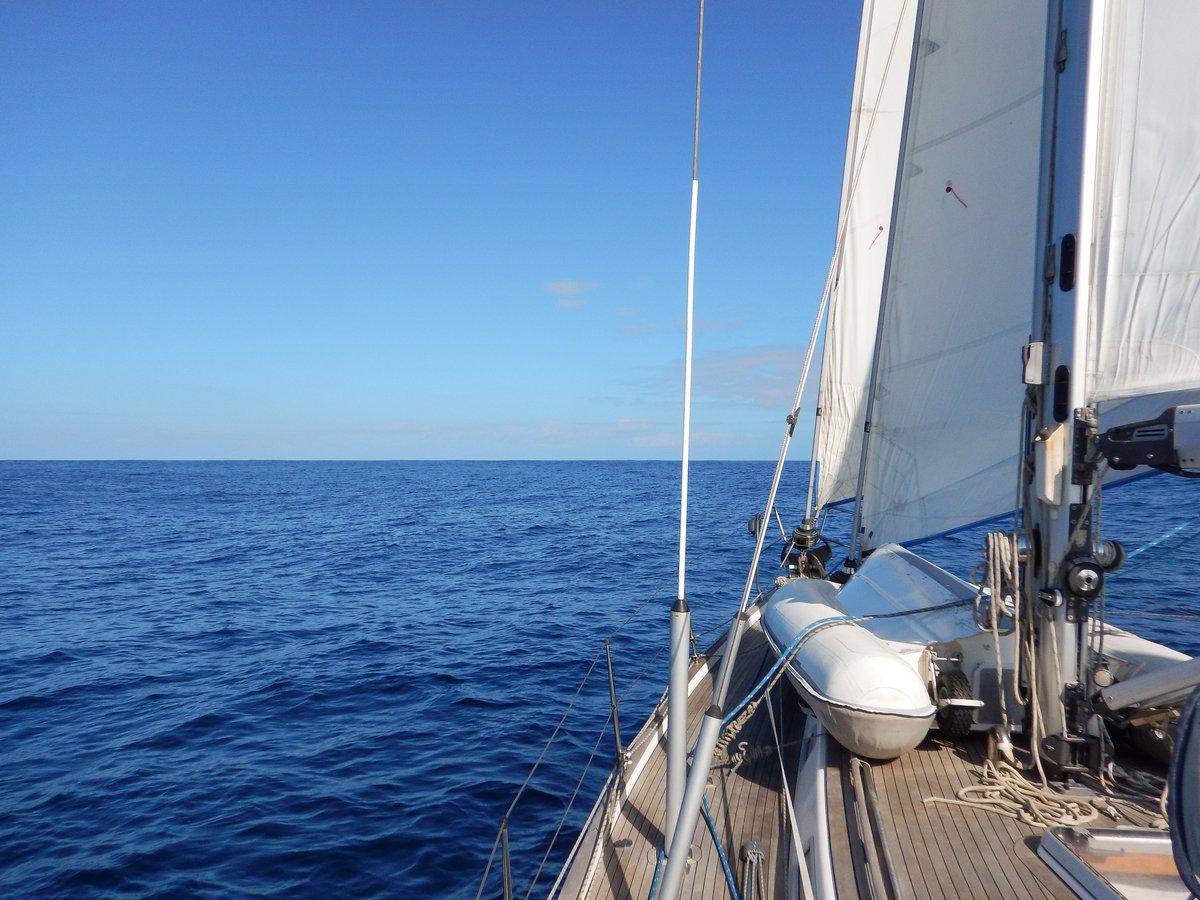
Unfortunately, the wind remained very light and Glenys had to start the engine again at 07:00. We’ve made fairly good progress in these fickle winds, doing 205 miles since we left Luderitz, which is an average of 4.6 knots. However, we’ve had to run the engine for 30% of the time, which has helped our average speed. We’ve been running the engine at 1,600 rpm, which only uses 2 litres of diesel per hour, so I reckon that we have 457 litres left – 225 hours more motoring if we have to.
This morning’s 3-day weather forecast showed light winds today, but picking up to South 10 knots at sunset and increasing to South 20-25 knots by tomorrow morning. The wind should gradually decrease to South-west 15 knots by the 12th. It looks like we’ll be motoring/bobbing along today and then have good sailing conditions for the next 3 days.
It’s been getting dark at 20:00 and dawn is not until 07:00, so we decided to put the clocks back an hour – if the sun comes up at 06:00, it makes Glenys’s 4-7 watch a bit more pleasant. We’ll be crossing the Greenwich Meridian in a few days, which will put us directly south of the UK and we’ll be on UK time – perhaps a little celebration will be called for?
It was such a lovely morning that I felt motivated enough to do a couple of jobs. I ran the watermaker for 1½ hours to top up our water tanks – we’ve not run it for a couple of weeks, so I was glad that it worked without a hitch.
I wandered around the deck to check for chafe. Everything looks okay, but all the sails are dirty with Namibian grime and we’re getting black marks on the mainsail where it’s rubbed against the filthy spreaders and shrouds. I’m hoping that the water in the anchorage in St Helena is clean, so that we can make plenty of water to scrub the sails, wash the ropes and clean everything on deck.
I changed the lures on our fishing lines and put them out with our birds splashing behind the stern. We didn’t have any strikes. We should have been fishing over the last two days because there’s been lots of bird activity (meaning lots of fish), but as usual at the start of a passage, I couldn’t be bothered. Hopefully when we are sailing faster tomorrow, we’ll start catching something.
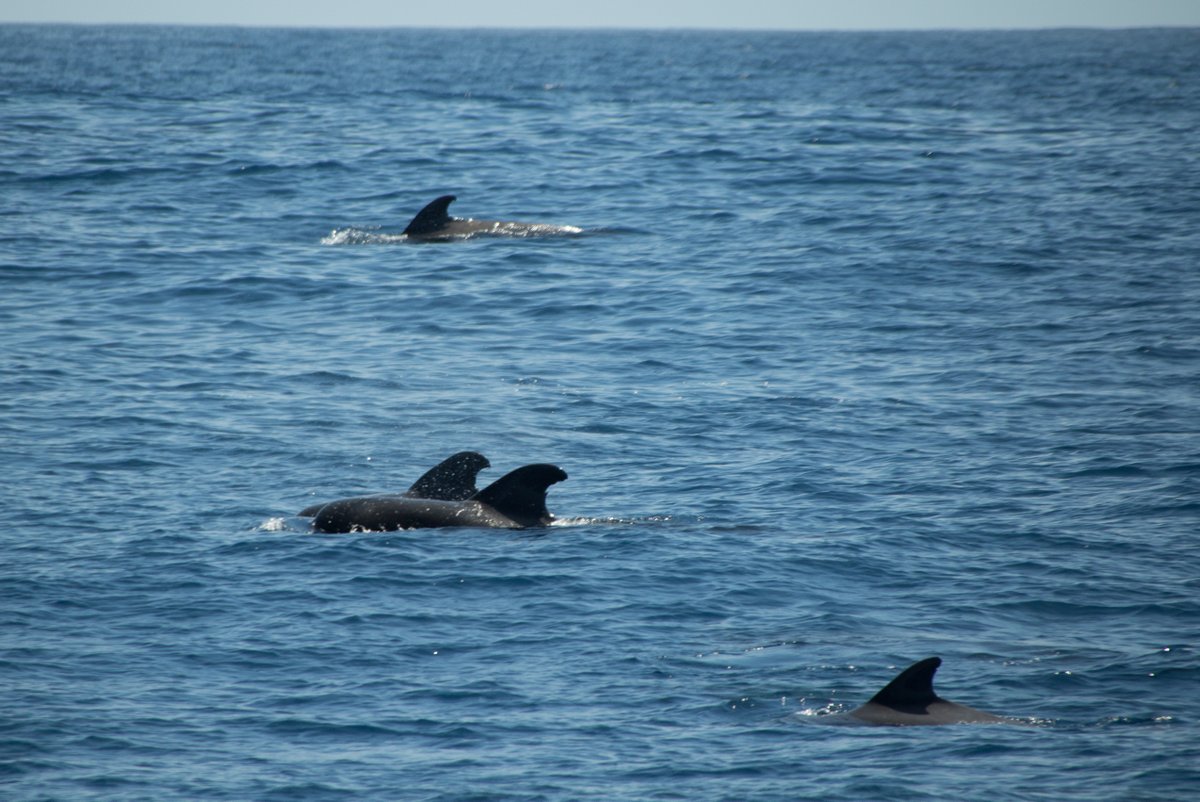
It remained nice and sunny all day and the wind was a little stronger than forecast, so we sailed more than expected, especially during the afternoon. We had a nice little encounter with a large pod of Short-finned Pilot Whales, but they didn’t hang around very long.
At 15:00, we were ripping along at 7 knots on a beam reach with a lovely 12 knot breeze. I thought that the stronger winds had arrived so, just before dinner, I put a reef in the main, only to have the wind die again an hour later - I shook the reef out and eventually had to start the engine. And then the wind came back; and then it went away; and then it came back - very frustrating.
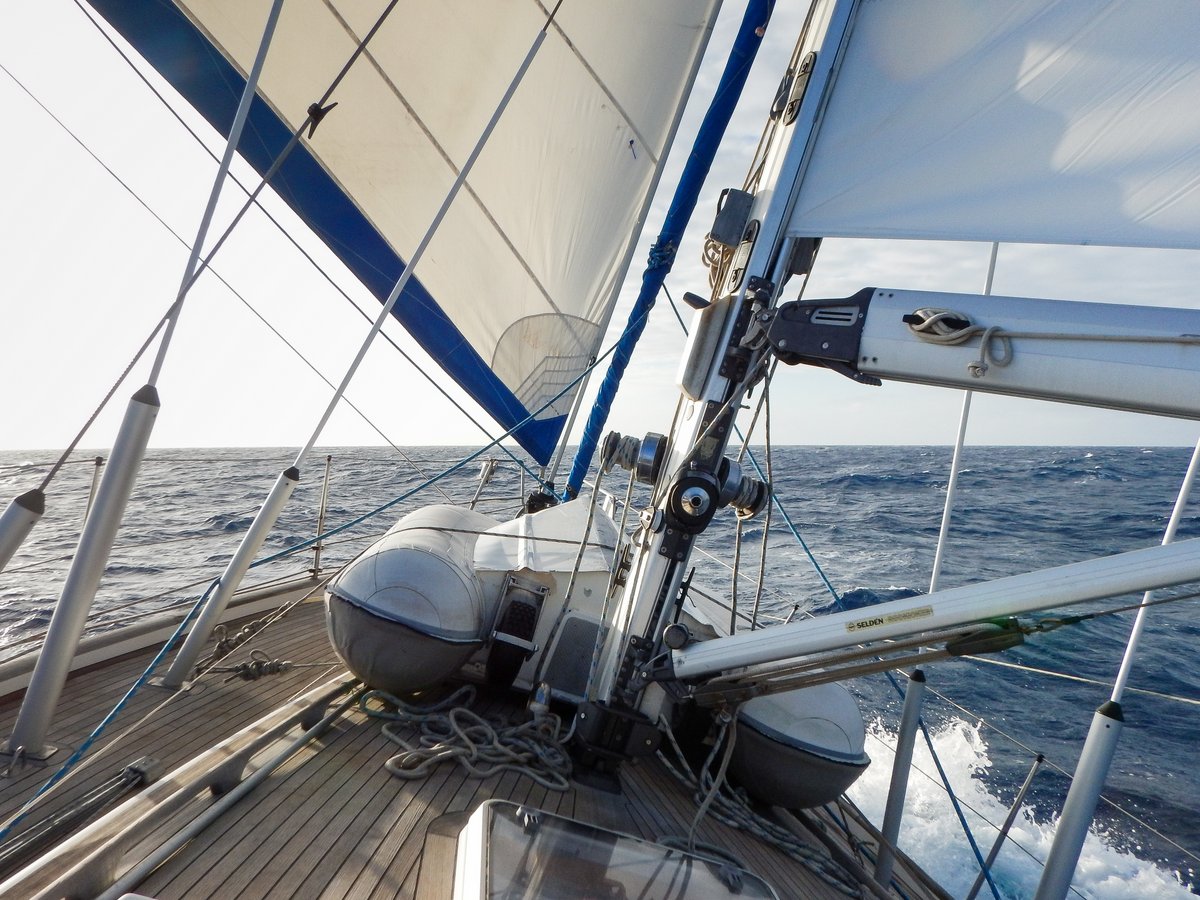
It wasn’t until after midnight that we settled down to 15 knots from the south-west. On my 1-4 watch, the wind backed to SSE and increased to 15-22 knots, so I put two reefs in the main and poled the genoa out to port. We rolled downwind for the remainder of the night doing 6.5 knots.
10 February 2018 Namibia to St Helena (Day 4)
There was much more cloud around in the morning, but the wind remained at SSE 15-22 - it was great sailing, but we were rolling madly. The weather forecast is for these winds to remain for 24 hours and then to drop slightly. It looks like 10-18 knot winds for the next three days, so we should make good progress.
The sea temperature has risen by another couple of degrees to 18.5°C - the water is definitely getting more Tropical because we started to see Flying Fish today.
We received a few emails from family via our satellite phone – it’s great to know that we’re so easily in touch with people ashore. Our son Craig, asked me for some advice on investing some savings that he’s accumulated – it seemed very surreal to be writing to him about UK tax, Pensions and ISAs when we’re in the middle of the South Atlantic Ocean.
The SSE 15-25 knot winds stayed with us all day – at times we were surfing at 8 knots. In the late afternoon, we skirted around a huge submerged mountain called Ewing Seamount, which rises from the sea bed at 4,500 metres up to a peak at 850 metres. Although there was no danger of hitting it, we were a little wary of encountering confused seas and large waves where the prevailing north-west-setting Buenguela current is deflected up the steep slopes.
Before dinner, I chatted to Stefan from “Sabir” on the SSB radio. They left 24 hours before us and had a very bouncy start to their passage with big 3 metre seas – totally different to our rather calm start. They’re north of our rhumb line and only 40 miles ahead of us, so we’re slowly catching them up.

At sunset, I rolled away the mainsail and we ran down-wind with just the genoa poled out to port. It was a dark, rolly night, with no surprises, apart from two Flying Fish who flew onto our deck. I managed to grab both of the smelly beasts and return them to the sea while they were still alive.
11 February 2018 Namibia to St Helena (Day 5)
The wind slowly dropped overnight and at dawn, we had SE 10-15 knots with blue skies. Unfortunately, a bank of clouds soon overtook us and we had our first light shower at 09:00. Clouds always cause trouble when sailing. These didn’t have any strong squalls, but the wind was veering all over the place and changing in strength from 5 knots to 15 knots as showers went past.
We pulled out the mainsail; we pulled out the staysail; we rolled the staysail away; we reefed the mainsail; we gybed the genoa; we gybed the genoa back; we pulled out the mainsail reefs. By midday, the sun had come out, but all afternoon, we had to keep making 30° course corrections to avoid gybing as the wind veered about.
The weather forecast for the next few days shows 8-15 knot south-east winds, which should be nice as long as the clouds bugger off. Yesterday, we had a good run of 158 miles and the water temperature is still rising – it’s now 20°C, which is nearly warm enough to go swimming.
During the morning, the snap shackle at the end of the boom sheared. The genoa sheet runs through this block to minimise chafe on the rope. This is the second one that has failed since we left Cape Town and it failed in the same way. A stainless steel bolt joins the block to the phosphor bronze shackle and the threads have stripped in the shackle – I guess that it’s long term galvanic corrosion. I bought both snap shackles seven years ago, so they’ve had a good life.
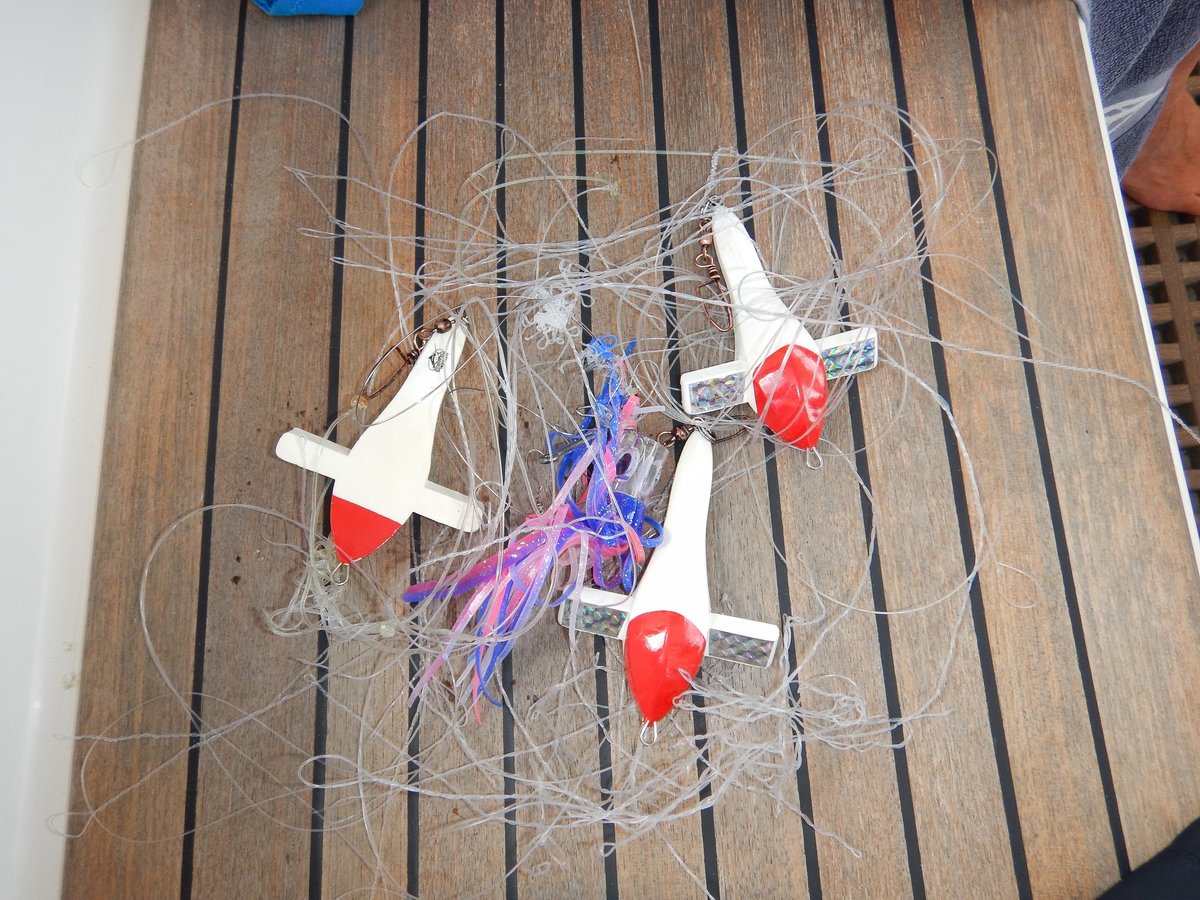
We’re not having any luck fishing. I put two fishing lines out on either side of our stern and I had our three birds set up on a 15 metre line in the middle . The birds are little aeroplane-looking devices, which bounce along on the surface making lots of splashing, which is supposed to attract fish.
Unfortunately, while we’ve been veering about, the birds became tangled with one of the fishing lines and knotted themselves together with 40 metres of fishing line; 2 metres of wire trace and the lure. It was a right mess and took me 20 minutes to cut it all apart to rescue the lure.
For dinner, Glenys made Navarin of Lamb, which she served with pomme de terre and petit pois – how does she do it? After dark, the weather settled down and we had a fabulous sail all night with 15 knots of wind, rolling gently downwind at 6-7 knots. Unfortunately, we’re near the end of the moon’s cycle, so it was a dark night, but the stars were spectacular.
12 February 2018 Namibia to St Helena (Day 6)
Dawn brought us 80% cloud cover and gentle 1.5 metre seas. The 10-15 knot south-east winds put us sailing dead downwind wing-on-wing doing a comfortable 6 knots – it doesn’t get much better than this. The weather forecast shows similar conditions for the next four days – fingers crossed.
I was very excited at 08:00, when I spotted the red and white spinnaker of “Sabir” on the horizon. After five days of seeing nothing, I finally had a mission – intercept “Sabir” and take a photo. Glenys didn’t share my joy at the chase and went to bed.
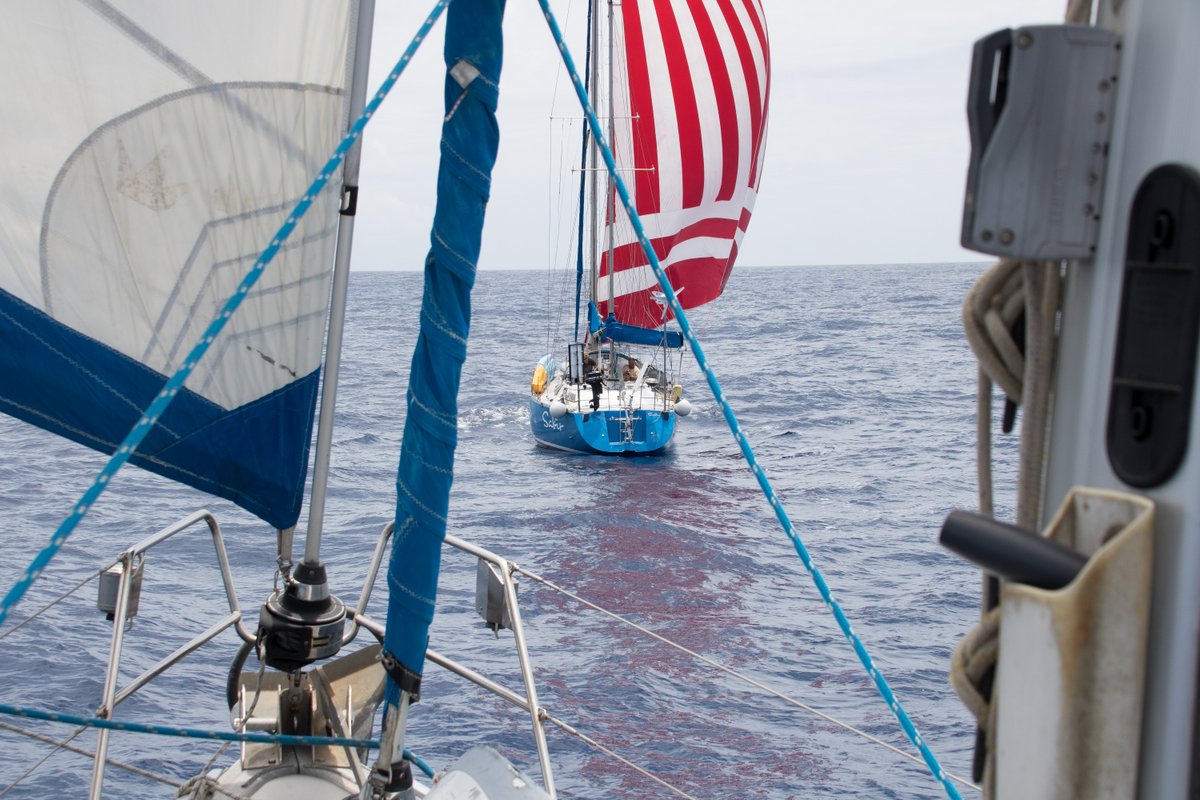
“Sabir” were about 3 miles north of us, so I had to gybe the mainsail and turn 40 degrees to starboard. It took me an hour to get onto their track, where I gybed back on course and the downwind chase began.
Unfortunately, the wind dropped, so we were only doing 3-4 knots and only going ½ knot faster than them, so it took 4 hours to catch up. We slowly sailed within 20 metres; shouted out greetings; had an obligatory photo session and remorselessly drifted off ahead of them – we’ll see them again in 5 or 6 days’ time.
We passed the halfway point to St Helena, so Glenys produced some fruit cake as a celebration. It was a very calm afternoon, so we ran the watermaker and Glenys washed a few smalls. I popped off to bed for my afternoon nap and Glenys landed a small Dorado, which we had for dinner.
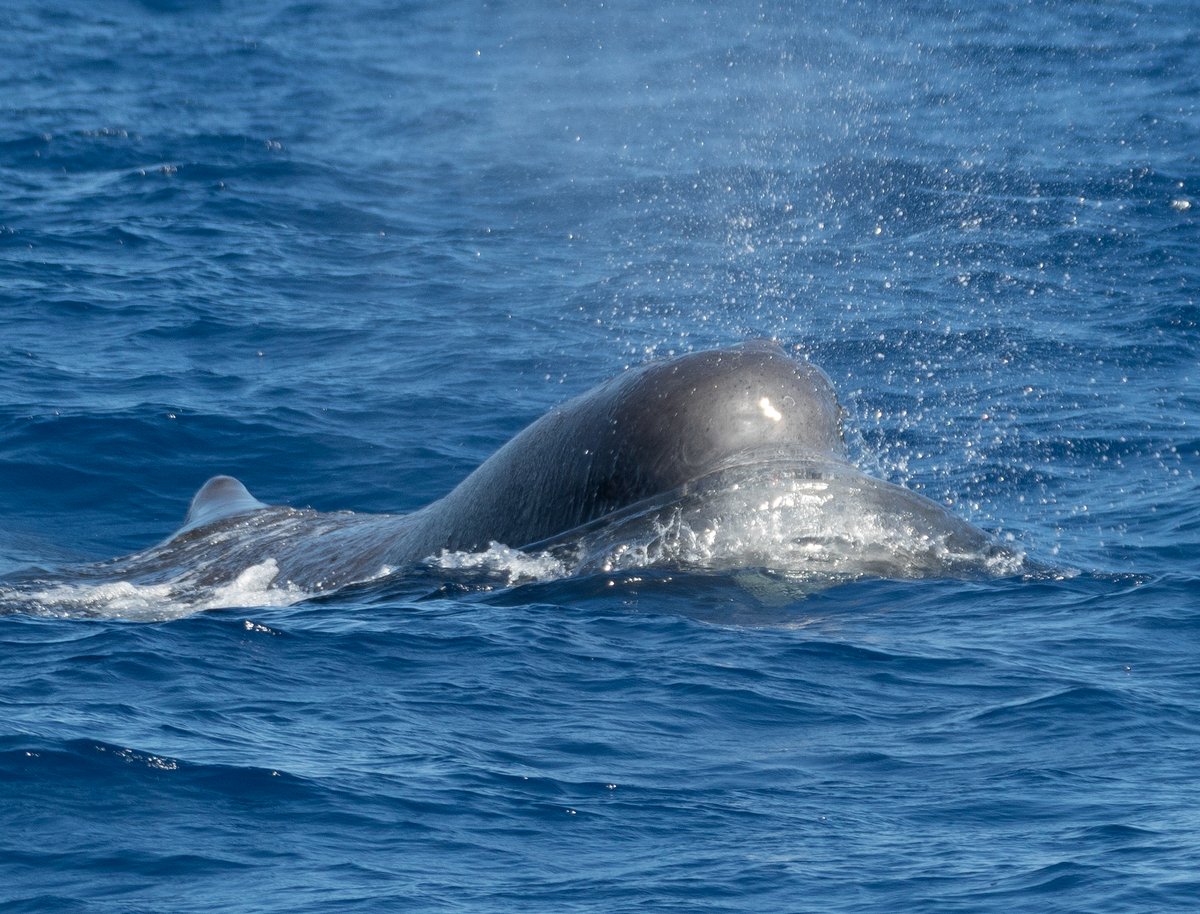
I was dragged out of bed after an hour, when Glenys spotted a Sperm Whale at the side of Alba. We reckon that it was nearly as long as our boat, maybe 10-12 metres, and it followed us for five minutes before going off to do whale things. I did a bit of reading on Sperm Whale behaviour and I think that it was a male – females travel in family groups with their calves and males are kicked out when they reach maturity.
The 8-15 knot winds continued after sunset giving us pleasant sailing conditions all night.
13 February 2018 Namibia to St Helena (Day 7)
The fabulous sailing conditions continued through to dawn and then lasted all the day. The forecast is for this good weather to last for another three days, which is great. At my 07:00 progress check this morning, we’d covered 140 miles in the last 24 hours and had 550 miles to go. If this weather keeps up, we’ll arrive on Saturday 17th – only 4 more nights to go.
Despite the benign sailing conditions, we’re both feeling a little weary because of the constant three hourly interruptions to our sleeping patterns. We’re sleeping more during the day now – Glenys has at least three hours in the morning and I have the same in the afternoon. It doesn’t help that the motion of the boat is so soporific.
The sea temperature has stabilised at 21°C and it’s pleasantly warm during the day, so I’m hoping that we’ll be able to go snorkelling in St Helena. We’ve not been in the water since leaving Madagascar in October last year.
Alas, we’ve had no luck with the fishing today, but we only had one lure out. I’ll get motivated tomorrow and stick out another line. With no fresh fish on the table, Glenys dug out a tin of salmon and made a very tasty Salmon Lasagne for dinner.
Once again, the 10-15 knot winds continued after sunset giving us mostly pleasant sailing conditions. The clouds built up on my 1-4 watch and we had a heavy shower giving us 20 knots of wind – not a problem, but the weather is getting more tropical and we’ll have to be more wary of strong squalls as we get further north towards the equator.
We were attacked by Flying Fish during the night. They look lovely with their silvery blue wings glinting in the tropical sun as they glide above the waves. However, they are very slimy and stink to high heaven. Several times, we heard a big thump as an 8 inch fish hit the coach roof at 30 miles per hour. They then flail around, shedding scales, desperate to get back in the water. By the time we’ve grabbed it and thrown it overboard our hands are covered in stinking slime.

One hit the windscreen, giving me a right old scare and another hit the cockpit coaming, so hard that it ricocheted over into the cockpit and proceeded to flail about on the seat. I tried to grab it, but it flipped onto the cockpit floor. I tried to grab it again, but it flopped towards the companionway way. Panic - if it got down below, it would cause chaos. Fortunately, I managed to grab it with two hands and heave it overboard.
14 February 2018 Namibia to St Helena (Day 8)
It looks like we’ll have good wind today and tomorrow, but the 16th and 17th are forecast to have light 5 knot winds - I guess that we’ll be motoring into St Helena on the 17th. Only 3 nights to go.
At 10:29 UTC, we crossed the Greenwich Meridian, so we’re now in the Western hemisphere, directly south of our families in the UK. Perhaps we were feeling a little homesick, but we’ve finally decided that we’ll leave the boat in Trinidad for the hurricane season and fly back to the UK for three months in July, returning to Trinidad in October.
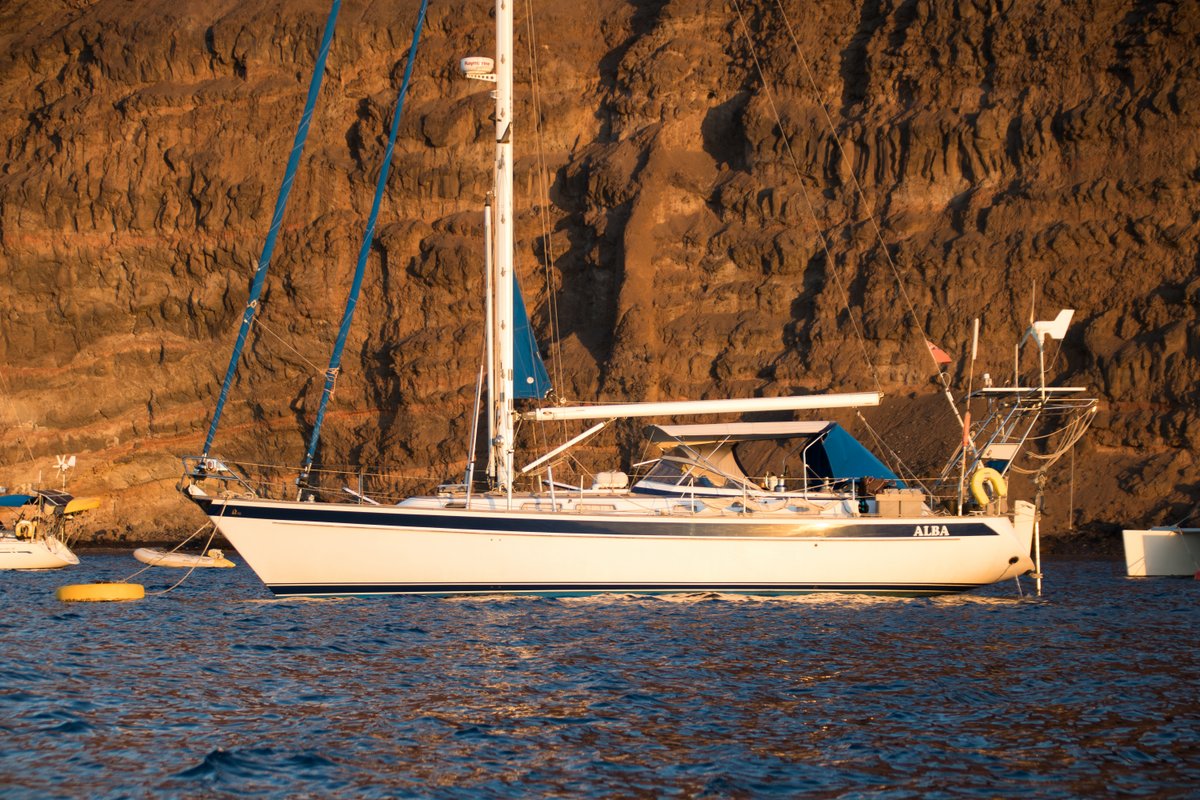
We’re going to put Alba up for sale privately and if she sells, we’ll move back to the UK. If she doesn’t sell, then next year, we’ll cruise up through the West Indies & the Bahamas to the east coast of the USA. Our current plan is to leave the boat for sale with the Hallberg Rassy dealer in Annapolis in September 2019. We haven’t paid UK VAT on the boat, so if we sell Alba in Europe, it will cost us 25% tax whereas the import duty into the USA is only 1.5% + fees. (See www.yachtalba.com for boat details.)

Just before lunch, we spotted a set of sails on the horizon ahead of us. We weren’t picking up their AIS position, so we didn’t know who they were, but we altered course slightly and gave chase. It took us 5 hours to get level with them, but it was approaching sunset, so we didn’t want to get too close.
We chatted to them on the VHF radio and found out that the boat is “Jomaro”. We met Jos, Yamille and their little girl Isabella briefly in Luderitz - they left with “Sabir”, 24 hours before us. They are a 53 foot Amel, so I’m very surprised that we’ve managed to overtake them – we must be doing something right for a change.
We put out two fishing lines in the morning and didn’t hear a whisper from either line, but when I pulled in one of the lures, the stainless steel leader was in knots, so something has had a go at it. I remade the lure and sharpened the hook, ready to catch a big one tomorrow.
It was another idyllic day, gliding downwind with 10-15 knots of wind doing 5.5 to 6.5 knots in comfortable 1 metre waves. Overnight, it wasn’t quite as good because the wind dropped a few knots, which was enough to make us roll every so often, making the sails slat and dropping our speed down to 4 to 5 knots.
15 February 2018 Namibia to St Helena (Day 9)
The wind was a little fickle first thing in the morning, but the breeze filled in nicely and by 09:00, we were back to 10-15 knots and doing 5 to 6 knots, with blue skies. Glorious. At 07:00, we only had 260 miles to go, so we should get in the day after tomorrow. The forecast is still for the wind to drop tomorrow, but fingers crossed, we’ll still be able to sail.

Having passed the Greenwich Meridian yesterday, we put our clocks back one hour after breakfast – we’re now on Greenwich Mean Time.
I put out our fishing lines and, ten minutes later, was rewarded by a small Dorado. It was soon dispatched and filleted ready for dinner. Later in the afternoon, we caught another couple of small Dorado at the same time – we must have passed close to a shoal of them. All three fish that we caught today were small females with roe – we really must find some pleasant way of eating the fish eggs.
As usual, we’ve been eating well this trip. For breakfast, we’ve been having fruit and yoghurt followed by cereal with granola and raisins, although the yoghurt ran out after day 6.
Lunch was sandwiches for the first four days until the bread ran out. Since then we’ve been having flour tortillas, which are great because the vacuum packed ones will last for several months. Glenys has been converting the left-overs from evening meals into a curry filling to make a Roti or stuffing the tortillas with fried fish with salsa or ham & cream cheese with tomatoes.
For dinner, we’ve had Cassoulet; Beef Chili with Rice; Navarin of Lamb with Vegetables; Dorado in Peanut Sauce with Rice; Fried Rice with Chorizo; Salmon Lasagne; Dorado & Chips; and Dorado Catalan with Rice.
The wind gradually dropped during the afternoon and past sunset but we were able to maintain at least 4 knots boat speed. At 01:00, the wind started to veer about and I gybed the genoa a few times, but then the wind dropped below 5 knots. It was pitch black so I couldn’t see, but I was hoping that this was a local cloud bank causing the problem. However, after 20 minutes of slatting sails and drifting, I had to turn on the engine.
An hour later, the wind came back – it was some damn cloud system causing the squirrely winds. Thankfully, we had steady winds until dawn, averaging 4.5 knots boat speed.
16 February 2018 Namibia to St Helena (Day 10)
At 07:00, we had 135 miles to go, which if we can maintain an average of 5 knots, puts us in Jamestown tomorrow morning. The forecast was for light winds this afternoon and evening, but we might have a chance at sailing after midnight. I emailed the Harbour Master and told him that we’d be arriving at midday.
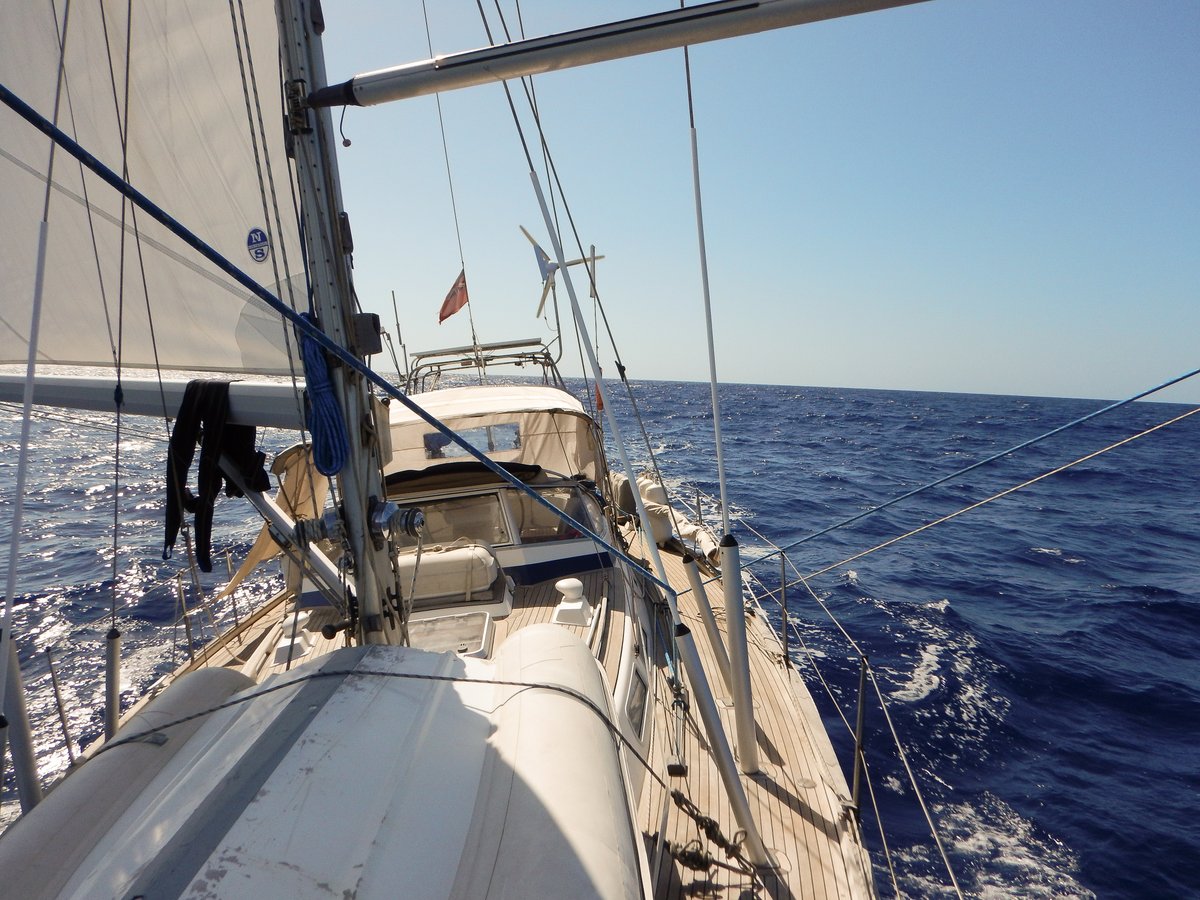
As forecast, the wind slowly died during the morning, but the sea was calm, so we managed to bob along under sail. We took advantage of the calm conditions to run the generator and watermaker for 90 minutes and our water tanks are now brimming full.
By 11:00, the wind fell below 5 knots, so I had to turn on the engine and we started motor-sailing. A small Dorado took one of our lines at lunchtime and briefly interrupted our meal of Fish Tortillas – eat one, catch one, the sustainable way. Later in the afternoon, we caught a larger, male Dorado – about 6 lb.
In the evening, I chatted to Stefan on “Sabir” who are now 80 miles behind us and also motor-sailing. They’re aiming to get in early on the 18th. I don’t know where “Jomaro” are, but they should be in late tomorrow.
The wind slowly picked up after dark and I was able to get sailing again at 20:00. By the time Glenys came on watch at 22:00, we were on a beam reach with 8-10 knots of wind doing 5 to 6 knots.
At our 01:00 watch change, we were 38 miles from the south-east coast of St Helena and could just make out red and white lights on the horizon. I wasn’t sure if it was the island or a fishing fleet without AIS, but flicking on the radar showed no targets within 32 miles. The strange red lights seem to be a series of warning beacons on the hills around the new airport, which is on the North-east corner of the island.
17 February 2018 Namibia to St Helena (Day 11)
At dawn, we were only 15 miles away from St Helena and could see the flat-topped, rugged island shrouded by clouds - very exciting. As we sailed closer, the island looked very bleak with huge cliffs soaring up from the sea. The clouds continued to hide the tops of the hills, but occasionally a flash of green would peek out high on the island, showing signs of cultivation.
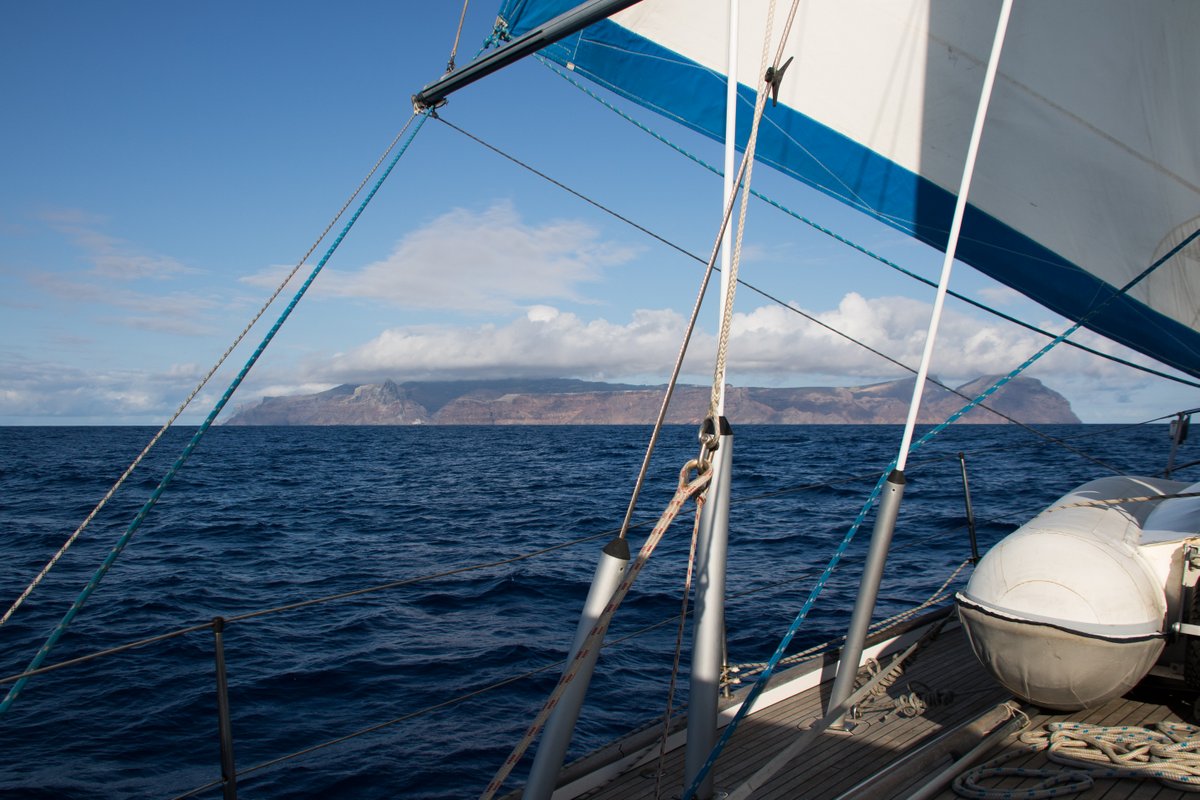
We sailed within a half a mile of the north-east corner of St Helena and then maintained our distance off the cliffs. For a change, the wind chased us around the island and we were able to sail to within ½ mile of the mooring field at Jamestown. On the approaches to the town, we could see old fortifications built into the cliffs defending the town.
Glenys and I always play a little game when approaching a new anchorage, trying to guess how many other cruisers will already be there. My guess of ten was much closer than Glenys’ six because there were already eleven boats swinging on the moorings.
The moorings are rubber-covered, 5 foot diameter disks, with a huge 8” diameter steel ring lying flat on the top of the mooring. There are no nice rope pennants to pick up with a boat hook, so we were fortunate that a French guy from “Altera” came over in his dinghy and threaded my two mooring lines through the ring. We were settled by 10:30.
I called Port Control on Ch14 and they said that we could either come in to clear at 11:00 or 15:00 this afternoon, so we elected to go in straight away. I called for the Ferry Boat on Ch16 and he said that he’d pick us up at 11:00. We were grateful that we’d put fenders down on one side of Alba because the rough ferry boat doesn’t have any fenders. The charge for the ferry is £2 per person per return trip.
David in Port Control was waiting for us in a white building on the dockside (the one with a clock). He took us into the Customs office, where two chatty ladies helped us to quickly fill in a form. We filled in another form for Port Control and paid over £35 in Port Duties. David then directed us to the Police Station where we completed the Immigration forms. On Monday morning, we have to go to the Immigration office in town to get our passports stamped. We were done and dusted by 12:00.
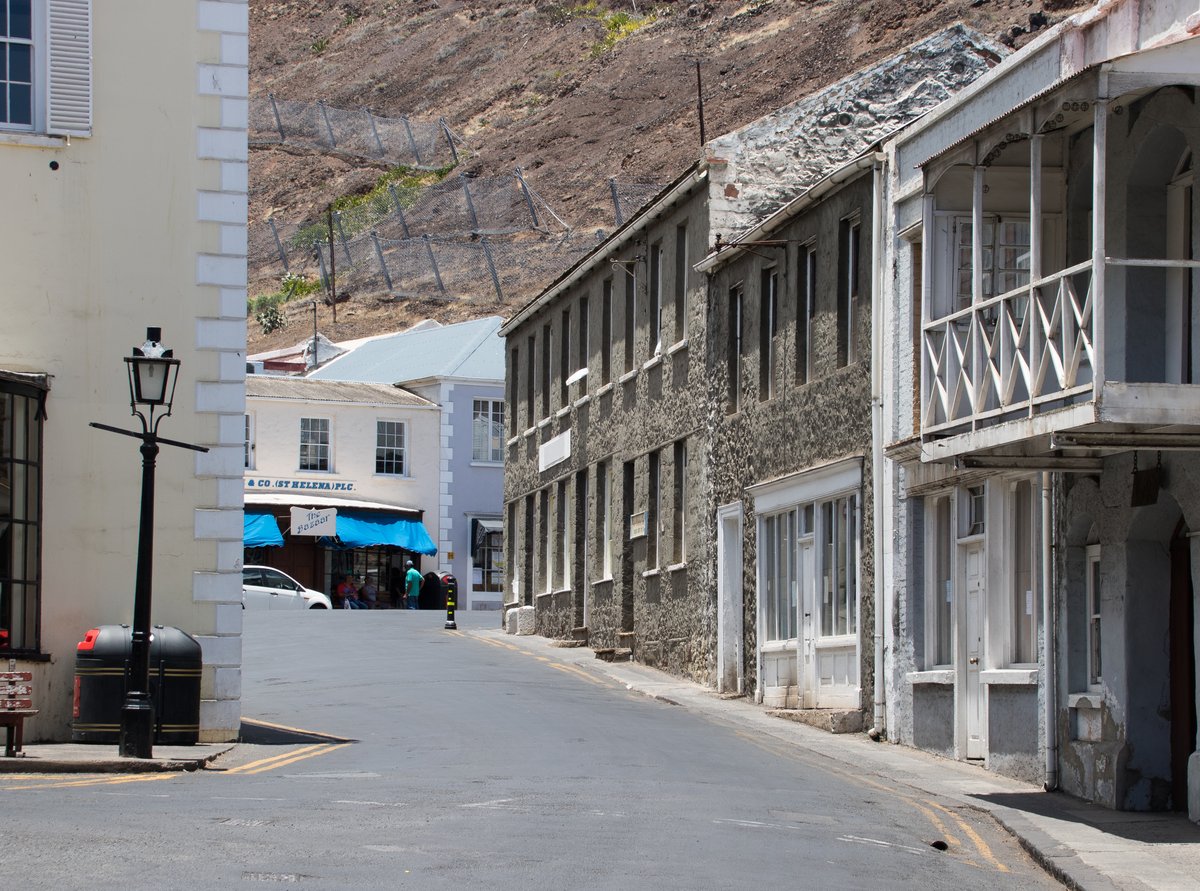
My first impressions are that I love the place. Jamestown is tucked into a narrow valley with very steep rocky slopes reaching hundreds of feet above the town. We entered through an arched gate in the defensive wall stretching across the mouth of the valley. Once inside the fortifications, the buildings along the winding streets look to be centuries old. We can’t wait to explore the island.
Everyone is very friendly. The islanders call themselves the “Saints” and they are fairly dark skinned with round faces, from a melting pot of descendants, including freed African slaves, Indian indentured workers, English immigrants, Chinese immigrants, not to mention the huge number of sailors who visited the islands in the 1800s. Amongst themselves, they speak their own language and when speaking English, they have an old-world west country accent, which you can easily imagine comes from the 18th century sailors.
We wandered around for a little while, bought a couple of loaves of brown bread and retired to Anne’s Restaurant, which is inside the lovely little park. Mark & Ron from “Beguine” were already seated in the airy restaurant, so we joined them. They’ve been here for a week and gave us some hints and tips. After a couple of beers and fishcake burgers, we retired back to Alba for a well-earned afternoon nap. We had an early night.
18 February 2018 Jamestown, St Helena
We had a bit of a lie-in and then pottered about getting the dinghy in the water. When we arrived, we looped two mooring lines through the large 8 inch steel ring on the mooring buoy. The ring is rusted and rough and would soon wear through the ropes, so I tied the ropes directly to the ring to prevent chafe.
It didn’t take long to tidy up after our 10 day passage and I’ve written a to-do-list to repair the few things that have gone wrong. We also started our campaign to wash the 20+ ropes that are filthy with desert sand.

At 11:00, we caught the ferry boat and went into town. Being a Sunday, it was very quiet, so we took the opportunity to stroll around the place and take some pictures of the architecture. Most of the fortified town was built in the 1860’s and reminds me of some coastal towns in North Wales. The buildings have thick walls and the narrow streets are contoured to the steep sided valley.
We tackled Jacob’s Ladder. This is a very steep set of concrete stairs, which used to be a funicular railway to deliver goods to Half Tree Hollow, the residential community high above Jamestown. There are 699 steps and they are big 9 inch steps, which makes it a tough climb. Glenys set off first and made it to the top before me, but of course I had to keep stopping to take photographs. There’s a great view of Jamestown nestled in the valley below.
At the top of the steps, there are the remains of a fort giving a fine view of the coast and the yacht mooring field far below. You can also clearly see the wreck of the Papanui, a cargo ship that caught fire and sunk in front of the town’s sea wall in 1911.
We wandered up to Rosie’s Restaurant, which is about 200m straight up the hill from the top of Jacob’s Ladder. Unfortunately, they were closed. They don’t open until 14:00 on a Sunday and we didn’t want to wait for 45 minutes. (They are open from 11:00 until late on Tuesdays to Saturdays, but closed all day on Monday.) We chatted to Rosie, who told us that business was slow - they just don’t get enough tourists.
By this time we were starving, so we scurried down the 699 steps and went to the Consulate Hotel to see if they were serving lunch. The place was deserted and they don’t do any meals for non-residents, but they do have a café serving drinks and cakes. We started chatting to the owner, Hazel, and decided to stop for a cold drink and a slice of her delicious carrot cake (which she gave us for free!)

Hazel told us the saga of the airport. The UK Government subsidises St Helena with millions of pounds each year. The only way to get to St Helena used to be on the Royal Mail Ship, RMS St Helena, but the ship was getting very old and expensive to run (the subsidy was £3 million per year), so they wanted to retire the ship. The last voyage was only one week ago – it was a shame that we just missed the farewell celebrations.
Someone decided that it would be a good investment to build a new airport capable of taking long distance jets and bring tourists in by air. The plan was for one or two big jets per week and the economic forecast was that the island would be self-sustaining with tourism within ten years. The airport was built at great expense to the UK tax payer and the locals started to ramp up their businesses in preparation for the influx of tourists. The runway was finished in 2017.
Unfortunately, there’s a problem with cross winds and turbulence on the runway, which is built on top of huge cliffs on the North-east corner of the island. The prevailing winds howl along the runway and drop off the cliff at the end causing massive eddies and turbulence. So instead of being able to make a normal approach and use the full length of the runway, planes have to descend steeply over the top of the turbulence and land in the end half of the runway.
At the moment, only smaller jets (Embraer E190) are able to land at St Helena. Tourists can now fly in from Johannesburg on the single flight each week. The plane is mostly taken up by locals flying to and from St Helena, so there are only 15 or so tourists arriving on the island each week - it’s a financial disaster for the local tourist businesses. Hazel tells us that the Consulate Hotel has 18 rooms and at the moment is only filling 2 or 3 each week.
19 February 2018 Jamestown, St Helena
Being a Monday, we went into town to sort out a few things. We exchanged money at the Bank of St Helena - a tiny little building. They charge 5% to give cash on a Credit Card, so instead, we exchanged our left-over South African Rand and $500 US dollars from our emergency cash. St Helena Pounds are not exchangeable anywhere else in the world, so any money that we have left, we’ll have to change back into British Pounds before we leave.
We called in at the Tourist Office and picked up a few brochures on tours and tourist attractions on the island. The Post Office is next to the Tourist Office, so we called in. Postage stamps of St Helena have always been popular amongst stamp collectors and I can remember having some colourful stamps in my school boy collection. Glenys bought some postcards to send to family and I bought some first day covers, showing the now decommissioned RMS St Helena and the new airport.

Immigration were our next stop, where we had our passports stamped and paid £14 for the privilege. After eating some sandwiches in the pleasant park, we sat in the Consulate Hotel, bought an hour’s worth of Internet for £6.50 and caught up with our emails. The internet is not too bad considering that it all comes via satellite - we’ve seen worse.
Back at Alba, we went snorkelling on the wreck of the Papanui. The wreck has been flattened over time, but there’s a lot of sea life and it’s great to be back in the water taking photos. I messed up most of my pictures because I accidently changed the shutter speed to 1/40th , which made everything blurred. It was a beginner’s mistake because I didn’t keep checking the settings, but I got a reasonable picture of a St Helena Butterflyfish and a very well camouflaged Scorpionfish .


20 February 2018 Jamestown, St Helena
James from “Carpe Diem” (who we met 4 years ago in the Marquesas), was born on St Helena and has set up St Helena Yacht Services. He arranged for the yachts in the mooring field to get diesel. It was all very simple with a boat coming alongside and pumping the fuel through a normal filling hose. I only needed 75 litres, confirming that we only use 2 litres per hour when motoring at 1500-1600 rpm.
When we’d all filled up with fuel, eight cruisers went out on “Carpe Diem” to look for Whale Sharks. There are three established boat operators who take people out to snorkel with Whale Sharks and I was a little sceptical about James’ ability to match their success rate in his 38 foot sailing yacht. However, it only cost £20 per person, so I went along with the flow and it proved to be a very good three hour trip.
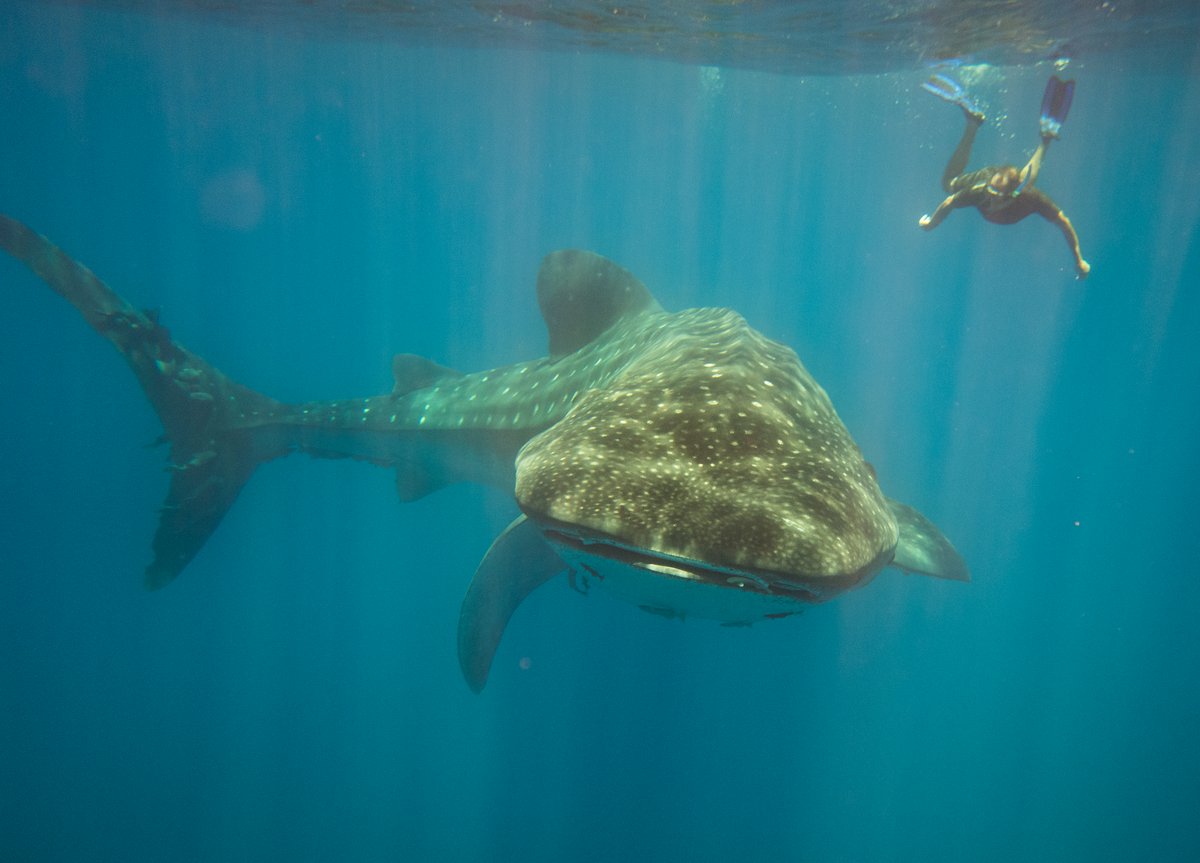
We snorkelled with 4 or 5 individual Whale Sharks, which are 10-15 metre long. James dropped us off alongside the huge creatures and we got very close to some of them, as they swam slowly along, 3-10 metres below the surface. Their tails are 10 foot high and their mouths are 1.5 metres wide – more than enough to swallow a man. Fortunately, the Whales Sharks are plankton eaters and move very slowly, so there is very little danger.
The weather was overcast and the water was slightly cloudy, so photography was a challenge, but I snapped a few photos and enjoyed being in the water with these gentle giants.
Later in the afternoon, I jumped on the ferry boat and nipped into town to use the Internet. The ferry is a little expensive at £2 per return trip, but it’s interesting to chat to Paul, the driver. Today, there was quite a swell at the landing dock, so I was glad that I didn’t have to worry about my dinghy being damaged against the concrete dock. A couple of cruisers are taking their own dinghies to the dock, but then have to mess about with anchors and long shore lines.
I checked the weather forecast and there’s a 2 metre Northern swell coming in on the 24th or 25th. Known locally as North Rollers, I’m told that these waves directly hit the shoreline at Jamestown and intensify when they hit the shallower water. It looks like the swell will be here for 3 or 4 days, making the mooring field very rolly and it will be very difficult or even impossible to get ashore. We’re not sure whether to stay or leave.
21 February 2018 Jamestown, St Helena
Together with “Jomaro”, we went on a island tour with Robert Peters, who is 82 years old and a real nice guy. He calls his tour “History on Wheels” and he drove us around the island, telling us about both the history and more recent tales about St Helena.

Our first couple of stops were about Napoleon. Following his defeat at the Battle of Waterloo in June 1815, Napoleon was transported to St Helena, arriving on the 15th October 1815. We were shown the small house at the top of Jamestown where Napoleon lived for 1 month until his permanent accommodation was completed. Longwood House used to be a barn, but was converted into a lovely house where Napoleon was incarcerated for 6 years until his death in Jun 1821. It’s now owned by the French government. Napoleon’s remains were relocated to France in 1840.
Robert took us to a place where we could see the airport runway. The UK government took 6 years and £300 million to build the runway – they had to level some hills and fill in a valley to make the runway long enough. It’s an impressive piece of civil engineering, but it’s easy to see how they get the turbulence on the approach.
The most striking thing about the island is the varied landscape. The coastline is mostly high rugged cliffs showing the island’s volcanic origins, but high on the hills, there’s lush vegetation and pasture land where cattle graze. In the 18th Century, much of the landscape was covered by a small tree called the Gumwood , but this indigenous tree was nearly wiped out by the indiscriminate release and grazing of goats. There are projects to re-introduce the Gumwood forests, which is now attracting birds like the colourful Madagascar Fody .


Flax plants were introduced in 1907 and the harvesting and production of Flax fibre was a major industry on the island. Although very poorly paid, the work was steady and several Flax mills were constructed. The major customer was the British Postal Service, who used Flax fibre to tie up bundles of mail.

Then in 1966, a British bureaucrat issued an edict that nylon twine would be used for the job and almost overnight the St Helena Flax industry was destroyed. Some of the highland slopes are still dominated by huge fields of Flax Plants . There is no incentive to replace the plants with anything else and at least the plants are minimising soil erosion.

We stopped at the Plantation House, which is a beautiful Georgian country house and is the Governor’s Residence. There are a few Giant Tortoises in the extensive grounds, one of which is called George and at 185 years old is said to be the oldest animal in the world. A short stop at High Knoll Fort completed our interesting day – a bargain for £15 each.

22 February 2018 Jamestown, St Helena
The North Rollers are definitely coming in. We’ve had mixed reports about how bad it will be. James from “Carpe Diem” says that it’s okay on the moorings, but one of the ferry boat drivers says that it’s mayhem with boats being pushed around everywhere. Most people agree that landing at the dock will be “challenging” or “impossible” for a few days and the local radio is advising people not to drive their cars on the sea front because of the danger of waves breaking over the sea wall.
We’ve seen most of what we wanted to see on St Helena. If we were in a nice protected anchorage, we’d probably stay for another week to do some of the many hikes inland; some more snorkelling; and maybe a scuba dive, but the prospect of being trapped on a rolling boat for several days is not very attractive and we’ve decided to leave on the 24th.
We were planning to visit Ascension Island, which is 500 miles north west of here, but the anchorage is not very good at the best of times and it’s badly affected by North Rollers. Talking to the locals here, they say that Ascension Island is slowly closing down – it’s no longer possible to buy any fuel on the island and there’s nothing to do. There’s also a problem with sharks, so nobody is allowed to swim. We’ve decided to give it a miss and go straight to Jacaré in Brazil which is 1,800 miles away.
Glenys went into town to do some provisioning – the locals said that vegetables come into town on Thursday morning, but Glenys couldn’t find anything special. The lack of fruit and vegetables is shocking. The islanders have become reliant on food coming in from South Africa on the RMS St Helena, but now that the ship has been retired, they are having to become more self sufficient. Unfortunately, it will take years before there will be sufficient locally grown produce.
Eggs are almost impossible to obtain because there has been a ban on importing eggs from South Africa due to worries about avian flu. Of course, it will take years for the locals to breed chickens and start to produce more eggs.
During our passage from Namibia, one of the gimbal studs on the cooker had sheared off, so I removed the cooker from the galley. It was a simple job to replace the stud - thankfully, I have some spares. I only replaced it five months ago, so I’m not sure why it had failed - perhaps the nuts behind had come loose? It took longer to clean everything than to do the repair.

Glenys removed the sprayhood to repair a three in tear that has appeared next to the zip. It was a simple repair because some stitching has perished and a seam had come undone. Most of the three hour job was unpicking some old velcro and tidying up the area to re-sew.
When she went to get her sewing machine from the locker under the front berth, Glenys discovered that two of the boxes of wine that we bought in South Africa had developed pin holes and leaked over everything below them. The sewing machine was okay because it’s in a substantial case, but there was mouldy red wine all over our rucksacks and cargo bags – yuk. This is a bit worrying because we thought that the bags inside the wine boxes were very tough and we have 40 litres of wine stowed in various places.
I popped into town in the afternoon to check the weather forecast and it looks good to leave in the 24th. I ordered two large brown loaves for tomorrow and then walked up to the hospital to buy a few over-the-counter medicines. The pharmacy was surprisingly cheap – I guess that it’s heavily subsidised.
23 February 2018 Jamestown, St Helena
The anchorage is has been really bouncy for the past two days with katabatic gusts and a 2 foot swell from the east – I wonder if this is a warning of the incoming 2 metre North Rollers. In between the gusts, I replaced the (now clean) genoa and staysail sheets.

We caught the 10:00 ferry boat and went into town to clear out. It only took 15 minutes to call in at Immigration; then pay our mooring fee at the Port Control (£13); and finally get the outward clearance from Customs - it’s probably the fastest clearance that we’ve ever done.
With time on our hands, we popped into the little town museum, which is free. It was a nice way to spend an hour or so and was very informative. At midday, we picked up the two brown loaves from “The Star” supermarket - I’m glad that I ordered them yesterday because all they had left on the shelves was limp, sliced white bread.
After a quick burger and chips at Anne’s restaurant, I went into the Consulate Hotel to do our last bit of internet, while Glenys went to the bank to exchange our remaining £70 of St Helena Pounds for British Pounds. The St Helena money cannot be changed anywhere other than on St Helena.
Unfortunately, there were 40 people queuing in the bank, so she gave up and came back. She asked the lady behind the bar in the Consulate Hotel and to our surprise, she had loads of British pounds and exchanged the lot for us, even the coins.
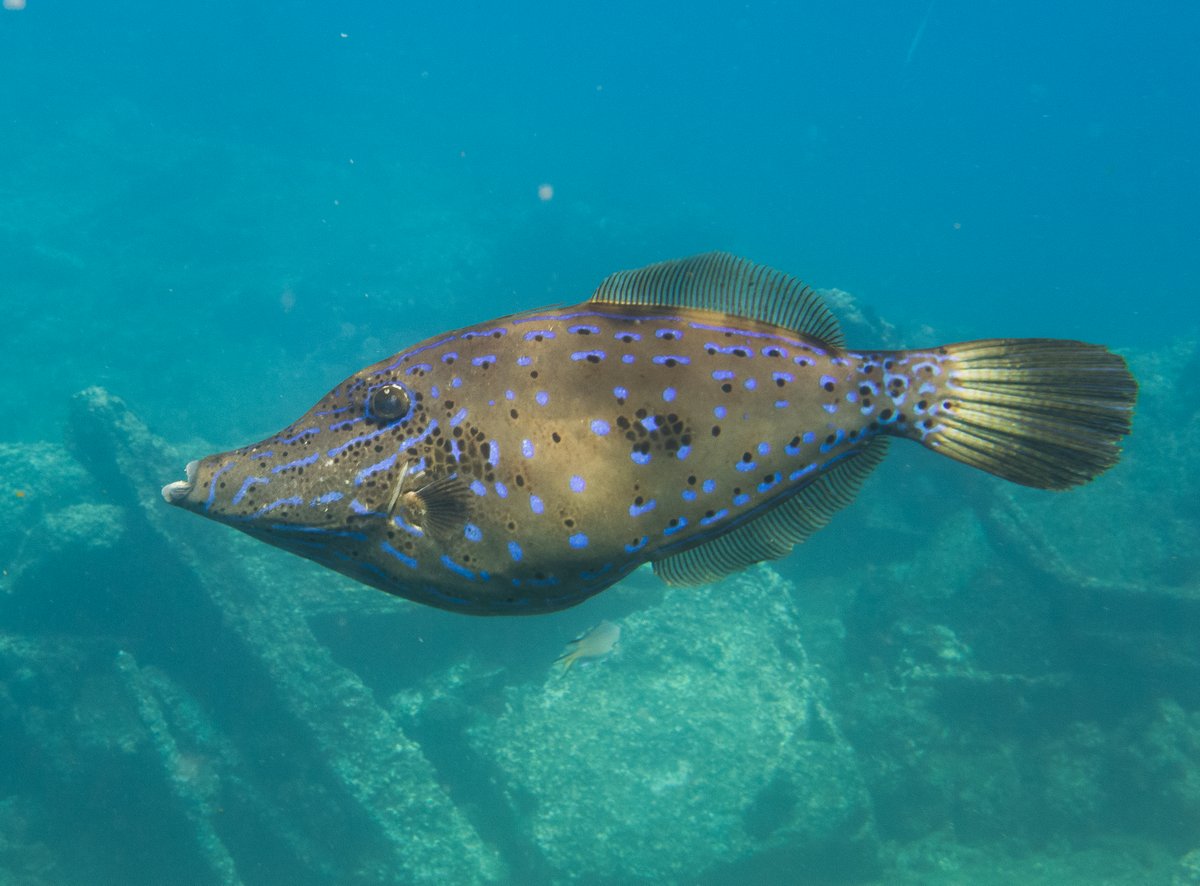
After catching the ferry back, I went for another snorkel on the wreck of the Papanui. I spent a pleasant hour free-diving and saw many Bearded Fireworms and a couple of Scrawled Filefish , but there was a lot of surge making photography a challenge.

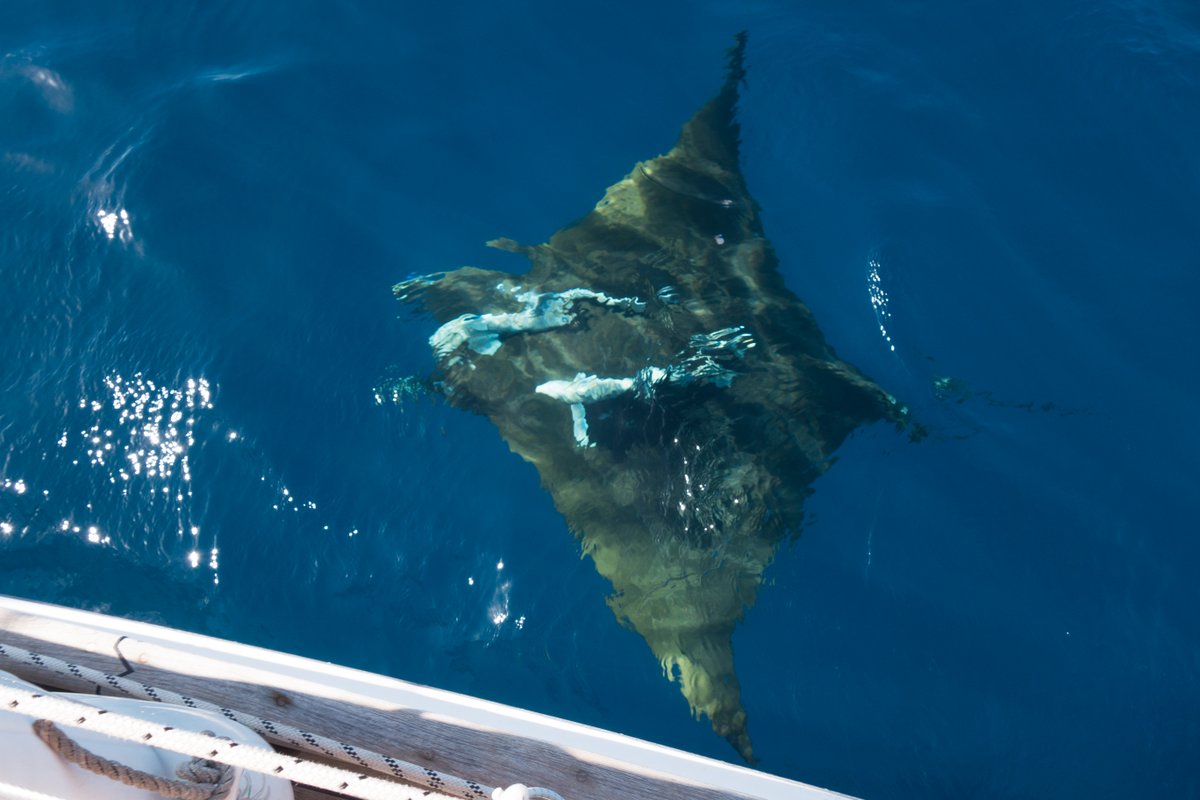
When I got back to Alba, I had a look at the bottom of the boat and found that the zinc on the propeller had wasted away completely – I fitted a new one in Richards Bay, only three months ago. I think that it’s eroded so fast because we’ve spent so much time in marinas in South Africa, probably with stray electrical currents. Unfortunately, I don’t have a new zinc, but found a partially worn one, which will be better than nothing.
After I’d had a lovely hot shower, a 5 foot wide Chilean Devil Ray swam around our boat for five minutes, but by the time that I’d got my camera and snorkelling gear out again, it had disappeared into the depths.
24 February 2018 St Helena to Brazil (Day 1)
After a lazy start to the morning, we pottered about getting the boat ready for the 1,800 mile trip to Brazil. While I still had the dinghy in the water, I attached the Hydrovane rudder and untied the mooring lines, looping them through the mooring ring for easy release. After lashing the dinghy on deck, we dropped our mooring at 10:30.
St Helena is a large, high island and severely disrupts the prevailing SE winds, so we had a frustrating time for the first 4 hours, with the wind veering around all over place. We motored for an hour and then tried to sail, but after gybing a few times, we gave up and motored-sailed until 14:00. By this time, the wind had settled down to ESE 6-12 knots and we were able to sail wing-on-wing with the genoa poled out to port, albeit only at 3 to 5 knots.
As soon as we’d left the mooring, I put out two fishing lines, hoping to catch something while we were close to land. A Brown Booby took an interest in our lures and dived down to catch one. Unfortunately, it managed to get the hook through its wing. I reeled in the squawking bird and lifted it on to the aft deck.
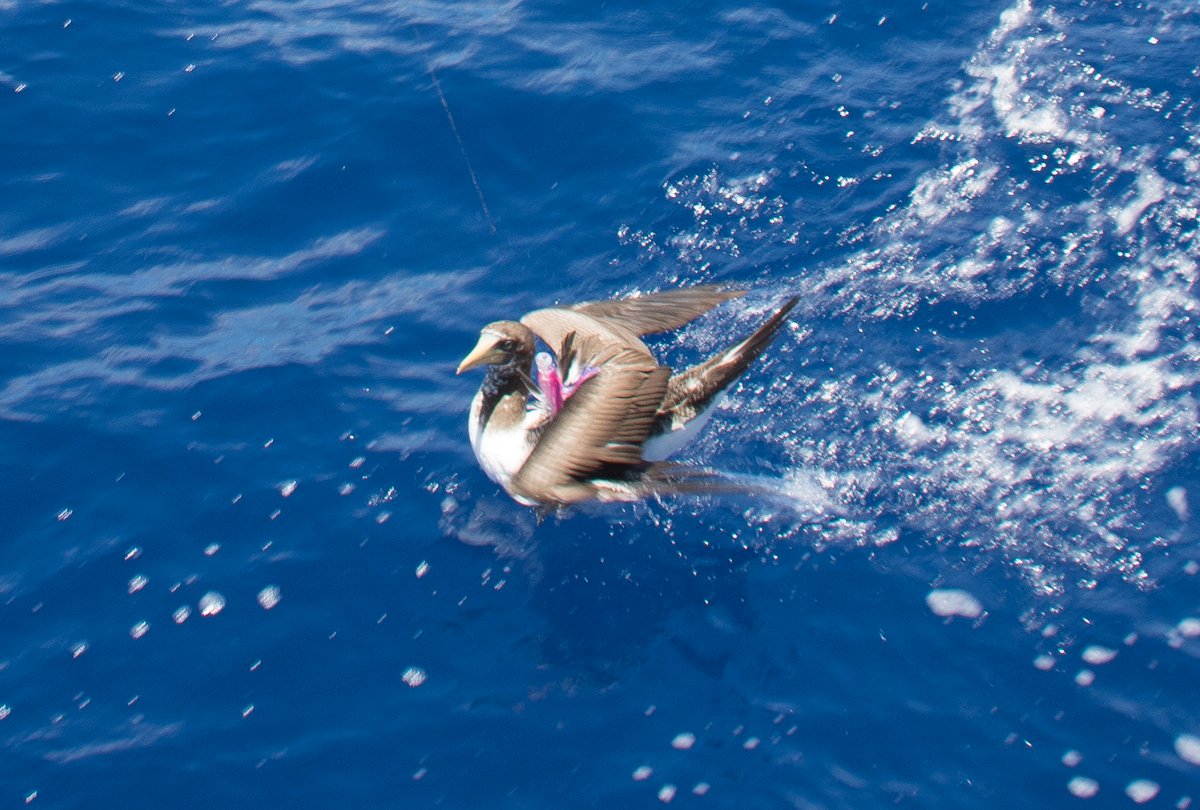
The Booby was not happy, snapping with its vicious 3 inch long beak at me as I tried to get close. After several attempts , I managed to drape a towel over its head and pin it down so that I could extract the hook from its wing. I lobbed the bird overboard and it seemed to be okay, floating for a minute and then flying off towards land.
The light winds continued throughout the afternoon and into the night - at times we’d manage 5.5 knots, but at other times we’d be down to 3 knots. I suspect that this is going to be a long slow trip. If we’re lucky, we might be able to average 5 knots, which would mean 15 days at sea. However, if we only average 4 knots it will take us 19 days.
For once, we seem to be starting a passage at a good phase of the moon. We had just over half a moon tonight, with a full moon in 6 days’ time, so we should have moonlight on most nights. Tonight was lovely, with 50% cloud cover. A one point on my 7-10 watch, I heard the blow of dolphins and could just see them, jumping out of the moon-dappled water at the side of the boat.
25 February 2018 St Helena to Brazil (Day 2)
The pleasant weather continued after dawn - we had scattered clouds and 8-14 knot winds allowing us to sail at 5 to 6 knots. At our 07:00 position check, we’d sailed 105 miles in 21 hours, which is a average of 5 knots – better than I first thought.

In the morning, we sailed past a Brown Noddy resting on a small log. As soon as our fishing lures were level with the flotsam, an 18lb Dorado took the popper lure on the rod. It took me 20 minutes to haul it in and gaff it onto our aft deck. We put a towel over its head to stop it flailing around; splashed a bit of cheap rum in the gills; and it was dead within a few minutes without too much blood and gore.
I then spent 25 minutes gutting and filleting the beast while we rolled along at 6 knots in 2 metres seas. Unsurprisingly, we had fried Dorado sandwiches for lunch and Dorado in Creamy Sauce with mashed potatoes for dinner.
We had consistent 8-14 knot winds for most of the day and racked up a fair few miles, but the wind became a little fickle after dark, dropping to as low as 5 knots for some of the time. Unfortunately, we still had 1½ metre seas, so during the lulls, we were being rolled about, causing our sails to bang and slat around as we drifted along at 2 to 3 knots – very frustrating. The lulls seemed to be caused by cloud banks passing us by, but they didn’t last more than an hour.
During Glenys’ 10-1 watch, we picked up a hitch-hiker – a small Brown Noddy took a liking to our solar panels and took a chance on a landing in the moonlight.
26 February 2018 St Helena to Brazil (Day 3)
Dawn brought us another beautiful day with a light SSE 8-12 knot breeze, which continued all day allowing us to average 5 knots.
At the moment, there’s not a lot to do, so I’ve been working on an Owner’s Manual for Alba. Over the past seven years, we’ve built up lot of knowledge on the use and maintenance of all the equipment on the boat. We’re expecting to sell Alba within the next 12 months and I’d like to pass on all my knowledge to the next owner.

It’s turning into an epic document. I have manufacturer’s manuals for practically every piece of gear on the boat and lots of notes and drawings that I’ve compiled over the years, so bringing it all together will keep me occupied until we get to the West Indies in May.
By sunset, the wind had increased by a few knots to 10-15 knots. It’s surprising how much better the boat feels with that extra little bit of pressure on the sails. It’s also good when the boat speed increases to 6 knots.
Overnight, we had some rain showers go through and the wind increased a bit more to 12-20 knots, so we were screaming along at 6.5 to 7.5 knots. When we started to plane at 8 knots, I put a reef in the main.
27 February 2018 St Helena to Brazil (Day 4)
The showers dissipated by 08:00, leaving us with blues skies with fluffy white clouds. The wind slowly backed, so we gybed the main to port and re-rigged the pole & genoa out to starboard. The afternoon was idyllic, sailing along at 6 knots.
We have three time zones to pass through before we get to Brazil, which is at GMT -3. Sunrise didn’t happen until 06:45 this morning, so we put the clocks back one hour and now Glenys will get an earlier dawn.

Night brought us showery weather again. The first shower hit Glenys at midnight, giving rain and variable winds. For my 1-4 watch, the wind was all over the place, changing in strength and direction as showers went past. Eventually, I gave up and ran the engine for 40 minutes; and then sailed for 20 minutes; and then motored a while. Glenys had more of the same on her 4-7 watch, so we ended up running the engine for 2.5 hours overnight. Oh well, we wanted hot water for the shower anyway.
28 February 2018 St Helena to Brazil (Day 5)
Once again, the showers dissipated after dawn, leaving us with fluffy white clouds and a nice day. The clouds built up a bit in the afternoon and messed about with the wind, but we managed to keep sailing at 4 to 6 knots all day.
The days are starting to blur together now. We’re both feeling weary with the three hour watches and the constant rolling, so we’re sleeping as much as we can. The most exciting event of the day was that Glenys washed some of our underwear and hung it out to dry in the sun.
It was a beautiful moonlit night with a few small clouds and a steady 8-12 knot breeze – we slid along at 4 to 5 knots. Fabulous, easy sailing.
There are more photos in our Photo Album section.