
9 February 2018 Namibia to St Helena (Day 3)
What a difference a day makes. After yesterday’s cold fog, this morning we had blue skies, light winds and a calm sea. Even better is that the sea has turned into a nice blue colour instead of the chilly green that we’ve had for the past few weeks. It’s definitely feeling warmer with the sea temperature up by 7°C to 16°C . There’s no need for jackets or woolly hats, although a thin fleece and socks were still required for breakfast.
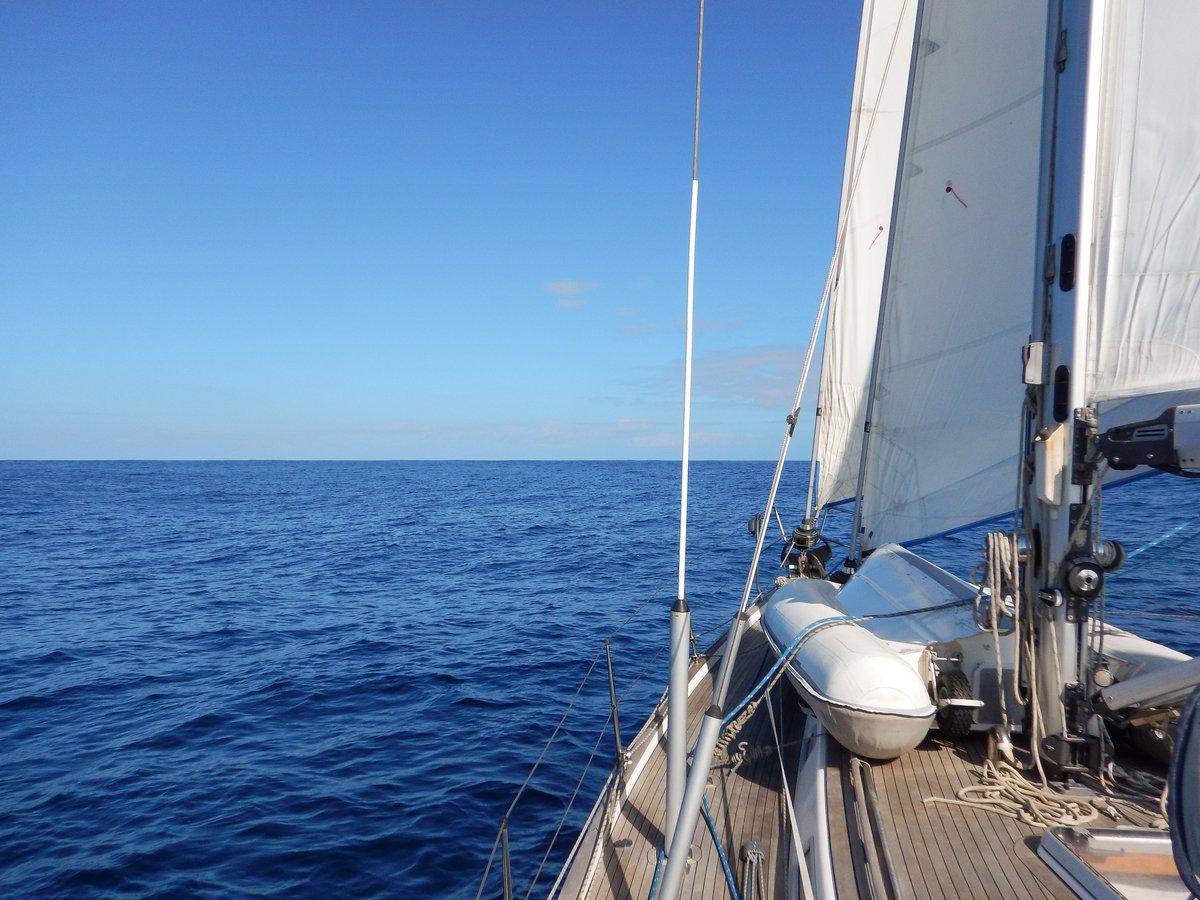
Unfortunately, the wind remained very light and Glenys had to start the engine again at 07:00. We’ve made fairly good progress in these fickle winds, doing 205 miles since we left Luderitz, which is an average of 4.6 knots. However, we’ve had to run the engine for 30% of the time, which has helped our average speed. We’ve been running the engine at 1,600 rpm, which only uses 2 litres of diesel per hour, so I reckon that we have 457 litres left – 225 hours more motoring if we have to.
This morning’s 3-day weather forecast showed light winds today, but picking up to South 10 knots at sunset and increasing to South 20-25 knots by tomorrow morning. The wind should gradually decrease to South-west 15 knots by the 12th. It looks like we’ll be motoring/bobbing along today and then have good sailing conditions for the next 3 days.
It’s been getting dark at 20:00 and dawn is not until 07:00, so we decided to put the clocks back an hour – if the sun comes up at 06:00, it makes Glenys’s 4-7 watch a bit more pleasant. We’ll be crossing the Greenwich Meridian in a few days, which will put us directly south of the UK and we’ll be on UK time – perhaps a little celebration will be called for?
It was such a lovely morning that I felt motivated enough to do a couple of jobs. I ran the watermaker for 1½ hours to top up our water tanks – we’ve not run it for a couple of weeks, so I was glad that it worked without a hitch.
I wandered around the deck to check for chafe. Everything looks okay, but all the sails are dirty with Namibian grime and we’re getting black marks on the mainsail where it’s rubbed against the filthy spreaders and shrouds. I’m hoping that the water in the anchorage in St Helena is clean, so that we can make plenty of water to scrub the sails, wash the ropes and clean everything on deck.
I changed the lures on our fishing lines and put them out with our birds splashing behind the stern. We didn’t have any strikes. We should have been fishing over the last two days because there’s been lots of bird activity (meaning lots of fish), but as usual at the start of a passage, I couldn’t be bothered. Hopefully when we are sailing faster tomorrow, we’ll start catching something.
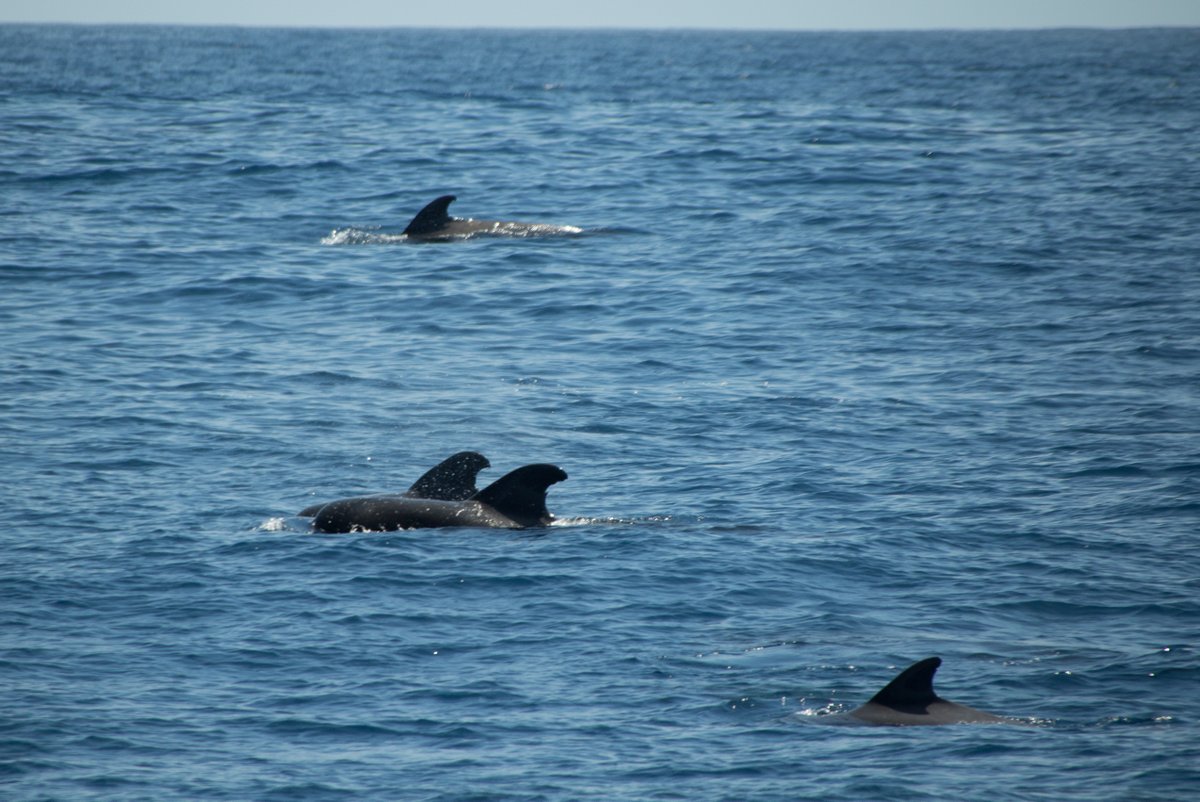
It remained nice and sunny all day and the wind was a little stronger than forecast, so we sailed more than expected, especially during the afternoon. We had a nice little encounter with a large pod of Short-finned Pilot Whales, but they didn’t hang around very long.
At 15:00, we were ripping along at 7 knots on a beam reach with a lovely 12 knot breeze. I thought that the stronger winds had arrived so, just before dinner, I put a reef in the main, only to have the wind die again an hour later - I shook the reef out and eventually had to start the engine. And then the wind came back; and then it went away; and then it came back - very frustrating.
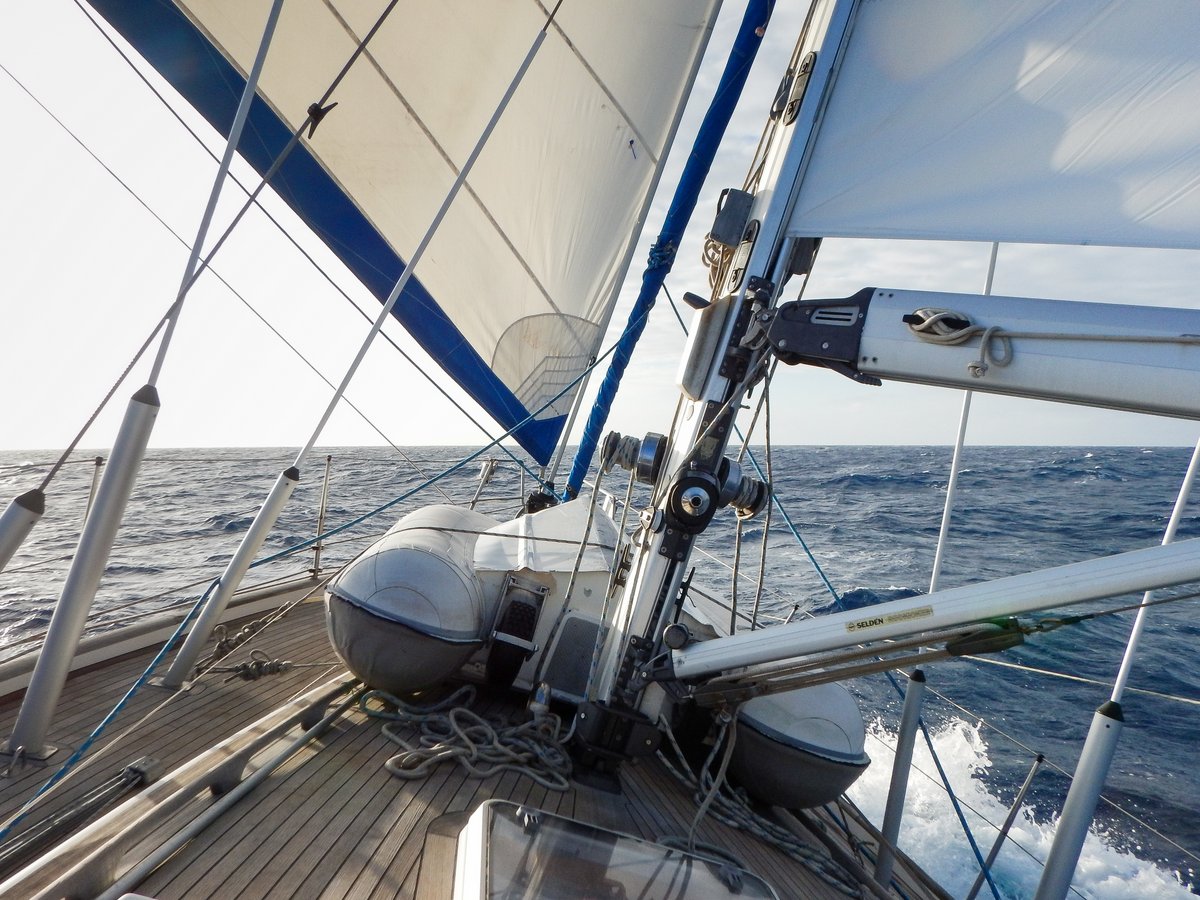
It wasn’t until after midnight that we settled down to 15 knots from the south-west. On my 1-4 watch, the wind backed to SSE and increased to 15-22 knots, so I put two reefs in the main and poled the genoa out to port. We rolled downwind for the remainder of the night doing 6.5 knots.
10 February 2018 Namibia to St Helena (Day 4)
There was much more cloud around in the morning, but the wind remained at SSE 15-22 - it was great sailing, but we were rolling madly. The weather forecast is for these winds to remain for 24 hours and then to drop slightly. It looks like 10-18 knot winds for the next three days, so we should make good progress.
The sea temperature has risen by another couple of degrees to 18.5°C - the water is definitely getting more Tropical because we started to see Flying Fish today.
We received a few emails from family via our satellite phone – it’s great to know that we’re so easily in touch with people ashore. Our son Craig, asked me for some advice on investing some savings that he’s accumulated – it seemed very surreal to be writing to him about UK tax, Pensions and ISAs when we’re in the middle of the South Atlantic Ocean.
The SSE 15-25 knot winds stayed with us all day – at times we were surfing at 8 knots. In the late afternoon, we skirted around a huge submerged mountain called Ewing Seamount, which rises from the sea bed at 4,500 metres up to a peak at 850 metres. Although there was no danger of hitting it, we were a little wary of encountering confused seas and large waves where the prevailing north-west-setting Buenguela current is deflected up the steep slopes.
Before dinner, I chatted to Stefan from “Sabir” on the SSB radio. They left 24 hours before us and had a very bouncy start to their passage with big 3 metre seas – totally different to our rather calm start. They’re north of our rhumb line and only 40 miles ahead of us, so we’re slowly catching them up.

At sunset, I rolled away the mainsail and we ran down-wind with just the genoa poled out to port. It was a dark, rolly night, with no surprises, apart from two Flying Fish who flew onto our deck. I managed to grab both of the smelly beasts and return them to the sea while they were still alive.
11 February 2018 Namibia to St Helena (Day 5)
The wind slowly dropped overnight and at dawn, we had SE 10-15 knots with blue skies. Unfortunately, a bank of clouds soon overtook us and we had our first light shower at 09:00. Clouds always cause trouble when sailing. These didn’t have any strong squalls, but the wind was veering all over the place and changing in strength from 5 knots to 15 knots as showers went past.
We pulled out the mainsail; we pulled out the staysail; we rolled the staysail away; we reefed the mainsail; we gybed the genoa; we gybed the genoa back; we pulled out the mainsail reefs. By midday, the sun had come out, but all afternoon, we had to keep making 30° course corrections to avoid gybing as the wind veered about.
The weather forecast for the next few days shows 8-15 knot south-east winds, which should be nice as long as the clouds bugger off. Yesterday, we had a good run of 158 miles and the water temperature is still rising – it’s now 20°C, which is nearly warm enough to go swimming.
During the morning, the snap shackle at the end of the boom sheared. The genoa sheet runs through this block to minimise chafe on the rope. This is the second one that has failed since we left Cape Town and it failed in the same way. A stainless steel bolt joins the block to the phosphor bronze shackle and the threads have stripped in the shackle – I guess that it’s long term galvanic corrosion. I bought both snap shackles seven years ago, so they’ve had a good life.
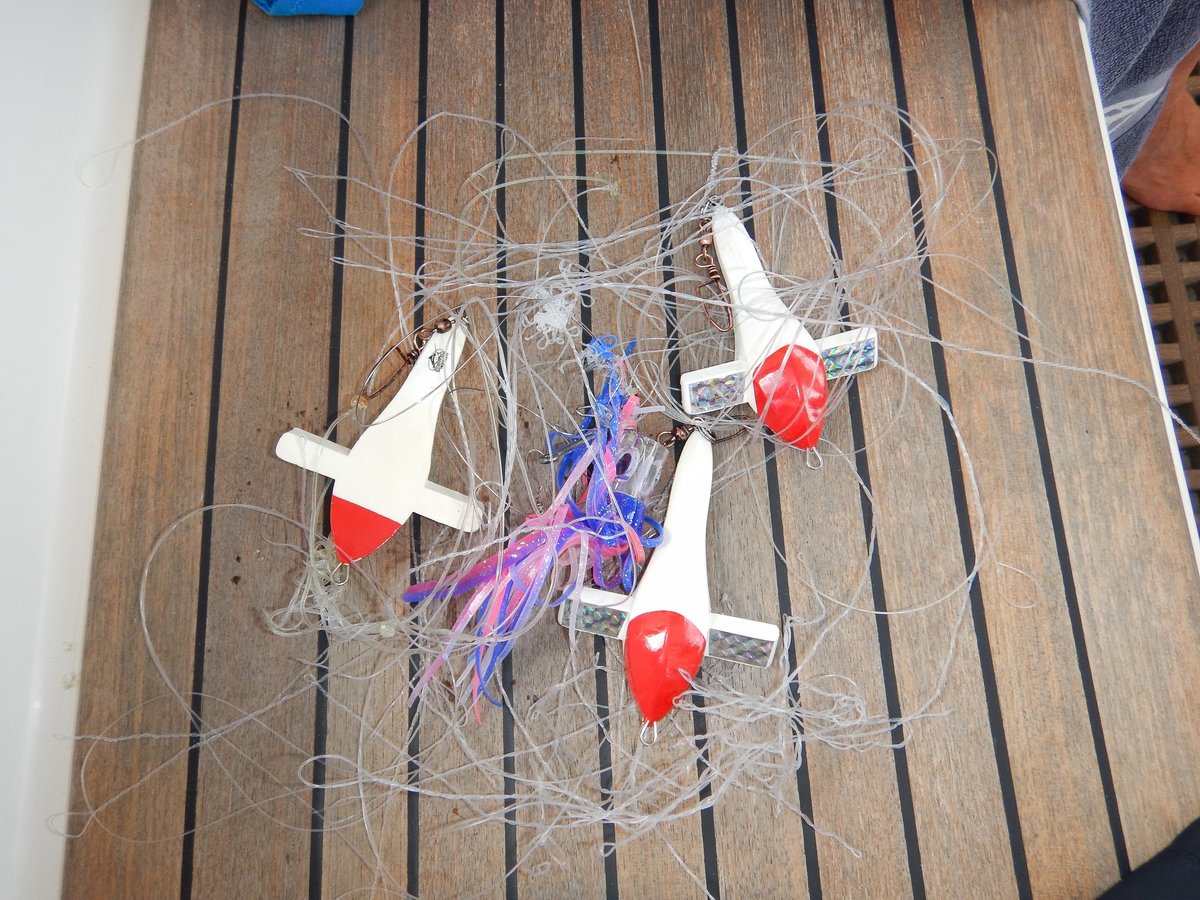
We’re not having any luck fishing. I put two fishing lines out on either side of our stern and I had our three birds set up on a 15 metre line in the middle . The birds are little aeroplane-looking devices, which bounce along on the surface making lots of splashing, which is supposed to attract fish.
Unfortunately, while we’ve been veering about, the birds became tangled with one of the fishing lines and knotted themselves together with 40 metres of fishing line; 2 metres of wire trace and the lure. It was a right mess and took me 20 minutes to cut it all apart to rescue the lure.
For dinner, Glenys made Navarin of Lamb, which she served with pomme de terre and petit pois – how does she do it? After dark, the weather settled down and we had a fabulous sail all night with 15 knots of wind, rolling gently downwind at 6-7 knots. Unfortunately, we’re near the end of the moon’s cycle, so it was a dark night, but the stars were spectacular.
12 February 2018 Namibia to St Helena (Day 6)
Dawn brought us 80% cloud cover and gentle 1.5 metre seas. The 10-15 knot south-east winds put us sailing dead downwind wing-on-wing doing a comfortable 6 knots – it doesn’t get much better than this. The weather forecast shows similar conditions for the next four days – fingers crossed.
I was very excited at 08:00, when I spotted the red and white spinnaker of “Sabir” on the horizon. After five days of seeing nothing, I finally had a mission – intercept “Sabir” and take a photo. Glenys didn’t share my joy at the chase and went to bed.
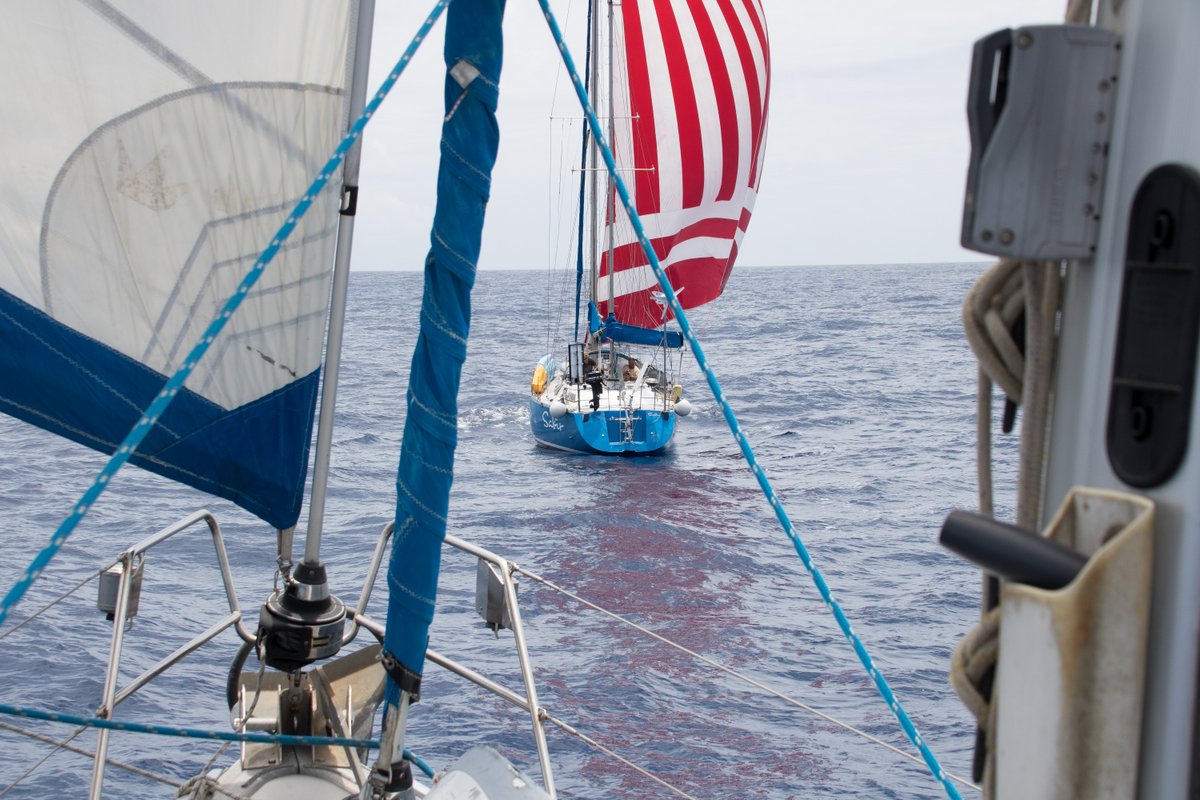
“Sabir” were about 3 miles north of us, so I had to gybe the mainsail and turn 40 degrees to starboard. It took me an hour to get onto their track, where I gybed back on course and the downwind chase began.
Unfortunately, the wind dropped, so we were only doing 3-4 knots and only going ½ knot faster than them, so it took 4 hours to catch up. We slowly sailed within 20 metres; shouted out greetings; had an obligatory photo session and remorselessly drifted off ahead of them – we’ll see them again in 5 or 6 days’ time.
We passed the halfway point to St Helena, so Glenys produced some fruit cake as a celebration. It was a very calm afternoon, so we ran the watermaker and Glenys washed a few smalls. I popped off to bed for my afternoon nap and Glenys landed a small Dorado, which we had for dinner.
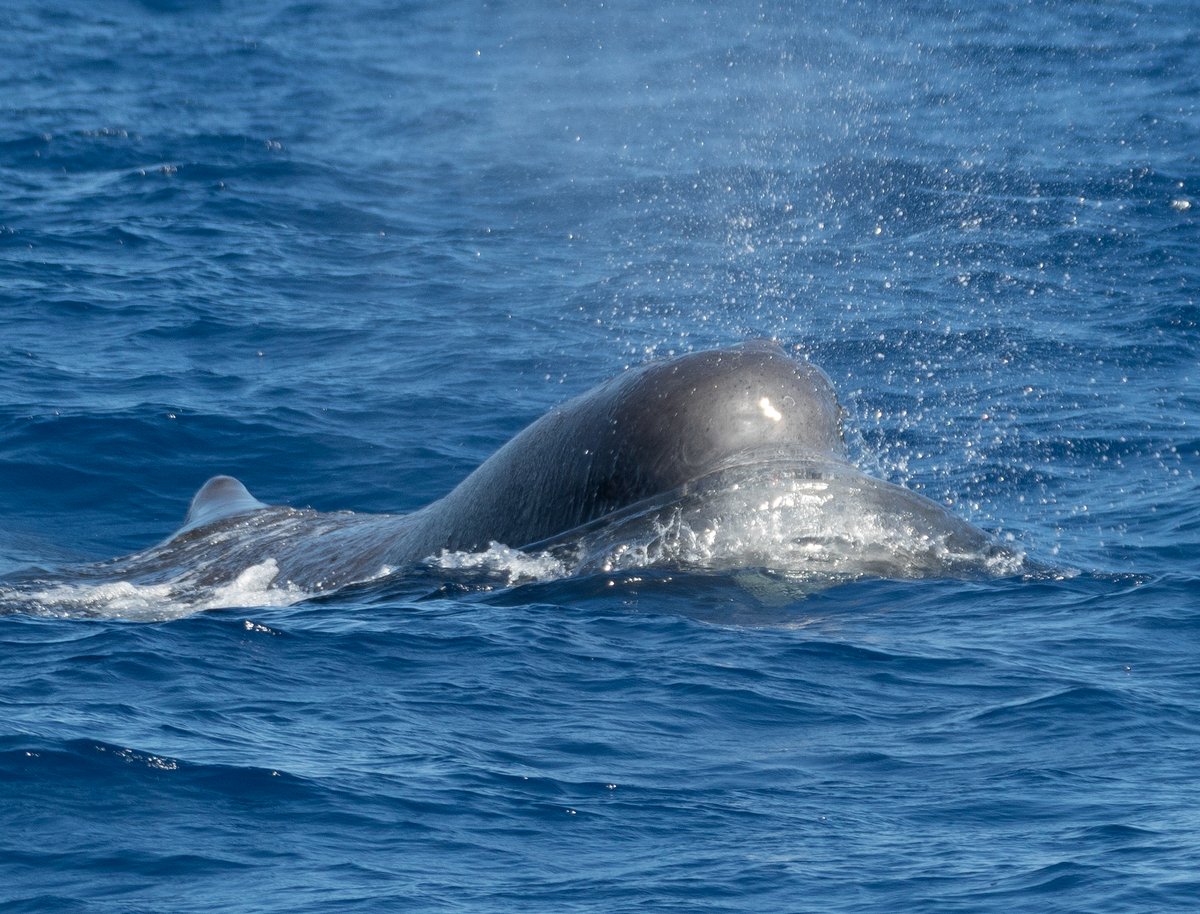
I was dragged out of bed after an hour, when Glenys spotted a Sperm Whale at the side of Alba. We reckon that it was nearly as long as our boat, maybe 10-12 metres, and it followed us for five minutes before going off to do whale things. I did a bit of reading on Sperm Whale behaviour and I think that it was a male – females travel in family groups with their calves and males are kicked out when they reach maturity.
The 8-15 knot winds continued after sunset giving us pleasant sailing conditions all night.
13 February 2018 Namibia to St Helena (Day 7)
The fabulous sailing conditions continued through to dawn and then lasted all the day. The forecast is for this good weather to last for another three days, which is great. At my 07:00 progress check this morning, we’d covered 140 miles in the last 24 hours and had 550 miles to go. If this weather keeps up, we’ll arrive on Saturday 17th – only 4 more nights to go.
Despite the benign sailing conditions, we’re both feeling a little weary because of the constant three hourly interruptions to our sleeping patterns. We’re sleeping more during the day now – Glenys has at least three hours in the morning and I have the same in the afternoon. It doesn’t help that the motion of the boat is so soporific.
The sea temperature has stabilised at 21°C and it’s pleasantly warm during the day, so I’m hoping that we’ll be able to go snorkelling in St Helena. We’ve not been in the water since leaving Madagascar in October last year.
Alas, we’ve had no luck with the fishing today, but we only had one lure out. I’ll get motivated tomorrow and stick out another line. With no fresh fish on the table, Glenys dug out a tin of salmon and made a very tasty Salmon Lasagne for dinner.
Once again, the 10-15 knot winds continued after sunset giving us mostly pleasant sailing conditions. The clouds built up on my 1-4 watch and we had a heavy shower giving us 20 knots of wind – not a problem, but the weather is getting more tropical and we’ll have to be more wary of strong squalls as we get further north towards the equator.
We were attacked by Flying Fish during the night. They look lovely with their silvery blue wings glinting in the tropical sun as they glide above the waves. However, they are very slimy and stink to high heaven. Several times, we heard a big thump as an 8 inch fish hit the coach roof at 30 miles per hour. They then flail around, shedding scales, desperate to get back in the water. By the time we’ve grabbed it and thrown it overboard our hands are covered in stinking slime.

One hit the windscreen, giving me a right old scare and another hit the cockpit coaming, so hard that it ricocheted over into the cockpit and proceeded to flail about on the seat. I tried to grab it, but it flipped onto the cockpit floor. I tried to grab it again, but it flopped towards the companionway way. Panic - if it got down below, it would cause chaos. Fortunately, I managed to grab it with two hands and heave it overboard.
14 February 2018 Namibia to St Helena (Day 8)
It looks like we’ll have good wind today and tomorrow, but the 16th and 17th are forecast to have light 5 knot winds - I guess that we’ll be motoring into St Helena on the 17th. Only 3 nights to go.
At 10:29 UTC, we crossed the Greenwich Meridian, so we’re now in the Western hemisphere, directly south of our families in the UK. Perhaps we were feeling a little homesick, but we’ve finally decided that we’ll leave the boat in Trinidad for the hurricane season and fly back to the UK for three months in July, returning to Trinidad in October.
We’re going to put Alba up for sale privately and if she sells, we’ll move back to the UK. If she doesn’t sell, then next year, we’ll cruise up through the West Indies & the Bahamas to the east coast of the USA. Our current plan is to leave the boat for sale with the Hallberg Rassy dealer in Annapolis in September 2019. We haven’t paid UK VAT on the boat, so if we sell Alba in Europe, it will cost us 25% tax whereas the import duty into the USA is only 1.5% + fees. (See www.yachtalba.com for boat details.)

Just before lunch, we spotted a set of sails on the horizon ahead of us. We weren’t picking up their AIS position, so we didn’t know who they were, but we altered course slightly and gave chase. It took us 5 hours to get level with them, but it was approaching sunset, so we didn’t want to get too close.
We chatted to them on the VHF radio and found out that the boat is “Jomaro”. We met Jos, Yamille and their little girl Isabella briefly in Luderitz - they left with “Sabir”, 24 hours before us. They are a 53 foot Amel, so I’m very surprised that we’ve managed to overtake them – we must be doing something right for a change.
We put out two fishing lines in the morning and didn’t hear a whisper from either line, but when I pulled in one of the lures, the stainless steel leader was in knots, so something has had a go at it. I remade the lure and sharpened the hook, ready to catch a big one tomorrow.
It was another idyllic day, gliding downwind with 10-15 knots of wind doing 5.5 to 6.5 knots in comfortable 1 metre waves. Overnight, it wasn’t quite as good because the wind dropped a few knots, which was enough to make us roll every so often, making the sails slat and dropping our speed down to 4 to 5 knots.
15 February 2018 Namibia to St Helena (Day 9)
The wind was a little fickle first thing in the morning, but the breeze filled in nicely and by 09:00, we were back to 10-15 knots and doing 5 to 6 knots, with blue skies. Glorious. At 07:00, we only had 260 miles to go, so we should get in the day after tomorrow. The forecast is still for the wind to drop tomorrow, but fingers crossed, we’ll still be able to sail.

Having passed the Greenwich Meridian yesterday, we put our clocks back one hour after breakfast – we’re now on Greenwich Mean Time.
I put out our fishing lines and, ten minutes later, was rewarded by a small Dorado. It was soon dispatched and filleted ready for dinner. Later in the afternoon, we caught another couple of small Dorado at the same time – we must have passed close to a shoal of them. All three fish that we caught today were small females with roe – we really must find some pleasant way of eating the fish eggs.
As usual, we’ve been eating well this trip. For breakfast, we’ve been having fruit and yoghurt followed by cereal with granola and raisins, although the yoghurt ran out after day 6.
Lunch was sandwiches for the first four days until the bread ran out. Since then we’ve been having flour tortillas, which are great because the vacuum packed ones will last for several months. Glenys has been converting the left-overs from evening meals into a curry filling to make a Roti or stuffing the tortillas with fried fish with salsa or ham & cream cheese with tomatoes.
For dinner, we’ve had Cassoulet; Beef Chili with Rice; Navarin of Lamb with Vegetables; Dorado in Peanut Sauce with Rice; Fried Rice with Chorizo; Salmon Lasagne; Dorado & Chips; and Dorado Catalan with Rice.
The wind gradually dropped during the afternoon and past sunset but we were able to maintain at least 4 knots boat speed. At 01:00, the wind started to veer about and I gybed the genoa a few times, but then the wind dropped below 5 knots. It was pitch black so I couldn’t see, but I was hoping that this was a local cloud bank causing the problem. However, after 20 minutes of slatting sails and drifting, I had to turn on the engine.
An hour later, the wind came back – it was some damn cloud system causing the squirrely winds. Thankfully, we had steady winds until dawn, averaging 4.5 knots boat speed.