
16 February 2018 Namibia to St Helena (Day 10)
At 07:00, we had 135 miles to go, which if we can maintain an average of 5 knots, puts us in Jamestown tomorrow morning. The forecast was for light winds this afternoon and evening, but we might have a chance at sailing after midnight. I emailed the Harbour Master and told him that we’d be arriving at midday.
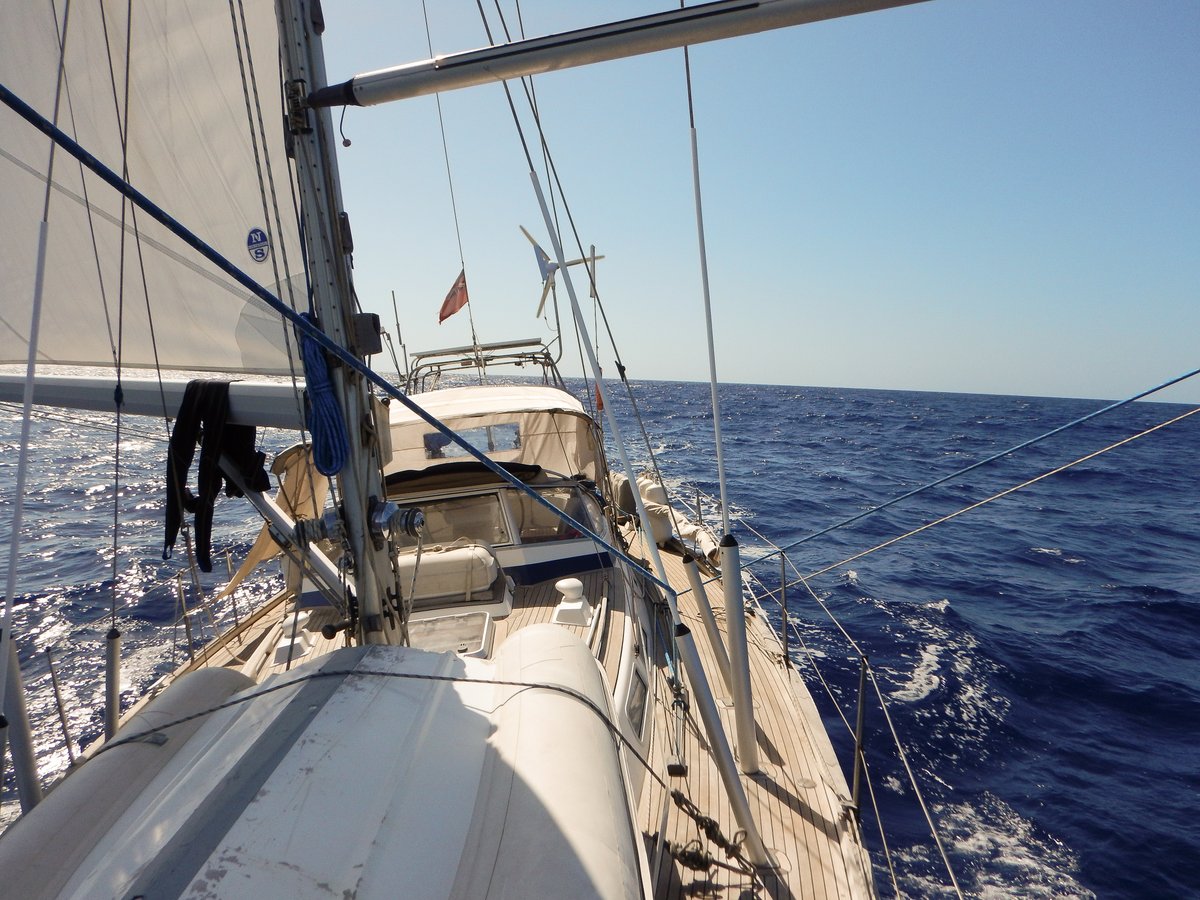
As forecast, the wind slowly died during the morning, but the sea was calm, so we managed to bob along under sail. We took advantage of the calm conditions to run the generator and watermaker for 90 minutes and our water tanks are now brimming full.
By 11:00, the wind fell below 5 knots, so I had to turn on the engine and we started motor-sailing. A small Dorado took one of our lines at lunchtime and briefly interrupted our meal of Fish Tortillas – eat one, catch one, the sustainable way. Later in the afternoon, we caught a larger, male Dorado – about 6 lb.
In the evening, I chatted to Stefan on “Sabir” who are now 80 miles behind us and also motor-sailing. They’re aiming to get in early on the 18th. I don’t know where “Jomaro” are, but they should be in late tomorrow.
The wind slowly picked up after dark and I was able to get sailing again at 20:00. By the time Glenys came on watch at 22:00, we were on a beam reach with 8-10 knots of wind doing 5 to 6 knots.
At our 01:00 watch change, we were 38 miles from the south-east coast of St Helena and could just make out red and white lights on the horizon. I wasn’t sure if it was the island or a fishing fleet without AIS, but flicking on the radar showed no targets within 32 miles. The strange red lights seem to be a series of warning beacons on the hills around the new airport, which is on the North-east corner of the island.
17 February 2018 Namibia to St Helena (Day 11)
At dawn, we were only 15 miles away from St Helena and could see the flat-topped, rugged island shrouded by clouds - very exciting. As we sailed closer, the island looked very bleak with huge cliffs soaring up from the sea. The clouds continued to hide the tops of the hills, but occasionally a flash of green would peek out high on the island, showing signs of cultivation.
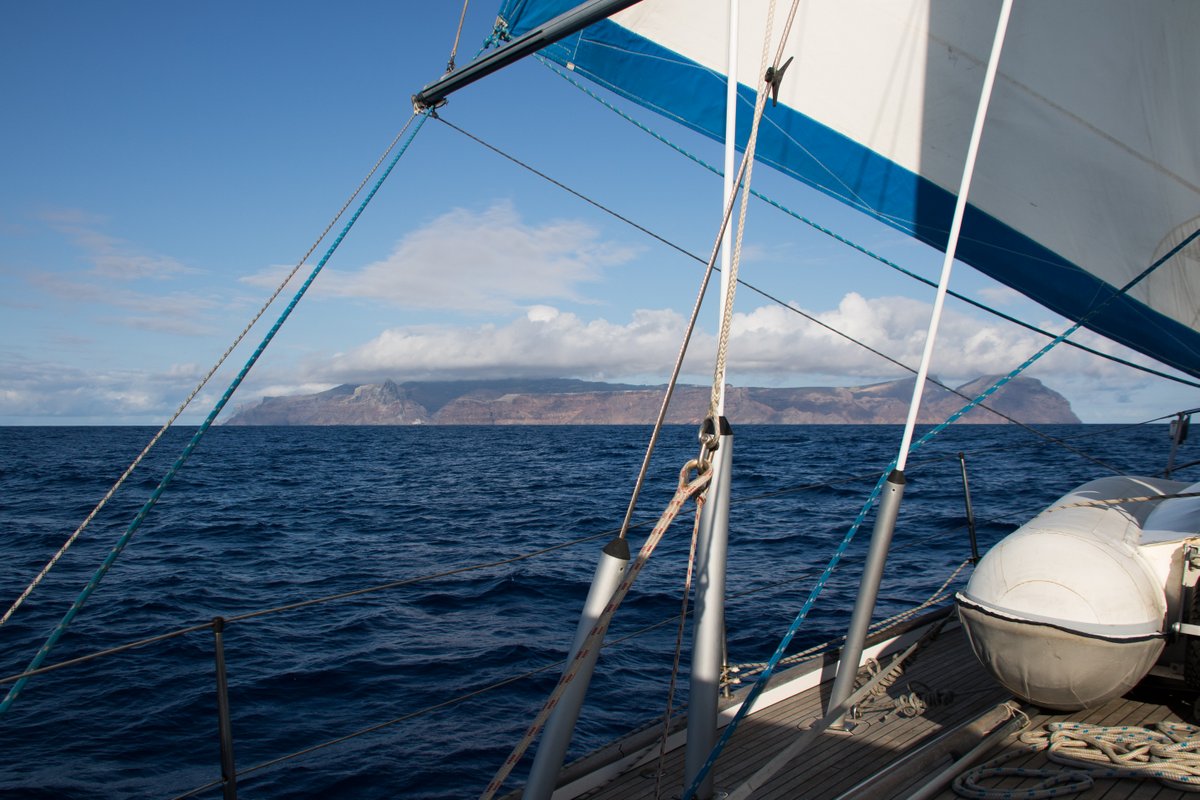
We sailed within a half a mile of the north-east corner of St Helena and then maintained our distance off the cliffs. For a change, the wind chased us around the island and we were able to sail to within ½ mile of the mooring field at Jamestown. On the approaches to the town, we could see old fortifications built into the cliffs defending the town.
Glenys and I always play a little game when approaching a new anchorage, trying to guess how many other cruisers will already be there. My guess of ten was much closer than Glenys’ six because there were already eleven boats swinging on the moorings.
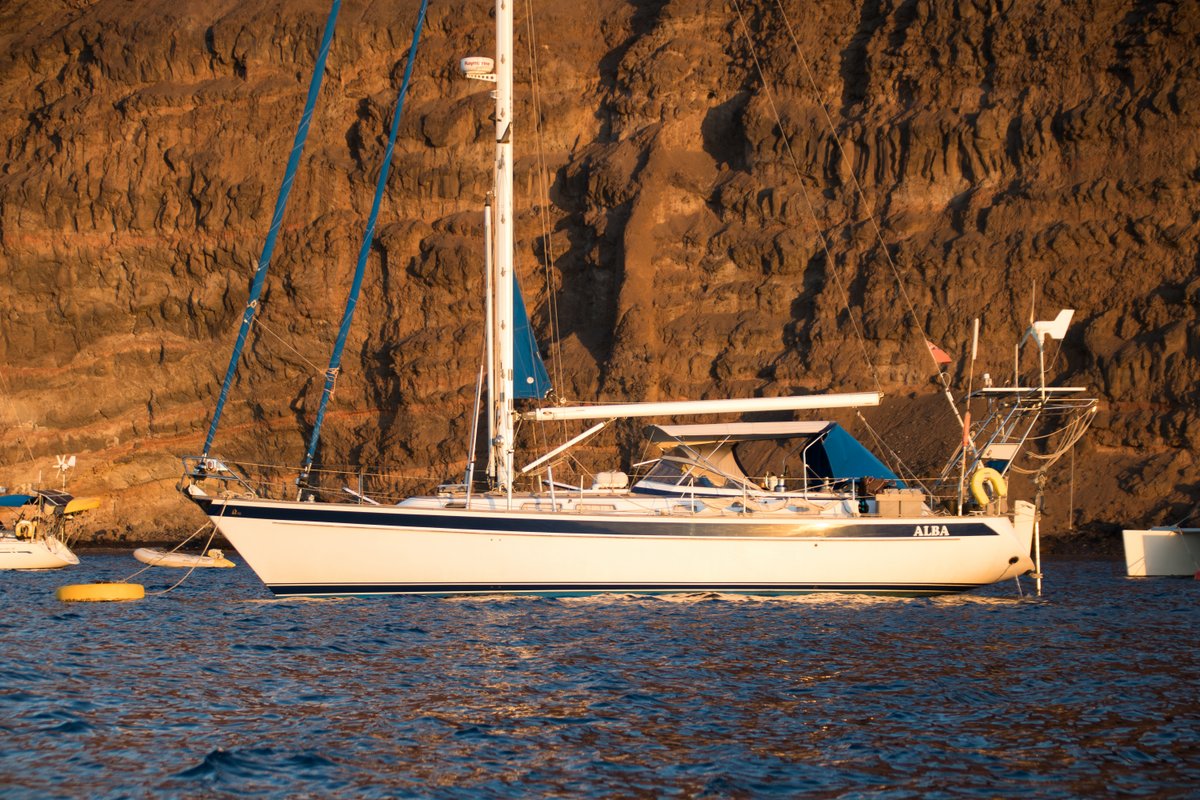
The moorings are rubber-covered, 5 foot diameter disks, with a huge 8” diameter steel ring lying flat on the top of the mooring. There are no nice rope pennants to pick up with a boat hook, so we were fortunate that a French guy from “Altera” came over in his dinghy and threaded my two mooring lines through the ring. We were settled by 10:30.
I called Port Control on Ch14 and they said that we could either come in to clear at 11:00 or 15:00 this afternoon, so we elected to go in straight away. I called for the Ferry Boat on Ch16 and he said that he’d pick us up at 11:00. We were grateful that we’d put fenders down on one side of Alba because the rough ferry boat doesn’t have any fenders. The charge for the ferry is £2 per person per return trip.
David in Port Control was waiting for us in a white building on the dockside (the one with a clock). He took us into the Customs office, where two chatty ladies helped us to quickly fill in a form. We filled in another form for Port Control and paid over £35 in Port Duties. David then directed us to the Police Station where we completed the Immigration forms. On Monday morning, we have to go to the Immigration office in town to get our passports stamped. We were done and dusted by 12:00.
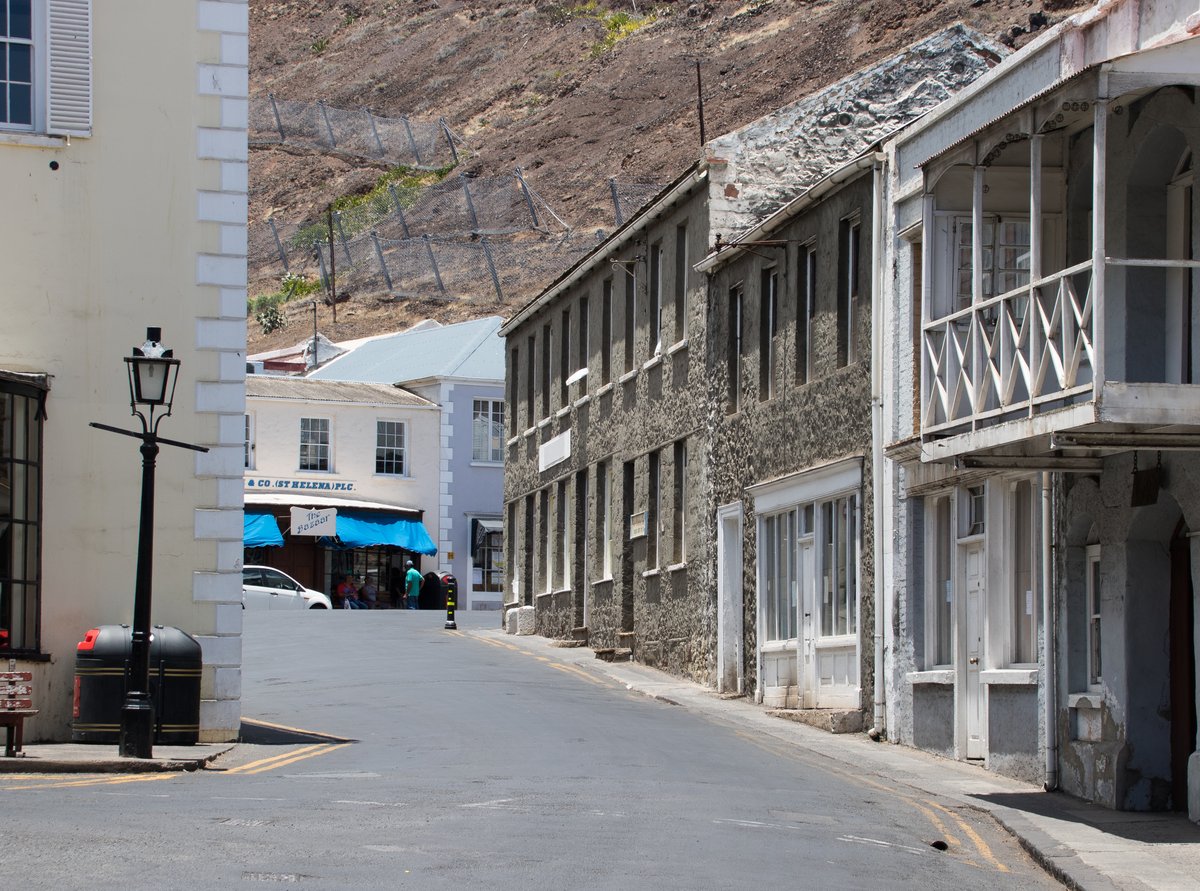
My first impressions are that I love the place. Jamestown is tucked into a narrow valley with very steep rocky slopes reaching hundreds of feet above the town. We entered through an arched gate in the defensive wall stretching across the mouth of the valley. Once inside the fortifications, the buildings along the winding streets look to be centuries old. We can’t wait to explore the island.
Everyone is very friendly. The islanders call themselves the “Saints” and they are fairly dark skinned with round faces, from a melting pot of descendants, including freed African slaves, Indian indentured workers, English immigrants, Chinese immigrants, not to mention the huge number of sailors who visited the islands in the 1800s. Amongst themselves, they speak their own language and when speaking English, they have an old-world west country accent, which you can easily imagine comes from the 18th century sailors.
We wandered around for a little while, bought a couple of loaves of brown bread and retired to Anne’s Restaurant, which is inside the lovely little park. Mark & Ron from “Beguine” were already seated in the airy restaurant, so we joined them. They’ve been here for a week and gave us some hints and tips. After a couple of beers and fishcake burgers, we retired back to Alba for a well-earned afternoon nap. We had an early night.
18 February 2018 Jamestown, St Helena
We had a bit of a lie-in and then pottered about getting the dinghy in the water. When we arrived, we looped two mooring lines through the large 8 inch steel ring on the mooring buoy. The ring is rusted and rough and would soon wear through the ropes, so I tied the ropes directly to the ring to prevent chafe.
It didn’t take long to tidy up after our 10 day passage and I’ve written a to-do-list to repair the few things that have gone wrong. We also started our campaign to wash the 20+ ropes that are filthy with desert sand.

At 11:00, we caught the ferry boat and went into town. Being a Sunday, it was very quiet, so we took the opportunity to stroll around the place and take some pictures of the architecture. Most of the fortified town was built in the 1860’s and reminds me of some coastal towns in North Wales. The buildings have thick walls and the narrow streets are contoured to the steep sided valley.
We tackled Jacob’s Ladder. This is a very steep set of concrete stairs, which used to be a funicular railway to deliver goods to Half Tree Hollow, the residential community high above Jamestown. There are 699 steps and they are big 9 inch steps, which makes it a tough climb. Glenys set off first and made it to the top before me, but of course I had to keep stopping to take photographs. There’s a great view of Jamestown nestled in the valley below.
At the top of the steps, there are the remains of a fort giving a fine view of the coast and the yacht mooring field far below. You can also clearly see the wreck of the Papanui, a cargo ship that caught fire and sunk in front of the town’s sea wall in 1911.
We wandered up to Rosie’s Restaurant, which is about 200m straight up the hill from the top of Jacob’s Ladder. Unfortunately, they were closed. They don’t open until 14:00 on a Sunday and we didn’t want to wait for 45 minutes. (They are open from 11:00 until late on Tuesdays to Saturdays, but closed all day on Monday.) We chatted to Rosie, who told us that business was slow - they just don’t get enough tourists.
By this time we were starving, so we scurried down the 699 steps and went to the Consulate Hotel to see if they were serving lunch. The place was deserted and they don’t do any meals for non-residents, but they do have a café serving drinks and cakes. We started chatting to the owner, Hazel, and decided to stop for a cold drink and a slice of her delicious carrot cake (which she gave us for free!)

Hazel told us the saga of the airport. The UK Government subsidises St Helena with millions of pounds each year. The only way to get to St Helena used to be on the Royal Mail Ship, RMS St Helena, but the ship was getting very old and expensive to run (the subsidy was £3 million per year), so they wanted to retire the ship. The last voyage was only one week ago – it was a shame that we just missed the farewell celebrations.
Someone decided that it would be a good investment to build a new airport capable of taking long distance jets and bring tourists in by air. The plan was for one or two big jets per week and the economic forecast was that the island would be self-sustaining with tourism within ten years. The airport was built at great expense to the UK tax payer and the locals started to ramp up their businesses in preparation for the influx of tourists. The runway was finished in 2017.
Unfortunately, there’s a problem with cross winds and turbulence on the runway, which is built on top of huge cliffs on the North-east corner of the island. The prevailing winds howl along the runway and drop off the cliff at the end causing massive eddies and turbulence. So instead of being able to make a normal approach and use the full length of the runway, planes have to descend steeply over the top of the turbulence and land in the end half of the runway.
At the moment, only smaller jets (Embraer E190) are able to land at St Helena. Tourists can now fly in from Johannesburg on the single flight each week. The plane is mostly taken up by locals flying to and from St Helena, so there are only 15 or so tourists arriving on the island each week - it’s a financial disaster for the local tourist businesses. Hazel tells us that the Consulate Hotel has 18 rooms and at the moment is only filling 2 or 3 each week.
19 February 2018 Jamestown, St Helena
Being a Monday, we went into town to sort out a few things. We exchanged money at the Bank of St Helena - a tiny little building. They charge 5% to give cash on a Credit Card, so instead, we exchanged our left-over South African Rand and $500 US dollars from our emergency cash. St Helena Pounds are not exchangeable anywhere else in the world, so any money that we have left, we’ll have to change back into British Pounds before we leave.
We called in at the Tourist Office and picked up a few brochures on tours and tourist attractions on the island. The Post Office is next to the Tourist Office, so we called in. Postage stamps of St Helena have always been popular amongst stamp collectors and I can remember having some colourful stamps in my school boy collection. Glenys bought some postcards to send to family and I bought some first day covers, showing the now decommissioned RMS St Helena and the new airport.

Immigration were our next stop, where we had our passports stamped and paid £14 for the privilege. After eating some sandwiches in the pleasant park, we sat in the Consulate Hotel, bought an hour’s worth of Internet for £6.50 and caught up with our emails. The internet is not too bad considering that it all comes via satellite - we’ve seen worse.
Back at Alba, we went snorkelling on the wreck of the Papanui. The wreck has been flattened over time, but there’s a lot of sea life and it’s great to be back in the water taking photos. I messed up most of my pictures because I accidently changed the shutter speed to 1/40th , which made everything blurred. It was a beginner’s mistake because I didn’t keep checking the settings, but I got a reasonable picture of a St Helena Butterflyfish and a very well camouflaged Scorpionfish .


20 February 2018 Jamestown, St Helena
James from “Carpe Diem” (who we met 4 years ago in the Marquesas), was born on St Helena and has set up St Helena Yacht Services. He arranged for the yachts in the mooring field to get diesel. It was all very simple with a boat coming alongside and pumping the fuel through a normal filling hose. I only needed 75 litres, confirming that we only use 2 litres per hour when motoring at 1500-1600 rpm.
When we’d all filled up with fuel, eight cruisers went out on “Carpe Diem” to look for Whale Sharks. There are three established boat operators who take people out to snorkel with Whale Sharks and I was a little sceptical about James’ ability to match their success rate in his 38 foot sailing yacht. However, it only cost £20 per person, so I went along with the flow and it proved to be a very good three hour trip.
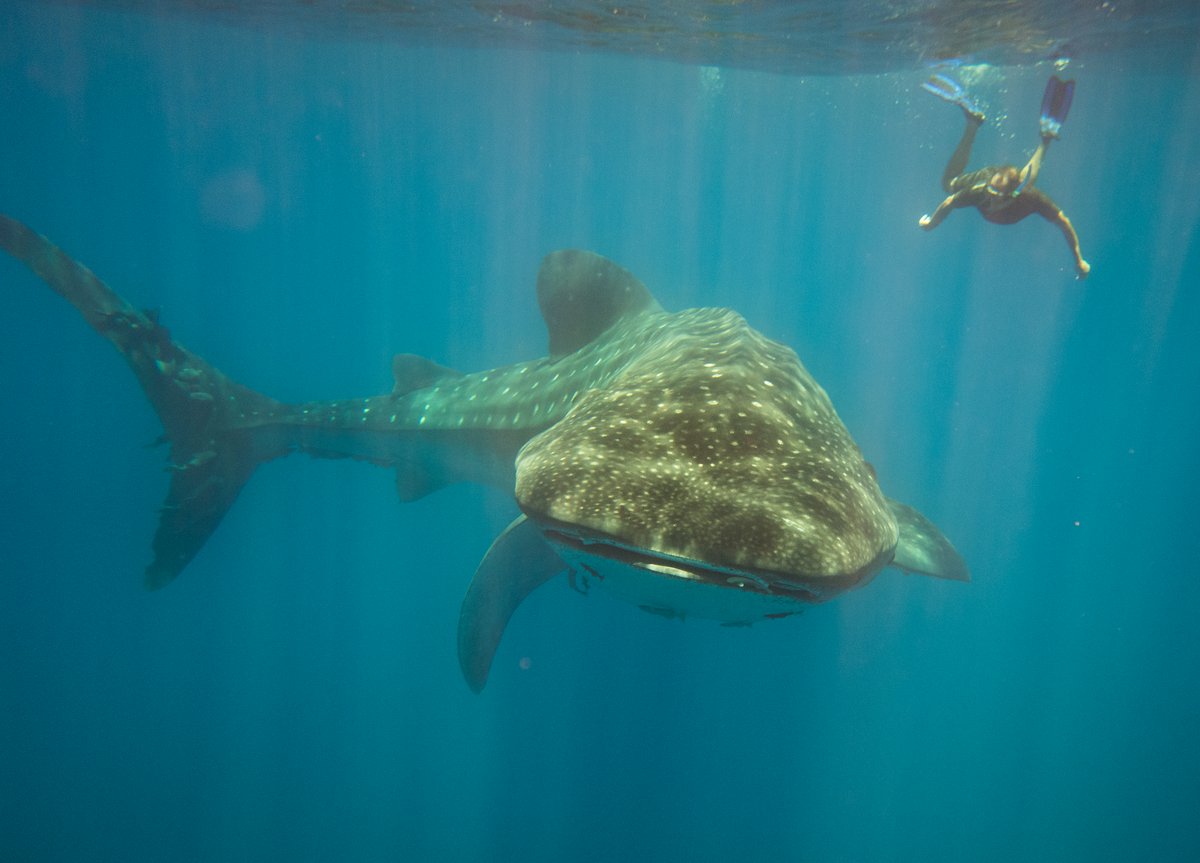
We snorkelled with 4 or 5 individual Whale Sharks, which are 10-15 metre long. James dropped us off alongside the huge creatures and we got very close to some of them, as they swam slowly along, 3-10 metres below the surface. Their tails are 10 foot high and their mouths are 1.5 metres wide – more than enough to swallow a man. Fortunately, the Whales Sharks are plankton eaters and move very slowly, so there is very little danger.
The weather was overcast and the water was slightly cloudy, so photography was a challenge, but I snapped a few photos and enjoyed being in the water with these gentle giants.
Later in the afternoon, I jumped on the ferry boat and nipped into town to use the Internet. The ferry is a little expensive at £2 per return trip, but it’s interesting to chat to Paul, the driver. Today, there was quite a swell at the landing dock, so I was glad that I didn’t have to worry about my dinghy being damaged against the concrete dock. A couple of cruisers are taking their own dinghies to the dock, but then have to mess about with anchors and long shore lines.
I checked the weather forecast and there’s a 2 metre Northern swell coming in on the 24th or 25th. Known locally as North Rollers, I’m told that these waves directly hit the shoreline at Jamestown and intensify when they hit the shallower water. It looks like the swell will be here for 3 or 4 days, making the mooring field very rolly and it will be very difficult or even impossible to get ashore. We’re not sure whether to stay or leave.
21 February 2018 Jamestown, St Helena
Together with “Jomaro”, we went on a island tour with Robert Peters, who is 82 years old and a real nice guy. He calls his tour “History on Wheels” and he drove us around the island, telling us about both the history and more recent tales about St Helena.

Our first couple of stops were about Napoleon. Following his defeat at the Battle of Waterloo in June 1815, Napoleon was transported to St Helena, arriving on the 15th October 1815. We were shown the small house at the top of Jamestown where Napoleon lived for 1 month until his permanent accommodation was completed. Longwood House used to be a barn, but was converted into a lovely house where Napoleon was incarcerated for 6 years until his death in Jun 1821. It’s now owned by the French government. Napoleon’s remains were relocated to France in 1840.
Robert took us to a place where we could see the airport runway. The UK government took 6 years and £300 million to build the runway – they had to level some hills and fill in a valley to make the runway long enough. It’s an impressive piece of civil engineering, but it’s easy to see how they get the turbulence on the approach.
The most striking thing about the island is the varied landscape. The coastline is mostly high rugged cliffs showing the island’s volcanic origins, but high on the hills, there’s lush vegetation and pasture land where cattle graze. In the 18th Century, much of the landscape was covered by a small tree called the Gumwood , but this indigenous tree was nearly wiped out by the indiscriminate release and grazing of goats. There are projects to re-introduce the Gumwood forests, which is now attracting birds like the colourful Madagascar Fody .


Flax plants were introduced in 1907 and the harvesting and production of Flax fibre was a major industry on the island. Although very poorly paid, the work was steady and several Flax mills were constructed. The major customer was the British Postal Service, who used Flax fibre to tie up bundles of mail.

Then in 1966, a British bureaucrat issued an edict that nylon twine would be used for the job and almost overnight the St Helena Flax industry was destroyed. Some of the highland slopes are still dominated by huge fields of Flax Plants . There is no incentive to replace the plants with anything else and at least the plants are minimising soil erosion.

We stopped at the Plantation House, which is a beautiful Georgian country house and is the Governor’s Residence. There are a few Giant Tortoises in the extensive grounds, one of which is called George and at 185 years old is said to be the oldest animal in the world. A short stop at High Knoll Fort completed our interesting day – a bargain for £15 each.

22 February 2018 Jamestown, St Helena
The North Rollers are definitely coming in. We’ve had mixed reports about how bad it will be. James from “Carpe Diem” says that it’s okay on the moorings, but one of the ferry boat drivers says that it’s mayhem with boats being pushed around everywhere. Most people agree that landing at the dock will be “challenging” or “impossible” for a few days and the local radio is advising people not to drive their cars on the sea front because of the danger of waves breaking over the sea wall.
We’ve seen most of what we wanted to see on St Helena. If we were in a nice protected anchorage, we’d probably stay for another week to do some of the many hikes inland; some more snorkelling; and maybe a scuba dive, but the prospect of being trapped on a rolling boat for several days is not very attractive and we’ve decided to leave on the 24th.
We were planning to visit Ascension Island, which is 500 miles north west of here, but the anchorage is not very good at the best of times and it’s badly affected by North Rollers. Talking to the locals here, they say that Ascension Island is slowly closing down – it’s no longer possible to buy any fuel on the island and there’s nothing to do. There’s also a problem with sharks, so nobody is allowed to swim. We’ve decided to give it a miss and go straight to Jacaré in Brazil which is 1,800 miles away.
Glenys went into town to do some provisioning – the locals said that vegetables come into town on Thursday morning, but Glenys couldn’t find anything special. The lack of fruit and vegetables is shocking. The islanders have become reliant on food coming in from South Africa on the RMS St Helena, but now that the ship has been retired, they are having to become more self sufficient. Unfortunately, it will take years before there will be sufficient locally grown produce.
Eggs are almost impossible to obtain because there has been a ban on importing eggs from South Africa due to worries about avian flu. Of course, it will take years for the locals to breed chickens and start to produce more eggs.
During our passage from Namibia, one of the gimbal studs on the cooker had sheared off, so I removed the cooker from the galley. It was a simple job to replace the stud - thankfully, I have some spares. I only replaced it five months ago, so I’m not sure why it had failed - perhaps the nuts behind had come loose? It took longer to clean everything than to do the repair.

Glenys removed the sprayhood to repair a three in tear that has appeared next to the zip. It was a simple repair because some stitching has perished and a seam had come undone. Most of the three hour job was unpicking some old velcro and tidying up the area to re-sew.
When she went to get her sewing machine from the locker under the front berth, Glenys discovered that two of the boxes of wine that we bought in South Africa had developed pin holes and leaked over everything below them. The sewing machine was okay because it’s in a substantial case, but there was mouldy red wine all over our rucksacks and cargo bags – yuk. This is a bit worrying because we thought that the bags inside the wine boxes were very tough and we have 40 litres of wine stowed in various places.
I popped into town in the afternoon to check the weather forecast and it looks good to leave in the 24th. I ordered two large brown loaves for tomorrow and then walked up to the hospital to buy a few over-the-counter medicines. The pharmacy was surprisingly cheap – I guess that it’s heavily subsidised.