
1 March 2018 St Helena to Brazil (Day 6)
We’re over 1/3 of the way now, which is encouraging, but the thought of another 10 days is discouraging. It was another lovely day pottering along at 4-5 knots. The weather forecast is for the wind to veer slightly and pick up later tonight and it looks like a band of rain is going to go over us tomorrow.
Our wind generator has been turning too fast and isn’t producing any power, so I did some investigation and changed the bridge rectifier. There isn’t enough wind to test it properly, but when we get the odd gust, it hasn’t been free-wheeling, so fingers crossed. For the rest of the time when I wasn’t sleeping, I wrote more of my Alba User Manual, which has turned into a chore, but now that I’ve started, I want to finish it. Oh, and I finished off the afternoon by playing a bit of guitar.

Glenys did some sleeping, some reading and a some stainless steel polishing on the stern arch and then produced baked Fish Pie for dinner with stir-fried cabbage.
Just before sunset, we gybed the main to starboard and poled out genoa to port in anticipation of the wind veering later. The wind is directly behind us so it doesn’t really matter what tack we’re on. There were a few more clouds around as night fell and the wind picked up to 10-15 knots, so we were doing 5 to 6 knots through the water, but that didn’t last long and we were soon back to 4 to 5 knots. It was another lovely night with a very bright full moon.
2 March 2018 St Helena to Brazil (Day 7)
Groundhog Day. Beautiful fluffy clouds all day. Steady breeze in the morning - sailing at 4 to 5 knots. Wind picked up in afternoon - increased our speed to 5 to 6 knots. Gybed main to port. Wind dropped a bit at midnight, so back to 4 to 5 knots boat speed. A beautiful full moonlit night.

3 March 2018 St Helena to Brazil (Day 8)
We woke to another beautiful day with a nice steady breeze, but the wind had veered about 15 degrees overnight forcing us six miles north of our rhumb line. After breakfast, we gybed the main over to starboard and then poled the genoa over to port. We’ve been running wing-on-wing, more or less downwind since we left St Helena 7 days ago, it’s amazing sailing.
There’s not a lot to see out here apart from sun, sea and sky. We had one Gannet circle us for 30 minutes yesterday and we disturb the occasional shoal of flying fish who glide off with their blue wings glinting in the sun. The sea is a deep, deep blue and has now reached 25°C – a huge change from the 9°C we had along the coast of South Africa. I spy with my little eye something beginning with “S”.
During the morning, we passed the halfway mark to Jacaré – it’s also the halfway point between Cape Town and Barbados. I still can’t believe that we’ll be back in the West Indies in a couple of months’ time. We had a piece of fruit cake to celebrate.
The wind backed during the morning, so after lunch, we had to gybe back onto port – that’s two sail changes in 24 hours, a very busy day.
This afternoon, I noticed a two metre swell rolling in from the north. It has a period of 12 seconds, with 50 metres between each wave, so it has no effect on us at all. We simply get lifted up and lowered down by 2 metres, which reveals the horizon and then hides it as the swell approaches us. The motion of the boat is affected more by the one metre waves created by the wind, which are catching us from behind and rolling us around.

Glenys used up the last of the Dorado for dinner, making Pan-fried Fish, Chips and Mushy Peas - it would have been perfect with a pint of Sam Smiths Bitter.
I’ve been having an SSB radio schedule with “Jomara”, who left at the same time as us; and “Sabir” who left two days before us. The propagation has been terrible, but I managed to get their positions this evening and we’ve gained 120 miles on both of them. They said that they’ve been motoring for a few hours today, so I’m pleased that we’ve been able to keep sailing, albeit at only 4-5 knots.
We’ve just passed full moon, so I had to wait for an hour before the moon came up over the horizon, but once out, we had another beautiful moonlit sail.
4 March 2018 St Helena to Brazil (Day 9)
We passed the 1,000 mile mark this morning, so we “only” have 800 miles to go. We’ve averaged 5.2 knots over the past 8 days and if we can up that to 5.3 knots, then we should be anchored in the river at Jacaré on the evening of Saturday 10th. Fingers crossed.
This weather is unbelievable. Today was exactly the same as yesterday – ESE 8-15 knots, fluffy white clouds against a blue sky, sailing wing-on-wing doing 4-6 knots. We still have the 2 metre swell coming from the north.
We spotted half a dozen Portugues Man Of War Jellyfish today. Above the surface, we can see a six inch long, three inch high “sail” which is a beautiful, light purple colour. They use this inflated sail to move across the surface of the Atlantic Ocean.


They are pretty to look at, but we know that below the surface, tentacles several metres long contain a deadly toxin paralysing any creature that touches them. I’m on a mission to photograph one, but they are as elusive as Flying fish – I spot one, but by the time that I‘ve grabbed my camera, they’ve disappeared astern.
Glenys has been doing well with her Garbage Management. Any vegetable matter goes overboard for the fishes; tins and glass get consigned to the deep and she cuts up any plastic and compresses it into old 2 litre soft drink bottles, which she has been saving. After 8 nights at sea, she only has half a carrier bag of garbage and 2½ bottles of plastic bits.
The moon took 2 hours to appear tonight, but it’s still big enough to light the sky, so the rest of the night was lovely. For the second half of the night we had a 10-15 knot winds, so we made good time.
We must be near a major shipping route because ships started to pop up on our AIS today. It looks like it’s the Great Circle route between Cape of Good Hope and the Caribbean because there’s a steady stream of ships passing within 40 miles of us. On Glenys’ 10-1 watch, a fishing boat passed within a few miles of us – she could see their lights, but no AIS. They’re a long way from land.
5 March 2018 St Helena to Brazil (Day 10)
Dawn brought us yet another fabulous day. The shipping is increasing and Glenys actually saw a big tanker on the horizon just after sunrise. It looks like we’ll be crossing the Great Circle route tomorrow.
We had another quiet day. I spent most of the morning down below, editing photos and getting ready for some serious Internet action when we get to Brazil. We’re going to put the boat up for sale on various websites and we need to organise a trip back to the UK in July. Also, we need to get more up to date information about French Guiana and Guyana, which we plan to visit when we leave Brazil.

I was allowed to put out the fishing lines today, but no joy. The highlight of the day was cutting my hair - 10 minutes with a ½” hair trimmer, job sorted.
The moon didn’t come up until after 22:00, so my 7-10 watch was a dark one. However, the sky was clear and the stars were impressive. Around midnight, a huge bank of clouds messed up the wind, altering the direction and strength for a couple of hours. Eventually, I gave up changing sails and turned on the engine for an hour until the clouds had buggered off. The rest of the night was peaceful.
6 March 2018 St Helena to Brazil (Day 11)
By day break, the wind had veered enough that we had to gybe the genoa pole – we’re getting faster with all this practise. The weather forecast shows continuing ESE to E winds, maybe a knot or two higher at times over the next 3 days, so we’re hoping that we can keep our average speed above 5.3 knots and make it to Jacaré before sunset on Saturday 10th.
Glenys has been taking sunrise photos every morning and has been trying to come up with a variety of images - silhouettes of the arch, shots of the sail with a shadow of the wind generator, shots from the bow, etc. She must have been very bored this morning because today’s shot has the silhouette of an elephant marching across the horizon...
On my daily walk around the deck, I found that the “lazy” sheet on the genoa has been too tight and has been pressing against the staysail. It’s been rubbing for 24 hours and has worn through and ripped some of the UV protection strip on the staysail. It will only take us a few hours to patch it when we get to Jacaré, but I’m kicking myself for not noticing it sooner. It’s so important to make sure that nothing is chafing on these long passages, when sails are not changed very often.

I’ve developed some kind of sore on my left big toe. I thought at first that it had been rubbing on the nail of the toe next to it, but upon closer examination there seem to be a few things that look like blisters and it’s painful to touch. It might be some kind of fungal infection, but we’re not sure. We don’t have any cream for fungal infections, so last night I slapped on some Triple Anti-biotic cream and covered it with a plaster.
This morning it looked worse and the skin around it looked “soggy” after being covered, so I’ve cleaned it with Betadine and will leave it open to the air. We still have another 4 or 5 days at sea until we can get to a doctor or pharmacy, so I hope that it doesn’t get any worse. I’d hate to die from an infected toe.
I put the fishing lines out, but no joy again. The afternoon was frustratingly slow and we had to gybe before dinner. The wind picked up a little on my 7-10 watch, but dropped off again in the early hours of the morning.
7 March 2018 St Helena to Brazil (Day 12)
We still had light winds in the morning and we were only making 4.5 knots. At 07:00, we had 440 miles to go, so we still need to average 5.3 knots to make it in on the evening of Saturday 10th. It was looking less likely as the morning progressed. In desperation, I pulled out the staysail, which kept collapsing behind the mainsail, but I reasoned that it must be adding a little bit to our boat speed. Arrival is feeling imminent, so Glenys finished off painting a Brazilian courtesy flag.
It was still daylight at 19:30 last night, so we changed the ship’s clocks back an hour to GMT -2. It’s surprising how many clocks we have to change – the ship’s clock, my laptop, Glenys’s tablet, the alarm clock, 2 Kindles and 2 cameras. Phew!

My big toe is looking a bit better today. It’s not as red as it was and the pustules seem to be a bit smaller. I’m going to keep cleaning it with Betadine and pray that I don’t have to have it amputated in Brazil.
Glenys and I both put on a bit of weight in South Africa because of a lack of exercise and indulging in vast quantities of food and alcohol. These recent long ocean passages have forced alcoholic abstinence on us and we eat less at sea anyway, so we’re both feeling less blobby. Glenys has read that the Brazilians love big meals with plenty of meat, so we’re going to try resist the cheap “All You Can Eat” beef dinners washed down with cheap Brazilian beer.
The wind remained light all day and it was boiling hot around midday. The sun was heating up the bimini and the heat was radiating down. With only a light breeze, it was unbearable in the cockpit, so we lurked down below where it was only 30°C. Fortunately, by one o’clock, the sun had gone behind the sail and the cockpit cooled down in the shade.
We had another lovely sail overnight. It was slow going, until 22:00 when the wind backed to the East and picked up to 15 knots, pushing us along at 5-6 knots for the rest of the night.
8 March 2018 St Helena to Brazil (Day 13)
The 10-15 knot winds continued into the morning allowing us to sail at 5-6 knots. At 07:00, we had 315 miles to go, so despite the slow conditions yesterday, we gained a bit of ground last night and we still have a chance of making port on the evening of Saturday 10th – our target remains at a frustrating 5.3 knots average.

The wind had veered overnight to finally put us on a broad reach, which is perfect for our asymmetrical spinnaker. We dragged the beast out of the front cabin and it took me a couple of goes to get it up because the spinnaker was twisted in the sleeve. Once we had the spinnaker inflated, our speed increased to a comfortable 6.5 to 7 knots.
I put out two fishing lures and, in the afternoon, the rod suddenly started screaming. I was in bed, but Glenys briefly saw a huge silver fish leap in to the air. It flailed away, landed in the water, the rod screamed again for a second and then it went quiet. I hauled in the line to find that the 60 lb wire trace had been broken. I guess it was a swordfish or a marlin, too big for us, but I lost a good lure.
The wind veered a little and dropped in the afternoon, but the spinnaker kept us going along at 5 to 6 knots. The only problem was that, as the wind came more behind us, the mainsail was blanketing the spinnaker and making it collapse every five minutes, which was irritating.
After my afternoon nap, I read an article on using an asymmetrical spinnaker and decided that I needed to pole the tack of the sail out to windward.
My timing was unfortunate because Glenys was making dinner and when she popped her head up to say it was ready, I was still messing about on the foredeck. She was a bit annoyed and then got even more annoyed when I accidentally tripped the spinnaker and then had to spend 15 minutes stowing it away, while dinner was going cold. I lost lots of Brownie points.

Although it’s been sunny, our solar panels are not quite keeping up with our energy usage. We’re using the autopilot all the time and my laptop is constantly on because we use it as our main chart plotter. However, I think that it’s the hotter climate that is tipping us over the edge. The sea water is now 27.5°C, which means that the water cooling on our fridges is not as efficient, so the compressors are running for longer.
Also the air temperature is much hotter, so we’re constantly running fans to keep cool down below. There’s not enough wind to generate power from our wind generator, so I’m having to run the engine or the generator for an hour each evening, which is irritating in such idyllic sailing conditions.
It was Glenys’s birthday today, but it was sort of postponed until we get to Brazil. However, we did have a piece of cake in the afternoon and Glenys put on a posh frock and had a glass of wine with her dinner.
It was another beautiful night with 8-15 knots of wind. We were back to having the sails set wing-on-wing again and were pottering along doing 4.5 to 5.5 knots.
9 March 2018 St Helena to Brazil (Day 14)
The days really are blurring together. It was another beautiful morning, sailing wing on wing, with 8-15 knots of wind, fluffy white clouds, 130 miles yesterday, 190 miles to go, meaning that we still have to do an average of 5.3 knots to get in at sunset tomorrow.

We’ve given up worrying about trying to get to the anchorage before dark - we’re going to go in at whatever time we arrive. There’s a buoyed shipping channel up to a quarantine anchorage at Cabadello, which I’m guessing will be free of hazards. It’s then 4 miles up river to the yacht anchorage at Jacaré. We’ll make up our mind which anchorage to stay in when we get there.
You’ll be relieved to know that my Big Toe is much, much better. It’s calmed down to half a dozen small red spots that look suspiciously like a fungal infection. I’ll buy some antifungal cream when we go into town.
The wind became lighter and lighter as the morning progressed. We cracked up at lunchtime and turned the engine on. The wind came back three hours later, but only enough to push us along at 4.5 knots.
It was another blisteringly hot afternoon. On my off-watch, I tried to sleep in the back cabin, but in spite of having a fan running above my head, it was stifling and I only slept fitfully for an hour before giving up and trying to find a corner in the cockpit where there was a bit of breeze. I think that our bodies have become used to the colder latitudes and it will take a while to get acclimatised to tropical heat again.
By sunset, it had cooled off considerably and the wind had increased a little, giving a welcome breeze to cool us down. At 19:00, we had just enough light to see and only 125 miles to go, so if we’re lucky with the wind tonight, we might be drinking a beer watching the sun go down in Jacaré tomorrow.

On my evening SSB chat with “Sabir” and “Jomaro”, “Sabir” told us that they arrived in Fernando de Noronja this morning, but they couldn’t stay because there was a 2½ metre (north) swell in the anchorage and it was impossible to land a dinghy. Stefan and Ilya are now on their way to Grenada – they should be there in 2 weeks.
“Jomaro” are also heading to Fernando de Noronja and should arrive on Monday 12th. They’ve been doing a lot of motoring since they left St Helena and are hoping to get diesel in there. Hopefully, the swell will have dissipated by the time they arrive, otherwise I guess that they’ll have to find somewhere to refuel on the north coast of Brazil.
During my 7-10 watch, the wind gradually picked up, and when I handed over to Glenys at 22:00, we were tromping along at 6.5 to 7 knots on a broad reach. The 12-20 knot winds continued until 03:00, knocking off a fair few miles.
10 March 2018 St Helena to Brazil (Day 15)
At 0700, we had 55 miles to go, so we felt confident of making it to Jacaré before dark. The wind deserted us at 09:30, so we motored for a couple of hours until we were able to sail again. The wind was veering about and we had to gybe a few times.
Just before lunch, while we were still 30 miles away from land, Glenys spotted the skyscrapers of Joao Pessoa - so exciting. I had a quick kip for an hour before we approached the entrance to the river. Large buoys mark a deep channel, which is used by commercial ships coming into the port of Cabedelo. We rolled away the main sail and sailed up the channel with just the genoa, but we had ½ knot of tide against us, so we soon turned on the engine. There were quite a few jet skis and speedboats whizzing about off the beaches on the seaward side of the peninsula.

Cabedelo is a scruffy looking town on the end of a long peninsula and had one large ship alongside the dock. We were soon past the built up area and the shoreline turned into mangroves with the occasional break for a house or two. The river is 4-5 metres deep in the middle, but we could see herons strutting around only 50 metres away, so it’s shallow a long way from shore.
After an hour motoring up the peaceful river, we turned a corner and saw the busy waterfront of Jacare. There are five little marinas all packed together along a ½ kilometre section of the shore. I would estimate that there are over 100 yachts and power boats moored at the docks, with half a dozen yachts on moorings or at anchor. We dropped our anchor at 07°02.13S 034°51.46W in 6 metres on excellent holding mud.
The area around Jacaré is a holiday destination for Brazilians and tourists flock to the waterfront to watch the sun go down over the river. Loud music was pumping out from an area at the south end of the waterfront and we could see hundreds of people enjoying themselves. Several large tourist boats were motoring about packed with people dancing to their own loud music. It’s a party town.
By the time we were settled it was 18:00, so we cracked open a beer and settled down to watch the tourists. Stefan and Anna from “Zanzibar” were going past in their dinghy, so I waved them over and invited them on board for a beer. They’ve sailed here from Europe via the Cape Verde Islands and have been here for six weeks. They gave us the run down on the local area.
After dinner and a nice bottle of celebratory red wine, we collapsed into bed.
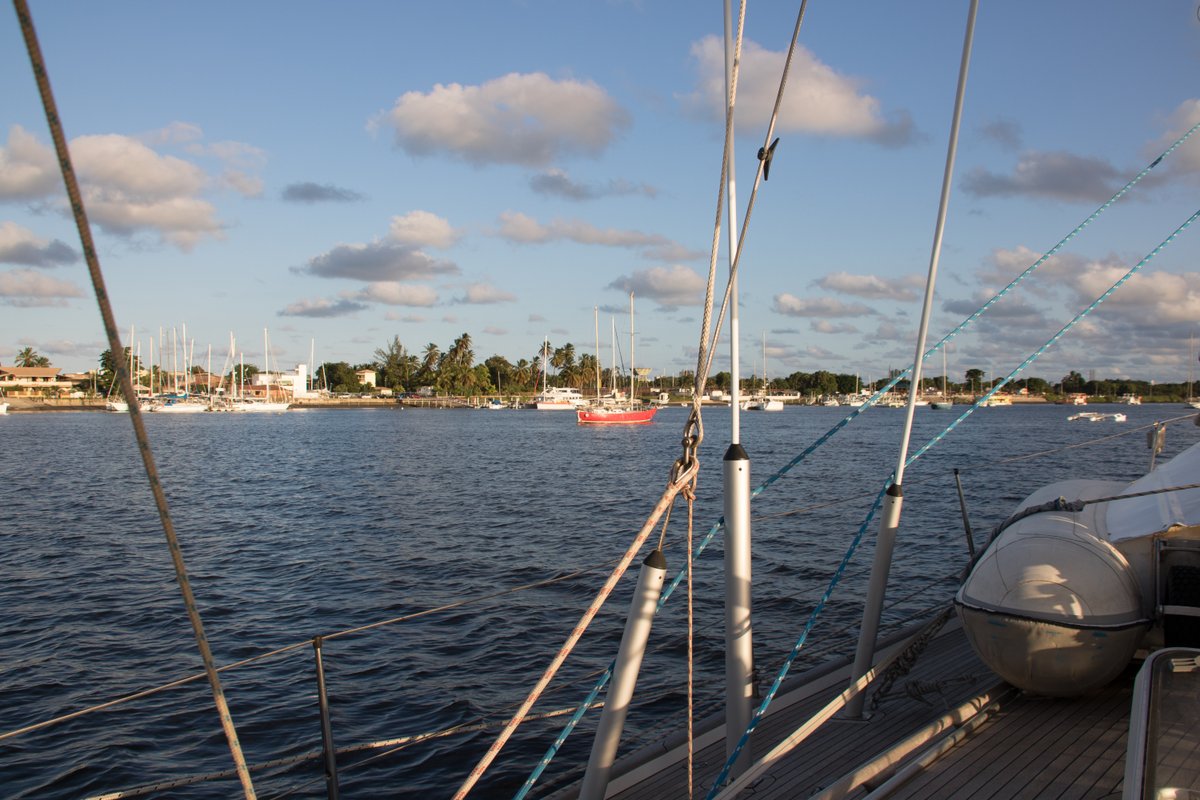
11 March 2018 Jacaré, Brazil
We understandably had a late start to the day and after breakfast, popped over to meet the only Brits in the anchorage, Steve & Alex on “Christiana Pearl”. They gave us lots of local information, including advice on the clearance process, which sounds like it will take us a couple of days. It’s a Sunday, so we can’t do anything today, but tomorrow we’ll have to tackle the bureaucracy.
Stefan and Anna on “Zanzibar” kindly gave us a lift in their rental car into the nearby town to get some cash out of an ATM and to go to a supermarket. The ATM charges an outrageous 24 Reais (£6) for the pleasure of issuing cash and, to add insult to injury, they limit the withdrawal to 1000 Reais (£200). (We later found out that the Bradesco Bank in Joao Pessoa has ATMs that don’t charge anything.)
Back at the marina, we caught a water taxi with Stefan and Anna to a small village on the mainland which is 1½ miles away across the river. The water taxi was a long tail, built from an 8hp auxiliary engine which you would normally see on a lawnmower. It was only 3 Reais each (£0.75)
The purpose of our little trip was to go to a local street-side food stall where they sell various types of soups. The place has become a bit of a cruiser’s Sunday destination and there were already about 15 sailors sat around the small plastic tables. It was interesting with different types of soup including fava beans with pork, prawns, crab, small clams, etc. We had a couple of small bowls each and a couple cold beers and a lot of pleasant conversation.

Back at the Marina, I took advantage of their Wi-Fi and sent out a few emails, catching up on administration. I did the electronic check-in on the Brazilian customs website (https:// www.edbv.receita. fazenda.gov.br). It took me four attempts to complete the “Entrada” form because of the poor internet speed.
The purpose of the form is to declare that I was temporarily importing my yacht and to state the value of the yacht, but it’s not clear what is required and which buttons to click. I was also confused for ten minutes because “United Kingdom” wasn’t present in the list of countries. It took me a while to figure out that “United Kingdom” was “Reino Unido” in Portuguese.
I had an online conversation with Paul and Lilian from “Luna Blu” and I was shocked to find out that they were boarded and robbed in Fortaleza on the north coast of Brazil. Six men boarded them at night, smashed open their door and rushed inside armed with machetes. They smacked Paul about, hitting him hard on the head and threatened Lillian with a machete. They were highly aggressive and took lots of stuff. Paul and Lillian reported it to the police and coast guard and then upped anchor and sailed to Grenada. They are understandably shaken up.
12 March 2018 Jacaré, Brazil
Last night, when I printed out the “Entrada” form for the customs, I discovered that I’d spelt my name wrong, so I was up at 06:00 to go into marina to use internet and fill in the form for the 5th time. After going back to the boat to print out the form, we took a taxi to Immigration with Peter and Theresa from “Leyna”. I was relieved to find out that, contrary to what is said on Noonsite, you don’t have to wear long trousers and long sleeved shirts with collars to visit the officials.
The marina organised the taxi for us. The driver was called Bernaldo, who didn’t speak any English, but saved us a lot of grief by accompanying us to the Immigration; then into Cabadelo to the Customs; and then waiting while the formalities were done. He charged us 70 Reals (£17.50) for the four of us, which I guess is a rip-off in local terms, but the whole process took three hours, so it was worth the expense.

Immigration is in the Federal Police building about 2 miles from the marina. We had to give our passports to the desk clerk, who then registered us on some system and then we sat down to wait for 45 minutes until 10:00. Once we saw the immigration officer, the process was relatively fast and we soon had our passports stamped.
Bernaldo then drove us into Cabedelo, which is a further 3 miles away. We went to the main port entrance and found customs in a small office inside the port. The customs guy was an officious little man, full of his self-importance. I handed over my papers and the printed copy of the Entrada Form. At this point, I noticed that there was a mistake on our paperwork from Immigration - everything was correct apart from the boat name wasn’t Alba.
I pointed this out to the customs guy and pretended to draw lines through the name with my pen, to explain that it was the wrong boat name. He became all agitated and told me not to deface the form. He realised that the boat name was wrong, but that was on the Immigration form and nothing to do with him. He allowed me to lightly change the name to Alba with a pencil. Having taken my paperwork, he turned to process the others.
By this time, four cruisers from two French boats had also arrived to clear in and the small office was crowded. The customs guy took Peter’s papers, but Peter hadn’t done the electronic Entrada form, so he was waved to one side. The French had filled in the on-line form, but hadn’t entered the details of the boats that they were importing.
For the next hour, it was chaos with the officer berating us all for not following procedures, while we used his computer to fill in the electronic forms. The officer should have sent them away to an internet café, but he was being chaotically helpful. Once he had obtained the correct paperwork from all boats, he then finished off everyone together, by printing out a form and signing it with great ceremony. I don’t know why he didn’t finish off our paperwork an hour earlier…

We paid Bernaldo and had a walk around town. There’s not a great amount to see - there’s a nice colonial church and a small fort, which took us 15 minutes to walk around. The town is a typically scruffy South American place.
The highlight was going to the wet market, buying a few vegetables and then having a meal in a small eatery on the first floor. It was a self-service place and the guy was very, very helpful, allowing us to taste a few things before piling it on our plates. He then kept coming over to make sure that we were okay and brought us some salad. We had a very typical Brazilian meal of Rice, Beans and Chicken - I’ve not had a proper plate of beans since we left Ecuador in 2014.

We caught a train back to Jacaré. The train runs between Cabadelo and Joao Pessoa, which is about ten miles. There’s only one railway line and the train runs about once per hour. It’s a very nice modern train similar to an underground train with automatic door. Apparently, we could get a free ride because we’re over 60, but it only costs 0.50 Realis each (£0.12) for any length of journey, so it’s not worth the hassle of trying to explain.
Back at the anchorage, we went to visit an English guy called Brian, who owns the Jacaré Marine boatyard. He’s about 80 years old, has been living here for 40 odd years and is very friendly and helpful. Brian gave us a very detailed hand-drawn map of Cabedelo and Joao Pessoa, showing the places of interest to cruisers.
13 March 2018 Jacaré, Brazil
Having done Immigration and Customs yesterday, we still had to go to the Port Captain to finish the clearance. We hopped on the train into Joao Pessoa. The port captain’s office is a white building with blue outlines, on the right hand side of the road leading up from the train station (about 400 metres walk). I filled in a form and handed over various documents, which took five minutes. We then had to wait 45 minutes for the sergeant to sign the form. Oh well, at least they had comfy chairs to sit in.

With our clearance finally finished, we wandered around Joao Pessoa. It’s a mixture of old colonial buildings and run down 1960s high rises. We found a large ornamental lake, which was near the wet market.
It was good to be wandering around a local market again - they just don’t have them in South Africa. There was a huge range of goods on sale, including scores of different types of dried beans and I spotted several stalls selling old fashioned Loofahs. (I discovered that these are made from drying a type of fibrous cucumber.) The market was better than the one in Cabadelo, but it’s a long way to lug a lot of vegetables back to the railway station.
There’s one area where there are many old churches, which seems to be the old part of town. Some of the churches date back to 1600 and there’s the Convent of San Francisco, which was built in 1589 and is now a cultural centre. We didn’t have time to go in but intend to return. The buildings in the surrounding area are interesting and there’s a very gaudy Masonic lodge, which looks like it should be in a Dan Brown novel.
We had lunch at a small self-service buffet - pile your plate up for 7 Reals (£1.70 each) - rice, beans and chicken - lovely. I could get used to this.
After lunch, we checked the train timetable and found that there was a train going in 20 minutes or another one in 1½ hours. I couldn’t face another hour wandering aimlessly in the beating sun, so I frog-marched Glenys down to station. She says we’ve got to go back and do some churches another day.

We seem to have been running around non-stop since we arrived here, so when we got back to the boat, we had a shower and an afternoon siesta.
14 March 2018 Jacaré, Brazil
We had a day of catching up on some chores. Glenys dropped off a load of laundry and we lugged 120 litres of water back to the boat to top up our tanks - the river is a deep brown colour from the sediment coming out of the mangroves and there’s no chance of running the water-maker. One of our two cooking gas bottles ran out last night, so I dropped it off ashore and someone is going to fill it for me.
The rest of the day was spent doing internet jobs. Glenys has booked us into a nice Pousada (Bed & Breakfast) in Olinda, which is a colonial town, 6 kilometres outside Recife. We’re going to travel there by bus on Saturday 17th and stay a couple of nights, which should be interesting. We’ll celebrate Glenys’ postponed birthday there.
I created adverts for selling Alba on four websites. It was a tedious process, not helped by the slow internet, but I’ve published the adverts and invested £120 for 3 months’ worth of advertising. We’ll see what comes out of that. We made the decision to sell Alba while sailing here, but to actually create adverts to sell our home is a bit unsettling.
The Jacare Marina Village is owned by Nicolas, a dour Frenchman, who only begrudgingly speaks English. I estimate that 90% of the berths in the marina are occupied by French speaking cruisers, so when they greet us in the morning it’s not “Bon Dia”, but “Bonjour” - it’s a French ghetto. Nicolas is charging me 125 Reals (£30) per week to use the marina’s facilities including showers, internet, water and use of the dock for our dinghy - I’m sure that I’m being charged non-French prices, but I can’t be bothered to argue.
15 March 2018 Jacaré, Brazil
I topped up our diesel tanks from a couple of jerry jugs. It’s quite nice to know that we’ve only used 50 litres all the way from St Helena. I dropped the empty jerry cans off at the marina and they will refill them for 4 Reals (£1) per litre. I also jerry-canned some water and filled up our water tanks. Glenys picked up the laundry from Carla, who did a great job. (She’s in the house with a big tree in the garden directly to the south of Jacare Marina Village.)
We spent the rest of the morning at the marina, using their internet, re-checking the adverts to sell Alba and other bits of admin. In the afternoon, I discovered that we can get internet on the boat from another marina, so we had a chilled out afternoon on-board, cruising the internet. I managed to publish my blog and photographs, which I wasn’t able to do on the slow internet at Jacare marina village.
An hour before sunset, we went ashore to the tourist area, where there are lots of small souvenir shops and cafes. There were hundreds of people milling about and a few musicians playing, so it was fun. Tourist boats were chugging around the river, all waiting for the main event.
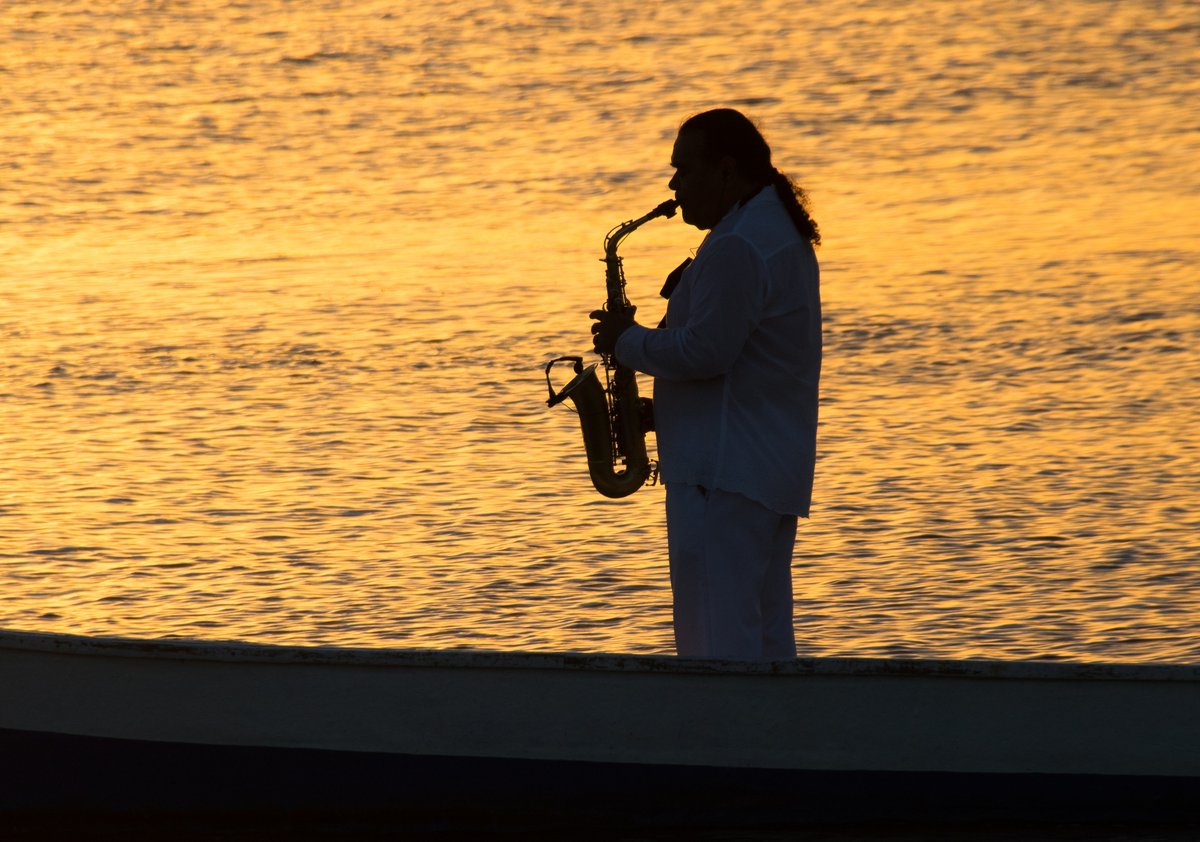
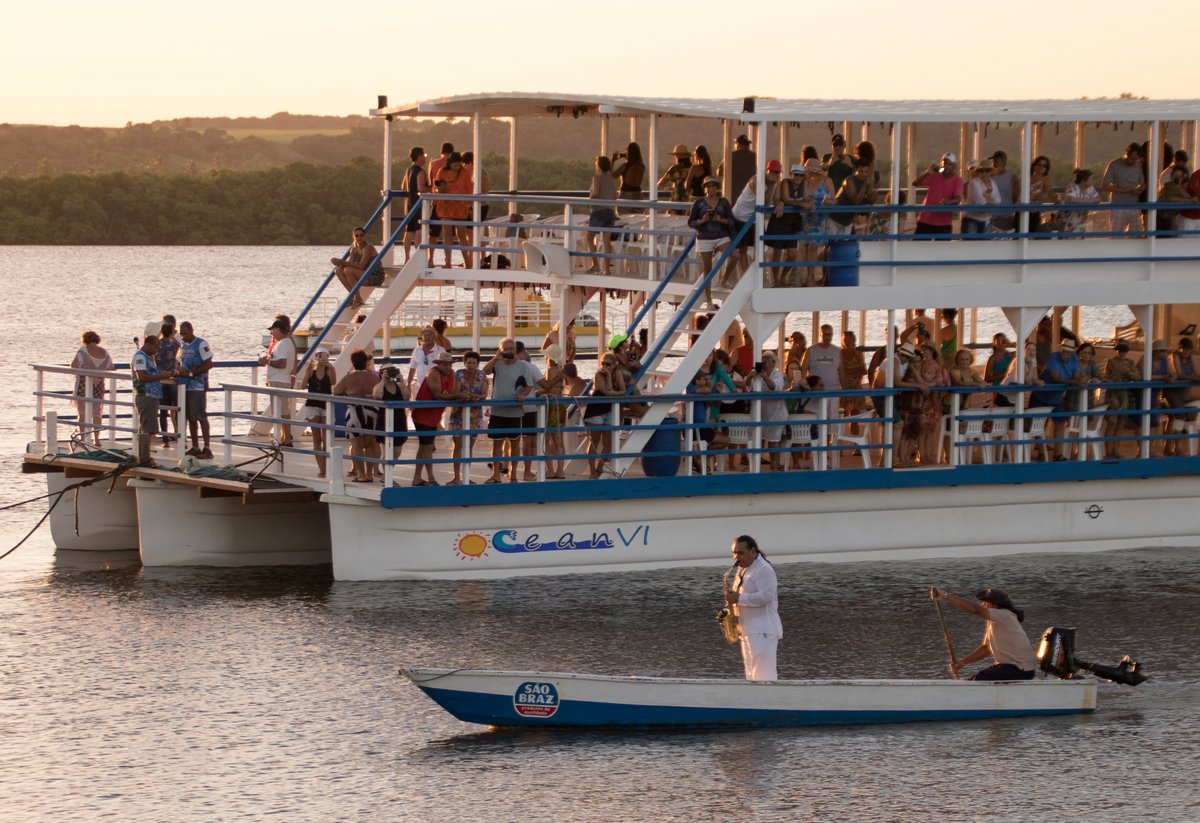
Just before the sun goes down, all the loud speakers switch to the mournful sound of Ravel’s Bolero. A small boat is rowed past the crowds, with a single saxophone player dressed in a white suit playing the tune. The same guy has been doing it for decades. It’s very picturesque seeing him drifting past, silhouetted by the setting sun. Unfortunately, the effect is rather spoiled by the huge Tourist Boats that pick up moorings and block most of the spectacular sunset.
16 March 2018 Jacaré, Brazil
I picked up our diesel from the marina. I’ve found out that Miserable Nicolas is charging other cruisers 100 Reals per week and is charging me 125 Reals, so I’ve got the hump and decided not to use his facilities any more. He didn’t half pull a face when I only gave him 107 Reals instead of 125, because we’d only used his facilities for six days.
I worked on the wind generator, which was still not outputting any power. I spent a couple of hours being very disciplined and testing the whole system, without finding anything wrong. Then I decided to change the fuse again and blow me down, it worked. I’ve changed the fuse before, but I must have had two bad ones… Ah well, at least it’s working now.

While I was in electrical mode, I tested the batteries. After the problems with charging on the passage here, I suspected that there might be something wrong. Sure enough, the three oldest ones are completely trashed and need replacing. They’ve obviously been pulling the other three batteries down, so I’ve disconnected them from the circuit and we’ll just have to run on 300 AH of capacity until I can replace them.
17 March 2018 Jacaré, Brazil
We spent the day travelling to Olinda. It was a long five hour journey - train into Joao Pessoa; executive coach to Recife Bus Terminal; underground to Recife city centre and then a local bus to Olinda. The journey went smoothly and I’m quite impressed by the public transport system. The local trains and buses are a bit rough, but the two hour intercity coach was air-conditioned with on-board wi-fi. It’s easy enough to get tickets at each of the stations.
The intercity bus went to the Recife Terminal Integrado de Passageiros (TIP), which was a little frustrating because the bus passed within 8 kilometres of Olinda and then carried on to the other side of Recife - we then had to travel back 22 kilometres via the city centre. The alternative was to get off the bus at Abreu e Lima and try to get a local minibus to Olinda. However, the idea of two (old) gringos, who can’t speak any Portuguese, trying to get a lift from locals seemed to be a recipe for robbery.
The trip might have been long, but we had a good time watching the locals and getting a feeling for the Brazilian way of life. The Recife Underground is chaotic, with dozens of vendors marching along the carriages shouting out their wares “Agua, Agua, Agua” was the predominate cry. The local buses into Olinda (1972, 1983 & 1992), stop on the road outside the underground Central Station and are bone-rattling, but you get a good tour of Recife.

Olinda is a lovely colonial town built by the Portuguese in the 1500s. It’s built on steep hillsides and the narrow, cobble-stoned streets wind between brightly painted houses, opening up in squares containing baroque churches, convents and monasteries. The town is only 6 kilometres outside Recife and it’s a popular destination for Brazilian tourists.
We walked up to the Pousada do Amparo, which is a small hotel and very nice. After dumping our bags, we went for a stroll around town, finishing at the top of the hill next to the Ingreja de Se, which is the centre of activity at sunset. There’s a great view of the town with the city of Recife in the distance. The square is packed with Brazilian tourists, strolling about, drinking cocktails and eating snacks cooked on the street stalls.
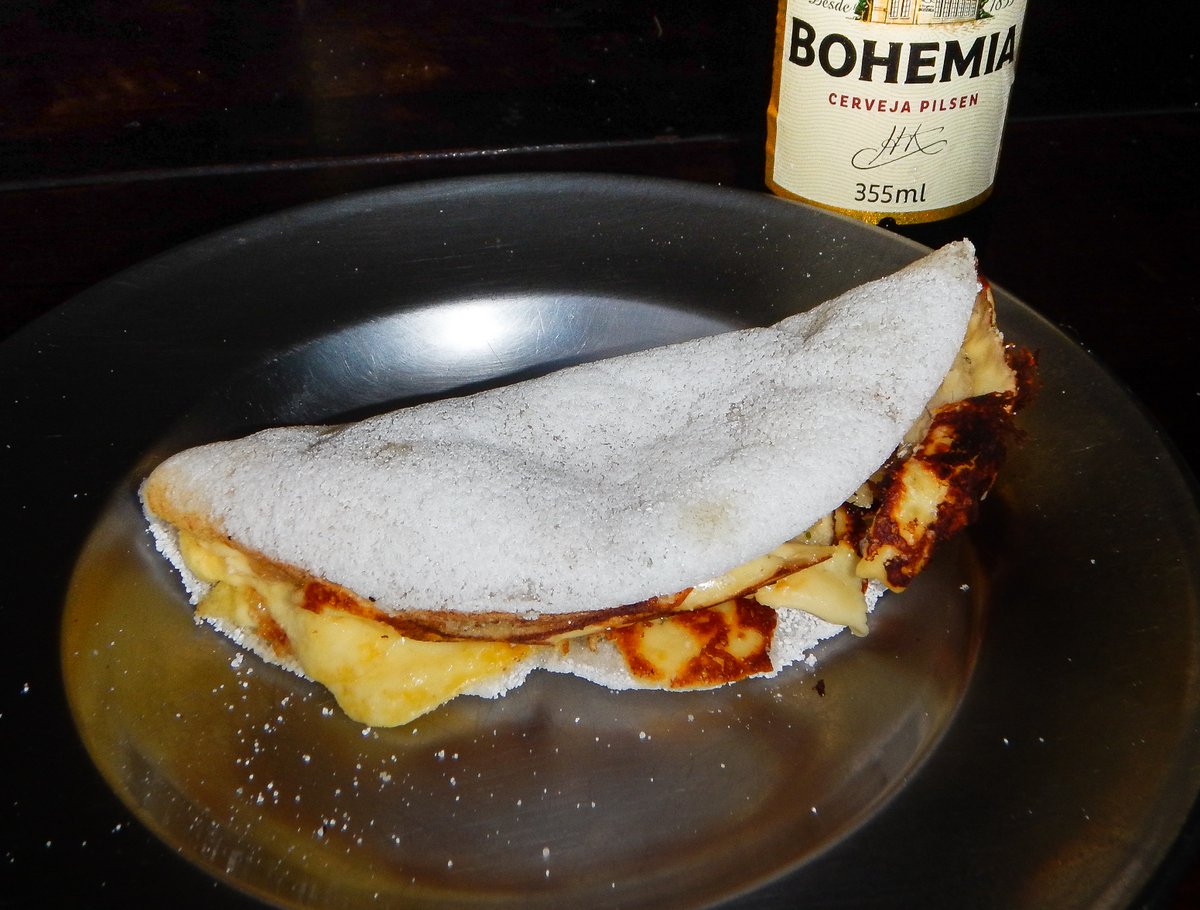
The local favourite snack is Tapioca. Dozens of small stalls were making a kind of tortilla from cooked Tapioca powder and then filling it with various savoury or sweet fillings. We found ourselves in a small bar (just along the street from the Observatory), where a lady dressed in white was producing Tapioca concoctions - we had one filled with Bacalhau and Cheese - very tasty especially when washed down with a cold beer.
For dinner, we selected a small restaurant (Nayle) just down the hill from our hotel. It was Glenys’s deferred birthday, so we had a couple of Caipirinha, which are Brazil's national cocktail. They are very simple to make - lots of crushed limes, ice and cachaça, which is 40°Proof Aguadente made from cane sugar - knocks your head off.

18 March 2018 Jacaré, Brazil
After a leisurely breakfast, we walked around Olinda. We’d found a walking tour of the town on the internet, which gave us a route and descriptions of the various sights. Our first stop was the Monastery of Bento, where the Benedictine monks have a special service at 10:00 every Sunday morning. The Gregorian chanting was lovely, but we could only take 30 minutes of the formal Catholic service.
The rest of the morning was a blur of churches, convents and monasteries, most of which were built in the 1600s and are still populated by very religious orders. One convent is occupied by the Sisters of Dorothy, who shun all contact with the outside world. The town is a very interesting place with lots of history.
We retired back to our hotel and had a siesta in the cool of the swimming pool and our air-conditioned room. Later in the afternoon, we visited a few more churches and strolled back up to the Ingreja de Se to see the sunset and do some more people-watching. Being a Sunday, many of the restaurants were closed, so we went back to the Nayle where we shared a fabulous Fish Stew and a bottle of wine.
19 March 2018 Jacaré, Brazil
After an early-ish breakfast, we caught a bus from Olinda to Recife city centre, where we walked to Marco Zero Square, which is supposed to be one of the “must-visit” places in Recife. We were disappointed - it’s a big square with lots of tourist guides touting for business and a large sanitised tourist souvenir shop, so we didn’t stay long. Instead we walked to the Mercado de Sao José, which was a bustling local market and interesting to stroll around.
At about 11:30, we caught an underground from the Central Station and returned to Jacaré. It took us six hours to get back to the boat because we had a long wait for the intercity coach, which then got caught in a traffic jam. However, we had a good short break and saw a lot of the Brazilian way of life.

20 March 2018 Jacaré, Brazil
We’ve decided to leave Brazil on Saturday 24th, so we walked into the main street of Jacaré to do some shopping. After checking out the three supermarkets, we walked a little further to the beach on the other side of the peninsula. We went for a short stroll along the beautiful white sand beach, but we were soon defeated by the beating sun.
After a double trolley shopping spree in the supermarket, we caught a cab back to Brian’s dinghy dock, which only cost us 9 Reals (£2.25). The afternoon was spent stowing food and chilling out.
21 March 2018 Jacaré, Brazil
Having experienced the slow process of clearing into Brazil, we decided to start a few days early. We parked our dinghy at Brian’s dinghy dock and walked to the Immigration, which took about 25 minutes. We arrived just before 10:00 and were kept waiting for 40 minutes until someone saw us.
The immigration officer was painfully pedantic and checked every stamp on every page of our passports. He then triple checked everything else before printing out two copies of the Exit (Saida) form, which he checked four times before signing it and handing it over. The process took a mind-numbing 40 minutes.
We had planned to catch a bus into Cabadelo, but it was 11:35 by the time that we walked to the main road and we knew that the Customs wouldn’t see anyone after 12:30, so we called it a day and walked back to the boat. We spent the afternoon chilling out.

Every evening just after dark, we’ve been getting these loud tapping noises coming from the hull. When we first heard it, there was only one or two things tapping and I was convinced that a rope or something had caught on the anchor chain and was banging against the hull in the strong current. We pulled up the anchor a little and motored forward to try to dislodge it without any luck.
I now think that our hull is covered by big barnacles or the noise is caused by shrimp or fish biting things off the hull. I’m going to have to go down underwater and investigate, but I’m not looking forward to it. The water is a horrible brown colour and the current rips by at over 4 knots at times, so I’m going to have to time it well.
22 March 2018 Jacaré, Brazil
At 08:15, we caught the train into Cabadelo to visit Customs. We’d been told not to get there before 09:30 because the custom officer’s boss wasn’t in until that time and he has to sign the paperwork. However, we thought that we’d get there early to get a head start. We walked into the office at 08:45 and to our astonishment, we were walking out at 08:55 - it’s a miracle.
Unfortunately, the next train to Joao Pessoa wasn’t until 10:15, so we walked to the little bus station and despite the unhelpfulness of the guy in charge of the office, we managed to get on the correct bus. The cost of the ticket was 3.55 Reals, which is 7 times the cost of the train, but being only £0.80 each, we decided that it was acceptable. The buses have an incredibly robust turnstile just past the driver, which is very narrow and strong, so it’s a challenge to get through it, especially for some of the predominantly large Brazilian ladies.

The driver was a maniac. He roared off as soon as the last passenger was through his door, accelerating through the gears, while using one hand and half his brain to give change to the money offered. There are bus stops along the route, but it would appear that they are just a convenient place for stopping to let passengers off.
Anyone can flag down a bus anywhere. Upon spotting a potential passenger, the driver accelerated towards them, slamming the brakes on at the last possible moment and veered to the side of the busy dual carriageway. The passenger scurries on-board, hanging on grimly as the bus roars off again. It wasn’t very restful, but great fun.
Miraculously arriving in Joao Pessoa in one piece, we dodged the heavy rain showers and walked to the Port Captain’s office, where we were processed within 15 minutes - God is obviously on our side today.
We strolled across town to the Centro Cultural de São Francisco which was a Convent built in 1589 and has been restored to become a religious museum. It’s only 6 Reals to get in and the ticket includes a guided tour. It’s all in Portuguese, but the place is astounding with four chapels, which are beautifully decorated with gilded carvings and frescoes. One of the chapels is dedicated to St Francis of Assisi, who (I now know) was the first saint to be given stigmata by the angels.
With time to spare, we called in at the zoo, which only cost 2 Reals each (£0.50). There’s a lot of building work in progress and the animals are in depressing 1960’s cages and concrete enclosures, but the grounds are pleasant and it was a nice way to pass an hour.

After a lunch of rice, beans and chicken, we strolled to the market where Glenys bought various types of beans. We caught the train back to Alba and then invited Stephen and Alex from “Christiana Pearl” over for a few sunset drinks.
23 March 2018 Jacaré, Brazil
Our plan is to sail tomorrow, so at slack tide, I donned scuba gear and went under the hull to investigate the extent of the fouling. I was pleasantly surprised to find that the antifoul paint has been doing a good job and there were hardly any creatures on the main hull. The propeller had ¼” of barnacles and soft growth, but that was soon scraped away. I even had time to swim around the boat and scrub the water line, before the current picked up.
We walked into Jacaré and did a last food shop at the supermarket. After a taxi ride back, I dropped Glenys off at the boat and did two runs ashore to lug 120 litres of water back to the boat. Brian let me get water from his Jacaré Marine boatyard for free, but I had to lug the heavy jerry cans 100 metres back to his dinghy dock. It’s so frustrating knowing that our water maker produces 170 litres and hour, but I can’t use it in the river because of all the sediment.
We chilled out in the afternoon and then went ashore to the Praia do Jacare to do some tourist watching and spend the last of our Reals on tourist crap and a few Caipirinhas.
24 March 2018 Brazil to French Guyana (Day 1)
The alarm went off at 06:45. It’s strange how the sound of an alarm clock makes you want to stay in bed, but time and tide wait for no man and we wanted to leave a hour before high tide. It took us a couple of hours to get the dinghy on deck and tidy up after two weeks at anchor, but at 09:00, we started to pull up the anchor. The anchor chain was covered in thick, slimy growth, so it took 10 minutes to try to wash off the worst of it.
The sky was overcast with lots of showers around us and no wind. Motoring down the river was uneventful and the tide had just started to push us out as we headed out of the ship channel. There was a one metre swell coming in from the north, but with hardly any wind and not much current, it was fine. The channel is only 10 metres deep and I would imagine that if there was a strong on-shore wind and an outgoing tide, it would be unpleasant.

There was a light 5 knot wind from the east, which just about filled the mainsail as we motored north. The afternoon was muggy, but the clouds eventually moved west over land and the wind picked up enough to sail at 16:00. Unfortunately, we had a slight 0.5 knot current against us, but we should pick up a favourable current when we turn the corner tomorrow.
As soon as we’d hit the open sea and settled down, we changed the ship’s clocks forward one hour. Over the past two weeks, while on Brazilian time, the sun has been setting at about 18:00. This is great for the tourists listening to Balero, but a bit too early for our watches. We should now have the sun going down as Glenys goes off-watch at 19:00 and sunrise should be about 06:00, which is perfect.
Glenys produced my favourite Brazilian meal for dinner – rice, beans & chicken. On our last two long passages, I’ve become constipated because of slight dehydration and the lack of exercise - sitting around all day doesn’t help the digestion. Glenys has decided that the solution is to increase our fibre intake by eating more beans. Of course, flatulence may then be a problem, but Glenys has read that the proper soaking of dried beans overnight, removes the starch and reduces the production of gas. We’ll see how it goes.
It was a pleasant night with a 10-14 knot east wind putting us on a beam reach at 5 to 6.5 knots. We followed the edge of the continental shelf about 15 miles offshore, where the depth drops off to thousands of metres, trying to find the elusive current. By 02:00, we had up to ½ knot with us. There were quite a few cargo ships following a similar route, so we had to keep a good watch – not as relaxing as the trip from St Helena where we didn’t see anything for days.
25 March 2018 Brazil to French Guyana (Day 2)
The wind dropped after dawn and we bobbed along until I cracked up at 11:00 and started the engine. Just after lunch, we turned the north-east corner of Brazil and started to head north-west. Probably due to a land effect, the wind veered to the south and increased enough to gybe the main and start to sail again. We were only achieving 3 to 4 knots boat speed, but we had about a knot of current with us, so it wasn’t too bad.

With hardly any wind, it’s blisteringly hot during the day, even in the shade of our bimini. When I went for my afternoon kip, I had to have a quick cold shower and then a fan running above my head to be able to sleep. The best time of the day was an hour before dark, when the temperature dropped to a comfortable level and we had dinner.
When the wind is light, we have the genoa poled out and a preventer on the main to minimise the sails bashing and banging as we roll in the waves. However, there’s still some serious snatch forces on the mast and gear. This morning, while I was in the saloon, I heard a metallic clink on the deck. I scurried up and found a broken piece of u-section stainless steel, about 6mm wide and 25mm long – very worrying. After searching the mast with a pair of binoculars, I discovered that it was part of a stainless steel thimble from the rod kicker wire – not an immediate problem, just another thing to go on the To Do List.
The wind dropped again over the afternoon and at 16:00, we had to put the engine back on for a couple of hours until the easterly 10 knot wind filled in, allowing us to sail wing-on-wing. The first half of the night was lovely, with a half moon and fluffy white clouds. The wind was consistent at 10-14 knots, and we were gliding along at 6 knots in the calm seas.
Unfortunately, at our 01:00 watch change, a huge black cloud system overtook us and the wind backed by 30 degrees, forcing me to gybe the main. The wind had picked up a little, so I put 1½ reefs in the main. 10 minutes later, the wind veered by 30 degrees and torrential rain started, soaking me through as I struggled to install the rain flaps on the bimini, while gybing the main back to port.
To add to my woes, I could see the lights of a fishing boat about quarter of a mile to starboard, restricting my ability run downwind. The wind increased over 20 knots, so I was glad that I’d put in a precautionary reef and then 10 minutes later, the wind died completely, forcing me to run the engine for an hour.
And then another rain shower came along and the wind backed by 120 degrees, putting us hard on the wind - we’re only 240 miles from the equator and back in the region of tropical squalls.
26 March 2018 Brazil to French Guyana (Day 3)
The miserable weather continued until lunch time. In the daylight, we could see that we were surrounded by big black squalls. The 3 day weather forecast looks horrible. There’s rain for the next 3 days and it looks like variable winds for the next 48 hours, so we’re going to be kept busy with sail changes.

Before breakfast, while it was raining heavily in another squall, we were called up by a seismic survey vessel. We were politely told that there was a 3 kilometre exclusion zone around the ship and cables stretching out 7 kilometres behind it! The ship was directly on our route, so we made a 15 degree correction to port to motor-sail around it, which took a couple of hours.
Early in the morning, Glenys noticed a 4 inch tear in the genoa, which must have been done during one of our gybes last night, but I can’t figure out what caused it. We had to roll away the sail, which put it out of action during the morning, while we waited for a long gap in the showers and gusty winds. It took us a couple of hours to darn the rip and then sew on two patches, one on either side of the sail. We had to use our “Speedy Stitcher”, so it’s not a pretty repair, but it’s very strong.
After lunch, the weather started to settle down and by 16:00, we were back to east 8-12 knot winds and sailing along at 4 to 5.5 knots, with at least 1 knot favourable current. At sunset, the skies were overcast, but at least we couldn’t see any black squalls.
The good weather continued until midnight and then the wind slowly backed to NNE, putting us on a close reach on starboard tack. At our 01:00 watch change, Glenys pointed out a dense, black cloud off to starboard, which had occasional lightning flashes and then she went to bed. I hate lightning.
I flicked on our radar and could see that we were six miles from the squall to our starboard. There was also another one six miles to our port. The next hour was spent watching the movement of these two squalls, which seemed to be going in the same direction as us.

Squalls have a habit of burning themselves out and others seem to appear by magic. Another squall popped up about 3 miles on our port side, but fortunately the one on our starboard dissipated. I rolled away our genoa, turned 40 degrees to starboard and motored directly into the 5 knot wind, away from the squalls. An hour later, the squalls were 10 miles off our port side, so I turned back on course.
Unfortunately, the light north wind was still 10-20 degrees off our starboard side and too tight to sail without forcing us to port, back towards the squalls, so I kept motor-sailing for the rest of my watch. The damn squall just kept moving parallel to us and at 04:00 was 9 miles off our port beam. Thankfully, over Glenys’s 4-7 watch, the squall dissipated and she was able to sail again.
27 March 2018 Brazil to French Guyana (Day 4)
The wind proved to be very fickle and we spent the morning motoring with a very light 3-5 knot south-west wind. There were a few squalls about in the early morning, but they didn’t get any closer than 6 miles and the latter half of the morning was very pleasant – overcast, but nothing nasty in sight.
As usual, I used email on our satellite phone to publish my daily position report to our “at sea” blog, so that my Mum knows were we are. For some reason, I’m having a lot of trouble sending and receiving emails on this trip. The Iridium server keeps timing out - I don’t know if it’s the squally atmospheric conditions or there’s simply poor satellite coverage in this area.
In any case, it’s taking twice as long every day. Normally it takes 3 minutes to get a weather forecast and now it’s taking 6 minutes – that’s £6 per day instead of £3. I’m now only getting a weather forecast every other day, because I only have 65 minutes left on my account, which needs to last us for another 6 weeks until we get to the Caribbean.
In the late afternoon, the wind finally picked up enough to sail – 6 to 9 knots from the north-east, putting us on a close reach, but that’s fine in such light winds and calm seas. With 1½ knots of current with us, our speed over the ground was 5 to 6.5 knots. Just before dinner, we caught a nice 10lb tuna, which I filleted ready for tomorrow.

We had a beautiful sunset with clear blue skies above us, but there were lots of cumulus clouds at various points on the horizon. We’ve been sailing 30-40 miles from the coast up to now, but are now starting across the huge bay where the Amazon River meets the sea and we’ll be 150 miles away from land. I’m hoping that we’ll be encountering less squalls as we head more offshore.
Overnight, the wind increased to NE 10-14 knots, putting us on a 70° close reach. We’ll be on the same course for the next 700 miles and the wind is likely to increase to NE 20 or higher once we pass the equator. At the moment, it’s fairly pleasant sailing upwind in these slight seas, but the stronger winds may bring bigger waves in the next few days. We don’t relish the idea of bashing to windward, so we’re aiming at a waypoint of 02°37N 45°22W, which is 10° higher than the rhumb line, which will allow us to ease the sheets if the going gets tougher.
At around 03:00, we were tromping along at 6.5 knots and I was gazing out to starboard at the stars and the bright moon shining on the silver sea. Unbeknownst to me, a squall had been sneaking up on us. The wind suddenly dropped, so I looked to port and could see the huge cloud approaching. I eased the main sheet and started to zip the side panels onto the bimini. I wasn’t fast enough, within 30 seconds, we had 18 knot winds and torrential rain – I got drenched.
Five minutes later, the wind died down to 5 knots and the rain stopped. After five more minutes, the wind came back from the north-east and we were off again.
28 March 2018 Brazil to French Guyana (Day 5)
The squalls continued until 09:00 and then the clouds thinned leaving us with hazy sunshine. The rest of the day was very bouncy as the wind increased to 15-20 knots and backed by 10°, putting the wind at 50-60° off our starboard bow.
It was a bit frustrating because the wind was gusty and, in the brief lulls, the steep, confused waves would stop us unless we were well powered up - crashing along at 7 knots, which was very uncomfortable. Every time that I tried to reef us back to a more comfortable 6 knots boat speed, we’d hit a big wave and our boat speed would drop to less than 4 knots and we’d wallow about for a minute, before picking up speed again.

This morning’s weather forecast showed NE 15-20 knots for the next three days, so we resigned ourselves to an unpleasant life heeled over at 15-20°.
We didn’t do anything all day apart from sleeping, reading and hanging on, bemoaning the fact that we have to sail upwind – we haven’t had to do it for a long time. The only good thing was that with a 1 knot favourable current, we averaged more than 7 knots over the ground and we should be able to ease the sheets by 20° on the morning of the 30th to give ourselves more of a beam reach for the last 2-3 days to Iles du Salut.
Despite the bouncy conditions, Glenys produced a fabulous Green Thai Curry with the tuna that I caught yesterday. At 21:45, we crossed the Equator for the fourth time. We didn’t have a party, but I did share a glass of ginger beer and a biscuit with Neptune - Glenys was asleep, hanging onto the bed in the recovery position.
During the night, we lost the favourable current and even had ½ knot against us at times. We seem to have lost the current when we left the steep continental shelf drop-off, but with the forecast north-east wind, we don’t want to be following the coast and risk having a very hard bash out of the Amazon Delta “bay” for the last two days.
On her dark 4-7 watch, Glenys was hit by a 20+ knot squall, forcing her to run downwind and reef the genoa. She had heavy rain for 10 minutes; then no wind for 10 minutes; and then the wind gradually came back to NE 12-18 and she was off beating upwind again.
29 March 2018 Brazil to French Guyana (Day 6)
Just after dawn we passed the halfway point with 670 miles to go. The morning was a little more pleasant than yesterday with lighter 10-15 knot winds and slightly calmer seas - we had no current at all, so perhaps yesterday’s steeper seas were caused by a wind against current effect. The wind had backed by 15° putting us very hard on the wind, but this wasn’t a problem in the milder conditions. We even ran the watermaker for an hour.

Yesterday, I had problem with the satellite phone again – it took 6 minutes to get a weather forecast despite having 4-5 bars signal strength. Today, I only wanted to publish my “at sea” blog, so I didn’t bother to connect to our email. Tomorrow, I’ll wait until midday to see if the time of day is affecting the data connection.
Just before lunch, I’d powered up the sail plan by adding the staysail because we were being stopped by steep waves again. When Glenys arose from her morning nap, she was a bit grumpy with the bouncy motion and being heeled over at 20 degrees. She went below to make pan-fried fish sandwiches and had a sense of humour failure when a particularly large roll of the boat slid the cooked fish into the galley sink. The air was blue with expletives. I quickly rolled away the staysail and depowered the main before she turned her frustration onto me.
We had ½ to 1 knot of current against us all afternoon, which was irritating – if we’d stayed closer to shore, following the 500m contour, then I think that we’d have had 1-2 knots of favourable current. However, we’re now sailing hard on the wind and if we were closer to shore, we might have been struggling to sail out of the shallows – I think I’d rather have the 50 miles extra sea room and take a bit longer.
Overnight, the skies were overcast with some large cloud systems, but we only had one light shower and a couple of short episodes where the wind picked up to 20 knots and then died on us for 10 minutes before returning to the normal 12-18 knots. Despite having to beat upwind, it wasn’t too bad.
30 March 2018 Brazil to French Guyana (Day 7)
The day remained overcast and we had a few showers. In the middle of the morning, we altered course 20° to port and eased the sheets. The wind then slowly veered by 10-20°, so within the space of a few hours, we’d gone from bashing upwind to a reach with the 15 knot wind just abaft the beam. What a difference in the motion – life is suddenly good again.
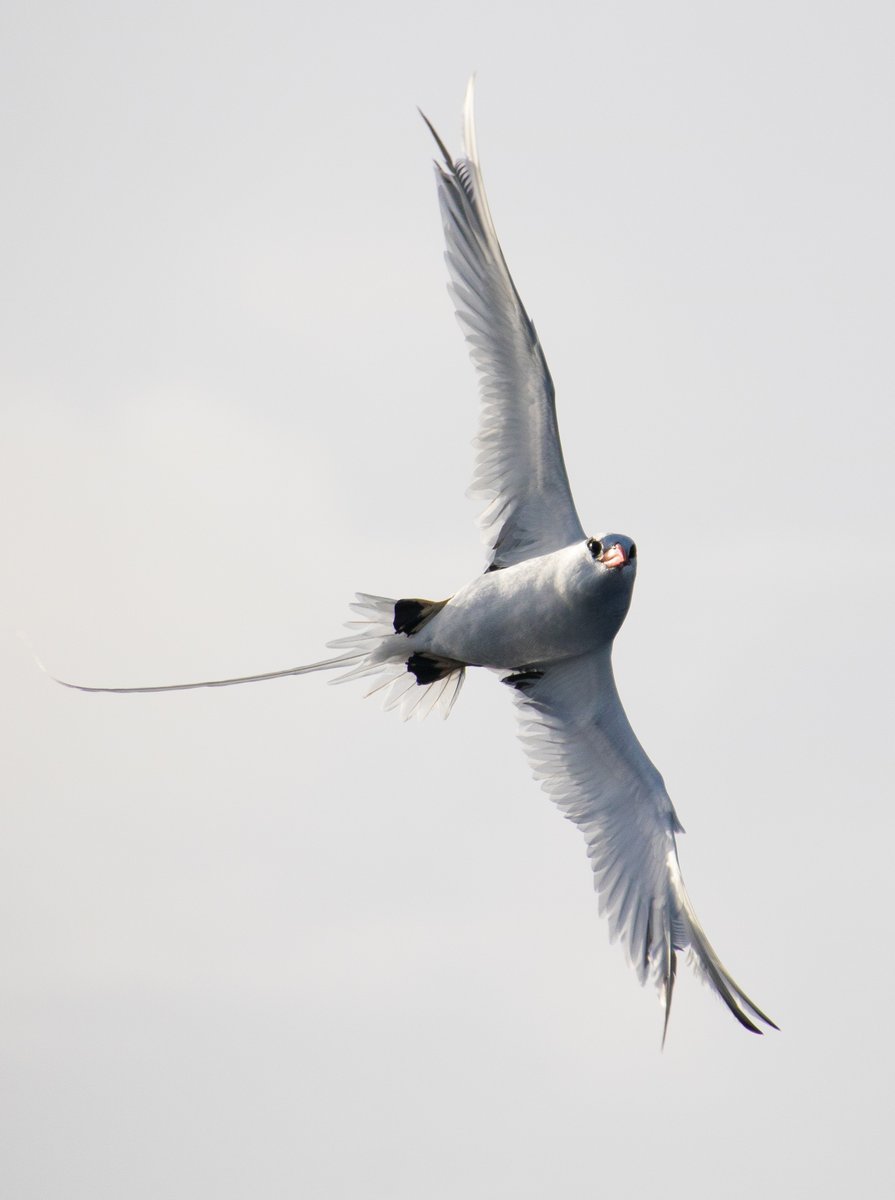
We’ve not see a huge amount of wildlife on this trip. A pod of dolphins joined us yesterday for ten minutes and we get occasional Gannets and Tropicbirds, which come and fly around us for a while. There’s lots of Sargassum Weed in the water, either in clumps or long lines hundreds of metres long. The only other thing we see are Flying Fish, which are plentiful and fairly large.
There was a full moon tonight, which made the night watches more bearable - the sky was overcast, but the bright moonlight gave us a fighting chance of seeing showers approaching. The couple of showers that hit us weren’t too bad with only 20 knot winds.
31 March 2018 Brazil to French Guyana (Day 8)
We had a nice bright start to the day. The wind was ENE 15-18 knots, so we were on a beam reach, doing 6 knots, which was a little bouncy in the 2 metres seas, but much better than beating to windward. At 07:00, we had 390 miles to go and the current had finally turned giving us a ½ knot push. The favourable current should increase as we approach land, so we’ve a fighting chance of getting to Iles du Salut before dark on the 2nd April.
Just after lunch, the clouds rolled in and the afternoon was overcast with some variation in wind strength, but all within the 12-20 knot range. There’s an incredible amount of Sargassum Weed about – maybe 1% of the ocean surface is weed in some places.
The overcast and blustery weather stayed with us all afternoon and into the night. A big rain system caught us just before our 22:00 watch change giving us 25 knots of wind, so I stayed up for a while with Glenys to make sure that it didn’t get any worse. Despite the full moon, it was a dark, miserable night.
There are more photos in our Photo Album section.