
11 October 2018 Chaguaramas, Trinidad
After breakfast, we did a bit of planning for our route up to the east coast of the USA next year. Glenys has discovered that the Bahamas have just introduced a $20US per day anchoring fee in the Exumas. We were planning to spend at least two months cruising in the Bahamas, so this was a bit of a shock - $600US per month…
Should we bypass the Bahamas and perhaps go to Columbia and Cuba instead? After a bit more research, we discovered that the outrageous fee is only payable in the Exuma Land and Sea Park, which only covers 30 miles, so there’s loads more places to go without being charged for anchoring.
I did a bit more work on the teak grating and worked out the final dimensions. Mike from El Lobo is coming over tomorrow with his small table saw and a belt sander, so I should soon be able to tick this job off the list.
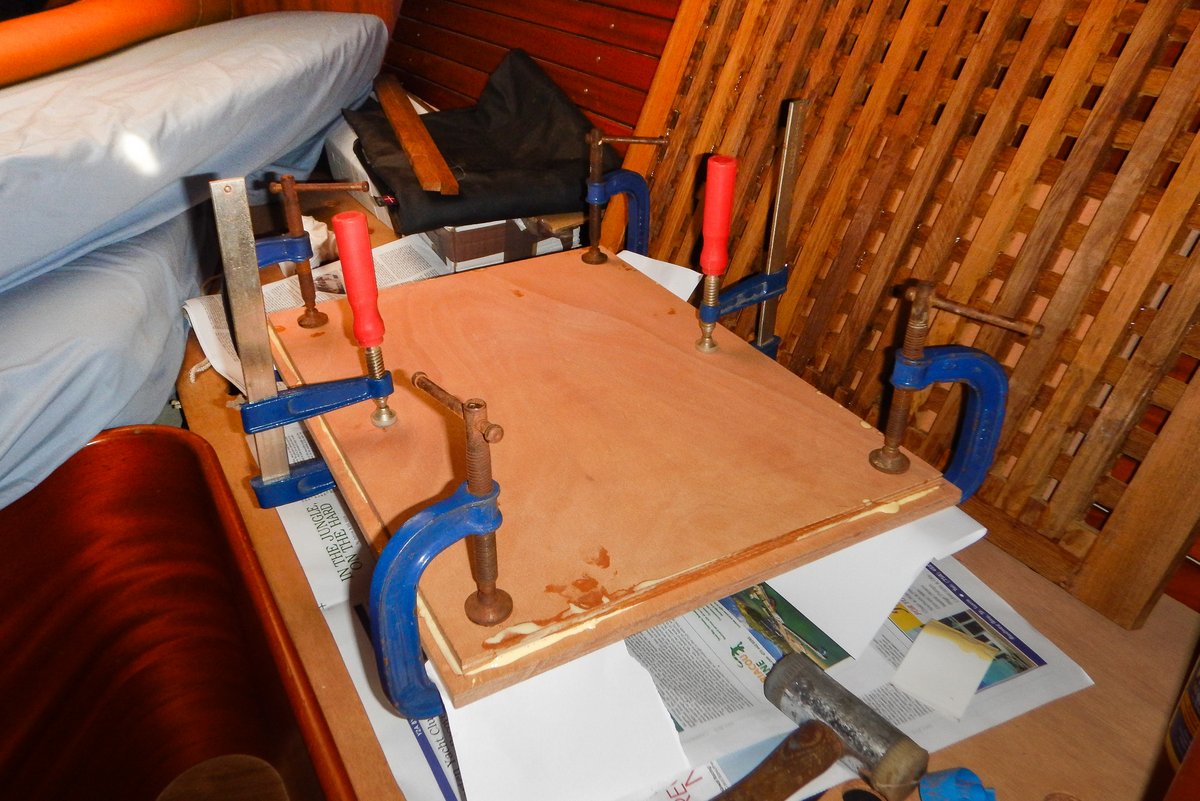
I picked up six pieces of plywood from one of the carpenters, so that I can make three cupboard doors for the front heads. They’ve charged me $120US to supply and cut up ½ sheet of marine plywood, which is outrageous, but they tell me that the marine plywood is imported hence the high cost. I glued and clamped one of the doors - I only have enough clamps to do one a day, so it will take a whole week to do the job including the painting.
Just before lunch, I decided to replace four clevis pins at the top of the lower shrouds. When Jonas, the rigger inspected the rig, he noticed that these clevis pins were 12mm instead of 14mm, so I brought four new ones back from the UK. It was a fairly simple, if lengthy job, climbing up and down the mast. I had a bit of a delay when I had to dash to the Chandlers to get some spacer washers - that took 30 minutes…
I was feeling very dehydrated after three hours in the sun, so I packed up in the late afternoon and chilled out for the rest of the day. Most of the jobs that we have to do are very technical and I have to do them, so Glenys is at a bit of a loose end and just pottering about while I mutter and curse in the beating heat.
12 October 2018 Chaguaramas, Trinidad
Mike from “El Lobo” came over to give me a hand with a few things. He brought his belt sander that made short work of flattening out my teak grating. He also brought a small portable table saw that we used to trim the grating to size. I still need to do a little more sanding, but the grating is almost finished.
We then drove to a hardware store called Kings, in St James, where I ordered three replacement mirrors. They told me that it would take 1½ hours, so we went to Mike’s partner’s bakery (she’s called Katrina) and had a leisurely lunch. I discovered that Mike has lost two boats since we were here in July!
His original boat “El Lobo” was a ferro-cement , junk-rigged schooner, which was hit by a jet ski about seven years ago. It appears that the repair to the hull failed and the boat sank in the Chaguaramas anchorage. His other boat was also a ferro-cement hull and also sank in the Chaguaramas anchorage. He thinks that it was hit by local boat. Both yachts were only insured as 3rd party, so it’s a huge loss to him - it was a conversation stopper.
After we picked up the mirrors, Mike dropped me back at the boat and I started to fit them. Unfortunately, some of the mounting brackets had corroded, but I was able to rescue enough to fit two of the mirrors. I know that they have some suitable brackets at King’s to I’ll have to get back there somehow.
Just before Miller Time, I managed to glue another of the cupboard doors. My back is still extremely stiff and sore - it’s only by taking Ibuprofen that I’m able to do any work at all. I’d like to rest it, but there are too many jobs to be done.
13 October 2018 Chaguaramas, Trinidad
The steering on Alba is driven by stainless steel cables which run through Teflon-lined conduit. The Whitlock manual states that the steering cables should be greased every year and replaced every 3-5 years. The conduit should be replaced every 5-10 years. The manual goes on to say that for boats in constant use, these numbers should be halved.

I’ve been very lax at the maintenance on this very important part of the boat, having never greased the steering cables and I’ve never considered changing them. While I was in the UK, I bought a new set of steering cables and conduit, but since getting back to Trinidad, I’ve been putting the job off because it could go horribly wrong and we could be stuck here for weeks waiting for parts.
Finally, I plucked up the courage to start the job today. With Swear Box handy, I spent the morning removing the steering cable and conduit, which seemed to go well. The afternoon was a little more fraught involving much swearing, grunting and straining (which didn’t help the pulled muscle in my back). By the end of the day, I was totally exhausted, but had replaced the conduit and had the steering cable in place ready to connect.
I was in bed by 20:30.
14 October 2018 Chaguaramas, Trinidad
After breakfast, I pulled the aft cabin apart again and spent the morning connecting and tensioning the steering cables. It was very fiddly, but it’s all done and I can sleep at night without worrying about our steering failing - unless of course, I’ve done something wrong…
While I’ve been doing the steering, Glenys has been giving me a hand occasionally and has been pottering about for the rest of the time, cleaning and polishing. In the afternoon, I did a bit of filling on the damn teak grating and glued the third and final cupboard door.
We’ve sprung a cooking gas leak. I fitted a new 9 kg bottle about a week ago and it’s completely empty. Fortunately, we’ve just had another bottle filled, but I can’t find the leak. It’s a big leak and the worry is that the gas is collecting in the bilges and the slightest spark will cause Alba to explode. It’s not the usual suspects of the flexible hose and regulator - although there is a smell of gas in the gas locker. I’ve checked everything that I can see, but tomorrow we’ll have to empty lots of cupboards in the galley and test every part of the system. We had cold salad tonight.
There are more photos in our Photo Album section.
15 October 2018 Chaguaramas, Trinidad
Jonas, the rigger turned up just after 08:00 as promised. When he inspected the rig back in June, he’d spotted three toggles that were the incorrect size and needed to be changed. They were in critical places at the top of the Back Stay; the top of the Fore Stay; and the bottom of the Inner Fore Stay.
Once he’d replaced the toggles, Jonas checked the tension on the rigging and re-tuned it. There wasn’t much wrong - the intermediate shrouds were too tight and the cap shrouds were a little too loose; he also backed off the lower shrouds. I think that the lowers may be too loose when beating to windward, but I won’t be able to check until we go sailing again. Jonas has told me to tighten all four of the lower shrouds equally, if I need to adjust.

With the rigging all done, I dinghied across to the sail loft and picked up the genoa and stay sail, which have had new sacrificial strips fitted and some other bits of maintenance. By the time that I’d got them on board, it was lunch time.
After a quick sandwich, I tackled the gas leak. The gas regulator was looking very corroded after travelling around the world, so I replaced it and also the flexible hose in the gas locker. I turned the gas on; pressurised the system; and then turned the gas off at the tank. To my great relief, the pressure held for ten minutes. The leak must have been in the regulator, escaping out through the safety vent, which is so large that it’s difficult to test with soap and water. I’m a happy bunny now and we had a hot meal in the evening.
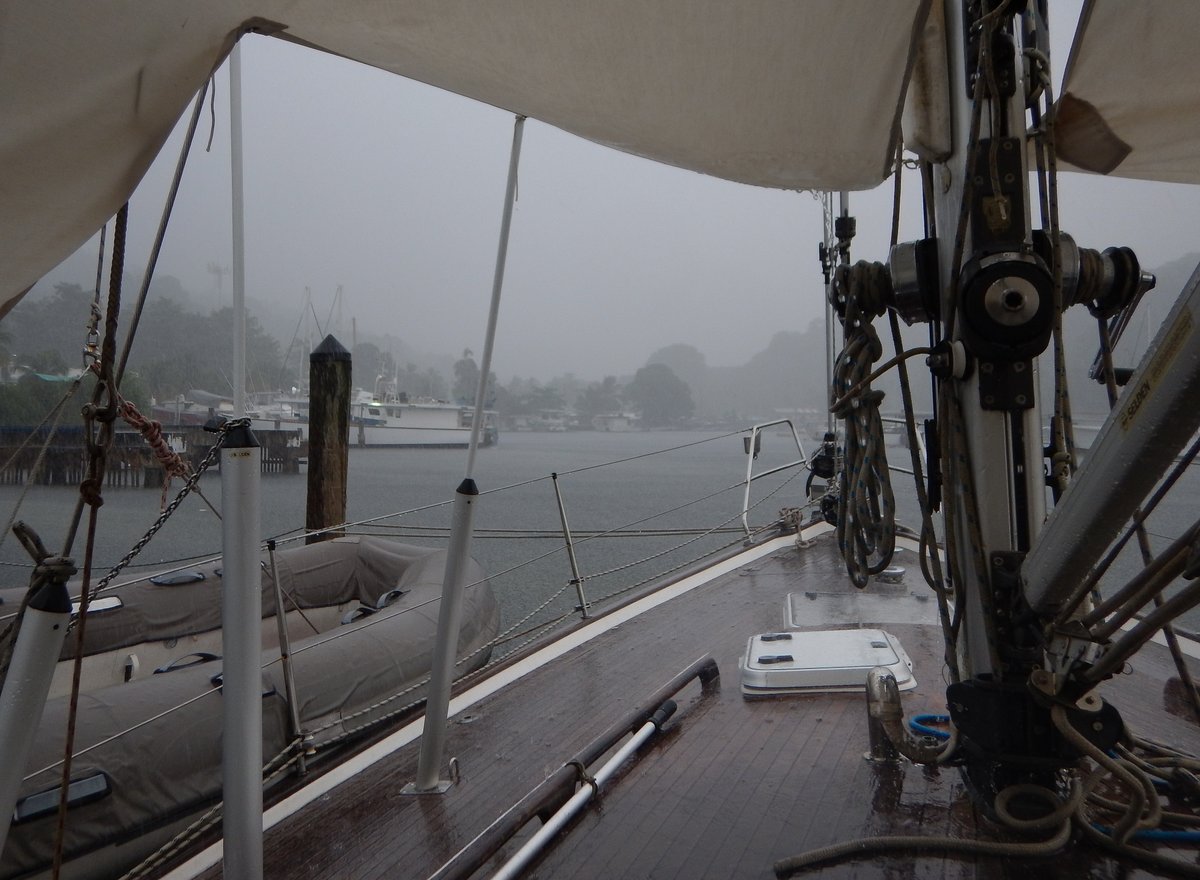
Work stopped for a heady rain squall, after which we put up the main sail. It’s been a long saga to sort out the creases that appear when we furl the main. Over the last few months, North Sails have shipped the sail up to Martinique, done some minor modifications and shipped it back to us. They claim that the sail material is in good condition and the sail still has the correct shape as designed. However, they have removed an inch or so from the luff in an attempt to flatten the sail.
The was no wind when we put the sail up so it was hard to set the halyard tension, but the sail looked okay and furled away with less creases than before. I’m not sure if the small changes in the rigging and the sail have made any difference - we’ll have to wait until we furl it in anger when we go sailing.
16 October 2018 Chaguaramas, Trinidad
I could hardly move this morning because my back had seized up - too much lifting, twisting and straining over the past three days has taken its toll on my pulled muscles. I popped a few Ibuprofen, did some stretching exercises and managed to get mobile again.

Our first job was to put up the genoa and stay-sail after having some maintenance done. The main work done by the sail loft was removing and replacing the UV sacrificial strips, which make the sail look much better. I spent the rest of the day pottering around on deck doing various little jobs to get the boat ready to sail. I replaced the two winch handle holders on the mast, which have looked awful for the last two years.
Later in the afternoon, I finally finished off the teak grating for the front heads, cutting a few grooves in the bottom to let water drain and giving it a final sanding. Glenys spent the afternoon sewing, including making a cover for our new life raft.
Over the past ten days, we’ve managed to tick a lot of jobs off our long list and it’s starting to feel like the boat is getting back together. We’re looking forward to getting back to cruising next week - our aim is to head off on Monday 22nd.
17 October 2018 Chaguaramas, Trinidad
Glenys continued sewing jobs, finishing off the life raft cover and making some new shower curtains for the front heads. She then re-stitched the leather cover on the steering wheel. Meanwhile, I had an engine room day.
We’ve developed a very small leak on the radiator cap spout on the heat exchanger. I spoke to the local Volvo guy and he says that the spout is press fitted into the heat exchanger. Replacement is an easy job to do in the workshop, but first the heat exchanger has to be removed from the engine, which is long complex job. At his suggestion, I’ve put a seam of Marine-Tex around the joint, which will sort out the minor weeping and defer the job until the heat exchanger has to come off for any reason.
We’ve had a saga with a leaking sea water pump for over a year now - I replaced the seals in Madagascar in November; had the shaft reground and the pump rebuilt in South Africa by the Volvo agent, which didn’t work; so I had to replace the seals again in May. While in England, I bought a new sea water pump, which I fitted today - hopefully that’s the end of sea water leaks.
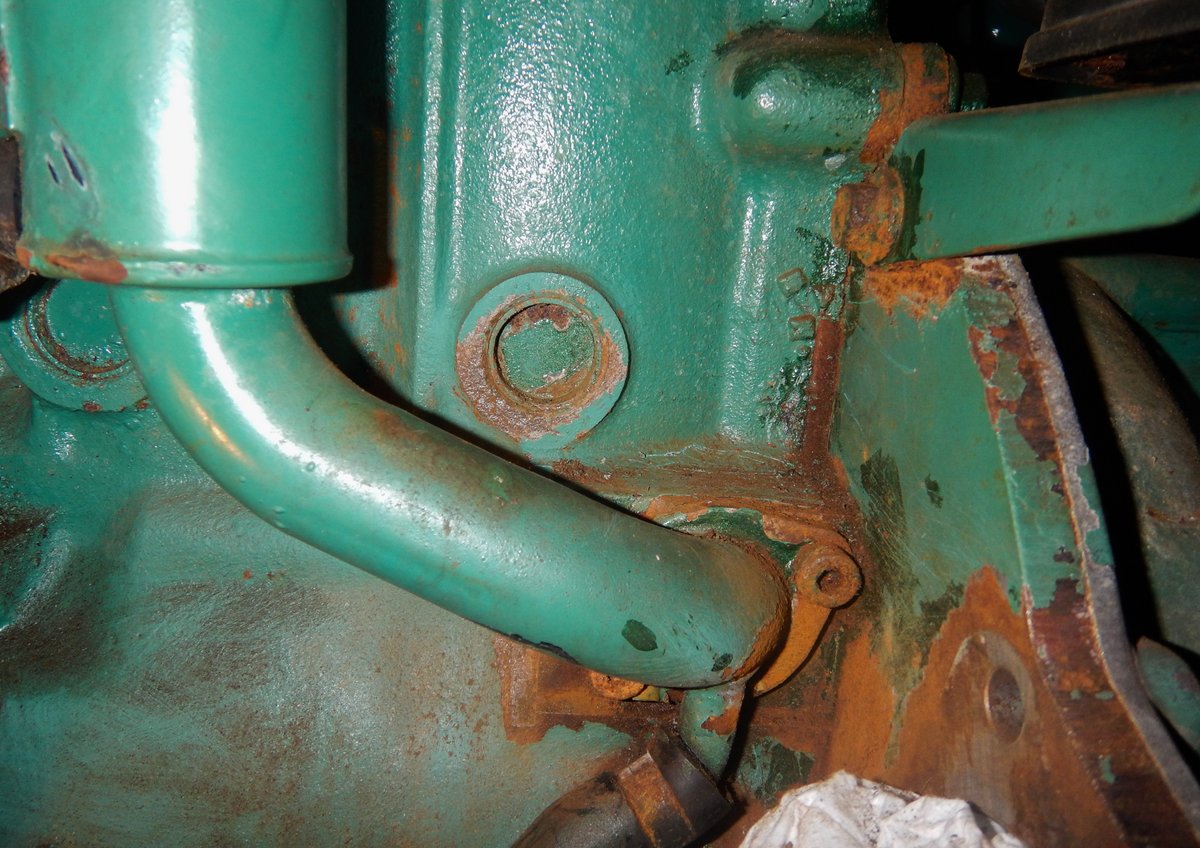
One of the consequences of a leaking sea water pump is that the rear of the engine is constantly soaked with seawater, which on a hot engine is rather corrosive. I’ve been trying to keep on top of rusting spots, but there are parts of the engine that I’ve not been able to access, particularly behind the alternators and the starter motor.
In the afternoon, I removed the starter motor and the alternator on the port side of the engine. This gave me access to surface rust patches, which I attacked with wire brushes. I then painted on some rust treatment and washed it down with water. The whole engine has become greasy and dirty, so while I had the electrics disconnected, I used spray-on degreaser and various brushes to get into all the nooks and crannies, washing down with fresh water.
The starter motor was also looking a bit sad with surface rust patches, so I wire brushed it down; painted on some rust treatment and then applied a coat of 2 part epoxy primer. I’ll finish it off tomorrow.