
8 November 2018 Clifton to Chatham Bay, Union Island
A huge squall went through overnight and another while we were having breakfast. The ITCZ shows no sign of moving. In a sunny interval, we went ashore to get some anti-fungal cream for an infection that Glenys has picked up on her ankle - such things are a consequence of living in the Tropics.

I’ve managed to pull a muscle in my lower back again. I injured it in Trinidad about a month ago and it took a couple of weeks to heal. I suspect that I’ve damaged the same muscle by twisting while lifting a 20 litre jerry can of petrol onto the deck. It was very painful yesterday and overnight it’s seized up completely. I took some ibuprofen and did some light stretching, so that I could move, but I’m going to have to take it easy for a few days. It’s a bummer getting old - my body just doesn’t heal as fast as it used to.
We were back on the boat by 10:00 and dropped the mooring. The weather was kind to us and we had a pleasant downwind sail to Chatham Bay where we anchored at 12°36.26N 061°27.06W in 8 metres of water. We had a very nice afternoon, with no more rain, so we just chilled out, resting my back.
9 November 2018 Chatham Bay, Union Island
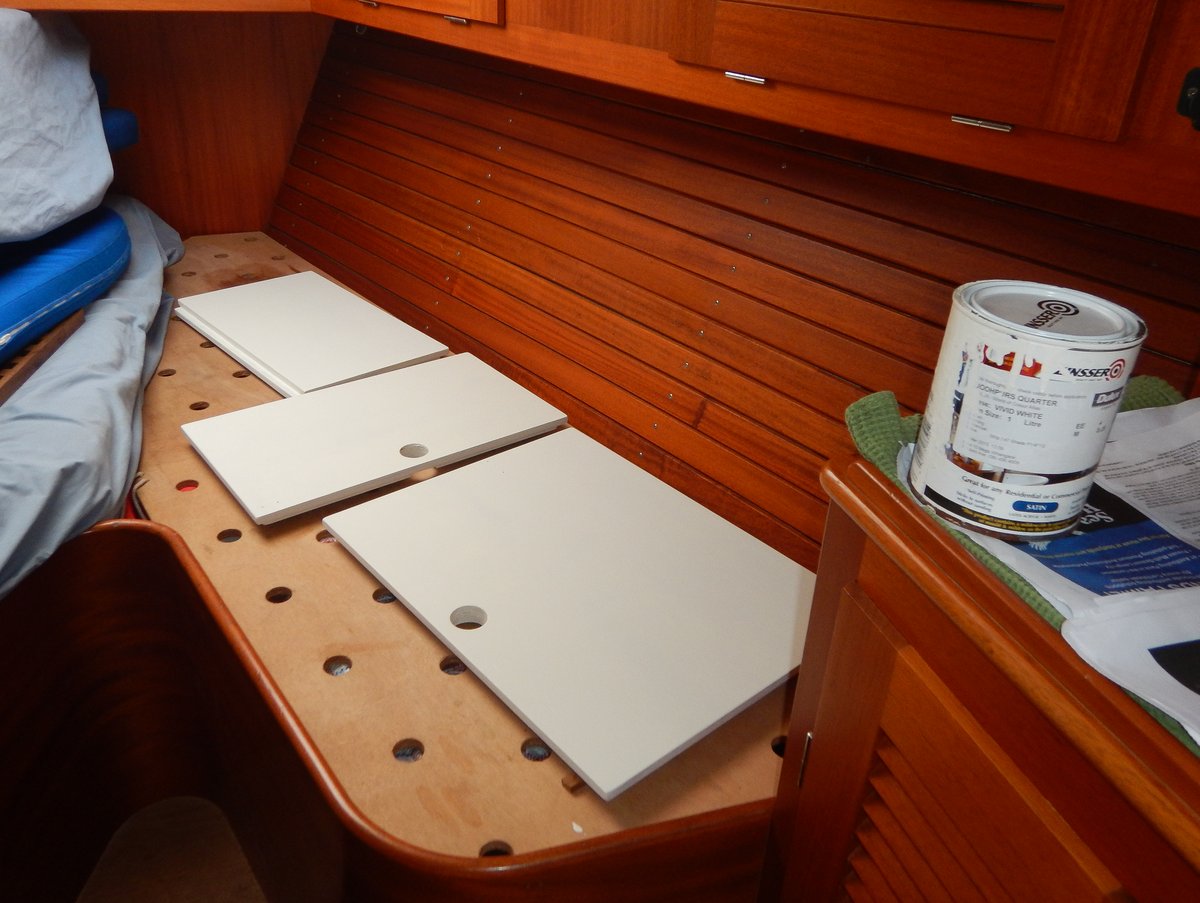
We had a quiet day. My back was a little better, so I went for a snorkel in the afternoon and don’t appear to have suffered any side effects. Glenys was a little more dynamic and put the first coat of paint on the cupboard doors.
I've lost the enthusiasm for trying to pursue a warranty claim on my life raft. This is the latest email from the Quality Manager at Survitec:
"I have reviewed the various communications that have been forwarded in relation to your warranty claim. You will be aware that a warranty claim is dependent on the liferaft being operated and maintained in accordance with operating instructions, please see below the relevant section of the warranty declaration.
1. The Liferaft has been maintained strictly in accordance with the Operating Instructions and is, in particular, serviced at a Survitec Approved Service Station (which will provide you with a Certificate of Servicing after each service) at the cost of the Purchaser at regular service intervals commencing from the Date of Manufacture (Service intervals should be in accordance with national regulation or, in the absence of a national regulation at least once every 3 years or every year in tropical areas).
Regular maintenance of a liferaft is critical to ensuring that the liferaft is operational if used in anger, but also critical in ensuring that the operational life of a liferaft is not reduced as this enables an approved service station to make running repairs, this is all the more critical when a raft is operating in tropical climates as we identify in the warranty declaration.
Unfortunately as your liferaft has not been maintained in line with requirements throughout its life we are unable to process a warranty claim."
In other words, bugger off...
10 November 2018 Chatham Bay, Union Island
We had another quiet day with lots of snorkelling in the morning. In the evening, we went for Happy Hour at Vanessa’s beach bar, where we met Barry and Layne on “Sweet Mango”. After a few rum punches, they left leaving Glenys and I to have a fabulous meal - it cost us £50 including the drinks, but we did drink a lot…
I’ve had further thoughts on the liferaft. As far as I can see all manufacturers (including Survitec) say that the first service on their life rafts is 3 years after date of manufacture. After that it gets a little confusing - some manufacturers say servicing should be every year; some say every year when in the tropics; and some say every three years regardless of where you are. After our experience and other people's comments, I think that, after the initial 3 year period, we should have our new liferaft serviced every year while sailing in the tropics.

A new 4-person life raft costs about $3,000 USD (half that in the UK) and our last two services (in Trinidad and New Zealand) cost $920USD each. With the high probability of the glue deteriorating over time, it might be safer to buy a new liferaft every three years - it's the same annual cost and there's no chance of some numpty servicing it incorrectly.
11 November 2018 Chatham Bay, Union Island
There were very strong katabatic winds overnight, so we didn’t sleep very well. The weather forecast shows that the wind is due to get very strong by Wednesday 14th, so we decided that we’d head over to the Tobago Cays today - we don’t want to be in the exposed Tobago Cays in 20 -30 knots winds.
We had a tough upwind motor-sail past the east end of Mayreau and then worked our way through the southern passage into the Tobago Cays. A rain squall hit us as we were approaching the reefs, but it was short-lived and we survived. We dropped anchor in 3.5 metres of water at 12°37.87N 061°21.36W.
By 14:00, the weather had deteriorated and we had overcast skies, rain and 20-25 knots winds raising 2 foot wind waves in the anchorage. We cracked up at 14:30 and went for a snorkel. It wasn’t much fun. There was a stiff 1 knot current and the waves ruined the underwater visibility. We saw a couple of turtles, but gave up after 30 minutes and retreated back to the boat.
We had a bouncy evening, watching a movie.
12 November 2018 Chatham Bay, Union Island
The day started off overcast and looked very unsettled, but by ten o’clock the skies brightened and the wind dropped, so we went for a snorkel with the Green Turtles. What a difference a day makes. The visibility was up to 15 metres and we saw plenty of Green Turtles and Southern Stingrays.
After swimming with the turtles for an hour, we ventured off to snorkel on a reef at the south-west corner of Petit Bateau Island. The reef was okay, but there’s lots of dead coral. However, there are shoals of friendly fish and even the groupers don’t run away - it just shows the benefit of marine national parks.

I was really excited when a Lemon Shark swam past me - only about ten metres away. Unfortunately, I had my camera on the wrong setting and didn’t get a good shot of it, but it circled around the shallow reef and came back - not so close this time, but I managed to get a snap of it. Five minutes later, the shark returned, so we decided that it was acting very territorial and got out of the water.

In the late afternoon, we went to Jamesby Island and had a sun-downer beer, sat on a rock overlooking the anchorage - it’s a lovely place when the sun shines.
13 November 2018 Chatham Bay to Saline Bay, Mayreau
The weather forecast still shows strong 20-30 knot winds and unsettled weather tomorrow, slowly returning to normal by Saturday 17th. We decided to run away to Saline Bay, which should be a lot more sheltered than the exposed reefs of the Tobago Cays.
It was a short, one hour, downwind run through the southern passage to Mayreau, where we anchored in Saline Bay at 12°38.01N 061°23.86W in 6 metres depth. The sea bed is mostly thick weed, but there are plenty of sandy patches to drop the anchor in - the sandy patches are actually one foot deep holes in the dense weed, so at worst the anchor will dig into the wall of the hole if it doesn’t dig into the sand.

We went for a snorkel on the rocky reef just to the east of where we anchored. The visibility was a little murky and the reef is covered by a light dusting of sediment, but it’s interesting enough and looks like a good place to practice my close-up photography.
We had a quiet afternoon.
14 November 2018 Saline Bay, Mayreau
It was a very windy and rainy day, so lurked around down below.
Our wind generator has been playing up and today it was whirring around very fast, indicating that it was under no load and therefore not charging the batteries. I traced the wiring and found that the fuse holder that I fitted a couple of months ago has become so hot that the plastic case had melted. Obviously too much current has been going through the 25 amp fuse and has exceeded the rating of the fuse holder. I replaced the wiring with a thicker cable and fitted a car-type 30 Amp fuse.